Lesson 5: Integrate QA/QC Processes into Project Scheduling and Resource Allocation
Effective integration of Quality Assurance and Quality Control (QA/QC) processes into project scheduling and resource allocation is a critical responsibility of a Senior Electrical QA/QC Engineer and Chartered Electrical Engineer (CEng) involved in complex electrical engineering projects. Modern electrical projects require more than technical execution; they demand structured planning approaches where quality activities, inspections, testing requirements, resource availability, and compliance obligations are embedded directly into the overall project delivery strategy.
In large-scale electrical projects, including power distribution systems, industrial installations, renewable energy projects, commercial infrastructure, and high-voltage networks, QA/QC activities must be strategically aligned with project schedules to ensure that quality verification occurs at the correct stages. A poorly integrated QA/QC process can result in delayed inspections, rework, material approval issues, failed testing activities, and increased project costs. Therefore, professional electrical engineers must understand how to coordinate quality requirements with project timelines, workforce planning, equipment availability, and material management.
A Senior Electrical QA/QC Engineer plays a key role in developing quality-driven project schedules by identifying inspection points, testing milestones, regulatory compliance requirements, resource needs, and risk control measures. Effective integration ensures that quality is not treated as a separate activity but as an essential component of project execution from design review through installation, commissioning, and final handover.
From an engineering management perspective, integrating QA/QC processes into project scheduling improves coordination between design teams, contractors, suppliers, inspectors, and project managers. It enables timely decision-making, supports efficient resource utilisation, reduces non-conformities, and ensures that electrical systems are delivered safely, reliably, and according to approved standards and specifications.
This lesson focuses on advanced approaches for combining QA/QC requirements with project planning and resource allocation strategies. It explores how electrical engineering professionals can develop effective quality schedules, allocate appropriate resources, manage inspection and testing activities, monitor quality performance, and maintain compliance throughout complex project lifecycles.
By applying structured QA/QC integration methods, electrical engineering teams can achieve improved project control, enhanced quality performance, reduced operational risks, and successful delivery of compliant electrical installations.
Analyze the Critical Dependencies Between Quality Control Processes and Overall Electrical Project Schedules
Introduction
In complex electrical engineering projects, successful delivery depends on the effective coordination between technical activities, project timelines, resource availability, and quality management processes. Quality Control (QC) activities are not independent tasks performed after construction activities are completed; rather, they are critical schedule-driven processes that influence every stage of electrical project execution. A Senior Electrical QA/QC Engineer and Chartered Electrical Engineer (CEng) must understand the relationship between quality control processes and overall project schedules to ensure that inspections, testing, approvals, and compliance activities are completed at the correct time without affecting project progress.
Electrical projects involve multiple interconnected activities, including design verification, material procurement, equipment installation, cable installation, system testing, commissioning, and final handover. Each activity depends on successful completion of previous quality checkpoints. Any delay or failure in quality control activities can create significant impacts on the project schedule, resulting in construction interruptions, resource conflicts, additional costs, and delayed project completion.
The integration of quality control processes into electrical project scheduling requires a systematic understanding of activity dependencies. For example, electrical equipment cannot be installed until approved materials have passed inspection, and commissioning cannot begin until installation inspections and testing activities have been successfully completed. These relationships create technical and operational dependencies that must be carefully planned and managed.
A professional Electrical QA/QC Engineer plays a key role in analysing these dependencies by identifying critical quality activities, establishing inspection milestones, coordinating with project managers, and ensuring that quality requirements are incorporated into project schedules. This approach ensures that quality control becomes a proactive project management function rather than a reactive corrective activity.
Effective management of QC dependencies improves project performance by reducing rework, preventing delays, ensuring regulatory compliance, and supporting safe operation of electrical systems. In modern engineering environments, quality control scheduling integration is essential for achieving reliable, cost-effective, and compliant electrical project outcomes.
Understanding Quality Control Dependencies in Electrical Projects
Definition of Quality Control Dependency
A quality control dependency refers to the relationship between a quality activity and another project activity where successful completion of one activity is required before another activity can proceed.
In electrical engineering projects, quality dependencies occur because many construction and commissioning activities require verification, approval, or acceptance before continuation.
Examples include:
- Electrical equipment installation depends on successful material approval.
- Cable energisation depends on completion of insulation resistance testing.
- Commissioning depends on successful installation inspection.
- Project handover depends on completion of quality documentation.
A Senior Electrical QA/QC Engineer must identify these dependencies during project planning to prevent unexpected delays and ensure that quality requirements are aligned with project milestones.
Importance of Analysing Quality Control and Schedule Dependencies
Analysing dependencies between QC processes and project schedules allows engineering teams to understand how quality activities influence project completion.
A detailed dependency analysis helps organisations:
- Identify critical quality milestones.
- Prevent schedule disruption.
- Improve coordination between departments.
- Allocate resources effectively.
- Reduce corrective work.
- Maintain compliance with electrical standards.
Without proper dependency analysis, quality activities may become bottlenecks that delay construction progress.
For example, if a transformer installation is completed before factory acceptance testing and site inspection approval, any identified defect may require removal, repair, and reinstallation. This creates unnecessary delays and increases project costs.
Relationship Between Quality Control and Electrical Project Scheduling
Electrical project schedules define when activities should occur, while quality control processes define how activities are verified and accepted.
The relationship between both functions can be explained as:
- Project scheduling determines activity timing.
- Quality control establishes verification requirements.
- Inspection activities confirm work quality.
- Testing activities validate system performance.
- Approval processes allow project progression.
Quality control activities must therefore be included within the project schedule rather than added separately.
A well-integrated schedule includes:
- Inspection dates.
- Testing milestones.
- Material approval periods.
- Hold points.
- Witness points.
- Commissioning activities.
Key Concepts in Quality Control and Schedule Integration
Quality Control Process Integration
Quality control process integration refers to the systematic inclusion of inspection, testing, verification, and approval activities within the overall project execution plan.
Integrated QC management ensures that quality activities occur at the correct project stages.
Important integrated QC activities include:
- Design verification.
- Material inspection.
- Installation inspection.
- Testing activities.
- Commissioning verification.
- Documentation review.
Benefits of integrated quality control include:
- Early identification of defects.
- Reduced project interruptions.
- Improved communication.
- Better schedule control.
Project Schedule Dependencies
Project schedule dependencies describe relationships between different project activities where one task relies on another task being completed.
Electrical projects commonly involve four major dependency types:
Technical Dependencies
Technical dependencies occur when one engineering activity requires completion of another technical activity.
Examples:
- Cable installation depends on approved cable specifications.
- Equipment commissioning depends on completed installation testing.
- Protection system operation depends on correct relay configuration.
Resource Dependencies
Resource dependencies occur when activities require specific personnel, equipment, or tools.
Examples:
- Testing requires qualified electrical engineers.
- Inspection requires certified inspectors.
- Commissioning requires specialised testing equipment.
Regulatory Dependencies
Regulatory dependencies occur when project progress depends on compliance approval.
Examples:
- Energisation requires regulatory acceptance.
- Electrical systems require inspection approval.
- Safety certificates require completion of testing.
Material Dependencies
Material dependencies occur when construction activities depend on approved materials being available.
Examples:
- Switchgear installation depends on equipment approval.
- Cable installation depends on material inspection.
- Panel installation depends on supplier documentation approval.
Critical Path and Quality Control Activities
Understanding the Critical Path
The critical path represents the sequence of project activities that directly determines the overall completion date.
Any delay in a critical path activity can delay the entire project.
Quality control activities can become part of the critical path when they are essential before the next activity can begin.
Examples include:
- Equipment inspection before installation.
- Testing before energisation.
- Approval before commissioning.
Impact of Delayed Quality Activities on Critical Path
Delayed QC activities may result in:
- Construction stoppages.
- Idle workforce.
- Equipment delays.
- Increased project costs.
- Extended completion dates.
For example:
A power distribution project requires switchgear testing before energisation. If testing is delayed due to unavailable testing equipment or incomplete documentation, the energisation milestone will also be delayed.
The QA/QC engineer must identify such risks early and ensure that quality activities are properly scheduled.
Critical Quality Control Activities Affecting Electrical Project Schedules
Design Quality Verification
Design quality verification is one of the earliest quality activities affecting project timelines.
Before electrical construction begins, QA/QC engineers review:
- Electrical drawings.
- Load calculations.
- Protection coordination studies.
- Equipment specifications.
- Compliance requirements.
Design verification prevents future schedule problems caused by:
- Design errors.
- Incorrect equipment selection.
- Regulatory non-compliance.
Key design quality activities include:
- Reviewing technical documents.
- Checking calculations.
- Confirming standards compliance.
- Approving drawings.
A delay in design approval can affect:
- Procurement schedules.
- Material delivery.
- Construction activities.
Material Inspection and Approval
Material approval is a major dependency within electrical project schedules because construction cannot proceed without accepted materials.
QA/QC engineers verify:
- Material specifications.
- Manufacturer certificates.
- Test reports.
- Quality documentation.
Material inspection activities include:
- Incoming material inspection.
- Factory acceptance testing.
- Documentation verification.
- Storage condition checks.
Delays in material approval may cause:
- Installation delays.
- Labour downtime.
- Schedule extension.
Example:
If electrical panels arrive without required compliance certificates, installation must be delayed until documentation is reviewed and approved.
Installation Quality Control
Installation quality control ensures that electrical systems are constructed according to approved designs and standards.
Installation inspections include:
- Cable routing verification.
- Equipment positioning checks.
- Termination inspection.
- Earthing verification.
- Protection system checks.
Installation QC activities directly affect project schedules because defects discovered later require corrective work.
Effective installation inspections help:
- Prevent rework.
- Maintain construction progress.
- Improve first-time quality.
Testing and Commissioning Activities
Testing and commissioning represent critical quality stages before electrical systems become operational.
Testing activities verify:
- Electrical safety.
- Equipment performance.
- Protection operation.
- System reliability.
Commissioning depends on completion of:
- Installation inspections.
- Testing procedures.
- Documentation approval.
Delays in testing may prevent:
- System energisation.
- Operational approval.
-
Final handover.
Process for Analysing Quality Control and Schedule Dependencies in Electrical Projects
Step 1: Identify Quality-Related Project Activities
The first step in analysing dependencies between quality control processes and electrical project schedules is identifying all quality-related activities that influence project progress. A Senior Electrical QA/QC Engineer must understand that every inspection, testing activity, approval stage, and verification process has a specific relationship with construction milestones.
During project planning, quality activities should be mapped against the project work breakdown structure (WBS) to determine where quality controls are required.
Important quality-related activities include:
- Design document review.
- Technical drawing approval.
- Material inspection.
- Supplier quality verification.
- Factory Acceptance Testing (FAT).
- Site Acceptance Testing (SAT).
- Installation inspection.
- Electrical testing.
- Commissioning approval.
- Final documentation review.
Identifying these activities allows project teams to understand which quality tasks must be completed before other activities can continue.
For example:
A medium-voltage switchgear installation project may require:
- Approved drawings before fabrication.
- Factory testing before delivery.
- Incoming inspection before installation.
- Installation inspection before energisation.
- Functional testing before final acceptance.
Each quality activity becomes a dependency within the overall project schedule.
Step 2: Map Quality Activities Against the Project Schedule
After identifying quality activities, the next stage is integrating them into the project schedule.
A QA/QC engineer must ensure that quality milestones are clearly included within:
- Project master schedules.
- Construction schedules.
- Procurement schedules.
- Commissioning schedules.
Quality activities should not be considered additional tasks; they are essential project activities that control progress.
Schedule integration involves:
- Defining inspection dates.
- Assigning responsible personnel.
- Identifying approval periods.
- Establishing testing timelines.
- Coordinating with construction activities.
For example:
Electrical Installation Activity:
Cable installation.
Related Quality Dependency:
Cable inspection and testing.
Schedule Relationship:
Cable installation cannot be considered complete until inspection and testing are successfully completed.
This prevents situations where construction teams proceed without required quality approval.
Step 3: Evaluate the Impact of Quality Delays
A critical responsibility of a Senior Electrical QA/QC Engineer is evaluating how delays in quality activities affect the overall project schedule.
Quality delays may occur due to:
- Failed inspections.
- Incomplete documentation.
- Testing failures.
- Material rejection.
- Lack of qualified inspectors.
- Equipment availability issues.
The impact of these delays must be assessed carefully.
Potential consequences include:
- Delayed construction activities.
- Increased labour costs.
- Equipment idle time.
- Extended project duration.
- Contract penalties.
For example:
If transformer testing fails during commissioning, the project may experience:
- Delayed energisation.
- Additional troubleshooting.
- Repeated testing.
- Revised commissioning dates.
Early identification of such risks allows project teams to develop corrective actions.
Step 4: Develop Quality-Based Schedule Controls
Quality-based schedule controls ensure that quality requirements are actively monitored throughout the project lifecycle.
These controls help maintain alignment between:
- Project progress.
- Quality requirements.
- Regulatory obligations.
Effective quality schedule controls include:
- Quality milestones.
- Inspection hold points.
- Testing checkpoints.
- Progress monitoring meetings.
- Quality performance indicators.
A Senior Electrical QA/QC Engineer should establish clear control mechanisms to track:
- Planned inspections.
- Completed inspections.
- Pending approvals.
- Outstanding non-conformances.
Critical Dependency Examples in Electrical Projects
Example 1: Design Approval Dependency
Electrical construction cannot begin until design documents are approved.
Dependency relationship:
Design Review
↓
Drawing Approval
↓
Material Procurement
↓
Installation ActivitiesIf design approval is delayed:
- Procurement is affected.
- Material delivery is delayed.
- Construction activities cannot proceed.
Quality control therefore directly influences project scheduling from the initial stage.
Example 2: Material Approval Dependency
Electrical equipment must pass quality verification before installation.
Dependency relationship:
Supplier Manufacturing
↓
Factory Testing
↓
Material Approval
↓
Site InstallationPotential schedule impact:
- Delayed equipment delivery.
- Installation postponement.
- Workforce downtime.
Effective material quality control reduces these risks.
Example 3: Testing and Commissioning Dependency
Electrical systems cannot be energised without successful testing.
Dependency relationship:
Installation Completion
↓
Inspection Approval
↓
Testing
↓
Commissioning
↓
Operational HandoverTesting failures can significantly affect completion dates.
Example 4: Non-Conformance Dependency
A non-conformance can interrupt project progress if not resolved quickly.
Dependency relationship:
Defect Identification
↓
Root Cause Analysis
↓
Corrective Action
↓
Verification
↓
Project ContinuationEffective non-conformance management prevents prolonged schedule disruption.
Professional Comparison Table: Quality Control and Schedule Dependencies
Quality Control Activity Definition Schedule Dependency Project Impact Design Verification Review of electrical designs to confirm technical and regulatory compliance Construction depends on approved designs Prevents design-related delays and rework Material Inspection Verification of electrical equipment and materials before use Installation depends on approved materials Prevents installation delays and equipment rejection Installation Inspection Assessment of completed electrical installation activities Testing depends on acceptable installation quality Reduces defects and corrective work Electrical Testing Verification of system safety and performance Commissioning depends on successful test results Ensures safe energisation and operation Commissioning Approval Final confirmation that systems meet requirements Handover depends on approval completion Supports project completion and operational readiness Case Study: Managing Quality-Schedule Dependencies in a Power Distribution Project
Project Background
A large industrial facility required the installation of a complete electrical distribution network consisting of:
- Medium-voltage switchgear.
- Transformers.
- Protection systems.
- Cable networks.
- Control panels.
The project had a strict completion deadline because the facility operation depended on successful electrical commissioning.
Identified Quality-Schedule Challenges
During project execution, the QA/QC team identified several potential schedule risks:
- Delayed equipment documentation.
- Incomplete installation inspections.
- Limited availability of testing specialists.
- Protection testing delays.
These issues had the potential to affect the commissioning milestone.
QA/QC Dependency Analysis
The Senior Electrical QA/QC Engineer analysed the relationship between quality activities and project milestones.
The analysis identified:
Material Approval Dependency:
Equipment approval was required before installation.
Installation Dependency:
Installation inspections were required before testing.
Testing Dependency:
Successful testing was required before energisation.
Commissioning Dependency:
Final approval was required before operational handover.
Corrective Actions Implemented
To prevent schedule delays, the QA/QC team implemented:
- Early document reviews.
- Improved inspection planning.
- Additional testing resources.
- Regular coordination meetings.
- Priority tracking of critical quality activities.
Project Outcome
The improved integration of QA/QC processes resulted in:
- Timely completion of inspections.
- Reduced installation defects.
- Successful testing completion.
- On-time commissioning.
The case demonstrates that effective management of quality dependencies directly supports successful electrical project delivery.
Key Benefits of Managing Quality Control and Schedule Dependencies
Improved Project Time Management
Effective dependency analysis helps project teams understand how quality activities influence timelines.
Benefits include:
- Better milestone planning.
- Reduced unexpected delays.
- Improved activity coordination.
Reduced Rework and Additional Costs
Early quality verification prevents defects from progressing into later project stages.
Benefits include:
- Lower repair costs.
- Reduced material wastage.
- Improved productivity.
Enhanced Resource Allocation
Quality scheduling supports effective use of:
- QA/QC engineers.
- Inspectors.
- Testing specialists.
- Technical equipment.
Improved Regulatory Compliance
Integrating quality activities into schedules ensures that:
- Inspections occur at required stages.
- Testing is completed correctly.
- Compliance evidence is maintained.
Better Stakeholder Coordination
Quality-schedule integration improves communication between:
- Project managers.
- Electrical engineers.
- Contractors.
- Suppliers.
- Clients.
Best Practices for Senior Electrical QA/QC Engineers
Senior QA/QC professionals should apply the following practices:
- Integrate QA/QC activities during project planning.
- Identify critical quality milestones early.
- Coordinate inspection activities with construction teams.
- Include testing requirements in project schedules.
- Monitor quality-related delays continuously.
- Maintain effective communication with stakeholders.
- Use risk-based quality planning.
- Review progress against quality objectives.
- Manage non-conformances promptly.
- Maintain accurate quality records.
Conclusion
Analysing the critical dependencies between quality control processes and electrical project schedules is essential for successful project execution. Electrical QA/QC activities directly influence construction progress, testing completion, commissioning readiness, and final project handover.
A Senior Electrical QA/QC Engineer must understand that quality control is not a separate function but an integrated part of project scheduling and delivery. By identifying dependencies, managing inspection milestones, coordinating testing activities, and controlling quality risks, engineering teams can prevent delays and improve overall project performance.
Effective integration of QA/QC processes with project schedules provides significant benefits, including improved resource utilisation, reduced rework, enhanced compliance, and reliable electrical system delivery. In complex electrical engineering environments, successful project outcomes depend on the ability to strategically manage the relationship between quality requirements and project timelines.
2. Integrate Complex QA/QC Inspection Milestones Seamlessly into Advanced Project Timelines
In advanced electrical engineering projects, successful project delivery depends on the effective integration of Quality Assurance and Quality Control (QA/QC) inspection milestones within the overall project timeline. Electrical systems are highly interconnected, and each stage of development requires planned verification activities to ensure compliance with engineering specifications, safety regulations, client requirements, and international electrical standards. A Senior Electrical QA/QC Engineer and Chartered Electrical Engineer (CEng) must ensure that inspection activities are strategically positioned within project schedules so that quality verification supports progress rather than becoming a source of delay.
Complex electrical projects such as power generation facilities, industrial plants, commercial infrastructure, renewable energy installations, and high-voltage distribution networks involve multiple quality checkpoints throughout their lifecycle. These checkpoints include design approval, material verification, factory inspections, installation inspections, electrical testing, commissioning approval, and final documentation review. Each inspection milestone has a specific relationship with project activities, and failure to complete these milestones at the correct stage can affect the entire project schedule.
Integrating QA/QC inspection milestones requires advanced planning, coordination, and understanding of project dependencies. Inspection activities cannot be randomly added to schedules after construction begins. They must be planned during the early project stages and linked with construction sequences, procurement activities, resource availability, and regulatory requirements. This ensures that quality verification occurs before critical activities proceed.
A professional Electrical QA/QC Engineer plays a significant role in developing quality-based project timelines by identifying mandatory inspection points, establishing approval requirements, coordinating with contractors and stakeholders, and monitoring milestone completion. Effective integration ensures that defects are identified early, corrective actions are implemented quickly, and project activities continue without unnecessary interruption.
The integration of complex QA/QC milestones into advanced project timelines improves project control, reduces risks, enhances compliance, and supports the successful delivery of safe and reliable electrical systems. Quality milestones become strategic management tools that help balance project speed with technical accuracy and regulatory compliance.
Understanding Complex QA/QC Inspection Milestones
Definition of QA/QC Inspection Milestones
QA/QC inspection milestones are planned points within a project schedule where specific quality verification activities must be completed before a related project activity can continue or be accepted.
These milestones represent formal quality control checkpoints that confirm whether:
- Design requirements have been achieved.
- Materials meet approved specifications.
- Installation activities comply with standards.
- Testing results satisfy acceptance criteria.
- Systems are ready for operation.
In electrical engineering projects, inspection milestones are essential because electrical failures can create significant safety, operational, and financial consequences. A structured milestone system allows QA/QC teams to control quality throughout the project lifecycle.
Examples of electrical QA/QC inspection milestones include:
- Approval of electrical design documents.
- Verification of approved equipment specifications.
- Factory Acceptance Testing (FAT).
- Incoming material inspection.
- Cable installation inspection.
- Electrical continuity testing.
- Insulation resistance testing.
- Protection system testing.
- Final commissioning approval.
Each milestone provides evidence that project activities have achieved the required quality level before progression.
Types of QA/QC Inspection Control Points
Hold Points
A hold point is a mandatory inspection stage where work cannot proceed until formal approval has been provided by the responsible authority.
Hold points are normally applied to critical activities where failure could create major risks.
Examples include:
- Approval before energisation.
- Approval before closing electrical panels.
- Approval before underground cable burial.
- Approval before equipment commissioning.
Characteristics of hold points include:
- Work must stop until approval is obtained.
- Formal inspection records are required.
- Authorised personnel must provide acceptance.
Hold points provide strong control over critical electrical activities and prevent hidden defects from progressing to later stages.
Witness Points
A witness point allows the client, consultant, or QA/QC representative to observe a specific activity.
The activity may proceed if the responsible party chooses not to attend after receiving proper notification.
Examples include:
- Factory equipment testing.
- Functional testing.
- Equipment performance verification.
Witness points improve transparency and stakeholder confidence during important quality activities.
Surveillance Inspections
Surveillance inspections involve continuous monitoring of ongoing project activities.
These inspections are generally used for:
- Installation quality monitoring.
- Contractor performance evaluation.
- Workmanship verification.
Surveillance activities help identify quality issues before they become major defects.
Testing Milestones
Testing milestones confirm that electrical systems perform according to technical requirements.
Examples include:
- Insulation resistance testing.
- Earth resistance testing.
- Protection relay testing.
- Functional performance testing.
Testing milestones are usually linked to commissioning schedules because successful testing is required before system operation.
Importance of Integrating QA/QC Inspection Milestones into Project Timelines
Preventing Project Delays
One of the main benefits of integrating inspection milestones into project schedules is preventing unexpected delays.
When inspection requirements are planned in advance:
- Resources can be allocated properly.
- Inspection teams can be scheduled.
- Required documents can be prepared.
- Testing equipment can be arranged.
Without planned milestones, projects may experience:
- Waiting periods.
- Repeated inspections.
- Delayed approvals.
- Construction interruptions.
For example, if switchgear testing is not included in the project timeline, commissioning activities may be delayed because the equipment cannot be energised without successful testing.
Ensuring Regulatory Compliance
Electrical projects must comply with national and international standards. Inspection milestones provide structured opportunities to verify compliance.
Integration ensures that:
- Regulatory requirements are addressed.
- Inspection evidence is maintained.
- Testing activities are completed correctly.
- Quality records are available.
A Senior Electrical QA/QC Engineer must ensure that regulatory checkpoints are included within project schedules from the planning stage.
Improving Construction Sequence Control
Electrical projects involve multiple interconnected activities. Inspection milestones help maintain correct construction sequencing.
For example:
Cable Installation
↓
Cable Inspection
↓
Cable Testing
↓
System Connection
↓
CommissioningIf inspection activities are skipped or delayed, subsequent activities may be affected.
Reducing Rework and Corrective Actions
Early inspection identification prevents defects from continuing into later project stages.
Effective milestone integration helps detect:
- Incorrect installation methods.
- Material defects.
- Testing failures.
- Documentation problems.
Benefits include:
- Reduced repair work.
- Lower project costs.
- Improved productivity.
Key Concepts of Advanced QA/QC Timeline Integration
Quality-Driven Project Scheduling
Quality-driven scheduling involves developing project timelines where quality activities are treated as essential project tasks.
Traditional scheduling often focuses mainly on:
- Construction activities.
- Labour requirements.
- Material delivery.
However, advanced electrical project scheduling must also include:
- Inspection requirements.
- Testing activities.
- Approval periods.
- Compliance verification.
A quality-driven schedule ensures that project progress is controlled by both production and verification requirements.
Key elements include:
- Defined inspection milestones.
- Quality responsibility assignment.
- Approval timelines.
- Testing schedules.
- Documentation requirements.
Milestone-Based Quality Management
Milestone-based quality management uses predefined checkpoints to measure project quality performance.
Each milestone should have:
- Clear objectives.
- Responsible personnel.
- Required documentation.
- Acceptance criteria.
- Completion status.
Examples:
Design Milestone:
Objective:
Confirm electrical design compliance.Required Evidence:
- Approved drawings.
- Design calculations.
- Compliance review records.
Installation Milestone:
Objective:
Verify correct installation.Required Evidence:
- Inspection reports.
- Photographs.
- Test results.
Critical Path Integration
The critical path represents activities that directly determine project completion time.
QA/QC milestones may become part of the critical path when approval is required before continuation.
Examples:
Equipment Delivery
↓
Inspection Approval
↓
Installation
↓
Testing
↓
CommissioningA delay in any quality milestone may directly delay project completion.
Senior QA/QC engineers must identify critical quality activities and ensure they receive appropriate priority.
Types of Complex QA/QC Inspection Milestones in Electrical Projects
Design Review Milestones
Design verification is the first major QA/QC milestone in electrical projects.
Before construction begins, engineers must confirm:
- Design compliance.
- Equipment suitability.
- Load calculations.
- Protection requirements.
- Safety considerations.
Design review activities include:
- Reviewing electrical drawings.
- Checking technical specifications.
- Verifying calculations.
- Confirming regulatory compliance.
Design approval directly affects:
- Procurement.
- Construction planning.
- Material selection.
A delay in design approval may create delays throughout the project lifecycle.
Procurement and Material Inspection Milestones
Electrical materials and equipment must be verified before installation.
Material quality milestones include:
- Supplier document review.
- Certificate verification.
- Factory inspection.
- Delivery inspection.
QA/QC engineers check:
- Equipment ratings.
- Manufacturer documentation.
- Test certificates.
- Compliance records.
Examples of materials requiring inspection:
- Transformers.
- Switchgear.
- Electrical panels.
- Cables.
-
Protection devices.
Process for Integrating QA/QC Inspection Milestones into Advanced Project Timelines
Step 1: Analyse Project Work Breakdown Structure (WBS)
The first step in integrating complex QA/QC inspection milestones into advanced electrical project timelines is analysing the project Work Breakdown Structure (WBS). The WBS divides a large electrical engineering project into smaller, manageable activities and allows QA/QC engineers to identify where quality verification activities are required.
A Senior Electrical QA/QC Engineer must review the complete project scope and determine which activities require mandatory inspection, testing, approval, or documentation.
The analysis should identify:
- Major electrical project phases.
- Construction sequences.
- Installation activities.
- Testing requirements.
- Commissioning stages.
- Regulatory approval points.
For complex electrical projects, the WBS may include:
- Electrical design development.
- Equipment procurement.
- Factory manufacturing.
- Equipment transportation.
- Installation activities.
- Electrical testing.
- System commissioning.
- Final handover.
Each activity must be reviewed to determine its quality requirements and inspection dependencies.
For example:
Project Activity:
Installation of medium-voltage switchgear.
Required QA/QC Milestones:
- Equipment delivery inspection.
- Physical installation inspection.
- Cable termination inspection.
- Protection testing.
- Functional testing.
- Commissioning approval.
This approach ensures that inspection milestones are included within the project timeline before construction activities begin.
Step 2: Define Inspection Requirements and Acceptance Criteria
After identifying project activities, the next step is defining specific inspection requirements for each milestone.
Every QA/QC milestone should clearly identify:
- Inspection type.
- Inspection timing.
- Responsible personnel.
- Required documents.
- Acceptance criteria.
Inspection requirements are developed based on:
- Electrical standards.
- Project specifications.
- Manufacturer requirements.
- Client expectations.
- Safety regulations.
For example:
Electrical Cable Installation Inspection:
Inspection Requirements:
- Verify cable route.
- Check cable identification.
- Confirm installation method.
- Inspect termination quality.
Acceptance Criteria:
- Correct cable size.
- Approved installation method.
- Proper support arrangement.
- Completed test records.
Clear acceptance criteria prevent disagreements between project teams and ensure consistent quality evaluation.
Step 3: Develop Quality Milestone Schedule
The development of a quality milestone schedule involves placing QA/QC activities into the overall project programme.
The milestone schedule should include:
- Planned inspection dates.
- Testing periods.
- Approval deadlines.
- Responsible inspectors.
- Required resources.
A well-developed quality schedule ensures that:
- Inspection teams are available.
- Contractors understand requirements.
- Materials are ready for verification.
- Testing equipment is arranged.
Important scheduling considerations include:
- Construction sequence.
- Equipment delivery dates.
- Availability of specialists.
- Regulatory requirements.
- Client inspection requirements.
For example:
Transformer Installation Timeline:
Equipment Delivery
↓
Incoming Inspection
↓
Installation Verification
↓
Electrical Testing
↓
Commissioning ApprovalEach stage depends on successful completion of the previous quality milestone.
Step 4: Coordinate QA/QC Activities with Project Stakeholders
Successful integration of inspection milestones requires strong communication between all project participants.
A Senior Electrical QA/QC Engineer must coordinate with:
- Project managers.
- Electrical designers.
- Construction supervisors.
- Contractors.
- Equipment suppliers.
- Client representatives.
Effective coordination ensures that:
- Inspection requirements are understood.
- Inspection dates are agreed.
- Documentation is prepared.
- Delays are identified early.
Regular coordination activities include:
- Quality planning meetings.
- Progress review meetings.
- Inspection coordination meetings.
- Technical discussions.
Poor communication can result in:
- Missed inspections.
- Delayed approvals.
- Repeated work.
- Schedule disruption.
Step 5: Monitor and Control Inspection Milestones
After establishing inspection milestones, continuous monitoring is required to ensure they are completed according to the project schedule.
Monitoring activities include:
- Reviewing inspection progress.
- Tracking completed milestones.
- Identifying delayed activities.
- Managing corrective actions.
QA/QC engineers should maintain records of:
- Planned inspections.
- Completed inspections.
- Pending approvals.
- Outstanding issues.
Quality monitoring tools may include:
- Inspection tracking systems.
- Digital quality management platforms.
- Progress dashboards.
- Quality reports.
Practical Examples of QA/QC Milestone Integration
Example 1: Transformer Installation Project
Project Situation
A large industrial facility requires installation of multiple power transformers as part of its electrical distribution system.
The transformer installation process includes several quality milestones.
Integrated QA/QC Timeline
Manufacturing Stage
Quality Milestone:
Factory Acceptance Testing (FAT)
Verification Activities:
- Manufacturing inspection.
- Electrical testing.
- Documentation review.
Schedule Dependency:
Transformer cannot be delivered without successful FAT approval.
Delivery Stage
Quality Milestone:
Incoming Equipment Inspection
Verification Activities:
- Physical condition check.
- Identification verification.
- Documentation confirmation.
Schedule Dependency:
Installation cannot begin until equipment acceptance is completed.
Installation Stage
Quality Milestone:
Installation Inspection
Verification Activities:
- Alignment checks.
- Connection verification.
- Earthing inspection.
Schedule Dependency:
Testing depends on successful installation approval.
Testing Stage
Quality Milestone:
Electrical Testing
Verification Activities:
- Insulation testing.
- Protection testing.
- Functional checks.
Schedule Dependency:
Commissioning depends on successful testing.
Example 2: Electrical Distribution System Project
A large commercial building requires installation of a complete electrical distribution network.
Major QA/QC milestones include:
Design Approval
Activities:
- Review electrical drawings.
- Verify load calculations.
- Confirm compliance requirements.
Dependency:
Procurement cannot proceed without approved designs.
Material Approval
Activities:
- Review certificates.
- Verify equipment specifications.
- Approve supplier documentation.
Dependency:
Installation depends on approved materials.
Installation Inspection
Activities:
- Cable inspection.
- Panel installation verification.
- Earthing checks.
Dependency:
Testing requires completed inspections.
Testing and Commissioning
Activities:
- System testing.
- Protection verification.
- Operational checks.
Dependency:
Final handover requires successful commissioning.
Professional Comparison Table: QA/QC Inspection Milestone Integration
QA/QC Milestone Definition Timeline Dependency Quality Impact Design Approval Verification that electrical designs meet technical and regulatory requirements Construction and procurement depend on approved designs Prevents design errors and project delays Material Inspection Verification of equipment and materials before installation Installation depends on accepted materials Reduces equipment rejection and rework Installation Inspection Examination of completed installation activities Testing depends on satisfactory installation quality Ensures correct workmanship and compliance Testing Milestone Verification of electrical system performance and safety Commissioning depends on successful testing results Confirms system reliability Commissioning Approval Final verification before operation Handover depends on completed commissioning Ensures safe project completion Case Study: Integration of QA/QC Milestones in a High-Voltage Electrical Project
Project Background
A high-voltage electrical infrastructure project was developed to support a large industrial manufacturing facility. The project included:
- High-voltage switchgear.
- Transformers.
- Protection systems.
- Underground cable networks.
- Control systems.
The project had a strict completion deadline because production activities depended on successful electrical energisation.
Initial Scheduling Challenge
The original project schedule focused mainly on construction activities and did not fully integrate QA/QC inspection milestones.
Potential risks included:
- Delayed equipment approvals.
- Testing conflicts.
- Late defect identification.
- Commissioning delays.
QA/QC Integration Strategy
The Senior Electrical QA/QC Engineer reviewed the project schedule and introduced quality milestones.
Actions included:
- Adding inspection activities into the master schedule.
- Establishing hold points.
- Planning testing periods.
- Coordinating supplier inspections.
- Assigning inspection responsibilities.
Implementation Results
After integrating QA/QC milestones:
- Equipment approvals were completed on time.
- Installation defects were identified early.
- Testing activities followed planned timelines.
- Commissioning was completed successfully.
Project Outcome
The integrated QA/QC approach resulted in:
- Improved schedule control.
- Reduced rework.
- Better communication.
- Successful regulatory compliance.
- Safe electrical system operation.
Key Benefits of Integrating QA/QC Inspection Milestones
Improved Project Schedule Control
Integration of quality milestones allows project teams to understand exactly when inspections and approvals are required.
Benefits include:
- Better activity planning.
- Reduced uncertainty.
- Improved milestone tracking.
Early Identification of Defects
Planned inspections allow problems to be detected before they affect later activities.
Benefits include:
- Reduced corrective work.
- Lower project costs.
- Improved construction efficiency.
Better Resource Allocation
Inspection milestone planning improves allocation of:
- QA/QC engineers.
- Testing specialists.
- Inspection equipment.
- Technical resources.
Enhanced Regulatory Compliance
Properly scheduled inspections ensure that:
- Required checks are completed.
- Testing evidence is maintained.
- Compliance requirements are achieved.
Improved Stakeholder Confidence
A structured QA/QC schedule provides confidence to:
- Clients.
- Consultants.
- Contractors.
- Regulatory authorities.
Best Practices for Senior Electrical QA/QC Engineers
Senior Electrical QA/QC Engineers should follow these best practices:
- Integrate QA/QC planning during the earliest project stages.
- Identify critical inspection milestones before construction begins.
- Link quality activities with project dependencies.
- Establish clear hold and witness points.
- Coordinate inspection activities with all stakeholders.
- Monitor milestone completion regularly.
- Use digital quality management systems.
- Maintain accurate inspection documentation.
- Analyse quality-related schedule risks.
- Apply lessons learned to future projects.
Conclusion
Integrating complex QA/QC inspection milestones into advanced electrical project timelines is essential for achieving successful project delivery. Quality activities must be strategically planned and coordinated with construction, procurement, testing, and commissioning schedules to ensure that project progress is maintained without compromising safety or compliance.
A Senior Electrical QA/QC Engineer plays a critical role in transforming quality requirements into practical project milestones. Through effective planning, stakeholder coordination, inspection scheduling, and continuous monitoring, QA/QC processes become an integral part of project management rather than a separate control function.
When inspection milestones are seamlessly integrated into project timelines, electrical engineering organisations can achieve improved schedule performance, reduced risks, enhanced regulatory compliance, and reliable electrical system delivery. This approach represents a professional standard of quality management required for complex electrical projects in modern engineering environments.
3. Allocate Specialized Resources and Personnel Effectively to Meet Stringent Electrical QA/QC Requirements
Effective allocation of specialised resources and competent personnel is a fundamental requirement for achieving successful Quality Assurance and Quality Control (QA/QC) outcomes in complex electrical engineering projects. Electrical systems are becoming increasingly sophisticated due to the integration of advanced protection systems, automation technologies, renewable energy solutions, high-voltage networks, and intelligent monitoring systems. These developments require highly skilled professionals, specialised testing equipment, and structured resource management approaches to ensure that electrical installations comply with technical specifications, safety regulations, and international quality standards.
A Senior Electrical QA/QC Engineer and Chartered Electrical Engineer (CEng) must ensure that appropriate resources are available at every stage of the project lifecycle. Resource allocation is not limited to assigning personnel; it involves strategically planning technical expertise, inspection teams, testing equipment, documentation systems, and support resources according to project requirements. Poor resource allocation can result in delayed inspections, incorrect testing procedures, quality failures, non-conformities, and increased project costs.
In large electrical engineering projects, QA/QC requirements are often stringent due to regulatory obligations and the potential consequences of electrical failures. Power generation facilities, industrial plants, commercial developments, infrastructure projects, and high-voltage installations require specialised personnel who understand electrical standards, testing procedures, inspection methodologies, and compliance requirements.
The role of a Senior Electrical QA/QC Engineer involves analysing project requirements, identifying necessary competencies, allocating suitable professionals, managing inspection resources, and ensuring that quality activities are completed effectively. This requires a balance between technical knowledge, project management skills, and understanding of quality systems.
Effective resource allocation ensures that:
- Qualified personnel are assigned to critical activities.
- Inspection and testing activities are completed on schedule.
- Appropriate equipment is available and calibrated.
- Quality documentation is maintained accurately.
- Regulatory compliance requirements are achieved.
A strategic approach to QA/QC resource management improves project performance by reducing quality risks, preventing rework, improving productivity, and supporting the safe delivery of reliable electrical systems.
Understanding Resource Allocation in Electrical QA/QC Projects
Definition of Resource Allocation
Resource allocation in electrical QA/QC management refers to the systematic process of identifying, assigning, and managing the personnel, equipment, tools, and technical resources required to complete quality-related activities successfully.
In electrical engineering projects, resource allocation ensures that every quality activity has appropriate support before execution begins.
The allocation process considers:
- Project scope.
- Electrical system complexity.
- Inspection requirements.
- Testing activities.
- Regulatory obligations.
- Project schedule.
- Available competencies.
A well-developed resource allocation strategy ensures that QA/QC activities are performed by competent individuals using suitable equipment and approved procedures.
For example:
A high-voltage substation project requires:
- Senior QA/QC engineers for compliance supervision.
- Electrical inspectors for installation verification.
- Testing engineers for protection and commissioning activities.
- Calibrated testing equipment for accurate measurements.
Each resource has a specific role in achieving project quality objectives.
Importance of Effective QA/QC Resource Planning
Resource planning is essential because electrical QA/QC activities depend heavily on specialist knowledge and technical accuracy. Unlike general construction activities, electrical quality verification requires professionals who understand complex systems, safety requirements, and regulatory standards.
Effective resource planning helps organisations:
- Achieve compliance with electrical standards.
- Improve inspection efficiency.
- Reduce quality-related delays.
- Minimise technical errors.
- Improve communication between project teams.
- Maintain consistent quality performance.
Without proper resource planning, projects may experience:
- Insufficient inspection coverage.
- Delayed testing activities.
- Incorrect assessment of defects.
- Poor documentation control.
- Increased corrective actions.
For example:
If a protection relay testing specialist is unavailable during the commissioning phase of a substation project, final energisation may be delayed even if all installation work has been completed.
This demonstrates the importance of aligning specialised personnel availability with project milestones.
Role of Senior Electrical QA/QC Engineers in Resource Allocation
A Senior Electrical QA/QC Engineer plays a central role in determining resource requirements and ensuring effective deployment.
Key responsibilities include:
- Reviewing project quality requirements.
- Identifying critical inspection activities.
- Determining required competencies.
- Allocating qualified personnel.
- Ensuring testing equipment availability.
- Monitoring resource effectiveness.
The Senior Electrical QA/QC Engineer must evaluate:
- Which activities require specialist expertise.
- Which inspections require independent verification.
- Which tests require certified personnel.
- Where additional resources are needed.
Professional judgement is essential because not all project activities carry the same level of risk.
For example:
Routine cable installation inspection may require a qualified electrical inspector, while protection system testing may require a specialist commissioning engineer with advanced technical experience.
Key Concepts of Electrical QA/QC Resource Management
Competency-Based Resource Allocation
Competency-based resource allocation involves assigning personnel according to their qualifications, experience, technical knowledge, and ability to perform specific QA/QC activities.
Electrical projects require different levels of expertise depending on the complexity of the task.
Competency considerations include:
- Academic qualifications.
- Professional certifications.
- Industry experience.
- Knowledge of electrical standards.
- Testing experience.
- Previous project exposure.
Examples:
A Senior QA/QC Engineer may be responsible for:
- Quality planning.
- Compliance decisions.
- Audit management.
An Electrical Inspector may be responsible for:
- Installation verification.
- Workmanship inspection.
- Defect identification.
A Testing Engineer may be responsible for:
- Electrical testing.
- Equipment performance verification.
- Commissioning support.
Benefits of competency-based allocation include:
- Improved inspection accuracy.
- Reduced technical errors.
- Faster problem resolution.
- Increased confidence in quality decisions.
Resource Planning and Scheduling
Resource planning ensures that required personnel and equipment are available when quality activities are scheduled.
QA/QC resource planning should consider:
- Project timeline.
- Construction sequence.
- Inspection frequency.
- Testing requirements.
- Workforce availability.
Important planning activities include:
- Developing inspection schedules.
- Assigning responsible engineers.
- Reserving testing equipment.
- Coordinating specialist support.
For example:
During a major electrical commissioning phase, multiple specialists may be required simultaneously:
- Protection engineer.
- Testing engineer.
- Electrical supervisor.
- QA/QC inspector.
Advanced planning prevents resource conflicts and commissioning delays.
Risk-Based Resource Allocation
Risk-based resource allocation focuses resources on activities with higher technical or safety risks.
Not all electrical activities require the same level of supervision.
High-risk activities may include:
- High-voltage equipment installation.
- Protection system testing.
- Energisation activities.
- Critical power system integration.
Risk-based allocation involves:
- Identifying high-risk activities.
- Assigning experienced personnel.
- Increasing inspection frequency.
- Providing additional technical support.
Benefits include:
- Improved risk control.
- Better use of specialist resources.
- Prevention of major failures.
Types of Specialized Resources Required for Electrical QA/QC Activities

Human Resources
Human resources are the most important component of electrical QA/QC management because quality decisions depend on professional knowledge and experience.
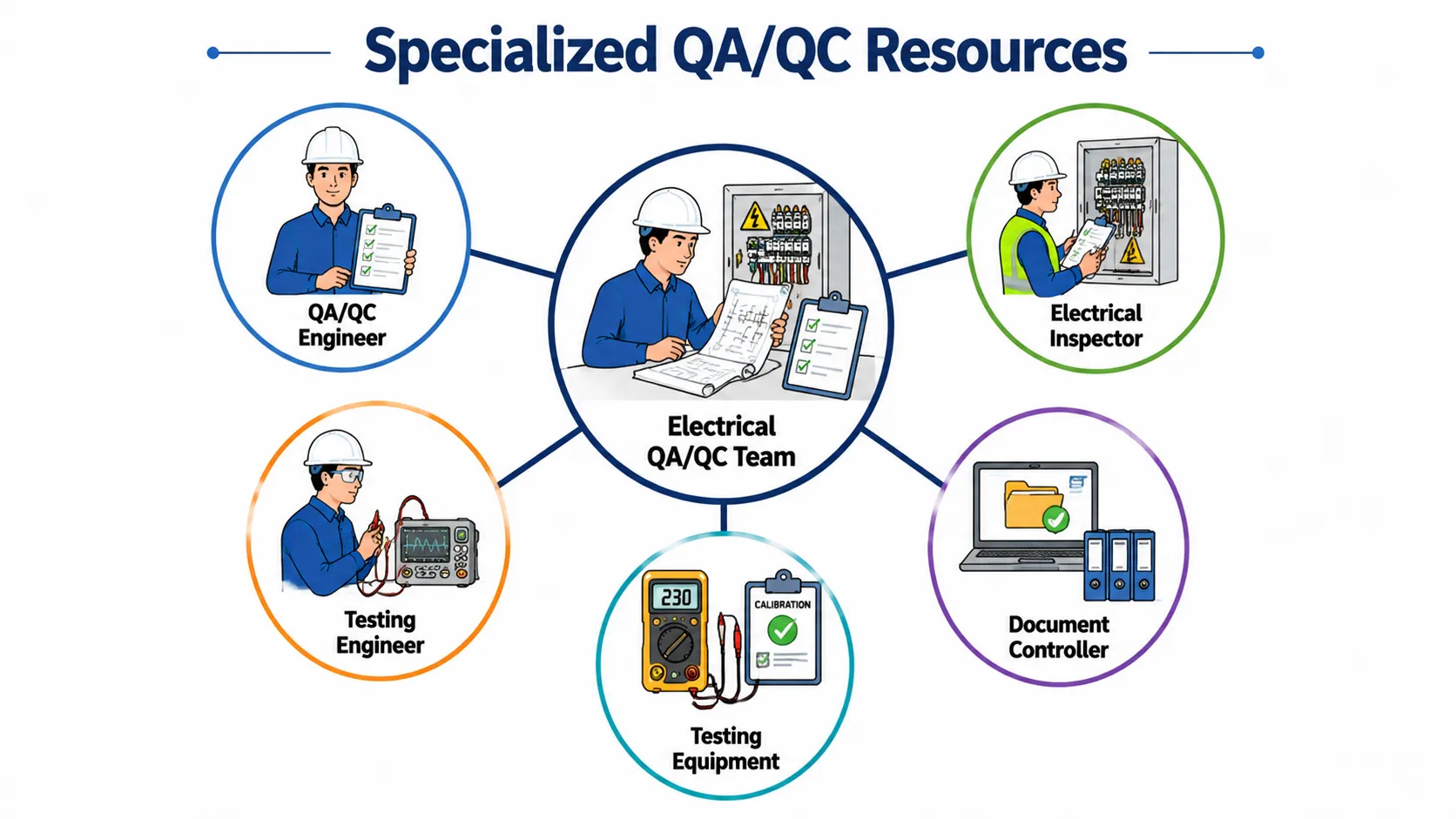
Specialised personnel categories include:
- Senior Electrical QA/QC Engineers.
- Electrical inspectors.
- Testing and commissioning engineers.
- Document controllers.
- Quality auditors.
- Technical specialists.
Each role contributes to maintaining project quality standards.
Senior Electrical QA/QC Engineers
Senior Electrical QA/QC Engineers provide technical leadership and quality management expertise throughout the project lifecycle.
Their responsibilities include:
- Developing quality plans.
- Reviewing technical requirements.
- Managing inspection activities.
- Monitoring compliance.
- Approving quality documentation.
They are responsible for ensuring that project activities follow:
- Approved drawings.
- Project specifications.
- Electrical standards.
- Regulatory requirements.
Key skills required include:
- Advanced electrical engineering knowledge.
- Quality management experience.
- Regulatory understanding.
- Problem-solving ability.
- Leadership skills.
Electrical Inspectors
Electrical inspectors perform practical verification activities during construction and installation.
Their responsibilities include:
- Checking installation quality.
- Verifying workmanship.
- Identifying defects.
- Recording inspection findings.
Typical inspection activities include:
- Cable installation checks.
- Equipment installation verification.
- Earthing inspection.
- Panel inspection.
Electrical inspectors provide essential site-level quality control information.
Testing and Commissioning Engineers
Testing and commissioning engineers specialise in verifying electrical system performance.
They are responsible for:
- Performing electrical tests.
- Analysing test results.
- Confirming system operation.
- Supporting commissioning activities.
Their expertise is essential for:
- Protection system testing.
- Transformer testing.
- Switchgear testing.
-
Functional verification.
Technical Resources and Equipment Required for Electrical QA/QC Activities
Effective electrical QA/QC management depends not only on competent personnel but also on the availability of suitable technical resources, testing instruments, inspection tools, and digital quality management systems. Electrical engineering projects involve complex verification activities where inaccurate measurements or unsuitable equipment can lead to incorrect quality decisions.
A Senior Electrical QA/QC Engineer must ensure that all technical resources used during inspections and testing activities are:
Suitable for the intended application.
Properly calibrated.
Maintained according to manufacturer requirements.
Operated by competent personnel.
Available according to the project schedule.
Technical resource planning is especially important for high-risk electrical systems where testing accuracy directly affects safety and operational reliability.
Electrical Testing Equipment
Electrical testing equipment is essential for verifying the performance, safety, and compliance of electrical installations.
Common testing resources include:
Insulation Resistance Testers
Insulation resistance testers are used to evaluate the condition of electrical insulation systems.
Applications include:
Cable insulation testing.
Motor winding assessment.
Transformer insulation verification.
Quality importance:
Identifies insulation weaknesses.
Prevents electrical failures.
Supports compliance verification.
Earth Resistance Testers
Earth resistance testing equipment verifies the effectiveness of grounding systems.
Applications include:
Earthing system verification.
Lightning protection testing.
Safety grounding assessment.
Quality importance:
Confirms electrical safety.
Reduces shock hazards.
Ensures grounding compliance.
Protection Relay Test Equipment
Protection relay testing equipment is required for verifying the operation of electrical protection systems.
Applications include:
Relay functional testing.
Protection coordination verification.
Fault response testing.
Quality importance:
Ensures reliable protection operation.
Prevents equipment damage.
Supports safe system operation.
Thermal Imaging Cameras
Thermal imaging equipment is used to identify abnormal temperature conditions within electrical systems.
Applications include:
Switchgear inspection.
Cable connection checks.
Panel condition monitoring.
Quality importance:
Detects overheating issues.
Prevents equipment failure.
Supports preventive maintenance.
Calibration and Equipment Control
Calibration management is a critical part of electrical QA/QC resource management.
All testing equipment must have:
Valid calibration certificates.
Traceable calibration records.
Defined calibration intervals.
Maintenance history.
Poor calibration control can result in:
Incorrect test results.
Invalid inspection records.
Compliance failures.
A Senior Electrical QA/QC Engineer must verify that testing equipment is controlled through an organised system.
Important equipment control activities include:
Maintaining calibration registers.
Checking equipment condition before use.
Removing expired equipment from service.
Recording testing equipment usage.
Digital Quality Management Resources
Modern electrical projects increasingly use digital systems to improve QA/QC efficiency.
Digital quality resources include:
Electronic inspection systems.
Document management platforms.
Quality tracking software.
Digital reporting tools.
Benefits include:
Faster inspection reporting.
Improved document control.
Better communication.
Real-time quality monitoring.
Digital systems support effective resource management by allowing project teams to track:
Inspection progress.
Non-conformance status.
Testing completion.
Approval records.
Process for Allocating QA/QC Resources Effectively
Step 1: Analyse Project Quality Requirements
The first step in effective resource allocation is understanding the project’s specific QA/QC requirements.
The Senior Electrical QA/QC Engineer must review:
Project specifications.
Electrical drawings.
Quality plans.
Inspection requirements.
Regulatory standards.
The analysis should identify:
Number of inspections required.
Required specialist skills.
Testing activities.
Documentation requirements.
For example:
A renewable energy project with battery storage systems may require specialists in:
Power electronics.
Battery safety systems.
Protection coordination.
Commissioning procedures.
Understanding these requirements ensures that appropriate resources are allocated from the beginning.
Step 2: Identify Required Competencies
After analysing project requirements, the next stage is identifying the competencies required for each QA/QC activity.
Competency evaluation should consider:
Technical qualifications.
Professional experience.
Certification requirements.
Previous project experience.
A competency matrix can be developed to match personnel skills with project needs.
Example:
QA/QC Activity Required Competency Electrical Inspection Qualified electrical inspector Protection Testing Protection testing specialist Compliance Audit Experienced QA/QC engineer Documentation Control Quality documentation specialist This approach ensures that the right personnel are assigned to the right tasks.
Step 3: Develop Resource Allocation Plan
A resource allocation plan defines how personnel, equipment, and technical resources will be assigned throughout the project lifecycle.
The plan should include:
Resource requirements.
Assignment responsibilities.
Availability periods.
Project milestones.
Important considerations include:
Construction phases.
Inspection workload.
Testing requirements.
Project risks.
A well-developed resource plan prevents:
Personnel shortages.
Testing delays.
Inspection conflicts.
Step 4: Monitor Resource Performance
Resource allocation should be continuously monitored throughout the project.
Monitoring activities include:
Reviewing inspection performance.
Evaluating workload distribution.
Checking testing efficiency.
Identifying resource gaps.
Performance indicators may include:
Completed inspections.
Number of quality issues identified.
Response time for corrective actions.
Testing completion rate.
Monitoring allows project managers to adjust resources when requirements change.
Step 5: Optimise Resource Utilisation
Optimising resources ensures that available personnel and equipment are used effectively.
Optimisation strategies include:
Prioritising critical activities.
Avoiding unnecessary resource duplication.
Coordinating specialist availability.
Improving communication.
For example:
A commissioning specialist may be scheduled for multiple systems within the same project phase rather than assigned inefficiently across unrelated activities.
Practical Examples of QA/QC Resource Allocation
Example 1: High-Voltage Substation Project
Project Background
A high-voltage substation project requires installation and commissioning of:
High-voltage switchgear.
Power transformers.
Protection systems.
Control panels.
Due to the safety-critical nature of the project, specialised resources are required.
Resource Allocation Strategy
The QA/QC team allocates:
Senior Electrical QA/QC Engineer:
Quality planning.
Compliance monitoring.
Inspection supervision.
Electrical Inspectors:
Installation verification.
Workmanship inspection.
Testing Engineers:
Relay testing.
Transformer testing.
Commissioning support.
Testing Equipment:
Relay test kits.
Insulation testers.
Earth resistance testers.
Project Benefit
Effective resource allocation ensures:
Timely inspections.
Accurate testing.
Reduced commissioning delays.
Example 2: Industrial Electrical Installation Project
Project Background
An industrial facility requires installation of:
Motor control centres.
Distribution panels.
Cable networks.
Emergency power systems.
Resource Requirements
The QA/QC plan includes:
Installation inspectors.
Testing specialists.
Documentation controllers.
Allocation Approach
Resources are assigned according to project phases:
Construction Phase:
Installation inspectors.
Testing Phase:
Testing engineers.
Handover Phase:
Documentation specialists.
Outcome
The structured approach results in:
Improved inspection coverage.
Reduced defects.
Faster project completion.
Professional Comparison Table: Electrical QA/QC Resources
Resource Type Definition QA/QC Responsibility Project Benefit Senior Electrical QA/QC Engineer Experienced professional responsible for quality management and compliance control Develop quality plans, supervise inspections, manage compliance Ensures effective quality governance Electrical Inspector Specialist responsible for verifying installation quality Perform inspections and identify defects Improves workmanship quality Testing Engineer Technical specialist responsible for electrical system testing Conduct testing and analyse results Ensures system reliability and safety Document Controller Professional managing quality documentation Maintain inspection records and compliance evidence Improves traceability and audit readiness Testing Equipment Calibrated tools used for electrical verification Support accurate measurements and testing Provides reliable quality evidence Case Study: Resource Allocation Management in a Large Electrical Infrastructure Project
Project Background
A major infrastructure project required the development of an electrical distribution system including:
Medium-voltage networks.
Distribution transformers.
Protection systems.
Control equipment.
The project involved strict quality requirements due to regulatory and safety obligations.
Initial Resource Challenges
During early planning, the project team identified:
Limited availability of testing specialists.
Multiple inspection requirements occurring simultaneously.
High demand for specialised testing equipment.
These challenges created potential risks to project completion.
QA/QC Resource Management Strategy
The Senior Electrical QA/QC Engineer developed a resource management plan.
Actions included:
Assigning experienced engineers to critical activities.
Scheduling inspectors according to construction progress.
Reserving testing equipment before commissioning.
Creating competency-based task assignments.
Project Results
The improved resource allocation approach achieved:
Reduced inspection delays.
Improved testing efficiency.
Better compliance control.
Successful project completion.
Key Benefits of Effective QA/QC Resource Allocation
Improved Inspection Quality
Assigning competent personnel ensures that inspections are performed accurately.
Benefits include:
Better defect identification.
Reliable inspection results.
Improved compliance assurance.
Faster Issue Resolution
Experienced specialists can quickly identify and resolve technical problems.
Benefits include:
Reduced project interruptions.
Faster corrective actions.
Improved productivity.
Reduced Project Risks
Effective resource planning reduces risks related to:
Poor workmanship.
Testing failures.
Compliance issues.
Improved Resource Efficiency
Proper allocation prevents:
Personnel conflicts.
Equipment shortages.
Unnecessary delays.
Enhanced Stakeholder Confidence
A well-managed QA/QC resource system provides confidence to:
Clients.
Consultants.
Contractors.
Regulatory authorities.
Challenges in Electrical QA/QC Resource Allocation
Shortage of Skilled Personnel
Complex electrical projects often require specialised professionals who may not always be available.
Solutions include:
Early resource planning.
Professional development.
Specialist subcontracting.
Limited Testing Equipment Availability
Advanced testing equipment may be required by multiple project teams.
Solutions include:
Equipment scheduling.
Calibration planning.
Resource sharing strategies.
Changing Project Requirements
Project changes may increase resource demands.
Solutions include:
Continuous resource review.
Flexible planning.
Risk-based allocation.
Best Practices for Senior Electrical QA/QC Engineers
Senior QA/QC professionals should:
Develop resource plans during project initiation.
Assign personnel according to competency.
Maintain training and qualification records.
Schedule testing resources in advance.
Monitor resource performance.
Use digital quality management systems.
Review resource requirements regularly.
Prioritise safety-critical activities.
Maintain effective communication.
Apply continuous improvement principles.
Conclusion
Effective allocation of specialised resources and personnel is essential for meeting stringent electrical QA/QC requirements in modern engineering projects. Electrical systems require highly competent professionals, accurate testing equipment, and structured resource management approaches to achieve safety, reliability, and regulatory compliance.
A Senior Electrical QA/QC Engineer must strategically plan and manage resources by analysing project requirements, identifying competencies, allocating appropriate personnel, and ensuring technical resources are available when required. Proper resource allocation improves inspection efficiency, reduces project risks, supports compliance, and contributes to successful project completion.
In complex electrical engineering environments, quality performance depends not only on procedures and standards but also on the effective management of people, equipment, and technical expertise. A well-planned QA/QC resource strategy ensures that electrical projects are delivered safely, efficiently, and according to international engineering expectations.
4. Adapt Resource Allocation and Schedules Dynamically to Address Unpredictable Delays or Quality Issues
In complex electrical engineering projects, uncertainty is a major challenge that can significantly affect project schedules, resource utilisation, and quality performance. Even with advanced planning, detailed risk assessments, and structured QA/QC procedures, unexpected events such as equipment failures, material delays, testing failures, design modifications, regulatory concerns, and workforce limitations can occur during project execution. A Senior Electrical QA/QC Engineer and Chartered Electrical Engineer (CEng) must therefore possess the capability to dynamically adapt resource allocation and project schedules to maintain quality standards while minimising disruption to project objectives.
Dynamic resource allocation refers to the ability of project teams to adjust personnel, equipment, inspection activities, and technical resources in response to changing project conditions. Unlike traditional resource planning approaches, which rely on fixed schedules and predetermined assignments, dynamic management requires continuous monitoring, rapid decision-making, and flexible deployment strategies. This approach allows electrical QA/QC teams to respond effectively when unexpected quality issues or delays threaten project progress.
Electrical projects involve multiple interconnected activities where a delay in one area can influence several dependent tasks. For example, a failed protection relay test during commissioning may delay energisation, affect operational handover, and require additional specialist resources. Similarly, rejection of electrical equipment due to non-compliance may require urgent supplier coordination, replacement planning, and schedule adjustment. Effective dynamic management ensures that these challenges are addressed without compromising safety, compliance, or final system performance.
A Senior Electrical QA/QC Engineer plays a critical role in maintaining project stability by analysing the impact of unexpected issues, prioritising quality-critical activities, reallocating resources, and coordinating recovery actions. This requires strong technical knowledge, project management capability, and an understanding of electrical regulations, inspection requirements, and quality control principles.
Dynamic adaptation of resources and schedules supports modern electrical projects by ensuring that:
Quality requirements remain achievable despite changing conditions.
Critical project activities receive appropriate resources.
Inspection and testing activities continue effectively.
Delays are controlled through proactive intervention.
Electrical systems are delivered safely and according to approved requirements.
In international electrical engineering environments, where projects involve multiple contractors, suppliers, regulatory authorities, and technical stakeholders, the ability to adapt resources and schedules is a key competency for professional QA/QC engineers.
Understanding Dynamic Resource Allocation in Electrical QA/QC Projects
Definition of Dynamic Resource Allocation
Dynamic resource allocation is the process of continuously adjusting and redistributing project resources according to changing project requirements, unexpected challenges, quality risks, and schedule conditions.
In electrical QA/QC management, resources include:
Qualified QA/QC engineers.
Electrical inspectors.
Testing and commissioning specialists.
Technical consultants.
Inspection tools.
Testing equipment.
Documentation resources.
Digital quality management systems.
Unlike static resource planning, dynamic allocation allows project teams to modify resource deployment when actual project conditions differ from the original plan.
For example:
A project schedule may initially allocate one electrical inspector for cable installation inspections. However, if installation activities increase unexpectedly across multiple work areas, additional inspection personnel may be required to prevent quality delays.
Dynamic allocation ensures that available resources are directed toward the areas with the highest quality impact and project importance.
Importance of Adaptive QA/QC Management
Adaptive QA/QC management is essential because electrical projects operate in environments where technical and operational conditions can change rapidly.
Unexpected challenges may include:
Equipment delivery delays.
Failed inspection results.
Incorrect installation practices.
Additional testing requirements.
Design changes.
Contractor performance issues.
A flexible QA/QC management approach enables engineering teams to respond effectively rather than allowing problems to develop into major project disruptions.
The importance of adaptive QA/QC management includes:
Maintaining project continuity.
Protecting critical milestones.
Reducing quality-related delays.
Improving decision-making.
Supporting compliance requirements.
For example, if a transformer fails testing before commissioning, a proactive QA/QC approach may involve:
Assigning additional testing specialists.
Reviewing failure causes.
Coordinating manufacturer support.
Adjusting commissioning activities.
This prevents uncontrolled delays and improves recovery efficiency.
Key Concepts of Adaptive QA/QC Resource Management
Flexible Resource Planning
Flexible resource planning involves creating resource strategies that allow adjustment when project conditions change.
Traditional planning methods often assume that:
Activities will follow the original schedule.
Resources will remain available.
Quality issues will be minimal.
However, complex electrical projects require more flexible approaches because unexpected situations are common.
Flexible resource planning includes:
Maintaining backup specialist availability.
Developing alternative inspection arrangements.
Planning contingency testing resources.
Monitoring resource utilisation continuously.
Key benefits include:
Faster response to project changes.
Reduced downtime.
Improved quality control coverage.
For example:
During a large electrical installation project, the absence of a protection testing engineer could delay commissioning. A flexible resource plan would include access to alternative qualified specialists to prevent schedule disruption.
Real-Time Quality Response Management
Real-time quality response management involves quickly identifying and responding to quality issues as they occur.
This approach requires:
Immediate issue identification.
Technical evaluation.
Corrective action planning.
Resource adjustment.
Common real-time responses include:
Increasing inspection frequency.
Assigning additional technical experts.
Reallocating testing equipment.
Revising work sequences.
For example:
If repeated cable termination defects are identified, the QA/QC team may:
Deploy an experienced electrical supervisor.
Increase inspection points.
Provide additional contractor guidance.
Review installation procedures.
This prevents repeated failures and improves overall project quality.
Risk-Based Resource Adjustment
Risk-based resource adjustment involves directing additional resources toward activities with higher quality and safety risks.
Not every project activity requires the same level of supervision.
High-risk electrical activities may include:
High-voltage equipment installation.
Protection system configuration.
Electrical energisation.
Critical power system testing.
Risk-based allocation involves:
Identifying high-impact activities.
Assigning experienced professionals.
Increasing monitoring levels.
Providing additional technical support.
Benefits include:
Better control of critical risks.
More effective resource utilisation.
Improved safety performance.
Types of Unpredictable Delays and Quality Issues in Electrical Projects
Technical Quality Issues
Technical issues are among the most common causes of project disruption because electrical systems require precise installation and testing.
Examples include:
Incorrect cable installation.
Equipment malfunction.
Protection system failures.
Testing failures.
Design inconsistencies.
These issues may affect:
Construction progress.
Commissioning activities.
Final project acceptance.
QA/QC teams must respond through:
Root cause analysis.
Corrective action planning.
Additional inspections.
Technical verification.
Material and Supply Chain Delays
Electrical projects depend heavily on specialised equipment and materials.
Unexpected supply chain issues may include:
Late equipment delivery.
Damaged materials.
Missing certificates.
Non-compliant products.
Examples of affected materials:
Transformers.
Switchgear.
Protection relays.
Electrical panels.
Specialised cables.
Dynamic response strategies include:
Reviewing alternative suppliers.
Prioritising critical equipment.
Adjusting installation sequences.
Increasing supplier communication.
Workforce and Resource Challenges
Availability of skilled personnel directly affects QA/QC performance.
Common challenges include:
Shortage of qualified inspectors.
Testing specialist availability problems.
Multiple project demands.
Unexpected workforce absence.
Possible solutions include:
Deploying additional personnel.
Rescheduling inspections.
Using approved specialist support.
Adjusting work priorities.
Regulatory and Compliance Issues
Changes in compliance requirements or failed regulatory inspections can create unexpected project delays.
Examples include:
Failed inspections.
Missing documentation.
Updated regulatory requirements.
Additional testing requirements.
QA/QC engineers must respond by:
Reviewing applicable requirements.
Updating procedures.
Assigning technical resources.
Coordinating corrective actions.
Process for Dynamically Adapting Resources and Schedules in Electrical QA/QC Projects
Step 1: Identify the Impact of Delay or Quality Issues
The first step in dynamic resource and schedule adaptation is accurately identifying the nature, severity, and potential consequences of unexpected delays or quality issues. A Senior Electrical QA/QC Engineer must conduct a detailed assessment to determine how the issue affects project objectives, quality requirements, and critical milestones.
Rapid identification allows project teams to make informed decisions before problems escalate.
The assessment process should consider:
The root cause of the issue.
The affected project activities.
The impact on critical path activities.
Required corrective actions.
Additional resources required.
Potential compliance implications.
For example:
During the commissioning stage of an industrial electrical project, protection relay testing identifies incorrect fault settings. The QA/QC engineer must evaluate:
Whether other protection devices are affected.
Whether additional testing specialists are required.
Whether commissioning dates need adjustment.
Whether regulatory approvals may be impacted.
A structured impact assessment prevents unnecessary resource allocation and ensures that corrective actions focus on the actual problem.
Step 2: Prioritise Critical Project Activities
After identifying the impact of a delay or quality issue, the next step is prioritising project activities based on their importance, risk level, and schedule impact.
Not all activities require immediate resource adjustment. Senior QA/QC professionals must determine which activities have the greatest influence on project completion.
Priority should be given to:
Critical path activities.
Safety-critical electrical systems.
Regulatory approval activities.
Commissioning-related tasks.
High-risk installation areas.
Prioritisation criteria include:
Impact on project completion date.
Impact on system safety.
Availability of alternative solutions.
Contractual requirements.
For example:
If a cable inspection delay affects a non-critical area, resources may remain unchanged. However, if the delay affects cables required for system energisation, additional inspectors may need to be deployed immediately.
Effective prioritisation ensures that limited resources are focused where they provide maximum project benefit.
Step 3: Reallocate Personnel and Technical Resources
Once priorities are established, resources must be redistributed to address the identified challenges.
Dynamic resource allocation may involve:
Assigning additional QA/QC engineers.
Deploying specialist inspectors.
Increasing testing support.
Rescheduling technical personnel.
Providing additional equipment.
Resource reallocation decisions should consider:
Personnel competency.
Availability.
Project requirements.
Safety implications.
Examples include:
Additional Inspection Support
When installation activities increase unexpectedly, additional inspectors may be assigned to maintain inspection coverage.
Specialist Technical Support
When complex technical issues occur, specialist engineers may be brought into the project to provide expert analysis.
Testing Equipment Adjustment
When testing activities overlap, additional calibrated testing equipment may be arranged to avoid delays.
A Senior Electrical QA/QC Engineer must ensure that resource changes maintain quality standards rather than simply accelerating project progress.
Step 4: Modify Project Schedules
Dynamic resource management must be supported by appropriate schedule adjustments.
Schedule modification involves reviewing the original project plan and updating activities based on current conditions.
Schedule adjustments may include:
Revising inspection dates.
Changing testing sequences.
Updating milestone completion dates.
Reorganising work packages.
The objective is not simply to shorten the schedule but to maintain realistic project progress while preserving quality requirements.
Effective schedule modification requires coordination between:
QA/QC teams.
Project managers.
Contractors.
Suppliers.
Clients.
For example:
If electrical equipment delivery is delayed, the project team may:
Complete alternative installation activities.
Reschedule equipment testing.
Adjust inspection priorities.
Maintain progress in other project areas.
This approach reduces idle time and improves resource utilisation.
Step 5: Monitor Recovery Actions
After implementing corrective actions, continuous monitoring is required to confirm that recovery strategies are effective.
Monitoring activities include:
Reviewing revised schedules.
Tracking quality milestones.
Checking corrective action progress.
Evaluating resource effectiveness.
QA/QC engineers should monitor:
Inspection completion rates.
Testing progress.
Non-conformance resolution.
Compliance status.
If recovery actions are not achieving expected results, further adjustments may be required.
Continuous monitoring ensures that temporary solutions do not create additional quality problems.
Practical Examples of Dynamic QA/QC Resource Management
Example 1: Transformer Testing Failure During Commissioning
Project Situation
A power distribution project reaches the commissioning stage, but transformer testing identifies abnormal test results.
The issue creates a potential delay because the transformer cannot be energised until the problem is resolved.
Initial Quality Challenge
The QA/QC team identifies:
Failed electrical test results.
Possible equipment performance issues.
Risk of commissioning delay.
Dynamic Resource Response
The Senior Electrical QA/QC Engineer implements:
Additional testing specialists.
Manufacturer technical support.
Detailed failure investigation.
Revised commissioning schedule.
Additional resources include:
Transformer testing engineers.
Protection specialists.
Technical consultants.
Outcome
The problem is resolved through effective resource adaptation, allowing:
Successful retesting.
Approved commissioning.
Reduced schedule impact.
Example 2: Delayed Electrical Equipment Delivery
Project Situation
A major electrical project experiences delays in the delivery of switchgear equipment due to supplier issues.
The delay threatens planned installation activities.
Quality and Schedule Impact
Potential consequences include:
Installation delays.
Idle workforce.
Testing schedule disruption.
Dynamic Adaptation Strategy
The project team responds by:
Reviewing alternative installation activities.
Adjusting inspection schedules.
Coordinating supplier recovery actions.
Preparing inspection resources for revised delivery dates.
Outcome
The project maintains progress by efficiently using available resources while waiting for equipment delivery.
Example 3: Unexpected Installation Defects
Project Situation
During cable installation inspections, QA/QC engineers identify repeated termination defects.
Quality Impact
The issue creates risks including:
Failed testing.
Rework requirements.
Commissioning delays.
Dynamic Response
Actions include:
Increasing inspection frequency.
Assigning experienced electrical supervisors.
Providing contractor guidance.
Reviewing installation procedures.
Outcome
Improved installation quality reduces further defects and prevents future delays.
Professional Comparison Table: Dynamic Response to QA/QC Challenges
Situation Definition Dynamic Response Project Benefit Testing Failure Electrical equipment or system does not achieve required test results Assign specialists, perform investigation, revise testing schedule Reduces commissioning delays and ensures compliance Material Delay Required electrical equipment is unavailable within planned timeframe Adjust activities, coordinate suppliers, revise resource deployment Maintains project progress Workforce Shortage Lack of available qualified QA/QC personnel Deploy additional inspectors or specialist support Maintains inspection coverage Installation Defect Workmanship or installation quality does not meet requirements Increase supervision, correct defects, repeat inspections Reduces rework and improves quality Regulatory Issue Compliance requirement is not achieved Review standards, update documentation, implement corrective action Ensures regulatory approval Case Study: Dynamic Resource Management in a Large Electrical Infrastructure Project
Project Background
A large electrical infrastructure project involved the construction of a high-capacity distribution system for an industrial facility.
The project included:
Medium-voltage switchgear.
Power transformers.
Protection systems.
Underground cable networks.
Control and monitoring systems.
Due to operational requirements, the project had a strict completion deadline.
Initial Challenges
During project execution, several unexpected issues occurred:
Delayed equipment delivery.
Additional testing requirements.
Limited availability of specialist engineers.
Installation quality concerns.
These issues created potential risks to project completion.
Dynamic QA/QC Adaptation Strategy
The Senior Electrical QA/QC Engineer implemented a flexible management approach.
Actions included:
Reviewing the impact of each issue.
Prioritising critical activities.
Assigning additional inspection resources.
Rescheduling testing activities.
Increasing communication with suppliers and contractors.
Resource Adjustment
The project team adapted resources by:
Bringing additional electrical inspectors.
Assigning specialist testing engineers.
Increasing technical review support.
Extending quality monitoring activities.
Schedule Recovery Approach
The project schedule was modified through:
Revised inspection sequences.
Updated testing milestones.
Alternative activity planning.
Improved coordination meetings.
Final Project Outcome
The adaptive QA/QC approach achieved:
Reduced schedule impact.
Successful completion of testing.
Improved quality control.
Compliance with project requirements.
Successful electrical system commissioning.
Key Benefits of Dynamic Resource and Schedule Adaptation
Reduced Project Delays
Dynamic management allows project teams to respond quickly when unexpected issues occur.
Benefits include:
Faster problem resolution.
Reduced downtime.
Improved milestone achievement.
Improved Quality Performance
Flexible resource allocation ensures that quality activities receive sufficient attention.
Benefits include:
Better inspection coverage.
Improved defect detection.
Reduced corrective work.
Better Resource Utilisation
Dynamic planning ensures resources are used effectively.
Benefits include:
Reduced resource conflicts.
Improved workforce efficiency.
Better equipment utilisation.
Enhanced Risk Management
Adaptive QA/QC practices support proactive risk control.
Benefits include:
Early identification of issues.
Improved decision-making.
Reduced project uncertainty.
Improved Stakeholder Confidence
Effective response strategies demonstrate strong project control.
Stakeholders gain confidence through:
Transparent communication.
Controlled quality processes.
Reliable project progress.
Best Practices for Senior Electrical QA/QC Engineers
Senior Electrical QA/QC Engineers should implement the following practices:
Maintain contingency resource plans.
Identify critical project risks early.
Monitor quality performance continuously.
Establish flexible inspection strategies.
Maintain communication with all stakeholders.
Use digital project monitoring systems.
Track resource availability regularly.
Develop alternative recovery strategies.
Prioritise safety-critical activities.
Review lessons learned after project completion.
Conclusion
Dynamic adaptation of resource allocation and schedules is an essential capability for managing modern electrical engineering projects. Unexpected delays, technical failures, material issues, and quality challenges are common factors that can affect project performance if not managed effectively.
A Senior Electrical QA/QC Engineer must be capable of analysing changing conditions, prioritising critical activities, reallocating specialised resources, and modifying schedules while maintaining strict quality requirements. Effective adaptation ensures that electrical projects continue progressing without compromising safety, compliance, or system reliability.
By implementing flexible resource management strategies, organisations can improve project resilience, reduce delays, optimise resource utilisation, and achieve successful delivery of complex electrical systems. In advanced electrical engineering environments, dynamic QA/QC management is a key factor in achieving reliable, compliant, and high-performance project outcomes.