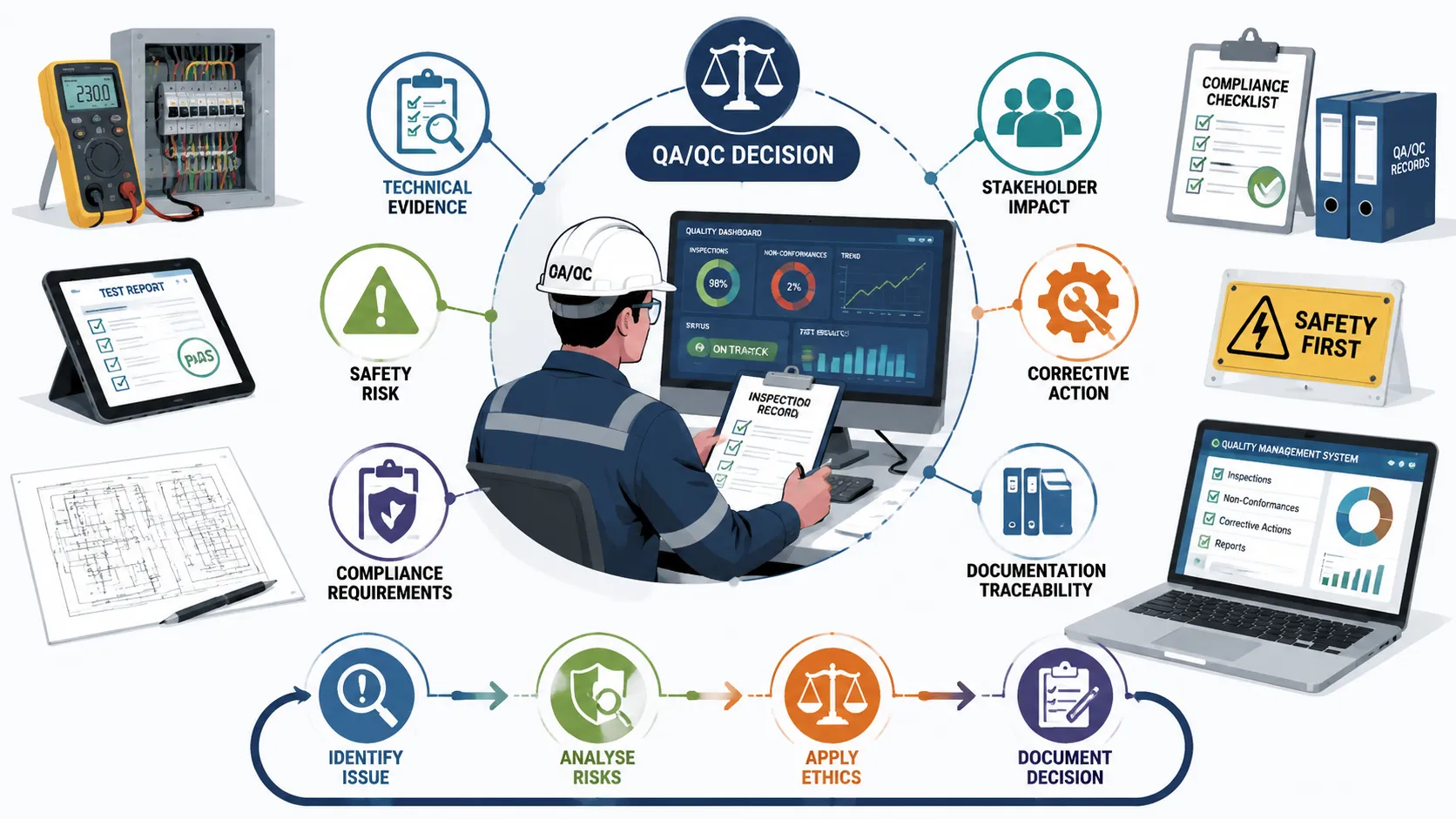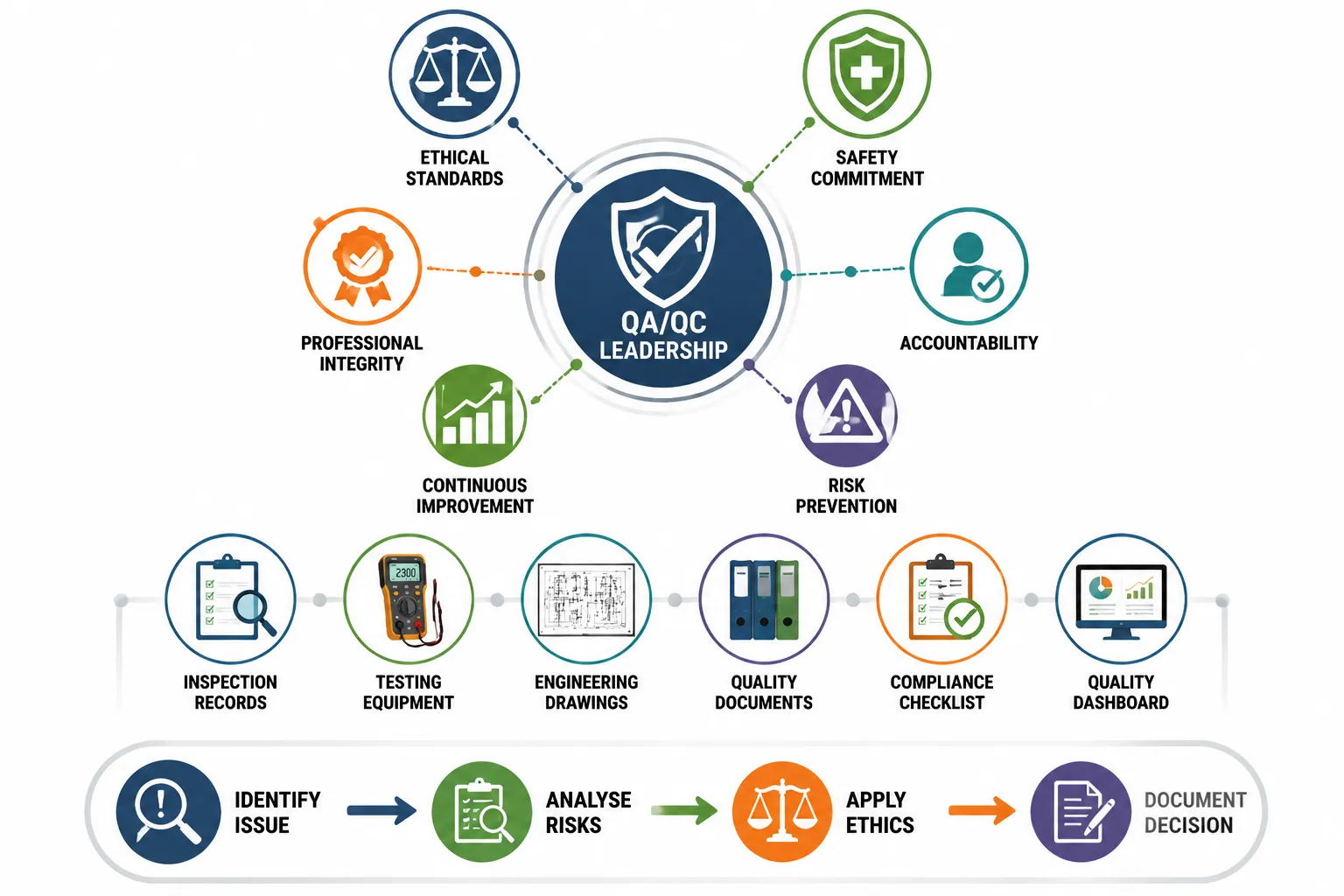
Lesson 5: Integrate ethical considerations into QA/QC leadership decisions.
Ethical decision-making is a fundamental responsibility of effective QA/QC leadership within electrical engineering environments. Senior QA/QC professionals are required to make decisions that influence product quality, system reliability, regulatory compliance, workplace safety and stakeholder confidence. In complex engineering projects, leaders often face challenging situations where technical requirements, commercial pressures, project deadlines and organisational expectations may conflict. This lesson explores how ethical principles guide QA/QC leaders in making fair, transparent and professionally responsible decisions while maintaining the highest standards of quality and integrity.
This lesson examines the role of ethics in electrical QA/QC leadership, including professional accountability, integrity, impartiality, confidentiality, responsible reporting and evidence-based decision-making. Learners will explore how ethical considerations influence inspection decisions, non-conformance management, corrective actions, team leadership and communication with clients, contractors and project stakeholders. The lesson also highlights the importance of protecting technical independence and ensuring that quality decisions are never compromised by pressure, personal interests or short-term project objectives.
By completing this lesson, learners will develop the ability to integrate ethical thinking into QA/QC leadership practices and apply professional judgement when managing complex engineering challenges. The knowledge gained will support stronger quality cultures, improved stakeholder trust, responsible leadership behaviour and sustainable project outcomes within electrical engineering and quality management environments.
1: Critically Analyse the Ethical Principles and Codes of Conduct Governing Electrical QA/QC Practices
Ethical principles and professional codes of conduct form the foundation of effective electrical Quality Assurance and Quality Control (QA/QC) practices. In complex engineering environments, QA/QC professionals are responsible not only for verifying technical compliance but also for ensuring that decisions are made with honesty, fairness, accountability and professional integrity. Electrical systems are often safety-critical assets where poor-quality decisions, inaccurate reporting or unethical practices can create serious consequences for people, organisations and the wider community.
Senior electrical QA/QC engineers, including Chartered Electrical Engineers (CEng) and quality professionals, must apply ethical judgement when managing inspections, testing activities, documentation, non-conformities, corrective actions and stakeholder communication. They frequently operate under competing pressures involving project deadlines, cost constraints, contractor expectations and client requirements. Ethical leadership ensures that technical decisions remain objective and that quality standards are protected even when commercial or operational pressures exist.
This section examines the ethical principles, professional responsibilities and codes of conduct that guide electrical QA/QC practices. It explores how ethical considerations influence inspection decisions, reporting accuracy, technical independence, confidentiality, safety responsibilities and relationships with project stakeholders. It also evaluates how ethical leadership contributes to quality culture, compliance performance and long-term engineering reliability.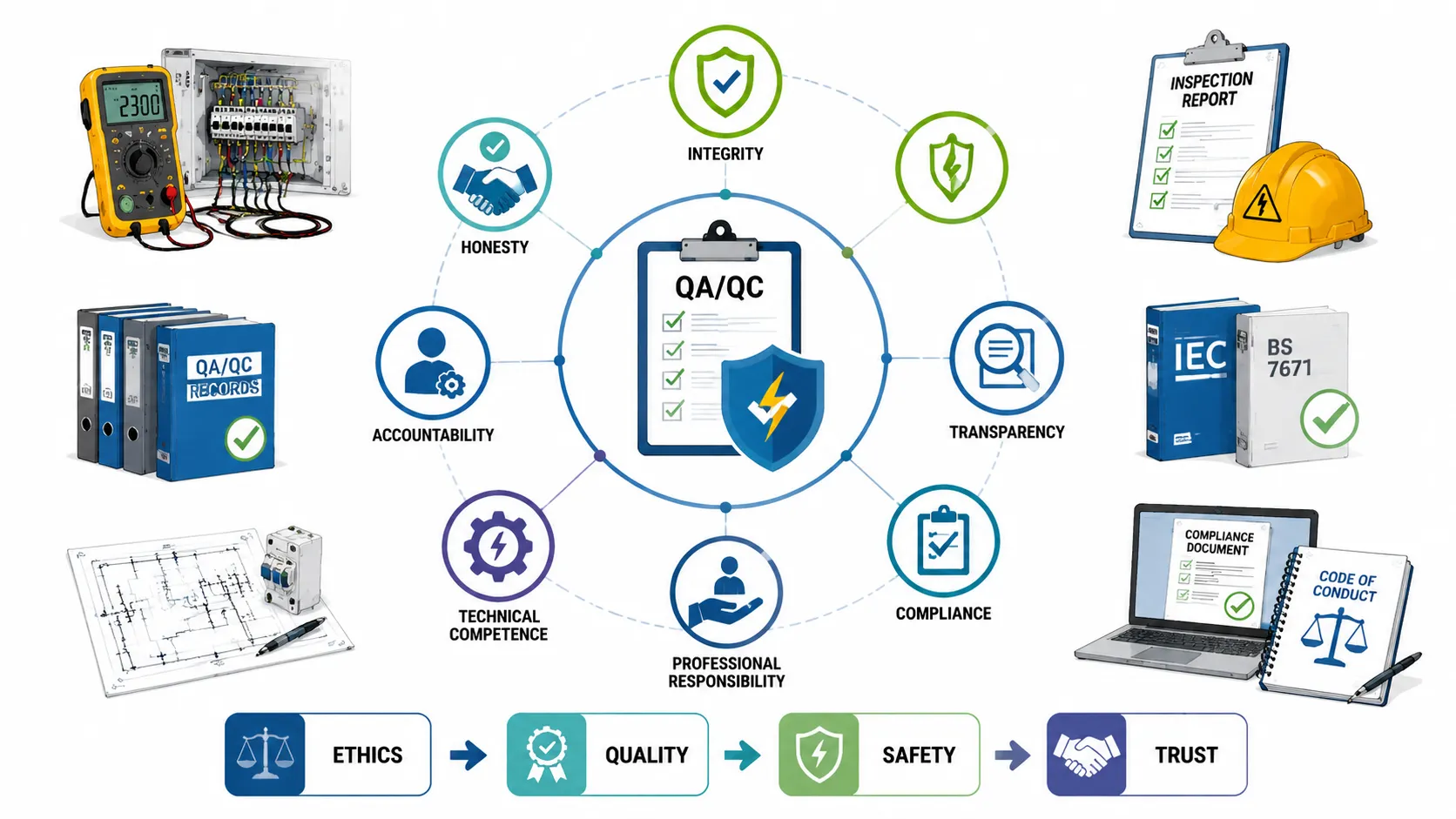
Understanding Ethics in Electrical QA/QC Practices
Ethics refers to the principles and values that determine what is considered professionally responsible and acceptable behaviour. Within electrical QA/QC, ethics provides a framework for making decisions when rules, procedures or technical requirements alone may not fully address a complex situation.
Electrical QA/QC professionals are expected to make decisions that protect:
Public safety.
Electrical system reliability.
Regulatory compliance.
Client interests.
Organisational reputation.
Professional credibility.
Environmental and operational responsibilities.
Ethical practice requires professionals to consider not only whether an activity is technically acceptable but also whether the decision is responsible, transparent and aligned with professional obligations.
For example, an electrical QA/QC engineer may discover that a component has passed a basic inspection but has questionable long-term reliability due to installation conditions. Although immediate acceptance may support project progress, an ethical professional must consider the potential future consequences before approving the work.
Importance of Ethical Leadership in Electrical QA/QC
Ethical leadership influences how quality decisions are made throughout an organisation. Senior QA/QC leaders establish expectations for professional behaviour and create an environment where employees understand that quality cannot be compromised for convenience.
Ethical QA/QC leadership supports:
Honest inspection reporting.
Accurate documentation.
Independent technical judgement.
Fair treatment of stakeholders.
Responsible risk management.
Transparent communication.
Continuous improvement.
A leader who demonstrates ethical behaviour encourages the entire QA/QC team to follow similar standards.
Key Ethical Principles Governing Electrical QA/QC
Integrity
Integrity is one of the most important ethical principles in engineering quality management. It requires professionals to act honestly, consistently and transparently regardless of external pressure.
In electrical QA/QC practices, integrity applies to:
Recording inspection findings accurately.
Reporting defects without modification.
Presenting test results truthfully.
Maintaining accurate quality documentation.
Communicating technical concerns openly.
Avoiding misleading statements.
An electrical QA/QC professional demonstrates integrity by reporting an identified defect even when doing so may delay project activities.
Practical Application of Integrity
A testing engineer identifies abnormal results during electrical testing. The construction team requests that the results are not reported immediately because the project deadline is approaching.
An ethical QA/QC professional should:
Record the actual test results.
Investigate the cause.
Communicate the concern appropriately.
Recommend corrective action.
Maintain technical evidence.
The objective is not to create unnecessary delay but to ensure that decisions are based on accurate information.
Objectivity and Impartiality
Objectivity requires QA/QC professionals to make decisions based on evidence rather than personal interests, relationships or external influence.
Impartiality means treating all relevant parties fairly while applying the same standards consistently.
Electrical QA/QC professionals should avoid decisions influenced by:
Personal relationships.
Contractor pressure.
Financial interests.
Organisational politics.
Project urgency.
Personal preferences.
Importance of Objectivity in Inspection Activities
Inspection decisions should be based on:
Approved drawings.
Specifications.
Standards.
Test results.
Inspection criteria.
Technical evidence.
A QA/QC engineer should not approve unacceptable work simply because the contractor is experienced or because the project is behind schedule.
Professional Competence
Ethical practice requires professionals to maintain appropriate knowledge, skills and competence.
A QA/QC engineer should understand:
Electrical engineering principles.
Inspection procedures.
Testing requirements.
Quality management systems.
Applicable standards.
Risk assessment methods.
Documentation requirements.
Professionals should recognise their limitations and seek appropriate support when required.
Competence Responsibilities Include:
Maintaining technical knowledge.
Participating in professional development.
Understanding current requirements.
Applying correct procedures.
Seeking specialist advice when necessary.
Accepting responsibility for decisions without adequate competence can create ethical and technical risks.
Accountability
Accountability means accepting responsibility for professional decisions and their consequences.
Electrical QA/QC professionals are accountable for:
Inspection decisions.
Quality records.
Technical recommendations.
Corrective action verification.
Reporting accuracy.
Accountability encourages careful decision-making because professionals understand that their actions can affect safety, performance and organisational reputation.
Transparency
Transparency involves providing clear, accurate and understandable information to relevant stakeholders.
In QA/QC environments, transparency applies to:
Inspection outcomes.
Test results.
Quality concerns.
Non-conformities.
Corrective actions.
Decision-making processes.
Transparent communication builds trust between:
QA/QC teams.
Contractors.
Clients.
Project managers.
Regulatory bodies.
Confidentiality
Electrical QA/QC professionals often access sensitive information, including:
Design documents.
Client information.
Technical specifications.
Project data.
Commercial information.
Ethical professionals must protect confidential information and only share information with authorised individuals.
Confidentiality does not mean hiding important safety or quality concerns.
Professionals must balance confidentiality with their responsibility to report significant risks.
Public Safety Responsibility
The protection of public safety is a primary ethical responsibility in engineering.
Electrical QA/QC professionals contribute to safety by ensuring:
Equipment is suitable.
Installations meet requirements.
Testing is completed correctly.
Defects are identified.
Risks are controlled.
A decision that improves short-term project performance but increases safety risk would be ethically unacceptable.
Professional Codes of Conduct in Electrical QA/QC
Professional codes of conduct provide guidance on expected behaviour and responsibilities.
They commonly require engineers and quality professionals to:
Act honestly.
Protect public welfare.
Maintain competence.
Respect professional responsibilities.
Avoid conflicts of interest.
Communicate accurately.
Support sustainable engineering practices.
Codes of conduct help professionals make appropriate decisions when facing complex situations.
Ethical Decision-Making Framework for QA/QC Professionals
Ethical decision-making requires a structured approach.
Step 1: Identify the Ethical Issue
Determine:
What decision must be made?
Who may be affected?
What values are involved?
Are there competing responsibilities?
Step 2: Review Technical Requirements
Consider:
Standards.
Procedures.
Specifications.
Contract requirements.
Regulatory expectations.
Step 3: Identify Stakeholders
Consider:
Client.
Contractor.
Employees.
Public users.
Organisation.
Regulators.
Step 4: Evaluate Options
Assess possible actions considering:
Safety.
Quality.
Compliance.
Risk.
Long-term consequences.
Step 5: Make a Defensible Decision
The chosen action should be:
Evidence-based.
Professionally justified.
Transparent.
Consistent with ethical responsibilities.
Step 6: Document the Decision
Maintain appropriate records showing:
Issue identified.
Evidence considered.
Decision made.
Actions required.
Ethical Challenges in Electrical QA/QC
Pressure to Accept Non-Compliant Work
One common ethical challenge occurs when project teams request acceptance of work that does not fully meet requirements.
Reasons may include:
Schedule pressure.
Cost concerns.
Client expectations.
Contractor difficulties.
The ethical response is to:
Evaluate evidence.
Explain the concern.
Identify corrective actions.
Maintain technical independence.
Manipulation of Quality Records
Quality records provide evidence that work has been completed correctly.
Unethical practices may include:
Changing inspection findings.
Altering test results.
Creating inaccurate records.
Removing evidence of defects.
Such actions damage trust and may create serious safety risks.
Ethical QA/QC professionals must maintain accurate and traceable documentation.
Conflict of Interest
A conflict of interest occurs when personal interests may influence professional judgement.
Examples include:
Personal relationships with suppliers.
Financial interests.
Pressure from management.
Preference for certain contractors.
Professionals should disclose and manage conflicts appropriately.
Balancing Commercial and Quality Requirements
Engineering projects require commercial awareness, but commercial objectives should not override essential quality requirements.
A professional QA/QC leader should seek solutions that balance:
Cost.
Programme.
Quality.
Safety.
Performance.
However, safety-critical and compliance requirements must remain protected.
Ethical Handling of Non-Conformities
Non-conformities represent situations where requirements have not been satisfied.
Ethical NCR management requires:
Accurate identification.
Clear description.
Objective classification.
Root-cause investigation.
Effective corrective action.
Verification before closure.
Closing NCRs without effective resolution is unethical because it creates false assurance.
Ethical Responsibilities During Audits
Audits require honesty and cooperation.
QA/QC professionals should:
Provide accurate information.
Support auditor access.
Avoid hiding problems.
Respond professionally.
Implement agreed improvements.
Attempting to manipulate audit outcomes damages the credibility of the quality management system.
Ethical Communication With Stakeholders
Effective communication requires:
Accuracy.
Respect.
Professional language.
Appropriate timing.
Transparency.
QA/QC leaders should avoid:
Misleading statements.
Withholding important information.
Blaming individuals unfairly.
Exaggerating problems.
Communication should support problem-solving rather than conflict creation.
Ethical Quality Culture Development
Ethical behaviour becomes stronger when embedded into organisational culture.
A strong ethical quality culture encourages:
Speaking up about concerns.
Honest reporting.
Professional challenge.
Learning from mistakes.
Fair decision-making.
Continuous improvement.
Leadership plays a critical role because employees often follow the behaviours demonstrated by senior personnel.
Role of Senior QA/QC Leaders in Ethical Practice
Senior leaders should:
Demonstrate ethical behaviour.
Establish clear expectations.
Support professional independence.
Protect employees who raise concerns.
Encourage evidence-based decisions.
Address unethical behaviour.
Promote continual improvement.
Leadership behaviour directly influences team culture.
Ethical Decision-Making Example
Scenario
A QA/QC engineer identifies repeated insulation testing failures in an electrical installation. The project manager requests approval to continue because replacement materials may delay completion.
Ethical Analysis
The engineer should consider:
Safety implications.
Technical requirements.
Available evidence.
Long-term reliability.
Corrective options.
Appropriate Response
The engineer should:
Record the findings.
Explain the risk.
Recommend corrective action.
Support problem-solving.
Avoid approving unacceptable work.
Outcome
The project may experience short-term delay but benefits from improved reliability and reduced future risk.
Ethical Leadership Case Study: Quality Pressure During Project Completion
Project Background
An electrical infrastructure project is approaching final handover. Several outstanding quality issues remain, including incomplete documentation and unresolved inspection findings.
Project management requests rapid closure to achieve the contractual milestone.
Ethical Challenge
The QA/QC team faces pressure between:
Meeting the deadline.
Protecting quality assurance.
Maintaining accurate records.
Leadership Response
The QA/QC leader:
Reviews outstanding issues.
Prioritises risks.
Maintains accurate documentation.
Communicates concerns professionally.
Establishes corrective action plans.
Ensures final acceptance is evidence-based.
Outcome
The project achieves handover with improved quality confidence because decisions were based on ethical and professional principles.
Case Study Conclusion
The case demonstrates that ethical leadership does not prevent project success. Instead, it supports sustainable success by ensuring that decisions protect safety, quality and stakeholder trust.
Ethical Principles and Their Application Table
| Ethical Principle | Meaning | QA/QC Application |
|---|---|---|
| Integrity | Acting honestly and consistently | Accurate inspection reporting |
| Objectivity | Making evidence-based decisions | Independent quality judgement |
| Competence | Maintaining professional capability | Correct inspection and testing decisions |
| Accountability | Accepting responsibility | Defensible QA/QC decisions |
| Transparency | Open and accurate communication | Clear reporting and documentation |
| Confidentiality | Protecting sensitive information | Secure handling of project data |
| Safety Responsibility | Protecting people and assets | Preventing unsafe acceptance |
| Fairness | Treating stakeholders consistently | Equal application of quality criteria |
Benefits of Ethical QA/QC Leadership
Ethical practices provide significant benefits, including:
Improved stakeholder trust.
Stronger quality culture.
Reduced compliance risks.
Better decision-making.
Increased professional credibility.
Improved audit performance.
More reliable electrical systems.
Reduced rework.
Better team confidence.
Stronger organisational reputation.
Improved long-term project outcomes.
Key Learning Points
Learners should understand that:
Ethics is fundamental to professional QA/QC practice.
Technical decisions must be based on evidence and integrity.
QA/QC professionals must maintain independence.
Public safety is a primary ethical responsibility.
Accurate documentation is an ethical obligation.
Confidential information must be protected.
Conflicts of interest should be managed appropriately.
Quality requirements should not be compromised by pressure.
Ethical leadership influences organisational culture.
Professional codes of conduct guide responsible behaviour.
Ethical decision-making requires structured evaluation.
Transparency builds stakeholder confidence.
Accountability strengthens professional practice.
Competence is essential for ethical performance.
Ethical behaviour supports sustainable quality improvement.
Conclusion
Ethical principles and professional codes of conduct provide the foundation for responsible electrical QA/QC leadership. Senior QA/QC professionals must apply integrity, objectivity, accountability, competence and transparency when making decisions that affect quality, safety and project performance. Ethical leadership ensures that technical judgement remains independent and that quality requirements are protected even under significant commercial and operational pressure.
By integrating ethical considerations into everyday QA/QC practices, electrical engineering organisations can develop stronger quality cultures, improve stakeholder confidence and deliver safer, more reliable systems. Ethical decision-making is therefore not only a professional obligation but also a critical factor in achieving long-term engineering excellence.
2: Evaluate Complex Scenarios Where Electrical Quality Requirements May Conflict With Project Timelines or Commercial Budgets
In complex electrical engineering projects, QA/QC leaders frequently face situations where technical quality requirements compete with project pressures such as strict deadlines, limited budgets, resource constraints and commercial expectations. These situations require advanced professional judgement because decisions made under pressure can directly affect electrical system reliability, operational safety, regulatory compliance and stakeholder confidence.
A Chartered Electrical Engineer (CEng) and senior electrical QA/QC professional must understand that successful project delivery requires a balanced approach. Quality cannot be considered separately from cost and schedule; however, commercial and programme pressures must not override essential technical requirements. Ethical QA/QC leadership involves analysing available options, assessing risks, communicating clearly with stakeholders and making decisions that protect long-term project performance.
Electrical quality requirements exist to ensure that installations, equipment and systems perform safely and reliably throughout their operational life. Project timelines and commercial budgets represent legitimate business requirements, but they must be managed through improved planning, efficient processes and responsible decision-making rather than by reducing essential quality controls.
This section explores how senior QA/QC professionals evaluate complex scenarios where electrical quality requirements conflict with project deadlines or financial limitations. It focuses on ethical decision-making, risk-based assessment, professional responsibility, stakeholder management and practical strategies for achieving quality objectives while considering real project constraints.
Understanding the Relationship Between Quality, Cost and Time in Electrical Projects
Electrical engineering projects are commonly managed around three interconnected objectives:
Quality.
Cost.
Time.
These objectives are often referred to as competing project constraints because changes in one area may affect the others.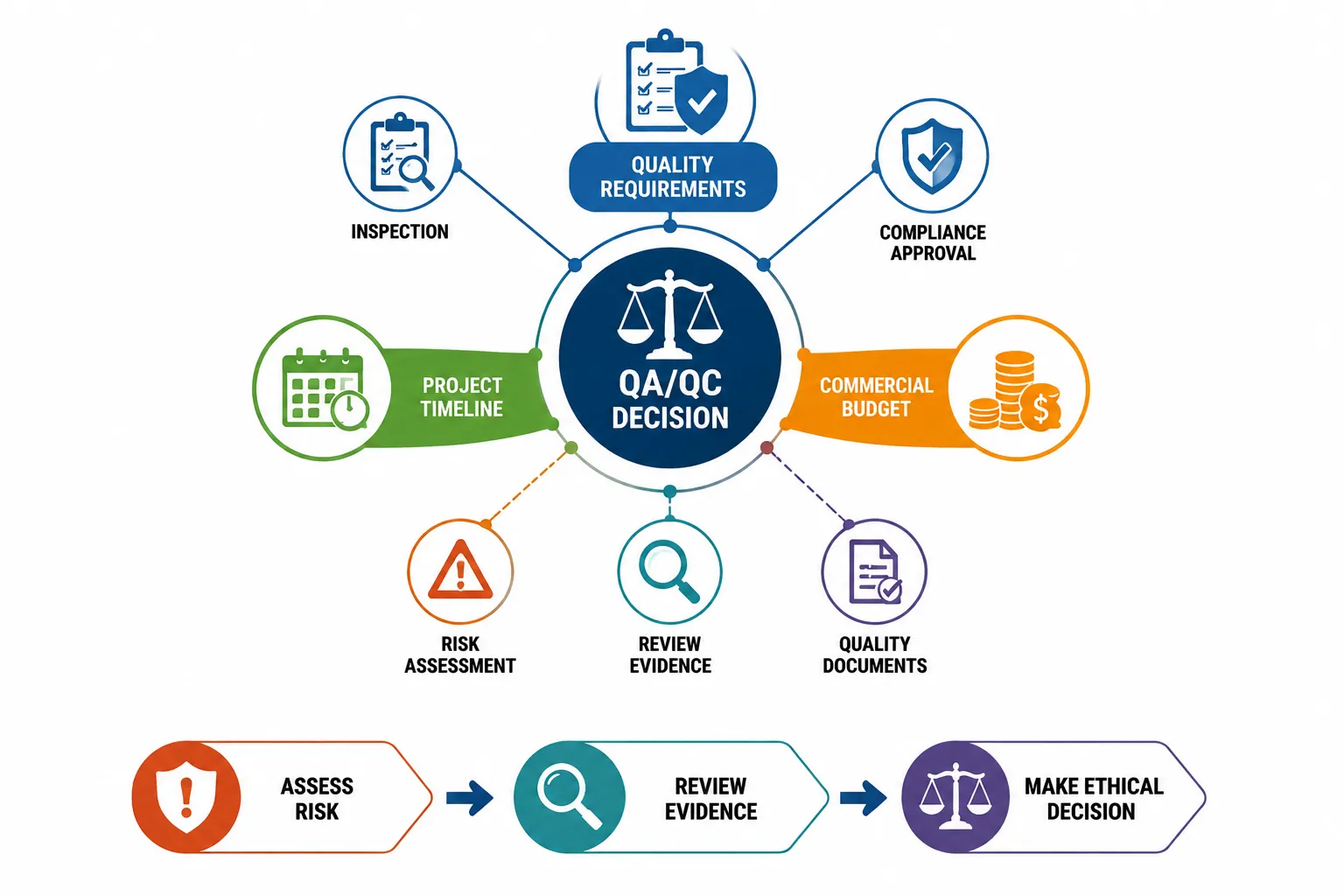
For example:
Reducing project time may increase pressure on inspections and testing.
Reducing cost may limit available quality resources.
Increasing quality requirements may require additional time or investment.
However, professional QA/QC leadership requires understanding that some quality requirements are not optional. Safety-critical testing, regulatory compliance, approved specifications and verification activities must be maintained regardless of commercial pressure.
The Role of QA/QC Leadership in Managing Conflicting Priorities
Senior QA/QC leaders act as a bridge between technical requirements and project objectives. Their responsibility is not to delay projects unnecessarily but to ensure that project decisions remain technically justified.
A professional QA/QC leader should:
Understand project objectives.
Protect essential quality requirements.
Identify acceptable alternatives.
Evaluate risks.
Communicate technical concerns.
Support efficient solutions.
Maintain ethical standards.
Provide evidence-based recommendations.
The role requires balancing professional independence with practical project awareness.
Key Concepts in Quality, Cost and Time Decision-Making
| Key Concept | Definition | Application in Electrical QA/QC |
|---|---|---|
| Quality Requirement | A defined condition or standard that work must satisfy | Ensuring electrical systems meet specifications |
| Project Constraint | A limitation affecting project delivery | Managing budget, resources and deadlines |
| Ethical Decision-Making | Selecting actions based on professional values and responsibilities | Protecting safety and quality under pressure |
| Risk-Based Decision | Choosing actions based on potential consequences | Prioritising critical electrical issues |
| Technical Integrity | Maintaining accuracy and reliability of engineering decisions | Preventing unacceptable acceptance decisions |
| Commercial Pressure | Influence created by financial or contractual demands | Managing budget-driven requests |
| Programme Pressure | Pressure to complete activities within required dates | Maintaining quality during deadlines |
| Value Engineering | Optimising cost without reducing required performance | Selecting efficient technical solutions |
| Quality Compromise | Reduction of standards that may affect performance | Avoiding unsafe cost-saving decisions |
| Corrective Action | Action taken to resolve identified problems | Restoring compliance |
| Preventive Action | Action taken to prevent future failures | Improving processes and reliability |
| Professional Judgement | Applying expertise to complex decisions | Evaluating competing project priorities |
Ethical Challenges When Quality Conflicts With Project Deadlines
One of the most challenging responsibilities for QA/QC professionals is managing situations where project teams request faster completion while quality verification remains incomplete.
Common examples include:
Requests to reduce inspection activities.
Pressure to accept incomplete documentation.
Requests to approve temporary solutions.
Delays in corrective action implementation.
Pressure to close non-conformities quickly.
Requests to use alternative materials without full assessment.
These situations require careful evaluation because short-term project benefits may create long-term technical risks.
Evaluating Deadline Pressure Against Quality Requirements
A project deadline may be influenced by:
Contract completion dates.
Client expectations.
Financial milestones.
Commissioning schedules.
Operational requirements.
However, QA/QC leaders should assess:
Is the required activity essential?
What risk exists if it is reduced?
Is there an alternative method?
Can resources be increased?
Can activities be resequenced?
Can efficiency improve without reducing quality?
The objective is not to choose quality over time or time over quality. The objective is to find solutions that maintain essential quality while improving project efficiency.
Scenario 1: Pressure to Complete Electrical Installation Without Full Inspection
Project Situation
An electrical installation project is approaching a major completion milestone. The construction team requests immediate approval because delays may affect contractual deadlines.
The QA/QC team identifies that:
Some inspection records are incomplete.
Certain installation checks require verification.
Testing evidence is not fully available.
Conflict
The project team prioritises:
Schedule completion.
Contract milestone achievement.
Cost control.
The QA/QC team prioritises:
Evidence-based acceptance.
Technical assurance.
Compliance.
Ethical Evaluation
A senior QA/QC leader should not simply reject progress or approve incomplete work.
The leader should:
Review outstanding requirements.
Identify critical versus non-critical issues.
Assess technical risk.
Develop an action plan.
Communicate clearly with stakeholders.
Appropriate Response
Possible solutions include:
Prioritising critical inspections.
Assigning additional competent inspectors.
Improving coordination.
Completing documentation verification in parallel.
Establishing a controlled completion plan.
The solution maintains quality while addressing programme concerns.
Scenario 2: Budget Reduction Affecting QA/QC Resources
Project Situation
A project experiences financial pressure, and management proposes reducing QA/QC staffing to lower costs.
Potential Risks
Reduced QA/QC resources may result in:
Delayed inspections.
Reduced testing oversight.
Increased defects.
Poor documentation.
Higher future rework costs.
Ethical Analysis
The QA/QC leader should evaluate whether the proposed reduction affects essential quality activities.
Considerations include:
Project complexity.
Electrical system criticality.
Inspection workload.
Competence requirements.
Risk exposure.
Appropriate Leadership Response
The leader should:
Present evidence-based risks.
Identify efficiency improvements.
Recommend appropriate resource levels.
Avoid unnecessary duplication.
Protect critical QA/QC activities.
Cost efficiency should not become quality neglect.
Scenario 3: Pressure to Accept Alternative Materials
Project Situation
A specified electrical component becomes unavailable. Procurement suggests using an alternative product to avoid project delay.
Conflict
The alternative may:
Reduce cost.
Improve availability.
Support programme recovery.
However, it may also require:
Technical review.
Approval.
Compatibility assessment.
Additional testing.
Ethical Evaluation
The QA/QC leader should ensure:
Technical suitability.
Approved change process.
Performance requirements.
Documentation updates.
The decision should be based on evidence rather than urgency.
Scenario 4: Reducing Testing Due to Programme Pressure
Project Situation
Commissioning activities are delayed, and project management requests reduced testing to recover time.
Ethical Concerns
Reducing testing may affect:
Safety.
Reliability.
Compliance.
Future maintenance.
System performance.
Professional Response
The QA/QC leader should evaluate:
Which tests are mandatory.
Which tests are risk-critical.
Whether additional resources can accelerate testing.
Whether sequencing can improve.
Testing requirements should only change through appropriate technical evaluation and approval.
Risk-Based Decision-Making Approach
A senior QA/QC professional should use risk-based thinking when evaluating conflicts.
The process includes:
Identify the Issue
Determine:
What quality requirement is affected?
What project pressure exists?
Who is impacted?
Assess Risk
Consider:
Safety impact.
Technical failure possibility.
Compliance consequences.
Financial consequences.
Operational impact.
Evaluate Options
Options may include:
Maintaining the original approach.
Increasing resources.
Changing sequence.
Applying approved alternatives.
Escalating the decision.
Select the Best Option
The preferred solution should:
Protect essential requirements.
Reduce unnecessary delay.
Be technically justified.
Be properly documented.
Balancing Commercial Considerations With Ethical Responsibilities
Commercial awareness is an important leadership skill. QA/QC professionals should understand project realities, including:
Budget limitations.
Contract obligations.
Client expectations.
Resource availability.
However, commercial considerations should not encourage unethical actions.
A professional leader should avoid:
Ignoring defects.
Reducing required inspections.
Accepting poor-quality materials.
Altering records.
Closing issues without evidence.
Ethical leadership means finding responsible solutions.
Value Engineering Without Reducing Quality
Value engineering can support cost efficiency when applied correctly.
Effective value engineering involves:
Reviewing design efficiency.
Removing unnecessary costs.
Improving processes.
Selecting suitable alternatives.
Optimising resources.
Poor value engineering may involve:
Reducing testing.
Lowering material quality.
Removing verification activities.
Ignoring lifecycle performance.
The difference is that good value engineering improves efficiency while maintaining required performance.
Managing Stakeholder Expectations
Conflicts often occur because stakeholders have different priorities.
Client Perspective
The client may prioritise:
Reliability.
Compliance.
Long-term performance.
Contractor Perspective
The contractor may prioritise:
Completion.
Cost control.
Resource efficiency.
Project Management Perspective
Project managers may prioritise:
Schedule.
Milestones.
Commercial outcomes.
QA/QC Perspective
QA/QC professionals prioritise:
Evidence.
Compliance.
Technical integrity.
A skilled leader aligns these perspectives through communication and evidence.
Communication Strategies During Quality Conflicts
Effective communication is essential when quality conflicts occur.
QA/QC leaders should:
Explain technical risks clearly.
Avoid emotional arguments.
Provide evidence.
Suggest practical solutions.
Communicate early.
Maintain professional relationships.
Poor communication can transform a manageable technical issue into a major dispute.
Decision-Making Framework for Complex QA/QC Conflicts
A structured framework helps leaders make consistent decisions.
Step 1: Understand the Situation
Identify:
Technical issue.
Project pressure.
Stakeholders involved.
Step 2: Review Requirements
Check:
Standards.
Specifications.
Procedures.
Contract requirements.
Step 3: Assess Consequences
Evaluate:
Safety.
Quality.
Cost.
Time.
Reputation.
Step 4: Develop Options
Consider:
Technical solutions.
Resource changes.
Alternative approaches.
Step 5: Evaluate Options
Assess:
Risk.
Compliance.
Practicality.
Long-term impact.
Step 6: Make a Professional Decision
Ensure the decision is:
Ethical.
Defensible.
Evidence-based.
Step 7: Document and Monitor
Maintain records and verify outcomes.
Case Study: Balancing Quality and Project Completion
Project Background
A large electrical infrastructure project is approaching final commissioning. The project is behind schedule due to design changes and procurement delays.
The project management team requests rapid completion.
Outstanding issues include:
Incomplete inspection documentation.
Several minor defects.
Testing schedule pressure.
Limited specialist resources.
Ethical Challenge
The QA/QC leader must balance:
Client expectations.
Contract deadlines.
Technical requirements.
Safety responsibilities.
Leadership Evaluation
The leader reviews:
Defect severity.
Testing requirements.
Documentation status.
Available resources.
Project risks.
Actions Taken
The QA/QC leader:
Categorises defects by risk.
Prioritises critical activities.
Allocates resources effectively.
Communicates risks.
Maintains required verification.
Creates a controlled completion plan.
Outcome
The project progresses toward completion without reducing essential quality controls.
Case Study Conclusion
The case demonstrates that ethical QA/QC leadership does not prevent successful project delivery. Instead, it supports sustainable success by ensuring that decisions consider technical reliability, stakeholder expectations and long-term consequences.
Benefits of Ethical Evaluation of Quality Conflicts
Effective evaluation of quality conflicts provides:
Improved decision-making.
Reduced technical risk.
Better stakeholder relationships.
Stronger quality culture.
Improved project reliability.
Reduced rework.
Better cost control.
Increased professional credibility.
Improved compliance performance.
Stronger engineering outcomes.
Common Mistakes When Managing Quality Conflicts
Prioritising Deadlines Above Safety
This can create unacceptable risks.
Accepting Unverified Work
This reduces quality assurance confidence.
Reducing QA/QC Resources Without Risk Assessment
This may increase future costs.
Ignoring Long-Term Consequences
Short-term savings may create lifecycle problems.
Making Decisions Without Evidence
This reduces professional credibility.
Failing to Communicate Risks
Stakeholders cannot make informed decisions without information.
Compromising Documentation
Incomplete records damage traceability.
Key Learning Points
Learners should understand that:
Quality, cost and time are interconnected project factors.
Ethical QA/QC leaders must balance competing priorities.
Deadlines should not justify unacceptable quality reduction.
Commercial pressures require professional judgement.
Risk-based decision-making supports better outcomes.
Evidence should guide technical decisions.
Value engineering should improve efficiency without reducing quality.
Stakeholder communication is essential during conflicts.
QA/QC independence must be protected.
Documentation provides accountability.
Long-term reliability should influence decisions.
Ethical leadership supports sustainable project success.
Conclusion
Electrical QA/QC leaders frequently face complex decisions where quality requirements conflict with project timelines and commercial budgets. Effective leadership requires a balanced approach that recognises legitimate project pressures while protecting essential technical, safety and compliance requirements. Through risk-based evaluation, ethical judgement, stakeholder communication and evidence-based decision-making, professionals can develop solutions that support both project success and engineering integrity.
The most successful QA/QC leaders understand that quality is not an obstacle to project delivery but a foundation for long-term performance. By maintaining professional ethics and applying structured decision-making methods, electrical engineering organisations can achieve reliable systems, improved stakeholder confidence and sustainable project outcomes.