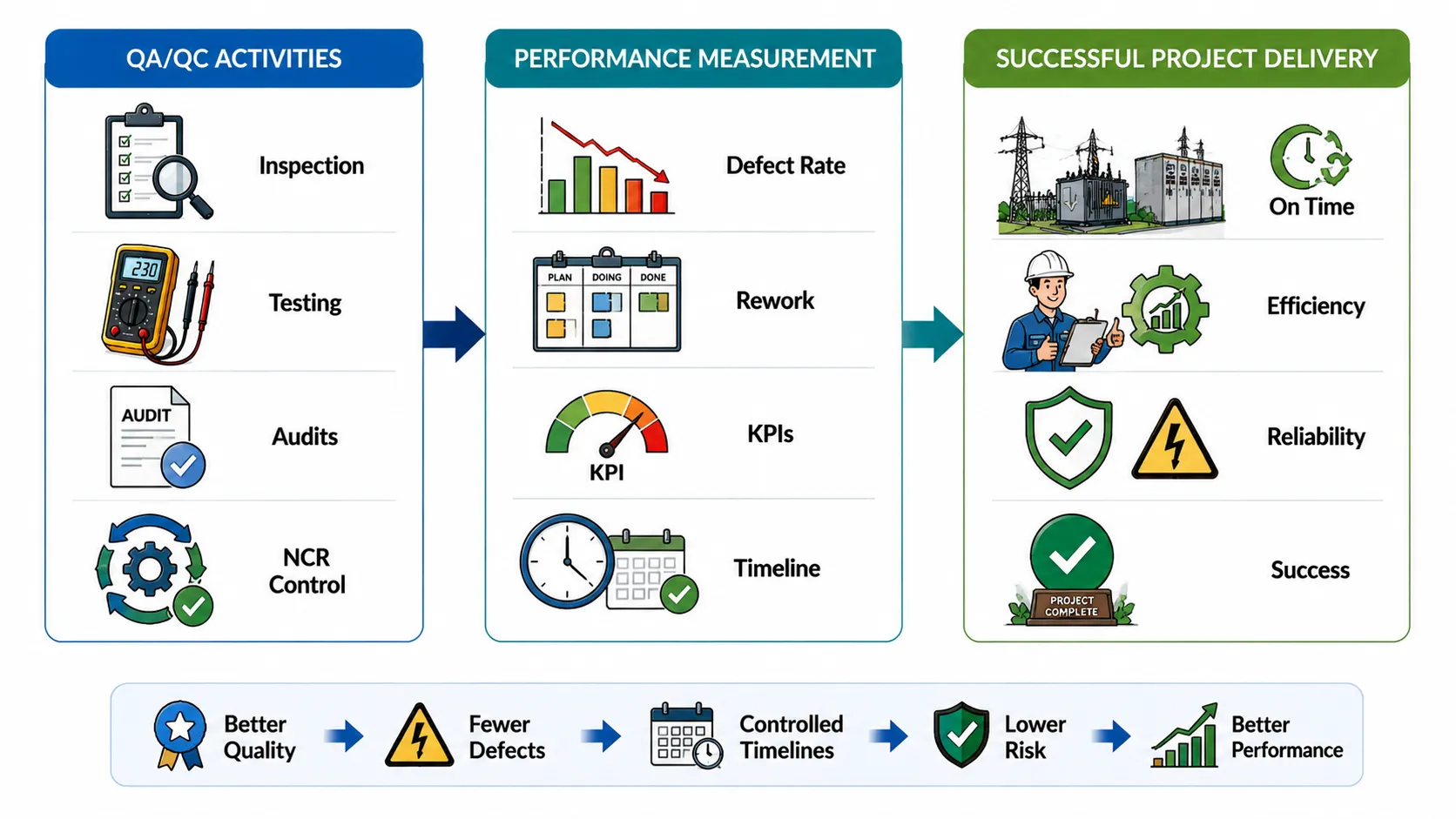
Lesson 5: Assess the Impact of Quality Management on Safety, Cost, and Project Performance in Electrical QA/QC Processes
Quality management plays a critical role in ensuring the successful delivery of complex electrical engineering projects by creating a structured approach to controlling risks, improving safety performance, managing costs, and achieving project objectives. In modern electrical environments, effective Quality Assurance and Quality Control (QA/QC) processes are not limited to identifying defects; they provide a strategic framework for preventing failures, improving reliability, and ensuring that electrical systems meet technical, regulatory, and client requirements. From the perspective of a Senior Chartered Electrical Engineer (CEng) and Senior Electrical QA/QC Engineer, quality management directly influences every stage of the electrical project lifecycle, including design, procurement, installation, testing, commissioning, and operational maintenance.
The integration of advanced QA/QC processes enables organisations to establish safer working environments by identifying potential hazards, controlling technical risks, and ensuring compliance with electrical safety standards and project specifications. Effective quality management reduces the likelihood of equipment failures, installation errors, testing issues, and operational risks that may affect personnel safety and system reliability. Through structured inspection plans, risk assessments, audits, non-conformance management, and continuous improvement practices, electrical engineering teams can improve safety outcomes while maintaining consistent quality performance.
Quality management also has a significant impact on project cost control and overall performance. Poor quality can result in expensive consequences, including rework, material wastage, project delays, equipment replacement, and additional labour requirements. By implementing robust QA/QC processes, organisations can identify issues at an early stage, improve resource utilisation, optimise workflows, and enhance project efficiency. Effective quality management therefore contributes to cost reduction, improved productivity, and successful project completion within planned timelines and budgets.
This lesson explores how quality management systems influence safety, cost efficiency, and project performance within electrical QA/QC operations. Learners will examine the relationship between quality practices and project success, evaluate the role of preventive quality strategies, analyse performance improvements, and understand how professional electrical engineers apply QA/QC principles to achieve safer, more reliable, and cost-effective electrical project outcomes. Through practical applications and industry-focused examples, this lesson develops the knowledge required to assess the wider impact of quality management in complex electrical engineering environments.
Analyze the Direct Relationship Between Advanced Quality Management and Electrical Safety Outcomes
Introduction to Advanced Quality Management and Electrical Safety Integration
Advanced quality management has become an essential component of modern electrical engineering projects because it directly influences safety performance, system reliability, and operational effectiveness. In complex electrical environments, safety outcomes are not achieved only through safety rules, personal protective equipment, or emergency procedures. A strong electrical safety culture depends on the ability of an organisation to establish controlled processes that prevent defects, minimise risks, and ensure that every stage of an electrical project meets defined quality requirements.
From the perspective of a Chartered Electrical Engineer (CEng) and Senior Electrical QA/QC Engineer Specialist, quality management and electrical safety are closely connected disciplines. Electrical failures frequently originate from weaknesses in quality processes, including poor design control, incorrect material selection, inadequate installation practices, insufficient testing, and ineffective documentation management. These quality failures can develop into serious safety hazards such as electrical shock, fire incidents, equipment damage, system instability, and operational failures.
Advanced Quality Assurance and Quality Control (QA/QC) processes create a preventive approach by identifying potential problems before they affect electrical safety. Instead of relying only on final inspections, advanced quality management focuses on controlling the complete project lifecycle, including design review, procurement verification, installation monitoring, testing, commissioning, and maintenance improvement.
The direct relationship between advanced quality management and electrical safety outcomes can be explained through the principle that:
A reliable quality management system creates safer electrical systems by preventing failures before they become hazards.
In professional electrical engineering practice, advanced quality management improves safety outcomes through:
- Effective risk identification and control.
- Improved design verification processes.
- Reliable equipment selection and inspection.
- Standardised installation procedures.
- Accurate testing and commissioning.
- Continuous monitoring and improvement.
- Prevention of repeated safety-related failures.
Understanding Advanced Quality Management in Electrical Engineering
Definition of Advanced Quality Management
Advanced quality management refers to the systematic application of improved quality principles, analytical methods, digital tools, and structured control processes to achieve consistent engineering performance and prevent failures.
Unlike traditional quality control methods that mainly focus on detecting defects after completion, advanced quality management focuses on prevention, prediction, and continuous improvement.
In electrical engineering projects, advanced quality management includes:
- Quality planning and strategy development.
- Risk-based quality control.
- Inspection and testing management.
- Process standardisation.
- Performance measurement.
- Root cause analysis.
- Corrective and preventive action management.
- Continuous improvement methodologies.
The purpose is to ensure that electrical systems are designed, installed, tested, and operated safely throughout their lifecycle.
Key Characteristics of Advanced Quality Management Systems
Advanced QA/QC systems are characterised by:
- Preventive rather than reactive quality practices.
- Integration of quality and safety objectives.
- Data-based decision-making.
- Continuous evaluation of performance.
- Effective communication between engineering teams.
- Standardised procedures and work instructions.
- Strong documentation control.
- Employee participation in improvement activities.
These characteristics help organisations identify safety risks early and introduce effective controls before failures occur.
Direct Relationship Between Quality Failures and Electrical Safety Risks
Quality Defects as Safety Hazards
In electrical engineering, many safety incidents are directly linked to failures in quality management processes. A defect may initially appear as a technical quality issue, but if it remains uncontrolled, it can become a major safety concern.
Examples include:
- Incorrect cable sizing causing overheating.
- Poor termination practices causing electrical arcing.
- Damaged insulation creating shock hazards.
- Incorrect protection settings causing equipment failure.
- Poor installation practices reducing system reliability.
- Inaccurate drawings causing unsafe modifications.
Advanced quality management prevents these issues by establishing control measures at every project stage.
Examples of Quality Issues Creating Safety Risks
Electrical safety risks can develop from:
Design Quality Failures
Poor design control may result in:
- Incorrect load calculations.
- Inadequate protection coordination.
- Improper equipment selection.
- Insufficient fault analysis.
Safety impact:
- Increased probability of electrical failures.
- Reduced system protection effectiveness.
- Higher operational risks.
Material Quality Failures
Poor material control may result in:
- Use of non-compliant components.
- Incorrect equipment specifications.
- Defective electrical accessories.
Safety impact:
- Reduced equipment reliability.
- Increased failure probability.
- Potential fire or operational hazards.
Installation Quality Failures
Poor installation practices may cause:
- Loose connections.
- Incorrect cable routing.
- Improper earthing.
- Damaged components.
Safety impact:
- Electrical shock risks.
- Equipment overheating.
- System malfunction.
Role of Quality Planning in Improving Electrical Safety Outcomes
Importance of Quality Planning
Quality planning establishes the foundation for achieving safe electrical project outcomes. It defines the methods, responsibilities, acceptance criteria, and verification activities required to ensure that electrical work complies with technical and safety requirements.
A well-developed quality plan ensures that safety considerations are integrated into project execution rather than treated as a separate activity.
Quality planning considers:
- Project specifications.
- Electrical standards and requirements.
- Safety objectives.
- Inspection requirements.
- Testing procedures.
- Responsibilities of QA/QC personnel.
Quality Planning Processes Supporting Safety
Advanced quality planning includes:
- Developing Inspection and Test Plans (ITPs).
- Identifying critical inspection points.
- Defining acceptance criteria.
- Establishing documentation requirements.
- Planning verification activities.
- Assigning quality responsibilities.
Benefits include:
- Early identification of potential risks.
- Improved control of project activities.
- Reduced installation errors.
- Better safety compliance.
Impact of Quality Control Activities on Electrical Safety
Inspection and Verification Processes
Quality control activities verify whether electrical systems, materials, and installation activities meet specified requirements.
Inspection activities include:
- Material receiving inspections.
- Equipment condition checks.
- Installation verification.
- Cable inspections.
- Connection inspections.
- Earthing system checks.
- Protection system verification.
These activities ensure that unsafe conditions are identified before energisation or operation.
Importance of Inspection Checklists
Inspection checklists provide a structured approach for ensuring that critical safety requirements are reviewed.
They help QA/QC teams verify:
- Correct installation practices.
- Compliance with approved drawings.
- Equipment suitability.
- Workmanship quality.
- Completion of required tests.
Benefits include:
- Reduced human error.
- Improved consistency.
- Better traceability.
Role of Testing and Commissioning in Electrical Safety Assurance
Importance of Electrical Testing
Testing and commissioning provide technical confirmation that electrical systems are safe, reliable, and ready for operation.
Testing identifies hidden defects that cannot always be detected through visual inspections.
Common testing activities include:
- Insulation resistance testing.
- Continuity testing.
- Earth resistance testing.
- Protection relay testing.
- Functional performance testing.
- Equipment verification.
Safety Outcomes Achieved Through Testing
Effective testing supports electrical safety by:
- Detecting installation defects.
- Confirming equipment performance.
- Verifying protection system operation.
- Reducing operational risks.
For example, protection relay testing ensures that electrical faults are detected and isolated correctly, preventing equipment damage and improving personnel safety.
Role of Quality Audits in Electrical Safety Improvement
Purpose of Quality Auditing
Quality audits evaluate whether quality processes are effective and whether project activities comply with established requirements.
Audits examine:
- Process implementation.
- Documentation accuracy.
- Inspection effectiveness.
- Corrective action performance.
- Compliance with procedures.
Safety Benefits of Quality Audits
Regular quality audits improve electrical safety by:
- Identifying weaknesses before incidents occur.
- Improving process control.
- Ensuring corrective actions are completed.
- Supporting continuous improvement.
Examples of audit findings include:
- Missing inspection records.
- Incomplete testing documents.
- Uncontrolled changes.
- Incorrect installation practices.
Non-Conformance Management and Safety Risk Control
Understanding Non-Conformance Management
A non-conformance occurs when materials, processes, or completed work do not meet specified requirements.
In electrical projects, non-conformities may include:
- Failed testing results.
- Incorrect installation.
- Defective materials.
- Documentation errors.
Importance of Effective NCR Management
A strong non-conformance management process ensures that:
- Problems are identified quickly.
- Causes are investigated.
- Corrective actions are implemented.
- Similar failures are prevented.
This directly improves electrical safety by ensuring unsafe conditions are corrected before system operation.
Advanced Quality Management Principles Supporting Electrical Safety
Risk-Based Quality Management
Risk-based quality management identifies possible failures and establishes preventive controls.
Applications include:
- Electrical hazard identification.
- Equipment reliability assessment.
- Installation risk evaluation.
- Maintenance planning.
Benefits:
- Reduced safety incidents.
- Improved preventive actions.
- Better resource allocation.
Process Standardisation
Standardised processes reduce variation and improve consistency.
Examples include:
- Approved installation procedures.
- Standard testing methods.
- Controlled inspection processes.
- Defined documentation requirements.
Benefits:
- Reduced human error.
- Improved safety performance.
- Consistent project outcomes.
Continuous Improvement Approach
Continuous improvement ensures that safety performance improves continuously through learning and evaluation.
Activities include:
- Reviewing incidents.
- Analysing defects.
- Updating procedures.
- Implementing lessons learned.
Benefits:
- Improved safety culture.
- Reduced repeated failures.
- Enhanced engineering performance.
Quality Management Activities and Their Impact on Electrical Safety
| Quality Management Activity | Definition | Safety Impact | Electrical Engineering Application |
|---|---|---|---|
| Quality Planning | Establishing quality requirements and control methods before execution | Prevents unsafe practices through planned controls | Developing Inspection and Test Plans |
| Inspection and Testing | Verification of materials, installation, and system performance | Identifies defects before operation | Cable, equipment, and protection testing |
| Quality Auditing | Reviewing processes for compliance and effectiveness | Detects weaknesses affecting safety | Project quality audits |
| Non-Conformance Management | Controlling and correcting defective work | Prevents unsafe conditions from remaining unresolved | Managing failed inspections |
| Continuous Improvement | Improving processes through evaluation and learning | Enhances safety performance over time | Applying lessons learned |
Practical Example: Improving Electrical Safety Through Advanced QA/QC
Project Background
A large industrial electrical installation project experienced repeated quality concerns during construction activities. The main issues included:
- Incorrect cable termination.
- Inconsistent inspection practices.
- Testing delays.
- Documentation gaps.
These issues created potential risks for future operation.
Quality Management Improvements Implemented
The organisation introduced:
- Improved inspection procedures.
- Detailed Inspection and Test Plans.
- Regular quality audits.
- Root Cause Analysis.
- Additional technical training.
Safety Improvements Achieved
The improvements resulted in:
- Reduced installation defects.
- Improved testing accuracy.
- Better identification of safety risks.
- Increased confidence before energisation.
- Improved system reliability.
This example demonstrates that advanced quality management directly contributes to improved electrical safety outcomes by preventing defects and strengthening project control.
Advanced Integration of Quality Management Systems for Improving Electrical Safety Performance
Role of Quality Management Systems in Preventing Electrical Safety Incidents
Advanced Quality Management Systems (QMS) provide a structured framework that connects quality objectives with electrical safety requirements. In complex electrical engineering projects, safety incidents are often caused by failures in planning, process control, communication, or verification activities rather than isolated technical mistakes.
A well-developed QMS ensures that safety is incorporated into every stage of project execution. It establishes procedures that control risks, verify compliance, and continuously improve engineering practices.
Advanced QMS supports electrical safety by:
Establishing clear quality responsibilities.
Controlling engineering changes.
Ensuring compliance with technical requirements.
Improving communication between project teams.
Monitoring safety-related quality indicators.
Providing evidence-based improvement decisions.
The integration of quality and safety management enables organisations to move from a reactive approach, where incidents are investigated after occurrence, towards a preventive approach where risks are identified and controlled before they create hazards.
Integration of Risk Management with Quality and Safety Processes
Importance of Risk-Based Quality Management
Risk-based thinking is a fundamental principle of advanced quality management. It allows electrical engineering organisations to identify potential failures and introduce preventive measures before problems affect safety.
Electrical projects involve various risks, including:
Electrical shock hazards.
Equipment malfunction.
Fire risks.
Protection system failures.
Installation errors.
Human performance issues.
Advanced QA/QC processes evaluate these risks throughout the project lifecycle.
Risk Management Process in Electrical QA/QC
A structured risk management process includes:
Identifying potential hazards.
Evaluating the likelihood and impact of failures.
Establishing preventive controls.
Monitoring risk performance.
Reviewing improvement opportunities.
This process improves safety outcomes by ensuring that critical risks receive appropriate attention.
Application of Failure Prevention Techniques in Electrical Safety
Failure Mode and Effects Analysis (FMEA)
FMEA is an advanced quality technique used to identify potential failures before they occur. It supports electrical safety by analysing possible failure modes and their consequences.
FMEA evaluates:
Possible equipment failures.
Causes of failures.
Effects on system operation.
Existing control measures.
Required preventive actions.
Electrical applications include:
Transformer reliability assessment.
Switchgear performance evaluation.
Protection system analysis.
Critical equipment review.
Benefits of FMEA for Electrical Safety
FMEA contributes to:
Early identification of safety risks.
Improved equipment reliability.
Reduced unexpected failures.
Better maintenance planning.
Enhanced operational safety.
Role of Root Cause Analysis in Improving Safety Outcomes
Moving Beyond Temporary Solutions
A common weakness in traditional quality management is addressing only the visible symptoms of a problem. Advanced QA/QC systems focus on identifying the actual causes behind failures.
Root Cause Analysis (RCA) helps organisations understand:
Why a failure occurred.
Which process weaknesses contributed.
How similar problems can be prevented.
RCA Process in Electrical Projects
The RCA process generally involves:
Defining the problem.
Collecting technical information.
Analysing contributing factors.
Identifying root causes.
Implementing corrective actions.
Monitoring effectiveness.
Example: Electrical Equipment Failure
A transformer experiences repeated overheating problems.
A basic response may involve replacing damaged components.
An advanced quality approach investigates:
Installation conditions.
Loading conditions.
Maintenance records.
Testing procedures.
Design assumptions.
The final improvement may involve:
Updating inspection procedures.
Improving monitoring systems.
Revising maintenance requirements.
This prevents repeated safety risks.
Continuous Improvement and Long-Term Electrical Safety Enhancement
Importance of Continuous Safety Improvement
Electrical safety performance must continuously improve because projects, technologies, and operational conditions constantly change.
Continuous improvement methods such as:
PDCA.
Six Sigma.
Kaizen.
TQM.
Lean improvement.
support ongoing safety enhancement.
PDCA Application in Electrical Safety
The PDCA cycle improves safety through:
Plan
Identify safety weaknesses and develop improvement strategies.
Examples:
Reviewing incident records.
Identifying high-risk activities.
Developing improved procedures.
Do
Implement selected improvements.
Examples:
Updating inspection methods.
Training personnel.
Improving testing procedures.
Check
Evaluate whether improvements achieved expected results.
Examples:
Reviewing safety performance data.
Monitoring defect reduction.
Act
Standardise successful improvements.
Examples:
Updating procedures.
Applying lessons learned to future projects.
Measuring the Impact of Quality Management on Electrical Safety
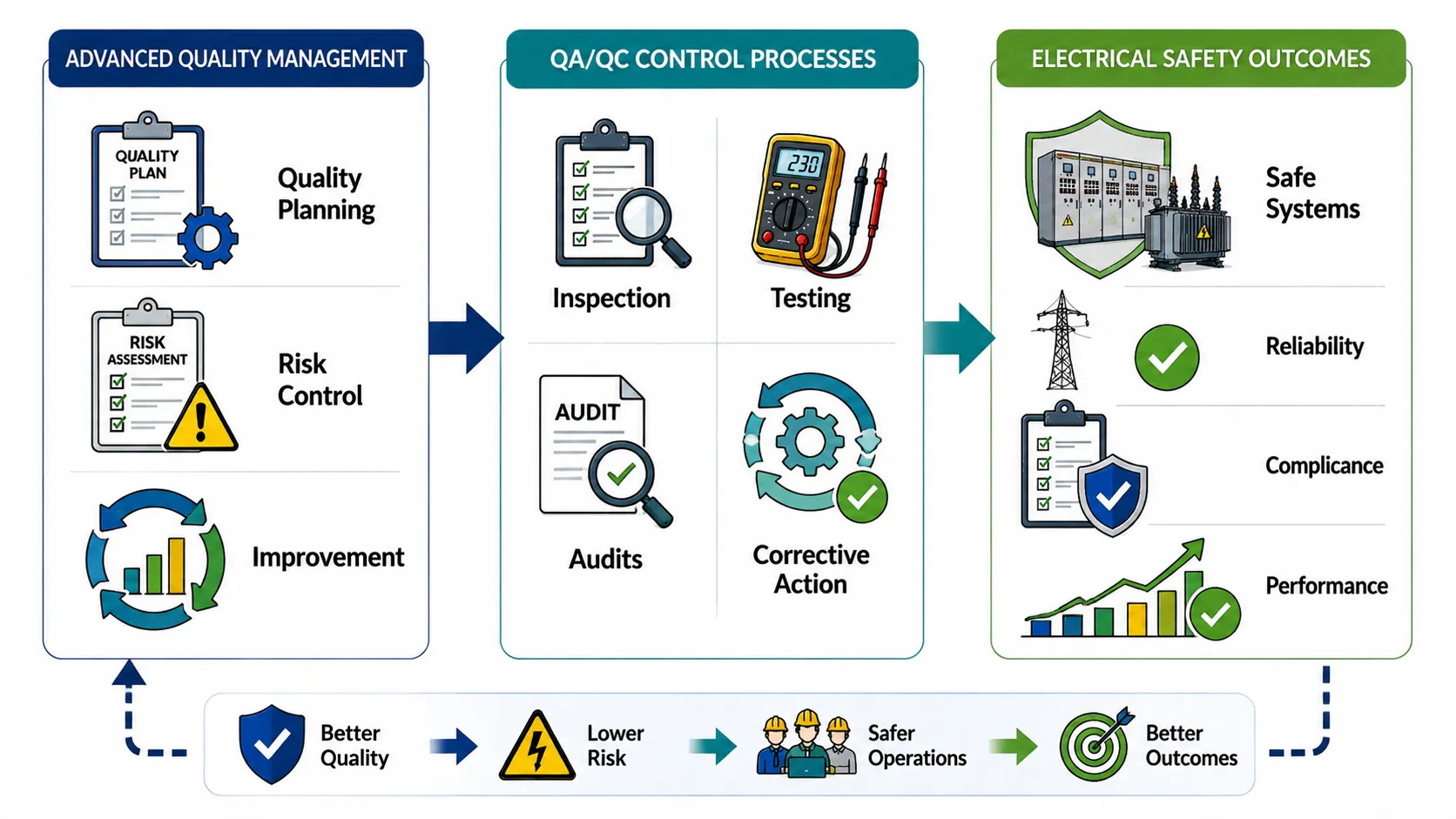
Safety and Quality Performance Indicators
Measurement is essential for determining whether quality management improvements are producing safer outcomes.
Important indicators include:
| Performance Indicator | Definition | Safety Improvement Application |
|---|---|---|
| Electrical Defect Rate | Number of identified quality defects within electrical activities | Measures effectiveness of defect prevention |
| Testing Failure Rate | Frequency of unsuccessful testing activities | Evaluates reliability of electrical systems |
| Non-Conformance Reports | Records of work not meeting requirements | Identifies safety-related quality weaknesses |
| Corrective Action Completion Time | Time required to resolve identified problems | Measures response effectiveness |
| Audit Findings | Issues identified during quality reviews | Evaluates process compliance |
Benefits of Performance Measurement
Effective measurement supports:
Early identification of safety risks.
Improved decision-making.
Better resource allocation.
Evidence-based improvements.
Stronger quality culture.
Digital Technologies Supporting Quality and Safety Improvement
Digital Quality Management Systems
Modern electrical projects increasingly use digital tools to improve quality and safety monitoring.
Digital QMS platforms support:
Real-time inspection records.
Automated reporting.
Defect tracking.
Corrective action monitoring.
Performance dashboards.
These technologies improve visibility of quality issues and allow faster responses.
Benefits of Digital Integration
Digital quality systems provide:
Improved traceability.
Reduced documentation errors.
Faster communication.
Better safety monitoring.
Improved project control.
Human Factors and Quality Management Influence on Electrical Safety
Importance of Competence and Training
Human performance is a major factor influencing electrical safety outcomes. Advanced quality management recognises that competent personnel are essential for reliable project execution.
Quality systems support competence through:
Training programmes.
Skills assessment.
Procedure awareness.
Performance evaluation.
Employee Involvement in Safety Improvement
Employees working directly with electrical systems often identify practical risks that may not be visible through documentation reviews.
Employee involvement supports:
Hazard identification.
Practical improvement suggestions.
Better compliance.
Stronger safety culture.
Case Study: Quality Management Improving Safety in a High-Voltage Substation Project
Project Background
A high-voltage substation project experienced several safety-related quality concerns during construction and commissioning.
The main challenges included:
Incorrect cable termination practices.
Inconsistent inspection records.
Delayed testing activities.
Equipment installation variations.
Although no major incident occurred, the project team identified increased future operational risks.
Quality Management Improvement Strategy
The organisation implemented an advanced QA/QC improvement programme.
Actions included:
Developing improved Inspection and Test Plans.
Introducing additional quality inspections.
Applying Root Cause Analysis.
Implementing FMEA for critical equipment.
Improving technician competency training.
Introducing digital quality monitoring.
Safety Performance Improvements
After implementation:
Cable installation defects reduced.
Testing reliability improved.
Unsafe conditions were identified earlier.
Commissioning confidence increased.
Equipment reliability improved.
The project demonstrated that effective quality management directly contributes to safer electrical operations.
Challenges in Integrating Quality Management with Electrical Safety
Resistance to Process Changes
Some organisations experience resistance when introducing advanced quality practices.
Common causes include:
Lack of awareness.
Additional documentation requirements.
Limited training.
Solutions include:
Employee engagement.
Clear communication.
Practical training.
Poor Quality Data Management
Without accurate data, organisations cannot effectively measure improvement.
Challenges include:
Incomplete records.
Incorrect reporting.
Delayed information sharing.
Solutions include:
Digital systems.
Standard reporting procedures.
Data verification.
Limited Leadership Support
Continuous improvement requires commitment from senior management.
Leadership responsibilities include:
Providing resources.
Supporting training.
Reviewing performance.
Encouraging improvement culture.
Key Benefits of Advanced Quality Management for Electrical Safety
Advanced quality management creates significant safety improvements, including:
Reduction in electrical failures.
Improved equipment reliability.
Better hazard identification.
Reduced safety incidents.
Improved compliance.
Stronger engineering controls.
Better project confidence.
Improved operational performance.
Additional organisational benefits include:
Lower maintenance costs.
Reduced project delays.
Improved stakeholder trust.
Stronger reputation for quality performance.
Conclusion
Advanced quality management has a direct and measurable impact on electrical safety outcomes by creating systems that prevent failures, control risks, and continuously improve engineering performance. In modern electrical projects, quality and safety cannot be managed separately because poor quality processes often create the conditions that lead to safety hazards.
Through effective quality planning, inspection and testing, risk-based thinking, FMEA, Root Cause Analysis, continuous improvement, digital monitoring, and performance evaluation, organisations can significantly improve electrical safety performance.
For Chartered Electrical Engineers and Senior Electrical QA/QC professionals, integrating advanced quality management principles into project activities ensures that electrical systems are safer, more reliable, compliant, and capable of delivering long-term operational performance.
2. Evaluate the Financial Impact of Quality Management Systems on Complex Electrical Project Budgets
Introduction to the Financial Relationship Between Quality Management and Electrical Project Budgets
Quality management systems (QMS) have a significant financial influence on complex electrical engineering projects because they determine how effectively resources are controlled, risks are managed, defects are prevented, and project objectives are achieved within allocated budgets. In large-scale electrical projects, financial performance is not only influenced by initial design and construction costs but also by the effectiveness of quality processes implemented throughout the project lifecycle.
From the perspective of a Chartered Electrical Engineer (CEng) and Senior Electrical QA/QC Engineer Specialist, quality management should not be considered an additional expense that increases project costs. Instead, it represents a strategic investment that protects project budgets by reducing failures, preventing rework, improving productivity, and ensuring efficient utilisation of materials, labour, and equipment.
Complex electrical projects such as power generation facilities, substations, industrial electrical installations, renewable energy systems, and infrastructure projects involve significant financial risks. Poor quality decisions during design, procurement, installation, or commissioning stages can create substantial cost consequences, including:
- Material replacement costs.
- Additional labour requirements.
- Project schedule delays.
- Equipment failures.
- Contract penalties.
- Increased maintenance expenses.
- Reduced operational reliability.
Advanced quality management systems address these challenges by introducing structured controls that identify problems early and prevent costly failures from progressing through the project lifecycle.
The financial relationship between quality management and project budgets can be summarised as:
Investment in effective QA/QC systems reduces the overall cost of electrical projects by preventing defects, improving efficiency, and increasing long-term asset performance.
Understanding Quality Management Systems in Electrical Project Cost Control
Definition of Quality Management Systems
A Quality Management System (QMS) is a structured framework of processes, procedures, responsibilities, and controls used to ensure that project activities consistently meet specified requirements.
In electrical engineering projects, a QMS provides control over:
- Design quality.
- Material procurement.
- Installation activities.
- Testing and commissioning.
- Documentation management.
- Corrective actions.
- Continuous improvement.
The purpose of a QMS is to ensure that project outputs meet technical, safety, regulatory, and client expectations while controlling unnecessary costs.
Role of QMS in Financial Management
A strong quality management system contributes to financial control by:
- Preventing defects before they occur.
- Improving project planning accuracy.
- Reducing unnecessary resource consumption.
- Controlling material wastage.
- Minimising delays.
- Improving productivity.
Effective QA/QC processes allow project managers and engineers to make informed decisions based on quality performance data rather than reacting to unexpected failures.
Relationship Between Quality Investment and Project Cost Performance
Quality as a Preventive Financial Strategy
Many organisations incorrectly view quality management as a cost-generating activity because it requires investment in:
- Quality personnel.
- Inspection activities.
- Testing equipment.
- Training.
- Documentation systems.
However, advanced quality management creates financial value by reducing the much higher costs associated with poor quality.
The cost of preventing a defect during early project stages is usually significantly lower than correcting a failure after installation or commissioning.
For example:
- Identifying an incorrect cable specification during design review requires minor corrective action.
- Discovering the same issue after installation may require cable replacement, additional labour, project delays, and system testing.
Therefore, quality management provides financial protection by controlling risks before they become expensive problems.
Financial Consequences of Poor Quality Management
Weak quality systems can negatively affect electrical project budgets through:
- Increased rework requirements.
- Additional material consumption.
- Extended project completion periods.
- Increased labour costs.
- Reduced equipment lifespan.
- Additional maintenance requirements.
Common examples include:
- Replacing incorrectly installed electrical components.
- Re-testing failed electrical systems.
- Correcting documentation errors.
- Repairing damaged equipment caused by poor installation practices.
Understanding the Cost of Quality (COQ) in Electrical Projects
Definition of Cost of Quality
The Cost of Quality (COQ) refers to the total financial impact associated with achieving quality requirements and managing quality failures.
COQ is divided into four main categories:
- Prevention costs.
- Appraisal costs.
- Internal failure costs.
- External failure costs.
Understanding these categories helps electrical project teams evaluate where quality investments provide the greatest financial benefit.
Prevention Costs in Electrical Quality Management
Definition of Prevention Costs
Prevention costs are investments made to avoid defects and failures before they occur.
In electrical engineering projects, prevention activities include:
- Quality planning.
- Engineering reviews.
- Staff training.
- Procedure development.
- Risk assessments.
- Supplier qualification.
Financial Benefits of Prevention Activities
Although prevention requires early investment, it reduces future project expenses by:
- Avoiding rework.
- Reducing errors.
- Improving productivity.
- Preventing safety-related failures.
Examples include:
- Reviewing electrical designs before construction begins.
- Training technicians on correct installation methods.
- Establishing approved supplier requirements.
These activities protect project budgets by reducing expensive corrective actions.
Appraisal Costs and Their Financial Role
Definition of Appraisal Costs
Appraisal costs are expenses associated with evaluating whether project activities meet quality requirements.
Examples include:
- Inspection activities.
- Testing procedures.
- Audits.
- Verification processes.
Importance of Appraisal Activities
Appraisal activities help detect problems before they become larger financial issues.
Examples:
- Testing insulation resistance before energisation.
- Inspecting cable termination quality.
- Verifying equipment specifications before installation.
Benefits include:
- Early defect detection.
- Reduced correction costs.
- Improved project reliability.
Internal Failure Costs in Electrical Projects
Definition of Internal Failure Costs
Internal failure costs occur when defects are identified before the project is delivered or commissioned.
Examples include:
- Failed testing.
- Incorrect installation.
- Material rejection.
- Rework activities.
Financial Impact of Internal Failures
Internal failures increase project costs through:
- Additional labour.
- Material replacement.
- Extended schedules.
- Additional inspection requirements.
Advanced QMS reduces internal failure costs by improving process control and early detection.
External Failure Costs in Electrical Projects
Definition of External Failure Costs
External failure costs occur when quality problems are discovered after project completion or during operation.
Examples include:
- Equipment breakdown.
- Customer complaints.
- Warranty claims.
- Operational interruptions.
Financial Risks of External Failures
External failures can create significant financial consequences:
- High repair costs.
- Contract disputes.
- Reputation damage.
- Loss of client confidence.
Effective QA/QC systems minimise these risks by ensuring that defects are controlled before project handover.
Impact of Quality Management on Material Cost Control
Importance of Material Quality Management
Electrical projects involve expensive materials and equipment, including:
- Transformers.
- Switchgear.
- Cables.
- Protection devices.
- Control systems.
Poor material management can create significant budget problems.
Advanced quality systems ensure:
- Correct material selection.
- Supplier verification.
- Incoming inspection.
- Storage control.
- Traceability.
Financial Benefits of Material Quality Control
Effective material quality management helps to:
- Reduce material wastage.
- Prevent incorrect purchases.
- Avoid replacement costs.
- Improve inventory control.
For example, verifying transformer specifications before delivery prevents expensive replacement after installation.
Influence of QA/QC on Labour and Productivity Costs
Relationship Between Quality and Workforce Efficiency
Poor quality increases labour costs because teams must spend additional time correcting mistakes.
Examples include:
- Reinstalling electrical components.
- Repeating testing activities.
- Correcting documentation.
- Repairing installation errors.
Advanced QA/QC improves productivity by ensuring:
- Clear work procedures.
- Better coordination.
- Reduced mistakes.
- Efficient workflow.
Labour Cost Benefits
Effective quality management contributes to:
- Reduced rework hours.
- Improved workforce utilisation.
- Better project scheduling.
- Increased installation efficiency.
Quality Management and Project Schedule Cost Control
Impact of Quality on Project Timelines
Project delays often create additional financial costs.
Causes include:
- Failed inspections.
- Equipment replacement.
- Testing failures.
- Poor coordination.
Advanced quality management reduces delays through:
- Early problem identification.
- Improved planning.
- Better communication.
- Effective corrective actions.
Financial Benefits of Schedule Protection
Maintaining project schedules helps organisations avoid:
- Delay penalties.
- Additional labour expenses.
- Equipment standby costs.
- Contract disputes.
Quality Management Activity and Financial Impact on Electrical Projects
| Quality Management Activity | Definition | Financial Impact | Electrical Project Application |
|---|---|---|---|
| Quality Planning | Establishing quality requirements before project execution | Reduces future correction costs | Developing electrical QA/QC plans |
| Inspection and Testing | Verification of materials and completed work | Prevents expensive failures | Equipment and cable testing |
| Supplier Quality Control | Ensuring suppliers provide compliant materials | Reduces replacement costs | Transformer and switchgear verification |
| Non-Conformance Management | Controlling defective work | Minimises rework expenses | Managing installation defects |
| Continuous Improvement | Improving processes through lessons learned | Reduces repeated costs | Improving future project performance |
Practical Example: Financial Benefits of Quality Management in an Electrical Project
Project Background
A large industrial electrical installation project faced increasing cost pressures due to:
- Installation defects.
- Repeated testing failures.
- Material inconsistencies.
- Schedule delays.
The project team implemented an advanced QMS approach.
Quality Improvements Implemented
The organisation introduced:
- Improved inspection procedures.
- Supplier quality checks.
- Additional design reviews.
- Digital defect tracking.
- Root cause analysis.
Financial Improvements Achieved
The project experienced:
- Reduced rework costs.
- Lower material wastage.
- Improved labour productivity.
- Reduced testing delays.
- Better budget control.
This example demonstrates that quality management systems provide measurable financial benefits by preventing problems before they affect project budgets.
Advanced Financial Evaluation of Quality Management Systems in Complex Electrical Projects
Evaluating Return on Quality Investment in Electrical Engineering Projects
Understanding Return on Quality Investment (ROQI)
Return on Quality Investment (ROQI) is an approach used to evaluate whether the financial investment made in quality management activities generates measurable benefits for an organisation. In complex electrical engineering projects, quality investments should be assessed not only by their immediate cost but also by their ability to reduce future expenses, improve project efficiency, and increase asset reliability.
A quality management system creates financial value when the savings achieved through defect prevention, reduced rework, improved productivity, and lower maintenance requirements exceed the cost of implementing quality processes.
In electrical projects, ROQI evaluation considers:
Cost of implementing QA/QC systems.
Reduction in defect-related expenses.
Improvement in project delivery performance.
Reduction in operational failures.
Increased equipment reliability.
Advanced quality management provides financial advantages by shifting project management from a failure correction approach to a prevention-based approach.
Financial Benefits of Quality Investment
Investment in quality management creates measurable financial improvements through:
Reduced project rework.
Improved labour efficiency.
Lower material wastage.
Reduced testing repetition.
Improved equipment performance.
Lower maintenance costs.
Reduced contractual risks.
For example, implementing advanced inspection procedures during electrical installation may increase early project costs, but it prevents expensive failures during commissioning and operation.
Impact of Quality Management Systems on Project Lifecycle Costs
Influence During Design Phase
The design phase has a major influence on the overall financial performance of an electrical project. Errors introduced during design can create significant costs during construction and operation.
Advanced quality management supports design cost control through:
Design verification reviews.
Electrical calculation checks.
Protection system analysis.
Compliance verification.
Engineering document control.
Benefits include:
Reduced design modifications.
Prevention of incorrect equipment selection.
Improved construction planning.
Lower risk of expensive changes.
A design error identified during review has a minimal financial impact compared with a design error discovered after installation.
Influence During Procurement Phase
Procurement quality management ensures that electrical materials and equipment meet project requirements before delivery.
Procurement quality controls include:
Supplier evaluation.
Material approval processes.
Factory acceptance testing.
Technical specification reviews.
Delivery inspections.
Financial advantages include:
Prevention of unsuitable equipment purchases.
Reduced replacement costs.
Improved supplier reliability.
Better inventory management.
For example, verifying switchgear specifications before purchase prevents costly replacement after delivery.
Influence During Construction Phase
Construction activities represent one of the highest financial risk areas in electrical projects because errors can directly affect schedule, labour costs, and system performance.
Quality management controls during construction include:
Installation inspections.
Work procedure verification.
Testing supervision.
Progress quality monitoring.
Defect tracking.
Financial benefits include:
Reduced reinstallation costs.
Lower labour wastage.
Improved productivity.
Fewer project delays.
Financial Impact of Reducing Rework and Defects
Relationship Between Defects and Project Costs
Rework is one of the largest sources of unnecessary cost in electrical projects. When work is completed incorrectly, organisations must spend additional resources to correct the problem.
Common causes of electrical project rework include:
Incorrect cable installation.
Failed equipment testing.
Incorrect termination.
Poor documentation.
Installation deviations.
How QA/QC Reduces Rework Costs
Advanced QA/QC systems reduce rework by:
Identifying defects early.
Establishing inspection checkpoints.
Improving communication.
Controlling installation procedures.
Ensuring compliance before completion.
Benefits include:
Reduced labour hours.
Reduced material consumption.
Improved schedule performance.
Increased project profitability.
Financial Influence of Quality Management on Equipment Reliability
Relationship Between Quality and Asset Performance
Electrical equipment represents a significant investment in complex projects. Poor quality installation or inadequate testing can reduce equipment lifespan and increase operational costs.
Quality management improves equipment reliability through:
Correct installation practices.
Proper testing procedures.
Quality material selection.
Preventive controls.
Long-Term Financial Benefits
Reliable electrical systems provide:
Reduced maintenance expenses.
Fewer unexpected failures.
Improved operational availability.
Longer equipment lifespan.
For example, high-quality transformer installation and commissioning reduce the likelihood of future failures that could result in expensive downtime.
Role of Digital Quality Management Systems in Budget Optimisation
Digital Transformation of QA/QC Processes
Modern electrical projects increasingly use digital quality management systems to improve financial control and project visibility.
Digital QMS platforms support:
Real-time inspection tracking.
Automated reporting.
Defect monitoring.
Document control.
Performance analysis.
Financial Benefits of Digital Quality Systems
Digital integration helps organisations:
Reduce administrative costs.
Improve reporting accuracy.
Identify cost risks earlier.
Improve decision-making speed.
Digital dashboards allow project managers to identify quality issues before they create significant budget impacts.
Quality Management and Risk-Based Budget Planning
Importance of Quality Risk Assessment
Quality risks can create unexpected financial pressures if they are not identified during project planning.
Risk-based quality management helps organisations evaluate:
Probability of defects.
Financial consequences.
Required preventive actions.
Resource allocation.
Benefits of Risk-Based Budget Control
Risk-based planning supports:
Better contingency planning.
More accurate cost forecasting.
Reduced unexpected expenses.
Improved project confidence.
Electrical projects with strong risk-based quality planning are more likely to achieve budget targets.
Cost-Benefit Analysis of Quality Management Systems
Purpose of Cost-Benefit Analysis
Cost-benefit analysis compares the financial investment required for quality activities with the financial benefits achieved through improved performance.
A project team evaluates:
Quality implementation costs.
Expected savings.
Risk reduction benefits.
Long-term financial improvements.
Quality Cost Evaluation Process
The evaluation process includes:
Identifying quality-related expenses.
Measuring failure costs.
Estimating improvement benefits.
Comparing investment against savings.
This approach supports management decisions regarding quality resource allocation.
Financial Performance Indicators for Quality Management Evaluation
Effective evaluation requires measurable indicators that demonstrate the financial impact of quality systems.
Important indicators include:
Cost of Rework
Measures:
Additional labour expenses.
Material replacement costs.
Additional testing requirements.
Improvement result:
Lower correction costs.
Better productivity.
Defect Cost Percentage
Measures:
Financial impact of quality failures compared with project budget.
Improvement result:
Better cost control.
Reduced failure expenditure.
Schedule Delay Cost
Measures:
Financial consequences caused by quality-related delays.
Improvement result:
Improved project completion performance.
Maintenance Cost Reduction
Measures:
Reduction in operational repair expenses due to improved construction quality.
Improvement result:
Increased asset reliability.
Challenges in Balancing Quality Investment and Project Budgets
Managing Initial Quality Costs
One challenge is that quality activities require early investment.
Costs may include:
QA/QC personnel.
Testing equipment.
Training programmes.
Digital systems.
However, reducing quality investment can create higher future costs through failures and corrective actions.
Maintaining Quality Under Budget Pressure
Electrical projects often face financial pressure to reduce expenses.
Common risks include:
Reduced inspections.
Limited testing.
Lower-quality materials.
Reduced training.
These decisions may create short-term savings but increase long-term financial risks.
Effective Balance Strategy
Organisations can balance quality and cost by:
Prioritising critical quality activities.
Using risk-based inspection methods.
Applying data-driven decisions.
Monitoring quality performance indicators.
Case Study: Financial Impact of Quality Management in a Large Electrical Infrastructure Project
Project Background
A large electrical infrastructure project involving power distribution systems experienced budget challenges due to:
Increasing rework activities.
Equipment testing failures.
Installation delays.
Material quality issues.
The project team reviewed the effectiveness of its existing quality management approach.
Quality Management Improvements Implemented
The organisation introduced:
Enhanced QA/QC planning.
Supplier quality evaluation.
Improved inspection procedures.
Digital quality tracking.
Root Cause Analysis for failures.
Continuous improvement reviews.
Financial Improvements Achieved
After implementing advanced quality management:
Rework expenses decreased.
Material wastage reduced.
Testing efficiency improved.
Project delays decreased.
Budget control improved.
The project demonstrated that quality management systems provide financial value by preventing unnecessary costs and improving resource efficiency.
Key Benefits of Quality Management Systems on Electrical Project Budgets
Advanced quality management systems provide financial benefits including:
Reduced project failure costs.
Improved budget accuracy.
Lower rework expenses.
Better resource utilisation.
Reduced material wastage.
Improved productivity.
Lower maintenance requirements.
Increased equipment reliability.
Improved project profitability.
Better stakeholder confidence.
Conclusion
Quality management systems have a direct and measurable financial impact on complex electrical project budgets. Effective QA/QC processes should be viewed as strategic investments rather than additional project expenses because they prevent costly failures, improve resource efficiency, and protect long-term project performance.
Through quality planning, inspection and testing, supplier control, risk-based management, digital quality systems, and continuous improvement practices, electrical engineering organisations can significantly reduce unnecessary costs and improve budget control.
For Chartered Electrical Engineers and Senior Electrical QA/QC professionals, understanding the financial value of quality management is essential for delivering electrical projects that achieve technical excellence, operational reliability, and sustainable financial performance.
3. Measure How Practical QA/QC Activities Affect Overall Project Performance and Delivery Timelines
Introduction to the Impact of Practical QA/QC Activities on Electrical Project Performance
Practical Quality Assurance and Quality Control (QA/QC) activities play a fundamental role in determining the success of complex electrical engineering projects by directly influencing productivity, reliability, cost control, compliance, and delivery timelines. In modern electrical projects, quality management is not limited to inspection after work completion; it is an integrated project control function that ensures every activity is executed correctly, efficiently, and according to approved requirements.
From the perspective of a Chartered Electrical Engineer (CEng) and Senior Electrical QA/QC Engineer Specialist, practical QA/QC activities provide measurable value throughout the project lifecycle. Electrical projects involve multiple technical processes, including design verification, procurement, installation, testing, commissioning, and handover. Any weakness in these areas can negatively affect project performance by creating delays, increasing rework, consuming additional resources, and reducing overall productivity.
Effective QA/QC practices help project teams identify quality risks at an early stage and implement preventive actions before they affect project schedules. For example, verifying electrical equipment specifications before procurement prevents costly replacements, while installation inspections prevent defects that may require dismantling and reinstallation. Similarly, structured testing and commissioning procedures ensure that electrical systems are ready for operation without unexpected delays.
The relationship between QA/QC activities and project delivery performance can be summarised as:
Effective QA/QC processes improve project performance by reducing defects, controlling risks, optimising resources, and ensuring timely completion of electrical engineering activities.
Practical QA/QC activities influence project performance through:
- Improved work accuracy.
- Reduced rework requirements.
- Better resource utilisation.
- Faster problem identification.
- Improved coordination between teams.
- Enhanced compliance with project requirements.
- Increased confidence during commissioning and handover.
Understanding Practical QA/QC Activities in Electrical Engineering Projects
Definition of Practical QA/QC Activities
Practical QA/QC activities are the operational processes used by engineering teams to ensure that project work meets defined quality, technical, and performance requirements.
Quality Assurance (QA) focuses on preventing defects by establishing effective processes, while Quality Control (QC) focuses on identifying and correcting defects through inspection, measurement, and testing.
In electrical engineering projects, practical QA/QC activities include:
- Quality planning.
- Inspection and Test Plans (ITPs).
- Material inspections.
- Installation inspections.
- Electrical testing.
- Documentation verification.
- Non-conformance management.
- Corrective and preventive actions.
- Quality audits.
These activities create a structured approach that supports successful project delivery.
Difference Between Quality Assurance and Quality Control Activities
| Activity Type | Definition | Main Purpose | Electrical Project Application |
|---|---|---|---|
| Quality Assurance | Planned processes used to prevent quality problems | Prevent defects before they occur | Developing procedures, audits, and quality plans |
| Quality Control | Inspection and testing activities used to identify defects | Verify completed work meets requirements | Cable testing, equipment inspection, commissioning checks |
Role of Quality Planning in Improving Project Delivery
Importance of Quality Planning
Quality planning establishes the framework required for successful project execution. It defines how quality requirements will be achieved, monitored, and verified throughout the electrical project.
A well-developed quality plan ensures that project teams understand:
- Required standards.
- Inspection responsibilities.
- Testing requirements.
- Acceptance criteria.
- Documentation expectations.
Poor quality planning can result in:
- Unclear responsibilities.
- Delayed inspections.
- Increased errors.
- Additional corrective work.
Quality Planning Activities Affecting Project Performance
Effective quality planning improves delivery timelines through:
- Early identification of critical quality requirements.
- Better coordination between engineering teams.
- Reduced uncertainty during execution.
- Improved scheduling of inspections and tests.
- Prevention of unexpected quality issues.
Benefits include:
- Improved workflow.
- Reduced project interruptions.
- Better milestone achievement.
- Improved resource planning.
For example, an electrical installation project with a detailed Inspection and Test Plan can schedule inspections at appropriate construction stages instead of discovering problems after completion.
Impact of Inspection Activities on Project Efficiency
Role of Electrical Inspections
Inspection activities provide verification that electrical work is completed according to approved drawings, specifications, and industry requirements.
Common electrical inspection activities include:
- Cable installation inspections.
- Equipment installation checks.
- Earthing system verification.
- Panel assembly inspections.
- Termination quality checks.
Inspections directly influence project performance because they identify issues before they become major problems.
How Inspections Improve Delivery Timelines
Effective inspections contribute to faster project delivery by:
- Detecting defects at early stages.
- Reducing major corrective work.
- Improving installation accuracy.
- Preventing commissioning failures.
For example:
A cable termination defect identified during installation inspection may require a few hours to correct. The same defect discovered during final testing may delay commissioning activities and require additional resources.
Key Benefits of Inspection Control
Practical inspection activities provide:
- Reduced rework.
- Improved workmanship quality.
- Better compliance.
- Increased confidence before testing.
- Improved project schedule control.
Influence of Testing and Commissioning on Project Performance
Importance of Electrical Testing
Testing and commissioning are critical QA/QC activities that confirm whether electrical systems perform according to design requirements.
Testing activities include:
- Insulation resistance testing.
- Continuity testing.
- Protection system testing.
- Functional testing.
- Equipment performance verification.
Testing provides technical evidence that systems are safe, reliable, and ready for operation.
Relationship Between Testing and Project Timelines
Effective testing procedures improve project delivery by:
- Identifying problems before final handover.
- Reducing commissioning delays.
- Improving system reliability.
- Supporting client acceptance.
Poor testing management can result in:
- Failed commissioning.
- Repeated testing activities.
- Delayed energisation.
- Additional labour costs.
Example: Protection System Testing
In a substation project, protection relay testing is essential before energisation.
If testing identifies incorrect settings early:
- Engineers can correct the issue.
- Commissioning can continue as planned.
If the issue is discovered after energisation:
- Project delays may occur.
- Additional investigation may be required.
- Operational risks increase.
Effect of Material Quality Control on Project Performance
Importance of Material Verification
Electrical projects depend on high-quality materials and equipment. Incorrect or defective materials can create significant delays and additional costs.
Material QA/QC activities include:
- Supplier evaluation.
- Material approval.
- Incoming inspection.
- Certificate verification.
- Storage control.
Impact on Project Delivery
Effective material quality control improves project timelines by:
- Preventing unsuitable materials from entering the project.
- Reducing replacement requirements.
- Ensuring materials are available when needed.
- Improving construction efficiency.
Examples include:
- Verifying cable specifications before delivery.
- Checking transformer documentation.
- Inspecting switchgear before installation.
Benefits of Material Quality Control
- Reduced procurement risks.
- Fewer installation delays.
- Improved equipment reliability.
- Better budget control.
- Increased project confidence.
Role of Non-Conformance Management in Maintaining Project Schedule
Understanding Non-Conformance Reports (NCRs)
A Non-Conformance Report identifies work, materials, or processes that do not meet project requirements.
Examples in electrical projects include:
- Incorrect installation methods.
- Failed testing results.
- Damaged equipment.
- Missing documentation.
Impact of NCR Management on Performance
Effective NCR management ensures:
- Problems are recorded immediately.
- Root causes are investigated.
- Corrective actions are completed.
- Similar issues are prevented.
Poor NCR management can result in:
- Repeated defects.
- Delayed activities.
- Increased project costs.
- Reduced productivity.
Benefits of Effective NCR Control
- Faster problem resolution.
- Reduced project disruption.
- Improved accountability.
- Better quality performance.
Relationship Between QA/QC Activities and Project Productivity
Improving Workforce Efficiency
Quality problems often reduce productivity because workers spend time correcting mistakes instead of progressing with planned activities.
Effective QA/QC improves productivity through:
- Clear work instructions.
- Improved coordination.
- Reduced installation errors.
- Better planning.
Productivity Improvements Through QA/QC
Practical QA/QC activities help achieve:
- More efficient labour utilisation.
- Reduced downtime.
- Improved workflow.
- Faster completion of activities.
For example, proper inspection of cable routes before installation prevents future modifications and avoids unnecessary labour costs.
Measuring QA/QC Influence on Project Performance
Key Performance Indicators (KPIs)
Measuring QA/QC effectiveness requires reliable performance indicators.
Important QA/QC project performance indicators include:
- Defect frequency.
- Rework percentage.
- Inspection completion rate.
- Testing success rate.
- NCR closure time.
- Schedule impact caused by quality issues.
These indicators help project teams understand how quality activities influence delivery performance.
Importance of Data-Based Evaluation
Data-based evaluation allows organisations to:
- Identify performance trends.
- Improve decision-making.
- Predict potential delays.
- Allocate resources effectively.
A project team can compare quality data with schedule performance to determine whether QA/QC activities are improving delivery outcomes.
Practical Example: QA/QC Activities Improving Electrical Project Delivery
Project Background
A large commercial electrical installation project experienced delays due to:
- Repeated installation errors.
- Failed testing activities.
- Poor material coordination.
- Delayed corrective actions.
The project management team reviewed its QA/QC approach.
Improvements Implemented
The organisation introduced:
- Improved Inspection and Test Plans.
- Daily quality monitoring.
- Better material inspection.
- Faster NCR management.
- Additional testing coordination.
Performance Improvements
After implementing improved QA/QC activities:
- Installation defects decreased.
- Testing activities became more efficient.
- Rework reduced.
- Project milestones were achieved more consistently.
This example demonstrates that practical QA/QC activities directly improve project performance and support timely delivery.