
Lesson 3: Recognise Cognitive Distortions
Cognitive distortions are a central concept within Cognitive Behavioural Therapy (CBT) and play a significant role in understanding how individuals develop and maintain psychological distress. This lesson focuses on recognising distorted thinking patterns and understanding their impact on emotional wellbeing and behaviour.
In CBT theory, individuals do not respond directly to events; instead, they respond to how they interpret those events. When these interpretations are inaccurate, exaggerated, or negatively biased, they are referred to as cognitive distortions. These distortions influence emotional responses such as anxiety, sadness, anger, and hopelessness, and often contribute to unhelpful behavioural patterns in both personal and professional contexts.
1. Introduction to Cognitive Distortions in CBT Theory
Overview and Conceptual Foundation
Cognitive distortions are a fundamental concept within Cognitive Behavioural Therapy (CBT) and represent one of the most important mechanisms through which psychological distress is developed and maintained. In CBT theory, individuals do not respond directly to events; instead, they respond to how they interpret those events. When these interpretations become inaccurate, biased, or negatively exaggerated, they are referred to as cognitive distortions.
In professional practice, cognitive distortions are widely recognised as maintaining factors in a range of psychological conditions, including depression, anxiety disorders, stress-related conditions, anger issues, and low self-esteem. These thinking patterns are often automatic, unconscious, and deeply embedded in everyday cognition, making them difficult for individuals to identify without structured guidance.
Understanding cognitive distortions is essential for learners in CBT because it forms the foundation for cognitive restructuring, emotional regulation, and behaviour change interventions.
Definition of Cognitive Distortions
Introduction to Definition and Meaning
A clear and accurate definition of cognitive distortions is essential in CBT because it provides the basis for identifying unhelpful thinking patterns and developing effective therapeutic strategies. Cognitive distortions are not random errors; they are consistent patterns of biased thinking that affect emotional and behavioural functioning.
These distortions influence how individuals interpret events, often leading to exaggerated negative thinking and emotional imbalance.
Definition of Cognitive Distortions in CBT
Cognitive distortions can be defined as systematic, biased, or inaccurate patterns of thinking that negatively influence emotional responses and behavioural outcomes.
They are experienced as automatic thoughts that feel true to the individual, even when they are not supported by objective evidence.
Key Characteristics of Cognitive Distortions
Cognitive distortions in CBT theory are identified by several core characteristics that explain their psychological impact:
- Inaccurate interpretation of reality
Individuals perceive situations in a way that does not reflect objective facts or balanced reasoning. - Habitual negative thinking patterns
These distortions occur repeatedly across different situations, becoming automatic cognitive habits. - Automatic and unconscious processing
Individuals are often unaware that they are engaging in distorted thinking patterns. - Emotional exaggeration of situations
Emotional responses are often stronger or more intense than the actual situation warrants. - Reinforcement of psychological distress
These patterns contribute to ongoing emotional difficulties such as anxiety, sadness, and stress.
Each of these characteristics demonstrates how cognitive distortions operate as internal thinking errors that influence perception, emotion, and behaviour.
Development of Cognitive Distortions
Cognitive distortions do not develop suddenly; they evolve over time through repeated psychological and environmental influences. They are shaped by life experiences and reinforced through habitual thinking patterns.
Key developmental factors include:
- Early childhood experiences and parenting styles
- Exposure to criticism, rejection, or trauma
- Learned behaviour from family, peers, and social environment
- Cultural beliefs and societal expectations
- Repeated reinforcement of negative thinking patterns
Over time, these influences shape how individuals interpret experiences, leading to stable patterns of distorted thinking that become part of their cognitive system.
Role of Cognitive Distortions in Psychological Functioning
Cognitive distortions play a central role in maintaining psychological distress. They influence how individuals think about themselves, others, and the future, often reinforcing negative emotional states and unhelpful behaviours.
Their psychological role includes:
- Maintaining emotional difficulties such as anxiety and depression
- Strengthening negative core beliefs about self-worth and capability
- Influencing the formation of automatic thoughts in daily situations
- Reinforcing avoidance, withdrawal, and safety-seeking behaviours
Because of these functions, cognitive distortions are considered primary targets in CBT interventions.
Practical Workplace and Real-Life Example
Cognitive distortions are highly relevant in workplace environments where performance pressure, deadlines, and feedback are common.
For example:
- Situation: Employee receives constructive feedback
- Distorted thought: “I am completely incompetent”
- Emotional response: Anxiety and self-doubt
- Behaviour: Avoidance of future tasks or feedback sessions
This example highlights how cognitive distortions influence emotional reactions and workplace performance, often leading to reduced productivity and confidence.
Role of Cognitive Distortions in CBT Theory
Introduction to Therapeutic Importance
In CBT theory, cognitive distortions are not only descriptive concepts but also functional targets for therapeutic intervention. Their identification and modification form a central part of cognitive restructuring, which is a core CBT technique used to improve emotional wellbeing and behaviour.
Functional Role in CBT Practice
Cognitive distortions contribute to psychological distress in several key ways:
- They maintain emotional difficulties by reinforcing negative thinking patterns
- They strengthen negative core beliefs about self, others, and the world
- They influence the content and intensity of automatic thoughts
- They reinforce avoidance behaviours and reduce coping effectiveness
Each of these functions demonstrates how distortions operate within a continuous cognitive cycle that maintains distress over time.
CBT Intervention Approach
In CBT practice, addressing cognitive distortions involves structured techniques designed to challenge and modify unhelpful thinking patterns.
Common intervention procedures include:
- Identifying distorted thoughts through guided questioning
- Examining evidence for and against the thought
- Reframing thoughts into balanced alternatives
- Testing beliefs through behavioural experiments
- Developing more realistic cognitive interpretations
These techniques help individuals replace distorted thinking with more accurate and functional cognitive patterns.
Clinical and Professional Relevance
Cognitive distortions are widely applied in clinical, educational, and workplace settings. Their identification is essential for professionals working in mental health, counselling, coaching, and organisational wellbeing.
Their relevance includes:
- Supporting accurate psychological assessment
- Improving emotional regulation strategies
- Enhancing decision-making processes
- Reducing workplace stress and burnout
- Strengthening resilience and coping skills
Understanding cognitive distortions allows practitioners to address the root causes of emotional distress rather than only managing symptoms.
Comparative Table: Impact of Cognitive Distortions in CBT
| Aspect | Description | Psychological Impact | Behavioural Outcome |
|---|---|---|---|
| Thinking Pattern | Biased interpretation of reality | Emotional exaggeration | Avoidance behaviour |
| Emotional Response | Reaction based on distortion | Anxiety, stress, sadness | Reduced engagement |
| Cognitive Effect | Reinforces negative beliefs | Low self-esteem | Negative self-perception |
| Behavioural Effect | Action influenced by emotion | Withdrawal or avoidance | Reduced performance |
Cognitive distortions are a core concept in CBT theory that explain how individuals develop biased and inaccurate interpretations of reality. These distortions are automatic, habitual, and often unconscious, yet they significantly influence emotional responses and behavioural patterns.
Within CBT practice, cognitive distortions are considered key maintaining factors of psychological distress, as they strengthen negative core beliefs, influence automatic thoughts, and reinforce maladaptive behaviours. Understanding their definition and role is essential for effective psychological assessment and intervention.
By identifying and addressing cognitive distortions, practitioners can help individuals develop more balanced thinking patterns, improve emotional regulation, and promote healthier behavioural responses across clinical, educational, and workplace environments.
2. Introduction to Common Cognitive Distortions in CBT
Overview of Distorted Thinking Patterns
Cognitive distortions are a core concept in Cognitive Behavioural Therapy (CBT) that explain how individuals develop inaccurate, biased, or unhelpful interpretations of reality. These distortions influence emotional responses and behavioural patterns, often leading to psychological distress such as anxiety, depression, stress, and low self-esteem.
In CBT practice, identifying common cognitive distortions is essential because these thinking patterns are not isolated events; they are habitual and automatic ways of interpreting experiences. When individuals repeatedly engage in distorted thinking, it affects their emotional wellbeing, decision-making ability, and behavioural responses in both personal and professional environments.
This lesson focuses on recognising the most common cognitive distortions, understanding their psychological impact, and applying this knowledge to real-life and workplace situations.
Common Cognitive Distortions in CBT
Introduction to Identification of Cognitive Distortions
Recognising cognitive distortions is a critical skill in CBT practice. These distortions appear in predictable patterns and influence how individuals interpret events. Each distortion has unique characteristics, emotional effects, and behavioural consequences.
Understanding these patterns helps practitioners and learners identify unhelpful thinking and support cognitive restructuring effectively.
Catastrophising
Introduction to Catastrophising
Catastrophising is a cognitive distortion where individuals expect the worst possible outcome, even when there is little or no evidence to support such thinking. It amplifies fear and creates unnecessary anxiety by exaggerating the seriousness of situations.
Definition and Concept
Catastrophising involves interpreting a situation as far worse than it actually is or assuming that the worst possible outcome will definitely occur.
Example Scenario
- Situation: Preparing for an important exam
- Thought: “If I fail this task, my entire career is ruined.”
Psychological Impact
- Increases anxiety and fear responses
- Reduces logical decision-making ability
- Creates avoidance of challenging tasks
- Strengthens negative emotional forecasting
Workplace Application
In workplace environments, catastrophising may appear as:
- “If I make one mistake, I will lose my job”
- “This project failure will end my career”
This leads to:
- Increased stress levels
- Reduced productivity
- Fear-based decision-making
Overgeneralisation
Introduction to Overgeneralisation
Overgeneralisation occurs when an individual takes one negative experience and applies it broadly to all similar situations. It is a common cognitive distortion that significantly affects motivation and confidence.
Definition and Concept
Overgeneralisation is the process of drawing broad conclusions based on a single event or limited evidence.
Example Scenario
- Situation: Failure in one exam
- Thought: “I failed once, so I will always fail.”
Psychological Impact
- Reduces motivation and persistence
- Encourages negative self-perception
- Reinforces feelings of helplessness
- Limits future goal-setting behaviour
Workplace Application
- “I made a mistake in one report, so I will always perform poorly.”
This can result in:
- Avoidance of responsibility
- Reduced confidence at work
- Decreased career development opportunities
Personalisation
Introduction to Personalisation
Personalisation is a cognitive distortion where individuals take responsibility for events that are outside their control. It leads to unnecessary guilt and emotional burden.
Definition and Concept
Personalisation involves incorrectly attributing external events or other people’s emotions to oneself.
Example Scenario
- Situation: A colleague appears upset
- Thought: “My colleague is upset, it must be my fault.”
Psychological Impact
- Increases guilt and self-blame
- Creates emotional stress
- Reduces emotional boundaries
- Encourages responsibility for uncontrollable events
Workplace Application
- Employee assumes team conflict is their fault
- Leads to overthinking and reduced confidence
- Impacts teamwork and communication negatively
All-or-Nothing Thinking
Introduction to Extreme Thinking Patterns
All-or-nothing thinking is a distortion where individuals see situations in absolute terms without recognising any middle ground. It is often linked to perfectionism and self-criticism.
Definition and Concept
This distortion involves viewing experiences in extremes such as success or failure, without considering partial success or progress.
Example Scenario
- Situation: Minor mistake in performance
- Thought: “If I am not perfect, I am a complete failure.”
Psychological Impact
- Increases stress and pressure
- Reduces cognitive flexibility
- Encourages perfectionism
- Leads to fear of failure
Workplace Application
- Employees may avoid tasks due to fear of imperfection
- Reduces innovation and creativity
- Increases burnout risk
Mental Filtering
Introduction to Negative Focus Bias
Mental filtering occurs when individuals focus only on negative aspects of a situation while ignoring positive elements. This creates a biased and unbalanced perception of reality.
Definition and Concept
Mental filtering is the tendency to selectively focus on negative information while discounting positive experiences.
Example Scenario
- Situation: Successful project completion with one minor error
- Thought: “I made a mistake, so the whole project is a failure.”
Psychological Impact
- Low self-esteem
- Negative emotional bias
- Reduced confidence and satisfaction
- Persistent dissatisfaction with achievements
Workplace Application
- Employees ignore achievements and focus on minor criticism
- Leads to reduced job satisfaction
- Affects performance evaluation perception
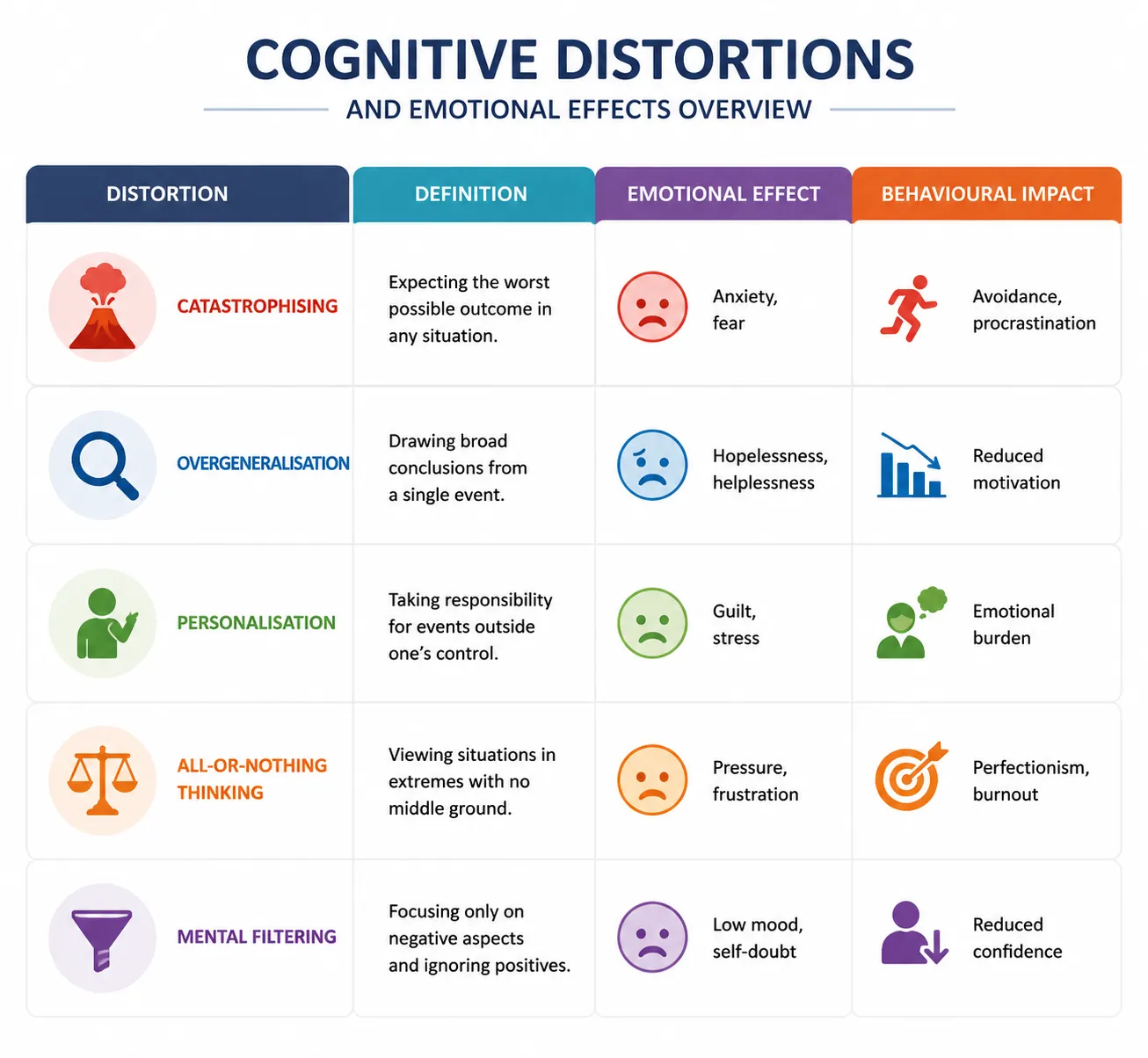
Comparative Table: Cognitive Distortions and Their Effects
| Cognitive Distortion | Definition | Emotional Effect | Behavioural Impact |
|---|---|---|---|
| Catastrophising | Expecting worst-case outcome | Anxiety, fear | Avoidance |
| Overgeneralisation | One event = all events | Hopelessness | Reduced motivation |
| Personalisation | Taking unnecessary blame | Guilt, stress | Emotional burden |
| All-or-nothing thinking | Extreme thinking patterns | Pressure, frustration | Perfectionism |
| Mental filtering | Focus only on negatives | Low mood | Reduced confidence |
Practical CBT Application
Introduction to Intervention Relevance
In CBT practice, identifying cognitive distortions is a key step in cognitive restructuring. Once identified, these distortions are challenged and replaced with balanced thinking patterns.
Common CBT Techniques
- Thought monitoring and identification
- Evidence-based questioning
- Cognitive restructuring exercises
- Behavioural experiments
- Reality testing techniques
Each method helps individuals develop more balanced, realistic thinking patterns and reduce emotional distress.
Cognitive distortions are common but powerful thinking errors that influence how individuals interpret reality and respond emotionally. Distortions such as catastrophising, overgeneralisation, personalisation, all-or-nothing thinking, and mental filtering affect mental wellbeing by increasing emotional intensity and reinforcing unhelpful behavioural patterns.
In CBT practice, recognising these distortions is essential for effective psychological intervention. By identifying and challenging these thinking patterns, individuals can develop more balanced cognition, improve emotional regulation, and enhance behavioural responses in both personal and professional contexts.
3. How Distorted Thinking Patterns Affect Mental Wellbeing
Introduction to Psychological Impact of Cognitive Distortions
Overview of Mental Wellbeing and Cognitive Processing
Cognitive Behavioural Therapy (CBT) is built on the understanding that human emotions and behaviours are strongly influenced by thought patterns rather than external events alone. Within this framework, cognitive distortions are recognised as one of the most significant contributors to psychological distress.
Cognitive distortions refer to biased or inaccurate ways of thinking that influence how individuals interpret experiences. When these distorted thinking patterns become habitual, they negatively affect mental wellbeing by shaping emotional reactions, reinforcing unhelpful beliefs, and encouraging maladaptive behaviours. Over time, this leads to persistent psychological difficulties such as anxiety, depression, stress, and reduced self-confidence.
Understanding the impact of cognitive distortions is essential for learners in CBT because it explains how thoughts translate into emotional suffering and behavioural patterns in both personal and professional contexts.
Emotional Impact of Cognitive Distortions
Introduction to Emotional Consequences
Emotions are directly influenced by how individuals interpret events. When interpretations are distorted, emotional responses become exaggerated, unstable, or disproportionate to the situation. Cognitive distortions therefore play a central role in shaping emotional wellbeing.
How Cognitive Distortions Affect Emotions
Distorted thinking patterns often lead to the following emotional outcomes:
- Increased anxiety and stress levels
Individuals perceive situations as more threatening than they actually are, leading to heightened fear and worry. - Persistent sadness or depressive moods
Negative interpretations of events contribute to feelings of hopelessness and low mood. - Irritability and emotional instability
Misinterpretation of social or workplace interactions can lead to frustration and emotional overreaction. - Reduced emotional resilience
Individuals become less able to cope with challenges due to repeated negative thinking patterns.
Each of these emotional effects occurs because cognitive distortions exaggerate perceived threats and reduce rational evaluation of situations.
Behavioural Impact of Cognitive Distortions
Introduction to Behavioural Consequences
Cognitive distortions do not only affect emotions; they also strongly influence behaviour. When individuals consistently think in distorted ways, their actions become shaped by avoidance, fear, or lack of confidence, which further maintains psychological distress.
How Distorted Thinking Influences Behaviour
Cognitive distortions commonly lead to:
- Avoidance of challenging situations
Individuals may avoid tasks or responsibilities due to fear of failure or judgment. - Reduced motivation and engagement
Negative thinking reduces interest in goals and personal development. - Withdrawal from social or professional activities
Individuals may isolate themselves due to negative expectations of others. - Procrastination and reduced productivity
Fear-based thinking leads to delay in completing tasks.
These behavioural responses often reinforce the original distorted thoughts, creating a continuous cycle of psychological difficulty.
Cognitive Cycle of Distress
Introduction to the Self-Reinforcing Cycle
One of the most important concepts in CBT is the cognitive cycle of distress. This cycle explains how distorted thinking maintains psychological problems over time by creating repeated patterns of negative emotion and behaviour.
Structure of the Cognitive Cycle
The cycle typically follows this pattern:
- Distorted thought occurs
A biased interpretation of an event is formed automatically. - Negative emotion is triggered
Emotional responses such as anxiety, anger, or sadness arise. - Unhelpful behaviour follows
The individual may avoid, withdraw, or reduce effort. - Lack of corrective experience reinforces distortion
Because the situation is not faced, the belief is never challenged.
This cycle is central to CBT intervention because breaking any part of it can lead to psychological improvement.
Case Study: Workplace Scenario
Introduction to Workplace Application
Workplace environments are common settings where cognitive distortions significantly affect performance, confidence, and wellbeing. Feedback, deadlines, and performance evaluations often trigger distorted thinking patterns.
Scenario Analysis
- Situation: Constructive criticism during performance appraisal
- Cognitive distortion: “I am completely incompetent” (all-or-nothing thinking)
- Emotional response: Anxiety and embarrassment
- Behavioural response: Avoidance of future feedback and reduced performance
Interpretation of the Case
This example demonstrates that emotional distress is not caused by feedback itself but by how the feedback is interpreted. The distortion leads to exaggerated thinking, which results in emotional discomfort and behavioural avoidance. Over time, this reduces workplace performance and confidence.
Case Study: Academic Scenario
Introduction to Educational Impact
Cognitive distortions are also highly relevant in academic environments where students frequently face evaluation, comparison, and performance pressure.
Scenario Analysis
- Situation: Poor performance in an assignment
- Cognitive distortion: Overgeneralisation
- Thought: “I will never succeed in this subject”
- Emotional response: Hopelessness
- Behavioural response: Reduced study effort
Interpretation of the Case
This scenario shows how a single negative experience can be incorrectly interpreted as a permanent pattern. This leads to emotional discouragement and reduced academic engagement, ultimately affecting learning outcomes.
Comparative Table: Types of Cognitive Distortions and Effects
Overview of Distortion Types and Their Impact
| Cognitive Distortion | Definition | Emotional Impact | Behavioural Outcome |
|---|---|---|---|
| Catastrophising | Expecting worst-case outcome | Anxiety, fear | Avoidance |
| Overgeneralisation | One event applied to all situations | Hopelessness | Reduced effort |
| Personalisation | Self-blame for external events | Guilt, shame | Social withdrawal |
| All-or-nothing thinking | Extreme thinking patterns | Stress, frustration | Perfectionism |
| Mental filtering | Focus only on negative aspects | Low mood | Reduced confidence |
Each distortion affects both emotional and behavioural functioning, demonstrating the importance of identification and intervention in CBT practice.
Practical Application in CBT Practice
Introduction to Clinical Relevance
In CBT practice, identifying cognitive distortions is a foundational step in cognitive restructuring. It allows practitioners to understand how individuals interpret situations and where emotional distress originates.
Intervention Process in CBT
CBT practitioners typically use structured methods to address cognitive distortions:
- Thought monitoring techniques
Individuals track and record distorted thoughts in real-time. - Cognitive reframing
Unhelpful thoughts are replaced with balanced interpretations. - Evidence-based questioning
Individuals examine facts supporting or contradicting their thoughts. - Behavioural experiments
Clients test beliefs through real-life actions. - Reality testing
Thoughts are compared against actual outcomes and evidence.
Each of these techniques helps reduce distortion-driven thinking and improves emotional regulation.
Cognitive distortions have a profound impact on mental wellbeing by influencing how individuals interpret experiences and respond emotionally and behaviourally. These distorted thinking patterns contribute to increased anxiety, low mood, avoidance behaviour, and reduced motivation, ultimately maintaining cycles of psychological distress.
In CBT practice, understanding the emotional and behavioural impact of cognitive distortions is essential for effective intervention. By identifying distortions and applying structured CBT techniques such as cognitive reframing and behavioural experiments, individuals can develop healthier thinking patterns, improve emotional resilience, and enhance both personal and professional functioning.
Conclusion
Cognitive distortions are automatic and habitual thinking errors that significantly shape how individuals interpret experiences, regulate emotions, and respond behaviourally. Although these patterns often operate outside conscious awareness, they play a critical role in maintaining psychological distress by exaggerating negative interpretations and reinforcing unhelpful emotional responses.
In CBT practice, identifying and addressing cognitive distortions such as catastrophising, overgeneralisation, personalisation, and all-or-nothing thinking is essential for effective intervention. By recognising these patterns and applying structured CBT techniques, individuals can develop more balanced thinking, improve emotional regulation, and build healthier, more adaptive behavioural responses that support long-term psychological wellbeing.