
Lesson 3: Identify the Relationship Between Thoughts, Emotions, and Behaviours
Understanding the relationship between thoughts, emotions, and behaviours is a key foundation of Cognitive Behavioural Therapy (CBT). This relationship explains how people interpret situations and why they respond differently to the same event. In everyday life, individuals often believe that situations directly cause emotional reactions. However, CBT shows that it is actually the way a person thinks about a situation that shapes their emotions and actions.
This concept is important because it helps individuals recognise that they can change how they feel and behave by changing how they think. It is widely used in mental health support, education, workplace wellbeing, and personal development. By learning this connection, individuals can better manage stress, improve decision-making, and respond more positively to challenges.
This lesson explains the cognitive triangle, how changes in thinking affect emotions and behaviours, and provides simple real-life examples to support understanding.
By the end of this lesson, learners will be able to:
- Explain the cognitive triangle (thoughts, emotions, behaviours)
- Understand how thoughts influence feelings and actions
- Describe how changing thinking patterns affects emotional responses
- Identify real-life examples of thought–emotion–behaviour interactions
- Apply basic CBT understanding to everyday situations
1. The Cognitive Triangle (Thoughts, Emotions, Behaviours)
The cognitive triangle is a simple and important idea in Cognitive Behavioural Therapy (CBT). It explains how human thoughts, emotions, and behaviours are connected and how they influence each other in daily life. Many people believe that situations directly cause emotions, but CBT shows that the way we think about a situation plays a major role in how we feel and act.
For example, two people may face the same situation, such as receiving feedback at work. One person may think, “This will help me improve,” and feel motivated. Another person may think, “I am not good enough,” and feel upset or anxious. This difference happens because of thinking patterns.
The cognitive triangle helps learners understand that thoughts, emotions, and behaviours are always linked. By learning this simple model, individuals can better understand their reactions and begin to manage stress, improve confidence, and respond more positively in everyday life.
Understanding the Cognitive Triangle
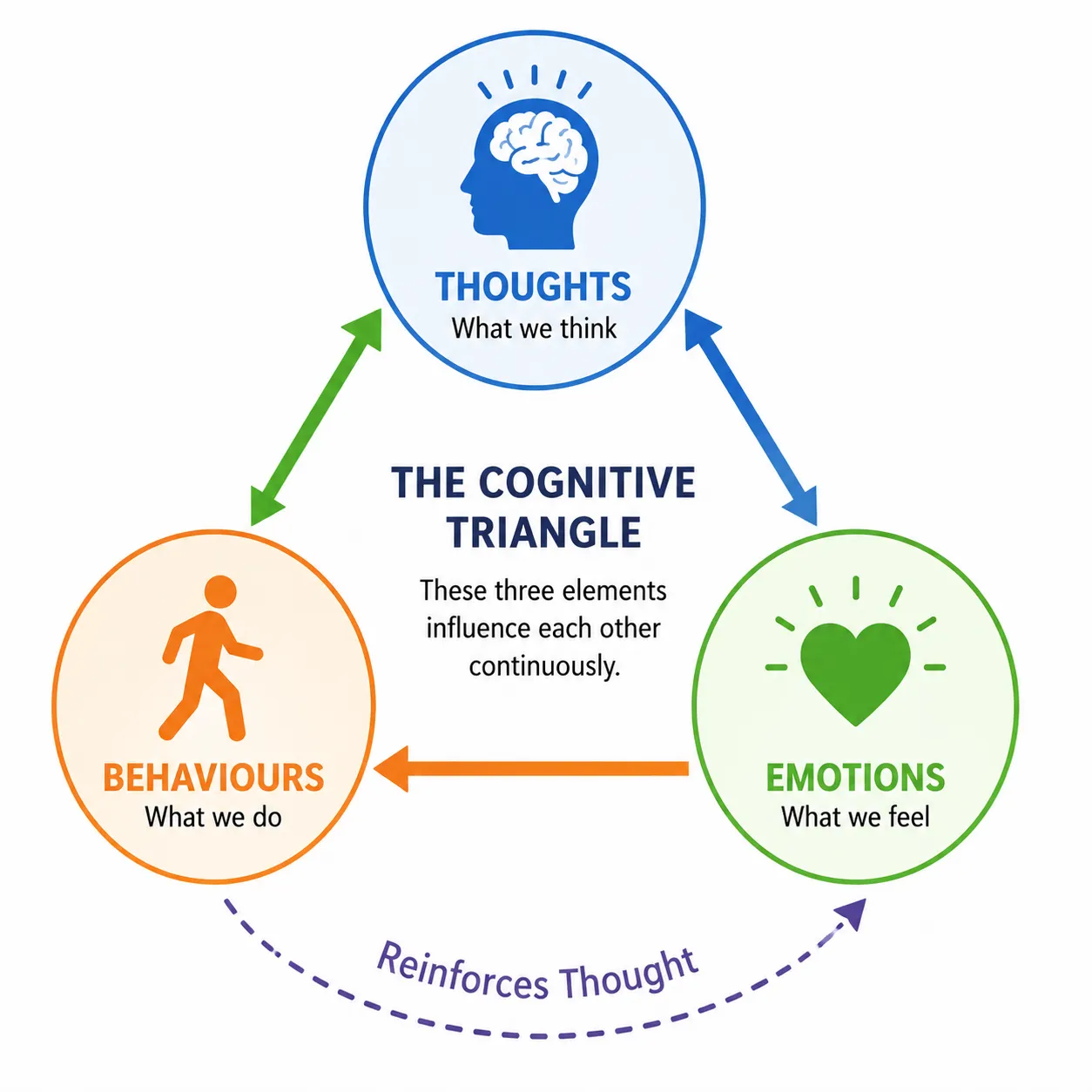
The cognitive triangle shows that thoughts, emotions, and behaviours are not separate. Instead, they form a continuous cycle where each one affects the other.
The main idea is simple:
- Thoughts affect emotions
- Emotions affect behaviours
- Behaviours can also affect thoughts
This means that if one part of the triangle changes, the other parts can also change.
For example, if a person changes negative thinking into more balanced thinking, they may feel calmer and behave more confidently.
Thoughts
Thoughts are the ideas, beliefs, and interpretations that occur in our minds. They help us make sense of situations. Thoughts can happen automatically or after careful thinking.
It is important to understand that thoughts are not always facts. They are personal interpretations, and they can sometimes be inaccurate or unhelpful.
Simple Examples of Thoughts
- “I will fail this task”
- “People are judging me”
- “I can handle this situation”
These thoughts influence how a person feels emotionally.
For example, if someone thinks “I will make a mistake,” they may start feeling nervous even before starting a task. However, if they think “I will try my best,” they may feel more confident.
Thoughts are the starting point of emotional and behavioural reactions.
Emotions
Emotions are the feelings we experience in response to our thoughts. They are natural reactions that help us respond to situations in life.
Emotions can be positive or negative depending on how we interpret events.
Common Emotions
- Anxiety
- Stress
- Happiness
- Confidence
- Frustration
- Sadness
Emotions are not random. They are influenced by our thinking patterns.
For example, if a person thinks, “I am not prepared,” they may feel anxious. If they think, “I am ready,” they may feel confident.
Emotions are important because they influence how a person behaves in different situations.
Behaviours
Behaviours are the actions we take based on our thoughts and emotions. They are the visible part of the cognitive triangle.
Behaviour shows how a person responds to their internal thoughts and feelings.
Examples of Behaviours
- Avoiding situations
- Speaking confidently
- Staying silent in meetings
- Asking for help
- Taking action to solve problems
For example, if someone feels anxious because they think they will fail, they may avoid the task. But if they feel confident, they are more likely to take action.
Behaviour is important because it can also influence future thoughts and emotions.
How the Cognitive Triangle Works
The cognitive triangle works as a cycle. One part leads to another, and the cycle continues.
Simple Flow of the Cognitive Triangle
Situation
→ Thought
→ Emotion
→ Behaviour
→ Reinforces Thought
This cycle explains how people can get stuck in negative patterns or build positive habits.
For example:
- A negative thought leads to fear
- Fear leads to avoidance
- Avoidance strengthens the belief “I cannot do it”
On the other hand:
- A balanced thought leads to confidence
- Confidence leads to action
- Action builds positive belief
This shows how powerful thinking patterns are in shaping behaviour.

How the Cognitive Triangle Affects Daily Life
The cognitive triangle is not only a theory. It is used in everyday life situations such as school, work, and relationships.
Workplace Example
- Thought: “I will make a mistake in the meeting”
- Emotion: Nervousness
- Behaviour: Avoiding speaking
If the thought changes:
- Thought: “I am prepared”
- Emotion: Confidence
- Behaviour: Participation in the meeting
Student Example
- Thought: “This subject is too difficult”
- Emotion: Frustration
- Behaviour: Not studying
If the thought changes:
- Thought: “I can learn step by step”
- Emotion: Motivation
- Behaviour: Studying regularly
Social Example
- Thought: “People will judge me”
- Emotion: Anxiety
- Behaviour: Avoiding social interaction
If the thought changes:
- Thought: “Most people are friendly”
- Emotion: Calmness
- Behaviour: Social engagement
These examples show how thinking directly influences real-life behaviour.
Cognitive Triangle Overview
| Component | Meaning | Example |
|---|---|---|
| Thoughts | Ideas or beliefs in the mind | “I will fail” |
| Emotions | Feelings experienced | Anxiety, confidence |
| Behaviours | Actions taken | Avoiding or trying |
This table helps learners clearly understand each part of the model.
Process Flow of Cognitive Triangle
Situation
→ Thought is formed
→ Emotion develops
→ Behaviour happens
→ Behaviour reinforces thought
This process repeats in daily life and shapes long-term habits.
Hierarchy of Cognitive Triangle
Cognitive System
Thoughts
Positive thoughts
Negative thoughts
Emotions
 Behaviours
This structure helps learners understand how thinking is the starting point of emotional and behavioural responses.
- Thoughts influence emotions
- Emotions influence behaviour
- Behaviour can reinforce thoughts
- The same situation can lead to different reactions
- Changing thoughts can improve emotional wellbeing
- Awareness of thinking patterns helps better decision-making
Case Study
Situation
A 26-year-old employee is asked to give a short presentation at work. They immediately think they will make mistakes in front of colleagues.
Action
The employee starts feeling nervous and avoids preparing properly. Later, they learn about the cognitive triangle and begin to challenge their thoughts. They replace “I will fail” with “I can prepare and do my best.” They also practice the presentation in small steps.
Result
The employee feels more confident, prepares better, and successfully delivers the presentation.
Learning Point
Thoughts strongly influence emotions and behaviours. Changing thinking patterns can lead to more positive actions and outcomes.
Key Takeaways
- The cognitive triangle shows the link between thoughts, emotions, and behaviours
- Thoughts are not facts; they are interpretations
- Emotions are shaped by thinking patterns
- Behaviour is the visible result of thoughts and feelings
- Changing thoughts can improve emotional and behavioural responses
- The cycle can be positive or negative depending on thinking patterns
The cognitive triangle is a simple but powerful model that explains how thoughts, emotions, and behaviours are connected. It helps learners understand that emotional reactions are not caused by situations alone but by how those situations are interpreted.
By becoming aware of this connection, individuals can begin to recognise unhelpful thinking patterns and make positive changes in how they feel and behave. This understanding is essential for improving emotional wellbeing, building confidence, and responding more effectively to everyday life challenges.
2. How Changes in Thinking Influence Emotions and Behaviours
In Cognitive Behavioural Therapy (CBT), one of the most important ideas is that changing the way we think can change how we feel and behave. Many people believe that situations directly control emotions, but CBT explains that it is our thoughts about a situation that create emotional reactions.
For example, two people may receive the same feedback at work. One may think, “This will help me improve,” and feel motivated. The other may think, “I am not good enough,” and feel anxious. The difference is not the situation itself, but the thinking behind it.
This lesson explains how changes in thinking influence emotions and behaviours in a simple and practical way so beginners can understand how CBT works in everyday life.
Understanding the Role of Thinking in CBT
Thinking is the starting point of emotional and behavioural responses. In CBT, thoughts are seen as interpretations, not facts. This means that people do not always see situations as they truly are; instead, they interpret them based on personal beliefs and past experiences.
When thoughts are negative or unhelpful, they can create emotional distress. When thoughts are balanced or positive, they can support emotional stability and better behaviour.
This shows that thoughts are powerful and can shape a person’s entire response to a situation.
Negative Thinking Pattern and Its Impact
A negative thinking pattern happens when a person interprets a situation in a harmful or unrealistic way. These thoughts often increase stress and reduce confidence.
Example of Negative Thinking Pattern
- Situation: Receiving feedback at work
- Thought: “I am not good enough”
- Emotion: Anxiety, low confidence
- Behaviour: Avoiding tasks or meetings
In this example, the thought “I am not good enough” is not necessarily true, but it feels real to the person. This thought creates anxiety, which then leads to avoidance behaviour.
Avoiding tasks may provide temporary relief, but in the long term it can increase stress and reduce performance.
Simple Explanation
Negative thoughts → Negative emotions → Avoidance behaviour
This cycle can repeat and make problems worse if not changed.
Balanced Thinking Pattern and Its Impact
A balanced thinking pattern is when a person views a situation in a more realistic and helpful way. Balanced thoughts do not ignore problems but focus on solutions and improvement.
Example of Balanced Thinking Pattern
- Situation: Receiving feedback at work
- Thought: “I can improve with practice”
- Emotion: Motivation, calmness
- Behaviour: Taking action to improve performance
In this example, the situation is the same, but the thinking is different. The balanced thought leads to a calmer emotional response and more positive behaviour.
Instead of avoiding the task, the person takes action to improve.
Simple Explanation
Balanced thoughts → Positive emotions → Active behaviour
This shows how thinking positively or realistically can improve outcomes.
Key Understanding About Thought Changes
Changing thoughts is a key part of CBT. It helps individuals understand that they have control over their emotional responses.
Important Points
- Thoughts are not always correct
- Thoughts can be changed with practice
- Changing thoughts can reduce emotional distress
- Balanced thinking leads to healthier behaviour
For example, if a person changes the thought “I always fail” to “I can learn from mistakes,” they are more likely to feel motivated instead of discouraged.
This change in thinking creates a positive shift in both emotions and actions.
Impact of Thought Change on Behaviour
Behaviour is strongly influenced by emotions, and emotions are influenced by thoughts. Therefore, when thinking changes, behaviour naturally changes as well.
When a person learns to replace negative thoughts with balanced thoughts, they often feel more confident and willing to take action.
Simple Behaviour Cycle
Negative thought → Negative emotion → Avoidance behaviour
Balanced thought → Positive emotion → Active behaviour
This cycle shows how thinking patterns directly influence daily actions.
For example:
- If someone thinks “I cannot do this,” they may avoid trying
- If someone thinks “I will try my best,” they are more likely to take action
This demonstrates the importance of managing thoughts in everyday situations.
Real-Life Workplace Example
Situation
An employee receives a new task at work that they feel is difficult.
Negative Thinking Response
- Thought: “I will fail this task”
- Emotion: Stress, fear
- Behaviour: Avoiding the task or delaying it
Balanced Thinking Response
- Thought: “This is challenging, but I can learn step by step”
- Emotion: Calmness, motivation
- Behaviour: Starting the task and asking for help if needed
This example shows how the same situation can lead to very different outcomes depending on thinking patterns.
Real-Life Student Example
Situation
A student is preparing for an exam.
Negative Thinking
- Thought: “I am not smart enough”
- Emotion: Anxiety
- Behaviour: Not studying properly
Balanced Thinking
- Thought: “If I study regularly, I can improve”
- Emotion: Motivation
- Behaviour: Studying consistently
This shows how thoughts directly influence effort and learning behaviour.
Comparison Table: Thought Influence on Behaviour
| Thinking Pattern | Emotional Effect | Behaviour Outcome |
|---|---|---|
| Negative thinking | Anxiety, fear, stress | Avoidance, withdrawal |
| Balanced thinking | Calmness, motivation | Action, participation |
This table helps learners clearly understand how different thinking styles affect emotions and actions.
Process Flow: How Thoughts Change Behaviour
Situation
→ Thought Formation
→ Emotional Response
→ Behavioural Action
→ Outcome Experience
→ Reinforced Thinking Pattern
This process explains how repeated thinking patterns become habits over time.
Simple Understanding of Thought Change
When a person learns to notice and change their thoughts, they can improve their emotional wellbeing. This does not mean ignoring problems, but understanding them in a more balanced way.
For example:
- Instead of thinking “Everything will go wrong,” a person can think “I will handle one step at a time”
- This reduces stress and increases confidence
Small changes in thinking can create big improvements in behaviour.
Case Study
Situation
A 29-year-old office worker is asked to lead a small team project. They immediately think they are not capable of handling responsibility.
Action
Because of this thought, they feel anxious and avoid taking leadership decisions. After learning about CBT, they begin to notice their thinking pattern. They change their thought to “I may not know everything, but I can learn and ask for support.” They also start preparing step by step.
Result
The employee becomes more confident, starts contributing to the project, and gradually improves their leadership skills.
Learning Point
Changing thoughts leads to better emotions and improved behaviour. Small changes in thinking can help individuals perform better in real-life situations.
Key Takeaways
- Thoughts influence how people feel and behave
- Negative thoughts can lead to stress and avoidance
- Balanced thoughts lead to motivation and action
- Changing thoughts can improve emotional wellbeing
- Behaviour improves when thinking becomes more positive and realistic
- CBT helps individuals recognise and change unhelpful thinking patterns
Changes in thinking play a powerful role in shaping emotions and behaviours. In CBT, it is understood that situations do not directly create feelings; instead, it is the way individuals interpret situations that determines their emotional response. When thinking patterns are negative, emotions and behaviours often become unhelpful. When thinking patterns are balanced, individuals experience more positive emotions and take more constructive actions.
By learning to identify and change unhelpful thoughts, individuals can improve their emotional wellbeing, build confidence, and respond more effectively to everyday challenges.
3. Examples of Thought–Emotion–Behaviour Interaction
Example 1: Workplace Situation
- Thought: “I will make a mistake during the presentation”
- Emotion: Nervousness
- Behaviour: Avoiding speaking in meetings
If the thought changes:
- Thought: “I have prepared well”
- Emotion: Confidence
- Behaviour: Participating actively
Example 2: Student Situation
- Thought: “I am not smart enough for this subject”
- Emotion: Frustration
- Behaviour: Not studying or giving up
If the thought changes:
- Thought: “I can improve with effort”
- Emotion: Motivation
- Behaviour: Studying regularly
Example 3: Social Situation
- Thought: “People will judge me”
- Emotion: Anxiety
- Behaviour: Avoiding social interaction
If the thought changes:
- Thought: “Most people are focused on themselves”
- Emotion: Calmness
- Behaviour: Engaging in conversation
Comparison Table: Thought Impact on Behaviour
| Thought Type | Emotional Response | Behaviour Outcome |
|---|---|---|
| Negative thought | Anxiety, fear | Avoidance, withdrawal |
| Balanced thought | Calm, confidence | Action, participation |
| Positive thought | Motivation, comfort | Engagement, improvement |
This table helps learners clearly see how thinking patterns affect real-life behaviour.
Cognitive Interaction Cycle
Situation
→ Thought Formation
→ Emotional Response
→ Behavioural Action
→ Outcome
→ Reinforces Thought Pattern
This cycle explains how repeated thinking patterns shape long-term behaviour.
Hierarchy Chart: Cognitive Structure
CBT Cognitive Model
 Thoughts
Automatic Thoughts
 Beliefs
 Emotions
Behaviours
This structure shows how thoughts sit at the core of emotional and behavioural responses.
Cognitive Triangle Key Points
- Thoughts shape emotions
- Emotions influence behaviour
- Behaviour can reinforce thoughts
- Changing thoughts changes emotional responses
- CBT focuses on identifying and adjusting thinking patterns
- Awareness of thoughts improves daily decision-making
Case Study
Situation
A 30-year-old office worker is asked to deliver a presentation. They begin thinking they will fail in front of colleagues.
Action
The individual starts avoiding preparation and feels increasingly anxious. After learning CBT principles, they identify their negative thought patterns and replace them with balanced thinking such as “I can prepare step by step and do my best.”
They also practice speaking in small groups to build confidence.
Result
The employee successfully delivers the presentation with reduced anxiety and improved confidence.
Learning Point
Changing thoughts can directly improve emotions and lead to more positive behaviours in real-life situations.
Key Takeaways
- The cognitive triangle shows the link between thoughts, emotions, and behaviours
- Thoughts influence how people feel and act
- Changing thinking patterns can improve emotional wellbeing
- Negative thoughts often lead to avoidance behaviour
- Balanced thinking encourages positive actions
- CBT helps individuals become aware of and change unhelpful thinking patterns
Conclusion
The relationship between thoughts, emotions, and behaviours is a central concept in CBT. It explains that people do not react directly to situations but respond based on their thoughts about those situations. The cognitive triangle helps learners understand how these three elements are connected and how they influence each other.
By recognising this relationship, individuals can begin to identify unhelpful thinking patterns and make positive changes in how they feel and behave. This understanding is essential for building emotional awareness, improving decision-making, and developing healthier responses in everyday life.