
Lesson 3: Demonstrate Awareness of Safe and Ethical Practice
Safe and ethical practice is a fundamental part of delivering effective Cognitive Behavioural Therapy (CBT). Every practitioner has a responsibility to provide care that protects clients, respects their rights, and follows recognised professional and ethical standards. During therapy, practitioners may sometimes encounter situations that require careful judgement, such as concerns about confidentiality, client safety, professional boundaries, or safeguarding. Knowing how to respond appropriately in these situations helps ensure that therapy remains safe, respectful, and focused on the client’s wellbeing.
Understanding the actions to take when ethical concerns arise prepares learners to recognise potential issues, follow organisational procedures, seek appropriate guidance, and make responsible professional decisions. By developing awareness of ethical responsibilities and safe working practices, practitioners can maintain trust, protect clients, and contribute to high-quality, client-centred CBT practice.
1. Describe Safe Working Practices in CBT Delivery
Safe working practices are an essential part of delivering effective Cognitive Behavioural Therapy (CBT). Every CBT practitioner has a responsibility to provide therapy in a way that protects clients, promotes wellbeing, and maintains professional standards. Safe practice helps create an environment where clients feel respected, valued, and comfortable discussing personal thoughts, feelings, and experiences.
People who attend CBT may be experiencing anxiety, depression, stress, trauma, or other emotional challenges. They often share sensitive information and rely on practitioners to treat them with care, respect, and professionalism. Safe working practices help practitioners protect clients from harm while ensuring therapy remains ethical, organised, and focused on achieving positive outcomes.
Understanding safe working practices is important for anyone beginning to learn about CBT. It helps learners recognise professional responsibilities, understand how to work safely with clients, and appreciate the importance of following ethical and organisational procedures. Safe working practices also protect practitioners by reducing the risk of misunderstandings, complaints, and professional misconduct.
What Are Safe Working Practices?
Safe working practices are the professional actions, behaviours, and procedures that help protect clients, practitioners, and others during the delivery of CBT.
These practices provide a clear framework for delivering therapy in a safe, respectful, ethical, and professional way. They help practitioners work responsibly while ensuring that the therapeutic relationship remains focused on supporting the client’s wellbeing.
Safe working practices include following professional standards, maintaining confidentiality, communicating respectfully, recognising personal limits, keeping accurate records, and working within organisational procedures.
By following these practices, practitioners reduce risks and create a positive environment where clients can participate confidently in therapy.
Why Safe Working Practices Are Important
Safe working practices are important because they protect everyone involved in therapy.
Clients need to know that they will be treated fairly, respectfully, and professionally. They also need confidence that the personal information they share will be handled responsibly and kept confidential whenever possible.
Practitioners also benefit from safe working practices because clear professional standards help guide everyday decisions and reduce the risk of mistakes.
Organisations benefit because safe practice supports high-quality services, protects their reputation, and helps maintain public confidence in mental health care.
Overall, safe working practices help create a professional environment where therapy can be delivered effectively and responsibly.
Key Principles of Safe Working Practice
Several important principles support safe CBT delivery.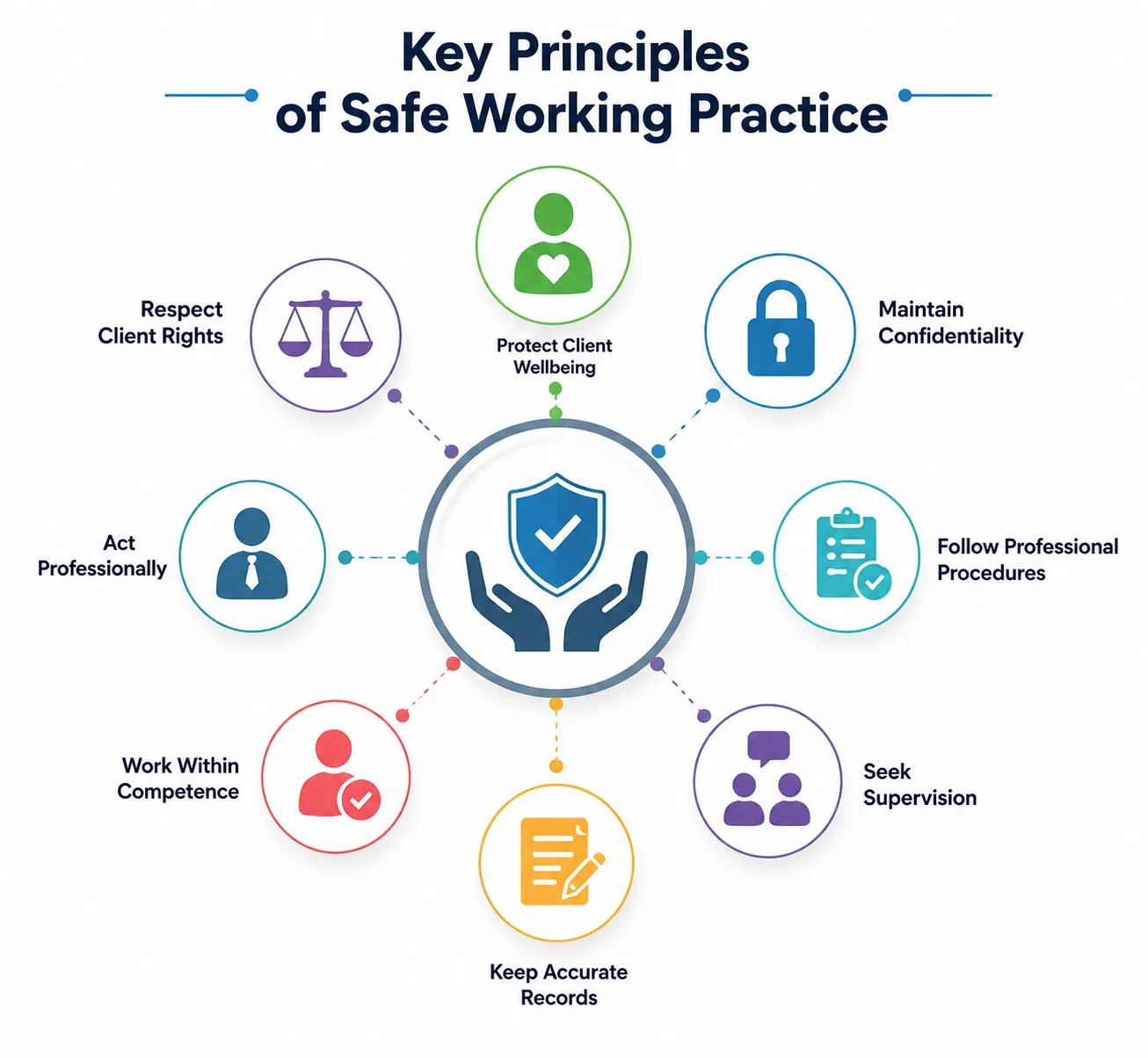
Protecting Client Wellbeing
The client’s wellbeing should always be the main priority.
Every professional decision should aim to support the client’s physical, emotional, and psychological safety.
Practitioners should create an environment where clients feel comfortable, respected, and supported throughout therapy.
Maintaining Confidentiality
Confidentiality is one of the most important responsibilities in CBT.
Clients often discuss highly personal information during therapy sessions. Practitioners should protect this information by storing records securely and only sharing information when legally or ethically required.
Respecting confidentiality helps build trust and encourages honest communication.
Obtaining Informed Consent
Before therapy begins, practitioners should explain:
- The purpose of CBT.
- What therapy involves.
- Confidentiality arrangements.
- The client’s rights.
- The client’s responsibilities.
Clients should understand this information before agreeing to take part in therapy.
Consent should continue throughout the therapeutic process.
Maintaining Professional Boundaries
Professional boundaries help ensure that therapy remains focused on the client’s needs.
Practitioners should communicate respectfully, avoid personal relationships with clients, and behave professionally at all times.
Maintaining clear boundaries protects both the client and the practitioner.
Working Within Professional Competence
Practitioners should only provide therapy that matches their education, training, and experience.
If a client’s needs are beyond their professional knowledge or skills, they should seek supervision or arrange an appropriate referral.
Recognising professional limitations is a sign of responsible practice.
Keeping Accurate Records
Good record keeping is an important part of safe practice.
Therapy records should be:
- Accurate.
- Clear.
- Up to date.
- Secure.
- Confidential.
Accurate records support continuity of care and provide evidence of professional practice.
Respecting Equality and Diversity
Every client deserves equal access to respectful and professional care.
Practitioners should treat every client fairly regardless of:
- Age
- Gender
- Ethnicity
- Religion
- Disability
- Sexual orientation
- Cultural background
Respecting diversity helps create an inclusive therapeutic environment.
Characteristics of Safe CBT Practice
Safe working practices are demonstrated through professional behaviour.
A safe CBT practitioner:
- Communicates respectfully.
- Maintains confidentiality.
- Keeps professional boundaries.
- Works within their competence.
- Follows workplace procedures.
- Protects client wellbeing.
- Maintains accurate documentation.
- Acts honestly and ethically.
- Seeks supervision when necessary.
- Continues professional learning.
These characteristics help maintain high standards of care throughout therapy.
Benefits of Safe Working Practices
Safe working practices benefit clients, practitioners, and organisations.
For clients, they create a safe environment where personal information can be shared confidently. Clients feel respected, protected, and supported throughout therapy.
For practitioners, safe working practices provide guidance for professional behaviour, reduce uncertainty, and support ethical decision-making.
For organisations, safe practice improves service quality, supports professional standards, reduces complaints, and strengthens public confidence.
Most importantly, safe working practices improve therapeutic outcomes by creating conditions where effective CBT can take place.
Safe Communication in CBT
Communication plays an important role in safe working practice.
Practitioners should:
- Listen carefully.
- Speak respectfully.
- Use language clients understand.
- Encourage questions.
- Explain information clearly.
- Avoid judgement.
Good communication helps clients understand therapy and encourages positive therapeutic relationships.
Maintaining a Safe Therapeutic Environment
A safe therapeutic environment allows clients to feel comfortable discussing sensitive topics.
Practitioners contribute to this environment by:
- Providing privacy during sessions.
- Maintaining confidentiality.
- Showing empathy.
- Respecting client dignity.
- Remaining calm and professional.
- Keeping sessions focused on therapy.
A supportive environment encourages trust and active participation.
Recognising Personal Limits
Safe practitioners understand that they cannot manage every situation alone.
Recognising personal limits means knowing when additional support is required.
Practitioners should seek supervision if they:
- Feel uncertain.
- Face unfamiliar situations.
- Need professional advice.
- Believe another specialist would better support the client.
Seeking help demonstrates professionalism rather than weakness.
Applying Safe Working Practices in Everyday Practice
Safe working practices are demonstrated through everyday professional behaviour.
A practitioner explains confidentiality before the first therapy session and answers the client’s questions honestly.
Another practitioner stores electronic records using secure passwords and keeps paper records in locked cabinets.
A practitioner politely declines personal invitations from clients to maintain professional boundaries.
When a client presents concerns outside the practitioner’s experience, an appropriate referral is arranged after discussing the situation with a supervisor.
These examples show how safe practice supports ethical and effective CBT.
Workplace Examples
Example 1
A practitioner begins each therapy session by checking that the client feels comfortable and understands the purpose of the session.
This helps create a safe and supportive therapeutic environment.
Example 2
A practitioner updates therapy notes immediately after each session and stores them securely according to organisational procedures.
This protects confidentiality and supports continuity of care.
Example 3
A practitioner notices that a client requires specialist trauma support beyond their own experience. After discussing the situation with a supervisor, the practitioner arranges an appropriate referral.
This demonstrates safe professional practice.
| Safe Working Practice | Why It Is Important | Example in CBT |
|---|---|---|
| Confidentiality | Protects client privacy | Store therapy records securely |
| Informed Consent | Supports informed choice | Explain therapy before treatment |
| Professional Boundaries | Maintains safe relationships | Keep communication professional |
| Professional Competence | Protects client wellbeing | Refer clients when specialist support is needed |
| Accurate Record Keeping | Supports continuity of care | Record session notes clearly |
| Respect for Diversity | Promotes equality | Treat every client fairly |
| Safe Communication | Builds trust | Listen respectfully and explain clearly |
Case Study
Situation
Rachel is a CBT practitioner meeting Ahmed for his first therapy session. Ahmed appears nervous and is unsure about what therapy involves. He is also worried that his employer may find out about the information he shares.
Action
Rachel welcomes Ahmed respectfully and explains how CBT works. She discusses confidentiality, including the situations where information may need to be shared for safety reasons. She answers Ahmed’s questions, gains informed consent before beginning therapy, keeps accurate records, and reassures him that his information will be stored securely. Throughout the session, Rachel maintains professional boundaries and focuses on Ahmed’s therapy goals.
Result
Ahmed feels reassured and begins participating openly in therapy. Because Rachel explained the process clearly and behaved professionally, trust develops quickly, allowing therapy to continue in a safe and supportive environment.
Learning Point
Safe working practices help protect clients, build trust, and create a positive therapeutic relationship. Clear communication, confidentiality, informed consent, and professional behaviour are essential for safe CBT delivery.
Key Takeaways
- Safe working practices protect clients, practitioners, and organisations.
- Client wellbeing should always be the highest priority.
- Confidentiality builds trust and protects personal information.
- Informed consent helps clients make informed decisions about therapy.
- Professional boundaries maintain safe therapeutic relationships.
- Practitioners should work within their professional competence.
- Accurate records support continuity of care and accountability.
- Respect for equality and diversity promotes inclusive practice.
- Good communication creates a safe and supportive therapeutic environment.
- Safe working practices contribute to ethical, effective, and client-centred CBT.
Safe working practices are the foundation of effective Cognitive Behavioural Therapy. They help practitioners provide respectful, professional, and client-centred care while protecting confidentiality, maintaining professional boundaries, and supporting client wellbeing. By following recognised professional standards and workplace procedures, practitioners create a safe environment where clients feel comfortable engaging in therapy.
Understanding and applying safe working practices enables practitioners to deliver CBT responsibly and confidently. By communicating effectively, working within their competence, maintaining accurate records, and respecting every client’s rights and dignity, practitioners contribute to high-quality therapeutic care and positive outcomes for those they support.
2. Explain Procedures for Safeguarding and Risk Management
Safeguarding and risk management are important parts of safe and ethical Cognitive Behavioural Therapy (CBT) practice. Every practitioner has a responsibility to help protect clients from harm while providing a safe, respectful, and supportive environment. Clients who attend CBT may be experiencing emotional distress, anxiety, depression, trauma, or other personal difficulties. Some clients may also be vulnerable because of their age, health, disability, or life circumstances. Understanding safeguarding and risk management helps practitioners recognise concerns early, respond appropriately, and protect the wellbeing of everyone involved.
Safeguarding is not only the responsibility of managers or specialist professionals. Every practitioner has a duty to remain alert to possible signs of harm, abuse, neglect, or serious risk and to follow the correct procedures when concerns arise. Risk management works alongside safeguarding by helping practitioners identify, assess, and reduce risks before they become more serious.
Learning about safeguarding and risk management prepares beginners to understand their responsibilities, recognise situations that require action, and appreciate the importance of following professional guidance and organisational procedures.
What Is Safeguarding?
Safeguarding means protecting people from abuse, neglect, exploitation, and avoidable harm. It involves creating a safe environment where individuals can receive support while their wellbeing, rights, and dignity are respected.
In CBT, safeguarding focuses on protecting clients who may be at risk because of their emotional wellbeing, mental health, personal circumstances, or vulnerability.
Safeguarding is based on early recognition, appropriate action, and following workplace procedures. Practitioners should never ignore concerns that could place a client or another person at risk.
What Is Risk Management?
Risk management is the process of identifying possible risks, assessing how serious they may be, and taking appropriate steps to reduce or manage those risks.
In CBT, risk management helps practitioners respond safely when they identify concerns that may affect a client’s wellbeing or the safety of others.
Risk management is not about removing every risk. Instead, it involves recognising concerns, making informed decisions, following professional guidance, and taking reasonable action to reduce harm.
Why Safeguarding and Risk Management Are Important
Safeguarding and risk management are essential because they help protect clients, practitioners, and the wider community.
Clients often discuss personal experiences that may indicate they are experiencing abuse, neglect, self-harm, or other situations that require professional support.
By recognising concerns early and following correct procedures, practitioners can help prevent harm and ensure clients receive appropriate assistance.
Good safeguarding practice also builds trust, supports ethical care, promotes professional accountability, and strengthens public confidence in mental health services.
Key Principles of Safeguarding
Several principles guide safeguarding practice in CBT.
The client’s safety should always be the highest priority.
Practitioners should listen carefully without making assumptions or promises they cannot keep.
Information should be handled confidentially but shared when necessary to protect someone from serious harm.
Concerns should be reported promptly using workplace procedures.
Practitioners should record information accurately and objectively.
When unsure, practitioners should seek advice from a supervisor or designated safeguarding lead.
These principles help ensure that safeguarding decisions are made responsibly and consistently.
Recognising Safeguarding Concerns
Safeguarding concerns can arise in many different situations.
Examples may include:
- A client talks about self-harm.
- A client describes physical abuse.
- A vulnerable adult appears neglected.
- A child may be at risk.
- A client reports domestic abuse.
- A client threatens serious harm to another person.
Recognising concerns does not mean making assumptions. Practitioners should remain calm, listen carefully, and follow organisational procedures.
Understanding Risk in CBT
Some risks may arise during therapy because clients discuss difficult emotions and personal experiences.
Possible risks include:
- Risk of self-harm.
- Risk of suicide.
- Risk of harm to others.
- Emotional distress during therapy.
- Safeguarding concerns involving children or vulnerable adults.
- Risks related to poor mental health.
Practitioners should remain aware of these possibilities while remembering that every client is different.
Risk should always be assessed carefully rather than assumed.
Procedures for Safeguarding
Every organisation has safeguarding procedures that practitioners are expected to follow.
Although procedures may vary slightly, they usually include the following steps.
First, recognise that a safeguarding concern may exist.
Next, remain calm and listen carefully to the client without interrupting or making promises about confidentiality that cannot be kept.
Record the information accurately using the client’s own words whenever possible.
Report the concern to the appropriate manager, safeguarding lead, or supervisor according to workplace procedures.
If there is immediate danger, emergency services or appropriate authorities should be contacted according to organisational policy.
Continue supporting the client within your professional role while allowing safeguarding specialists to manage the situation.
Following these procedures helps ensure that concerns are managed safely and professionally.
Procedures for Risk Management
Risk management follows a structured approach.
The practitioner first identifies the possible risk.
Information is then gathered to understand the situation more clearly.
The level of risk is considered based on available information.
Appropriate action is taken to reduce the risk.
The situation is recorded accurately.
Where necessary, supervision is sought and referrals are arranged.
The situation is then monitored and reviewed.
Following this process helps practitioners make safe and balanced professional decisions.
The Importance of Confidentiality During Safeguarding
Confidentiality remains important during safeguarding.
However, confidentiality is not absolute.
If there is a serious risk of harm to the client or another person, practitioners may need to share relevant information with appropriate professionals.
Only necessary information should be shared, and wherever possible the client should be informed about why disclosure is required.
Balancing confidentiality with safeguarding responsibilities is an important part of ethical practice.
Professional Responsibilities
Every CBT practitioner has important safeguarding responsibilities.
These include:
- Protecting client wellbeing.
- Remaining alert to possible risks.
- Following safeguarding procedures.
- Maintaining accurate records.
- Respecting confidentiality.
- Seeking supervision when required.
- Working within professional competence.
- Reporting concerns promptly.
- Treating clients with dignity and respect.
These responsibilities help ensure that safeguarding remains an everyday part of professional practice.
Applying Safeguarding in Everyday Practice
Safeguarding is demonstrated through everyday professional behaviour.
A practitioner notices that a client appears unusually distressed and gently asks supportive questions while listening carefully.
Another practitioner follows confidentiality procedures by storing client records securely.
When a client describes behaviour suggesting possible abuse, the practitioner follows organisational safeguarding procedures instead of trying to investigate independently.
A practitioner who feels uncertain about a situation discusses it immediately with their supervisor before taking further action.
These actions demonstrate safe and responsible professional practice.
Workplace Examples
Example 1
During a therapy session, a client says they have recently been thinking about harming themselves.
The practitioner remains calm, carries out an initial risk assessment, follows safeguarding procedures, informs the appropriate supervisor, and arranges additional support.
Example 2
A client mentions that a vulnerable family member is being neglected.
The practitioner records the information accurately and follows organisational safeguarding procedures to report the concern.
Example 3
A practitioner becomes unsure whether a situation requires safeguarding action.
Rather than making assumptions, they seek advice from their supervisor before deciding on the next steps.
| Safeguarding or Risk Management Step | Purpose | Example |
|---|---|---|
| Recognise the concern | Identify possible risk | Notice signs of self-harm or abuse |
| Listen carefully | Understand the situation | Allow the client to speak without interruption |
| Record information | Keep accurate information | Write factual session notes |
| Report concerns | Follow workplace procedures | Inform the safeguarding lead |
| Take appropriate action | Protect safety | Arrange emergency support if required |
| Seek supervision | Obtain professional guidance | Discuss concerns with a supervisor |
| Review the situation | Monitor ongoing safety | Continue supporting the client appropriately |
Case Study
Situation
Sophie is a CBT practitioner supporting Michael, who has been attending therapy for anxiety. During one session, Michael tells Sophie that he has recently been feeling hopeless and has started thinking about harming himself. He asks Sophie not to tell anyone because he is worried about what might happen.
Action
Sophie remains calm and listens carefully without judging Michael. She explains that while confidentiality is very important, there are situations where information must be shared to protect someone’s safety. She follows her organisation’s safeguarding procedures, completes a risk assessment, records the information accurately, informs her supervisor, and arranges appropriate support for Michael.
Result
Michael receives additional help from specialist mental health services and continues receiving CBT support. He later understands that Sophie acted to protect his wellbeing. The therapeutic relationship remains positive because Sophie communicated honestly and followed professional procedures.
Learning Point
Safeguarding and risk management help protect clients when serious concerns arise. Following workplace procedures, seeking supervision, and acting in the client’s best interests are essential parts of safe CBT practice.
Key Takeaways
- Safeguarding protects people from abuse, neglect, exploitation, and harm.
- Risk management helps identify and reduce potential risks.
- Client wellbeing should always be the highest priority.
- Practitioners should recognise safeguarding concerns early and follow workplace procedures.
- Confidentiality is important but may be limited when serious risks exist.
- Accurate record keeping supports safe and accountable practice.
- Supervision provides valuable support when practitioners are unsure.
- Practitioners should work within their competence and report concerns promptly.
- Safe safeguarding practice protects clients, practitioners, and organisations.
- Understanding safeguarding and risk management supports ethical and professional CBT delivery.
Safeguarding and risk management are essential parts of safe and ethical CBT practice. They help practitioners protect clients from harm, respond appropriately to concerns, and provide therapy in a safe and supportive environment. By recognising risks early, following safeguarding procedures, and maintaining accurate records, practitioners can support client wellbeing while meeting their professional responsibilities.
Understanding these procedures enables practitioners to respond confidently when concerns arise and ensures that therapy remains focused on safety, respect, and effective care. By following organisational policies, seeking supervision when needed, and always acting in the client’s best interests, practitioners contribute to high-quality, ethical, and client-centred CBT practice.
3. Identify Actions to Take When Ethical Concerns Arise
Ethical concerns can arise at any stage of Cognitive Behavioural Therapy (CBT). Although practitioners work hard to provide safe, respectful, and professional care, situations sometimes occur where they must decide how to respond to an ethical issue. Knowing what action to take helps protect clients, maintain professional standards, and support safe therapeutic practice.
Ethical concerns may involve confidentiality, professional boundaries, safeguarding, informed consent, professional competence, or situations where a client or another person may be at risk of harm. Practitioners should never ignore these concerns or try to manage serious situations alone. Instead, they should follow recognised procedures, seek guidance when needed, and always act in the client’s best interests.
Understanding the correct actions to take when ethical concerns arise helps learners develop confidence in recognising potential problems and responding responsibly. It also prepares future practitioners to work safely, ethically, and professionally while protecting both clients and themselves.
What Is an Ethical Concern?
An ethical concern is a situation where a practitioner is unsure about the most appropriate professional action or where a client’s safety, rights, dignity, or wellbeing may be affected.
Ethical concerns do not always involve wrongdoing. Sometimes they arise because different responsibilities appear to conflict. For example, a practitioner may need to balance respecting confidentiality with protecting someone from serious harm.
Recognising ethical concerns early allows practitioners to respond appropriately before problems become more serious.
Examples of ethical concerns include:
- Concerns about confidentiality.
- Possible safeguarding issues.
- Professional boundary concerns.
- Working beyond professional competence.
- Conflicts of interest.
- Poor record keeping.
- Concerns about professional behaviour.
- Situations involving possible harm to the client or others.
Why It Is Important to Take Action
Ignoring ethical concerns can place clients, practitioners, and organisations at risk.
Taking appropriate action helps protect client wellbeing, maintain trust, and ensure therapy continues safely and professionally.
Responding appropriately also helps practitioners:
- Protect clients from harm.
- Follow professional standards.
- Maintain ethical practice.
- Reduce professional risk.
- Build public confidence.
- Support effective therapeutic relationships.
Acting early often prevents small concerns from becoming larger problems.
Recognising Ethical Concerns
The first step is recognising that a concern exists.
Practitioners should remain aware of situations that may require further attention.
Possible signs include:
- A client discloses information suggesting risk of harm.
- Confidential information has been shared inappropriately.
- Professional boundaries appear unclear.
- A practitioner feels uncertain about a decision.
- A client requests something outside the practitioner’s role.
- A situation creates a conflict of interest.
- The practitioner feels they do not have the knowledge or experience to manage the situation safely.
Recognising concerns early allows appropriate support to be provided.
Actions to Take When Ethical Concerns Arise
When an ethical concern is identified, practitioners should follow a calm and structured approach.
Stay Calm and Remain Professional
The first action is to remain calm.
Practitioners should avoid making quick decisions based on emotion or personal opinion.
Remaining professional helps ensure that decisions are fair, balanced, and focused on client wellbeing.
Gather Information
Before taking action, practitioners should understand the situation clearly.
This may involve listening carefully to the client, reviewing relevant information, and considering what has happened without making assumptions.
Only factual information should be considered.
Follow Professional and Organisational Procedures
Every organisation has policies and procedures that guide ethical practice.
Practitioners should follow these procedures carefully whenever ethical concerns arise.
Using established procedures helps ensure consistency and protects both clients and practitioners.
Seek Advice or Supervision
No practitioner is expected to manage every situation alone.
If there is uncertainty, guidance should be sought from:
- A supervisor.
- A manager.
- A designated safeguarding lead.
- Another authorised professional within the organisation.
Seeking advice demonstrates responsible professional behaviour.
Protect Client Wellbeing
The client’s safety and wellbeing should always remain the highest priority.
If there is a risk of harm, practitioners should follow safeguarding procedures and take appropriate action to reduce that risk.
Maintain Confidentiality Where Possible
Confidentiality should continue to be respected.
However, if sharing information is necessary to protect someone from serious harm, practitioners should follow organisational procedures and only share relevant information with authorised people.
Whenever appropriate, clients should be informed about why information is being shared.
Keep Accurate Records
All ethical concerns and actions taken should be recorded clearly, accurately, and objectively.
Good records provide evidence of professional decision-making and support continuity of care.
Records should include:
- What happened.
- What action was taken.
- Who was informed.
- Any advice received.
- The outcome.
Reflect on the Situation
After the concern has been managed, practitioners should reflect on what happened.
Reflection helps improve future practice and supports continuous professional development.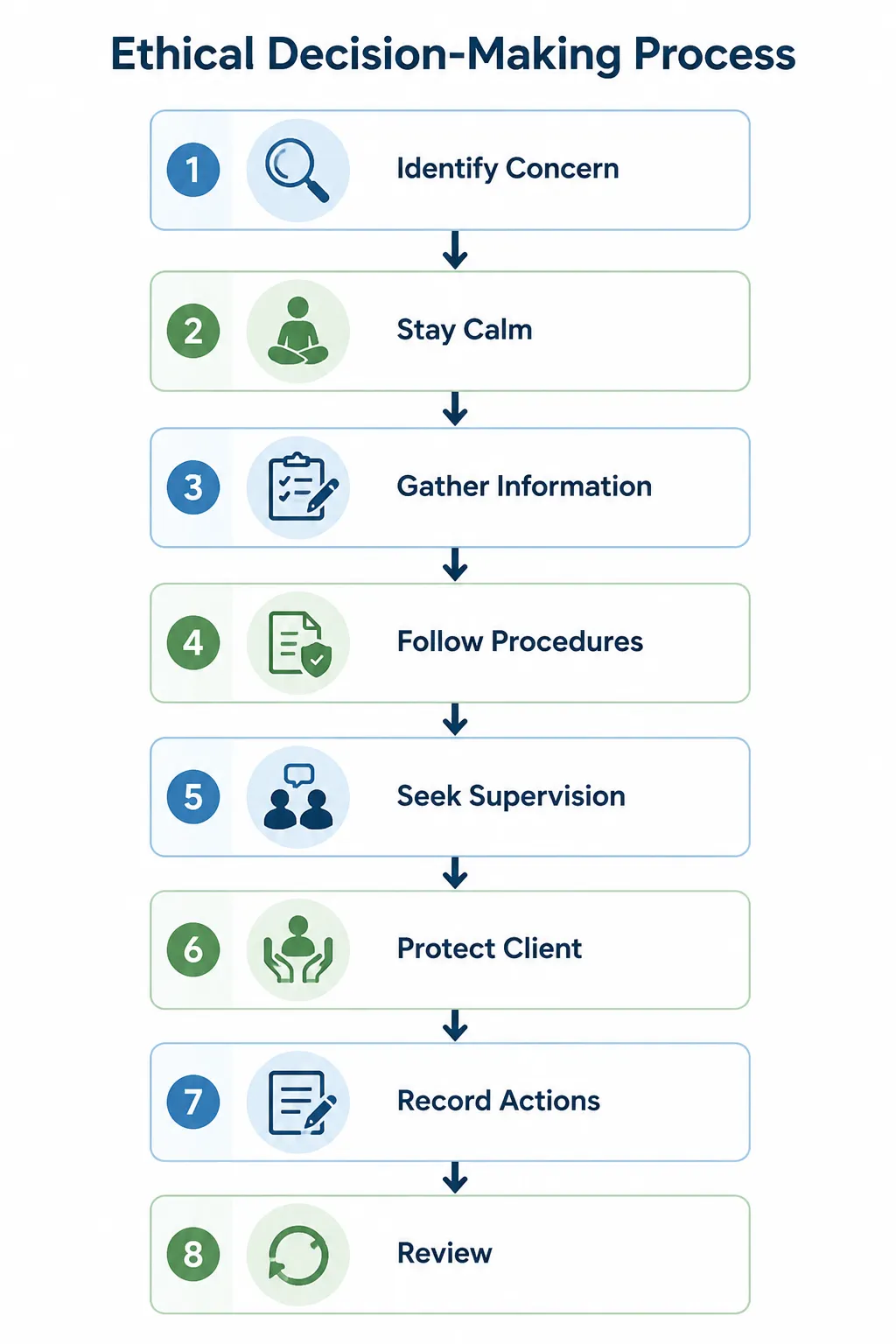
Working Within Professional Competence
Sometimes ethical concerns arise because a client’s needs are beyond the practitioner’s knowledge or experience.
In these situations, practitioners should:
- Recognise their limitations.
- Seek supervision.
- Arrange an appropriate referral if necessary.
- Continue supporting the client within their professional role.
Working within professional competence protects clients and promotes safe practice.
Professional Responsibilities
Every practitioner has important responsibilities when ethical concerns arise.
These include:
- Acting honestly.
- Following professional standards.
- Protecting confidentiality.
- Respecting client dignity.
- Reporting concerns appropriately.
- Seeking supervision when needed.
- Maintaining professional boundaries.
- Keeping accurate records.
- Working within competence.
- Putting client wellbeing first.
These responsibilities support ethical and professional CBT practice.
Applying Ethical Decision-Making in Everyday Practice
Ethical concerns may occur during everyday work.
A practitioner notices that a client appears unusually distressed and calmly asks appropriate questions while remaining supportive.
Another practitioner realises they have accidentally received confidential information intended for someone else. They immediately report the mistake and follow organisational procedures.
A practitioner feels unsure about managing a complex safeguarding concern and discusses the situation with their supervisor before taking further action.
These examples show that responding appropriately is more important than trying to solve every problem alone.
Workplace Examples
Example 1
A client tells a practitioner that they are thinking about harming themselves.
The practitioner listens carefully, follows safeguarding procedures, seeks supervision, and arranges appropriate support.
Example 2
A practitioner receives an expensive gift from a client.
Instead of accepting it immediately, they follow workplace guidance and discuss the situation with their manager.
Example 3
A practitioner realises that a client’s needs are beyond their professional experience.
They discuss the situation with their supervisor and arrange an appropriate referral while continuing to support the client within their role.
| Action | Purpose | Example in CBT Practice |
|---|---|---|
| Stay calm | Support good judgement | Remain professional during difficult conversations |
| Gather information | Understand the concern | Listen carefully before making decisions |
| Follow procedures | Ensure safe practice | Follow organisational policies |
| Seek supervision | Obtain professional guidance | Discuss concerns with a supervisor |
| Protect client wellbeing | Reduce risk of harm | Follow safeguarding procedures |
| Maintain confidentiality | Protect client privacy | Share information only when necessary |
| Keep accurate records | Support accountability | Record actions taken clearly |
| Reflect on practice | Improve future decisions | Review learning after the situation |
Case Study
Situation
Daniel is a CBT practitioner supporting Lisa, who has been receiving therapy for anxiety. During a session, Lisa tells Daniel that she feels overwhelmed and has recently been thinking about harming herself. She asks him not to tell anyone because she is worried about being judged.
Action
Daniel remains calm and listens carefully without interrupting. He explains that confidentiality is important but also explains that information may need to be shared if there is a serious risk of harm. He follows the organisation’s safeguarding procedures, carries out an initial risk assessment, records the discussion accurately, informs his supervisor, and arranges appropriate support for Lisa while keeping her informed throughout the process.
Result
Lisa receives immediate help from specialist services and continues attending CBT sessions. She later understands that Daniel acted to protect her wellbeing. Trust remains strong because Daniel explained each step honestly and treated her with dignity and respect.
Learning Point
When ethical concerns arise, practitioners should remain calm, follow professional procedures, seek supervision, protect client wellbeing, and document their actions accurately. These steps help ensure safe and ethical CBT practice.
Key Takeaways
- Ethical concerns should never be ignored.
- The first step is recognising that a concern exists.
- Practitioners should remain calm and gather accurate information.
- Workplace procedures should always be followed.
- Client wellbeing should remain the highest priority.
- Supervision provides valuable support during difficult situations.
- Confidentiality should be respected but may need to be limited to protect safety.
- Accurate records support accountability and continuity of care.
- Practitioners should always work within their professional competence.
- Reflecting on ethical situations helps improve future professional practice.
Taking the correct action when ethical concerns arise is an important part of safe and professional CBT practice. By recognising concerns early, following organisational procedures, seeking supervision, protecting client wellbeing, and maintaining accurate records, practitioners can respond confidently and responsibly while maintaining high professional standards.
Understanding these actions helps practitioners provide ethical, respectful, and client-centred care in a wide range of situations. Consistently applying professional guidance and acting in the client’s best interests strengthens therapeutic relationships, supports safe practice, and contributes to positive outcomes for both clients and practitioners.
Conclusion
Responding appropriately to ethical concerns is an essential part of safe and professional Cognitive Behavioural Therapy (CBT) practice. By recognising ethical issues early, remaining calm, following organisational procedures, seeking supervision when needed, and maintaining accurate records, practitioners can protect client wellbeing while meeting their professional responsibilities. These actions help ensure that therapy is delivered safely, ethically, and with respect for every client.
Understanding how to respond to ethical concerns also helps practitioners make responsible decisions and maintain high standards of professional practice. By working within their competence, respecting confidentiality, and always acting in the client’s best interests, practitioners build trust, strengthen therapeutic relationships, and contribute to positive outcomes for both clients and the wider profession.