
Lesson 3: Apply Appropriate Research Methodologies to Investigate QA/QC Issues
Selecting and applying appropriate research methodologies is a fundamental requirement for conducting effective electrical Quality Assurance and Quality Control (QA/QC) investigations. This lesson focuses on developing the ability to choose suitable research approaches that align with specific QA/QC challenges, research objectives, and identified knowledge gaps. In modern electrical engineering projects, quality issues such as installation defects, testing failures, documentation weaknesses, system reliability concerns, and technology implementation challenges require structured investigation methods to generate accurate evidence and practical solutions.
Electrical QA/QC research requires more than identifying problems; it involves systematic data collection, analysis, and evaluation to understand the causes, impacts, and potential improvements associated with quality challenges. This lesson explores different research methodologies, including qualitative, quantitative, and mixed-method approaches, and explains how they can be applied to investigate complex electrical quality management issues. By selecting suitable methodologies, researchers can evaluate industry practices, analyse performance data, understand professional experiences, and develop evidence-based recommendations that improve quality outcomes.
Effective research methodology application enables researchers to produce reliable findings that support innovation, continuous improvement, and better decision-making within electrical QA/QC environments. This lesson develops learners’ understanding of research planning, data analysis techniques, methodological limitations, and practical investigation strategies required for advanced QA/QC research. Through the application of appropriate research methods, learners gain the ability to investigate real-world electrical quality challenges and contribute valuable solutions that enhance safety, reliability, efficiency, and performance in engineering projects.
1. Critically Compare Different Research Methodologies and Their Suitability for Investigating Complex Electrical QA/QC Problems
Research methodology selection is a fundamental element of advanced electrical Quality Assurance and Quality Control (QA/QC) research because the chosen approach determines how effectively a problem can be investigated, analysed, and resolved. Complex electrical QA/QC issues often involve technical, operational, organisational, and human factors that cannot always be understood through a single research approach. Therefore, researchers must critically compare different methodologies and evaluate their suitability based on the nature of the research problem, available evidence, project environment, and expected outcomes.
Electrical QA/QC challenges may include recurring installation defects, ineffective inspection processes, testing failures, quality documentation issues, reliability concerns, digital transformation barriers, and performance variations between projects. Investigating these issues requires a structured methodology capable of generating reliable evidence and providing meaningful conclusions. The selection of an appropriate research methodology ensures that the investigation addresses the actual causes of quality problems rather than only analysing their visible effects.
A critical comparison of research methodologies involves evaluating the strengths, weaknesses, applications, and limitations of different approaches. Researchers must understand when qualitative methods provide deeper insights into professional experiences, when quantitative methods are more suitable for measuring performance and identifying patterns, and when mixed-method approaches are required to investigate complex relationships between technical and human factors.
In electrical QA/QC research, no single methodology is universally suitable for all investigations. The most appropriate approach depends on the research objectives, the complexity of the quality issue, the type of information required, and the intended contribution of the study. Selecting the correct methodology allows researchers to produce evidence-based findings that support improved quality management systems, enhanced electrical reliability, and better engineering decision-making.
Understanding Research Methodology in Electrical QA/QC Investigations
Research methodology refers to the structured approach used by researchers to collect, analyse, interpret, and present information during an investigation. It defines how evidence will be obtained and how conclusions will be developed.
In electrical QA/QC research, methodology provides a framework for investigating issues such as:
- Causes of electrical defects
- Effectiveness of inspection procedures
- Performance of quality management systems
- Impact of emerging technologies
- Reliability of testing methods
- Human factors affecting quality outcomes
A suitable methodology should:
- Align with the research question
- Generate reliable evidence
- Address the complexity of the problem
- Support valid conclusions
- Provide practical value to industry
For example, investigating why electrical installation defects repeatedly occur may require understanding both numerical defect data and the experiences of quality professionals. In this case, a combined research approach may provide stronger evidence than a single method.
Key Concepts of Research Methodologies
| Research Methodology | Definition | Suitability for Electrical QA/QC Research | Main Strengths | Main Limitations |
|---|---|---|---|---|
| Qualitative Research | A method focused on understanding experiences, opinions, behaviours, and processes | Suitable for investigating organisational challenges and professional experiences | Provides detailed understanding and context | Findings may be difficult to generalise |
| Quantitative Research | A method involving numerical data collection and statistical analysis | Suitable for measuring defects, performance indicators, and quality trends | Provides measurable and comparable results | May not explain underlying reasons |
| Mixed-Method Research | Combination of qualitative and quantitative approaches | Suitable for complex QA/QC problems involving technical and human factors | Provides comprehensive understanding | Requires more time and resources |
| Case Study Research | Detailed investigation of a specific project, organisation, or event | Suitable for analysing real electrical quality challenges | Provides practical industry insights | Limited general application |
| Experimental Research | Investigation involving controlled testing and comparison | Suitable for evaluating technical methods or technologies | Supports cause-and-effect analysis | May not reflect real project conditions |
| Survey Research | Collection of information from groups of participants | Suitable for analysing industry practices and opinions | Allows wider data collection | Depends on participant accuracy |
Qualitative Research Methodology for Electrical QA/QC Problems
Qualitative research focuses on understanding experiences, behaviours, decision-making processes, and professional perspectives. It is particularly useful when investigating complex issues where numerical data alone cannot explain the reasons behind quality failures.
In electrical QA/QC environments, qualitative research may involve:
- Interviews with QA/QC engineers
- Discussions with project managers
- Observation of quality processes
- Analysis of professional experiences
- Review of organisational practices
For example, a researcher investigating why quality procedures are not consistently followed may use interviews to understand:
- Training limitations
- Communication problems
- Management influences
- Workplace culture
- Resource challenges
Strengths of Qualitative Research
Qualitative methods provide several advantages:
- They explore complex workplace situations in detail
- They identify hidden causes behind quality problems
- They provide professional perspectives
- They help understand decision-making processes
- They reveal organisational challenges
For electrical QA/QC research, qualitative methods are valuable when investigating:
- Quality culture
- Human error factors
- Implementation barriers
- Professional judgement
- Organisational improvement strategies
Limitations of Qualitative Research
Despite its benefits, qualitative research has limitations:
- Findings may depend on participant experiences
- Results may not represent all organisations
- Data analysis can require significant interpretation
- Researcher bias must be carefully controlled
Therefore, qualitative research should be designed carefully to ensure credibility and reliability.
Quantitative Research Methodology for Electrical QA/QC Problems
Quantitative research focuses on numerical measurement, statistical analysis, and identifying measurable relationships between variables. It is suitable when researchers need objective data to evaluate quality performance.
In electrical QA/QC investigations, quantitative methods may analyse:
- Defect frequency
- Testing results
- Inspection records
- Failure rates
- Project performance indicators
- Quality improvement measurements
For example, a researcher evaluating the effectiveness of a new inspection technology may compare defect rates before and after implementation.
Strengths of Quantitative Research
Quantitative methods provide:
- Measurable evidence
- Statistical comparison
- Performance evaluation
- Trend identification
- Greater potential for generalisation
They are particularly useful for:
- Measuring quality improvements
- Analysing reliability data
- Comparing different approaches
- Evaluating technology performance
Limitations of Quantitative Research
Quantitative approaches may have limitations:
- They may not explain why problems occur
- They require reliable data availability
- Human factors may be difficult to measure
- Complex workplace issues may be simplified
For example, defect statistics may show an increase in failures but may not explain whether the cause was poor training, communication issues, or inadequate procedures.
Mixed-Method Research Methodology
Mixed-method research combines qualitative and quantitative approaches to provide a more complete understanding of complex problems.
This approach is particularly suitable for electrical QA/QC investigations because quality issues often involve both technical measurements and human factors.
A mixed-method study may include:
Quantitative elements:
- Analysis of defect records
- Statistical evaluation
- Performance measurements
Qualitative elements:
- Professional interviews
- Workplace observations
- Expert opinions
Advantages of Mixed-Method Research
Mixed-method research provides:
- Comprehensive understanding
- Stronger evidence validation
- Combination of technical and practical perspectives
- Improved research reliability
For example, a researcher investigating electrical commissioning failures may:
- Analyse failure statistics
- Interview commissioning engineers
- Review project documentation
This provides a deeper understanding than using only one approach.
Limitations of Mixed-Method Research
Challenges include:
- Greater time requirements
- Increased complexity
- Need for multiple research skills
- More detailed data management
However, for complex electrical QA/QC problems, the benefits often justify the additional effort.
Case Study Research in Electrical QA/QC
Case study methodology involves detailed investigation of a specific project, organisation, or quality issue.
It is highly relevant to electrical engineering because many QA/QC challenges are influenced by project-specific conditions.
Examples include:
- Investigation of electrical installation failures
- Analysis of renewable energy project quality issues
- Evaluation of digital QA/QC implementation
Benefits of Case Study Research
Case studies provide:
- Real-world understanding
- Detailed project insights
- Practical recommendations
- Connection between theory and practice
Limitations of Case Study Research
Limitations include:
- Limited ability to generalise findings
- Dependence on available project information
- Potential confidentiality issues
Experimental Research in Electrical QA/QC
Experimental research involves controlled testing to evaluate relationships between variables.
It may be used for:
- Testing new inspection technologies
- Comparing testing methods
- Evaluating equipment performance
- Assessing quality improvement techniques
For example, researchers may compare traditional inspection methods with automated inspection systems.
Critical Comparison of Research Methodologies for QA/QC Problems
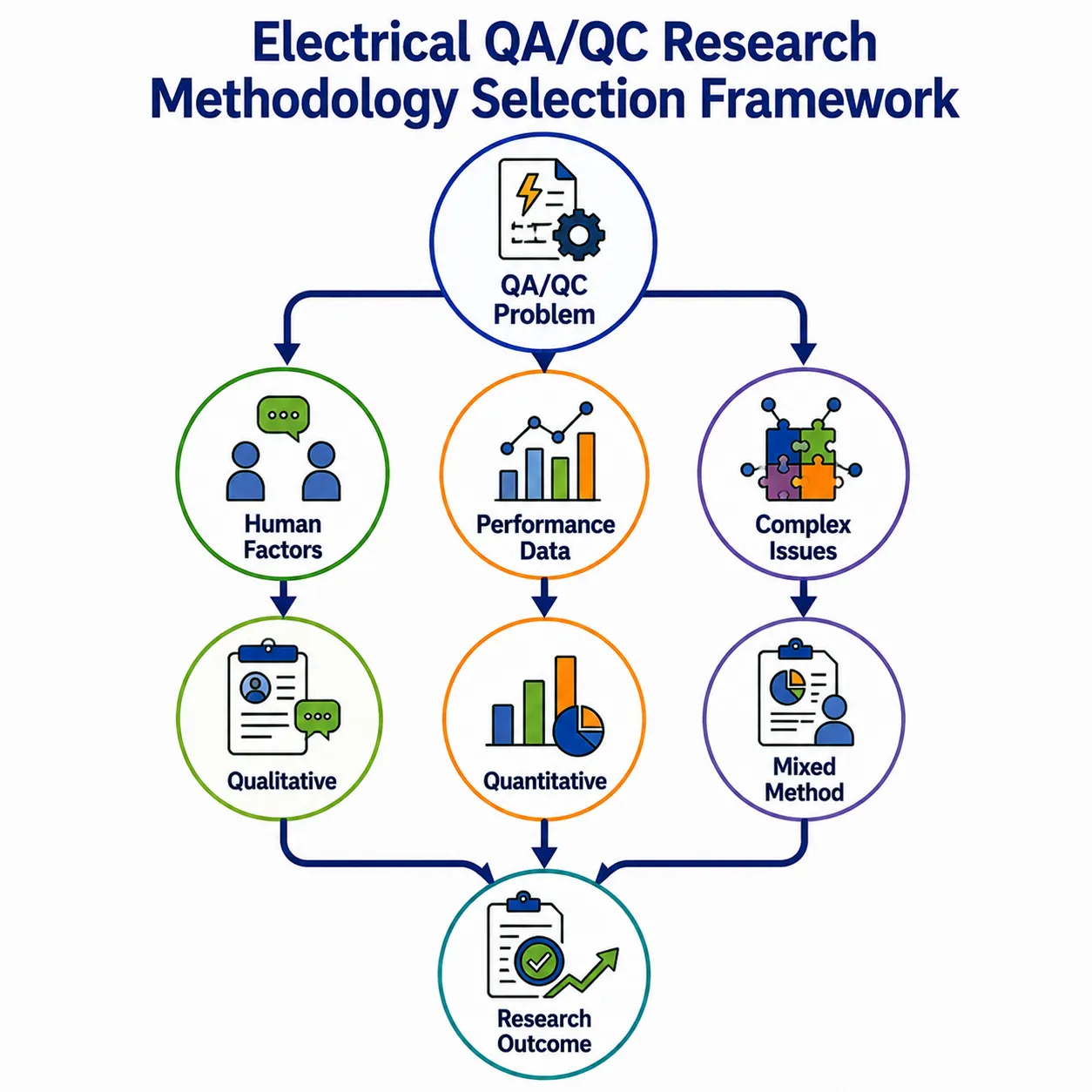
Different electrical QA/QC problems require different research approaches.
Investigating Human Factors Affecting Quality
Most suitable methodology:
- Qualitative research
- Mixed-method research
Reason:
Human behaviours, decision-making, and workplace culture require detailed understanding.
Measuring Defect Reduction
Most suitable methodology:
- Quantitative research
Reason:
Defect rates and quality indicators require numerical analysis.
Evaluating Digital QA/QC Adoption
Most suitable methodology:
- Mixed-method research
Reason:
Technology effectiveness requires both performance data and user experience analysis.
Analysing a Major Project Failure
Most suitable methodology:
- Case study research
Reason:
Detailed examination of real project conditions is required.
Methodology Selection Process for Electrical QA/QC Research
Define the Research Problem
Researchers should first understand:
- What problem requires investigation?
- What information is needed?
- What outcome is expected?
Identify Research Objectives
Objectives determine what methodology is appropriate.
For example:
Objective:
Measure improvement in defect detection.
Suitable method:
Quantitative analysis.
Objective:
Understand barriers to technology adoption.
Suitable method:
Qualitative interviews.
Evaluate Available Data
Researchers should consider:
- Data accessibility
- Quality of information
- Participant availability
- Project conditions
Select Appropriate Methodology
The selected method should provide the strongest evidence for answering the research question.
Evaluate Methodological Limitations
Researchers must consider:
- Reliability
- Validity
- Practical constraints
- Possible bias
Practical Example: Investigating Electrical Quality Defects
Research Problem
A construction organisation experiences repeated electrical installation defects despite established QA/QC procedures.
Methodology Comparison
Qualitative approach:
Could identify:
- Training issues
- Communication problems
- Management challenges
Quantitative approach:
Could analyse:
- Defect frequency
- Testing results
- Failure trends
Mixed-method approach:
Could combine both perspectives.
Recommended Methodology
A mixed-method approach would provide the most complete understanding because the problem involves both technical performance and human factors.
Case Study: Digital QA/QC Implementation Investigation
Background
An organisation introduces digital inspection tools but experiences inconsistent results.
Research Approaches
Qualitative research identifies:
- User acceptance issues
- Training requirements
Quantitative research evaluates:
- Inspection speed
- Defect reporting accuracy
Outcome
The combined methodology provides recommendations for improving digital QA/QC implementation.
Key Benefits of Selecting Appropriate Research Methodologies
Appropriate methodology selection provides:
- Reliable research findings
- Better understanding of QA/QC challenges
- Improved problem-solving capability
- Stronger evidence-based decisions
- Practical industry recommendations
- Improved quality management strategies
Conclusion
Critically comparing different research methodologies is essential for investigating complex electrical QA/QC problems effectively. Qualitative, quantitative, mixed-method, case study, and experimental approaches each provide unique advantages depending on the nature of the research problem. Selecting the most appropriate methodology requires careful consideration of research objectives, available evidence, project conditions, and expected outcomes.
A well-selected research methodology enables researchers to generate reliable knowledge and develop practical solutions for electrical quality challenges. By applying suitable research approaches, QA/QC investigations can address technical issues, organisational barriers, and emerging industry challenges while contributing to improved safety, reliability, performance, and continuous improvement in electrical engineering projects.
2. Select and Justify the Most Appropriate Research Methods (Qualitative, Quantitative, or Mixed) for the Specific Project
Selecting the most appropriate research method is a critical decision in advanced electrical Quality Assurance and Quality Control (QA/QC) research because the methodology determines how effectively a research project can investigate problems, generate evidence, and develop practical solutions. Complex electrical QA/QC issues often involve multiple dimensions, including technical performance, human behaviour, organisational processes, technology implementation, risk management, and quality improvement strategies. Therefore, researchers must carefully evaluate whether qualitative, quantitative, or mixed-method approaches are most suitable for addressing the specific research objectives.
The selection of a research method should not be based only on researcher preference or convenience. Instead, it should be justified through a clear understanding of the research problem, the type of information required, available resources, expected outcomes, and the complexity of the investigation. A suitable research method enables researchers to collect reliable evidence, analyse relevant factors, and produce findings that contribute to improved electrical quality management practices.
In electrical QA/QC investigations, some research projects require detailed understanding of professional experiences, decision-making processes, and organisational challenges. Other projects require measurable evidence, statistical analysis, and performance evaluation. In many advanced engineering investigations, both approaches may be necessary because quality problems are rarely caused by a single factor. For this reason, researchers must critically assess the suitability of qualitative, quantitative, and mixed-method approaches before selecting the final methodology.
The ability to justify research method selection demonstrates advanced research competence because it shows that the chosen approach is aligned with the research question and capable of producing meaningful outcomes. A well-justified methodology strengthens research reliability, improves practical relevance, and ensures that findings can support better decision-making within electrical engineering quality management environments.
Understanding Research Method Selection in Electrical QA/QC Projects
Research method selection refers to the process of choosing the most suitable approach for collecting, analysing, and interpreting information to answer a research question. The selected method must match the nature of the problem being investigated.
Electrical QA/QC projects may investigate issues such as:
Causes of electrical installation defects
Effectiveness of inspection procedures
Reliability of testing methods
Performance of quality management systems
Barriers to digital QA/QC implementation
Impact of emerging technologies
Sustainability-related quality challenges
Each problem may require a different research approach.
For example:
A project investigating “Why do electrical teams experience difficulties adopting digital QA/QC systems?” may require qualitative research because it focuses on experiences, opinions, and organisational barriers.
A project investigating “How much has a digital inspection system reduced electrical defects?” may require quantitative research because it requires measurable performance data.
A project investigating “How can digital QA/QC systems improve electrical project quality while considering technical and organisational factors?” may require a mixed-method approach because both numerical evidence and professional perspectives are required.
Key Concepts Related to Research Method Selection
| Research Method | Definition | Suitable Electrical QA/QC Applications | Key Advantages | Key Limitations |
|---|---|---|---|---|
| Qualitative Method | Research approach focused on understanding experiences, opinions, behaviours, and processes | Investigating quality culture, implementation barriers, and professional decision-making | Provides detailed understanding of complex issues | Findings may have limited generalisation |
| Quantitative Method | Research approach based on numerical data measurement and statistical analysis | Measuring defects, quality performance, testing results, and improvement outcomes | Provides measurable and comparable evidence | May not explain underlying causes |
| Mixed Method | Combination of qualitative and quantitative approaches | Investigating complex QA/QC issues involving technical and human factors | Provides comprehensive understanding | Requires more time and resources |
| Case Study Method | Detailed investigation of a specific project or organisation | Analysing real electrical quality problems | Provides practical insights | Results may be context-specific |
| Experimental Method | Controlled testing of variables to evaluate relationships | Comparing technologies, testing methods, or quality improvements | Supports cause-and-effect analysis | May not represent real project conditions |
Factors Influencing Research Method Selection
Selecting the correct research method requires evaluation of several important factors.
Nature of the Research Problem
The type of problem determines the most suitable methodology.
Researchers should consider:
Is the problem technical or behavioural?
Does it require measurement or explanation?
Does it involve multiple interacting factors?
Is existing knowledge sufficient?
Technical performance problems often require quantitative methods, while organisational challenges often require qualitative methods.
Research Objectives
Research objectives provide direction for methodology selection.
Examples:
Objective:
“To evaluate the effectiveness of automated electrical inspection systems.”
Suitable method:
Quantitative research.
Objective:
“To understand barriers affecting adoption of automated inspection systems.”
Suitable method:
Qualitative research.
Objective:
“To develop a framework for successful automated inspection implementation.”
Suitable method:
Mixed-method research.
Type of Data Required
The required data type strongly influences method selection.
Quantitative data includes:
Defect numbers
Testing measurements
Failure rates
Performance indicators
Qualitative data includes:
Professional opinions
Experiences
Observations
Decision-making processes
Available Resources
Researchers must consider:
Time availability
Access to project information
Participant availability
Research skills
Financial resources
A highly complex methodology may not be practical if sufficient resources are unavailable.
Selecting Qualitative Research Methods for QA/QC Projects
Qualitative research is appropriate when the objective is to understand experiences, behaviours, and processes that influence electrical quality outcomes.
It focuses on answering questions such as:
Why does a problem occur?
How do professionals experience a process?
What challenges affect quality improvement?
Suitable Applications of Qualitative Research
Qualitative methods are suitable for investigating:
Quality management culture
Human error factors
Communication problems
Training challenges
Technology acceptance issues
Organisational barriers
For example, if an organisation experiences repeated quality failures despite having procedures in place, qualitative research can investigate whether the causes relate to:
Poor communication
Lack of training
Weak supervision
Inconsistent implementation
Common Qualitative Methods
Interviews
Interviews allow researchers to collect detailed information from:
QA/QC engineers
Project managers
Electrical supervisors
Testing specialists
Benefits include:
Detailed professional insights
Understanding of decision-making
Identification of hidden challenges
Observations
Observation allows researchers to examine actual workplace practices.
Applications include:
Inspection processes
Testing activities
Documentation procedures
Document Analysis
Researchers can analyse:
Quality records
Inspection reports
Non-conformance reports
Project documentation
Justification for Qualitative Methods
Qualitative research should be selected when:
The research problem involves human factors
Detailed understanding is required
Existing numerical data is insufficient
Organisational behaviour influences quality outcomes
Selecting Quantitative Research Methods for QA/QC Projects
Quantitative research is appropriate when researchers need measurable evidence to evaluate performance, relationships, or improvements.
It focuses on questions such as:
How much improvement occurred?
How frequently does a problem occur?
What relationship exists between variables?
Suitable Applications of Quantitative Research
Quantitative methods are suitable for:
Measuring defect reduction
Analysing testing performance
Comparing quality indicators
Evaluating technology effectiveness
Examples of quantitative data:
Number of defects before and after intervention
Inspection completion rates
Testing accuracy percentages
Failure frequency
Common Quantitative Methods
Surveys
Surveys can collect structured responses from large groups.
Applications:
Industry quality practices
Technology adoption rates
Training effectiveness
Statistical Analysis
Statistical methods can identify:
Performance trends
Relationships between factors
Improvement levels
Performance Measurement
Researchers can evaluate:
Quality indicators
Reliability measures
Project outcomes
Justification for Quantitative Methods
Quantitative research should be selected when:
Numerical evidence is required
Performance measurement is important
Results need comparison
Data availability is strong
Selecting Mixed-Method Research for Complex QA/QC Projects
Mixed-method research combines qualitative and quantitative approaches to provide a more complete understanding of complex problems.
Electrical QA/QC issues often involve both technical and human factors, making mixed methods highly valuable.
Suitable Applications of Mixed Methods
Mixed methods are suitable for investigating:
Digital QA/QC implementation
Advanced inspection technologies
Quality improvement frameworks
Sustainability and performance challenges
For example:
A researcher investigating digital inspection systems may:
Quantitative analysis:
Measure defect reduction
Compare inspection times
Qualitative analysis:
Interview users about challenges
Understand implementation barriers
Justification for Mixed Methods
Mixed methods should be selected when:
The problem has multiple dimensions
Both measurable results and explanations are required
Technical and human factors interact
Strong evidence validation is needed
Research Method Selection Process
Step 1: Define the Research Question
The research question determines what type of evidence is required.
Researchers should identify whether the question focuses on:
Measurement
Explanation
Evaluation
Development
Step 2: Identify Required Evidence
Researchers should determine:
What information is needed?
Where will data come from?
How will data be analysed?
Step 3: Compare Available Methods
Researchers should evaluate:
Strengths
Limitations
Suitability
Practical requirements
Step 4: Select and Justify the Method
The chosen method should clearly support the research objectives.
The justification should explain:
Why this method is appropriate
Why alternatives are less suitable
How it will answer the research question
Step 5: Evaluate Method Limitations
Researchers should identify:
Possible bias
Data limitations
Resource challenges
Reliability concerns
Practical Example: Selecting Research Methods for Electrical Defect Investigation
Research Problem
An electrical construction project experiences repeated installation defects despite existing QA/QC procedures.
Possible Research Approaches
Qualitative Approach
Investigates:
Engineer experiences
Training issues
Communication problems
Advantages:
Explains root causes
Limitation:
Limited statistical evidence
Quantitative Approach
Investigates:
Defect frequency
Inspection records
Testing results
Advantages:
Provides measurable evidence
Limitation:
May not explain causes
Mixed Method Approach
Combines:
Defect data analysis
Professional interviews
Advantage:
Provides complete understanding
Recommended Method
A mixed-method approach would be most suitable because electrical defects involve both technical failures and organisational factors.
Case Study: Selecting Research Methodology for Digital QA/QC Adoption
Background
A company introduces digital inspection software but experiences inconsistent adoption among project teams.
Research Objective
To evaluate how digital QA/QC systems influence quality performance and identify adoption challenges.
Method Selection
Quantitative component:
Analyse defect rates
Compare inspection efficiency
Qualitative component:
Interview users
Evaluate implementation challenges
Research Justification
Mixed methods provide a complete understanding because the project requires measurement of performance improvements and investigation of human factors.
Key Benefits of Appropriate Research Method Selection
Selecting the correct research method provides:
Improved research accuracy
Stronger evidence quality
Better understanding of QA/QC issues
More reliable conclusions
Practical engineering recommendations
Increased research impact
Common Mistakes in Research Method Selection
Researchers should avoid:
Selecting methods without considering objectives
Using only convenient methods
Ignoring limitations
Collecting unsuitable data
Failing to justify choices
Strategies for Effective Method Justification
Researchers can improve methodology selection by:
Linking methods directly to research questions
Considering project complexity
Evaluating available evidence
Combining methods where appropriate
Explaining limitations clearly
Conclusion
Selecting and justifying the most appropriate research method is essential for successful investigation of electrical QA/QC problems. Qualitative, quantitative, and mixed-method approaches each provide different advantages depending on the nature of the research challenge. The most effective methodology is determined by the research objectives, evidence requirements, project conditions, and expected contribution to knowledge.
A well-justified research method enables researchers to investigate complex quality issues effectively and produce valuable findings for electrical engineering practice. By selecting appropriate methodologies, researchers can develop evidence-based solutions that improve quality management systems, enhance reliability, support innovation, and contribute to continuous improvement within electrical QA/QC environments.
3. Design a Robust Research Framework That Accounts for Interacting Variables and Unpredictable Factors in the Electrical Sector
Designing a robust research framework is an essential requirement for investigating complex electrical Quality Assurance and Quality Control (QA/QC) issues. A well-developed research framework provides a structured pathway for understanding relationships between different variables, analysing influencing factors, collecting reliable evidence, and developing meaningful conclusions. In the electrical sector, research investigations often involve multiple interacting elements, including technical performance, human behaviour, environmental conditions, technological changes, regulatory requirements, project constraints, and organisational practices.
Electrical QA/QC problems rarely occur due to a single cause. Issues such as equipment failure, installation defects, testing inconsistencies, documentation errors, and quality system weaknesses usually result from the interaction of several variables. Therefore, researchers must design frameworks capable of analysing these complex relationships rather than focusing only on isolated factors. A robust framework allows researchers to identify direct and indirect influences, evaluate uncertainty, and develop research outcomes that reflect real engineering conditions.
Modern electrical projects operate within rapidly changing environments where unpredictable factors can influence quality outcomes. These factors may include supply chain disruptions, technological advancements, changing standards, workforce capability variations, environmental conditions, and unexpected operational challenges. A strong research framework must therefore include flexibility, risk consideration, and appropriate methods for managing uncertainty.
The development of a research framework enables researchers to establish clear connections between research objectives, variables, data sources, analytical methods, and expected outcomes. By creating a structured approach, researchers can investigate complex QA/QC challenges systematically and produce findings that support improved electrical quality management practices.
Understanding Research Framework Design in Electrical QA/QC Investigations
A research framework is a structured model that explains how a research project will investigate a problem and generate knowledge. It establishes the relationship between the research question, variables, methodology, data collection processes, and analysis techniques.
In electrical QA/QC research, a framework helps researchers understand:
What factors influence quality performance
How different variables interact
Which evidence is required
How information will be analysed
How research findings will contribute to improvement
For example, a research project investigating electrical installation quality may consider relationships between:
Workforce competence
Inspection frequency
Material quality
Testing procedures
Management practices
Environmental conditions
A robust framework ensures that these factors are analysed together rather than separately.
Importance of a Robust Research Framework
A strong research framework provides several important advantages for electrical QA/QC investigations.
It helps researchers to:
Clearly define research boundaries
Identify important variables
Understand complex relationships
Select appropriate research methods
Improve data collection quality
Reduce uncertainty
Develop reliable conclusions
In the electrical sector, where project conditions can change quickly, a structured framework supports better decision-making and improves research reliability.
Key Concepts Related to Research Framework Development
| Concept | Definition | Importance in Electrical QA/QC Research |
|---|---|---|
| Research Framework | A structured model showing how research elements connect together | Provides direction and organisation for investigation |
| Variable | A factor that can influence or change research outcomes | Helps identify causes affecting quality performance |
| Independent Variable | A factor that influences another variable | Helps determine possible causes of QA/QC issues |
| Dependent Variable | The outcome affected by influencing factors | Measures quality performance results |
| Interacting Variables | Multiple factors affecting each other simultaneously | Represents real engineering complexity |
| Uncertainty Factor | An unpredictable condition affecting outcomes | Helps manage risks within research |
| Research Model | A conceptual representation of relationships between factors | Supports analysis and interpretation |
| Data Validation | Process of confirming accuracy and reliability of information | Improves research credibility |
| Risk Analysis | Evaluation of possible factors affecting research outcomes | Supports better decision-making |
| Research Boundary | Defined limits of the investigation | Maintains research focus |
Identifying Variables Within Electrical QA/QC Research
A critical part of framework design is identifying variables that influence the research problem. Electrical quality outcomes are usually affected by multiple technical and non-technical factors.
Technical Variables
Technical variables relate directly to electrical systems, equipment, and engineering processes.
Examples include:
Equipment specifications
Installation methods
Testing procedures
Material quality
System design parameters
Maintenance practices
These variables influence:
System reliability
Performance efficiency
Safety outcomes
Failure rates
Human Variables
Human factors significantly influence electrical QA/QC performance.
Examples include:
Worker competence
Training levels
Experience
Communication effectiveness
Decision-making ability
For example, a technically correct inspection procedure may fail if personnel do not have adequate knowledge or training.
Organisational Variables
Organisational factors influence how quality systems are implemented.
Examples include:
Management commitment
Quality culture
Resource availability
Communication structures
Documentation control
Weak organisational processes can create repeated quality problems even when technical standards exist.
Environmental Variables
Environmental conditions can affect electrical project performance.
Examples include:
Temperature variations
Humidity
Weather conditions
Site conditions
External operational influences
These factors should be considered when designing research frameworks.
External Variables
The electrical sector is influenced by external factors such as:
Regulatory changes
Supply chain issues
Market conditions
Technology development
Industry trends
These variables may introduce uncertainty into research outcomes.
Analysing Interacting Variables in Electrical QA/QC Research
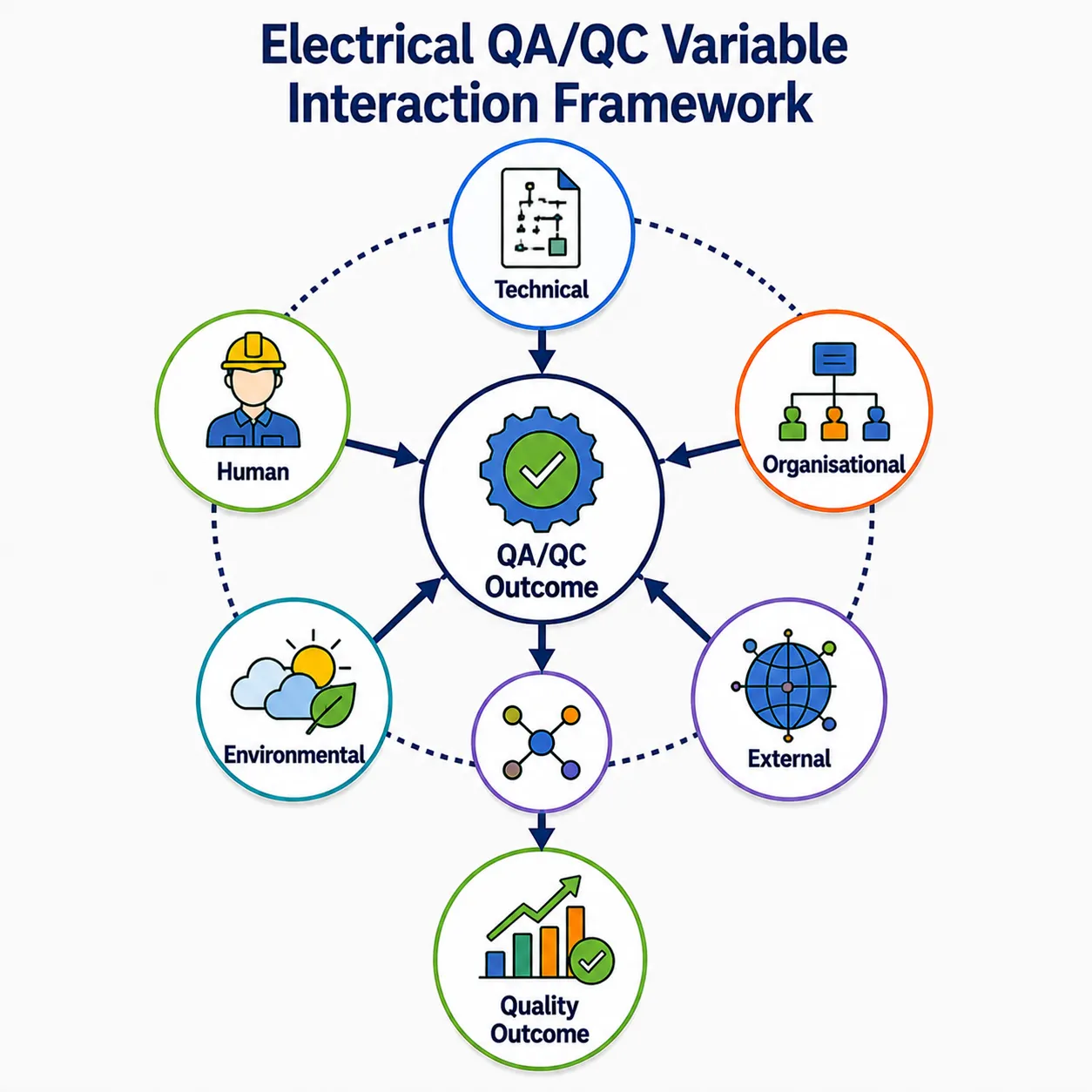
Complex electrical problems usually involve relationships between multiple variables.
For example:
Poor workforce training
↓
Incorrect installation practices
↓
Increased defects
↓
Reduced system reliability
A research framework must identify these connections.
Direct Relationships
A direct relationship occurs when one factor immediately affects another.
Example:
Improved inspection frequency → Reduced defects
Indirect Relationships
Indirect relationships occur when one variable influences another through an intermediate factor.
Example:
Management commitment → Better training → Improved installation quality
Multiple Variable Interactions
Many electrical QA/QC problems involve several interacting factors.
Example:
Quality failure may result from:
Poor documentation
Inadequate supervision
Material issues
Time pressure
Communication problems
A robust framework must capture these interactions.
Designing a Research Framework Process
Define the Research Problem
The first step is identifying the specific QA/QC challenge requiring investigation.
Researchers should define:
The quality issue
The affected systems
The possible influencing factors
The expected improvement area
Example:
Problem:
“Repeated electrical testing failures during project commissioning.”
Establish Research Objectives
Objectives should explain what the research intends to achieve.
Objectives may include:
Identifying failure causes
Evaluating current processes
Developing improvement strategies
Assessing technology effectiveness
Identify Key Variables
Researchers should determine:
Independent variables
Dependent variables
External influences
Control factors
Example:
Independent variables:
Inspection methods
Training quality
Testing procedures
Dependent variable:
Electrical quality performance
Develop Variable Relationships
Researchers should establish how variables interact.
This may involve:
Conceptual diagrams
Process models
Relationship maps
Select Research Methods
The framework should determine suitable research approaches.
Possible methods include:
Qualitative interviews
Quantitative analysis
Surveys
Case studies
Mixed-method investigations
Plan Data Collection
Researchers should identify:
Data sources
Collection methods
Participants
Measurement approaches
Analyse and Validate Findings
The framework should include processes for:
Data analysis
Evidence evaluation
Reliability checking
Conclusion development
Managing Unpredictable Factors in Electrical Research
Electrical projects are influenced by uncertainty. A robust framework must account for unexpected conditions.
Technological Changes
Electrical technologies develop rapidly.
Examples:
Smart monitoring systems
Artificial intelligence tools
Automated inspection technologies
Research frameworks should remain flexible enough to consider emerging technologies.
Regulatory Changes
Changes in:
Standards
Regulations
Quality requirements
may influence research outcomes.
Researchers should monitor relevant developments throughout the investigation.
Project Constraints
Electrical projects may experience:
Budget limitations
Time pressures
Resource shortages
These factors can influence quality performance.
Supply Chain Uncertainty
Material availability and supplier performance may affect:
Installation quality
Project schedules
Equipment reliability
Workforce Variations
Changes in workforce capability can influence:
Installation accuracy
Testing quality
Compliance performance
Practical Example: Research Framework for Electrical Installation Quality
Research Problem
A construction organisation experiences repeated electrical installation defects.
Framework Variables
Technical factors:
Installation methods
Material quality
Testing procedures
Human factors:
Worker competence
Training effectiveness
Organisational factors:
Supervision
Quality management practices
External factors:
Project deadlines
Supply chain issues
Research Approach
The framework combines:
Quantitative methods:
Defect analysis
Testing records
Qualitative methods:
Engineer interviews
Workplace observations
Expected Outcome
The framework identifies the most significant factors affecting electrical installation quality and provides improvement recommendations.
Case Study: Research Framework for Digital QA/QC Systems
Background
An organisation introduces digital quality management software but experiences inconsistent adoption.
Identified Variables
Technology factors:
System usability
Data accuracy
Human factors:
User skills
Training
Organisational factors:
Management support
Implementation strategy
Framework Application
The research evaluates:
How technology affects quality performance
How users interact with the system
What barriers prevent successful adoption
Findings
The framework reveals that technology alone does not guarantee improvement; successful implementation requires effective training, management support, and process integration.
Benefits of a Robust Research Framework
A strong framework provides:
Improved Research Accuracy
By considering multiple variables, researchers produce more reliable findings.
Better Understanding of Complex Problems
The framework reveals relationships between different influencing factors.
Stronger Decision-Making
Research outcomes provide evidence for quality improvement strategies.
Reduced Research Risk
Considering uncertainty improves investigation reliability.
Practical Industry Application
Findings can be applied to real electrical engineering challenges.
Support for Innovation
Framework-based research encourages development of improved QA/QC solutions.
Common Challenges in Framework Development
Researchers may experience challenges such as:
Identifying all relevant variables
Managing complex relationships
Limited data availability
Changing project conditions
Balancing research scope
These challenges require careful planning and continuous evaluation.
Strategies for Improving Research Framework Quality
Researchers can improve framework effectiveness by:
Conducting detailed literature reviews
Consulting industry professionals
Validating assumptions
Considering multiple perspectives
Updating frameworks when conditions change
Using appropriate analytical methods
Conclusion
Designing a robust research framework is essential for investigating complex electrical QA/QC issues because it provides a structured approach for understanding interacting variables and unpredictable factors. Electrical quality challenges are influenced by technical, human, organisational, and external conditions, making it necessary to develop frameworks that reflect real engineering environments. By identifying relationships between variables, selecting appropriate methodologies, and considering uncertainty, researchers can produce reliable and meaningful findings.
A well-designed research framework enables electrical QA/QC investigations to contribute valuable knowledge and practical improvements. Through systematic analysis of complex quality issues, researchers can support better decision-making, improve reliability, enhance safety performance, and develop innovative approaches that strengthen quality management practices across the electrical sector.
4. Apply the Chosen Methodologies Practically to Conduct Ethical and Valid Investigations into QA/QC Issues
Applying selected research methodologies effectively is a critical stage in conducting advanced electrical Quality Assurance and Quality Control (QA/QC) investigations. After identifying the research problem, reviewing existing knowledge, and selecting an appropriate methodology, researchers must implement the chosen approach in a structured, ethical, and scientifically valid manner. The practical application of research methods determines whether the investigation can generate reliable evidence, identify root causes, and provide meaningful improvements for electrical quality management practices.
Electrical QA/QC investigations often involve complex engineering challenges where technical systems, human performance, organisational processes, and external conditions interact. Therefore, applying research methodologies requires careful planning to ensure that collected information accurately represents the investigated issue. A poorly applied methodology can lead to unreliable findings, incorrect conclusions, and ineffective recommendations. In contrast, a well-executed methodology enables researchers to understand quality failures, evaluate existing procedures, and develop solutions that improve safety, reliability, efficiency, and performance.
Ethical and valid research practices are particularly important within the electrical sector because investigations may involve sensitive project information, professional opinions, operational data, and safety-related issues. Researchers must ensure confidentiality, obtain appropriate permissions, maintain data accuracy, and avoid bias throughout the research process. Ethical research protects participants and organisations while strengthening the credibility of research outcomes.
This lesson focuses on how selected methodologies, including qualitative, quantitative, and mixed-method approaches, can be practically applied to investigate QA/QC issues. It examines research planning, data collection, analysis techniques, validation processes, ethical considerations, and the development of evidence-based conclusions suitable for professional electrical engineering environments.
Understanding Practical Methodology Application in Electrical QA/QC Research
Applying a research methodology involves transforming a theoretical research approach into a structured investigation process. It requires researchers to implement appropriate procedures for collecting, analysing, and interpreting evidence.
In electrical QA/QC research, practical methodology application includes:
Defining investigation procedures
Selecting appropriate data sources
Collecting accurate information
Analysing evidence systematically
Maintaining ethical standards
Validating research findings
For example, if a researcher investigates repeated electrical installation defects, practical methodology application may involve:
Reviewing quality inspection records
Analysing defect trends
Interviewing QA/QC professionals
Observing installation practices
Evaluating existing procedures
The objective is not only to identify that defects exist but to understand why they occur and how quality performance can be improved.
Key Concepts Related to Ethical and Valid Research Investigation
| Concept | Definition | Importance in Electrical QA/QC Research |
|---|---|---|
| Research Ethics | Principles that ensure research is conducted responsibly and fairly | Protects participants, organisations, and information |
| Validity | The extent to which research accurately investigates the intended issue | Ensures findings represent the actual problem |
| Reliability | The consistency and repeatability of research results | Improves confidence in conclusions |
| Data Collection | Systematic gathering of information for analysis | Provides evidence for investigation |
| Research Bias | Influence that may affect objectivity of findings | Must be controlled to maintain accuracy |
| Confidentiality | Protection of sensitive information | Maintains trust and professional responsibility |
| Triangulation | Using multiple evidence sources to confirm findings | Strengthens research credibility |
| Method Application | Practical implementation of selected research procedures | Converts research design into action |
| Evidence Analysis | Evaluation and interpretation of collected information | Supports informed conclusions |
| Research Integrity | Maintaining honesty and accuracy throughout investigation | Ensures professional research standards |
Applying Qualitative Methodologies in QA/QC Investigations
Qualitative research methods are applied when researchers need to understand experiences, behaviours, decision-making processes, and organisational challenges affecting quality performance.
In electrical QA/QC investigations, qualitative methods are useful for exploring issues such as:
Poor quality culture
Communication failures
Training limitations
Implementation barriers
Management influences
Human error factors
Practical Application of Interviews
Interviews are one of the most common qualitative methods used in QA/QC investigations.
Researchers may interview:
QA/QC engineers
Electrical supervisors
Project managers
Testing specialists
Maintenance professionals
A structured interview process should include:
Clearly defined objectives
Relevant questions
Participant selection criteria
Ethical consent procedures
Accurate recording methods
For example, when investigating repeated commissioning failures, interviews may reveal that:
Testing procedures were unclear
Communication between teams was ineffective
Staff lacked specific training
Practical Application of Observations
Observation allows researchers to examine actual workplace practices.
Examples include observing:
Inspection procedures
Testing activities
Installation methods
Documentation processes
Observation helps identify differences between:
Planned procedures
Actual practices
For example, a company may have detailed inspection procedures, but observation may reveal that time pressures cause employees to skip certain quality checks.
Applying Quantitative Methodologies in QA/QC Investigations
Quantitative research methods are applied when researchers need measurable evidence to evaluate performance, relationships, or improvement outcomes.
Electrical QA/QC quantitative investigations may analyse:
Defect frequency
Testing results
Failure rates
Inspection performance
Quality indicators
Practical Application of Data Analysis
Researchers may collect numerical information from:
Quality reports
Testing records
Inspection databases
Non-conformance reports
The analysis may identify:
Common failure patterns
Performance trends
Improvement opportunities
For example:
Before implementing a new inspection process:
High number of installation defects
After implementation:
Reduced defect frequency
The researcher can evaluate whether the improvement approach was effective.
Practical Application of Surveys
Surveys allow researchers to collect information from larger groups.
QA/QC surveys may investigate:
Industry practices
Training effectiveness
Technology adoption
Quality management challenges
Effective surveys require:
Clear questions
Appropriate participant selection
Reliable response measurement
Applying Mixed Methodologies in QA/QC Investigations
Mixed-method research combines qualitative and quantitative approaches to provide a complete understanding of complex issues.
Electrical quality problems often require mixed methods because they involve:
Technical performance
Human decisions
Organisational processes
External influences
Example of Mixed-Method Application
Research topic:
“Improving digital QA/QC system implementation in electrical construction projects.”
Quantitative investigation:
Analyse defect records
Measure inspection efficiency
Compare quality performance
Qualitative investigation:
Interview users
Explore implementation challenges
Understand organisational barriers
Combined findings provide stronger conclusions than either method alone.
Ensuring Ethical Research Practices
Ethical research is essential when investigating electrical QA/QC issues because investigations may involve confidential information and professional participants.
Obtaining Informed Consent
Researchers must ensure participants understand:
Research purpose
Data usage
Participation requirements
Privacy protection
Participants should voluntarily agree before providing information.
Maintaining Confidentiality
Electrical projects may involve sensitive information including:
Project performance data
Quality failures
Company procedures
Technical documentation
Researchers must protect this information by:
Removing identifying details
Securely storing data
Limiting access
Avoiding Research Bias
Bias can influence research outcomes.
Researchers should avoid:
Selecting only supportive evidence
Ignoring conflicting findings
Influencing participant responses
Strategies include:
Using objective questions
Comparing multiple sources
Applying transparent analysis methods
Ensuring Research Validity
Validity determines whether the research accurately investigates the intended problem.
Researchers can improve validity by:
Using appropriate methodologies
Selecting relevant participants
Collecting suitable data
Linking findings to research objectives
Types of Validity in QA/QC Research
Internal Validity
Ensures relationships between variables are accurately understood.
Example:
Determining whether a new inspection method actually reduced defects.
External Validity
Considers whether findings can apply to other situations.
Example:
Determining whether findings from one project may support similar electrical projects.
Ensuring Research Reliability
Reliable research should produce consistent results when similar conditions exist.
Reliability can be improved through:
Standardised procedures
Accurate data recording
Clear research protocols
Repeatable analysis methods
Data Collection Process for QA/QC Investigations
Define Data Requirements
Researchers should identify:
What information is needed
Where data will come from
How data will support objectives
Select Data Sources
Possible sources include:
Project documents
Inspection records
Testing reports
Professional interviews
Industry databases
Collect Data Systematically
Researchers should maintain:
Accurate records
Consistent procedures
Ethical controls
Analyse Collected Evidence
Analysis methods depend on the chosen methodology.
Qualitative analysis may involve:
Identifying themes
Comparing experiences
Evaluating patterns
Quantitative analysis may involve:
Statistical evaluation
Trend analysis
Performance comparison
Validate Research Findings
Validation ensures conclusions are supported by reliable evidence.
Researchers can use:
Multiple data sources
Expert review
Comparative analysis
Participant feedback
Practical Example: Investigating Electrical Testing Failures
Background
An industrial facility experiences repeated electrical testing failures during commissioning.
Research Approach
A mixed-method investigation is selected.
Quantitative Application
Researchers analyse:
Testing records
Failure frequency
Equipment performance data
Qualitative Application
Researchers conduct:
Engineer interviews
Process observations
Ethical Considerations
Researchers:
Protect company information
Obtain participant consent
Maintain objective analysis
Outcome
The investigation identifies that failures were caused by a combination of:
Inconsistent testing procedures
Communication problems
Limited training
The research provides recommendations for improving QA/QC performance.
Case Study: Applying Research Methodology for Digital Quality Improvement
Project Situation
A construction organisation introduces a digital quality management platform but continues experiencing documentation errors.
Investigation Method
The researcher applies mixed methods.
Quantitative evidence:
Documentation error rates
Inspection completion times
Qualitative evidence:
User interviews
Process observations
Findings
The investigation identifies:
Technology capability was effective
User training was insufficient
Implementation processes required improvement
Research Contribution
The study develops recommendations for successful digital QA/QC implementation.
Key Benefits of Ethical and Valid QA/QC Research
Applying methodologies correctly provides:
Improved Problem Understanding
Research reveals actual causes behind quality issues.
Reliable Decision-Making
Evidence-based findings support better engineering decisions.
Enhanced Quality Improvement
Research outcomes contribute to improved procedures and systems.
Increased Professional Confidence
Reliable investigations provide stronger recommendations.
Better Safety Outcomes
Improved QA/QC practices reduce electrical risks.
Common Challenges During Method Application
Researchers may face:
Limited access to data
Participant availability issues
Confidentiality restrictions
Changing project conditions
Methodological limitations
These challenges require careful planning and flexible research strategies.
Strategies for Effective Method Application
Researchers should:
Clearly define research procedures
Maintain ethical standards
Use reliable evidence sources
Validate findings through multiple approaches
Document research decisions
Continuously review methodology effectiveness
Conclusion
Applying selected research methodologies practically is essential for conducting ethical and valid investigations into electrical QA/QC issues. The effectiveness of a research project depends not only on choosing an appropriate methodology but also on implementing it through structured data collection, accurate analysis, ethical practices, and reliable validation processes. By applying qualitative, quantitative, or mixed-method approaches appropriately, researchers can investigate complex quality challenges and develop evidence-based improvements.
A robust research investigation enables electrical QA/QC professionals and researchers to identify root causes, improve quality management systems, and support safer and more reliable engineering outcomes. Through ethical research practices and systematic methodology application, investigations can generate valuable knowledge that contributes to innovation, continuous improvement, and enhanced performance within the electrical sector.