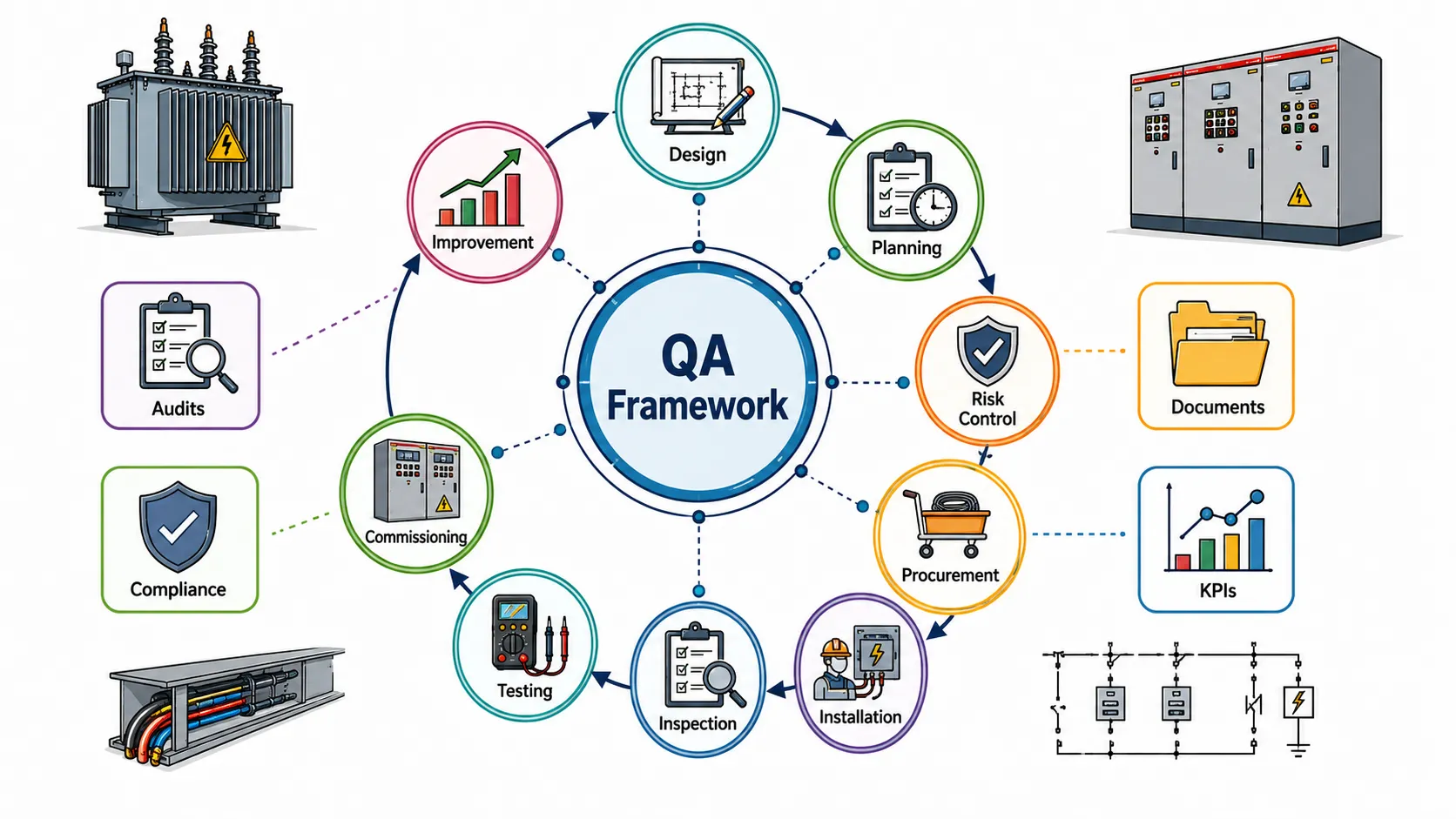
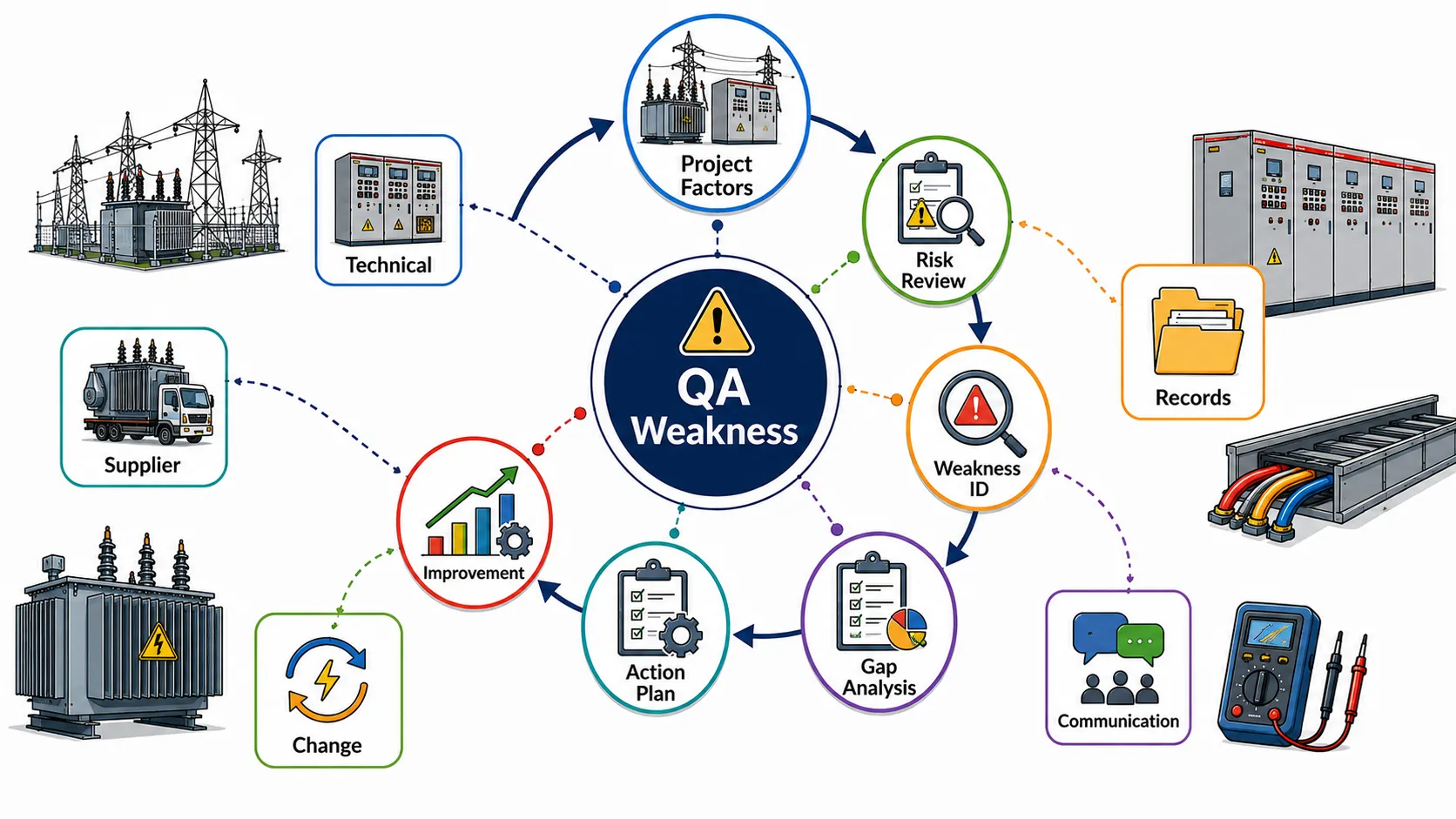
Lesson 3: Analyse the Effectiveness of Quality Assurance Frameworks in Complex Environments
In modern electrical engineering projects, maintaining consistent quality performance within complex environments requires advanced Quality Assurance (QA) frameworks that can effectively manage technical challenges, regulatory requirements, stakeholder expectations, and rapidly changing project conditions. Large-scale electrical projects, including high-voltage substations, renewable energy systems, industrial power networks, and infrastructure developments, involve multiple interconnected processes where quality failures can affect safety, reliability, cost, and long-term operational performance. This lesson examines how quality assurance frameworks are structured, applied, and evaluated to ensure that electrical engineering activities achieve defined quality objectives throughout the project lifecycle.
Effective QA frameworks provide a proactive approach to quality management by focusing on prevention, process control, risk management, and continuous improvement rather than only identifying defects after completion. In complex electrical engineering environments, these frameworks integrate internationally recognised quality principles, including process-based management, risk-based thinking, audit practices, performance evaluation, and evidence-based decision-making. A well-designed quality assurance framework enables organisations to control engineering processes from design development and procurement through installation, inspection, testing, commissioning, and final handover. It also supports effective coordination between engineers, contractors, suppliers, and clients to maintain consistent quality standards across all project activities.
This lesson explores the methods used to analyse the effectiveness of QA frameworks in challenging electrical engineering environments by evaluating their ability to reduce risks, improve process performance, ensure compliance, and achieve project quality goals. It examines key elements such as quality audits, quality indicators, corrective and preventive actions, supplier quality management, documentation control, and continuous improvement strategies. By understanding how QA frameworks perform in real-world applications, learners develop the ability to assess quality systems, identify improvement opportunities, and contribute to reliable engineering outcomes. Effective quality assurance is not only a compliance requirement but also a strategic approach that enhances project success, operational reliability, and professional excellence within the global electrical engineering sector.
Examine the Key Features of Quality Assurance (QA) Frameworks Applied in Complex Electrical Settings
Introduction to Quality Assurance Frameworks in Complex Electrical Engineering Environments
Quality Assurance (QA) frameworks are fundamental components of modern electrical engineering projects because they establish structured methods for controlling, improving, and maintaining quality throughout the complete project lifecycle. In complex electrical environments, projects involve highly sophisticated systems, safety-critical equipment, multiple engineering disciplines, international suppliers, regulatory requirements, and demanding performance expectations. Examples include high-voltage transmission networks, electrical substations, renewable energy facilities, industrial automation systems, smart grid infrastructure, and large-scale power distribution projects.
Unlike traditional quality control approaches that focus mainly on detecting defects after work completion, advanced QA frameworks are designed around prevention, process improvement, risk management, and continuous monitoring. They ensure that quality is built into every stage of an electrical project, beginning with design development and engineering calculations, continuing through procurement and installation, and extending to testing, commissioning, and operational handover.
From the perspective of a Chartered Electrical Engineer (CEng) and Senior Electrical QA/QC Engineer, an effective QA framework is not simply a collection of procedures and documents. It is an integrated management system that connects technical processes, human resources, suppliers, contractors, and project objectives. The effectiveness of a QA framework depends on its ability to identify potential risks, establish appropriate controls, measure performance, and support continual improvement.
In complex electrical settings, QA frameworks provide organisations with confidence that electrical systems will perform safely, reliably, and efficiently throughout their operational life. They support compliance with international standards such as ISO 9001 Quality Management Systems and help engineering organisations achieve consistent quality outcomes across challenging project environments.
Understanding Quality Assurance Frameworks
Definition of Quality Assurance Frameworks
A Quality Assurance framework is a systematic structure of policies, procedures, processes, responsibilities, and monitoring activities designed to ensure that engineering activities consistently meet specified quality requirements.
In electrical engineering projects, a QA framework provides a planned approach for:
- Preventing defects before they occur.
- Controlling engineering processes.
- Ensuring compliance with technical specifications.
- Managing project risks.
- Improving operational reliability.
- Maintaining accurate quality records.
- Supporting continuous improvement.
A QA framework operates across the entire project lifecycle rather than focusing on one specific activity. It connects design teams, procurement departments, construction personnel, testing engineers, commissioning specialists, suppliers, and clients through controlled quality processes.
For example, in a high-voltage substation project, a QA framework ensures that:
- Design calculations are reviewed and approved.
- Equipment specifications meet operational requirements.
- Suppliers provide compliant materials.
- Installation activities follow approved procedures.
- Testing confirms system performance.
- Documentation supports future maintenance activities.
Difference Between Quality Assurance and Quality Control
Although Quality Assurance and Quality Control are closely related, they perform different functions within electrical engineering projects.
Quality Assurance focuses on preventing problems by improving processes and systems, while Quality Control focuses on identifying problems through inspection and verification.
| Aspect | Quality Assurance (QA) | Quality Control (QC) |
|---|---|---|
| Main Purpose | Prevent quality problems | Detect quality defects |
| Approach | Process-focused | Product/output-focused |
| Timing | Before and during activities | During and after activities |
| Main Activities | Audits, procedures, planning, training | Inspection, testing, verification |
| Electrical Example | Developing installation procedures | Testing installed electrical equipment |
Both QA and QC must work together to achieve reliable electrical project outcomes.
Importance of QA Frameworks in Complex Electrical Settings
Complex electrical projects involve multiple technical interfaces where small errors can create significant consequences. A failure in design, installation, testing, or documentation can affect safety, system reliability, project costs, and operational performance.
A strong QA framework helps organisations manage these challenges by providing structured processes for quality planning, monitoring, and improvement.
Major challenges addressed by QA frameworks include:
- Complex engineering interfaces between electrical systems.
- Increasing technical requirements.
- Strict regulatory compliance obligations.
- Large-scale supplier networks.
- Advanced electrical technologies.
- Tight project schedules.
- High reliability expectations.
- Safety-critical operational requirements.
For example, a failure in a protection relay configuration within a power substation may result in incorrect system responses during electrical faults. An effective QA framework prevents such failures through design reviews, testing procedures, verification processes, and documentation control.
Key benefits of applying QA frameworks in complex electrical environments include:
- Improved electrical system reliability.
- Reduction in technical failures.
- Better project coordination.
- Increased compliance with standards.
- Reduced rework and project delays.
- Enhanced stakeholder confidence.
- Improved safety performance.
- Better lifecycle management of electrical assets.
Core Principles of Advanced QA Frameworks
Advanced QA frameworks used in electrical engineering environments are based on several fundamental quality management principles. These principles ensure that quality activities are systematic, measurable, and aligned with project objectives.
Process-Based Quality Management Approach
A process-based approach is one of the most important features of an effective QA framework. This approach considers a project as a collection of interconnected processes rather than independent activities.
Electrical engineering projects typically include:
- Engineering design.
- Procurement.
- Manufacturing.
- Installation.
- Inspection.
- Testing.
- Commissioning.
- Handover.
Each process has:
- Defined inputs.
- Required resources.
- Responsible personnel.
- Controlled procedures.
- Expected outputs.
- Performance measurements.
A process-based QA framework ensures that changes or failures in one area are effectively managed before affecting other project activities.
Example of Process Interaction
During a power plant electrical installation:
- Design requirements determine equipment selection.
- Equipment selection influences procurement activities.
- Procurement affects installation planning.
- Installation quality influences testing results.
- Testing results determine commissioning approval.
The QA framework ensures that information flows effectively between all these processes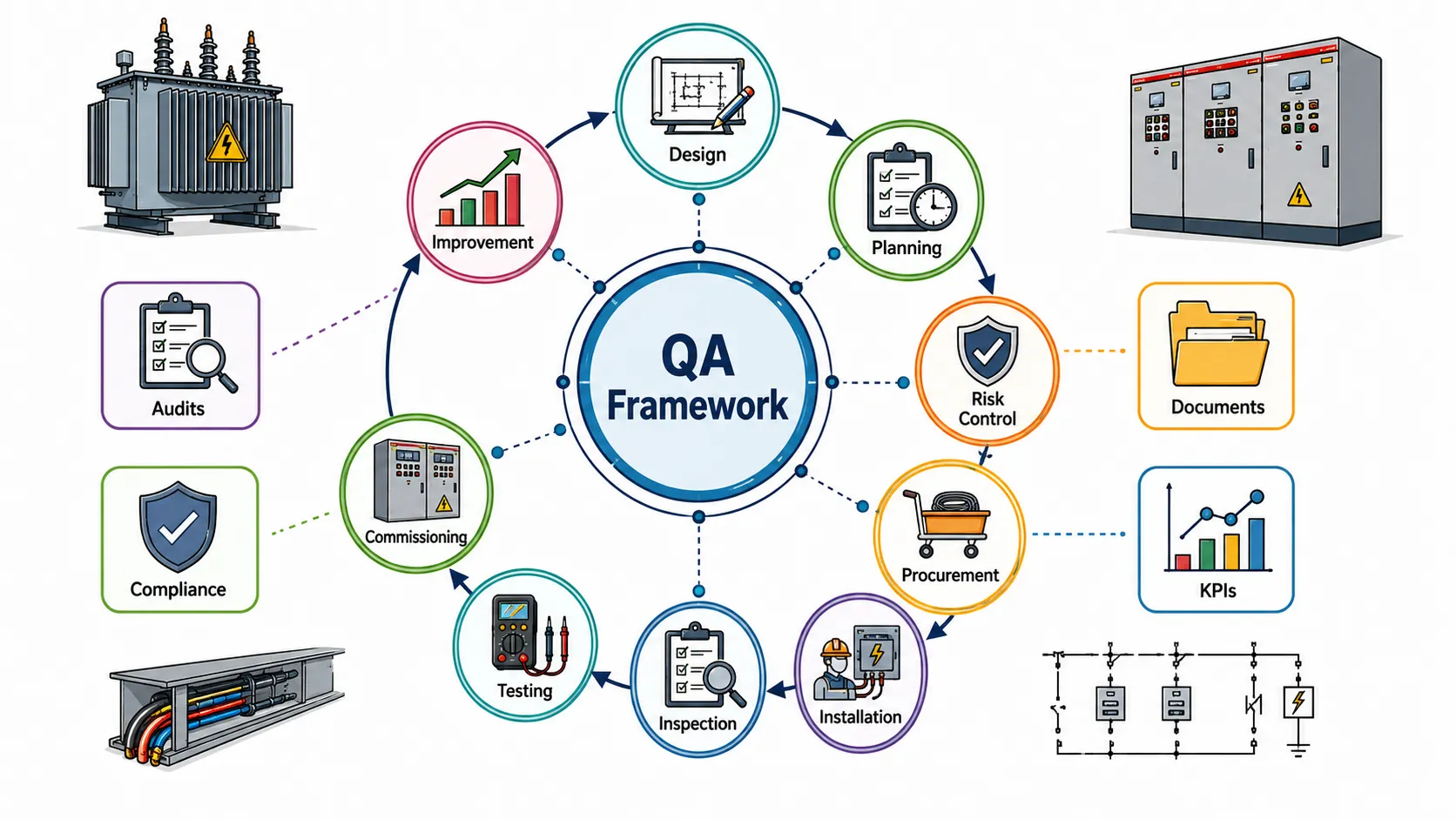
Risk-Based Quality Management
Risk-based thinking is a critical feature of modern QA frameworks because complex electrical projects contain numerous technical and operational uncertainties.
Instead of waiting for failures to occur, organisations identify potential risks and implement preventive controls.
Risk management process includes:
Risk Identification
Potential quality risks are identified through:
- Design reviews.
- Engineering assessments.
- Supplier evaluations.
- Site investigations.
- Previous project experience.
Common electrical project risks include:
- Incorrect equipment selection.
- Incompatible system interfaces.
- Material defects.
- Installation errors.
- Testing failures.
- Supplier delays.
Risk Assessment
Identified risks are evaluated based on:
- Probability of occurrence.
- Impact on project performance.
- Safety implications.
- Cost consequences.
Risk Control
Control measures may include:
- Additional inspections.
- Design verification.
- Supplier audits.
- Testing requirements.
- Additional technical reviews.
Risk Monitoring
Risks are continuously reviewed throughout project execution to ensure controls remain effective.
Quality Planning Framework
Quality planning is a fundamental element of QA frameworks because it defines how quality objectives will be achieved.
A project-specific Quality Plan provides clear guidance for all project participants and ensures consistent implementation of quality requirements.
A Quality Plan normally includes:
- Project quality objectives.
- Applicable standards and regulations.
- Roles and responsibilities.
- Inspection requirements.
- Testing procedures.
- Audit schedules.
- Document control methods.
- Non-conformance procedures.
- Corrective action processes.
For electrical projects, quality planning ensures that critical activities are controlled before execution begins.
Example: Electrical Substation Quality Planning
A substation project Quality Plan may define:
- Transformer inspection procedures.
- Switchgear testing requirements.
- Cable installation verification.
- Protection system testing.
- Commissioning acceptance criteria.
This approach reduces uncertainty and improves project control.
Documentation and Information Control
Documentation management is a critical feature of QA frameworks because electrical projects generate large amounts of technical information.
Accurate documentation provides evidence that project activities have been completed according to approved requirements.
Important QA documentation includes:
- Engineering drawings.
- Technical specifications.
- Inspection reports.
- Test certificates.
- Calibration records.
- Material approvals.
- Audit reports.
- Non-conformance reports.
- Commissioning records.
Effective documentation control ensures:
- Correct information is available to project teams.
- Unapproved changes are prevented.
- Technical records remain traceable.
- Compliance evidence is maintained.
Document control procedures include:
- Document approval.
- Revision management.
- Access control.
- Distribution management.
- Record storage.
- Retention requirements.
For example, using an outdated electrical drawing during installation may result in incorrect cable routing or equipment connection errors. A strong QA framework prevents this through controlled document management systems.
Quality Auditing and Compliance Management
Auditing is an essential feature of QA frameworks because it provides objective evidence of system effectiveness.
Audits evaluate whether quality processes are:
- Properly implemented.
- Consistently followed.
- Effective in achieving objectives.
- Compliant with standards.
Types of Quality Audits
Internal Quality Audits
Internal audits are performed by the organisation to evaluate its own processes.
They review:
- Quality procedures.
- Project records.
- Inspection activities.
- Staff competency.
- Corrective actions.
Supplier Quality Audits
Supplier audits assess whether external suppliers can meet project quality requirements.
They evaluate:
- Manufacturing processes.
- Quality systems.
- Testing capability.
- Documentation practices.
Project Quality Audits
Project audits focus on overall project performance.
They examine:
- Compliance with Quality Plans.
- Risk management effectiveness.
- Contractor performance.
-
Quality improvement activities.
Supplier and Contractor Quality Assurance in Complex Electrical Projects
In complex electrical engineering environments, the quality performance of suppliers and contractors has a direct impact on overall project success. Modern electrical projects depend on globally distributed supply chains, specialist manufacturers, installation contractors, testing teams, and commissioning experts. Therefore, an effective Quality Assurance framework must include structured controls to ensure that all external organisations meet project quality expectations.
Supplier and contractor quality assurance focuses on evaluating capability, monitoring performance, and ensuring compliance with technical and quality requirements before and during project execution.
A strong supplier and contractor QA framework ensures that:
- Equipment meets approved technical specifications.
- Manufacturing processes follow required standards.
- Installation activities comply with approved procedures.
- Testing results meet acceptance criteria.
- Quality documentation is complete and traceable.
Key Supplier Quality Assurance Activities
Supplier quality assurance procedures commonly include:
- Supplier prequalification assessments.
- Review of quality certifications.
- Technical capability evaluation.
- Manufacturing process assessments.
- Factory Acceptance Testing (FAT).
- Supplier performance monitoring.
- Material inspection.
- Corrective action management.
Supplier Evaluation Process
Before selecting a supplier for critical electrical equipment, organisations should evaluate:
- Previous project experience.
- Technical competence.
- Manufacturing capacity.
- Quality management systems.
- Testing facilities.
- Compliance history.
For example, a transformer manufacturer supplying equipment for a high-voltage substation must demonstrate:
- Manufacturing capability.
- Electrical testing competence.
- Compliance with applicable standards.
- Effective quality control procedures.
Contractor Quality Assurance Controls
Electrical installation contractors also require effective QA monitoring because poor workmanship can compromise system reliability.
Contractor QA controls include:
- Approved method statements.
- Competency verification.
- Installation procedures.
- Site inspections.
- Testing supervision.
- Quality reporting.
- Corrective action procedures.
A contractor working on cable installation, for example, must demonstrate correct installation methods, appropriate testing procedures, and compliance with approved engineering drawings.
Digital Quality Assurance Frameworks in Electrical Engineering
The increasing complexity of electrical projects has encouraged organisations to adopt digital technologies to improve QA performance. Digital QA frameworks provide faster access to information, improved monitoring capabilities, and better decision-making.
Traditional paper-based quality systems often create challenges such as:
- Delayed reporting.
- Missing records.
- Poor document traceability.
- Communication difficulties.
Digital QA systems overcome these limitations by creating connected quality management environments.
Digital QA Framework Components Include:
- Cloud-based document management.
- Electronic inspection systems.
- Digital Inspection and Test Plans (ITPs).
- Mobile quality applications.
- Automated approval workflows.
- Quality dashboards.
- Digital audit records.
- Real-time reporting systems.
Benefits of Digital QA Implementation
Digital quality assurance provides:
- Faster access to technical information.
- Improved document accuracy.
- Better communication between teams.
- Real-time defect monitoring.
- Improved audit preparation.
- Faster corrective action closure.
For example, during a renewable energy project, quality inspectors can use mobile applications to record installation defects, upload photographs, assign corrective actions, and track completion status immediately.
Performance Measurement and Evaluation of QA Frameworks
An effective QA framework must be measurable to determine whether it is achieving project quality objectives. Performance evaluation provides evidence regarding the effectiveness of quality processes and identifies areas requiring improvement.
Quality performance measurement involves analysing:
- Quality indicators.
- Audit results.
- Inspection outcomes.
- Testing performance.
- Non-conformance trends.
- Stakeholder feedback.
Key QA Performance Indicators (KPIs)
Important indicators include:
Non-Conformance Rate
Measures the number of identified quality failures during project execution.
A successful QA framework should achieve:
- Reduced repeated defects.
- Faster issue resolution.
- Improved process control.
Inspection Acceptance Rate
Measures the percentage of inspected activities approved without corrective action.
A higher acceptance rate indicates:
- Effective planning.
- Competent personnel.
- Improved installation quality.
Corrective Action Closure Time
Measures how quickly quality problems are resolved.
Effective QA systems achieve:
- Faster response.
- Better root cause analysis.
- Prevention of repeated failures.
Audit Performance
Evaluates whether quality processes are operating effectively.
Audit performance indicators include:
- Number of findings.
- Closure effectiveness.
- Compliance level.
- Improvement opportunities.
Continuous Improvement Within QA Frameworks
Continuous improvement is a fundamental feature of advanced QA frameworks. Complex electrical environments continuously change due to technological developments, regulatory updates, and evolving project requirements.
A successful QA framework must support ongoing improvement rather than maintaining fixed procedures.
Continuous Improvement Activities Include:
- Reviewing quality performance data.
- Analysing recurring problems.
- Updating procedures.
- Improving training programmes.
- Enhancing inspection methods.
- Improving supplier controls.
Corrective and Preventive Action Process
An effective QA framework uses corrective and preventive actions to improve project performance.
The process includes:
Problem Identification
Quality issues are identified through:
- Inspections.
- Audits.
- Testing failures.
- Client feedback.
Root Cause Analysis
The organisation determines why the problem occurred rather than only correcting the immediate issue.
Common techniques include:
- Five Whys Analysis.
- Cause-and-effect analysis.
- Process evaluation.
Improvement Implementation
Actions may include:
- Revising procedures.
- Improving training.
- Updating specifications.
- Increasing inspection controls.
Effectiveness Verification
The organisation confirms whether improvements successfully prevent recurrence.
Challenges in Applying QA Frameworks in Complex Electrical Settings
Although QA frameworks provide significant benefits, their implementation in complex environments can involve challenges.
Managing Multiple Stakeholders
Electrical projects often involve:
- Clients.
- Consultants.
- Contractors.
- Suppliers.
- Regulatory authorities.
Different expectations and communication methods can create quality management difficulties.
Solutions include:
- Clear responsibilities.
- Regular coordination meetings.
- Controlled communication processes.
Managing Technical Complexity
Modern electrical systems involve advanced technologies and complex interfaces.
Challenges include:
- Equipment compatibility.
- System integration.
- Testing complexity.
Solutions include:
- Engineering reviews.
- Interface management.
- Verification procedures.
Maintaining Documentation Accuracy
Large projects generate thousands of technical documents.
Challenges include:
- Revision errors.
- Missing records.
- Incorrect approvals.
Solutions include:
- Digital document control systems.
- Revision tracking.
- Controlled access.
Comparison Table: Traditional Quality Approach vs Advanced QA Framework
Feature Traditional Quality Approach Advanced QA Framework Quality Focus Detecting defects Preventing defects Management Style Reactive Proactive Risk Management Limited Integrated risk-based approach Documentation Basic records Controlled digital systems Supplier Control Limited monitoring Detailed supplier assurance Improvement Occasional actions Continuous improvement Performance Measurement Limited indicators KPI-based evaluation Practical Case Study: QA Framework Application in a High-Voltage Substation Project
A national electricity organisation developed a large high-voltage substation project involving transformers, switchgear, protection systems, control equipment, and communication networks. Due to the critical nature of the facility, an advanced QA framework was implemented.
The project faced several quality challenges:
- Multiple international equipment suppliers.
- Complex electrical interfaces.
- Strict commissioning requirements.
- High reliability expectations.
- Extensive documentation requirements.
The QA framework included:
- Design verification procedures.
- Supplier quality assessments.
- Factory Acceptance Testing.
- Installation inspections.
- Digital quality monitoring.
- Internal audits.
- Performance evaluation.
During equipment delivery, the QA team identified incomplete testing documentation from a supplier. Instead of allowing installation to proceed, the QA framework required verification and corrective action before acceptance.
Additional actions included:
- Supplier review.
- Document correction.
- Technical verification.
- Quality approval before installation.
During construction, inspection teams monitored installation quality and identified minor workmanship issues. Corrective actions were implemented immediately, preventing larger problems during commissioning.
The final evaluation showed:
- Reduced installation defects.
- Improved supplier performance.
- Successful commissioning.
- Complete quality documentation.
- Increased client confidence.
The case study demonstrates that effective QA frameworks provide structured control over complex electrical environments and support successful project outcomes.
Key Benefits of Effective QA Frameworks in Complex Electrical Settings
Technical Benefits
- Improved electrical system reliability.
- Better engineering accuracy.
- Reduced technical failures.
- Improved testing performance.
- Enhanced asset lifecycle management.
Project Management Benefits
- Improved coordination.
- Better risk control.
- Reduced delays.
- Improved resource utilisation.
- Enhanced decision-making.
Quality Improvement Benefits
- Reduced defects.
- Better compliance.
- Improved corrective actions.
- Stronger continuous improvement culture.
Stakeholder Benefits
- Increased client confidence.
- Improved transparency.
- Better communication.
- Higher satisfaction.
Conclusion
Quality Assurance frameworks are essential for managing quality performance within complex electrical engineering environments. Their effectiveness depends on the ability to integrate structured processes, risk management principles, supplier controls, digital technologies, performance monitoring, and continuous improvement strategies.
In advanced electrical projects, QA frameworks provide more than compliance assurance; they create a proactive system that improves reliability, safety, efficiency, and long-term operational performance. By implementing effective QA practices, organisations can successfully manage technical complexity, reduce project risks, and deliver high-quality electrical systems that meet international expectations.
A well-designed and properly implemented QA framework enables electrical engineering organisations to achieve consistent quality outcomes while supporting innovation, operational excellence, and sustainable project success.
2. Critically Analyse the Performance of an Existing QA Framework Against Specific Electrical Project Requirements
Introduction to QA Framework Performance Analysis in Electrical Engineering Projects
In complex electrical engineering environments, implementing a Quality Assurance (QA) framework is only the first step towards achieving reliable project outcomes. The true effectiveness of a QA framework is determined by how well it performs against specific project requirements, technical specifications, regulatory obligations, safety expectations, and operational objectives. A framework that appears effective in documentation and planning stages must be critically evaluated during actual project execution to confirm whether it delivers measurable improvements in quality, reliability, compliance, and efficiency.
Electrical engineering projects such as high-voltage substations, renewable energy plants, industrial electrical installations, transmission networks, and smart grid systems involve numerous interconnected activities. The performance of a QA framework must therefore be analysed across multiple areas, including design verification, procurement control, installation quality, inspection processes, testing procedures, documentation management, risk control, and continuous improvement.
From the perspective of a Chartered Electrical Engineer (CEng) and Senior Electrical QA/QC Engineer Specialist, analysing an existing QA framework requires a systematic evaluation approach rather than simple compliance checking. The assessment must determine whether quality processes are capable of preventing failures, controlling project risks, supporting technical decision-making, and ensuring that electrical systems meet their intended performance requirements.
A high-performing QA framework should provide evidence that project activities are:
- Planned according to defined quality objectives.
- Controlled through effective procedures.
- Verified through inspections and testing.
- Improved through feedback and corrective actions.
- Aligned with client and regulatory expectations.
Critical analysis allows engineering organisations to identify strengths, weaknesses, and improvement opportunities within their existing QA systems.
Understanding the Purpose of QA Framework Performance Analysis
Definition of QA Framework Performance Analysis
QA framework performance analysis is the structured evaluation of an existing quality assurance system to determine its effectiveness in achieving specific electrical project requirements.
This process examines whether the QA framework:
- Supports project quality objectives.
- Controls technical and operational risks.
- Ensures compliance with standards.
- Prevents recurring quality failures.
- Improves project performance.
- Provides reliable evidence of quality achievement.
Unlike routine audits that mainly verify compliance, critical performance analysis investigates whether the QA framework is actually delivering value and improving project outcomes.
Importance of Critical Analysis in Electrical Projects
Electrical engineering projects have strict reliability and safety requirements because failures can result in:
- Equipment damage.
- Power system interruptions.
- Safety hazards.
- Financial losses.
- Regulatory penalties.
- Reduced operational efficiency.
Therefore, organisations must evaluate whether their QA framework is suitable for the complexity and risk level of the project.
Critical analysis helps determine:
- Whether quality procedures are practical.
- Whether controls are effective.
- Whether resources are properly allocated.
- Whether project risks are being managed.
- Whether improvement actions produce measurable results.
For example, a QA framework may include detailed inspection procedures for transformer installation. However, performance analysis may reveal that inspections are completed too late, allowing installation errors to progress. This demonstrates that having procedures alone does not guarantee effective quality management.
Evaluating QA Framework Alignment with Electrical Project Requirements
Understanding Specific Electrical Project Requirements
The first stage of analysing QA framework performance is understanding the specific requirements of the electrical project.
Electrical project requirements may include:
- Technical specifications.
- Design criteria.
- International standards.
- Regulatory requirements.
- Client expectations.
- Safety obligations.
- Environmental conditions.
- Operational performance targets.
A QA framework must be evaluated against these requirements to determine whether it provides adequate controls.
Examples of Electrical Project Requirements
A high-voltage substation project may require:
- Transformer reliability.
- Protection system accuracy.
- Switchgear performance verification.
- Cable testing compliance.
- Complete commissioning documentation.
A renewable energy project may require:
- Solar inverter performance verification.
- Grid connection compliance.
- Energy output reliability.
- Environmental protection measures.
The QA framework must demonstrate that its processes directly support these objectives.
Assessing Quality Objectives and Performance Targets
A key feature of an effective QA framework is the establishment of measurable quality objectives.
Quality objectives provide a benchmark for evaluating framework performance.
Examples include:
- Reducing installation defects.
- Achieving successful testing results.
- Minimising rework.
- Completing documentation before handover.
- Improving supplier performance.
A critical evaluation should examine whether quality objectives are:
- Clearly defined.
- Measurable.
- Relevant to project requirements.
- Regularly monitored.
- Successfully achieved.
Evaluation Questions for Quality Objectives
A Senior Electrical QA/QC Engineer may assess:
- Are quality objectives linked with project risks?
- Are performance indicators clearly defined?
- Are quality targets communicated to project teams?
- Are improvement actions based on performance results?
If quality objectives are unclear or unrealistic, the QA framework may fail to provide effective project control.
Analysing QA Process Effectiveness
Evaluation of Process Control Systems
A QA framework relies on controlled processes to ensure consistent project performance. The effectiveness of these processes must be analysed throughout the electrical project lifecycle.
Important processes include:
- Design review.
- Procurement control.
- Supplier approval.
- Installation verification.
- Inspection management.
- Testing procedures.
- Commissioning approval.
A high-performing QA framework ensures that each process has:
- Defined responsibilities.
- Approved procedures.
- Required resources.
- Performance measurements.
- Review mechanisms.
Process Performance Evaluation Includes:
- Reviewing process effectiveness.
- Identifying delays.
- Analysing repeated failures.
- Checking communication between departments.
- Measuring process outputs.
For example, if a project repeatedly experiences cable testing failures, the analysis should examine whether the issue originates from:
- Poor installation procedures.
- Insufficient training.
- Weak inspection controls.
- Inadequate material verification.
Analysing Design Quality Assurance Performance
Electrical design quality has a major influence on overall project success. Therefore, existing QA frameworks must be evaluated for their ability to control design processes.
Design QA assessment should consider:
- Engineering calculation verification.
- Drawing reviews.
- Design change management.
- Technical approval processes.
- Interface coordination.
Effective Design QA Should Ensure:
- Designs meet project specifications.
- Safety requirements are considered.
- Equipment compatibility is verified.
- Changes are properly controlled.
- Engineering errors are reduced.
For example, in an industrial electrical installation, incorrect load calculations can result in unsuitable equipment selection. A strong QA framework should identify such issues during design reviews before construction begins.
Evaluating Procurement and Supplier Quality Controls
Electrical projects often depend on specialist equipment supplied by external manufacturers. Therefore, supplier quality performance is a critical area for QA framework evaluation.
The analysis should examine whether supplier controls effectively manage:
- Equipment quality.
- Manufacturing processes.
- Delivery requirements.
- Certification compliance.
- Testing documentation.
Supplier QA Performance Indicators Include:
- Supplier defect rate.
- Delivery accuracy.
- Documentation completeness.
- Factory testing performance.
- Corrective action response time.
A weak supplier control process may result in:
- Non-compliant equipment.
- Installation delays.
- Additional testing requirements.
- Increased project costs.
Assessing Inspection and Testing Effectiveness
Inspection and testing activities provide evidence that electrical systems meet required standards.
Critical analysis should evaluate whether inspections and tests are:
- Planned effectively.
- Conducted at appropriate stages.
- Performed by competent personnel.
- Based on approved criteria.
- Properly documented.
Important Electrical Testing Activities Include:
- Insulation resistance testing.
- Cable testing.
- Transformer testing.
- Protection relay testing.
- Functional system testing.
- Commissioning verification.
An effective QA framework ensures that testing identifies potential failures before systems become operational.
Quality Audit Performance Evaluation
Audits are important tools for measuring QA framework effectiveness. However, their value depends on whether they identify meaningful improvements rather than only confirming document availability.
A critical audit performance review should examine:
- Audit frequency.
- Auditor competency.
- Finding quality.
- Corrective action effectiveness.
- Improvement outcomes.
Effective Audit Systems Should:
- Identify process weaknesses.
- Evaluate compliance.
- Support improvement decisions.
- Monitor corrective actions.
For example, if audits repeatedly identify the same documentation issue, the QA framework may not be effectively addressing root causes.
Comparison Table: QA Framework Performance Evaluation Areas
Evaluation Area Definition Electrical Project Application Performance Indicator Process Control Management of project activities through defined procedures Controlling design, installation, and testing activities Reduced process failures Quality Objectives Measurable targets established for project quality Defect reduction and testing success targets Achievement rate Supplier Control Management of external quality performance Equipment supplier evaluation and monitoring Supplier compliance Inspection Management Verification of completed work Electrical installation inspections Inspection acceptance rate Testing Control Verification of system performance Equipment and commissioning tests Testing success rate Audit Performance Evaluation of QA system effectiveness Internal and external quality audits Corrective action effectiveness Practical Example: QA Framework Evaluation in a Power Distribution Project
A power distribution organisation implemented a QA framework for a major electrical infrastructure project. The framework included design reviews, supplier assessments, inspection procedures, testing requirements, and documentation controls.
During performance analysis, the organisation evaluated:
- Number of installation defects.
- Supplier compliance.
- Testing failures.
- Audit findings.
- Documentation accuracy.
The analysis identified that while inspection procedures were effective, supplier documentation delays were affecting project handover schedules.
Improvement actions included:
- Strengthening supplier documentation requirements.
- Introducing earlier document reviews.
- Improving communication between procurement and quality teams.
As a result:
- Documentation delays were reduced.
- Project handover efficiency improved.
- Quality records became more complete.
- Stakeholder confidence increased.
This example demonstrates that critical QA framework analysis identifies practical improvement opportunities beyond basic compliance.
Advanced Performance Evaluation of Existing QA Frameworks in Electrical Engineering Projects
Analysing Quality Performance Through Key Performance Indicators (KPIs)
Key Performance Indicators (KPIs) provide measurable evidence for evaluating whether an existing QA framework is effectively supporting electrical project requirements. A QA framework may contain detailed procedures and documentation, but its actual performance can only be confirmed through measurable outcomes.
In complex electrical engineering environments, KPIs help quality professionals determine whether processes are achieving expected results and whether corrective actions are improving project performance.
A Senior Electrical QA/QC Engineer evaluates KPIs to identify:
- Quality performance trends.
- Recurring technical issues.
- Process weaknesses.
- Improvement opportunities.
- Compliance performance.
Important QA Performance Indicators in Electrical Projects
Non-Conformance Rate
Non-conformance rate measures the number of identified deviations from approved requirements, specifications, or procedures.
A critical analysis should examine:
- Frequency of non-conformities.
- Severity of defects.
- Root causes.
- Repeated failure patterns.
- Effectiveness of corrective actions.
A high non-conformance rate may indicate weaknesses in:
- Installation procedures.
- Supplier management.
- Workforce competency.
- Inspection controls.
A successful QA framework should demonstrate a gradual reduction in non-conformities through preventive measures.
Rework Percentage
Rework percentage indicates how much completed work requires correction due to quality failures.
High rework levels may result from:
- Poor design coordination.
- Incorrect installation practices.
- Inadequate inspection planning.
- Communication failures.
An effective QA framework should reduce rework by ensuring:
- Early design verification.
- Proper work instructions.
- Competent personnel.
- Timely inspections.
Inspection Acceptance Rate
Inspection acceptance rate evaluates how frequently completed activities meet quality requirements without requiring corrective action.
A high acceptance rate demonstrates:
- Effective planning.
- Clear technical requirements.
- Skilled workforce.
- Strong process control.
For example, in an electrical cable installation project, a high first-time inspection approval rate indicates that installation teams understand requirements and follow approved procedures.
Corrective Action Effectiveness
Corrective action effectiveness measures whether identified problems are permanently resolved.
A strong QA framework should ensure that corrective actions:
- Address root causes.
- Prevent recurrence.
- Improve processes.
- Are completed within defined timelines.
Simply closing corrective actions without analysing causes does not demonstrate effective quality improvement.

Evaluating Risk Management Performance Within Existing QA Frameworks
Risk management effectiveness is a major factor when analysing QA framework performance. Complex electrical projects contain technical, operational, environmental, and supply chain risks that can influence quality outcomes.
An existing QA framework should be assessed based on its ability to:
- Identify potential quality risks.
- Evaluate risk impact.
- Implement preventive controls.
- Monitor changing conditions.
Risk Evaluation Process
Risk Identification
The QA framework should provide methods for identifying risks related to:
- Electrical design.
- Equipment selection.
- Manufacturing quality.
- Installation activities.
- Testing procedures.
- Commissioning activities.
Risk Assessment
Risks should be evaluated according to:
- Probability.
- Impact.
- Safety consequences.
- Project cost implications.
Risk Control Measures
Effective controls may include:
- Additional inspections.
- Supplier audits.
- Design verification.
- Testing requirements.
- Technical reviews.
Risk Monitoring
The QA framework should continuously monitor whether controls remain effective throughout project execution.
For example, in a renewable energy electrical project, changes in inverter technology may introduce compatibility risks. A strong QA framework identifies these risks early and establishes verification procedures before installation.
Analysing Compliance Performance Against Standards and Requirements
An existing QA framework must be evaluated against applicable international standards, project specifications, and regulatory requirements.
Compliance analysis determines whether quality processes are aligned with:
- ISO-based quality principles.
- Client requirements.
- Engineering specifications.
- Safety regulations.
- Industry practices.
Compliance Evaluation Areas Include:
- Quality documentation.
- Engineering approvals.
- Inspection procedures.
- Testing records.
- Calibration certificates.
- Competency records.
A QA framework that maintains documentation but fails to ensure practical compliance may not effectively support project quality objectives.
For example, an electrical contractor may have inspection procedures available, but if site teams do not consistently apply them, the framework performance is ineffective.
Evaluating Documentation and Traceability Performance
Documentation quality is a critical indicator of QA framework effectiveness because electrical projects require accurate records for operation, maintenance, and future modifications.
Performance analysis should examine whether documentation systems provide:
- Accuracy.
- Accessibility.
- Traceability.
- Revision control.
- Long-term reliability.
Important Documentation Performance Areas:
- Engineering drawings.
- Equipment certificates.
- Inspection reports.
- Testing results.
- Commissioning records.
- Material approvals.
An effective QA framework ensures that every critical activity has supporting evidence.
For example, during the operational phase of a substation, maintenance engineers rely on accurate commissioning records to understand equipment performance history. Poor documentation can increase maintenance risks and operational uncertainty.
Identifying Gaps and Improvement Opportunities in Existing QA Frameworks
Critical analysis of an existing QA framework should not only identify failures but also highlight opportunities for improvement.
A gap analysis compares current QA performance against:
- Project requirements.
- Industry standards.
- Best practices.
- Client expectations.
Common QA Framework Gaps in Electrical Projects
Weak Communication Between Teams
Problems may occur when:
- Engineering teams work separately from construction teams.
- Supplier information is delayed.
- Quality requirements are unclear.
Improvement actions include:
- Regular quality coordination meetings.
- Improved information-sharing systems.
- Defined communication responsibilities.
Limited Risk Management Integration
Some QA frameworks focus mainly on inspection rather than prevention.
Improvements include:
- Integrating risk assessment into planning.
- Reviewing risks throughout the project.
- Developing preventive strategies.
Ineffective Corrective Action Systems
A common weakness is closing corrective actions without addressing root causes.
Improvement requires:
- Detailed investigations.
- Root cause analysis.
- Verification of improvement effectiveness.
Digital Assessment of QA Framework Performance
Modern electrical projects increasingly use digital quality management systems to improve quality monitoring and decision-making.
A critical evaluation should assess whether digital tools improve:
- Data accuracy.
- Reporting speed.
- Document control.
- Inspection efficiency.
- Communication.
Digital QA Evaluation Areas Include:
- Electronic inspection records.
- Real-time quality dashboards.
- Mobile inspection applications.
- Automated approval workflows.
- Digital document management.
Benefits of Digital QA Performance Monitoring
Digital systems provide:
- Faster identification of defects.
- Improved traceability.
- Better project visibility.
- Reduced administrative errors.
- Improved audit readiness.
For example, a large electrical infrastructure project using digital inspection tools can monitor installation quality across multiple locations and immediately identify areas requiring corrective action.
Detailed Case Study: Critical Analysis of QA Framework Performance in a High-Voltage Substation Project
A utility organisation implemented an advanced QA framework for the construction of a high-voltage substation. The project included transformers, switchgear, protection systems, control panels, and communication networks.
The existing QA framework included:
- Quality planning procedures.
- Supplier evaluation processes.
- Inspection and testing requirements.
- Document control systems.
- Internal quality audits.
Although the framework was well structured, performance analysis was conducted to determine whether it effectively supported project requirements.
Initial Performance Assessment
The evaluation identified several strengths:
- Strong inspection procedures.
- Effective equipment testing processes.
- Good compliance documentation.
- Clear quality responsibilities.
However, several improvement areas were identified:
- Delayed supplier documentation.
- Limited early risk reviews.
- Slow corrective action closure.
- Communication gaps between engineering and construction teams.
Improvement Actions Implemented
The organisation improved the QA framework through:
- Earlier supplier document verification.
- Additional design review meetings.
- Digital quality tracking systems.
- Improved corrective action monitoring.
- Additional contractor training.
Final Performance Results
After improvements, the project achieved:
- Reduced quality-related delays.
- Improved supplier performance.
- Faster issue resolution.
- Better documentation control.
- Successful commissioning.
The analysis demonstrated that continuous evaluation of QA framework performance improves project outcomes and ensures alignment with electrical project requirements.
Key Benefits of Critically Analysing QA Framework Performance
Project Quality Benefits
Critical QA analysis provides:
- Reduced technical failures.
- Improved electrical system reliability.
- Better compliance performance.
- Reduced defects.
- Improved testing outcomes.
Operational Benefits
Effective evaluation supports:
- Better decision-making.
- Improved resource allocation.
- Faster problem identification.
- More efficient workflows.
Management Benefits
Organisations achieve:
- Better understanding of quality performance.
- Improved risk visibility.
- Stronger quality culture.
- More effective improvement strategies.
Stakeholder Benefits
Clients and stakeholders benefit from:
- Increased confidence.
- Greater transparency.
- Reliable project delivery.
- Improved operational performance.
Conclusion
Critically analysing the performance of an existing QA framework against specific electrical project requirements is essential for ensuring that quality systems deliver practical value rather than only meeting documentation expectations. In complex electrical environments, effective QA frameworks must demonstrate their ability to control processes, manage risks, improve performance, and support reliable engineering outcomes.
A comprehensive evaluation approach involving KPIs, audits, compliance reviews, risk assessments, documentation analysis, and stakeholder feedback provides organisations with clear evidence of QA effectiveness. It also identifies weaknesses and improvement opportunities that strengthen future project performance.
For electrical engineering organisations, continuous QA framework evaluation is a strategic approach that enhances safety, reliability, efficiency, and long-term asset performance. By continuously improving quality systems, organisations can successfully manage complex electrical projects and achieve internationally recognised standards of engineering excellence.
3. Identify Areas of Weakness Within a QA Framework When Dealing With Unpredictable or Interacting Project Factors
Introduction to QA Framework Weakness Identification in Complex Electrical Environments
Quality Assurance (QA) frameworks are designed to provide structured methods for controlling project quality, preventing failures, and ensuring that engineering activities achieve defined requirements. However, even well-established QA frameworks can experience weaknesses when applied within complex electrical engineering environments where unpredictable conditions and interacting project factors influence performance. Large-scale electrical projects involve dynamic technical challenges, changing client requirements, supply chain uncertainties, environmental variations, regulatory updates, and coordination between multiple stakeholders. These factors can create situations where existing QA processes may not provide sufficient control.
In complex electrical settings such as high-voltage substations, renewable energy systems, industrial electrical installations, and transmission networks, quality failures rarely occur due to a single cause. Instead, they often result from the interaction of multiple factors, including communication failures, inadequate risk controls, incomplete documentation, supplier issues, design changes, and resource limitations. Therefore, identifying weaknesses within a QA framework requires a detailed analysis of how effectively the system responds to uncertainty and changing project conditions.
From the perspective of a Chartered Electrical Engineer (CEng) and Senior Electrical QA/QC Engineer Specialist, evaluating QA weaknesses is not limited to identifying non-conformities. It involves analysing whether quality systems are flexible, proactive, and capable of managing complex interactions throughout the project lifecycle. A strong QA framework should not only control planned activities but also adapt effectively when unexpected situations occur.
The identification of QA weaknesses enables organisations to strengthen quality processes, improve risk management strategies, enhance communication, and develop more resilient project delivery systems.
Understanding Weaknesses Within a Quality Assurance Framework
Definition of QA Framework Weaknesses
A weakness within a Quality Assurance framework refers to any limitation, gap, or ineffective process that reduces the ability of the quality system to achieve project objectives, manage risks, or maintain consistent performance.
A QA weakness may occur when:
- Procedures do not address actual project conditions.
- Risk controls are insufficient.
- Communication systems fail.
- Quality responsibilities are unclear.
- Monitoring processes do not detect problems early.
- Corrective actions do not prevent recurrence.
In electrical engineering projects, QA weaknesses can increase the likelihood of:
- Equipment failures.
- Installation defects.
- Testing problems.
- Project delays.
- Safety risks.
- Increased costs.
Importance of Identifying QA Weaknesses
Identifying weaknesses allows organisations to improve their quality systems before failures affect project outcomes.
A proactive weakness identification process helps organisations to:
- Prevent repeated quality failures.
- Improve project reliability.
- Strengthen risk management.
- Enhance decision-making.
- Improve stakeholder coordination.
- Reduce rework.
- Increase compliance effectiveness.
For example, a QA framework may include inspection procedures for electrical equipment installation. However, if inspections are performed only after completion of major activities, defects may remain hidden until commissioning. This indicates a weakness in inspection timing and process planning.
Understanding Unpredictable and Interacting Project Factors
Complexity of Modern Electrical Engineering Projects
Modern electrical engineering projects operate within highly interconnected environments where multiple systems and activities influence each other. A change in one area can create unexpected impacts across other project processes.
Examples include:
- Design modifications affecting procurement.
- Supplier delays affecting installation schedules.
- Weather conditions affecting construction activities.
- Regulatory changes affecting compliance requirements.
- Equipment availability affecting commissioning plans.
A QA framework must therefore be capable of managing uncertainty rather than only controlling predictable activities.
Types of Unpredictable Factors Affecting QA Performance
Technical Uncertainties
Electrical projects frequently involve complex technologies and engineering interfaces. Technical uncertainties can create quality challenges when systems interact in unexpected ways.
Examples include:
- Equipment compatibility issues.
- New technology implementation.
- Design integration problems.
- Testing difficulties.
Potential QA weaknesses include:
- Limited design review processes.
- Insufficient technical verification.
- Poor interface management.
Supply Chain Uncertainty
Electrical projects depend on specialist equipment suppliers, manufacturers, and international logistics networks.
Supply chain issues may include:
- Delayed equipment delivery.
- Manufacturing defects.
- Incorrect documentation.
- Material shortages.
QA framework weaknesses may occur when:
- Supplier evaluation is inadequate.
- Quality requirements are unclear.
- Supplier monitoring is limited.
Environmental and Site Conditions
Electrical installation activities are influenced by physical and environmental conditions.
Examples include:
- Extreme temperatures.
- Humidity.
- Dust exposure.
- Limited site access.
- Unexpected ground conditions.
Potential QA weaknesses include:
- Poor environmental risk assessment.
- Inadequate site preparation.
- Lack of contingency planning.
Regulatory and Compliance Changes
Electrical projects must comply with evolving regulations, industry standards, and client requirements.
Changes may affect:
- Design requirements.
- Testing procedures.
- Documentation expectations.
- Safety obligations.
QA weaknesses may occur when organisations:
- Fail to monitor regulatory updates.
- Do not revise procedures.
- Lack effective change management.
Identifying Weaknesses Through QA Process Analysis
Evaluating Quality Planning Effectiveness
Quality planning establishes how quality objectives will be achieved. A weakness in quality planning can affect the entire project lifecycle.
A critical evaluation should assess whether the Quality Plan includes:
- Clear quality objectives.
- Defined responsibilities.
- Inspection requirements.
- Risk controls.
- Testing procedures.
- Communication processes.
Common weaknesses include:
- Generic quality plans not adapted to project conditions.
- Lack of measurable objectives.
- Poor integration between engineering and construction activities.
A strong Quality Plan should be flexible enough to adapt when project conditions change.
Analysing Risk Management Weaknesses
Risk management is one of the most important elements of a QA framework. However, many organisations focus on identifying initial risks but fail to continuously monitor changing conditions.
Common Risk Management Weaknesses Include:
- Incomplete risk identification.
- Poor risk prioritisation.
- Limited stakeholder involvement.
- Lack of preventive actions.
- Failure to update risk assessments.
For example, during a renewable energy electrical project, a supplier may introduce a different inverter model due to availability issues. If the QA framework does not include effective technical review procedures, compatibility problems may occur during commissioning.
Effective Risk Improvement Approaches Include:
- Regular risk reviews.
- Dynamic risk registers.
- Technical workshops.
- Early warning systems.
- Preventive action planning.
Evaluating Documentation and Information Management Weaknesses
Documentation control is essential for maintaining quality traceability in electrical projects. Weak documentation systems can create serious risks.
Potential documentation weaknesses include:
- Incorrect document revisions.
- Delayed approvals.
- Missing inspection records.
- Poor communication of changes.
- Incomplete testing evidence.
Effective Documentation Management Requires:
- Controlled document systems.
- Revision tracking.
- Clear approval procedures.
- Digital record management.
- Accessible quality information.
For example, using outdated electrical drawings during installation can result in incorrect cable routing, equipment connections, or protection settings. This demonstrates a failure in document control processes.
Analysing Communication and Coordination Weaknesses
Complex electrical projects involve multiple teams working together, including:
- Electrical engineers.
- Civil contractors.
- Equipment suppliers.
- Testing specialists.
- Project managers.
- Client representatives.
Poor communication can create quality failures even when individual teams perform correctly.
Communication Weaknesses May Include:
- Unclear responsibilities.
- Delayed technical information.
- Poor change notification.
- Limited coordination meetings.
- Inconsistent reporting systems.
A QA framework should establish effective communication processes to ensure that quality information reaches the correct personnel at the correct time.
Evaluating Inspection and Testing Weaknesses
Inspection and testing activities verify whether electrical systems meet required performance standards. However, weaknesses in these processes can allow defects to remain undetected.
Common inspection weaknesses include:
- Inspections performed too late.
- Inadequate inspection criteria.
- Lack of competent inspectors.
- Poor test documentation.
- Limited follow-up actions.
Effective Inspection Improvement Measures Include:
- Risk-based inspection planning.
- Competency verification.
- Clear acceptance criteria.
- Real-time reporting.
- Independent verification.
For example, inspecting electrical cable installation only after backfilling prevents visual verification of installation quality. A stronger QA framework would include inspection points before covering the cables.
Comparison Table: Common QA Framework Weaknesses in Electrical Projects
QA Area Definition Common Weakness Project Impact Quality Planning Process of defining quality requirements and controls Generic or incomplete quality plans Poor quality coordination Risk Management Identifying and controlling potential failures Limited risk monitoring Unexpected project problems Documentation Control Managing quality records and technical information Revision errors and missing records Reduced traceability Communication Management Sharing quality information between teams Poor coordination Increased mistakes Inspection Control Verification of completed work Late or ineffective inspections Defects remain undetected Supplier Management Controlling external quality performance Weak supplier monitoring Equipment quality issues Practical Example: QA Weakness Identification in a High-Voltage Project
A high-voltage substation project experienced repeated commissioning delays due to protection system testing failures. The organisation reviewed its existing QA framework to identify weaknesses.
The analysis identified:
- Limited early design verification.
- Poor communication between design and commissioning teams.
- Incomplete testing documentation.
- Delayed supplier information.
The organisation improved the QA framework by:
- Introducing additional design reviews.
- Strengthening supplier documentation requirements.
- Improving communication procedures.
- Implementing earlier testing checkpoints.
The improvements reduced commissioning problems and increased project reliability.
Advanced Analysis of QA Framework Weaknesses in Complex Electrical Environments
Evaluating Weaknesses in Change Management Processes
Change is a common feature of complex electrical engineering projects. Design modifications, equipment substitutions, regulatory updates, client requirements, and unforeseen technical challenges can occur throughout project execution. An effective QA framework must provide a structured approach for managing these changes without affecting quality, safety, or project objectives.
Weak change management processes represent a significant weakness because uncontrolled changes can introduce technical errors and reduce system reliability.
Common Change Management Weaknesses
- Changes implemented without technical review.
- Inadequate impact assessment.
- Lack of stakeholder approval.
- Poor communication of revised requirements.
- Failure to update technical documentation.
- Insufficient verification after changes.
For example, during an industrial power system installation, a supplier may propose replacing a specified protection relay with an alternative model. If the QA framework does not require technical compatibility assessment, the replacement may create problems during commissioning.
Effective Change Management Improvements
A stronger QA framework should include:
- Formal change request procedures.
- Engineering impact assessments.
- Approval workflows.
- Updated documentation control.
- Post-change verification activities.
A well-managed change process ensures that project flexibility does not compromise electrical system quality.
Analysing Weaknesses in Supplier and Contractor Quality Management
External suppliers and contractors significantly influence the success of electrical projects. A QA framework that lacks effective supplier and contractor controls may experience quality failures that are difficult to correct later.
Complex electrical projects often involve:
- International equipment manufacturers.
- Specialist installation contractors.
- Testing organisations.
- Maintenance providers.
Weaknesses in external quality management can result in:
- Non-compliant equipment.
- Poor workmanship.
- Delayed deliveries.
- Missing certificates.
- Incomplete testing records.
Common Supplier QA Weaknesses
- Selecting suppliers mainly based on cost.
- Limited supplier audits.
- Poor monitoring of manufacturing quality.
- Lack of supplier performance evaluation.
- Weak control of subcontractor activities.
Effective Supplier Quality Controls Include:
- Supplier prequalification.
- Technical capability assessment.
- Factory inspections.
- Quality performance monitoring.
- Supplier corrective action reviews.
For example, a transformer supplier may provide equipment that meets basic specifications but lacks complete factory testing records. A strong QA framework should identify this issue before equipment acceptance.
Evaluating Weaknesses in Competency and Training Management
Human competency is a critical factor affecting quality performance in electrical engineering projects. Even well-designed QA systems can fail if personnel do not understand procedures, technical requirements, or safety expectations.
A QA framework should ensure that all personnel involved in quality-related activities possess appropriate skills and knowledge.
Competency Management Weaknesses Include:
- Inadequate technical training.
- Poor awareness of quality procedures.
- Lack of competency verification.
- Insufficient experience assessment.
- Limited refresher training.
These weaknesses may result in:
- Incorrect installations.
- Testing errors.
- Documentation mistakes.
- Unsafe working practices.
Effective Competency Management Approaches
Organisations should implement:
- Training needs assessments.
- Competency matrices.
- Technical certification reviews.
- Regular skills evaluation.
- Continuous professional development.
For example, commissioning engineers working on protection systems must understand testing procedures and equipment settings. Lack of competency can result in incorrect protection performance and operational risks.
Digital QA Framework Limitations and Weakness Identification
Digital Quality Assurance systems have improved the efficiency of modern electrical projects. However, digital tools can also create new weaknesses if they are not properly implemented.
Digital QA systems include:
- Electronic inspection platforms.
- Cloud-based documentation systems.
- Mobile quality applications.
- Automated reporting dashboards.
Although these technologies improve information management, organisations must evaluate their limitations.
Common Digital QA Weaknesses
- Poor user training.
- Incorrect data entry.
- System integration problems.
- Cybersecurity concerns.
- Overdependence on automated reports.
- Lack of data verification.
For example, a digital inspection application may provide real-time reporting, but inaccurate information entered by site personnel can create incorrect quality decisions.
Improving Digital QA Effectiveness
Organisations should establish:
- User training programmes.
- Data validation procedures.
- System access controls.
- Cybersecurity measures.
- Regular digital system reviews.
Digital systems should support professional judgement rather than replace engineering evaluation.
Evaluating Weaknesses in Quality Culture
A strong QA framework depends not only on procedures but also on organisational quality culture. A weak quality culture can reduce the effectiveness of even advanced quality systems.
Quality culture refers to the shared attitudes, behaviours, and commitment of employees towards achieving quality objectives.
Signs of Weak Quality Culture
- Treating QA as paperwork only.
- Avoiding reporting of problems.
- Prioritising speed over quality.
- Ignoring improvement opportunities.
- Limited management involvement.
These behaviours can create hidden risks within electrical projects.
Developing a Strong Quality Culture
Organisations can improve quality culture through:
- Leadership commitment.
- Employee involvement.
- Open communication.
- Recognition of quality performance.
- Continuous improvement initiatives.
A positive quality culture encourages teams to identify problems early rather than allowing failures to develop.
Performance Monitoring Weaknesses Within QA Frameworks
An effective QA framework requires continuous performance monitoring to identify whether quality objectives are being achieved.
Weak monitoring systems may fail to identify:
- Increasing defect rates.
- Supplier problems.
- Repeated failures.
- Poor corrective actions.
- Process inefficiencies.
Common Monitoring Weaknesses
- Lack of meaningful KPIs.
- Infrequent performance reviews.
- Poor data analysis.
- Limited management involvement.
- Focus only on final results.
A strong monitoring system should evaluate both current performance and future risks.
Important QA Monitoring Indicators Include:
- Non-conformance trends.
- Inspection results.
- Testing performance.
- Audit findings.
- Corrective action completion.
- Supplier performance.
Advanced Methods for Identifying QA Framework Weaknesses
Root Cause Analysis
Root cause analysis helps organisations understand why quality failures occur rather than only correcting visible problems.
Common methods include:
- Five Whys Analysis.
- Cause-and-effect diagrams.
- Failure analysis.
- Process mapping.
For example, repeated cable testing failures may initially appear to be installation problems. Root cause analysis may reveal that unclear installation procedures caused inconsistent workmanship.
Gap Analysis
Gap analysis compares the existing QA framework against required performance expectations.
The process identifies differences between:
- Current practices.
- Project requirements.
- Industry standards.
- Best practices.
Gap Analysis Areas Include:
- Documentation systems.
- Risk management.
- Inspection processes.
- Supplier controls.
- Training systems.
- Audit effectiveness.
The results help organisations develop targeted improvement plans.
Continuous Improvement Reviews
Continuous improvement reviews evaluate whether previous improvements have successfully strengthened the QA framework.
They examine:
- Performance trends.
- Feedback from project teams.
- Audit outcomes.
- Client satisfaction.
- Operational results.
A successful QA framework should continuously evolve according to project experience and changing conditions.
Detailed Case Study: Identifying QA Framework Weaknesses in a Renewable Energy Electrical Project
A large renewable energy project involved the installation of solar generation systems, inverters, transformers, and grid connection equipment. The organisation had an established QA framework based on international quality management principles.
The framework included:
- Quality plans.
- Inspection procedures.
- Supplier controls.
- Testing requirements.
- Documentation systems.
However, during project execution, several quality issues appeared.
Identified Problems
The project team observed:
- Delays in equipment approval.
- Incorrect installation records.
- Communication problems between suppliers and contractors.
- Repeated inverter configuration errors.
QA Framework Weakness Analysis
The investigation identified several weaknesses:
Weak Change Control
Equipment specifications changed due to supplier availability, but the impact assessment process was insufficient.
Limited Supplier Monitoring
Supplier documentation was reviewed only after delivery instead of during manufacturing.
Communication Gaps
Engineering teams and installation teams lacked effective information-sharing processes.
Insufficient Digital QA Training
Site personnel used digital inspection tools incorrectly, reducing data accuracy.
Improvement Actions
The organisation strengthened the QA framework through:
- Improved change management procedures.
- Earlier supplier quality reviews.
- Additional technical coordination meetings.
- Digital QA training programmes.
- Enhanced inspection checkpoints.
Final Outcomes
After implementing improvements:
- Installation errors reduced.
- Documentation quality improved.
- Supplier performance increased.
- Commissioning activities became more efficient.
- Stakeholder confidence improved.
This case demonstrates that identifying QA weaknesses enables organisations to create stronger and more adaptable quality systems.
Key Benefits of Identifying QA Framework Weaknesses
Project Performance Benefits
Identifying weaknesses helps organisations achieve:
- Improved project reliability.
- Reduced delays.
- Lower rework costs.
- Better resource management.
- Improved quality outcomes.
Technical Benefits
Effective weakness analysis supports:
- Improved engineering accuracy.
- Better system performance.
- Reduced equipment failures.
- Enhanced testing reliability.
Risk Management Benefits
Organisations achieve:
- Earlier risk identification.
- Stronger preventive controls.
- Improved decision-making.
- Reduced uncertainty.
Organisational Benefits
A strong weakness identification process creates:
- Better quality culture.
- Improved teamwork.
- Stronger compliance.
- Continuous improvement capability.
Conclusion
Identifying weaknesses within a QA framework is essential for managing unpredictable and interacting factors in complex electrical engineering environments. Modern electrical projects operate under changing technical, operational, regulatory, and supply chain conditions, requiring quality systems that are flexible, proactive, and continuously improving.
A critical evaluation of QA weaknesses helps organisations understand limitations within their existing processes and develop targeted improvement strategies. Areas such as risk management, supplier control, documentation, change management, competency development, digital systems, and quality culture must be regularly assessed to ensure effective performance.
For complex electrical projects, a successful QA framework is not a fixed system but an evolving management approach that adapts to uncertainty and emerging challenges. By identifying weaknesses early and implementing continuous improvements, engineering organisations can achieve safer, more reliable, and higher-quality electrical project outcomes.
4. Measure the Overall Effectiveness of QA Frameworks Using Advanced Practical and Cognitive Evaluation Methods
Introduction to Measuring Quality Assurance Framework Effectiveness in Electrical Engineering Projects
In complex electrical engineering environments, implementing a Quality Assurance (QA) framework is essential for maintaining consistent quality, reliability, safety, and compliance. However, the existence of a QA framework alone does not guarantee successful project outcomes. Organisations must measure the overall effectiveness of their QA frameworks using advanced practical and cognitive evaluation methods to determine whether quality systems are achieving their intended objectives.
Electrical projects such as high-voltage substations, renewable energy systems, industrial power networks, electrical infrastructure developments, and automation systems involve multiple interacting processes. The effectiveness of a QA framework depends on how well it manages engineering risks, controls project activities, supports decision-making, and improves performance throughout the project lifecycle.
From the perspective of a Chartered Electrical Engineer (CEng) and Senior Electrical QA/QC Engineer Specialist, measuring QA effectiveness requires a combination of practical performance assessment and cognitive evaluation. Practical evaluation examines measurable evidence such as inspection results, audit findings, testing performance, defect rates, and compliance records. Cognitive evaluation focuses on the ability of engineering teams and quality professionals to analyse problems, make informed decisions, manage risks, and apply professional judgement in uncertain situations.
A comprehensive QA effectiveness measurement approach enables organisations to identify whether their quality systems are genuinely improving project outcomes or simply fulfilling administrative requirements. It provides evidence for continuous improvement and ensures that electrical projects achieve required technical, operational, and safety standards.
Understanding QA Framework Effectiveness Measurement
Definition of QA Framework Effectiveness
QA framework effectiveness refers to the ability of a quality assurance system to achieve planned quality objectives, control project risks, prevent failures, and improve overall engineering performance.
An effective QA framework should demonstrate the ability to:
- Prevent defects before they occur.
- Maintain compliance with project requirements.
- Improve process reliability.
- Support effective decision-making.
- Reduce operational risks.
- Achieve customer and stakeholder expectations.
Effectiveness measurement evaluates whether QA processes are producing the desired results rather than simply checking whether procedures exist.
For example, a project may have detailed inspection procedures, but if repeated defects continue to occur, the QA framework may not be effective. Performance measurement helps identify whether quality controls are successfully preventing problems.
Importance of Measuring QA Effectiveness in Complex Electrical Environments
Complex electrical projects require continuous evaluation because technical conditions, project requirements, and operational risks can change throughout execution.
Measuring QA effectiveness helps organisations:
- Identify strengths and weaknesses within quality systems.
- Improve project reliability.
- Reduce quality-related failures.
- Optimise resource allocation.
- Strengthen risk management.
- Improve engineering decision-making.
- Demonstrate compliance.
Electrical systems often operate in safety-critical environments where quality failures can have serious consequences.
Examples include:
- Transformer failures affecting power supply reliability.
- Protection system errors causing unsafe operation.
- Cable installation defects leading to equipment damage.
- Incorrect testing procedures affecting commissioning decisions.
A strong QA effectiveness measurement process ensures that such risks are identified and controlled before they impact system performance.
Key Concepts of QA Effectiveness Evaluation
Practical Evaluation Methods
Practical evaluation focuses on measurable evidence collected from real project activities. It determines whether QA processes are functioning effectively during design, procurement, construction, testing, and commissioning.
Practical evaluation methods include:
- Quality audits.
- Inspection performance reviews.
- Testing analysis.
- Non-conformance evaluation.
- Corrective action assessment.
- Supplier performance monitoring.
- Documentation reviews.
These methods provide objective evidence of QA framework performance.
Quality Audit Evaluation
Quality audits are one of the most important practical methods for measuring QA effectiveness. Audits evaluate whether quality processes are:
- Implemented correctly.
- Followed consistently.
- Producing expected results.
- Supporting project objectives.
A QA audit may examine:
- Quality plans.
- Engineering procedures.
- Inspection records.
- Testing documentation.
- Corrective actions.
- Compliance evidence.
Effective audit evaluation considers:
- Number of findings.
- Severity of issues.
- Time required for corrective actions.
- Repeated findings.
- Improvement trends.
For example, if a substation project repeatedly receives audit findings related to documentation control, this indicates a weakness within the QA framework that requires improvement.
Inspection and Testing Performance Evaluation
Inspection and testing provide direct evidence of whether electrical systems meet technical requirements.
A QA effectiveness assessment should evaluate:
- Inspection completion rates.
- First-time approval rates.
- Testing success levels.
- Defect identification trends.
- Corrective action effectiveness.
Electrical testing activities may include:
- Transformer testing.
- Switchgear verification.
- Protection relay testing.
- Cable insulation testing.
- Functional commissioning tests.
An effective QA framework should ensure that testing identifies potential failures before equipment becomes operational.
Example: Electrical Testing Evaluation
During a high-voltage project, testing data may show repeated insulation resistance failures. The QA evaluation should investigate whether the cause relates to:
- Material quality.
- Installation practices.
- Environmental conditions.
- Testing procedures.
This demonstrates how practical evaluation supports continuous improvement.
Non-Conformance Analysis as a QA Measurement Method
Non-conformance analysis evaluates the number, type, and severity of quality failures identified during project execution.
A non-conformance occurs when a product, process, or activity does not meet specified requirements.
Examples include:
- Incorrect cable installation.
- Missing equipment certification.
- Failed testing results.
- Incomplete documentation.
Non-Conformance Evaluation Process
Identification
Quality issues are identified through:
- Inspections.
- Audits.
- Testing.
- Client observations.
Investigation
The organisation determines:
- What happened.
- Why it happened.
- Which process failed.
Corrective Action
Actions are implemented to:
- Remove the immediate problem.
- Prevent recurrence.
- Improve processes.
Effectiveness Review
The organisation confirms whether corrective actions successfully improved performance.
A reduction in repeated non-conformances indicates improved QA framework effectiveness.
Quality Performance Indicators (KPIs) for QA Measurement
Key Performance Indicators (KPIs) provide measurable information about quality system performance.
A QA framework cannot be effectively evaluated without clear performance indicators.
Important QA KPIs Include:
Defect Rate
Measures the number of quality failures identified during project execution.
A lower defect rate indicates stronger quality control.
Rework Percentage
Measures the amount of work requiring correction.
High rework levels may indicate:
- Poor planning.
- Weak inspection processes.
- Insufficient competency.
Corrective Action Closure Time
Measures how quickly identified problems are resolved.
Effective QA frameworks achieve:
- Faster issue resolution.
- Better root cause analysis.
- Reduced recurrence.
Audit Performance
Measures the effectiveness of quality audits through:
- Number of findings.
- Closure rates.
- Improvement outcomes.
Cognitive Evaluation Methods for QA Framework Effectiveness
Understanding Cognitive Evaluation in Quality Management
Cognitive evaluation examines the ability of individuals and teams to apply knowledge, analyse situations, solve problems, and make professional decisions.
In complex electrical environments, quality performance depends not only on procedures but also on human judgement.
A QA framework may provide instructions, but engineers must often make decisions when facing:
- Unplanned technical issues.
- Equipment failures.
- Design conflicts.
- Changing project conditions.
Cognitive evaluation measures whether personnel can effectively apply quality principles in real situations.
Engineering Decision-Making Assessment
Engineering judgement is a critical capability in complex electrical projects.
Cognitive evaluation examines whether professionals can:
- Analyse technical information.
- Identify risks.
- Evaluate alternatives.
- Select appropriate solutions.
For example, during commissioning, engineers may discover unexpected protection system behaviour. A strong QA framework requires personnel who can investigate causes and make technically justified decisions.
Decision-Making Evaluation Includes:
- Problem analysis.
- Risk assessment.
- Technical reasoning.
- Evidence-based judgement.
- Solution evaluation.
Problem-Solving Capability Assessment
Problem-solving capability demonstrates how effectively project teams respond to quality challenges.
Cognitive evaluation assesses whether teams can:
- Identify root causes.
- Develop corrective strategies.
- Evaluate consequences.
- Implement improvements.
Examples include:
- Investigating repeated equipment failures.
- Resolving supplier quality issues.
- Managing design conflicts.
Effective problem-solving indicates that the QA framework supports organisational learning and improvement.
Risk Evaluation Capability Assessment
Risk management requires technical understanding and professional judgement.
Cognitive evaluation assesses whether personnel can:
- Identify emerging risks.
- Prioritise critical issues.
- Develop preventive actions.
- Adapt to changing conditions.
For example, if a supplier changes electrical equipment specifications, engineers must evaluate compatibility risks before approval.
Comparison Table: Practical and Cognitive QA Evaluation Methods
Evaluation Method Definition Application in Electrical Projects Key Outcome Quality Audits Systematic review of quality processes Checking QA compliance and effectiveness Identifies process improvements Inspections Verification of completed activities Evaluating installation quality Reduces defects Testing Analysis Assessment of technical performance Verifying electrical equipment operation Ensures reliability KPI Monitoring Measuring quality performance indicators Tracking defects and improvements Provides measurable evidence Decision Evaluation Assessing professional judgement Managing technical challenges Improves problem-solving Risk Assessment Evaluating potential failures Controlling project uncertainties Reduces quality risks Practical Example: Measuring QA Effectiveness in an Electrical Infrastructure Project
A large electrical infrastructure project implemented a QA framework covering design control, supplier management, inspections, testing, and commissioning.
The organisation measured effectiveness through:
- Audit performance.
- Defect trends.
- Testing results.
- Corrective action completion.
- Engineering decision reviews.
The evaluation identified that inspection procedures were effective, but corrective actions were taking too long to close.
Improvement measures included:
- Better root cause analysis.
- Clear responsibility assignment.
- Digital corrective action tracking.
As a result:
- Issue resolution improved.
- Quality performance increased.
-
Project risks reduced.
Advanced Methods for Measuring QA Framework Effectiveness in Electrical Engineering Projects
QA Maturity Assessment for Evaluating Framework Performance
A QA maturity assessment is an advanced evaluation approach used to determine how effectively an organisation’s quality assurance framework operates and how well it supports complex electrical project requirements. Unlike basic compliance checks, maturity assessment evaluates the overall capability, consistency, and improvement potential of the quality management system.
In complex electrical environments, QA maturity assessment helps organisations understand whether their quality framework is:
Reactive or proactive.
Process-driven or inconsistent.
Data-based or dependent on assumptions.
Continuously improving or remaining unchanged.
A mature QA framework demonstrates strong integration between engineering processes, quality controls, risk management, and organisational decision-making.
Levels of QA Framework Maturity
Initial Level
At this stage, quality activities are mainly reactive.
Characteristics include:
Problems identified after failure occurs.
Limited quality planning.
Inconsistent procedures.
Dependence on individual experience.
Electrical projects operating at this level may experience:
Frequent defects.
Increased rework.
Poor documentation.
Uncontrolled risks.
Managed Level
At this stage, basic quality processes are established.
Characteristics include:
Defined procedures.
Basic inspection systems.
Quality responsibilities assigned.
Some performance monitoring.
However, processes may still lack integration.
Defined Level
A defined QA framework includes:
Standardised procedures.
Controlled documentation.
Formal auditing.
Structured risk management.
Electrical projects benefit from improved consistency and reliability.
Optimised Level
The highest maturity level focuses on continuous improvement.
Characteristics include:
Data-driven decision-making.
Predictive quality management.
Digital monitoring.
Advanced risk analysis.
Continuous innovation.
Measuring QA Effectiveness Through Data Analysis
Modern electrical projects generate significant amounts of quality data from inspections, testing, audits, and operational feedback. Analysing this data provides deeper understanding of QA framework effectiveness.
Data-driven QA evaluation helps organisations identify:
Quality trends.
Repeated failures.
Process inefficiencies.
Improvement opportunities.
Important Quality Data Sources Include:
Inspection reports.
Testing records.
Audit findings.
Non-conformance reports.
Supplier performance data.
Commissioning results.
Client feedback.
Data Analysis Methods Include:
Trend analysis.
Statistical evaluation.
Failure pattern analysis.
Performance comparison.
Predictive assessment.
For example, analysing defect trends in electrical cable installations may reveal that most failures occur during specific installation stages. The organisation can then improve procedures and training requirements.
Digital Quality Performance Monitoring
Digital technologies have transformed how organisations measure QA framework effectiveness. Advanced digital QA systems allow real-time monitoring of quality performance across complex electrical projects.
Digital QA evaluation methods include:
Electronic inspection systems.
Cloud-based quality platforms.
Real-time dashboards.
Automated reporting systems.
Digital audit management tools.
Benefits of Digital QA Measurement
Digital monitoring enables organisations to:
Track quality performance instantly.
Identify problems earlier.
Improve communication.
Maintain accurate records.
Support evidence-based decisions.
For example, during a large power transmission project, digital inspection systems can collect information from multiple construction locations and provide project managers with immediate visibility of quality performance.
Evaluating Stakeholder Satisfaction and Quality Outcomes
Stakeholder feedback is an important cognitive and practical measurement method for evaluating QA framework effectiveness.
Electrical projects involve multiple stakeholders, including:
Clients.
Consultants.
Contractors.
Suppliers.
Regulatory authorities.
Operational teams.
A successful QA framework should create confidence among stakeholders by demonstrating:
Reliable processes.
Transparent communication.
Consistent quality outcomes.
Stakeholder Evaluation Methods Include:
Client satisfaction surveys.
Technical review meetings.
Contractor feedback.
Operational performance reviews.
Post-project evaluations.
Stakeholder feedback helps identify quality issues that may not be visible through technical measurements alone.
For example, a client may identify communication problems during project execution even when technical quality indicators appear acceptable.
Continuous Improvement Measurement
Continuous improvement is a major indicator of QA framework effectiveness. A successful quality system should not remain static; it should continuously improve based on project experience, performance data, and changing requirements.
Continuous Improvement Evaluation Includes:
Reviewing previous project performance.
Analysing quality failures.
Updating procedures.
Improving training systems.
Enhancing risk controls.
Improvement Measurement Questions
Organisations should evaluate:
Have previous quality issues been reduced?
Are corrective actions preventing recurrence?
Are processes becoming more efficient?
Are teams improving their quality performance?
A QA framework that supports continuous improvement demonstrates long-term effectiveness.
Advanced Practical Evaluation Techniques
Failure Mode and Effects Analysis (FMEA)
Failure Mode and Effects Analysis is a structured method used to identify potential failures and evaluate their impact.
In electrical engineering projects, FMEA can assess:
Equipment failure risks.
Installation problems.
Testing failures.
Operational issues.
The process evaluates:
Failure causes.
Failure consequences.
Risk priority.
Preventive controls.
For example, FMEA can identify risks associated with transformer failure and establish preventive inspection and testing requirements.
Root Cause Analysis Evaluation
Root cause analysis measures how effectively the QA framework responds to quality failures.
A strong QA system should not only correct defects but also prevent them from occurring again.
Evaluation considers:
Investigation quality.
Cause identification.
Corrective action effectiveness.
Long-term improvement.
Common techniques include:
Five Whys Analysis.
Fishbone diagrams.
Process analysis.
Benchmarking Against Industry Best Practices
Benchmarking compares QA framework performance against recognised industry practices and successful projects.
Electrical organisations can evaluate:
Quality performance levels.
Process efficiency.
Digital capability.
Risk management practices.
Benchmarking helps identify:
Improvement opportunities.
Competitive advantages.
Areas requiring investment.
Detailed Case Study: Measuring QA Framework Effectiveness in a High-Voltage Power Project
A national energy organisation implemented a QA framework for the construction and commissioning of a high-voltage electrical transmission project.
The project included:
Substation construction.
High-voltage equipment installation.
Protection system integration.
Testing and commissioning activities.
The organisation wanted to measure whether its QA framework was effectively supporting project requirements.
Initial QA Performance Assessment
The evaluation team assessed:
Quality audits.
Inspection results.
Testing performance.
Non-conformance records.
Supplier performance.
Stakeholder feedback.
The assessment identified several positive outcomes:
Strong inspection procedures.
Good technical documentation.
Effective testing processes.
However, improvement areas were identified:
Slow corrective action closure.
Limited predictive risk analysis.
Delayed supplier communication.
Implementation of Advanced Evaluation Methods
The organisation introduced:
KPI monitoring dashboards.
Digital quality tracking.
Additional risk reviews.
Engineering decision assessments.
Supplier performance analysis.
These methods provided better visibility of quality performance.
Final Evaluation Results
After implementing improvements, the project achieved:
Reduced quality failures.
Faster corrective action completion.
Improved supplier performance.
Better stakeholder communication.
More efficient commissioning.
The evaluation demonstrated that measuring QA effectiveness through practical and cognitive methods created measurable improvements in project performance.
Key Benefits of Measuring QA Framework Effectiveness
Project Quality Benefits
Effective QA measurement provides:
Improved electrical system reliability.
Reduced technical failures.
Better compliance.
Improved testing performance.
Reduced rework.
Risk Management Benefits
Advanced evaluation methods support:
Early risk identification.
Better preventive controls.
Improved uncertainty management.
Reduced project disruptions.
Organisational Benefits
QA effectiveness measurement helps organisations achieve:
Stronger quality culture.
Better decision-making.
Improved engineering capability.
Continuous improvement.
Stakeholder Benefits
Clients and stakeholders benefit through:
Increased confidence.
Improved transparency.
Reliable project outcomes.
Better operational performance.
Professional Engineering Benefits
For electrical engineering professionals, advanced QA evaluation develops:
Analytical capability.
Technical judgement.
Problem-solving skills.
Quality leadership skills.
Conclusion
Measuring the overall effectiveness of QA frameworks using advanced practical and cognitive evaluation methods is essential for achieving successful outcomes in complex electrical engineering projects. A quality system should not only demonstrate compliance with procedures but also prove its ability to prevent failures, manage risks, support engineering decisions, and continuously improve performance.
Practical evaluation methods such as audits, inspections, testing analysis, KPI monitoring, and non-conformance reviews provide measurable evidence of QA performance. Cognitive evaluation methods, including decision-making assessment, risk analysis, and problem-solving evaluation, ensure that engineering teams have the capability to respond effectively to complex challenges.
For modern electrical engineering organisations, effective QA measurement creates a proactive quality culture where continuous improvement, technical excellence, and operational reliability become central project objectives. Through advanced evaluation methods, organisations can strengthen their QA frameworks and deliver safer, more reliable, and higher-performing electrical systems.