
Lexiton International
Lexiton International Welcome to Lexiton International
Certificate in Cognitive Behavioural Therapy (CBT): Principles and Techniques
Section 1: Unit No 1: Introduction to Cognitive Behavioural Therapy
Section 2: Unit No 2: Cognitive Models and Thought Patterns
Lesson 1: Understand Cognitive Models Used in CBT Quiz No 1: Understand Cognitive Models Used in CBT Lesson 2: Identify Automatic Thoughts and Core Beliefs Certificate in CBT | Thoughts, Emotions & Behaviours | Lecture 3 Quiz No 2: Identify Automatic Thoughts and Core Beliefs Lesson 3: Recognise Cognitive Distortions Certificate in CBT | Cognitive Distortions | Lecture 4 Quiz No 3: Recognise Cognitive Distortions
Section 3: Unit No 3: Behavioural Principles in CBT
Section 4: Unit No 4: Assessment and Case Formulation
Section 5: Unit No 5: CBT Techniques and Intervention Strategies
Section 6: Unit No 6: Professional Practice and Ethical Considerations
Lesson 5

Lesson 2: Identify Automatic Thoughts and Core Beliefs
Cognitive Behavioural Therapy (CBT) is a structured, evidence-based psychological approach that explains human emotional and behavioural responses through the interaction between cognition, emotion, and action. Within this model, automatic thoughts and core beliefs represent two fundamental layers of cognition that directly influence how individuals interpret life experiences and respond to them emotionally and behaviourally.

In professional practice, understanding these cognitive levels is essential for accurate psychological assessment, case formulation, and intervention planning. Automatic thoughts operate at a surface cognitive level and are often immediate responses to situations, while core beliefs exist at a deeper level and shape long-term patterns of thinking and emotional vulnerability. Together, they form a continuous cognitive system that explains both short-term emotional reactions and long-term behavioural tendencies.

1. Define Automatic Thoughts and Core Beliefs

Introduction to Cognitive Definitions in CBT

In CBT practice, defining cognitive constructs accurately is essential because therapeutic interventions depend on identifying the correct level of cognition. Automatic thoughts and core beliefs represent two distinct but interconnected cognitive structures. Understanding their definitions allows practitioners to distinguish between immediate emotional reactions and deeper psychological schemas that maintain distress.

Automatic Thoughts

Introduction to Automatic Thoughts

Automatic thoughts are the most immediate and observable level of cognition in CBT. They arise spontaneously in response to external events or internal experiences and often occur without conscious awareness. These thoughts are crucial because they directly influence emotional responses and behavioural reactions in real time.

Definition of Automatic Thoughts

Automatic thoughts can be defined as rapid, involuntary cognitive interpretations that occur in response to a situation. They are often experienced as factual and unquestioned by the individual, even when they are distorted or inaccurate.

In clinical and professional CBT practice, automatic thoughts are recognised as:

  • Immediate cognitive responses to events or stimuli
  • Brief and situation-specific interpretations
  • Often emotionally charged and reactive
  • Frequently influenced by cognitive distortions
  • Not always aligned with objective reality

These characteristics make automatic thoughts a primary target in early-stage cognitive restructuring interventions.

Key Characteristics of Automatic Thoughts

Automatic thoughts demonstrate distinct psychological properties that differentiate them from deeper cognitive structures. Understanding these characteristics is essential for accurate identification in therapeutic and workplace contexts.

  • Instant and involuntary nature
    Automatic thoughts occur rapidly without deliberate reasoning. They often emerge before conscious awareness is engaged.
  • Situation-specific responses
    They are triggered by specific events such as criticism, failure, conflict, or achievement.
  • Influence of cognitive distortions
    Common distortions include catastrophising, overgeneralisation, and personalisation.
  • Emotional intensity
    These thoughts are closely linked with emotional reactions such as anxiety, anger, or sadness.
  • Questionable accuracy
    They are often accepted as truth despite lacking objective evidence.

Each of these features contributes to how individuals interpret and emotionally respond to daily experiences.

Practical Example of Automatic Thoughts

In real-life scenarios, automatic thoughts significantly influence emotional and behavioural outcomes.

For example, in an academic setting:

  • Situation: A student receives a low grade
  • Automatic thought: “I will never succeed in this subject”
  • Emotional response: Anxiety and disappointment
  • Behavioural response: Avoidance of studying or disengagement

This demonstrates how a single automatic thought can influence emotional regulation and behaviour.

Workplace Relevance of Automatic Thoughts

In organisational environments, automatic thoughts play a significant role in employee wellbeing and performance outcomes.

Common workplace examples include:

  • After receiving feedback: “I am not competent enough”
  • During high workload: “I cannot handle this pressure”
  • Before presentations: “I will embarrass myself”

These thoughts may result in:

  • Reduced productivity
  • Increased stress levels
  • Avoidance of responsibilities
  • Decreased confidence and motivation

Understanding and addressing automatic thoughts is therefore essential in workplace counselling and occupational mental health interventions.

Core Beliefs

Introduction to Core Beliefs

Core beliefs represent the deepest level of cognition in CBT. They are fundamental assumptions that individuals hold about themselves, others, and the world. These beliefs are developed over time through life experiences and significantly influence how individuals interpret and respond to events.

Unlike automatic thoughts, core beliefs are often unconscious and require structured therapeutic exploration to identify and modify.

Definition of Core Beliefs

Core beliefs can be defined as deeply embedded cognitive schemas that shape an individual’s perception of reality. They form the foundation upon which automatic thoughts and intermediate beliefs are constructed.

In CBT practice, core beliefs are:

  • Long-standing and stable cognitive structures
  • Deeply internalised assumptions about identity and environment
  • Generalised beliefs about self-worth, safety, and competence
  • Resistant to change without therapeutic intervention
  • Often outside conscious awareness until explored in therapy

These characteristics make core beliefs a central focus in long-term psychological intervention.

Key Characteristics of Core Beliefs

Core beliefs possess unique psychological properties that distinguish them from surface-level thoughts:

  • Stability over time
    Core beliefs remain relatively unchanged across situations and time periods.
  • Deep psychological embedding
    They are formed through early childhood experiences, trauma, and repeated reinforcement.
  • Generalised interpretation system
    They influence broad categories of thinking rather than specific situations.
  • Resistance to change
    Modification requires structured cognitive restructuring techniques.
  • Limited conscious awareness
    Individuals often need therapeutic guidance to identify them.

Each of these characteristics contributes to their strong influence on emotional and behavioural patterns.
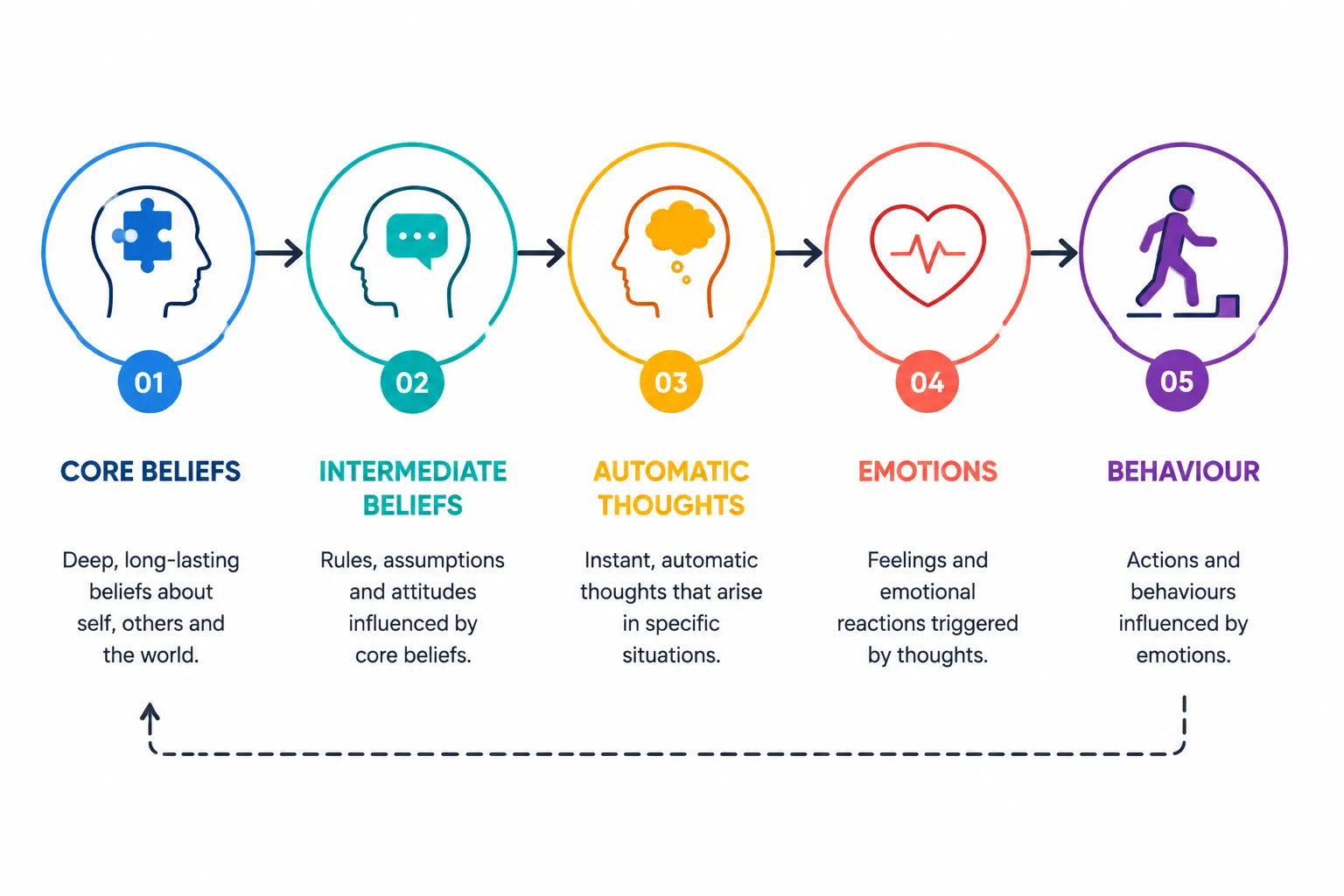
Cognitive behavioral flowchart infographic

Types of Core Beliefs

Core beliefs can be categorised into three main domains, each influencing psychological functioning differently:

  • Self-related beliefs
    These relate to personal worth and identity, such as “I am unworthy” or “I am incompetent.”
  • World-related beliefs
    These involve perceptions of the external environment, such as “The world is unsafe” or “People cannot be trusted.”
  • Future-related beliefs
    These shape expectations about future outcomes, such as “Things will never improve” or “I will always fail.”

Each category contributes to emotional vulnerability and behavioural decision-making.

Practical Example of Core Beliefs

In an educational context:

  • Core belief: “I am not intelligent enough”
  • Situation: Challenging coursework assignment
  • Automatic thought: “I will fail this task”
  • Emotional response: Anxiety and hopelessness
  • Behaviour: Avoidance of studying or procrastination

This illustrates how core beliefs indirectly influence behaviour through automatic thoughts and emotional responses.

Workplace Example of Core Beliefs

In professional settings, core beliefs significantly affect career progression and performance:

  • Core belief: “I am not capable of leadership”
  • Workplace situation: Opportunity for promotion
  • Automatic thought: “I will not succeed in this role”
  • Emotional response: Fear and self-doubt
  • Behaviour: Avoidance of leadership opportunities

Such patterns can limit professional development and organisational contribution.

Comparative Overview of Cognitive Levels

Cognitive LevelDefinitionStabilityAwareness LevelImpact on Behaviour
Automatic ThoughtsImmediate interpretations of situationsLow stabilityHigh awarenessShort-term emotional reactions
Core BeliefsDeep assumptions about self, others, and worldHigh stabilityLow awarenessLong-term behavioural patterns

This comparison highlights the hierarchical nature of cognition in CBT and demonstrates how deeper beliefs influence surface-level thoughts and behaviours.

Automatic thoughts and core beliefs represent two essential cognitive layers within Cognitive Behavioural Therapy that significantly influence emotional and behavioural functioning. Automatic thoughts are immediate, situation-based interpretations that shape short-term emotional responses, while core beliefs are deep-rooted cognitive structures that determine long-term perceptions of self, others, and the world.

Understanding the interaction between these cognitive levels is essential for effective psychological assessment and intervention. By identifying and addressing both automatic thoughts and core beliefs, practitioners can support individuals in developing healthier thinking patterns, improved emotional regulation, and more adaptive behavioural responses across clinical, educational, and workplace environment.

2. Explain How Automatic Thoughts Influence Emotional Responses

Introduction to Cognitive-Emotional Interaction

In Cognitive Behavioural Therapy (CBT), understanding how thoughts influence emotions is essential for explaining psychological distress and behavioural patterns. This topic focuses on the relationship between automatic thoughts and emotional responses, which is one of the most important foundations of CBT practice.

Automatic thoughts are immediate, spontaneous interpretations of situations, while emotions are the psychological reactions that follow these interpretations. CBT theory clearly states that emotions are not directly caused by external events, but by how those events are interpreted through automatic thinking patterns. This understanding is critical for identifying anxiety, depression, stress responses, and behavioural difficulties in both clinical and workplace environments.

Cognitive-Emotional Interaction Process

Introduction to Cognitive-Emotional Processing

The cognitive-emotional interaction process explains how individuals interpret events and develop emotional responses through internal thought patterns. In CBT practice, this process is used to understand how psychological distress is formed and maintained.

Rather than reacting directly to situations, individuals first generate automatic thoughts that assign meaning to events. These thoughts act as a filter that determines emotional intensity and behavioural reactions.

Definition of Cognitive-Emotional Interaction

Cognitive-emotional interaction refers to the continuous process in which thoughts influence emotions and behaviour. This process is automatic, rapid, and often unconscious.

Key principles include:

  • Thoughts act as mediators between events and emotions
  • Emotional responses depend on interpretation, not the event itself
  • Cognitive distortions can intensify emotional reactions
  • Behaviour is shaped by emotional intensity

These principles form the foundation of CBT-based emotional regulation strategies.

How Automatic Thoughts Shape Emotional Experience

Automatic thoughts are the first cognitive response to any situation. They determine whether a situation is perceived as positive, negative, threatening, or safe.

The process includes:

  • Immediate interpretation of an event
  • Rapid mental evaluation based on beliefs and experience
  • Emotional activation depending on thought content
  • Behavioural reaction influenced by emotional intensity

When thoughts are rational, emotional responses are balanced. When distorted, emotions become exaggerated and may lead to psychological distress.

Mechanism of Emotional Influence

Introduction to Emotional Response Mechanism

The emotional influence mechanism describes how automatic thoughts create emotional reactions in a structured sequence. This model is widely used in CBT assessment and intervention planning to identify points where cognitive distortions occur.

Step-by-Step Emotional Influence Process

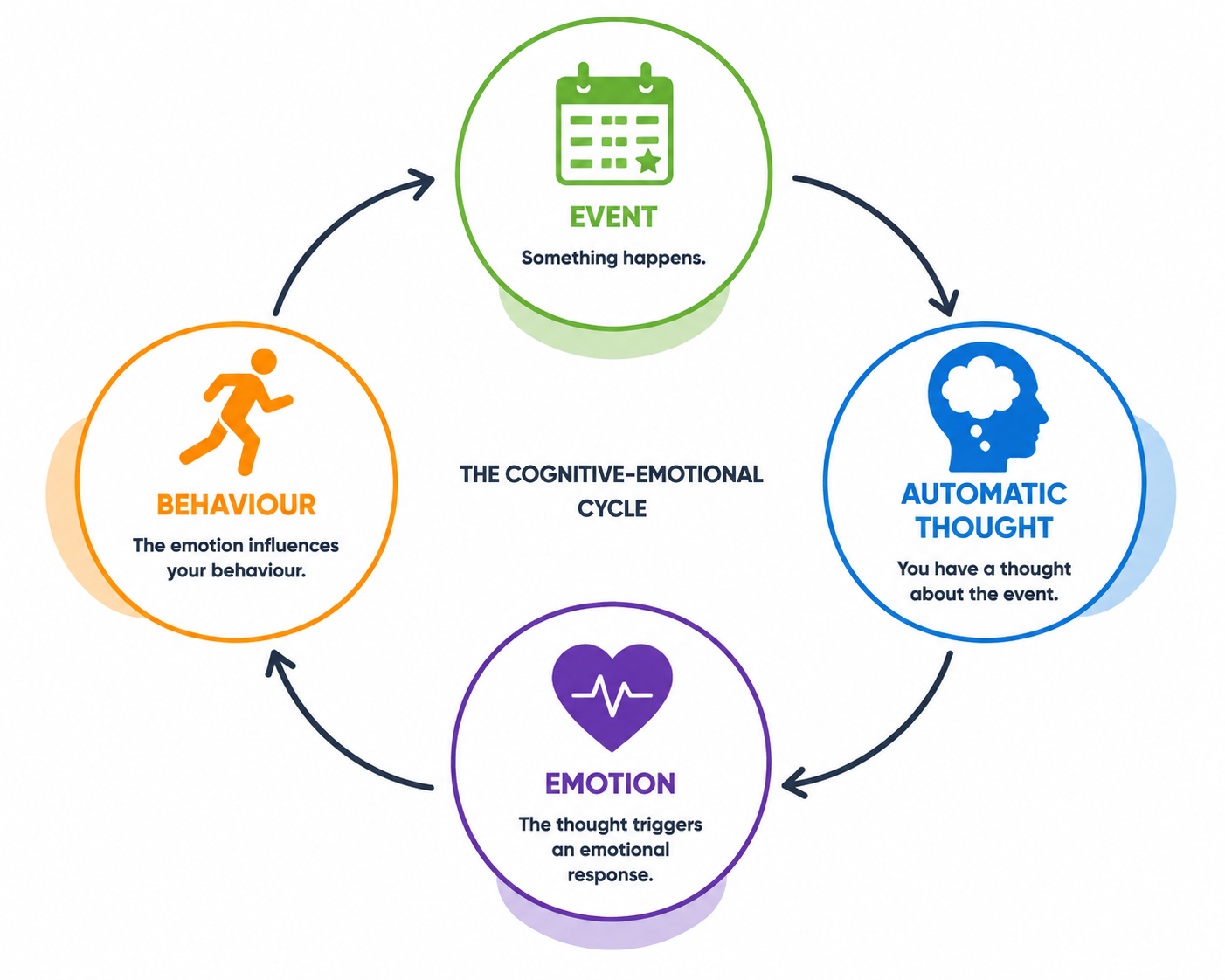
The influence of automatic thoughts on emotions follows this structured sequence:

  • Step 1: Activating Event Occurs
    A situation triggers a cognitive response, such as criticism, failure, or success.
  • Step 2: Generation of Automatic Thoughts
    The mind produces immediate interpretations without conscious reasoning.
  • Step 3: Acceptance of Thoughts as True
    Individuals often believe these thoughts are factual.
  • Step 4: Emotional Response Activation
    Emotions such as anxiety, anger, sadness, or embarrassment are triggered.
  • Step 5: Behavioural Response Formation
    Emotional intensity influences actions such as avoidance, withdrawal, or engagement.

Critical Understanding

In CBT, it is important to understand that emotional intensity is not caused by events themselves but by the interpretation of those events. When automatic thoughts are distorted, emotional responses become disproportionate and unhelpful.

Common cognitive distortions include:

  • Catastrophising
  • Overgeneralisation
  • Personalisation
  • All-or-nothing thinking

These distortions amplify emotional distress and maintain negative behavioural cycles.

Practical Example of Emotional Influence

Introduction to Real-Life Application

Practical examples help learners understand how cognitive processes operate in real-life situations. In both clinical and workplace settings, automatic thoughts strongly influence emotional responses and behavioural outcomes.

Workplace Scenario Example

A professional receives performance feedback.

  • Situation: Constructive criticism during appraisal
  • Automatic Thought: “I am not good enough for this job”
  • Emotional Response: Anxiety, embarrassment, reduced confidence
  • Behavioural Response: Avoidance of future feedback

This demonstrates that emotional response is driven by interpretation, not the event itself.

Clinical Interpretation

In CBT practice, this scenario is analysed by:

  • Identifying automatic thoughts
  • Detecting cognitive distortions
  • Challenging irrational interpretations
  • Replacing with balanced thinking
  • Testing beliefs through behavioural strategies

This structured approach helps reduce emotional distress and improve coping ability.

Workplace Application of Automatic Thoughts

Introduction to Occupational Relevance

Automatic thoughts are highly relevant in workplace environments where pressure, deadlines, and evaluation are common. These thoughts directly influence employee performance, wellbeing, and motivation.

Organisational Example

  • Employee Situation: Missed project deadline
  • Automatic Thought: “I always fail under pressure”
  • Emotional Outcome: Stress and self-doubt
  • Behaviour: Reduced productivity and avoidance

Workplace Impact

Unchecked automatic thoughts may lead to:

  • Reduced productivity
  • Increased stress levels
  • Poor decision-making
  • Avoidance of responsibilities
  • Decreased confidence

Understanding and managing these thoughts improves workplace mental health and performance.

Comparative Understanding of Cognitive Influence

StageCognitive ProcessEmotional ImpactBehavioural Outcome
EventExternal triggerNeutral initiallySituation occurs
ThoughtAutomatic interpretationEmotional activationMeaning assigned
EmotionAffective responseIntensity increasesStress or confidence
BehaviourAction responseCoping strategyPerformance effect

Cognitive emotional cycle infographic diagram 1Automatic thoughts play a crucial role in shaping emotional responses by acting as immediate interpretations of events. These interpretations determine whether emotions become balanced or distorted. When automatic thoughts are inaccurate or influenced by cognitive distortions, they lead to intensified emotional reactions and unhelpful behavioural patterns.

Understanding this cognitive-emotional relationship is essential in CBT practice, as it allows practitioners to identify the root cause of emotional distress and apply structured interventions. In both clinical and workplace environments, recognising and addressing automatic thoughts supports improved emotional regulation, healthier thinking patterns, and more adaptive behaviour.


3. Identify Examples of Core Beliefs and Their Impact on Behaviour

Introduction to Core Beliefs in CBT

Core beliefs are the deepest level of cognition in Cognitive Behavioural Therapy (CBT). They represent fundamental assumptions individuals hold about themselves, other people, and the world. These beliefs are usually formed early in life through experiences, learning, and repeated patterns of success, failure, or emotional interaction.

In CBT practice, core beliefs are important because they shape how individuals interpret situations and directly influence emotional responses and behaviour. When core beliefs are negative or unhelpful, they can contribute to long-term psychological distress, including anxiety, low self-esteem, and depressive thinking patterns.

Understanding the Role of Core Beliefs

Core beliefs act as the foundation of human cognition. They are not usually visible at surface level but influence every thought and emotional reaction. These beliefs shape how individuals interpret daily experiences and determine whether they see situations positively or negatively.

In practical CBT application, core beliefs are important because they:

  • Influence emotional reactions in different situations
  • Shape automatic thoughts in daily life
  • Affect decision-making and behaviour patterns
  • Maintain long-term psychological patterns

When core beliefs are rigid or negative, they reinforce unhelpful behavioural cycles and emotional distress.

Common Categories of Core Beliefs

Core beliefs are generally divided into three main categories. Each category plays a different role in shaping cognition and behaviour.

Self-Related Core Beliefs

These beliefs focus on how a person views themselves.

Common examples include:

  • “I am unworthy”
  • “I am not capable”
  • “I am a failure”

These beliefs often lead to low self-confidence, self-doubt, and avoidance of challenges.

World-Related Core Beliefs

These beliefs relate to how individuals view other people and their environment.

Examples include:

  • “The world is unsafe”
  • “People cannot be trusted”
  • “Others will reject me”

Such beliefs often lead to isolation, distrust, and difficulty in forming relationships.

Future-Related Core Beliefs

These beliefs reflect expectations about future outcomes.

Examples include:

  • “Things will never improve”
  • “I will always struggle”
  • “Success is not possible for me”

These beliefs often result in hopelessness, lack of motivation, and reduced goal-setting behaviour.

Case Study: Impact of Core Beliefs on Behaviour

Core beliefs strongly influence how individuals respond to everyday situations by shaping automatic thoughts and emotional reactions.

Example Scenario

  • Core belief: “I am not intelligent enough”
  • Situation: Challenging academic task
  • Automatic thought: “I will fail this anyway”
  • Emotional response: Anxiety and hopelessness
  • Behaviour: Avoidance of studying or reduced effort

This example shows how a deep belief influences surface thoughts and leads to behavioural avoidance.

Workplace Example: Leadership and Performance

In workplace settings, core beliefs significantly affect performance, confidence, and career development.

Example Scenario

An employee with a core belief of inadequacy may:

  • Avoid leadership roles
  • Depend heavily on others for decisions
  • Experience anxiety in challenging tasks
  • Avoid career progression opportunities

Over time, this behaviour reinforces the original belief, creating a continuous cycle of low confidence and avoidance.

Clinical Interpretation

In CBT practice, identifying core beliefs is essential because they:

  • Maintain long-term emotional difficulties
  • Influence automatic thought patterns
  • Shape behavioural responses
  • Reinforce psychological distress cycles

Therapeutic intervention typically involves:

  • Identifying belief patterns through guided questioning
  • Challenging the evidence for the belief
  • Developing balanced alternative beliefs
  • Testing new beliefs through real-life behaviour

Comparative Overview of Cognitive Levels

Cognitive LevelNatureStabilityAwareness LevelClinical Focus
Automatic ThoughtsImmediate interpretationsLowHighShort-term cognitive restructuring
Core BeliefsDeep assumptionsHighLowLong-term cognitive change

Integrated Understanding

Core beliefs and automatic thoughts are closely connected. Core beliefs form the foundation of cognition, while automatic thoughts are their surface expression in daily situations.

The relationship works as follows:

  • Core beliefs influence interpretation of events
  • Interpretations create automatic thoughts
  • Automatic thoughts generate emotional responses
  • Emotions influence behaviour
  • Behaviour reinforces core beliefs

Understanding this relationship is essential for effective CBT intervention.

Core beliefs are deep cognitive structures that strongly influence emotional and behavioural patterns. They shape how individuals interpret themselves, others, and future experiences. Negative core beliefs can lead to persistent psychological distress by generating unhelpful automatic thoughts and reinforcing maladaptive behaviours.

By identifying self-related, world-related, and future-related beliefs, CBT practitioners can better understand the root causes of emotional difficulties. Addressing these beliefs alongside automatic thoughts allows for more effective cognitive restructuring and long-term behavioural change in both clinical and real-world settings.

Conclusion

Automatic thoughts and core beliefs represent two fundamental levels of cognition within Cognitive Behavioural Therapy (CBT), each playing a distinct but interconnected role in shaping human emotional and behavioural responses. Automatic thoughts function as immediate interpretations of daily events and directly influence short-term emotional reactions, while core beliefs operate at a deeper psychological level, forming the underlying assumptions that guide long-term thinking patterns, emotional vulnerability, and behavioural tendencies.

In CBT practice, understanding the interaction between these two cognitive structures is essential for effective assessment and intervention. By identifying and addressing both automatic thoughts and core beliefs, practitioners are able to support individuals in breaking negative cognitive cycles, improving emotional regulation, and developing more balanced and adaptive behavioural responses in both personal and professional contexts.

W:H: