
Lesson 2: Explain the Core Principles of Cognitive Behavioural Therapy (CBT)
Cognitive Behavioural Therapy (CBT) is a widely used, evidence-based psychological approach that helps individuals understand how their thoughts, emotions, and behaviours are interconnected. It is grounded in the idea that psychological distress is not only influenced by external events, but more significantly by how individuals interpret and respond to those events.
In modern mental health practice, CBT is considered one of the most effective therapeutic models for treating conditions such as anxiety, depression, stress-related disorders, phobias, and behavioural difficulties. Its structured and goal-oriented nature makes it highly applicable in clinical, counselling, educational, and workplace wellbeing settings.
Learners studying CBT at certificate level must understand its core principles, particularly how cognition influences behaviour and emotions, and how structured therapeutic interventions are used to create positive psychological change.
By the end of this lesson, learners will be able to:
- Describe the core theoretical principles underlying CBT
- Explain how cognition influences emotions and behaviour
- Identify the structured and goal-oriented nature of CBT
- Understand the interaction between thoughts, feelings, and actions
- Apply basic CBT principles to real-life psychological scenarios
1. Core Theoretical Principles Underlying Cognitive Behavioural Therapy (CBT)
Cognitive Behavioural Therapy (CBT) is a simple and practical approach used in mental health support to help people understand how their thoughts, feelings, and behaviours are connected. It is widely used in counselling, healthcare, education, and workplace wellbeing because it focuses on everyday thinking patterns that affect emotional wellbeing.
The main idea of CBT is that people do not react to situations directly. Instead, they react based on how they think about those situations. This means that changing the way we think can help improve how we feel and behave.
For example, two people may experience the same situation, such as receiving feedback at work. One person may think, “This will help me improve,” while another may think, “I am not good enough.” These different thoughts lead to different emotions and actions.
This lesson explains the core theoretical principles of CBT in a very simple way so beginners can understand how CBT works in real life.
The Cognitive Model (Thought–Emotion–Behaviour Link)
The most important principle of CBT is called the cognitive model. It explains that thoughts, emotions, and behaviours are all connected.
This means:
- What we think affects how we feel
- How we feel affects how we behave
- What we do can also change how we think
A key concept in CBT is that events themselves do not directly cause emotional reactions. Instead, it is the interpretation of the event that creates feelings.
For example, if a student fails an exam:
- One thought may be: “I am a failure”
- This may lead to sadness and loss of confidence
- The student may then stop studying
But another person may think:
- “I need to study differently next time”
- This may lead to motivation and planning
- The person continues studying with improvement
This shows that the same event can lead to different outcomes depending on thoughts.
Simple Cognitive Model Flow
Situation → Thought → Emotion → Behaviour
For example:
- Situation: Receiving criticism at work
- Thought: “I made a mistake” or “I am useless”
- Emotion: Motivation or sadness
- Behaviour: Improving work or avoiding tasks
This simple model is the foundation of all CBT practice.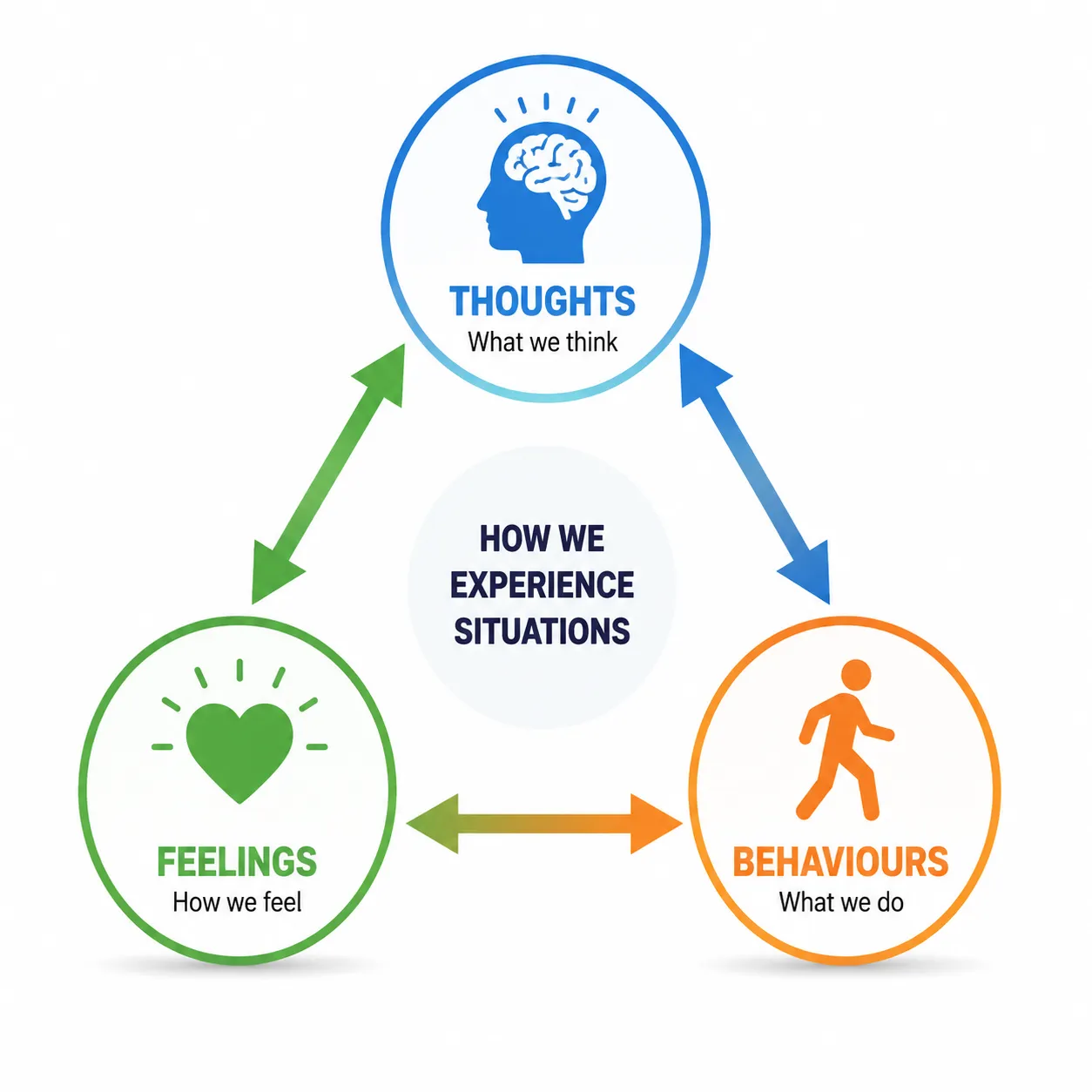
Cognitive Distortions (Unhelpful Thinking Patterns)
Another key principle of CBT is that people sometimes think in unhelpful or unrealistic ways. These are called cognitive distortions. They are common thinking errors that can affect mood and behaviour negatively.
Cognitive distortions are not permanent problems, but habits of thinking that can be changed with practice.
Common Cognitive Distortions
| Type | Meaning | Simple Example |
|---|---|---|
| Overgeneralisation | Making broad conclusions from one event | “I failed once, I will always fail” |
| Catastrophising | Expecting the worst outcome | “This mistake will ruin everything” |
| Black-and-white thinking | Seeing things as only good or bad | “If I am not perfect, I am useless” |
| Personalisation | Blaming yourself for everything | “It is all my fault” |
These thinking patterns often increase stress, anxiety, and low confidence.
For example, if a person makes a small mistake at work and thinks, “I always ruin everything,” this thought is not realistic. It increases emotional pressure and may reduce performance.
CBT helps individuals identify these patterns and replace them with more balanced thinking such as:
“I made a mistake, but I can improve next time.”
The Role of Learning and Experience
CBT is based on the idea that behaviour and emotional reactions are learned over time. This means that people are not “stuck” with their reactions. Instead, they have learned certain ways of thinking and behaving, and these can be changed.
For example:
- A person who becomes anxious in social situations may have learned to associate social events with fear
- A person who avoids challenges may have learned that avoiding problems reduces stress temporarily
CBT uses the idea that if behaviour is learned, it can also be unlearned or changed through new experiences and practice.
This is done through:
- Practicing new ways of thinking
- Trying new behaviours step by step
- Building positive habits over time
For example, someone afraid of public speaking can slowly practice speaking in small groups first, then gradually move to larger groups.
This shows that learning plays a powerful role in shaping human behaviour and emotions.
Present-Focused Approach
CBT mainly focuses on what is happening in a person’s life right now. While past experiences may sometimes be important, CBT does not spend most of its time exploring the past.
The reason is simple: current thoughts and behaviours are what maintain emotional problems today.
The focus is on:
- Current thoughts
- Current feelings
- Current behaviours
- Current problems
For example, if a person is feeling anxious at work, CBT will focus on what they are thinking and doing in the present situation rather than deeply analysing childhood experiences.
However, past experiences may still be considered if they are directly affecting current thinking patterns.
For example:
- A past experience of criticism may lead to current fear of feedback
- CBT will focus on how this belief affects present behaviour
This approach makes CBT practical and solution-focused.
Table: Core CBT Principles Summary
| Principle | Simple Meaning | Everyday Example |
|---|---|---|
| Cognitive Model | Thoughts affect feelings and behaviour | Thinking “I will fail” leads to anxiety |
| Cognitive Distortions | Unhelpful thinking patterns | “I always fail” after one mistake |
| Learning Theory | Behaviour is learned and changeable | Avoiding fear through practice |
| Present Focus | Focus on current problems | Managing today’s anxiety instead of past events |
Simple Case Study
Situation
A young employee starts feeling nervous after receiving feedback from a supervisor. They begin thinking they are not good at their job.
Action
Using CBT principles, the employee learns to:
- Identify negative thoughts like “I always make mistakes”
- Replace them with balanced thoughts like “I am still learning”
- Practice focusing on improving one task at a time
Result
The employee becomes more confident, reduces anxiety, and improves job performance over time.
Learning Point
Thoughts strongly influence emotions and behaviour, and changing thinking patterns can improve daily life.
Key Takeaways
- CBT is based on the connection between thoughts, emotions, and behaviours
- It is not events, but how we think about events that affects feelings
- Unhelpful thinking patterns can increase stress and anxiety
- Behaviour is learned and can be changed through practice
- CBT focuses on present problems rather than the past
- Small changes in thinking can lead to better emotional wellbeing
The core theoretical principles of Cognitive Behavioural Therapy provide a simple way to understand how human thoughts influence emotions and behaviour. CBT shows that people are not controlled by situations, but by how they interpret those situations. By identifying unhelpful thinking patterns, learning new ways of thinking, and focusing on present challenges, individuals can gradually improve their emotional wellbeing and behaviour in everyday life.
2. Role of Cognition in Influencing Behaviour and Emotions
Cognition plays a very important role in how people understand and respond to everyday life situations. It refers to the way individuals think, interpret, remember, and understand information around them. In Cognitive Behavioural Therapy (CBT), cognition is considered the main factor that shapes how a person feels emotionally and behaves in different situations.
Many people believe that events directly cause emotions. However, CBT explains that it is not the event itself that creates feelings, but the way the event is interpreted in the mind. This means that two people can experience the same situation but feel completely different emotions because their thoughts about the situation are different.
For example, if two employees receive the same feedback from a manager, one may think it is helpful advice and feel motivated, while the other may think it is criticism and feel upset. This difference happens because of cognition.
Understanding cognition helps learners recognise how thoughts influence emotional wellbeing and daily behaviour. This awareness is important for personal development, stress management, and improving communication in both personal and workplace life.
Understanding Cognition
Cognition refers to mental processes that include thinking, understanding, beliefs, interpretation, and perception. It is the internal process through which people make sense of the world around them.
In simple terms, cognition is “how we think about things.” These thoughts may happen consciously or automatically without awareness. Cognition affects how people judge situations, react emotionally, and decide how to behave.
For example:
- A person sees a colleague not greeting them
- One interpretation may be “they are angry with me”
- Another interpretation may be “they are busy or distracted”
Both interpretations come from cognition, but they lead to different emotional reactions.
Cognition is therefore the starting point of emotional experience in CBT.
How Thoughts Shape Emotions
One of the most important principles in CBT is that thoughts shape emotions. This means that emotional responses are influenced by how a person interprets a situation rather than the situation itself.
Thoughts act like filters in the mind. These filters can change how reality is experienced.
Simple Process of Emotional Response
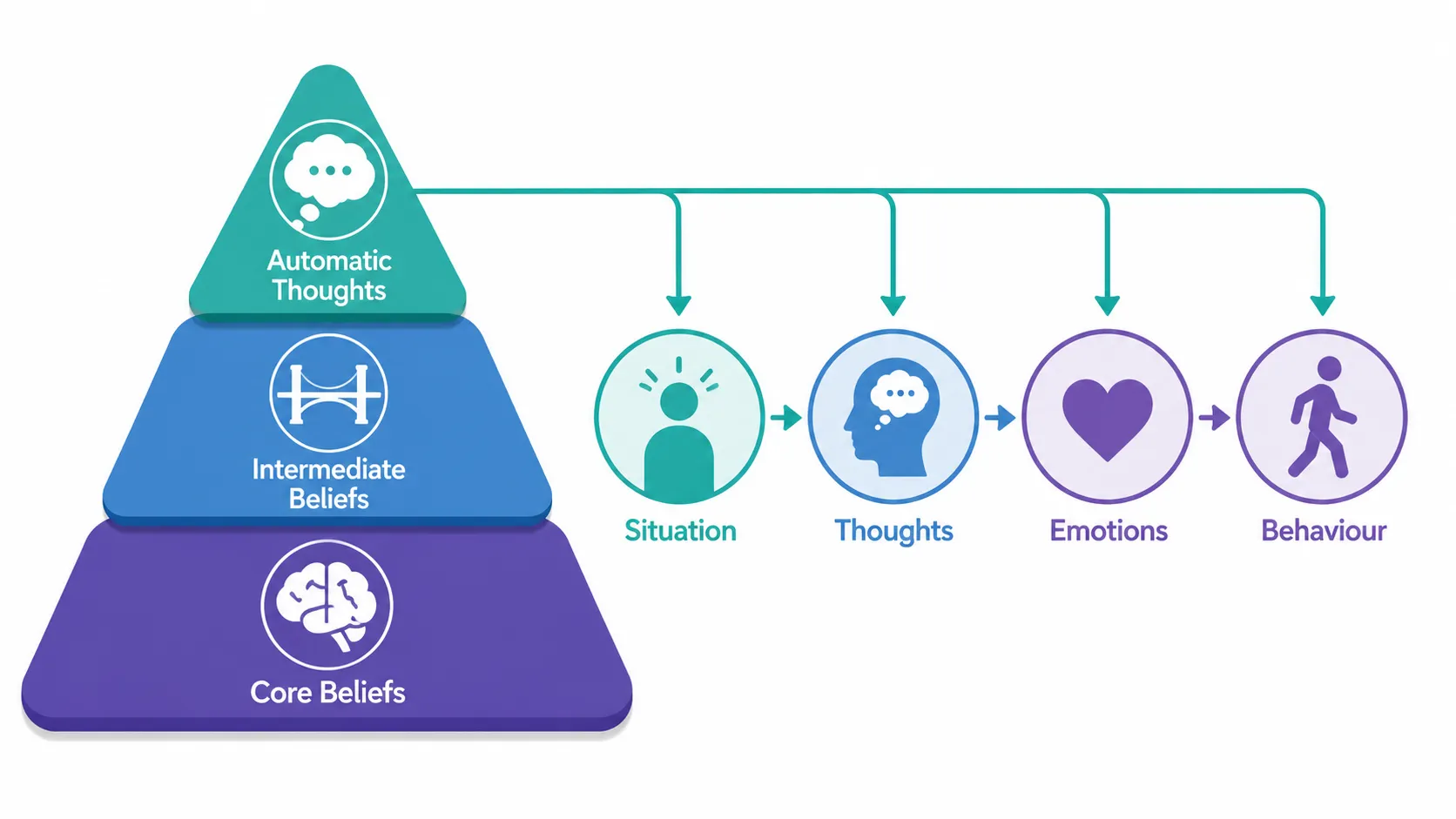
Situation → Automatic Thought → Emotional Response
Example in Daily Life
- Situation: A student receives feedback from a teacher
- Thought: “I am not good enough”
- Emotion: Sadness, anxiety, loss of confidence
In the same situation, another student may think:
- “I can improve with practice”
- Emotion: Motivation and determination
This shows that emotions are not fixed reactions. They depend on thoughts.
Example in Workplace Setting
- Situation: A manager asks for a meeting
- Thought: “I am going to be fired”
- Emotion: Fear, stress
- Behaviour: Avoiding communication
If the thought changes to:
- “This may be a routine discussion”
- Emotion becomes calm and neutral
This demonstrates how cognition directly influences emotional wellbeing.
Automatic Thoughts
Automatic thoughts are the immediate thoughts that appear in the mind in response to situations. They happen very quickly and often without conscious effort.
These thoughts are important because they directly affect emotional reactions.
Key Characteristics of Automatic Thoughts
- They happen instantly
- They are often unexamined
- They can be positive or negative
- They feel true even when they are not accurate
Simple Examples
- “I made a mistake, I am useless”
- “People are judging me”
- “This situation will go badly”
These thoughts are common in everyday life, especially during stress.
Automatic thoughts can sometimes be helpful, but often they are negative or unrealistic. When people believe these thoughts without questioning them, they may experience unnecessary stress or anxiety.
For example, if a person makes a small mistake and immediately thinks, “I always fail,” this thought may create sadness and reduce confidence. CBT teaches individuals to notice these thoughts and understand that they are not always facts.
Core Beliefs
Core beliefs are deep and long-standing thoughts about oneself, others, and the world. They are formed through life experiences and strongly influence how a person interprets situations.
Core beliefs are usually more powerful than automatic thoughts because they shape them.
Types of Core Beliefs
- Self-beliefs: “I am not good enough” or “I am capable”
- World beliefs: “The world is unsafe” or “The world is fair”
- Future beliefs: “Things will never improve” or “My future is positive”
These beliefs act like background thinking patterns that influence daily thoughts.
For example:
- A person with a negative self-belief may interpret feedback as criticism
- A person with a positive self-belief may see feedback as improvement opportunity
Core beliefs are often formed in childhood or through repeated life experiences. They are not always accurate but feel very real to the individual.
CBT focuses on helping individuals recognise and gradually challenge unhelpful core beliefs.
Cognitive Influence Table
| Cognitive Level | Description | Impact on Behaviour and Emotions |
|---|---|---|
| Automatic Thoughts | Immediate thoughts in situations | Quick emotional reaction |
| Intermediate Beliefs | Rules and assumptions people follow | Behaviour patterns in daily life |
| Core Beliefs | Deep, long-term beliefs about self and world | Strong emotional and life impact |
This table shows how different levels of thinking influence human behaviour. Understanding these levels helps individuals identify where negative thinking starts.

How Cognition Affects Behaviour and Emotions in Daily Life
Cognition influences not only emotions but also behaviour. When a person has negative thoughts, they may avoid situations, feel anxious, or behave defensively.
For example:
- Negative thought: “I will fail”
- Emotion: Anxiety
- Behaviour: Avoiding tasks
On the other hand, positive or balanced thinking leads to healthier behaviour:
- Thought: “I can try my best”
- Emotion: Confidence
- Behaviour: Taking action
This shows that changing thoughts can lead to better emotional and behavioural outcomes.
Case Study
Situation
A customer service employee receives a complaint from a client. The employee immediately thinks, “I am bad at my job.”
Action
The employee experiences stress and begins avoiding customer interactions. After learning basic CBT principles, they start identifying their automatic thoughts and replacing them with more balanced thinking, such as “One complaint does not define my ability.”
Result
The employee becomes more confident, communicates better with customers, and handles complaints more calmly.
Learning Point
Thoughts directly influence emotions and behaviour. Changing unhelpful thoughts can improve performance and emotional wellbeing.
Key Takeaways
- Cognition refers to thinking, interpretation, and perception
- Thoughts influence how people feel and behave
- Automatic thoughts happen quickly and affect emotions
- Core beliefs are deep assumptions that shape thinking patterns
- Negative thinking can increase stress and reduce confidence
- Changing thoughts can improve emotional and behavioural responses
Cognition plays a central role in how people experience daily life. It shapes emotions, influences behaviour, and affects decision-making. CBT explains that it is not situations themselves that cause emotional reactions, but the way individuals think about those situations. By understanding automatic thoughts and core beliefs, learners can begin to recognise how thinking patterns affect wellbeing. This awareness is the first step toward developing healthier thinking habits, improving emotional balance, and making more positive choices in everyday life.
3. CBT as a Goal-Oriented and Structured Approach
Cognitive Behavioural Therapy (CBT) is a practical and structured way of helping people understand and manage emotional and behavioural difficulties. Unlike open-ended conversations, CBT follows a clear plan with specific goals, steps, and outcomes.
In everyday life, people often struggle with stress, anxiety, low confidence, or negative thinking. CBT helps by breaking these problems into smaller parts and working through them in a structured way. It teaches individuals how to identify unhelpful thoughts, understand their impact, and gradually replace them with more balanced thinking.
A key feature of CBT is that it is not random or unplanned. It is focused, organised, and designed to help people make real and measurable improvements in a limited time.
This lesson explains how CBT is goal-oriented, structured, time-limited, and collaborative in a simple and practical way.
Goal-Oriented Nature of CBT
CBT always begins with clear goals. A goal is something a person wants to achieve during therapy. These goals give direction and help measure progress.
Instead of talking generally about problems, CBT focuses on what the person wants to change or improve in their life.
Examples of CBT Goals
- Reduce anxiety in social situations
- Improve confidence at work
- Change negative thinking patterns
- Learn better ways to manage stress
- Improve reactions to criticism or feedback
These goals are simple and practical. They are based on real-life situations that affect daily living.
For example, if a person feels nervous in meetings, a CBT goal may be to feel more confident when speaking in front of others. This gives a clear focus for therapy sessions.
Goals are usually set together by the therapist and the client. This helps ensure that the therapy is relevant and meaningful to the individual.
Why Goals are Important
- They give direction to therapy
- They help track improvement
- They keep the person focused
- They make progress measurable
Without goals, therapy would be less structured and less effective.
Structured Therapy Sessions
CBT sessions follow a clear and predictable structure. Each session is organised in steps so that time is used effectively and the client always knows what to expect.
This structure helps create consistency and makes therapy easier to follow, especially for beginners.
Typical CBT Session Flow
Review → Agenda Setting → Discussion → Skill Practice → Homework → Summary
Simple Explanation of Each Step
- Review: The therapist and client discuss progress from the last session
- Agenda Setting: They decide what to focus on in the current session
- Discussion: They talk about thoughts, feelings, or challenges
- Skill Practice: The client learns and practices new thinking or coping skills
- Homework: Small tasks are given to practice outside the session
- Summary: The session is reviewed and key points are noted
This structured approach ensures that every session has a purpose and builds on the previous one.
Example in Practice
A person learning to manage anxiety may:
- Review situations where anxiety occurred
- Identify negative thoughts
- Practice replacing those thoughts with balanced thinking
- Complete a simple homework task like writing down thoughts during stressful moments
This step-by-step process helps build confidence gradually.
Time-Limited Approach
CBT is usually short-term compared to many other types of therapy. It is designed to help people make changes within a limited number of sessions.
Most CBT programmes last between 6 to 20 sessions depending on the person’s needs and condition.
Why CBT is Time-Limited
- Focuses on practical skill-building
- Encourages quick understanding of problems
- Helps people apply changes in real life faster
- Avoids long-term dependency on therapy
This does not mean CBT is rushed. Instead, it is focused and efficient.
Simple Explanation
Rather than spending years discussing problems, CBT helps individuals learn skills they can use immediately in daily life.
For example, someone with stress may learn:
- How to identify stress-related thoughts
- How to challenge unhelpful thinking
- How to use relaxation or coping strategies
These skills can be used even after therapy ends.
Collaborative Approach
CBT is based on teamwork between the therapist and the client. This is called a collaborative approach.
In CBT, the client is not a passive listener. Instead, they actively participate in their own improvement.
Key Features of Collaboration
- Therapist and client make decisions together
- Goals are set jointly
- The client shares thoughts and experiences openly
- The therapist guides and supports learning
This approach helps build trust and engagement.
Why Collaboration is Important
- Increases motivation
- Makes therapy more personal
- Helps the client feel involved
- Improves learning and results
For example, if a client is struggling with workplace anxiety, both the therapist and client work together to identify triggers and create practical solutions.
CBT Structure Summary Table
| Feature | Description | Benefit |
|---|---|---|
| Goal-oriented | Focus on clear and specific goals | Helps measure progress |
| Structured | Each session follows a clear plan | Improves understanding and consistency |
| Time-limited | Short-term therapy approach | Encourages fast skill development |
| Collaborative | Client and therapist work together | Increases engagement and success |
This table helps learners understand the main features of CBT in a simple and clear way.
Process Flow of CBT (Simple Steps)
CBT follows a logical process to help people understand and change their thinking and behaviour.
Problem Identification
→ Goal Setting
→ Understanding Thoughts and Feelings
→ Identifying Negative Thinking
→ Changing Unhelpful Thoughts
→ Practicing New Behaviours
→ Reviewing Progress
→ Achieving Outcome
This process shows that CBT is structured and step-by-step, making it easier for beginners to follow.
CBT Framework (Simple Hierarchy)
CBT Model
Thoughts (What we think)
Automatic Thoughts
Unhelpful Thinking Patterns
Core Beliefs
Feelings (Emotions we experience)
Behaviours (What we do)
This structure helps learners understand how thoughts influence feelings and actions.
Case Study
Situation
A 28-year-old office worker receives critical feedback from their supervisor. After this, the employee begins to feel anxious and avoids attending team meetings.
Action
Using CBT principles, the employee works with a therapist to:
- Identify negative thoughts such as “I am not good at my job”
- Understand how these thoughts affect feelings and behaviour
- Replace them with balanced thoughts like “I can learn from this feedback”
- Gradually attend meetings again with support
Result
The employee becomes more confident, reduces anxiety, and starts participating in meetings again.
Learning Point
Structured CBT helps individuals break problems into steps, change unhelpful thinking, and improve real-life behaviour.
Key Takeaways
- CBT is structured, practical, and goal-focused
- Clear goals guide the entire therapy process
- Sessions follow a step-by-step structure
- CBT is usually short-term and skill-based
- Clients actively participate in setting goals and solving problems
- Collaboration improves engagement and outcomes
- CBT helps people apply changes in everyday life
CBT is a structured and goal-oriented approach that helps people understand and improve their thoughts, feelings, and behaviours. By setting clear goals, following a planned session structure, working within a short time frame, and actively involving the client, CBT provides a practical and effective way to manage emotional challenges.
This approach makes CBT especially useful for beginners because it focuses on simple, real-life problems and teaches practical skills that can be used beyond therapy sessions.
Conclusion
The core principles of Cognitive Behavioural Therapy (CBT) offer a simple and practical way to understand how people think, feel, and behave in everyday situations. By recognising that thoughts strongly influence emotions and actions, individuals can begin to notice unhelpful thinking patterns and learn how to change them.
CBT is effective because it is structured, focused on clear goals, and designed to create real improvements in a short period of time. This makes it a practical approach for managing common emotional and behavioural challenges. Overall, CBT helps individuals develop more balanced thinking, improve emotional wellbeing, and respond to life situations in a healthier and more positive way.