
Lexiton International
Lexiton International Welcome to Lexiton International
Certificate in Cognitive Behavioural Therapy (CBT): Principles and Techniques
Section 1: Unit No 1: Introduction to Cognitive Behavioural Therapy
Section 2: Unit No 2: Cognitive Models and Thought Patterns
Section 3: Unit No 3: Behavioural Principles in CBT
Lesson 1: Understand Behavioural Principles Relevant to CBT Quiz No 1: Understand Behavioural Principles Relevant to CBT Lesson 2: Explain how Behaviour Influences Emotional Wellbeing Lecture 5: Behavioural Principles & History Taking Quiz No 2: Explain how Behaviour Influences Emotional Wellbeing Lesson 3: Identify Behavioural Interventions Used in CBT Lecture 6: Behavioural Techniques in CBT Quiz No 3: Identify Behavioural Interventions Used in CBT
Section 4: Unit No 4: Assessment and Case Formulation
Section 5: Unit No 5: CBT Techniques and Intervention Strategies
Section 6: Unit No 6: Professional Practice and Ethical Considerations
Lesson 8

Lesson 2: Explain how Behaviour Influences Emotional Wellbeing

Behaviour plays an important role in shaping how a person feels emotionally in daily life. In Cognitive Behavioural Therapy (CBT), behaviour is not seen only as actions, but also as a key factor that can influence mood, stress levels, and overall mental wellbeing. Many emotional difficulties are maintained or reduced depending on how a person behaves in different situations.

In real-life and workplace settings, people often experience stress, anxiety, or low mood based on their behavioural responses. For example, avoiding difficult tasks may reduce stress temporarily but increase pressure later. Understanding how behaviour influences emotions helps learners recognise patterns that affect wellbeing and supports healthier choices in everyday life.

This knowledge is essential for anyone studying CBT because it explains how simple behavioural changes can lead to meaningful emotional improvement.

By the end of this lesson, learners will be able to:

  • Describe how behaviour can maintain or reduce emotional distress
  • Explain the impact of avoidance behaviours on mental health
  • Identify links between behavioural patterns and emotional outcomes
  • Recognise how behaviour influences emotional wellbeing in daily life

How Behaviour Influences Emotional Wellbeing

Behaviour and emotions are closely connected. What a person does in response to a situation can either improve or worsen how they feel. In CBT, this connection is very important because it helps explain why some emotional problems continue over time.

When a person engages in positive or helpful behaviour, emotional wellbeing improves. However, when a person uses unhelpful behaviours such as avoidance, withdrawal, or procrastination, emotional distress often increases.

Simple Understanding

  • Helpful behaviour → better emotional wellbeing
  • Unhelpful behaviour → increased emotional distress

For example, talking about a problem may reduce stress, while avoiding it may increase anxiety.

1. How Behaviour Maintains or Reduces Emotional Distress

Understanding how behaviour affects emotional wellbeing is an important part of Cognitive Behavioural Therapy (CBT). People often think emotions are only caused by outside events, but in reality, behaviour plays a major role in shaping how a person feels. The way someone responds to stress can either make emotional distress worse or help reduce it over time.

In everyday life, individuals respond differently to challenges. Some behaviours help them cope better, while others may temporarily feel helpful but create long-term emotional difficulties. CBT focuses on helping people recognise these patterns so they can make healthier behavioural choices that support emotional balance.

Behaviour That Maintains Emotional Distress

Certain behaviours may seem useful in the moment because they reduce discomfort quickly, but they often keep emotional problems active or make them worse in the long run. These behaviours are usually linked with avoiding difficulty or escaping uncomfortable feelings.

When a person avoids responsibilities, they may feel less pressure at that moment. However, the responsibility does not disappear. It builds up and often creates more stress later. Similarly, when someone isolates themselves from others, they may feel temporarily safe, but over time, this can increase loneliness and sadness.

Another common behaviour is overthinking without taking action. This can create a cycle where the person keeps worrying but does not solve the problem. Procrastination also works in a similar way. Delaying tasks reduces stress for a short time, but the pressure increases as deadlines approach. Withdrawing from support systems, such as friends, family, or colleagues, also reduces opportunities for emotional relief and guidance.

These behaviours are important to understand because they often become habits. Once repeated, they form a pattern where the person feels stuck in emotional distress without realising the behaviour is contributing to it.

Key behaviours that maintain distress

  • Avoiding responsibilities
  • Isolating from others
  • Overthinking without action
  • Procrastination
  • Withdrawing from support systems

Example

A student feels stressed about upcoming exams. Instead of studying, they avoid revision and spend time on distractions. At first, this reduces pressure and feels comfortable. However, as the exam date approaches, the lack of preparation increases anxiety and fear. The behaviour that provided short relief ends up increasing emotional distress.

Behaviour That Reduces Emotional Distress

Not all behaviours increase stress. Some actions help reduce emotional pressure and support emotional wellbeing. These behaviours usually involve facing problems in a structured and manageable way rather than avoiding them.

Talking to someone for support is one of the most effective ways to reduce emotional distress. Sharing feelings can help a person feel understood and less alone. Completing tasks step by step is another helpful approach. When a large task feels overwhelming, breaking it into smaller parts makes it easier to manage and reduces pressure.

Practising relaxation techniques such as deep breathing or taking short breaks can also help calm the mind. Engaging in positive activities, such as exercise, hobbies, or social interaction, improves mood and reduces negative thinking. Facing problems gradually instead of avoiding them helps build confidence and reduces fear over time.

These behaviours may require more effort at first, but they help create long-term emotional stability. Over time, they also improve confidence and problem-solving ability.

Key behaviours that reduce distress

  • Talking to someone for support
  • Completing tasks step by step
  • Practising relaxation
  • Engaging in positive activities
  • Facing problems gradually

Example

An employee has a large project at work and feels overwhelmed. Instead of avoiding it, they divide the task into smaller sections and complete one part at a time. They also take short breaks and ask a colleague for guidance. As a result, stress reduces, and confidence increases.

Behaviour Impact Overview

Behaviour influences emotional wellbeing in predictable ways. The table below shows how different types of behaviour affect emotions over time.

Behaviour TypeEffect on EmotionShort-Term ResultLong-Term Result
AvoidanceIncreases anxietyTemporary reliefIncreased stress
Problem-solvingReduces stressSmall effort neededImproved wellbeing
IsolationIncreases sadnessFeels safe initiallyLoneliness increases
EngagementImproves moodMore effort requiredBetter emotional health

This table helps show that short-term comfort is not always linked to long-term emotional wellbeing. Some behaviours feel easier at first but lead to more emotional difficulty later.

How Behaviour Patterns Influence Emotional State

Behaviour often becomes a pattern when it is repeated regularly. These patterns strongly influence how a person feels over time. If someone repeatedly avoids problems, their anxiety tends to grow. If someone regularly engages in positive actions, their emotional wellbeing improves.

For example, a person who avoids social situations may feel less anxious in the moment. However, over time, this avoidance can increase fear of social interaction. On the other hand, a person who gradually participates in social activities may feel nervous at first but becomes more confident with practice.

CBT focuses on helping individuals notice these patterns and slowly replace unhelpful behaviours with more supportive ones.
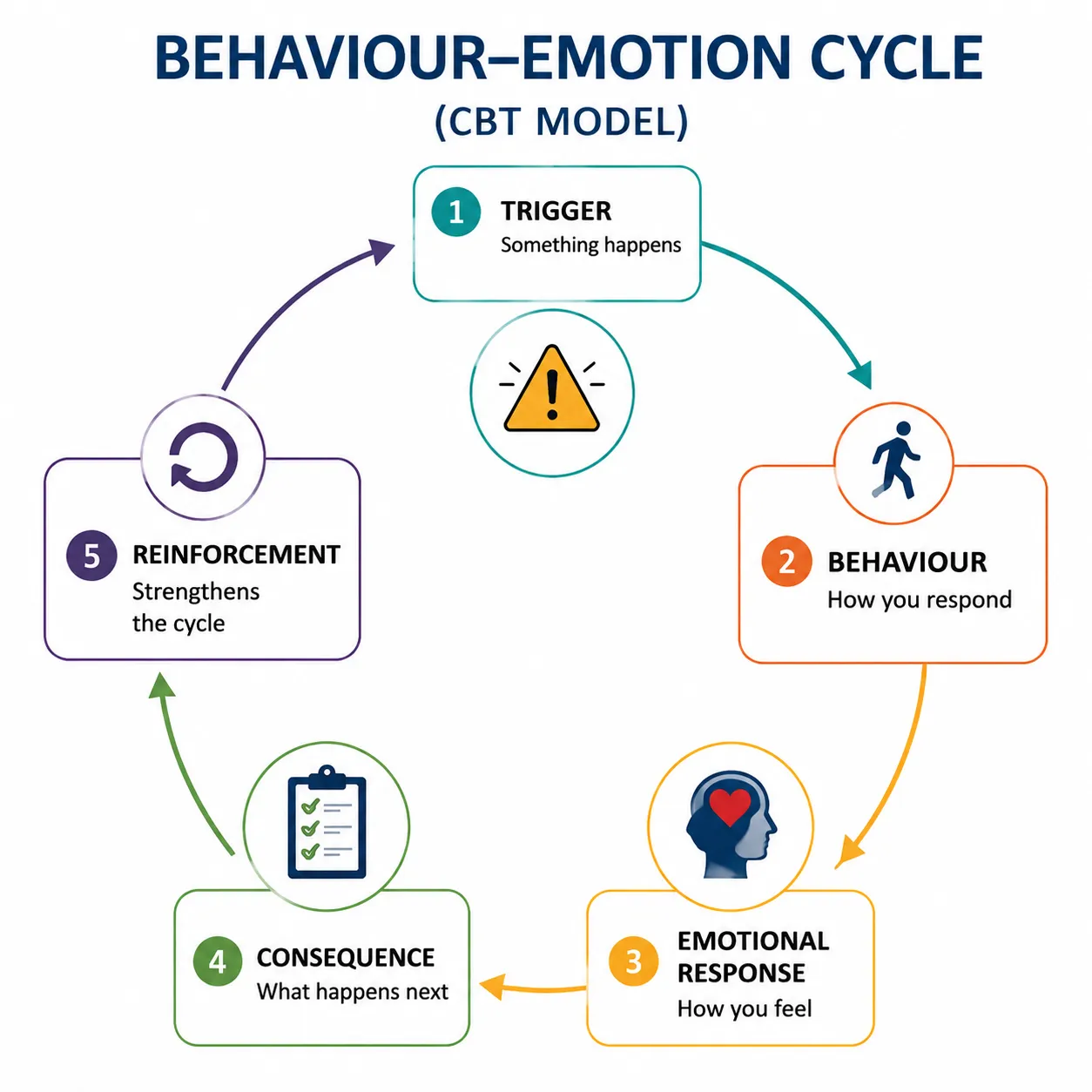
CBT behavior emotion cycle infographic

Workplace Example

In a workplace setting, behaviour has a direct impact on emotional wellbeing and performance. An employee who avoids asking questions may feel less embarrassed temporarily. However, this can lead to confusion, mistakes, and increased stress later.

If the same employee starts asking small questions and gradually participates more in discussions, they begin to feel more confident. This reduces stress and improves job performance. This example shows how behaviour choices can shape emotional outcomes in a professional environment.

Case Study

Situation

A young professional named Ali feels overwhelmed by his workload and starts avoiding important tasks.

Action

Instead of completing tasks, Ali delays them and spends time on unimportant activities. This gives him temporary relief from stress.

Result

As deadlines approach, Ali feels more pressure and anxiety. His workload increases, and his confidence decreases.

Learning Point

Avoidance reduces stress only for a short time but increases emotional distress in the long run. Facing tasks gradually would have helped reduce pressure and improve emotional wellbeing.

Recognising Behaviour and Emotional Links

It is important to understand that emotions and behaviour are connected. A person’s actions influence how they feel, and their feelings also influence their actions. This creates a cycle that can either be helpful or unhelpful.

When behaviour is positive and structured, emotional wellbeing improves. When behaviour is based on avoidance or withdrawal, emotional distress increases. Recognising this connection is the first step toward improving mental wellbeing.

Practical Everyday Understanding

In daily life, people can observe how small behavioural changes affect emotions. For example:

  • Going for a walk may improve mood
  • Ignoring a problem may increase worry
  • Talking to a friend may reduce stress
  • Delaying work may increase pressure

These examples show that behaviour is not just action; it is closely linked to emotional experience.

Key Takeaways

  • Behaviour can either increase or reduce emotional distress
  • Avoidance may provide short-term relief but increases long-term stress
  • Positive actions improve emotional wellbeing and confidence
  • Behaviour patterns shape emotional responses over time
  • Small changes in behaviour can significantly improve mental health
  • CBT helps individuals replace unhelpful behaviours with healthier ones

Behaviour plays a central role in emotional wellbeing. Some behaviours, such as avoidance and withdrawal, may feel helpful at first but often increase emotional distress over time. Other behaviours, such as problem-solving, support-seeking, and gradual engagement, help reduce stress and build emotional strength.

By understanding how behaviour influences emotions, individuals can make better choices in their daily lives. CBT uses this understanding to help people develop healthier behavioural patterns that support long-term emotional stability and wellbeing.
2. Impact of Avoidance Behaviours on Mental Health

Avoidance behaviour is a common human response when a person feels stressed, anxious, or uncomfortable in a situation. It happens when someone tries to escape or stay away from tasks, people, or environments that create emotional discomfort. In Cognitive Behavioural Therapy (CBT), avoidance is considered an important behaviour pattern because it has a strong impact on mental health and emotional wellbeing.

While avoidance may seem helpful at first because it reduces stress in the moment, it often creates bigger emotional problems over time. Understanding how and why avoidance develops helps learners recognise its effects on daily life, work performance, and long-term mental health.

What is Avoidance Behaviour?

Avoidance behaviour means deliberately staying away from situations that feel difficult, stressful, or emotionally uncomfortable. This can include avoiding conversations, responsibilities, social situations, or challenging tasks.

At first, avoidance feels like a relief. When a person avoids something they fear, their anxiety reduces immediately. However, the main problem is that the situation is not solved. It is only delayed.

For example, if a person avoids making an important phone call because it feels stressful, they may feel calm at that moment. But later, the problem still exists, and the stress becomes stronger.

Avoidance is important in CBT because it creates a cycle where fear increases instead of decreasing.

How Avoidance Affects Mental Health

Avoidance behaviour can have several negative effects on a person’s mental health when it becomes a repeated habit. It slowly changes how a person thinks, feels, and behaves in different situations.

One major effect is increased anxiety over time. When a person avoids something, they never get the chance to learn that the situation may not be as bad as expected. This increases fear and makes the situation feel more dangerous in the mind.

Avoidance can also reduce confidence. When a person avoids challenges, they miss opportunities to learn and grow. Over time, they may start believing they cannot handle difficult situations.

Another common effect is social withdrawal. People may stop interacting with others because social situations feel uncomfortable. This can lead to loneliness and emotional distress.

Low mood or depression can also develop when avoidance continues for a long time. A lack of activity, achievement, or social contact can reduce motivation and emotional energy.

Avoidance also reduces problem-solving ability. Instead of facing challenges, the person escapes from them, which prevents learning new coping skills.

Key mental health effects of avoidance

  • Increased anxiety over time
  • Reduced confidence
  • Social withdrawal
  • Low mood or depression
  • Reduced problem-solving ability

Why Avoidance Becomes a Habit

Avoidance becomes a habit because it gives short-term relief. When a person avoids a stressful situation, their anxiety reduces immediately. The brain learns that avoidance “works” in the short term.

However, this short-term relief creates a long-term problem. The situation is never faced, so fear remains. Over time, the brain becomes more sensitive to the same situation, and anxiety increases.

This is why avoidance is often described as a cycle in CBT.

Avoidance Cycle (Process Understanding)

The avoidance cycle explains how behaviour repeats and increases emotional distress over time.

Trigger → Anxiety → Avoidance Behaviour → Temporary Relief → Increased Anxiety → Repeated Avoidance

Simple explanation of each step

  • Trigger: Something stressful happens
  • Anxiety: The person feels fear or worry
  • Avoidance Behaviour: The person escapes or avoids the situation
  • Temporary Relief: Stress reduces for a short time
  • Increased Anxiety: Fear grows because the problem is not solved
  • Repeated Avoidance: The behaviour happens again and becomes a habit

Everyday understanding

A person avoids something, feels better for a moment, but becomes more afraid later. This creates a repeating loop that affects mental health.

Workplace Example of Avoidance

In a workplace setting, avoidance behaviour is very common and can affect performance and stress levels.

An employee may avoid asking questions because they feel unsure or afraid of appearing inexperienced. At first, this helps them avoid embarrassment. However, they may start making mistakes due to lack of understanding.

As mistakes increase, pressure builds, and stress becomes higher. The employee may feel even less confident and avoid asking questions again. This creates a cycle where avoidance increases workplace stress instead of reducing it.

Behaviour and Emotional Connection

Avoidance behaviour shows a clear link between actions and emotions. When a person avoids something, they are trying to reduce negative emotions like fear or stress. However, because the situation is not faced, the emotional problem becomes stronger over time.

This connection is important in CBT because it helps learners understand that emotional wellbeing is not only influenced by thoughts, but also by behaviour patterns.

Case Study

Situation

A student named Sara feels anxious about participating in classroom discussions.

Action

Sara avoids speaking in class whenever possible. She stays silent even when she knows the answer. Each time she avoids speaking, her anxiety reduces temporarily.

Result

Over time, Sara becomes more fearful of speaking. Her confidence decreases, and she starts feeling more nervous even before class begins.

Learning Point

Avoidance reduces stress only for a short time but increases fear and anxiety in the long term. Facing situations gradually would help reduce anxiety and improve confidence.

Recognising Avoidance in Daily Life

Avoidance behaviour can appear in many everyday situations. It is not always obvious, but it often shows through patterns such as:

  • Delaying important tasks
  • Ignoring messages or calls
  • Avoiding difficult conversations
  • Staying away from social events
  • Not asking for help when needed

Recognising these patterns is the first step toward improving mental wellbeing.

Healthy Alternatives to Avoidance

Instead of avoiding problems, small positive actions can help reduce emotional distress:

  • Breaking tasks into smaller steps
  • Talking to someone for support
  • Facing challenges gradually
  • Practising relaxation before difficult tasks
  • Asking questions instead of staying silent

These actions help the brain learn that challenges can be managed safely.

Comparison Table

Behaviour TypeShort-Term EffectLong-Term Effect
AvoidanceTemporary reliefIncreased anxiety
Facing situationSlight discomfortReduced fear over time
Asking for supportImmediate reliefImproved confidence
Delaying tasksShort comfortIncreased stress

Key Takeaways

  • Avoidance is a common behaviour linked with anxiety and stress
  • It reduces discomfort only in the short term
  • Long-term avoidance increases fear, stress, and emotional distress
  • Avoidance can affect confidence, relationships, and mental health
  • CBT helps individuals break avoidance cycles through gradual change
  • Small actions can help build confidence and reduce fear

Avoidance behaviour has a strong impact on mental health and emotional wellbeing. Although it may feel helpful in the moment, it prevents people from facing challenges and learning that situations are manageable. Over time, this increases anxiety and reduces confidence.

By understanding the avoidance cycle, learners can recognise how behaviour influences emotions and how small changes can improve mental health. CBT uses this understanding to help individuals gradually face challenges, reduce fear, and build healthier behavioural patterns for long-term emotional wellbeing.

3. Links Between Behavioural Patterns and Emotional Outcomes

Behavioural patterns refer to the repeated ways in which a person acts in different situations. These patterns develop over time and gradually become habits. In Cognitive Behavioural Therapy (CBT), behavioural patterns are very important because they have a direct influence on how a person feels emotionally.

In everyday life, people often do not realise that their actions are strongly connected to their emotional wellbeing. Some behaviours improve mood and confidence, while others increase stress, anxiety, or sadness. Understanding this connection helps learners recognise how daily actions shape mental health and how small changes in behaviour can improve emotional outcomes.

Understanding Behavioural Patterns in Daily Life

Behavioural patterns are formed through repeated actions. When a person responds to situations in the same way again and again, it becomes a habit. These habits influence emotional states over time.

For example, if a person regularly avoids challenges, they may start feeling less confident. On the other hand, if a person regularly completes tasks and engages with others, they may feel more positive and motivated.

CBT focuses on helping individuals recognise these patterns so they can understand how behaviour and emotions are linked.

Positive Behavioural Patterns

Positive behavioural patterns are actions that support emotional wellbeing. These behaviours help reduce stress, improve mood, and build confidence over time.

Examples of Positive Patterns

  • Regular exercise → improves mood and energy
  • Seeking support → reduces stress and emotional pressure
  • Task completion → increases confidence and satisfaction
  • Social interaction → reduces loneliness and improves wellbeing

These behaviours may require effort, but they create positive emotional results in the long term.

Simple Explanation

When a person engages in positive activities, the brain receives signals of achievement and support. This helps improve emotional balance and reduces negative feelings.

Negative Behavioural Patterns

Negative behavioural patterns are repeated actions that harm emotional wellbeing over time. These behaviours may feel easier in the short term, but they increase emotional distress later.

Examples of Negative Patterns

  • Avoidance → increases anxiety and fear
  • Isolation → leads to sadness and loneliness
  • Procrastination → causes stress buildup
  • Negative self-talk → reduces self-esteem

Simple Explanation

Negative behaviours often reduce discomfort for a short time, but they prevent progress. As a result, emotional stress increases over time.

Behaviour–Emotion Link Table

The table below shows how different behavioural patterns affect emotional outcomes.

Behaviour PatternEmotional Outcome
Facing challengesConfidence increases
Avoiding tasksStress increases
Social interactionMood improves
IsolationEmotional distress increases
Healthy routinesStability improves

This table shows that behaviour and emotions are closely connected. What a person does directly affects how they feel.

Behavioural Cycle and Emotional Influence

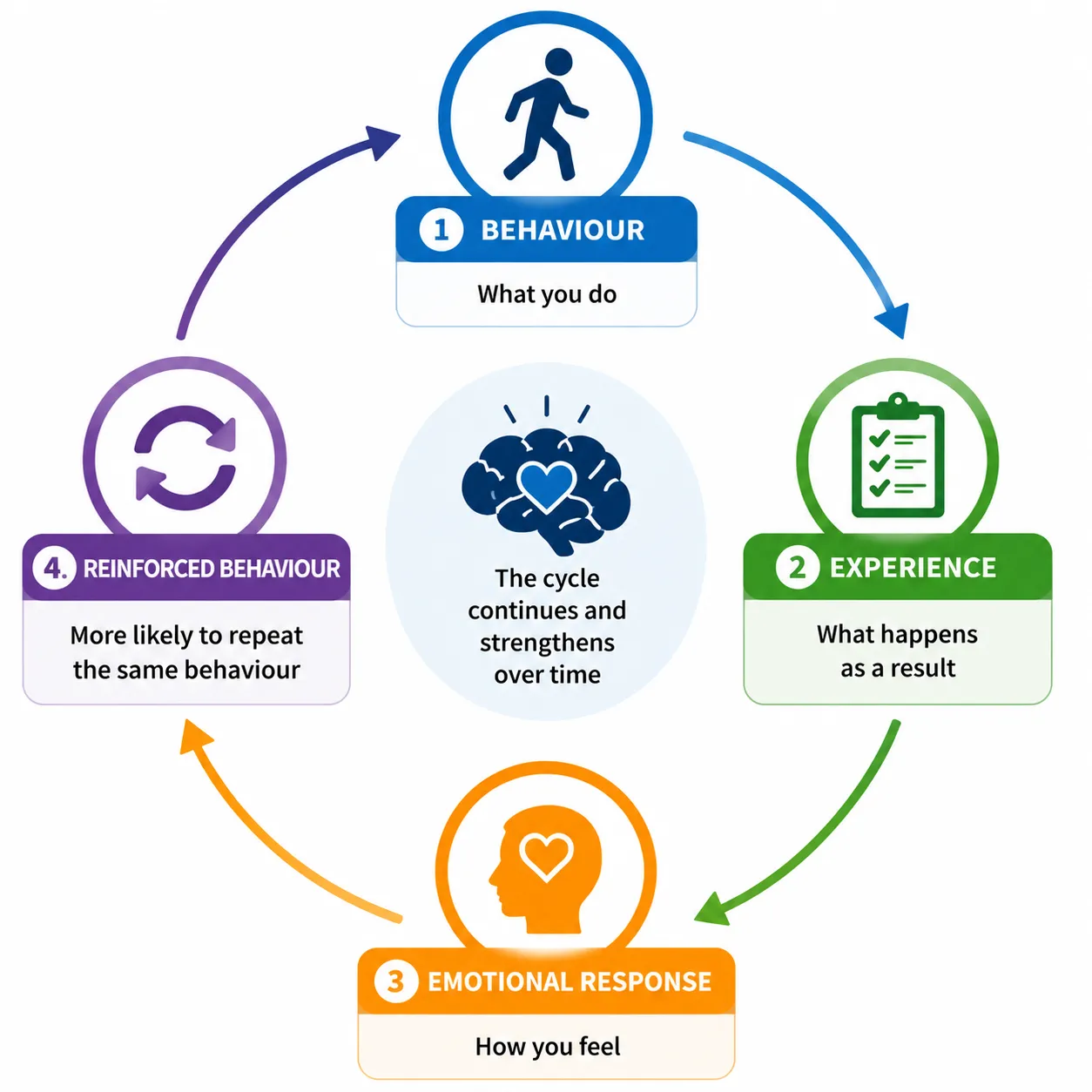
Behaviour and emotions influence each other in a continuous cycle. When a person behaves in a certain way, it creates an emotional response. That emotional response then influences future behaviour.

Behavioural Cycle

Behaviour → Experience → Emotional Response → Reinforced Behaviour

Simple Explanation

  • A person takes action (behaviour)
  • They experience a result
  • They feel an emotion based on that result
  • This emotion influences whether they repeat the behaviour

Example

If a person avoids speaking in a meeting, they may feel less stress at that moment. This feeling reinforces avoidance behaviour. Over time, this cycle can increase fear and reduce confidence.
Behavior and emotional response cycle

Healthy vs Unhealthy Behavioural Patterns

Behavioural patterns can be either helpful or unhelpful depending on their impact on emotions.

Healthy Patterns

  • Facing challenges
  • Engaging in social activities
  • Completing tasks step by step
  • Seeking help when needed

Unhealthy Patterns

  • Avoiding responsibilities
  • Isolating from others
  • Delaying tasks
  • Negative thinking habits

Healthy behaviours improve emotional wellbeing, while unhealthy behaviours increase emotional distress.

  • Behaviour directly affects emotional wellbeing
  • Positive actions improve mood and confidence
  • Negative actions increase stress and anxiety
  • Emotional patterns are learned through repetition
  • Behavioural cycles influence long-term mental health
  • CBT helps break negative behaviour patterns

Everyday Life Example

A person feels anxious about meeting new people. Instead of avoiding social situations, they decide to attend small gatherings first. At first, they feel nervous, but over time, they become more comfortable. Their confidence increases, and anxiety reduces.

This example shows how behaviour can slowly change emotional outcomes when repeated in a positive direction.

Workplace Example

An employee feels stressed about deadlines. Instead of delaying tasks, they create a simple plan and complete work step by step. This reduces pressure and improves emotional control. Over time, the employee feels more confident and less stressed at work.

This shows how behavioural choices directly affect workplace wellbeing and performance.

Case Study

Background

Sara is a young professional working in a busy office. She often feels overwhelmed by her workload.

Situation

Sara avoids difficult tasks and delays important responsibilities. This gives her short-term relief from stress but increases pressure later.

Challenge

Her avoidance behaviour leads to missed deadlines, increased stress, and reduced confidence at work.

Analysis

CBT analysis shows that Sara’s emotional distress is maintained by repeated avoidance behaviour. Each time she avoids tasks, her anxiety temporarily reduces, but the long-term stress increases.

Solution

Sara is encouraged to break tasks into smaller steps, complete one task at a time, and gradually face responsibilities instead of avoiding them. She is also encouraged to recognise small achievements.

Learning Outcome

Sara learns that facing tasks in small steps reduces long-term stress and improves emotional wellbeing. Her confidence improves as she changes her behavioural pattern.

Behaviour and Emotional Awareness

Understanding behavioural patterns helps individuals become more aware of how their actions affect emotions. Many people do not realise that small daily choices can have a strong impact on mental wellbeing.

For example:

  • Completing a task can improve confidence
  • Avoiding a task can increase stress
  • Social interaction can improve mood
  • Isolation can increase loneliness

This awareness is important in CBT because it helps individuals make better choices in daily life.

Key Takeaways

  • Behavioural patterns are repeated actions that shape emotional wellbeing
  • Positive behaviours improve mood, confidence, and stability
  • Negative behaviours increase stress, anxiety, and emotional distress
  • Behaviour and emotions are linked in a continuous cycle
  • CBT helps identify and change unhelpful behaviour patterns
  • Small behavioural changes can improve long-term mental health

Behavioural patterns play a key role in shaping emotional outcomes. In CBT, it is understood that behaviour and emotions are closely connected and continuously influence each other. Positive behavioural patterns support emotional wellbeing, while negative patterns can increase distress over time.

By recognising these patterns, individuals can understand how their actions affect their feelings and make better choices in daily life. CBT encourages gradual and practical changes in behaviour, helping individuals build healthier emotional responses and improve overall wellbeing.

Conclusion

Behaviour plays a significant role in shaping emotional wellbeing. In Cognitive Behavioural Therapy (CBT), this connection is important for understanding why emotional difficulties persist and how they can be managed more effectively. Positive or helpful behaviours can reduce stress and improve mood, while unhelpful behaviours such as avoidance or withdrawal may increase emotional distress over time.

By identifying and understanding these behavioural patterns, individuals can make small but meaningful changes in their daily lives. CBT encourages gradual improvement in behaviour, which helps people develop healthier emotional responses and achieve better balance and stability in everyday situations.