
Lesson 2: Explain Case Formulation
Case formulation is a key part of Cognitive Behavioural Therapy (CBT). It means making sense of a client’s problems by organising all the information gathered during assessment into a clear and structured explanation.
Instead of only focusing on symptoms, case formulation helps the therapist understand why the problem is happening and what is keeping it going. This makes CBT more practical and focused on real-life solutions.
In everyday therapy practice, case formulation is used to connect thoughts, emotions, behaviours, and life events into one clear picture. It acts as a “map” that guides treatment decisions and helps both the therapist and client understand the problem better.
This knowledge is important for learners because it shows how CBT moves from simple assessment to structured treatment planning in a logical and evidence-based way.
By the end of this lesson, learners will be able to:
- Define CBT case formulation
- Identify the main components of a CBT formulation model
- Explain how formulation guides intervention planning
- Understand the relationship between assessment and treatment planning
- Apply basic case formulation thinking in simple scenarios
1. What is CBT Case Formulation?
In Cognitive Behavioural Therapy (CBT), case formulation is a key step that helps the therapist understand a client’s problems in a structured and meaningful way. It is used after assessment and plays an important role in planning the right support for the client.
Many people experience emotional or behavioural problems such as anxiety, stress, low mood, or fear. However, these problems do not appear without reason. CBT case formulation helps to explain why a problem exists, how it started, and what is keeping it going in daily life.
Instead of only giving a label to a problem, CBT focuses on understanding the connection between thoughts, feelings, and behaviours. This makes therapy more practical and focused on real-life improvement.
For beginners, case formulation can be understood as a simple “story map” of the client’s difficulties. It helps both the therapist and client see how different parts of life are connected and influencing each other.
Understanding of Case Formulation
CBT case formulation is a structured explanation of a client’s difficulties based on their thoughts, feelings, behaviours, and life experiences.
It helps to organise information in a clear way so that the therapist can understand the full picture instead of looking at isolated symptoms.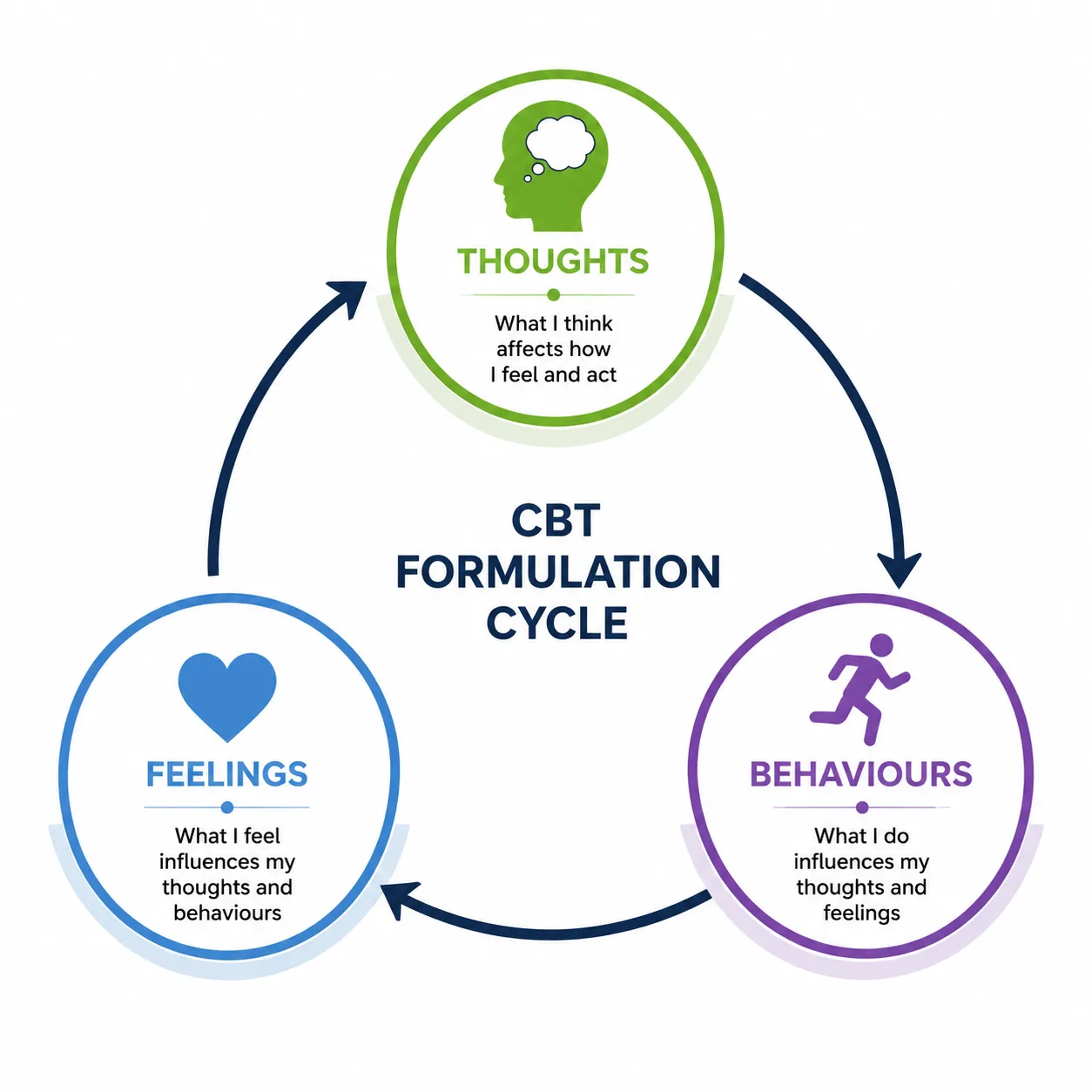
Three Key Questions in Case Formulation
CBT case formulation mainly focuses on three simple questions:
- What is the problem?
- How did it start?
- What is keeping it going?
These questions help the therapist understand not just the symptoms, but also the background and causes behind them.
Key Purpose of Case Formulation
CBT case formulation is important because it helps in many practical ways during therapy:
- To understand client problems clearly and completely
- To connect thoughts, emotions, and behaviours in one picture
- To identify triggers that cause emotional distress
- To understand what is maintaining or repeating the problem
- To guide planning of therapy sessions
- To make therapy personal and suitable for each client
This ensures that therapy is not general, but designed for the specific needs of the individual.
CBT Case Formulation helps in:
- Understanding the problem
- Identifying causes
- Finding maintaining factors
- Planning treatment
- Tracking progress
This simple structure helps therapists turn information into action.
How Case Formulation Works in Simple Terms
To understand case formulation easily, imagine it like putting together pieces of a puzzle.
Each piece represents something different about the client:
- Thoughts
- Feelings
- Behaviours
- Life experiences
When these pieces are connected, they form a complete picture of the client’s situation. This picture helps the therapist understand what is happening and how to support the client effectively.
Example from Everyday Life
A person feels nervous before speaking in meetings at work.
At first, it may look like simple shyness. But case formulation helps explore deeper:
- The person thinks: “I will make mistakes”
- This thought creates anxiety
- Because of anxiety, they avoid speaking
- Avoidance reduces confidence
- This keeps the problem going
This simple cycle shows how thoughts and behaviours affect each other over time.
Key Components of Case Formulation (Simple View)
CBT case formulation usually includes the following basic parts:
- Current problem
- Background experiences
- Triggers (what starts the problem)
- Thoughts (what the person believes)
- Feelings (emotional response)
- Behaviours (actions taken)
- Maintaining factors (what keeps it going)
Each part helps build a complete understanding of the situation.
Table: Understanding Case Formulation Elements
| Element | Meaning | Simple Example |
|---|---|---|
| Problem | Main difficulty | Anxiety in social situations |
| Trigger | What starts it | Speaking in meetings |
| Thoughts | What person thinks | “I will fail” |
| Feelings | Emotional response | Fear and worry |
| Behaviour | What they do | Avoid speaking |
| Maintaining factor | What keeps it going | Avoidance reduces confidence |
Why CBT Does Not Just Label Problems
In traditional approaches, problems may simply be named, such as “anxiety disorder” or “depression.” However, CBT goes further.
CBT focuses on:
- Understanding why the problem exists
- Understanding how it continues
- Finding practical ways to change it
This makes therapy more helpful and solution-focused.
How Case Formulation Helps Clients
Case formulation is not only useful for therapists. It also helps clients in simple ways:
- It helps them understand their own thoughts and behaviours
- It makes problems feel clearer and less confusing
- It shows how problems can be changed step by step
- It increases self-awareness
- It supports motivation for change
When clients understand their own patterns, they can actively participate in improving their situation.
Real-Life Workplace Example
A customer service employee feels stressed when dealing with complaints.
Through case formulation, it is found that:
- They believe customers will always be angry
- This creates fear before answering calls
- They rush conversations or avoid difficult customers
- This increases mistakes and stress
By understanding this pattern, the therapist can help the person change their thoughts and improve confidence.
How Case Formulation Guides Therapy (Simple View)
Case formulation is used to decide what kind of therapy techniques will help the client.
For example:
- If negative thinking is the problem → focus on changing thoughts
- If avoidance is the issue → focus on gradual exposure
- If low activity is present → focus on increasing daily engagement
This makes therapy structured and goal-focused.
Flow of Case Formulation
Assessment Information
→ Identify Thoughts and Feelings
→ Identify Behaviours
→ Find Triggers
→ Understand Maintaining Factors
→ Create Case Formulation Summary
→ Plan Treatment
This flow shows how information becomes action in CBT.
Understanding of Maintaining Factors
Maintaining factors are very important in CBT. They explain why the problem does not go away easily.
Examples include:
- Avoiding situations
- Negative thinking habits
- Lack of confidence
- Fear of failure
These factors keep the problem active over time. CBT focuses on breaking these patterns.
Case Study
Situation
A 30-year-old office worker feels anxious during team meetings and avoids speaking.
Action
The therapist builds a case formulation by identifying:
- Thought: “My ideas are not good enough”
- Emotion: Anxiety and fear
- Behaviour: Avoids speaking in meetings
- Trigger: Being asked to present ideas
Result
The client understands that avoidance is increasing anxiety. With support, they begin small steps like speaking once in meetings.
Learning Point
Case formulation helps identify how thoughts and behaviours are connected, making it easier to create a clear plan for improvement.
Key Takeaways
- Case formulation is a structured way to understand client problems
- It explains how problems start and continue
- It connects thoughts, feelings, and behaviours
- It helps identify triggers and maintaining factors
- It guides therapy planning in CBT
- It supports personalised and practical treatment
CBT case formulation is a simple but powerful way of understanding a client’s difficulties. It goes beyond naming problems and focuses on explaining how different parts of a person’s thoughts, feelings, and behaviours are connected.
By organising information in a clear structure, therapists can understand what is causing the problem and what is keeping it going. This helps create a practical and personalised treatment plan that supports real improvement in the client’s daily life.
For beginners, case formulation is best understood as a “story map” that connects all parts of a person’s experience into one clear picture, helping both therapist and client work together effectively.
2. Components of a CBT Formulation Model
Cognitive Behavioural Therapy (CBT) uses a structured way of understanding a person’s psychological difficulties. This structure is called a CBT formulation model. It helps therapists organise information about a client’s problems in a clear and simple way.
Instead of looking at problems in isolation, CBT connects different parts of a person’s experience. It looks at how thoughts, feelings, behaviours, and life events work together. This makes it easier to understand why a problem is happening and why it continues over time.
For beginners, the CBT formulation model can be seen as a simple map. This map shows what the problem is, what caused it, and what keeps it going in daily life.
Understanding these components is important because it helps learners see how CBT turns information into practical support for clients.
What is a CBT Formulation Model?
A CBT formulation model is a structured framework used to explain a client’s psychological problem. It is built using different components that describe thoughts, feelings, behaviours, and life experiences.
Each component plays a role in understanding the client’s situation clearly. When all components are combined, they create a full picture of the problem.
This model helps therapists:
- Understand the client’s difficulties
- Identify causes and triggers
- Recognise thinking and behaviour patterns
- Plan suitable treatment steps
Presenting Problem
The presenting problem is the main issue that brings the client to therapy. It is the starting point of the CBT formulation model.
Common examples include:
- Anxiety
- Depression
- Stress
- Social withdrawal
- Low confidence
The presenting problem helps the therapist understand what the client is struggling with right now.
For example, a client may say, “I feel very anxious in social situations.” This becomes the starting point for further exploration.
Triggering Events
Triggering events are situations or experiences that start or worsen the problem. These events often happen before the emotional or behavioural difficulties begin.
Examples include:
- Losing a job
- Conflict with family or friends
- Exam failure
- Stressful workplace experience
- Traumatic life events
These events help explain why the problem started or became more intense.
For example, a person may begin feeling anxious at work after receiving negative feedback from a manager.
Core Beliefs
Core beliefs are deep-rooted thoughts that a person holds about themselves, others, or the world. These beliefs are often formed early in life and strongly influence behaviour.
Common examples include:
- “I am not good enough”
- “People cannot be trusted”
- “I will always fail”
- “I am weak”
Core beliefs are very powerful because they shape how a person interprets situations.
For example, someone who believes “I am not good enough” may feel anxious even in simple social interactions.
Automatic Thoughts
Automatic thoughts are quick, immediate thoughts that appear in response to a situation. These thoughts happen almost instantly and are often not fully controlled.
Example:
- Situation: Speaking in a meeting
- Automatic thought: “I will make a mistake”
These thoughts influence how a person feels and behaves. They are often negative and unrealistic.
Automatic thoughts are important in CBT because they can be identified and changed through therapy.
Emotions
Emotions are the feelings experienced by the client in response to thoughts and situations. They are a natural part of human experience.
Common emotions include:
- Fear
- Anxiety
- Sadness
- Anger
- Shame
In CBT, emotions are closely linked to thoughts and behaviours. A negative thought can create strong emotional reactions.
For example, thinking “I will fail” may lead to fear and anxiety.
Behaviour Patterns
Behaviour patterns are the actions or reactions of the client based on their thoughts and emotions. These behaviours can either help or worsen the problem.
Common behaviour patterns include:
- Avoiding social situations
- Staying silent in meetings
- Overthinking situations
- Procrastination
- Withdrawal from activities
Behaviour patterns are important because they often maintain the problem over time.
For example, avoiding meetings may reduce anxiety in the short term but increase fear in the long term.
Maintaining Factors
Maintaining factors are the elements that keep the problem going over time. They prevent improvement and continue the cycle of difficulties.
Examples include:
- Avoidance behaviour
- Negative thinking habits
- Lack of coping skills
- Limited social interaction
- Constant worry or rumination
These factors are very important in CBT because treatment often focuses on breaking these cycles.
Table: CBT Formulation Components
| Component | Meaning | Example |
|---|---|---|
| Presenting Problem | Main issue | Anxiety |
| Triggering Events | Situations causing problem | Job stress |
| Core Beliefs | Deep beliefs | “I am not capable” |
| Automatic Thoughts | Immediate thoughts | “I will fail” |
| Emotions | Feelings experienced | Fear, worry |
| Behaviour | Actions taken | Avoiding meetings |
| Maintaining Factors | Keeps problem active | Avoidance |
Hierarchy of CBT Formulation Structure
CBT follows a simple structure that shows how different components are connected:
Core Beliefs
→ Automatic Thoughts
→ Emotions
→ Behaviour
→ Maintaining Cycle
This hierarchy helps learners understand how deep beliefs influence thoughts, which affect emotions and behaviours, creating a repeating cycle.
How Components Work Together
In real CBT practice, all components are connected. They do not work separately.
For example:
- A core belief like “I am not good enough” influences thoughts
- These thoughts create emotional reactions like anxiety
- Anxiety leads to avoidance behaviour
- Avoidance keeps the belief strong
This cycle shows how psychological problems continue over time.
Real-Life Workplace Example
A new employee feels nervous during presentations.
- Core belief: “I am not confident”
- Automatic thought: “I will make mistakes”
- Emotion: Fear and anxiety
- Behaviour: Avoids speaking in meetings
- Maintaining factor: Lack of practice increases fear
This simple example shows how CBT components explain real workplace challenges.
Case Study
Situation
A 27-year-old office worker experiences anxiety during team discussions.
Action
The therapist identifies CBT formulation components:
- Presenting problem: Social anxiety
- Trigger: Negative feedback from manager
- Core belief: “I am not good enough”
- Automatic thought: “I will embarrass myself”
- Emotion: Fear and nervousness
- Behaviour: Avoids speaking in meetings
Result
The therapist understands that avoidance is maintaining the anxiety cycle. A structured plan is developed to gradually help the client participate in discussions.
Learning Point
Understanding CBT formulation components helps explain how thoughts and behaviours maintain emotional problems.
Key Takeaways
- CBT formulation model explains how psychological problems develop and continue
- It includes presenting problems, triggers, beliefs, thoughts, emotions, behaviours, and maintaining factors
- Each component is connected and influences the others
- Negative thoughts and behaviours often maintain problems
- Understanding these components helps in planning effective CBT treatment
- The model is simple, structured, and practical for real-life use
The CBT formulation model is a simple and structured way of understanding a client’s psychological difficulties. It breaks down problems into clear components such as thoughts, emotions, behaviours, and life experiences.
By understanding each component, therapists can see how problems start and why they continue. This helps in creating practical and effective treatment plans that are tailored to each individual.
For beginners, this model provides a clear foundation for understanding how CBT works in real-life situations. It turns complex psychological problems into simple, understandable parts that can be managed step by step.
3. How Case Formulation Guides Intervention Planning (CBT)
In Cognitive Behavioural Therapy (CBT), case formulation is not only used to understand a client’s problems. It also plays a very important role in planning treatment. This means it helps the therapist decide what type of support, techniques, and actions will be most useful for the client.
Many people come to therapy with difficulties such as anxiety, stress, low confidence, or fear in social situations. Case formulation helps the therapist understand how these problems are connected to thoughts, feelings, and behaviours. Once this is clear, the therapist can plan the right intervention.
For beginners, intervention planning simply means deciding “what to do next” to help the client improve. Case formulation acts like a guide or roadmap that shows the direction of therapy.
Without case formulation, treatment may become general and less effective. With it, therapy becomes structured, personal, and focused on real needs.
How Case Formulation Supports Intervention Planning
Case formulation is important because it directly connects understanding the problem with taking action to solve it.
It helps the therapist to:
- Understand what needs to change
- Identify negative thinking patterns
- Recognise unhelpful behaviours
- Set clear and realistic therapy goals
- Select suitable CBT techniques
- Plan step-by-step intervention
This makes therapy more organised and easier to follow for both the client and therapist.
How It Works in Practice
In real CBT practice, case formulation is used as a foundation for decision-making.
It helps to:
- Break down the client’s problem into simple parts
- Understand what is causing and maintaining the issue
- Decide which area should be worked on first
- Choose the most effective methods for change
For example, if a client avoids social situations due to fear, the therapist can plan gradual exposure and confidence-building activities instead of general advice.
Step-by-Step Process of Intervention Planning
Case formulation follows a clear and simple process that leads to treatment planning:
Assessment Information
→ Identify Thoughts, Feelings, Behaviours
→ Build Case Formulation
→ Identify Maintaining Factors
→ Set Treatment Goals
→ Choose CBT Techniques
→ Begin Intervention
This step-by-step process ensures that therapy is based on understanding, not guesswork.
Setting Treatment Goals
Once the case formulation is completed, the next step is to set clear goals. These goals guide the direction of therapy.
Goals are based on what the formulation reveals about the client’s difficulties.
Common examples of treatment goals include:
- Reducing anxiety in social situations
- Improving self-confidence
- Changing negative thinking patterns
- Increasing participation in daily activities
- Improving coping skills
Good goals are simple, realistic, and focused on change.
For example:
Instead of saying “stop anxiety,” a better goal is “reduce anxiety when speaking in meetings.”
Selecting CBT Techniques
Case formulation also helps the therapist choose the right CBT techniques. Different problems require different methods.
Some common CBT techniques include:
1. Cognitive restructuring
This helps clients change negative or unhelpful thoughts into more balanced thinking.
Example:
“I will fail” → “I can try my best and learn from mistakes”
2. Behavioural activation
This encourages clients to increase positive and meaningful activities.
Example:
A client with low mood is encouraged to return to hobbies or social activities.
3. Exposure therapy
This helps clients gradually face situations they fear instead of avoiding them.
Example:
A person afraid of speaking in public starts by speaking in small groups first.
Each technique is chosen based on the client’s specific formulation.
Personalising Therapy
One of the most important roles of case formulation is personalisation. This means therapy is designed specifically for each individual.
No two clients are exactly the same. Even if two people have anxiety, their causes, thoughts, and behaviours may be different.
Case formulation ensures that:
- Therapy matches the client’s real situation
- Techniques are relevant and practical
- Progress is more effective and realistic
For example:
One client may need help with negative thinking, while another may need help with avoidance behaviour. Case formulation helps identify this difference.
Comparison Table: Assessment vs Case Formulation
| Aspect | Assessment | Case Formulation |
|---|---|---|
| Purpose | Collect information | Explain the problem |
| Focus | Symptoms | Causes and patterns |
| Output | Raw data | Structured understanding |
| Use | Initial stage | Treatment planning |
This shows that assessment gathers information, while case formulation turns that information into a useful plan.
How Case Formulation Guides Therapy
Case formulation helps to:
- Understand the problem clearly
- Identify thought and behaviour patterns
- Set simple and clear goals
- Choose the right CBT techniques
- Track progress during therapy
This process ensures that therapy is structured and focused on improvement.
Practical Example
A client feels anxious at work and avoids speaking in meetings.
Using case formulation, the therapist identifies:
- Trigger: Negative feedback from manager
- Thought: “I am not good at my job”
- Emotion: Anxiety and fear
- Behaviour: Avoids speaking in meetings
- Maintaining factor: Avoidance reduces confidence
Based on this understanding, the therapist plans:
- Cognitive restructuring to challenge negative thoughts
- Gradual exposure to speaking in meetings
- Confidence-building activities in small steps
This shows how understanding the problem leads directly to action.
Case Study
Background
A 25-year-old client experiences social anxiety and avoids group discussions at work and social events.
Situation
The client believes they will be judged or laughed at when speaking in groups.
Challenge
The client finds it difficult to express ideas and often stays silent during group interactions.
Analysis
- Core belief: “People will laugh at me”
- Automatic thoughts: “I will say something wrong”
- Emotion: Fear and anxiety
- Behaviour: Avoidance of group participation
Solution
A CBT case formulation is developed. It shows that avoidance is the main factor keeping the problem active. Based on this, the therapist plans:
- Gradual exposure to group speaking situations
- Cognitive restructuring to challenge negative thoughts
- Small confidence-building exercises
Result
The client slowly begins participating in small group discussions and gains more confidence over time.
Learning Point
Case formulation helps turn understanding into a clear and structured treatment plan that supports real behavioural change.
Key Takeaways
- Case formulation connects understanding with action in CBT
- It helps explain how and why a problem exists
- It identifies thoughts, emotions, behaviours, and maintaining factors
- It is based on assessment information
- It directly guides treatment planning and intervention
- It ensures therapy is structured, practical, and personalised
- It helps therapists choose the right CBT techniques for each client
Case formulation is a key part of CBT because it does more than describe problems. It helps therapists understand how a problem works and what keeps it going. This understanding is then used to plan effective treatment.
By identifying thoughts, feelings, behaviours, and maintaining factors, case formulation provides a clear direction for therapy. It ensures that goals are realistic and that the right techniques are chosen for each individual.
For beginners, case formulation can be seen as a bridge between understanding a problem and taking action to improve it. It makes therapy structured, meaningful, and focused on real-life change.
Conclusion
CBT case formulation is a structured and practical way of understanding a client’s psychological difficulties. It goes beyond identifying symptoms and focuses on explaining how the problem developed and what is keeping it active.
By organising information into clear components such as thoughts, emotions, behaviours, and beliefs, therapists can create a meaningful understanding of the client’s situation. This understanding is then used to design effective and personalised treatment plans.
In CBT practice, case formulation is essential because it connects assessment with intervention. It ensures therapy is focused, evidence-based, and tailored to each individual client’s needs.