
Lesson 2: Continuing Education
Continuing education is a fundamental pillar of professional competence in addiction counselling and mental health treatment. In a field that is constantly evolving due to new research, emerging substances, updated treatment models, and changing client needs, practitioners must remain committed to lifelong learning to deliver safe, ethical, and effective care.
Within addiction and mental health services, professionals are expected to demonstrate not only initial qualification but also ongoing development through structured learning, training programmes, supervision, and self-directed study. Continuing education ensures that practitioners remain aligned with current clinical guidelines, evidence-based interventions, and regulatory expectations.
In workplace settings, continuing education directly enhances service quality. Counsellors who actively engage in professional development are better equipped to apply modern therapeutic approaches, respond to complex client presentations, and make informed decisions in high-risk situations. This lesson explores how continuous learning strengthens professional practice and ensures up-to-date knowledge in addiction counselling.
By the end of this lesson, learners will be able to:
- Define continuing education and its importance in addiction counselling.
- Identify different forms of professional development opportunities.
- Explain how ongoing learning improves counselling effectiveness.
- Analyse current research, trends, and best practices in addiction treatment.
- Demonstrate strategies for maintaining professional competence.
- Apply updated knowledge to workplace scenarios in addiction and mental health services.
- Evaluate the importance of lifelong learning in professional practice.
1: Pursue Ongoing Learning Opportunities and Professional Development in Addiction Counselling
Understanding Continuing Education in Addiction Counselling
Continuing education represents a structured and continuous process of professional learning that extends beyond initial qualification. In the context of addiction counselling and mental health practice, it encompasses all formal and informal learning activities designed to maintain, update, and enhance professional knowledge, clinical competence, and ethical practice standards.
Unlike initial training, which provides foundational knowledge and skills, continuing education focuses on lifelong professional development, ensuring that practitioners remain responsive to evolving clinical demands, emerging research, and changing societal needs. It is both a professional requirement and an ethical responsibility in most international counselling frameworks.
In addiction counselling, continuing education is not optional; it is an essential mechanism for ensuring that practitioners remain competent in dealing with complex and dynamic client presentations. These include polysubstance use, co-occurring mental health disorders, trauma-related conditions, relapse cycles, and socially influenced addictive behaviours.
Continuing education includes multiple learning pathways such as:
- Formal academic qualifications and accredited certifications
- Clinical workshops and professional training programmes
- Supervised clinical practice and mentorship
- Conferences, seminars, and professional forums
- Online learning platforms and digital training modules
- Independent research and evidence-based reading
- Reflective practice and experiential learning
Each of these contributes to the development of a reflective, competent, and ethically responsible practitioner.
Theoretical Foundations of Continuing Education
Continuing education is strongly grounded in adult learning theories and professional competence frameworks.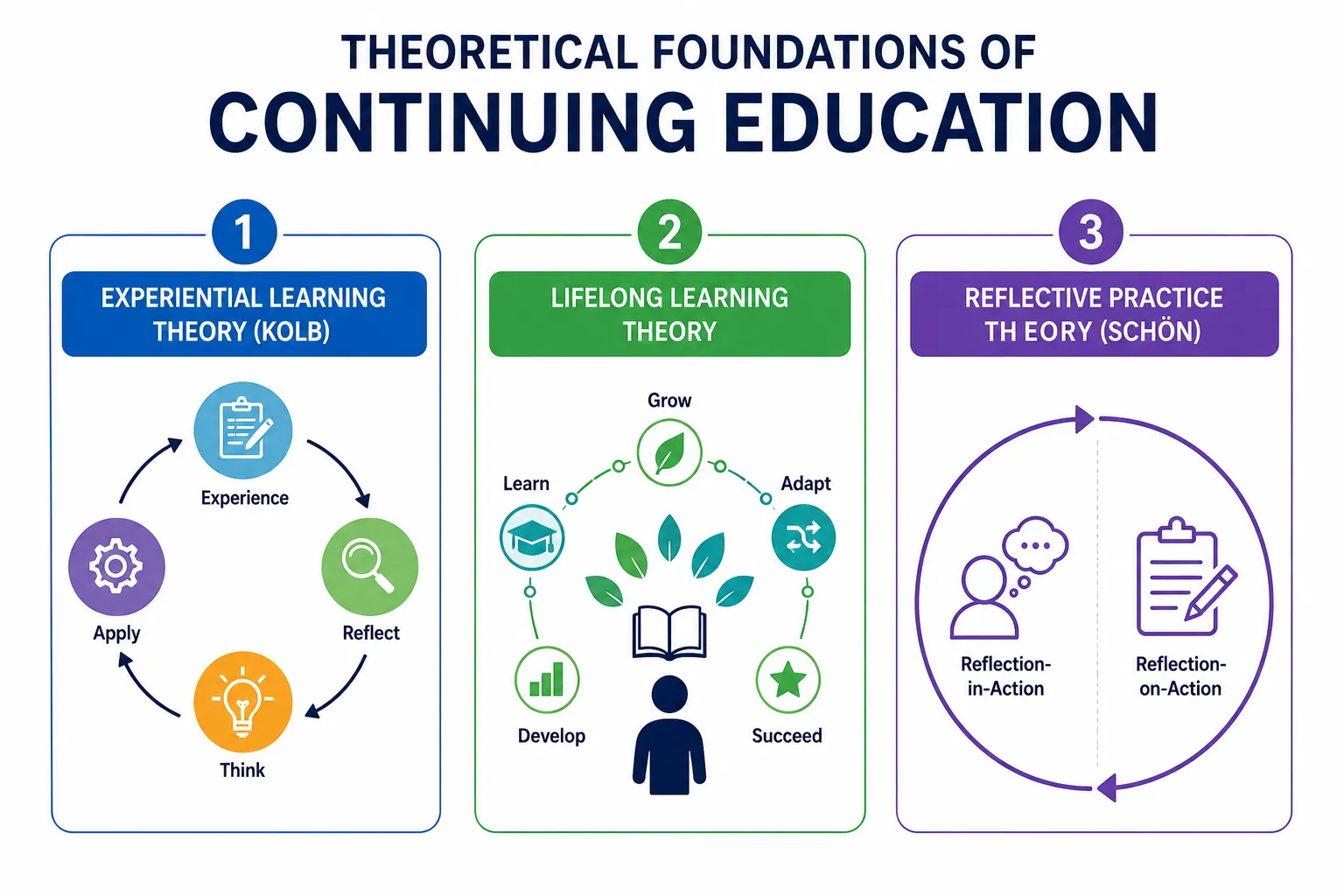
1. Experiential Learning Theory (Kolb)
Kolb’s learning cycle emphasises that professional development occurs through:
- Concrete experience
- Reflective observation
- Abstract conceptualisation
- Active experimentation
In addiction counselling, this means practitioners learn most effectively when they reflect on real client interactions and apply new knowledge in practice.
2. Lifelong Learning Theory
This theory emphasises that learning is a continuous process throughout professional life. In counselling, it ensures adaptability to new treatment approaches and evolving client needs.
3. Reflective Practice Theory (Schön)
Schön highlights “reflection-in-action” and “reflection-on-action” as essential tools for professional competence, particularly in complex human service environments.
Importance of Continuing Education in Addiction Counselling
Addiction counselling operates within a rapidly evolving healthcare landscape. Continuous professional development is required to ensure that practitioners remain aligned with current scientific knowledge, clinical standards, and ethical frameworks.
Key Drivers of Change in the Field
The need for continuing education is influenced by several critical developments:
- Emergence of new psychoactive substances and behavioural addictions
- Advances in neuroscience and brain-based addiction research
- Evolving psychological therapies (CBT, MI, DBT, trauma-informed care)
- Changes in public health policy and legal frameworks
- Cultural diversity and shifting societal attitudes toward addiction
- Integration of digital health and tele-therapy services
Without ongoing education, practitioners risk applying outdated or ineffective interventions that may compromise client safety and recovery outcomes.
Risks of Inadequate Continuing Education
Failure to engage in ongoing learning may lead to:
- Use of outdated treatment models
- Misinterpretation of complex client needs
- Reduced ethical compliance and professional accountability
- Ineffective or harmful intervention strategies
- Decreased client trust and engagement
- Professional stagnation and reduced employability
Benefits of Continuing Education
For Practitioners
Continuing education enhances professional capability by:
- Expanding clinical knowledge and therapeutic skills
- Strengthening confidence in complex decision-making
- Improving adaptability in diverse client situations
- Enhancing professional credibility and employability
- Supporting career progression and specialization
- Promoting ethical and evidence-based practice
For Clients
Clients benefit directly through:
- Improved quality of therapeutic care
- More accurate assessments and treatment planning
- Enhanced safety and ethical protection
- Increased likelihood of positive recovery outcomes
- More personalised and culturally sensitive interventions
Hierarchy of Continuing Professional Development
                      Continuing Education
                               │
        ┌──────────────────────┼──────────────────────┐
        │                      │                      │
   Formal Learning       Informal Learning    Practice-Based Learning
        │                      │                      │
 Qualifications        Self-Directed Study     Clinical Experience
 Certifications        Research Reading        Supervision
 Accredited Courses    Peer Collaboration      Case Reviews
 Workshops             Online Learning         Reflective Practice
Conferences Professional Networks Workplace Learning| Type | Description | Example | Professional Value |
|---|---|---|---|
| Formal Education | Structured accredited programmes | Diploma in Addiction Counselling | Career advancement and certification |
| Workshops | Short focused skill training | Motivational Interviewing workshop | Practical skill enhancement |
| Conferences | Large-scale professional learning events | International addiction conference | Exposure to latest research |
| Clinical Supervision | Guided professional reflection | Monthly supervision sessions | Ethical and safe practice development |
| Self-Directed Learning | Independent study and research | Reading peer-reviewed journals | Flexible knowledge development |
| Digital Learning | Online courses and webinars | Telehealth counselling training | Accessible continuous learning |
Continuing Education Process in Professional Practice
Continuing education follows a cyclical process that integrates learning with clinical application.
Identify Learning Needs
        ↓
Select Relevant Learning Opportunity
        ↓
Engage in Structured Learning Activity
        ↓
Apply Knowledge in Clinical Practice
        ↓
Evaluate Client Outcomes
        ↓
Reflect on Professional Performance
        ↓
Refine Skills and Knowledge
        ↓
Enhance Service QualityContinuing education includes both structured and unstructured learning methods. Each plays a distinct role in professional development.
| Aspect | Formal Learning | Informal Learning |
|---|---|---|
| Structure | Accredited and structured | Flexible and self-directed |
| Validation | Certified qualification | No formal certification |
| Flexibility | Limited flexibility | Highly flexible |
| Cost | Often high | Usually low or free |
| Application | Theoretical and applied | Experience-based |
| Strength | Credibility and recognition | Continuous adaptability |
Both approaches are essential. Formal learning ensures compliance with professional standards, while informal learning supports ongoing adaptability in real-world practice.
Workplace Applications of Continuing Education
1. Addiction Counselling Settings
Practitioners apply updated knowledge to:
- Improve relapse prevention strategies
- Integrate trauma-informed care approaches
- Use evidence-based motivational techniques
- Adapt treatment plans to individual needs
2. Mental Health Services
Continuing education supports:
- Dual diagnosis management
- Risk assessment improvements
- Ethical decision-making in complex cases
3. Community Health Programs
Learning enhances:
- Outreach effectiveness
- Cultural competence
- Engagement with vulnerable populations
Case Study: Impact of Continuing Education on Practice
Background
A counsellor working in a rehabilitation centre notices increasing cases of opioid dependency combined with anxiety disorders.
Situation
The practitioner feels uncertain about integrating mental health interventions with addiction treatment.
Action
They enrol in a professional certification course on integrated dual diagnosis treatment and attend a national mental health conference.
Application
The practitioner begins applying integrated CBT techniques and trauma-informed approaches in therapy sessions.
Outcome
Clients show improved engagement, reduced relapse rates, and better emotional regulation.
Learning Insight
Continuing education directly enhances clinical competence, confidence, and treatment effectiveness.
Best Practices for Continuing Education
Effective professional development requires strategic engagement rather than passive participation.
- Engage in continuous rather than occasional learning
- Align learning with professional development goals
- Combine theoretical knowledge with practical application
- Maintain a structured professional development portfolio
- Participate actively in supervision and peer learning
- Reflect critically on learning experiences
- Apply new knowledge immediately in practice
- Evaluate impact on client outcomes
Continuing Education Cycle
 Identify Learning Needs
        ↓
Engage in Education/Training
        ↓
 Acquire Updated Knowledge
        ↓
Apply in Clinical Practice
        ↓
 Evaluate Outcomes
        ↓
 Reflect and Improve
        ↓
Enhance Professional Competence- Continuing education is essential for maintaining professional competence in addiction counselling.
- It ensures practitioners remain aligned with current research and clinical best practices.
- A combination of formal, informal, and experiential learning is required for effective development.
- Evidence-based practice depends on continuous updating of knowledge and skills.
- Professional growth is directly linked to lifelong learning and reflective practice.
Continuing education is a fundamental requirement for professional excellence in addiction counselling and mental health treatment. It ensures that practitioners remain competent, informed, and capable of responding effectively to evolving client needs and emerging clinical challenges. Through structured learning, reflective practice, and engagement with current research, counsellors strengthen their ability to deliver ethical, evidence-based, and client-centred care. Ultimately, continuing education enhances both professional development and client recovery outcomes, making it an indispensable component of lifelong professional practice.
2: Stay Informed About Current Research, Trends, and Best Practices in Addiction and Mental Health Treatment
The Importance of Staying Updated in Addiction Counselling and Mental Health Practice
The fields of addiction counselling and mental health treatment are among the most rapidly evolving areas of health and social care practice. Advances in scientific research, emerging treatment approaches, changing patterns of substance use, technological innovation, and evolving public health priorities continuously reshape professional practice. As a result, addiction counsellors have a professional and ethical responsibility to remain informed about current developments in order to provide effective, evidence-based, and client-centred care.
Professional competence is not achieved solely through obtaining an initial qualification. Knowledge and skills that were considered current during training may become outdated as new evidence emerges. Consequently, practitioners must engage in ongoing professional learning to ensure that their interventions remain relevant, safe, and effective.
In addiction counselling, staying updated is particularly important because client needs are increasingly complex. Many individuals seeking support experience co-occurring mental health conditions, trauma histories, social challenges, behavioural addictions, and multiple substance dependencies. Addressing these complexities requires practitioners to maintain current knowledge and adapt their approaches in line with contemporary evidence and professional standards.
Remaining informed also strengthens professional confidence and decision-making. Practitioners who regularly engage with new research and emerging best practices are better equipped to evaluate treatment options, respond to challenges, and contribute to positive recovery outcomes.
Why Continuous Knowledge Development Matters
The healthcare and counselling sectors operate within dynamic environments where professional expectations continue to evolve. Modern addiction counsellors are expected to demonstrate evidence-informed decision-making, cultural competence, ethical accountability, and the ability to integrate new knowledge into practice.
Several factors contribute to the need for continuous professional updating:
Advances in Treatment Methodologies
Treatment approaches have evolved significantly over recent decades. Modern interventions increasingly emphasise person-centred care, motivational enhancement, trauma-informed approaches, and integrated treatment models.
Emerging Psychological Research
Research continues to improve understanding of addiction, recovery processes, relapse prevention, behavioural change, and mental health interventions.
Developments in Pharmacological Treatment
New medications and treatment protocols continue to emerge for substance dependence and co-occurring mental health conditions.
Changes in Policy and Regulatory Frameworks
Governments, professional bodies, and healthcare organisations regularly update regulations, safeguarding requirements, ethical standards, and clinical guidelines.
Growth of Digital Health Technologies
Telehealth services, digital therapeutic interventions, online counselling platforms, and mobile recovery applications are increasingly influencing service delivery.
Professionals who fail to remain informed risk applying outdated interventions that may reduce treatment effectiveness and compromise client care.
Sources of Professional Knowledge and Information
Professional development depends on access to reliable and credible information sources. Addiction counsellors must develop the ability to identify, evaluate, and apply information from multiple sources to support evidence-based practice.
Academic Research
Academic research forms the foundation of evidence-based addiction treatment. Peer-reviewed journals provide scientifically validated information regarding:
- Treatment effectiveness
- Recovery outcomes
- Mental health interventions
- Behavioural change strategies
- Emerging addiction trends
Research enables practitioners to make decisions based on evidence rather than personal opinion or tradition.
Professional Application
A counsellor reviewing research on relapse prevention may discover new therapeutic techniques that improve client engagement and long-term recovery outcomes.
Professional Bodies and Associations
Professional organisations play a critical role in disseminating current knowledge and maintaining standards of practice.
These organisations typically provide:
- Ethical guidelines
- Professional standards
- Best practice frameworks
- Position statements
- Continuing professional development opportunities
Professional membership often provides access to resources that support ongoing competence and ethical practice.
Clinical Supervision
Clinical supervision remains one of the most valuable professional learning tools available to addiction counsellors.
Through supervision, practitioners can:
- Discuss challenging cases
- Explore ethical dilemmas
- Receive feedback on interventions
- Identify professional development needs
- Apply current best practice guidance
Supervision bridges the gap between theoretical knowledge and practical application.
Conferences, Workshops, and Seminars
Professional events provide opportunities to learn directly from researchers, clinicians, and industry experts.
Benefits include:
- Exposure to emerging trends
- Networking opportunities
- Sharing professional experiences
- Learning innovative intervention strategies
- Accessing current research findings
These events also encourage collaborative learning and interdisciplinary practice.
Digital Learning Platforms
Technology has transformed professional learning by increasing accessibility and flexibility.
Examples include:
- Online courses
- Webinars
- Professional podcasts
- Digital libraries
- Virtual conferences
- Professional discussion forums
Digital learning enables practitioners to update their knowledge regardless of geographical location.
Current Trends Influencing Addiction Counselling Practice
Modern addiction treatment continues to evolve in response to emerging research and changing societal needs.
Understanding current trends enables practitioners to provide contemporary and effective services.
Trauma-Informed Care
Trauma-informed care recognises the significant relationship between trauma and addiction.
Rather than asking:
“What is wrong with this person?”
Practitioners are encouraged to ask:
“What has happened to this person?”
This approach promotes empathy, safety, empowerment, and collaboration.
Professional Benefits
- Improved therapeutic relationships
- Reduced re-traumatisation
- Enhanced client engagement
- Better treatment outcomes
Integrated Treatment Models
Research increasingly supports integrated treatment approaches that address addiction and mental health conditions simultaneously.
Many individuals seeking addiction support experience co-occurring conditions such as:
- Anxiety disorders
- Depression
- Post-traumatic stress disorder
- Personality disorders
Integrated treatment improves continuity of care and supports holistic recovery.
Digital Therapeutic Interventions
Technology is becoming an increasingly important component of addiction treatment.
Examples include:
- Telehealth counselling
- Mobile recovery applications
- Online support communities
- Virtual therapy platforms
Digital interventions increase accessibility while complementing traditional treatment approaches.
Harm Reduction Strategies
Modern addiction services increasingly recognise that recovery pathways vary between individuals.
Harm reduction focuses on:
- Reducing risks associated with substance use
- Improving health outcomes
- Increasing treatment engagement
- Supporting gradual behaviour change
This approach may serve as an important stepping stone toward long-term recovery.
Person-Centred Care
Person-centred care places the individual at the centre of treatment planning and decision-making.
Key principles include:
- Respect for client autonomy
- Individualised care planning
- Collaborative goal setting
- Recognition of personal strengths
Person-centred approaches are strongly associated with improved engagement and recovery outcomes.
Comparison: Traditional and Contemporary Addiction Treatment Approaches
| Traditional Approaches | Contemporary Approaches |
|---|---|
| Focus primarily on abstinence | Focus on recovery and wellbeing |
| Standardised interventions | Individualised treatment planning |
| Professional-directed decision-making | Collaborative decision-making |
| Relapse viewed as treatment failure | Relapse viewed as part of recovery |
| Limited use of technology | Integration of digital interventions |
| Separate treatment systems | Integrated care models |
Applying Research to Professional Practice
Remaining informed is only valuable when knowledge is translated into professional action.
This process is commonly referred to as evidence-based practice (EBP).
Understanding Evidence-Based Practice
Evidence-based practice combines three essential components:
- Best available research evidence
- Professional expertise and clinical judgement
- Client preferences, needs, and values
The integration of these elements ensures that treatment decisions are both scientifically supported and individually appropriate.
Evidence-Based Practice Process Flow
Current Research Evidence
          ↓
Critical Evaluation
          ↓
Assessment of Client Needs
          ↓
Integration with Professional Expertise
          ↓
Selection of Appropriate Intervention
          ↓
Implementation in Practice
          ↓
Monitoring Outcomes
          ↓
Continuous ImprovementAn addiction counsellor learns through current research that mindfulness-based relapse prevention can improve emotional regulation and reduce relapse risk among individuals recovering from opioid dependence.
Following professional development training, the counsellor integrates mindfulness exercises into weekly treatment sessions.
After several months, client feedback indicates:
- Improved emotional awareness
- Better stress management
- Increased engagement with recovery planning
This demonstrates how research can directly influence treatment effectiveness.
Best Practices for Maintaining Current Knowledge
Staying informed requires a proactive and systematic approach.
Professional Guidelines
Commit to Regular Learning
Professional learning should occur continuously rather than only when required.
Critically Evaluate Information
Not all information sources are equally reliable. Practitioners should prioritise evidence-based and professionally recognised resources.
Maintain a Professional Development Portfolio
Documenting learning activities supports reflection and professional accountability.
Participate in Supervision
Supervision provides opportunities to discuss emerging developments and apply them appropriately.
Engage in Professional Networks
Collaboration with colleagues encourages knowledge sharing and exposure to new ideas.
Apply Learning Promptly
Knowledge becomes meaningful when translated into practical improvements in service delivery.
Case Study: Professional Development in Practice
Background
A counsellor working within a residential rehabilitation service notices an increasing number of clients presenting with both substance misuse and depressive symptoms.
Situation
Although experienced in addiction counselling, the practitioner feels less confident managing complex mental health concerns alongside substance dependence.
Professional Response
The counsellor:
- Enrols in an accredited online course on dual diagnosis treatment.
- Attends a professional mental health conference.
- Participates in supervision focused on integrated treatment planning.
Analysis
Through these learning opportunities, the practitioner develops a stronger understanding of:
- Co-occurring disorders
- Integrated treatment approaches
- Mental health assessment techniques
- Collaborative care planning
Outcome
The counsellor improves assessment quality, develops more comprehensive treatment plans, and works more effectively with multidisciplinary mental health professionals.
Learning Point
This case demonstrates how continuing education directly enhances professional competence and service quality.
Staying Current in Professional Practice
Access Current Research
↓
Engage in Professional Learning
↓
 Update Knowledge and Skills
↓
Apply Learning in Practice
↓
Evaluate Outcomes
↓
Reflect and Refine Practice
↓
Improve Professional Competence
↓
Enhance Client Outcomes
Update Knowledge and Skills
↓
Apply Learning in Practice
↓
Evaluate Outcomes
↓
Reflect and Refine Practice
↓
Improve Professional Competence
↓
Enhance Client Outcomes Update Knowledge and Skills
↓
Apply Learning in Practice
↓
Evaluate Outcomes
↓
Reflect and Refine Practice
↓
Improve Professional Competence
↓
Enhance Client Outcomes
Update Knowledge and Skills
↓
Apply Learning in Practice
↓
Evaluate Outcomes
↓
Reflect and Refine Practice
↓
Improve Professional Competence
↓
Enhance Client OutcomesIn addiction counselling and mental health treatment, professional competence depends upon a commitment to continuous learning and evidence-informed practice. By actively engaging with current research, emerging trends, professional guidance, and innovative treatment approaches, practitioners can enhance their effectiveness, maintain ethical standards, and provide high-quality support that reflects the evolving needs of individuals, families, and communities.
Conclusion
Staying informed about current research, emerging trends, and evolving best practices is essential for effective addiction counselling and mental health treatment. As the field continues to develop, practitioners must actively engage with new knowledge, evidence-based interventions, and professional learning opportunities to ensure their practice remains relevant, ethical, and responsive to client needs. Continuous engagement with research and professional development enables counsellors to make informed decisions, adapt to changing treatment environments, and deliver high-quality support grounded in current evidence.
By integrating contemporary research findings, innovative treatment approaches, and professional expertise into everyday practice, addiction counsellors strengthen their professional competence and enhance the quality of care they provide. A commitment to lifelong learning not only supports individual professional growth but also contributes to improved client engagement, better recovery outcomes, and the ongoing advancement of addiction and mental health services.