
Lesson 1: Understand Cognitive Models Used in CBT
Cognitive Behavioural Therapy (CBT) is based on the principle that psychological distress is not caused only by external events, but by how individuals interpret those events through internal cognitive structures. These structures are referred to as cognitive models, which explain how people process information, develop beliefs, and produce emotional and behavioural responses.
In clinical and therapeutic practice, cognitive models provide a structured and evidence-based framework for identifying unhelpful thinking patterns and replacing them with more balanced and realistic interpretations. These models are widely used in counselling, psychotherapy, coaching, education, and mental health services across international settings.
1. Key Cognitive Models Used in CBT Practice
The Role of Cognitive Models in Modern CBT
Cognitive Behavioural Therapy (CBT) is grounded in the scientific understanding that psychological distress is not merely a reaction to external life events, but a consequence of how individuals interpret and mentally construct those events. Within clinical psychology and counselling practice, cognitive models provide structured theoretical frameworks that explain the relationship between cognition, emotion, and behaviour.
These models are essential in both assessment and intervention because they allow practitioners to move beyond surface-level symptoms and explore underlying cognitive structures that maintain psychological difficulties. In contemporary mental health services, cognitive models are applied across diverse contexts including clinical therapy, workplace counselling, coaching, education, addiction recovery, and trauma-informed care.
Three foundational cognitive frameworks dominate CBT practice:
- Beck’s Cognitive Model
- Ellis’s ABC Model (Rational Emotive Behaviour Therapy)
- Cognitive Triad Model
Each provides a distinct but complementary explanation of how maladaptive thinking patterns develop and how they can be modified through structured psychological intervention.
Beck’s Cognitive Model
Theoretical Foundation and Conceptual Framework
Aaron T. Beck’s Cognitive Model is widely regarded as the cornerstone of modern CBT. Developed through clinical observation of depressed patients, Beck proposed that emotional disorders are largely maintained by systematic distortions in thinking rather than objective external reality.
At the core of this model is the principle that cognition operates at multiple levels, forming a hierarchy that influences emotional and behavioural responses. These levels include:
- Automatic thoughts
- Intermediate beliefs
- Core beliefs
This hierarchical structure is significant because it demonstrates that surface-level thoughts are often reflections of deeper cognitive schemas.
Structural Levels of Cognition
Automatic Thoughts
Automatic thoughts are immediate, involuntary interpretations of situations. They occur rapidly and are often accepted as factual without critical evaluation. In clinical settings, these thoughts are typically the first point of identification during cognitive restructuring.
Characteristics include:
- Rapid cognitive responses
- Emotionally charged interpretations
- Often distorted or exaggerated
- Situation-specific
Intermediate Beliefs
Intermediate beliefs function as conditional assumptions, rules, and attitudes that guide behaviour. These beliefs are less conscious than automatic thoughts but more stable and generalized.
Examples include:
- “If I do not succeed, I am a failure.”
- “I must be approved by others to be valued.”
- “Mistakes should always be avoided.”
These beliefs often develop as coping mechanisms but become maladaptive over time.
Core Beliefs
Core beliefs are deeply embedded cognitive structures formed early in life through experience, upbringing, and social conditioning. They represent fundamental perceptions of self, others, and the world.
Common core beliefs include:
- “I am unworthy.”
- “Others are critical and rejecting.”
- “The world is unsafe.”
These beliefs are highly resistant to change and often require long-term therapeutic intervention.
Practical Application in Clinical and Workplace Settings
In CBT practice, Beck’s model is used to identify cognitive distortions and restructure dysfunctional thinking patterns.
Case Illustration
A learner fails an academic examination:
- Automatic thought: “I am stupid.”
- Intermediate belief: “If I fail once, I will always fail.”
- Core belief: “I am not good enough.”
This progression illustrates how a single event can activate deeply rooted cognitive schemas, leading to emotional distress such as anxiety, shame, or avoidance behaviour.
Clinical Intervention Process
- Identification of automatic thoughts through thought records
- Challenging intermediate beliefs using Socratic questioning
- Restructuring core beliefs through long-term cognitive reframing
Critical Evaluation of Beck’s Model
Beck’s model is highly effective due to its structured and evidence-based nature. However, it has been critically discussed in academic literature:
- It requires high cognitive awareness from clients
- Deep core belief restructuring can be time-intensive
- Cultural variations may influence belief formation differently
Despite these limitations, it remains one of the most widely validated models in psychotherapy.
Ellis’s ABC Model (Rational Emotive Behaviour Therapy Framework)
Theoretical Background
Albert Ellis introduced the ABC Model as part of Rational Emotive Behaviour Therapy (REBT), emphasising that emotional distress is not caused by events themselves but by the beliefs individuals hold about those events.
This model shifted psychological focus from external circumstances to internal cognitive interpretation, making it a foundational framework in cognitive therapy development.
Structure of the ABC Model
A – Activating Event
The activating event refers to any external or internal situation that triggers a cognitive response. It may include criticism, failure, rejection, or perceived threat.
B – Beliefs
Beliefs represent the interpretation of the activating event. These beliefs may be rational or irrational and determine emotional outcomes.
Examples of irrational beliefs include:
- “I must always be successful.”
- “People must treat me fairly at all times.”
- “Failure is unbearable.”
C – Consequences
Consequences refer to emotional and behavioural responses resulting from beliefs rather than the activating event itself.
 Case Study Application
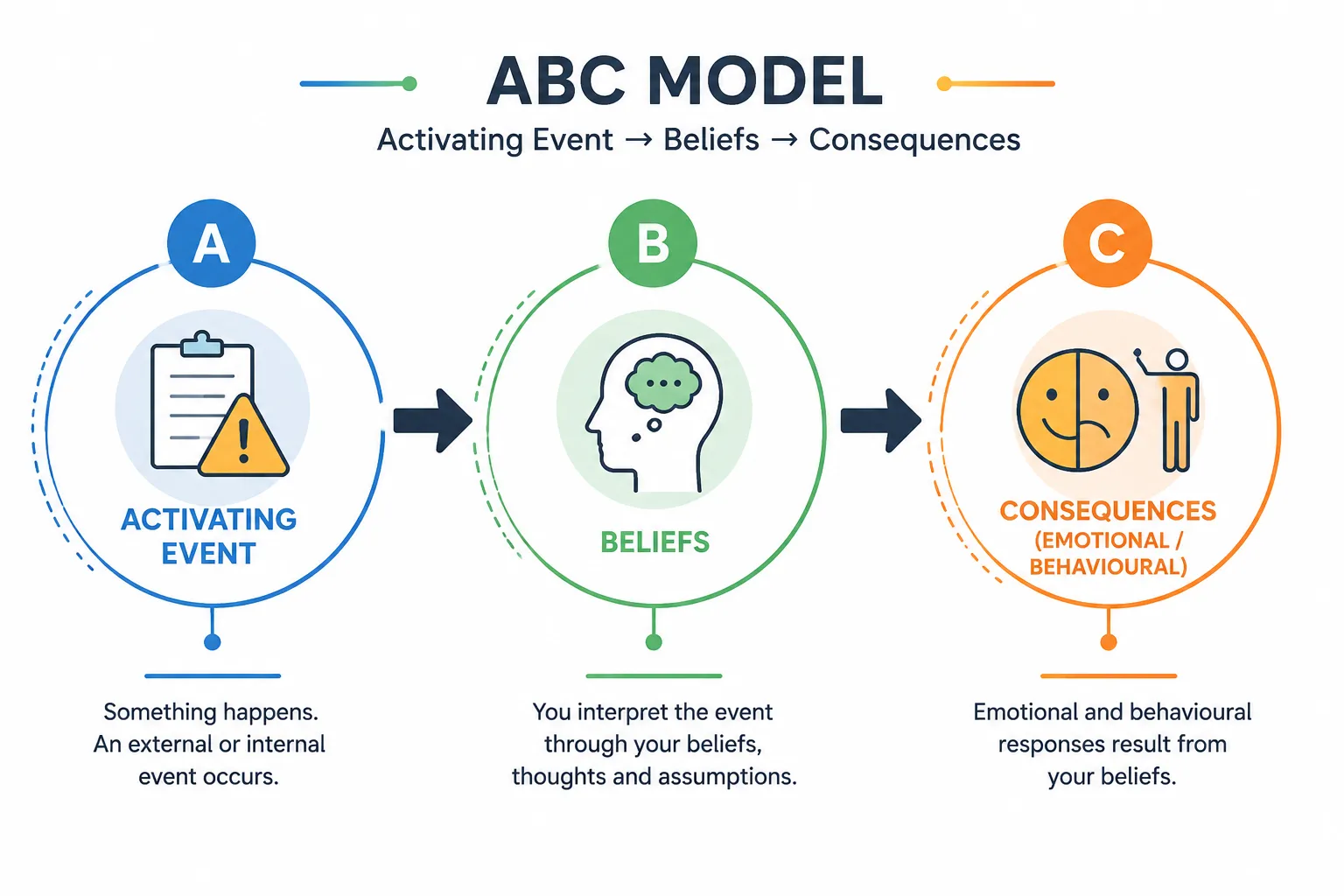 Case Study Application
Workplace Scenario
- A: Employee receives critical feedback from a supervisor
- B: “I must never make mistakes, or I am incompetent.”
- C: Anxiety, reduced confidence, withdrawal from responsibilities
This demonstrates how irrational belief systems influence emotional regulation and workplace performance.
Therapeutic Application
CBT practitioners use the ABC framework to:
- Identify irrational beliefs
- Challenge cognitive distortions using disputation techniques
- Replace irrational beliefs with rational alternatives
Common techniques include:
- Cognitive disputation
- Reality testing
- Logical restructuring
- Behavioural experiments
Critical Analysis of Ellis’s Model
Ellis’s model is widely respected for its simplicity and practical applicability. However:
- It may oversimplify complex emotional processes
- It does not explicitly address deep unconscious belief systems
- Some emotional responses may not follow a linear A-B-C structure
Despite this, it remains highly effective in short-term therapeutic interventions.
Cognitive Triad Model
Theoretical Overview
The Cognitive Triad Model, developed by Aaron Beck, specifically explains the cognitive patterns associated with depression. It identifies three interrelated negative belief systems that reinforce depressive thinking.
This model is particularly valuable in understanding chronic depressive states and emotional vulnerability.
Core Components of the Cognitive Triad
Negative View of Self
Individuals perceive themselves as inadequate, unworthy, or fundamentally flawed. This perception leads to low self-esteem and self-critical thinking.
Negative View of the World
The external environment is perceived as hostile, demanding, or unfair. Individuals may interpret neutral events as threatening or rejecting.
Negative View of the Future
Individuals develop hopeless expectations, believing that current difficulties will persist indefinitely.
Clinical Case Illustration
A professional experiencing workplace burnout:
- Self: “I am not competent enough.”
- World: “My workplace is unfair and unsupportive.”
- Future: “Things will never improve.”
This cognitive pattern reinforces emotional distress and reduces motivation for change.
Clinical Importance and Intervention Strategy
The Cognitive Triad is particularly effective in:
- Identifying depressive cognitive patterns
- Designing targeted interventions for depression
- Supporting relapse prevention strategies
Therapeutic interventions include:
- Cognitive restructuring of negative beliefs
- Behavioural activation techniques
- Future-oriented goal setting
Critical Evaluation
Strengths:
- Highly effective in depression-focused therapy
- Simple and clinically observable framework
- Strong empirical support in psychological research
Limitations:
- Limited application outside depressive disorders
- Does not fully explain anxiety-based cognition
- Requires integration with broader CBT models for complex cases
Comparative Analysis of Cognitive Models in CBT
| Model | Focus | Strength | Limitation | Clinical Use |
|---|---|---|---|---|
| Beck’s Cognitive Model | Cognitive hierarchy | Deep structural analysis | Time-intensive | Broad CBT applications |
| Ellis ABC Model | Belief-emotion link | Simple and practical | Oversimplification | Short-term interventions |
| Cognitive Triad | Depressive cognition | Strong depression focus | Limited scope | Depression treatment |
Integrated Clinical Perspective
Modern CBT practice rarely relies on a single cognitive model. Instead, clinicians integrate multiple frameworks to develop a comprehensive understanding of client cognition.
For example:
- Beck’s model identifies deep belief structures
- Ellis’s model challenges irrational thinking patterns
- Cognitive Triad identifies depressive cognitive themes
This integrated approach enhances:
- Diagnostic accuracy
- Treatment personalization
- Long-term therapeutic effectiveness
- Cognitive flexibility in clients
Cognitive models form the theoretical backbone of Cognitive Behavioural Therapy by explaining how thoughts influence emotional and behavioural responses. Beck’s Cognitive Model provides a hierarchical understanding of cognition, Ellis’s ABC Model focuses on belief-driven emotional consequences, and the Cognitive Triad highlights depressive thinking patterns.
Together, these frameworks provide a comprehensive, evidence-based foundation for understanding psychological distress and developing effective therapeutic interventions in clinical, educational, and workplace settings.
2. Models as a Foundation for Psychological Understanding
Cognitive models are central to contemporary psychological theory and clinical practice, particularly within Cognitive Behavioural Therapy (CBT). They provide a structured explanatory framework for understanding how individuals perceive, interpret, and respond to life events. Rather than viewing psychological distress as a direct consequence of external circumstances, cognitive models emphasise the mediating role of cognition in shaping emotional and behavioural outcomes.
In modern mental health practice, this perspective represents a major shift from purely behavioural or psychodynamic explanations toward an integrative, evidence-based understanding of human functioning. Cognitive models are now widely applied in clinical psychology, psychiatry, counselling, occupational health, education, and organisational wellbeing programmes.
Their primary value lies in their ability to:
- Explain the development of psychological disorders
- Identify maintaining mechanisms of distress
- Provide structured pathways for therapeutic intervention
- Support measurable and replicable treatment outcomes
From an academic perspective, cognitive models bridge theory and practice by offering clinicians a systematic way to conceptualise distress, while also guiding intervention planning.
Theoretical Foundation: Cognitive Appraisal and Emotional Response
At the heart of cognitive models is the principle of cognitive appraisal. This concept suggests that individuals do not respond directly to events; rather, they respond to their interpretation of those events.
Core Principle
It is not the event itself that determines emotional outcome, but the meaning assigned to the event.
This principle aligns with broader psychological theories, including:
- Information processing theory
- Schema theory
- Emotional regulation frameworks
- Learning theory and reinforcement principles
Cognitive models propose that individuals develop internal cognitive structures (schemas) based on early experiences, cultural conditioning, and reinforcement history. These schemas influence how new information is processed, often leading to systematic distortions in thinking.
Mechanism of Psychological Distress: The Cognitive Cycle
Psychological distress develops through a predictable and self-reinforcing cognitive-emotional-behavioural cycle. This cycle is essential in understanding the onset and maintenance of mental health difficulties such as anxiety disorders, depression, stress-related conditions, and adjustment disorders.
Step-by-Step Cognitive Distress Model
1. External or Internal Trigger Event
An activating situation occurs. This may be:
- Academic failure
- Workplace criticism
- Social rejection
- Financial difficulty
- Internal physiological sensations (e.g., panic symptoms)
2. Cognitive Appraisal of the Event
The individual interprets the situation based on pre-existing beliefs, assumptions, and schemas. These interpretations are not neutral; they are influenced by cognitive bias and prior learning experiences.
3. Activation of Cognitive Distortions
Distorted thinking patterns emerge automatically, such as:
- Catastrophising
- Overgeneralisation
- Personalisation
- Black-and-white thinking
- Emotional reasoning
These distortions amplify perceived threat and reduce rational processing.
4. Emotional Response Generation
Emotional states are produced based on cognitive interpretation rather than objective reality. Common responses include:
- Anxiety
- Shame
- Anger
- Hopelessness
- Guilt
5. Behavioural Response and Reinforcement
The individual engages in coping behaviours that often reinforce the original negative belief system. These may include:
- Avoidance
- Withdrawal
- Procrastination
- Safety behaviours
- Social isolation
6. Maintenance of Dysfunctional Cycle
The behavioural response prevents corrective learning, reinforcing maladaptive beliefs and sustaining psychological distress.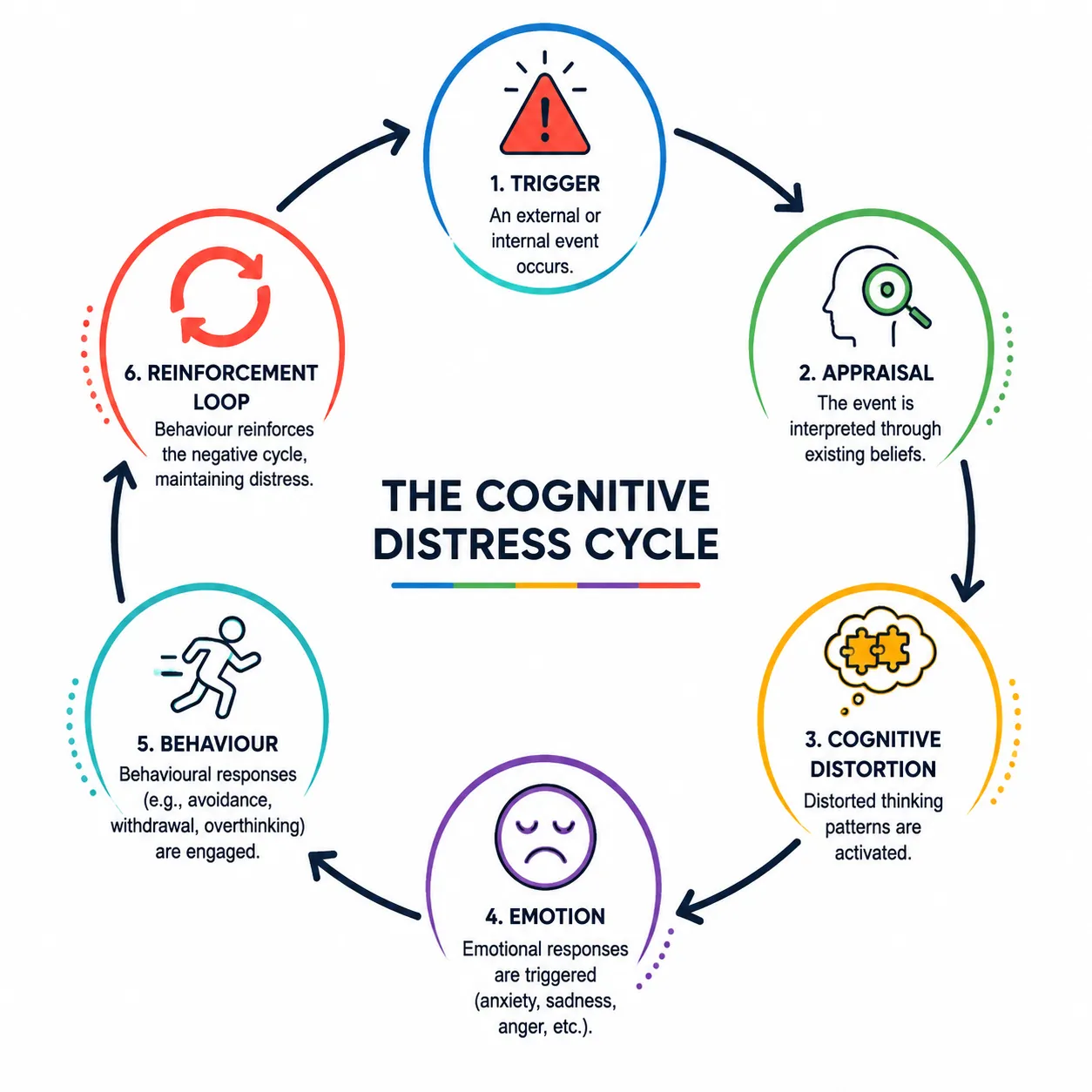
Critical Understanding: Why Cognitive Models Are Clinically Effective
Cognitive models are not merely descriptive; they are functional frameworks used to intervene in psychological processes. Their clinical effectiveness lies in their ability to target the mechanism of distress rather than only symptoms.
Key Clinical Contributions
- Provide structured formulation of psychological problems
- Enable identification of maintaining cognitive processes
- Support measurable cognitive change over time
- Facilitate client self-awareness and metacognition
From an evidence-based practice perspective, cognitive models are strongly supported by empirical research in treating:
- Major depressive disorder
- Generalised anxiety disorder
- Panic disorder
- Post-traumatic stress disorder
- Work-related stress conditions
Real-World Application: Academic Performance and Cognitive Distress
Case Scenario: Student Underperformance
A university student receives a low examination grade.
Without Cognitive Understanding
- Interprets outcome as personal failure
- Develops belief: “I am not intelligent enough”
- Emotional response: anxiety and shame
- Behaviour: avoidance of study and disengagement
This creates a downward spiral of academic performance and psychological distress.
With CBT-Based Cognitive Reframing
- Identifies cognitive distortion: all-or-nothing thinking
- Reframes interpretation: “One result does not define ability”
- Emotional regulation improves
- Behaviour shifts toward structured revision and resilience building
This demonstrates how cognitive models transform interpretation, emotion, and behaviour simultaneously.
Cognitive Models in Workplace and Organisational Contexts
Psychological distress is not limited to clinical populations; it is highly prevalent in workplace environments. Cognitive models are widely used in occupational psychology and employee wellbeing programmes.
Common Workplace Stress Triggers
- Performance evaluation and appraisal systems
- Leadership criticism or feedback
- Job insecurity
- Role ambiguity
- High workload and time pressure
Cognitive Interpretation in Workplace Stress
Employees often interpret workplace events through distorted beliefs such as:
- “If I make a mistake, I will lose my job.”
- “I must always perform perfectly.”
- “My manager’s criticism means I am incompetent.”
These interpretations directly influence emotional burnout, disengagement, and reduced productivity.
Organisational Application of CBT Principles
Employers and HR professionals use cognitive frameworks to:
- Design stress management interventions
- Improve resilience training programmes
- Reduce absenteeism and presenteeism
- Enhance employee emotional regulation skills
Comparative Analysis of Cognitive Influence on Psychological Outcomes
| Stage of Cognitive Process | Functional Interpretation | Dysfunctional Interpretation | Psychological Outcome |
|---|---|---|---|
| Event perception | Neutral observation | Threat-based interpretation | Emotional imbalance |
| Thought processing | Rational appraisal | Cognitive distortion | Anxiety/depression |
| Emotional response | Proportionate emotion | Intensified emotional reaction | Distress escalation |
| Behavioural response | Adaptive coping | Avoidance/withdrawal | Reinforced dysfunction |
This comparison highlights how cognitive distortions fundamentally alter emotional and behavioural outcomes even when external events remain unchanged.
Clinical Importance of Cognitive Models in Psychological Practice
Cognitive models are essential tools in both assessment and intervention. Their importance extends across multiple stages of therapeutic practice.
1. Identification of Maladaptive Cognition
Practitioners use structured assessment tools such as:
- Thought records
- Cognitive interviews
- Behavioural observation
- Self-report scales
These help identify irrational or unhelpful thinking patterns.
2. Breaking the Cycle of Psychological Distress
By targeting cognition, therapists interrupt the automatic progression from thought to emotion to behaviour. This prevents reinforcement of negative belief systems.
3. Designing Structured Interventions
Cognitive models allow clinicians to design targeted interventions such as:
- Cognitive restructuring
- Behavioural activation
- Exposure therapy
- Rational disputation techniques
4. Supporting Long-Term Cognitive Change
Long-term outcomes include:
- Improved emotional resilience
- Reduced relapse rates in depression and anxiety
- Enhanced problem-solving ability
- Greater psychological flexibility
Integrative Case Study: Chronic Anxiety in Professional Environment
A mid-level manager experiences ongoing anxiety due to performance pressure.
Cognitive Analysis
- Core belief: “I must not fail”
- Intermediate belief: “Mistakes will damage my career permanently”
- Automatic thoughts: “I will be exposed as incompetent”
Emotional Impact
- Persistent anxiety
- Sleep disturbance
- Reduced concentration
Behavioural Consequences
- Overworking
- Avoidance of delegation
- Excessive checking behaviours
Therapeutic Intervention Using Cognitive Model
- Identification of cognitive distortions
- Cognitive restructuring of perfectionistic beliefs
- Behavioural experiments to test assumptions
- Development of balanced thinking patterns
Outcome
Improved emotional regulation, increased performance efficiency, and reduced anxiety symptoms.
Critical Evaluation of Cognitive Models
While cognitive models are highly effective, academic literature highlights certain limitations:
Strengths
- Strong empirical support
- Structured and replicable framework
- Highly applicable across settings
- Effective for multiple disorders
Limitations
- Overemphasis on conscious cognition
- Limited explanation of unconscious emotional drivers
- Cultural variability in belief systems
- Requires cognitive engagement from clients
Despite these limitations, cognitive models remain foundational in modern psychotherapy due to their adaptability and evidence base.
Cognitive models provide a comprehensive and scientifically grounded framework for understanding psychological distress. They explain how external events are interpreted through internal belief systems, leading to emotional and behavioural consequences that can either maintain or reduce distress.
Through structured processes such as cognitive appraisal, distortion identification, and behavioural reinforcement, these models offer both explanatory and therapeutic value. Their application in clinical, educational, and occupational settings demonstrates their versatility and effectiveness in addressing a wide range of psychological difficulties.
Ultimately, cognitive models not only enhance understanding of mental health problems but also empower individuals to develop greater cognitive awareness, emotional regulation, and adaptive coping strategies, making them a cornerstone of modern evidence-based psychological practice.
3. Identify differences between various CBT cognitive frameworks
The Importance of Comparative Understanding in CBT
Cognitive Behavioural Therapy (CBT) is not a single unified model but rather a family of interrelated cognitive frameworks that collectively explain how thoughts influence emotions and behaviour. In professional psychological practice, understanding the differences between these frameworks is essential for accurate case formulation, effective intervention planning, and evidence-based therapeutic decision-making.
Each cognitive framework offers a unique lens for conceptualising psychological distress. While they share the common assumption that cognition mediates emotional experience, they differ in structure, focus, depth of analysis, and clinical application. Advanced practitioners are expected to integrate these models rather than rely on a single framework, particularly when working with complex or comorbid psychological conditions.
The three core frameworks commonly used in CBT practice include:
- Beck’s Cognitive Model
- Ellis’s ABC Model (Rational Emotive Behaviour Therapy)
- Cognitive Triad Model
This section provides a critical, comparative, and practice-oriented analysis of these frameworks within contemporary mental health and behavioural science.
Theoretical Foundations of CBT Cognitive Frameworks
Shared Philosophical Assumptions
Despite their structural differences, all CBT cognitive frameworks are grounded in several shared theoretical assumptions:
- Human cognition directly influences emotional experience
- Psychological distress is maintained by maladaptive thinking patterns
- Changing cognition leads to measurable emotional and behavioural change
- Individuals can learn to identify and restructure dysfunctional thoughts
These assumptions are supported by decades of empirical research in clinical psychology, particularly in the treatment of depression and anxiety disorders.
Divergence in Conceptual Focus
Although unified in principle, each model differs in emphasis:
- Beck’s model focuses on cognitive hierarchy and schema depth
- Ellis’s model focuses on belief evaluation and disputation
- Cognitive Triad focuses on depressive cognition patterns
This divergence allows clinicians to select or combine models depending on symptom presentation and therapeutic goals.
Comparative Analysis of Cognitive Models in CBT
Functional Overview of Core Frameworks
The following table provides a structured comparison of the three primary CBT cognitive frameworks used in clinical and applied psychology.
Comparative Table: Cognitive Models in CBT Practice
| Cognitive Model | Core Focus | Structural Concept | Primary Clinical Use | Strengths | Limitations |
|---|---|---|---|---|---|
| Beck’s Cognitive Model | Cognitive hierarchy | Core beliefs → Intermediate beliefs → Automatic thoughts | Depression, anxiety, personality-related cognition | Deep structural analysis of cognition | Time-intensive, requires cognitive insight |
| Ellis ABC Model | Belief-emotion relationship | Activating event → Beliefs → Consequences | Emotional regulation, anger, anxiety | Simple, practical, highly applicable | May oversimplify emotional complexity |
| Cognitive Triad | Depressive cognition patterns | Self, world, future negativity | Clinical depression interventions | Strong diagnostic clarity for depression | Limited scope outside depressive disorders |
Beck’s Cognitive Model: Structural Depth and Clinical Utility
Advanced Conceptual Understanding
Beck’s Cognitive Model is widely regarded as the most comprehensive cognitive framework in CBT due to its hierarchical structure. It explains that cognition operates at multiple interconnected levels, with deep core beliefs influencing surface-level automatic thoughts.
This layered structure allows clinicians to trace psychological distress back to its origin, often rooted in early developmental experiences, trauma, or learned cognitive biases.
Clinical Strength
Beck’s model is particularly effective in:
- Identifying deep-rooted cognitive schemas
- Understanding chronic emotional disorders
- Supporting long-term therapeutic change
- Facilitating cognitive restructuring processes
Practical Interpretation in Clinical Settings
In therapy, practitioners typically move through a structured process:
- Identification of automatic thoughts
- Exploration of intermediate beliefs
- Reconstruction of core beliefs
- Behavioural experimentation to test cognitive accuracy
Example: Workplace Cognitive Dysfunction
An employee experiencing performance anxiety may present:
- Automatic thought: “I will fail this task”
- Intermediate belief: “I must never make mistakes at work”
- Core belief: “I am incompetent”
This layered analysis enables targeted intervention at multiple cognitive levels.
Ellis’s ABC Model: Rational Evaluation of Beliefs
Theoretical Foundation
Ellis’s ABC Model is grounded in Rational Emotive Behaviour Therapy (REBT), which emphasises that emotional disturbance is not caused by events themselves but by irrational beliefs about those events.
This model represents a shift from emotional reaction analysis to belief evaluation and logical restructuring.
Functional Structure of the ABC Model
- A (Activating Event): External or internal trigger
- B (Beliefs): Interpretation of the event
- C (Consequences): Emotional and behavioural outcomes
Advanced Clinical Interpretation
Unlike Beck’s hierarchical model, Ellis’s framework is linear and highly action-oriented. It is particularly useful in short-term interventions where rapid cognitive restructuring is required.
Therapeutic Application Techniques
Clinicians use several techniques within this model:
- Cognitive disputation (challenging irrational beliefs)
- Logical analysis of belief systems
- Empirical testing of assumptions
- Development of rational replacement beliefs
Example: Emotional Dysregulation in Workplace
- A: Receiving negative feedback
- B: “I must always perform perfectly or I am worthless”
- C: Anxiety, anger, withdrawal
This model enables immediate identification and restructuring of irrational thinking.
Cognitive Triad Model: Depression-Focused Cognitive Structure
Theoretical Background
The Cognitive Triad Model specifically addresses depressive cognition and is one of the most influential frameworks in understanding clinical depression.
It identifies three interrelated negative cognitive domains:
- Negative perception of self
- Negative perception of the world
- Negative perception of the future
Clinical Interpretation
The Cognitive Triad explains how depressive individuals develop a self-reinforcing belief system that maintains emotional distress over time.
This model is particularly useful in:
- Major depressive disorder
- Persistent depressive disorder
- Adjustment disorders with depressive features
Example: Clinical Depression Case
A patient may present with:
- Self: “I am a failure”
- World: “Everything is against me”
- Future: “Things will never improve”
This triadic pattern creates cognitive rigidity and emotional hopelessness.
Critical Comparative Analysis of CBT Frameworks
Structural Differences in Cognitive Processing
Each model conceptualises cognition differently:
- Beck: Multi-layered cognitive hierarchy
- Ellis: Linear belief-consequence relationship
- Cognitive Triad: Domain-specific depressive cognition
These differences influence therapeutic strategy, session planning, and intervention depth.
Functional Differences in Clinical Application
Beck vs Ellis
Beck’s model is exploratory and diagnostic, focusing on deep cognitive restructuring. Ellis’s model is directive and intervention-focused, prioritising immediate belief correction.
Beck vs Cognitive Triad
Beck provides a universal framework applicable to multiple disorders, whereas the Cognitive Triad is disorder-specific and primarily depression-oriented.
Ellis vs Cognitive Triad
Ellis focuses on rationality of beliefs across emotional conditions, while the Cognitive Triad focuses specifically on depressive thought content rather than belief logic.
Integrated Clinical Practice in Modern CBT
Why Integration is Essential
In modern psychotherapy, practitioners rarely rely on a single cognitive model. Instead, they adopt an integrative approach to enhance diagnostic precision and treatment effectiveness.
Integration allows clinicians to:
- Address both surface and deep cognition
- Tailor interventions to individual client needs
- Improve therapeutic efficiency
- Enhance long-term recovery outcomes
Integrated Application in Clinical Settings
Case Scenario: Workplace Burnout and Anxiety
A professional client presents with chronic stress and emotional exhaustion.
- Beck’s model identifies perfectionism and core inadequacy beliefs
- Ellis’s model challenges irrational performance expectations
- Cognitive Triad addresses hopelessness about career progression
Clinical Benefits of Integration
- Improved emotional insight
- Enhanced cognitive flexibility
- Reduction in relapse rates
- Strengthened coping mechanisms
- Greater behavioural adaptability
Best Practice in CBT Framework Application
Professional CBT practitioners follow evidence-based guidelines when applying cognitive models:
- Begin with surface cognition (automatic thoughts)
- Progress to belief-level analysis
- Identify disorder-specific cognitive patterns
- Apply model integration for complex cases
- Validate change through behavioural experimentation
A comprehensive understanding of CBT cognitive frameworks is essential for effective psychological assessment and intervention. Beck’s Cognitive Model provides deep structural insight into cognition, Ellis’s ABC Model offers a practical framework for belief restructuring, and the Cognitive Triad Model specifically addresses depressive cognition.
When applied individually, each model offers valuable clinical insight; however, when integrated, they form a powerful, multidimensional approach to understanding and treating psychological distress. This integrated cognitive perspective enhances diagnostic accuracy, improves therapeutic outcomes, and supports sustainable psychological resilience in both clinical and occupational environments.
Conclusion
Cognitive models form a foundational component of Cognitive Behavioural Therapy (CBT) by explaining how individuals interpret events and how these interpretations directly influence emotional states and behavioural responses. Beck’s Cognitive Model highlights a hierarchical structure of cognition ranging from core beliefs to automatic thoughts, while Ellis’s ABC Model demonstrates how beliefs mediate the relationship between activating events and emotional consequences. The Cognitive Triad further expands this understanding by focusing specifically on depressive thinking patterns related to the self, world, and future.
Collectively, these cognitive frameworks provide practitioners with essential tools to understand the origins and maintenance of psychological distress in a structured and evidence-based manner. By identifying and challenging distorted thinking patterns, professionals are able to implement targeted therapeutic interventions that promote cognitive restructuring, emotional regulation, and improved behavioural outcomes across a wide range of clinical and real-world settings.