
Lesson 1: Understand Assessment in CBT
Assessment is a core foundation of Cognitive Behavioural Therapy (CBT), as it enables practitioners to develop a clear understanding of the client’s psychological, emotional, and behavioural difficulties. It is the starting point of effective therapy because it helps identify presenting problems, underlying cognitive patterns, and maintaining factors that influence mental health conditions.
In professional CBT practice, assessment is not a one-time activity but an ongoing process that guides treatment planning and therapeutic decision-making. It ensures that interventions are evidence-based, personalised, and aligned with the client’s needs, making it essential for effective clinical outcomes and ethical therapeutic practice.
By the end of this lesson, learners will be able to:
- Understand the purpose of assessment in CBT practice
- Identify key methods used in CBT assessment
- Explain how assessment information is gathered and systematically recorded
- Recognise the role of assessment in guiding treatment planning and case formulation
1. Purpose of Assessment in CBT Practice
Assessment is one of the most important first steps in Cognitive Behavioural Therapy (CBT). It is the process where a therapist gathers basic information about a person’s thoughts, feelings, behaviours, and life situation. This helps the therapist understand what the person is going through and why they may be experiencing emotional or psychological difficulties.
In simple terms, assessment in CBT means “getting to know the problem clearly before trying to solve it.” Without proper assessment, it becomes difficult to choose the right support or treatment. It ensures that help is given in a structured and meaningful way rather than based on guesswork.
In everyday life, people often talk about their problems without fully understanding what is causing them. CBT assessment helps organise this information in a clear way so that both the therapist and the client can see the problem more clearly.
Assessment is not a one-time activity. It continues throughout therapy because people change over time, and their thoughts and feelings also change. This makes assessment a continuous learning and understanding process.
Why Assessment is Important in CBT
The purpose of assessment in CBT can be understood through its key functions. Each function plays a role in helping the therapist support the client in a safe and effective way.
1. Identifying the Main Problem
One of the first goals of assessment is to clearly understand the main issue the client is facing. Many people describe their problems in general terms such as stress, worry, sadness, or anger. However, CBT assessment helps break this down into specific problems.
For example:
- Instead of “I feel stressed,” assessment may reveal:
- Work pressure
- Fear of failure
- Negative self-thoughts
This clarity is important because treatment depends on knowing the exact problem.
2. Understanding Thoughts, Emotions, and Behaviour
CBT focuses on the connection between thoughts, emotions, and behaviour. Assessment helps explore how a person thinks, how they feel, and how they act in different situations.
For example:
- A person may think: “I will fail”
- This thought creates anxiety
- Anxiety leads to avoidance behaviour
Understanding this pattern helps in planning support that targets all three areas.
3. Exploring Triggers and Causes
Assessment helps identify what triggers emotional reactions or behaviour. Triggers can be situations, people, memories, or environments.
For example:
- A crowded place may trigger anxiety
- A difficult conversation may trigger anger
- A memory may trigger sadness
By identifying triggers, therapy becomes more focused and practical.
4. Understanding Maintaining Factors
Some problems continue because certain patterns keep them going. These are called maintaining factors. Assessment helps identify these patterns.
For example:
- Avoiding social situations increases fear
- Overthinking increases anxiety
- Negative self-talk reduces confidence
Once these are understood, they can be gradually changed during therapy.
5. Supporting Case Formulation
Case formulation means creating a simple explanation of the client’s problem. Assessment provides the information needed to build this explanation.
Without assessment, case formulation would not be accurate. It ensures that therapy is based on real understanding rather than assumptions.
6. Helping in Treatment Planning
Assessment guides the therapist in choosing the right type of support. Different people need different approaches.
For example:
- Someone with anxiety may need relaxation techniques
- Someone with negative thinking may need cognitive restructuring
- Someone with avoidance behaviour may need gradual exposure
Assessment ensures that treatment is personalised and suitable.
7. Monitoring Progress
Assessment is also used during and after therapy to check improvement. It helps answer questions like:
- Is the client feeling better?
- Are negative thoughts reducing?
- Is behaviour improving?
This helps both the therapist and client understand whether therapy is working.
CBT Assessment Focus Areas
CBT assessment looks at five main areas of human experience. These areas help in understanding the complete picture of a person’s difficulties.
CBT Focus Areas Table
| Focus Area | Meaning | Simple Example |
|---|---|---|
| Cognition | Thoughts and beliefs | “I am not good enough” |
| Emotion | Feelings | Anxiety, sadness, anger |
| Behaviour | Actions | Avoiding people, crying, withdrawing |
| Physiology | Body reactions | Fast heartbeat, sweating |
| Environment | Surroundings and situations | Workplace stress, family issues |
These five areas are connected. A change in one area often affects the others.
For example:
- Negative thoughts (cognition) can create fear (emotion)
- Fear can lead to avoidance (behaviour)
- Avoidance can increase stress in daily life (environment impact)
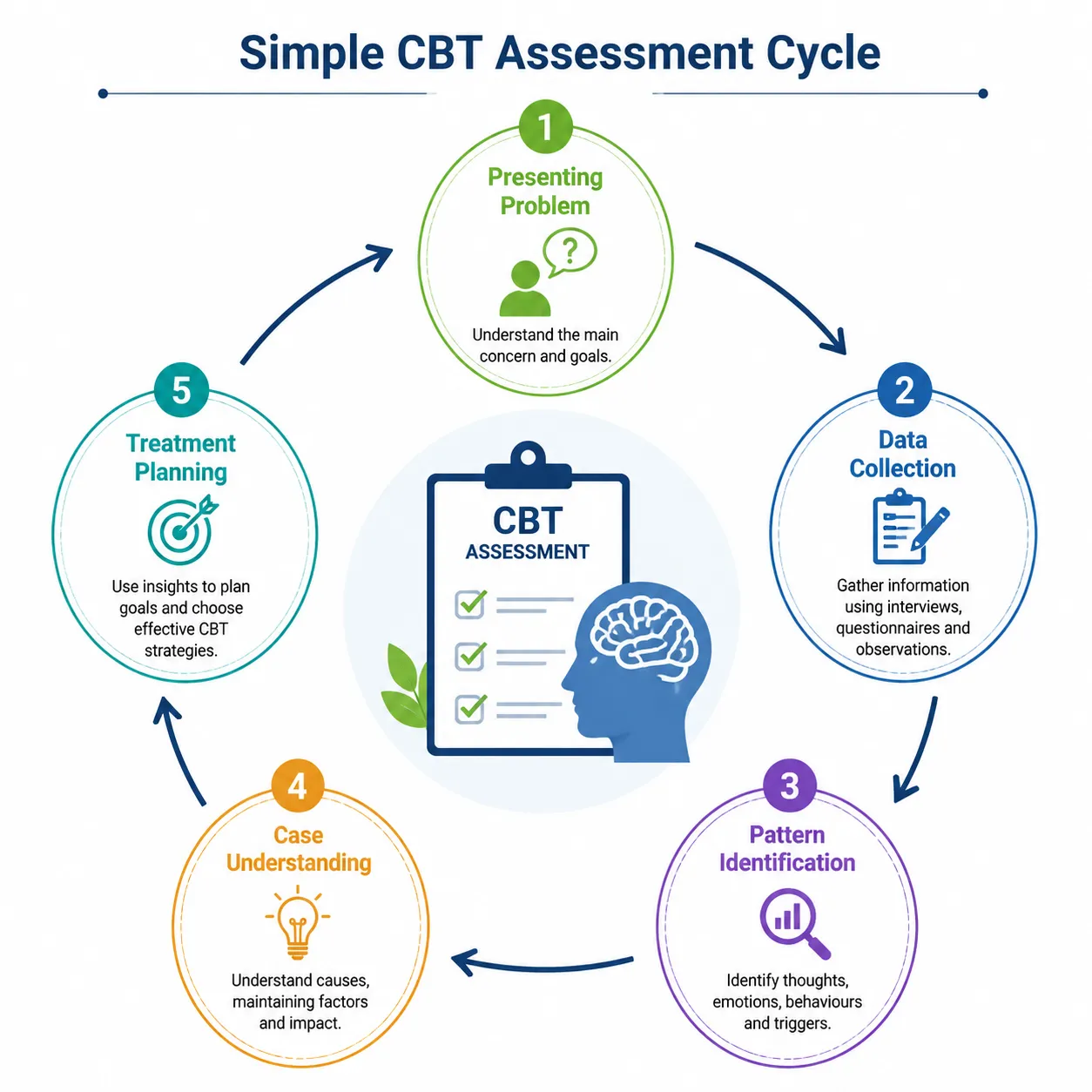
Simple Understanding of CBT Assessment Flow
CBT assessment follows a simple step-by-step process. It helps organize information in a logical way.
CBT Assessment Flow
Presenting Problem
→ Collect Information
→ Identify Patterns
→ Understand Causes
→ Plan Support/Treatment
This flow helps ensure that nothing important is missed during the assessment process.
How Assessment is Used in Real Life
CBT assessment is not only used in therapy rooms. It is also useful in everyday understanding of human behaviour.
For example:
- A student struggling with exams may feel anxious
- Assessment helps identify whether the issue is fear of failure or lack of preparation
- A worker feeling stressed may discover it is due to workload or negative thinking
In both cases, assessment helps clarify the real cause instead of focusing only on surface-level stress.

Case Study: Simple CBT Assessment Example
Situation
A 19-year-old student feels constantly anxious before exams. They say, “I always feel nervous and forget everything during exams.”
Action
A CBT therapist conducts an assessment by asking simple questions about thoughts, feelings, and behaviour. The therapist also uses a basic questionnaire and discusses daily study habits.
During assessment, it is found that:
- The student believes “I will fail no matter how hard I try”
- This thought increases anxiety
- Anxiety leads to avoiding study
Result
The therapist understands that the main issue is negative thinking combined with avoidance behaviour, not lack of ability.
Learning Point
Proper assessment helps identify the real cause of a problem so that support can be more effective and focused.
Key Learning
- Assessment in CBT is used to understand a person’s thoughts, feelings, and behaviour
- It helps identify the main problem clearly and practically
- It explores triggers, causes, and maintaining factors
- It supports treatment planning and case formulation
- It helps track progress during therapy
- It focuses on five main areas: cognition, emotion, behaviour, physiology, and environment
Assessment in CBT is a simple but powerful process that helps understand people’s problems in a clear and structured way. It ensures that therapy is based on real understanding rather than assumptions. By identifying thoughts, emotions, behaviours, and environmental influences, assessment helps create effective support plans that match individual needs.
For beginners, it is important to remember that CBT assessment is not complicated. It is simply about listening carefully, observing patterns, and understanding how different parts of a person’s experience are connected.
1. Methods Used in CBT Assessment
Cognitive Behavioural Therapy (CBT) is a structured and practical approach used in mental health support to help people understand how their thoughts, feelings, and behaviours are connected. Before any treatment begins, CBT practitioners must carry out an assessment.
Assessment simply means gathering information about the client to understand their situation clearly. This step is very important because it helps the therapist decide what kind of support is needed and how best to help the client improve.
In CBT, assessment is not based on guesswork. It uses different methods to collect clear and useful information. These methods help the therapist understand what the client is experiencing in daily life, what triggers their problems, and how those problems affect their thinking and behaviour.
For beginners, it is important to understand that CBT assessment methods are simple tools used to build a full picture of the client’s mental and emotional condition. Each method gives a different type of information, and together they help create a complete understanding.
Purpose of CBT Assessment Methods
CBT assessment methods are used for several basic but important reasons:
- To understand the client’s main problems
- To identify patterns in thoughts and behaviour
- To measure the level of emotional distress
- To ensure client safety and identify risks
- To support planning of treatment
- To track changes over time
These methods are often used together because one method alone cannot give a full understanding of the client.
Common CBT Assessment Methods
CBT practitioners use a range of simple but effective methods. Each method helps collect specific types of information.
1. Clinical Interview
A clinical interview is a structured conversation between the therapist and the client. It is usually the first step in assessment.
During this interview, the therapist asks questions about:
- The client’s current problems
- Emotional feelings such as sadness, fear, or stress
- Behaviour patterns in daily life
- Family, work, and social background
This method helps the therapist build trust and understand the client in their own words.
2. Questionnaires
Questionnaires are simple forms that include questions about feelings, thoughts, and behaviours. Clients answer by selecting options or rating their experiences.
These tools help measure:
- Level of anxiety
- Level of depression
- Stress intensity
- Frequency of symptoms
They are useful because they provide clear and measurable results.
3. Behavioural Observation
Behavioural observation means watching how the client behaves during the session or in real-life situations.
The therapist may observe:
- Body language
- Eye contact
- Emotional reactions
- Avoidance behaviour
This method helps identify patterns that the client may not directly report.
4. Thought Records
Thought records are tools used to write down automatic thoughts that appear in daily situations.
Clients are encouraged to record:
- What situation happened
- What thoughts came to mind
- What emotions were felt
- What behaviour followed
This helps identify negative thinking patterns.
5. Self-Monitoring Diaries
In self-monitoring, the client keeps a daily diary of thoughts, feelings, and actions.
This method helps:
- Increase self-awareness
- Identify triggers
- Understand behaviour patterns
It is very useful for understanding what happens outside therapy sessions.
6. Risk Assessment Tools
Risk assessment tools are used to check if the client is at risk of harm, such as self-harm or suicide.
The therapist carefully checks:
- Level of distress
- Safety concerns
- Urgent mental health risks
This method is very important for protecting client safety.
Table: CBT Assessment Methods Overview
| Method | What It Is | Purpose |
|---|---|---|
| Clinical Interview | Conversation between therapist and client | Understand overall problem |
| Questionnaires | Simple rating forms | Measure symptoms |
| Behavioural Observation | Watching behaviour | Identify patterns |
| Thought Records | Writing down thoughts | Find negative thinking |
| Self-Monitoring Diaries | Daily tracking by client | Build self-awareness |
| Risk Assessment Tools | Safety evaluation forms | Ensure client safety |
How CBT Assessment Methods Work Together
In real practice, CBT methods are not used separately. They are combined to get a complete picture of the client.
For example:
- The interview gives general information
- Questionnaires give measurable scores
- Observation shows real behaviour
- Diaries show daily life patterns
- Thought records show thinking styles
- Risk tools ensure safety
When all this information is combined, the therapist can understand the client more clearly.
Process Flow of CBT Assessment Methods
CBT assessment follows a simple step-by-step process:
Client Referral
→ Clinical Interview
→ Standardised Questionnaires
→ Behavioural Observation
→ Cognitive Analysis (Thought Records + Diaries)
→ Data Integration (Combining all information)
This process helps ensure that no important detail is missed.
Comparison of CBT Assessment Methods
Different methods have different strengths and limitations. Understanding this helps learners see why multiple tools are used.
| Method | Strengths | Limitations |
|---|---|---|
| Clinical Interview | Flexible, allows discussion | May depend on client honesty |
| Questionnaires | Easy to score and compare | May not show full detail |
| Behavioural Observation | Shows real behaviour | Time-limited view |
| Self-Reports (Diaries) | Personal insight | May be incomplete or inaccurate |
This comparison shows that no single method is perfect. That is why CBT uses a combination approach.
Real-Life Example
A client visits a CBT therapist because they feel very anxious in social situations.
The therapist uses different assessment methods:
- Conducts a clinical interview to understand the problem
- Gives a questionnaire to measure anxiety level
- Observes the client’s nervous behaviour during conversation
- Asks the client to keep a thought diary for one week
From this combined information, the therapist understands that the client often thinks “people will judge me,” which increases anxiety.
This simple example shows how different methods work together in real CBT practice.
Case Study
Situation:
A young office worker feels stressed and avoids speaking in meetings.
Action:
The therapist uses a clinical interview, anxiety questionnaire, behavioural observation, and self-monitoring diary.
Result:
The assessment shows that the client fears making mistakes in front of colleagues, which leads to avoidance behaviour.
Learning Point:
Using multiple CBT assessment methods helps identify both thoughts and behaviours behind the problem, not just the surface symptoms.
Key Takeaways
- CBT assessment uses different methods to understand the client
- No single method is enough on its own
- Clinical interviews help gather basic information
- Questionnaires measure symptoms clearly
- Behaviour observation shows real actions
- Thought records and diaries help identify thinking patterns
- Risk tools ensure client safety
- All methods are combined for a complete understanding
CBT assessment methods are simple but powerful tools used to understand a client’s thoughts, feelings, and behaviours. Each method provides a different piece of information, and together they help build a full picture of the client’s condition.
By using interviews, questionnaires, observation, and self-monitoring tools, CBT practitioners can better understand problems and provide the right support. This structured approach ensures that clients receive safe, effective, and personalised care.
Understanding these methods is an important first step for anyone learning CBT, as it builds the foundation for future skills in case formulation and therapy planning.
3. Gathering and Recording Assessment Information (CBT)
In Cognitive Behavioural Therapy (CBT), gathering and recording assessment information is a very important step before any treatment begins. This process helps the therapist understand the client’s thoughts, feelings, behaviours, and life situation in a clear and organised way.
CBT is based on evidence and structure, so decisions are not made based on guesswork. Instead, therapists collect real information from different sources and record it carefully. This ensures that the support given to the client is accurate, safe, and helpful.
For beginners, it is important to understand that this process is like building a full picture of a person’s mental and emotional condition. Each piece of information adds to understanding the overall situation.
Without proper gathering and recording of information, therapy may become unclear or ineffective. That is why CBT places strong importance on structured documentation and careful assessment.
Why Gathering and Recording Information is Important
In CBT practice, this step is essential for several simple reasons:
- It helps understand the client’s real problems clearly
- It ensures accurate treatment planning
- It allows progress to be tracked over time
- It supports professional and ethical practice
- It improves communication between healthcare professionals
- It ensures client safety and risk management
This process is not done once only. It continues throughout therapy sessions so that changes in the client’s condition can be monitored.
How Information is Gathered in CBT
CBT practitioners use different simple and practical methods to collect information. Each method provides useful details about the client’s situation.
1. Direct Client Interviews
The most common way to gather information is through a direct conversation between the therapist and the client.
During the interview, the therapist may ask about:
- Current emotional problems
- Daily life challenges
- Thoughts and worries
- Behaviour patterns
- Sleep, work, and social life
This method helps the therapist understand the client’s experience in their own words.
2. Standardised Psychological Assessments
These are simple structured forms or questionnaires that help measure emotional states like anxiety, stress, or depression.
They are used to:
- Understand severity of symptoms
- Compare changes over time
- Provide clear numerical results
For example, a client may rate how often they feel worried on a scale from 1 to 10.
3. Session Observations
During therapy sessions, the therapist also observes the client’s behaviour.
This may include:
- Body language
- Facial expressions
- Speech patterns
- Emotional reactions
Observation helps identify feelings or behaviours that the client may not directly explain.
4. Client Self-Report Tools
Clients are often asked to describe their own experiences using simple tools such as:
- Thought diaries
- Mood charts
- Daily logs
These tools help clients become more aware of their thoughts and emotions in daily life.
5. Historical and Background Information
Understanding a client’s past is also important. This includes:
- Family background
- Work history
- Education
- Previous mental health issues
- Life events or stress situations
This information helps the therapist understand possible causes of current problems.
6. Collateral Information
Sometimes, additional information is collected from other sources such as:
- Family members
- Medical records
- Previous healthcare providers
This is only done when necessary and with proper permission. It helps give a more complete understanding of the client’s situation.
Table: How CBT Information is Gathered
| Method | What It Means | Purpose |
|---|---|---|
| Client Interview | Talking with the client | Understand main concerns |
| Questionnaires | Simple rating forms | Measure symptoms |
| Observation | Watching behaviour | Identify patterns |
| Self-Reports | Diaries and logs | Increase self-awareness |
| Background History | Past information | Understand causes |
| Collateral Information | Family or medical data | Complete understanding |
How Information is Recorded in CBT
After information is collected, it must be recorded properly. Recording means writing or storing the information in a structured way so it can be used later for treatment planning and review.
CBT uses different recording methods to ensure information is clear, organised, and easy to follow.
1. Clinical Notes
Clinical notes are written summaries of each therapy session.
They usually include:
- What the client discussed
- Observations made by the therapist
- Key problems identified
- Next steps planned
These notes help keep a clear record of progress.
2. Structured Forms
CBT uses standard forms that guide therapists in recording information.
These forms help ensure:
- Consistency in documentation
- No important information is missed
- Easy comparison between sessions
3. Digital Records
Many therapy services now use electronic systems to store client information.
These systems:
- Keep records safe and organised
- Allow easy access for authorised professionals
- Support long-term tracking of progress
4. Case Formulation Sheets
These sheets are used to organise all information into a clear CBT structure.
They show:
- Thoughts
- Feelings
- Behaviours
- Triggers
- Maintaining factors
This helps the therapist understand how the client’s problems are connected.
5. Progress Charts
Progress charts are used to track changes in symptoms over time.
They may show:
- Anxiety levels decreasing or increasing
- Mood changes
- Behaviour improvement
This helps measure whether therapy is working.
Hierarchy Chart: CBT Information Flow
Client Information
→ Data Collection Methods
→ Clinical Documentation
→ Case Formulation
→ Treatment Plan
This shows how raw information becomes a structured plan for therapy.
Process Flow: Assessment Recording Cycle
Collect Data
→ Organise Information
→ Document Findings
→ Review Progress
→ Update Case Formulation
This cycle continues throughout therapy sessions and helps ensure ongoing improvement.
Real-Life Example
A client visits a CBT therapist because they are experiencing anxiety at work.
The therapist gathers information by:
- Conducting a direct interview
- Using a simple anxiety questionnaire
- Asking the client to keep a thought diary
- Observing nervous behaviour during sessions
- Reviewing basic background information
All this information is then recorded in clinical notes and a digital system. This helps the therapist understand the full situation and plan suitable support.
Case Study
Situation
A 28-year-old client experiences anxiety, sleep problems, and avoids social situations.
Action
The CBT therapist gathers information using:
- Clinical interviews
- Standard questionnaires
- Thought records
The client initially struggles to explain thoughts clearly and often downplays symptoms.
To improve understanding, the therapist introduces:
- Structured questioning
- Self-monitoring diaries
Result
The therapist gathers clearer information about the client’s thinking patterns and daily behaviour. This allows a more accurate understanding of the problem.
Learning Point
Using multiple methods to gather and record information helps create a complete and accurate picture of the client’s condition.
Key Takeaways
- Gathering information is the first step in CBT assessment
- Information comes from interviews, questionnaires, observation, and reports
- Recording ensures all information is organised and useful
- Clinical notes, digital systems, and progress charts are commonly used
- CBT assessment is an ongoing process, not a one-time activity
- Accurate documentation improves treatment quality and safety
Gathering and recording assessment information is a core part of CBT practice. It helps therapists understand clients in a structured and clear way. By using interviews, questionnaires, observation, and self-reports, therapists collect important details about thoughts, emotions, and behaviour.
Once collected, this information is carefully recorded using clinical notes, digital systems, and structured tools. This ensures that therapy is organised, professional, and effective.
For beginners, understanding this process is important because it shows how CBT builds a complete picture of a person’s difficulties before treatment begins.
Conclusion
CBT assessment is a structured and essential process that provides the foundation for effective therapeutic practice. It allows practitioners to gather clear and relevant information about a client’s thoughts, emotions, behaviours, and life circumstances using different assessment methods such as interviews, questionnaires, and observations.
By combining multiple assessment tools and maintaining accurate records, CBT practitioners can develop a complete understanding of client needs. This supports more targeted, ethical, and evidence-based interventions, ensuring that therapy is both effective and aligned with the client’s individual situation.