
Lesson 1: Formulate a Research Question Relevant to Electrical QA/QC
Electrical Quality Assurance and Quality Control (QA/QC) research plays a critical role in improving the safety, reliability, efficiency, and overall performance of modern electrical projects. This lesson introduces learners to the importance of developing a clear, focused, and professionally relevant research question that addresses real challenges within electrical QA/QC practices. A well-designed research question establishes the foundation of a successful research project by defining the area of investigation, identifying specific quality-related issues, and guiding the collection and analysis of meaningful evidence. In the electrical engineering sector, effective research questions support the investigation of key areas such as quality management systems, inspection and testing procedures, electrical safety performance, compliance requirements, sustainability objectives, emerging technologies, and continual improvement strategies.
Formulating a relevant research question requires advanced understanding of electrical QA/QC principles, industry practices, project challenges, and opportunities for innovation. This lesson explores how learners can identify research problems, recognise knowledge gaps, analyse existing quality practices, and convert professional observations into structured research opportunities. Learners will develop the ability to create research questions that are clear, achievable, measurable, and aligned with electrical engineering quality objectives. The process involves considering the significance of the research topic, defining the intended outcomes, evaluating available resources, and ensuring that the research contributes practical value to electrical QA/QC decision-making.
A strong research question enables electrical QA/QC professionals to critically examine complex issues affecting project performance, including quality failures, inspection effectiveness, testing reliability, risk management approaches, sustainable electrical installations, digital quality tools, and improvements in construction and operational processes. By developing effective research questions, learners enhance their analytical thinking, problem-solving abilities, and evidence-based decision-making skills. This lesson supports the development of professional research capability by connecting academic investigation with real-world electrical QA/QC applications, enabling learners to produce valuable insights and recommendations that contribute to safer, more efficient, and higher-quality electrical engineering outcomes.
1. Critically Evaluate Current Industry Trends to Identify Potential Areas for Advanced QA/QC Research
The electrical engineering sector is experiencing rapid transformation due to technological advancement, increasing sustainability expectations, complex infrastructure requirements, and the growing demand for reliable and efficient electrical systems. These changes are significantly influencing the way Quality Assurance and Quality Control (QA/QC) processes are designed, implemented, monitored, and improved. For advanced electrical QA/QC professionals, understanding current industry trends is essential for identifying research opportunities that can address emerging challenges, improve project outcomes, and support continual improvement within electrical installations and operations.
Advanced QA/QC research is no longer limited to traditional inspection activities, material verification, and compliance checking. Modern electrical projects require a deeper investigation into areas such as digital quality management, artificial intelligence, automation, predictive maintenance, sustainable electrical systems, renewable energy integration, data-driven decision-making, advanced testing methods, and risk-based quality strategies. These developments create new research opportunities where existing QA/QC practices can be critically evaluated and improved to meet the demands of modern electrical engineering environments.
A research question relevant to electrical QA/QC should be developed from a clear understanding of current industry challenges and future requirements. By critically evaluating industry trends, researchers can identify gaps between current practices and desired performance levels. These gaps provide opportunities to investigate weaknesses in quality processes, explore innovative solutions, evaluate technology adoption, and develop strategies that enhance electrical safety, reliability, efficiency, and sustainability.
Understanding the Importance of Industry Trend Analysis in Electrical QA/QC Research
Industry trend analysis is the systematic evaluation of current developments, challenges, technologies, regulations, and operational changes affecting a specific professional field. In electrical QA/QC, trend analysis helps researchers understand how the industry is evolving and where improvements are required.
A well-conducted trend analysis allows professionals to identify:
Emerging technical challenges
Limitations in existing QA/QC practices
Opportunities for technological improvement
Changing client expectations
New regulatory requirements
Sustainability pressures
Areas requiring further investigation
Research based on current industry trends has greater practical value because it addresses real problems faced by electrical engineering organisations.
For example, traditional QA/QC methods often rely heavily on manual inspections and documentation. However, modern projects increasingly require real-time monitoring, digital records, automated inspections, and predictive analysis. This transition creates research opportunities to evaluate whether digital QA/QC systems can improve defect detection, reduce human error, and increase project efficiency.
Key Concepts Related to Advanced QA/QC Research
| Concept | Definition | Importance in Electrical QA/QC Research |
|---|---|---|
| Industry trend analysis | The process of evaluating current developments and future directions within an industry | Helps identify relevant research opportunities |
| Research gap | An area where existing knowledge, methods, or solutions are insufficient | Provides a foundation for new investigations |
| Digital QA/QC | Use of digital technologies to manage quality processes and information | Improves monitoring, reporting and decision-making |
| Predictive quality management | Using data analysis to identify potential quality issues before failure occurs | Supports proactive defect prevention |
| Sustainable QA/QC | Quality management that integrates environmental, technical and economic considerations | Supports sustainable electrical projects |
| Automation in inspection | Use of automated tools and technologies for quality verification | Reduces inspection errors and improves efficiency |
| Data-driven decision-making | Using collected information and analysis to support professional decisions | Improves accuracy and reliability of QA/QC decisions |
| Emerging technology adoption | Integration of new technical solutions into existing processes | Creates opportunities for innovation research |
| Quality performance indicators | Measurable factors used to evaluate quality effectiveness | Supports objective research evaluation |
| Continual improvement | Ongoing enhancement of processes, systems and outcomes | Enables long-term QA/QC development |
Current Industry Trends Influencing Electrical QA/QC Research
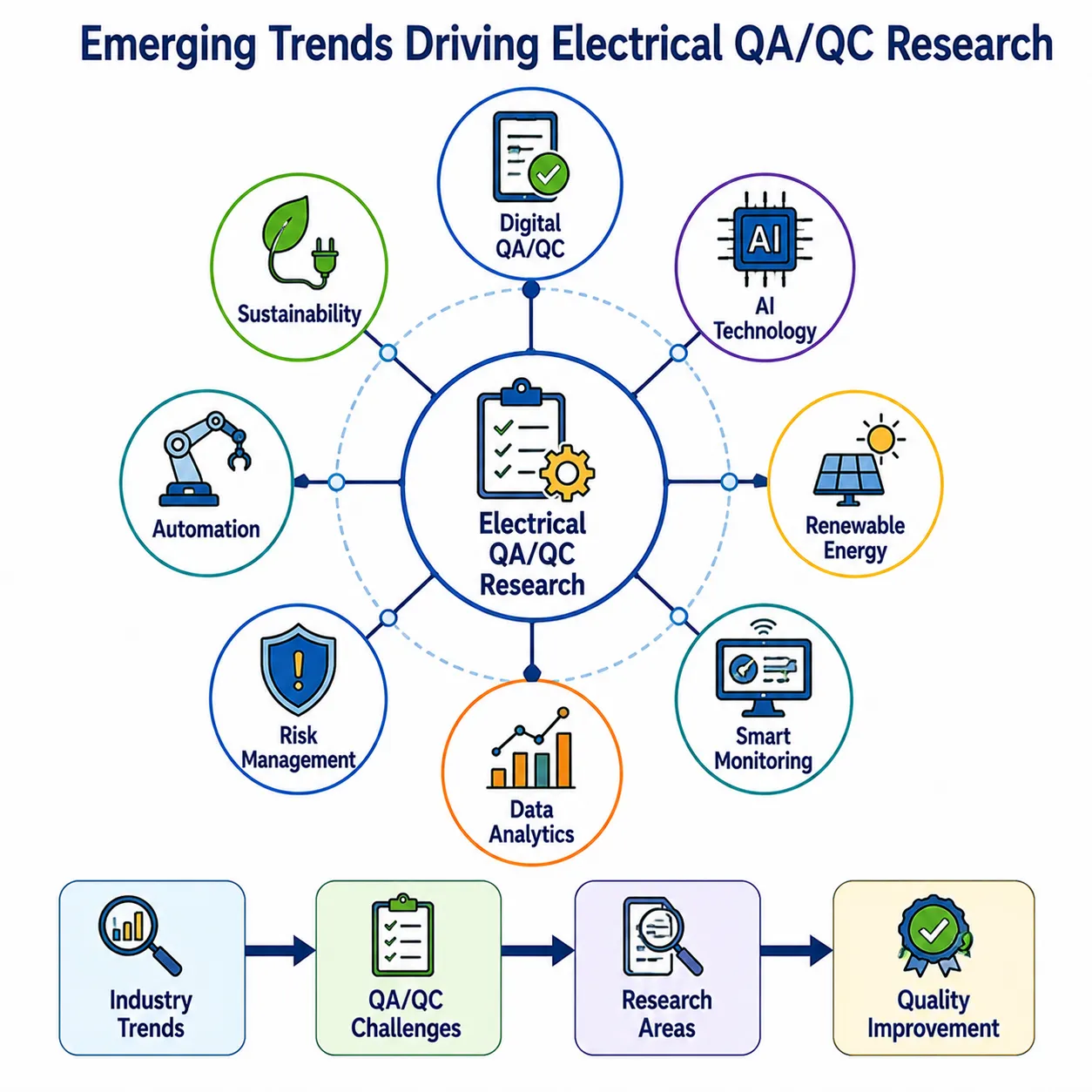
Digital Transformation of Quality Management Systems
One of the most significant trends affecting electrical QA/QC is the transition from traditional paper-based quality systems to digital quality management platforms. Electrical projects generate large volumes of information, including inspection reports, test results, commissioning records, material approvals, non-conformance reports, and compliance documentation.
Digital transformation enables organisations to:
Store quality records electronically
Access project information in real time
Improve communication between stakeholders
Track quality issues more effectively
Reduce documentation errors
Improve audit readiness
Support data analysis
However, digital QA/QC adoption also creates research opportunities.
Potential research areas include:
Effectiveness of digital inspection systems compared with traditional methods
Impact of electronic documentation on quality performance
Barriers to digital QA/QC implementation
Data security challenges in quality management systems
Integration of digital tools with existing project workflows
A researcher may investigate whether digital quality platforms improve defect identification rates or reduce project delays caused by documentation problems.
Artificial Intelligence and Machine Learning in QA/QC
Artificial Intelligence (AI) and Machine Learning (ML) are becoming increasingly important in engineering quality management. These technologies can analyse large amounts of project data to identify patterns, predict failures, and support decision-making.
In electrical QA/QC environments, AI applications may include:
Automated defect detection
Predictive equipment failure analysis
Quality risk prediction
Automated document review
Inspection data analysis
Performance forecasting
The introduction of AI creates several research opportunities.
Potential research questions may examine:
How accurately can AI predict electrical equipment failures?
Can machine learning improve inspection planning?
What are the limitations of AI-based quality decisions?
How can AI support human engineering judgement?
Although AI provides significant potential benefits, research is needed to evaluate reliability, accuracy, ethical considerations, and practical implementation challenges.
Increasing Focus on Sustainable Electrical Projects
Sustainability has become a major influence on electrical engineering projects. Organisations are increasingly required to reduce energy consumption, minimise environmental impact, improve efficiency, and demonstrate responsible resource management.
This trend directly affects QA/QC practices because sustainability objectives must be verified through quality processes.
Research opportunities include:
Effectiveness of sustainability-focused QA/QC procedures
Methods for verifying energy performance after commissioning
Quality risks associated with renewable energy systems
Sustainable material selection and quality performance
Relationship between installation quality and energy efficiency
For example, poor installation practices in renewable energy systems can reduce expected performance. Research can investigate how improved QA/QC processes influence the operational efficiency of sustainable electrical installations.
Renewable Energy Integration and Quality Challenges
The rapid growth of renewable energy systems has introduced new challenges for electrical quality management.
Projects involving:
Solar photovoltaic systems
Battery energy storage
Hybrid electrical systems
Smart grids
Distributed generation
require advanced QA/QC approaches.
Traditional quality methods may not fully address the complexity of these systems.
Research areas may include:
Quality control challenges in renewable energy installations
Testing methods for energy storage systems
Performance verification of renewable technologies
Reliability assessment of distributed electrical systems
Integration challenges between renewable sources and existing networks
A research project could examine how QA/QC practices should evolve to ensure renewable electrical systems achieve their expected performance.
Advanced Testing and Commissioning Methods
Testing and commissioning remain fundamental components of electrical QA/QC. However, modern systems require more advanced verification methods due to increasing complexity.
Current trends include:
Automated testing equipment
Real-time monitoring
Digital commissioning records
Remote testing capabilities
Advanced diagnostic techniques
Potential research topics include:
Effectiveness of automated testing compared with manual testing
Reliability of digital commissioning processes
Methods for improving fault detection
Relationship between commissioning quality and long-term asset performance
Research in this area can help organisations improve system reliability and reduce operational failures.
Internet of Things (IoT) and Smart Monitoring Systems
IoT technology allows electrical assets to be continuously monitored through connected sensors and intelligent devices.
Applications include:
Equipment condition monitoring
Temperature monitoring
Energy monitoring
Performance tracking
Fault detection
IoT creates opportunities for proactive QA/QC approaches.
Potential research areas include:
Effectiveness of IoT-based quality monitoring
Cost-benefit analysis of smart monitoring systems
Data reliability issues
Cybersecurity risks
Integration challenges
A researcher may investigate whether IoT monitoring reduces unexpected electrical failures compared with traditional inspection schedules.
Risk-Based Quality Management Approaches
Modern electrical projects are becoming more complex, requiring organisations to move from routine inspection approaches towards risk-based QA/QC management.
Risk-based approaches focus resources on areas with the highest potential consequences.
Research opportunities include:
Effectiveness of risk-based inspection planning
Comparison between traditional and risk-based QA/QC methods
Quality risk prediction models
Relationship between risk management and project performance
This approach is particularly valuable for large infrastructure projects where complete inspection of every activity may not be practical.
Data Analytics and Quality Performance Measurement
Electrical projects generate significant amounts of quality data.
Examples include:
Inspection results
Testing records
Defect information
Non-conformance reports
Commissioning results
Maintenance records
Data analytics allows organisations to identify trends and improve decision-making.
Potential research areas include:
Use of data analytics for defect reduction
Quality performance prediction models
Identification of recurring quality failures
Relationship between quality data and project outcomes
Effective use of quality data can transform QA/QC from a reactive process into a proactive improvement system.
Cybersecurity Considerations in Electrical QA/QC
As electrical systems become more connected, cybersecurity has become an important quality consideration.
Smart electrical systems, digital monitoring platforms, and connected devices introduce new risks.
Research opportunities include:
Cybersecurity requirements for smart electrical systems
Impact of cyber risks on quality management
Integration of cybersecurity into QA/QC procedures
Protection of digital quality records
Electrical QA/QC research increasingly needs to consider both physical system performance and digital system security.
Identifying Research Opportunities from Industry Trends
The process of identifying a suitable QA/QC research area involves several stages.
Stage 1: Monitor Industry Developments
Researchers should review:
Emerging technologies
Industry publications
Engineering reports
Professional standards
Project challenges
Market developments
This helps identify important areas requiring investigation.
Stage 2: Identify Existing Challenges
Researchers should examine:
Common project failures
Quality issues
Operational problems
Technology limitations
Process weaknesses
These challenges often provide strong research opportunities.
Stage 3: Evaluate Research Significance
A potential research topic should be assessed according to:
Industry relevance
Practical value
Availability of information
Potential improvement impact
Feasibility
A strong research topic should solve a meaningful problem.
Stage 4: Identify Knowledge Gaps
Researchers should ask:
What is currently unknown?
What methods are ineffective?
What improvements are required?
What evidence is missing?
Knowledge gaps form the basis of valuable research questions.
Stage 5: Develop a Focused Research Question
A research question should be:
Clear
Specific
Researchable
Relevant
Achievable
Evidence-based
For example:
Weak question:
“How can technology improve QA/QC?”
Strong question:
“How can digital inspection platforms improve defect detection efficiency in large-scale electrical installation projects?”
Examples of Potential Advanced QA/QC Research Areas
Digital Quality Management
Possible research questions:
How effective are digital QA/QC platforms in reducing documentation errors?
What barriers affect digital quality system adoption?
Renewable Energy Quality Control
Possible research questions:
How can QA/QC procedures improve the reliability of solar PV installations?
What quality risks affect battery energy storage systems?
Artificial Intelligence Applications
Possible research questions:
Can AI-based inspection improve defect identification accuracy?
How can AI support electrical maintenance prediction?
Sustainable Electrical Projects
Possible research questions:
How does installation quality influence energy efficiency performance?
What QA/QC strategies support sustainable electrical infrastructure?
Advanced Testing Methods
Possible research questions:
How effective are automated testing technologies in improving commissioning outcomes?
What factors influence electrical system testing reliability?
Practical Example: Research Opportunity Identification
Project Background
A large commercial building project has experienced repeated electrical quality issues, including:
Incorrect installation records
Delayed inspections
Testing documentation errors
Repeated non-conformities
The organisation currently uses manual quality documentation.
Industry Trend Analysis
Current industry trends indicate increased adoption of:
Digital quality platforms
Mobile inspection tools
Real-time reporting systems
Research Opportunity
A potential research question could be:
“How can digital QA/QC management systems improve inspection efficiency and reduce documentation-related quality failures in commercial electrical projects?”
Research Value
The research could help determine:
Whether digital tools improve quality performance
Whether implementation costs are justified
What challenges affect adoption
How digital systems can support continual improvement
Case Study: Identifying a Research Topic Through Industry Analysis
Background
An electrical engineering company delivering renewable energy projects noticed inconsistent performance between installed solar systems and predicted energy output.
Although equipment specifications were correct, several projects experienced reduced operational efficiency.
Initial Investigation
The QA/QC team identified possible causes:
Installation variations
Inadequate testing procedures
Incorrect commissioning methods
Monitoring limitations
Industry Trend Review
The organisation reviewed current trends:
Increased renewable energy adoption
Advanced monitoring technologies
Digital commissioning
Data-driven performance analysis
Research Opportunity
The identified research topic became:
“Evaluating the effectiveness of advanced QA/QC monitoring methods in improving solar PV system performance.”
Potential Research Benefits
The research could:
Improve commissioning procedures
Reduce performance gaps
Enhance quality verification
Support sustainable energy objectives
Improve future project delivery
Benefits of Trend-Based QA/QC Research
Improved industry relevance
Research addresses current professional challenges rather than outdated issues.
Better innovation opportunities
Emerging technologies provide opportunities for improved quality processes.
Enhanced decision-making
Research findings support evidence-based professional decisions.
Improved project performance
Research can identify methods to reduce defects, delays and failures.
Stronger sustainability outcomes
Research supports more efficient and environmentally responsible electrical systems.
Professional development
Advanced research skills improve technical capability and career progression.
Challenges in Identifying QA/QC Research Areas
Researchers may face challenges including:
Rapid technology changes
Limited access to project data
Difficulty measuring long-term outcomes
Resistance to new methods
Lack of standardised approaches
Complexity of electrical systems
These challenges should be considered when selecting a research topic.
Conclusion
Critically evaluating current industry trends is a fundamental step in identifying valuable research opportunities within electrical QA/QC. The rapid development of digital technologies, renewable energy systems, artificial intelligence, automation, sustainability requirements, advanced testing methods, and data-driven quality management has created significant opportunities for improving electrical project performance. However, these developments also introduce new technical, operational, and quality challenges that require systematic investigation through professional research.
A successful QA/QC research project should begin with a clear understanding of industry needs, existing limitations, and future challenges. By analysing emerging trends and identifying knowledge gaps, researchers can formulate meaningful research questions that contribute practical solutions to electrical engineering environments. Trend-based research enables professionals to improve quality processes, enhance electrical safety, optimise project performance, and support sustainable development. Through structured investigation and evidence-based analysis, advanced QA/QC research can help organisations develop more reliable, efficient, and future-ready electrical systems.
2. Formulate a Clear, Complex Research Question That Addresses a Significant Problem in Electrical Quality Management
Developing a strong research question is one of the most important stages of an advanced electrical Quality Assurance and Quality Control (QA/QC) research project. A well-defined research question provides direction, establishes the purpose of the investigation, and determines the type of evidence required to develop meaningful findings. In electrical quality management, research questions must address significant professional challenges related to system reliability, installation quality, inspection effectiveness, testing procedures, compliance performance, sustainability requirements, emerging technologies, and continual improvement.
Modern electrical projects are becoming increasingly complex due to the integration of renewable energy systems, intelligent monitoring technologies, digital quality platforms, advanced automation, and stricter performance expectations. These developments have created new quality management challenges that cannot always be solved through traditional inspection and testing approaches. Therefore, advanced QA/QC research requires professionals to formulate complex research questions that investigate real industry problems and generate practical solutions.
A high-quality research question should not simply describe a general area of interest. It should investigate a specific problem, explore relationships between different factors, evaluate existing practices, and provide opportunities for improvement. For example, a question such as “How can electrical quality be improved?” is too broad because it does not identify the specific quality issue, technology, process, or measurable outcome. A stronger research question would examine how a particular QA/QC strategy, technology, or management approach influences a defined electrical quality challenge.
In professional electrical environments, research questions should connect academic investigation with practical project requirements. They should help organisations understand why quality failures occur, how current processes perform, what improvements are possible, and how future electrical projects can achieve better safety, reliability, sustainability, and operational performance.
Understanding the Role of a Research Question in Electrical Quality Management
A research question acts as the foundation of an investigation by defining what the researcher intends to understand, analyse, or improve. In electrical QA/QC research, it provides a structured pathway for examining complex quality-related issues.
A well-developed research question helps researchers to:
- Define the main problem requiring investigation
- Establish clear research objectives
- Identify suitable data collection methods
- Determine relevant technical information
- Analyse current practices
- Evaluate improvement opportunities
- Develop evidence-based recommendations
Electrical quality management involves multiple interconnected factors, including:
- Design quality
- Material selection
- Installation practices
- Inspection processes
- Testing procedures
- Commissioning activities
- Documentation control
- Compliance requirements
- Operational performance
- Maintenance effectiveness
Because these areas interact with each other, research questions must often consider multiple variables rather than focusing on a single issue.
For example, poor electrical system performance may not result from equipment failure alone. It may involve:
- Incorrect installation methods
- Inadequate testing procedures
- Weak inspection controls
- Poor documentation
- Lack of competent supervision
- Ineffective quality management systems
A complex research question should therefore investigate relationships between these factors.
Key Concepts and Definitions Related to Research Question Development
| Concept | Definition | Importance in Electrical QA/QC Research |
|---|---|---|
| Research question | A clearly defined statement identifying the issue or problem to be investigated | Provides direction and focus for the research project |
| Research problem | A specific challenge, weakness, or knowledge gap requiring investigation | Forms the basis for developing a meaningful research question |
| Research objective | A defined purpose describing what the research aims to achieve | Helps measure research progress and outcomes |
| Quality management | The coordinated activities used to control and improve quality performance | Provides the framework for QA/QC investigations |
| Quality assurance | Planned activities that prevent defects and ensure processes meet requirements | Helps investigate preventive quality strategies |
| Quality control | Inspection, testing, and verification activities used to identify defects | Supports research into quality performance |
| Research scope | The boundaries defining what the investigation will include or exclude | Prevents the research becoming unrealistic |
| Research variable | A factor or condition that can influence research outcomes | Helps analyse relationships between different quality factors |
| Knowledge gap | An area where existing information or solutions are insufficient | Creates opportunities for original research |
| Evidence-based research | Investigation supported by reliable information and measurable evidence | Improves validity and professional relevance |
Characteristics of an Effective Electrical QA/QC Research Question
A strong research question should demonstrate several important characteristics.
Clear and Specific
The research question should clearly identify:
- The problem being investigated
- The electrical context
- The quality management area
- The expected investigation focus
A vague question creates difficulties during research because the researcher may collect unnecessary information.
Example of a weak research question:
“Are electrical systems improving?”
This question lacks:
- Specific quality area
- Research boundaries
- Performance indicators
- Investigation purpose
Example of a stronger research question:
“How can digital inspection technologies improve defect identification and reporting efficiency in large-scale electrical installation projects?”
This question identifies:
- Technology focus
- QA/QC process
- Performance improvement area
- Project context
Relevant to Industry Challenges
An effective research question should address a genuine professional problem.
Relevant electrical QA/QC problems may include:
- High defect rates during installation
- Repeated non-conformities
- Inefficient inspection procedures
- Poor commissioning outcomes
- Delayed quality approvals
- Weak documentation control
- Sustainability performance failures
- Ineffective monitoring systems
Research becomes more valuable when it addresses issues experienced by electrical engineering organisations.
Complex Enough for Advanced Investigation
At Level 6 diploma standard, research questions should demonstrate critical thinking rather than simple information gathering.
A complex research question may investigate:
- Causes of quality failures
- Effectiveness of improvement strategies
- Relationships between technology and performance
- Barriers affecting implementation
- Long-term impacts of quality decisions
Example:
“How does the implementation of digital QA/QC management systems influence defect reduction, documentation accuracy, and project delivery performance in electrical construction projects?”
This requires analysis of multiple factors rather than a simple yes/no response.
Researchable Through Evidence
A research question must allow the collection and analysis of relevant evidence.
Possible evidence sources include:
- Project quality records
- Inspection reports
- Testing results
- Industry surveys
- Technical documents
- Interviews with professionals
- Performance data
- Case studies
A question that cannot be supported by available evidence may not produce reliable conclusions.
Aligned With Electrical Quality Objectives
The research question should contribute to improved:
- Electrical safety
- System reliability
- Installation quality
- Compliance performance
- Operational efficiency
- Sustainability outcomes
Identifying Significant Problems in Electrical Quality Management
Before formulating a research question, researchers must identify a significant quality management problem.
A significant problem is one that:
- Affects project performance
- Creates safety concerns
- Causes financial impact
- Reduces system reliability
- Limits sustainability performance
- Requires improvement
Common Electrical QA/QC Research Problem Areas
Defective Installation Practices
Electrical installation defects can lead to:
- System failures
- Safety risks
- Additional costs
- Project delays
Potential research areas:
- Effectiveness of inspection methods
- Causes of repeated installation defects
- Relationship between supervision and installation quality
Possible research question:
“What factors influence the effectiveness of electrical installation inspections in reducing construction-stage defects?”
Ineffective Testing and Commissioning
Testing and commissioning confirm whether electrical systems operate according to requirements.
Common challenges include:
- Incomplete testing procedures
- Poor documentation
- Incorrect test methods
- Delayed commissioning approval
Potential research question:
“How can advanced commissioning techniques improve electrical system reliability and reduce operational failures?”
Digital Transformation Challenges
Many organisations are adopting digital QA/QC systems, but implementation challenges remain.
Possible issues include:
- Staff resistance
- Training requirements
- Data management problems
- Integration difficulties
Potential research question:
“What barriers affect the adoption of digital QA/QC systems within electrical engineering projects?”
Sustainability Performance Verification
Sustainable electrical systems require effective quality verification.
Research challenges include:
- Measuring energy performance
- Verifying efficiency claims
- Maintaining sustainable operation
Potential research question:
“How can QA/QC processes improve verification of sustainability performance in renewable electrical installations?”
Emerging Technology Integration
New technologies introduce both opportunities and risks.
Examples include:
- Artificial intelligence
- Smart monitoring
- Automated inspection
- Internet of Things systems
Potential research question:
“What factors determine the successful implementation of AI-based quality monitoring in electrical projects?”
Process for Formulating a Complex Research Question
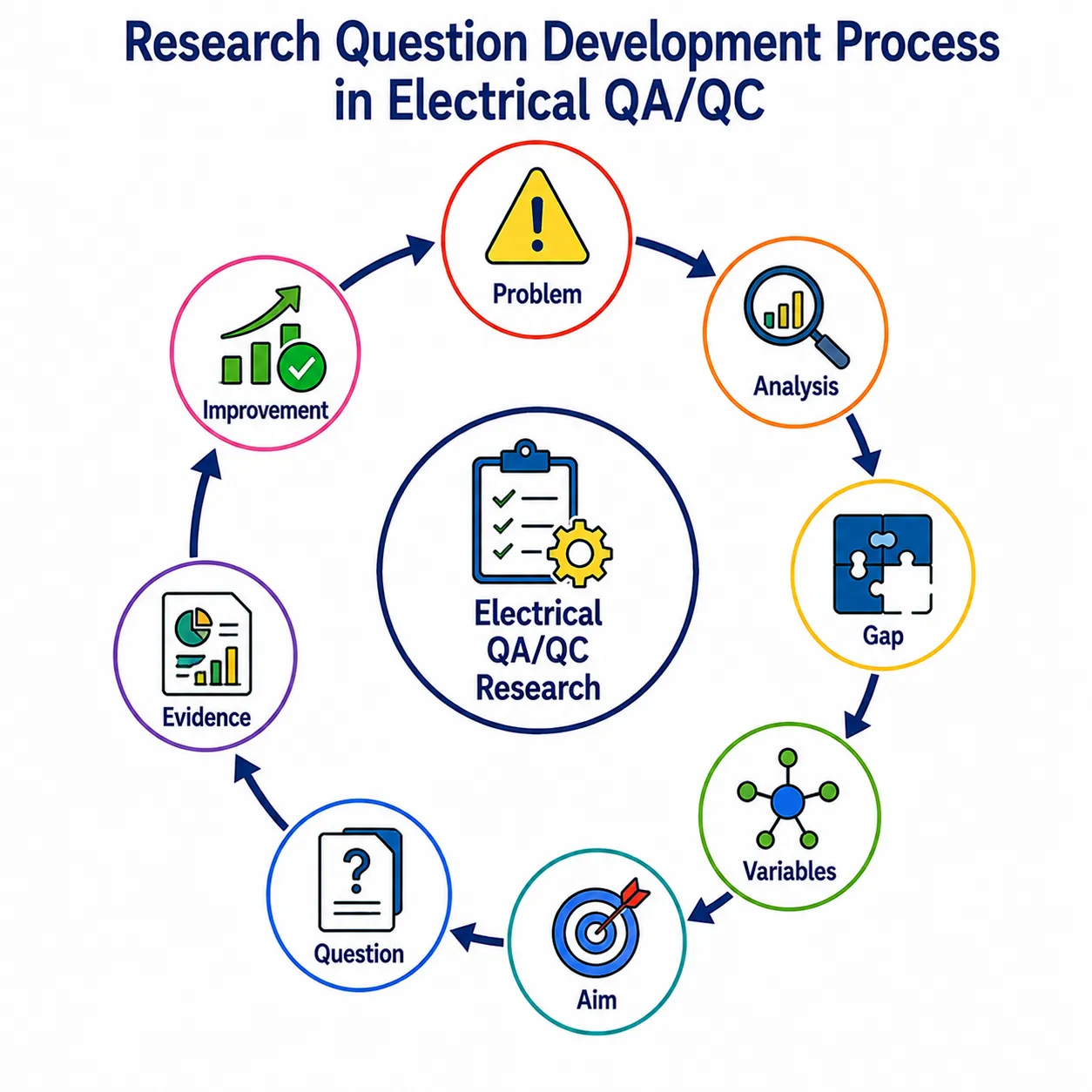
Stage 1: Identify the Research Area
The first step is selecting a broad area of interest.
Examples:
- Electrical testing
- Quality management systems
- Renewable energy QA/QC
- Digital quality tools
- Inspection improvement
The researcher should select an area connected with professional experience and industry relevance.
Stage 2: Identify the Specific Problem
The broad topic should then be narrowed into a specific problem.
Example:
Broad topic:
Digital QA/QC
Specific problem:
Poor adoption of digital inspection systems causing documentation delays.
Stage 3: Analyse Existing Practices
Researchers should evaluate:
- Current procedures
- Existing technologies
- Industry approaches
- Known limitations
This helps identify improvement opportunities.
Stage 4: Identify the Research Gap
A research gap may exist when:
- Current methods are ineffective
- Existing solutions are incomplete
- New technologies require evaluation
- Industry needs additional evidence
Stage 5: Define Research Variables
Variables help structure the investigation.
Example:
Research question:
“How does automated inspection technology influence defect detection in electrical projects?”
Variables:
Independent variable:
Automated inspection technology
Dependent variable:
Defect detection performance
Stage 6: Develop the Research Question
The final question should combine:
- Problem
- Context
- Investigation focus
- Expected outcome
Examples of Strong Electrical QA/QC Research Questions
Example 1: Digital Quality Management
Research question:
“How can digital quality management platforms improve inspection efficiency and reduce documentation errors in large-scale electrical installation projects?”
Research focus:
- Digital systems
- Inspection efficiency
- Documentation accuracy
Example 2: Renewable Energy Quality
Research question:
“What QA/QC strategies are most effective in improving performance verification of commercial solar photovoltaic installations?”
Research focus:
- Renewable energy
- Quality strategies
- Performance verification
Example 3: Artificial Intelligence
Research question:
“How can artificial intelligence support predictive quality management in electrical maintenance operations?”
Research focus:
- AI applications
- Predictive analysis
- Maintenance quality
Example 4: Testing and Commissioning
Research question:
“What factors influence the effectiveness of electrical commissioning processes in reducing operational failures?”
Research focus:
- Commissioning
- Reliability
- Failure reduction
Practical Example: Developing a Research Question from a Quality Problem
Case Background
An electrical engineering organisation delivering industrial projects identified repeated quality problems during project completion.
Common issues included:
- Incomplete inspection records
- Delayed approvals
- Repeated installation defects
- Poor communication between teams
Initial Problem Identification
The organisation recognised that existing manual QA/QC processes were not effectively preventing quality issues.
Industry Analysis
Current industry trends showed increasing adoption of:
- Digital inspection applications
- Real-time reporting systems
- Automated quality tracking
Research Opportunity
The research question developed was:
“How can digital QA/QC systems improve inspection management and reduce quality-related delays in industrial electrical projects?”
Research Importance
The research could help determine:
- Whether digital tools improve quality performance
- Implementation challenges
- Training requirements
- Cost-benefit considerations
Benefits of Developing Strong Research Questions
A well-formulated research question provides several benefits:
Improved Research Focus
It prevents unnecessary investigation and maintains clear direction.
Better Evidence Collection
Researchers can identify appropriate information sources.
Increased Professional Value
Research findings become more relevant to industry needs.
Improved Decision-Making
Evidence-based conclusions support better quality strategies.
Enhanced Innovation
Research can identify opportunities for improved methods and technologies.
Stronger Project Outcomes
Research findings can contribute to safer and more reliable electrical systems.
Common Mistakes When Developing Electrical QA/QC Research Questions
Researchers should avoid:
Being Too Broad
Example:
“How can electrical quality improve?”
Problem:
The topic is too large and lacks specific direction.
Focusing Only on Description
Example:
“What is electrical testing?”
Problem:
This does not investigate a problem or improvement opportunity.
Ignoring Practical Application
Research should connect with real electrical engineering challenges.
Selecting Topics Without Available Evidence
A question should be realistic and achievable.
Ignoring Industry Relevance
Research should address current professional needs.
Case Study: Research Question Development for Smart Electrical Systems
Background
A commercial facility introduced smart electrical monitoring systems to improve energy efficiency and equipment reliability. However, after implementation, the organisation experienced inconsistent data quality and difficulties interpreting monitoring information.
Problem Identification
The QA/QC team identified several challenges:
- Incorrect sensor readings
- Limited staff understanding
- Data interpretation issues
- Lack of standard procedures
Research Gap
Although smart monitoring technologies were available, limited evidence existed regarding effective QA/QC approaches for managing these systems.
Developed Research Question
“How can QA/QC procedures be improved to ensure reliable performance monitoring of smart electrical systems in commercial facilities?”
Research Value
The research could support:
- Improved monitoring reliability
- Better quality procedures
- Enhanced maintenance decisions
- Improved system performance
Conclusion
Formulating a clear and complex research question is a fundamental requirement for advanced electrical QA/QC research because it establishes the direction, purpose, and value of the investigation. A strong research question should address a significant industry problem, consider current electrical engineering challenges, and create opportunities for improving quality management practices. By analysing issues such as digital transformation, renewable energy integration, testing effectiveness, sustainability verification, and emerging technologies, researchers can identify meaningful areas where further investigation is required.
A professionally developed research question enables learners to move beyond basic observation and undertake structured analysis that contributes practical solutions to electrical quality management. Through careful problem identification, evaluation of existing practices, recognition of research gaps, and evidence-based investigation, advanced QA/QC research can support safer installations, improved reliability, better project performance, and continual improvement across modern electrical engineering environments.
3. Justify the Relevance and Feasibility of the Proposed Research Question Within the Context of Electrical Engineering
Developing a research question is only the first stage of an advanced electrical Quality Assurance and Quality Control (QA/QC) research project. A professionally developed research question must also be justified by demonstrating that it is both relevant to current electrical engineering challenges and feasible within the available research conditions. A research question may appear technically interesting, but if it does not address a significant industry problem, contribute to quality improvement, or provide realistic opportunities for investigation, it will have limited professional value.
In electrical engineering, QA/QC research must focus on practical challenges that influence project safety, reliability, performance, sustainability, compliance, and operational efficiency. The relevance of a proposed research question determines whether the investigation can provide meaningful benefits to engineering organisations, project teams, and future electrical developments. At the same time, feasibility ensures that the research can realistically be completed by considering factors such as available resources, data accessibility, research methods, time limitations, technical complexity, and stakeholder involvement.
A strong research justification demonstrates that the proposed investigation is not only academically valuable but also practically applicable. Advanced electrical QA/QC research should create a connection between engineering theory and real-world project requirements by investigating problems that affect the quality of electrical installations, systems, and processes.
Understanding Research Relevance in Electrical Engineering QA/QC
Research relevance refers to the importance and usefulness of a research question in addressing a recognised issue, improving professional practice, or contributing new knowledge to a specific field. In electrical QA/QC, relevance is determined by how closely the research topic connects with current engineering challenges and industry requirements.
A relevant research question should contribute to areas such as:
- Improving electrical installation quality
- Reducing defects and non-conformities
- Enhancing inspection and testing effectiveness
- Improving commissioning performance
- Supporting sustainable electrical solutions
- Increasing system reliability
- Reducing operational failures
- Improving quality management processes
- Supporting digital transformation
- Strengthening risk management practices
Electrical engineering projects are becoming more complex due to advanced technologies, renewable energy integration, smart systems, and increasing performance expectations. Therefore, research questions must address challenges that reflect modern engineering environments rather than focusing only on traditional practices.
For example, a research question investigating the effectiveness of digital inspection systems in reducing electrical installation defects is highly relevant because many organisations are currently transitioning from manual quality processes to digital solutions.
Key Concepts Related to Research Relevance and Feasibility
| Concept | Definition | Importance in Electrical QA/QC Research |
|---|---|---|
| Research relevance | The importance and practical value of a research topic within a professional context | Ensures research addresses meaningful engineering problems |
| Research feasibility | The practicality and possibility of successfully completing the research | Determines whether objectives can be achieved realistically |
| Industry problem | A technical, operational, or management challenge affecting project performance | Provides a foundation for valuable research |
| Research scope | Defined boundaries of the investigation | Prevents the research becoming too broad or unrealistic |
| Research objective | A specific outcome the research intends to achieve | Provides direction and measurable targets |
| Research methodology | The approach used to collect and analyse evidence | Determines how research findings will be developed |
| Data availability | Access to relevant information required for investigation | Influences research practicality |
| Stakeholder involvement | Participation of relevant professionals or organisations | Improves research accuracy and practical value |
| Knowledge contribution | The new understanding or improvement generated by research | Demonstrates research significance |
| Practical application | The ability to implement research findings in real environments | Connects academic research with industry improvement |
Evaluating the Relevance of a Proposed Research Question
A proposed electrical QA/QC research question should be evaluated against several important criteria to determine its relevance.
Alignment with Current Electrical Engineering Challenges
The first consideration is whether the research question addresses a real and current engineering challenge.
Modern electrical engineering challenges include:
- Increasing complexity of electrical systems
- Integration of renewable energy technologies
- Growing demand for energy efficiency
- Digital transformation of quality processes
- Increased reliability expectations
- Need for improved safety management
- Reduction of construction defects
- Improved lifecycle performance
A research question that addresses these areas is more likely to provide valuable outcomes.
For example:
Research question:
“How can digital QA/QC platforms improve inspection efficiency in large-scale electrical projects?”
This question is relevant because electrical projects increasingly require faster communication, accurate documentation, and improved quality monitoring.
Contribution to Quality Improvement
Electrical QA/QC research should ultimately contribute to improved project outcomes.
A relevant research question should help investigate:
- Why quality failures occur
- How defects can be prevented
- How inspection processes can improve
- How testing reliability can increase
- How project performance can be monitored
Research that only describes existing processes without identifying improvement opportunities may have limited professional value.
Importance to Industry Stakeholders
A research question becomes more valuable when it addresses concerns experienced by:
- Electrical contractors
- Project managers
- Quality engineers
- Facility operators
- Maintenance teams
- Clients
- Regulatory organisations
For example, research into reducing electrical commissioning failures is relevant because unsuccessful commissioning can result in:
- Project delays
- Increased costs
- Operational problems
- Safety concerns
Alignment with Sustainability Objectives
Sustainability has become an important consideration in electrical engineering.
Relevant QA/QC research may investigate:
- Energy efficiency verification
- Renewable energy system quality
- Sustainable material selection
- Reduction of electrical losses
- Lifecycle performance improvement
For example:
“How can QA/QC procedures improve energy performance verification in solar photovoltaic installations?”
This question is relevant because renewable energy projects require reliable performance measurement to achieve sustainability objectives.
Contribution to Existing Knowledge
A strong research question should identify an area where existing knowledge is incomplete.
Examples of knowledge gaps include:
- Limited evidence about new technologies
- Lack of standardised procedures
- Unclear effectiveness of current methods
- Limited understanding of emerging risks
Research should aim to provide new insights rather than simply repeat existing information.
Assessing Research Feasibility in Electrical Engineering
Research feasibility determines whether the proposed investigation can realistically be completed.
A feasible research question should consider:
- Available time
- Available resources
- Technical requirements
- Access to information
- Research skills
- Data collection methods
- Project limitations
A highly valuable research topic may still be unsuitable if it cannot be practically investigated.
Evaluating Research Scope
One of the most important feasibility considerations is defining an appropriate research scope.
A research question should not be:
- Too broad
- Too complex
- Impossible to measure
- Beyond available resources
Example of an unrealistic question:
“How can all electrical systems worldwide achieve zero defects?”
This question is too broad.
A more feasible question:
“How can digital inspection procedures reduce installation defects in commercial electrical projects?”
This question has:
- Defined technology
- Specific quality issue
- Practical context
- Measurable outcomes
Availability of Research Data
A feasible research project requires access to reliable information.
Potential data sources include:
- Project inspection records
- Testing reports
- Quality documentation
- Non-conformance reports
- Interviews
- Surveys
- Technical standards
- Case studies
- Performance measurements
Before selecting a research question, researchers should consider whether the required data can realistically be obtained.
Availability of Technical Resources
Electrical QA/QC research may require access to:
- Testing equipment
- Digital platforms
- Project documentation
- Technical experts
- Software tools
- Monitoring systems
A research question should match available resources.
For example, investigating advanced artificial intelligence inspection systems may require access to relevant datasets and digital tools.
Time Management Considerations
A research question should be achievable within the available timeframe.
Researchers should consider:
- Data collection duration
- Analysis requirements
- Literature review requirements
- Testing periods
- Report preparation time
A focused research question allows better management of research activities.
Complexity and Technical Requirements
Electrical engineering research can involve highly technical systems.
The researcher should evaluate whether they have sufficient understanding of:
- Electrical principles
- QA/QC processes
- Testing methods
- Data analysis
- Research techniques
A feasible research question should provide appropriate challenge without becoming impossible.
Process for Justifying a Research Question

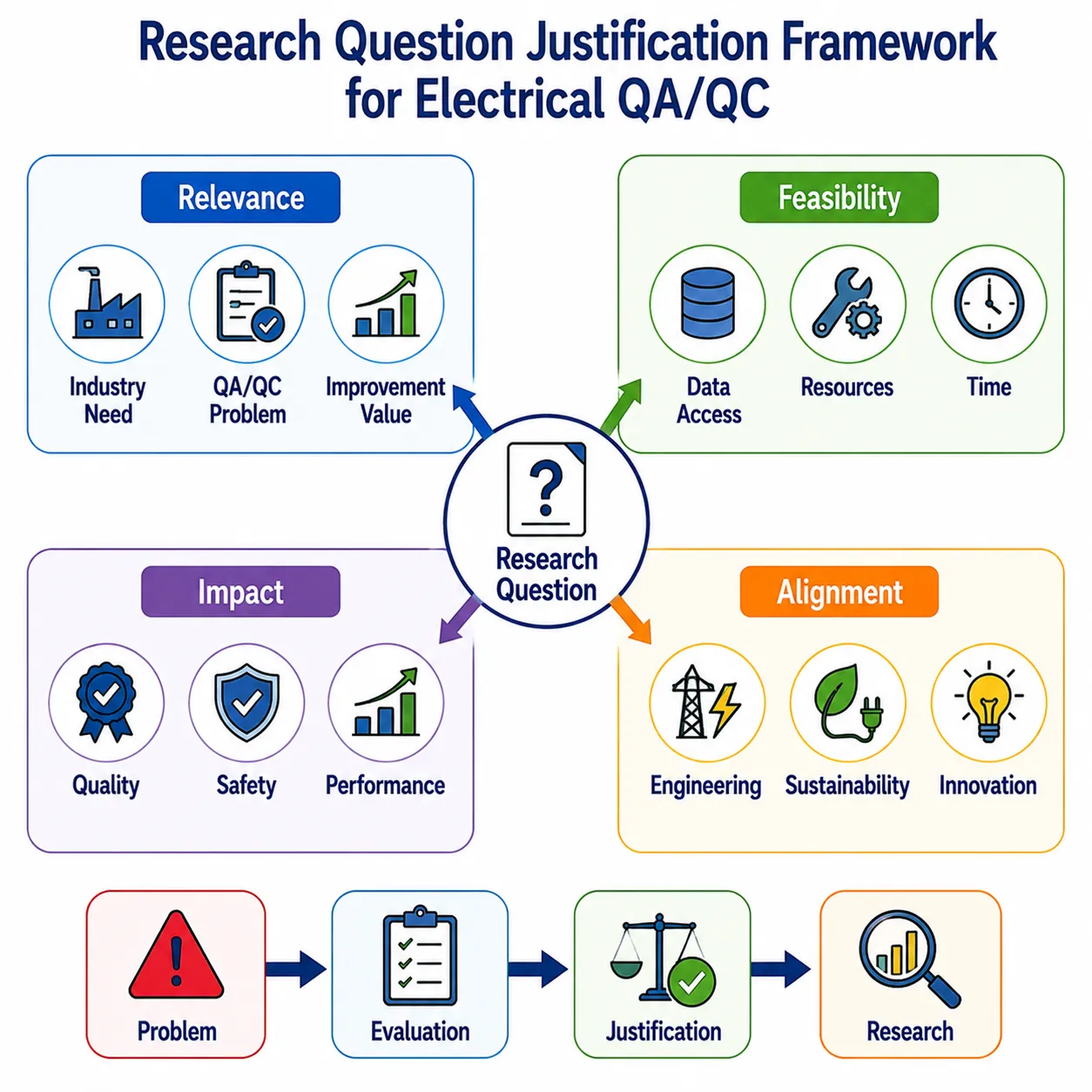
Step 1: Define the Engineering Problem
The first step is identifying the exact problem requiring investigation.
The problem should be:
- Clearly described
- Industry relevant
- Supported by evidence
- Connected with QA/QC improvement
Example:
Repeated electrical installation defects are causing project delays and increased corrective work.
Step 2: Explain Why the Problem Matters
The researcher should explain the consequences of the problem.
Potential impacts include:
- Increased project costs
- Reduced reliability
- Safety concerns
- Delayed completion
- Poor sustainability performance
Step 3: Identify the Research Contribution
The researcher should explain what the investigation will contribute.
Possible contributions include:
- Improved procedures
- Better decision-making
- New quality strategies
- Technology evaluation
- Performance improvement methods
Step 4: Evaluate Practical Feasibility
The researcher should assess:
- Available information
- Required resources
- Research methods
- Time requirements
- Technical capability
Step 5: Confirm Research Alignment
The final question should align with:
- Electrical engineering needs
- QA/QC objectives
- Industry challenges
- Available evidence
Practical Examples of Relevant and Feasible Research Questions
Example 1: Digital QA/QC Systems
Research question:
“How can digital quality management systems improve inspection accuracy and reduce documentation errors in electrical construction projects?”
Relevance
This question is relevant because many organisations are adopting digital solutions to improve quality management.
Feasibility
The research can be conducted through:
- Reviewing project documentation
- Interviewing quality professionals
- Analysing digital system performance
Example 2: Renewable Energy Quality Management
Research question:
“What QA/QC strategies can improve performance verification of commercial solar PV installations?”
Relevance
Renewable energy projects require reliable quality processes to achieve expected energy performance.
Feasibility
The research can use:
- Performance data
- Commissioning records
- Industry case studies
Example 3: Electrical Testing Improvement
Research question:
“How can advanced testing methods reduce commissioning failures in industrial electrical systems?”
Relevance
Commissioning failures can affect project completion and operational reliability.
Feasibility
Research methods may include:
- Reviewing testing records
- Analysing failure patterns
- Consulting technical specialists
Case Study: Justifying a Research Question for Electrical Quality Improvement
Project Background
An electrical engineering organisation delivering large commercial developments identified repeated quality problems during project completion.
The main issues included:
- Delayed inspections
- Incomplete quality records
- Repeated installation defects
- Communication problems between project teams
The organisation wanted to improve its QA/QC performance.
Identifying the Research Problem
Analysis showed that traditional paper-based quality systems were creating:
- Slow information sharing
- Documentation errors
- Limited quality tracking
Developing the Research Question
The proposed research question became:
“How can digital QA/QC management systems improve inspection efficiency and reduce quality-related delays in commercial electrical projects?”
Evaluating Relevance
The research was relevant because:
- Digital transformation is increasing in construction industries.
- Quality documentation problems affect project performance.
- Improved inspection processes can reduce defects.
Evaluating Feasibility
The research was feasible because:
- Project quality records were available.
- Quality professionals could provide feedback.
- Digital tools could be evaluated.
- Research could be completed within the available timeframe.
Expected Research Contribution
The research could support:
- Improved inspection procedures
- Better documentation control
- Reduced project delays
- Enhanced quality performance
Benefits of Justifying Research Relevance and Feasibility
Improved Research Quality
A justified research question provides clear direction and improves investigation quality.
Better Industry Impact
Research outcomes are more likely to solve real engineering problems.
Efficient Resource Use
Feasibility assessment prevents wasted time and resources.
Stronger Professional Value
Research findings become more useful for engineering organisations.
Improved Decision-Making
Evidence-based research supports better QA/QC decisions.
Increased Innovation Potential
Well-designed research can identify opportunities for improved technologies and processes.
Common Challenges When Justifying Research Questions
Researchers may experience challenges such as:
- Selecting topics that are too broad
- Limited access to project data
- Difficulty defining measurable outcomes
- Rapid technology changes
- Lack of stakeholder participation
- Limited research time
These challenges should be considered during research planning.
Strategies to Improve Research Question Justification
Researchers can improve their research proposals by:
- Reviewing current industry trends
- Consulting technical professionals
- Analysing previous project failures
- Defining clear objectives
- Selecting realistic research methods
- Establishing measurable outcomes
- Maintaining a practical scope
Conclusion
Justifying the relevance and feasibility of a proposed research question is a critical stage in advanced electrical QA/QC research. A successful research question must address a meaningful engineering problem, contribute to quality improvement, and demonstrate practical value for industry stakeholders. By evaluating current challenges such as digital transformation, sustainability requirements, renewable energy integration, testing effectiveness, and quality management improvements, researchers can ensure their investigations remain professionally significant and aligned with modern electrical engineering needs.
A feasible and relevant research question provides a strong foundation for successful research by ensuring that objectives can be achieved through available resources, appropriate methodologies, and reliable evidence. Through careful evaluation of research scope, data availability, technical requirements, and industry importance, electrical QA/QC professionals can develop investigations that support safer systems, improved project performance, enhanced reliability, and continual improvement within the electrical engineering sector.
4. Define the Scope and Specific Objectives Required to Successfully Answer the Formulated QA/QC Research Question
Defining the scope and establishing specific research objectives are essential stages in developing a successful electrical Quality Assurance and Quality Control (QA/QC) research project. After formulating a research question, the researcher must clearly determine the boundaries of the investigation and identify the specific outcomes required to answer the question effectively. Without a clearly defined scope and structured objectives, research can become too broad, difficult to manage, or unable to produce meaningful conclusions.
In electrical engineering QA/QC research, scope definition provides a clear framework that explains what aspects of the problem will be investigated and what areas will remain outside the study. It ensures that the research remains focused on a specific quality challenge, technical issue, process improvement opportunity, or emerging development. Similarly, research objectives establish the practical steps required to achieve the overall research aim by identifying what information must be collected, analysed, evaluated, and interpreted.
Modern electrical projects involve complex systems, advanced technologies, sustainability requirements, regulatory expectations, and demanding performance criteria. Therefore, effective research planning requires careful consideration of technical boundaries, available resources, data accessibility, project limitations, and expected outcomes. A well-defined research scope allows researchers to investigate significant QA/QC issues while maintaining realistic research control.
For example, a research question focusing on improving digital QA/QC systems in electrical projects could become unrealistic if it attempts to investigate every digital technology, every project type, and every quality management process worldwide. A clearly defined scope may instead focus on how digital inspection platforms influence defect reporting efficiency within commercial electrical installation projects. This creates a manageable and valuable research direction.
Understanding Research Scope in Electrical QA/QC Investigation
Research scope refers to the defined boundaries that determine the extent, focus, and limitations of a research project. It identifies the specific area of investigation and establishes what the researcher will examine to answer the research question.
In electrical QA/QC research, scope definition helps determine:
- The electrical engineering area being studied
- The quality management issue being investigated
- The project environment involved
- The technologies or processes included
- The type of evidence required
- The limitations of the research
A clear research scope prevents unnecessary expansion of the investigation and ensures that available resources are used effectively.
For example:
Broad research topic:
“Improving electrical quality management”
Focused research scope:
“Evaluating the effectiveness of digital inspection tools in reducing documentation errors during commercial electrical installation projects.”
The focused scope provides:
- A specific technology
- A defined quality issue
- A clear project context
- Measurable outcomes
Importance of Defining Scope Before Conducting Research
A well-defined research scope provides several advantages for electrical QA/QC investigations.
It helps researchers:
- Maintain clear research direction
- Select appropriate data sources
- Identify suitable research methods
- Manage available time effectively
- Avoid unnecessary investigation areas
- Develop achievable objectives
- Produce meaningful conclusions
In professional engineering environments, unclear research scope can create difficulties because electrical quality management involves many interconnected areas.
For example, a study about electrical system reliability could involve:
- Equipment selection
- Installation quality
- Testing procedures
- Commissioning processes
- Maintenance practices
- Operational conditions
- Environmental factors
Without a defined scope, investigating all these areas may become impractical.
Key Concepts Related to Research Scope and Objectives
| Concept | Definition | Application in Electrical QA/QC Research |
|---|---|---|
| Research scope | The defined boundaries and focus areas of an investigation | Controls the extent of the QA/QC study |
| Research aim | The overall purpose that the research intends to achieve | Provides the main direction of investigation |
| Research objective | A specific measurable outcome required to achieve the research aim | Defines research activities and expected results |
| Research limitation | A factor restricting the extent of the investigation | Helps establish realistic boundaries |
| Research parameter | A defined factor considered during investigation | Supports structured data analysis |
| Research methodology | The approach used to collect and evaluate evidence | Determines how objectives will be achieved |
| Research outcome | The expected result generated from the investigation | Demonstrates research contribution |
| Variable | A factor that may influence research findings | Helps analyse relationships between factors |
| Deliverable | A specific output produced during research | Provides evidence of research progress |
| Evaluation criteria | Standards used to assess research findings | Supports objective analysis |
Components of an Effective Research Scope
A complete research scope should clearly identify several important components.
Research Topic Area
The scope should define the general area of investigation.
Examples include:
- Electrical inspection processes
- Digital QA/QC systems
- Renewable energy quality management
- Electrical testing procedures
- Quality risk management
- Sustainable electrical installations
The topic area provides the foundation for further scope development.
Specific Quality Problem
The research should focus on a specific problem rather than a general area.
Examples:
- Increasing electrical installation defects
- Inefficient inspection procedures
- Poor documentation control
- Inconsistent commissioning results
- Limited effectiveness of quality monitoring systems
A specific problem creates a stronger basis for investigation.
Project or Industry Context
The scope should define where the research applies.
Possible contexts include:
- Commercial buildings
- Industrial facilities
- Renewable energy projects
- Infrastructure developments
- Manufacturing environments
- Electrical maintenance operations
The context ensures that findings are relevant to a specific professional environment.
Research Boundaries
Research boundaries define what will and will not be included.
Examples of boundaries:
Included:
- Digital inspection methods
- Quality reporting processes
- Defect reduction analysis
Excluded:
- Electrical design optimisation
- Financial investment analysis
- Non-electrical construction activities
Clear boundaries improve research feasibility.
Data Requirements
The scope should identify the information required to complete the investigation.
Possible data sources include:
- Inspection records
- Testing reports
- Quality documentation
- Project performance data
- Interviews
- Surveys
- Technical standards
- Case studies
Understanding data requirements early helps determine whether the research is achievable.
Developing Specific Research Objectives
Research objectives translate the research question into practical investigation steps. They explain what the researcher needs to accomplish to answer the research question.
Effective objectives should be:
- Clear
- Specific
- Measurable
- Achievable
- Relevant
- Time-bound
A research objective should describe an action rather than a general intention.
Weak objective:
“To understand electrical quality.”
Strong objective:
“To evaluate the effectiveness of digital inspection systems in reducing electrical installation defects within commercial projects.”
The stronger objective identifies:
- The action
- The technology
- The quality issue
- The project context
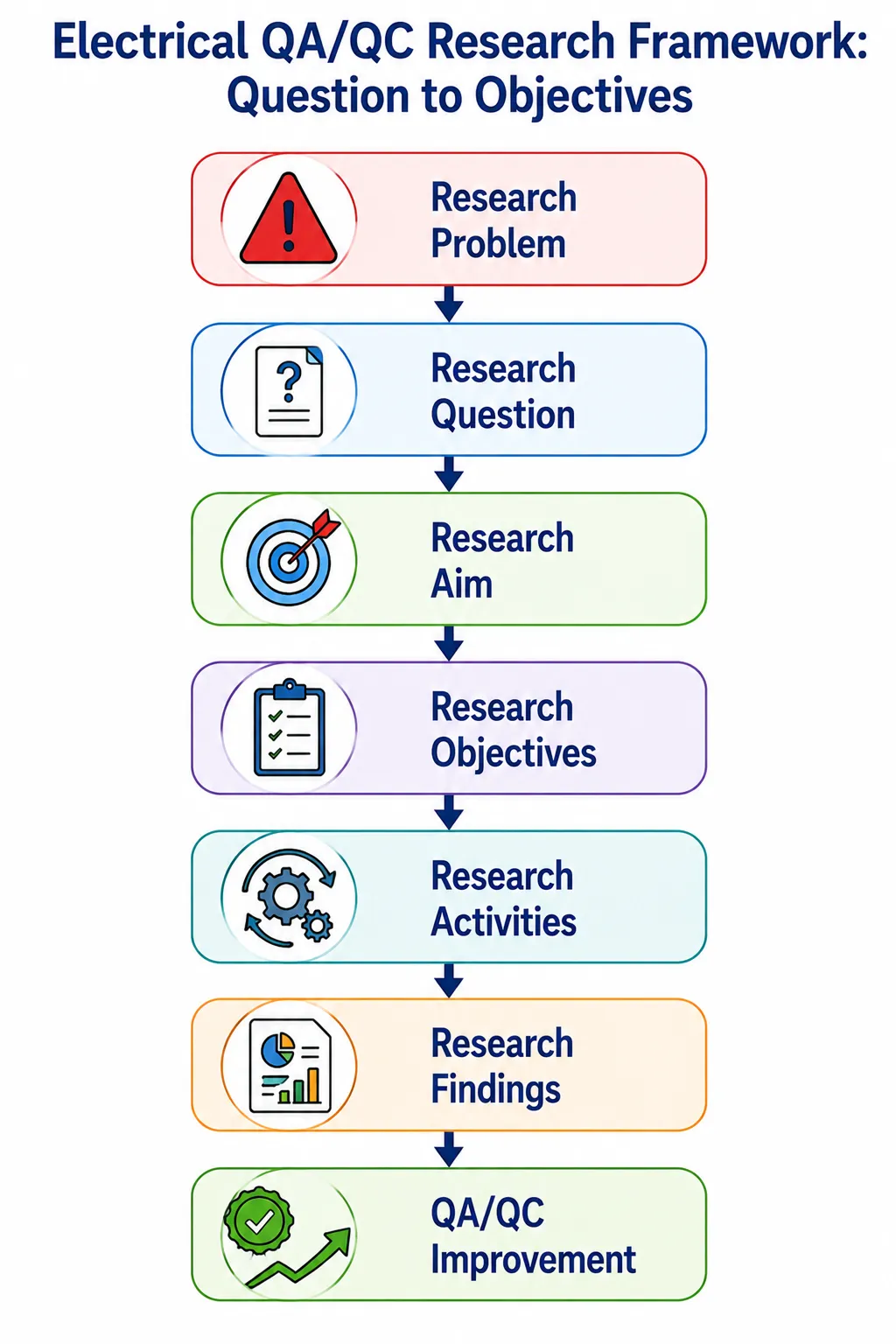
Relationship Between Research Question, Aim and Objectives
A successful research structure follows a logical connection:
Research Question
↓
Research Aim
↓
Research Objectives
↓
Research Activities
↓
Research Findings
For example:
Research Question:
“How can digital QA/QC systems improve electrical inspection performance?”
Research Aim:
“To evaluate the impact of digital QA/QC systems on electrical inspection efficiency.”
Research Objectives:
- Identify current digital QA/QC practices
- Analyse their impact on inspection processes
- Evaluate implementation challenges
-
Recommend improvement strategies

Process for Defining Research Scope
Identify the Main Research Problem
The first step is understanding the issue that requires investigation.
The researcher should identify:
- What quality problem exists?
- Why does it matter?
- Who is affected?
- What improvement is required?
Example:
Repeated electrical defects are increasing project delays and corrective work.
Analyse Existing Knowledge
Before defining the scope, researchers should review:
- Existing studies
- Industry practices
- Technical documents
- Previous project experiences
This helps identify what is already known and where further research is required.
Determine the Research Focus
The research should concentrate on a specific area.
Possible focus areas:
- Technology effectiveness
- Process improvement
- Quality performance
- Risk reduction
- Sustainability verification
A focused investigation produces stronger findings.
Establish Research Boundaries
The researcher should define:
- Location
- Project type
- Technology involved
- Time period
- Quality factors examined
Example:
The study will focus on commercial electrical installation projects completed within the last five years.
Identify Required Resources
The researcher should evaluate:
- Available data
- Access to professionals
- Required tools
- Research timeframe
- Technical knowledge
This ensures feasibility.
Develop Research Objectives
Objectives should directly support answering the research question.
They should explain:
- What will be investigated
- How evidence will be collected
- What outcomes are expected
Types of Research Objectives in Electrical QA/QC
Analytical Objectives
These objectives examine existing conditions.
Examples:
- Analyse current electrical inspection procedures.
- Evaluate causes of repeated quality failures.
- Examine relationships between installation quality and system performance.
Evaluation Objectives
These objectives assess effectiveness.
Examples:
- Evaluate the effectiveness of digital quality management systems.
- Assess current testing procedures.
- Compare traditional and advanced QA/QC approaches.
Development Objectives
These objectives focus on improvement.
Examples:
- Develop recommendations for improving inspection processes.
- Propose strategies for reducing electrical defects.
- Create improved QA/QC frameworks.
Measurement Objectives
These objectives focus on measurable outcomes.
Examples:
- Measure defect reduction after implementing digital inspection tools.
- Assess changes in commissioning performance.
- Evaluate improvements in documentation accuracy.
Practical Example: Defining Scope and Objectives for Digital QA/QC Research
Research Question
“How can digital QA/QC management systems improve inspection efficiency and reduce quality-related delays in commercial electrical projects?”
Research Scope
The study focuses on:
- Commercial electrical installations
- Digital inspection systems
- Quality documentation processes
- Defect reporting efficiency
The study does not include:
- Electrical design processes
- Building architecture
- Financial investment strategies
Research Aim
To evaluate how digital QA/QC systems influence inspection efficiency and quality management performance.
Research Objectives
The research objectives include:
- Identify current digital QA/QC practices used in electrical projects.
- Analyse the impact of digital tools on inspection accuracy.
- Evaluate challenges affecting technology adoption.
- Recommend strategies for improving digital quality management.
Case Study: Developing a Research Framework for Renewable Energy QA/QC
Project Background
An organisation delivering commercial solar photovoltaic projects identified differences between predicted and actual system performance.
Although equipment specifications were achieved, operational output was lower than expected.
Research Problem
The organisation suspected that quality management processes during installation and commissioning were affecting performance.
Research Question
“How can QA/QC procedures improve performance verification in commercial solar photovoltaic installations?”
Scope Definition
The research focused on:
- Solar PV installation quality
- Commissioning procedures
- Performance verification methods
- Quality documentation
The research excluded:
- Solar panel manufacturing
- Energy market analysis
- Financial investment decisions
Research Objectives
The study aimed to:
- Analyse existing solar PV QA/QC procedures.
- Identify factors affecting performance verification.
- Evaluate commissioning effectiveness.
- Develop recommendations for improving quality outcomes.
Research Benefits
The research could support:
- Improved installation quality
- Better commissioning procedures
- Increased renewable energy performance
- Reduced operational issues
Challenges When Defining Scope and Objectives
Researchers may experience several difficulties.
Scope Becoming Too Broad
A common problem is attempting to investigate too many areas.
Solution:
- Focus on one main problem
- Define clear boundaries
- Prioritise important factors
Objectives Not Matching the Research Question
Objectives should directly contribute to answering the research question.
Solution:
- Review each objective
- Remove unnecessary activities
- Ensure alignment
Limited Data Availability
Some research areas may require unavailable information.
Solution:
- Confirm data access early
- Adjust research scope if required
- Use alternative evidence sources
Excessive Technical Complexity
Advanced electrical systems can create investigation difficulties.
Solution:
- Select realistic boundaries
- Focus on measurable factors
- Use appropriate research methods
Benefits of Clear Scope and Objectives
Improved Research Control
A defined scope keeps the investigation focused.
Better Use of Resources
Researchers can allocate time and effort effectively.
Stronger Research Outcomes
Clear objectives improve the quality of findings.
Increased Industry Value
Research becomes more applicable to professional practice.
Easier Evaluation
Defined objectives provide measurable criteria for assessing success.
Improved Decision-Making
Research findings become more useful for engineering improvements.
Professional Approach to Scope Management
Effective scope management requires continuous review throughout the research process.
Researchers should regularly evaluate:
- Whether the investigation remains focused
- Whether objectives are achievable
- Whether additional boundaries are required
- Whether research activities remain aligned with the question
Changes should be controlled rather than allowing uncontrolled expansion.
Linking Research Scope with Electrical Engineering Practice
A strong research scope should maintain connection with practical engineering requirements.
Research outcomes should support improvements in:
- Safety performance
- Quality consistency
- System reliability
- Operational efficiency
- Sustainability achievement
- Project delivery performance
This ensures research provides value beyond academic assessment.
Conclusion
Defining the scope and specific objectives of an electrical QA/QC research project is essential for creating a structured, achievable, and valuable investigation. A clearly established scope ensures that research remains focused on a significant engineering problem while preventing unnecessary expansion into unrelated areas. By identifying research boundaries, available resources, project context, and required evidence, researchers can develop investigations that are realistic and professionally relevant.
Well-developed research objectives provide a clear pathway for achieving the research aim and answering the formulated QA/QC research question. Through effective scope management and objective planning, electrical engineering researchers can produce meaningful findings that support improved quality management, enhanced reliability, safer electrical systems, and continual improvement within modern engineering projects.