
Lesson 1: Evidence-Based Practices
Evidence-based practices play a vital role in the treatment of addiction and substance abuse. These practices are interventions and treatment methods that have been scientifically researched and proven to produce positive outcomes for individuals struggling with substance use disorders. In modern health, social care, counselling, and rehabilitation settings, professionals are expected to use evidence-based approaches to ensure treatment is effective, ethical, and tailored to the needs of clients.
Understanding evidence-based treatment modalities helps practitioners make informed decisions when supporting individuals through recovery. Different approaches address various aspects of addiction, including thoughts, behaviours, motivation, emotional wellbeing, and relapse prevention. Knowledge of these treatment methods enables professionals to select appropriate interventions, improve recovery outcomes, and provide person-centred support within addiction treatment services.
By the end of this lesson, learners will be able to:
- Define evidence-based practices in addiction treatment.
- Explain the importance of evidence-based treatment modalities.
- Evaluate commonly used treatment approaches for addiction and substance abuse.
- Discuss the effectiveness of different therapeutic interventions.
- Identify the limitations of various treatment approaches.
- Compare cognitive-behavioural therapy and motivational interviewing.
- Recognise how treatment approaches are applied in professional practice.
Apply knowledge of evidence-based interventions to workplace scenarios.
1: Evaluate Evidence-Based Treatment Modalities for Addiction and Substance Abuse
Understanding Evidence-Based Practices
Evidence-based practices (EBPs) form the foundation of modern addiction treatment and recovery services. In the field of substance misuse treatment, practitioners are expected to use interventions that are supported by credible scientific research rather than relying solely on personal opinions, assumptions, or traditional methods. Evidence-based practices help ensure that individuals experiencing addiction receive treatments that have been tested, evaluated, and shown to improve recovery outcomes.
Addiction is a complex condition influenced by biological, psychological, social, and environmental factors. As a result, treatment approaches must be carefully selected to address the unique needs of each individual. Evidence-based practice provides a structured framework for making informed treatment decisions by combining the best available research evidence with professional expertise and client-centred care. This approach allows practitioners to deliver interventions that are both effective and responsive to individual circumstances.
In professional settings such as rehabilitation centres, community recovery services, mental health organisations, and healthcare facilities, evidence-based treatment approaches are widely used to improve recovery rates, reduce relapse risks, and support long-term wellbeing. By understanding evidence-based practices, professionals can ensure that treatment plans are tailored to the needs of service users while maintaining high standards of ethical and professional practice.
Key Elements of Evidence-Based Practice
Evidence-based practice is built upon three interconnected components:
- Research Evidence
- Refers to findings from scientific studies, clinical trials, and systematic reviews that demonstrate the effectiveness of particular treatment approaches.
- Research helps practitioners identify interventions that are most likely to produce positive outcomes.
- Clinical Expertise
- Includes the knowledge, skills, experience, and professional judgement of trained practitioners.
- Enables professionals to apply research findings appropriately in real-world situations.
- Individual Client Needs and Preferences
- Recognises that every individual has unique experiences, goals, cultural backgrounds, and recovery needs.
- Ensures treatment plans are personalised rather than adopting a one-size-fits-all approach.
The integration of these three components creates a balanced and effective approach to addiction treatment that is both scientifically informed and person-centred.
Why Evidence-Based Practices Matter
The use of evidence-based interventions has become increasingly important as addiction treatment services seek to improve outcomes and demonstrate accountability. Effective treatment is not simply about reducing substance use; it also involves improving mental health, social functioning, physical wellbeing, and quality of life.
Evidence-based approaches contribute to positive outcomes in several ways:
- Improve treatment effectiveness by using methods proven to work.
- Increase the likelihood of sustained recovery.
- Reduce the risk of relapse and repeated treatment episodes.
- Promote consistency across treatment services.
- Support professional accountability and ethical decision-making.
- Enable practitioners to evaluate and improve treatment outcomes.
- Enhance public confidence in addiction treatment services.
From an organisational perspective, evidence-based interventions help ensure resources are used efficiently. Services that implement effective treatments are more likely to achieve successful recovery outcomes and meet professional standards.
Practical Example
A rehabilitation centre introduces a treatment programme based on Cognitive-Behavioural Therapy and Motivational Interviewing because research demonstrates their effectiveness in supporting behavioural change and relapse prevention. As a result, clients experience higher treatment completion rates and improved recovery outcomes compared to previous programmes that lacked a structured evidence base.
Core Components of Evidence-Based Treatment
Effective addiction treatment requires more than selecting a particular therapy. It involves ongoing assessment, professional judgement, client participation, and continuous evaluation.
| Component | Description | Importance in Treatment |
|---|---|---|
| Research Evidence | Findings from scientific studies and clinical trials | Ensures interventions are supported by reliable evidence |
| Professional Expertise | Knowledge and experience of trained practitioners | Helps practitioners apply treatments effectively |
| Client Preferences | Individual needs, values, and treatment goals | Supports personalised and client-centred care |
| Outcome Evaluation | Monitoring treatment effectiveness over time | Enables treatment adjustments and quality improvement |
These components work together to ensure treatment remains responsive, effective, and focused on achieving positive recovery outcomes.
Types of Evidence-Based Treatment Modalities
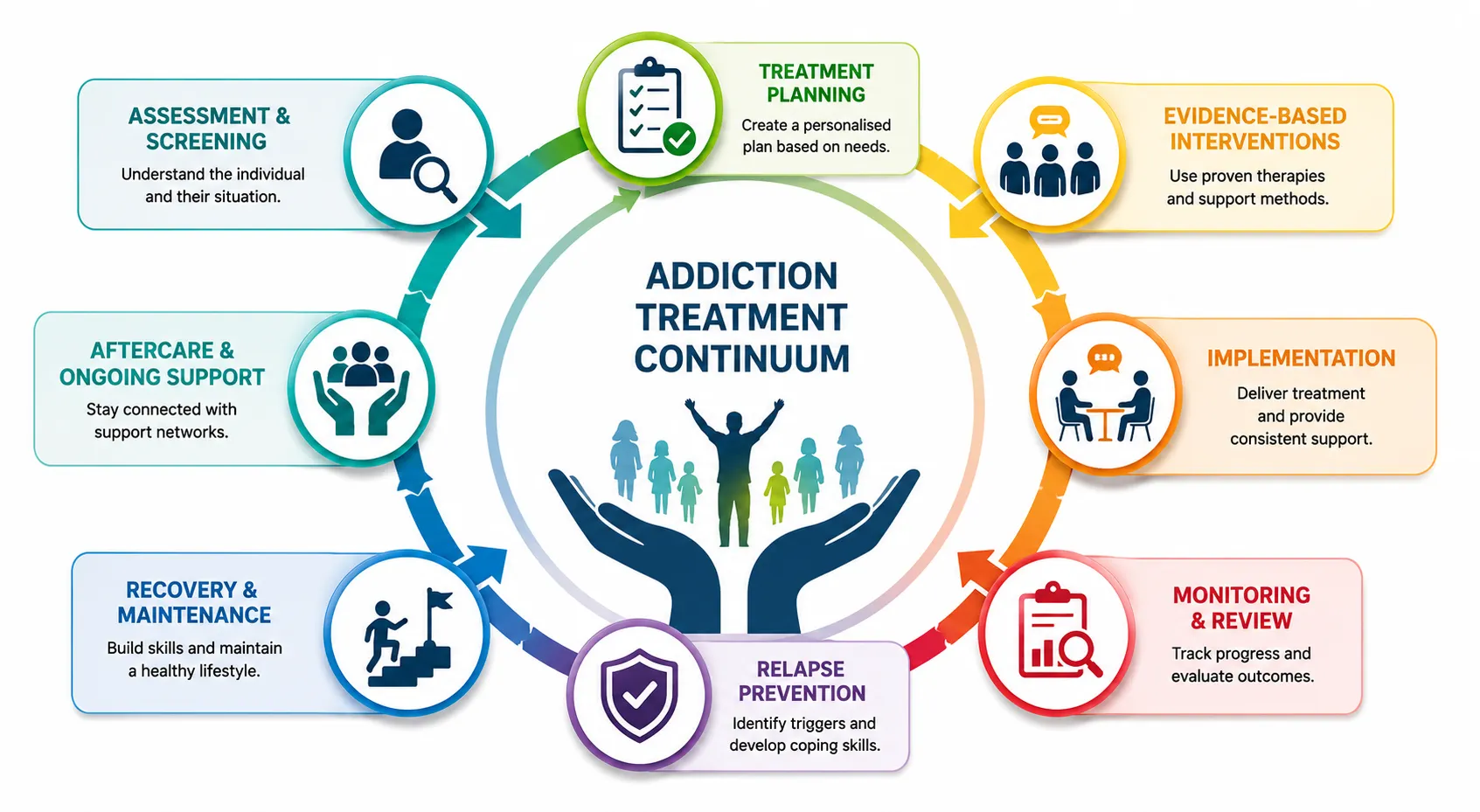
A range of evidence-based treatment approaches are used within addiction recovery services. Each modality addresses different aspects of addiction and may be used independently or in combination with other interventions.
1. Cognitive-Behavioural Therapy (CBT)
Cognitive-Behavioural Therapy is one of the most widely researched and commonly used approaches in addiction treatment. CBT is based on the principle that thoughts, emotions, and behaviours are interconnected. Harmful thought patterns can contribute to substance misuse, while changing those patterns can support healthier behaviours.
CBT helps individuals identify situations, beliefs, and emotional triggers that lead to substance use. Once these factors are recognised, clients learn practical strategies to challenge negative thinking and replace harmful behaviours with healthier alternatives.
Key Principles of CBT
- Understanding triggers that contribute to substance use.
- Identifying negative thought patterns.
- Challenging irrational or unhelpful beliefs.
- Developing healthy coping strategies.
- Building relapse prevention skills.
Advantages of CBT
- Strong scientific evidence supports its effectiveness.
- Suitable for treating various forms of addiction.
- Helps develop practical problem-solving skills.
- Encourages long-term behavioural change.
- Can address co-occurring mental health difficulties.
Limitations of CBT
- Requires active participation and commitment.
- Some individuals may struggle with reflective exercises.
- Progress may take time before significant changes occur.
- May not fully address social or environmental influences.
Workplace Application
A support worker helping an individual recovering from alcohol dependence may use CBT techniques to identify workplace stressors that trigger drinking behaviour. The client can then develop alternative coping strategies such as relaxation techniques, exercise, or structured problem-solving.
2. Motivational Interviewing (MI)
Motivational Interviewing is a client-centred counselling approach designed to increase an individual’s readiness and motivation for change. It is particularly effective for individuals who feel uncertain or ambivalent about reducing substance use.
Rather than directing clients, practitioners use supportive communication techniques to help individuals explore their own reasons for change and develop confidence in their ability to succeed.
Key Principles of Motivational Interviewing
- Collaboration between practitioner and client.
- Empathy and non-judgemental communication.
- Respect for personal autonomy.
- Encouragement of self-motivation.
- Exploration of ambivalence towards change.
Advantages of MI
- Increases engagement in treatment.
- Reduces resistance and defensiveness.
- Encourages personal responsibility.
- Effective during the early stages of recovery.
- Strengthens commitment to behavioural change.
Limitations of MI
- Relies heavily on client willingness to engage.
- May not be sufficient as a standalone intervention.
- Success depends on practitioner skill and experience.
- Results may vary between individuals.
Practical Example
A young adult referred to a substance misuse service may not believe their drug use is problematic. Through Motivational Interviewing, the practitioner helps the individual explore how substance use is affecting relationships, education, and future goals, increasing motivation for change.
3. Medication-Assisted Treatment (MAT)
Medication-Assisted Treatment combines prescribed medication with counselling and behavioural interventions. It is commonly used for opioid and alcohol dependence and aims to reduce physical symptoms associated with addiction.
MAT recognises that addiction often involves significant biological factors. Medications can help manage withdrawal symptoms and cravings, allowing individuals to focus more effectively on psychological and behavioural recovery.
Common Uses of MAT
- Opioid dependence.
- Alcohol dependence.
- Long-term recovery support.
Advantages of MAT
- Supports physical stabilisation.
- Reduces withdrawal discomfort.
- Decreases cravings.
- Improves treatment retention rates.
- Can reduce the risk of overdose.
Limitations of MAT
- Requires medical supervision.
- May attract social stigma.
- Not suitable for every individual.
- Does not address behavioural issues independently.
Industry Relevance
MAT is widely used in healthcare and rehabilitation settings where integrated treatment approaches are considered best practice for managing certain substance use disorders.
4. Group Therapy
Group therapy involves structured therapeutic sessions facilitated by trained professionals and attended by multiple participants. Individuals are encouraged to share experiences, discuss challenges, and support one another within a safe environment.
Group therapy is based on the understanding that recovery can be strengthened through peer support and shared learning.
Benefits of Group Therapy
- Provides peer support and encouragement.
- Reduces feelings of isolation.
- Promotes shared learning experiences.
- Enhances communication and interpersonal skills.
- Creates opportunities for accountability.
Advantages
- Cost-effective treatment option.
- Encourages social connection.
- Builds confidence and resilience.
- Helps individuals learn from others’ experiences.
Limitations
- Privacy and confidentiality concerns.
- Some individuals may feel uncomfortable sharing.
- Group dynamics can influence participation.
- May not address highly individualised needs.
Workplace Example
Community recovery programmes frequently use group therapy sessions to help individuals develop social support networks and maintain motivation during recovery.
5. Family-Based Interventions
Addiction affects not only the individual but also family members and close relationships. Family-based interventions involve family participation in treatment to improve communication, strengthen support systems, and address relationship difficulties.
These interventions recognise that recovery is often more successful when supportive family relationships are present.
Advantages
- Enhances family communication.
- Builds supportive recovery environments.
- Improves understanding of addiction.
- Addresses the impact of substance misuse on family relationships.
- Encourages collaborative recovery planning.
Limitations
- Family participation may be limited.
- Existing conflicts may create challenges.
- Some family members may require additional support.
- Not all individuals have supportive family networks.
Comparison of Evidence-Based Treatment Modalities
| Treatment Modality | Main Focus | Strengths | Limitations |
|---|---|---|---|
| CBT | Thoughts and behaviours | Strong evidence, relapse prevention | Requires commitment |
| Motivational Interviewing | Motivation for change | Builds engagement | Depends on readiness |
| Medication-Assisted Treatment | Physical dependence | Reduces withdrawal symptoms | Requires medical oversight |
| Group Therapy | Peer support | Shared learning and encouragement | Group participation challenges |
| Family Interventions | Family relationships | Improves support systems | Family involvement may vary |
This comparison highlights that no single treatment modality is universally effective for all individuals. Successful treatment often involves combining multiple approaches to address physical, psychological, behavioural, and social aspects of addiction.
Treatment Selection Process
Selecting the most appropriate treatment approach requires a structured assessment process.
Process Flow Diagram
Assessment of Client Needs
↓
Identification of Addiction Severity
↓
Selection of Appropriate Treatment Approach
↓
Implementation of Intervention
↓
Monitoring and Review
↓
Treatment Adjustment if Required
↓
Improved Recovery Outcomes
Explanation of the Process
- Assessment of Client Needs
- Identifies substance use patterns, mental health concerns, and personal circumstances.
- Identification of Addiction Severity
- Determines the level of support and intervention required.
- Selection of Appropriate Treatment Approach
- Matches treatment methods to client needs and recovery goals.
- Implementation of Intervention
- Delivers the selected treatment plan.
- Monitoring and Review
- Evaluates progress and identifies challenges.
- Treatment Adjustment if Required
- Modifies interventions based on changing needs and outcomes.
- Improved Recovery Outcomes
- Supports sustained recovery and long-term wellbeing.
Evidence-based treatment modalities are essential components of effective addiction and substance abuse services. By combining scientific research, professional expertise, and individual client needs, evidence-based practices provide a reliable framework for supporting recovery and improving treatment outcomes. Approaches such as Cognitive-Behavioural Therapy, Motivational Interviewing, Medication-Assisted Treatment, Group Therapy, and Family-Based Interventions each address different aspects of addiction and contribute to a comprehensive treatment strategy.
While every treatment modality offers distinct benefits, each also has limitations that practitioners must consider when developing individualised treatment plans. Effective recovery support requires careful assessment, ongoing monitoring, and flexibility in selecting interventions that align with the needs and circumstances of each person. Through the use of evidence-based practices, addiction professionals can promote safer, more consistent, and more successful recovery outcomes while supporting individuals in achieving long-term health, wellbeing, and positive life change.
2: Effectiveness and Limitations of Different Treatment Approaches in Addiction Care
Evaluating Treatment Effectiveness
Treatment effectiveness is a fundamental concept in addiction recovery and refers to the extent to which a specific intervention achieves its intended clinical and psychosocial outcomes. In professional practice, effectiveness is not measured solely by abstinence from substances, but by a broader set of recovery indicators including psychological stability, social reintegration, improved coping skills, and enhanced quality of life.
In modern healthcare and social care systems, treatment effectiveness is assessed through continuous monitoring, client feedback, and outcome-based evaluation tools. Evidence-based practice emphasises that no single treatment approach guarantees success for every individual due to the complex and multidimensional nature of addiction.
Indicators of Effective Treatment Outcomes
Effective addiction treatment is generally associated with the following outcomes:
- Reduced substance use or complete abstinence
- Improved emotional regulation and mental health stability
- Enhanced social functioning and interpersonal relationships
- Increased engagement in treatment programmes
- Lower relapse frequency and severity
- Improved quality of life and daily functioning
Each of these outcomes reflects not only behavioural change but also psychological and social recovery, which are essential components of long-term rehabilitation.
Factors Influencing Treatment Effectiveness
Treatment success is highly individualised and influenced by multiple interrelated factors:
- Individual circumstances: Personal history, trauma exposure, and lifestyle conditions significantly impact recovery progress.
- Severity of addiction: Higher dependency levels often require more intensive or integrated treatment approaches.
- Motivation for change: Readiness and willingness to engage in treatment strongly influence outcomes.
- Support systems: Family, peer, and community support enhance recovery stability.
- Co-occurring mental health conditions: Anxiety, depression, or trauma-related disorders can complicate treatment response.
In professional settings, practitioners must assess these factors carefully to ensure appropriate intervention selection and improved treatment alignment.
Cognitive-Behavioural Therapy (CBT): Effectiveness and Limitations
Cognitive-Behavioural Therapy (CBT) is one of the most widely researched and implemented psychological interventions in addiction treatment. It is grounded in the principle that thoughts, feelings, and behaviours are interconnected, and that modifying dysfunctional thinking patterns can lead to improved behavioural outcomes.
Effectiveness of CBT in Addiction Treatment
CBT has demonstrated strong effectiveness across various substance use disorders, particularly in structured rehabilitation and outpatient settings.
Key areas of effectiveness include:
- Helping individuals identify high-risk triggers and situations
- Supporting emotional regulation and cognitive restructuring
- Developing practical coping strategies for cravings and stress
- Strengthening relapse prevention planning and self-control
CBT is especially effective because it equips individuals with lifelong skills that can be applied beyond the treatment environment. Research in addiction psychology consistently supports CBT as a high-impact intervention for reducing relapse risk and improving long-term recovery outcomes.
Limitations of CBT
Despite its effectiveness, CBT has certain limitations that practitioners must consider:
- Requires high levels of cognitive engagement and reflection
- May not be suitable for individuals with severe cognitive impairment or low insight
- Progress can be gradual and requires sustained effort
- Less effective when not combined with social or environmental interventions
In practice, CBT is often more effective when integrated with motivational and medical approaches.
Motivational Interviewing (MI): Effectiveness and Limitations
Motivational Interviewing (MI) is a client-centred, goal-oriented counselling approach designed to enhance intrinsic motivation for behavioural change. It is particularly useful during the early stages of treatment when individuals may feel ambivalent about change.
Effectiveness of Motivational Interviewing
MI is highly effective in increasing engagement and readiness for treatment. It focuses on collaboration rather than confrontation, allowing clients to explore their own reasons for change.
Key benefits include:
- Enhancing willingness to enter and remain in treatment
- Strengthening personal responsibility and decision-making
- Reducing resistance and defensiveness during counselling
- Supporting early-stage behavioural change processes
MI is widely used in community addiction services, prisons, and healthcare settings where initial resistance to treatment is common.
Limitations of Motivational Interviewing
Although effective, MI has certain limitations:
- Less effective when used as a standalone treatment for severe addiction
- Heavily dependent on practitioner communication skills
- Outcomes vary depending on client readiness and engagement
- Requires follow-up interventions for sustained recovery
In most clinical environments, MI is used as a preparatory intervention before structured therapies such as CBT or rehabilitation programmes.
Comparison: Cognitive-Behavioural Therapy vs Motivational Interviewing
The following table provides a structured comparison of CBT and MI, highlighting their key differences in clinical application.
| Feature | Cognitive-Behavioural Therapy (CBT) | Motivational Interviewing (MI) |
|---|---|---|
| Primary Goal | Behaviour modification through cognitive change | Enhancing motivation for change |
| Therapeutic Approach | Structured, directive, skills-based | Client-centred and collaborative |
| Focus Area | Thoughts, emotions, behaviours | Ambivalence and readiness for change |
| Client Role | Active participant in structured tasks | Collaborative decision-maker |
| Best Application | Relapse prevention and long-term recovery | Early engagement and treatment readiness |

Interpretation of Comparison
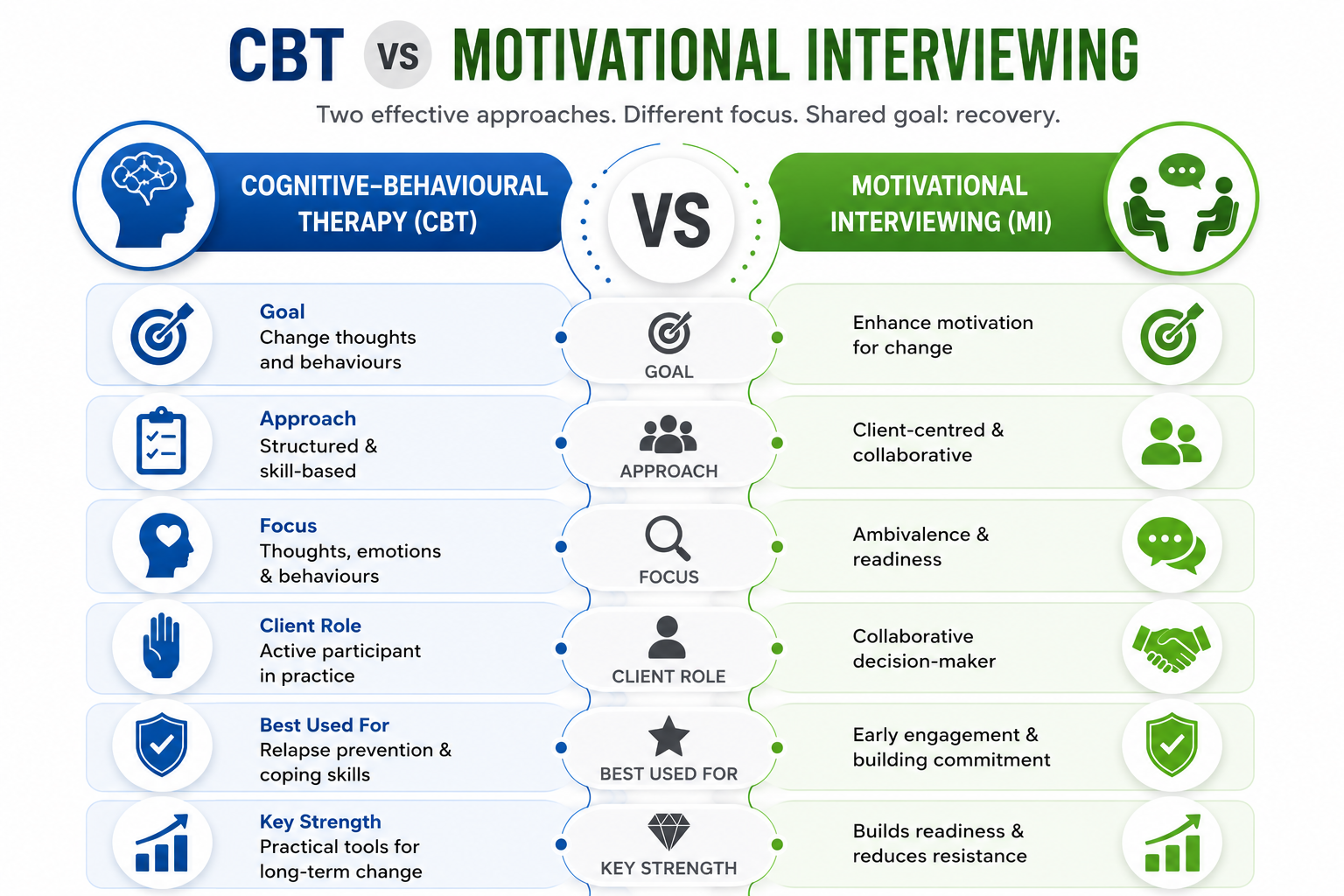
This comparison highlights that CBT and MI serve different but complementary roles in addiction treatment. CBT focuses on long-term behavioural change, while MI is more effective in initiating change readiness. In integrated treatment systems, both approaches are often combined to maximise recovery outcomes.
Factors Influencing Treatment Success
Treatment success in addiction recovery is influenced by multiple interconnected domains. Understanding these factors enables practitioners to design more effective, person-centred interventions.
Hierarchy of Treatment Success Factors
- Client Factors
- Motivation levels
- Commitment to recovery
- Mental and emotional health status
- Practitioner Factors
- Clinical skills and experience
- Communication and empathy
- Quality of therapeutic relationship
- Treatment Factors
- Appropriateness of intervention
- Duration and intensity of treatment
- Availability of follow-up support
- Environmental Factors
- Family involvement and support
- Employment stability
- Access to community resources
Critical Analysis
In real-world practice, treatment effectiveness is rarely determined by a single factor. Instead, success emerges from the interaction between personal readiness, therapeutic quality, and environmental stability. This reinforces the importance of holistic assessment and multi-agency collaboration in addiction services.
Best Practices for Effective Treatment Delivery
To maximise treatment effectiveness, professionals follow evidence-based best practice principles that ensure safety, consistency, and improved outcomes.
Key best practices include:
- Conducting comprehensive biopsychosocial assessments
- Matching interventions to individual client needs
- Applying evidence-based treatment approaches consistently
- Encouraging active client participation in recovery planning
- Monitoring progress through structured evaluation tools
- Addressing co-occurring mental health conditions
- Implementing relapse prevention strategies early in treatment
- Maintaining ethical and professional standards in all interventions
These practices ensure that treatment is not only clinically effective but also ethically sound and person-centred.
Practical Application in Professional Settings
In addiction recovery services, practitioners frequently adapt treatment approaches based on client needs and readiness levels.
Workplace Example
- Client A presents with strong motivation to quit alcohol use. CBT is implemented to help identify triggers and develop coping mechanisms.
- Client B shows resistance and uncertainty. Motivational Interviewing is used initially to build engagement before introducing structured therapy.
This demonstrates the importance of flexible treatment planning and personalised intervention strategies in real-world practice.
Case Study: Integrated Treatment Approach
Background
Sarah, a 32-year-old woman, is dependent on prescription medication following long-term medical treatment for chronic pain.
Situation
Sarah recognises that her medication use has become problematic but feels anxious about withdrawal and uncertain about change.
Clinical Challenge
She presents with:
- Moderate substance dependence
- Anxiety related to withdrawal symptoms
- Low confidence in recovery ability
Assessment and Analysis
A multidisciplinary assessment identifies the need for both motivational enhancement and cognitive restructuring to support recovery.
Intervention Plan
- Motivational Interviewing to strengthen readiness for change
- CBT to develop coping strategies and manage triggers
- Ongoing monitoring and psychological support
Outcome
Over time, Sarah becomes more engaged in treatment, develops healthier coping mechanisms, and gradually reduces dependency under professional supervision.
Key Learning Point
This case demonstrates that combining evidence-based approaches improves recovery outcomes by addressing both psychological readiness and behavioural change.
The effectiveness of addiction treatment is shaped by the quality of interventions used and the individual needs of service users. Cognitive-Behavioural Therapy and Motivational Interviewing represent two widely used and evidence-supported approaches, each serving distinct but complementary roles within the recovery process. While CBT focuses on structured behavioural change and relapse prevention, MI strengthens motivation and readiness for change.
However, treatment outcomes are not determined by therapy alone. Client characteristics, practitioner competence, treatment design, and environmental influences all play critical roles in shaping recovery success. Therefore, effective addiction treatment requires a holistic, flexible, and evidence-based approach that integrates multiple interventions.
In conclusion, understanding both the effectiveness and limitations of different treatment approaches enables practitioners to make informed decisions, deliver person-centred care, and ultimately improve long-term recovery outcomes for individuals affected by substance use disorders.