
Lesson no 4 : Design research approaches integrating genomics and nutrition.
Designing research approaches that integrate genomics and nutrition is an important area of modern nutritional science. It focuses on investigating how genetic variation, gene expression, molecular pathways and dietary exposures interact to influence human health, metabolism and disease risk. This interdisciplinary approach combines principles from nutrition science, molecular biology, genetics, epidemiology, biochemistry and bioinformatics to develop robust and evidence-based research studies.
Genomics enables researchers to examine large-scale genetic and molecular information, including DNA variants, gene expression patterns and interactions between genes and environmental factors. When integrated with detailed nutritional data, these approaches can help researchers understand why individuals may respond differently to the same foods, nutrients or dietary patterns. Such research supports the development of more personalised and scientifically informed nutritional strategies.
Effective research design requires the clear identification of a research problem, the development of focused research questions and hypotheses, and the selection of appropriate study designs and methodologies. Researchers must also consider participant selection, dietary assessment methods, biological sample collection, genomic analysis, data quality and statistical approaches. Advanced bioinformatics tools are often required to manage and interpret complex datasets generated from genomic and nutritional research.
An important aspect of this field is the integration of multiple sources of evidence. Genetic findings should be interpreted alongside dietary intake, physiological measurements, clinical biomarkers, lifestyle factors and environmental influences. Researchers must critically evaluate potential confounding variables and avoid assuming that genetic associations automatically demonstrate causation.
Ethical and professional responsibilities are equally important. Research involving genetic information requires appropriate informed consent, data protection, confidentiality and careful communication of findings. Researchers must also consider the limitations of predictive genetic models and ensure that conclusions are supported by reliable scientific evidence.
This lesson develops the knowledge and practical skills required to design, evaluate and apply research approaches that connect genomics with nutrition. Learners will explore how to formulate research questions, select suitable methodologies, integrate complex datasets and critically interpret findings. By applying evidence-based research principles, Learners will be better prepared to investigate gene–nutrient interactions and contribute to the growing field of personalised nutrition and molecular health research.
1.Design a Comprehensive and Ethical Research Protocol Integrating Practical Nutritional Interventions with Advanced Genomic Sequencing Techniques
The integration of nutrition research with genomic sequencing represents an important development in modern biomedical and nutritional science. A well-designed research protocol can investigate how dietary interventions interact with genetic variation, gene expression and biological pathways to influence health outcomes. However, combining practical nutritional interventions with advanced genomic techniques creates methodological and ethical complexities that must be carefully managed.
A comprehensive research protocol provides a structured plan explaining why the study is being conducted, what questions it intends to answer, how participants will be recruited, how nutritional interventions will be delivered, which genomic techniques will be used, how biological samples and data will be managed, and how findings will be analysed and communicated.
The purpose is not simply to collect large amounts of genetic and dietary information. High-quality research requires the meaningful integration of these data to address a clearly defined scientific question. Researchers must therefore balance scientific ambition with feasibility, participant safety, privacy, methodological quality and ethical responsibility.

Key Definitions and Concepts
| Term | Definition | Importance in Integrated Nutrition–Genomics Research |
|---|---|---|
| Research protocol | A detailed written plan describing the objectives, methods, ethical safeguards and procedures of a research study | Provides consistency, transparency and scientific direction |
| Nutritional intervention | A planned change in dietary intake, nutrient exposure or dietary behaviour introduced for research purposes | Enables researchers to investigate dietary effects under defined conditions |
| Genomic sequencing | Laboratory methods used to determine the sequence or variation of genetic material | Identifies genetic factors relevant to biological responses |
| Gene–nutrient interaction | The relationship in which genetic variation and nutritional exposure influence biological outcomes together | Supports investigation of individual variation in dietary responses |
| Informed consent | A voluntary decision to participate based on adequate understanding of the study | Protects participant autonomy and ethical rights |
| Biomarker | A measurable biological characteristic that reflects a physiological or pathological process | Helps evaluate biological responses to an intervention |
| Confounding variable | A factor that may influence both the exposure and outcome and distort interpretation | Must be identified and controlled where possible |
| Data governance | The system for managing access, storage, security and appropriate use of data | Essential when handling sensitive genetic information |
| Bioinformatics | The application of computational methods to analyse complex biological data | Supports the processing and interpretation of genomic datasets |
| Clinical validity | The extent to which a genomic finding is meaningfully associated with a biological or clinical outcome | Prevents unsupported interpretation of genetic results |
1. Establishing the Scientific Foundation of the Research Protocol
Defining the Research Problem
The first stage in designing an integrated nutrition–genomics study is to identify a precise and scientifically relevant problem. Broad questions such as whether “diet affects genes” are too vague to support a rigorous protocol. The research problem should identify the population, nutritional exposure, genomic measurement and biological or physiological outcome.
For example, a research study might investigate whether a defined dietary intervention is associated with changes in metabolic biomarkers and whether these changes differ according to selected genetic characteristics. The study must distinguish clearly between exploratory research and research designed to test a specific hypothesis.
A strong research problem should be:
Scientifically relevant and supported by existing evidence.
Clearly linked to nutrition and genomic science.
Specific enough to allow measurable outcomes.
Feasible within available resources and laboratory capacity.
Ethically appropriate.
Relevant to the selected participant population.
Capable of generating meaningful and interpretable data.
Developing a Clear Research Question
A focused research question provides direction for all later methodological decisions. It determines what information must be collected and what analytical approaches may be appropriate.
An integrated question may consider:
The population being studied.
The nutritional intervention or dietary exposure.
The relevant comparison group.
The genomic or molecular variables of interest.
The primary biological outcome.
The duration of observation or intervention.
For example:
How does a structured dietary intervention influence selected metabolic biomarkers, and are the observed responses associated with predefined genetic variation within the study population?
This type of question avoids assuming that a genetic association proves causation. Instead, it provides a framework for investigating possible relationships.
Formulating Research Objectives
Research objectives translate the general research question into practical tasks.
Typical objectives may include:
To assess baseline dietary intake and nutritional status.
To implement a standardised nutritional intervention.
To collect biological samples according to validated procedures.
To generate genomic or sequencing data using appropriate laboratory methods.
To evaluate changes in selected physiological or metabolic outcomes.
To investigate associations between genomic variation and response patterns.
To identify potential confounding factors.
To evaluate the feasibility and acceptability of the intervention.
To ensure secure and ethical management of genetic information.
2. Developing a Testable Hypothesis
The Role of Hypotheses
A hypothesis is a proposed explanation or prediction that can be investigated using systematic methods. Not every genomics study requires a single simple hypothesis, particularly exploratory research involving large datasets. Nevertheless, researchers should clearly distinguish between predefined hypotheses and exploratory analyses.
A hypothesis should be:
Based on existing scientific knowledge.
Clearly stated.
Related to measurable variables.
Capable of being tested.
Free from unsupported assumptions.
Appropriate for the proposed study design.
Example Hypothesis Structure
A possible hypothesis could state that:
A defined nutritional intervention will be associated with measurable changes in selected metabolic outcomes, and the magnitude of these responses may differ according to relevant genomic characteristics.
This wording is scientifically cautious. It does not assume that all genetic differences cause a particular response.
Pre-Specified and Exploratory Analyses
Researchers should identify which analyses are planned before data collection and which analyses are exploratory.
Pre-specified analyses may include:
Primary outcome comparisons.
Defined genomic variables.
Planned subgroup analyses.
Specific biomarker measurements.
Adjustment for predetermined confounders.
Exploratory analyses may include:
Discovery of unexpected genomic associations.
Investigation of additional biological pathways.
Identification of previously unrecognised response patterns.
Generation of hypotheses for future research.
Clear separation between these approaches improves scientific transparency.
3. Selecting an Appropriate Research Design
Common Research Designs
The research design must match the research question. Different designs offer different strengths and limitations.
Possible designs include:
Randomised controlled trials.
Parallel-group intervention studies.
Crossover studies.
Prospective cohort studies.
Case-control studies.
Observational dietary studies.
Pilot and feasibility studies.
Mixed-methods studies.
A nutritional intervention combined with genomic analysis may use a randomised controlled design when practical and ethical. However, observational research may be more appropriate when researchers are examining naturally occurring dietary patterns.
Randomised Controlled Designs
Randomisation can reduce systematic differences between intervention groups. Participants may receive different dietary interventions according to a predefined allocation procedure.
Potential advantages include:
Improved ability to investigate intervention effects.
Reduced selection bias.
Clearer comparison between groups.
Greater methodological control.
However, challenges may include:
Cost and resource requirements.
Difficulty maintaining dietary adherence.
Participant withdrawal.
Ethical limitations.
Complexity when analysing genomic subgroups.
Crossover Designs
In a crossover design, participants may receive more than one intervention at different periods.
Potential advantages include:
Participants can act as their own comparison.
Reduced influence of some individual differences.
Potentially improved statistical efficiency.
Important considerations include:
Adequate washout periods.
Potential carry-over effects.
Dietary adherence.
Stability of the biological condition being studied.
4. Defining the Study Population
Participant Eligibility
The protocol must clearly define who can participate. Eligibility criteria should be scientifically justified rather than unnecessarily restrictive.
Inclusion criteria may consider:
Age range.
Relevant health characteristics.
Ability to provide informed consent.
Willingness to follow study procedures.
Ability to provide dietary information.
Suitability for biological sample collection.
Exclusion criteria may consider:
Conditions that significantly affect the primary outcome.
Current participation in conflicting research.
Treatments likely to interfere substantially with interpretation.
Situations where participation could create unacceptable risk.
Representativeness and Diversity
Genomic research requires careful consideration of population diversity. Findings generated in one population may not automatically apply equally to all populations.
Researchers should consider:
Genetic ancestry and population structure.
Sex and biological characteristics where relevant.
Age.
Socioeconomic factors.
Dietary culture.
Geographic context.
Environmental exposures.
A lack of diversity can reduce the generalisability of research findings.
5. Designing the Nutritional Intervention
Defining the Intervention Clearly
A nutritional intervention must be described precisely enough for another research team to understand and reproduce it.
The protocol should specify:
Foods, nutrients or dietary patterns involved.
Amount and frequency of exposure.
Duration.
Method of delivery.
Educational materials.
Dietary support procedures.
Monitoring methods.
Permitted modifications.
Criteria for discontinuation.
The intervention should be practical and appropriate for the participant population.
Standardisation of Nutritional Exposure
Variation in dietary intake can create major challenges. Researchers should attempt to standardise important aspects of the intervention without making it unnecessarily difficult for participants.
Strategies may include:
Standardised meal plans.
Portion guidance.
Food provision where feasible.
Digital dietary tracking.
Regular dietary counselling.
Food diaries.
Dietary recalls.
Biomarkers of nutritional exposure.
No single method perfectly measures dietary adherence. Combining appropriate approaches may improve interpretation.
Measuring Adherence
Adherence should be evaluated because a lack of biological response may reflect poor intervention implementation rather than an absence of physiological effect.
Useful measures may include:
Self-reported food records.
Repeated dietary recalls.
Digital monitoring tools.
Attendance at study visits.
Returned food records.
Relevant nutritional biomarkers.
Structured adherence questionnaires.
6. Integrating Advanced Genomic Sequencing Techniques
Choosing the Appropriate Genomic Method
The genomic method should be selected according to the research objective rather than simply choosing the most technologically advanced approach.
Possible methods include:
Targeted genetic testing.
Genotyping arrays.
Targeted sequencing panels.
Whole-exome sequencing.
Whole-genome sequencing.
Transcriptomic analysis where gene expression is relevant.
Each approach differs in cost, data volume and interpretative complexity.
Targeted Approaches
Targeted methods examine predefined genes or genomic regions. They may be appropriate when strong biological evidence already exists.
Potential benefits include:
Focused analysis.
Reduced data complexity.
Lower cost.
Easier interpretation.
Limitations may include:
Failure to identify unexpected relevant variation.
Dependence on existing scientific knowledge.
Broad Sequencing Approaches
Whole-exome or whole-genome sequencing generates much larger datasets.
Potential benefits include:
Wider exploration of genetic variation.
Opportunity for discovery.
Identification of previously unexamined variants.
Challenges include:
Greater cost.
Complex data storage.
Incidental findings.
Increased bioinformatics requirements.
Greater ethical responsibilities.
7. Biological Sample Collection and Laboratory Procedures
Selecting Appropriate Biological Samples
The biological sample should be appropriate for the genomic technique and research question.
Common samples may include:
Blood.
Saliva.
Buccal cells.
Tissue samples where ethically and clinically appropriate.
The protocol should clearly explain why a particular sample is required.
Standard Operating Procedures
Consistent procedures are essential for data quality.
The protocol should include procedures for:
Participant identification.
Sample labelling.
Collection methods.
Storage conditions.
Transport.
Processing timelines.
DNA extraction.
Quality control.
Sample tracking.
Preventing Sample Errors
Errors in biological sample management can invalidate research findings.
Key safeguards include:
Unique participant identifiers.
Secure chain-of-custody procedures.
Double-checking sample labels.
Controlled laboratory environments.
Staff training.
Documentation of deviations.
Quality assurance procedures.
8. Genomic Data Processing and Bioinformatics
The Importance of Data Quality
Raw genomic data cannot automatically be interpreted as reliable scientific evidence. Quality assessment is required before analysis.
Important quality procedures may include:
Assessment of sequencing quality.
Detection of contamination.
Evaluation of coverage.
Variant calling quality checks.
Identification of technical artefacts.
Verification of sample identity.
Appropriate data filtering.
Bioinformatics Workflow
A typical workflow may involve:
Collection of biological samples.
Extraction and quality assessment of genetic material.
Sequencing or genotyping.
Generation of raw data.
Quality control.
Alignment or processing against appropriate reference resources.
Variant identification.
Annotation.
Statistical analysis.
Biological interpretation.
Validation where appropriate.
Each stage should be documented within the protocol.
Data Integration
Integrated nutrition–genomics research may combine:
Dietary intake data.
Genomic data.
Clinical measurements.
Metabolic biomarkers.
Anthropometric data.
Physical activity information.
Environmental exposures.
Researchers must establish a clear data structure before analysis begins.
9. Identifying Outcomes and Measurements
Primary Outcomes
The primary outcome is the main measure used to address the central research question.
Examples may include:
Change in a defined metabolic biomarker.
Change in a physiological measurement.
Change in nutrient status.
Variation in biological response to an intervention.
The primary outcome should be clearly defined before the study begins.
Secondary Outcomes
Secondary outcomes may provide additional information.
Examples include:
Changes in dietary behaviour.
Additional biomarkers.
Measures of adherence.
Participant-reported outcomes.
Exploratory genomic associations.
Researchers should avoid collecting excessive outcomes without a clear scientific purpose.
10. Managing Confounding and Bias
Understanding Confounding
Nutrition and genomics research is particularly vulnerable to confounding because biological outcomes are influenced by multiple factors.
Potential confounders include:
Age.
Sex.
Baseline health status.
Physical activity.
Smoking.
Alcohol consumption.
Medication use.
Socioeconomic conditions.
Existing dietary habits.
Population structure.
Strategies for Managing Confounding
Appropriate strategies may include:
Careful participant selection.
Randomisation.
Stratification.
Matching where appropriate.
Statistical adjustment.
Collection of relevant baseline information.
Sensitivity analyses.
Researchers should recognise that statistical adjustment cannot correct for every unknown or poorly measured factor.
Reducing Bias
Potential forms of bias include:
Selection bias.
Measurement bias.
Recall bias.
Attrition bias.
Confirmation bias.
Analytical bias.
Strategies to reduce bias include:
Clear eligibility criteria.
Standardised data collection.
Predefined analytical plans.
Blinding where practical.
Transparent reporting.
Independent quality review.
11. Ethical Foundations of Nutrition–Genomics Research
Informed Consent
Genetic research requires particularly careful informed consent because participants may not fully understand the long-term implications of genomic data.
Consent information should explain:
The purpose of the study.
What participation involves.
The nutritional intervention.
Biological sample collection.
Genomic analysis.
Possible risks and burdens.
Potential benefits and limitations.
Data storage procedures.
Future use of samples where applicable.
Withdrawal procedures.
Management of relevant findings.
Consent should be understandable and voluntary.
Protecting Participant Autonomy
Participants should have sufficient information to make informed decisions.
Researchers should avoid:
Exaggerating potential benefits.
Presenting research as guaranteed treatment.
Pressuring individuals to participate.
Using unnecessarily complex language.
Making unsupported predictions based on genetic information.
12. Privacy, Confidentiality and Genetic Data Protection
Why Genetic Data Require Special Protection
Genetic information can potentially provide information about biological characteristics and may have relevance beyond the individual.
The research protocol should specify:
Who can access identifiable data.
How data will be coded or pseudonymised.
Where data will be stored.
How long data will be retained.
How data sharing will be controlled.
Procedures for security incidents.
Data Governance Procedures
Strong governance may include:
Role-based access controls.
Secure storage systems.
Data encryption where appropriate.
Participant coding systems.
Data access logs.
Approved data-sharing agreements.
Clear retention and destruction policies.
Researchers should only collect information necessary for the stated research objectives.
13. Managing Incidental and Secondary Findings
Understanding Incidental Findings
Broad genomic sequencing may reveal findings unrelated to the original research question. These may create ethical and practical challenges.
The protocol should establish procedures before sequencing begins.
Important questions include:
Which findings may be considered potentially relevant?
Who will review such findings?
What level of evidence is required?
Will findings be communicated?
Can participants choose whether to receive certain information?
Avoiding Unsupported Clinical Interpretation
Research findings should not automatically be presented as clinical diagnoses.
Researchers should:
Clearly distinguish research findings from clinical testing.
Avoid communicating uncertain variants as confirmed disease risks.
Establish appropriate pathways for specialist review.
Provide clear information about limitations.
14. Statistical Planning and Sample Considerations
Planning the Analysis
Statistical analysis should not be designed only after researchers observe the results. The protocol should identify major analytical approaches in advance.
The analysis plan may address:
Primary outcome analysis.
Secondary outcomes.
Covariate adjustment.
Missing data.
Subgroup analyses.
Multiple comparisons.
Exploratory analyses.
Sensitivity analyses.
Sample Size Considerations
Integrated genomics research may require careful sample planning because genetic analyses can involve large numbers of variables.
Sample planning should consider:
Expected effect size.
Outcome variability.
Study design.
Number of comparison groups.
Expected participant attrition.
Genomic analysis complexity.
Available resources.
An underpowered study may produce uncertain results even when large quantities of genomic data are collected.
15. Practical Example of an Integrated Research Protocol
Research Scenario
A research team wishes to investigate whether a structured dietary intervention influences metabolic biomarkers and whether biological responses vary according to selected genomic characteristics.
The proposed study could include:
Adults meeting predefined eligibility criteria.
Baseline dietary assessment.
Collection of relevant clinical measurements.
Biological sample collection.
Genomic analysis using a justified technique.
Implementation of a defined dietary intervention.
Monitoring of adherence.
Repeat biomarker assessment.
Integrated statistical analysis.
Protocol Structure
The practical sequence may be:
Identify the scientific problem.
Review existing evidence.
Define the research question.
Establish objectives and hypotheses.
Select an appropriate study design.
Obtain ethical approval.
Develop informed consent procedures.
Recruit eligible participants.
Collect baseline dietary and clinical data.
Collect biological samples.
Perform validated genomic analysis.
Deliver the nutritional intervention.
Monitor adherence and safety.
Collect follow-up measurements.
Conduct predefined data analysis.
Interpret results cautiously.
Report limitations and uncertainty.
16. Key Benefits of an Integrated Research Protocol
A well-designed protocol offers substantial scientific and practical benefits.
Scientific Benefits
Supports systematic investigation of gene–nutrient interactions.
Improves transparency and reproducibility.
Helps distinguish predefined hypotheses from exploratory findings.
Encourages rigorous data quality procedures.
Supports integration of multiple biological datasets.
Practical Benefits
Provides clear guidance to the research team.
Improves consistency across study sites.
Helps monitor participant safety.
Clarifies staff responsibilities.
Supports efficient data management.
Ethical Benefits
Protects participant rights.
Promotes informed consent.
Improves privacy protection.
Establishes procedures for unexpected findings.
Reduces the risk of inappropriate use of genetic information.
17. Critical Challenges and Limitations
Complexity of Biological Systems
Human responses to diet are influenced by many interacting variables. Genetic variation is only one component.
Researchers must consider:
Environmental exposures.
Dietary patterns.
Lifestyle behaviours.
Physiological status.
Medication use.
Microbiological factors.
Social determinants of health.
Therefore, a genomic finding should rarely be interpreted in isolation.
Challenges in Dietary Measurement
Self-reported dietary data can be affected by inaccurate recall and reporting.
Potential improvements include:
Repeated assessments.
Standardised instruments.
Digital dietary records.
Biomarker support.
Staff training.
Risk of Overinterpretation
Large genomic datasets can generate many statistical associations. Some associations may be weak, non-replicable or clinically irrelevant.
Responsible interpretation requires:
Appropriate statistical controls.
Biological plausibility.
Replication.
External validation.
Transparent reporting.
Clear distinction between association and causation.
18. Professional Responsibilities of the Research Team
Interdisciplinary Collaboration
Integrated genomics and nutrition research often requires collaboration between professionals with different expertise.
A research team may include:
Nutrition scientists.
Dietitians.
Molecular biologists.
Geneticists.
Bioinformaticians.
Statisticians.
Clinical researchers.
Data governance specialists.
Ethics professionals.
Each discipline contributes to research quality.
Competence and Training
Research personnel should be trained in:
Research ethics.
Informed consent.
Nutritional assessment.
Sample handling.
Data security.
Laboratory procedures.
Protocol adherence.
Appropriate communication of findings.
Individuals should work within their professional competence and seek specialist input when necessary.
19. A Step-by-Step Model for Developing the Protocol
Step 1: Identify the Research Need
Define a meaningful problem based on scientific evidence and knowledge gaps.
Step 2: Review Existing Literature
Examine previous research to identify established findings, inconsistencies and unanswered questions.
Step 3: Define the Research Question
Ensure the question identifies the relevant population, nutritional exposure and biological outcomes.
Step 4: Select the Study Design
Choose a design that can appropriately address the research objective.
Step 5: Design the Nutritional Intervention
Specify the intervention, duration, monitoring and adherence procedures.
Step 6: Select the Genomic Method
Choose sequencing or genetic analysis methods that match the scientific objective.
Step 7: Establish Ethical Procedures
Prepare consent, privacy and participant protection procedures.
Step 8: Develop Data Management Systems
Create secure systems for dietary, clinical and genomic information.
Step 9: Define the Analysis Plan
Specify primary outcomes, secondary outcomes and approaches for managing confounding.
Step 10: Implement Quality Assurance
Monitor protocol adherence, laboratory quality and data accuracy.
Step 11: Interpret Findings Critically
Consider evidence strength, limitations, biological plausibility and uncertainty.
Step 12: Communicate Results Responsibly
Report findings accurately without overstating predictive or clinical significance.
Conclusion
Designing a comprehensive and ethical research protocol integrating nutritional interventions with advanced genomic sequencing requires careful scientific planning and professional judgement. The protocol must connect a clearly defined research question with an appropriate study design, practical nutritional intervention, justified genomic methodology and robust analytical framework.
High-quality research depends on more than advanced technology. Researchers must ensure accurate dietary assessment, reliable biological sample management, rigorous genomic data processing and careful control of confounding and bias. Ethical considerations are central because genomic information is sensitive and may have implications for privacy, autonomy and the communication of uncertain findings.
A strong integrated protocol should therefore combine scientific rigour with participant protection. It should define clear objectives, establish transparent procedures, maintain secure data governance and avoid unsupported assumptions about genetic prediction. By following these principles, researchers can generate more reliable evidence about the complex relationships between nutrition, genomic variation and human health, while supporting responsible progress in personalised nutrition and molecular research.
2.Justify the Logical Selection of Specific Molecular Biomarkers and Genetic Targets for Accurately Monitoring the Physiological Outcomes of a Proposed Nutritional Study
The selection of appropriate molecular biomarkers and genetic targets is a critical stage in the design of nutritional research. Nutritional interventions can influence numerous biological processes simultaneously, including energy metabolism, inflammation, oxidative balance, lipid transport, glucose regulation, cellular signalling and gene expression. Researchers must therefore select measurements that are scientifically relevant to the research question and capable of accurately reflecting the physiological outcomes under investigation.
A molecular biomarker is a measurable biological characteristic that provides information about a physiological process, nutritional exposure, metabolic response or disease-related mechanism. Genetic targets refer to specific genes, genetic variants or molecular pathways selected because they may influence an individual’s response to dietary exposure. The logical selection of these measurements requires more than choosing commonly used laboratory tests. Each biomarker or genetic target must have a clear biological rationale and a direct relationship with the objectives of the proposed nutritional study.
For example, a study investigating the metabolic effects of a dietary intervention should not rely solely on changes in body weight. Researchers may need to assess relevant biomarkers of glucose regulation, lipid metabolism or inflammation, depending on the proposed mechanism of action. Similarly, genetic analysis should focus on targets supported by biological plausibility and relevant evidence rather than testing large numbers of variants without a clear scientific purpose.
This section explains how researchers can justify the selection of molecular biomarkers and genetic targets, evaluate their scientific value and integrate them into a robust nutritional research protocol.
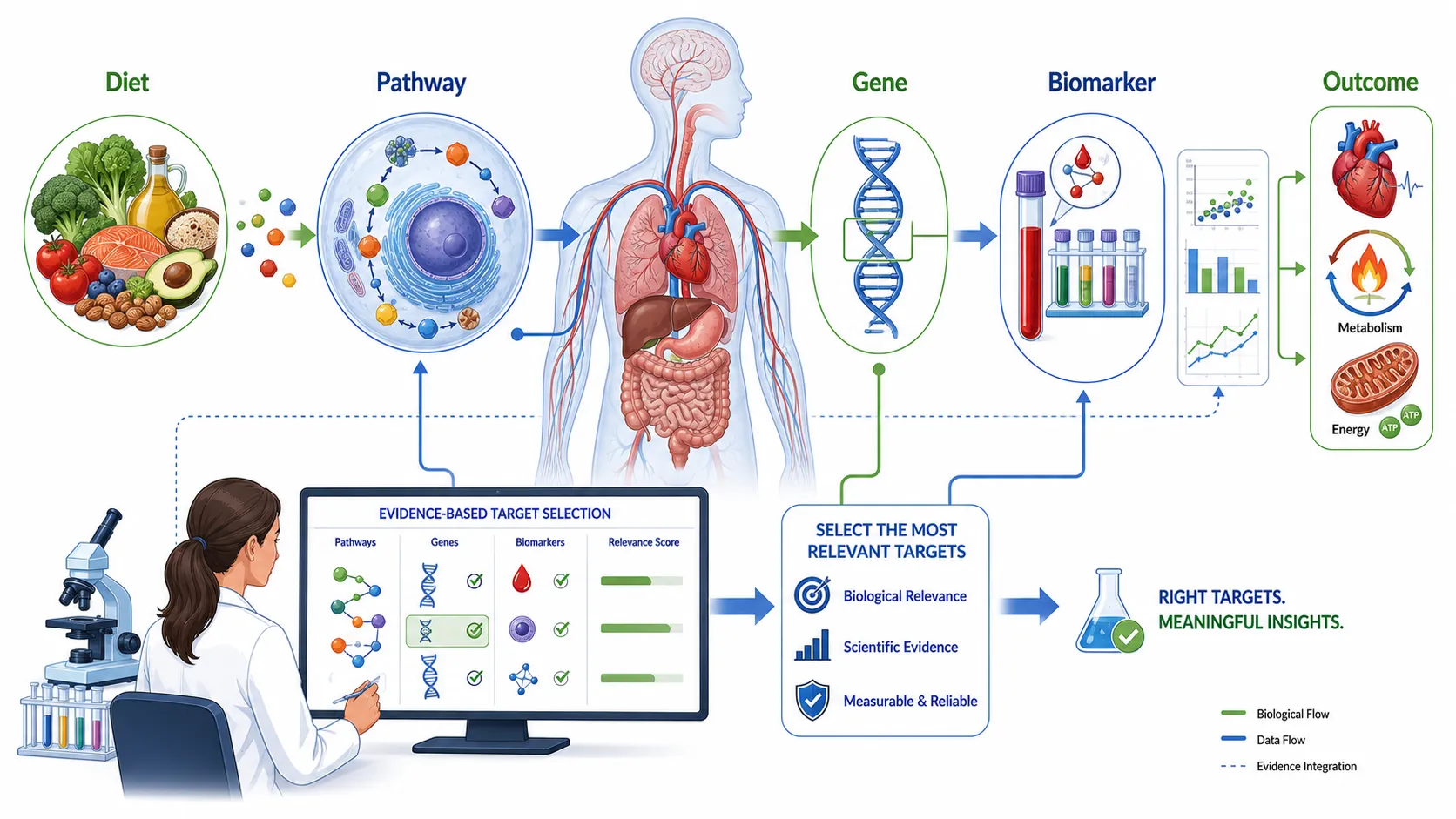
Key Definitions and Concepts
| Term | Definition | Relevance to Nutritional Research |
|---|---|---|
| Molecular biomarker | A measurable biological characteristic that indicates a physiological, metabolic or molecular process | Helps monitor biological responses to nutritional interventions |
| Genetic target | A specific gene, genetic variant or genomic region selected for investigation | May help explain differences in individual responses to diet |
| Physiological outcome | A measurable change in normal body function or biological activity | Indicates whether an intervention has produced a meaningful response |
| Biological plausibility | The extent to which a proposed relationship is consistent with known biological mechanisms | Supports the scientific justification for selecting a marker |
| Clinical validity | The extent to which a measurement is meaningfully associated with a relevant physiological or clinical outcome | Helps determine whether a biomarker is useful for interpretation |
| Analytical validity | The ability of a laboratory method to accurately and reliably measure the intended target | Ensures confidence in laboratory results |
| Sensitivity | The ability of a measurement to detect a biological change when one occurs | Important for monitoring intervention effects |
| Specificity | The ability of a measurement to reflect a particular biological process rather than unrelated influences | Helps improve interpretation |
| Genetic variation | Differences in DNA sequence between individuals | May contribute to variation in nutrient metabolism and response |
| Nutritional phenotype | An observable biological response associated with nutritional exposure | Connects dietary intake with measurable physiological outcomes |
1. Understanding the Purpose of Biomarker Selection
Biomarkers Must Match the Research Question
The first principle of biomarker selection is alignment. A biomarker should be selected because it helps answer the specific research question. Researchers should begin by identifying what physiological change they expect to investigate rather than beginning with a long list of available laboratory tests.
For example, consider a proposed study investigating whether a structured dietary pattern influences metabolic regulation. The research team may wish to understand whether the intervention affects glucose homeostasis, lipid metabolism or inflammatory activity. Each objective requires different measurements.
A poorly designed study may collect numerous biomarkers simply because laboratory testing is available. This can increase costs, complicate analysis and increase the risk of identifying chance associations.
A logically designed study instead asks:
What is the primary physiological process being investigated?
What biological mechanism is expected to connect the diet with the outcome?
Which biomarker most directly reflects that mechanism?
Is the biomarker sufficiently sensitive to detect change?
Is the measurement reliable and reproducible?
Can the result be meaningfully interpreted?
Is the biomarker appropriate for the study population?
Linking Exposure, Mechanism and Outcome
A useful framework involves connecting three major components:
Nutritional Exposure → Biological Mechanism → Physiological Outcome
For example:
Dietary modification → Altered nutrient signalling → Change in metabolic biomarker
This framework prevents researchers from selecting biomarkers without a clear scientific rationale.
The selection process should therefore involve:
Defining the dietary intervention.
Identifying the expected biological mechanism.
Identifying relevant molecular pathways.
Selecting biomarkers that reflect pathway activity.
Choosing measurable physiological outcomes.
Determining appropriate timing for measurement.
2. Categories of Molecular Biomarkers in Nutritional Studies
Biomarkers of Nutritional Exposure
These biomarkers provide information about whether a nutrient or food-related compound has entered the body or has been metabolically processed.
They may help researchers determine:
Whether participants were exposed to the intended nutritional intervention.
Whether self-reported dietary intake is consistent with biological evidence.
Whether nutrient absorption may have occurred.
Whether differences in exposure exist between participants.
Examples may include:
Circulating nutrient concentrations.
Metabolites associated with dietary intake.
Fatty acid profiles.
Selected vitamin-related measurements.
Mineral status indicators.
These markers can strengthen research because self-reported dietary information may contain recall or reporting errors.
Biomarkers of Physiological Response
These biomarkers indicate whether the body has responded to the nutritional exposure.
Relevant categories may include:
Glucose-related biomarkers.
Lipid-related biomarkers.
Inflammatory markers.
Oxidative stress indicators.
Hormonal measurements.
Metabolic intermediates.
The choice depends on the specific physiological hypothesis.
Biomarkers of Mechanism
Some biomarkers are selected because they provide insight into how an intervention may work.
For example, researchers may investigate:
Enzyme activity.
Gene expression.
Protein concentrations.
Cellular signalling molecules.
Metabolic pathway intermediates.
These measurements may help connect an observed physiological change with an underlying biological mechanism.
3. Establishing Biological Plausibility
Why Biological Plausibility Matters
A biomarker should ideally have a recognised relationship with the nutritional exposure and the proposed physiological outcome. Biological plausibility strengthens the scientific argument for inclusion.
For example, if a study investigates dietary influences on glucose metabolism, relevant measurements might be selected because they reflect aspects of glucose regulation rather than unrelated biological systems.
The rationale should be based on:
Established biochemical pathways.
Existing scientific literature.
Known nutrient functions.
Relevant physiological mechanisms.
Evidence from previous research.
Avoiding Weak Biological Assumptions
Researchers should avoid assuming that a measurable change automatically represents a meaningful physiological improvement.
A biomarker may:
Change temporarily.
Be influenced by unrelated factors.
Vary between individuals.
Reflect adaptation rather than improvement.
Be affected by medication or illness.
Therefore, interpretation should consider the wider biological context.
4. Selecting Biomarkers According to the Nutritional Intervention
Studies Involving Carbohydrate-Related Interventions
A study examining changes in carbohydrate intake may require biomarkers related to glucose regulation and metabolic response.
Potential areas of interest may include:
Circulating glucose.
Longer-term indicators of glucose exposure.
Insulin-related measurements.
Markers reflecting metabolic regulation.
Relevant lipid measurements.
The specific selection should depend on the intervention and research population.
Studies Involving Dietary Fat Modification
When investigating changes in dietary fat intake, researchers may consider biomarkers related to:
Lipid transport.
Fatty acid composition.
Lipoprotein metabolism.
Cellular lipid signalling.
Potential considerations include whether the research focuses on:
Short-term metabolic response.
Long-term physiological adaptation.
Specific dietary fatty acid patterns.
Genetic variation affecting lipid metabolism.
Studies Involving Protein or Amino Acid Interventions
Protein-related research may investigate:
Amino acid concentrations.
Nitrogen-related metabolism.
Protein turnover indicators.
Relevant metabolic pathways.
Researchers should ensure that selected measurements reflect the proposed biological mechanism rather than merely recording total protein intake.
Micronutrient Intervention Studies
Micronutrient research may require particular attention to biomarkers that distinguish between intake, body stores and functional biological effects.
Potential categories include:
Circulating nutrient levels.
Functional enzyme activity.
Metabolites influenced by nutrient availability.
Indicators of physiological function.
A single circulating concentration may not always provide a complete assessment of nutritional status.
5. Evaluating Analytical Validity
Accuracy and Reliability
A biomarker cannot provide meaningful information if the laboratory method used to measure it is unreliable.
Researchers should consider:
Accuracy.
Precision.
Repeatability.
Reproducibility.
Detection limits.
Laboratory quality procedures.
Analytical validity refers to whether the method accurately measures the intended biological target.
Pre-Analytical Variables
Laboratory results can be affected before the sample reaches the analytical stage.
Important variables include:
Timing of sample collection.
Fasting status where relevant.
Recent food intake.
Physical activity.
Sample handling.
Storage conditions.
Transport time.
A strong protocol should standardise these factors where scientifically appropriate.
Laboratory Quality Control
Important procedures include:
Use of validated methods.
Equipment calibration.
Internal quality controls.
External quality assessment where available.
Staff competency monitoring.
Documentation of deviations.
6. Sensitivity, Specificity and Responsiveness
Sensitivity to Biological Change
A useful biomarker should be capable of detecting the type and magnitude of change expected during the study.
For example, a short-term intervention may require a biomarker that responds within the study timeframe. A marker that changes only after prolonged exposure may not be suitable for a brief intervention.
Researchers should consider:
Expected intervention duration.
Expected biological response time.
Natural variability.
Laboratory measurement precision.
Specificity of Interpretation
Some biomarkers are influenced by multiple physiological processes. This does not automatically make them unsuitable, but interpretation should recognise potential limitations.
A biomarker may be affected by:
Acute illness.
Physical activity.
Medication.
Stress.
Hydration status.
Sleep.
Dietary intake.
Therefore, multiple complementary biomarkers may sometimes provide a more reliable interpretation than one measurement alone.
7. Selecting Appropriate Genetic Targets
The Purpose of Genetic Target Selection
Genetic targets should be selected because they are relevant to the biological question being investigated.
A genetic target may be selected because it:
Participates in nutrient metabolism.
Influences nutrient transport.
Affects enzymatic activity.
Influences metabolic signalling.
Has evidence of interaction with dietary exposure.
Contributes to variation in physiological response.
Candidate Gene Approaches
A candidate gene approach focuses on predefined genes with an established or plausible biological role.
Potential advantages include:
Clear scientific rationale.
Focused analysis.
Reduced analytical complexity.
Easier interpretation.
Potential limitations include:
Dependence on existing knowledge.
Risk of missing unexpected biological pathways.
Possibility of non-replication.
Genome-Wide Approaches
Broader genomic approaches may investigate a larger number of variants.
Potential advantages include:
Discovery potential.
Wider examination of genetic variation.
Identification of previously unrecognised associations.
Challenges include:
Large data volume.
Multiple testing issues.
Higher resource requirements.
Increased risk of false-positive findings without appropriate controls.
8. Connecting Genetic Targets to Nutritional Physiology
Nutrient Metabolism Pathways
Genetic targets should be connected to relevant biological functions.
Researchers may consider genes involved in:
Nutrient transport.
Enzyme production.
Cellular signalling.
Lipid metabolism.
Glucose regulation.
Vitamin metabolism.
Mineral transport.
Energy production.
The selection must be justified using scientific evidence rather than assumptions about genetic prediction.
From Genetic Variant to Physiological Outcome
A logical pathway may be represented as:
Genetic variation → Molecular effect → Altered biological pathway → Modified nutrient response → Measurable physiological outcome
However, each stage requires evidence. A genetic variant does not automatically produce a measurable physiological effect.
Researchers should investigate:
Whether the variant has known biological significance.
Whether the variant affects gene function or expression.
Whether the pathway is relevant to the intervention.
Whether the proposed outcome can be measured.
9. Gene Expression as a Research Target
Understanding Gene Expression
Gene expression refers to the process through which genetic information is used to produce functional RNA or proteins.
Nutritional exposures may influence cellular signalling and regulatory processes associated with gene expression.
Researchers may investigate:
Changes in expression patterns.
Differences between intervention groups.
Associations between dietary exposure and molecular response.
Important Limitations
Gene expression is:
Tissue-specific.
Time-dependent.
Influenced by environmental factors.
Sensitive to physiological conditions.
A measurement obtained from one tissue may not fully represent activity in another tissue.
Researchers must therefore justify:
The selected biological sample.
The timing of collection.
The relevance of the measured tissue.
10. Multi-Biomarker Approaches
Why One Biomarker May Be Insufficient
Complex nutritional responses may not be accurately represented by a single measurement.
For example, a physiological process may involve:
Nutrient exposure.
Hormonal regulation.
Cellular metabolism.
Inflammatory activity.
Genetic variation.
A multi-biomarker approach can provide a broader understanding.
Example Framework
A nutritional study may collect:
Dietary Data
Dietary intake assessment.
Intervention adherence information.
Exposure Biomarkers
Relevant nutrient-related measurements.
Physiological Biomarkers
Metabolic outcomes.
Molecular Biomarkers
Gene or protein-related measurements.
Genetic Information
Relevant variants or genomic characteristics.
The integration of these datasets may strengthen interpretation.
11. Timing and Frequency of Biomarker Measurement
Baseline Assessment
Baseline measurements establish the participant’s initial biological status.
Baseline data can help researchers:
Identify initial variation.
Adjust for pre-existing differences.
Evaluate change over time.
Interpret individual responses.
Follow-Up Measurements
The timing of follow-up depends on the expected mechanism.
Researchers should consider whether a biomarker is expected to change:
Within hours.
Over several days.
After several weeks.
Over longer periods.
Repeated measurement may provide better information about the pattern of response.
Practical Considerations
The measurement schedule should balance:
Scientific value.
Participant burden.
Cost.
Laboratory capacity.
Ethical considerations.
Collecting samples too frequently without scientific justification may create unnecessary participant burden.
12. Managing Confounding Variables
Why Confounding Affects Biomarker Interpretation
A biomarker may change for reasons unrelated to the intervention.
Potential confounders include:
Age.
Biological sex.
Baseline nutritional status.
Physical activity.
Medication use.
Smoking.
Alcohol intake.
Sleep patterns.
Acute illness.
Strategies for Management
Researchers may:
Collect relevant baseline information.
Standardise measurement conditions.
Use appropriate eligibility criteria.
Randomise participants where possible.
Adjust statistically for important factors.
Conduct sensitivity analyses.
Confounding should be addressed during study design rather than only after data collection.
13. Practical Example: Selecting Biomarkers for a Proposed Study
Research Scenario
A research team proposes a nutritional intervention designed to investigate changes in metabolic regulation among adults with differing baseline dietary patterns.
The research objectives include:
Assessing adherence to the intervention.
Monitoring metabolic response.
Investigating selected molecular pathways.
Exploring whether genetic variation contributes to differences in response.
Logical Selection Process
The research team should first identify:
1. Nutritional Exposure
What precisely is changing in the diet?
2. Expected Biological Mechanism
Which metabolic pathways may respond?
3. Physiological Outcome
What measurable change would indicate a relevant response?
4. Molecular Evidence
Which biomarkers can provide mechanistic information?
5. Genetic Targets
Which genes or variants have a scientifically supported relationship with the relevant pathway?
Possible Data Categories
The study could include:
Dietary intake measures.
Nutritional exposure biomarkers.
Metabolic biomarkers.
Selected molecular markers.
Carefully justified genetic targets.
The protocol should explain why every category contributes to answering the research question.
14. Ethical Considerations in Genetic Target Selection
Proportionality
Researchers should avoid collecting extensive genetic information that is unnecessary for the research objective.
The principle of proportionality requires consideration of:
Scientific necessity.
Participant privacy.
Data management capacity.
Potential risks.
Informed Consent for Genetic Analysis
Participants should understand:
What genetic information will be analysed.
Why it is being analysed.
How the data will be stored.
Who may access it.
Whether future research use is planned.
How potentially relevant findings will be managed.
Avoiding Genetic Determinism
Genetic information should not be presented as determining an individual’s future health with certainty.
Nutritional outcomes are influenced by:
Genetics.
Diet.
Physical activity.
Environment.
Physiological status.
Social and behavioural factors.
Professional communication should reflect this complexity.
15. Statistical Considerations for Biomarker and Genetic Data
Multiple Comparisons
Testing many biomarkers and genetic variants increases the possibility of chance findings.
Researchers should:
Define primary outcomes.
Limit unnecessary testing.
Use appropriate statistical procedures.
Distinguish exploratory findings from confirmatory results.
Correlated Biomarkers
Many biological markers are related to one another. Researchers should avoid treating every measurement as completely independent.
Appropriate analysis may consider:
Biological pathways.
Correlations between variables.
Multivariable models.
Predefined analytical frameworks.
Missing Data
Missing samples or incomplete dietary information can influence results.
The protocol should define:
How missing data will be recorded.
Reasons for missingness.
Planned analytical approaches.
Sensitivity analyses where appropriate.
16. Criteria for Justifying Final Biomarker Selection
Before finalising the research protocol, each biomarker should be evaluated against a structured set of questions.
Scientific Relevance
Does the biomarker address the research objective?
Is it connected to the proposed biological mechanism?
Is there sufficient scientific evidence supporting its use?
Analytical Quality
Can it be measured accurately?
Is the method validated?
Is laboratory capacity available?
Physiological Meaning
Does a change have a meaningful biological interpretation?
What factors may influence the result?
Is the biomarker sufficiently sensitive?
Practical Feasibility
Is collection practical?
What is the cost?
What is the participant burden?
Can the measurement schedule be implemented consistently?
Ethical Acceptability
Is the measurement necessary?
Are privacy risks appropriately managed?
Is informed consent adequate?
17. Key Benefits of Logical Biomarker and Genetic Target Selection
Careful selection improves both scientific quality and practical efficiency.
Research Benefits
Produces more focused research questions.
Improves the interpretation of findings.
Reduces unnecessary data collection.
Supports reproducibility.
Strengthens biological explanations.
Clinical and Translational Benefits
Appropriately designed research may:
Improve understanding of physiological responses to diet.
Identify meaningful biological response patterns.
Support future hypothesis development.
Contribute to evidence-based nutritional science.
However, research findings should not be translated into individual recommendations without sufficient validation.
Ethical Benefits
Focused selection:
Minimises unnecessary collection of sensitive genetic data.
Reduces participant burden.
Supports responsible data governance.
Improves transparency.
18. A Step-by-Step Procedure for Selecting Biomarkers and Genetic Targets
Step 1: Define the Research Question
Identify the exact physiological question the study intends to investigate.
Step 2: Identify the Nutritional Exposure
Specify the nutrient, food, dietary pattern or intervention.
Step 3: Map the Biological Mechanism
Identify relevant biochemical and physiological pathways.
Step 4: Select the Primary Outcome
Choose the most important measurable physiological response.
Step 5: Identify Supporting Biomarkers
Select additional markers that provide information about exposure, mechanism or response.
Step 6: Evaluate Analytical Validity
Confirm that the selected laboratory methods are reliable.
Step 7: Identify Relevant Genetic Targets
Select genes or variants based on biological relevance and scientific evidence.
Step 8: Evaluate Ethical Implications
Ensure genetic data collection is necessary and appropriately governed.
Step 9: Establish the Measurement Timeline
Determine when baseline and follow-up samples will be collected.
Step 10: Develop the Analysis Plan
Define how biomarkers and genetic information will be integrated and interpreted.
19. Critical Evaluation of Common Mistakes
Selecting Too Many Biomarkers
Collecting excessive measurements can create problems such as:
Increased cost.
Greater participant burden.
Complex analysis.
Increased risk of false-positive findings.
Researchers should prioritise markers that directly contribute to the study objectives.
Selecting Biomarkers Without a Mechanistic Rationale
A biomarker should not be included simply because it is commonly used.
The protocol should explain:
Why it was selected.
What process it represents.
How it relates to the intervention.
Overinterpreting Genetic Associations
A statistical association between a genetic variant and a dietary response does not necessarily demonstrate causation.
Interpretation should consider:
Biological plausibility.
Effect size.
Replication.
Population characteristics.
Potential confounding.
Ignoring Timing
A scientifically relevant biomarker may still be unsuitable if measured at the wrong time.
Researchers must align:
Intervention duration.
Biological response time.
Sample collection schedule.
Conclusion
The logical selection of molecular biomarkers and genetic targets is fundamental to accurately monitoring the physiological outcomes of nutritional research. Researchers must begin with a clear scientific question and develop a direct connection between the nutritional intervention, expected biological mechanism and measurable outcome.
Appropriate biomarkers should demonstrate scientific relevance, analytical validity and meaningful physiological interpretation. Genetic targets should be selected based on biological plausibility and credible evidence rather than assumptions that genetic information can independently predict nutritional outcomes.
A comprehensive approach may combine dietary information, exposure biomarkers, physiological measurements, molecular indicators and carefully justified genetic data. However, more measurements do not automatically produce better research. The strongest research protocols prioritise relevance, quality, feasibility and ethical responsibility.
By systematically evaluating each proposed biomarker and genetic target, researchers can improve the precision and interpretability of nutritional studies. This approach supports the responsible integration of molecular science and nutrition research while protecting participants and maintaining appropriate scientific standards.
3.Formulate a Rigorous Scientific Methodology to Effectively Isolate the Specific Effects of Diet on Gene Expression While Strictly Controlling for External Environmental Variables
Understanding how diet influences gene expression is a major objective within molecular nutrition and nutrigenomics research. However, identifying the specific effects of dietary exposure on gene expression is scientifically challenging because gene activity is influenced by many factors beyond food and nutrient intake. Physical activity, sleep, stress, medication, environmental exposures, age, biological variation and underlying health status can all affect molecular pathways and gene expression patterns.
A rigorous scientific methodology is therefore required to separate, as far as reasonably possible, the effects of the dietary intervention from the influence of external environmental variables. The purpose is not to create an unrealistic environment in which every external influence is removed. Instead, researchers must identify important sources of variation, control them through appropriate study design, measure them accurately and account for remaining influences during analysis.
A strong methodology should combine a clearly defined research question, a suitable experimental design, standardised dietary exposure, carefully selected biological samples, validated gene expression techniques, systematic environmental monitoring and transparent statistical analysis. These elements work together to improve internal validity and strengthen confidence that observed molecular changes are related to the nutritional intervention.
Key Definitions and Concepts
| Term | Definition | Importance in Diet–Gene Expression Research |
|---|---|---|
| Gene expression | The process through which genetic information is used to produce functional RNA or proteins | Provides a measurable molecular response to nutritional and environmental influences |
| Dietary exposure | The intake or controlled provision of foods, nutrients or dietary patterns being investigated | Represents the primary independent variable in the study |
| Environmental variable | An external factor that may influence biological outcomes | Must be controlled, measured or considered during analysis |
| Confounding variable | A factor associated with both the dietary exposure and the outcome that may distort interpretation | Can create misleading conclusions about dietary effects |
| Internal validity | The degree to which observed effects can reasonably be attributed to the intervention | A major objective of rigorous experimental methodology |
| Randomisation | The allocation of participants to groups using a predetermined random process | Helps reduce systematic differences between groups |
| Standardisation | The use of consistent procedures across participants and study periods | Reduces unnecessary variation |
| Gene expression profiling | The measurement of activity patterns across one or more genes | Enables assessment of molecular responses |
| Biological variability | Natural differences between and within individuals | Must be considered when interpreting molecular results |
| External validity | The extent to which findings may be applicable beyond the study population | Supports responsible interpretation and future application |
1. Defining the Scientific Problem and Research Question
Establishing a Precise Research Objective
The first stage in formulating a rigorous methodology is to define exactly what the study intends to investigate. A broad question such as whether “diet changes genes” is scientifically insufficient because diet contains multiple exposures and gene expression involves complex, tissue-specific biological processes.
The research question should identify:
The study population.
The specific dietary exposure.
The relevant comparison.
The biological sample.
The gene expression outcome.
The intended observation period.
A more focused question may examine whether a defined dietary modification is associated with measurable changes in selected gene expression pathways under standardised study conditions.
Developing Specific Research Objectives
The methodology should translate the main research question into measurable objectives.
Typical objectives may include:
To establish baseline dietary intake.
To standardise the nutritional intervention.
To measure baseline gene expression.
To monitor relevant environmental exposures.
To collect biological samples at predefined time points.
To compare gene expression changes between groups.
To assess whether observed changes remain after accounting for important confounders.
Clear objectives prevent unnecessary data collection and improve analytical focus.
Developing a Testable Hypothesis
The hypothesis should specify the expected relationship without assuming that the effect is already proven.
For example:
A defined dietary intervention will be associated with measurable changes in selected gene expression pathways compared with an appropriate control condition after controlling for major environmental and behavioural variables.
This type of hypothesis identifies:
The independent variable.
The expected molecular outcome.
The importance of environmental control.
2. Selecting an Appropriate Study Design
Why Study Design Is Critical
The ability to isolate dietary effects depends heavily on the research design. Different study designs provide different levels of control.
Possible designs include:
Randomised controlled trials.
Crossover intervention studies.
Controlled feeding studies.
Prospective observational studies.
Longitudinal cohort studies.
Laboratory-based mechanistic studies.
Where feasible and ethically appropriate, controlled intervention designs can provide stronger evidence regarding dietary effects.
Randomised Controlled Studies
Participants are allocated to intervention conditions using a random procedure.
Potential advantages include:
Reduction of selection bias.
Improved group comparability.
Better control of dietary exposure.
Stronger support for causal interpretation.
However, randomisation does not eliminate all variation. Researchers must still monitor:
Dietary adherence.
Environmental exposures.
Medication changes.
Physical activity.
Illness.
Crossover Studies
In crossover studies, participants may receive more than one dietary condition at different times.
This design can be useful because:
Each participant may serve as their own comparison.
Some individual biological differences are reduced.
Fewer participants may be required for certain research questions.
Important considerations include:
Adequate washout periods.
Carry-over effects.
Stable health conditions.
Consistent sample timing.
Controlled Feeding Studies
Controlled feeding studies provide a high level of dietary standardisation because researchers can define the foods and nutrients consumed.
Potential benefits include:
Greater control of nutrient exposure.
Reduced dietary reporting error.
Improved intervention consistency.
Limitations include:
Higher cost.
Reduced convenience.
Potentially lower generalisability.
Increased participant burden.
3. Standardising the Dietary Intervention
Defining the Exposure Precisely
A rigorous nutritional study must clearly describe what participants receive or consume.
The protocol should specify:
Foods included.
Nutrient composition.
Portion sizes.
Frequency of intake.
Intervention duration.
Preparation methods where relevant.
Permitted substitutions.
Monitoring procedures.
Without clear standardisation, it becomes difficult to determine what exposure produced an observed molecular response.
Controlling Dietary Variation
Dietary variation can be reduced using several strategies.
These may include:
Providing standardised meals.
Developing structured meal plans.
Using weighed food portions.
Providing detailed preparation instructions.
Restricting specific competing foods where justified.
Monitoring dietary records.
Using relevant nutritional biomarkers.
The level of control should be appropriate to the research question and ethical requirements.
Measuring Dietary Adherence
Researchers should not assume that participants follow dietary instructions perfectly.
Adherence may be monitored using:
Food diaries.
Repeated dietary recalls.
Digital food tracking.
Study visit records.
Returned food packaging.
Biological exposure markers.
Combining self-reported and objective methods can improve confidence.
4. Identifying External Environmental Variables
The Complexity of Environmental Influence
Gene expression responds to numerous internal and external influences. Researchers should identify variables that are most likely to affect the pathways under investigation.
Important environmental variables may include:
Physical activity.
Sleep duration.
Psychological stress.
Tobacco exposure.
Alcohol intake.
Medication use.
Acute infection.
Occupational exposures.
Air pollution.
Seasonal changes.
Not every possible environmental variable can be completely controlled. Researchers should prioritise variables with strong biological relevance.
Developing an Environmental Variable Framework
A practical approach is to classify variables into three groups.
Variables Controlled Directly
These may include:
Dietary intervention conditions.
Sample collection procedures.
Fasting conditions where appropriate.
Timing of clinical visits.
Variables Measured and Adjusted
These may include:
Physical activity.
Sleep patterns.
Medication use.
Stress indicators.
Variables Recorded as Potential Limitations
Some environmental exposures may be difficult to measure accurately. These should be acknowledged during interpretation.
5. Controlling Physical Activity
Why Physical Activity Matters
Physical activity can influence:
Energy metabolism.
Hormonal activity.
Inflammatory processes.
Cellular signalling.
Gene expression.
If participants in one dietary group exercise substantially more than participants in another group, observed molecular differences may not be attributable solely to diet.
Control Strategies
Researchers may:
Record baseline activity levels.
Provide standardised activity guidance.
Ask participants to maintain usual activity.
Use activity monitors where feasible.
Record significant changes in exercise patterns.
The chosen approach should match the study design.
6. Controlling Sleep and Circadian Influences
Biological Importance of Timing
Gene expression is not static throughout the day. Some biological processes demonstrate circadian patterns.
Therefore, inconsistent sample collection times may introduce unnecessary variation.
Researchers should consider:
Time of day.
Sleep duration.
Sleep quality.
Shift work.
Recent travel across time zones.
Standardising Sample Timing
Possible procedures include:
Collecting samples at similar times of day.
Recording recent sleep duration.
Providing pre-visit instructions.
Recording shift-work status.
This improves comparability between measurements.
7. Managing Psychological and Physiological Stress
Stress as a Molecular Influencer
Stress-related physiological responses may affect:
Hormonal signalling.
Inflammatory pathways.
Energy metabolism.
Cellular activity.
Researchers should therefore consider whether major stress differences could influence gene expression outcomes.
Relevant factors may include:
Acute stressful events.
Chronic occupational stress.
Major life changes.
Sleep disruption.
The purpose is not necessarily to exclude all individuals experiencing stress, but to understand its potential influence.
Measurement Approaches
Potential approaches include:
Validated questionnaires.
Structured participant reporting.
Relevant physiological indicators where justified.
Recording major events during the study period.
8. Controlling Medication and Health Status
Medication Effects
Many medications can affect metabolic and molecular pathways.
The protocol should establish procedures for:
Recording current medication.
Recording changes during the study.
Identifying medications likely to affect primary outcomes.
Establishing scientifically justified exclusion criteria.
Researchers should avoid unnecessary exclusion but must protect the validity of the study.
Acute Illness
Acute infection or inflammation can influence molecular measurements.
Possible protocol procedures include:
Screening participants before sample collection.
Recording recent illness.
Postponing sampling where scientifically appropriate.
Defining criteria for temporary exclusion from analysis.
9. Selecting the Appropriate Biological Sample
Tissue Specificity
Gene expression differs substantially between tissues. A sample should therefore be selected according to the biological question.
Potential samples may include:
Blood-derived cells.
Buccal cells.
Tissue samples where clinically and ethically justified.
Researchers must avoid assuming that gene expression measured in one tissue fully represents every biological tissue.
Factors Influencing Sample Selection
The choice should consider:
Biological relevance.
Participant safety.
Ethical acceptability.
Practical feasibility.
Sample stability.
Analytical requirements.
Standardised Sample Collection
The protocol should define:
Collection method.
Timing.
Storage conditions.
Transport procedures.
Processing time.
Laboratory quality controls.
Consistency is essential because poor sample handling can alter molecular measurements.
10. Selecting Gene Expression Measurement Techniques
Targeted Gene Expression Methods
Targeted methods may be appropriate when researchers have predefined genes or pathways of interest.
Potential benefits include:
Focused analysis.
Clear interpretation.
Lower data complexity.
These methods are suitable when biological evidence supports specific molecular targets.
Broad Expression Profiling
Broader approaches may investigate expression patterns across large numbers of genes.
Potential benefits include:
Discovery of unexpected pathways.
Comprehensive pathway analysis.
Identification of broader molecular responses.
Challenges include:
Large data volume.
Multiple statistical comparisons.
Greater analytical complexity.
Method Selection Principles
The selected method should depend on:
The research question.
Available resources.
Sample quality.
Number of targets.
Required sensitivity.
Analytical expertise.
11. Randomisation and Allocation Procedures
The Purpose of Randomisation
Randomisation aims to distribute known and unknown factors more evenly between study groups.
This can reduce systematic differences related to:
Baseline health.
Lifestyle.
Genetic background.
Environmental factors.
Good Allocation Practice
The methodology should describe:
How randomisation will be generated.
Who will manage allocation.
Whether allocation concealment is possible.
How group assignment will be documented.
Transparent procedures improve methodological quality.
12. Blinding and Reducing Observer Bias
Blinding in Nutritional Research
Complete blinding is not always possible because participants may recognise dietary differences.
However, researchers may still reduce bias by:
Blinding laboratory staff to group allocation.
Coding biological samples.
Using standardised analysis procedures.
Predefining outcome measures.
Why This Matters
Knowledge of group assignment can unintentionally influence:
Sample handling.
Data processing.
Interpretation.
Objective laboratory procedures can help reduce this risk.
13. Baseline Assessment and Repeated Measurement
Establishing Baseline Conditions
Baseline measurement is essential for understanding individual variation before intervention.
Researchers may assess:
Dietary intake.
Health status.
Physical activity.
Sleep.
Medication use.
Relevant biomarkers.
Baseline gene expression.
Repeated Measurements
Gene expression responses may vary over time. A single follow-up measurement may not capture the complete response.
Repeated measurements can help identify:
Early molecular responses.
Sustained adaptations.
Temporary fluctuations.
Individual response patterns.
The schedule should be scientifically justified and should not create unnecessary burden.
14. Statistical Strategies for Isolating Dietary Effects
Predefined Analysis Plans
Researchers should define the primary analytical approach before examining final outcomes.
The analysis plan may include:
Primary gene expression outcomes.
Secondary outcomes.
Covariates.
Environmental variables.
Subgroup analyses.
Missing data procedures.
Adjusting for Measured Variables
Statistical models may account for measured factors such as:
Age.
Baseline values.
Physical activity.
Sleep.
Medication use.
However, statistical adjustment cannot fully correct poor study design or unmeasured confounding.
Within-Participant Analysis
Repeated measurement designs can compare changes within individuals over time.
This may help account for:
Stable individual biological differences.
Baseline variation.
The method must still account for time-dependent environmental changes.
15. Quality Assurance and Data Integrity
Standard Operating Procedures
Every major research process should be documented.
Procedures may cover:
Participant recruitment.
Dietary delivery.
Environmental monitoring.
Sample collection.
Laboratory processing.
Data entry.
Statistical analysis.
Data Verification
Quality procedures may include:
Double-checking data.
Electronic validation rules.
Laboratory quality controls.
Audit trails.
Secure data storage.
High-quality data management supports reproducibility.
16. Practical Research Scenario
Proposed Study
A research team wants to investigate whether a defined dietary pattern influences selected gene expression pathways associated with nutrient metabolism.
The research question requires the team to separate dietary effects from environmental influences.
Methodological Framework
The study could include:
Clearly defined eligibility criteria.
Random allocation where appropriate.
A standardised dietary intervention.
Baseline dietary assessment.
Monitoring of adherence.
Standardised biological sample collection.
Measurement of selected environmental variables.
Blinded laboratory analysis where possible.
Predefined statistical models.
Environmental Control Plan
The team could:
Control directly:
Dietary composition.
Sample collection timing.
Laboratory procedures.
Measure continuously or repeatedly:
Physical activity.
Sleep.
Medication changes.
Record and consider during interpretation:
Acute illness.
Major stress events.
Unavoidable environmental exposures.
This structured approach improves confidence in the results without making unrealistic claims of complete environmental control.
17. Key Benefits of a Rigorous Methodology
Improved Internal Validity
A carefully controlled methodology improves the ability to associate observed molecular changes with the dietary intervention.
Benefits include:
Reduced confounding.
Improved group comparability.
More reliable measurements.
Greater interpretative confidence.
Better Reproducibility
Clearly documented methods enable other researchers to:
Understand the study.
Repeat procedures.
Compare findings.
Evaluate methodological quality.
Stronger Evidence for Nutrition Science
Rigorous methods can help distinguish between:
Temporary associations.
Meaningful biological responses.
Potential causal effects.
Responsible Use of Molecular Data
Careful methodology reduces the risk of:
Overinterpretation.
False-positive findings.
Unsupported biological claims.
18. Common Methodological Challenges
Incomplete Dietary Adherence
Participants may not follow dietary instructions consistently.
Possible solutions include:
Clear participant education.
Regular contact.
Practical meal guidance.
Objective exposure measurements where possible.
Unmeasured Environmental Exposures
Not every environmental variable can be measured.
Researchers should:
Prioritise important variables.
Acknowledge remaining limitations.
Avoid claiming complete control.
High Biological Variability
Individuals naturally differ in molecular responses.
Researchers may address this through:
Adequate sample size.
Repeated measurement.
Appropriate statistical models.
Careful participant characterisation.
Multiple Testing
Large-scale gene expression analysis can produce many statistical comparisons.
Researchers should:
Predefine primary outcomes.
Use appropriate statistical correction.
Clearly label exploratory findings.
19. Step-by-Step Scientific Methodology
Step 1: Define the Dietary Exposure
Specify exactly what dietary factor will be investigated.
Step 2: Define the Molecular Outcome
Identify the gene expression pathway or molecular response of interest.
Step 3: Select an Appropriate Study Design
Choose a design capable of controlling important sources of variation.
Step 4: Establish Participant Criteria
Define scientifically justified inclusion and exclusion criteria.
Step 5: Standardise the Intervention
Ensure dietary exposure is delivered consistently.
Step 6: Identify Environmental Variables
Classify variables as:
Directly controlled.
Measured and statistically considered.
Recorded as limitations.
Step 7: Establish Sample Procedures
Standardise sample type, timing, collection and storage.
Step 8: Select Validated Analytical Techniques
Choose methods appropriate for the research question.
Step 9: Monitor Adherence and Environmental Change
Collect relevant information throughout the study.
Step 10: Implement Quality Assurance
Monitor protocol adherence and laboratory performance.
Step 11: Apply the Predefined Analysis Plan
Evaluate the relationship between diet and gene expression while accounting for measured environmental influences.
Step 12: Interpret Findings Critically
Consider:
Effect size.
Biological plausibility.
Consistency.
Confounding.
Study limitations.
20. Critical Evaluation of Environmental Control
Complete Control Is Rarely Possible
A common misconception is that rigorous research requires the elimination of every external influence. In human nutritional research, this is rarely possible.
People live in complex environments and experience variation in:
Daily routines.
Physical activity.
Sleep.
Stress.
Environmental exposure.
Scientific rigour therefore involves managing variation appropriately rather than claiming that it does not exist.
The Balance Between Control and Realism
Highly controlled research may improve internal validity but reduce real-world applicability.
Less controlled studies may better reflect everyday conditions but can make causal interpretation more difficult.
Researchers should therefore balance:
Experimental control.
Participant feasibility.
Ethical responsibility.
External validity.
The most appropriate balance depends on the research objective.
Conclusion
Formulating a rigorous scientific methodology to isolate the effects of diet on gene expression requires careful control, measurement and interpretation of external environmental variables. A strong methodology begins with a precise research question and continues through the selection of an appropriate study design, standardised dietary intervention, relevant biological samples and validated molecular techniques.
Environmental factors such as physical activity, sleep, stress, medication use and acute illness can influence molecular outcomes and must therefore be considered throughout the research process. Researchers should identify which variables can be directly controlled, which should be measured and statistically considered, and which unavoidable factors should be recognised as limitations.
Randomisation, standardisation, repeated measurement, blinded laboratory procedures and predefined analytical plans can strengthen internal validity. However, statistical techniques cannot compensate fully for poor study design or uncontrolled bias.
The strongest nutritional genomics research recognises the complexity of human biology. Rather than making unrealistic claims that diet can be studied independently of all external influences, rigorous researchers develop transparent methods that minimise confounding and clearly acknowledge uncertainty.
By integrating controlled dietary interventions with systematic environmental monitoring and high-quality gene expression analysis, researchers can generate more reliable evidence about how nutrition influences molecular pathways. This methodological approach supports reproducible, ethical and scientifically robust research in genomics, molecular nutrition and personalised nutritional science.
4.Design a Robust Clinical Trial Framework That Systematically Utilises Nutrigenetic Profiling to Stratify Study Participants
Nutrigenetics examines how inherited genetic variation may influence an individual’s response to nutrients, foods and dietary patterns. As nutritional science moves towards more personalised approaches, clinical trials increasingly need to consider whether participants with different genetic profiles respond differently to the same intervention. A robust clinical trial framework can therefore use nutrigenetic profiling to stratify participants into scientifically relevant groups while maintaining rigorous ethical, methodological and statistical standards.
Participant stratification refers to the systematic grouping of participants according to predefined characteristics that may influence the study outcome. In nutrigenetic research, these characteristics may include specific genetic variants, combinations of variants or carefully justified genetic risk profiles relevant to nutrient metabolism. The purpose is not to assume that a genetic variant determines an individual’s health outcome. Instead, stratification allows researchers to investigate whether inherited biological differences are associated with variations in physiological or metabolic responses to a controlled nutritional intervention.
Designing such a trial requires more than collecting genetic data and dividing participants into groups. Researchers must establish a biologically plausible rationale for selecting genetic markers, define clear eligibility criteria, protect genetic privacy, avoid inappropriate genetic discrimination, control for confounding factors and ensure that the statistical analysis is sufficiently powered to investigate differences between strata. The framework must also distinguish between exploratory findings and clinically meaningful evidence.
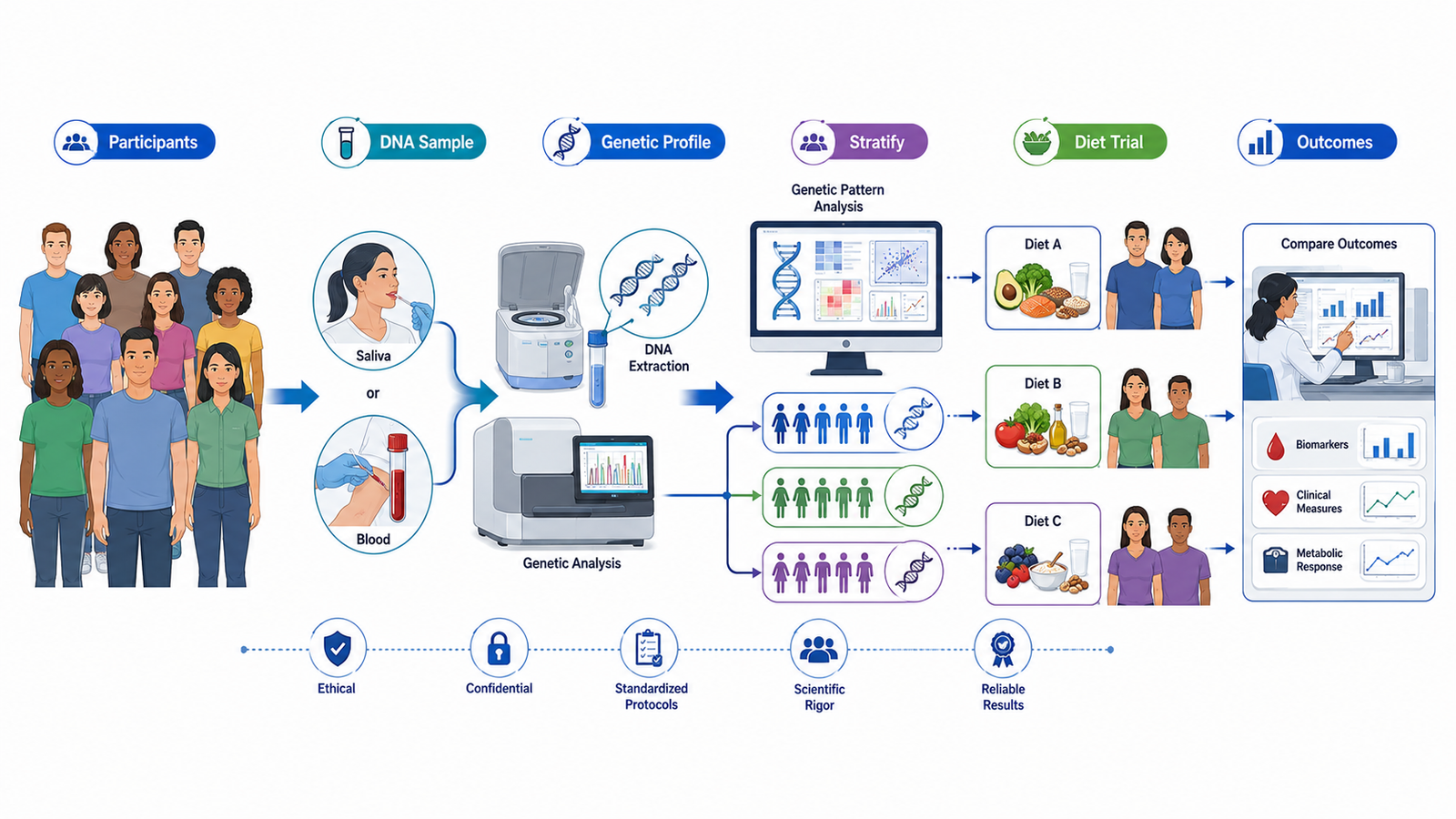
Key Definitions and Concepts
| Term | Definition | Relevance to Nutrigenetic Clinical Trials |
|---|---|---|
| Nutrigenetics | The study of how inherited genetic variation may influence individual responses to nutrients and dietary exposures | Provides the scientific basis for investigating differential dietary responses |
| Genetic variant | A difference in DNA sequence between individuals | May influence nutrient metabolism, transport or biological response |
| SNP | A single nucleotide polymorphism involving variation at one DNA position | Commonly investigated in nutrigenetic research |
| Participant stratification | The systematic classification of participants into predefined subgroups | Enables comparison of responses across relevant genetic profiles |
| Genotype | The genetic variant or allele combination carried by an individual | Can be used as a predefined stratification factor |
| Phenotype | An observable biological or physiological characteristic | Helps connect genetic variation with measurable outcomes |
| Gene–diet interaction | A situation in which the effect of a dietary exposure differs according to genetic variation | A central question in nutrigenetic trial design |
| Randomisation | Allocation of participants to intervention groups using a random process | Reduces systematic allocation bias |
| Confounding | Distortion of an observed relationship by another associated factor | Must be controlled during design and analysis |
| Genetic risk profile | A defined combination of genetic information associated with a biological characteristic | Requires strong scientific justification before clinical interpretation |
| Clinical endpoint | A predefined health or physiological outcome used to assess intervention effects | Determines the practical value of the trial |
| Statistical power | The probability of detecting a meaningful effect when one exists | Essential when analysing genetic subgroups |
1. Understanding the Purpose of Nutrigenetic Participant Stratification
Moving Beyond the “One Diet Fits All” Assumption
Traditional nutritional clinical trials often evaluate the average effect of an intervention across an entire study population. This approach can provide valuable evidence, but an average result may conceal meaningful variation between individuals. Some participants may demonstrate a substantial physiological response, while others may experience little measurable change.
Nutrigenetic profiling offers a possible method for investigating whether part of this variation is associated with inherited biological differences.
A nutrigenetic clinical trial may therefore ask:
Do participants with different genotypes respond differently to the same dietary intervention?
Does genetic variation influence nutrient absorption or metabolism?
Can predefined genetic subgroups explain differences in physiological outcomes?
Does a specific dietary intervention show greater benefit in one genetically defined group?
Are observed genetic differences biologically plausible and reproducible?
The central aim is to investigate variation scientifically rather than to make deterministic claims about genes.
Stratification as a Research Tool
Participant stratification should improve the scientific precision of a trial.
A carefully designed stratification framework may help researchers:
Explore biologically plausible differences in response.
Reduce imbalance between relevant participant groups.
Investigate potential gene–diet interactions.
Improve interpretation of heterogeneous responses.
Generate evidence for future personalised nutrition research.
However, inappropriate stratification can create problems. If too many genetic subgroups are created from a small participant sample, statistical power may be reduced and the risk of false findings may increase.
2. Establishing a Clear Clinical Research Question
Defining the Population, Intervention and Outcome
The clinical trial framework should begin with a precise research question.
A structured approach should identify:
The target population.
The nutritional intervention.
The comparison condition.
The genetic factor of interest.
The primary outcome.
The study duration.
For example, a trial might investigate whether participants with predefined variants in a biologically relevant nutrient metabolism pathway demonstrate different responses to a standardised dietary intervention.
The question should be based on evidence rather than on the assumption that every genetic variant has practical nutritional significance.
Developing a Scientifically Justified Hypothesis
The hypothesis should clearly distinguish between the dietary effect and the possible modifying effect of genotype.
A conceptual hypothesis may be:
The physiological response to a defined dietary intervention differs according to a pre-specified genetic profile involved in the relevant metabolic pathway.
The hypothesis should specify:
The exposure.
The molecular or physiological mechanism.
The genotype of interest.
The measurable outcome.
3. Selecting Appropriate Nutrigenetic Markers
Biological Plausibility
Genetic markers should not be selected simply because they are commercially available or frequently discussed in personalised nutrition marketing. The selected variant should have a reasonable biological relationship with the nutrient or physiological pathway under investigation.
Researchers should consider whether the genetic target is related to:
Nutrient digestion.
Nutrient absorption.
Transport processes.
Enzyme activity.
Cellular metabolism.
Receptor signalling.
Regulation of metabolic pathways.
Evidence-Based Marker Selection
The selection process should review:
Biological mechanisms.
Previous research findings.
Population relevance.
Reproducibility of associations.
Strength of available evidence.
Clinical significance.
A single preliminary association is generally insufficient to justify strong clinical conclusions.
Avoiding Excessive Genetic Testing
Testing a very large number of variants without a clear hypothesis may increase the risk of:
Multiple testing problems.
False-positive findings.
Difficult interpretation.
Unnecessary collection of sensitive genetic data.
The most rigorous framework therefore prioritises scientifically justified targets.
4. Defining the Participant Population
Establishing Eligibility Criteria
Eligibility criteria should be related to the study objective rather than designed merely to produce a highly selective population.
Researchers may consider:
Age range.
Sex where biologically relevant.
Baseline health status.
Nutritional status.
Existing medical conditions.
Medication use.
Pregnancy status where relevant.
Ability to follow the dietary intervention.
Representativeness and Diversity
Genetic variation and dietary patterns differ across populations. A trial should therefore consider whether the participant population is sufficiently diverse and appropriate for the intended research question.
Important considerations include:
Population ancestry and genetic diversity.
Dietary habits.
Environmental conditions.
Access to intervention foods.
Social and cultural relevance.
Researchers must avoid treating ancestry as a simple substitute for genotype. Individual genetic profiling and careful population analysis are distinct scientific processes.
5. Designing the Nutrigenetic Profiling Process
Genetic Sample Collection
The clinical trial protocol should clearly describe how genetic samples will be collected.
Possible biological materials may include:
Saliva.
Buccal cell samples.
Blood samples.
The chosen method should be:
Scientifically suitable.
Safe.
Ethically acceptable.
Appropriate for the intended analysis.
Laboratory Quality Procedures
Genetic data quality is fundamental. The framework should include procedures for:
Sample identification.
Secure coding.
Prevention of contamination.
Sample storage.
Laboratory validation.
Quality assurance.
Errors in genotype classification can directly affect participant stratification and invalidate later analysis.
Data Processing and Verification
Before stratification, researchers should establish quality-control procedures.
These may include:
Checking sample quality.
Confirming genotype calls.
Reviewing missing data.
Identifying technical inconsistencies.
Applying predefined exclusion procedures.
The analytical process should be transparent and reproducible.
6. Developing a Participant Stratification Strategy
Pre-Specified Stratification
The stratification strategy should be defined before outcome analysis.
Researchers should clearly state:
Which genetic variants will be used.
How genotypes will be classified.
Which groups will be compared.
Why the grouping is biologically justified.
Pre-specification reduces the risk of creating subgroups after results are known simply because they appear statistically interesting.
Simple and Scientifically Defensible Groups
A trial may classify participants according to relevant genotype categories.
However, grouping must consider:
The frequency of each genotype.
Expected participant numbers.
Biological interpretation.
Statistical power.
Creating numerous small groups can weaken the study.
Stratification Before Randomisation
In some trials, genetic strata may be established before participants are randomly allocated to dietary intervention groups.
This can help ensure that relevant genetic profiles are reasonably distributed across interventions.
For example:
Participants undergo consent and baseline assessment.
Genetic profiling is completed.
Participants are classified into predefined strata.
Randomisation occurs within each stratum.
Dietary interventions are delivered.
Outcomes are compared according to the pre-specified analysis plan.
This approach can reduce imbalance in important genetic characteristics.
7. Randomisation Within Genetic Strata
Why Stratified Randomisation Is Useful
If genotype is considered an important potential modifier of dietary response, simple randomisation may occasionally produce unequal distribution of relevant genotypes between intervention groups.
Stratified randomisation can improve balance.
The general process involves:
Identifying the predefined genetic stratum.
Creating an allocation process within that stratum.
Randomly assigning participants to intervention conditions.
Maintaining Methodological Rigour
Randomisation procedures should remain independent from outcome assessment.
The framework should define:
Allocation generation methods.
Allocation concealment where feasible.
Personnel responsible for randomisation.
Documentation procedures.
Genetic information should not be used to manipulate allocation in a way that introduces bias.
8. Standardising the Nutritional Intervention
Consistent Dietary Exposure
A nutrigenetic trial must carefully define the intervention.
The protocol should specify:
Nutrient composition.
Foods provided or recommended.
Portion sizes.
Frequency.
Duration.
Preparation methods.
Adherence requirements.
The intervention must be consistent enough to allow researchers to evaluate whether genotype modifies response.
Monitoring Adherence
Adherence should be assessed rather than assumed.
Methods may include:
Food records.
Digital dietary monitoring.
Dietary recalls.
Study meal distribution records.
Relevant nutritional biomarkers.
Combining methods can improve confidence.
9. Selecting Appropriate Clinical and Molecular Outcomes
Primary Outcomes
The primary outcome should directly address the research question.
Depending on the study objective, outcomes may include:
Metabolic biomarkers.
Physiological measurements.
Nutrient status indicators.
Molecular pathway responses.
The primary outcome should be selected before data collection.
Secondary Outcomes
Secondary outcomes may provide additional information regarding:
Safety.
Adherence.
Mechanistic changes.
Individual variation.
Longer-term physiological responses.
Secondary analyses should not be presented as equivalent to primary outcomes unless they were pre-specified and adequately powered.
10. Measuring Baseline Characteristics
Why Baseline Data Matter
Participants differ in more than genotype.
Baseline assessment may include:
Dietary intake.
Body composition where appropriate.
Physical activity.
Sleep patterns.
Relevant health indicators.
Medication use.
Nutritional biomarkers.
These factors may influence the response to dietary intervention.
Establishing Comparable Groups
Baseline information enables researchers to determine whether:
Genetic strata differ systematically.
Intervention groups are reasonably balanced.
Important confounders require adjustment.
Genetic stratification should therefore complement, rather than replace, comprehensive participant assessment.
11. Controlling Environmental and Behavioural Confounders
Environmental Variables Affect Nutritional Responses
A participant’s response to diet may be influenced by multiple factors.
Important variables may include:
Physical activity.
Sleep.
Smoking.
Alcohol intake.
Psychological stress.
Medication changes.
Acute illness.
A rigorous trial should identify these variables in advance.
Strategies for Control
Researchers may:
Standardise important procedures.
Record lifestyle behaviours.
Provide consistent participant instructions.
Measure major confounders.
Adjust statistically where appropriate.
Complete environmental control is rarely possible. The aim is to minimise and understand confounding.
12. Statistical Planning and Sample Size
The Challenge of Genetic Subgroups
Nutrigenetic trials often require larger samples because participants are divided into genetic subgroups.
For example, if a relatively uncommon genotype is of interest, only a small proportion of screened participants may qualify for that subgroup.
The study must therefore consider:
Variant frequency.
Number of intervention groups.
Expected effect size.
Participant dropout.
Required statistical power.
Planning for Interaction Analysis
A major question may be whether the effect of diet differs according to genotype.
This requires analysis of a potential interaction between:
Dietary intervention.
Genetic profile.
Outcome.
Detecting interactions may require more participants than detecting an overall intervention effect.
Avoiding Underpowered Subgroup Claims
Researchers should not make strong conclusions based on very small genetic subgroups.
Warning signs include:
Wide confidence intervals.
Unstable estimates.
Inconsistent results.
Results that cannot be replicated.
13. Ethical Requirements for Genetic Research
Informed Consent
Participants should understand:
What genetic information will be collected.
Why it is being collected.
How it will be analysed.
Who may access it.
How long it will be stored.
Whether data may be used in future research.
Consent should be clear and appropriate to the research context.
Genetic Privacy
Genetic information is sensitive because it may reveal information beyond the immediate research question.
The framework should establish:
Secure data storage.
Controlled access.
Data coding or pseudonymisation.
Appropriate retention procedures.
Incidental Findings
The protocol should consider the possibility of unexpected findings.
Researchers should define:
Whether certain findings will be reviewed.
Under what circumstances information may be communicated.
What professional support is available where appropriate.
14. Blinding and Bias Reduction
Blinding Genetic Information
Where feasible, researchers assessing clinical outcomes may be blinded to participant genotype.
This can reduce the possibility that expectations influence:
Outcome measurement.
Participant interaction.
Interpretation.
Laboratory Blinding
Laboratory samples may be coded so that analysts do not know:
Intervention group.
Participant identity.
Outcome status.
Blinding may not always be possible at every stage, but potential sources of bias should be actively considered.
15. Data Management and Security
Separating Identifiers From Genetic Data
A secure clinical trial framework should separate direct personal identifiers from research datasets where possible.
This may involve:
Participant identification codes.
Restricted access systems.
Encrypted storage.
Controlled data transfer.
Data Governance
The protocol should clearly define:
Who owns the data.
Who can access it.
How it may be shared.
How future use will be governed.
Good governance protects participants and strengthens research credibility.
16. Practical Clinical Trial Scenario
Research Question
A research team wants to investigate whether a structured dietary intervention produces different metabolic responses among participants with predefined nutrigenetic profiles.
Proposed Trial Framework
The study could follow these stages:
Recruit eligible participants.
Obtain informed consent for clinical and genetic data.
Collect baseline health and dietary information.
Obtain genetic samples.
Perform validated nutrigenetic analysis.
Classify participants into predefined genetic strata.
Randomise participants within each stratum.
Deliver a standardised dietary intervention.
Monitor adherence and environmental variables.
Collect follow-up clinical and molecular outcomes.
Analyse overall and genotype-specific responses.
Example of Participant Flow
Stage 1: Recruitment
Participants are assessed against predefined eligibility criteria.
Stage 2: Baseline Assessment
Researchers record:
Health characteristics.
Dietary habits.
Lifestyle factors.
Relevant biomarkers.
Stage 3: Genetic Profiling
Samples are processed using validated laboratory procedures.
Stage 4: Stratification
Participants are placed into predefined genetic categories based on the research protocol.
Stage 5: Randomisation
Participants are randomly assigned within genetic strata.
Stage 6: Intervention
The dietary intervention is delivered consistently.
Stage 7: Monitoring
Researchers monitor:
Adherence.
Health changes.
Environmental variables.
Adverse events.
Stage 8: Outcome Assessment
Primary and secondary outcomes are measured according to predefined procedures.
Stage 9: Statistical Analysis
Researchers evaluate:
Overall dietary effects.
Differences between genetic strata.
Potential gene–diet interactions.
17. Key Benefits of Nutrigenetic Stratification
Improved Understanding of Individual Variation
Stratification can help researchers investigate why participants may respond differently to the same intervention.
Potential benefits include:
Identification of heterogeneous responses.
Improved biological interpretation.
More targeted future research.
Better Trial Balance
Stratified randomisation can help distribute relevant genetic characteristics more evenly.
Potential Advancement of Personalised Nutrition
High-quality trials may contribute evidence regarding whether personalised dietary strategies provide benefits beyond general dietary recommendations.
However, this evidence must be based on:
Replication.
Biological plausibility.
Clinically meaningful outcomes.
18. Common Challenges and Limitations
Small Genetic Subgroups
Rare variants can produce very small groups.
Possible consequences include:
Reduced statistical power.
Unstable estimates.
Increased uncertainty.
Overinterpretation of Genetic Effects
A genetic association does not necessarily establish a clinically useful dietary recommendation.
Researchers should distinguish between:
Statistical association.
Biological relevance.
Clinical significance.
Population-Specific Findings
A finding observed in one population may not automatically apply to another population with different genetic backgrounds or environmental conditions.
Complexity of Gene–Environment Interactions
Dietary response is influenced by multiple factors.
These may include:
Multiple genes.
Dietary patterns.
Lifestyle.
Microbiological factors.
Health status.
Environmental exposure.
A single genetic marker rarely explains the complete response.
19. Step-by-Step Framework for Designing the Trial
Step 1: Define the Clinical Question
Clearly specify the dietary intervention, genetic factor and outcome.
Step 2: Review Existing Evidence
Evaluate biological plausibility and previous findings.
Step 3: Select Genetic Targets
Choose scientifically justified variants.
Step 4: Develop Ethical Procedures
Prepare informed consent, privacy and data governance processes.
Step 5: Define the Study Population
Establish clear and fair eligibility criteria.
Step 6: Calculate Required Sample Size
Consider genetic subgroup frequency and interaction testing.
Step 7: Establish Nutrigenetic Profiling Procedures
Use validated collection and laboratory methods.
Step 8: Define Genetic Strata
Pre-specify how participants will be grouped.
Step 9: Randomise Within Strata
Maintain balanced intervention allocation.
Step 10: Standardise the Intervention
Ensure consistent dietary exposure.
Step 11: Monitor Adherence and Confounders
Record factors that may influence outcomes.
Step 12: Measure Outcomes
Use validated clinical and molecular methods.
Step 13: Apply the Statistical Plan
Assess overall and genotype-specific responses.
Step 14: Interpret Findings Critically
Consider:
Statistical uncertainty.
Effect size.
Biological plausibility.
Replication.
Clinical relevance.
20. Critical Evaluation of the Clinical Trial Framework
Genetic Stratification Is Not the Same as Personalised Treatment
An important scientific distinction must be maintained. Stratifying participants by genotype for research purposes does not automatically mean that the resulting intervention is clinically validated for individual treatment.
A research finding must undergo appropriate:
Replication.
Validation.
Clinical evaluation.
Average Effects Remain Important
A trial should not focus exclusively on genetic subgroups and ignore the overall intervention effect.
Both questions may be valuable:
Does the intervention work overall?
Does the response differ across predefined genetic profiles?
Pre-Specification Protects Scientific Integrity
Genetic datasets can contain many possible subgroup combinations. If researchers repeatedly search for significant results after data collection, false-positive findings become more likely.
Pre-specification helps ensure that:
Hypotheses are scientifically justified.
Analysis remains transparent.
Results are interpreted responsibly.
Conclusion
Designing a robust clinical trial framework that utilises nutrigenetic profiling to stratify study participants requires the integration of clinical research methodology, molecular science, nutritional assessment, ethical governance and advanced statistical planning. The purpose of stratification is to investigate whether inherited genetic variation contributes to meaningful differences in physiological response to controlled dietary interventions.
A rigorous framework begins with a clear research question and evidence-based selection of genetic targets. Participants should undergo informed consent and validated genetic profiling before being classified into pre-specified, scientifically meaningful strata. Where appropriate, randomisation within these strata can improve balance between intervention groups.
The dietary intervention must be carefully standardised, while adherence, lifestyle factors, health status and environmental variables are monitored to reduce confounding. Adequate sample size and statistical power are particularly important because genetic subgroup analysis can quickly reduce the number of participants available for comparison.
Ethical responsibilities are central to this process. Genetic information requires strong protection through informed consent, secure data management, restricted access and transparent governance. Researchers must also avoid deterministic interpretations and recognise that genes interact with diet, lifestyle and environmental conditions.
Ultimately, nutrigenetic stratification can strengthen nutritional clinical research when it is based on robust evidence, appropriate study design and careful statistical analysis. It should be used as a scientific tool for investigating biological variation rather than as a shortcut for making unsupported personalised dietary claims. A well-designed trial can contribute valuable evidence towards understanding individual differences in nutrient response and the future development of safe, evidence-based personalised nutrition.
5.Critically Evaluate the Advanced Statistical Models Required to Accurately Analyse the Complex, Multi-Variable Data Generated from Large Gene–Diet Interaction Studies
Large gene–diet interaction studies generate highly complex datasets that combine genetic information, dietary exposure data, clinical measurements, biochemical markers, environmental variables and physiological outcomes. Analysing these datasets accurately requires more than calculating simple averages or comparing two groups. Researchers must use advanced statistical models that can account for multiple variables, biological interactions, repeated measurements, population differences and the high dimensionality of genomic data.
A gene–diet interaction occurs when the relationship between a dietary exposure and a biological or clinical outcome differs according to an individual’s genetic variation. For example, two individuals may consume similar diets but demonstrate different metabolic responses because of differences in genes involved in nutrient transport, enzyme activity or metabolic regulation. Statistical analysis is required to determine whether an observed difference represents a meaningful interaction, random variation or the influence of other confounding factors.
The central challenge is that gene–diet studies often contain many variables measured simultaneously. A single research project may include thousands or millions of genetic variants, multiple dietary components, repeated biomarker measurements and extensive lifestyle information. These data structures create substantial risks of false-positive findings, overfitting and misleading interpretation if inappropriate statistical methods are used.
A rigorous analytical framework must therefore match the statistical model to the research question, data structure and biological context. It should also include quality control, management of missing data, adjustment for confounding, interaction testing, correction for multiple comparisons and independent validation. Advanced statistical models are valuable tools, but they do not automatically create valid evidence. Their results must be interpreted in relation to biological plausibility, study design and clinical relevance.
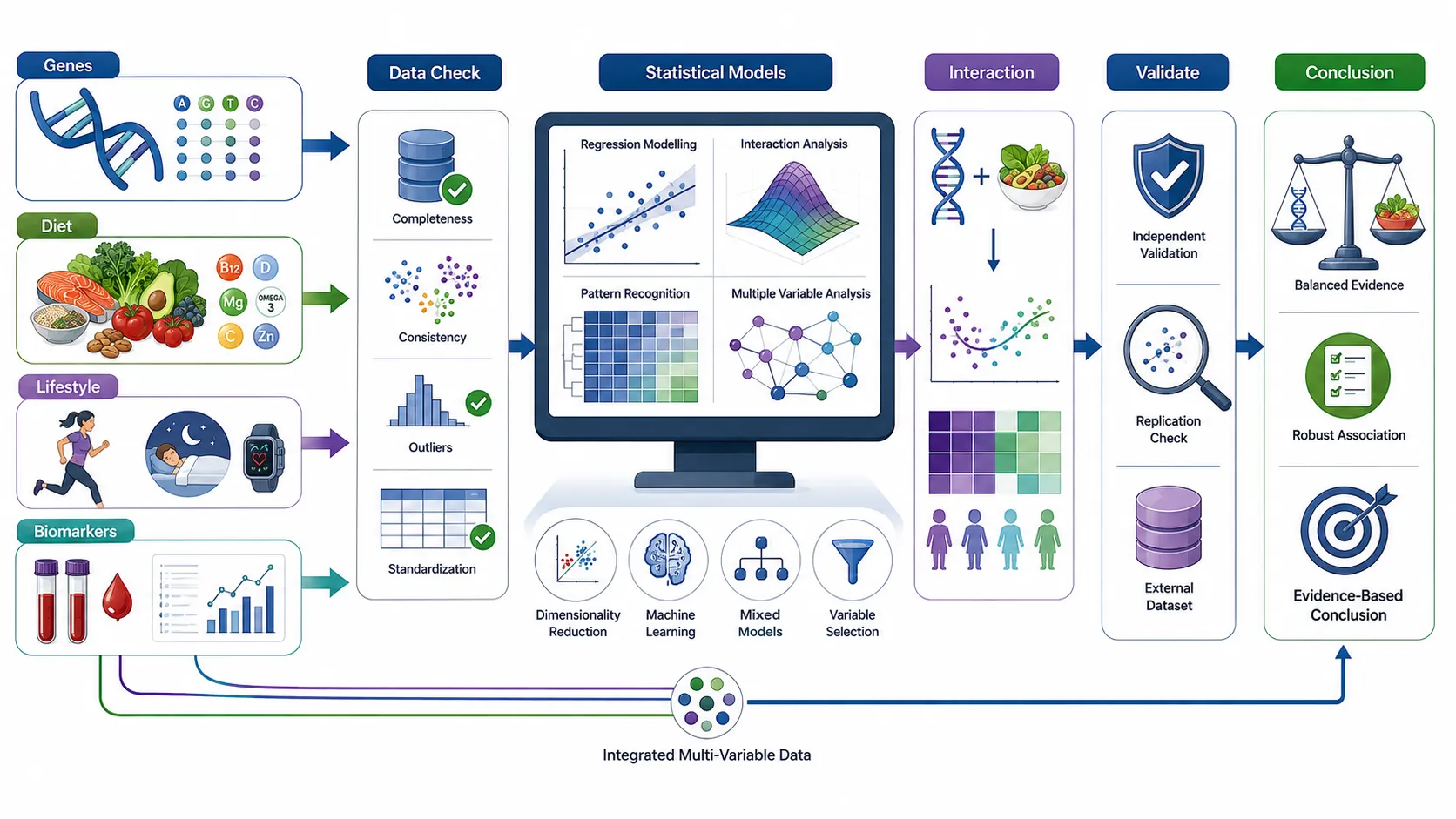
Key Definitions and Statistical Concepts
| Term | Definition | Importance in Gene–Diet Studies |
|---|---|---|
| Gene–diet interaction | A situation in which the effect of a dietary exposure on an outcome differs according to genetic variation | Central relationship being investigated |
| Independent variable | A factor used to explain or predict variation in an outcome | May include dietary intake or genotype |
| Dependent variable | The outcome measured in response to one or more predictors | May include a biomarker, physiological measure or clinical outcome |
| Covariate | An additional variable included in a statistical model | Helps account for relevant differences between participants |
| Confounding | Distortion of an association by another related factor | Can produce misleading gene–diet associations |
| Interaction term | A model component that tests whether the effect of one variable depends on another | Used to examine gene–diet interactions |
| Regression model | A statistical method used to estimate relationships between predictors and outcomes | Forms the basis of many analytical approaches |
| Mixed-effects model | A model that includes both population-level and participant-specific effects | Useful for repeated or clustered measurements |
| Multiple testing | Performing many statistical comparisons within one dataset | Increases the probability of false-positive results |
| False discovery rate | A method used to control the expected proportion of false-positive findings | Important in large genomic analyses |
| Overfitting | When a model describes the training data extremely well but performs poorly on new data | A major risk in high-dimensional datasets |
| Machine learning | Computational methods that identify patterns and make predictions from complex data | Can support discovery and prediction when properly validated |
| Population stratification | Genetic differences between population groups that can distort genetic associations | Must be considered in genomic analysis |
1. Understanding the Statistical Complexity of Gene–Diet Interaction Studies
Multiple Sources of Biological Data
Gene–diet interaction research often combines information from several sources. These datasets may include genetic variants, dietary records, biomarkers and clinical outcomes.
Common data categories include:
Genomic data, including SNPs and other genetic variants.
Dietary intake information.
Nutritional biomarkers.
Blood-based biochemical measures.
Anthropometric measurements.
Physical activity data.
Sleep and lifestyle variables.
Medication information.
Clinical outcomes.
Environmental exposure data.
Each category has different measurement properties and sources of error. Genetic information is generally stable throughout life, whereas dietary intake may change from day to day and may be affected by reporting error.
The High-Dimensional Data Problem
A dataset is described as high dimensional when the number of variables is very large relative to the number of participants.
For example, a study may include:
Thousands of participants.
Hundreds of dietary variables.
Millions of genetic variants.
Multiple health outcomes.
This creates a statistical challenge because a model containing too many variables may identify patterns that occur by chance.
Researchers must therefore distinguish between:
Genuine biological signals.
Random statistical associations.
Measurement error.
Model artefacts.
2. Establishing the Statistical Analysis Plan
Importance of Pre-Specification
The statistical analysis plan should be developed before the final outcome analysis.
A strong plan should define:
Primary research questions.
Primary outcomes.
Secondary outcomes.
Genetic variables.
Dietary exposures.
Covariates.
Interaction models.
Missing data procedures.
Multiple testing corrections.
Sensitivity analyses.
Pre-specification reduces the risk of selectively reporting statistically significant results.
Primary and Exploratory Analyses
Researchers should clearly distinguish between:
Confirmatory Analysis
This tests pre-specified hypotheses.
Characteristics include:
Defined genetic targets.
Defined dietary exposures.
Predefined outcomes.
Formal statistical testing.
Exploratory Analysis
This investigates potential new relationships.
Characteristics include:
Broad data exploration.
Pattern discovery.
Hypothesis generation.
Exploratory findings should generally require independent validation before strong conclusions are made.
3. Regression Models as a Foundation
Linear Regression
Linear regression is commonly used when the outcome is continuous.
For example, researchers may investigate whether:
Dietary exposure predicts a biomarker level.
Genotype predicts variation in a physiological measurement.
A basic model may include:
Dietary exposure.
Genetic variable.
Relevant covariates.
Logistic Regression
Logistic regression is appropriate when the outcome has two categories.
For example:
Presence or absence of a defined clinical outcome.
Responder or non-responder classification.
The model estimates how predictors are associated with the probability of an outcome.
Cox and Time-to-Event Models
When researchers investigate the time until a specific event occurs, survival analysis methods may be appropriate.
Examples may include:
Time to disease development.
Time to clinical progression.
These models are particularly relevant to long-term cohort studies.
4. Modelling Gene–Diet Interaction Terms
The Basic Interaction Concept
A gene–diet interaction model evaluates whether the effect of diet differs according to genotype.
The model may include:
Genetic effect.
Dietary effect.
Gene × diet interaction term.
The interaction term is critical because it tests whether the association between diet and outcome changes across genetic groups.
Interpreting Interaction Results
A statistically significant interaction does not automatically mean that the finding is clinically important.
Researchers should consider:
Effect size.
Confidence intervals.
Biological plausibility.
Sample size.
Replication.
Practical Example
Suppose a study examines a dietary pattern and a metabolic outcome.
Researchers may compare:
Participants with one genotype.
Participants with another genotype.
If the dietary association differs substantially between the groups, this may indicate a possible gene–diet interaction.
However, further analysis is needed to exclude:
Confounding.
Random variation.
Population differences.
5. Multivariable Regression Models
Why Multiple Variables Must Be Considered
Human nutritional responses are influenced by numerous factors. A simple model may therefore produce misleading results.
Relevant variables may include:
Age.
Biological sex where relevant.
Baseline health.
Physical activity.
Medication use.
Total energy intake.
Smoking.
Alcohol consumption.
Socioeconomic influences.
Multivariable models allow researchers to consider several variables simultaneously.
Benefits of Multivariable Modelling
Potential benefits include:
Improved control of confounding.
More precise estimates.
Better interpretation of relationships.
Assessment of multiple predictors.
However, including unnecessary variables can also create problems.
Researchers must avoid:
Adjusting for variables that should not be controlled.
Including highly correlated predictors without consideration.
Building excessively complex models.
6. Mixed-Effects Models for Repeated Measurements
Longitudinal Gene–Diet Research
Many studies measure participants at several time points.
For example:
Baseline.
Mid-intervention.
End of intervention.
Follow-up.
Measurements from the same participant are not statistically independent.
Advantages of Mixed-Effects Models
Mixed-effects models can account for:
Repeated measurements.
Individual baseline differences.
Different numbers of observations.
Correlation within participants.
These models include both:
Fixed Effects
These represent population-level relationships.
Examples include:
Dietary intervention.
Genotype.
Time.
Random Effects
These account for individual or group-level variation.
Examples include:
Participant-specific baseline differences.
Study centre differences.
Practical Value
Mixed-effects models are particularly useful in large intervention studies where participants provide repeated biological samples.
7. Generalised Estimating Equations
Analysing Correlated Data
Generalised estimating equations, often referred to as GEEs, provide another approach for analysing repeated or correlated observations.
They may be useful when researchers are primarily interested in population-average effects.
Potential applications include:
Repeated metabolic outcomes.
Longitudinal dietary studies.
Clustered participant data.
The choice between mixed-effects models and GEEs depends on:
Research objectives.
Data structure.
Required interpretation.
8. High-Dimensional Genomic Statistical Methods
The Scale of Genomic Data
Large genomic datasets may contain enormous numbers of variables.
Testing each variant against each dietary exposure can produce:
Millions of comparisons.
Increased computational demands.
High false-positive risk.
Traditional regression remains important but may require additional methods.
Dimension Reduction
Dimension reduction methods simplify complex datasets while retaining important information.
Common conceptual approaches include:
Principal component analysis.
Factor-based methods.
Feature extraction.
These techniques can help researchers identify broader patterns.
Principal Component Analysis
Principal component analysis, or PCA, transforms correlated variables into a smaller number of components.
Potential uses include:
Summarising dietary patterns.
Reducing correlated molecular variables.
Addressing population structure.
PCA can improve analytical efficiency, but the resulting components must be interpreted carefully.
9. Regularisation Methods
The Problem of Too Many Predictors
When many variables are included in a model, overfitting becomes more likely.
Regularisation methods place constraints on model complexity.
Examples include:
LASSO regression.
Ridge regression.
Elastic net methods.
LASSO Regression
LASSO can reduce the influence of less informative variables.
Potential benefits include:
Variable selection.
Improved model simplicity.
Reduced overfitting.
However, variable selection may be unstable when predictors are highly correlated.
Ridge Regression
Ridge regression reduces the influence of highly correlated predictors without necessarily removing them completely.
It may be useful when:
Many predictors are correlated.
Prediction is prioritised.
Elastic Net
Elastic net combines features of LASSO and ridge methods.
It may be useful for:
High-dimensional data.
Groups of correlated predictors.
These methods require appropriate tuning and validation.
10. Machine Learning Models
Role of Machine Learning
Machine learning can identify complex patterns that may be difficult to capture using traditional models.
Potential approaches include:
Random forests.
Gradient boosting methods.
Support vector machines.
Neural network approaches.
Potential Benefits
Machine learning may help:
Identify complex predictor combinations.
Model non-linear relationships.
Improve prediction.
Important Limitations
Machine learning does not automatically establish causation.
Key risks include:
Overfitting.
Poor interpretability.
Dataset bias.
Lack of external validation.
A highly accurate predictive model may still fail to explain the underlying biological mechanism.
11. Multiple Testing Correction
Why Multiple Testing Is a Major Problem
If thousands of statistical tests are performed, some will appear significant by chance.
For example, testing:
Numerous genetic variants.
Multiple nutrients.
Multiple outcomes.
can generate a very large number of comparisons.
Correction Approaches
Researchers may use methods designed to control false findings.
Important approaches include:
Family-wise error control.
Bonferroni-type correction.
False discovery rate procedures.
False Discovery Rate
False discovery rate approaches can be useful in large-scale molecular studies because they balance discovery with control of expected false-positive findings.
The method should be selected according to:
Number of comparisons.
Study objectives.
Consequences of false findings.
12. Bayesian Statistical Approaches
Beyond Traditional Significance Testing
Bayesian methods incorporate prior information with observed data.
This may be particularly useful when:
Previous biological evidence exists.
Evidence needs to be updated.
Researchers want probability-based interpretation.
Potential Advantages
Bayesian models can:
Incorporate prior knowledge.
Represent uncertainty differently.
Support hierarchical modelling.
However, results can depend on assumptions regarding prior distributions.
Researchers must therefore report assumptions transparently.
13. Structural Equation Models
Investigating Complex Pathways
Gene–diet relationships may involve indirect pathways.
For example:
Dietary exposure may influence:
A metabolic process.
A biochemical biomarker.
A physiological outcome.
Structural equation modelling can help examine complex hypothesised relationships between multiple variables.
Potential applications include:
Mediation pathways.
Latent variables.
Complex biological models.
Important Consideration
A statistical pathway model does not prove a biological mechanism by itself.
The hypothesised structure should be based on scientific knowledge.
14. Mediation and Moderation Analysis
Mediation
Mediation analysis investigates whether a relationship may operate through an intermediate factor.
A conceptual pathway may be:
Dietary exposure → molecular process → clinical outcome.
Researchers may investigate whether the intermediate process explains part of the relationship.
Moderation
Genetic variation may act as a moderator.
This means:
The dietary effect differs depending on genotype.
Gene–diet interaction analysis is therefore closely related to moderation analysis.
Practical Importance
Distinguishing between mediation and moderation improves:
Model selection.
Interpretation.
Biological reasoning.
15. Managing Missing Data
Why Missing Data Matter
Large clinical and genomic studies frequently contain missing information.
Examples include:
Incomplete dietary records.
Missing follow-up samples.
Laboratory processing failures.
Participant withdrawal.
Ignoring missing data can introduce bias.
Analytical Approaches
Potential strategies include:
Complete-case analysis where justified.
Multiple imputation.
Model-based approaches.
Sensitivity analysis.
The best approach depends on why data are missing.
Understanding Missingness
Researchers should investigate whether data are:
Missing completely at random.
Missing in relation to observed variables.
Missing in relation to unobserved factors.
Assumptions should be reported clearly.
16. Addressing Population Stratification
The Genetic Population Structure Problem
Genetic variants can differ in frequency between population groups.
If population differences are also associated with dietary patterns or health outcomes, false genetic associations may occur.
Analytical Strategies
Researchers may use:
Population structure variables.
Genetic principal components.
Stratified analysis.
Appropriate mixed models.
The purpose is to reduce the risk that population differences are incorrectly interpreted as direct gene–diet effects.
17. Multi-Level and Hierarchical Models
Complex Data Structures
Large studies may involve participants grouped within:
Families.
Clinics.
Geographic areas.
Research centres.
Multi-level models can account for clustering at different levels.
Example
A multi-centre trial may include:
Participant level.
Clinical centre level.
Regional level.
Ignoring clustering may underestimate uncertainty.
18. Model Validation and Replication
Internal Validation
Researchers should evaluate how well models perform within the study dataset.
Methods may include:
Cross-validation.
Resampling.
Training and testing datasets.
External Validation
External validation evaluates the model in an independent population.
This is particularly important for:
Predictive models.
Machine learning models.
Nutrigenetic risk scores.
Replication
A gene–diet association should ideally be investigated in independent datasets.
Replication strengthens confidence that a finding is:
Reproducible.
Not population-specific.
Less likely to be a false-positive result.
19. Practical Scenario: Analysing a Large Gene–Diet Dataset
Study Background
A research consortium collects data from thousands of participants to investigate how genetic variation influences metabolic responses to dietary patterns.
The dataset includes:
Genetic information.
Dietary assessments.
Repeated metabolic biomarkers.
Physical activity data.
Medication records.
Clinical outcomes.
Analytical Framework
Researchers may follow these stages:
Stage 1: Data Quality Control
Check:
Genetic data quality.
Dietary data completeness.
Outliers.
Duplicate records.
Stage 2: Define Primary Variables
Specify:
Dietary exposure.
Genetic target.
Primary outcome.
Stage 3: Identify Confounders
Consider:
Age.
Baseline health.
Energy intake.
Physical activity.
Stage 4: Fit Interaction Models
Evaluate:
Dietary effect.
Genetic effect.
Gene × diet interaction.
Stage 5: Correct for Multiple Testing
Apply an appropriate correction procedure.
Stage 6: Validate Findings
Use:
Independent datasets.
Cross-validation.
Sensitivity analyses.
Interpretation
A statistically significant result should be considered alongside:
Effect size.
Confidence interval.
Biological plausibility.
Reproducibility.
20. Key Benefits of Advanced Statistical Models
Advanced statistical approaches can provide several important benefits.
Improved Management of Complex Data
They allow researchers to:
Analyse many variables.
Account for repeated observations.
Model interactions.
Manage clustered data.
Greater Analytical Precision
Appropriate models can:
Reduce confounding.
Improve effect estimation.
Quantify uncertainty.
Support for Personalised Nutrition Research
Advanced modelling may help identify patterns of individual variation.
However, prediction should not be confused with clinical proof.
Improved Reproducibility
Predefined and validated analytical procedures can strengthen:
Transparency.
Replication.
Scientific credibility.
21. Critical Limitations of Advanced Models
Complexity Does Not Guarantee Accuracy
A highly sophisticated model can still produce misleading results when:
The data are poor quality.
Important confounders are missing.
The sample is biased.
The model assumptions are inappropriate.
Interpretability Challenges
Some advanced machine learning models may be difficult to explain.
This creates challenges when:
Clinical decisions require transparency.
Researchers need to explain mechanisms.
Findings must be communicated to non-specialists.
Risk of Overfitting
Overfitting occurs when the model learns random features rather than meaningful patterns.
Researchers should use:
Independent testing.
Cross-validation.
External validation.
22. Step-by-Step Model Selection Process
Step 1: Define the Research Question
Determine whether the goal is:
Explanation.
Association testing.
Prediction.
Interaction analysis.
Step 2: Examine the Data Structure
Identify:
Outcome type.
Number of variables.
Repeated observations.
Clustering.
Step 3: Select the Primary Statistical Model
Possible options include:
Linear regression.
Logistic regression.
Mixed-effects modelling.
Survival analysis.
Step 4: Add Interaction Terms
Where appropriate, include pre-specified gene × diet interactions.
Step 5: Address High Dimensionality
Consider:
Dimension reduction.
Regularisation.
Feature selection.
Step 6: Control for Multiple Testing
Apply appropriate correction procedures.
Step 7: Validate the Model
Use:
Cross-validation.
Independent datasets.
Sensitivity analysis.
Step 8: Interpret Results Critically
Consider:
Effect size.
Uncertainty.
Biological relevance.
Clinical significance.
Conclusion
Large gene–diet interaction studies require sophisticated statistical approaches because they involve highly complex relationships between genetic variation, dietary exposure, environmental factors and physiological outcomes. No single statistical model is suitable for every research question. The most appropriate method depends on the study design, outcome type, number of predictors, repeated measurements and biological objectives.
Regression models provide an essential foundation for evaluating relationships and interaction effects. Mixed-effects and generalised estimating equation approaches can address repeated measurements, while multivariable and hierarchical models can account for confounding and complex data structures. High-dimensional genomic datasets may require dimension reduction and regularisation techniques to reduce overfitting, while machine learning methods can support pattern recognition and prediction when rigorous validation is applied.
Multiple testing correction is essential when large numbers of genetic and dietary variables are analysed. Missing data, population stratification and clustering must also be considered carefully because they can distort results and create false associations.
The critical evaluation of advanced statistical models involves recognising both their strengths and limitations. Complex computational techniques cannot compensate for poor study design, inaccurate dietary measurement or inadequate sample size. Statistical significance alone does not demonstrate biological importance or clinical usefulness.
The strongest gene–diet research therefore integrates advanced statistical modelling with high-quality study design, biological knowledge, transparent analysis and independent validation. By selecting models according to the structure and purpose of the data, researchers can generate more reliable evidence about the complex interactions between genes, nutrition and human health.
6.Construct a Highly Detailed Research Funding Proposal That Clearly Articulates the Scientific Merit, Methodology, and Practical Clinical Application of a Novel Nutrigenomics Study
A research funding proposal is a structured and persuasive academic document designed to demonstrate why a proposed research project deserves financial support. In nutrigenomics, a high-quality funding proposal must communicate a scientifically important problem, present a robust and feasible methodology, demonstrate the originality of the proposed research and explain how the findings could contribute to practical clinical nutrition and healthcare.
Nutrigenomics investigates how nutrients and dietary patterns interact with genes and influence gene expression, molecular pathways and physiological outcomes. Because nutrigenomics research frequently involves advanced genomic sequencing, laboratory analysis, bioinformatics, clinical assessments and large datasets, studies can require substantial resources. Funding bodies therefore expect researchers to provide a clear justification for the proposed investment and demonstrate that the research has both scientific merit and potential practical value.
Constructing a detailed proposal requires more than describing an interesting idea. The researcher must develop a logical connection between the identified problem, research question, scientific background, methodology, analysis plan, ethical safeguards, budget and anticipated clinical impact. Every section should support the overall argument that the project is important, methodologically sound, achievable and capable of generating meaningful evidence.
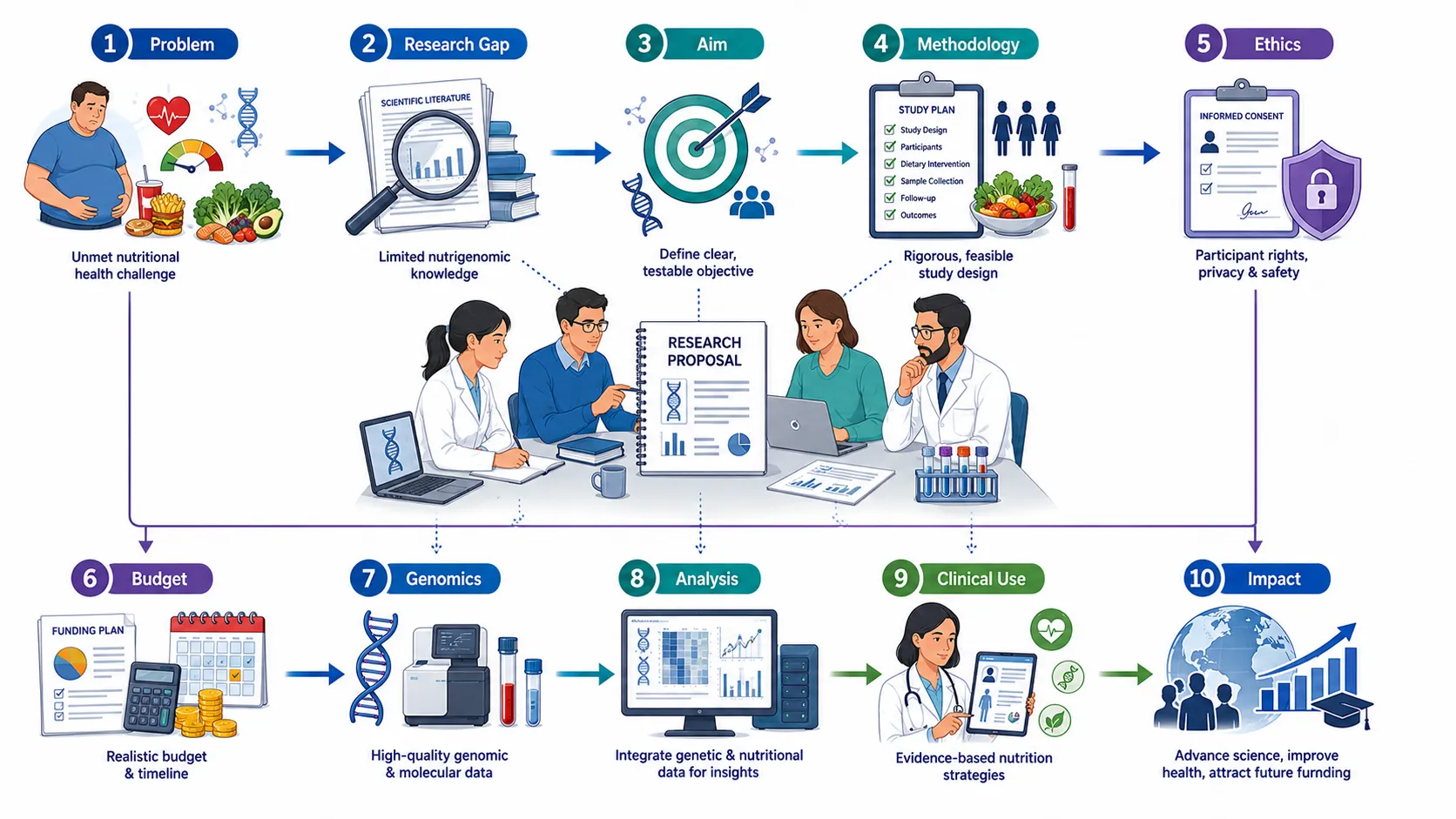
Key Definitions and Concepts
| Term | Definition | Importance in a Nutrigenomics Funding Proposal |
|---|---|---|
| Research funding proposal | A formal document requesting financial support for a defined research project | Demonstrates why the project should receive investment |
| Scientific merit | The importance, originality, quality and potential contribution of the research | Helps reviewers determine the value of the proposed study |
| Nutrigenomics | The study of interactions between nutrition, gene expression and biological function | Provides the scientific foundation for the proposed research |
| Research gap | An important question that remains insufficiently answered by existing evidence | Justifies the need for a new study |
| Methodology | The systematic approach used to collect, analyse and interpret research data | Demonstrates scientific rigour and feasibility |
| Biomarker | A measurable biological indicator of a physiological or pathological process | Provides objective evidence of nutritional or metabolic change |
| Clinical translation | The process of applying research findings to improve clinical practice | Demonstrates practical relevance |
| Feasibility | The extent to which a project can realistically be completed with available resources | Supports confidence in the proposed study |
| Work package | A defined group of related research activities within a larger project | Helps organise complex research programmes |
| Dissemination | The planned communication of research findings to relevant audiences | Increases scientific and practical impact |
| Risk management | The systematic identification and management of potential research problems | Demonstrates responsible project planning |
| Value for money | The relationship between expected research benefits and the resources requested | Important for funding decisions |
1. Understanding the Purpose of a Research Funding Proposal
The Role of the Proposal
A research funding proposal is both a scientific document and a strategic justification for investment. It must provide sufficient technical detail for expert reviewers while remaining clear enough to demonstrate the overall importance and practical direction of the study.
The proposal should answer several fundamental questions:
What problem will the research address?
Why is this problem important?
What is currently known?
What important knowledge gap remains?
What is novel about the proposed study?
How will the research be conducted?
Why is the methodology appropriate?
What resources are required?
What outcomes are expected?
How could the findings influence clinical practice?
A successful proposal presents these elements as one coherent scientific argument rather than as unrelated sections.
The Importance of Persuasive Scientific Communication
Funding is competitive. A proposal must therefore clearly communicate why the proposed research deserves priority.
A strong proposal should demonstrate:
Scientific originality.
Clinical relevance.
Methodological quality.
Research feasibility.
Appropriate expertise.
Ethical responsibility.
Potential for meaningful impact.
The proposal should avoid unsupported claims. Instead, scientific merit should be demonstrated through logical reasoning and evidence-based justification.
2. Establishing the Scientific Merit of the Proposed Study
Identifying an Important Scientific Problem
The first stage is to identify a clearly defined problem within nutrigenomics or nutritional science.
Potential areas may include:
Variation in individual responses to dietary interventions.
Differences in nutrient metabolism associated with genetic variation.
Identification of molecular markers of dietary response.
Gene–diet interactions in metabolic health.
Mechanisms linking dietary patterns with altered gene expression.
Nutritional strategies for individuals with different metabolic profiles.
The proposed problem should be sufficiently focused to support rigorous investigation.
Developing a Clear Research Gap
A research gap is not simply a topic that has been studied infrequently. A meaningful gap should represent an important unanswered question.
Researchers should examine whether existing studies have limitations related to:
Small sample sizes.
Short intervention periods.
Limited population diversity.
Inconsistent dietary assessment.
Inadequate replication.
Limited genomic analysis.
Lack of clinically relevant outcomes.
A strong proposal clearly explains how the new study addresses a specific limitation.
Assessing Novelty
Novelty may arise from:
A new research question.
A new population.
An improved methodology.
Integration of multiple biological datasets.
A new analytical framework.
Investigation of an understudied interaction.
Novelty should not be exaggerated. A funding proposal should accurately distinguish between a genuinely new approach and an incremental improvement.
3. Developing a Clear Research Aim and Objectives
The Research Aim
The research aim provides the overall purpose of the study.
A strong aim should be:
Clear.
Specific.
Scientifically relevant.
Achievable.
Research Objectives
Objectives divide the overall aim into measurable activities.
A nutrigenomics proposal may include objectives such as:
Characterise baseline dietary and metabolic profiles.
Identify selected genetic variants relevant to nutrient metabolism.
Assess changes in molecular biomarkers following a dietary intervention.
Evaluate potential gene–diet interactions.
Develop evidence-based models of individual physiological response.
Objectives should follow a logical sequence.
Developing Research Questions
Research questions should connect directly with the objectives.
Examples of broad research questions include:
Does genetic variation modify the physiological response to a defined dietary intervention?
Which molecular biomarkers are associated with variation in dietary response?
Can integrated genomic and nutritional data improve the prediction of metabolic outcomes?
Each question should be realistically answerable using the proposed methodology.
4. Constructing a Strong Scientific Rationale
Connecting Evidence to the Proposed Study
The scientific rationale explains why the proposed research is necessary.
It should:
Summarise relevant scientific knowledge.
Identify important limitations.
Explain the knowledge gap.
Justify the proposed approach.
The rationale should create a logical pathway:
Existing Evidence → Identified Limitation → Research Gap → Proposed Study → Expected Contribution
Avoiding an Unfocused Literature Summary
A funding proposal should not simply list previous studies.
The literature discussion should critically address:
Areas of agreement.
Areas of uncertainty.
Methodological weaknesses.
Contradictory findings.
Unanswered questions.
This demonstrates critical understanding.
5. Designing the Methodology
Selecting an Appropriate Study Design
The study design must align with the research question.
Possible designs include:
Randomised controlled trials.
Prospective cohort studies.
Controlled dietary interventions.
Observational studies.
Cross-over studies.
Mechanistic laboratory studies.
The choice should be justified.
Intervention-Based Research
Where the aim is to examine the physiological effects of a dietary intervention, researchers may consider:
Baseline assessment.
Defined intervention.
Follow-up assessment.
Biological sample collection.
The intervention should be sufficiently described to support reproducibility.
Important considerations include:
Dietary composition.
Intervention duration.
Participant adherence.
Monitoring procedures.
Safety considerations.
Observational Research
Observational approaches may be useful when interventions are impractical or when researchers investigate naturally occurring dietary patterns.
However, observational research requires careful consideration of:
Confounding.
Measurement error.
Reverse causation.
Selection bias.
6. Participant Selection and Recruitment
Defining the Target Population
The proposal should specify who will participate in the study.
Relevant characteristics may include:
Age range.
Health status.
Relevant physiological characteristics.
Dietary characteristics.
Clinical inclusion criteria.
Inclusion and Exclusion Criteria
These criteria should protect participant safety and improve scientific consistency.
Possible considerations include:
Relevant health conditions.
Current medication use.
Pregnancy where relevant to the research question.
Recent major dietary changes.
Conditions affecting nutrient metabolism.
Criteria should be scientifically justified rather than unnecessarily restrictive.
Recruitment Strategy
The proposal should explain:
Where participants will be recruited.
How they will be approached.
How eligibility will be assessed.
How informed consent will be obtained.
Recruitment planning should be realistic.
7. Integrating Genomic and Nutritional Data
Genomic Data Collection
The proposal should explain how genetic or genomic information will be obtained.
Potential processes include:
Collection of appropriate biological samples.
DNA extraction.
Quality assessment.
Genotyping or sequencing.
Bioinformatics processing.
The level of genomic analysis should match the research objectives.
Nutritional Data Collection
Dietary exposure must also be measured carefully.
Potential methods include:
Food records.
Dietary recalls.
Food frequency questionnaires.
Controlled meal provision.
Nutritional biomarkers.
Each method has strengths and limitations.
Combining Data Sources
A major feature of nutrigenomics research is data integration.
Researchers may integrate:
Dietary exposure.
Genotype.
Gene expression.
Metabolic biomarkers.
Clinical outcomes.
Integration requires a predefined analytical strategy.
8. Selecting Molecular Biomarkers
Importance of Biomarker Selection
Biomarkers should be selected because they are directly relevant to the proposed biological pathway.
Researchers should consider:
Biological relevance.
Analytical validity.
Reliability.
Sensitivity to change.
Clinical usefulness.
Categories of Potential Biomarkers
Depending on the research question, relevant measurements may include:
Metabolic indicators.
Nutrient-related biomarkers.
Markers of inflammation.
Gene expression indicators.
Epigenetic measurements.
The proposal should avoid measuring unnecessary biomarkers simply because technology is available.
Linking Biomarkers to Outcomes
A strong proposal explains the pathway:
Dietary Exposure → Molecular Change → Physiological Response → Clinical Relevance
This connection strengthens the scientific rationale.
9. Developing a Detailed Data Analysis Plan
Importance of Predefined Analysis
The analysis plan should be established before examining final outcomes.
It should identify:
Primary outcome.
Secondary outcomes.
Main predictors.
Interaction terms.
Confounding variables.
Statistical models.
Missing data procedures.
Analysing Gene–Diet Interactions
The analytical model may examine:
Genetic effects.
Dietary effects.
Gene × diet interactions.
Researchers should also evaluate:
Effect sizes.
Confidence intervals.
Statistical uncertainty.
Biological relevance.
Managing Large Datasets
Large datasets may require:
Data quality control.
Variable selection.
Dimension reduction.
Multiple testing correction.
Validation procedures.
Advanced statistical techniques should be selected according to the research question rather than used solely because they are technically complex.
10. Ethical and Governance Considerations
Informed Consent
Participants must receive clear information regarding:
Research procedures.
Biological sample collection.
Genetic analysis.
Data storage.
Potential risks.
Withdrawal procedures.
Genetic research requires particular attention because genetic information may have long-term relevance.
Data Protection
The proposal should describe procedures for:
Secure data storage.
Controlled access.
Appropriate coding or pseudonymisation.
Data retention.
Data sharing governance.
Ethical Challenges in Nutrigenomics
Important considerations may include:
Incidental findings.
Genetic privacy.
Re-identification risks.
Communication of uncertain results.
Potential psychological impact.
The proposal should demonstrate that these issues have been considered proactively.
11. Organising the Research into Work Packages
Purpose of Work Packages
Complex research projects can be divided into structured work packages.
A possible structure may include:
Work Package 1: Project Preparation
Activities may include:
Ethical approval.
Protocol finalisation.
Staff preparation.
Work Package 2: Recruitment and Baseline Assessment
Activities may include:
Participant screening.
Consent.
Baseline dietary assessment.
Biological sampling.
Work Package 3: Intervention or Exposure Monitoring
Activities may include:
Dietary monitoring.
Adherence assessment.
Follow-up procedures.
Work Package 4: Laboratory and Genomic Analysis
Activities may include:
Sample processing.
Genomic analysis.
Biomarker measurement.
Work Package 5: Data Integration and Statistical Analysis
Activities may include:
Data cleaning.
Statistical modelling.
Sensitivity analysis.
Work Package 6: Clinical Translation and Dissemination
Activities may include:
Interpretation.
Publication.
Professional communication.
Work packages help reviewers assess feasibility.
12. Developing a Project Timeline
Importance of Realistic Scheduling
The proposal should demonstrate that the project can be completed within the funding period.
A timeline may include:
Project preparation.
Ethical approval.
Recruitment.
Data collection.
Laboratory analysis.
Statistical analysis.
Dissemination.
Key Milestones
Milestones may include:
Ethical approval obtained.
Recruitment target achieved.
Data collection completed.
Laboratory analysis completed.
Primary analysis completed.
Results prepared for dissemination.
A realistic timeline should account for potential delays.
13. Preparing a Justified Budget
Principles of Research Budgeting
The budget should directly reflect the research activities.
Possible categories include:
Research staff.
Laboratory materials.
Sequencing or genotyping.
Dietary assessment.
Data management.
Statistical support.
Participant expenses.
Equipment where justified.
Dissemination activities.
Demonstrating Value for Money
Funding bodies expect resources to be justified.
The proposal should explain:
Why each major cost is necessary.
How the cost supports the methodology.
Why the resource represents reasonable value.
An unnecessarily inflated budget may reduce confidence in project management.
14. Risk Management and Contingency Planning
Identifying Potential Risks
Every major research project involves uncertainty.
Potential risks include:
Slow participant recruitment.
Participant withdrawal.
Low dietary adherence.
Laboratory delays.
Insufficient sample quality.
Data processing difficulties.
Developing Mitigation Strategies
A strong proposal should include practical responses.
Examples include:
Multiple recruitment pathways.
Additional participant retention strategies.
Standard operating procedures.
Backup laboratory arrangements.
Secure data backups.
Risk Management Principles
Effective planning should:
Identify risks early.
Estimate potential impact.
Develop mitigation procedures.
Monitor emerging problems.
15. Demonstrating Practical Clinical Application
From Research Findings to Practice
One of the most important sections of a nutrigenomics funding proposal explains how the research could contribute to healthcare.
Potential applications may include:
Improved understanding of variation in dietary response.
Better identification of relevant biological pathways.
Development of evidence-based research tools.
Improved stratification in future nutrition studies.
Clinical application should be presented cautiously.
A research finding should not be described as ready for clinical implementation unless sufficient validation exists.
Translational Pathway
A potential pathway may include:
Scientific Discovery → Replication → Validation → Clinical Evaluation → Evidence-Based Application
This demonstrates realistic understanding of research translation.
16. Practical Example of a Novel Nutrigenomics Study
Proposed Research Concept
A research team proposes to investigate whether variation in selected metabolic pathways is associated with differences in physiological response to a structured dietary intervention.
Scientific Problem
Individuals demonstrate variable metabolic responses to similar dietary changes.
Research Gap
Existing evidence may be limited by:
Short follow-up.
Limited molecular assessment.
Inadequate integration of dietary and genomic data.
Proposed Methodology
The study could involve:
Baseline clinical assessment.
Standardised dietary intervention.
Collection of dietary adherence data.
Collection of biological samples.
Selected genomic analysis.
Measurement of relevant biomarkers.
Longitudinal follow-up.
Expected Scientific Contribution
The study may improve understanding of:
Individual variation.
Gene–diet interactions.
Molecular pathways.
Potential Practical Relevance
If findings are independently validated, they may contribute to:
Improved research models.
Future targeted nutritional investigations.
Development of more personalised evidence-based approaches.
17. Communicating Scientific Merit to Funding Reviewers
Clarity and Logical Structure
Reviewers may have expertise in different areas.
The proposal should therefore:
Explain complex concepts clearly.
Avoid unnecessary jargon.
Define specialised terminology.
Connect every section logically.
Demonstrating Investigator Capability
The proposal should describe relevant expertise.
Important areas may include:
Nutrition.
Genomics.
Laboratory science.
Statistics.
Bioinformatics.
Clinical research.
Where one team member cannot provide all expertise, multidisciplinary collaboration should be clearly demonstrated.
18. Key Benefits of a High-Quality Nutrigenomics Funding Proposal
A well-designed proposal provides benefits beyond obtaining funding.
Scientific Benefits
It can:
Clarify the research question.
Improve methodological planning.
Identify knowledge gaps.
Strengthen analytical strategies.
Operational Benefits
It can support:
Better project management.
Clear allocation of responsibilities.
Risk identification.
Resource planning.
Clinical Benefits
A carefully designed translational framework can:
Focus research on meaningful outcomes.
Improve relevance to clinical practice.
Support future evidence development.
Educational and Professional Benefits
Researchers develop skills in:
Critical evaluation.
Scientific writing.
Research planning.
Ethical reasoning.
Budget management.
Evidence communication.
19. Step-by-Step Procedure for Constructing the Proposal
Step 1: Identify the Clinical or Scientific Problem
Clearly define the problem requiring investigation.
Step 2: Review Existing Evidence
Critically examine:
Current knowledge.
Methodological limitations.
Research gaps.
Step 3: Develop the Research Aim
State the overall purpose clearly.
Step 4: Create Specific Objectives
Develop measurable objectives.
Step 5: Select the Methodology
Choose the design that best answers the research question.
Step 6: Define Participants and Procedures
Specify:
Population.
Recruitment.
Data collection.
Follow-up.
Step 7: Plan Genomic and Nutritional Analysis
Define:
Molecular targets.
Dietary measurements.
Data integration procedures.
Step 8: Develop the Statistical Analysis Plan
Specify:
Outcomes.
Predictors.
Confounders.
Interaction analysis.
Validation.
Step 9: Address Ethics and Governance
Include:
Consent.
Privacy.
Genetic data management.
Participant safety.
Step 10: Develop the Budget and Timeline
Ensure all requested resources are justified.
Step 11: Include Risk Management
Identify challenges and practical mitigation strategies.
Step 12: Explain Expected Impact
Describe:
Scientific contribution.
Clinical relevance.
Dissemination.
Future translation.
20. Common Weaknesses That Should Be Avoided
A critical understanding of proposal development requires recognising common weaknesses.
Weak or Overly Broad Research Questions
Problems include:
Lack of focus.
Unclear outcomes.
Excessive scope.
Inadequate Methodological Justification
A proposal should not merely state the chosen method.
It should explain:
Why it is appropriate.
How it addresses the research question.
Overstating Clinical Impact
Researchers should avoid:
Claiming immediate clinical benefits without evidence.
Presenting exploratory findings as established interventions.
Ignoring the need for validation.
Insufficient Risk Planning
Potential problems should not be ignored.
A credible proposal acknowledges uncertainty and provides practical solutions.
21. Critical Evaluation of the Overall Proposal
Before submission, researchers should evaluate the proposal systematically.
Key questions include:
Is the research question important?
Is the knowledge gap clearly demonstrated?
Is the proposed approach original?
Is the methodology appropriate?
Are the outcomes measurable?
Is the statistical analysis suitable?
Are ethical safeguards adequate?
Is the project feasible?
Is the budget justified?
Is the clinical relevance realistic?
A proposal is strongest when these elements reinforce one another.
Conclusion
Constructing a highly detailed research funding proposal for a novel nutrigenomics study requires the integration of scientific reasoning, methodological rigour, ethical responsibility, financial planning and practical clinical awareness. The proposal must clearly establish a meaningful research problem and demonstrate that the proposed study addresses an important gap in current knowledge.
Scientific merit is strengthened by a well-defined research question, critical review of existing evidence and a convincing explanation of the study’s originality. Methodological quality requires an appropriate study design, careful participant selection, reliable dietary assessment, suitable genomic analysis and a robust statistical plan. Ethical governance is particularly important because nutrigenomics research may involve sensitive genetic and biological information.
A successful funding proposal must also demonstrate feasibility. Realistic work packages, timelines, budgets and risk management procedures show that the research team can translate a scientific concept into a deliverable project. Funding reviewers must be able to understand how resources will be used and how the research will be managed.
The practical clinical application of nutrigenomics research should be described through a realistic translational pathway. Scientific discoveries require replication, validation and further clinical investigation before they can be incorporated into routine practice. A responsible proposal therefore balances innovation with scientific caution.
Ultimately, the highest-quality nutrigenomics funding proposals present a coherent narrative in which the scientific problem, research gap, methodology, analytical strategy and anticipated practical value are closely connected. Through careful planning and evidence-based justification, researchers can design funding proposals that support credible scientific discovery and contribute to the long-term development of more precise and effective nutritional research and clinical practice.