Lexiton International
Lexiton International Welcome to Lexiton International
Courses › QualCert Level 7 Postgraduate Diploma in Nutritional Biochemistry (Pgd Nutritional Biochemistry)

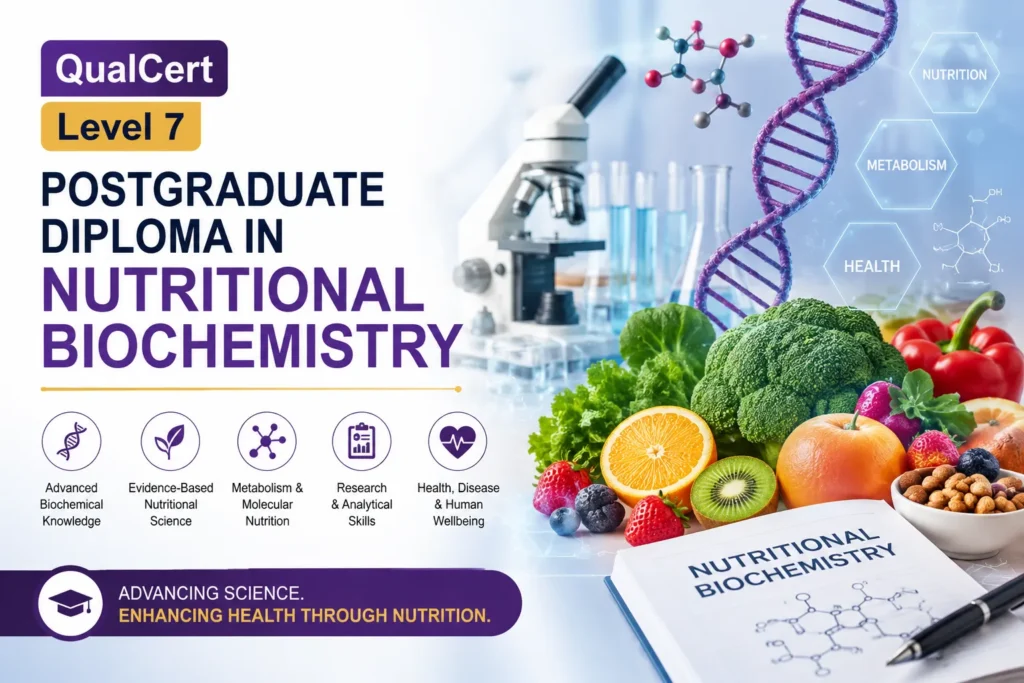
QualCert Level 7 Postgraduate Diploma in Nutritional Biochemistry (Pgd Nutritional Biochemistry)

The QualCert Level 7 Postgraduate Diploma in Nutritional Biochemistry (PGD Nutritional Biochemistry) is an advanced programme designed to develop in-depth...

Advanced 24 lessons 24 quizzes
Overview
Curriculum 48
Instructor

The QualCert Level 7 Postgraduate Diploma in Nutritional Biochemistry (PGD Nutritional Biochemistry) is an advanced programme designed to develop in-depth knowledge of the biochemical processes that influence human nutrition, metabolism and health. The course explores the relationship between nutrients, molecular mechanisms and physiological functions, helping Learners understand how food components interact with the human body at cellular and biochemical levels.

Through advanced study of nutritional science and biochemistry, Learners examine macronutrient and micronutrient metabolism, energy production, molecular nutrition, metabolic regulation and the biochemical factors associated with health and disease. The programme also develops an understanding of current research, evidence-based nutritional science and emerging developments in the global field of nutrition.

This Level 7 postgraduate diploma is suitable for Learners seeking advanced academic and professional knowledge in nutritional biochemistry and related disciplines. It supports the development of critical thinking, scientific analysis and research skills relevant to nutrition, biomedical science, healthcare, food science and public health contexts.

The QualCert Level 7 Postgraduate Diploma in Nutritional Biochemistry provides a strong foundation for advanced learning and professional development in nutritional science. Learners gain the theoretical knowledge and analytical perspective needed to understand complex biochemical relationships between diet, metabolism and human wellbeing in an increasingly research-driven and globally evolving healthcare environment.

Section 1: Unit no 1 : Advanced Human Biochemistry
8 items
Advanced Human Biochemistry explores the complex biochemical processes that regulate human health and physiological function. Learners develop an understanding of biomolecules, enzymes, cellular processes, energy production and metabolic pathways, while examining how biochemical regulation influences nutrition, metabolism and disease. The unit provides advanced theoretical knowledge essential for analysing molecular mechanisms and understanding their relevance to nutritional biochemistry and human health.
Lesson no 1 : Explain the molecular and cellular basis of human metabolism.
Quiz no 1 : Explain the molecular and cellular basis of human metabolism.
Quiz
Lesson no 2 : Analyse enzymatic pathways relevant to nutrition.
Quiz no 2 : Analyse enzymatic pathways relevant to nutrition.
Quiz
Lesson no 3 : Evaluate the role of macronutrients in metabolic regulation.
Quiz no 3 : Evaluate the role of macronutrients in metabolic regulation.
Quiz
Lesson no 4 : Assess biochemical mechanisms underlying nutrient-related diseases.
Quiz no 4 : Assess biochemical mechanisms underlying nutrient-related diseases.
Quiz
Section 2: Unit no 2 : Nutrient Metabolism and Physiology
8 items
Nutrient Metabolism and Physiology explores the complex biochemical and physiological processes through which the human body digests, absorbs, transports, utilises and stores essential nutrients. This unit examines the metabolic roles of carbohydrates, proteins, lipids, vitamins and minerals, while analysing how these nutrients contribute to energy production, cellular function, hormonal regulation and overall physiological health. Learners will develop an advanced understanding of nutrient interactions, metabolic adaptation and the relationship between nutritional status and human health across different physiological conditions.
Lesson no 1 : Examine the digestion, absorption, and transport of nutrients.
Quiz no 1 : Examine the digestion, absorption, and transport of nutrients.
Quiz
Lesson no 2 : Interpret metabolic pathways of carbohydrates, lipids, and proteins.
Quiz no 2 : Interpret metabolic pathways of carbohydrates, lipids, and proteins.
Quiz
Lesson no 3: Evaluate hormonal and biochemical regulation of nutrient metabolism.
Quiz no 3 :Evaluate hormonal and biochemical regulation of nutrient metabolism.
Quiz
Lesson no 4 : Apply knowledge to clinical and research contexts.
Quiz no 4 : Apply knowledge to clinical and research contexts.
Quiz
Section 3: Unit no 3 : Molecular Nutrition and Genomics
8 items
Molecular Nutrition and Genomics explores how nutrients interact with genes and molecular processes to influence human health. This unit covers nutrigenomics, nutrigenetics, gene expression, epigenetics, and personalised nutrition, helping Learners understand how genetic variation and dietary factors affect metabolism, disease risk, and overall physiological function
Lesson no 1 : Investigate gene–nutrient interactions and epigenetic influences.
Quiz no 1 : Investigate gene–nutrient interactions and epigenetic influences.
Quiz
Lesson no 2 : Analyse nutrigenomics and nutrigenetics data.
Quiz no 2 : Analyse nutrigenomics and nutrigenetics data.
Quiz
Lesson no 3 : Evaluate the impact of diet on gene expression and disease risk.
Quiz no 3 : Evaluate the impact of diet on gene expression and disease risk.
Quiz
Lesson no 4 : Design research approaches integrating genomics and nutrition.
Quiz no 4 : Design research approaches integrating genomics and nutrition.
Quiz
Section 4: Unit no 4 : Clinical Biochemistry and Nutritional Assessment
8 items
This unit introduces Learners to the principles of clinical biochemistry and nutritional assessment. It explores how laboratory tests, biochemical markers, dietary information and physiological data are used to evaluate nutritional status, identify deficiencies or metabolic abnormalities, and support evidence-based nutritional interventions. Learners will develop the ability to interpret relevant biochemical data and apply their knowledge in clinical and professional practice.
Lesson no 1 : Apply biochemical principles to assess nutritional status.
Quiz no 1 : Apply biochemical principles to assess nutritional status.
Quiz
Lesson no 2 : Interpret laboratory tests and biomarkers for nutrient deficiencies and imbalances.
Quiz no 2 : Interpret laboratory tests and biomarkers for nutrient deficiencies and imbalances.
Quiz
Lesson no 3 : Develop evidence-based nutritional strategies for clinical practice.
Quiz no 3 : Develop evidence-based nutritional strategies for clinical practice.
Quiz
Lesson no 4 : Critically evaluate current research in clinical nutrition.
Quiz no 4 : Critically evaluate current research in clinical nutrition.
Quiz
Section 5: Unit no 5 : Advanced Metabolic Disorders and Therapeutics
8 items
This unit provides Learners with an advanced understanding of complex metabolic disorders and the therapeutic approaches used to manage them. It explores the biochemical and physiological mechanisms underlying metabolic dysfunction, including disturbances in glucose, lipid, protein and energy metabolism. Learners will examine diagnostic markers, clinical assessment methods, evidence-based nutritional strategies and therapeutic interventions used in the management of metabolic conditions. The unit also develops the ability to critically evaluate emerging research and apply scientific knowledge to complex clinical scenarios, supporting safe, informed and effective decision-making in professional healthcare and nutrition practice.
Lesson no 1 : Examine biochemical mechanisms of metabolic diseases such as diabetes and obesity.
Quiz no 1 : Examine biochemical mechanisms of metabolic diseases such as diabetes and obesity.
Quiz
Lesson no 2 : Evaluate nutritional interventions for disease management.
Quiz no 2 : Evaluate nutritional interventions for disease management.
Quiz
Lesson no 3 : Analyse pharmacological and dietary strategies for metabolic health.
Quiz no 3 : Analyse pharmacological and dietary strategies for metabolic health.
Quiz
Lesson no 4 : Critically assess research evidence to inform professional practice.
Quiz no 4 : Critically assess research evidence to inform professional practice.
Quiz
Section 6: Unit no 6 : Research Methods and Professional Practice in Nutritional Biochemistry
8 items
This unit develops Learnersu2019 ability to understand, evaluate and apply research evidence within nutritional biochemistry and professional practice. Learners will explore research methodologies, critical appraisal, ethical principles, biochemical data interpretation and evidence-based decision-making. The unit also strengthens skills in analysing scientific literature, identifying bias and limitations, communicating research findings and translating complex biochemical evidence into safe, effective and practical nutritional strategies for professional and clinical settings.
Lesson no 1 : Design and conduct advanced nutritional biochemistry research.
Quiz no 1 : Design and conduct advanced nutritional biochemistry research.
Quiz
Lesson no 2: Apply statistical and bioinformatics tools to analyse biochemical data.
Quiz no 2 : Apply statistical and bioinformatics tools to analyse biochemical data.
Quiz
Lesson no 3 : Critically appraise scientific literature and research methodologies.
Quiz no 3 : Critically appraise scientific literature and research methodologies.
Quiz
Lesson no 4 : Demonstrate professional and ethical standards in practice and Continuing Professional Development (CPD).
Quiz no 4 : Demonstrate professional and ethical standards in practice and Continuing Professional Development (CPD).
Quiz

lexiton international

Administrator

QualCert Level 7 Postgraduate Diploma in Nutritional Biochemistry (Pgd Nutritional Biochemistry)
$1,200.00
  • 24 lessons
  • 24 quizzes
  • Lifetime access