
Lesson no 1 : Lead QA/QC teams effectively on mechanical engineering projects.
Introduction
Leading QA/QC teams effectively on mechanical engineering projects is a critical responsibility that directly influences project quality, safety, compliance, productivity and successful delivery. Mechanical engineering projects often involve complex activities such as fabrication, welding, material inspection, equipment installation, piping work, testing, commissioning and final handover. These activities require close coordination between engineers, inspectors, technicians, supervisors, contractors and project managers. Effective QA/QC leadership ensures that all team members understand their responsibilities and work consistently in accordance with approved specifications, project procedures, inspection requirements and applicable engineering standards.
Learners to the essential principles and practices required to lead QA/QC teams within mechanical engineering environments. Effective leadership involves more than assigning tasks and monitoring performance. A QA/QC leader must communicate clear expectations, coordinate inspection activities, manage technical information, support professional decision-making and encourage a strong culture of quality and continuous improvement. Leaders must also ensure that potential quality issues are identified at an early stage and addressed before they develop into significant defects, delays or non-compliance.
An important aspect of QA/QC leadership is the ability to organise and supervise a diverse technical team. Mechanical projects may involve personnel with different levels of experience, technical knowledge and responsibilities. The QA/QC leader must allocate duties appropriately, provide technical guidance, conduct effective briefings and ensure that inspection and testing activities are completed at the correct stages of the project. Clear communication between the QA/QC team and other project departments is essential to prevent misunderstandings and maintain effective workflow.
This explores professional leadership behaviours, including accountability, teamwork, problem-solving, conflict management and evidence-based decision-making. QA/QC leaders must be able to respond calmly and effectively when technical problems, inspection failures or disagreements arise. They should use approved procedures, technical evidence and project requirements to guide decisions and communicate solutions clearly to relevant stakeholders.
Effective leadership also supports the development of a positive quality culture. By encouraging teamwork, reporting of concerns, professional responsibility and continuous learning, QA/QC leaders can help create an environment where quality is understood as a shared responsibility rather than the duty of one individual or department.
Learners will develop a clear understanding of how effective leadership, communication, coordination and supervision contribute to successful QA/QC management on mechanical engineering projects. They will be better prepared to guide teams, manage quality activities, address workplace challenges and support the consistent achievement of project quality objectives.
1.Critically Evaluate Different Leadership Styles to Manage and Motivate a Diverse Team of Mechanical Inspectors and Quality Technicians
Effective leadership is a fundamental requirement for the successful management of QA/QC teams working on mechanical engineering projects. Mechanical inspectors and quality technicians may perform highly specialised duties involving material inspection, dimensional verification, welding inspection, non-destructive testing coordination, pressure testing, equipment inspection, documentation review and quality reporting. These responsibilities often take place within demanding project environments where safety, technical accuracy, productivity and compliance must be maintained simultaneously.
A diverse QA/QC team may include personnel with different levels of technical competence, professional experience, cultural backgrounds, communication styles and workplace expectations. Therefore, a single leadership approach is not always suitable for every person or situation. Effective QA/QC leaders must understand different leadership styles and critically evaluate when each approach is appropriate.
The purpose of leadership within mechanical QA/QC is not simply to supervise people. It is to create direction, establish accountability, motivate performance, support professional development and ensure that inspection activities contribute effectively to project quality objectives.

Key Concepts and Definitions
| Term | Definition | Importance in Mechanical QA/QC |
|---|---|---|
| Leadership | The ability to influence, guide and support individuals or teams towards agreed objectives. | Supports coordinated inspection, quality performance and project compliance. |
| Management | The process of planning, organising, allocating resources and controlling activities. | Ensures QA/QC resources and activities are properly coordinated. |
| Motivation | The internal and external factors that encourage people to perform effectively. | Influences engagement, accuracy and commitment to quality responsibilities. |
| Leadership Style | A leader’s characteristic approach to directing, supporting and influencing others. | Determines how teams receive guidance, make decisions and respond to challenges. |
| Delegation | Assigning appropriate authority and responsibility to another person. | Allows competent inspectors and technicians to manage suitable tasks effectively. |
| Situational Leadership | Adapting leadership behaviour according to the competence and needs of the individual or situation. | Helps leaders provide the appropriate level of direction and support. |
| Quality Culture | Shared values and behaviours that support consistent commitment to quality. | Encourages personnel to take ownership of inspection and quality responsibilities. |
| Team Diversity | Differences among team members in experience, skills, culture, knowledge and working styles. | Requires inclusive communication and flexible leadership approaches. |
Understanding the Leadership Requirements of a Mechanical QA/QC Team
QA/QC teams operate at the intersection of engineering requirements, project schedules and workplace activities. Leaders must ensure that team members understand what must be inspected, when inspections must take place, what acceptance criteria apply and how evidence must be recorded.
The leadership challenge becomes more complex when a team includes experienced inspectors, newly appointed technicians, specialist personnel and workers from different organisational or cultural backgrounds. An experienced welding inspector may require a high level of professional autonomy, while a newly appointed quality technician may require detailed guidance and regular supervision.
An effective leader therefore considers:
The technical competence of each team member.
The complexity and risk level of the task.
The experience of personnel with similar activities.
The urgency of the project situation.
The consequences of incorrect decisions.
The need for consultation with engineering specialists.
The communication preferences and professional needs of the team.
The level of independence that can safely be provided.
Leadership should not be confused with simply being the most technically experienced person. A technically competent individual may still struggle to lead a team if they cannot communicate expectations, manage conflict or motivate others.
Core Responsibilities of a QA/QC Team Leader
A mechanical QA/QC leader normally has responsibilities that include:
Establishing clear quality objectives.
Allocating inspection and verification duties.
Coordinating inspection activities with project operations.
Monitoring team performance.
Supporting technical decision-making.
Ensuring concerns and non-conformities are reported.
Promoting compliance with approved procedures.
Developing the competence of junior personnel.
Communicating with engineers, supervisors and project managers.
Encouraging a positive and professional quality culture.
Autocratic Leadership Style
Autocratic leadership involves a leader making decisions and providing direct instructions with limited participation from team members. The leader maintains strong control over the work process and expects instructions to be followed clearly.
In a mechanical QA/QC environment, this style can be useful when immediate action is required or when a high-risk situation demands clear control. For example, if an inspection identifies a serious defect in a critical pressure-containing component, the QA/QC leader may need to immediately stop the affected activity and provide direct instructions.
Potential Benefits of Autocratic Leadership
This approach may provide:
Rapid decision-making.
Clear authority during emergencies.
Strong control over high-risk activities.
Consistent direction when time is limited.
Useful support for inexperienced personnel.
Reduced confusion during urgent situations.
Limitations of Autocratic Leadership
However, excessive use may create problems.
Potential disadvantages include:
Reduced employee participation.
Lower motivation among experienced personnel.
Limited sharing of technical knowledge.
Dependence on the leader for decisions.
Reduced willingness to raise concerns.
Possible communication barriers.
An experienced inspector may become disengaged if every technical decision is controlled without recognising their professional competence.
Practical Example
A newly established fabrication workshop has several inexperienced quality technicians. The QA/QC leader initially uses a highly directive approach to establish inspection routines.
The leader provides:
Clear daily inspection assignments.
Defined inspection priorities.
Step-by-step reporting instructions.
Regular supervision.
Immediate feedback on errors.
In this situation, a directive leadership style may initially be appropriate. However, as the technicians gain competence, the leader should gradually increase delegation and involvement.
Democratic or Participative Leadership Style
Democratic leadership involves team members in discussions and decision-making. The leader still maintains responsibility for the final decision but actively seeks professional input.
This approach can be particularly valuable in mechanical QA/QC because inspectors and technicians often possess specialised knowledge gained through direct workplace experience.
A participative leader may ask:
What inspection challenges are occurring?
Which activities create repeated non-conformities?
Are current inspection procedures practical?
What improvements could reduce rework?
Are there communication gaps between QA/QC and production?
Benefits of Democratic Leadership
Participative leadership can:
Encourage professional engagement.
Improve team communication.
Use the technical knowledge of team members.
Increase ownership of decisions.
Support continuous improvement.
Strengthen trust between the leader and team.
Limitations of Democratic Leadership
This style may be less effective when:
Immediate action is required.
A safety-critical decision cannot be delayed.
The issue requires specialist authority.
Team members lack sufficient technical knowledge.
Extended discussion could affect the project schedule.
Therefore, participation should not result in unnecessary delay when urgent quality action is required.
Practical Example
A QA/QC team experiences repeated delays because inspection requests are submitted too late by the production department. Instead of issuing instructions without consultation, the QA/QC leader organises a meeting involving inspectors, supervisors and planners.
The team identifies that:
Production schedules are not consistently shared.
Inspection hold points are not clearly communicated.
Some technicians receive information too late.
Inspection resources are not always available when required.
By involving relevant personnel, the leader can develop a more practical solution.
Transformational Leadership Style
Transformational leadership focuses on inspiring people, encouraging improvement and helping teams achieve higher levels of performance. Transformational leaders communicate a clear vision and encourage personnel to develop professionally.
Within mechanical QA/QC, transformational leadership can support the development of a strong quality culture. Instead of focusing only on finding defects, the leader encourages the team to prevent problems and improve processes.
A transformational leader may communicate a vision such as:
Quality is achieved through prevention, professional responsibility and continuous improvement, not only through final inspection.
This approach encourages personnel to understand the wider importance of their work.
Key Characteristics
Transformational leaders often:
Communicate a clear purpose.
Encourage innovation.
Support professional development.
Recognise positive performance.
Promote continuous improvement.
Encourage ownership of quality.
Build commitment to shared objectives.
Benefits for QA/QC Teams
The benefits may include:
Increased employee engagement.
Improved problem-solving.
Stronger quality culture.
Greater willingness to report concerns.
Enhanced professional development.
Improved cooperation across departments.
Practical Example
A QA/QC leader notices that inspectors repeatedly identify similar dimensional errors after fabrication is complete. Rather than accepting this as a normal inspection finding, the leader encourages the team to analyse the cause.
The team determines that:
Measuring equipment is not always available at the work area.
Fabricators are not consistently checking dimensions during assembly.
Inspection occurs too late to prevent rework.
The leader supports the development of an improved process involving earlier verification and clearer responsibilities.
This demonstrates leadership focused on improvement rather than simply identifying faults.
Transactional Leadership Style
Transactional leadership is based on clear expectations, performance monitoring and structured consequences or recognition. The relationship between leader and team is based on agreed responsibilities and expected performance.
In QA/QC environments, transactional leadership is useful because many activities must be completed according to defined requirements.
For example:
Inspection reports must be completed accurately.
Test records must be submitted on time.
Calibration records must remain current.
Non-conformities must be reported.
Inspection plans must be followed.
Benefits of Transactional Leadership
This style supports:
Clear accountability.
Consistent task completion.
Defined performance expectations.
Structured monitoring.
Improved control of routine activities.
Limitations
If used without supportive leadership, it may:
Encourage minimum compliance rather than improvement.
Reduce creativity.
Focus excessively on performance targets.
Create a compliance-driven rather than quality-driven culture.
Therefore, transactional leadership is often most effective when combined with coaching and developmental approaches.
Situational Leadership
Situational leadership is particularly relevant to diverse mechanical QA/QC teams. It involves adapting the leadership style according to the competence, confidence and needs of the individual and the circumstances.
A leader may need to provide different levels of direction to different team members.
Example of Situational Leadership
Consider four personnel:
A newly appointed quality technician.
An experienced mechanical inspector.
A competent technician performing an unfamiliar task.
A senior specialist working on a routine activity.
The leader should not manage all four people in exactly the same way.
The newly appointed technician may require:
Detailed instructions.
Frequent supervision.
Demonstration of procedures.
Regular feedback.
The experienced inspector may require:
Clear objectives.
Access to relevant information.
Professional autonomy.
Support when complex issues arise.
The competent technician performing an unfamiliar task may require a mixture of:
Technical guidance.
Consultation.
Close monitoring initially.
The senior specialist may require:
Delegated responsibility.
Defined project boundaries.
Appropriate authority.
Periodic performance review.
Benefits of Situational Leadership
Situational leadership can:
Match support to competence.
Avoid unnecessary supervision.
Improve confidence.
Encourage professional development.
Support efficient delegation.
Improve team motivation.
Coaching Leadership Style
Coaching leadership focuses on developing the competence and confidence of team members. Rather than simply providing answers, the leader supports individuals in understanding problems and improving their professional performance.
In QA/QC, coaching is particularly valuable for developing:
Inspection competence.
Report-writing skills.
Technical interpretation.
Problem-solving ability.
Professional judgement.
Communication skills.
Effective Coaching Practices
A QA/QC leader may:
Observe performance.
Identify development needs.
Discuss strengths and improvement areas.
Provide constructive feedback.
Set realistic development objectives.
Monitor progress.
Encourage reflective learning.
Practical Scenario
A quality technician repeatedly produces incomplete inspection reports. An ineffective leader may simply criticise the technician.
A coaching leader would investigate the underlying issue.
Possible causes may include:
Limited understanding of reporting requirements.
Difficulty interpreting technical drawings.
Inadequate training.
Excessive workload.
Lack of access to required information.
The leader can then provide targeted support rather than assuming poor performance is caused by lack of motivation.
Delegative Leadership Style
Delegative leadership involves giving competent personnel significant responsibility and autonomy. The leader provides objectives and boundaries but allows individuals to determine appropriate methods within their authority.
This approach is suitable for experienced professionals who possess the competence required for specific activities.
Benefits
Delegation can:
Improve efficiency.
Develop leadership capability.
Increase professional ownership.
Reduce unnecessary management control.
Use specialist knowledge effectively.
Risks
Delegation should not mean abandonment.
Potential risks include:
Unclear responsibilities.
Insufficient monitoring.
Decisions beyond delegated authority.
Inconsistent implementation.
The leader must clearly define:
The task.
Expected outcome.
Applicable requirements.
Authority limits.
Reporting expectations.
Escalation requirements.
Comparing Leadership Styles in Mechanical QA/QC
No single leadership style is always superior. The most effective approach depends on the team, task and project environment.
A QA/QC leader should critically evaluate each style by considering:
Does the team require immediate direction?
Is consultation necessary?
Does the team have relevant technical expertise?
Is the activity safety-critical?
Is the task routine or unfamiliar?
Does the situation require innovation?
What level of competence exists?
How much time is available?
Leadership Style Selection Guide
A practical approach may include:
Autocratic/directive leadership for urgent or high-risk situations.
Democratic leadership for improvement and collaborative problem-solving.
Transformational leadership for developing quality culture and engagement.
Transactional leadership for structured compliance and routine accountability.
Situational leadership for adapting to different competence levels.
Coaching leadership for professional development.
Delegative leadership for experienced and competent specialists.
Managing a Diverse Mechanical QA/QC Team
Team diversity can provide significant benefits. A diverse team may include different experiences, technical perspectives and problem-solving approaches.
However, diversity can also create communication challenges if not managed effectively.
Types of Diversity Relevant to QA/QC Teams
A team may differ in:
Technical qualifications.
Practical experience.
Engineering disciplines.
Cultural background.
Language proficiency.
Age and career stage.
Communication style.
Professional confidence.
An effective leader recognises these differences without making assumptions about an individual’s capability.
Inclusive Leadership Practices
Inclusive leadership involves:
Treating team members with professional respect.
Encouraging appropriate participation.
Providing clear communication.
Avoiding unnecessary assumptions.
Recognising individual strengths.
Supporting equitable professional development.
Ensuring concerns can be raised safely.
Motivation in Mechanical QA/QC Teams
Motivation affects how consistently people perform their responsibilities. A motivated QA/QC team is more likely to demonstrate attention to detail, professional accountability and commitment to improvement.
Motivation is not achieved only through financial rewards. Professional recognition, development opportunities, autonomy and meaningful work can also influence engagement.
Key Motivational Factors
Mechanical inspectors and technicians may be motivated by:
Clear expectations.
Recognition of good performance.
Opportunities to develop technical skills.
Fair treatment.
Appropriate autonomy.
Access to suitable resources.
Constructive feedback.
Involvement in improvement activities.
Opportunities for career progression.
Avoiding Demotivation
Leaders should avoid practices such as:
Publicly blaming individuals for honest mistakes.
Ignoring professional concerns.
Providing inconsistent instructions.
Excessively supervising experienced personnel.
Failing to recognise strong performance.
Assigning responsibility without authority.
Allowing unresolved conflicts to continue.
Communication as a Leadership Tool
Communication is one of the most important elements of QA/QC leadership. Inspection activities depend on the accurate transfer of technical information.
Poor communication may result in:
Missed inspections.
Incorrect acceptance decisions.
Delayed testing.
Rework.
Documentation errors.
Conflict between departments.
Effective Communication Practices
Leaders should:
Use clear and appropriate language.
Confirm understanding.
Communicate changes promptly.
Use approved documentation.
Avoid unnecessary technical jargon when explaining tasks.
Encourage questions.
Record important decisions.
Ensure instructions reach relevant personnel.
Communication Scenario
A revised inspection requirement is issued during fabrication.
The QA/QC leader should:
Review the approved change.
Identify affected activities.
Inform relevant inspectors and technicians.
Explain the practical impact.
Update relevant inspection arrangements.
Confirm understanding.
Maintain appropriate records.
Simply circulating a document may not be sufficient.
Managing Conflict Within QA/QC Teams
Technical disagreements are common in engineering environments. Conflict may occur because of:
Different interpretations of requirements.
Production pressure.
Unclear responsibilities.
Resource limitations.
Communication failures.
Effective leaders manage conflict professionally rather than allowing personal disagreements to influence quality decisions.
A Structured Conflict Management Process
A QA/QC leader should:
Define the issue clearly.
Listen to relevant perspectives.
Separate facts from assumptions.
Review technical evidence.
Identify applicable requirements.
Develop possible solutions.
Agree an appropriate action.
Record significant decisions.
The objective is not simply to determine who is correct. The objective is to achieve an appropriate, evidence-based solution.
Practical Example: Selecting an Appropriate Leadership Style
A mechanical project is approaching a critical testing stage. The QA/QC team includes:
Two senior inspectors.
Three experienced technicians.
Two newly appointed technicians.
The project schedule is under pressure, and a potential quality issue has been identified.
The leader should not rely on one leadership style.
An effective response may involve:
Using directive leadership to control the immediate quality risk.
Consulting senior inspectors on the technical issue.
Assigning experienced technicians specific verification tasks.
Providing close supervision to newly appointed technicians.
Communicating the findings to project management.
Conducting a review after the issue is resolved.
This demonstrates situational and adaptive leadership.
A Practical Process for Leading and Motivating QA/QC Teams
Step 1: Understand the Team
Identify:
Technical competence.
Experience levels.
Strengths.
Development needs.
Communication requirements.
Step 2: Define Clear Objectives
Ensure the team understands:
Quality objectives.
Inspection priorities.
Project milestones.
Individual responsibilities.
Escalation procedures.
Step 3: Select an Appropriate Leadership Approach
Consider:
Task complexity.
Risk level.
Team competence.
Time constraints.
Required level of consultation.
Step 4: Communicate Expectations
Provide clear information regarding:
Required work.
Acceptance criteria.
Documentation.
Deadlines.
Reporting arrangements.
Step 5: Support Performance
Use:
Coaching.
Feedback.
Technical guidance.
Training opportunities.
Appropriate resources.
Step 6: Monitor Without Excessive Control
Monitor:
Inspection completion.
Report quality.
Technical accuracy.
Compliance trends.
Non-conformity patterns.
Step 7: Recognise and Develop the Team
Recognise:
Strong performance.
Professional initiative.
Effective problem-solving.
Contributions to improvement.
Step 8: Review Leadership Effectiveness
Leaders should regularly reflect on:
Whether communication is effective.
Whether team members understand expectations.
Whether motivation is improving.
Whether delegation is appropriate.
Whether conflicts are resolved effectively.
Key Benefits of Effective Leadership in Mechanical QA/QC
Effective leadership provides significant benefits to both the project and the workforce.
These benefits include:
Improved inspection coordination.
Higher employee engagement.
Better communication.
Earlier identification of quality risks.
Reduced rework.
Improved accountability.
Greater professional development.
More effective problem-solving.
Stronger quality culture.
Improved project performance.
Critical Considerations for Professional Leadership
A professional QA/QC leader must avoid assuming that leadership means applying constant authority. Effective leadership requires judgement and flexibility.
The leader must balance:
Direction and autonomy.
Control and trust.
Compliance and continuous improvement.
Technical authority and team participation.
Immediate action and careful analysis.
The most effective leadership style is therefore often not a fixed style. It is the ability to select and adapt an appropriate approach while maintaining professional integrity and responsibility.
Conclusion
Critically evaluating different leadership styles enables QA/QC professionals to manage mechanical inspectors and quality technicians more effectively. Autocratic, democratic, transformational, transactional, situational, coaching and delegative approaches each provide potential benefits and limitations. The appropriate choice depends on factors such as technical competence, task complexity, risk, urgency and the professional needs of the team.
A diverse mechanical QA/QC team requires leadership that recognises individual strengths and development needs while maintaining clear quality expectations. Effective leaders communicate clearly, motivate personnel, support professional development, manage conflict and create an environment in which quality concerns can be raised and addressed constructively.
Ultimately, successful QA/QC leadership combines technical understanding with strong interpersonal and management skills. By adapting leadership approaches to the situation, promoting accountability and encouraging continuous improvement, QA/QC leaders can strengthen team performance and support the successful delivery of mechanical engineering projects.
2.Assign Specific Inspection Tasks and Project Roles Based on Team Members’ Individual Technical Skills, Qualifications, and Certifications
Effective allocation of inspection tasks and project roles is a critical responsibility of a QA/QC leader on mechanical engineering projects. Mechanical inspection activities involve different levels of technical complexity, professional responsibility and risk. Assigning the wrong person to a specialised inspection activity can result in inaccurate findings, non-compliance, safety concerns, rework, project delays and possible failure to meet contractual or regulatory requirements.
A competent QA/QC leader must therefore understand the individual capabilities of mechanical inspectors and quality technicians before allocating responsibilities. Task allocation should not be based only on job title, availability or length of service. It should be based on verified technical skills, relevant qualifications, current certifications, practical experience, competence and the specific requirements of the project.
This approach helps ensure that the right person performs the right task within the limits of their authorised competence. It also supports accountability, improves inspection reliability and creates opportunities for personnel development.


Key Concepts and Definitions
| Term | Definition | Application in Mechanical QA/QC |
|---|---|---|
| Competence | The demonstrated ability to apply knowledge, skills and experience to perform a task effectively. | Used to determine whether an individual can safely and reliably perform an assigned inspection activity. |
| Qualification | Formal recognition that an individual has completed a specified programme of education, training or assessment. | Provides evidence of relevant technical knowledge or professional preparation. |
| Certification | Formal confirmation that an individual meets defined competence or professional requirements for a particular activity. | May be required before personnel perform specialised inspection or testing duties. |
| Authorisation | Formal permission granted by an organisation or responsible authority to perform a defined task. | Confirms that a competent individual is approved to undertake specific project duties. |
| Task Allocation | The process of assigning specific duties to appropriate personnel. | Ensures inspection responsibilities match individual competence and project requirements. |
| Competency Matrix | A structured record showing personnel skills, qualifications, experience and authorisations. | Supports objective decisions when assigning QA/QC roles and inspection tasks. |
| Delegation | Assigning responsibility and appropriate authority for a specific task while retaining overall accountability. | Enables QA/QC leaders to distribute work effectively without losing control of quality requirements. |
| Scope of Competence | The defined range of activities an individual is competent and authorised to perform. | Prevents personnel from undertaking activities beyond their verified capability. |
The Importance of Competence-Based Task Allocation
Mechanical engineering projects involve a wide range of inspection and quality activities. These may include receiving inspection of materials, dimensional checks, visual examination, welding inspection, coating inspection, equipment verification, pressure testing, review of quality documentation and coordination of specialised testing.
Although several individuals may hold the title of inspector or quality technician, their capabilities may differ significantly. One person may have extensive experience in fabrication inspection, while another may specialise in mechanical equipment, piping systems or material traceability.
For this reason, effective task allocation begins with understanding the actual competence of the team.
A competence-based approach helps the QA/QC leader to make informed decisions by considering:
Technical knowledge relevant to the task.
Formal qualifications.
Current professional certifications.
Practical workplace experience.
Previous performance.
Specific training completed.
Familiarity with relevant equipment or systems.
Understanding of applicable inspection procedures.
Authorisation limits.
The risk and complexity of the assigned activity.
The aim is not simply to fill available positions. The aim is to establish a technically capable team structure that supports reliable inspection outcomes.
Understanding the Difference Between Skills, Qualifications and Certifications
These terms are often used together, but they do not mean exactly the same thing.
Technical Skills
Technical skills refer to the practical and professional abilities required to perform a specific activity. These skills may be developed through education, structured training and workplace experience.
Examples include:
Reading engineering drawings.
Using measuring instruments.
Performing dimensional inspections.
Reviewing material identification.
Understanding welding documentation.
Preparing inspection reports.
Using inspection and test plans.
Identifying visible defects.
A person may possess strong technical skills but still require additional authorisation before undertaking certain specialised activities.
Qualifications
Qualifications provide formal evidence that an individual has successfully completed an educational or vocational programme.
Relevant qualifications may demonstrate knowledge in areas such as:
Mechanical engineering.
Manufacturing engineering.
Quality management.
Welding technology.
Materials engineering.
Inspection practice.
However, possession of a qualification does not automatically demonstrate competence in every workplace situation. Practical experience and task-specific competence must also be considered.
Certifications
Certifications may provide evidence that an individual has met defined professional requirements for a particular discipline or activity.
Depending on the project and applicable requirements, specialised activities may require appropriately certified personnel.
The QA/QC leader must therefore verify:
Whether certification is relevant to the task.
Whether it remains current.
Whether the certification covers the required scope.
Whether additional project authorisation is required.
Why the Distinction Matters
A person may:
Hold a qualification but lack practical experience.
Possess experience but require formal certification for a specific activity.
Hold a certification that does not cover the required scope.
Have appropriate competence but require formal organisational authorisation.
Effective role allocation considers all relevant evidence rather than relying on a single document.
Establishing a Team Competence Profile
Before assigning inspection duties, the QA/QC leader should establish a clear profile of available personnel.
This profile should provide a structured overview of:
Name and project role.
Technical discipline.
Formal qualifications.
Relevant certifications.
Expiry dates of time-limited certifications.
Practical experience.
Specialist skills.
Previous project responsibilities.
Approved scope of work.
Training requirements.
Development needs.
A competency matrix is particularly useful because it allows the leader to compare available capability with project requirements.
Benefits of a Competency Matrix
A well-maintained competency matrix can:
Support objective task allocation.
Identify skills shortages.
Prevent inappropriate assignments.
Highlight expired certifications.
Support workforce planning.
Identify training requirements.
Improve audit readiness.
Strengthen accountability.
The matrix should be reviewed regularly because personnel competence and project requirements can change.
Analysing Project Requirements Before Assigning Roles
Task allocation should begin with an analysis of the project rather than with the available workforce.
The QA/QC leader should first identify the inspection activities required by the project.
These may include:
Material receiving inspections.
Material identification and traceability checks.
Fabrication inspections.
Dimensional verification.
Welding-related inspections.
Equipment inspections.
Installation verification.
Pressure or leak test coordination.
Review of calibration status.
Documentation review.
Final quality dossier preparation.
Each activity should then be assessed according to its complexity and level of risk.
Questions to Consider
The QA/QC leader should ask:
What technical knowledge is required?
Does the task require a specific certification?
What are the consequences of an incorrect decision?
Does the task involve safety-critical equipment?
Is independent inspection required?
What procedures and acceptance criteria apply?
Does the individual require formal authorisation?
Is supervision necessary?
This process ensures that personnel selection is based on project needs rather than convenience.
Matching People to Tasks
Once the project requirements and team competence profiles have been established, the QA/QC leader can begin matching individuals to appropriate roles.
An effective matching process considers three areas:
Task Requirements
The leader identifies:
Required technical knowledge.
Required practical skills.
Applicable qualifications.
Required certifications.
Level of authority.
Complexity.
Risk level.
Individual Capability
The leader reviews:
Demonstrated competence.
Relevant experience.
Training history.
Current certification status.
Previous performance.
Ability to work independently.
Project Conditions
The leader considers:
Project schedule.
Workforce availability.
Inspection workload.
Geographic location.
Shift arrangements.
Client requirements.
Specialist resource availability.
The most suitable assignment occurs where task requirements and individual capability are appropriately matched.
Assigning Roles According to Technical Specialisation
A diverse mechanical QA/QC team may contain personnel with different areas of expertise.
Material and Receiving Inspection Roles
Personnel assigned to material inspection may require competence in:
Reviewing purchase specifications.
Checking material identification.
Confirming quantity and condition.
Reviewing relevant certificates.
Maintaining traceability.
Identifying damaged materials.
Their responsibilities may include:
Inspecting incoming materials.
Recording discrepancies.
Checking identification markings.
Supporting material traceability systems.
Reporting non-conforming materials.
Dimensional Inspection Roles
Personnel performing dimensional verification should understand:
Engineering drawings.
Tolerances.
Measurement techniques.
Appropriate measuring equipment.
Calibration requirements.
Tasks may include:
Checking component dimensions.
Verifying alignment.
Confirming fabrication tolerances.
Recording measurement results.
Fabrication and Welding Inspection Roles
Where project requirements demand specialised competence, tasks should be assigned to appropriately qualified and authorised personnel.
The QA/QC leader should verify:
The relevance of the person’s competence.
The scope of applicable certification.
Project-specific requirements.
Any required independence.
Potential duties may include:
Monitoring fabrication activities.
Reviewing approved procedures.
Verifying identification and traceability.
Conducting permitted inspection activities.
Recording inspection findings.
Testing and Verification Roles
Testing activities may require personnel with specific technical knowledge and authority.
The assigned person should understand:
Approved test procedures.
Test equipment.
Safety requirements.
Acceptance criteria.
Documentation requirements.
Depending on project arrangements, the QA/QC leader may allocate separate responsibilities for:
Test preparation.
Equipment verification.
Witnessing.
Recording results.
Reviewing completed documentation.
The Role of Certifications in Task Assignment
Certifications can provide important evidence when assigning specialised tasks. However, the QA/QC leader should not simply confirm that a certificate exists.
The leader should verify its relevance.
Certification Verification Process
The verification process should include:
Confirming the identity of the individual.
Reviewing the certification document.
Checking validity dates where applicable.
Confirming the issuing body or approval route required by the project.
Reviewing the scope covered.
Comparing the scope with the proposed task.
Confirming any project-specific authorisation requirements.
Recording the verification outcome.
Common Errors to Avoid
Leaders should avoid:
Assuming all certifications cover all activities.
Ignoring expiry dates.
Accepting outdated records without verification.
Assigning tasks outside the individual’s scope.
Assuming experience replaces mandatory certification.
Failing to record authorisation decisions.
Delegating Inspection Tasks Effectively
Delegation is essential when managing large mechanical projects. A QA/QC leader cannot personally perform every inspection activity.
However, effective delegation requires structure.
The leader should clearly communicate:
What must be done.
Why the task is important.
Which requirements apply.
What authority the individual has.
What decisions require escalation.
What records must be completed.
When the task must be completed.
Delegation Does Not Remove Leadership Accountability
The individual performing a task remains responsible for completing assigned duties properly. However, the QA/QC leader retains responsibility for ensuring that delegation decisions are appropriate within the project management structure.
Therefore, delegation should include appropriate monitoring.
Using Risk to Prioritise Task Allocation
Not all inspection activities carry the same consequences.
A low-risk routine check may be appropriate for a developing technician working under supervision. A complex or safety-critical inspection may require an experienced and specifically authorised specialist.
A risk-based approach considers:
Consequences of failure.
Complexity of the system.
Likelihood of error.
Need for specialist knowledge.
Regulatory requirements.
Client requirements.
High-Risk Activities May Require
Specialist competence.
Current certification.
Independent verification.
Additional supervision.
Formal approval.
Enhanced documentation.
Lower-Risk Activities May Support Development
Appropriate lower-risk tasks can provide opportunities for developing personnel to gain experience under controlled supervision.
This supports workforce development without compromising quality.
Supporting New and Developing Team Members
An effective QA/QC leader must consider not only current competence but also future capability.
Junior or developing personnel should not automatically be excluded from important work. Instead, they should be assigned responsibilities that match their current competence while providing structured development opportunities.
A development approach may include:
Observation of experienced personnel.
Supervised task performance.
Gradual increase in responsibility.
Technical mentoring.
Feedback after inspections.
Additional training.
Competence reassessment.
Practical Development Example
A newly appointed quality technician may initially:
Assist with document preparation.
Observe material inspections.
Perform basic checks under supervision.
Review completed inspection records.
As competence develops, the technician may gradually undertake more complex responsibilities within approved limits.
Managing Workload and Resource Allocation
Task assignment must also consider workload.
Even a highly competent inspector may make errors if assigned excessive responsibilities across multiple critical activities.
The QA/QC leader should monitor:
Number of active inspections.
Inspection deadlines.
Travel requirements.
Shift patterns.
Documentation workload.
Complexity of assigned work.
Effective workload management helps prevent:
Rushed inspections.
Missed hold points.
Incomplete reports.
Inspector fatigue.
Delayed quality decisions.
Practical Workload Controls
Leaders may:
Prioritise critical activities.
Allocate backup personnel.
Balance routine and complex tasks.
Use inspection schedules.
Review resource requirements regularly.
Escalate shortages to project management.
Maintaining Independence and Avoiding Conflicts of Interest
Some inspection activities require a level of independence.
A QA/QC leader should consider whether assigning an individual to a particular task could create a conflict between production responsibilities and inspection responsibilities.
For example, a person responsible for producing a component may not always be the appropriate person to provide independent acceptance of the same work.
Clear role separation supports:
Objectivity.
Credibility.
Traceability.
Client confidence.
Practical Process for Assigning Inspection Tasks and Project Roles
A structured process can improve consistency and fairness.
Step 1: Identify Project Activities
Prepare a list of required:
Inspections.
Tests.
Reviews.
Witness points.
Hold points.
Documentation activities.
Step 2: Define Competence Requirements
For each activity, identify:
Required knowledge.
Required skills.
Required experience.
Mandatory qualifications.
Required certifications.
Authorisation requirements.
Step 3: Review Personnel Records
Review available evidence including:
Qualifications.
Certifications.
Training records.
Competence assessments.
Experience records.
Authorisation records.
Step 4: Match Personnel to Tasks
Assign individuals whose verified competence matches the activity.
Step 5: Define Roles and Authority
Clearly establish:
Responsibility.
Reporting line.
Decision-making authority.
Escalation requirements.
Documentation duties.
Step 6: Communicate Assignments
Ensure personnel understand:
Their tasks.
Applicable requirements.
Expected outcomes.
Project priorities.
Step 7: Monitor Performance
Review:
Quality of inspection findings.
Completion of records.
Compliance with procedures.
Need for additional support.
Step 8: Review and Adjust
Reallocate responsibilities when:
Project activities change.
Personnel availability changes.
New competence is developed.
Certification status changes.
Workload becomes excessive.
Practical Example: Allocating Roles on a Mechanical Installation Project
Consider a mechanical installation project involving fabricated components, piping assemblies and equipment installation.
The QA/QC leader has the following personnel:
One senior mechanical inspector with extensive installation experience.
One experienced fabrication inspector.
Two quality technicians with dimensional inspection skills.
One newly appointed technician.
A suitable allocation may involve:
Senior Mechanical Inspector
Responsible for:
Complex installation inspections.
Coordination of critical inspection activities.
Technical support to the QA/QC team.
Escalation of significant issues.
Fabrication Inspector
Responsible for:
Fabrication-related inspections.
Review of applicable fabrication records.
Monitoring assigned quality activities.
Quality Technicians
Responsible for:
Dimensional checks within their competence.
Basic verification activities.
Preparation of inspection records.
Reporting findings to the responsible inspector.
Newly Appointed Technician
Responsible for:
Supporting documentation activities.
Assisting with basic inspections under supervision.
Developing familiarity with procedures.
This allocation uses individual strengths while ensuring appropriate supervision.
Common Problems in Task Allocation
Poor task allocation can create serious quality management problems.
Assigning by Availability Alone
The nearest available person may not be the most competent person for the task.
Relying Only on Job Titles
A job title does not always provide sufficient evidence of competence.
Ignoring Certification Scope
A valid certification may not cover every specialised activity.
Overloading Experienced Personnel
Frequently assigning all complex tasks to one person may create delays and increase the risk of fatigue.
Underusing Competent Personnel
Experienced technicians may become disengaged if they are consistently assigned only routine tasks.
Failing to Develop Junior Staff
Without structured development, the organisation may face future competence shortages.
Key Benefits of Effective Role and Task Assignment
A structured competence-based allocation system provides benefits including:
Improved inspection accuracy.
Better use of technical expertise.
Stronger compliance.
Reduced risk of inappropriate decisions.
Clearer accountability.
Improved workforce development.
More efficient use of resources.
Greater client confidence.
Better project performance.
Communication and Documentation of Role Assignments
Role allocation should be clearly documented and communicated.
Useful records may include:
Organisation charts.
Responsibility matrices.
Inspection assignment schedules.
Competency matrices.
Authorisation records.
Training plans.
Clear documentation helps prevent uncertainty about who is responsible for specific activities.
Reviewing Individual Performance
Task allocation should not be treated as a one-time decision.
The QA/QC leader should review whether the assignment is working effectively.
Performance indicators may include:
Accuracy of inspection records.
Timeliness of reporting.
Quality of technical decisions.
Compliance with procedures.
Ability to identify concerns.
Communication effectiveness.
Where performance issues occur, the leader should investigate the cause rather than making assumptions.
Possible causes include:
Insufficient competence.
Unclear instructions.
Inadequate resources.
Excessive workload.
Inappropriate task allocation.
Professional Judgement in Role Allocation
Effective QA/QC leadership requires professional judgement.
A leader must balance:
Project requirements and available competence.
Efficiency and quality assurance.
Delegation and supervision.
Current capability and development needs.
Individual autonomy and organisational control.
Professional judgement should always be supported by appropriate evidence.
The leader should be able to explain:
Why a person was selected.
What evidence demonstrated competence.
What authority was delegated.
What supervision was required.
Conclusion
Assigning specific inspection tasks and project roles according to individual technical skills, qualifications and certifications is essential for effective leadership of mechanical QA/QC teams. The process requires more than reviewing job titles or assigning work according to availability. QA/QC leaders must evaluate verified competence, relevant experience, qualifications, certification scope, authorisation and the complexity of each project activity.
A structured competency-based approach helps ensure that inspection responsibilities are allocated to suitable personnel within their approved scope of competence. It improves accountability, supports compliance, reduces quality risks and enables technical resources to be used effectively.
Effective leaders also recognise the importance of workforce development. Experienced personnel should be given appropriate autonomy, while developing technicians should receive structured supervision and opportunities to build competence. By maintaining accurate competence records, monitoring performance and adjusting assignments as project conditions change, QA/QC leaders can create a capable, motivated and reliable team.
Ultimately, successful task allocation ensures that the right people perform the right inspection activities at the right time, with the appropriate authority, competence and support required to achieve consistent quality outcomes on mechanical engineering projects.
3.Resolve Technical Disagreements or Work Conflicts Within the Quality Team Quickly to Maintain a Productive and Collaborative Workshop Environment
Technical disagreements and workplace conflicts are common within mechanical engineering QA/QC teams. Quality inspectors, engineers, technicians, supervisors and production personnel may hold different views about technical requirements, inspection findings, acceptance criteria, work priorities or the interpretation of drawings and procedures. These differences are not always harmful. When managed professionally, technical disagreement can improve decision-making by encouraging evidence-based discussion and careful examination of engineering requirements.
However, unresolved conflict can negatively affect workshop productivity, team relationships, communication and quality performance. A disagreement that begins with a difference in technical opinion may develop into a personal conflict if it is ignored, poorly managed or handled without appropriate professional judgement. For this reason, QA/QC leaders must be capable of identifying disagreements early, separating technical issues from personal issues and applying a structured resolution process.
The primary objective is not to prove one person right or wrong. The objective is to reach a technically sound, evidence-based and professionally acceptable decision that protects quality, safety, compliance and project objectives.

Key Definitions and Concepts
| Term | Definition | Application in Mechanical QA/QC |
|---|---|---|
| Technical disagreement | A difference of professional opinion regarding engineering requirements, inspection findings or acceptance criteria. | May arise when inspectors interpret a drawing, procedure or specification differently. |
| Workplace conflict | A situation in which individuals or groups experience disagreement that affects working relationships or project performance. | Can occur between inspectors, technicians, supervisors or production teams. |
| Conflict resolution | A structured process used to identify the cause of disagreement and reach an acceptable solution. | Helps restore cooperation while ensuring technical requirements are maintained. |
| Root cause | The underlying factor that created or contributed to a problem or disagreement. | May include unclear requirements, poor communication or incomplete technical information. |
| Evidence-based decision | A decision supported by verified facts, approved documents, records or technical requirements. | Prevents decisions from being based only on personal opinion. |
| Escalation | Referring an unresolved issue to a person or authority with greater responsibility or technical authority. | Used when the team cannot resolve a significant technical matter internally. |
| Mediation | A process in which a neutral person helps individuals communicate and work towards a solution. | Can assist when a disagreement has become personal or difficult to manage. |
| Professional judgement | The ability to make sound decisions by applying knowledge, evidence, experience and appropriate standards. | Essential when resolving complex QA/QC disagreements. |
| Collaborative working | Working together through open communication, shared responsibility and mutual respect. | Supports effective quality performance and problem-solving. |
| Constructive disagreement | A professional difference of opinion focused on improving understanding or decision-making. | Can lead to better technical solutions when managed respectfully. |
Understanding Technical Disagreements in Mechanical QA/QC Teams
Mechanical QA/QC work requires personnel to make decisions based on engineering requirements and inspection evidence. Because projects can involve complex drawings, specifications, procedures and acceptance criteria, different professionals may interpret information differently.
For example, two inspectors may disagree about whether a measured dimension falls within an acceptable tolerance. One may focus on the drawing requirement, while another may refer to a project-specific inspection procedure. In another situation, an inspector may identify a potential defect while a production representative considers the condition acceptable based on previous experience.
Such disagreements should not immediately be treated as misconduct or poor performance. The first responsibility of the QA/QC leader is to determine whether the disagreement is:
A legitimate technical difference.
A misunderstanding of the requirement.
A communication failure.
A documentation problem.
A role or responsibility issue.
A resource or workload problem.
A personal conflict.
Understanding the nature of the disagreement is essential because each situation may require a different response.
Common Causes of Technical Disagreements
Technical disagreements often arise because mechanical projects involve multiple sources of information and several professional disciplines.
Differences in Interpretation
Team members may interpret the same requirement differently because of:
Different levels of technical knowledge.
Previous experience on different projects.
Familiarity with different industry practices.
Incomplete understanding of the applicable procedure.
Unclear wording in project documentation.
A QA/QC leader should therefore avoid assuming that disagreement is caused by poor attitude. The underlying technical basis must first be investigated.
Unclear Drawings and Specifications
Engineering drawings or specifications may contain:
Incomplete information.
Conflicting references.
Unclear tolerances.
Missing revision information.
Ambiguous technical wording.
When documentation is unclear, individuals may reasonably reach different conclusions.
Poor Communication
Many workplace conflicts begin because information was not communicated clearly.
Examples include:
A revised procedure was not shared with the whole team.
A verbal instruction was understood differently by different personnel.
Inspection responsibilities were not clearly defined.
Production schedules were changed without informing inspectors.
Role and Authority Confusion
Conflict can develop when individuals are uncertain about who has the authority to make a decision.
For example:
A technician may believe they can accept a condition that requires inspector approval.
Two inspectors may issue different instructions.
A production supervisor may challenge a quality decision without following the agreed escalation process.
Clear roles and responsibilities reduce these problems.
Workload and Time Pressure
Technical disagreements may become more serious when personnel work under pressure.
Time pressure can lead to:
Rushed communication.
Incomplete review of evidence.
Emotional responses.
Resistance to inspection requirements.
Attempts to make quick decisions without sufficient information.
A productive QA/QC environment requires leaders to recognise the influence of workload and schedule pressure.
Distinguishing Technical Disagreement from Personal Conflict
One of the most important leadership skills is separating the technical issue from the relationship between individuals.
A technical disagreement focuses on:
Requirements.
Evidence.
Inspection findings.
Procedures.
Measurements.
Acceptance criteria.
A personal conflict may involve:
Disrespectful communication.
Personal criticism.
Lack of trust.
Competition between individuals.
Previous unresolved disagreements.
The technical issue should be addressed objectively, while inappropriate behaviour should be managed separately according to organisational procedures.
Questions a QA/QC Leader Should Ask
Before attempting to resolve a disagreement, the leader should establish:
What exactly is the technical issue?
Which requirement is being interpreted differently?
What evidence supports each viewpoint?
Are the correct document revisions available?
Has the issue been communicated accurately?
Is there a personal relationship problem affecting the discussion?
This fact-finding stage helps prevent the leader from making a premature judgement.
The Importance of Early Conflict Resolution
Minor disagreements can become major workplace conflicts when they are ignored.
Early intervention helps maintain:
Professional relationships.
Clear communication.
Inspection efficiency.
Team confidence.
Workshop productivity.
A delay in resolving a technical disagreement may also create operational consequences.
For example, if inspectors disagree about the acceptance of a fabricated component and no decision is made, the component may remain on hold. This could delay subsequent manufacturing or installation activities.
At the same time, leaders must not sacrifice technical accuracy simply to resolve the conflict quickly. The objective is timely and correct resolution.
A Structured Process for Resolving Technical Disagreements
A systematic process improves consistency and reduces the influence of personal opinion.
Step 1: Identify the Exact Issue
The disagreement should be defined clearly.
Instead of saying:
“The inspectors disagree about the component.”
The issue should be stated more precisely:
“The inspectors disagree about whether the measured flange alignment meets the tolerance stated in the approved drawing.”
A clear problem statement focuses discussion.
Step 2: Pause Unnecessary Escalation
If the disagreement is becoming emotional, the leader should prevent further escalation.
This may involve:
Asking team members to stop arguing.
Separating individuals temporarily if necessary.
Moving the discussion to an appropriate location.
Ensuring that the issue is discussed professionally.
The leader should remain neutral during the initial stage.
Step 3: Gather Relevant Evidence
The next step is to collect factual information.
Evidence may include:
Approved drawings.
Specifications.
Inspection procedures.
Inspection and test plans.
Measurement records.
Calibration records.
Previous approved decisions.
Engineering correspondence.
The purpose is to establish facts before reaching a conclusion.
Step 4: Confirm Document Status
A significant number of disagreements occur because individuals are using different document revisions.
The leader should confirm:
Document identification.
Revision number.
Approval status.
Project applicability.
Using an outdated document can produce an incorrect technical conclusion.
Step 5: Listen to Both Technical Positions
Each person should be given an opportunity to explain their interpretation.
Effective listening involves:
Allowing the person to finish.
Asking factual questions.
Avoiding immediate judgement.
Requesting evidence.
Clarifying technical terminology.
The leader should focus on understanding rather than defending a position.
Step 6: Compare Evidence Against Requirements
The team should compare the available evidence with the applicable technical requirements.
The key question is:
“What do the approved requirements actually require?”
This prevents the discussion from becoming a competition between personal opinions.
Step 7: Reach a Decision or Escalate
If the evidence provides a clear answer, the responsible authority should document and communicate the decision.
If the issue remains unclear, it should be escalated through the approved project process.
Escalation may involve:
Senior QA/QC personnel.
Engineering authorities.
Project management.
Client representatives.
Other authorised technical decision-makers.
Step 8: Record the Resolution
Significant decisions should be documented.
The record may include:
Description of the issue.
Relevant evidence.
Applicable requirements.
Decision made.
Responsible authority.
Required actions.
Step 9: Communicate the Outcome
The final decision should be communicated to relevant personnel.
Communication should explain:
What was decided.
Why the decision was made.
What action is required.
Whether procedures or records require updating.
Step 10: Review Lessons Learned
The leader should consider whether the same disagreement could occur again.
If so, improvements may include:
Clarifying procedures.
Providing additional training.
Improving document control.
Updating role responsibilities.
Using Evidence Rather Than Personal Opinion
One of the strongest principles in QA/QC conflict resolution is evidence-based decision-making.
Statements such as:
“I have always done it this way.”
or:
“I think this should be acceptable.”
may provide useful context but are not sufficient evidence for accepting or rejecting work.
Professional decisions should be supported by appropriate sources.
These may include:
Approved project documents.
Applicable specifications.
Valid inspection procedures.
Verified measurement data.
Authorised engineering decisions.
Approved technical clarifications.
Benefits of Evidence-Based Decisions
This approach:
Improves objectivity.
Reduces personal conflict.
Strengthens technical decisions.
Improves traceability.
Supports accountability.
Communication Skills for Conflict Resolution
Technical competence alone is not sufficient for effective leadership. Communication skills strongly influence whether a disagreement is resolved constructively.
Use Neutral Language
A leader should avoid language that blames individuals.
Instead of:
“You inspected this incorrectly.”
A more constructive approach is:
“Let us review the inspection requirement and measurement evidence together.”
Neutral language keeps attention on the issue.
Ask Open Questions
Useful questions include:
What evidence supports this conclusion?
Which document are you referring to?
Can you explain how you interpreted this requirement?
Is there another relevant project document?
Open questions encourage professional discussion.
Avoid Interrupting
Interrupting can increase frustration and make individuals feel that their views are not being considered.
Summarise Key Points
The leader can reduce misunderstanding by summarising:
“So, the first position is based on the drawing tolerance, while the second position is based on the inspection procedure. Let us compare both documents.”
Maintaining Professional Respect
Technical disagreement should never justify disrespectful behaviour.
A productive workshop environment requires:
Respectful communication.
Professional language.
Willingness to listen.
Recognition of different expertise.
Appropriate challenge of technical decisions.
QA/QC leaders should establish clear expectations that individuals may challenge technical decisions but must do so professionally.
Conflict Resolution Styles in QA/QC Leadership
Different situations may require different approaches.
Collaborative Approach
The collaborative approach involves working together to identify the best solution.
This is particularly suitable when:
The issue is technically complex.
Several perspectives are valuable.
The relationship between individuals is important.
Directive Approach
A more directive approach may be required when:
Immediate action is necessary.
Safety is affected.
A clear authority must make a decision.
The leader should still ensure that the decision is based on appropriate evidence.
Mediation Approach
Mediation may be appropriate when:
Communication has broken down.
Personal conflict is affecting technical work.
Individuals are unable to discuss the issue constructively.
Escalation Approach
Escalation should be used when the issue exceeds the authority or competence of the current team.
Practical Scenario: Dimensional Inspection Disagreement
Two inspectors review a fabricated mechanical frame.
Inspector A believes that a measured dimension is acceptable because the measurement is within the tolerance shown on the drawing.
Inspector B believes that the dimension should be rejected because a project-specific procedure states an additional alignment requirement.
The QA/QC leader should not immediately select the more senior inspector’s opinion.
A structured approach would involve:
Reviewing the current approved drawing.
Reviewing the applicable project procedure.
Confirming which requirement governs the inspection.
Reviewing the measurement method.
Confirming the calibration status of the measuring equipment.
Consulting the responsible technical authority if the requirements conflict.
The final decision should be based on the applicable approved requirement.
Practical Scenario: Conflict Between Quality and Production Personnel
A production supervisor requests immediate release of a component to avoid a schedule delay.
A quality inspector refuses because required inspection evidence is incomplete.
The QA/QC leader must manage both the technical requirement and the workplace relationship.
The appropriate approach includes:
Reviewing the inspection requirement.
Confirming whether the missing evidence is mandatory.
Identifying whether an approved alternative process exists.
Communicating the risk clearly.
The component should not be accepted solely because of production pressure.
However, the leader should work collaboratively to identify a compliant solution, such as prioritising the required inspection activity.
Managing Recurring Disagreements
Repeated disagreements may indicate a deeper organisational problem.
The leader should investigate whether recurring issues are caused by:
Unclear procedures.
Poor document control.
Insufficient training.
Role confusion.
Inconsistent technical instructions.
A recurring conflict should therefore trigger a review of the underlying system.
Useful Improvement Actions
These may include:
Updating procedures.
Conducting technical briefings.
Improving competency assessments.
Clarifying decision-making authority.
Introducing standard technical clarification processes.
Preventing Conflict Through Clear Role Definition
Prevention is more effective than repeatedly resolving the same disputes.
A QA/QC team should understand:
Who performs inspections.
Who reviews results.
Who approves decisions.
Who may stop work.
Who receives escalation requests.
Clear responsibility matrices can reduce duplication and conflict.
Building a Collaborative Quality Culture
A strong QA/QC culture encourages people to raise concerns without fear of inappropriate criticism.
Team members should understand that identifying a potential problem is a professional responsibility.
A collaborative culture promotes:
Open reporting.
Constructive challenge.
Shared learning.
Mutual technical support.
Respect for different expertise.
Leadership Behaviours That Support Collaboration
Effective leaders should:
Remain calm under pressure.
Listen before making decisions.
Recognise useful technical contributions.
Address inappropriate behaviour fairly.
Avoid favouritism.
Encourage evidence-based discussion.
Balancing Speed and Technical Accuracy
The lesson requirement emphasises resolving disagreements quickly. However, speed must not reduce technical quality.
A QA/QC leader must distinguish between:
Quickly beginning the resolution process.
Quickly reaching an unsupported decision.
The appropriate objective is efficient and evidence-based resolution.
A Practical Priority System
Issues may be prioritised according to:
Safety impact.
Quality impact.
Production impact.
Regulatory significance.
Urgency.
High-risk issues should receive immediate attention.
Escalating Complex Technical Disputes
Not every disagreement should be resolved at workshop level.
Escalation is appropriate when:
Requirements are ambiguous.
Approved documents conflict.
The decision exceeds local authority.
Significant safety consequences exist.
The issue may affect contractual compliance.
Effective escalation should provide clear information.
The escalation record should include:
The technical question.
Relevant documents.
Available evidence.
Positions already considered.
Potential project impact.
This allows the higher authority to make an informed decision.
The Role of Documentation in Conflict Resolution
Documentation provides traceability and protects the integrity of the quality system.
Important disagreements may require records of:
The original issue.
Inspection findings.
Technical evidence.
Decision-making process.
Final resolution.
Documentation should be factual and professional.
Records should avoid:
Personal accusations.
Emotional comments.
Unsupported assumptions.
Handling Behavioural Conflict
Sometimes the technical issue is resolved, but tension remains between individuals.
The leader may need to address:
Disrespectful communication.
Repeated interruption.
Personal criticism.
Refusal to cooperate.
Behaviour should be addressed according to organisational expectations.
The leader should:
Discuss the behaviour privately where appropriate.
Explain the expected professional standard.
Listen to relevant concerns.
Agree improvement expectations.
Monitor future behaviour.
Key Benefits of Effective Conflict Resolution
Resolving disagreements professionally provides important benefits.
For Quality Performance
More accurate decisions.
Better use of technical evidence.
Reduced risk of incorrect acceptance.
Improved consistency.
For the Team
Greater trust.
Improved communication.
Better cooperation.
Higher morale.
For the Project
Reduced delays.
Faster resolution of technical issues.
Improved productivity.
Stronger compliance.
For the Organisation
Better learning from recurring issues.
Improved procedures.
Reduced rework.
Stronger professional culture.
Practical Conflict Resolution Checklist
When a disagreement occurs, the QA/QC leader should:
Remain calm and neutral.
Define the exact issue.
Separate facts from opinions.
Confirm document revisions.
Gather technical evidence.
Listen to all relevant viewpoints.
Compare evidence with approved requirements.
Make or obtain an authorised decision.
Record significant outcomes.
Communicate the resolution.
Review lessons learned.
Developing Team Members’ Conflict Resolution Skills
Conflict resolution should not depend entirely on the QA/QC leader.
Team members should develop skills in:
Professional communication.
Active listening.
Evidence review.
Technical discussion.
Problem-solving.
Appropriate escalation.
Training Activities May Include
Technical case studies.
Simulated disagreements.
Group problem-solving exercises.
Lessons learned discussions.
Communication workshops.
Professional Judgement in Difficult Situations
Some disagreements involve incomplete evidence or competing project priorities.
For example, a project may require an urgent decision while engineering clarification is still pending.
The QA/QC leader must apply professional judgement by considering:
Technical risk.
Safety consequences.
Available evidence.
Authority limits.
Project requirements.
Where uncertainty remains significant, the safest and most compliant approach may be to maintain the work on hold until authorised clarification is received.
Professional judgement does not mean relying on personal preference. It means applying knowledge, evidence and experience responsibly.
The Role of the QA/QC Leader as a Conflict Manager
A QA/QC leader performs more than a technical supervisory function. The leader also influences the behaviour and working culture of the team.
Effective leaders:
Identify disagreements early.
Encourage respectful discussion.
Prevent personal conflict.
Focus on evidence.
Make decisions within their authority.
Escalate appropriately.
Protect both quality and professional relationships.
The leader should model the behaviour expected from the team.
Continuous Improvement Following Conflict
Every significant technical disagreement provides an opportunity for improvement.
After resolution, the QA/QC leader should ask:
Why did this disagreement occur?
Was the requirement unclear?
Were personnel using different documents?
Is additional training required?
Should responsibilities be clarified?
This converts conflict into organisational learning.
Conclusion
Resolving technical disagreements and workplace conflicts quickly and professionally is an essential responsibility of a QA/QC leader on mechanical engineering projects. Differences of technical opinion are not necessarily negative; when managed constructively, they can improve analysis, challenge assumptions and lead to stronger engineering decisions.
The key to effective resolution is to separate technical issues from personal conflict and focus on verified evidence, approved documentation and applicable requirements. QA/QC leaders should use a structured process that identifies the exact issue, gathers relevant evidence, listens to different viewpoints, confirms document status and reaches or escalates an authorised decision.
Maintaining a productive and collaborative workshop environment also requires respectful communication, clear roles, effective workload management and a culture in which team members can raise genuine concerns. Leaders must balance the need for rapid resolution with the requirement for technical accuracy and compliance.
By resolving disagreements fairly, documenting important decisions and learning from recurring problems, QA/QC leaders can strengthen both team relationships and quality performance. Ultimately, effective conflict resolution ensures that technical challenges do not become unnecessary barriers to collaboration, productivity and the successful delivery of mechanical engineering projects.
4.Design Performance Review Goals for Team Members to Ensure Their Daily Quality Control Work Aligns with Overall Project Milestones
Effective leadership of a QA/QC mechanical engineering team requires more than assigning inspection duties and resolving workplace conflicts. QA/QC leaders must also establish clear performance review goals that connect each team member’s daily activities with the wider objectives and milestones of the mechanical engineering project. When team members understand how their routine inspection, testing, documentation and reporting responsibilities contribute to project delivery, they are more likely to work with purpose, accountability and consistency.
Performance review goals provide a structured method for monitoring individual contribution, recognising strengths, identifying development needs and improving alignment between personal performance and project requirements. In a mechanical QA/QC environment, goals should not focus only on the number of inspections completed. They should also consider the accuracy, timeliness, reliability and professional quality of the work performed.
A poorly designed performance review system can encourage individuals to focus only on quantity. For example, an inspector who is measured only by the number of inspections completed may feel pressure to work quickly rather than thoroughly. A well-designed system balances productivity with quality, safety, compliance, documentation and professional behaviour.
The overall purpose is to ensure that daily QA/QC activities support major project milestones, such as completion of fabrication, successful testing, mechanical completion, client inspection, final documentation and project handover.
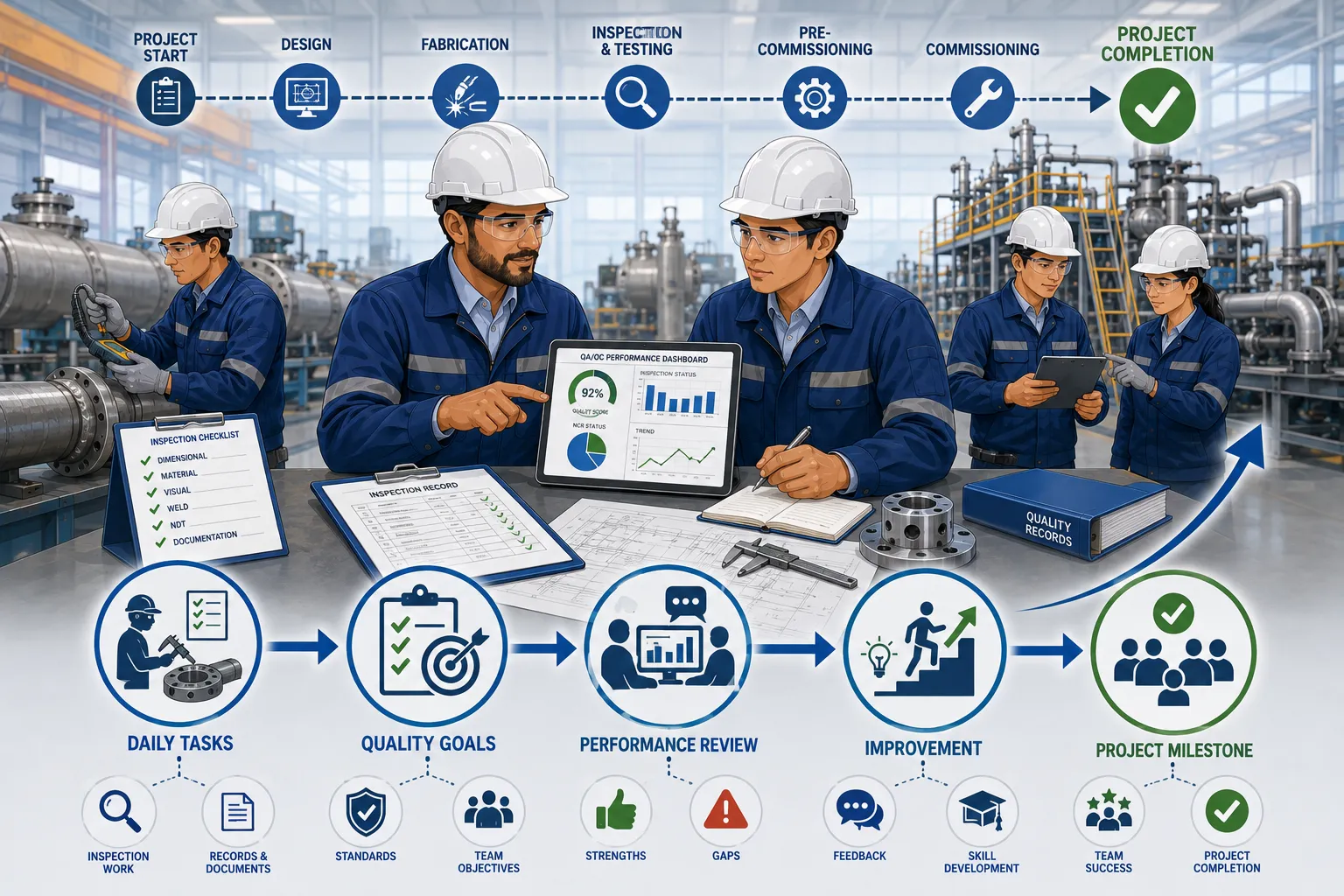
Key Definitions and Concepts
| Term | Definition | Application in Mechanical QA/QC |
|---|---|---|
| Performance goal | A clearly defined result or improvement expected from an individual within a specified period. | Used to guide inspectors and technicians towards project-related quality objectives. |
| Performance review | A structured assessment of an individual’s work, achievements, strengths and development needs. | Helps leaders evaluate whether team members are meeting assigned QA/QC responsibilities. |
| Project milestone | A significant point or achievement in the project schedule that indicates progress or completion of a major activity. | Examples include fabrication completion, testing completion and mechanical handover. |
| Key Performance Indicator (KPI) | A measurable indicator used to assess progress towards a defined objective. | May measure inspection completion, reporting timeliness or closure of assigned actions. |
| SMART goal | A goal designed to be Specific, Measurable, Achievable, Relevant and Time-bound. | Supports clear and practical performance expectations. |
| Quality objective | A defined result related to improving or maintaining quality performance. | May relate to inspection accuracy, compliance or reduction of repeat findings. |
| Competence development | The process of improving knowledge, skills and ability to perform professional responsibilities. | Supports continuous improvement of QA/QC personnel. |
| Milestone alignment | Connecting individual tasks and performance goals with important project deliverables. | Ensures daily work contributes directly to project progress. |
| Performance feedback | Information provided to an individual regarding the effectiveness of their work and areas for improvement. | Helps team members improve inspection quality and professional practice. |
| Corrective action | An action taken to address the cause of an identified problem and prevent recurrence. | May become a performance objective where recurring work issues require improvement. |
Understanding the Relationship Between Daily QA/QC Work and Project Milestones
Mechanical engineering projects are normally managed through planned stages and milestones. Each milestone represents an important point in the progression of work. QA/QC activities must support these stages by ensuring that required inspections, tests, records and approvals are completed at the appropriate time.
A mechanical project may include milestones such as:
Approval of project quality documentation.
Completion of material receiving activities.
Completion of fabrication stages.
Completion of installation activities.
Completion of required inspections.
Completion of testing.
Mechanical completion.
Client acceptance.
Final document handover.
Daily work performed by QA/QC personnel contributes directly to these milestones.
For example, an inspector responsible for fabrication activities may perform daily visual and dimensional checks. These individual activities may appear routine, but they support the larger milestone of fabrication completion. If inspections are delayed or records are incomplete, the project may be unable to demonstrate that the fabrication stage has met its required quality conditions.
Therefore, performance goals should clearly answer the question:
How does this individual’s daily work contribute to the next important project milestone?
When this connection is understood, performance management becomes a practical project management tool rather than simply an administrative exercise.
The Importance of Aligning Individual Goals with Project Objectives
Individual performance goals should not be created in isolation. They should reflect the needs of the project and the responsibilities assigned to the individual.
A QA/QC leader must therefore understand:
The project scope.
The project schedule.
Major milestones.
Inspection requirements.
Testing requirements.
Client expectations.
Documentation requirements.
Available resources.
Once these requirements are understood, they can be translated into meaningful goals for individual team members.
Benefits of Goal Alignment
Aligning individual performance goals with project milestones helps to:
Improve focus on project priorities.
Clarify individual responsibilities.
Reduce missed inspection activities.
Improve coordination between departments.
Support timely completion of records.
Strengthen accountability.
Identify performance issues early.
Improve workforce motivation.
When people understand the importance of their contribution, they can make better day-to-day decisions about priorities.
Principles for Designing Effective Performance Review Goals
Performance goals should be fair, realistic and relevant to the individual’s role.
A good goal should consider:
The individual’s responsibilities.
Their level of competence.
Available resources.
Project requirements.
The level of authority assigned.
The importance of the relevant project milestone.
Goals should also be sufficiently clear that the individual understands what successful performance looks like.
Key Principles
Effective goals should be:
Relevant to the individual’s actual role.
Connected to project requirements.
Based on measurable or observable evidence.
Realistic within available resources.
Focused on both quality and productivity.
Reviewed regularly.
Adjusted when project conditions change.
Applying the SMART Goal Approach
The SMART approach can help QA/QC leaders develop structured performance goals.
Specific
A goal should clearly state what is expected.
A weak goal may be:
“Improve inspection performance.”
A more specific goal may be:
“Complete assigned dimensional inspection activities in accordance with the approved inspection schedule and applicable procedures.”
Specific goals reduce uncertainty.
Measurable
The leader and team member should be able to identify evidence of progress.
Measurements may include:
Completion of assigned inspections.
Timeliness of reports.
Accuracy of records.
Closure of assigned actions.
Completion of planned training.
Measurement should not encourage inappropriate behaviour. Quantity should therefore be balanced with quality.
Achievable
Goals should be realistic.
A leader should consider:
Workload.
Personnel availability.
Inspection complexity.
Access to required information.
Availability of calibrated equipment.
Unrealistic goals can reduce motivation and encourage rushed work.
Relevant
The goal should support both the individual’s role and the project.
For example, a fabrication inspector should have objectives related to relevant fabrication quality activities rather than unrelated administrative responsibilities.
Time-Bound
Goals should be linked to a time period or project milestone.
Examples include:
Before completion of the fabrication stage.
During the current project phase.
By the next performance review period.
Types of Performance Goals for Mechanical QA/QC Personnel
Different personnel may require different performance goals.
Quality of Inspection Work
These goals focus on the reliability and accuracy of inspection activities.
Examples may include:
Apply approved inspection criteria consistently.
Complete inspection records accurately.
Identify and report significant non-conformities promptly.
Maintain appropriate evidence for inspection decisions.
Timeliness Goals
Timeliness is important because delayed quality activities can affect the project schedule.
Examples include:
Complete assigned inspection reports within agreed project timescales.
Review assigned records before the relevant milestone.
Escalate inspection delays promptly.
Documentation Goals
QA/QC work requires accurate records.
Goals may include:
Maintain complete inspection documentation.
Use current approved document revisions.
Submit records according to document control requirements.
Compliance Goals
Personnel may be required to demonstrate consistent compliance with:
Project procedures.
Inspection plans.
Approved technical requirements.
Organisational quality processes.
Professional Development Goals
Performance reviews should also support future competence.
Examples include:
Develop competence in an additional inspection activity.
Complete relevant project training.
Improve technical understanding of assigned systems.
Collaboration Goals
Team performance is particularly important in workshop environments.
Goals may include:
Participate constructively in technical briefings.
Communicate quality concerns clearly.
Support coordination with production and engineering personnel.
Linking Goals to Specific Project Milestones
A practical approach is to identify major project milestones and then determine the individual activities required to support them.
Example: Fabrication Completion Milestone
To achieve fabrication completion, the project may require:
Completion of planned inspections.
Resolution of identified non-conformities.
Completion of required records.
Verification of relevant documentation.
Individual goals may therefore include:
Complete assigned fabrication inspections according to the approved schedule.
Record inspection findings accurately.
Escalate significant issues promptly.
Maintain complete documentation for assigned work areas.
Example: Testing Milestone
Before testing can be completed, the project may require:
Confirmation of test readiness.
Availability of relevant records.
Appropriate verification of equipment.
Completion of required inspections.
The team member’s goals should reflect their assigned contribution.
Example: Final Handover Milestone
At the handover stage, documentation becomes particularly important.
Performance goals may include:
Review assigned records for completeness.
Identify missing documentation early.
Support timely closure of documentation gaps.
Developing Goals Through a Collaborative Process
Performance goals should not simply be imposed without discussion.
A collaborative goal-setting process allows the team member to:
Understand project priorities.
Explain practical challenges.
Identify development needs.
Clarify expectations.
The QA/QC leader should retain responsibility for ensuring that goals support the project, but involving the individual can improve commitment and understanding.
A Goal-Setting Discussion May Include
Review of current responsibilities.
Discussion of upcoming project milestones.
Review of previous performance.
Identification of strengths.
Identification of development needs.
Agreement on measurable objectives.
Establishing Key Performance Indicators Carefully
KPIs can help monitor progress, but they must be selected carefully.
An inappropriate KPI may encourage the wrong behaviour.
For example, measuring an inspector only by the number of inspections completed may encourage speed at the expense of quality.
A balanced KPI system should consider multiple dimensions.
Possible Performance Indicators
Depending on the project, appropriate indicators may include:
Completion of planned inspection activities.
Timeliness of inspection reporting.
Accuracy and completeness of records.
Timely escalation of significant concerns.
Closure of assigned quality actions.
Compliance with approved procedures.
Professional participation in team activities.
The purpose of KPIs should be improvement and performance understanding rather than punishment.
Balancing Quantity and Quality
One of the most important challenges in performance management is balancing productivity with quality.
A team member who completes a high number of inspections may not necessarily be performing effectively if records are incomplete or significant issues are missed.
Similarly, an inspector who performs extremely detailed checks may create unnecessary delays if routine work is not managed efficiently.
Effective performance goals should therefore consider:
Accuracy.
Timeliness.
Completeness.
Professional judgement.
Compliance.
Example of a Balanced Goal
Instead of:
“Complete the highest possible number of inspections.”
A more balanced objective is:
“Complete assigned inspections within the approved project schedule while maintaining accurate records and applying applicable acceptance criteria consistently.”
This recognises both productivity and quality.
Conducting Performance Reviews
Performance reviews should be structured and evidence-based.
A review should not depend only on the manager’s personal impression.
The QA/QC leader may consider:
Completed work records.
Inspection reports.
Audit findings.
Quality trends.
Training records.
Feedback from relevant project personnel.
A Performance Review Process
Step 1: Prepare Relevant Evidence
Collect appropriate information before the meeting.
This may include:
Previous goals.
Completed activities.
Performance records.
Training progress.
Relevant quality findings.
Step 2: Review Achievements
Recognise successful contributions.
Examples include:
Timely completion of critical inspections.
Improved reporting quality.
Effective identification of quality issues.
Support provided to other team members.
Step 3: Discuss Challenges
Ask the individual about difficulties that affected performance.
Possible issues may include:
Excessive workload.
Missing technical information.
Equipment availability.
Training needs.
Step 4: Identify Improvement Areas
Improvement should be discussed constructively.
The focus should be on:
What needs to improve.
Why improvement is important.
What support is required.
Step 5: Set Future Goals
Future goals should connect directly with upcoming project milestones.
Providing Constructive Performance Feedback
Feedback should be:
Timely.
Specific.
Respectful.
Evidence-based.
Focused on improvement.
A leader should avoid vague statements such as:
“Your work needs to improve.”
A more useful statement may be:
“Several inspection records required correction before approval. For the next review period, the goal is to improve first-time completeness by checking all required fields before submission.”
Constructive feedback identifies both the issue and the expected improvement.
Recognising Strong Performance
Performance management should not focus only on problems.
Recognition helps reinforce positive behaviour.
Appropriate recognition may relate to:
High-quality technical work.
Consistent reliability.
Effective teamwork.
Successful completion of critical activities.
Professional improvement.
Recognition should be fair and based on genuine performance evidence.
Identifying Performance Gaps
A performance gap occurs when actual performance does not meet the required standard.
The QA/QC leader should investigate the reason before taking action.
Possible causes include:
Lack of competence.
Unclear instructions.
Inadequate training.
Excessive workload.
Insufficient resources.
Poor role definition.
Different causes require different solutions.
Example
If a technician repeatedly submits incomplete reports, the solution may not simply be to instruct them to work harder.
The leader should determine whether:
The procedure is unclear.
Training is required.
The workload is excessive.
The reporting system is difficult to use.
Using Performance Goals to Support Competence Development
Performance reviews should support professional growth.
A developing team member may have goals such as:
Improve understanding of engineering drawings.
Develop competence in a new inspection activity.
Complete supervised inspection assignments.
Improve technical reporting skills.
Development goals should be realistic and supported through appropriate training and supervision.
Adjusting Goals When Project Conditions Change
Mechanical projects are dynamic. Project priorities may change because of:
Revised schedules.
Design changes.
Unexpected quality issues.
Changes in client requirements.
Resource limitations.
Performance goals should therefore be reviewed rather than treated as fixed for the entire project.
Examples of When Goals May Need Adjustment
Goals may require revision when:
A major project milestone is moved.
An individual’s responsibilities change.
New technical requirements are introduced.
Significant additional work is assigned.
Regular review ensures that goals remain relevant.
Practical Scenario: Fabrication Inspection Team
A mechanical fabrication project has an upcoming milestone for completion of a major assembly.
The QA/QC leader manages three inspectors.
Inspector A is responsible for dimensional checks.
Inspector B is responsible for reviewing assigned quality records.
Inspector C is responsible for coordinating final inspection activities.
The leader develops goals linked to the milestone.
Inspector A
Goal areas include:
Complete assigned dimensional inspections.
Report significant deviations promptly.
Maintain complete measurement records.
Inspector B
Goal areas include:
Review assigned records for completeness.
Identify documentation gaps early.
Support timely correction of incomplete records.
Inspector C
Goal areas include:
Coordinate inspection readiness.
Track completion of assigned activities.
Escalate risks that may affect the milestone.
Each person has different daily responsibilities, but all goals contribute to the same project objective.
Managing Performance Without Creating Unhealthy Competition
Performance systems should encourage improvement rather than unnecessary competition.
Comparing individuals without considering differences in responsibilities can create conflict.
For example:
One inspector may work on highly complex activities.
Another may perform a larger number of routine checks.
Direct comparison based only on numbers may therefore be unfair.
Performance goals should reflect the actual responsibilities and complexity of each role.
The Role of Self-Assessment
Self-assessment can improve performance review discussions.
Team members can be encouraged to consider:
What they achieved.
What challenges they experienced.
What skills they developed.
What support they require.
Self-assessment encourages ownership of professional development.
Documentation of Performance Goals
Performance objectives should be recorded clearly.
A performance goal record may include:
Team member role.
Defined objective.
Related project milestone.
Performance measure.
Review date.
Required support.
Documentation helps ensure consistency and transparency.
Using Performance Data Responsibly
Performance data should be interpreted carefully.
One isolated error does not always demonstrate poor overall performance. Similarly, a high volume of completed work does not automatically demonstrate strong quality performance.
The QA/QC leader should consider:
Trends over time.
Complexity of work.
Available resources.
Changes in responsibilities.
Professional judgement is required when interpreting performance information.
Key Benefits of Milestone-Aligned Performance Goals
A structured performance review system provides benefits for the individual, team and project.
Benefits for Team Members
Clearer expectations.
Better understanding of priorities.
Recognition of achievements.
Improved development opportunities.
Constructive feedback.
Benefits for the QA/QC Team
Improved coordination.
Greater accountability.
Better workload awareness.
Stronger communication.
Improved collaboration.
Benefits for the Project
Better alignment with milestones.
Earlier identification of delays.
Improved inspection planning.
Stronger documentation readiness.
Reduced risk of missed quality activities.
Common Mistakes to Avoid
QA/QC leaders should avoid several common performance management mistakes.
Setting Vague Goals
Goals such as:
“Do better quality work”
do not clearly explain what improvement is required.
Focusing Only on Quantity
High inspection numbers should not be treated as the only indicator of performance.
Ignoring Project Changes
Goals that are no longer relevant should be reviewed and updated.
Providing Feedback Only at the End
Feedback should be continuous rather than limited to formal review meetings.
Using Performance Reviews Only for Criticism
A good review should recognise achievements as well as identify improvement needs.
Ignoring Resource Problems
Individuals should not be judged unfairly for performance problems caused by inadequate resources or unclear requirements.
Creating a Continuous Performance Management Culture
Performance management should be an ongoing leadership activity.
The QA/QC leader should maintain regular communication through:
Daily coordination.
Technical briefings.
Progress reviews.
Individual feedback discussions.
Formal performance reviews.
This approach helps identify problems before they affect major project milestones.
A Practical Goal-Setting Framework for QA/QC Leaders
When designing a goal, the leader should follow this sequence:
Identify the Project Milestone
Determine the important project outcome.
Examples:
Completion of fabrication.
Completion of installation.
Successful testing.
Final handover.
Identify Required QA/QC Activities
Determine what quality activities are necessary to achieve the milestone.
Assign Individual Responsibilities
Identify which team members are responsible for specific activities.
Define Expected Performance
State what successful performance looks like.
Establish Evidence
Determine how performance will be reviewed.
Agree Review Timing
Set appropriate review points before critical milestones.
Provide Support
Identify required:
Training.
Technical guidance.
Resources.
Supervision.
Professional Judgement in Performance Reviews
Performance management requires fairness and professional judgement.
A QA/QC leader should avoid allowing personal relationships to influence assessments.
The leader should consider:
Verified evidence.
Actual responsibilities.
Project conditions.
Demonstrated performance.
Improvement over time.
Fair performance reviews strengthen trust within the team.
Integrating Performance Goals with Team Objectives
Individual goals should also support wider team objectives.
For example, a QA/QC team objective may be to ensure inspection readiness before a major project milestone.
Individual contributions may include:
Completing inspections.
Reviewing records.
Managing outstanding actions.
Coordinating technical information.
When these responsibilities are aligned, individual performance contributes to collective success.
Example Performance Review Goal Structure
A practical goal structure may contain:
Objective: Complete assigned inspection activities to support the scheduled fabrication milestone.
Project link: Fabrication completion.
Expected performance: Inspections completed according to the approved plan with accurate records.
Evidence: Inspection reports and completion records.
Review point: Before the scheduled milestone.
Support required: Access to current drawings and calibrated equipment.
This structure clearly connects individual work with project delivery.
Conclusion
Designing effective performance review goals is an essential leadership responsibility within mechanical QA/QC teams. Individual goals should connect daily inspection, testing, documentation and quality control activities with the wider project milestones that determine successful project delivery.
A strong performance management approach does not focus only on the number of inspections completed. It balances productivity with accuracy, compliance, documentation quality, professional behaviour and continuous competence development. Goals should be specific, measurable, achievable, relevant and time-bound while remaining flexible enough to respond to changing project conditions.
QA/QC leaders should develop goals through a structured process that begins with understanding project milestones and identifying the quality activities required to achieve them. Individual responsibilities can then be translated into clear performance objectives supported by appropriate evidence and regular feedback.
Performance reviews should recognise achievements, identify genuine development needs and provide practical support for improvement. When conducted fairly and consistently, they strengthen accountability, motivation and professional growth.
Ultimately, milestone-aligned performance goals help ensure that every member of the QA/QC team understands how their daily work contributes to the wider success of the mechanical engineering project. This creates a more focused, accountable and collaborative team capable of supporting quality requirements while helping the project achieve its planned objectives and milestones efficiently.