
Lesson no 6 : Advise teams on legal, industry-specific, and international requirements in mechanical QA/QC.
Introduction
Advising teams on legal, industry-specific, and international requirements is a critical responsibility within mechanical Quality Assurance and Quality Control (QA/QC). Mechanical projects operate within complex regulatory environments where engineering activities must satisfy applicable laws, client specifications, industry codes, safety requirements, environmental obligations, and internationally recognised standards. QA/QC professionals must therefore be able to interpret these requirements accurately and provide clear, practical guidance that supports compliant mechanical design, manufacturing, installation, inspection, testing, and final project handover.
This lesson develops the knowledge and professional competence required to advise engineering and project teams on the requirements that apply to mechanical systems and operations. Learners will explore how legal requirements, industry-specific regulations, contractual obligations, and international engineering standards influence quality planning and decision-making. Particular attention is given to identifying applicable requirements, interpreting technical clauses, communicating compliance expectations, and supporting teams in applying requirements correctly throughout the project lifecycle.
In mechanical QA/QC, effective advice must be based on reliable evidence rather than personal opinion. Professionals need to understand the difference between mandatory legal obligations, contractual requirements, recommended industry practices, and technical standards. They must also recognise that the requirements applicable to a project may vary according to the country, industry sector, equipment type, operating conditions, and level of risk involved. A requirement relevant to pressure equipment, for example, may differ significantly from one applicable to structural steelwork, piping systems, rotating machinery, or specialised manufacturing processes.
The lesson also examines the importance of professional communication when advising multidisciplinary teams. QA/QC personnel must be able to explain complex legal and technical requirements in language that engineers, supervisors, inspectors, contractors, and managers can understand and apply. Clear advice helps prevent non-compliance, reduces quality failures, supports workplace safety, and improves confidence in project decisions.
Learners will further consider practical methods for monitoring regulatory changes, assessing compliance risks, resolving conflicting requirements, and escalating issues when specialist legal or technical interpretation is required. By developing these skills, Learners will be better prepared to support informed decision-making and consistent compliance across mechanical projects.
Ultimately, this lesson strengthens the ability to act as a knowledgeable QA/QC adviser who can guide teams towards safe, compliant, traceable, and internationally aligned mechanical engineering practices.
1.Translating Complex Legal and International Engineering Rules into Clear Instructions for Engineering and Assembly Teams
Mechanical QA/QC professionals frequently work with complex legal requirements, international engineering standards, industry codes, client specifications, and technical procedures. These documents are often written for engineers, regulators, certification bodies, designers, or technical specialists. However, the people responsible for carrying out the work may include assembly technicians, machine operators, welders, fitters, supervisors, inspectors, and other personnel who need clear and practical instructions rather than lengthy legal or technical language.
The ability to translate complex requirements into simple, accurate, and actionable instructions is therefore an essential QA/QC competency. The objective is not to change the meaning of a legal or technical requirement. Instead, the QA/QC professional must interpret the requirement correctly and communicate what the relevant team must do, check, record, and report.
Effective translation of requirements helps ensure that engineering and assembly activities are performed consistently, safely, and in accordance with applicable obligations. It also reduces misunderstandings, prevents avoidable non-conformities, and strengthens communication between management, engineering, QA/QC, and operational teams.
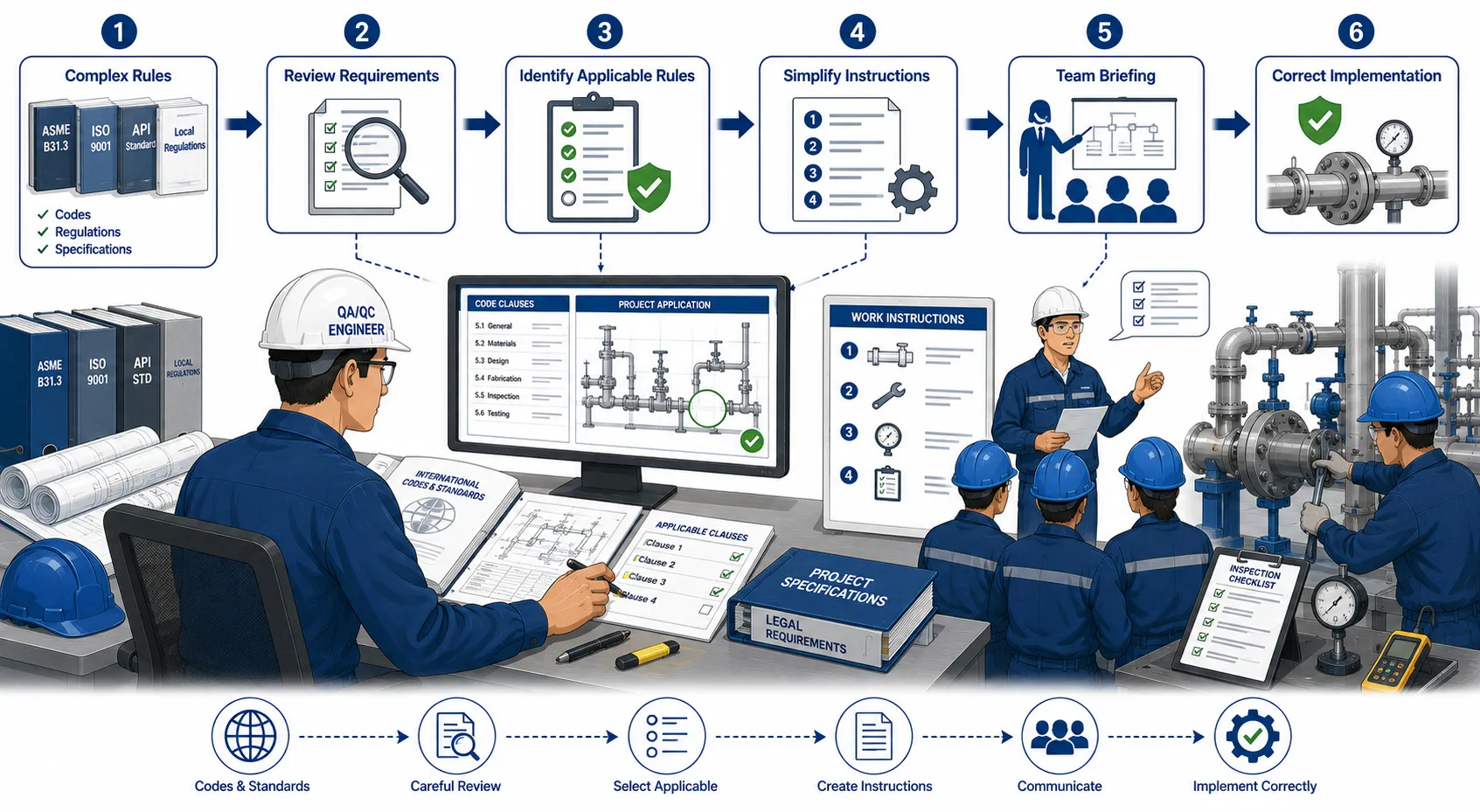
Understanding the Meaning of Requirement Translation
Requirement translation is the structured process of converting complex legal, regulatory, contractual, or technical requirements into clear workplace instructions that can be understood and applied by the relevant personnel.
A legal or international engineering requirement may contain:
- Technical terminology.
- Complex definitions.
- Conditional statements.
- References to other clauses.
- Mandatory requirements.
- Exceptions and limitations.
- Verification requirements.
- Documentation obligations.
- Competency requirements.
- Inspection and testing conditions.
The QA/QC professional must identify the practical meaning of these requirements.
For example, a technical requirement may state that a component must be manufactured, inspected, tested, and documented according to an approved procedure and applicable standard.
A practical instruction for the assembly team could be:
- Use only the approved material and component.
- Follow the current approved work instruction.
- Complete the required assembly checks.
- Do not proceed beyond the inspection point without approval where required.
- Record the inspection results on the approved form.
- Report any deviation immediately.
The simplified instruction is easier to understand, but it must remain technically accurate and must not remove important controls.
Why Complex Requirements Must Be Communicated Clearly
A requirement is only effective when the people responsible for implementing it understand what is expected. A technically correct standard does not automatically guarantee compliance if the operational team does not understand how its requirements apply to daily work.
Clear communication is particularly important in mechanical engineering because projects often involve multiple teams and disciplines.
These may include:
- Design engineers.
- Mechanical engineers.
- QA/QC engineers.
- Production supervisors.
- Assembly teams.
- Welding personnel.
- Inspection personnel.
- Maintenance teams.
- Procurement personnel.
- Contractors and subcontractors.
- Project managers.
- Client representatives.
Each group may require the same underlying requirement to be communicated differently according to its responsibilities.
For example, a design engineer may need to understand technical design limits, while an assembly technician may need a clear instruction regarding component orientation, tightening requirements, inspection points, or identification markings.
Key Concepts and Definitions
| Term | Definition | Importance in Mechanical QA/QC |
|---|---|---|
| Legal requirement | A mandatory obligation established by applicable law or regulatory authority | Failure to comply may create legal, safety, or operational consequences |
| International standard | A recognised technical framework that establishes requirements, specifications, or guidance | Supports consistent engineering and quality practices |
| Engineering code | A structured set of technical rules used for design, fabrication, inspection, testing, or operation | Helps ensure mechanical systems meet defined engineering requirements |
| Compliance | Meeting applicable legal, regulatory, contractual, and technical requirements | Demonstrates that work has been performed according to required obligations |
| Interpretation | Determining the correct meaning and application of a requirement | Prevents incorrect assumptions and inappropriate implementation |
| Work instruction | A clear document explaining how a specific task should be performed | Converts higher-level requirements into practical actions |
| Acceptance criteria | Defined conditions that must be met for work or a product to be accepted | Supports objective inspection and decision-making |
| Traceability | The ability to connect materials, activities, inspections, and records throughout a process | Provides evidence of controlled and compliant work |
| Escalation | Referring an issue to an appropriate higher-level or specialist authority | Ensures complex or uncertain matters receive proper review |
| Non-conformity | Failure to meet a specified requirement | Triggers investigation, corrective action, or further control |
Identifying the Source of the Requirement
Legal Requirements
Legal requirements may arise from national, regional, or local legislation. Depending on the project and location, these requirements may relate to:
- Workplace safety.
- Environmental protection.
- Pressure equipment.
- Machinery safety.
- Hazardous substances.
- Product conformity.
- Worker competence.
- Testing and inspection.
- Record retention.
- Waste management.
A QA/QC professional should not assume that every international standard is automatically a legal requirement. The legal status of a standard may depend on the jurisdiction, contract, regulatory framework, or specific application.
Industry-Specific Requirements
Different mechanical industries may operate under specialised requirements.
Examples include:
- Oil and gas facilities.
- Power generation.
- Manufacturing plants.
- Process industries.
- Marine engineering.
- Construction projects.
- Pressure systems.
- Pipelines.
- Heavy machinery.
Industry requirements may contain detailed expectations relating to materials, fabrication, inspection, testing, personnel competence, and documentation.
International Engineering Standards
International standards help establish recognised approaches to quality, safety, manufacturing, testing, and engineering control.
A mechanical project may use standards relating to:
- Quality management.
- Mechanical design.
- Materials.
- Welding.
- Non-destructive testing.
- Pressure systems.
- Dimensional inspection.
- Calibration.
- Environmental management.
- Occupational safety.
The QA/QC professional must determine which requirements are applicable to the specific project rather than applying documents without considering scope.
The Importance of Understanding Scope
What Is Scope?
The scope of a legal requirement or engineering standard explains what the document covers and, in some cases, what it does not cover.
Before translating any requirement into an instruction, the QA/QC professional should establish:
- What activity is covered?
- What equipment is included?
- What materials are included?
- What stage of the project is affected?
- Are there exclusions?
- Are there special conditions?
- Which geographical jurisdiction applies?
- Does the client contract specify additional requirements?
Failure to understand scope can result in incorrect instructions.
Practical Scope Review Questions
Before communicating a requirement to a team, ask:
- Does this requirement apply to this mechanical system?
- Does it apply to manufacturing, installation, testing, or operation?
- Is the requirement mandatory or contractual?
- Does the current revision apply?
- Are there referenced documents that must also be reviewed?
- Does the requirement contain conditions or exceptions?
- Who is responsible for implementation?
- What evidence of compliance is required?
These questions help prevent the common mistake of simplifying a requirement before its meaning has been properly understood.
Breaking Complex Requirements into Manageable Elements
Complex technical clauses should not normally be communicated as one large block of information. A more effective approach is to divide the requirement into smaller elements.
A useful method is to identify five practical questions:
- What must be done?
- Who must do it?
- When must it be done?
- How must compliance be checked?
- What evidence must be retained?
For example, a requirement may state that inspection shall be carried out using suitable calibrated equipment before final acceptance.
This can be translated as:
- Select the approved inspection method.
- Use the specified measuring equipment.
- Confirm that the equipment has valid calibration status.
- Carry out the inspection at the required stage.
- Compare results with the acceptance criteria.
- Record the inspection results.
- Obtain required approval before release.
This approach creates a direct connection between the higher-level requirement and the workplace activity.
A Structured Process for Translating Requirements
Step 1: Obtain the Correct and Current Source
The first step is to confirm that the source document is valid and current.
The QA/QC professional should verify:
- Document title.
- Document number.
- Revision or edition.
- Publication status.
- Contractual applicability.
- Related specifications.
- Applicable project documents.
Using an outdated requirement can lead to incorrect instructions and avoidable non-compliance.
Step 2: Read the Requirement in Context
A single sentence should not always be interpreted independently. The surrounding clauses, definitions, notes, references, and conditions may affect its meaning.
The reviewer should examine:
- The purpose of the clause.
- Definitions used within the document.
- Related requirements.
- Referenced standards.
- Exceptions.
- Conditions.
- Acceptance requirements.
Context is essential because technical language can have a specific meaning within a particular standard.
Step 3: Identify Mandatory Actions
The next stage is to identify the actual obligations created by the requirement.
These may include:
- Performing an activity.
- Using an approved procedure.
- Employing competent personnel.
- Conducting an inspection.
- Carrying out a test.
- Recording results.
- Obtaining approval.
- Maintaining traceability.
- Reporting deviations.
The QA/QC professional should separate mandatory actions from explanatory information.
Step 4: Identify Responsibility
Every instruction should identify the responsible role where appropriate.
Responsibilities may be allocated to:
- Engineering.
- Production.
- Assembly.
- QA/QC.
- Inspection.
- Supervision.
- Project management.
Clear responsibilities reduce the risk of important tasks being overlooked because each team assumes another department will complete them.
Step 5: Convert the Requirement into Actionable Language
The instruction should use clear operational language.
Useful action words include:
- Check.
- Verify.
- Measure.
- Inspect.
- Record.
- Confirm.
- Report.
- Stop.
- Isolate.
- Obtain approval.
- Release.
Avoid vague wording such as:
- Handle appropriately.
- Ensure everything is correct.
- Follow requirements as necessary.
- Use suitable controls.
These statements may sound acceptable but can be difficult to apply consistently.
Step 6: Define Acceptance Criteria
A team needs to understand how to determine whether the work is acceptable.
The instruction should clarify:
- Required dimensions.
- Permitted tolerances.
- Test requirements.
- Inspection criteria.
- Approval points.
- Required documentation.
Acceptance criteria should come from approved project requirements and should not be invented by the person writing the instruction.
Step 7: Communicate the Instruction
Communication methods may include:
- Approved work instructions.
- Standard operating procedures.
- Inspection and test plans.
- Toolbox talks.
- Technical briefings.
- Pre-job meetings.
- Visual work aids.
- Training sessions.
- Digital workflow systems.
The method should suit the complexity and risk of the task.
Step 8: Confirm Understanding
Issuing an instruction does not prove that the team understands it.
Understanding can be confirmed through:
- Questions and answers.
- Demonstration.
- Supervised practice.
- Competency assessment.
- Observation of work.
- Inspection results.
Feedback should be used to identify areas requiring further clarification.
Step 9: Monitor Implementation
The QA/QC professional should verify whether the instruction is being followed in practice.
This may involve:
- Workplace observation.
- Record review.
- Process audits.
- Inspection.
- Sampling.
- Interviews with personnel.
Where implementation differs from the approved instruction, the issue should be investigated.
Step 10: Improve the Instruction Where Necessary
If teams repeatedly misunderstand a requirement, the communication method may require improvement.
Possible improvements include:
- Simplifying language.
- Adding diagrams.
- Providing examples.
- Improving sequencing.
- Clarifying responsibilities.
- Separating different task stages.
- Adding acceptance criteria.
However, any significant technical change must be reviewed and approved through the appropriate document control process.
Principles of Clear Technical Communication
Use Simple but Accurate Language
Simple language does not mean removing technical accuracy. The objective is to communicate the correct meaning using words that the intended audience can understand.
A useful instruction should be:
- Clear.
- Specific.
- Concise.
- Accurate.
- Relevant.
- Action-focused.
Use Short and Logical Sentences
Long sentences can contain multiple requirements and increase the risk of misunderstanding.
Instead of combining several actions in one sentence, separate them into logical steps.
For example:
- Check the component identification.
- Verify that the component matches the approved drawing.
- Inspect the component for visible damage.
- Record the inspection result.
- Report any non-conformity before assembly.
Avoid Unnecessary Legal Language
Operational teams generally do not need every legal explanation when performing routine work. They need to understand the applicable action and its required outcome.
However, the controlled QA/QC documentation should maintain a link to the original source where traceability is required.
Explain the Purpose Where Useful
People often follow procedures more effectively when they understand why a control exists.
For example:
- Verify the material identification before installation to maintain material traceability.
- Check calibration status to ensure measurement results are reliable.
- Stop work at the inspection point to prevent unverified work from progressing.
Understanding the purpose can improve professional judgement.
Using Visual and Structured Instructions
The Value of Visual Communication
Mechanical activities are often easier to understand when written instructions are supported by visual information.
Useful visual tools include:
- Component diagrams.
- Assembly drawings.
- Process flowcharts.
- Inspection checklists.
- Colour-coded identification systems.
- Photographic examples.
- Acceptable and unacceptable examples.
Visual aids should support approved instructions and should be controlled where they form part of the official quality documentation.
Checklists
Checklists can help ensure that important activities are not missed.
A mechanical assembly checklist may include:
- Correct component identified.
- Material identification verified.
- Current drawing available.
- Required tools available.
- Measuring equipment within calibration.
- Assembly completed according to procedure.
- Inspection completed.
- Results recorded.
- Non-conformities reported.
Checklists are particularly useful for repetitive activities, but they should not replace professional judgement where technical assessment is required.
Communicating Requirements to Different Teams
Engineering Teams
Engineering teams may require detailed information relating to:
- Design requirements.
- Material selection.
- Engineering calculations.
- Technical limitations.
- Applicable codes.
- Revision changes.
Communication should focus on technical interpretation and project impact.
Assembly Teams
Assembly personnel generally require practical task information.
This may include:
- Correct sequence.
- Component identification.
- Assembly method.
- Required tools.
- Inspection points.
- Acceptance criteria.
- Actions to take when a problem is identified.
Supervisory Teams
Supervisors require information about:
- Responsibilities.
- Resource requirements.
- Competency needs.
- Hold points.
- Quality risks.
- Escalation procedures.
QA/QC Teams
QA/QC personnel require a clear understanding of:
- Applicable requirements.
- Inspection methods.
- Sampling requirements.
- Acceptance criteria.
- Record requirements.
- Non-conformity processes.
The same source requirement may therefore produce different instructions for different roles.
Practical Example: Translating a Technical Requirement
Consider a mechanical assembly process where critical fasteners must be tightened according to an approved engineering specification and verified before release.
A complex technical requirement may involve references to:
- Assembly procedure.
- Approved torque values.
- Tool calibration.
- Inspection requirements.
- Record completion.
The practical instruction could be structured as follows.
Before Assembly
- Confirm the current approved assembly instruction.
- Verify the component identification.
- Check that the required fastening tools are available.
- Confirm the tool calibration status where applicable.
During Assembly
- Install the fasteners in the specified sequence.
- Apply the approved tightening requirements.
- Do not use unauthorised methods or tools.
- Stop and report any damaged component.
After Assembly
- Complete the required inspection.
- Verify compliance with the specified acceptance criteria.
- Record the results.
- Obtain required QA/QC release before progressing.
This structure helps the team understand exactly what is expected at each stage.
Managing Differences Between Requirements
Mechanical projects may contain multiple sources of requirements, including:
- Laws and regulations.
- Client specifications.
- International standards.
- Engineering codes.
- Approved drawings.
- Manufacturer instructions.
- Company procedures.
These requirements may sometimes appear to conflict.
A Structured Approach to Potential Conflicts
When a potential conflict is identified:
- Do not make assumptions.
- Identify all relevant source documents.
- Confirm the applicable revisions.
- Review the scope of each requirement.
- Determine whether the requirements genuinely conflict.
- Refer the issue to the appropriate technical or contractual authority.
- Record the decision.
- Update instructions if required.
A QA/QC professional should not independently override legal, engineering, or contractual requirements without appropriate authority.
Escalation of Complex Issues
When Should an Issue Be Escalated?
Escalation may be necessary when:
- The requirement is unclear.
- Two requirements appear to conflict.
- The issue involves legal interpretation.
- A safety-critical decision is required.
- A technical deviation is proposed.
- The applicable standard is uncertain.
- The project specification is incomplete.
Recognising the limits of one’s authority is an important aspect of professional competence.
Appropriate Escalation
Depending on the issue, escalation may involve:
- Senior QA/QC personnel.
- Project engineering.
- Design authority.
- Regulatory specialists.
- Legal advisers.
- Client representatives.
- Certification or inspection authorities.
The escalation process should preserve the issue history and supporting evidence.
Common Mistakes When Simplifying Requirements
Oversimplification
Removing important conditions can change the meaning of a requirement.
For example, changing a requirement that applies only under specific operating conditions into a general instruction may result in unnecessary or incorrect controls.
Adding Personal Interpretation
Instructions should be based on approved requirements rather than personal preferences.
Using Outdated Documents
An outdated standard or procedure may result in instructions that no longer reflect project requirements.
Failing to Identify Responsibility
If no responsible role is identified, important activities may be missed.
Omitting Records
A task may be physically completed correctly but still lack required evidence.
Using Ambiguous Language
Words such as “properly”, “suitably”, and “appropriately” may require further clarification.
Benefits of Effective Requirement Translation
Clear translation of complex requirements provides significant benefits to mechanical projects.
Quality Benefits
- Improves consistency of work.
- Reduces interpretation errors.
- Supports objective inspection.
- Improves traceability.
- Reduces repeated non-conformities.
Safety Benefits
- Helps teams understand critical controls.
- Supports safe working practices.
- Reduces the risk of unsafe assumptions.
- Improves awareness of hold and stop points.
Operational Benefits
- Reduces delays caused by misunderstandings.
- Supports efficient communication.
- Improves coordination between departments.
- Reduces rework.
Compliance Benefits
- Supports consistent implementation of requirements.
- Provides clearer evidence of controlled processes.
- Improves audit readiness.
- Helps identify compliance gaps earlier.
Practical Workplace Scenario
A mechanical assembly team receives a new project procedure containing several technical references and detailed requirements. During the morning briefing, the supervisor simply tells the team to “follow the new standard”.
This approach is insufficient because the team may not understand:
- Which parts of the standard apply.
- What has changed.
- Which activities require inspection.
- What records must be completed.
- What actions require approval.
A better QA/QC approach would be to review the requirements and produce a controlled implementation guide.
The guide could identify:
Task Requirements
- Confirm the current approved drawing.
- Use the specified materials.
- Follow the approved assembly sequence.
Quality Controls
- Inspect critical dimensions.
- Use calibrated measuring equipment.
- Record inspection results.
Escalation Requirements
- Stop work if the component does not match the drawing.
- Report deviations immediately.
- Do not proceed past a required hold point without approval.
This method provides the operational team with practical instructions while maintaining alignment with the original requirement.
Developing an Effective Requirement Communication System
An organisation should establish a structured process for communicating new and revised requirements.
A strong system may include the following stages:
Requirement Identification
Identify relevant changes in:
- Legislation.
- Regulations.
- Standards.
- Client specifications.
- Engineering requirements.
Applicability Assessment
Determine:
- Which projects are affected.
- Which departments are affected.
- Which procedures require review.
Technical Review
Obtain appropriate technical interpretation where required.
Instruction Development
Convert applicable requirements into:
- Procedures.
- Work instructions.
- Inspection plans.
- Checklists.
- Training materials.
Approval
Ensure revised instructions are reviewed and authorised through document control.
Communication
Inform relevant teams through suitable methods.
Competence Verification
Confirm that affected personnel understand their responsibilities.
Implementation Monitoring
Use inspections, audits, and observations to confirm effective application.
Continual Improvement
Review non-conformities and feedback to improve future communication.
Key Skills Required by a QA/QC Adviser
To translate complex legal and international engineering requirements effectively, a QA/QC professional should develop a range of professional skills.
These include:
- Technical reading.
- Requirement interpretation.
- Critical thinking.
- Risk awareness.
- Clear written communication.
- Verbal communication.
- Document control.
- Professional judgement.
- Problem-solving.
- Stakeholder communication.
The professional must also understand the boundaries of their own competence and seek specialist advice where necessary.
Key Points for Learners
The most important principles of this topic are:
- Understand the original requirement before simplifying it.
- Confirm the correct scope and applicability.
- Use current and controlled source documents.
- Identify the practical actions required.
- Define responsibilities clearly.
- Explain when and how activities must be performed.
- State measurable acceptance criteria.
- Identify required inspection and testing activities.
- Specify necessary records and traceability.
- Use clear and action-focused language.
- Adapt communication to the intended audience.
- Use visual aids and checklists where appropriate.
- Confirm that teams understand the instruction.
- Monitor implementation in the workplace.
- Escalate complex legal or technical issues appropriately.
- Maintain document control when requirements or instructions change.
Conclusion
Translating complex legal and international engineering rules into simple and clear instructions is a fundamental responsibility for senior mechanical QA/QC professionals. The process requires more than shortening technical documents. It requires careful interpretation, accurate identification of applicable obligations, clear communication, professional judgement, and effective monitoring of implementation.
The most effective QA/QC advice connects high-level requirements with practical workplace actions. Engineering and assembly teams should understand what they must do, why it is required, how compliance will be checked, and what evidence must be recorded. Clear instructions reduce uncertainty while preserving the original technical and legal intent.
A structured approach involving requirement identification, scope review, technical interpretation, action planning, communication, verification, monitoring, and continual improvement helps organisations maintain consistent compliance. By developing these skills, Learners can provide valuable guidance to engineering and assembly teams, support effective mechanical QA/QC operations, and contribute to safer, more reliable, and internationally aligned project outcomes.
2.Leading Technical Brief Sessions on Quality Milestones, Code Boundaries, and Testing Duties
Technical brief sessions are an essential part of effective mechanical QA/QC management. Field technicians often perform work in dynamic environments where multiple activities take place simultaneously, schedules change rapidly, and technical requirements must be applied correctly under practical working conditions. A well-planned technical brief helps ensure that field personnel understand the project-specific quality requirements that apply to their work before critical activities begin.
In mechanical projects, a technical brief is more than a routine meeting. It is a structured communication process used to explain what work is planned, which quality milestones must be achieved, what technical codes and specifications apply, where the boundaries of those requirements begin and end, and what inspection or testing duties must be completed. The purpose is to connect project documentation with practical field activities.
For a QA/QC professional, leading such sessions requires technical knowledge, communication skills, professional judgement, and the ability to explain complex information in a way that field technicians can understand and apply. The briefing must be accurate but also practical. Technicians should leave the session knowing what they are required to do, what standards apply, when inspections are required, what records must be completed, and when they must stop work and seek further instruction.
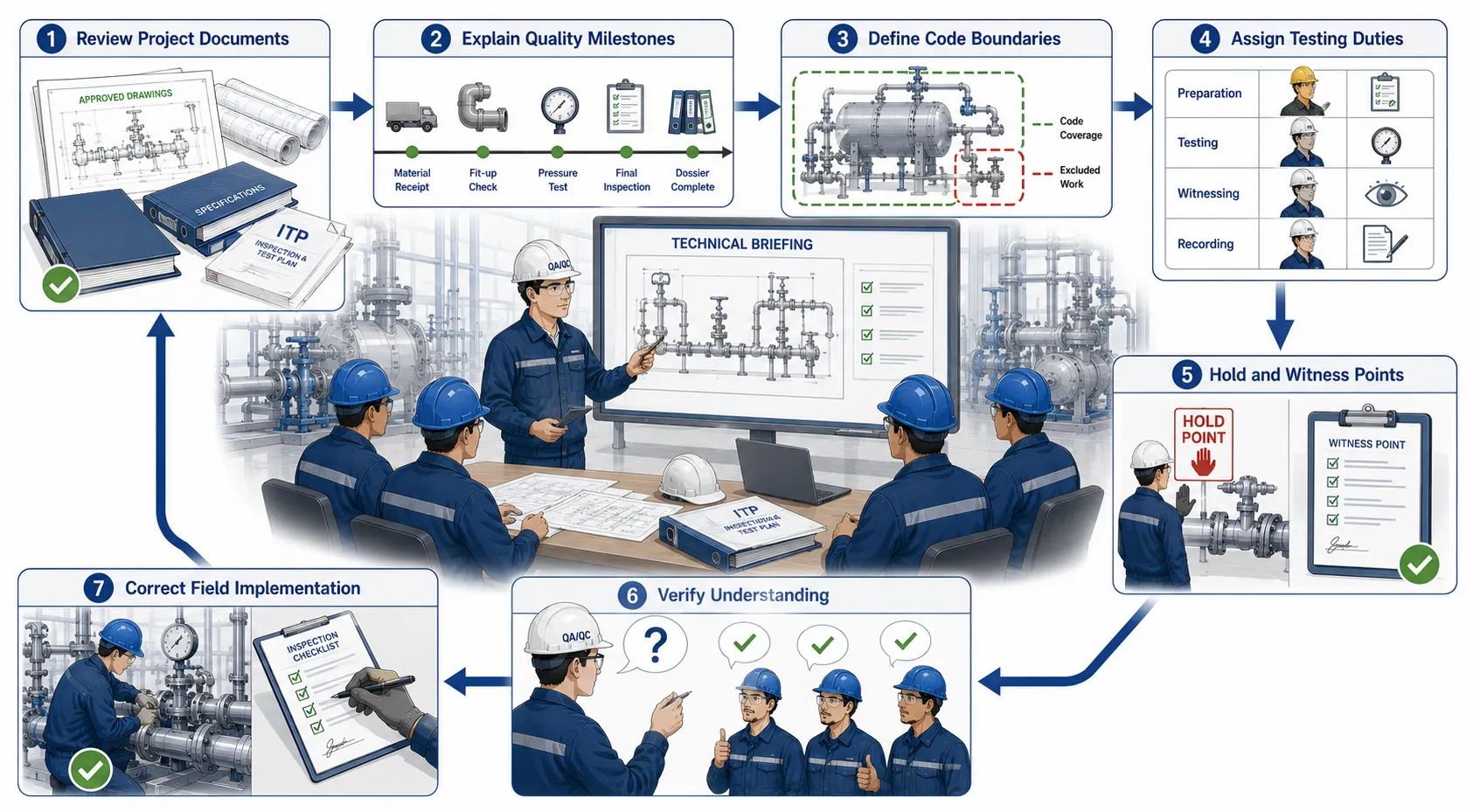
Key Concepts and Definitions
| Term | Definition | Importance in Field QA/QC |
|---|---|---|
| Technical brief | A structured session used to communicate technical, quality, safety, and testing requirements to relevant personnel | Ensures teams understand project-specific expectations before or during work |
| Quality milestone | A defined stage at which specified quality requirements must be achieved or verified | Prevents uncontrolled progression of work |
| Code boundary | The defined limit of where a particular engineering code, standard, or requirement applies | Helps prevent incorrect application of technical requirements |
| Hold point | A mandatory point where work cannot continue until required inspection or approval is completed | Provides formal control over critical activities |
| Witness point | A stage where an authorised party may observe an inspection or test | Supports transparency and verification |
| Inspection and Test Plan (ITP) | A controlled document defining inspection stages, responsibilities, acceptance criteria, and records | Provides a structured framework for quality control |
| Acceptance criteria | Defined conditions that determine whether work, material, or test results are acceptable | Supports objective decisions |
| Technical competency | The demonstrated ability to perform work according to required technical standards | Supports reliable and compliant work |
| Testing duty | A defined responsibility to prepare, perform, witness, verify, or record a test | Ensures testing activities are properly controlled |
| Escalation | The process of referring an issue to an appropriate authority when it cannot be resolved at the current level | Prevents unauthorised technical decisions |
Understanding the Purpose of Technical Brief Sessions
Why Technical Briefs Are Necessary
Mechanical engineering projects can involve piping systems, pressure equipment, structural supports, rotating equipment, machinery, fabricated components, and complex assemblies. Each activity may have different quality requirements.
Field technicians may receive information from:
- Approved drawings.
- Technical specifications.
- Project quality plans.
- Inspection and Test Plans.
- Work instructions.
- Method statements.
- Applicable engineering codes.
- Client requirements.
- Manufacturer instructions.
Without structured communication, important requirements may be misunderstood or overlooked.
A technical brief creates an opportunity to explain these requirements before work progresses. It allows the QA/QC professional to focus on the requirements that are most relevant to the specific activity rather than expecting technicians to interpret large volumes of technical documentation independently.
The main purposes of a technical brief include:
- Explaining the planned activity.
- Identifying applicable quality requirements.
- Clarifying project-specific milestones.
- Explaining relevant code boundaries.
- Defining inspection responsibilities.
- Explaining testing requirements.
- Confirming acceptance criteria.
- Identifying documentation requirements.
- Clarifying stop-work and escalation requirements.
- Confirming understanding.
Connecting Documentation with Field Work
One of the most important functions of a technical brief is to translate controlled project requirements into practical actions.
For example, an approved ITP may contain several inspection stages. A field technician does not simply need to know that an ITP exists. The technician needs to understand:
- Which activity is being inspected.
- When the inspection must take place.
- Who performs the inspection.
- Which equipment is required.
- What acceptance criteria apply.
- What records must be completed.
- Whether work can continue after the inspection.
The technical brief should therefore convert documentation into a logical sequence of field actions.
Preparing for a Technical Brief
Review the Planned Scope of Work
Before leading a session, the QA/QC professional should understand exactly what work is planned.
Preparation should include reviewing:
- The work package.
- Current approved drawings.
- Applicable specifications.
- Relevant procedures.
- Inspection requirements.
- Test requirements.
- Project quality objectives.
- Previous non-conformities where relevant.
- Site conditions that may affect quality.
The briefing should focus on the actual work that technicians are expected to perform.
Confirm Document Status
Only current and approved documents should be used when explaining project requirements.
The briefing leader should verify:
- Document identification.
- Revision status.
- Approval status.
- Project applicability.
- Related technical references.
Using an obsolete drawing or procedure during a technical brief can result in widespread quality failures.
Identify the Intended Audience
The content and technical depth of a briefing should be suitable for the personnel involved.
The audience may include:
- Mechanical technicians.
- Assembly technicians.
- Pipe fitters.
- Welders.
- Equipment operators.
- Inspectors.
- Supervisors.
- Testing personnel.
The QA/QC professional should consider the responsibilities of each group.
A supervisor may require information about coordination and quality milestones, while a technician may require detailed information about assembly sequence and inspection requirements.
Define the Learning Objectives of the Brief
Every technical brief should have clear objectives.
By the end of the session, field technicians should be able to:
- Identify the work activity being discussed.
- Recognise applicable quality milestones.
- Understand relevant code boundaries.
- Identify their testing responsibilities.
- Follow approved procedures.
- Recognise acceptance criteria.
- Know when to stop work.
- Understand reporting and escalation requirements.
Clear objectives help keep the session focused.
Explaining Project-Specific Quality Milestones
What Are Quality Milestones?
A quality milestone is a defined stage in the project at which specified requirements must be completed, inspected, verified, or approved before further progress occurs.
Quality milestones may occur during:
- Material receipt.
- Component identification.
- Fabrication.
- Assembly.
- Welding.
- Heat treatment.
- Dimensional inspection.
- Pressure testing.
- Functional testing.
- Final inspection.
- Client handover.
Each milestone provides an opportunity to verify that the work remains compliant.
Typical Mechanical Quality Milestones
A mechanical project may include milestones such as:
- Material verification completed.
- Approved procedure available.
- Personnel competency confirmed.
- Equipment calibration verified.
- Assembly inspection completed.
- Required tests performed.
- Non-conformities resolved.
- Final records compiled.
- Client acceptance obtained where required.
During the technical brief, technicians should understand which milestones apply to their work.
Explaining Milestones in Sequence
The best approach is usually to explain milestones according to the actual work sequence.
For example:
Before Work Starts
Technicians may need to:
- Confirm the correct drawing.
- Check material identification.
- Review the approved work instruction.
- Verify equipment condition.
- Confirm measurement equipment status.
During the Activity
Technicians may need to:
- Follow the approved sequence.
- Maintain component identification.
- Perform intermediate checks.
- Protect completed work.
- Report deviations.
Before Progressing
The team may need to:
- Complete an inspection.
- Meet acceptance criteria.
- Obtain required approval.
- Complete quality records.
This sequence helps technicians understand when each quality control must occur.
Understanding Code Boundaries
Meaning of Code Boundaries
A code boundary identifies the limits within which a particular engineering code, standard, or technical requirement applies.
Understanding boundaries is important because mechanical projects may contain several systems governed by different technical requirements.
A field technician should not assume that one requirement automatically applies to every component on a project.
The QA/QC professional must explain:
- Which system is covered.
- Which equipment is included.
- Which work activities are affected.
- Where the requirement stops applying.
- Which alternative requirement applies beyond that boundary.
Why Code Boundaries Matter
Failure to understand code boundaries can result in:
- Incorrect inspection methods.
- Incorrect testing requirements.
- Unnecessary work.
- Missing mandatory controls.
- Incorrect documentation.
- Non-compliance with project specifications.
For example, a project may contain multiple mechanical systems with different design conditions and quality requirements. The briefing must clearly explain which requirements apply to the specific activity.
Practical Questions for Explaining Code Boundaries
A QA/QC professional should help technicians understand:
- What equipment is included?
- What activity is covered?
- Which approved specification applies?
- What is outside the scope?
- Are there special interfaces?
- Are there different requirements for connected systems?
Clear boundary communication prevents technicians from relying on assumptions.
Explaining Testing Duties
Importance of Defined Testing Responsibilities
Testing is a controlled quality activity. Different personnel may have different responsibilities.
A testing process may involve:
- Preparing the system.
- Checking test equipment.
- Performing the test.
- Witnessing the test.
- Recording results.
- Reviewing results.
- Approving completion.
The technical brief should clearly explain who is responsible for each activity.
Typical Testing Duties
Depending on the project, technicians may be required to:
- Prepare equipment for testing.
- Install temporary test arrangements.
- Verify system identification.
- Confirm isolation where required.
- Check test equipment.
- Monitor test conditions.
- Record readings.
- Report abnormal results.
- Restore the system after testing.
Technicians should understand the limits of their authority. They should not independently change test parameters or acceptance criteria without approval.
Testing Equipment and Calibration
Reliable test results depend on suitable equipment.
Before testing begins, the responsible personnel should verify:
- Correct instrument selection.
- Valid calibration status where required.
- Suitable measurement range.
- Equipment identification.
- Physical condition.
- Proper connection or installation.
The technical brief should explain why calibration matters.
A test result is only useful when the measurement process is sufficiently reliable and controlled.
The Inspection and Test Plan as a Briefing Tool
Using the ITP Effectively
An Inspection and Test Plan can provide a structured basis for a technical brief.
Relevant sections may explain:
- Activity sequence.
- Inspection stages.
- Responsible personnel.
- Applicable procedures.
- Acceptance criteria.
- Hold points.
- Witness points.
- Required records.
The QA/QC professional should avoid simply reading the ITP aloud. Instead, the content should be explained in practical terms.
Example of Practical Translation
Instead of stating:
“Inspection shall be performed according to the approved ITP.”
The briefing can explain:
- Complete the assembly stage.
- Inform QA/QC when the activity is ready.
- Do not cover or close the work before inspection.
- Provide access for inspection.
- Correct any identified non-conformity.
- Obtain the required release before proceeding.
This communication is more useful for field technicians.
Conducting an Effective Technical Brief
Step 1: Introduce the Activity
Begin by clearly identifying:
- The project area.
- The equipment or system.
- The planned activity.
- The purpose of the briefing.
For example:
“Today’s briefing covers the assembly and inspection requirements for the identified mechanical equipment package.”
This gives the session a clear focus.
Step 2: Explain the Quality Objectives
Describe what successful work should achieve.
The quality objectives may include:
- Correct installation.
- Compliance with approved drawings.
- Protection of materials.
- Accurate measurements.
- Successful inspection.
- Completion of required records.
Step 3: Identify Applicable Requirements
Explain the relevant requirements without overwhelming the team with unnecessary technical information.
Focus on:
- Approved drawings.
- Work instructions.
- Applicable specifications.
- Inspection requirements.
- Test procedures.
Step 4: Explain Code Boundaries
Clearly state:
- Where the requirement applies.
- Which components are included.
- Any important exclusions.
- Interface areas requiring special attention.
Step 5: Explain Quality Milestones
Present the activity in the order in which quality controls will occur.
Use:
- Flowcharts.
- Checklists.
- Drawings.
- Simple diagrams.
Step 6: Define Testing Duties
Explain:
- Who prepares.
- Who performs.
- Who witnesses.
- Who records.
- Who approves.
Step 7: Explain Stop and Escalation Points
Technicians must understand when they should stop work.
Typical stop situations include:
- Incorrect material identification.
- Missing approved drawing.
- Expired calibration status.
- Damaged component.
- Failed inspection.
- Unexpected test result.
- Unauthorised deviation.
Step 8: Confirm Understanding
Do not assume that silence means understanding.
Use:
- Direct questions.
- Practical examples.
- Demonstrations.
- Scenario discussions.
Step 9: Record the Brief
Where required by the organisation, maintain evidence of the briefing.
Records may include:
- Date.
- Project activity.
- Topics covered.
- Names or roles of attendees.
- Trainer or briefing leader.
- Questions raised.
- Actions required.
Communication Techniques for Field Technicians
Use Clear and Direct Language
Technical language should be used where necessary, but instructions should remain understandable.
Effective communication includes:
- Short sentences.
- Logical sequence.
- Clear action words.
- Relevant examples.
Useful instructions include:
- Check the identification.
- Measure the dimension.
- Record the result.
- Stop at the hold point.
- Report the deviation.
Avoid Information Overload
A briefing should not attempt to explain every project requirement at once.
Focus on the activity currently being performed.
Key information should be prioritised according to:
- Risk.
- Complexity.
- Quality impact.
- Testing requirements.
Encourage Questions
Field technicians should be encouraged to raise concerns.
A strong technical briefing environment allows personnel to ask:
- Which requirement applies?
- What happens if the measurement is outside tolerance?
- Who must approve the next stage?
- What record is required?
Questions can reveal misunderstandings before they become quality failures.
Using Practical Examples and Scenarios
Scenario: Missing Calibration Evidence
A technician is preparing to measure a critical component. The required measuring instrument is available, but its calibration status cannot be confirmed.
The correct briefing message should be:
- Do not use the instrument for acceptance measurement until its status is verified.
- Inform the responsible supervisor or QA/QC representative.
- Obtain suitable controlled equipment.
This scenario demonstrates how a simple decision can affect the reliability of quality evidence.
Scenario: Work Approaching a Hold Point
An assembly team has completed a critical installation stage and is ready to continue.
The technical brief should explain:
- Check the ITP.
- Confirm whether a hold point applies.
- Notify the required inspection authority.
- Do not proceed until release is obtained where required.
Scenario: Unexpected Test Result
During a controlled test, a recorded value is outside the expected acceptance range.
The correct response should normally include:
- Stop and maintain safe control of the activity.
- Record the actual observation.
- Do not alter the result.
- Report the issue.
- Follow the approved non-conformity or investigation process.
Technicians should understand that hiding or changing results is unacceptable.
Benefits of Effective Technical Brief Sessions
Quality Benefits
Effective briefings can:
- Reduce misunderstandings.
- Improve work consistency.
- Prevent repeated errors.
- Improve compliance with procedures.
- Strengthen inspection readiness.
Safety Benefits
Technical briefings can help personnel recognise:
- Critical hazards.
- Testing risks.
- Stop-work conditions.
- Equipment limitations.
- Escalation requirements.
Operational Benefits
Clear communication can:
- Reduce rework.
- Improve coordination.
- Prevent unnecessary delays.
- Improve resource planning.
- Support efficient testing.
Professional Benefits
Regular technical briefings can:
- Improve technical awareness.
- Develop workplace competency.
- Strengthen communication between teams.
- Encourage professional responsibility.
- Improve confidence in quality decisions.
Common Problems in Technical Brief Sessions
Using Generic Information
A generic briefing may not address the actual project activity.
A strong briefing should be project-specific.
Reading Documents Without Explanation
Simply reading a procedure does not ensure understanding.
The leader should explain:
- What the requirement means.
- Why it matters.
- How it applies.
Failing to Explain Boundaries
Technicians may apply a requirement incorrectly if they do not understand its scope.
Ignoring Testing Responsibilities
Unclear responsibilities can lead to missed tests or incomplete records.
Not Checking Understanding
A briefing is incomplete if the leader never confirms whether the information has been understood.
Failing to Update Briefing Content
When project requirements change, briefing materials may also need to be reviewed.
Monitoring the Effectiveness of Technical Briefs
The effectiveness of a briefing should be measured through workplace performance rather than attendance alone.
Useful methods include:
- Field observation.
- Inspection results.
- Audit findings.
- Non-conformity trends.
- Technician feedback.
- Record reviews.
Indicators of effective communication include:
- Reduced repeated errors.
- Correct completion of inspection records.
- Improved compliance with hold points.
- Better testing discipline.
- Faster identification of deviations.
The Role of Professional Judgement
A QA/QC professional leading a technical brief must use professional judgement when deciding:
- How much information to provide.
- Which risks require emphasis.
- Whether the audience requires additional explanation.
- When a technical issue requires escalation.
However, professional judgement must not replace approved technical requirements.
Where requirements are unclear, the appropriate action is to seek clarification from an authorised technical source.
Recommended Structure for a Technical Brief Session
A practical technical briefing can follow this structure:
Opening
- Identify the activity.
- Explain the purpose.
Scope
- Define the work area.
- Identify relevant equipment.
Requirements
- Explain applicable documents.
- Confirm current revisions.
Quality Milestones
- Explain checks before, during, and after work.
Code Boundaries
- Identify where requirements apply.
- Explain exclusions and interfaces.
Testing Duties
- Explain responsibilities.
- Confirm required equipment and records.
Hold and Witness Points
- Identify when work must stop or be made available for inspection.
Acceptance Criteria
- Explain measurable requirements.
Non-Conformity and Escalation
- Explain what to do when requirements are not met.
Questions and Confirmation
- Invite questions.
- Confirm understanding.
Documentation
- Record the briefing where required.
Key Points for Learners
When leading a technical brief session, remember to:
- Prepare using current approved documents.
- Focus on the specific project activity.
- Identify applicable quality milestones.
- Explain code and requirement boundaries.
- Define inspection and testing responsibilities.
- Explain hold and witness points.
- State acceptance criteria clearly.
- Use practical language.
- Support explanations with examples.
- Encourage questions.
- Confirm understanding.
- Record the briefing where required.
- Monitor field implementation.
- Escalate unclear or conflicting technical issues.
Conclusion
Leading technical brief sessions is a key responsibility for mechanical QA/QC professionals who advise and support field teams. A successful briefing ensures that project requirements are understood not only as written technical obligations but also as practical actions that technicians can apply during real workplace activities.
Quality milestones provide clear points for verification, while code boundaries help teams understand exactly where specific requirements apply. Clearly defined testing duties ensure that preparation, execution, witnessing, recording, and approval activities are properly controlled.
The most effective technical brief is structured, project-specific, practical, and interactive. It uses current information, clear language, realistic examples, and defined responsibilities. It also encourages technicians to raise questions and report uncertainty rather than making assumptions.
By preparing thoroughly, communicating clearly, confirming understanding, and monitoring implementation, QA/QC professionals can strengthen compliance, reduce quality failures, improve testing discipline, and support reliable mechanical project delivery. Effective technical briefing therefore acts as an important bridge between international engineering requirements and successful field execution.
3.Providing Expert Guidance to Project Managers on Handling Technical Disputes or Interpretation Problems Regarding International Mechanical Codes
Technical disputes and interpretation problems are common in complex mechanical engineering projects. They may arise when project managers, engineers, contractors, clients, inspectors, or third-party authorities interpret the wording of an international mechanical code differently. Such disagreements can affect mechanical design, material selection, fabrication, welding, inspection, testing, acceptance decisions, project schedules, costs, and contractual relationships.
For a senior QA/QC mechanical professional, providing expert guidance does not simply mean selecting an interpretation based on personal opinion. It requires a structured and evidence-based approach. The professional must identify the applicable requirement, understand the technical context, review the exact wording of the relevant code or standard, examine project specifications and contractual requirements, consult authorised sources where necessary, and communicate a clear recommendation to the project manager.
The main objective is to resolve technical uncertainty in a manner that protects safety, quality, compliance, project objectives, and professional integrity. Project managers need clear advice because incorrect decisions can result in non-compliance, costly rework, rejected equipment, failed inspections, or operational risks.
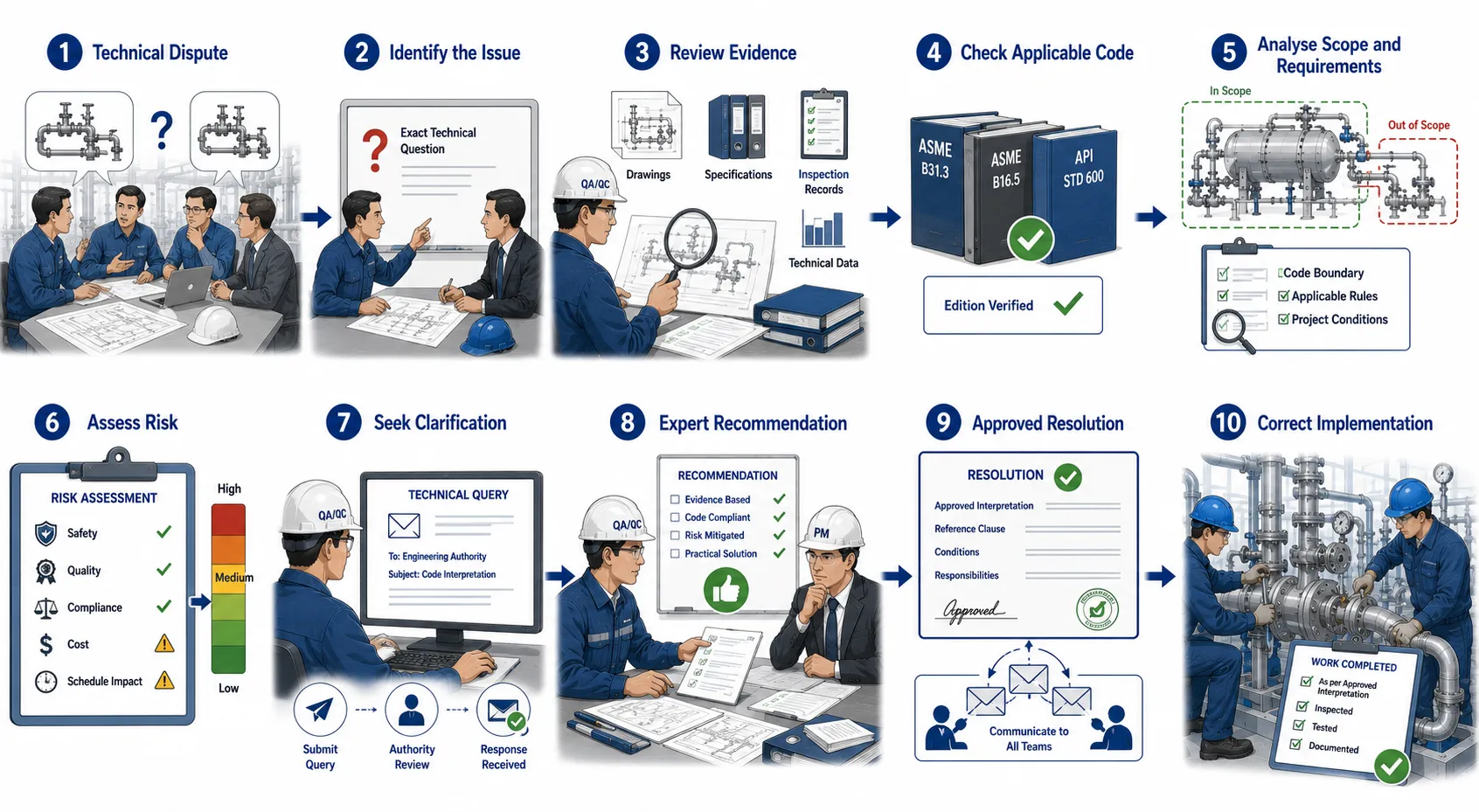
Key Definitions and Concepts
| Term | Definition | Relevance to Mechanical QA/QC |
|---|---|---|
| Technical dispute | A disagreement regarding a technical requirement, method, result, or acceptance decision | May affect project progress and quality decisions |
| Code interpretation | The process of determining the intended meaning and application of a code requirement | Essential when wording or applicability is unclear |
| Applicable code | The engineering code or standard formally identified as relevant to a project or activity | Provides the technical framework for compliance |
| Code edition | A specific published version of a code or standard | Different editions may contain different requirements |
| Project specification | A document defining project-specific technical and quality requirements | May add requirements beyond the general code |
| Deviation | An approved departure from an original requirement under controlled conditions | Must not be treated as informal permission to ignore requirements |
| Technical query | A formal request for clarification concerning a technical requirement | Creates a controlled route for resolving uncertainty |
| Concession | Formal acceptance of a specific non-conforming condition under defined circumstances | Requires authorised approval |
| Non-conformity | Failure to fulfil a specified requirement | Requires control, evaluation, and appropriate action |
| Acceptance criteria | Defined conditions used to determine whether work or results are acceptable | Central to resolving inspection disputes |
| Hierarchy of documents | The agreed order of authority between contracts, laws, specifications, drawings, and standards | Helps resolve conflicting requirements |
Understanding the Nature of Technical Disputes
Why Technical Disputes Occur
International mechanical codes are developed for broad engineering applications. They are often detailed and technically complex. A single project may also involve multiple documents, including client specifications, drawings, material requirements, inspection procedures, national regulations, and contractual obligations.
Disputes can occur when different parties focus on different documents or interpret the same clause differently.
Common causes include:
- Ambiguous interpretation of technical wording.
- Use of different code editions.
- Conflicting project specifications.
- Unclear code applicability.
- Differences between design and construction requirements.
- Incomplete technical documentation.
- Unauthorised assumptions.
- Misunderstanding of acceptance criteria.
- Changes introduced during the project.
- Differences between client and contractor expectations.
- Interface issues between different mechanical systems.
A technical dispute should therefore be treated as a controlled engineering issue rather than a personal disagreement.
The Difference Between a Technical Dispute and a Technical Non-Conformity
These terms should not be confused.
A technical dispute exists when parties disagree about what requirement applies or how a requirement should be interpreted. A non-conformity exists when an applicable requirement has been identified and the work has failed to meet it.
For example, two engineers may disagree about whether a particular inspection is mandatory. This is an interpretation issue. Once the applicable requirement is confirmed, failure to perform the required inspection may become a non-conformity.
Project managers need expert guidance to distinguish between these situations because the response process may differ.
The Role of the QA/QC Mechanical Expert
Providing Objective Technical Advice
The QA/QC professional should act as an independent and evidence-based technical adviser.
Expert guidance should be based on:
- Approved project documentation.
- Applicable international codes.
- Relevant regulations.
- Contractual requirements.
- Technical evidence.
- Engineering principles.
- Authorised interpretations where available.
The professional should avoid resolving disputes through:
- Personal preference.
- Informal industry habits.
- Verbal assumptions.
- Pressure to protect the schedule.
- Unsupported opinions.
The objective is to help the project manager make a defensible decision.
Supporting Project Managers
Project managers are responsible for coordinating technical, commercial, operational, and schedule requirements. However, they may require specialist support when an international mechanical code presents a complex interpretation issue.
The QA/QC mechanical expert can assist by:
- Explaining the technical background.
- Identifying applicable requirements.
- Comparing relevant documents.
- Assessing technical risks.
- Identifying compliance implications.
- Recommending a controlled resolution process.
- Preparing technical evidence.
- Supporting communication with clients and inspectors.
The advice should be sufficiently clear for management-level decision-making.
Establishing the Applicable Requirements
Start with the Project Scope
Before interpreting any clause, the expert should understand the actual engineering situation.
Key questions include:
- What mechanical system is involved?
- What work activity is under review?
- What equipment is affected?
- What are the operating conditions?
- What stage has the project reached?
- Who is responsible for the work?
- What decision is required?
A code clause cannot be interpreted effectively without understanding its technical context.
Confirm Which Documents Apply
The next step is to identify the complete set of applicable documents.
This may include:
- National laws and regulations.
- Contract requirements.
- Client specifications.
- Approved engineering specifications.
- Applicable international codes.
- Project drawings.
- Inspection and Test Plans.
- Approved procedures.
- Manufacturer requirements.
The expert should confirm that each document is current and applicable.
Check the Correct Code Edition
One of the most common causes of technical disagreement is the use of different editions of the same standard.
A project team should verify:
- The code title.
- The specific edition.
- The publication date where relevant.
- Any project amendments.
- Any applicable addenda or formally adopted revisions.
An engineer should not automatically apply the newest edition if the project contract or specification identifies a different controlled edition.
Understanding the Hierarchy of Technical Requirements
Why Document Hierarchy Is Important
Mechanical projects often contain multiple requirements. In some cases, these requirements may appear to conflict.
A project should have a defined method for determining which document takes precedence.
The hierarchy may involve:
- Mandatory legal requirements.
- Contractual obligations.
- Client specifications.
- Project specifications.
- Engineering drawings.
- International codes.
- Approved procedures.
The exact hierarchy depends on the project and contract.
Identifying Genuine Conflicts
Not every difference between documents is a conflict.
A project specification may impose an additional requirement beyond a minimum code requirement. This does not necessarily mean the code and specification conflict.
The QA/QC expert should determine whether:
- Both requirements can be satisfied.
- One document adds further control.
- The documents genuinely contradict each other.
- Formal clarification is required.
This prevents unnecessary technical disputes.
A Structured Process for Resolving Interpretation Problems
Step 1: Define the Exact Technical Question
The issue should be written clearly.
A weak technical question may be:
“Is this acceptable?”
A stronger question may be:
“Does the identified requirement permit the proposed inspection method for this component under the specified service conditions?”
A clear question helps prevent unnecessary discussion.
Step 2: Gather Relevant Evidence
Evidence should be collected before making recommendations.
Relevant information may include:
- Drawings.
- Specifications.
- Code clauses.
- Material certificates.
- Inspection reports.
- Test results.
- Previous approvals.
- Change records.
- Photographs where relevant.
The evidence should relate directly to the issue.
Step 3: Identify the Exact Code Requirement
The expert should review the relevant clause carefully.
Important considerations include:
- Scope statements.
- Definitions.
- Mandatory requirements.
- Exceptions.
- Notes.
- Referenced sections.
- Tables.
- Figures.
- Appendices where applicable.
A clause should not normally be interpreted in isolation when related sections affect its meaning.
Step 4: Assess Applicability
The expert should determine whether the clause actually applies to the equipment or activity.
Consider:
- Equipment classification.
- Design conditions.
- Material type.
- Operating service.
- Project location.
- Manufacturing method.
- Inspection stage.
Step 5: Compare with Project Requirements
The interpretation must then be checked against project-specific documents.
Ask:
- Does the project specification add requirements?
- Does the drawing contain specific instructions?
- Has the client imposed additional controls?
- Is there an approved project procedure?
Step 6: Evaluate Technical and Compliance Risk
The project manager should understand the consequences of each possible interpretation.
Risks may include:
- Safety risk.
- Regulatory non-compliance.
- Quality failure.
- Rework.
- Schedule delay.
- Client rejection.
- Increased cost.
Step 7: Develop Resolution Options
Where uncertainty remains, the expert should identify practical options.
Possible options include:
- Apply the stricter requirement where appropriate.
- Seek formal technical clarification.
- Perform additional inspection.
- Conduct further testing.
- Revise the engineering design.
- Submit a formal deviation request.
Step 8: Obtain Appropriate Approval
Technical interpretation should be approved at the correct authority level.
Depending on the project, approval may involve:
- Engineering authority.
- Client representative.
- Design organisation.
- Independent inspector.
- Regulatory authority.
Step 9: Document the Decision
The final interpretation and decision should be recorded.
The record should include:
- Technical issue.
- Applicable documents.
- Evidence reviewed.
- Interpretation.
- Decision.
- Approving authority.
- Required actions.
Step 10: Communicate and Implement
Once resolved, the decision must be communicated to affected personnel.
Relevant updates may be required to:
- Procedures.
- Drawings.
- ITPs.
- Work instructions.
- Training materials.
- Quality records.
Analysing the Wording of International Mechanical Codes
Reading Beyond Individual Words
Technical disputes often occur when a single word is interpreted without considering the wider context.
The QA/QC professional should examine:
- The purpose of the section.
- Definitions used by the code.
- Related clauses.
- Scope limitations.
- Referenced requirements.
Technical interpretation should be systematic rather than selective.
Mandatory and Conditional Requirements
International standards often use language to indicate different levels of obligation.
The expert must determine whether a statement is:
- Mandatory.
- Conditional.
- Informative.
- Recommended.
- Applicable only under specific conditions.
This distinction can have significant implications for compliance.
Importance of Definitions
Codes may define technical terms in a specific way.
A word used in everyday engineering practice may have a more precise meaning within a particular standard.
Therefore, when a dispute involves terminology, the expert should review the code’s definitions before relying on general industry usage.
Managing Disputes Between Different Project Parties
Contractor and Client Disputes
A contractor may believe that completed work meets the applicable code, while the client may request additional work.
The QA/QC expert should:
- Avoid emotional arguments.
- Identify the exact requirement.
- Present objective evidence.
- Compare the completed work with acceptance criteria.
- Identify whether additional requirements are contractual.
The discussion should focus on evidence rather than authority or opinion.
Engineering and Construction Disputes
Engineering teams may focus on design intent, while construction teams focus on practical installation requirements.
A QA/QC professional can support both parties by:
- Clarifying the approved design basis.
- Reviewing construction limitations.
- Identifying applicable procedures.
- Establishing whether the issue requires design review.
Construction personnel should not independently change an engineering requirement to resolve a practical difficulty.
Inspector and Contractor Disputes
An inspector may reject work that the contractor considers acceptable.
The expert should examine:
- The documented acceptance criteria.
- Inspection evidence.
- Measurement methods.
- Instrument calibration.
- Applicable tolerances.
Where required, the issue should be escalated through the approved technical query process.
Using Technical Queries Effectively
Purpose of a Technical Query
A technical query provides a formal method for requesting clarification.
It should be used when:
- A requirement is unclear.
- Documents conflict.
- A code clause has uncertain applicability.
- A technical condition differs from the approved design.
- Further authority is required.
A Good Technical Query Should Include
- A clear description of the issue.
- Relevant equipment identification.
- Applicable document references.
- Exact technical question.
- Supporting evidence.
- Proposed options where appropriate.
- Potential project impact.
The purpose is not to influence the answer but to obtain a clear and authorised decision.
Avoiding Poor Technical Queries
Poor technical queries may:
- Contain vague questions.
- Omit evidence.
- Reference obsolete documents.
- Combine unrelated issues.
- Assume an answer.
A well-structured query improves the likelihood of a timely resolution.
Providing Clear Recommendations to Project Managers
Present the Issue in Management Language
Project managers require technically accurate information but may also need a clear summary of operational implications.
A useful recommendation should explain:
- What the issue is.
- Why it exists.
- Which requirement applies.
- What the technical risk is.
- What options are available.
- What action is recommended.
Use an Evidence-Based Recommendation Format
A practical structure is:
Issue
What technical dispute or uncertainty exists?
Requirement
Which documents or clauses are relevant?
Evidence
What technical information has been reviewed?
Analysis
How do the requirements apply to the actual situation?
Risk
What could happen if the issue is not resolved correctly?
Recommendation
What action should management take?
Approval Required
Who must authorise the decision?
This structure supports clear professional communication.
Practical Example: Conflicting Inspection Requirements
Consider a mechanical installation project where a contractor follows an international engineering code that requires a particular inspection stage. The client specification appears to require an additional inspection before the same activity is closed.
The project manager asks whether the additional inspection is necessary.
The QA/QC expert should not immediately state that the international code represents the complete requirement.
Instead, the expert should:
- Review the project specification.
- Confirm contractual applicability.
- Check the project document hierarchy.
- Determine whether the client requirement is additional or conflicting.
- Assess whether both inspections can be completed.
If the client specification is contractually applicable and requires additional inspection, the project may need to meet both requirements.
The expert should provide this conclusion with supporting evidence.
Practical Example: Dispute Over Test Acceptance
A pressure-related mechanical test produces a result close to the acceptance limit.
The contractor argues that the result should be accepted because it is within measurement uncertainty. The inspector argues that the recorded value exceeds the stated limit.
The QA/QC expert should review:
- The approved test procedure.
- The acceptance criteria.
- The instrument range.
- Calibration information.
- Measurement method.
- Applicable technical requirements.
The expert should not alter the recorded result to make it acceptable.
If uncertainty must be considered, the method for doing so should be technically justified and consistent with the applicable project requirements.
Practical Example: Different Interpretations of a Code Boundary
A project contains interconnected mechanical systems. One team believes that a particular international code applies to the complete system, while another believes it applies only to a defined section.
The expert should:
- Review the code scope.
- Identify equipment boundaries.
- Review design documentation.
- Examine system interfaces.
- Determine whether separate requirements apply.
A system boundary should be established using controlled technical evidence rather than informal descriptions.
Risk-Based Decision-Making
Understanding Technical Risk
Not every interpretation issue has the same potential consequence.
A minor documentation issue may have limited impact, while an incorrect interpretation affecting a critical mechanical system may have serious consequences.
Risk assessment should consider:
- Severity of potential consequences.
- Probability of failure.
- Detectability of the problem.
- Regulatory implications.
- Operational impact.
Using Risk to Prioritise Action
High-risk disputes should receive immediate technical attention.
Examples include disputes affecting:
- Critical equipment integrity.
- Pressure containment.
- Structural stability.
- Material suitability.
- Mandatory inspection.
- Safety-related testing.
Low-risk matters should still be controlled, but they may require a different level of urgency.
Benefits of Expert Guidance
Providing structured guidance to project managers produces significant benefits.
Improved Technical Decisions
Expert analysis helps ensure that decisions are based on:
- Applicable requirements.
- Reliable evidence.
- Technical context.
- Controlled interpretation.
Reduced Rework
Early clarification can prevent:
- Incorrect fabrication.
- Rejected installations.
- Repeated inspections.
- Unnecessary dismantling.
Stronger Compliance
A controlled interpretation process helps demonstrate that technical decisions were made responsibly.
Better Project Communication
Clear advice improves communication between:
- Project management.
- Engineering.
- Construction.
- QA/QC.
- Clients.
- Inspectors.
Improved Professional Accountability
Documented decisions create a traceable record of:
- The issue.
- Evidence.
- Decision-making process.
- Authorised approval.
Common Mistakes When Handling Technical Disputes
Making Decisions Based on Personal Experience Alone
Experience is valuable, but it should support rather than replace documented technical requirements.
Applying a Code Without Checking Its Scope
A standard may not apply to every mechanical component or activity.
Using the Wrong Edition
The correct project-controlled edition must be confirmed.
Ignoring Project-Specific Requirements
A general code may establish baseline requirements, while the project may require additional controls.
Treating Verbal Approval as Final Authority
Significant technical decisions should be formally documented.
Allowing Schedule Pressure to Control Interpretation
Project urgency should not justify ignoring applicable technical requirements.
Failing to Escalate Complex Issues
Some disputes require specialist engineering or authorised external clarification.
When to Escalate a Technical Dispute
A QA/QC professional should escalate when:
- The code wording remains unclear.
- Multiple requirements genuinely conflict.
- The issue affects safety.
- The issue affects design integrity.
- The decision exceeds delegated authority.
- Regulatory interpretation is required.
- The financial or contractual consequences are significant.
Escalation is a professional control measure, not a failure of competence.
Communication Skills for Expert Technical Guidance
Remain Neutral
The QA/QC expert should focus on the requirement rather than supporting a particular department.
Separate Facts from Assumptions
Technical advice should clearly distinguish:
- Confirmed facts.
- Technical assumptions.
- Unresolved questions.
- Recommended actions.
Explain Complexity Clearly
Project managers need clear conclusions.
Avoid unnecessary technical language when a simple explanation is possible.
Use Visual Evidence Where Appropriate
Complex issues may be explained using:
- Marked-up drawings.
- System diagrams.
- Inspection photographs.
- Comparison tables.
- Decision flowcharts.
Visual information can reduce misunderstanding.
A Recommended Technical Dispute Resolution Workflow
Identify the Issue
Define the disagreement clearly and accurately.
Secure Relevant Work
Where the issue affects critical work, prevent uncontrolled progression until the appropriate decision is made.
Collect Evidence
Gather current drawings, specifications, records, and test information.
Identify Applicable Requirements
Confirm the relevant code, standard, specification, and document edition.
Analyse Scope and Applicability
Determine whether the cited requirement applies to the actual system or activity.
Compare Requirements
Identify additional requirements or genuine conflicts.
Assess Risk
Evaluate safety, quality, compliance, schedule, and cost implications.
Develop Resolution Options
Identify technically valid options.
Seek Authorised Clarification
Use formal technical queries or approved escalation routes where necessary.
Recommend an Action
Provide the project manager with a clear evidence-based recommendation.
Obtain Approval
Ensure the decision is authorised by the appropriate person or organisation.
Implement the Decision
Update relevant work instructions, records, and project controls.
Verify Effectiveness
Confirm that the resolution has been correctly implemented.
Developing a Culture of Controlled Technical Interpretation
Organisations should avoid relying solely on individual experts to solve every dispute.
A mature QA/QC system should establish:
- Clear document control.
- Defined technical authority.
- Formal technical query processes.
- Controlled change management.
- Regular technical briefings.
- Lessons-learned systems.
- Training on code interpretation.
This creates consistency across projects.
Building Organisational Knowledge
Resolved technical disputes can provide valuable lessons.
Where appropriate, organisations should record:
- The issue encountered.
- The interpretation method.
- The approved decision.
- Preventive measures.
These lessons can help reduce repeated disputes on future projects.
Key Professional Principles for Learners
When advising project managers on international mechanical code disputes, remember to:
- Define the technical issue precisely.
- Understand the actual project context.
- Use current and approved documents.
- Confirm the correct code edition.
- Check the scope before applying a clause.
- Review related clauses and definitions.
- Consider the project document hierarchy.
- Separate interpretation problems from confirmed non-conformities.
- Base recommendations on evidence.
- Assess safety and compliance risks.
- Use formal technical queries when clarification is needed.
- Escalate issues beyond your authority.
- Document decisions and approvals.
- Communicate the final decision clearly.
- Verify implementation.
Conclusion
Providing expert guidance to project managers on technical disputes and interpretation problems involving international mechanical codes is a critical QA/QC responsibility. These issues require more than technical familiarity with standards. They demand structured analysis, professional judgement, evidence-based decision-making, effective communication, and a clear understanding of project-specific requirements.
The most reliable approach begins by defining the exact technical question and identifying all applicable documents. The QA/QC mechanical expert must then confirm the correct code edition, review the scope and relevant clauses, analyse the actual engineering context, compare project requirements, and assess the risks associated with each possible interpretation.
Where uncertainty remains, formal clarification and appropriate escalation should be used rather than assumptions. The final recommendation should provide project managers with a clear explanation of the issue, applicable requirements, evidence, risks, available options, and recommended action.
By managing technical disputes in a controlled and professional manner, mechanical QA/QC teams can reduce conflict, prevent costly rework, strengthen regulatory and contractual compliance, protect engineering integrity, and support confident project decision-making.