
Lesson no 5 : Maintain comprehensive documentation for regulatory compliance and quality assurance.
Maintaining comprehensive documentation is a fundamental responsibility within mechanical Quality Assurance and Quality Control (QA/QC). Accurate, controlled, and accessible documentation provides clear evidence that mechanical projects, manufacturing activities, inspections, testing processes, and installations have been completed in accordance with applicable regulatory requirements, quality standards, client specifications, and approved procedures.
This lesson introduces Learners to the principles and practices required to establish and maintain an effective documentation system for regulatory compliance and quality assurance. In mechanical engineering environments, documentation may include quality manuals, procedures, inspection and test plans, material certificates, calibration records, welding records, non-conformance reports, corrective action records, inspection reports, test certificates, and audit documentation. Each document plays an important role in demonstrating conformity and supporting effective decision-making throughout the project lifecycle.
Learners will explore how documents should be created, reviewed, approved, issued, updated, stored, retrieved, and retained under a controlled system. Particular attention is given to document accuracy, revision control, traceability, confidentiality, and accessibility. Poor documentation control can result in the use of outdated procedures, missing quality evidence, loss of material traceability, regulatory non-compliance, and difficulties during internal or external audits.
The lesson also examines the importance of maintaining reliable records that provide objective evidence of completed activities and quality performance. Learners will understand how effective documentation supports inspections, audits, investigations, corrective actions, and continuous improvement.
By the end of this lesson, Learners will be able to understand the importance of comprehensive documentation in maintaining regulatory compliance and quality assurance. They will be better prepared to manage controlled documents and quality records professionally, ensuring that mechanical projects have reliable evidence of conformity, accountability, traceability, and compliance with applicable requirements.
1.Establishing a Secure and Traceable Document Control System for ITPs and Final Quality Records
A secure and traceable document control system is an essential element of effective Quality Assurance and Quality Control (QA/QC) in mechanical engineering projects. Inspection and Test Plans (ITPs), inspection records, test certificates, material documentation, calibration records and final quality dossiers provide objective evidence that work has been completed in accordance with approved requirements.
Without effective document control, organisations may use outdated ITPs, lose critical inspection evidence, experience difficulties during audits, or fail to demonstrate compliance with contractual, regulatory and quality requirements. A well-designed system ensures that documents are correctly created, reviewed, approved, issued, updated, protected, retrieved and retained throughout the project lifecycle.
This section explains how QA/QC professionals can establish a secure and traceable document control system specifically for organising ITPs and final quality records.
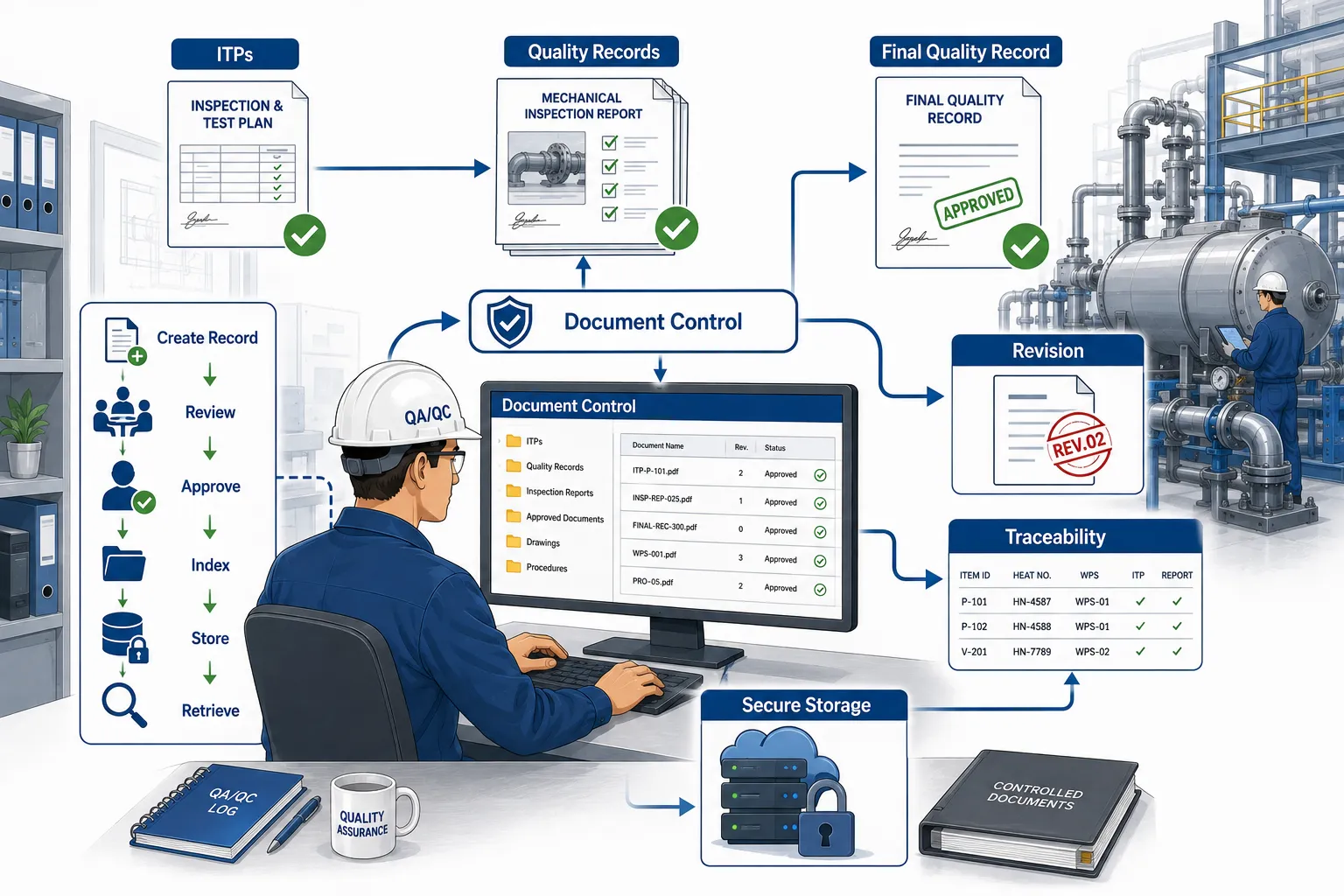
Understanding Document Control in Mechanical QA/QC
Document control is the systematic management of documents and records to ensure that the correct information is available to authorised personnel at the right time and in the correct version.
In mechanical QA/QC, document control covers both controlled documents and completed quality records.
Controlled documents may include:
- Inspection and Test Plans (ITPs)
- Quality procedures
- Method statements
- Project Quality Plans
- Technical specifications
- Approved drawings
- Inspection checklists
- Testing procedures
- Work instructions
- Document control procedures
Quality records may include:
- Completed inspection reports
- Test reports
- Material Test Certificates
- Calibration certificates
- Welding inspection records
- Non-Destructive Testing records
- Pressure test records
- Dimensional inspection reports
- Non-Conformance Reports
- Corrective action records
- Final acceptance certificates
- Manufacturing data records
The fundamental principle is that controlled documents provide instructions about what should be done, while records provide evidence of what was actually done.
Why Secure and Traceable Document Control Is Important
Mechanical projects can generate thousands of documents and records. These documents may be produced by engineers, inspectors, manufacturers, subcontractors, laboratories, suppliers and clients. If information is not organised systematically, the risk of error increases significantly.
A secure document control system helps an organisation maintain confidence in the reliability and integrity of its quality information.
Key reasons for establishing such a system include:
- Preventing the unintended use of obsolete documents
- Ensuring approved ITPs are available before inspections begin
- Maintaining traceability between materials, components and records
- Protecting records from loss or unauthorised modification
- Supporting regulatory and contractual compliance
- Improving audit readiness
- Enabling efficient retrieval of quality evidence
- Supporting investigation of quality problems
- Providing evidence for final project handover
- Strengthening accountability across the project team
For a QA/QC Mechanical Engineer, documentation is not simply an administrative requirement. It is an important technical control mechanism.
Key Definitions and Concepts
| Term | Definition | Importance in QA/QC Documentation |
|---|---|---|
| Document Control | A systematic process for managing the creation, review, approval, distribution, revision and withdrawal of documents | Ensures personnel use current and authorised information |
| Inspection and Test Plan (ITP) | A controlled document defining inspection, testing, responsibilities, acceptance criteria and verification points | Provides a structured framework for quality control activities |
| Quality Record | Documented objective evidence that an activity, inspection or test has been completed | Demonstrates conformity and supports traceability |
| Revision Control | The process of identifying and managing changes to documents | Prevents the use of outdated information |
| Traceability | The ability to follow the history, application or location of an item through documented evidence | Links materials, activities and final products |
| Document Register | A controlled list containing document identification and status information | Provides visibility of documents and their current revisions |
| Retention Period | The defined period for which documents and records must be preserved | Supports contractual, legal and quality requirements |
| Access Control | Restrictions that determine who can view, edit, approve or delete information | Protects confidentiality and document integrity |
| Quality Dossier | A structured collection of final quality records for a project or component | Supports handover, acceptance and future reference |
Establishing the Foundation of the Document Control System
A document control system should not be created randomly. It must be designed according to the size, complexity and risk profile of the mechanical project.
The first step is to define what information requires control and how that information will move through the organisation.
Defining the Scope of Document Control
The organisation should clearly identify the categories of documents and records covered by the system.
The scope may include:
- Engineering documents
- QA/QC procedures
- ITPs
- Inspection records
- Testing records
- Supplier documentation
- Material certificates
- Calibration records
- Audit records
- Non-conformance documentation
- Corrective action records
- Final project dossiers
The scope should also define which departments and external parties are responsible for creating and managing information.
For example, responsibilities may involve:
- Engineering department
- QA/QC department
- Production department
- Procurement department
- Document control department
- Third-party inspection agencies
- Suppliers
- Subcontractors
- Clients
Clear scope prevents uncertainty about which documents require formal control.
Developing a Document Control Procedure
A formal procedure should explain how documents move from creation to final retention.
The procedure should normally address:
- Document creation
- Identification and numbering
- Review requirements
- Approval authority
- Distribution
- Revision control
- Access permissions
- Storage
- Backup arrangements
- Retrieval
- Archiving
- Retention
- Disposal
The procedure should be sufficiently detailed to provide consistency while remaining practical for the workplace.
Establishing Roles and Responsibilities
Document control requires clear accountability. If responsibilities are unclear, documents may remain unapproved, records may be misplaced, and revisions may not be communicated.
Typical responsibilities include the following.
Document Author
The document author may be responsible for:
- Preparing the initial document
- Ensuring technical accuracy
- Using the approved format
- Identifying applicable requirements
- Submitting the document for review
Technical Reviewer
The reviewer may:
- Check technical correctness
- Confirm alignment with specifications
- Identify missing requirements
- Verify consistency with other project documents
Approver
The approver should have appropriate authority to:
- Accept the document for controlled use
- Confirm that required reviews have been completed
- Authorise the document revision
Document Controller
The document controller may:
- Assign document numbers
- Maintain the document register
- Issue controlled copies
- Update revision status
- Manage distribution
- Archive superseded documents
QA/QC Personnel
QA/QC personnel should:
- Confirm that current ITPs are used
- Complete inspection records accurately
- Submit final records for controlled storage
- Support traceability between inspections and project activities
Creating a Unique Document Identification System
Every controlled document should have a unique identity. This prevents confusion when several similar documents exist.
A document identification system may use information such as:
- Project code
- Discipline
- Document type
- Equipment or system reference
- Sequential number
- Revision number
For example, a document number might distinguish between:
- Mechanical ITP
- Piping ITP
- Welding ITP
- Pressure testing procedure
- Final inspection record
The numbering system should be logical and consistently applied.
Important Elements of Document Identification
A controlled document should normally display:
- Document title
- Unique document number
- Project reference
- Revision number
- Issue date
- Author
- Reviewer
- Approver
- Document status
These details make it easier for users to determine whether a document is suitable for use.
Using Revision Numbers Effectively
Revision control is one of the most important elements of document security.
When an ITP changes, the new revision should clearly identify:
- The revision number
- Date of revision
- Nature of the change
- Person responsible for the change
- Required review
- Approval status
For example, Revision 02 may include an additional hold point or updated acceptance criteria.
Personnel must be informed when a revised document affects their work.
Controlling Inspection and Test Plans (ITPs)
An Inspection and Test Plan is a critical QA/QC document because it defines how work will be inspected and tested.
The ITP should be controlled before being released for operational use.
Essential Information Within an ITP
An effective ITP may include:
- Activity or work stage
- Inspection requirements
- Test requirements
- Applicable specifications
- Acceptance criteria
- Inspection methods
- Frequency of inspection
- Responsible personnel
- Witness points
- Hold points
- Review points
- Required quality records
Each ITP should be linked to relevant project specifications and approved procedures.
The ITP Approval Process
Before an ITP is used, it should normally pass through a structured workflow.
Step 1: Preparation
The responsible technical person prepares the ITP based on:
- Project requirements
- Technical specifications
- Approved drawings
- Applicable procedures
- Quality requirements
Step 2: Technical Review
The ITP is reviewed to confirm:
- Inspection stages are complete
- Acceptance criteria are defined
- Applicable references are correct
- Responsibilities are clear
- Required records are identified
Step 3: QA/QC Review
QA/QC personnel assess whether the ITP:
- Provides adequate quality control points
- Includes appropriate verification activities
- Supports traceability
- Matches the Project Quality Plan
Step 4: Approval
Authorised personnel approve the document for use.
Step 5: Controlled Distribution
The approved revision is issued to relevant personnel.
Step 6: Monitoring of Use
Supervisors and inspectors verify that the correct revision is being used.
Designing a Secure Document Storage Structure
A document control system should provide a logical storage structure.
Digital storage systems are widely used because they can improve retrieval, access control and version management. However, electronic systems must also be properly protected.
A typical folder structure may include:
- Project Administration
- Engineering Documents
- Approved ITPs
- Material Documentation
- Inspection Records
- Test Records
- Calibration Records
- Non-Conformance Records
- Corrective Actions
- Audit Records
- Final Quality Dossier
Principles of Secure Digital Storage
A secure electronic system should include:
- Password protection
- User authentication
- Role-based permissions
- Controlled editing rights
- Backup systems
- Recovery arrangements
- Audit trails
- Protection against unauthorised deletion
Different users should have different levels of access.
For example:
- Inspectors may upload completed records
- Engineers may review technical documents
- Document controllers may manage revisions
- Managers may approve documents
- General users may have view-only access
This approach helps protect document integrity.
Maintaining Backup and Recovery Arrangements
Loss of quality records can create serious project and compliance problems.
An organisation should establish:
- Regular backups
- Secure backup locations
- Recovery procedures
- Periodic testing of recovery arrangements
- Protection against accidental deletion
The organisation should not assume that electronic storage alone guarantees security.
Establishing Full Traceability of Quality Records
Traceability means that a person can follow the connection between a mechanical item and the records supporting its quality.
For example, a completed pressure vessel may need to be linked to:
- Material certificates
- Welding records
- Welder qualifications
- NDT reports
- Heat treatment records
- Dimensional inspection reports
- Pressure test records
- Final inspection reports
A document control system should make these relationships easy to identify.
Traceability Through Reference Numbers
Traceability can be strengthened by using common reference information.
Examples include:
- Project number
- Equipment identification number
- Drawing number
- Material heat number
- Weld number
- Inspection report number
- Test report number
These identifiers should be accurately recorded throughout the documentation process.
Traceability Chain Example
Consider a fabricated mechanical component.
The traceability process may follow this sequence:
- Material is received with a certificate
- Material identification is recorded
- Material is assigned to a specific component
- Fabrication activities are recorded
- Inspections are completed
- Test results are documented
- Final acceptance is recorded
- All records are compiled into the quality dossier
If any link is missing, demonstrating complete conformity becomes more difficult.
Managing Final Quality Records
Final quality records provide the evidence required for project completion and handover.
These records should be reviewed for completeness before final submission.
Typical Final Quality Records
The final package may include:
- Approved ITPs
- Inspection reports
- Test reports
- Material certificates
- Calibration certificates
- Welding records
- NDT records
- Pressure testing documentation
- Non-conformance reports
- Corrective action evidence
- Final acceptance records
The exact contents will depend on project requirements.
Conducting a Final Record Review
Before records are transferred to the final dossier, a systematic review should be completed.
The reviewer should confirm:
- Required documents are present
- Documents are legible
- Records are correctly identified
- Required signatures are present
- Dates are complete
- Acceptance results are recorded
- Supporting certificates are attached
- Traceability references are correct
- Outstanding issues have been addressed
A final completeness check can prevent significant delays during project handover.
Implementing an Effective Document Control Process
The following process can be used to establish and maintain a document control system.
Step 1: Identify Applicable Documentation Requirements
Determine the documents and records required by:
- Project specifications
- Client requirements
- Regulatory obligations
- Quality management procedures
- Approved engineering requirements
Step 2: Classify Documents and Records
Separate information into logical categories.
For example:
- Controlled documents
- Temporary working documents
- Inspection records
- Test records
- Final records
Step 3: Assign Unique Identification
Provide every controlled document with:
- A document number
- Revision number
- Issue date
- Status
Step 4: Establish Review and Approval Controls
Define who can:
- Create
- Review
- Approve
- Issue
- Modify documents
Step 5: Create the Document Register
The register should provide visibility of:
- Document title
- Document number
- Current revision
- Status
- Issue date
- Responsible department
Step 6: Control Distribution
Ensure that authorised personnel receive the correct revision.
Step 7: Protect Stored Information
Apply:
- Access permissions
- Secure storage
- Backup controls
- Audit trails
Step 8: Collect Completed Quality Records
Records should be submitted promptly after activities are completed.
Step 9: Review for Completeness
Check records before archiving or handover.
Step 10: Archive and Retain Records
Maintain records for the required retention period.
Practical Example: Document Control for a Mechanical Piping Project
Consider a mechanical piping installation project.
The project begins with approved engineering drawings and ITPs. The QA/QC department establishes a document register identifying all required records.
The workflow may include:
- An approved piping ITP is issued
- Material certificates are received and registered
- Materials are linked to heat numbers
- Inspection records are completed at defined stages
- Welding records are collected
- NDT reports are linked to weld numbers
- Pressure test records are completed
- Calibration certificates for test instruments are verified
- Final inspection records are reviewed
- All documentation is compiled into a final quality dossier
The document controller ensures that each record is correctly named, indexed and stored.
If a client later asks for evidence relating to a particular pipe spool, the organisation should be able to retrieve the relevant documentation efficiently.
Common Document Control Problems
Several weaknesses can reduce the effectiveness of a documentation system.
Use of Obsolete Documents
Employees may continue using an old ITP after a revised version has been issued.
This can result in:
- Incorrect inspection requirements
- Missed verification activities
- Failure to meet revised specifications
The system should clearly identify obsolete documents and prevent unintended use.
Missing Signatures or Approvals
Incomplete records may not demonstrate that an activity was properly verified.
Common problems include:
- Missing inspector signatures
- Missing approval dates
- Unidentified reviewers
- Incomplete acceptance decisions
Poor File Naming
Files with unclear names are difficult to retrieve.
Examples of poor naming include:
- Final Report
- New Document
- Inspection 1
- Latest Version
A standard naming convention improves organisation and traceability.
Uncontrolled Electronic Changes
Unauthorised changes can compromise the reliability of quality information.
Effective controls should prevent:
- Unauthorised editing
- Undetected deletion
- Replacement of approved documents
- Loss of revision history
Key Benefits of an Effective Document Control System
A properly managed system creates significant benefits for mechanical QA/QC operations.
Compliance Benefits
The system helps demonstrate conformity with:
- Applicable regulations
- Project requirements
- Client specifications
- Approved quality procedures
Operational Benefits
It improves the ability to:
- Locate information quickly
- Reduce duplication
- Avoid outdated instructions
- Coordinate project activities
Quality Benefits
Effective document control supports:
- Reliable inspection evidence
- Improved traceability
- Consistent verification
- Better corrective action management
Audit Benefits
During internal or external audits, controlled documentation allows the organisation to demonstrate:
- What requirements applied
- Which procedures were followed
- What inspections occurred
- What results were achieved
- How non-conformities were managed
Professional Practice for QA/QC Personnel
QA/QC professionals should treat documentation as an essential part of the technical work process.
Good professional practice includes:
- Completing records immediately or as soon as practicable
- Using approved document formats
- Checking revision status before work begins
- Recording information accurately and legibly
- Avoiding unauthorised corrections
- Maintaining clear traceability references
- Reporting missing or incorrect records promptly
- Protecting confidential information
- Following retention requirements
Professional Checklist for Final Quality Documentation
Before closing a mechanical project stage, QA/QC personnel should verify:
- Is the applicable ITP approved?
- Is the correct revision being used?
- Are all required inspection records available?
- Are acceptance criteria clearly recorded?
- Are material certificates traceable?
- Are testing records complete?
- Are measuring instruments supported by valid calibration evidence?
- Are non-conformities appropriately recorded and resolved?
- Are records reviewed for completeness?
- Can the information be retrieved efficiently?
Continuous Improvement of the Document Control System
Document control systems should be reviewed regularly because project conditions, technology and regulatory requirements can change.
Improvement activities may include:
- Analysing audit findings
- Reviewing repeated documentation errors
- Improving document templates
- Updating naming conventions
- Strengthening electronic access controls
- Providing staff training
- Improving retrieval processes
Feedback from users can also identify weaknesses in the system.
For example, if inspectors repeatedly struggle to locate approved ITPs, the organisation may need to improve the electronic document register or distribution process.
Conclusion
Establishing a secure and traceable document control system is essential for organising Inspection and Test Plans and final quality records in mechanical QA/QC. The system must ensure that documents are correctly identified, reviewed, approved, issued, revised, protected, retrieved and retained.
A strong document control process connects inspection activities with reliable evidence and creates a complete traceability chain from materials and fabrication activities through to testing and final acceptance. Secure storage, revision control, access management and systematic record review all contribute to the integrity of the quality management process.
For QA/QC professionals, effective documentation provides more than evidence of completed work. It supports regulatory compliance, improves accountability, strengthens audit readiness and helps organisations demonstrate that mechanical systems and installations have been inspected and verified against applicable requirements. By applying structured document control practices, organisations can reduce errors, prevent the use of obsolete information and maintain reliable quality records throughout the complete project lifecycle.
2.Compiling Comprehensive Manufacturer’s Data Records (MDRs) for Final Client Handover
Manufacturer’s Data Records (MDRs) are an essential part of quality assurance and regulatory compliance within mechanical engineering, fabrication, manufacturing and construction projects. An MDR is a structured collection of documents and objective quality records that demonstrate how a mechanical item, component, equipment package or fabricated system was manufactured, inspected, tested and accepted.
For QA/QC Mechanical Engineering professionals, compiling a comprehensive MDR is not simply a document collection activity. It is a controlled verification process. Every required certificate, inspection record, test log and sign-off must be checked for completeness, accuracy, traceability and conformity before the final documentation package is handed over to the client.
A poorly compiled MDR may result in delayed project acceptance, client rejection, audit findings, payment delays or difficulties in demonstrating compliance. A complete MDR, however, provides a reliable documentary history of the manufactured product and gives the client confidence that all specified quality requirements have been fulfilled.
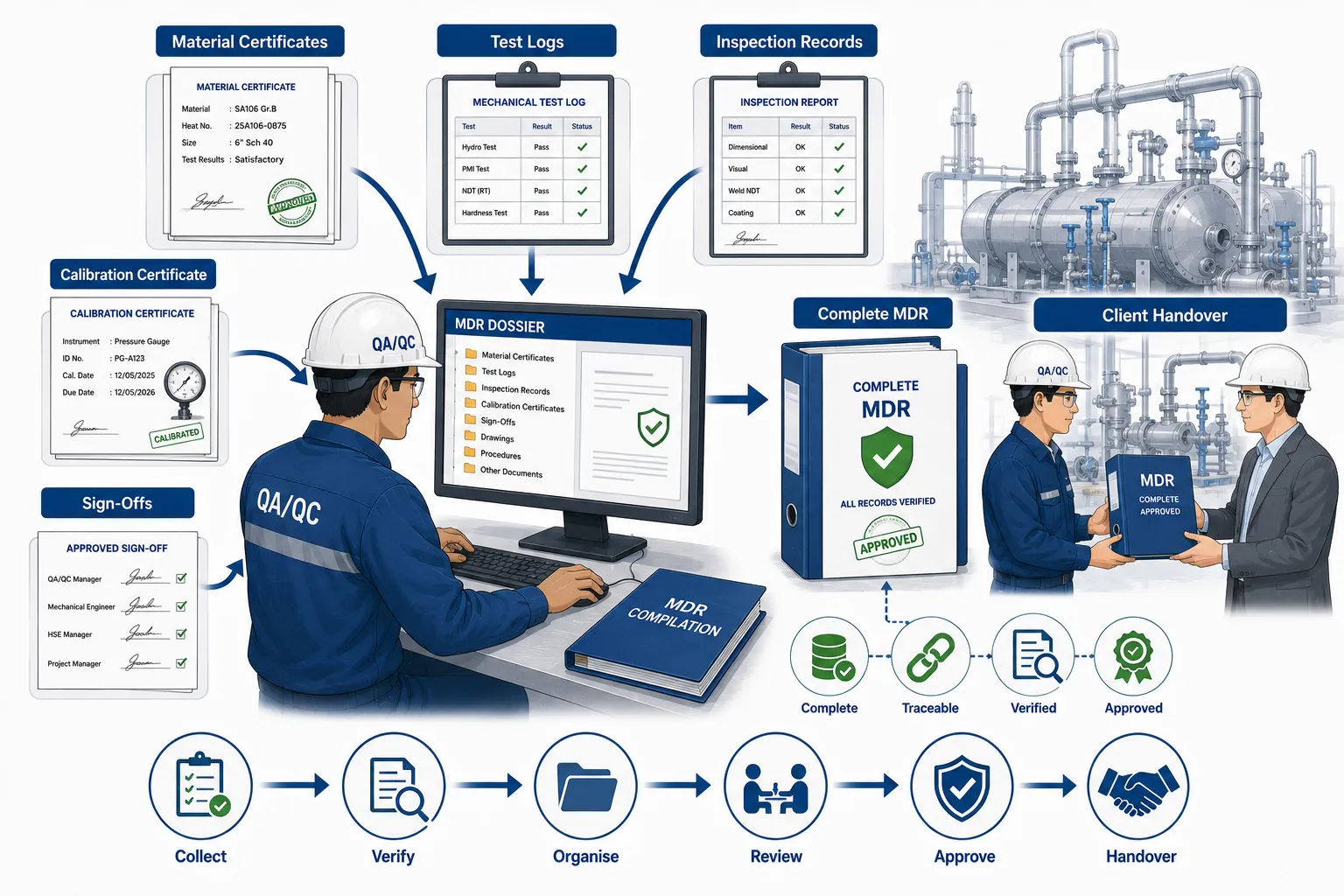
Understanding the Purpose of a Manufacturer’s Data Record
A Manufacturer’s Data Record is a final controlled documentation package containing evidence generated during the manufacturing, fabrication, inspection and testing of an item.
Depending on the project, an MDR may relate to:
- Pressure vessels
- Piping systems
- Storage tanks
- Heat exchangers
- Structural mechanical components
- Pumps and rotating equipment
- Skids and packaged equipment
- Fabricated pipe spools
- Industrial machinery
- Mechanical assemblies
The MDR brings together documents that may have been created by different departments, inspectors, laboratories, suppliers and third-party organisations.
Its primary purpose is to demonstrate that the final product has been manufactured and verified in accordance with:
- Client specifications
- Purchase order requirements
- Approved drawings
- Inspection and Test Plans
- Applicable engineering standards
- Approved manufacturing procedures
- Contractual requirements
- Regulatory requirements
- Quality management procedures
An MDR should provide a clear and traceable story of the product from the receipt of materials through manufacturing and final acceptance.
Key Definitions and Concepts
| Term | Definition | Importance in MDR Compilation |
|---|---|---|
| Manufacturer’s Data Record (MDR) | A controlled package of documents and records demonstrating how an item was manufactured, inspected and tested | Provides objective evidence for final client handover |
| Material Certificate | A document confirming the identity and specified properties of a material | Supports material conformity and traceability |
| Test Log | A documented record of testing activities, conditions and results | Demonstrates that required tests were completed |
| Sign-off | Formal confirmation that an activity, inspection or review has been accepted by an authorised person | Demonstrates accountability and approval |
| Traceability | The ability to follow the history and identity of a material or component through records | Connects materials and processes to the final product |
| Quality Dossier | A structured collection of quality documents for a project or manufactured item | Supports organised handover and future reference |
| Document Index | A controlled list showing all documents included in the MDR | Helps verify completeness and improve retrieval |
| Final Handover | The formal transfer of completed work and required documentation to the client | Marks completion of contractual documentation obligations |
| Objective Evidence | Information that can be verified and used to demonstrate conformity | Forms the foundation of a reliable MDR |
The Role of MDRs in Mechanical QA/QC
Mechanical manufacturing projects involve many stages, and each stage may generate important quality records. If these records are not collected and organised systematically, evidence can be lost before final handover.
An MDR provides a controlled method of bringing this information together.
The MDR may demonstrate:
- What materials were used
- Whether materials met specified requirements
- Which manufacturing activities were performed
- Which inspections took place
- What tests were conducted
- Whether results met acceptance criteria
- How non-conformities were managed
- Who reviewed and accepted critical activities
- Whether final requirements were completed
For the QA/QC department, the MDR is therefore a key link between quality planning and final product acceptance.
MDRs as Evidence of Product History
A completed mechanical component does not always visibly show its full quality history. For example, a fabricated component may look acceptable during final visual inspection, but this does not demonstrate:
- The original material grade
- The source of the material
- The material heat number
- Whether required tests were completed
- Whether inspection equipment was controlled
- Whether manufacturing procedures were followed
The MDR provides this historical evidence.
A complete documentation chain can demonstrate the journey from raw material to final product.
Identifying MDR Requirements Before Manufacturing Begins
One of the most important professional practices is to identify MDR requirements at the beginning of the project rather than waiting until manufacturing is complete.
If documentation requirements are identified too late, records may already be missing or difficult to recover.
Reviewing Contractual and Client Requirements
Before compiling an MDR, QA/QC personnel should review the relevant project documentation.
This may include:
- Purchase orders
- Client specifications
- Technical data sheets
- Engineering drawings
- Inspection and Test Plans
- Project Quality Plans
- Applicable standards
- Contractual document requirements
The purpose is to establish exactly what the client expects to receive.
Creating an MDR Document Requirement List
A document requirement list should identify all records expected for final handover.
The list may include:
- Document name
- Document number
- Responsible department
- Required revision
- Submission stage
- Review status
- Final inclusion status
This list becomes a useful control tool throughout the project.
Establishing Responsibilities
Clear responsibilities are necessary because MDR documents may come from multiple sources.
Typical responsibilities may include:
Engineering Department
Engineering personnel may provide:
- Approved drawings
- Technical specifications
- Design-related documentation
- Approved revisions
Procurement Department
Procurement personnel may support:
- Supplier documentation
- Purchase records
- Material documentation
Manufacturing Department
Manufacturing personnel may provide:
- Production records
- Process records
- Manufacturing completion information
QA/QC Department
QA/QC personnel may manage:
- ITP records
- Inspection reports
- Test reports
- Non-conformance records
- Final documentation review
Document Control Personnel
Document controllers may:
- Maintain the MDR index
- Check document identification
- Control revisions
- Organise the final package
- Manage document submission
Establishing an MDR Structure
A well-organised MDR should follow a logical structure.
The structure should make it easy for a client, auditor or project engineer to locate specific evidence.
Typical MDR Sections
Although project requirements vary, an MDR may be divided into sections such as:
- Cover page
- Document index
- Project information
- Approved technical documents
- Material certificates
- Manufacturing records
- Inspection records
- Test records
- Special process records
- Calibration records
- Non-conformance documentation
- Corrective action evidence
- Final inspection and acceptance records
A consistent structure improves efficiency and reduces the risk of missing information.
The Importance of the MDR Index
The MDR index is one of the most important control documents within the package.
It should normally show:
- Section number
- Document title
- Document number
- Revision number
- Date
- Document status
- Inclusion status
The index allows the compiler and reviewer to compare expected documentation against the actual contents of the MDR.
Using Logical Document Numbering
Every record should be identifiable.
Good identification may include:
- Project number
- Equipment number
- Component identification
- Document number
- Revision number
Consistent identification supports document retrieval and traceability.
Compiling Material Certificates
Material certificates are often among the most important documents in a mechanical MDR.
They provide evidence concerning the properties and identity of materials used during manufacturing.
Types of Material Documentation
Depending on the project, material records may include:
- Material Test Certificates
- Material inspection certificates
- Chemical analysis reports
- Mechanical test reports
- Supplier certificates
- Heat number records
- Material receiving inspection reports
The specific documents required will depend on the applicable specification and project requirements.
Verifying Material Certificates
QA/QC personnel should not simply collect certificates. Each certificate should be reviewed.
The review should consider:
- Material description
- Material grade
- Specification reference
- Heat number or batch number
- Chemical composition where required
- Mechanical properties where required
- Certificate identification
- Supplier or manufacturer information
The information should also be compared with project requirements.
Maintaining Material Traceability
Material traceability connects the physical material to its documentary evidence.
For example, the following chain may be required:
- Material certificate
- Heat number
- Material identification marking
- Receiving inspection record
- Component or fabrication record
If the heat number on a certificate cannot be connected to the actual component, the certificate may not provide sufficient evidence for that component.
Including Inspection Records in the MDR
Inspection records provide evidence that defined quality checks were completed.
These records should be linked to the relevant ITP and project requirements.
Common Inspection Records
An MDR may contain:
- Receiving inspection reports
- Visual inspection reports
- Dimensional inspection reports
- Fit-up inspection records
- Welding inspection records
- Final inspection reports
- Internal inspection records
- Third-party inspection reports
Each record should clearly identify:
- The item inspected
- The inspection date
- Applicable criteria
- Inspection result
- Inspector identity
- Acceptance status
Reviewing Inspection Record Completeness
Before including a record in the MDR, QA/QC personnel should verify that:
- All mandatory fields are completed
- The item is correctly identified
- Acceptance criteria are referenced
- Results are recorded
- Required signatures are present
- Dates are accurate
- The correct document revision was used
Incomplete records should be addressed before final handover.
Compiling Test Logs and Test Certificates
Testing records demonstrate that mechanical products have undergone required verification activities.
The nature of testing will depend on the equipment and project requirements.
Common Types of Mechanical Test Records
Examples include:
- Hydrostatic test records
- Pneumatic test records
- Pressure test certificates
- Leak test reports
- Performance test records
- Functional test reports
- Material test reports
- Non-Destructive Testing reports
Essential Information in Test Logs
A complete test log should normally include:
- Identification of the tested item
- Test method
- Test procedure
- Test date
- Test conditions
- Test equipment
- Measured results
- Acceptance criteria
- Final result
- Responsible personnel
Where applicable, the record should also provide evidence that the measuring equipment used was appropriately controlled.
Linking Test Equipment to Calibration Records
If a pressure test is performed using a gauge, the MDR should provide appropriate evidence concerning the status of the gauge where required.
This may include:
- Instrument identification number
- Calibration certificate
- Calibration validity period
- Measurement range
The objective is to support confidence in the reliability of the recorded measurement.
Managing Special Process Documentation
Certain mechanical processes require additional control because their quality cannot always be fully verified by final inspection alone.
Examples may include:
- Welding
- Heat treatment
- Non-Destructive Testing
- Coating applications
The MDR should include the records required by the project and applicable procedures.
Welding Documentation
Where required, welding documentation may include:
- Approved welding procedures
- Welder qualification records
- Welding inspection reports
- Weld maps
- Welding logs
- NDT records
- Post-weld heat treatment records
These records should be connected through clear references.
For example:
- Weld number
- Joint identification
- Welder identification
- NDT report reference
Heat Treatment Documentation
Heat treatment records may contain:
- Component identification
- Heat treatment procedure reference
- Temperature records
- Heating cycle information
- Holding time
- Cooling information
- Responsible personnel
These records should demonstrate that the required process was carried out under controlled conditions.
Managing Sign-Offs and Approvals
Sign-offs demonstrate that an authorised person has reviewed, witnessed or accepted a particular activity.
They are important because they provide accountability.
Types of Sign-Offs
MDR documentation may include sign-offs from:
- QA/QC Inspectors
- Production Supervisors
- Welding Inspectors
- Third-Party Inspectors
- Client Representatives
- Project Engineers
The required sign-off will depend on the activity and contractual requirements.
Checking Sign-Off Validity
When reviewing sign-offs, QA/QC personnel should check:
- Is the signature or approval present?
- Is the person authorised to sign?
- Is the date recorded?
- Is the relevant activity clearly identified?
- Does the sign-off correspond to the correct stage?
A signature without sufficient context may not provide reliable evidence.
Step-by-Step Process for Compiling an MDR
A structured process should be followed from the beginning of the project.
Step 1: Review Project Requirements
Identify all MDR requirements from:
- Contract documents
- Client specifications
- Technical requirements
- Quality plans
- ITPs
Step 2: Prepare the MDR Index
Create a controlled index containing all required documentation.
The index should be established early and updated throughout the project.
Step 3: Collect Documents During Production
Records should be collected continuously rather than only at the end.
This includes:
- Material certificates
- Inspection reports
- Test logs
- Process records
Step 4: Verify Document Identification
Check that every record identifies:
- Project
- Equipment
- Component
- Activity
- Relevant reference number
Step 5: Check Revision Status
Confirm that controlled documents included in the MDR are the correct approved revisions.
Step 6: Verify Completeness
Compare actual records against the MDR index.
Identify:
- Missing documents
- Incomplete records
- Missing signatures
- Incorrect references
Step 7: Verify Traceability
Confirm the links between:
- Materials and certificates
- Components and inspection records
- Tests and equipment
- Special processes and supporting records
Step 8: Resolve Outstanding Issues
Any documentation gaps should be formally investigated.
The organisation should not simply ignore missing evidence.
Step 9: Arrange Documents Logically
Compile records according to the approved MDR structure.
Step 10: Conduct Final Quality Review
A competent reviewer should verify the completed package.
Step 11: Obtain Final Approval
Required internal and external approvals should be obtained.
Step 12: Submit the MDR to the Client
The final package should be transferred through the approved document submission process.
Ensuring Completeness Before Client Handover
Completeness is one of the most important characteristics of a high-quality MDR.
An MDR may contain many technically correct documents but still be incomplete.
A Final MDR Completeness Check Should Confirm
- All required sections are present
- The MDR index is accurate
- All documents are legible
- Required certificates are included
- Inspection records are complete
- Test records are complete
- Required sign-offs are present
- Revisions are correct
- Traceability is demonstrated
- Non-conformities are appropriately addressed
- Final acceptance evidence is included
A structured checklist is useful for this purpose.
Practical Example: MDR for a Fabricated Mechanical Assembly
Consider a manufacturer producing a fabricated mechanical assembly for an industrial client.
The MDR compilation process may begin before material delivery.
Stage 1: Material Receipt
The organisation collects:
- Material certificates
- Receiving inspection records
- Material identification records
Stage 2: Fabrication
The manufacturing process generates:
- Fabrication records
- Fit-up inspection reports
- Process documentation
Stage 3: Special Processes
Where applicable, the organisation collects:
- Welding records
- NDT reports
- Heat treatment records
Stage 4: Testing
The QA/QC department collects:
- Pressure test logs
- Functional test records
- Final test certificates
Stage 5: Final Inspection
The final records include:
- Final inspection report
- Acceptance sign-off
- Outstanding issue status
Stage 6: MDR Compilation
The document controller:
- Organises all records
- Updates the MDR index
- Checks document references
- Identifies missing information
Stage 7: Final Review
QA/QC personnel verify that all required evidence is present before submission.
This approach reduces the risk of discovering missing documentation at the final handover stage.
Common Problems During MDR Compilation
Several common issues can weaken an MDR.
Missing Material Certificates
A missing certificate may prevent confirmation of material conformity.
Possible actions include:
- Checking document registers
- Contacting suppliers
- Reviewing receiving records
- Investigating whether acceptable alternative evidence exists
Missing documentation should not simply be replaced with assumptions.
Incorrect Traceability References
A certificate may exist but relate to a different component or material.
Common errors include:
- Incorrect heat numbers
- Incorrect equipment numbers
- Typographical errors
- Missing transfer records
Traceability should therefore be actively verified.
Incomplete Test Records
A test record may contain results but omit:
- Test conditions
- Acceptance criteria
- Equipment identification
- Inspector approval
The record may require correction or additional verification.
Missing Sign-Offs
An otherwise complete record may not contain the required acceptance signature.
QA/QC personnel should determine:
- Whether the sign-off is contractually required
- Whether the activity can be independently verified
- Whether the authorised person can complete the record
Mixed Document Revisions
An MDR may accidentally include obsolete procedures or superseded drawings.
The final review should confirm that controlled documents are correctly identified.
Security and Integrity of MDR Documentation
An MDR contains important quality evidence and should be protected from unauthorised changes or loss.
Electronic MDR Controls
Electronic systems should support:
- Controlled access
- Secure storage
- User permissions
- Backup arrangements
- Document revision control
- Audit trails where applicable
Protecting Record Integrity
Once records are completed and accepted, unauthorised changes should be prevented.
Professional controls may include:
- Read-only final records
- Controlled electronic approval
- Revision history
- Restricted editing permissions
- Secure archival storage
The objective is to preserve confidence in the authenticity of the documentation.
Key Benefits of a Comprehensive MDR
A well-managed MDR provides benefits to both the manufacturer and the client.
Benefits for the Manufacturer
A comprehensive MDR can:
- Demonstrate completed quality activities
- Support contractual compliance
- Reduce disputes
- Improve audit readiness
- Support efficient project close-out
- Improve internal traceability
Benefits for the Client
The client receives:
- Clear evidence of conformity
- Confidence in the quality process
- Easier access to technical records
- Information for future maintenance
- Support for regulatory and asset documentation
Benefits for QA/QC Management
MDR control helps QA/QC teams:
- Identify documentation gaps early
- Monitor project quality completion
- Improve accountability
- Strengthen final acceptance processes
Professional Best Practices for MDR Compilation
QA/QC professionals should apply systematic practices throughout the project.
Recommended practices include:
- Establishing the MDR index at project commencement
- Collecting records continuously
- Checking documents against requirements
- Maintaining consistent file naming
- Verifying revision status
- Checking signatures and approvals
- Maintaining clear material traceability
- Reviewing test evidence carefully
- Resolving documentation gaps promptly
- Performing an independent final review
MDR Compilation Checklist
Before final submission, confirm the following:
- Have all required documents been identified?
- Is the MDR index complete?
- Are material certificates included and traceable?
- Are inspection records complete?
- Are test logs complete and acceptable?
- Are special process records included where required?
- Are calibration records available where applicable?
- Are required sign-offs present?
- Have non-conformities been addressed?
- Are document revisions correct?
- Are records legible and retrievable?
- Has final QA/QC review been completed?
The Role of QA/QC Personnel in Final Client Handover
QA/QC personnel play an important role in ensuring that the MDR accurately reflects the quality history of the manufactured item.
Their responsibilities may include:
- Reviewing documentation requirements
- Monitoring record collection
- Verifying technical completeness
- Confirming traceability
- Identifying documentation gaps
- Coordinating corrective actions
- Supporting final review
- Providing evidence during client review
Professional judgement is particularly important when records contain discrepancies.
For example, a QA/QC Engineer should not assume that a certificate is acceptable simply because it is present. The certificate must be checked against the required material, component and project specification.
Continuous Improvement of the MDR Process
The MDR process should be reviewed after project completion.
Organisations can identify opportunities for improvement by analysing:
- Common missing records
- Repeated client comments
- Audit findings
- Delays in final handover
- Traceability problems
- Document retrieval difficulties
Improvement actions may include:
- Updating MDR templates
- Improving document registers
- Providing staff training
- Introducing electronic document control
- Improving communication with suppliers
- Conducting periodic documentation reviews
Continuous improvement helps future projects achieve faster and more reliable handovers.
Conclusion
Compiling comprehensive Manufacturer’s Data Records is a critical QA/QC activity that provides documented evidence of material conformity, manufacturing activities, inspections, testing and final acceptance. A complete MDR must contain all required material certificates, test logs, inspection records and authorised sign-offs in a structured and traceable format.
The process should begin at the start of the project through the development of a clear MDR index and document requirement list. Records should be collected continuously, reviewed for completeness and linked to the relevant materials, components and manufacturing activities.
Before final client handover, QA/QC personnel must verify document accuracy, revision status, traceability, approvals and completeness. A secure and well-organised MDR strengthens regulatory and contractual compliance, supports audit readiness and provides the client with confidence in the quality history of the mechanical product.
By applying structured document control, systematic verification and professional QA/QC judgement, organisations can produce reliable MDR packages that support successful final acceptance and long-term technical traceability.
3.Audit Internal Document Trails to Ensure Mechanical Change Orders and Engineering Deviations Are Fully Approved and Recorded
Effective document control is a fundamental requirement of quality assurance and regulatory compliance in mechanical engineering projects. Mechanical systems frequently undergo changes during design, procurement, fabrication, installation, testing and commissioning. These changes may result from revised client requirements, technical problems, material availability, site conditions, safety concerns or engineering improvements. Similarly, engineering deviations may be required when the original design, specification or approved procedure cannot be followed exactly.
Every authorised change must be controlled through a clear and traceable document trail. Regular internal audits help organisations confirm that mechanical change orders and engineering deviations have been properly identified, technically reviewed, approved by authorised personnel, implemented correctly and recorded within the relevant project documentation.
This process protects the integrity of the mechanical system and prevents unauthorised changes from entering the project. It also ensures that final quality records accurately represent what was actually designed, manufactured, installed and tested.
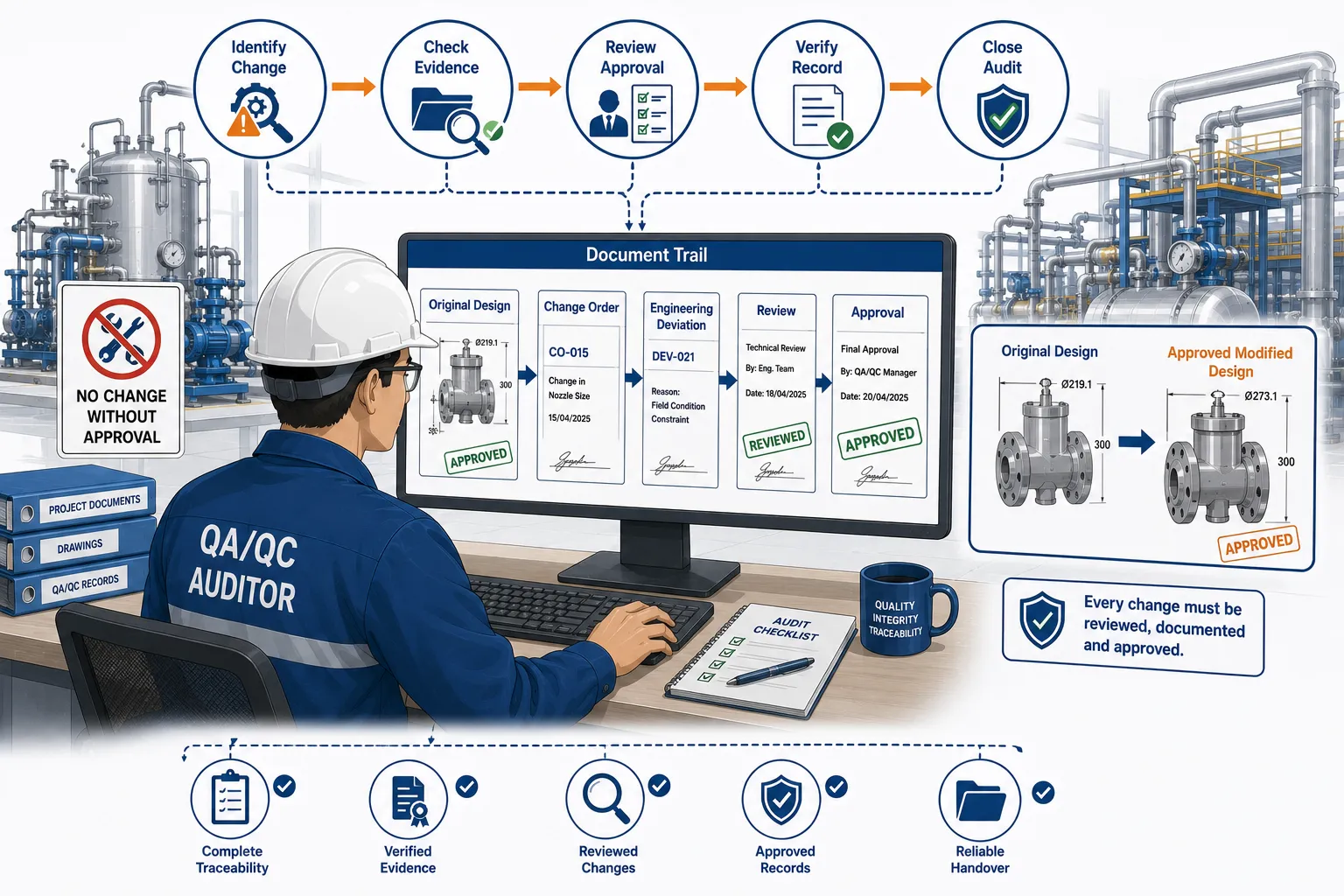
Understanding Internal Document Trails
An internal document trail is the sequence of controlled records that shows how a decision, change, deviation or technical action progressed through an organisation.
For a mechanical change, the document trail may begin with a request or identified issue and continue through technical review, risk assessment, approval, implementation, inspection and final record updating.
A typical document trail may include:
- Original approved drawings
- Change requests
- Mechanical change orders
- Engineering queries
- Technical evaluations
- Risk assessments
- Engineering deviation requests
- Approval records
- Revised drawings
- Revised specifications
- Inspection records
- Test records
- Final as-built documentation
The purpose of the trail is to provide objective evidence that the change was controlled.
A strong document trail should answer important questions such as:
- What was changed?
- Why was the change required?
- Who requested the change?
- What technical impact was assessed?
- Which standards or specifications were affected?
- Who reviewed the change?
- Who approved the change?
- When was the change implemented?
- Were related documents updated?
- Was the completed change inspected or verified?
Without a complete trail, it may be difficult to demonstrate that the final mechanical installation conforms to approved requirements.
Key Definitions and Concepts
| Term | Definition | Importance in QA/QC Document Auditing |
|---|---|---|
| Change Order | A formally controlled instruction authorising a change to approved project requirements, design, scope or work | Ensures changes are formally reviewed and approved |
| Engineering Deviation | A formally authorised departure from an original technical requirement under defined conditions | Prevents uncontrolled departures from specifications |
| Document Trail | A traceable sequence of records showing the development, review, approval and implementation of an action | Provides objective evidence and accountability |
| Change Control | A systematic process used to manage modifications to approved requirements | Protects quality, safety and technical integrity |
| Technical Review | An evaluation of the engineering implications of a proposed change | Identifies risks and technical consequences |
| Approval Authority | A person or organisation authorised to approve a particular change | Ensures decisions are made at the correct level |
| Revision Control | A method for identifying and managing changes to controlled documents | Prevents use of obsolete information |
| As-Built Record | Documentation showing the final condition of an installed or manufactured system | Provides an accurate record of the completed work |
| Audit Trail | Evidence showing who performed an action, when it occurred and how it was authorised | Supports accountability and compliance |
| Non-Conformity | A failure to meet a specified requirement | May trigger corrective action or further investigation |
The Difference Between a Change Order and an Engineering Deviation
Although these terms are closely related, they should not be treated as identical.
A change order normally represents a formal modification to an approved project requirement, scope, design or work instruction. It may permanently alter the original approved arrangement.
An engineering deviation generally represents an authorised departure from a specific requirement. Depending on the circumstances, the deviation may be temporary, limited or subject to defined conditions.
Mechanical Change Orders
Mechanical change orders may involve changes to:
- Equipment configuration
- Piping routes
- Material specifications
- Component dimensions
- Support arrangements
- Installation methods
- Manufacturing processes
- Testing requirements
A change order should normally follow the organisation’s approved change management process.
Engineering Deviations
Engineering deviations may arise when:
- Specified materials are temporarily unavailable
- Site conditions prevent the original installation method
- A manufacturing constraint is discovered
- A dimensional variation requires technical assessment
- An alternative technical solution is proposed
A deviation should not become an informal method of bypassing approved engineering requirements.
Instead, it should be technically justified and formally authorised.
Why Regular Internal Audits Are Necessary
Document trails can become incomplete when projects involve multiple departments, contractors and suppliers. Records may be created at different times and stored in different systems.
Regular internal audits help identify weaknesses before they affect final quality acceptance.
An internal audit may reveal:
- Missing approval signatures
- Unauthorised changes
- Obsolete drawings in use
- Missing engineering justifications
- Incorrect document revisions
- Unrecorded field modifications
- Incomplete deviation records
- Changes not reflected in as-built documents
Regular auditing changes document control from a reactive activity into a preventive quality control process.
Key Objectives of Document Trail Auditing
Internal document audits should aim to:
- Verify that all changes are formally recorded
- Confirm that approvals were obtained before implementation
- Check that authorised personnel approved the changes
- Confirm that technical impacts were assessed
- Verify that related documents were updated
- Identify unauthorised deviations
- Confirm revision control effectiveness
- Support accurate final project records
Establishing a Controlled Change Management System
A reliable audit process depends on having a structured change management system.
The organisation should establish clear procedures describing how changes and deviations are handled.
Essential Elements of the System
A mechanical change management system should define:
- How changes are initiated
- Which form or system must be used
- Required technical information
- Risk assessment requirements
- Review responsibilities
- Approval levels
- Implementation controls
- Inspection requirements
- Document update requirements
- Record retention arrangements
The procedure should be understood by engineering, production, QA/QC and document control personnel.
Assigning Clear Responsibilities
Different personnel may have different responsibilities.
Change Requestor
The person requesting the change should:
- Clearly describe the proposed modification
- Explain the reason for the change
- Provide relevant technical information
- Identify affected equipment or documents
Engineering Personnel
Engineering personnel may:
- Evaluate technical feasibility
- Assess design implications
- Review applicable requirements
- Identify additional controls
QA/QC Personnel
QA/QC personnel may:
- Review quality implications
- Confirm inspection requirements
- Verify documentation
- Audit implementation records
Authorised Approvers
Approvers should:
- Review the relevant information
- Confirm their authority
- Approve, reject or request further information
Document Control Personnel
Document control personnel may:
- Update registers
- Control revisions
- Archive superseded records
- Maintain traceability
Planning Regular Internal Document Trail Audits
Audits should be planned rather than performed randomly without clear objectives.
An audit programme should consider project complexity and the level of change activity.
Factors Affecting Audit Frequency
Audit frequency may depend on:
- Number of active changes
- Project size
- Technical complexity
- Safety significance
- Previous audit findings
- Regulatory requirements
- Client requirements
Projects involving frequent mechanical modifications may require more frequent reviews.
Developing an Audit Schedule
An audit schedule may define:
- Audit areas
- Planned audit dates
- Responsible auditor
- Applicable procedures
- Records to be sampled
- Reporting requirements
The schedule should provide sufficient coverage without unnecessarily disrupting project activities.
Preparing for a Document Trail Audit
Preparation is essential for an effective audit.
The auditor should first understand the project and the relevant document control requirements.
Reviewing Applicable Requirements
Before the audit, the auditor should review:
- Change control procedures
- Engineering management procedures
- Project Quality Plans
- Client specifications
- Document control procedures
- Inspection and Test Plans
- Previous audit reports
This helps the auditor establish clear audit criteria.
Identifying the Audit Population
The auditor should determine which changes and deviations fall within the audit scope.
The population may include:
- Open change orders
- Closed change orders
- Engineering deviations
- Revised drawings
- Field change requests
- Technical queries
The auditor can then determine whether all records or a representative sample will be reviewed.
Preparing an Audit Checklist
A checklist helps ensure consistency.
Useful questions include:
- Is the change uniquely identified?
- Is the reason for the change documented?
- Was technical review completed?
- Was risk assessed?
- Was the correct approval obtained?
- Was approval obtained before implementation?
- Were affected documents revised?
- Was obsolete information removed from use?
- Was implementation verified?
- Is the final record complete?
Step-by-Step Process for Auditing Change Orders and Deviations
A systematic approach improves the reliability of the audit.
Step 1: Select the Change Record
Select a change order or deviation from the controlled register.
Confirm:
- Unique identification number
- Project reference
- Equipment reference
- Current status
Step 2: Review the Original Requirement
The auditor should identify what requirement existed before the change.
This may involve reviewing:
- Original drawings
- Specifications
- Purchase documents
- Approved procedures
Without understanding the original requirement, the auditor cannot accurately assess the significance of the change.
Step 3: Review the Change Justification
The reason for the modification should be documented clearly.
Typical reasons may include:
- Design improvement
- Site interference
- Material availability
- Safety concern
- Client instruction
- Technical correction
The justification should be sufficient to support the need for review.
Step 4: Examine the Technical Assessment
The change should have been evaluated for its possible effects.
The assessment may consider:
- Mechanical strength
- Pressure integrity
- Material compatibility
- Operational performance
- Safety
- Inspection requirements
- Regulatory compliance
Step 5: Verify Approval Authority
The auditor should confirm that the change was approved by an appropriately authorised person.
This includes checking:
- Name
- Position
- Approval status
- Date of approval
An approval is not automatically valid simply because a signature is present.
Step 6: Confirm Approval Timing
One important audit question is whether approval was obtained before implementation.
If work was performed before approval, the organisation may need to investigate the circumstances.
Step 7: Verify Implementation
The auditor should confirm that the implemented change matches the approved change.
Evidence may include:
- Inspection reports
- Photographs
- Revised drawings
- Site verification records
- Test reports
Step 8: Check Related Document Updates
A change may affect several documents.
The auditor should verify that relevant documents were reviewed and updated.
These may include:
- Drawings
- Specifications
- Material lists
- Inspection plans
- Test procedures
- Operating documents
Step 9: Verify Final Record Closure
Before a change is closed, the organisation should confirm that all required actions have been completed.
The record should show:
- Implementation status
- Verification status
- Final approval where required
- Document updates
- Closure date
Auditing Approval Status
Approval status is one of the most critical areas of document trail auditing.
A change may be technically reasonable but still represent a compliance risk if it was not approved through the required process.
Approval Checks Should Include
- Correct approval level
- Required engineering review
- QA/QC review where applicable
- Client approval where required
- Third-party approval where required
- Complete approval records
Common Approval Problems
Auditors may identify:
- Missing signatures
- Undated approvals
- Approval by unauthorised personnel
- Verbal approvals with no formal record
- Implementation before approval
Each finding should be evaluated according to the organisation’s procedures and the significance of the change.
Auditing Revision Control
Mechanical projects can generate many document revisions.
If revision control is weak, personnel may use outdated information.
Important Revision Control Checks
The auditor should confirm:
- Current revisions are clearly identified
- Superseded documents are controlled
- Revised documents are issued correctly
- Change references are recorded
- As-built documents reflect approved modifications
Practical Example
A piping support drawing is revised after a site interference is identified.
The audit should verify:
- The original drawing was identified.
- The technical problem was recorded.
- The revised support arrangement was reviewed.
- The change was approved.
- The new drawing revision was issued.
- The installation used the revised information.
- The final records reflected the completed arrangement.
If any link is missing, the document trail may be incomplete.
Auditing Engineering Deviations
Engineering deviations require careful review because they involve departure from an established requirement.
The auditor should confirm that the deviation was controlled and justified.
Key Audit Questions
- What requirement was deviated from?
- Why was the deviation necessary?
- Was technical suitability assessed?
- Was risk evaluated?
- Was the deviation approved?
- Were any conditions attached to the approval?
- Was the deviation temporary or permanent?
- Was final implementation verified?
Reviewing Deviation Validity
An approved deviation should clearly identify its scope.
For example, it may apply only to:
- One component
- A defined batch
- A particular installation
- A specific period
The auditor should ensure that the deviation was not incorrectly applied beyond its authorised scope.
The Importance of Traceability
Traceability connects all stages of the change process.
A complete trail should link:
- Original requirement
- Change request
- Technical assessment
- Approval
- Revised documentation
- Physical implementation
- Inspection
- Final record
The absence of one link can create uncertainty.
For example, a revised drawing may exist, but if there is no record explaining why it was changed, the historical trail may be incomplete.
Practical Example: Auditing a Piping Modification
A mechanical contractor identifies an interference between a planned piping route and an existing structural member.
A field team proposes a new route.
Required Controlled Process
The process should include:
- Identification of the interference
- Formal change request
- Engineering assessment
- Review of stress and support implications where applicable
- Approval by authorised personnel
- Revision of drawings
- Controlled issue of revised information
- Installation inspection
- Update of final records
Audit Findings
During an internal audit, the auditor discovers that:
- The revised piping route was installed
- A revised drawing exists
- The drawing is technically approved
- The change request form is missing
The installation may be technically acceptable, but the documentation trail is incomplete.
The auditor should record the finding according to the organisation’s audit process and ensure appropriate follow-up.
Practical Example: Engineering Deviation for Material Substitution
A specified mechanical material is temporarily unavailable.
The supplier proposes an alternative material.
The organisation should not simply install the alternative.
The process should include:
- Formal deviation request
- Comparison of material requirements
- Engineering evaluation
- Quality review
- Required approval
- Updated documentation
- Material traceability records
The audit should verify every stage.
Recording Audit Findings
Audit findings should be factual and supported by objective evidence.
The auditor should avoid personal opinions.
A Professional Finding May Include
- Audit criterion
- Objective evidence reviewed
- Description of the gap
- Reference to the affected record
- Classification according to the audit system
For example, the finding should clearly identify the missing approval or record rather than simply stating that “documentation is poor”.
Managing Corrective Actions
Audit findings should lead to controlled corrective actions.
The purpose is not only to correct the immediate documentation problem but also to prevent recurrence.
Corrective Action Process
A typical process may include:
- Identify the non-conformity.
- Contain the immediate risk.
- Determine the cause.
- Define corrective action.
- Assign responsibility.
- Establish a completion date.
- Verify effectiveness.
- Close the action formally.
Examples of Corrective Actions
Actions may include:
- Recovering missing approval records
- Updating the change register
- Training relevant personnel
- Revising document control procedures
- Introducing electronic approval controls
- Increasing audit frequency
Key Benefits of Regular Document Trail Audits
Regular audits provide important benefits for mechanical projects.
Improved Compliance
Audits help verify that changes follow approved procedures.
Benefits include:
- Better alignment with project requirements
- Improved regulatory readiness
- Stronger contractual compliance
Reduced Risk of Unauthorised Changes
Early identification helps prevent uncontrolled modifications.
This protects:
- Mechanical integrity
- Safety
- Product quality
- Project reliability
Improved Traceability
A complete document trail makes it easier to understand the history of a mechanical system.
This supports:
- Maintenance
- Future modifications
- Incident investigations
- Client audits
Better Project Handover
Projects with complete change records can prepare more accurate final documentation.
This supports:
- As-built documentation
- Manufacturer’s Data Records
- Final client acceptance
Key Controls for Effective Change Documentation
Organisations should implement practical controls.
Recommended controls include:
- Unique change identification numbers
- Central change registers
- Defined approval workflows
- Controlled document templates
- Electronic revision tracking
- Regular internal audits
- Clear retention requirements
Good Documentation Practices
Personnel should ensure that records are:
- Accurate
- Legible
- Dated
- Identifiable
- Complete
- Traceable
- Protected from unauthorised changes
The Role of Digital Document Management Systems
Digital systems can improve document trail control when used effectively.
Such systems may support:
- Centralised storage
- Controlled access
- Automated workflows
- Revision history
- Electronic approvals
- Audit logs
However, technology alone does not guarantee compliance.
Personnel must still ensure that:
- The correct information is entered
- Approval authorities are properly assigned
- Records are reviewed
- Changes follow the approved procedure
Common Weaknesses Identified During Audits
Internal auditors should remain alert to recurring weaknesses.
Common issues include:
- Changes implemented before approval
- Missing engineering evaluations
- Incomplete deviation forms
- Unauthorised signatures
- Outdated drawings in use
- Changes missing from final records
- Incorrect document references
- Closed changes without verification
Recognising these patterns can help organisations improve their quality management systems.
Developing a Culture of Controlled Change
Effective change control depends on organisational culture as well as procedures.
Personnel should understand that documentation is not unnecessary administration. It provides evidence that engineering decisions were properly controlled.
Organisations should encourage personnel to:
- Report required changes early
- Avoid informal modifications
- Seek clarification when requirements are unclear
- Follow approval processes
- Maintain accurate records
Management should support the process by providing:
- Clear procedures
- Appropriate training
- Adequate resources
- Defined responsibilities
Professional Judgement During Document Audits
QA/QC professionals must apply professional judgement when reviewing document trails.
Not every missing document has the same level of significance.
The auditor should consider:
- Safety impact
- Technical impact
- Regulatory importance
- Contractual requirements
- Scope of the affected change
For example, a missing internal routing record may require a different response from an unauthorised change affecting pressure containment.
Professional judgement should always be supported by objective evidence and established procedures.
Integrating Document Trail Audits with the Quality Management System
Document trail audits should not operate as isolated activities.
They should connect with wider quality processes, including:
- Internal audits
- Non-conformance management
- Corrective actions
- Risk management
- Document control
- Management review
This integration allows organisations to identify recurring weaknesses and improve the overall system.
Using Audit Results for Improvement
Audit results can reveal trends such as:
- Repeated late approvals
- Frequent missing signatures
- Poor revision control
- Delays in document updates
Management can then take targeted action to improve performance.
A Practical Internal Audit Checklist
Before closing an audit, the auditor should confirm the following.
Change Identification
- Is every change uniquely identified?
- Is the affected mechanical system clearly stated?
- Is the reason for the change recorded?
Technical Review
- Was the change technically evaluated?
- Were relevant quality and safety impacts considered?
- Were applicable requirements reviewed?
Approval
- Was approval formally recorded?
- Did the correct authority approve the change?
- Was approval obtained at the appropriate stage?
Implementation
- Does the physical work match the approved change?
- Was implementation inspected where required?
- Are relevant test records available?
Documentation
- Were drawings and specifications updated?
- Are correct revisions available?
- Are final records complete?
Closure
- Were outstanding actions completed?
- Was effectiveness verified?
- Is the change formally closed?
Conclusion
Regular auditing of internal document trails is essential for ensuring that mechanical change orders and engineering deviations are fully approved, implemented under control and accurately recorded. Mechanical projects frequently experience changes, but every change must be traceable from its original request through technical evaluation, formal approval, implementation, verification and final documentation.
A strong internal audit process examines the complete chain of evidence, including the original requirement, change justification, engineering review, risk considerations, approval authority, revision control, implementation records and final closure. This approach helps organisations identify missing approvals, unauthorised modifications, obsolete documents and incomplete engineering records before they create significant quality or compliance problems.
For QA/QC Mechanical Engineering professionals, effective document trail auditing is therefore a critical part of maintaining mechanical integrity and regulatory compliance. By applying structured audit procedures, maintaining clear traceability and addressing findings through effective corrective action, organisations can strengthen their quality assurance systems and ensure that final project documentation accurately represents the mechanical system that has been delivered.
4.Manage a Digital Archiving Workflow for Rapid Retrieval of Critical Safety and Quality Records
Digital archiving is a critical element of modern QA/QC and regulatory compliance in mechanical engineering projects. Mechanical organisations generate large volumes of records throughout design, procurement, manufacturing, fabrication, installation, inspection, testing and commissioning. These records may include Inspection and Test Plans (ITPs), material certificates, welding records, calibration certificates, pressure test reports, non-conformance reports, engineering change orders, risk assessments and final quality dossiers.
During an external regulatory inspection, client audit or certification assessment, an organisation may be required to produce specific records quickly. If documents are stored in different locations, incorrectly named, poorly indexed or inadequately controlled, valuable time can be lost. Delayed retrieval may create the impression that records are missing or that the organisation has weak document control, even where the required information actually exists.
A well-managed digital archiving workflow ensures that critical safety and quality records are securely stored, correctly classified, traceable, protected from unauthorised alteration and rapidly retrievable. For QA/QC Mechanical Engineering professionals, digital archiving is not simply an administrative activity. It is a structured quality assurance process that supports regulatory compliance, operational continuity, audit readiness and long-term traceability.
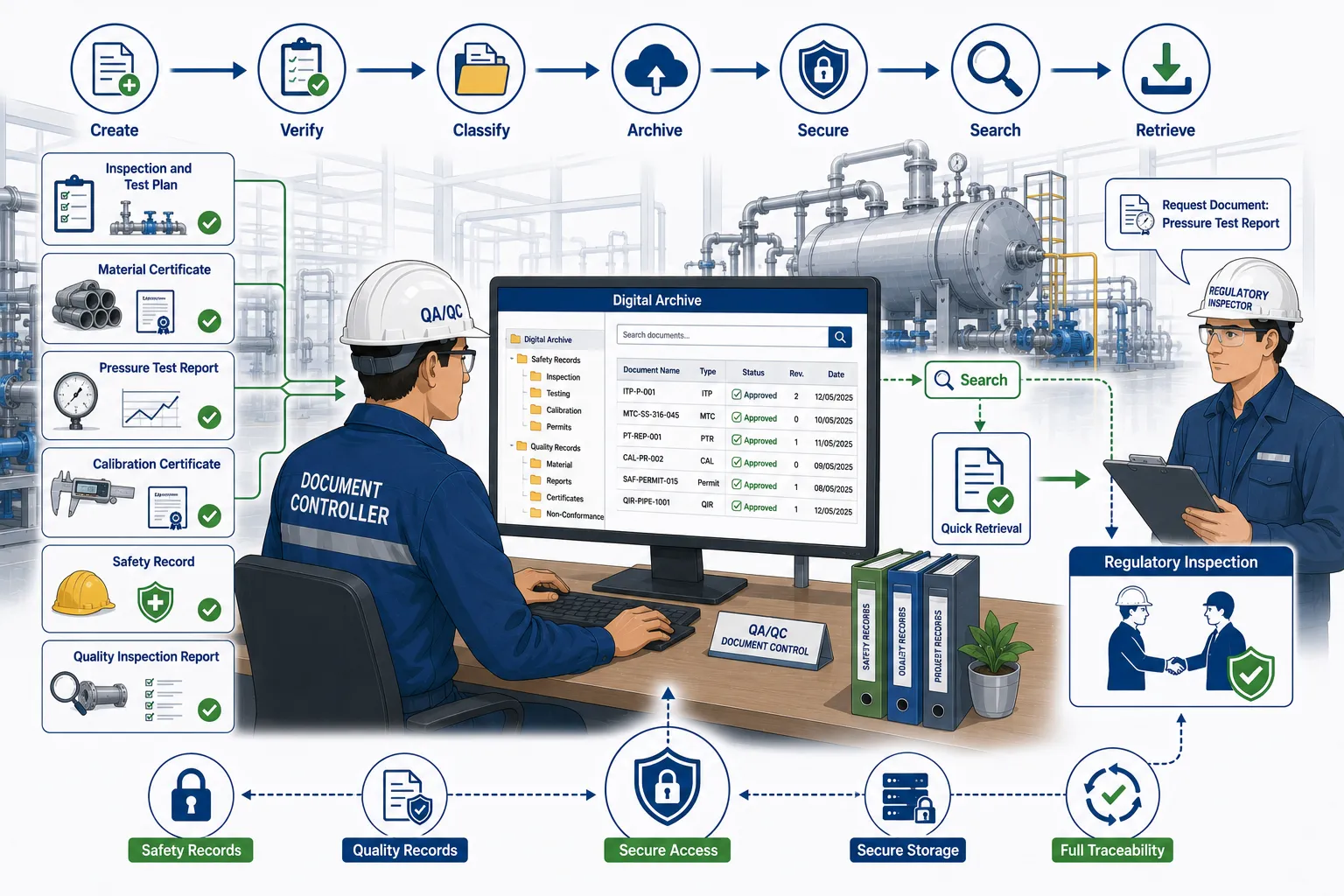
The Purpose of Digital Archiving in Mechanical QA/QC
Digital archiving is the systematic process of preserving electronic records in a controlled environment for future retrieval, verification and reference.
In a mechanical engineering environment, archived records provide evidence that important activities were completed in accordance with approved requirements.
A digital archive may support:
- Regulatory inspections
- External audits
- Client audits
- Internal quality reviews
- Incident investigations
- Maintenance activities
- Project handovers
- Legal or contractual reviews
- Future engineering modifications
The main objective is to ensure that important records remain:
- Available
- Accurate
- Complete
- Secure
- Legible
- Traceable
- Retrievable
A record that exists but cannot be found when required provides limited practical value during an inspection.
Key Definitions and Concepts
| Term | Definition | Importance in Digital Archiving |
|---|---|---|
| Digital Archive | A controlled electronic storage environment used to preserve records for future retrieval | Ensures long-term availability of important safety and quality evidence |
| Metadata | Structured information describing a document, such as date, project number, revision or equipment ID | Improves searching, classification and retrieval |
| Document Index | A structured register listing archived records and their identifying information | Helps confirm completeness and locate records quickly |
| Retrieval | The process of locating and accessing a required record | Critical during inspections and audits |
| Retention Period | The defined length of time for which a record must be kept | Supports legal, contractual and regulatory compliance |
| Access Control | Restrictions that determine who may view, edit or approve records | Protects confidential and controlled information |
| Audit Trail | A record showing actions performed on a document, including creation, modification or approval | Supports accountability and document integrity |
| Version Control | A process used to identify and manage different revisions of a document | Prevents accidental use of obsolete information |
| Backup | A protected copy of information maintained to support recovery after loss or system failure | Protects against data loss |
| Record Integrity | Confidence that a record remains accurate, complete and protected from unauthorised alteration | Essential for reliable quality evidence |
Why Rapid Record Retrieval Is Essential During Regulatory Inspections
External regulatory inspections may occur at different stages of a mechanical project or during routine oversight of an organisation’s activities. Inspectors may request specific evidence relating to safety, quality or technical compliance.
Examples of requested records may include:
- Material certificates
- Pressure test records
- Calibration certificates
- Welding qualification records
- Inspection reports
- Non-conformance records
- Corrective action records
- Risk assessments
- Engineering change records
- Maintenance records
The organisation must be able to locate the requested evidence efficiently.
The Consequences of Poor Retrieval
Poor document retrieval can result in:
- Delays during inspections
- Increased audit findings
- Reduced confidence in the quality system
- Difficulty proving compliance
- Project handover delays
- Increased administrative workload
- Potential contractual disputes
A strong archiving workflow reduces these risks by making document location predictable and controlled.
The Principle of Inspection Readiness
Inspection readiness means that critical evidence can be retrieved without creating unnecessary disruption to normal operations.
An organisation should not need to search through multiple personal computers, email accounts or paper files when an inspector requests an important record.
Instead, the organisation should know:
- Where records are stored
- How they are classified
- Who controls them
- How they can be retrieved
- Which version is valid
Identifying Critical Safety and Quality Records
Not every document has the same level of importance. A digital archiving workflow should identify records that are critical to demonstrating safety and quality compliance.
Common Safety Records
Safety-related records may include:
- Risk assessments
- Safety inspection reports
- Incident records
- Emergency procedures
- Equipment safety checks
- Permit-related records where applicable
- Safety training records
- Corrective action records
Common Mechanical QA/QC Records
Quality records may include:
- Inspection and Test Plans
- Inspection reports
- Material Test Certificates
- Welding records
- Non-Destructive Testing reports
- Pressure test records
- Dimensional inspection records
- Calibration certificates
- Non-conformance reports
- Corrective action records
Engineering and Project Control Records
Engineering-related archives may contain:
- Approved drawings
- As-built drawings
- Technical specifications
- Change orders
- Engineering deviations
- Design review records
- Equipment data sheets
Prioritising Records for Rapid Retrieval
Organisations should identify records that may be requested frequently or urgently.
Priority records may include those associated with:
- High-risk equipment
- Pressure systems
- Safety-critical components
- Regulatory approvals
- Major quality incidents
- Client acceptance
Designing a Structured Digital Archiving Workflow
A digital archiving workflow should define how records move from active use into controlled storage.
A typical workflow can include:
- Record creation
- Record review
- Approval
- Classification
- Metadata assignment
- Secure storage
- Indexing
- Backup
- Retention management
- Retrieval and verification
Each stage should be clearly defined.
Step 1: Create or Receive the Record
Records may be generated internally or received from external organisations.
Examples include:
- Supplier material certificates
- Laboratory reports
- Inspection reports
- Engineering drawings
The responsible person should ensure that the record is complete before entering it into the archive.
Step 2: Verify Record Completeness
Before archiving, records should be checked for essential information.
The review may confirm:
- Document title
- Project reference
- Equipment identification
- Date
- Revision
- Approval status
- Required signatures
Incomplete records should be identified before final archiving.
Step 3: Classify the Record
Records should be placed within a logical classification structure.
For example:
-
Project
-
Mechanical
- Materials
- Welding
- Inspection
- Testing
- Calibration
- Non-Conformities
-
Mechanical
A consistent classification structure improves retrieval speed.
Step 4: Assign Metadata
Metadata provides searchable information about a record.
Useful metadata may include:
- Project number
- Equipment number
- Document number
- Record type
- Date
- Revision
- Discipline
- Inspection stage
- Retention category
Good metadata reduces dependence on manually searching through folders.
Step 5: Archive the Record
The approved record is stored in the designated digital archive.
The system should provide appropriate protection and controlled access.
Step 6: Update the Archive Index
The archive index should record the location and status of important documents.
This may include:
- Document title
- Unique identification number
- Storage location
- Revision
- Date archived
- Retention period
Step 7: Protect and Back Up the Record
The organisation should ensure that records can be recovered if the main storage system fails.
Step 8: Test Retrieval
Records should periodically be retrieved to confirm that the system is functioning effectively.
Developing a Logical File Classification Structure
A digital archive should not depend solely on individual employee knowledge.
The classification system should be understandable to authorised personnel.
Project-Based Classification
One common approach is to organise records according to project.
For example:
Project Number
Mechanical Discipline
Equipment Package
Record Category
Specific Document
This structure can help users move from general information to specific records.
Equipment-Based Classification
For major mechanical assets, an organisation may use equipment identification as a primary reference.
Examples include:
- Pump identification
- Pressure vessel identification
- Piping system identification
- Heat exchanger identification
This approach is particularly useful when records must be retrieved for a specific asset.
Process-Based Classification
Records may also be organised by activity.
Examples include:
- Material receiving
- Fabrication
- Welding
- Inspection
- Testing
- Final acceptance
The chosen method should match the organisation’s operational needs.
Establishing Consistent File Naming Conventions
A file naming convention is a standard method of naming electronic records.
Consistent naming improves searchability and reduces confusion.
A File Name May Include
- Project number
- Equipment ID
- Document type
- Document number
- Revision
- Date
For example, a naming structure may follow a controlled format such as:
Project reference + Equipment identification + Record type + Revision
The exact format should be defined by the organisation’s document control procedure.
Good File Naming Practices
Effective file names should be:
- Consistent
- Meaningful
- Concise
- Unique
- Linked to project references
Personnel should avoid unclear names such as:
- Final document
- New report
- Latest version
- Test file
These descriptions can quickly create confusion.
Metadata and Indexing for Fast Retrieval
Metadata is one of the most effective tools for improving digital retrieval.
A well-indexed archive allows users to search using several different criteria.
Useful Search Criteria
A QA/QC professional may need to search by:
- Project number
- Equipment number
- Material heat number
- Document number
- Inspection date
- Supplier name
- Record category
The archive should support appropriate searching based on organisational requirements.
The Importance of a Master Document Index
A master document index can provide an overview of archived records.
It may show:
- Record identification
- Description
- Revision
- Status
- Storage location
- Retention period
The index helps demonstrate that the archive is complete.
Managing Version and Revision Control
One of the greatest risks in document management is the use of obsolete information.
Mechanical projects may involve frequent revisions to drawings, specifications and procedures.
Effective Revision Control Requires
- Unique document identification
- Clear revision numbers
- Revision dates
- Approval status
- Control of superseded versions
The archive should distinguish between historical records and currently applicable documents.
Archived Does Not Always Mean Current
An important principle is that an archived document may remain valuable as historical evidence but should not automatically be used as the current working document.
For example:
- An old drawing may be required for historical traceability.
- The latest approved drawing may be required for current work.
The system must clearly distinguish between these uses.
Controlling Access to Digital Archives
Critical safety and quality records should be protected from unauthorised access or alteration.
Access control should reflect job responsibilities.
Different Levels of Access May Include
View-Only Access
Personnel can:
- Search
- Read
- Download authorised records
They cannot alter the original controlled record.
Controlled Editing Access
Authorised personnel can:
- Update designated active records
- Upload revised documents
- Submit records for review
Administrative Access
Authorised administrators may:
- Manage permissions
- Configure archive categories
- Maintain system controls
Access should be reviewed regularly.
Maintaining Record Integrity
Record integrity means that information remains accurate and trustworthy.
A quality record should not be changed without appropriate control.
Important Integrity Controls
Organisations may use:
- User authentication
- Permission controls
- Revision history
- Electronic approval
- Audit logs
- Read-only final records
These controls help demonstrate whether records have been managed appropriately.
Why Integrity Matters During Inspections
An external inspector may need confidence that the record being presented is authentic.
A controlled digital system can support this confidence by demonstrating:
- Record identity
- Approval status
- Revision history
- Access history where applicable
Establishing Backup and Recovery Procedures
Even a well-organised archive can fail if there is no effective recovery arrangement.
Potential risks include:
- Hardware failure
- Software failure
- Accidental deletion
- Cybersecurity incidents
- Physical damage to equipment
A backup strategy should therefore be established.
Key Backup Considerations
The organisation should define:
- What information is backed up
- How frequently backups occur
- Where backup copies are stored
- Who is responsible
- How recovery is tested
Recovery Testing
A backup is only useful if information can actually be restored.
Periodic recovery testing helps confirm that the organisation can recover critical records when required.
Defining Record Retention Periods
Safety and quality records should be retained for an appropriate period based on applicable requirements.
Retention periods may depend on:
- Regulatory requirements
- Contractual requirements
- Client requirements
- Internal procedures
- Equipment lifecycle needs
The archive system should clearly identify when records are eligible for review, transfer or disposal.
Controlled Record Disposal
Records should not be deleted simply because a project has ended.
Before disposal, organisations should verify:
- The retention period has expired
- No legal hold applies
- No investigation requires the record
- Disposal is authorised
Preparing for External Regulatory Inspections
An organisation should prepare its archive system before an inspection takes place.
Inspection preparation should not involve creating missing records after the event.
The objective is to ensure that existing evidence is organised and accessible.
Pre-Inspection Activities
QA/QC teams may:
- Review the archive index
- Check access permissions
- Confirm critical records are retrievable
- Verify document completeness
- Test search functions
- Identify responsible personnel
Creating an Inspection Retrieval Plan
The organisation should know who is responsible for locating records.
The plan may identify:
- Document controller
- QA/QC representative
- Engineering representative
- System administrator
Clear responsibilities reduce confusion during an inspection.
Rapid Retrieval Procedures During an Inspection
When an inspector requests a document, the organisation should follow a controlled process.
Step 1: Confirm the Request
Identify exactly what record is being requested.
Clarify:
- Project
- Equipment
- Date range
- Record type
Step 2: Search the Archive
Use appropriate metadata and search criteria.
Avoid searching through unrelated folders where a controlled index is available.
Step 3: Verify the Record
Before presenting the document, confirm:
- Correct identification
- Correct revision
- Legibility
- Completeness
Step 4: Provide the Record
Provide access through the approved method.
The organisation should maintain appropriate confidentiality and access controls.
Step 5: Record the Inspection Request Where Required
An inspection log may record:
- Requested document
- Time requested
- Record provided
- Responsible person
This can support internal review after the inspection.
Practical Example: Retrieving a Pressure Test Record
During an external inspection, a regulator requests the pressure test record for a specific mechanical system.
A poorly managed organisation may need to:
- Search paper files
- Contact former employees
- Review emails
- Search multiple computers
A controlled digital archive should allow the authorised person to search using:
- Project number
- Equipment identification
- Test category
The relevant record should then be verified and retrieved.
The organisation may also retrieve supporting evidence, such as:
- Test procedure
- Inspection record
- Calibration information
- Final approval
This demonstrates a complete and controlled quality trail.
Practical Example: Retrieving a Calibration Certificate
An inspector requests evidence that a pressure gauge used during testing was appropriately controlled.
The archive should allow QA/QC personnel to retrieve the certificate using:
- Instrument identification
- Calibration date
- Project reference
The record should clearly connect to the relevant inspection or test activity where required.
This example demonstrates why metadata and traceability are important.
Common Problems in Digital Archiving
Organisations may experience several weaknesses.
Inconsistent File Names
If employees use different naming practices, searching becomes difficult.
Examples of poor practices include:
- Personal abbreviations
- Missing project references
- Unclear version names
A controlled naming procedure reduces this risk.
Duplicate Records
Multiple copies of the same record can create confusion.
The archive should identify the controlled master record.
Missing Metadata
A document may be stored but difficult to locate if important search information is absent.
Uncontrolled Access
Too much editing access may result in accidental changes or deletion.
Inadequate Backups
Failure to maintain reliable backups can lead to permanent loss of critical evidence.
Obsolete Documents
Old versions may be incorrectly presented as current information.
Regular archive reviews can help identify these issues.
Conducting Regular Archive Audits
Digital archiving systems should be audited regularly.
The purpose is to verify that the workflow continues to operate effectively.
Archive Audit Activities May Include
- Checking record completeness
- Testing document retrieval
- Reviewing access permissions
- Verifying backup arrangements
- Checking revision control
- Reviewing metadata quality
Retrieval Time Testing
An organisation may conduct a practical exercise.
For example, an auditor requests:
- A material certificate
- A pressure test report
- A calibration certificate
- An approved change order
The responsible team should retrieve the records within the organisation’s defined expectations.
This tests the real effectiveness of the archive.
Key Benefits of a Digital Archiving Workflow
A well-managed system provides significant advantages.
Faster Regulatory Response
Records can be retrieved efficiently when requested.
Benefits include:
- Reduced inspection delays
- Improved confidence
- Better audit performance
Improved QA/QC Traceability
Records can be linked across the project lifecycle.
This supports:
- Material traceability
- Inspection verification
- Test evidence
- Change management
Better Information Security
Access controls and backups help protect important records.
Reduced Administrative Work
A structured system reduces time spent searching for information.
Stronger Project Handover
A well-organised archive supports the preparation of:
- Manufacturer’s Data Records
- Quality dossiers
- Final handover packages
Roles and Responsibilities in Digital Archiving
Digital archiving requires cooperation between different departments.
QA/QC Personnel
QA/QC personnel may:
- Verify record completeness
- Identify critical quality evidence
- Support retrieval testing
- Review archive compliance
Document Controllers
Document controllers may:
- Manage document indexing
- Maintain controlled storage
- Monitor revision status
- Support document retrieval
Engineers
Engineers may:
- Provide approved technical records
- Identify engineering changes
- Confirm document relevance
IT and System Administrators
IT personnel may:
- Maintain system security
- Manage backups
- Support recovery procedures
- Control technical access
Developing a Digital Archiving Procedure
A formal procedure should define how the organisation manages electronic records.
The procedure should include:
- Purpose and scope
- Record categories
- Classification rules
- Naming conventions
- Metadata requirements
- Access control
- Revision control
- Backup requirements
- Retention requirements
- Retrieval procedures
- Audit arrangements
A clear procedure ensures that digital archiving is performed consistently.
Professional Best Practices for QA/QC Digital Archiving
QA/QC professionals should apply structured practices throughout the document lifecycle.
Recommended practices include:
- Archive records promptly after approval
- Use standard document identification
- Apply consistent metadata
- Maintain a current document index
- Protect final records from unauthorised alteration
- Test record retrieval regularly
- Review access permissions
- Maintain reliable backup arrangements
- Monitor retention periods
- Conduct periodic archive audits
Digital Archiving Readiness Checklist
Before considering the archive inspection-ready, confirm:
- Are critical safety records identified?
- Are quality records properly classified?
- Are files consistently named?
- Is metadata complete?
- Are current and historical revisions distinguishable?
- Are access controls effective?
- Are backup systems functioning?
- Can critical records be retrieved quickly?
- Are retention periods defined?
- Are archive audits conducted regularly?
Continuous Improvement of Digital Archiving Systems
Digital archiving should be reviewed as project requirements and technologies change.
Improvement opportunities may be identified through:
- External audit findings
- Internal audit results
- Retrieval delays
- User feedback
- System incidents
- Missing record investigations
Possible improvements may include:
- Improving metadata requirements
- Updating file naming conventions
- Enhancing search functions
- Providing staff training
- Strengthening backup arrangements
- Improving document control procedures
Continuous improvement helps ensure that the archive remains effective as the organisation grows.
The Role of Professional Judgement
QA/QC professionals must apply professional judgement when determining which records require the highest level of control and rapid retrieval.
Priority should consider:
- Safety significance
- Regulatory importance
- Contractual requirements
- Equipment criticality
- Potential quality consequences
For example, records relating to safety-critical mechanical systems may require stronger retrieval and retention controls than routine administrative records.
Professional judgement should always operate within the organisation’s approved procedures and applicable requirements.
Integrating Digital Archiving with the Wider Quality Management System
Digital archiving should be integrated with other QA/QC activities.
Important connections include:
- Document control
- Inspection planning
- Audit management
- Non-conformance control
- Corrective action management
- Change management
- Final project handover
When these systems are connected, the organisation can follow the complete history of a mechanical item from initial documentation through inspection and final acceptance.
Conclusion
Managing a digital archiving workflow is essential for ensuring that critical mechanical safety and quality records can be retrieved quickly and reliably during external regulatory inspections. A strong system provides controlled storage, logical classification, consistent file naming, effective metadata, revision control, secure access, backup arrangements and defined retention procedures.
The workflow should begin when records are created or received and continue through verification, classification, indexing, archiving, protection and periodic retrieval testing. QA/QC professionals play a central role in ensuring that inspection reports, material certificates, test logs, calibration records, change orders and other critical documents remain complete, traceable and accessible.
Regular archive audits and retrieval exercises help demonstrate that the system works in practice rather than only appearing effective on paper. When inspectors request evidence, an organisation should be able to locate, verify and present the correct record without unnecessary delay.
By implementing a structured and secure digital archiving workflow, mechanical organisations can strengthen regulatory compliance, improve QA/QC traceability, reduce administrative delays and maintain continuous readiness for external inspections and audits.