
Lesson no 3 :Develop QA/QC policies and procedures aligned with international benchmarks.
Developing effective QA/QC policies and procedures aligned with international benchmarks is essential for ensuring consistency, reliability, safety, and continuous improvement in mechanical engineering projects and operations. Quality Assurance (QA) focuses on establishing planned systems and processes that prevent defects, while Quality Control (QC) focuses on inspecting, testing, and verifying that materials, components, manufacturing activities, and completed work meet specified requirements.
International benchmarks provide recognised principles and structured approaches that help organisations develop quality systems capable of meeting global expectations. Well-designed QA/QC policies define the organisation’s overall commitment to quality, compliance, accountability, and continual improvement. Supporting procedures translate these commitments into clear operational steps that personnel can follow during design, procurement, manufacturing, installation, inspection, testing, and project handover.
This lesson enables Learners to understand how QA/QC policies and procedures should be developed, reviewed, implemented, and controlled to achieve alignment with recognised international quality principles and project requirements. Learners will explore the importance of defining responsibilities, establishing inspection and testing controls, managing documents and records, controlling non-conforming work, verifying personnel competence, and implementing corrective and preventive improvement measures.
The lesson also highlights the importance of adapting international benchmarks to the specific needs of an organisation and mechanical project. Effective QA/QC documentation must be practical, clearly communicated, regularly reviewed, and consistently applied by relevant personnel.
By developing structured and internationally aligned QA/QC policies and procedures, organisations can strengthen compliance, reduce defects and rework, improve traceability, manage risks more effectively, and build greater confidence among clients and stakeholders. This knowledge supports Learners in contributing to robust, reliable, and continuously improving mechanical QA/QC management systems.
1. Designing High-Level Corporate QA/QC Policies Aligned with ISO 9001 Core Requirements
Introduction
High-level corporate QA/QC policies provide the strategic direction for how an organisation manages quality across its operations, projects, products, and services. In mechanical engineering and QA/QC environments, these policies establish the organisation’s commitment to meeting customer requirements, applicable statutory and regulatory obligations, technical specifications, and recognised quality management principles.
When designing corporate QA/QC policies, organisations should align their overall approach with the core requirements and principles of ISO 9001. ISO 9001 provides an internationally recognised framework for establishing, implementing, maintaining, and continually improving a Quality Management System (QMS). A corporate policy should not simply reproduce the wording of an international standard. Instead, it should translate relevant requirements into a clear organisational commitment that can guide decision-making and support practical procedures.
For a QA/QC mechanical engineering organisation, this means developing policies that address leadership, customer focus, risk-based thinking, process control, competence, documented information, performance evaluation, corrective action, and continual improvement. These policies should then be supported by detailed procedures, work instructions, inspection plans, testing requirements, and quality records.
A well-designed corporate QA/QC policy provides a consistent foundation for all departments. It ensures that quality is treated as an organisational responsibility rather than being limited to the QA/QC department.
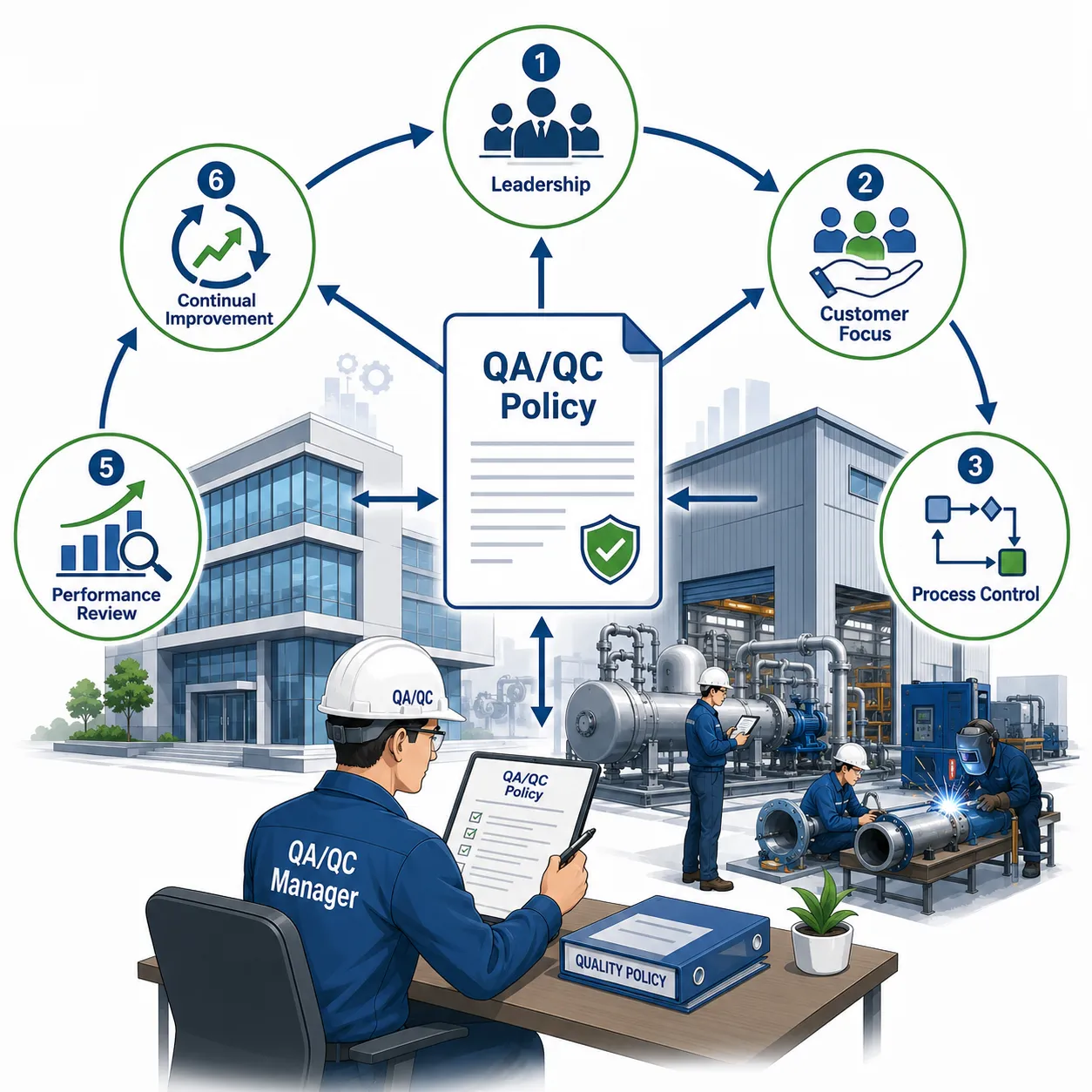
Understanding the Purpose of a Corporate QA/QC Policy
A corporate QA/QC policy is a high-level statement that defines an organisation’s intentions and direction relating to quality. It establishes the principles that management and personnel are expected to follow when planning and performing work.
The policy should communicate what the organisation intends to achieve and how quality supports its wider business objectives. It should also provide a framework for establishing measurable quality objectives.
A strong corporate QA/QC policy should:
- reflect the organisation’s purpose and operational context
- support the strategic direction of the organisation
- demonstrate commitment to meeting applicable requirements
- support customer satisfaction
- promote consistent process performance
- provide a framework for quality objectives
- encourage risk-based thinking
- support continual improvement
- define management’s commitment to quality
- be communicated and understood throughout the organisation
In a mechanical engineering environment, the policy may apply to:
- engineering design activities
- procurement and supplier control
- material receiving and verification
- fabrication and manufacturing
- welding and specialised processes
- heat treatment
- mechanical installation
- inspection and testing
- calibration and measurement
- non-conforming work control
- project completion and handover
Key Definitions and Concepts
| Term | Definition | Relevance to Corporate QA/QC Policy |
|---|---|---|
| Quality Policy | A formal statement of an organisation’s overall intentions and direction relating to quality | Provides strategic direction for the QMS |
| Quality Management System | A structured system of processes used to manage and improve quality | Provides the framework supporting the policy |
| Quality Assurance | Planned and systematic activities intended to provide confidence that requirements will be fulfilled | Focuses on prevention and process control |
| Quality Control | Operational techniques used to verify that specified requirements are met | Focuses on inspection, testing, and verification |
| Customer Focus | Understanding and meeting customer requirements and expectations | Supports satisfaction and long-term confidence |
| Risk-Based Thinking | Considering risks and opportunities when planning and managing processes | Supports proactive quality management |
| Documented Information | Controlled information required for effective operation and evidence of conformity | Supports consistency and traceability |
| Continual Improvement | Ongoing enhancement of processes, systems, and performance | Promotes long-term quality development |
| Corrective Action | Action taken to eliminate the cause of a non-conformity | Helps prevent recurrence |
| Quality Objective | A measurable quality-related result the organisation aims to achieve | Converts policy commitments into measurable action |
The Relationship Between Corporate Policy and ISO 9001
Designing Alignment Rather Than Copying the Standard
An organisation should understand that a corporate QA/QC policy is not intended to be a complete copy of ISO 9001 requirements. The standard contains detailed requirements covering the operation and management of a QMS, while a policy is a high-level expression of commitment and direction.
The policy should therefore reflect the central themes of the standard in language that is relevant to the organisation.
For example, rather than reproducing technical clauses, a corporate policy may state that the organisation is committed to:
- consistently meeting customer and applicable requirements
- maintaining effective and controlled operational processes
- identifying and managing quality-related risks
- ensuring personnel are competent for assigned responsibilities
- monitoring and improving process performance
- controlling non-conforming outputs
- using evidence and performance information for decision-making
- continually improving the effectiveness of the QMS
Detailed procedures can then explain how these commitments are implemented.
Translating Requirements into Organisational Commitments
A useful policy-development approach involves identifying major quality management requirements and converting them into clear organisational commitments.
The process may include:
- reviewing the organisation’s scope and activities
- identifying applicable quality requirements
- analysing customer expectations
- identifying relevant statutory and regulatory obligations
- defining major organisational processes
- identifying quality risks and opportunities
- establishing management responsibilities
- drafting the high-level policy
- reviewing the policy for suitability
- obtaining top management approval
- communicating the approved policy
- periodically reviewing its continuing suitability
This approach helps ensure that the policy is meaningful and connected to actual operations.
Understanding Organisational Context
Why Context Is Important
A corporate QA/QC policy should reflect the environment in which the organisation operates. A mechanical engineering company working in fabrication, construction, manufacturing, maintenance, or industrial projects may face different risks and requirements.
Management should therefore consider both internal and external factors.
Internal factors may include:
- organisational structure
- available resources
- workforce competence
- production capability
- quality culture
- technology and equipment
- internal communication systems
- previous non-conformities
- process performance
External factors may include:
- customer requirements
- contractual specifications
- market expectations
- statutory requirements
- regulatory obligations
- industry standards
- supplier capability
- technological developments
Practical Example
Consider a mechanical fabrication organisation that supplies pressure-related components to industrial projects. Its quality policy should recognise that failures may affect safety, reliability, compliance, and customer confidence.
The organisation may therefore commit to:
- controlling critical manufacturing processes
- ensuring competent and authorised personnel perform specialised work
- maintaining material traceability
- applying appropriate inspection and testing
- controlling non-conforming products
- improving processes through analysis of quality performance
The policy becomes relevant because it reflects the actual risks and activities of the organisation.
Leadership and Management Commitment
The Importance of Top Management
High-level QA/QC policies require visible leadership commitment. Quality management cannot operate effectively when responsibility is placed entirely on inspectors or QA/QC personnel.
Top management should establish the policy, ensure it supports organisational direction, provide necessary resources, and promote awareness across relevant functions.
Leadership responsibilities should include:
- approving the quality policy
- defining organisational quality objectives
- assigning responsibilities and authorities
- providing adequate resources
- supporting competent personnel
- promoting customer focus
- reviewing QMS performance
- addressing significant quality risks
- supporting corrective actions
- encouraging continual improvement
Quality as a Shared Responsibility
A common weakness in organisations is the belief that quality belongs only to the QA/QC department. Although QA/QC professionals play an essential role, every department contributes to quality.
For example:
- procurement affects material conformity
- engineering affects design accuracy
- production affects process consistency
- supervisors affect work control
- inspectors affect verification
- management affects resources and direction
A corporate policy should therefore promote shared accountability.
Practical Leadership Statement
A high-level policy may communicate that:
Quality is the responsibility of all personnel, supported by effective leadership, controlled processes, competent people, objective evidence, and continual improvement.
This type of statement creates a clear expectation without becoming an operational procedure.
Customer Focus and Requirement Management
Understanding Customer Requirements
Customer focus is a central element of an effective quality management system. Mechanical projects often involve complex specifications, drawings, contractual requirements, inspection requirements, and technical standards.
A corporate QA/QC policy should commit the organisation to understanding and meeting applicable customer requirements.
Important activities include:
- reviewing contract requirements
- clarifying technical specifications
- identifying inspection requirements
- confirming delivery expectations
- reviewing applicable standards
- managing approved changes
- addressing customer feedback
- investigating complaints
Managing Requirements Throughout the Project
Requirements should not be reviewed only when a contract is received. They should be communicated through relevant stages of the project.
This may involve:
- contract review
- engineering review
- procurement review
- production planning
- inspection planning
- testing
- final acceptance
- project handover
A policy should establish the organisational commitment to maintaining this discipline.
Process-Based Quality Management
Understanding the Process Approach
Effective QA/QC management requires organisations to understand how activities are connected. A process-based approach views the organisation as a system of related activities rather than isolated departments.
For example, a mechanical manufacturing process may include:
- receiving customer requirements
- reviewing technical specifications
- planning production
- procuring materials
- receiving and verifying materials
- manufacturing components
- conducting inspections
- performing testing
- managing non-conformities
- completing final acceptance
Each activity produces an output that may become an input to another process.
Identifying Process Controls
Corporate policy should support the establishment of controlled processes. Each significant process should have appropriate responsibilities, resources, criteria, and monitoring arrangements.
Process controls may include:
- approved procedures
- defined responsibilities
- competent personnel
- controlled equipment
- acceptance criteria
- inspection points
- testing requirements
- documented records
- performance indicators
Benefits of a Process-Based Approach
A process-based approach can help an organisation:
- understand how activities influence each other
- identify quality risks earlier
- reduce duplication
- improve communication
- establish clear responsibilities
- improve consistency
- support evidence-based decisions
- identify improvement opportunities
Risk-Based Thinking in QA/QC Policy
Moving from Reactive to Proactive Quality Management
Traditional quality control often focuses on identifying defects after they occur. Modern quality management requires organisations to consider risks before problems become significant.
Risk-based thinking means considering what could go wrong, what opportunities may exist, and what level of control is appropriate.
Potential QA/QC risks may include:
- use of incorrect materials
- unqualified personnel
- outdated drawings
- inadequate inspection
- measurement equipment failure
- supplier quality problems
- incorrect manufacturing parameters
- incomplete traceability
- uncontrolled changes
Incorporating Risk into Corporate Policy
A high-level policy does not need to contain a complete risk register. However, it should commit the organisation to considering risks and opportunities when planning and controlling quality-related activities.
This commitment may include:
- identifying significant quality risks
- applying controls appropriate to risk
- prioritising critical activities
- monitoring risk controls
- reviewing changes
- learning from failures
Practical Example
A mechanical project identifies welding as a critical process because poor welding quality may affect structural integrity.
Risk-based controls may include:
- approved welding procedures
- qualified welders
- controlled consumables
- pre-weld checks
- in-process monitoring
- non-destructive testing where required
- traceable records
The corporate policy supports the principle that critical risks receive appropriate controls.
Establishing Quality Objectives
From Policy to Measurable Performance
A corporate QA/QC policy provides general direction, but quality objectives translate that direction into measurable results.
For example, a policy commitment to continual improvement may be supported by objectives related to:
- reduction in repeat non-conformities
- improvement in inspection completion rates
- reduction in customer complaints
- improved supplier performance
- increased on-time completion of quality documentation
- improved corrective action effectiveness
Characteristics of Effective Objectives
Quality objectives should generally be:
- relevant to the organisation
- aligned with the quality policy
- measurable where practical
- communicated to responsible personnel
- monitored at planned intervals
- reviewed for continued suitability
Avoiding Weak Objectives
A statement such as “Improve quality” is too broad to be effectively monitored.
A stronger approach would identify:
- what will be improved
- how performance will be measured
- who is responsible
- what target is appropriate
- when progress will be reviewed
Competence and Awareness
Competence as a Corporate Quality Commitment
Mechanical QA/QC activities often involve specialised knowledge and skills. Personnel may be required to perform welding, inspection, testing, heat treatment, calibration, or other critical activities.
Corporate policy should recognise the importance of competent personnel.
The organisation should commit to ensuring that personnel performing work affecting quality have appropriate:
- education
- training
- skills
- experience
- qualifications
- authorisation where required
Competence Management Process
A structured competence process may involve:
- defining the competence requirements for each role
- assessing available competence
- identifying gaps
- providing training or development
- verifying competence where appropriate
- maintaining qualification records
- monitoring qualification validity
- reviewing continuing competence
Awareness
Personnel should also understand:
- the quality policy
- relevant quality objectives
- their responsibilities
- the consequences of non-conforming work
- the importance of following approved procedures
- how their activities contribute to quality performance
Documented Information and Policy Control
Why Documentation Matters
A corporate QA/QC policy should support a controlled documentation system. Personnel cannot consistently follow requirements if they use outdated or uncontrolled information.
Documented information may include:
- quality policies
- quality manuals
- procedures
- work instructions
- inspection and test plans
- drawings
- specifications
- forms
- checklists
- inspection reports
- non-conformance reports
- corrective action records
Key Document Control Principles
An effective system should ensure that documents are:
- reviewed before approval
- approved by authorised personnel
- clearly identified
- available where needed
- protected from unintended changes
- updated when necessary
- removed or controlled when obsolete
- retained according to organisational requirements
Corporate Policy Perspective
The high-level policy should not explain every document-control activity. Instead, it should establish the commitment to maintaining accurate, accessible, and controlled information.
Detailed document-control procedures can define the operational process.
Operational Planning and QA/QC Control
Translating Policy into Project Activities
Corporate QA/QC commitments must be implemented through operational controls. In mechanical engineering, this often involves planning how quality requirements will be achieved before work begins.
Operational quality planning may address:
- project requirements
- applicable standards
- acceptance criteria
- inspection stages
- testing requirements
- personnel competence
- equipment requirements
- material controls
- traceability
- quality records
Inspection and Test Planning
An Inspection and Test Plan (ITP) may identify when verification activities are required.
Typical controls may include:
- review points
- witness points
- hold points
- visual inspections
- dimensional inspections
- material verification
- pressure testing
- functional testing
- final inspection
Benefits of Planned Controls
Effective planning can:
- prevent missed inspections
- clarify responsibilities
- improve coordination
- identify critical stages
- improve traceability
- reduce rework
- support customer confidence
Control of External Providers
Supplier and Subcontractor Quality
The quality of externally provided products and services can directly affect mechanical project outcomes.
A corporate QA/QC policy should therefore recognise the importance of supplier and subcontractor control.
The organisation may need to:
- define supplier requirements
- evaluate supplier capability
- communicate specifications
- verify purchased materials
- monitor supplier performance
- address supplier non-conformities
- maintain appropriate supplier records
Practical Example
A mechanical manufacturer purchases critical steel materials from an external supplier.
Quality controls may include:
- approved purchase specifications
- verification of material certificates
- receiving inspection
- traceability checks
- storage controls
- supplier performance monitoring
The corporate policy establishes the commitment to controlling externally provided inputs, while procedures define the detailed process.
Control of Non-Conforming Outputs
Understanding Non-Conforming Work
A non-conforming output is a product, service, process result, or activity that does not meet a specified requirement.
Examples include:
- incorrect dimensions
- defective welds
- incorrect material
- failed pressure tests
- incomplete inspection records
- unauthorised process changes
Core Control Principles
A corporate QA/QC policy should support a formal approach to non-conforming work.
The organisation should ensure that non-conforming outputs are:
- identified
- controlled
- documented
- assessed
- prevented from unintended use where necessary
- corrected through authorised methods
- verified before release where applicable
Typical Non-Conformance Process
A structured process may involve:
- identify the issue
- control or contain the affected item
- record the non-conformance
- assess the impact
- investigate the cause where required
- determine an authorised disposition
- implement corrective action
- verify the result
- close the record
- analyse trends where appropriate
Performance Evaluation
Monitoring the Effectiveness of the Quality System
A corporate policy should establish a commitment to monitoring and evaluating quality performance.
An organisation cannot effectively improve a system if it does not understand how the system is performing.
Performance evaluation may include:
- internal audits
- inspection results
- customer feedback
- complaint analysis
- non-conformance trends
- corrective action status
- supplier performance
- process performance indicators
- management reviews
Internal Audits
Internal audits help determine whether processes are being implemented as planned and whether the quality management system remains effective.
An effective audit programme should:
- be planned
- consider process importance
- consider previous audit results
- use competent auditors
- record findings
- support corrective action
- follow up significant issues
Corrective Action and Continual Improvement
Learning from Problems
A mature QA/QC system does not simply correct visible defects. It also seeks to understand why problems occurred and how recurrence can be prevented.
Corrective action should focus on causes rather than symptoms.
For example, if an incorrect material is installed, simply replacing the material may be a correction. Investigating why the wrong material was issued and improving identification or verification processes represents corrective action.
Continual Improvement Activities
Improvement may be supported through:
- trend analysis
- audit findings
- customer feedback
- process reviews
- lessons learned
- corrective action analysis
- performance data
- employee improvement suggestions
Benefits of Continual Improvement
Continual improvement can help organisations:
- reduce recurring defects
- improve efficiency
- strengthen customer confidence
- improve process consistency
- reduce rework
- manage risks more effectively
- improve organisational learning
Developing the Corporate QA/QC Policy
Step 1: Understand the Organisation
Before drafting the policy, management should understand:
- organisational purpose
- strategic objectives
- scope of activities
- key customers
- major risks
- applicable requirements
- operational processes
Step 2: Identify Core Quality Commitments
The organisation should determine the commitments that must be reflected in the policy.
These may include:
- customer satisfaction
- conformity to requirements
- effective process management
- competent personnel
- risk management
- performance evaluation
- continual improvement
Step 3: Draft Clear High-Level Statements
The policy should use clear and understandable language.
It should avoid:
- excessive technical detail
- unnecessary repetition
- unclear commitments
- unrealistic promises
- vague statements without direction
Step 4: Review Alignment
The draft should be reviewed to ensure alignment with:
- organisational strategy
- applicable QMS requirements
- customer expectations
- operational reality
- legal and regulatory obligations
Step 5: Obtain Leadership Approval
The policy should be formally approved by appropriate top management.
Approval demonstrates:
- leadership commitment
- organisational ownership
- accountability
- authority
Step 6: Communicate the Policy
The policy should be communicated to relevant personnel.
Communication methods may include:
- induction programmes
- training sessions
- noticeboards
- controlled digital systems
- management meetings
- quality awareness activities
Step 7: Review and Improve
The policy should be reviewed periodically and when significant organisational changes occur.
Possible review triggers include:
- major changes in business activities
- new products or services
- significant customer requirements
- major quality failures
- organisational restructuring
- changes to applicable requirements
Example of a High-Level Corporate QA/QC Policy Structure
Policy Statement
The organisation is committed to delivering products and services that consistently meet applicable customer, contractual, statutory, regulatory, and technical requirements.
Customer Commitment
The organisation will understand and manage applicable customer requirements and seek to enhance customer satisfaction through reliable performance and effective communication.
Process Commitment
The organisation will establish, implement, and maintain controlled processes that support consistent and reliable outcomes.
Competence Commitment
The organisation will ensure that personnel performing work affecting quality are appropriately competent and aware of their responsibilities.
Risk Commitment
The organisation will apply risk-based thinking to identify and manage factors that may affect quality and operational performance.
Improvement Commitment
The organisation will monitor performance, address non-conformities, implement corrective actions, and continually improve the effectiveness of its quality management system.
Practical Mechanical Engineering Example
Scenario
A company manufactures and installs mechanical piping systems for industrial facilities. Previous projects have experienced recurring problems involving incomplete material traceability and delayed inspection records.
Management decides to strengthen its corporate QA/QC policy.
The policy includes commitments to:
- maintain controlled and traceable materials
- apply planned inspection and verification activities
- ensure competent personnel perform specialised work
- control documented information
- investigate significant non-conformities
- monitor quality performance
- improve processes using evidence and lessons learned
Supporting Procedures
The policy is supported by procedures for:
- material receiving and traceability
- welding control
- inspection and testing
- document control
- non-conformance management
- corrective action
- internal auditing
- competence management
This demonstrates the difference between a policy and a procedure. The policy establishes organisational direction, while procedures explain how activities are performed.
Common Mistakes When Designing Corporate QA/QC Policies
Writing a Policy That Is Too Detailed
A corporate policy should not attempt to contain every operational instruction.
Problems may arise when a policy includes:
- detailed inspection steps
- specific equipment settings
- complete testing instructions
- department-level work instructions
These details are more appropriate for procedures and work instructions.
Using Generic Statements Without Meaning
Statements such as “We are committed to quality” are insufficient when they provide no clear direction.
A stronger policy identifies meaningful commitments relating to:
- conformity
- customers
- processes
- competence
- improvement
Failing to Connect Policy and Objectives
A policy should provide the framework for measurable objectives.
For example:
- policy commitment: continual improvement
- objective: reduce repeat non-conformities through corrective action analysis
Treating the Policy as a Display Document
A policy is ineffective if it is displayed but not understood or applied.
Organisations should ensure that personnel understand:
- why quality matters
- their responsibilities
- relevant objectives
- how the policy affects their work
Key Benefits of ISO 9001-Aligned Corporate QA/QC Policies
Developing high-level policies aligned with recognised international quality management principles can provide significant benefits.
These include:
- improved consistency across departments
- clearer management commitment
- stronger customer confidence
- better control of quality risks
- improved process accountability
- reduced defects and rework
- enhanced traceability
- improved competence management
- stronger control of non-conforming work
- more effective corrective actions
- improved audit readiness
- greater support for continual improvement
Summary
Designing high-level corporate QA/QC policies aligned with the core requirements of ISO 9001 requires more than writing a general statement about quality. The policy should reflect the organisation’s purpose, strategic direction, operational context, customer requirements, and commitment to continual improvement.
An effective policy provides a clear foundation for the Quality Management System by promoting leadership commitment, customer focus, process-based management, risk-based thinking, competence, controlled documented information, operational control, performance evaluation, corrective action, and continual improvement.
For mechanical engineering organisations, these principles support consistent control of materials, manufacturing processes, specialised activities, inspection, testing, traceability, and non-conforming work. The corporate policy should remain high-level and strategic, while detailed procedures and work instructions define how specific QA/QC activities are performed.
By developing meaningful, practical, and well-communicated QA/QC policies, organisations can establish a stronger quality culture, improve process reliability, reduce recurring problems, and create a structured foundation for sustained quality performance.
2.Writing Clear, Step-by-Step Standard Operating Procedures (SOPs) for Mechanical Material Handling
Introduction
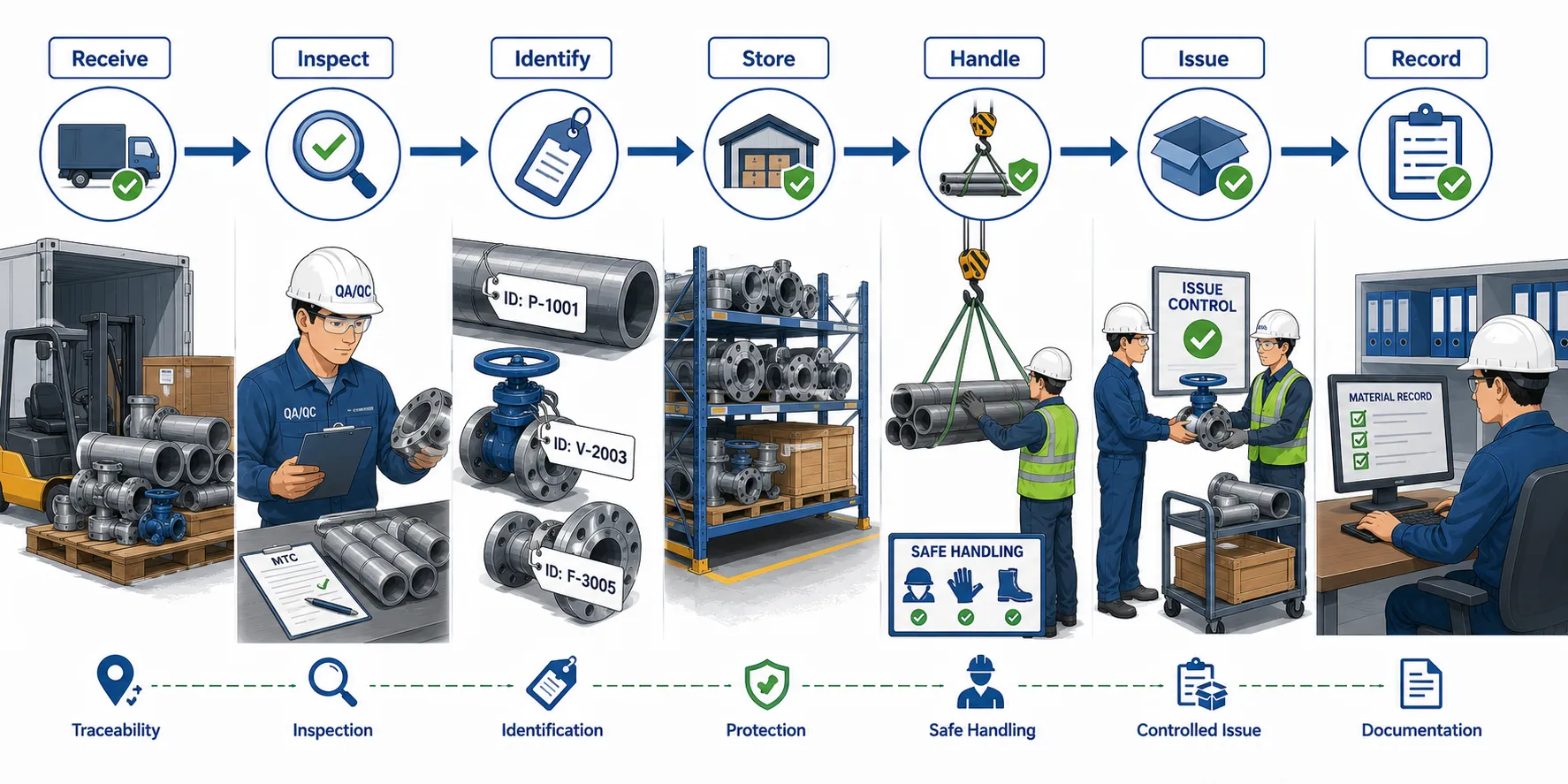
Mechanical material handling is a critical activity within manufacturing, fabrication, construction, maintenance, warehousing, and industrial engineering environments. Materials must be received, unloaded, identified, inspected, transported, stored, protected, issued, and, where necessary, returned or disposed of in a controlled manner. Failures in any of these activities can result in material damage, loss of traceability, safety incidents, contamination, incorrect material installation, production delays, and costly rework.
A Standard Operating Procedure (SOP) provides clear, structured, and repeatable instructions for performing a specific activity. In QA/QC Mechanical Engineering, an effective SOP helps ensure that material handling activities are performed consistently by different personnel, across different shifts and project locations. The purpose is not merely to create documentation but to establish a practical system that personnel can understand and apply.
Global best practices emphasise controlled processes, risk management, personnel competence, traceability, safe working methods, appropriate equipment, inspection, documentation, and continual improvement. A material-handling SOP should reflect these principles while remaining suitable for the organisation’s actual operations.
This section explains how to design clear, step-by-step SOPs for mechanical material handling. Learners will explore the essential structure of an SOP, the complete material-handling process, safety and quality controls, traceability requirements, responsibilities, documentation, practical workplace examples, and methods for reviewing and improving procedures.
Key Definitions and Concepts
| Term | Definition | Importance in Mechanical Material Handling |
|---|---|---|
| Standard Operating Procedure (SOP) | A controlled document describing the approved method for performing a routine activity | Ensures consistency and repeatability |
| Material Handling | The movement, storage, protection, control, and management of materials | Prevents damage, loss, and incorrect use |
| Material Traceability | The ability to identify and track material from receipt through use or installation | Supports quality verification and compliance |
| Material Identification | Marking or labelling material so that its type, grade, batch, heat number, or status can be recognised | Prevents material mix-ups |
| Receiving Inspection | Verification performed when materials arrive at a facility or project site | Confirms quantity, condition, and conformity |
| Quarantine | Controlled segregation of material that is awaiting inspection or has been identified as non-conforming | Prevents unintended use |
| Preservation | Measures used to protect material from deterioration or environmental damage | Maintains material condition |
| Non-Conforming Material | Material that does not meet specified requirements | Requires identification and controlled disposition |
| Competence | The demonstrated ability to perform assigned work using appropriate knowledge and skills | Supports safe and reliable handling |
| Inspection Record | Documented evidence that required verification activities have been completed | Supports traceability and quality assurance |
Understanding the Purpose of an SOP for Material Handling
Why Mechanical Material Handling Requires Formal Procedures
Mechanical materials may include pipes, valves, fittings, flanges, structural steel, plates, fasteners, rotating equipment, pressure components, welding consumables, fabricated assemblies, and other engineering items. These materials may vary significantly in size, weight, value, fragility, and technical requirements.
Without a clear procedure, different personnel may handle the same material in different ways. This inconsistency can create serious quality and safety problems.
Common risks include:
- dropping or damaging materials
- using incorrect lifting equipment
- mixing different material grades
- losing heat or batch identification
- exposing materials to corrosion
- storing materials in unsuitable locations
- issuing unverified materials for installation
- using damaged components
- losing inspection documentation
- allowing non-conforming material to enter production
A clear SOP reduces uncertainty by defining what should be done, who should perform the activity, what controls are required, and what records must be maintained.
Main Objectives of a Material-Handling SOP
An effective SOP should aim to:
- protect personnel from handling-related hazards
- prevent material damage
- maintain identification and traceability
- ensure correct storage conditions
- prevent material mix-ups
- define inspection requirements
- control non-conforming materials
- establish clear responsibilities
- support compliance with project requirements
- maintain accurate records
- promote consistent working practices
Principles of Global Best Practice
Consistency and Standardisation
Global best practices emphasise performing important activities in a controlled and repeatable manner. An SOP should provide a standard method that can be followed by relevant personnel.
Standardisation helps ensure that:
- work does not depend entirely on individual preferences
- critical controls are not missed
- training can be delivered consistently
- inspections are easier to verify
- process performance can be monitored
However, standardisation should not mean unnecessary complexity. The procedure must remain practical.
Risk-Based Thinking
Material-handling activities should be planned according to risk. A small box of standard fasteners does not require the same controls as a large pressure vessel or a heavy fabricated component.
The level of control should consider:
- material weight
- dimensions
- fragility
- material value
- safety consequences
- environmental sensitivity
- technical criticality
- traceability requirements
- storage conditions
Higher-risk materials may require additional controls such as:
- approved lifting plans
- specialist handling equipment
- additional inspections
- restricted storage areas
- enhanced identification
- environmental monitoring
Clear Allocation of Responsibility
A good SOP identifies who is responsible for each stage.
Typical roles may include:
- warehouse personnel
- material controllers
- QA/QC Inspectors
- lifting supervisors
- equipment operators
- storekeepers
- project engineers
- site supervisors
The procedure should avoid unclear statements such as “the team shall ensure”. Instead, responsibilities should be assigned clearly.
The Essential Structure of a Mechanical Material-Handling SOP
SOP Title and Identification
Every controlled SOP should have a clear title and unique identification.
For example:
Mechanical Material Receiving, Handling, Storage and Issue Procedure
The document should also include appropriate control information, such as:
- document number
- revision number
- issue date
- approval status
- document owner
- review date
This helps prevent the use of obsolete procedures.
Purpose
The purpose section explains why the procedure exists.
A suitable purpose statement may be:
To establish a controlled and consistent method for receiving, inspecting, handling, identifying, storing, preserving and issuing mechanical materials in order to maintain safety, quality, traceability and material integrity.
The purpose should be concise and relevant.
Scope
The scope defines where and to what the procedure applies.
It may cover:
- warehouses
- fabrication workshops
- construction sites
- storage yards
- manufacturing facilities
It may also identify the types of materials included.
References and Applicable Requirements
The SOP should identify relevant sources of requirements where appropriate.
These may include:
- project specifications
- approved engineering drawings
- material specifications
- quality plans
- lifting procedures
- safety requirements
- manufacturer instructions
- applicable organisational policies
The SOP should be updated when applicable requirements change.
Step-by-Step Process for Mechanical Material Handling
Step 1: Plan the Material-Handling Activity
Material handling should begin with planning rather than immediate movement.
Before handling, personnel should consider the material and associated risks.
The planning stage should include:
- identifying the material
- checking dimensions and weight
- reviewing handling instructions
- selecting suitable equipment
- assessing the movement route
- identifying hazards
- confirming personnel competence
- checking storage availability
For large or unusual items, additional planning may be required.
Practical Example
A large mechanical pump arrives at a project warehouse.
Before unloading, personnel should:
- confirm the pump identity
- review delivery documentation
- determine its weight
- identify approved lifting points
- select suitable lifting equipment
- inspect lifting accessories
- establish a safe unloading area
- control access to the lifting zone
This planned approach reduces the risk of injury and equipment damage.
Step 2: Receive and Verify Materials
Receiving Controls
When materials arrive, they should not automatically be accepted for use. A controlled receiving process should be followed.
Receiving personnel should verify:
- purchase or delivery documentation
- quantity received
- material description
- visible condition
- identification markings
- certificates where required
- packaging condition
- evidence of transport damage
Initial Receiving Inspection
The inspection should identify obvious problems such as:
- damaged packaging
- corrosion
- dents
- deformation
- missing labels
- incorrect quantities
- incorrect material
- missing documentation
Materials with unresolved concerns should be controlled appropriately.
Key Receiving Procedure
A typical process is:
- receive the delivery
- verify the delivery documents
- confirm material identity
- inspect quantity
- inspect visible condition
- review required documentation
- record the receiving status
- identify accepted, pending, or rejected material
- transfer the material to the appropriate location
This sequence provides a clear foundation for traceability.
Step 3: Maintain Material Identification and Traceability
Importance of Identification
Mechanical materials may appear visually similar while having different properties or specifications. Incorrect identification can lead to serious quality failures.
For example, two pipes may have similar dimensions but different:
- material grades
- pressure ratings
- corrosion resistance
- temperature capabilities
The SOP should clearly define how identification will be maintained.
Traceability Requirements
Depending on project requirements, material traceability may involve:
- material description
- part number
- batch number
- heat number
- manufacturer details
- inspection status
- storage location
- receiving reference
- associated certificates
Good Traceability Practices
Personnel should:
- preserve original identification where possible
- avoid removing required markings
- transfer identification during cutting where required
- use controlled tags or labels
- link materials to relevant documentation
- maintain accurate issue records
Material Identification Rules
An SOP may require that materials must not be issued when:
- identification is missing
- material status is unclear
- traceability cannot be confirmed
- required inspection is incomplete
This prevents accidental use of unsuitable materials.
Step 4: Select Suitable Handling Equipment
Equipment Selection
Handling equipment must be suitable for the material and activity.
Examples include:
- forklifts
- cranes
- overhead lifting equipment
- chain blocks
- lifting beams
- slings
- shackles
- pallet trucks
- trolleys
Selection should consider:
- load weight
- load dimensions
- centre of gravity
- lifting points
- movement distance
- environmental conditions
- available space
Equipment Inspection
Before use, relevant equipment should be checked for suitability and condition.
Personnel should verify:
- equipment identification
- inspection status
- safe working limits
- visible condition
- compatibility with the load
Damaged or unsuitable equipment should not be used.
Example
A long section of mechanical pipe may bend or become unstable if lifted incorrectly.
The handling plan may require:
- multiple support points
- suitable lifting accessories
- controlled movement
- adequate exclusion areas
The SOP should explain when additional lifting controls are required.
Step 5: Perform Safe Loading and Unloading
Preparing the Work Area
The unloading area should be suitable for the planned activity.
Checks may include:
- stable ground conditions
- sufficient working space
- controlled vehicle access
- adequate lighting
- clear travel routes
- exclusion zones
Safe Loading Practices
Personnel should:
- follow approved lifting arrangements
- avoid standing under suspended loads
- maintain clear communication
- control unauthorised access
- avoid sudden movements
- place loads on stable supports
Quality Considerations
Safe handling also protects quality.
Materials should not be:
- dragged unnecessarily
- dropped
- struck against hard surfaces
- stacked unsafely
- exposed to damaging conditions
Step 6: Inspect Material After Handling
Why Post-Handling Inspection Is Important
Materials may be damaged during transportation or movement.
Inspection after handling may identify:
- dents
- scratches
- distortion
- coating damage
- broken packaging
- damaged threads
- missing identification
The level of inspection should reflect the criticality of the material.
Inspection Process
The SOP may require:
- visual examination
- verification of identification
- confirmation of physical condition
- comparison with acceptance criteria
- recording of findings
- appropriate action if damage is identified
Where damage affects material integrity, the item should be controlled pending technical review.
Step 7: Store Materials Correctly
Storage as a Quality Control Activity
Storage is not simply placing material in an available space. Improper storage can cause deterioration or loss of identification.
Storage conditions should consider:
- moisture
- temperature
- contamination
- corrosion
- sunlight
- vibration
- physical damage
Storage Controls
Good practice may include:
- designated storage areas
- clear material identification
- separation of different material types
- protected storage for sensitive items
- controlled stacking
- regular storage inspections
- appropriate preservation methods
Examples of Storage Risks
Improper storage may result in:
- corrosion of metallic components
- deformation of pipes
- contamination of valves
- deterioration of seals
- mixing of material grades
- damage to machined surfaces
The SOP should provide clear instructions for preventing these risks.
Step 8: Preserve Material Condition
Understanding Preservation
Preservation refers to actions taken to maintain the condition and usability of materials.
The level of preservation depends on:
- material type
- storage duration
- environmental conditions
- manufacturer requirements
- project requirements
Preservation Measures
Examples include:
- protective coatings
- end caps
- moisture protection
- protective wrapping
- covered storage
- controlled humidity
- periodic condition checks
Practical Example
Machined mechanical components may require protective coverings to prevent:
- corrosion
- contamination
- surface damage
The SOP should clearly state who is responsible for monitoring preservation conditions.
Step 9: Control Material Issue
Issuing the Correct Material
Material issue is a critical stage because an incorrect component may enter fabrication or installation.
Before issue, personnel should verify:
- material identification
- required specification
- inspection status
- quantity
- destination
- traceability requirements
Material Issue Process
A controlled process may include:
- receive the approved material request
- identify the required item
- verify material status
- confirm identification
- check quantity
- record the issue
- transfer material safely
- maintain traceability
Preventing Material Mix-Ups
The SOP should include controls such as:
- clearly labelled storage locations
- controlled issue documentation
- verification against material requests
- separation of similar materials
- restricted access to critical materials
Step 10: Handle Non-Conforming or Damaged Material
Identification and Segregation
Material that does not meet requirements must be prevented from unintended use.
Examples include:
- damaged material
- unidentified material
- expired materials where applicable
- incorrect materials
- materials with missing documentation
The SOP should require:
- clear identification
- segregation where appropriate
- formal recording
- technical assessment
- authorised disposition
Possible Dispositions
Depending on the nature of the issue, an authorised decision may involve:
- acceptance after technical review
- repair
- rework
- return to supplier
- rejection
- controlled alternative use where authorised
Personnel should not independently alter or release non-conforming materials without appropriate authority.
Step 11: Maintain Records
Importance of Material-Handling Records
Records provide objective evidence that activities have been performed as required.
Relevant records may include:
- delivery notes
- receiving inspection reports
- material certificates
- material registers
- traceability records
- storage inspection reports
- material issue records
- non-conformance reports
Record-Control Principles
Records should be:
- legible
- accurate
- identifiable
- retrievable
- protected from unauthorised changes
- retained according to applicable requirements
Digital systems may also be used where appropriate.
Developing a Clear and Effective SOP
Use Simple and Direct Language
An SOP should be written so that relevant personnel can understand and follow it.
Effective instructions should:
- use clear action verbs
- follow a logical sequence
- avoid unnecessary jargon
- define technical terms
- identify responsibilities
- include acceptance criteria where necessary
Instead of writing:
Appropriate measures should be taken to ensure suitable material handling.
A clearer instruction is:
Verify the material weight and select handling equipment with adequate capacity before moving the material.
Use Numbered Steps
Step-by-step instructions are easier to follow when numbered.
For example:
- Verify material identification.
- Confirm material weight.
- Inspect the selected handling equipment.
- Establish the safe movement route.
- Move the material using the approved method.
- Inspect the material after placement.
- Update the material location record.
This structure improves usability.
Responsibilities Within the SOP
Management Responsibilities
Management should ensure that:
- appropriate resources are available
- suitable procedures are approved
- competent personnel are assigned
- necessary equipment is provided
- performance is reviewed
Warehouse Personnel Responsibilities
Warehouse personnel may be responsible for:
- receiving materials
- checking quantities
- maintaining storage areas
- preserving identification
- controlling material issue
- updating records
QA/QC Responsibilities
QA/QC personnel may:
- verify inspection requirements
- review material documentation
- monitor traceability
- inspect critical materials
- manage non-conforming material
- support audits
Supervisory Responsibilities
Supervisors should ensure that:
- personnel follow the SOP
- work is properly planned
- equipment is suitable
- unsafe conditions are controlled
- deviations are reported
Training and Competence Requirements
Training Personnel on the SOP
Developing an SOP is not enough. Personnel must understand how to apply it.
Training may include:
- induction training
- procedure awareness
- practical demonstrations
- supervised practice
- competence assessment
- refresher training
Competence Verification
The organisation should verify that personnel can perform their assigned tasks safely and correctly.
Competence may be demonstrated through:
- training records
- qualifications
- experience
- practical observation
- formal assessment
- authorisation
Practical Workplace Example
Scenario: Receiving Mechanical Piping Materials
A fabrication facility receives several bundles of pipes, fittings, and flanges for an industrial project.
The material-handling SOP requires the following:
Before Unloading
- review the delivery documentation
- confirm expected quantities
- check the unloading area
- verify lifting equipment suitability
- establish an exclusion zone
During Unloading
- use suitable lifting accessories
- follow approved lifting methods
- avoid impact damage
- maintain communication between personnel
- place materials on suitable supports
After Unloading
- inspect visible condition
- verify material identification
- record receiving details
- check required certificates
- assign storage locations
Before Issue to Fabrication
- confirm material specification
- verify traceability
- confirm inspection status
- record the material issue
This example demonstrates how a high-level policy can be translated into a practical SOP.
Reviewing and Improving the SOP
Why SOPs Must Be Reviewed
Procedures may become outdated because of:
- changes in equipment
- new material types
- changes in project requirements
- incidents
- audit findings
- recurring non-conformities
- process improvements
An outdated procedure can create new risks.
Review Process
A structured review may involve:
- collecting performance information
- reviewing incidents and non-conformities
- considering audit findings
- consulting relevant personnel
- identifying improvement opportunities
- updating the SOP
- obtaining approval
- communicating changes
- withdrawing obsolete versions
Continual Improvement
Improvement should be based on evidence.
Useful sources include:
- inspection results
- incident reports
- material damage records
- audit findings
- employee feedback
- customer feedback
- non-conformance trends
Key Benefits of Clear Material-Handling SOPs
Effective SOPs provide benefits for both quality and operational performance.
These benefits include:
- improved personnel safety
- reduced material damage
- better traceability
- reduced material mix-ups
- improved storage control
- greater consistency between shifts
- clearer responsibilities
- improved audit readiness
- reduced rework
- stronger project compliance
- improved accountability
- better customer confidence
Common Mistakes When Writing Material-Handling SOPs
Making the Procedure Too Complex
An excessively detailed SOP may be difficult to use during active work.
Avoid:
- unnecessary repetition
- unrelated technical information
- complicated language
- unclear instructions
The SOP should contain sufficient detail to control the activity without becoming impractical.
Using Vague Instructions
Statements such as “Handle carefully” are open to interpretation.
A stronger instruction identifies the required action.
For example:
- inspect lifting equipment before use
- use approved lifting points
- maintain identification during movement
- store materials on suitable supports
Ignoring Quality During Safety Planning
Material handling is both a safety and quality activity.
A process may be physically safe but still cause quality problems if it:
- damages protective coatings
- removes identification
- contaminates components
- distorts materials
The SOP should address both dimensions.
Failing to Define Actions for Abnormal Conditions
A good SOP should explain what personnel must do when something goes wrong.
Examples include:
- material damage
- missing identification
- missing certificates
- unsuitable storage conditions
- equipment defects
Personnel should know when to:
- stop work
- isolate the material
- report the issue
- record the non-conformance
- seek technical guidance
Key Learning Points
Effective mechanical material-handling SOPs should:
- define a clear purpose and scope
- assign specific responsibilities
- use simple and direct language
- provide numbered step-by-step instructions
- incorporate safety and quality controls
- maintain material identification
- preserve traceability
- require suitable handling equipment
- control receiving and inspection
- define correct storage conditions
- protect materials from deterioration
- control material issue
- manage non-conforming materials
- maintain appropriate records
- require competent personnel
- support periodic review and continual improvement
Summary
Writing clear, step-by-step Standard Operating Procedures for mechanical material handling is an essential part of an effective QA/QC management system. A well-designed SOP provides a consistent method for receiving, inspecting, moving, identifying, storing, preserving, issuing, and controlling mechanical materials.
The procedure should reflect recognised international quality management principles, including process control, risk-based thinking, competence, traceability, documented information, and continual improvement. It should also remain practical and relevant to the organisation’s actual workplace conditions.
A strong SOP clearly defines responsibilities, identifies risks, establishes control points, and explains what personnel must do during both normal and abnormal situations. By following a structured material-handling process, organisations can reduce safety incidents, prevent material damage, maintain traceability, avoid incorrect material use, and improve overall project quality.
For QA/QC mechanical engineering professionals, the ability to develop and implement effective SOPs is essential for transforming high-level quality policies into consistent workplace practices.
3. Formulating Complete Project Quality Plans (PQPs) That Balance Client Specifications and International Engineering Benchmarks
Introduction
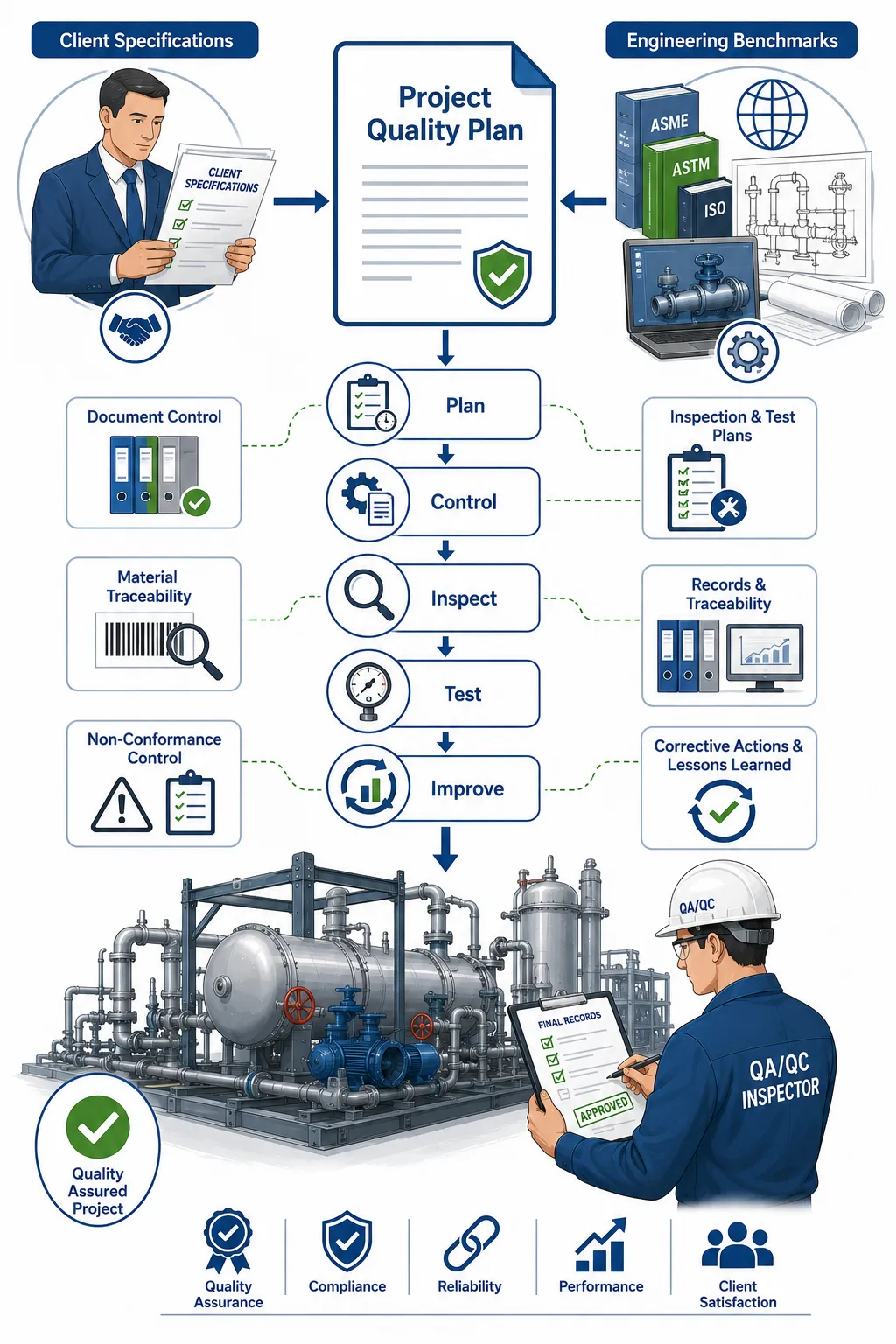
A Project Quality Plan (PQP) is one of the most important quality management documents used in mechanical engineering projects. It provides a structured framework explaining how the project team will plan, control, inspect, test, verify, document, and continually improve activities to ensure that the completed work meets agreed requirements.
A complete PQP must balance two major sources of requirements. The first is the client’s specifications, contractual requirements, drawings, technical documents, inspection requirements, and project expectations. The second is the relevant international engineering benchmarks, including recognised quality management principles, engineering codes, technical standards, and accepted industry practices.
These requirements may come from different documents and may vary in their level of detail. Therefore, the QA/QC professional must carefully analyse, compare, organise, and translate them into practical project controls. The purpose is not to select one requirement over another without review. Instead, the project team must identify all applicable requirements and establish a clear method for achieving conformity.
In mechanical engineering, a PQP may cover design review, procurement, material control, fabrication, welding, heat treatment, inspection, testing, calibration, documentation, non-conformance management, corrective action, auditing, and final handover.
A well-developed PQP creates a connection between contractual expectations and practical site or workshop activities. It defines responsibilities, quality objectives, inspection stages, acceptance criteria, records, and reporting arrangements.
The PQP should be a living project document. It must be reviewed and updated when approved changes occur, while ensuring that all revisions are properly controlled.
Key Definitions and Concepts
| Term | Definition | Importance in a PQP |
|---|---|---|
| Project Quality Plan (PQP) | A project-specific document describing how quality requirements will be planned, controlled, verified, and documented | Provides the overall quality framework for the project |
| Client Specification | A documented requirement issued or agreed by the client relating to technical, quality, performance, or contractual expectations | Defines project-specific expectations |
| International Engineering Benchmark | A recognised engineering code, standard, guideline, or accepted industry practice used to establish technical expectations | Supports consistent and recognised engineering quality |
| Quality Objective | A measurable result the project intends to achieve in relation to quality | Converts quality commitments into measurable targets |
| Inspection and Test Plan (ITP) | A document identifying inspection and testing activities, responsibilities, acceptance criteria, and control points | Supports verification of work |
| Acceptance Criteria | Defined conditions that must be met for work, material, or a product to be accepted | Provides an objective basis for decisions |
| Hold Point | A mandatory control point at which work cannot proceed until required approval or release is obtained | Prevents uncontrolled continuation of critical work |
| Witness Point | A point at which a designated party may observe an activity or inspection | Provides additional verification opportunity |
| Non-Conformance | Failure to meet a specified requirement | Requires formal control and resolution |
| Traceability | The ability to identify and track the history, application, or location of an item | Supports verification and accountability |
Understanding the Purpose of a Project Quality Plan
Why a PQP Is Necessary
Mechanical engineering projects involve many interconnected activities and multiple parties. These may include clients, consultants, contractors, engineers, suppliers, manufacturers, inspectors, testing organisations, and regulatory authorities.
Without a structured quality plan, project requirements can become fragmented. Different departments may follow different interpretations of specifications, and important inspection or documentation requirements may be missed.
A PQP establishes a common quality framework for the project.
Its primary purposes include:
- defining how project quality requirements will be achieved
- identifying applicable specifications and standards
- assigning QA/QC responsibilities
- establishing inspection and testing arrangements
- defining document-control requirements
- maintaining material and product traceability
- controlling non-conforming work
- supporting corrective action
- providing evidence of conformity
- establishing arrangements for quality monitoring and improvement
The PQP as a Project-Specific Control Document
A corporate QA/QC policy applies across the organisation, while a PQP focuses on the specific requirements of an individual project.
For example, an organisation may have one corporate policy requiring controlled inspection and testing. However, different projects may require different:
- material specifications
- engineering codes
- client approval stages
- testing methods
- documentation formats
- hold points
- reporting arrangements
The PQP translates general corporate quality commitments into project-specific actions.
Balancing Client Specifications and International Engineering Benchmarks
Understanding the Two Sources of Requirements
The development of a PQP requires careful analysis of both client requirements and recognised engineering benchmarks.
Client requirements may include:
- contract documents
- project specifications
- approved drawings
- data sheets
- scope of work
- inspection requirements
- reporting requirements
- project procedures
International engineering benchmarks may include:
- recognised quality management principles
- applicable mechanical engineering codes
- material standards
- welding standards
- testing standards
- manufacturing standards
- inspection requirements
The project team should identify which requirements apply to each activity.
Avoiding Assumptions
A common QA/QC mistake is assuming that one document automatically covers all requirements.
For example:
- a client specification may impose additional inspection requirements
- an engineering standard may define technical acceptance criteria
- a drawing may define specific dimensions
- a purchase order may define certification requirements
The PQP should establish a method for identifying and managing these requirements together.
Developing a Requirements Hierarchy
Projects should establish a clear method for dealing with multiple sources of requirements.
The process may include:
- reviewing contractual documents
- identifying technical specifications
- identifying applicable engineering standards
- reviewing statutory and regulatory requirements
- identifying client-specific procedures
- recording potential conflicts
- seeking clarification where necessary
- documenting the agreed interpretation
The project team should not independently ignore or change contractual requirements.
Establishing the Scope of the PQP
Defining Project Boundaries
The PQP should clearly state the activities, locations, products, and services covered.
The scope may include:
- engineering activities
- procurement
- material receiving
- fabrication
- welding
- machining
- assembly
- installation
- inspection
- testing
- preservation
- final handover
Identifying Exclusions
Where certain activities are outside the project scope, this should also be clear.
For example, a project may involve mechanical fabrication but not detailed design. The PQP should avoid creating unnecessary controls for activities that are not performed.
A clear scope helps:
- prevent confusion
- define responsibilities
- avoid duplication
- support effective auditing
Establishing Project Quality Objectives
Converting Requirements into Measurable Goals
The PQP should contain appropriate project quality objectives.
Quality objectives provide measurable targets that support the project’s overall quality commitments.
Examples may include:
- completion of planned inspections before release
- timely closure of significant non-conformities
- reduction of repeat quality failures
- completion of required material documentation
- achievement of defined inspection compliance rates
Objectives should be relevant to the project and monitored at planned intervals.
Characteristics of Effective Quality Objectives
Effective objectives should be:
- relevant
- clear
- measurable where practical
- achievable
- monitored
- assigned to responsible personnel
- linked to project requirements
A vague objective such as “maintain high quality” is difficult to measure.
A stronger approach is to identify a specific quality performance indicator and monitor it throughout the project.
Defining Project Organisation and Responsibilities
Why Responsibilities Must Be Clear
Quality failures often occur because responsibilities are unclear rather than because procedures do not exist.
The PQP should identify key roles and their responsibilities.
Typical project roles may include:
- project manager
- project engineer
- QA/QC manager
- QA/QC inspector
- construction or fabrication manager
- procurement representative
- warehouse controller
- welding coordinator
- document controller
- site supervisor
Example Responsibilities
The Project Manager may be responsible for:
- ensuring adequate resources
- supporting implementation of the PQP
- reviewing project quality performance
The QA/QC Manager may be responsible for:
- implementing quality controls
- managing inspections
- monitoring non-conformities
- coordinating audits
The QA/QC Inspector may be responsible for:
- performing assigned inspections
- reviewing records
- reporting findings
- verifying conformity
The PQP should clearly distinguish responsibilities from authorities.
Developing a Requirements Register
Purpose of a Requirements Register
A requirements register helps the project team identify and track applicable requirements.
The register may contain:
- document title
- document reference
- revision number
- applicable activity
- key requirement
- responsible person
- verification method
Practical Benefits
A requirements register can:
- reduce missed requirements
- improve traceability
- support audits
- simplify project planning
- identify conflicting requirements
Example
A mechanical piping project may identify requirements relating to:
- material specifications
- fabrication tolerances
- welding controls
- inspection requirements
- pressure testing
- documentation
Each requirement can then be linked to an appropriate project control.
Planning the Project Quality Management System
Linking the PQP to Project Processes
A PQP should not operate as an isolated document. It should connect with the project’s actual processes.
The project quality system may include:
- document control
- procurement control
- material management
- inspection
- testing
- equipment calibration
- competence management
- non-conformance control
- corrective action
- auditing
- reporting
Each process should have clear inputs, activities, controls, outputs, and records.
Process-Based Planning
A process-based approach asks:
- What is the purpose of the process?
- What requirements apply?
- Who performs the activity?
- What resources are required?
- What risks exist?
- How is the output verified?
- What records are required?
This creates a logical structure for the PQP.
Material Quality Management Within the PQP
Controlling Mechanical Materials
Material quality is fundamental to mechanical engineering projects.
The PQP should define controls for:
- supplier selection
- purchase specifications
- receiving inspection
- material certification
- material identification
- traceability
- storage
- preservation
- material issue
Material Verification
Mechanical materials may require verification against:
- approved purchase requirements
- material specifications
- certificates
- markings
- dimensions
- inspection requirements
Practical Example
A project receives alloy steel piping material.
The PQP may require:
- verification of delivery documentation
- review of material certification
- confirmation of material identification
- visual condition inspection
- recording of storage location
- maintenance of traceability
The material should not be released for fabrication until applicable verification activities are completed.
Inspection and Test Planning
The Role of the Inspection and Test Plan
The ITP is often a key supporting document to the PQP.
It identifies:
- activities to be inspected
- inspection stages
- responsible personnel
- acceptance criteria
- applicable references
- required records
- hold points
- witness points
Developing the ITP
The development process may include:
- identify the project activity
- identify applicable requirements
- determine inspection stages
- establish acceptance criteria
- assign responsibilities
- identify records
- determine hold and witness points
- obtain required approval
Typical Mechanical Inspection Activities
An ITP may cover:
- material receiving
- fit-up inspection
- dimensional inspection
- welding inspection
- non-destructive testing
- heat treatment verification
- pressure testing
- final inspection
Establishing Acceptance Criteria
Importance of Clear Acceptance Criteria
Inspection cannot be performed effectively if the inspector does not know what constitutes acceptable work.
Acceptance criteria should be based on approved requirements.
These may include:
- client specifications
- approved drawings
- engineering standards
- approved procedures
- manufacturer instructions
Avoiding Subjective Decisions
A PQP should promote objective verification.
Instead of stating:
“Ensure that the work is satisfactory.”
A stronger requirement would be:
“Verify the completed work against the applicable drawing, approved procedure, and specified acceptance criteria.”
This reduces personal interpretation.
Managing Hold Points and Witness Points
Hold Points
A hold point is a critical control stage where work must not continue until the required inspection or approval has taken place.
Examples may include:
- approval before pressure testing
- inspection before covering critical work
- approval before applying protective coatings
Witness Points
A witness point provides an opportunity for a designated party to observe an activity.
The work may proceed according to agreed arrangements if the witnessing party does not attend within the applicable notification process.
Benefits of Defined Control Points
Clearly defined control points help:
- prevent missed inspections
- improve client confidence
- control critical activities
- maintain accountability
- support traceability
Risk-Based Quality Planning
Identifying Quality Risks
A PQP should consider risks that may affect project quality.
Typical mechanical engineering risks include:
- incorrect materials
- incomplete documentation
- unqualified personnel
- welding defects
- inadequate inspection
- equipment calibration failure
- supplier delays
- uncontrolled design changes
Applying Appropriate Controls
Higher-risk activities may require increased control.
Controls may include:
- additional inspections
- independent verification
- specialist personnel
- increased testing
- management review
- additional documentation
The purpose is not to create unnecessary paperwork but to apply suitable controls based on risk.
Managing Project Changes
Why Change Control Is Essential
Mechanical projects may experience changes to:
- drawings
- specifications
- materials
- processes
- suppliers
- inspection requirements
Uncontrolled changes can result in serious quality problems.
Change-Control Process
The PQP should establish a structured process.
This may include:
- identify the proposed change
- record the change
- review technical and quality impacts
- identify affected documents
- obtain required approval
- communicate the approved change
- update relevant records
- verify implementation
Example
A project proposes an alternative mechanical component because the original component is unavailable.
The replacement should not automatically be accepted.
The project team should review:
- technical suitability
- applicable specifications
- compatibility
- client approval requirements
- documentation requirements
Control of Non-Conformities
Identifying Non-Conforming Work
The PQP should establish a formal process for managing work or materials that do not meet requirements.
Examples include:
- failed inspections
- incorrect dimensions
- damaged materials
- incomplete traceability
- unacceptable weld results
- failed pressure tests
Typical Non-Conformance Process
The process may involve:
- identify the non-conformance
- control the affected item
- record the issue
- assess the impact
- determine the cause where necessary
- propose corrective action
- obtain appropriate disposition
- implement the action
- verify the result
- close the record
Importance of Root Cause Analysis
Corrective action should address the underlying cause rather than only the visible problem.
For example:
Replacing a defective component corrects the immediate problem.
Investigating why the incorrect component was selected may identify a weakness in:
- purchasing controls
- material identification
- document management
Corrective Action and Continual Improvement
Using Project Information for Improvement
A complete PQP should support learning throughout the project.
Useful information may come from:
- inspection results
- audit findings
- non-conformance trends
- client feedback
- supplier performance
- project meetings
- lessons learned
Improvement Actions
Improvement may involve:
- revising procedures
- improving training
- strengthening inspection controls
- improving supplier evaluation
- updating checklists
- improving communication
Key Benefits
Continual improvement can:
- reduce recurring problems
- improve efficiency
- reduce rework
- strengthen quality performance
- improve future project planning
Document and Record Control
Controlling Project Documentation
Mechanical projects generate large quantities of technical and quality information.
The PQP should establish controls for:
- drawings
- specifications
- procedures
- inspection reports
- test reports
- certificates
- non-conformance records
- audit reports
- final dossiers
Important Document-Control Principles
Documents should be:
- clearly identified
- reviewed and approved
- available at the point of use
- protected from unintended changes
- updated when required
- withdrawn or controlled when obsolete
Quality Records
Quality records provide evidence that activities were completed.
Examples include:
- inspection reports
- test certificates
- material certificates
- calibration certificates
- qualification records
- approval records
Competence and Resource Planning
Personnel Competence
The PQP should identify competence requirements for critical project roles.
Competence may be demonstrated through:
- education
- training
- experience
- qualifications
- certification
- authorisation
Resources
The project should also identify necessary resources.
These may include:
- inspection personnel
- testing equipment
- calibrated measuring instruments
- suitable facilities
- approved procedures
- information systems
Practical Consideration
A quality plan may be technically excellent but ineffective if the project lacks sufficient qualified inspectors or suitable measuring equipment.
Resource planning is therefore essential.
Monitoring and Measuring Project Quality Performance
Quality Performance Indicators
The PQP should identify suitable methods for monitoring performance.
Examples may include:
- inspection completion rates
- number of non-conformities
- repeat non-conformities
- corrective action closure status
- material rejection rates
- rework levels
- audit findings
- client complaints
Using Data Effectively
Performance data should not simply be collected. It should be reviewed and used for decision-making.
Project management may analyse:
- trends
- recurring issues
- high-risk areas
- process weaknesses
Appropriate actions can then be planned.
Auditing the Project Quality System
Purpose of Project Audits
Audits help determine whether planned controls are being implemented effectively.
Audits may review:
- compliance with the PQP
- implementation of procedures
- completeness of records
- effectiveness of corrective actions
- control of critical processes
Audit Process
A typical audit process includes:
- prepare the audit plan
- review relevant requirements
- conduct the audit
- record findings
- communicate results
- assign corrective actions
- verify completion
- review effectiveness
Communication and Client Interface
Maintaining Clear Communication
Quality requirements must be communicated effectively across the project.
Communication may involve:
- kick-off meetings
- quality meetings
- inspection notifications
- technical queries
- progress reports
- non-conformance reports
Client Confidence
A well-managed PQP provides confidence that the project team understands and controls quality requirements.
Effective communication helps:
- clarify expectations
- resolve technical issues
- manage changes
- avoid misunderstandings
- improve project relationships
Step-by-Step Process for Developing a Complete PQP
Step 1: Review the Contract and Scope
Identify:
- project deliverables
- client specifications
- technical requirements
- contractual quality obligations
Step 2: Identify Applicable Standards and Benchmarks
Determine:
- applicable engineering standards
- recognised technical codes
- statutory requirements
- project procedures
Step 3: Create a Requirements Matrix
Record:
- requirement
- source
- applicable activity
- responsible person
- verification method
Step 4: Define Project Quality Objectives
Establish measurable project quality goals.
Step 5: Define Organisation and Responsibilities
Identify:
- roles
- authorities
- reporting relationships
- quality responsibilities
Step 6: Identify Project Processes
Define controls for:
- procurement
- material management
- fabrication
- inspection
- testing
- documentation
Step 7: Develop Supporting Quality Documents
Prepare or identify:
- SOPs
- ITPs
- checklists
- inspection procedures
- reporting formats
Step 8: Establish Non-Conformance Controls
Define:
- identification
- recording
- segregation
- investigation
- disposition
- corrective action
Step 9: Define Performance Monitoring
Establish:
- quality indicators
- audit arrangements
- reporting methods
- review meetings
Step 10: Obtain Approval and Communicate
The PQP should be:
- reviewed
- approved
- issued
- communicated
- implemented
Step 11: Monitor and Update
The project team should review the PQP throughout the project and update it when approved changes occur.
Practical Workplace Example
Scenario: Mechanical Fabrication Project
A contractor is awarded a project to fabricate and install mechanical equipment and piping for an industrial facility.
The client provides:
- technical specifications
- approved drawings
- inspection requirements
- documentation requirements
The project team also identifies applicable international engineering benchmarks relevant to:
- materials
- fabrication
- welding
- inspection
- testing
PQP Development
The QA/QC team develops a PQP containing:
Project Scope
The PQP covers:
- material procurement
- receiving inspection
- fabrication
- welding
- inspection
- testing
- final documentation
Responsibilities
Responsibilities are assigned to:
- Project Manager
- QA/QC Manager
- Welding Coordinator
- QA/QC Inspectors
- Supervisors
- Document Controller
Inspection Controls
ITPs are developed for:
- material receiving
- fit-up
- welding
- non-destructive testing
- pressure testing
- final inspection
Non-Conformance Control
Any work failing specified requirements is:
- identified
- recorded
- controlled
- technically assessed
- corrected or otherwise dispositioned through authorised processes
Final Handover
The final quality dossier contains:
- material records
- inspection reports
- test reports
- certificates
- approved non-conformance records
This example demonstrates how the PQP integrates different quality requirements into one controlled project system.
Common Challenges When Developing PQPs
Over-Reliance on Generic Templates
A generic template can provide a starting structure, but copying it without project-specific review may create gaps.
A PQP should reflect:
- actual project scope
- client requirements
- applicable standards
- project risks
Excessive Documentation
More documentation does not always mean better quality.
The PQP should focus on meaningful controls rather than unnecessary paperwork.
Unclear Responsibilities
When responsibilities overlap without clear authority, inspections and approvals may be delayed or missed.
Failure to Manage Changes
A PQP that is not reviewed during project changes may become outdated.
Weak Communication
Even a well-written PQP is ineffective if personnel do not understand their responsibilities.
Key Benefits of a Complete Project Quality Plan
A well-developed PQP can provide:
- clear alignment with client requirements
- structured application of engineering benchmarks
- improved project consistency
- clearer responsibilities
- stronger inspection planning
- better material traceability
- reduced quality risks
- improved control of non-conforming work
- better documentation
- enhanced client confidence
- improved audit readiness
- support for continual improvement
Key Learning Points
When formulating a Project Quality Plan, Learners should remember to:
- begin with a detailed review of project requirements
- identify applicable engineering benchmarks
- establish a clear requirements hierarchy
- define project-specific quality objectives
- assign responsibilities and authorities
- apply risk-based quality planning
- develop appropriate inspection and test controls
- define objective acceptance criteria
- maintain document and record control
- manage changes formally
- control non-conforming work
- monitor project quality performance
- conduct audits and reviews
- use lessons learned for continual improvement
Summary
Formulating a complete Project Quality Plan requires a structured and project-specific approach to quality management. The PQP must balance client specifications with applicable international engineering benchmarks and translate these requirements into practical controls.
A successful PQP identifies what must be achieved, who is responsible, how work will be controlled, when inspections and tests will take place, what acceptance criteria apply, and what evidence must be retained.
For QA/QC mechanical engineering professionals, the ability to develop a comprehensive PQP is essential for connecting contractual quality expectations with day-to-day engineering activities. A strong PQP supports material control, fabrication quality, inspection, testing, traceability, non-conformance management, performance monitoring, and continual improvement.
By developing clear, practical, and controlled Project Quality Plans, organisations can improve consistency, reduce rework, strengthen compliance, manage project risks, and provide reliable evidence that mechanical engineering work has been completed in accordance with agreed requirements.
4.Reviewing and Updating Existing Company Quality Manuals to Ensure They Remain Effective When Project Working Conditions Change
Introduction
A company quality manual provides a high-level description of how an organisation manages quality, controls its processes, assigns responsibilities, and maintains continual improvement. In mechanical engineering and QA/QC environments, the quality manual acts as an important reference document linking corporate quality policies with operational procedures, project quality plans, inspection activities, testing requirements, and documented evidence.
However, a quality manual cannot remain effective if it is treated as a permanent document that never changes. Mechanical projects operate in changing environments. New technologies may be introduced, project locations may change, client requirements may become more demanding, materials may differ, production methods may be modified, and new risks may emerge. Changes in working conditions can affect whether existing quality controls remain suitable.
For this reason, organisations must establish a systematic process for reviewing and updating their quality manuals. The objective is to ensure that documented quality arrangements continue to reflect actual operational conditions and remain capable of achieving intended quality outcomes.
A review should not result in unnecessary changes merely to create a new document revision. Every update should be justified, controlled, approved, communicated, and implemented effectively. QA/QC professionals must determine what has changed, assess the effect of that change on existing quality controls, identify gaps, and introduce suitable improvements.
This section explains how organisations can review and update quality manuals when project working conditions change. It covers key definitions, change triggers, review methods, risk assessment, document control, stakeholder involvement, implementation, verification, practical examples, and continual improvement.
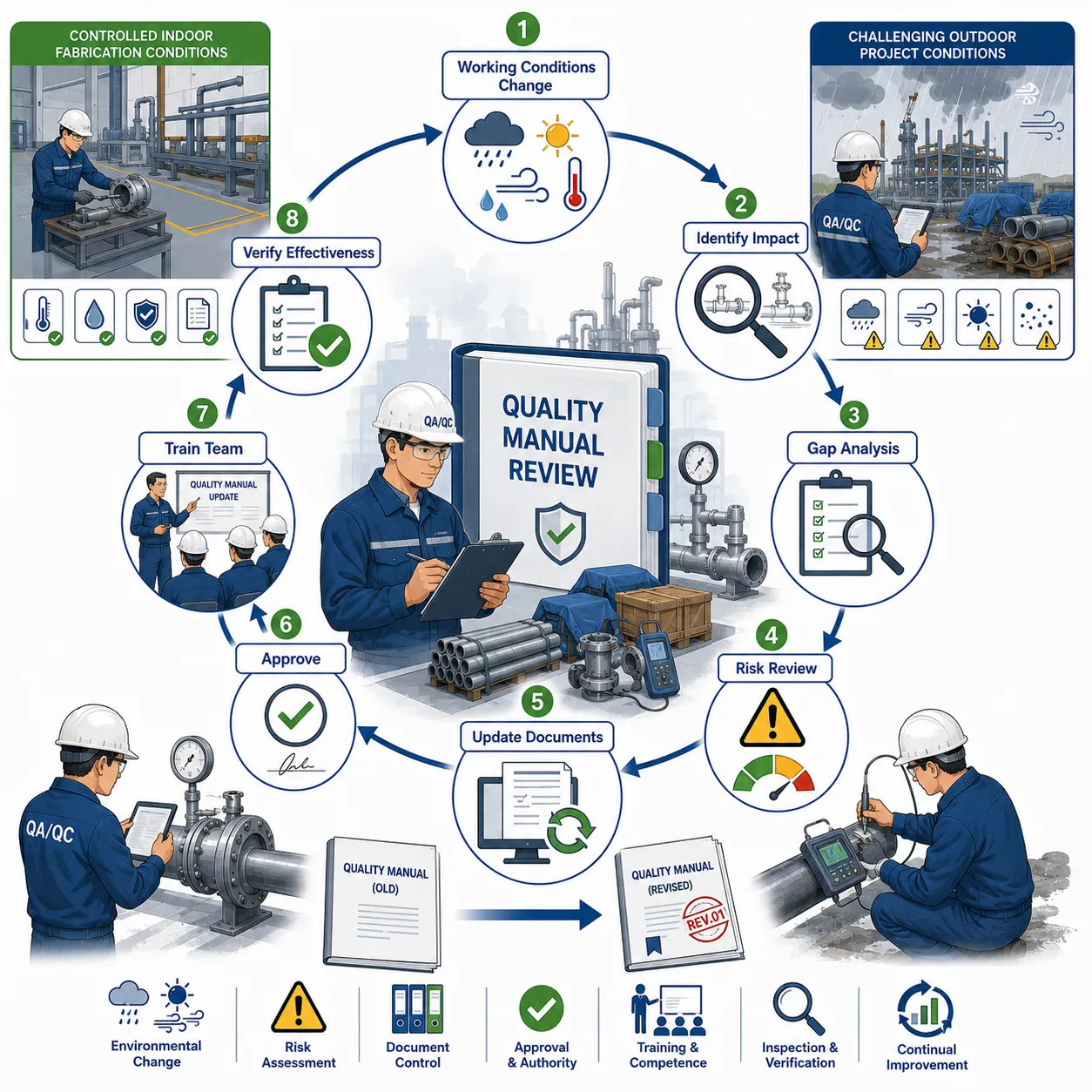
Key Definitions and Concepts
| Term | Definition | Importance in Quality Manual Review |
|---|---|---|
| Quality Manual | A high-level document describing the organisation’s quality management framework and key quality processes | Provides overall direction for the quality management system |
| Change Management | A structured process for evaluating, approving, implementing, and monitoring changes | Prevents uncontrolled modifications |
| Working Conditions | The operational, environmental, technical, organisational, and project circumstances under which work is performed | May affect the suitability of existing quality controls |
| Document Review | A systematic examination of documented information to determine its continuing suitability and effectiveness | Identifies outdated or inadequate requirements |
| Revision | An approved modification to a controlled document | Ensures the latest information is formally issued |
| Risk Assessment | A process used to identify and evaluate factors that may affect quality or operational performance | Helps determine the level of control required |
| Document Control | The system used to approve, issue, revise, distribute, and protect documented information | Prevents the use of obsolete information |
| Gap Analysis | A comparison between current arrangements and required or desired arrangements | Identifies areas requiring improvement |
| Corrective Action | Action taken to address the cause of an identified non-conformity | Prevents recurrence of problems |
| Continual Improvement | Ongoing enhancement of processes and systems based on evidence and performance information | Ensures the quality system remains effective |
Understanding the Purpose of a Quality Manual
The Role of the Quality Manual
A quality manual provides an organised description of the organisation’s overall approach to quality. Depending on the organisation’s structure, it may explain:
- the scope of the quality management system
- corporate quality commitments
- organisational responsibilities
- major business processes
- document-control arrangements
- quality planning principles
- operational control arrangements
- inspection and verification activities
- non-conformance management
- corrective action processes
- internal audit arrangements
- management review activities
- continual improvement processes
The quality manual should provide direction without becoming overloaded with detailed work instructions.
Quality Manual Versus Operational Procedure
It is important to distinguish between a quality manual and a detailed procedure.
A quality manual generally explains:
- what the organisation’s quality management system includes
- how major quality responsibilities are structured
- what high-level controls are applied
A procedure generally explains:
- how a specific activity is performed
- who performs each step
- what records are required
- what acceptance criteria apply
A work instruction generally provides more detailed guidance for performing a specific task.
When project working conditions change, the organisation must decide which level of documentation requires revision.
Why Project Working Conditions Change
Changes Are Normal in Mechanical Projects
Mechanical engineering projects rarely remain completely unchanged from start to finish. Changes may occur because of technical, commercial, environmental, organisational, or operational factors.
Examples of changing conditions include:
- relocation of the project site
- changes in climate or environmental exposure
- introduction of new equipment
- changes in material specifications
- new client requirements
- revised engineering drawings
- changes in manufacturing methods
- increased project scale
- changes in subcontractors
- changes in workforce competence
- new inspection technologies
- supply chain disruptions
These changes may affect the suitability of existing quality controls.
Environmental Changes
Environmental conditions can directly influence mechanical quality.
For example:
- high humidity may increase corrosion risks
- coastal environments may require stronger preservation controls
- extreme temperatures may affect material storage
- dusty environments may increase contamination risks
- remote locations may affect inspection availability
If the existing quality manual does not address these conditions appropriately, supplementary procedures or revisions may be required.
Operational Changes
Operational changes may include:
- introduction of automated equipment
- use of new lifting methods
- revised fabrication sequences
- increased production capacity
- changes in inspection methods
- new software systems
The organisation should determine whether existing procedures remain suitable for the revised process.
Recognising When a Quality Manual Requires Review
Planned Periodic Reviews
A quality manual should be reviewed at planned intervals.
A periodic review helps ensure that documentation does not become outdated simply because no major issue has been reported.
Periodic review may consider:
- continuing suitability
- organisational changes
- audit results
- performance trends
- customer feedback
- recurring non-conformities
Event-Based Reviews
Some changes should trigger an immediate review rather than waiting for the next scheduled review.
Typical triggers include:
- significant project scope changes
- new client specifications
- revised engineering requirements
- major quality failures
- changes in applicable standards
- introduction of critical equipment
- serious audit findings
- changes in organisational structure
Questions That Should Trigger Review
QA/QC personnel should ask:
- Has the project environment changed?
- Has the work method changed?
- Are new materials being used?
- Have client requirements changed?
- Are current inspection methods still suitable?
- Has a significant quality failure occurred?
- Are personnel responsibilities still clear?
- Do existing records provide sufficient evidence?
If the answer indicates a significant gap, the quality documentation should be reviewed.
Establishing a Systematic Review Process
Step 1: Identify the Change
The first step is to define exactly what has changed.
The change should be clearly described.
For example:
The project has moved from an indoor fabrication workshop to an outdoor coastal construction environment.
This description immediately identifies potential quality implications.
Step 2: Determine the Scope of Impact
The organisation should determine which parts of the quality management system may be affected.
Possible affected areas include:
- material storage
- corrosion protection
- inspection frequency
- preservation procedures
- equipment protection
- document availability
- personnel competence
A single change may affect multiple processes.
Step 3: Collect Relevant Information
The review team should gather evidence before changing the quality manual.
Relevant information may include:
- client requirements
- project specifications
- drawings
- inspection records
- audit findings
- non-conformance reports
- risk assessments
- performance data
- employee feedback
Step 4: Perform a Gap Analysis
A gap analysis compares:
- current documented controls
- changed working conditions
- new or revised requirements
The purpose is to identify where the existing manual or supporting documents are insufficient.
Step 5: Assess Risks
The organisation should consider the potential consequences of continuing with existing controls.
Risk questions may include:
- What could go wrong?
- How likely is the problem?
- What could be affected?
- Are existing controls sufficient?
- What additional controls are required?
Step 6: Develop the Required Updates
The organisation should revise only the areas requiring change while ensuring consistency across related documents.
Updates may involve:
- revising the quality manual
- updating procedures
- creating new work instructions
- changing inspection plans
- revising training requirements
- updating risk controls
Step 7: Review and Approve
Draft changes should be reviewed by appropriate personnel before formal approval.
Step 8: Communicate and Implement
The updated requirements must be communicated to relevant personnel.
Step 9: Verify Effectiveness
The organisation should confirm that the revised arrangements are actually working.
Conducting a Gap Analysis
Purpose of Gap Analysis
A gap analysis is a structured method for identifying differences between the existing quality system and the requirements created by changed conditions.
The process involves comparing:
- existing quality manual content
- current project conditions
- applicable requirements
- actual workplace practices
Example of a Simple Gap
Existing requirement:
Materials shall be stored in designated warehouse areas.
New project condition:
Materials will now be stored temporarily in an outdoor coastal area.
Gap:
The existing requirement does not define controls for moisture, salt exposure, or outdoor preservation.
Required action:
Update the relevant quality controls to include appropriate preservation and inspection requirements.
Key Areas for Gap Analysis
A QA/QC review may examine:
- organisational responsibilities
- operational controls
- material management
- inspection and testing
- equipment calibration
- competence
- document control
- supplier management
- non-conformance management
- emergency arrangements
Applying Risk-Based Thinking to Manual Updates
Why Risk Assessment Is Essential
Not every change requires the same level of documentation or control.
Risk-based thinking helps organisations prioritise their efforts.
A minor administrative change may require only a document update. A major change to a critical mechanical manufacturing process may require:
- technical review
- revised procedures
- additional training
- new inspections
- management approval
Typical Quality Risks
Changed conditions may create risks such as:
- corrosion
- material damage
- incorrect process application
- inadequate inspection
- loss of traceability
- measurement errors
- communication failures
- increased rework
Risk Control Measures
Appropriate controls may include:
- additional inspections
- revised acceptance criteria
- increased supervision
- environmental monitoring
- enhanced material preservation
- additional personnel training
- revised inspection frequencies
Reviewing Organisational Context
Internal Factors
Internal changes may include:
- organisational restructuring
- new management
- increased workforce
- changes in competence
- new equipment
- revised processes
The quality manual should remain aligned with the organisation’s actual structure.
External Factors
External factors may include:
- client expectations
- market conditions
- project location
- supplier capability
- regulatory changes
- technological developments
A quality manual that ignores these changes may become disconnected from operational reality.
Reviewing Roles and Responsibilities
Changes in Project Organisation
Project working conditions may change because of new personnel or organisational restructuring.
For example:
- a new subcontractor is appointed
- inspection activities are outsourced
- project responsibilities are reorganised
- a new QA/QC Manager is appointed
The quality manual should clearly identify whether existing responsibilities remain appropriate.
Questions for Review
The review should consider:
- Are responsibilities clearly assigned?
- Are authorities still appropriate?
- Has responsibility been transferred?
- Are communication routes clear?
- Do personnel understand their quality responsibilities?
Practical Improvement
Where roles change, the organisation may need to update:
- organisation charts
- responsibility matrices
- approval authorities
- communication procedures
Updating Material and Equipment Controls
Changes in Materials
Mechanical projects may introduce new:
- alloys
- piping materials
- coatings
- seals
- fasteners
- pressure components
New materials may require different handling, storage, inspection, or traceability arrangements.
Example
An organisation previously handled standard carbon steel components in a covered warehouse.
A new project introduces corrosion-resistant alloy materials requiring stricter segregation and identification controls.
The quality system should review:
- storage arrangements
- identification methods
- material handling
- inspection requirements
Equipment Changes
New equipment may also affect quality controls.
Examples include:
- automated welding systems
- digital measuring devices
- advanced testing equipment
- automated manufacturing systems
The quality manual and supporting procedures should address:
- equipment suitability
- maintenance
- calibration
- operator competence
- data management
Reviewing Inspection and Testing Controls
Why Inspection Arrangements May Need Revision
Changed working conditions can affect inspection effectiveness.
For example:
- outdoor work may reduce visibility
- remote projects may have limited inspection resources
- increased production may require more inspectors
- new technology may require different verification methods
Review Questions
QA/QC professionals should consider:
- Are inspection points still suitable?
- Are acceptance criteria unchanged?
- Is inspection frequency adequate?
- Are measuring instruments suitable?
- Are inspectors competent for the revised activity?
Updating Inspection Plans
Where changes are significant, the organisation may revise:
- Inspection and Test Plans
- checklists
- inspection frequencies
- hold points
- witness points
- reporting requirements
Managing Document Control During Updates
Preventing the Use of Obsolete Information
One of the greatest risks during a quality manual update is that personnel continue using old documents.
The organisation should have a controlled revision process.
Key activities include:
- preparing the revised document
- reviewing technical accuracy
- obtaining approval
- assigning a revision number
- issuing the approved version
- withdrawing obsolete versions
- updating document registers
Electronic Document Control
Digital systems can improve control by:
- providing access to current documents
- restricting unauthorised editing
- recording revision history
- supporting approval workflows
However, technology alone does not guarantee effective control. Personnel must understand which documents are approved for use.
Involving Relevant Stakeholders
Why Consultation Is Important
Quality manual reviews should not always be performed by one individual.
Different personnel may identify different operational risks.
Relevant contributors may include:
- senior management
- QA/QC personnel
- project engineers
- production supervisors
- warehouse personnel
- maintenance personnel
- safety representatives
- document controllers
Benefits of Consultation
Stakeholder involvement can:
- improve accuracy
- identify practical issues
- increase acceptance
- reduce unrealistic requirements
- improve implementation
Balancing Expert and Operational Knowledge
Technical experts may understand standards and requirements, while operational personnel understand practical workplace conditions.
Both perspectives are valuable.
Updating Procedures and Supporting Documents
The Quality Manual Is Part of a Document Hierarchy
When a quality manual changes, related documents may also require review.
These may include:
- SOPs
- work instructions
- inspection plans
- checklists
- forms
- training materials
- quality records
Maintaining Consistency
A common problem occurs when the quality manual is updated but supporting procedures remain unchanged.
For example:
The revised manual requires enhanced material traceability.
However, the warehouse SOP still uses the old identification process.
This creates inconsistency.
The review process should therefore identify all affected documents.
Training and Competence After Updates
Communicating Changes
Personnel should understand what has changed and why.
Communication methods may include:
- toolbox talks
- formal training
- quality meetings
- induction updates
- controlled electronic notifications
Competence Requirements
Some changes may require more than awareness.
New processes may require:
- practical training
- supervised work
- competence assessment
- formal authorisation
Practical Example
A project introduces a new digital inspection system.
Personnel may require training on:
- data entry
- inspection records
- digital approvals
- equipment operation
The organisation should verify that training has been effective.
Monitoring the Effectiveness of the Updated Manual
Updating Is Not the Final Step
A document update does not automatically improve performance.
The organisation must verify that the revised controls are effective.
Methods may include:
- workplace inspections
- internal audits
- review of quality records
- interviews with personnel
- analysis of non-conformance trends
Performance Indicators
Useful indicators may include:
- number of repeat non-conformities
- inspection completion rates
- material rejection rates
- corrective action effectiveness
- audit findings
Internal Audits Following Significant Changes
Purpose of Follow-Up Audits
A significant change may justify an additional audit.
The audit can determine whether:
- updated procedures are being followed
- obsolete documents have been removed
- personnel understand changes
- records are being maintained
- new controls are effective
Audit Questions
Auditors may ask:
- Which document revision is currently in use?
- What changed in the procedure?
- How were personnel informed?
- What evidence shows implementation?
- Have any problems occurred since the update?
Practical Workplace Example
Scenario: Change from Indoor to Outdoor Fabrication
A mechanical fabrication company begins a new project at a remote outdoor industrial site.
Its existing quality manual was developed primarily for controlled indoor workshop operations.
New Working Conditions
The project introduces:
- high humidity
- dust exposure
- temperature variation
- limited covered storage
- remote inspection arrangements
Gap Analysis
The QA/QC team identifies weaknesses in:
- material preservation
- storage inspection
- document accessibility
- environmental monitoring
Quality Manual and Procedure Updates
The organisation introduces:
- enhanced preservation requirements
- more frequent material condition inspections
- controlled digital access to documents
- revised storage procedures
- additional personnel awareness training
Effectiveness Review
After implementation, QA/QC personnel review:
- material damage records
- inspection reports
- audit findings
- employee feedback
This demonstrates a complete change-management cycle.
Managing Major Versus Minor Changes
Minor Changes
Minor changes may include:
- updated job titles
- corrected document references
- administrative improvements
These may require limited review and approval.
Major Changes
Major changes may include:
- new manufacturing processes
- changes in project location
- new critical materials
- significant client requirements
- major quality failures
Major changes may require:
- formal risk assessment
- management review
- technical approval
- revised procedures
- additional training
- effectiveness monitoring
Common Mistakes During Quality Manual Updates
Updating Documents Without Reviewing Actual Work
A document may appear compliant but fail to reflect real workplace conditions.
QA/QC personnel should compare:
- written procedures
- actual practices
- changed project conditions
Changing Documents Without Controlling Revisions
Uncontrolled updates can result in multiple versions being used simultaneously.
Failing to Communicate Changes
Personnel cannot follow requirements they do not know have changed.
Making Excessive Changes
Not every operational variation requires a major quality manual revision.
The level of change should be proportionate to the impact.
Ignoring Supporting Documents
Updating only the quality manual while leaving related procedures unchanged can create contradictions.
Step-by-Step Procedure for Reviewing and Updating a Quality Manual
Step 1: Identify the Review Trigger
Determine why the review is required.
Examples include:
- changed project conditions
- audit findings
- new requirements
- major non-conformance
Step 2: Define the Change
Clearly describe:
- what changed
- where it changed
- when it changed
- why it changed
Step 3: Identify Affected Processes
Determine which areas may be affected.
These may include:
- material handling
- fabrication
- inspection
- testing
- documentation
Step 4: Gather Evidence
Collect:
- records
- audit findings
- specifications
- performance data
- feedback
Step 5: Perform a Gap Analysis
Compare existing requirements with current conditions.
Step 6: Assess Risks
Determine:
- potential consequences
- likelihood of failure
- adequacy of existing controls
Step 7: Develop Proposed Revisions
Update:
- manual sections
- procedures
- responsibilities
- supporting documents
Step 8: Review and Approve
Ensure relevant technical and management personnel review the changes.
Step 9: Issue the Controlled Revision
Update the document register and withdraw obsolete versions.
Step 10: Train and Communicate
Ensure relevant personnel understand and apply the revised requirements.
Step 11: Verify Effectiveness
Monitor implementation through:
- audits
- inspections
- performance indicators
- feedback
Step 12: Record Lessons Learned
Use the information to improve future change-management activities.
Key Benefits of Regular Quality Manual Review
A systematic review and update process can provide significant benefits.
These include:
- improved alignment with current project conditions
- stronger control of quality risks
- reduced use of outdated procedures
- improved operational consistency
- better employee understanding
- improved audit readiness
- stronger traceability
- reduced recurring non-conformities
- better client confidence
- improved continual improvement
Key Learning Points
Learners should understand that an effective quality manual must remain relevant to actual operations.
Key principles include:
- quality manuals require planned and event-based reviews
- changed working conditions can create new quality risks
- changes should be assessed before implementation
- gap analysis helps identify weaknesses
- risk-based thinking supports proportionate controls
- affected procedures must also be reviewed
- revisions require formal approval and document control
- personnel must be informed and trained
- implementation must be verified
- continual improvement should be based on evidence
Summary
Reviewing and updating existing company quality manuals is essential when project working conditions change. Mechanical engineering projects may experience changes in location, environment, materials, equipment, personnel, client requirements, and operational processes. These changes can make existing quality controls less suitable or ineffective.
A structured review process enables organisations to identify changes, assess their impact, perform gap analysis, evaluate risks, revise relevant documentation, obtain approval, communicate updates, and verify effectiveness.
The quality manual should remain a practical and relevant document that reflects the organisation’s actual quality management arrangements. Supporting procedures, inspection plans, work instructions, and training materials must also remain consistent with approved revisions.
For QA/QC mechanical engineering professionals, the ability to manage documentation changes is a critical professional competence. Effective quality manual review supports compliance, consistency, risk control, continual improvement, and confidence that the organisation’s quality management system remains capable of meeting changing project requirements.