
Lexiton International
Lexiton International Welcome to Lexiton International
Level 6 Diploma in Quality Assurance and Quality Control (QA/QC) Mechanical
Section 1: Unit 1: Advanced Quality Management Systems in Mechanical Engineering
Section 2: Unt No 2: Mechanical System Inspection and Testing Techniques
Section 3: Unit 3: Statistical Process Control and Data Analysis in Mechanical Engineering
Section 4: Unit No 4: Mechanical Components, Materials, and Reliability in QA/QC
Section 5: Unit no 5 : Compliance with International Mechanical Standards and Regulations
Lesson no 1 : Understand global mechanical engineering standards and regulatory requirements. Quiz no 1 : Understand global mechanical engineering standards and regulatory requirements. Lesson no 2 : Ensure mechanical projects comply with safety, quality, regulations. Quiz no 2 : Ensure mechanical projects comply with safety, quality, regulations. Lesson no 3 :Develop QA/QC policies and procedures aligned with international benchmarks. Quiz no 3 : Develop QA/QC policies and procedures aligned with international benchmarks. Lesson no 4 : Conduct audits and inspections to verify adherence to standards. Quiz no 4 : Conduct audits and inspections to verify adherence to standards. Lesson no 5 : Maintain comprehensive documentation for regulatory compliance and quality assurance. Quiz no 5 : Maintain comprehensive documentation for regulatory compliance and quality assurance. Lesson no 6 : Advise teams on legal, industry-specific, and international requirements in mechanical QA/QC. Quiz no 6 : Advise teams on legal, industry-specific, and international requirements in mechanical QA/QC.
Section 6: Unit no 6 :Leadership, Risk Management, and Project Supervision in QA/QC Mechanical
Lesson 26

Lesson no 2 : Ensure mechanical projects comply with safety, quality, regulations.

This lesson focuses on the essential processes and professional responsibilities required to ensure that mechanical engineering projects meet applicable safety requirements, quality standards, legal regulations, technical codes, and project specifications. Learners will develop an understanding of how compliance must be integrated throughout the complete project lifecycle, from design and material selection to manufacturing, inspection, testing, installation, operation, and final handover.

The lesson examines the relationship between safety, quality assurance, quality control, and regulatory compliance within mechanical projects. Learners will explore how international standards, national regulations, client specifications, engineering codes, inspection procedures, and risk management practices influence project decisions. Particular attention is given to identifying applicable requirements, interpreting compliance obligations, maintaining accurate documentation, and ensuring that inspection and testing activities provide reliable evidence of conformity.

Learners will also understand the importance of recognising potential hazards and quality risks before they result in equipment failure, accidents, non-conformities, delays, or legal consequences. The lesson introduces systematic approaches for reviewing project requirements, developing inspection and test plans, monitoring critical activities, managing non-conformities, implementing corrective actions, and maintaining traceability.

Through practical workplace examples and professional scenarios, Learners will examine how mechanical QA/QC personnel contribute to safe and compliant project delivery. They will learn to evaluate whether materials, fabrication processes, welding activities, mechanical assemblies, pressure systems, testing operations, and final products meet defined requirements.

By completing this lesson, Learners will be better prepared to apply professional judgement when dealing with complex compliance issues. They will understand that successful mechanical project delivery requires more than meeting technical specifications; it also requires a structured commitment to safety, quality, regulatory obligations, documentation, and continuous improvement. This knowledge supports effective decision-making and helps ensure that mechanical systems are reliable, fit for purpose, safe to operate, and compliant with applicable project and legal requirements.

1.Setting Up a Clear Compliance Tracking Matrix for Mechanical Installations

A compliance tracking matrix is a structured management tool used to identify, organise, monitor and demonstrate compliance with all applicable safety, environmental, legal, regulatory and project-specific requirements. In mechanical engineering projects, installations may involve rotating equipment, piping systems, pressure equipment, lifting systems, machinery, HVAC systems, pumps, compressors and other mechanical assemblies. Each installation activity can create workplace safety and environmental risks if requirements are not properly identified and controlled.

A clear compliance tracking matrix helps the project team ensure that every applicable requirement is translated into a practical action. Rather than relying on memory or informal communication, the matrix provides a documented system showing what requirement applies, where it comes from, who is responsible, what evidence is required and whether compliance has been achieved.

For QA/QC Mechanical Engineering professionals, the matrix is an important link between national workplace safety and environmental laws, technical standards, project specifications and actual site activities. It supports systematic compliance throughout planning, installation, inspection, testing and handover.
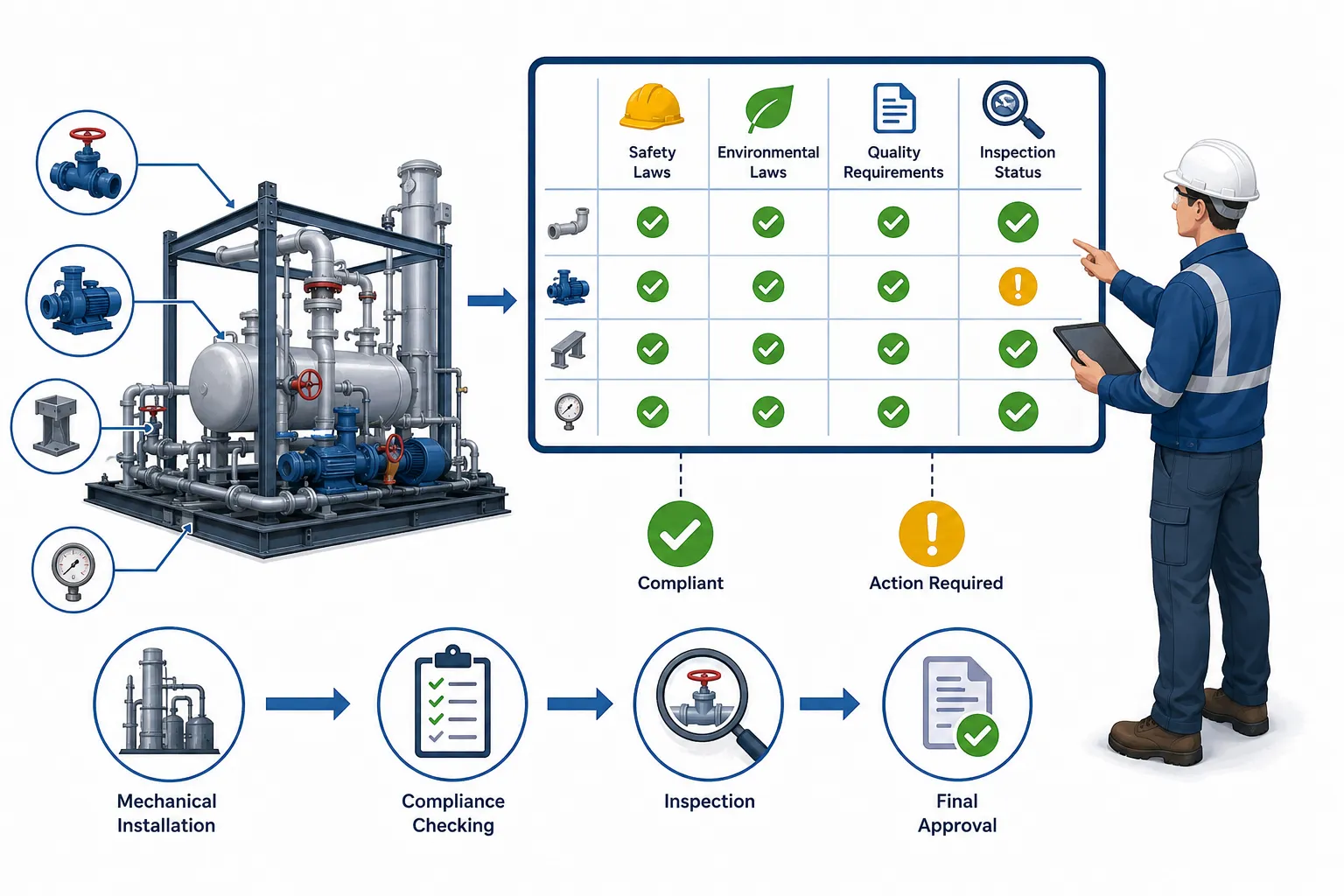
Mechanical Installation Compliance Workflow

Purpose of a Compliance Tracking Matrix

The main purpose of a compliance tracking matrix is to prevent important legal and regulatory requirements from being overlooked. Mechanical projects often operate under multiple layers of requirements. These may include national legislation, workplace safety regulations, environmental laws, local authority requirements, engineering standards, client specifications and internal company procedures.

A well-designed matrix enables the project team to:

  • Identify all applicable legal and regulatory obligations.
  • Link requirements to specific mechanical installations.
  • Assign responsibility for compliance activities.
  • Define inspection, monitoring and verification requirements.
  • Record objective evidence of compliance.
  • Identify gaps before they become serious non-conformities.
  • Monitor outstanding actions and deadlines.
  • Support internal and external audits.
  • Improve communication between engineering, QA/QC, HSE and project teams.
  • Provide evidence during project handover.

The matrix should therefore be treated as a live project control document rather than a document created only for audit purposes.

Key Definitions and Concepts

The following table explains important terms used when developing and maintaining a compliance tracking matrix.

TermDefinitionApplication in Mechanical QA/QC
Compliance Tracking MatrixA structured document used to monitor applicable requirements, responsibilities, actions and evidence of conformityUsed to track legal, safety, environmental and technical obligations
Legal RequirementA mandatory obligation established through applicable legislation or authorised regulatory requirementsMust be identified and incorporated into project controls
Regulatory ComplianceThe process of meeting requirements established by regulatory authoritiesDemonstrated through inspections, records, permits and other evidence
Safety RequirementA requirement intended to prevent injury, illness, accidents or unsafe conditionsApplied to installation methods, equipment operation and workplace controls
Environmental RequirementAn obligation intended to control environmental impactsApplied to waste, emissions, spills, noise and resource use
Compliance EvidenceObjective information demonstrating that a requirement has been fulfilledIncludes certificates, inspection reports, permits and test records
Non-ConformityFailure to meet a specified requirementRequires investigation, correction and appropriate follow-up
Corrective ActionAction taken to address the cause of a non-conformity and reduce recurrenceUsed to strengthen future compliance performance
Responsible PersonThe individual or role assigned to complete or verify a compliance activityProvides accountability within the project
Compliance StatusThe current condition of a requirement, such as compliant, pending or non-compliantEnables project teams to prioritise action

Understanding the Compliance Environment

National Workplace Safety Laws

Mechanical installations must comply with applicable workplace safety laws in the country or jurisdiction where the project is performed. National requirements may establish duties for employers, contractors, designers, installers and equipment operators.

The exact legal requirements vary between countries. Therefore, QA/QC professionals must avoid assuming that a requirement used on one project automatically applies to another location. The project team should identify the relevant legal framework for the specific installation site.

National workplace safety requirements may address:

  • Safe systems of work.
  • Machinery and equipment safety.
  • Pressure system safety.
  • Lifting operations.
  • Electrical isolation associated with mechanical equipment.
  • Working at height.
  • Confined-space activities.
  • Fire prevention and emergency arrangements.
  • Personal protective equipment.
  • Competence and training requirements.
  • Risk assessment and hazard control.
  • Accident and incident reporting.
  • Inspection and maintenance obligations.

A compliance matrix should identify which requirements apply directly to each mechanical installation activity.

Environmental Laws and Requirements

Mechanical projects can create significant environmental impacts. Installation activities may involve fuels, lubricants, chemicals, hydraulic fluids, welding consumables, packaging materials and waste products.

Environmental compliance should not be treated as separate from mechanical quality management. Poor installation practices can create both quality and environmental failures. For example, an incorrectly installed lubrication system may cause repeated oil leakage, resulting in equipment failure and environmental contamination.

Environmental requirements may include:

  • Waste management and disposal controls.
  • Prevention of soil contamination.
  • Spill prevention and response.
  • Control of hazardous substances.
  • Air emission controls.
  • Noise and vibration management.
  • Water protection requirements.
  • Storage of oils and chemicals.
  • Environmental permits and approvals.
  • Recycling and waste segregation.
  • Record-keeping and reporting obligations.

The compliance matrix should clearly identify environmental obligations relevant to each activity.

Core Components of an Effective Compliance Tracking Matrix

Requirement Reference

Every requirement entered into the matrix should have a clear source reference. This may include the title or reference number of the applicable legislation, regulation, permit, project specification or approved procedure.

The source should be sufficiently clear to allow the project team to verify the original requirement.

A requirement reference may identify:

  • Applicable legislation.
  • Regulatory requirement.
  • Local authority condition.
  • Environmental permit.
  • Project specification.
  • Client requirement.
  • Engineering code.
  • Company procedure.
  • Approved method statement.

The purpose is not simply to list document titles. The matrix should identify the specific requirement that affects the installation.

Requirement Description

The requirement description should explain what the project must actually do.

For example, an entry should not merely state:

“Workplace Safety Law.”

A more useful entry would describe the practical requirement, such as:

“Mechanical lifting equipment must be inspected and approved before use where required by the applicable regulatory framework.”

Clear descriptions reduce confusion and improve accountability.

Applicable Installation or Activity

The matrix should show where the requirement applies. A large mechanical project may include hundreds of different activities.

Examples include:

  • Pump installation.
  • Compressor installation.
  • Piping erection.
  • Pressure testing.
  • Alignment activities.
  • Equipment lifting.
  • Welding and fabrication.
  • Chemical cleaning.
  • Lubrication activities.
  • Commissioning.
  • Waste disposal.

Linking the requirement to a specific activity makes the matrix practical and easier to use.

Responsible Person

Each requirement should have an assigned responsible role. Responsibility should be clearly defined, even when several departments are involved.

Possible responsible roles include:

  • Project Manager.
  • Mechanical Engineer.
  • QA/QC Engineer.
  • HSE Manager.
  • Site Supervisor.
  • Environmental Officer.
  • Installation Contractor.
  • Inspection Authority.
  • Commissioning Engineer.

Assigning responsibility prevents important actions from being overlooked because everyone assumes another person is managing them.

Evidence of Compliance

Compliance must be demonstrated through objective evidence. A verbal statement that an activity was completed is generally insufficient for effective QA/QC control.

Evidence may include:

  • Inspection reports.
  • Test certificates.
  • Equipment certificates.
  • Training records.
  • Competency records.
  • Risk assessments.
  • Method statements.
  • Work permits.
  • Environmental monitoring records.
  • Waste disposal records.
  • Photographic evidence where appropriate.
  • Calibration certificates.
  • Audit reports.
  • Approval documents.

The matrix should state the specific evidence required.

Step-by-Step Process for Developing the Matrix

Step 1: Define the Project Scope

The first step is to understand the mechanical project in sufficient detail. The project team should identify all major systems, equipment and installation activities.

The scope review should consider:

  • Type of mechanical systems.
  • Installation location.
  • Project duration.
  • Site conditions.
  • Construction methods.
  • Equipment hazards.
  • Environmental sensitivities.
  • Client requirements.
  • Contractors and subcontractors.
  • Testing and commissioning activities.

Without a clear understanding of scope, it is difficult to identify all applicable requirements.

Step 2: Identify Applicable Legal and Regulatory Requirements

The next stage is to identify the national and local requirements applicable to the project.

The identification process may involve:

  • Reviewing national workplace safety legislation.
  • Reviewing environmental legislation.
  • Checking local authority requirements.
  • Reviewing project permits.
  • Consulting competent legal or regulatory specialists.
  • Reviewing client contractual requirements.
  • Identifying industry-specific regulations.

The project should maintain a controlled legal and regulatory register that supports the compliance matrix.

Step 3: Determine Relevance to Mechanical Activities

Not every legal requirement will apply to every activity. The QA/QC and HSE teams should evaluate relevance.

Questions may include:

  • Does the requirement apply to the installation location?
  • Does it apply to the equipment type?
  • Does it apply to the installation method?
  • Does it apply to the contractor?
  • Does it require a permit or approval?
  • Does it require periodic inspection?
  • Does it require documented evidence?

Only applicable requirements should be assigned to specific activities, but potentially applicable requirements should also be reviewed carefully before exclusion.

Step 4: Convert Requirements into Practical Controls

Legal wording can be complex. The matrix should translate applicable requirements into practical and measurable project actions.

For example:

Legal requirement → Safe use of lifting equipment.

Practical control → Verify that lifting equipment is inspected, suitable for the planned load and operated by competent personnel.

Evidence → Inspection certificate, lifting plan and operator competence record.

This process converts broad compliance obligations into actions that can be monitored.

Step 5: Assign Responsibilities

Each compliance action should be assigned to an appropriate person or department.

A strong responsibility system should identify:

  • Who performs the action.
  • Who verifies completion.
  • Who approves the evidence.
  • Who monitors ongoing compliance.
  • Who escalates non-conformities.

Responsibility should be linked to actual project roles rather than simply naming a department.

Step 6: Establish Compliance Status Categories

A standard status system helps management understand the condition of each requirement.

Typical categories include:

  • Not Applicable.
  • Not Started.
  • In Progress.
  • Pending Evidence.
  • Compliant.
  • Partially Compliant.
  • Non-Compliant.
  • Action Required.
  • Closed.

The organisation should define these categories clearly to ensure consistent use.

Step 7: Record Evidence and Verification

Once an action is completed, the responsible person should provide evidence. QA/QC or another authorised role should verify that the evidence meets the requirement.

Verification should consider:

  • Is the evidence complete?
  • Is the document current?
  • Does it relate to the correct equipment?
  • Is traceability available?
  • Has the activity been performed by competent personnel?
  • Does the evidence demonstrate actual conformity?

Simply uploading a document into a project folder does not automatically prove compliance.

Step 8: Review and Update the Matrix

The matrix must be updated when project conditions change.

Updates may be required because of:

  • Design changes.
  • Changes in installation methods.
  • New equipment.
  • Regulatory changes.
  • Revised permits.
  • New environmental conditions.
  • Audit findings.
  • Non-conformities.
  • Changes in contractors.

Regular review meetings help ensure that the matrix remains accurate.

Integrating the Matrix into Mechanical Installation Activities

Planning Stage

Compliance should begin before physical installation work starts. The matrix should be developed during planning and reviewed as the project progresses.

Planning activities may include:

  • Reviewing applicable laws.
  • Identifying permits.
  • Assessing environmental risks.
  • Reviewing installation procedures.
  • Establishing inspection requirements.
  • Identifying competency requirements.
  • Planning safety controls.

Early planning reduces the risk of expensive changes during installation.

Material and Equipment Control

Mechanical installations require materials and equipment that meet both technical and safety requirements.

The compliance matrix may track:

  • Material approval requirements.
  • Traceability requirements.
  • Equipment certification.
  • Storage requirements.
  • Hazardous substance controls.
  • Inspection requirements.
  • Calibration status.

For example, lifting accessories should not be used solely because they are physically available. Their suitability, identification and inspection status must also be verified.

Installation Activities

During installation, the matrix should support active monitoring.

Typical controls include:

  • Approved work procedures.
  • Risk assessments.
  • Permit requirements.
  • Equipment inspection.
  • Competence verification.
  • Environmental protection measures.
  • QA/QC inspection points.
  • Housekeeping controls.

The project team should use the matrix as part of routine management rather than waiting until final project audits.

Testing and Commissioning

Testing activities can introduce additional risks. Pressure testing, rotating equipment testing and system commissioning require specific safety and quality controls.

The matrix should identify:

  • Testing authorisation requirements.
  • Test procedure approval.
  • Instrument calibration.
  • Exclusion zones.
  • Emergency arrangements.
  • Environmental controls.
  • Acceptance criteria.
  • Test documentation.

This ensures that successful testing demonstrates both technical conformity and controlled project execution.

Managing Non-Conformities Through the Matrix

Identifying Non-Compliance

A non-conformity occurs when a requirement has not been fulfilled.

Examples include:

  • Missing equipment certification.
  • Expired calibration.
  • Unauthorised environmental discharge.
  • Incomplete inspection records.
  • Use of unapproved materials.
  • Missing safety permit.
  • Failure to perform a required inspection.

The matrix should clearly show the status of the requirement rather than allowing issues to remain hidden within general project documentation.

Corrective Action Process

When non-compliance is identified, the project should follow a structured process.

The process may include:

  1. Identify the non-conformity.
  2. Contain the immediate risk.
  3. Record the issue.
  4. Determine the cause.
  5. Define corrective action.
  6. Assign responsibility.
  7. Establish a completion deadline.
  8. Verify implementation.
  9. Confirm effectiveness.
  10. Close the action when evidence is satisfactory.

Corrective action should address the cause of the problem, not only the visible result.

Escalation of Serious Issues

Some compliance issues require immediate escalation.

Examples include:

  • Serious safety hazards.
  • Environmental pollution.
  • Use of uncertified critical equipment.
  • Regulatory breaches.
  • Unsafe pressure testing.
  • Major deviations from approved installation requirements.

The matrix should identify escalation routes for critical issues.

Practical Example: Pump Installation Project

Consider a project involving the installation of a large industrial pump.

The project team may identify the following requirements:

Safety Controls

  • Lifting equipment must be suitable and inspected.
  • Personnel involved in lifting must be competent.
  • The installation area must be controlled.
  • Lockout or isolation procedures must be applied where necessary.

Quality Controls

  • Pump model and materials must match approved documentation.
  • Foundation dimensions must be verified.
  • Alignment must meet specified tolerances.
  • Inspection and test records must be completed.

Environmental Controls

  • Lubricants must be stored safely.
  • Spills must be prevented and controlled.
  • Waste materials must be segregated.
  • Contaminated materials must be disposed of through approved methods.

The compliance matrix would assign each requirement to a responsible person, identify required evidence and record the current compliance status.

Benefits of a Clear Compliance Tracking Matrix

A properly maintained matrix provides significant benefits to mechanical projects.

Improved Legal and Regulatory Awareness

The matrix makes applicable requirements visible to the project team.

Benefits include:

  • Reduced risk of overlooked obligations.
  • Better understanding of responsibilities.
  • Improved preparation for inspections.
  • More consistent decision-making.

Better Integration of QA/QC and HSE Activities

Quality and safety teams often work with related information but through separate processes. A compliance matrix can improve coordination.

It supports:

  • Shared understanding of requirements.
  • Coordinated inspections.
  • Improved communication.
  • Reduced duplication of effort.
  • Better project control.

Stronger Audit Readiness

Auditors and clients often require evidence that applicable requirements have been systematically managed.

A well-maintained matrix provides:

  • Clear requirement references.
  • Evidence locations.
  • Responsibility assignments.
  • Status information.
  • Action history.

This reduces the time required to collect information during audits.

Reduced Project Risk

Compliance failures can cause:

  • Injuries.
  • Equipment damage.
  • Environmental incidents.
  • Project delays.
  • Financial losses.
  • Regulatory action.
  • Reputational damage.

The matrix supports early identification and management of these risks.

Common Mistakes to Avoid

Creating a Matrix That Is Too General

A matrix containing only broad document titles provides limited value.

Avoid:

  • “Follow safety law.”
  • “Comply with environmental requirements.”
  • “Meet quality standards.”

Instead, identify practical and measurable obligations.

Treating the Matrix as a One-Time Document

Projects change continuously. A matrix that is never updated quickly becomes unreliable.

The team should:

  • Review it regularly.
  • Update it after design changes.
  • Add new requirements when applicable.
  • Close completed actions properly.
  • Remove or mark genuinely inapplicable requirements.

Failing to Define Evidence

A compliance status should be supported by evidence.

Weak approach:

“Compliant – checked.”

Stronger approach:

“Compliant – verified through approved inspection report and current equipment certificate.”

Assigning Responsibility Without Verification

The person completing an activity may not always be the person who verifies compliance.

The system should distinguish between:

  • Performing.
  • Checking.
  • Approving.
  • Monitoring.

This improves independence and accountability.

Professional Responsibilities of the QA/QC Mechanical Engineer

The QA/QC Mechanical Engineer plays an important role in maintaining the integrity of the compliance tracking process. However, legal and regulatory compliance is a shared project responsibility.

The QA/QC professional should:

  • Review applicable technical and project requirements.
  • Coordinate with HSE and environmental personnel.
  • Verify inspection and testing evidence.
  • Maintain traceability.
  • Identify quality-related compliance gaps.
  • Raise non-conformities when requirements are not met.
  • Support corrective action processes.
  • Participate in audits and reviews.
  • Monitor changes affecting quality requirements.

The QA/QC professional should also recognise the limits of their authority. Complex legal interpretations should be referred to competent regulatory, legal or specialist personnel where necessary.

Key Principles for Effective Implementation

A successful compliance tracking matrix should follow several fundamental principles.

Clarity

Every requirement should be understandable.

The matrix should avoid:

  • Unclear terminology.
  • Unexplained abbreviations.
  • Vague responsibilities.
  • Ambiguous status descriptions.

Traceability

Every important requirement should be traceable from its source to the evidence demonstrating compliance.

Traceability should connect:

  • Requirement.
  • Activity.
  • Responsible person.
  • Inspection or control.
  • Evidence.
  • Compliance status.

Accountability

Every action should have a clearly assigned responsible role.

Timeliness

Compliance should be checked before the activity creates unacceptable risk or becomes impossible to correct economically.

Continuous Improvement

Findings from audits, incidents and non-conformities should be used to improve the matrix and project procedures.

Summary

Setting up a clear compliance tracking matrix is a fundamental activity for ensuring that mechanical installations meet applicable national workplace safety and environmental laws alongside project quality requirements. The matrix provides a structured method for identifying requirements, determining applicability, assigning responsibility, defining evidence and monitoring compliance status.

An effective matrix does not simply list laws and standards. It converts complex requirements into practical project controls that can be implemented, inspected and verified. It connects safety, environmental protection, quality assurance and quality control throughout the mechanical project lifecycle.

For QA/QC Mechanical Engineering professionals, the ability to establish and maintain a compliance tracking matrix supports stronger project governance, improved audit readiness, effective risk management and more reliable evidence of conformity. When used as a live management tool, it helps project teams identify problems early, implement corrective actions and ensure that mechanical installations are completed safely, responsibly and in accordance with applicable requirements.
2.Verifying Certified Personnel for Specialised Manufacturing Processes

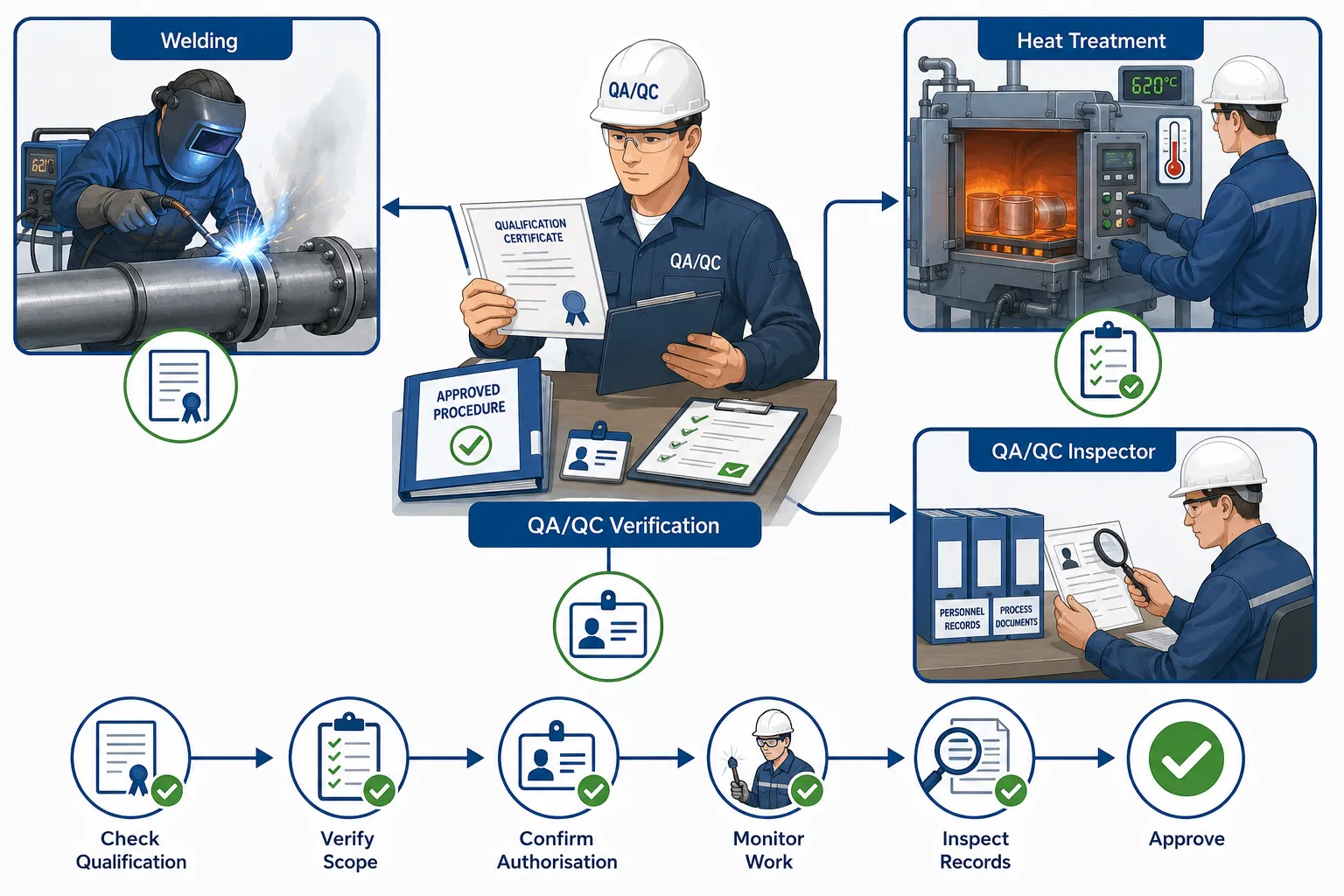
Specialised manufacturing processes, including welding, heat treatment and other controlled activities, can have a direct impact on the safety, reliability, integrity and service life of mechanical equipment. Unlike ordinary production activities, these processes may significantly alter the physical, mechanical or metallurgical properties of materials. For this reason, mechanical projects must ensure that such activities are performed by appropriately qualified, competent and, where required, certified or formally authorised personnel in accordance with applicable legal, regulatory, contractual and quality requirements.

For QA/QC Mechanical Engineering professionals, verification of personnel competence is a critical part of process control. It is not sufficient to inspect only the final product. Quality assurance requires the organisation to confirm, before and during production, that the people performing critical work are authorised and capable of carrying out the required procedures.

This section explains how to verify personnel qualifications, certifications, approvals and competence for specialised manufacturing activities. It also examines the importance of documentation, process control, traceability, supervision and compliance with applicable quality rules.

QAQC Welding and Heat Treatment Workflow

Why Personnel Certification and Competence Matter

Mechanical components used in pressure systems, structural applications, industrial machinery, pipelines and other critical installations may fail if specialised processes are performed incorrectly.

For example, poor welding may result in:

  • Cracks.
  • Lack of fusion.
  • Incomplete penetration.
  • Porosity.
  • Excessive distortion.
  • Reduced mechanical strength.
  • Leakage.
  • Premature equipment failure.

Similarly, incorrect heat treatment may affect:

  • Hardness.
  • Toughness.
  • Ductility.
  • Strength.
  • Residual stress.
  • Microstructure.
  • Dimensional stability.

The competence of the individual performing the process is therefore closely connected to product quality and safety.

A strong QA/QC system verifies that:

  • The person is authorised for the specific activity.
  • The qualification is appropriate for the work.
  • The approval or certification remains valid where validity requirements apply.
  • The person is working within the limits of their qualification.
  • The correct approved procedure is being followed.
  • Required records are maintained.
  • The work is properly supervised and inspected.

Key Definitions and Concepts

The following table summarises important terminology relevant to specialised manufacturing personnel verification.

TermDefinitionQA/QC Application
CompetenceThe demonstrated ability to apply knowledge, skills and experience to perform a task effectivelyUsed to determine whether personnel can safely and correctly perform assigned activities
QualificationFormal recognition that a person has met specified technical or performance requirementsUsed to verify suitability for a defined manufacturing activity
CertificationFormal confirmation issued by an authorised body or organisation that specified requirements have been metMay be required for particular regulated or contractual activities
AuthorisationFormal permission from an organisation to perform a specific activityLinks an individual’s competence to a particular work responsibility
Special ProcessA process where final inspection alone may not fully verify the quality of the resultIncludes processes such as welding and heat treatment
Welding ProcedureA documented method defining how a welding activity must be performedPersonnel must work within applicable procedure requirements
Heat Treatment ProcedureA controlled document defining heating, holding, cooling and monitoring requirementsSupports consistent material properties
TraceabilityThe ability to connect work, personnel, materials and records throughout the production processSupports verification and investigation
Quality RecordDocumented evidence that a required activity or control has been completedUsed during inspection, audit and handover
Non-ConformityFailure to meet a specified requirementRequires appropriate correction and follow-up

Understanding Specialised Manufacturing Processes

What Makes a Manufacturing Process Specialised?

A specialised process is generally one in which the quality of the result cannot always be fully confirmed by simple final inspection. The process itself must therefore be controlled.

For example, a final visual inspection may identify some welding defects, but it cannot necessarily demonstrate that every internal or metallurgical requirement has been achieved. Similarly, a final dimensional check cannot always prove that heat treatment produced the required internal material properties.

Because of this, quality assurance focuses on controlling:

  • Personnel.
  • Procedures.
  • Equipment.
  • Materials.
  • Process parameters.
  • Inspection activities.
  • Records.

Special processes require confidence in the entire manufacturing system rather than reliance on final inspection alone.

Examples of Specialised Manufacturing Activities

Depending on the project and applicable requirements, specialised activities may include:

  • Manual welding.
  • Semi-automatic welding.
  • Automated welding.
  • Welding inspection.
  • Non-destructive testing.
  • Heat treatment.
  • Post-weld heat treatment.
  • Controlled thermal processing.
  • Specialised material joining.
  • Pressure testing.
  • Critical coating applications.

The exact personnel requirements depend on the applicable law, regulation, engineering standard, project specification and organisational procedure.

Legal, Regulatory and Quality Requirements

Understanding Applicable Requirements

The requirement for certified or qualified personnel may originate from different sources. A QA/QC professional must identify which requirements apply to the particular project.

Possible sources include:

  • National workplace safety laws.
  • Manufacturing regulations.
  • Pressure equipment requirements.
  • Industry regulations.
  • Engineering codes and standards.
  • Client specifications.
  • Approved quality plans.
  • Contractual requirements.
  • Company procedures.
  • Regulatory authority requirements.

The applicable requirements may differ depending on:

  • The country of manufacture.
  • The location of installation.
  • The type of equipment.
  • The service conditions.
  • The industry sector.
  • The level of risk.
  • The contractual agreement.

A qualification that is acceptable for one activity or project should not automatically be assumed to satisfy every other requirement.

Legal Compliance Versus Internal Company Approval

An important distinction must be made between external requirements and internal authorisation.

A company may provide internal training and authorise an employee to perform a task. However, internal authorisation does not automatically replace an externally required qualification or certification.

The QA/QC team should verify:

  • What external requirement applies.
  • Whether formal certification is required.
  • Whether an approved qualification is required.
  • Whether internal authorisation is also necessary.
  • Whether the individual’s approval covers the planned work.

This prevents the incorrect assumption that attendance at a training course alone proves full qualification for a specialised process.

Verification of Welding Personnel

Establishing the Welding Personnel Requirements

Before welding begins, the responsible QA/QC personnel should identify the applicable requirements for welders and welding operators.

The review should consider:

  • Type of material.
  • Material thickness.
  • Welding process.
  • Joint configuration.
  • Welding position.
  • Service conditions.
  • Applicable project requirements.
  • Required procedure.
  • Applicable qualification limits.

The objective is to confirm that the person assigned to perform the work is suitable for that specific activity.

Reviewing Welder Qualifications

A welder’s qualification record should be reviewed against the actual work requirements.

The review may consider:

  • Identity of the welder.
  • Unique identification number.
  • Qualification reference.
  • Applicable welding process.
  • Approved material range.
  • Thickness range where applicable.
  • Welding position.
  • Joint type.
  • Validity status.
  • Continuity requirements where applicable.

The QA/QC professional should not simply confirm that a certificate exists. The certificate must be relevant to the planned welding work.

Verifying Identity

The qualification document must be linked to the individual performing the work.

Good verification practices may include:

  • Checking official identification.
  • Confirming the welder identification number.
  • Comparing production records.
  • Reviewing qualification documentation.
  • Ensuring weld marks can be traced to the individual.

Effective identification prevents situations where a qualified person’s documentation is incorrectly associated with work performed by another person.

Monitoring Welding During Production

Verification should continue after the qualification review.

During production, QA/QC personnel may check:

  • Correct welding procedure availability.
  • Welder identification.
  • Material traceability.
  • Joint preparation.
  • Consumable control.
  • Preheat requirements.
  • Welding sequence.
  • Environmental conditions where relevant.
  • Interpass controls.
  • Visual quality.
  • Recording requirements.

This demonstrates that personnel verification is only one part of the overall welding quality assurance process.

Verification of Heat Treatment Personnel

Importance of Competence in Heat Treatment

Heat treatment can significantly affect material performance. Incorrect temperatures, holding periods or cooling conditions can result in unacceptable material properties.

The personnel responsible for heat treatment must understand:

  • Applicable procedures.
  • Equipment operation.
  • Temperature monitoring.
  • Heating rates.
  • Holding requirements.
  • Cooling requirements.
  • Recording systems.
  • Equipment limitations.
  • Safety requirements.

Where the project or regulatory framework requires formal certification or qualification, appropriate evidence must be verified.

Reviewing Heat Treatment Authorisation

The QA/QC professional should determine whether personnel have the required competence and authority for the specific process.

Verification may include:

  • Training records.
  • Qualification records.
  • Certification where applicable.
  • Employer authorisation.
  • Experience records.
  • Procedure-specific competence.
  • Supervisor approval.

The evidence required should match the risk and regulatory importance of the activity.

Verification of Heat Treatment Equipment Operators

Personnel competence must also be considered alongside equipment suitability.

The QA/QC team may verify:

  • Operator authorisation.
  • Understanding of the procedure.
  • Familiarity with equipment.
  • Calibration awareness.
  • Ability to respond to deviations.
  • Record completion capability.

A qualified operator working with unsuitable or poorly controlled equipment may still produce a non-conforming result. Personnel and equipment controls must therefore operate together.

Establishing a Personnel Qualification Verification System

Step 1: Identify Critical Manufacturing Activities

The organisation should first identify which activities require formal competence verification.

The review may include:

  • Welding.
  • Heat treatment.
  • Non-destructive testing.
  • Pressure testing.
  • Critical assembly.
  • Specialised inspection.
  • Material verification.

Each activity should be assessed according to its potential impact on:

  • Safety.
  • Product integrity.
  • Regulatory compliance.
  • Environmental risk.
  • Customer requirements.

Step 2: Identify Applicable Personnel Requirements

The project team should identify the requirements applicable to each critical activity.

The requirement may specify:

  • Certification.
  • Qualification.
  • Training.
  • Experience.
  • Authorisation.
  • Periodic renewal.
  • Competence assessment.
  • Supervision.

The requirement should be clearly recorded in the project quality documentation.

Step 3: Collect Personnel Documentation

The organisation should establish a controlled record of relevant personnel evidence.

Documents may include:

  • Certificates.
  • Qualification records.
  • Training records.
  • Competence assessments.
  • Experience records.
  • Authorisation letters.
  • Continuity records where applicable.

Records should be controlled to prevent the use of expired, incorrect or unauthorised documentation.

Step 4: Verify Validity and Scope

The QA/QC professional should review whether the qualification remains applicable.

Important checks may include:

  • Expiry date.
  • Renewal requirements.
  • Process limitations.
  • Material limitations.
  • Thickness limitations.
  • Position limitations.
  • Procedure requirements.
  • Project-specific restrictions.

A valid document does not necessarily mean that the individual is qualified for every task.

Step 5: Assign Personnel to Appropriate Work

Only personnel whose qualifications and authorisations match the work should be assigned.

The assignment process should consider:

  • Complexity of the task.
  • Level of risk.
  • Required qualification.
  • Current authorisation.
  • Experience.
  • Supervision requirements.

This prevents inappropriate allocation of personnel.

Step 6: Monitor Work Performance

Competence verification should include observation of actual work.

The supervisor or QA/QC team may monitor:

  • Compliance with procedures.
  • Correct equipment use.
  • Understanding of instructions.
  • Record completion.
  • Response to abnormal conditions.
  • Quality of workmanship.

Poor performance may indicate the need for additional supervision, reassessment or corrective action.

Step 7: Maintain Traceability

The project should be able to identify who performed each critical activity.

Traceability may connect:

  • Personnel identification.
  • Work location.
  • Equipment identification.
  • Procedure reference.
  • Material batch.
  • Inspection results.
  • Date of activity.

Traceability supports effective investigation when problems are identified.

Role of Procedures in Personnel Verification

Approved Procedures Must Be Available

Even highly experienced personnel should work in accordance with applicable controlled procedures.

Before specialised work begins, personnel should have access to:

  • Approved welding procedures.
  • Heat treatment procedures.
  • Inspection instructions.
  • Quality plans.
  • Method statements.
  • Safety requirements.

The applicable procedure should be:

  • Approved where required.
  • Current.
  • Available at the point of use.
  • Relevant to the planned activity.
  • Under document control.

Matching Personnel to Procedures

The QA/QC team should confirm that the individual is qualified or authorised for the procedure being used.

This requires checking the relationship between:

  • Personnel qualification.
  • Process.
  • Material.
  • Equipment.
  • Joint or component type.
  • Applicable procedure.

A mismatch should be identified before work begins.

Documentation and Record Control

Personnel Qualification Register

A central personnel qualification register can help control certification and authorisation status.

The register may contain:

  • Personnel name.
  • Employee identification.
  • Role.
  • Qualification type.
  • Qualification reference.
  • Applicable process.
  • Issue date.
  • Expiry date where applicable.
  • Scope limitations.
  • Current status.

The register should be regularly reviewed.

Expiry and Renewal Monitoring

Some qualifications or authorisations require renewal, continuity confirmation or periodic reassessment.

A good monitoring system should:

  • Identify upcoming expiry dates.
  • Provide advance notification.
  • Prevent assignment of personnel when requirements are no longer valid.
  • Record renewal actions.

Failure to monitor validity can result in work being completed by personnel who no longer meet applicable requirements.

Control of Copies

Qualification documents should be controlled to avoid confusion.

The organisation should prevent:

  • Use of outdated certificates.
  • Unauthorised document changes.
  • Missing pages.
  • Incorrect personnel records.
  • Duplicate records with conflicting information.

Electronic document control systems can improve accessibility and monitoring when properly managed.

Inspection and Audit of Personnel Compliance

Internal QA/QC Verification

Routine QA/QC verification may include:

  • Reviewing personnel registers.
  • Checking qualifications before work.
  • Comparing personnel identity with records.
  • Observing work activities.
  • Reviewing production records.
  • Checking traceability.

This verification should be planned according to the importance and risk of the activity.

Internal Audits

Internal audits can evaluate whether the personnel qualification system is effective.

Audit questions may include:

  • Are required qualifications identified?
  • Are records current?
  • Are qualification limits understood?
  • Are personnel assigned appropriately?
  • Are expired records prevented from use?
  • Is work traceable to personnel?
  • Are deviations recorded and controlled?

Audit findings should be addressed through appropriate corrective action.

External Audits and Regulatory Inspections

Clients, certification bodies and regulatory authorities may review personnel competence records.

The organisation should therefore ensure that records are:

  • Available.
  • Legible.
  • Current.
  • Traceable.
  • Protected from unauthorised alteration.

Good record control demonstrates confidence in the manufacturing quality system.

Practical Example: Welding Verification Scenario

Consider a mechanical fabrication project involving the welding of a critical piping component.

Before welding begins, the QA/QC Engineer reviews the project requirements and confirms that welding personnel must meet defined qualification requirements.

The QA/QC process may involve:

  • Reviewing the approved welding procedure.
  • Identifying the required welding process.
  • Checking the welder’s qualification.
  • Confirming the qualification is current where applicable.
  • Reviewing scope limitations.
  • Confirming the welder’s identity.
  • Assigning a traceable weld identification mark.
  • Monitoring initial production work.
  • Reviewing inspection results.

During inspection, the QA/QC team discovers that the assigned welder’s qualification does not cover the actual welding position.

The appropriate response may include:

  • Stopping or controlling the affected work.
  • Identifying all potentially affected welds.
  • Recording the non-conformity.
  • Reviewing project requirements.
  • Obtaining authorised technical direction.
  • Reassigning appropriately qualified personnel.
  • Inspecting affected work as required.
  • Implementing corrective action.

The key lesson is that finding a certificate is not enough. The scope of the qualification must match the actual work.

Practical Example: Heat Treatment Scenario

A fabrication facility completes welding on a critical mechanical component requiring controlled heat treatment.

The project quality plan requires the process to be performed using an approved procedure and controlled temperature monitoring.

Before work begins, the responsible team verifies:

  • The applicable heat treatment procedure.
  • Personnel competence and authorisation.
  • Equipment suitability.
  • Temperature measurement capability.
  • Calibration status of monitoring instruments.
  • Recording requirements.

During the process, the temperature record shows a deviation from the required procedure.

The team should not simply accept the component because heat treatment was performed.

Appropriate action may include:

  • Recording the deviation.
  • Reviewing the extent of the affected work.
  • Preventing unauthorised release.
  • Seeking authorised technical evaluation.
  • Determining required corrective action.
  • Maintaining complete records.

This example demonstrates the relationship between personnel competence, procedure control and objective evidence.

Common Non-Conformities

Expired or Invalid Qualifications

One of the most common problems is failure to monitor qualification validity.

Potential causes include:

  • Poor record control.
  • No expiry monitoring system.
  • Weak communication.
  • Incorrect personnel assignment.

Preventive controls include:

  • Central qualification registers.
  • Automated reminders.
  • Regular QA/QC reviews.
  • Supervisor verification before assignment.

Qualifications Outside Their Scope

A qualification may exist but not cover the specific work.

Common errors include:

  • Incorrect welding process.
  • Different material category.
  • Different thickness range.
  • Unauthorised position.
  • Different joint configuration.

QA/QC professionals must review scope rather than simply checking whether a certificate exists.

Work Performed by Unauthorised Personnel

This may occur when:

  • Qualified personnel are unavailable.
  • Production schedules create pressure.
  • Identification controls are weak.
  • Supervisors fail to verify assignments.

Strong traceability and supervision reduce this risk.

Inadequate Process Records

Missing records can create serious compliance problems even when the physical work appears acceptable.

Records may be required to demonstrate:

  • Who performed the work.
  • Which procedure was used.
  • When the activity occurred.
  • What equipment was used.
  • What inspection was completed.

Benefits of Verifying Certified and Competent Personnel

Improved Product Quality

Appropriately qualified personnel are more likely to perform specialised activities in accordance with established requirements.

Benefits include:

  • Reduced defects.
  • Improved consistency.
  • Better process control.
  • Reduced rework.
  • Improved reliability.

Enhanced Safety

Incorrect specialised manufacturing processes can create hazards during operation.

Effective competence verification supports:

  • Safer equipment.
  • Reduced failure risk.
  • Better process discipline.
  • Improved workplace safety.

Stronger Regulatory Compliance

Where legal or regulatory requirements apply, documented verification provides evidence that the organisation has taken appropriate steps.

This can support:

  • Regulatory inspections.
  • Client reviews.
  • Project audits.
  • Certification assessments.

Improved Traceability

Personnel traceability helps organisations investigate quality problems and identify affected work.

It also supports:

  • Root cause analysis.
  • Corrective action.
  • Product integrity reviews.
  • Continuous improvement.

Increased Client Confidence

Clients are more likely to have confidence in a project when critical processes are performed under controlled conditions by appropriately qualified personnel.

Best Practices for QA/QC Professionals

Establish a Competence Matrix

A competence matrix can show which personnel are authorised for specific activities.

It may include:

  • Names.
  • Roles.
  • Processes.
  • Qualification status.
  • Validity dates.
  • Scope limitations.

This provides a quick overview for project planning.

Verify Before Work Starts

Personnel verification should occur before critical work begins.

A pre-work check may confirm:

  • Correct person.
  • Correct qualification.
  • Correct procedure.
  • Valid status.
  • Appropriate scope.

This is more effective than discovering problems after manufacturing is complete.

Coordinate with Production and HSE Teams

QA/QC should work collaboratively with:

  • Production supervisors.
  • Welding coordinators.
  • Heat treatment personnel.
  • HSE teams.
  • Engineering personnel.

Effective communication reduces the risk of incorrect personnel assignment.

Use Risk-Based Verification

Higher-risk activities may require increased verification and supervision.

Factors may include:

  • Criticality of equipment.
  • Operating pressure.
  • Temperature conditions.
  • Material complexity.
  • Safety consequences.
  • Regulatory requirements.

Resources should be focused where failure could have the greatest impact.

Continuous Improvement of Personnel Competence Systems

Personnel verification should be reviewed as part of continuous improvement.

Useful performance indicators may include:

  • Number of qualification-related non-conformities.
  • Expired qualification incidents.
  • Rework associated with specialised processes.
  • Audit findings.
  • Training completion rates.
  • Corrective action effectiveness.

The organisation can use this information to improve training, planning and document control.

Summary

Verifying that specialised manufacturing activities, such as welding and heat treatment, are performed by appropriately qualified, competent and, where required, certified personnel is an essential element of mechanical QA/QC. The verification process must go beyond checking whether a certificate exists. QA/QC professionals must determine whether the individual’s qualification or authorisation is current, relevant and within the scope required for the actual work.

Effective control requires a systematic process that identifies applicable legal, regulatory and project requirements; verifies personnel documentation; confirms identity and scope; monitors actual performance; maintains traceability; and manages non-conformities.

Welding and heat treatment are examples of specialised processes where final inspection alone may not provide complete assurance of conformity. Therefore, control of personnel, procedures, equipment and process records is essential.

By establishing strong qualification registers, competence matrices, verification procedures and audit processes, mechanical organisations can improve product quality, strengthen safety, support regulatory compliance and reduce the risk of costly failures. For QA/QC Mechanical Engineering professionals, personnel competence verification is a key responsibility that contributes directly to reliable, safe and compliant mechanical project delivery.

3.Managing a Formal System for Safety and Quality Non-Compliance During Active Mechanical Projects

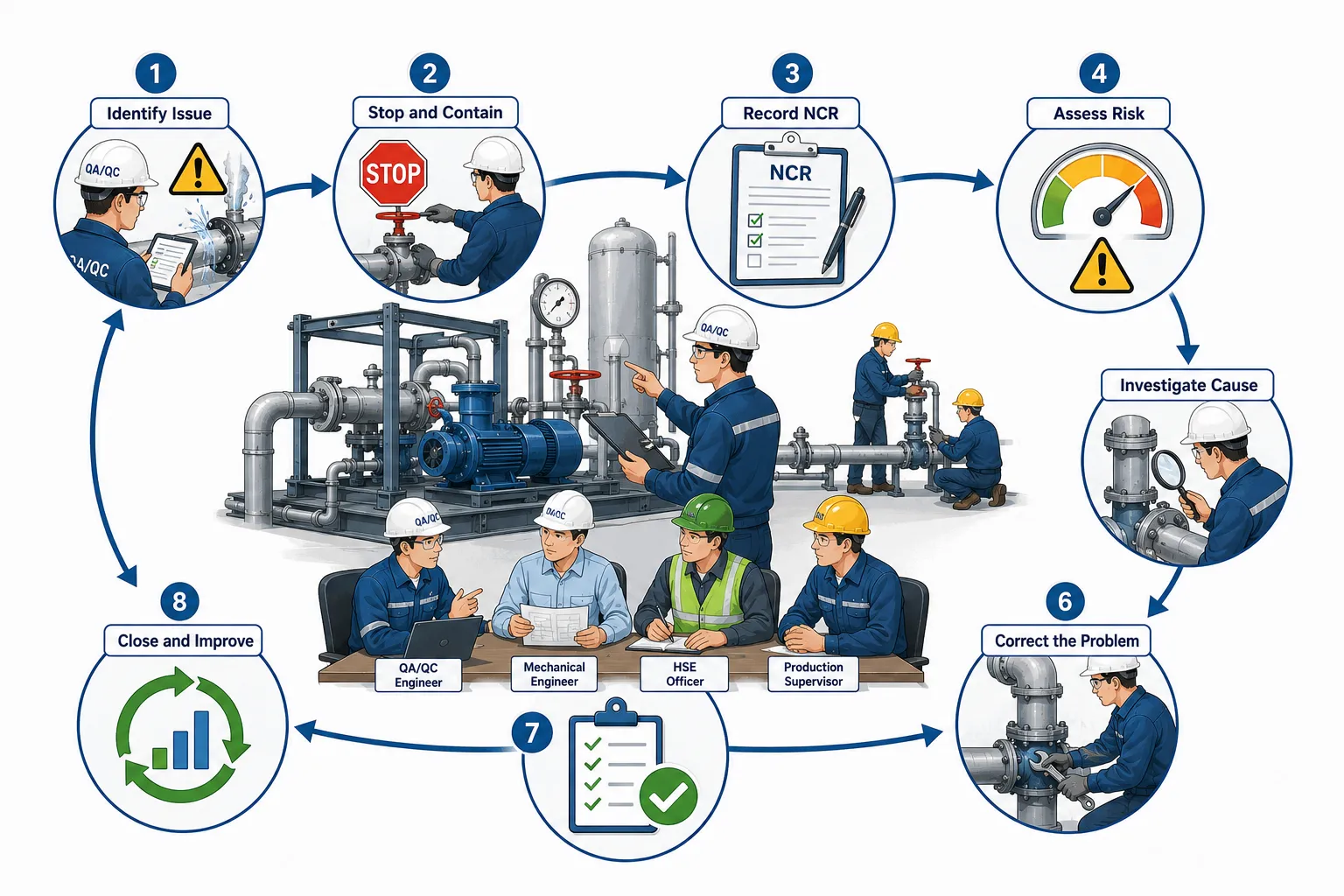
Mechanical projects involve multiple activities that must be controlled simultaneously, including material receiving, fabrication, welding, heat treatment, equipment installation, piping erection, inspection, testing, commissioning and final handover. During these active project stages, safety or quality requirements may not always be fully achieved. When such failures are identified, the organisation must have a formal and systematic method for recording, reviewing, controlling, correcting and preventing the recurrence of non-compliance issues.

A formal non-compliance management system is an essential part of mechanical Quality Assurance and Quality Control (QA/QC). It ensures that problems are not ignored, hidden or corrected informally without proper investigation. The system provides a controlled process through which the project team can identify what went wrong, assess the potential consequences, take immediate action, determine the underlying cause and implement appropriate corrective measures.

For QA/QC Mechanical Engineering professionals, effective non-compliance management is not limited to issuing a report. It requires professional judgement, technical understanding, communication, documentation and coordination with engineering, production, HSE and project management personnel.

A strong system supports the fundamental principle that problems should be identified as early as possible, controlled before they create further consequences and used as opportunities for continuous improvement.

Industrial QAQC Process Workflow

Why a Formal Non-Compliance Management System Is Necessary

Active mechanical projects operate under time pressure, production demands and complex technical requirements. Without a formal system, personnel may attempt to resolve problems informally. Although immediate action may sometimes be necessary to make an area safe, informal correction without documentation can create serious quality, safety and traceability problems.

For example, a welding defect may be repaired without recording the original non-conformity. This can result in:

  • Loss of traceability.
  • Repeated defects remaining unidentified.
  • Incorrect repair procedures.
  • Failure to investigate the root cause.
  • Incomplete inspection records.
  • Increased risk of future failure.

Similarly, an unsafe installation activity may be corrected temporarily without investigating why the unsafe condition developed. The same issue may then occur elsewhere on the project.

A formal system provides a structured approach to ensure that every significant issue receives appropriate attention.

The main purposes of the system are to:

  • Identify safety and quality non-compliance promptly.
  • Protect people, equipment and the environment.
  • Prevent further non-conforming work.
  • Record the issue accurately.
  • Assess the technical and safety impact.
  • Determine the appropriate disposition.
  • Identify root causes.
  • Implement corrective actions.
  • Verify that actions are effective.
  • Prevent recurrence.
  • Maintain evidence for audits and project handover.

Key Definitions and Concepts

The following table explains key terms used within a formal safety and quality non-compliance management system.

TermDefinitionApplication in Mechanical QA/QC
Non-ComplianceFailure to meet a legal, regulatory, safety, quality, technical or project requirementMay relate to materials, processes, personnel, equipment or documentation
Non-ConformityA failure to fulfil a specified requirementOften recorded through a formal NCR or equivalent system
ObservationA condition that may require attention but does not necessarily represent a confirmed non-conformityUsed for early identification and improvement
Safety IncidentAn event or condition that causes or could cause injury, damage or unsafe consequencesRequires appropriate HSE investigation and control
Non-Conformance ReportA controlled document used to record and manage a non-conformityProvides traceability from identification to closure
ContainmentImmediate action taken to prevent further use, progression or impact of a problemMay include stopping work or segregating materials
CorrectionAction taken to eliminate an identified non-conformityAddresses the immediate issue
Corrective ActionAction taken to address the cause of a non-conformity and reduce recurrenceFocuses on the underlying system or process
Root CauseThe underlying reason why a problem occurredIdentified through structured investigation
DispositionThe authorised decision regarding how non-conforming work or material will be handledMay include repair, rework or other approved action
VerificationConfirmation through evidence that an action has been completed correctlySupports closure of the issue
Effectiveness ReviewAssessment of whether corrective action has prevented recurrenceConfirms that the solution works in practice

Understanding Safety and Quality Non-Compliance

Quality Non-Compliance

A quality non-compliance occurs when work, material, equipment or documentation does not meet a defined requirement.

Examples within mechanical projects include:

  • Incorrect material supplied or installed.
  • Welding performed outside the approved procedure.
  • Missing material traceability.
  • Incorrect equipment alignment.
  • Failed pressure test.
  • Expired measuring instrument calibration.
  • Incorrect heat treatment parameters.
  • Dimensional tolerances exceeded.
  • Required inspection not completed.
  • Unapproved repair work.
  • Incomplete quality documentation.

Quality non-compliance must be managed according to the criticality of the issue and the applicable project requirements.

Safety Non-Compliance

Safety non-compliance occurs when workplace activities do not meet applicable safety requirements or approved control measures.

Examples may include:

  • Work undertaken without required authorisation.
  • Unsafe lifting operations.
  • Missing protective equipment.
  • Failure to isolate mechanical equipment.
  • Unsafe pressure testing arrangements.
  • Inadequate access or working platforms.
  • Poor housekeeping around machinery.
  • Uncontrolled hazardous energy.
  • Failure to follow an approved safe system of work.

Safety issues may require immediate intervention because the consequences can affect people before a formal investigation is completed.

Environmental Non-Compliance

Environmental issues may also occur during active mechanical projects and should be managed through an appropriate formal process.

Examples include:

  • Oil or chemical spills.
  • Incorrect waste disposal.
  • Leakage from equipment.
  • Uncontrolled discharge.
  • Improper storage of hazardous materials.
  • Excessive emissions or dust where applicable.

Safety, environmental and quality systems may use separate reporting processes, but effective project management requires appropriate coordination between them.

The Principles of an Effective Non-Compliance Management System

Timely Identification

Problems should be identified as soon as reasonably possible. Delayed identification can increase the amount of affected work and make correction more expensive.

Early identification can occur through:

  • Routine inspections.
  • Quality control checks.
  • HSE inspections.
  • Internal audits.
  • Testing.
  • Supervisor observations.
  • Worker reports.
  • Client inspections.
  • Regulatory inspections.

A positive reporting culture is important. Personnel should understand that reporting a genuine issue supports project improvement.

Immediate Control

Once an issue is identified, the first priority is to prevent further harm or non-conforming work.

Immediate controls may include:

  • Stopping the affected activity.
  • Securing the work area.
  • Isolating equipment.
  • Segregating non-conforming materials.
  • Preventing further installation.
  • Notifying responsible personnel.
  • Establishing temporary safety controls.

The appropriate response depends on the severity and potential consequences of the issue.

Objectivity

Non-compliance should be assessed using facts and evidence rather than personal opinion.

The investigation should consider:

  • What requirement applies?
  • What actually occurred?
  • What evidence is available?
  • What is the extent of the issue?
  • What risks exist?
  • What work or equipment may be affected?

An objective approach improves fairness and technical accuracy.

Traceability

The system should enable the project team to trace the issue from identification to final closure.

Traceability should include:

  • Issue identification number.
  • Date and location.
  • Description.
  • Applicable requirement.
  • Affected equipment or work.
  • Immediate action.
  • Responsible person.
  • Investigation results.
  • Corrective action.
  • Verification records.
  • Closure approval.

Establishing the Formal Non-Compliance Process

Step 1: Identify and Report the Issue

Any authorised project team member should understand how to report a safety or quality concern.

The initial report should contain clear factual information.

Important information may include:

  • Date and time.
  • Location.
  • Project area.
  • Equipment identification.
  • Description of the issue.
  • Applicable requirement.
  • Person reporting the issue.
  • Immediate risk.
  • Photographic evidence where appropriate.

The report should avoid assumptions until the facts have been reviewed.

Step 2: Assess the Severity and Risk

Not all non-compliances have the same level of significance. The project should assess the potential consequences.

Factors may include:

  • Risk to personnel.
  • Risk to equipment.
  • Risk to the environment.
  • Impact on structural integrity.
  • Impact on pressure containment.
  • Extent of affected work.
  • Regulatory implications.
  • Client requirements.

A critical safety issue requires a different response from a minor documentation error.

Step 3: Apply Immediate Containment

Containment prevents the issue from spreading.

For quality issues, containment may include:

  • Identifying affected materials.
  • Placing materials on hold.
  • Stopping further installation.
  • Segregating defective components.
  • Suspending the affected process.

For safety issues, containment may include:

  • Stopping work.
  • Isolating energy sources.
  • Establishing exclusion zones.
  • Removing personnel from danger.
  • Providing temporary protective measures.

Containment does not automatically solve the root cause. It controls the immediate situation.

Step 4: Record the Non-Compliance Formally

The project should use an approved reporting system, such as:

  • Non-Conformance Report.
  • Safety Non-Compliance Report.
  • Corrective Action Report.
  • Incident Reporting System.
  • Integrated Project Management System.

The form should provide sufficient information to support investigation and future review.

A well-structured report may include:

  • Unique reference number.
  • Requirement reference.
  • Description of the issue.
  • Classification.
  • Severity.
  • Affected work.
  • Immediate action.
  • Investigation findings.
  • Root cause.
  • Proposed corrective action.
  • Responsible person.
  • Target completion date.
  • Verification details.
  • Closure approval.

Classification of Non-Compliance

Minor Non-Compliance

A minor issue generally has limited impact and can be corrected without significant technical consequences.

Examples may include:

  • Incomplete document entry.
  • Minor labelling error.
  • Isolated housekeeping issue.
  • Missing non-critical record.

However, repeated minor issues may indicate a larger system failure.

Major Non-Compliance

A major non-compliance may significantly affect quality, safety or compliance.

Examples may include:

  • Use of incorrect material.
  • Failure of a critical test.
  • Unauthorised welding.
  • Serious safety procedure violation.
  • Missing traceability for critical components.

Major issues normally require formal investigation and authorised disposition.

Critical Non-Compliance

A critical issue may create immediate or potentially severe consequences.

Examples include:

  • Serious threat to life.
  • Unsafe pressure testing.
  • Major structural integrity concern.
  • Release of hazardous energy.
  • Significant environmental contamination.

Critical issues require immediate escalation and control.

Investigating the Non-Compliance

Establishing the Investigation Team

The investigation should involve appropriate personnel depending on the nature of the issue.

Possible members include:

  • QA/QC Engineer.
  • Mechanical Engineer.
  • HSE Representative.
  • Production Supervisor.
  • Project Manager.
  • Specialist Technical Expert.
  • Equipment Manufacturer Representative.

The investigation team should have sufficient technical competence to understand the issue.

Gathering Evidence

The investigation should collect objective information before reaching conclusions.

Evidence may include:

  • Inspection reports.
  • Test records.
  • Material certificates.
  • Personnel qualification records.
  • Equipment calibration records.
  • Work procedures.
  • Photographs.
  • Witness statements.
  • Maintenance records.
  • Production records.

Evidence should be protected and controlled where required.

Determining the Extent of the Problem

One of the most important investigation questions is:

“How far does the problem extend?”

For example, if an incorrect welding parameter is identified, the investigation should determine:

  • Which welds were affected?
  • When did the problem begin?
  • Which personnel were involved?
  • Which materials were used?
  • Was the issue isolated or repeated?

This process prevents the incorrect assumption that the problem is limited to the first item discovered.

Root Cause Analysis

Why Root Cause Analysis Is Important

Correcting the visible problem does not necessarily prevent recurrence.

For example:

Problem: A pressure test record is incomplete.

Correction: Complete the missing record.

This addresses the immediate issue but does not answer why the record was incomplete.

Possible underlying causes may include:

  • Inadequate training.
  • Unclear procedure.
  • Poor supervision.
  • Excessive workload.
  • Weak document control.

Root cause analysis aims to identify and address these underlying factors.

Common Root Cause Analysis Techniques

The project may use appropriate investigation methods, such as:

  • Five Whys.
  • Cause-and-effect analysis.
  • Process mapping.
  • Barrier analysis.
  • Trend analysis.

The selected method should be suitable for the complexity and importance of the issue.

Example of the Five Whys

A mechanical component was installed incorrectly.

  1. Why was it installed incorrectly?

    • The installation orientation was misunderstood.
  2. Why was it misunderstood?

    • The installation drawing was unclear.
  3. Why was the drawing unclear?

    • The revision had not been properly reviewed.
  4. Why was the revision not reviewed?

    • Document distribution controls were ineffective.
  5. Why were document controls ineffective?

    • The project lacked a clear process for confirming receipt of revised drawings.

The root cause may therefore relate to document control rather than the individual installer alone.

Determining the Appropriate Disposition

Correction and Rework

Rework involves bringing non-conforming work into full compliance with the original requirements.

Examples include:

  • Correcting equipment alignment.
  • Replacing an incorrect component.
  • Repeating an inspection.
  • Completing an approved repair process.

Rework should be controlled and inspected.

Repair

Repair may restore the component to an acceptable condition but may require specific technical approval.

Repair decisions should consider:

  • Engineering requirements.
  • Applicable standards.
  • Safety implications.
  • Future service conditions.
  • Inspection requirements.

Unauthorised repair work should not be accepted simply because the component appears satisfactory.

Replacement

Replacement may be necessary when correction or repair cannot provide sufficient assurance.

Examples include:

  • Incorrect material grade.
  • Severely damaged component.
  • Unacceptable manufacturing defect.

Use as Is

In some controlled situations, an authorised technical decision may determine that a deviation does not affect fitness for purpose. Such decisions should only be made through the appropriate authority and documented process.

The QA/QC professional should not independently approve technical deviations outside their assigned authority.

Implementing Corrective Actions

Developing an Effective Action Plan

A corrective action plan should clearly state:

  • What action will be taken.
  • Who is responsible.
  • When it must be completed.
  • What resources are required.
  • How completion will be verified.

Actions should address the cause of the problem rather than only its symptoms.

Examples of Corrective Actions

Depending on the issue, actions may include:

  • Revising procedures.
  • Providing additional training.
  • Improving supervision.
  • Introducing inspection hold points.
  • Improving document control.
  • Recalibrating equipment.
  • Strengthening material traceability.
  • Revising risk assessments.

Corrective actions should be proportionate to the significance of the issue.

Preventive Improvement

Although modern quality systems focus strongly on risk-based prevention, projects should also use lessons learned to reduce the likelihood of future problems.

Preventive improvements may include:

  • Reviewing similar project activities.
  • Conducting additional risk assessments.
  • Updating inspection plans.
  • Improving competence requirements.
  • Sharing lessons learned.

Verification of Corrective Actions

Completion Verification

The QA/QC or authorised responsible person should verify that the assigned action has actually been completed.

Verification may involve:

  • Reviewing revised documents.
  • Observing changed practices.
  • Reviewing inspection records.
  • Checking training evidence.
  • Re-inspecting corrected work.

Completion should be supported by objective evidence.

Effectiveness Verification

Completion alone does not prove that the corrective action was successful.

The project should consider:

  • Has the issue occurred again?
  • Has the process improved?
  • Are personnel following the revised procedure?
  • Have similar problems reduced?

Effectiveness review is particularly important for recurring or high-risk issues.

Managing Communication and Escalation

Internal Communication

Relevant personnel should be informed according to the nature and severity of the issue.

Communication may involve:

  • Project management.
  • Engineering.
  • QA/QC.
  • HSE.
  • Production.
  • Procurement.
  • Contractors.

Information should be shared with those who need to take action while maintaining appropriate control over sensitive records.

Escalation of Serious Issues

Serious safety or quality issues should have defined escalation routes.

Escalation may be required when:

  • Immediate danger exists.
  • Regulatory obligations may be affected.
  • Critical equipment integrity is uncertain.
  • The issue affects multiple systems.
  • Project completion may be significantly delayed.

Clear escalation procedures prevent delays in decision-making.

Practical Scenario: Welding Non-Compliance

During a routine inspection, a QA/QC Inspector identifies a completed weld that appears to have been produced using an incorrect process parameter.

The formal response may include:

Immediate Actions

  • Identify the weld.
  • Prevent further work using the same uncontrolled condition.
  • Notify the responsible supervisor.
  • Review affected production.

Investigation

The team reviews:

  • Welding procedure.
  • Personnel qualification.
  • Welding records.
  • Equipment settings.
  • Inspection history.

Root Cause

The investigation identifies that an updated procedure was issued, but the revised version was not effectively communicated to the production team.

Corrective Action

The project may:

  • Remove obsolete documents.
  • Improve revision distribution.
  • Brief affected personnel.
  • Conduct additional verification.

Verification

QA/QC verifies that:

  • The correct procedure is now available.
  • Personnel understand the revision.
  • Subsequent work complies with the updated requirements.

This scenario demonstrates that the problem may be caused by a system failure rather than only individual error.

Practical Scenario: Safety Non-Compliance During Pressure Testing

A mechanical project is preparing to perform pressure testing on a piping section. During a site inspection, the HSE representative identifies that the exclusion area is inadequate.

The issue creates a potential safety risk because personnel may be exposed if equipment fails during testing.

The formal process should include:

  • Immediate suspension or control of testing activities.
  • Establishment of appropriate exclusion arrangements.
  • Review of the approved testing plan.
  • Assessment of why the control was inadequate.
  • Correction of the unsafe condition.
  • Verification before testing restarts.

The project should also consider whether the issue indicates a wider weakness in planning or supervision.

Key Benefits of a Formal Non-Compliance Management System

Improved Safety Performance

A formal system helps identify and control unsafe conditions before they cause serious consequences.

Benefits include:

  • Faster response to hazards.
  • Improved accountability.
  • Better investigation.
  • Reduced recurrence.

Improved Product Quality

Systematic management prevents non-conforming work from progressing through the project unnoticed.

This supports:

  • Reduced rework.
  • Improved reliability.
  • Better inspection control.
  • Stronger traceability.

Better Regulatory Compliance

Documented processes provide evidence that the organisation identifies, investigates and manages compliance failures.

This supports:

  • Regulatory inspections.
  • Client audits.
  • Certification assessments.
  • Project handover.

Stronger Continuous Improvement

Non-compliance information can identify trends and recurring weaknesses.

Trend analysis may reveal:

  • Repeated welding defects.
  • Frequent documentation problems.
  • Common safety violations.
  • Training weaknesses.
  • Equipment reliability issues.

Management can use this information to improve the overall project system.

Roles and Responsibilities

QA/QC Personnel

QA/QC professionals may be responsible for:

  • Identifying quality non-conformities.
  • Raising formal reports.
  • Coordinating technical reviews.
  • Monitoring corrective actions.
  • Verifying closure.
  • Maintaining records.

HSE Personnel

HSE professionals may:

  • Investigate safety issues.
  • Assess hazards.
  • Recommend control measures.
  • Monitor compliance.
  • Support incident investigations.

Engineering Personnel

Engineering personnel may:

  • Review technical consequences.
  • Approve technical dispositions.
  • Provide repair guidance.
  • Assess fitness for purpose.

Project Management

Project management should:

  • Provide resources.
  • Support corrective actions.
  • Ensure accountability.
  • Monitor serious and recurring issues.

Common Mistakes to Avoid

Closing Issues Too Early

A report should not be closed simply because an action has been assigned.

Closure should normally require:

  • Completion evidence.
  • Verification.
  • Appropriate approval.
  • Effectiveness review where necessary.

Focusing Only on Individual Blame

Individual error may contribute to a problem, but the investigation should also examine the wider system.

Consider:

  • Training.
  • Procedures.
  • Supervision.
  • Workload.
  • Communication.
  • Equipment.

A blame-focused culture can discourage reporting.

Failing to Assess the Extent

A project should determine whether similar work is affected.

Failure to assess extent can allow additional non-conforming work to remain undiscovered.

Using Corrective Action as a Generic Statement

Actions such as “be more careful” are not effective corrective actions.

A strong action should be:

  • Specific.
  • Measurable.
  • Assigned.
  • Time-bound.
  • Verifiable.

Best Practices for Effective Implementation

Establish Clear Reporting Channels

All relevant personnel should understand:

  • What must be reported.
  • How to report it.
  • Who receives the report.
  • What happens after reporting.

Use a Risk-Based Approach

Higher-risk issues should receive greater investigation and management attention.

Factors may include:

  • Potential injury.
  • Equipment criticality.
  • Regulatory impact.
  • Financial consequences.
  • Likelihood of recurrence.

Maintain an Issue Register

A central register can help management monitor open and closed issues.

The register may include:

  • Reference number.
  • Issue category.
  • Location.
  • Severity.
  • Responsible person.
  • Due date.
  • Status.
  • Closure date.

Analyse Trends

Regular trend analysis can identify recurring weaknesses.

Useful indicators may include:

  • Number of non-conformities.
  • Repeat issues.
  • Average closure time.
  • Overdue actions.
  • Defect categories.
  • Safety observation trends.

Continuous Improvement and Lessons Learned

A mature project does not treat every non-compliance as an isolated event. Lessons should be reviewed and shared where appropriate.

The lessons learned process may include:

  • Reviewing completed reports.
  • Identifying recurring causes.
  • Updating procedures.
  • Improving training.
  • Revising inspection plans.
  • Sharing relevant findings across teams.

This converts project experience into organisational knowledge.

Summary

Managing a formal system to handle, review and correct safety or quality non-compliance issues is essential for maintaining control during active mechanical project stages. The system should provide a clear process for identifying issues, applying immediate containment, recording the problem, assessing its severity, investigating the cause, determining appropriate corrective action and verifying that the action is effective.

For mechanical QA/QC professionals, successful non-compliance management requires more than completing a Non-Conformance Report. It requires objective investigation, technical judgement, effective communication, accurate documentation and collaboration with engineering, HSE, production and project management teams.

A strong system ensures that problems are not simply corrected and forgotten. Instead, each significant issue is used to understand weaknesses, improve controls and reduce the likelihood of recurrence. By maintaining traceability, accountability and effective verification, mechanical projects can improve safety performance, product quality, regulatory compliance and overall project reliability.