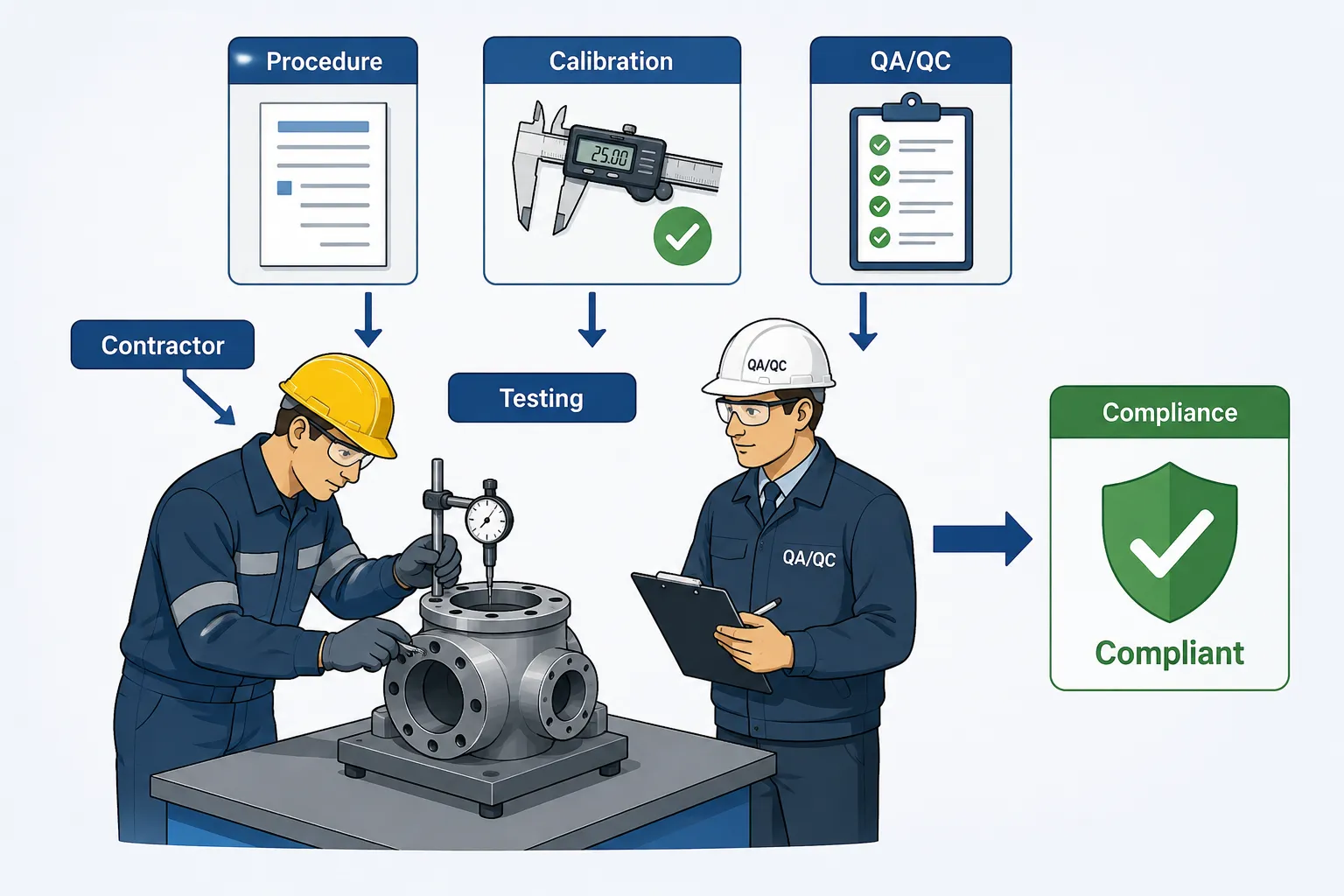
Lesson 5: Ensure all inspection and testing procedures comply with organisational and regulatory standards
Effective mechanical inspection policies provide the foundation for maintaining equipment integrity, product conformity, workplace safety, and reliable operational performance. As national regulations, international standards, engineering codes, inspection technologies, and organisational risk profiles evolve, existing company policies must be periodically reviewed to ensure they remain accurate, relevant, and fit for purpose. A structured review examines whether inspection frequencies, testing methods, acceptance criteria, competency requirements, calibration controls, documentation, non-conformance management, and corrective-action processes continue to reflect current regulatory and engineering expectations.
Reviewing inspection policies requires more than checking whether a regulation or standard is mentioned within a company document. It involves systematically comparing current organisational practices with applicable national regulatory frameworks, international standards, engineering codes, quality requirements, and recognised industry practices. A compliance gap analysis can identify areas where policies are fully aligned, partially implemented, outdated, or insufficiently controlled. Particular attention should be given to mechanical systems and components where inspection effectiveness directly influences safety and reliability, including fabricated assemblies, welded components, pressure-containing equipment, rotating machinery, structural elements, lifting equipment, and critical plant assets.
Operational alignment is achieved when regulatory requirements are effectively translated into practical inspection controls across workshops, manufacturing facilities, maintenance operations, testing environments, and engineering sites. A robust inspection policy should establish clear responsibilities, competent personnel, suitable inspection methods, calibrated equipment, defined acceptance criteria, traceable records, effective NCR controls, corrective actions, and periodic verification. By continuously reviewing and updating these arrangements, organisations can strengthen mechanical QA/QC, regulatory compliance, asset integrity, inspection governance, operational reliability, and quality performance, while reducing the risk of outdated procedures and unmanaged compliance gaps.
1: Review Existing Company Inspection Policies Against Updated National and International Regulatory Frameworks to Ensure Full Operational Alignment
Reviewing company inspection policies against updated national and international regulatory frameworks is a fundamental component of effective mechanical quality assurance, quality control, compliance management, and operational governance. Mechanical inspection policies establish the organisational rules for how equipment, components, fabricated assemblies, machinery, materials, testing activities, and inspection records are controlled. However, regulations, standards, engineering codes, technologies, manufacturing methods, and operational risks can change over time. A policy that was technically appropriate when originally developed may become incomplete, outdated, or inconsistent with current requirements.
A professional review therefore needs to determine whether the organisation’s documented inspection requirements remain suitable for its actual mechanical operations. This includes examining inspection frequencies, inspection methods, personnel competence, calibration arrangements, acceptance criteria, documentation, traceability, non-conformance controls, corrective actions, internal audits, management responsibilities, and escalation arrangements. The objective is not simply to update references within a policy document; it is to verify that current regulatory and technical expectations have been translated into practical controls that are implemented consistently across the workplace.
Understanding Inspection Policy and Regulatory Alignment
An inspection policy is a controlled organisational framework that establishes how inspection and verification activities are planned, performed, recorded, reviewed, and improved. It normally provides the direction from which more detailed procedures, inspection and test plans, work instructions, checklists, forms, and quality records are developed.
Regulatory alignment means ensuring that the company’s inspection arrangements correspond with the requirements that legally or contractually apply to its activities. International standards and engineering codes may provide additional technical requirements, depending on the industry, project, client, equipment type, and contractual arrangements.
A useful compliance relationship can be represented as:
Regulatory Requirements → Applicable Standards → Company Policy → Inspection Procedures → Workplace Implementation → Evidence → Review and Improvement
Each stage must be connected. A company may have an excellent policy document, but if the associated inspection procedure is outdated or workers are using obsolete acceptance criteria, operational alignment has not been achieved.
Key Definitions
| Term | Definition | Application to Mechanical Inspection |
|---|---|---|
| Inspection Policy | Controlled organisational statement governing inspection activities | Establishes the overall inspection framework |
| Regulatory Framework | Applicable legal and regulatory requirements governing operations | Defines mandatory compliance obligations |
| International Standard | Recognised technical or management standard used across jurisdictions | Provides consistent technical or management expectations |
| Engineering Code | Technical rules or practices governing design, fabrication, inspection or operation | Establishes engineering acceptance and control requirements |
| Compliance | Conformity with applicable requirements | Demonstrates that required controls are being followed |
| Operational Alignment | Consistency between requirements, procedures and actual workplace practice | Ensures policies work in real operations |
| Gap Analysis | Structured comparison between existing controls and required controls | Identifies missing or inadequate arrangements |
| Document Control | Process for controlling document approval, revision and use | Prevents obsolete inspection requirements |
| Traceability | Ability to connect inspection evidence to equipment, component and requirement | Supports verification and auditability |
| Acceptance Criteria | Defined conditions used to determine conformity | Supports objective inspection decisions |
| Non-Conformance | Failure to meet an applicable specified requirement | Initiates containment and corrective action |
| Corrective Action | Action taken to address the cause of a non-conformance | Prevents recurrence |
| Competence | Demonstrated ability to perform assigned inspection duties | Ensures reliable inspection results |
| Calibration | Comparison or adjustment of measurement equipment against a known reference | Supports measurement accuracy |
| Audit Evidence | Objective information demonstrating compliance or non-compliance | Supports verification and management review |
Why Inspection Policies Require Periodic Review
Mechanical engineering environments are dynamic. Equipment may be modified, new manufacturing processes may be introduced, suppliers may change, inspection technologies may develop, and regulatory requirements may be revised.
A policy review may therefore be triggered by:
- Changes to applicable legislation.
- Revision of technical standards.
- Changes to engineering codes.
- Introduction of new equipment.
- Modification of existing machinery.
- New manufacturing processes.
- Changes in inspection technology.
- Changes in organisational structure.
- Changes in risk profile.
- Major mechanical failures.
- Repeated non-conformances.
- Customer complaints.
- Audit findings.
- Regulatory findings.
- Changes in contractual requirements.
- Introduction of new materials.
- Changes in supplier arrangements.
- Significant process modifications.
A mature QA/QC system does not wait for a regulatory inspection or major failure before reviewing its policies. Review should be planned and risk-based.
Identifying the Applicable Regulatory Framework

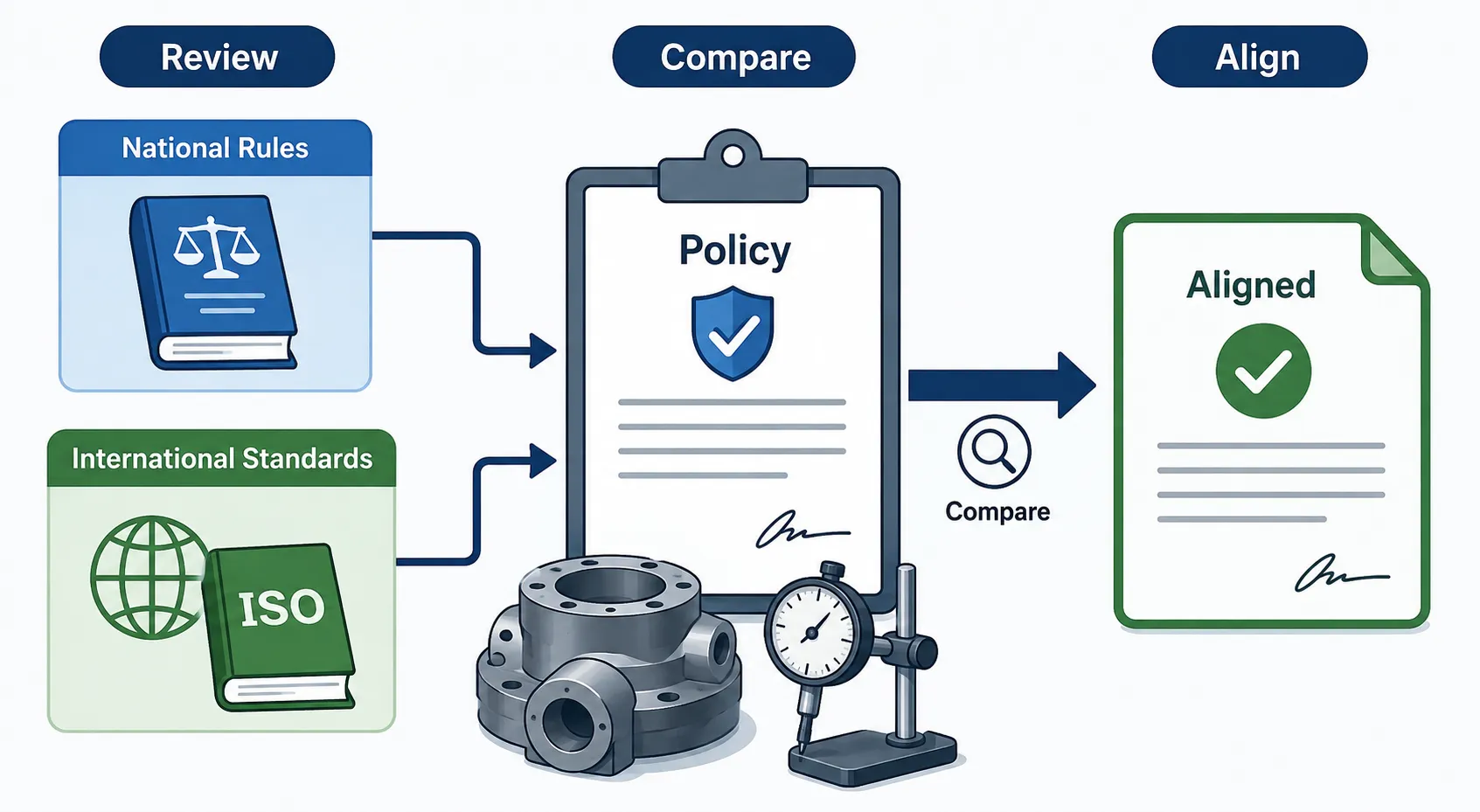
One of the most important stages is determining which requirements actually apply to the organisation.
Not every regulation or international standard applies to every mechanical operation. A professional review therefore begins by establishing the organisation’s activities, assets, processes, geographical locations, contractual obligations, and risk profile.
Areas to Consider
- Type of mechanical equipment.
- Manufacturing activities.
- Fabrication activities.
- Maintenance activities.
- Testing activities.
- Pressure-related equipment.
- Rotating machinery.
- Structural components.
- Welding activities.
- Lifting equipment.
- Material handling systems.
- Inspection and NDT activities.
- Environmental operating conditions.
- Workplace hazards.
- Customer requirements.
- Project specifications.
- Applicable national requirements.
- Applicable international standards.
- Relevant engineering codes.
This prevents two opposite problems: applying irrelevant requirements unnecessarily and failing to identify requirements that genuinely apply.
National Regulatory Requirements
National regulatory frameworks establish legally enforceable requirements within a particular jurisdiction. Depending on the location and industry, these may address:
- Workplace health and safety.
- Machinery safety.
- Pressure systems.
- Lifting equipment.
- Environmental controls.
- Electrical and mechanical interfaces.
- Construction activities.
- Product safety.
- Industrial plant operation.
- Inspection and certification.
- Competence requirements.
- Record retention.
A company inspection policy should clearly identify the regulations relevant to its operations rather than relying on generic references.
Reviewing Regulatory Changes
A structured regulatory review should establish:
- What requirement previously applied?
- Has it been revised?
- What has changed?
- When did the change become applicable?
- Does the change affect company operations?
- Which policy or procedure is affected?
- What practical controls must change?
- Who is responsible for implementing the change?
- What evidence will demonstrate implementation?
This approach converts regulatory change into an operational improvement process.
International Standards and Engineering Codes
International standards can provide common technical and management frameworks for organisations operating across borders. Depending on the application, mechanical inspection activities may interact with standards covering:
- Quality management.
- Asset management.
- Welding quality.
- Non-destructive testing.
- Materials testing.
- Dimensional inspection.
- Mechanical testing.
- Calibration.
- Risk management.
- Inspection competence.
- Equipment integrity.
Engineering codes can also establish requirements for specific equipment or applications. The company must identify which codes are contractually, technically, or legally applicable rather than treating every international standard as automatically mandatory.
Difference Between Regulation, Standard and Company Procedure
Understanding the hierarchy of requirements is essential.
Regulation
A regulation generally establishes legally enforceable obligations.
Standard
A standard provides recognised technical or management requirements and may become applicable through legislation, contract, specification, certification arrangements, or company adoption.
Engineering Code
An engineering code generally establishes technical rules, design principles, fabrication requirements, inspection methods, or acceptance criteria for a defined application.
Company Policy
The company policy converts applicable external requirements into organisational expectations.
Procedure
The procedure explains how the requirement is implemented.
Work Instruction
The work instruction provides detailed operational direction for a specific activity.
Inspection Record
The record provides evidence that the required activity was performed.
The relationship can therefore be understood as:
Requirement → Policy → Procedure → Work Activity → Inspection Evidence
Conducting a Compliance Gap Analysis
A compliance gap analysis is one of the most effective methods for reviewing existing inspection policies.
The process compares:
Current State against Required State
The difference represents the compliance or operational gap.
Typical Gap Categories
- Fully compliant.
- Partially compliant.
- Not compliant.
- Requirement not addressed.
- Requirement unclear.
- Requirement outdated.
- Requirement inconsistently implemented.
- Requirement documented but not demonstrated.
- Requirement implemented but not documented.
This classification helps management prioritise corrective action.
Step-by-Step Inspection Policy Review Process
Step 1: Establish the Review Scope
The first step is to define exactly what is being reviewed.
The scope may include:
- Mechanical inspection policy.
- Inspection procedures.
- NDT procedures.
- Welding inspection controls.
- Calibration procedures.
- Material inspection.
- Dimensional inspection.
- Equipment inspection.
- NCR procedures.
- Corrective-action procedures.
- Inspection records.
- Competency requirements.
The scope should also identify sites, departments, equipment categories, production lines, and projects included in the review.
Step 2: Identify Applicable Requirements
Develop a controlled register of relevant requirements.
This may include:
- National regulations.
- International standards.
- Engineering codes.
- Contract specifications.
- Customer requirements.
- Internal engineering standards.
- Manufacturer requirements.
Step 3: Establish Current Document Status
Review the current revision status of:
- Policies.
- Procedures.
- Inspection forms.
- Checklists.
- Technical specifications.
- Drawings.
- Test methods.
- Acceptance criteria.
- Calibration requirements.
Step 4: Compare Requirements
Each applicable requirement should be compared against the company’s existing controls.
Questions should include:
- Is the requirement addressed?
- Is the requirement correctly interpreted?
- Is responsibility assigned?
- Is implementation defined?
- Is evidence generated?
- Is the requirement being followed?
Step 5: Verify Workplace Implementation
Document review alone is insufficient.
Inspectors should determine whether the actual workplace matches the policy.
This may involve:
- Observing inspection activities.
- Interviewing personnel.
- Reviewing completed records.
- Examining equipment identification.
- Checking calibration status.
- Reviewing NCRs.
- Sampling inspection reports.
- Comparing actual methods with approved procedures.
Step 6: Record Gaps
Each identified gap should be documented objectively.
A useful gap record includes:
- Requirement.
- Existing control.
- Identified gap.
- Risk.
- Evidence.
- Responsible person.
- Corrective action.
- Target date.
- Verification method.
Step 7: Assess Risk
Not every gap presents the same level of risk.
Consider:
- Safety consequence.
- Mechanical integrity consequence.
- Regulatory consequence.
- Product quality consequence.
- Operational consequence.
- Financial consequence.
- Customer consequence.
Step 8: Prioritise Corrective Actions
High-risk gaps should receive priority.
Typical priority categories may include:
- Critical.
- High.
- Medium.
- Low.
Step 9: Update Documentation
Where necessary, revise:
- Policy statements.
- Procedures.
- Inspection frequencies.
- Acceptance criteria.
- Responsibilities.
- Forms.
- Checklists.
- Training materials.
Step 10: Verify Implementation
The revised policy must be implemented rather than simply approved.
Verification may involve:
- Training.
- Competency checks.
- Workplace observations.
- Record sampling.
- Internal audits.
- Inspection performance reviews.
Reviewing Inspection Frequencies
Inspection frequency is a critical policy component.
A policy may require inspection:
- Before operation.
- During production.
- At defined intervals.
- After maintenance.
- After modification.
- Following abnormal events.
- Following repairs.
- During commissioning.
- During periodic integrity assessments.
The review should determine whether these frequencies remain appropriate for the current risk profile.
Risk-Based Frequency Considerations
Frequency may depend on:
- Equipment criticality.
- Failure history.
- Operating conditions.
- Failure consequences.
- Age.
- Condition.
- Duty cycle.
- Previous inspection results.
- Manufacturer requirements.
- Regulatory requirements.
A high-criticality component with a history of deterioration may require stronger inspection controls than a low-risk component.
Reviewing Inspection Methods
Inspection methods should remain technically suitable for the defects being sought.
The review should consider whether procedures appropriately define:
- Visual inspection.
- Dimensional inspection.
- Surface examination.
- NDT.
- Functional testing.
- Pressure testing where applicable.
- Material verification.
- Mechanical testing.
- Condition monitoring.
The selected method should be capable of detecting the type of defect or degradation relevant to the equipment.
Reviewing Acceptance Criteria
Acceptance criteria are essential because inspection results require objective evaluation.
A policy should provide a clear basis for determining:
Accept → Monitor → Repair → Reject → Escalate
Acceptance criteria may be derived from applicable:
- Regulations.
- Engineering codes.
- Standards.
- Drawings.
- Specifications.
- Manufacturer requirements.
- Contract requirements.
A vague statement such as “inspect for defects” is insufficient for a robust QA/QC system. The inspection procedure should establish how findings are evaluated.
Reviewing Personnel Competence
Updated requirements may affect inspection personnel competency.
The policy review should examine:
- Qualification requirements.
- Training requirements.
- Experience.
- Authorisation.
- Role responsibilities.
- Supervision.
- Competency assessments.
- Continuing professional development.
Competence should correspond to the complexity and consequence of the inspection activity.
Examples of Competency Considerations
- Visual inspection competence.
- Dimensional inspection competence.
- NDT competence.
- Welding inspection competence.
- Drawing interpretation.
- Measurement equipment use.
- Data interpretation.
- NCR preparation.
- Risk assessment.
Reviewing Calibration Controls
Measurement reliability depends heavily on suitable and controlled inspection equipment.
The policy should establish requirements for:
- Equipment identification.
- Calibration status.
- Calibration intervals.
- Calibration traceability.
- Equipment condition.
- Out-of-calibration equipment.
- Calibration records.
- Equipment storage.
- Equipment verification.
Where an instrument is found to be out of calibration, the organisation should determine whether previous inspection results may have been affected.
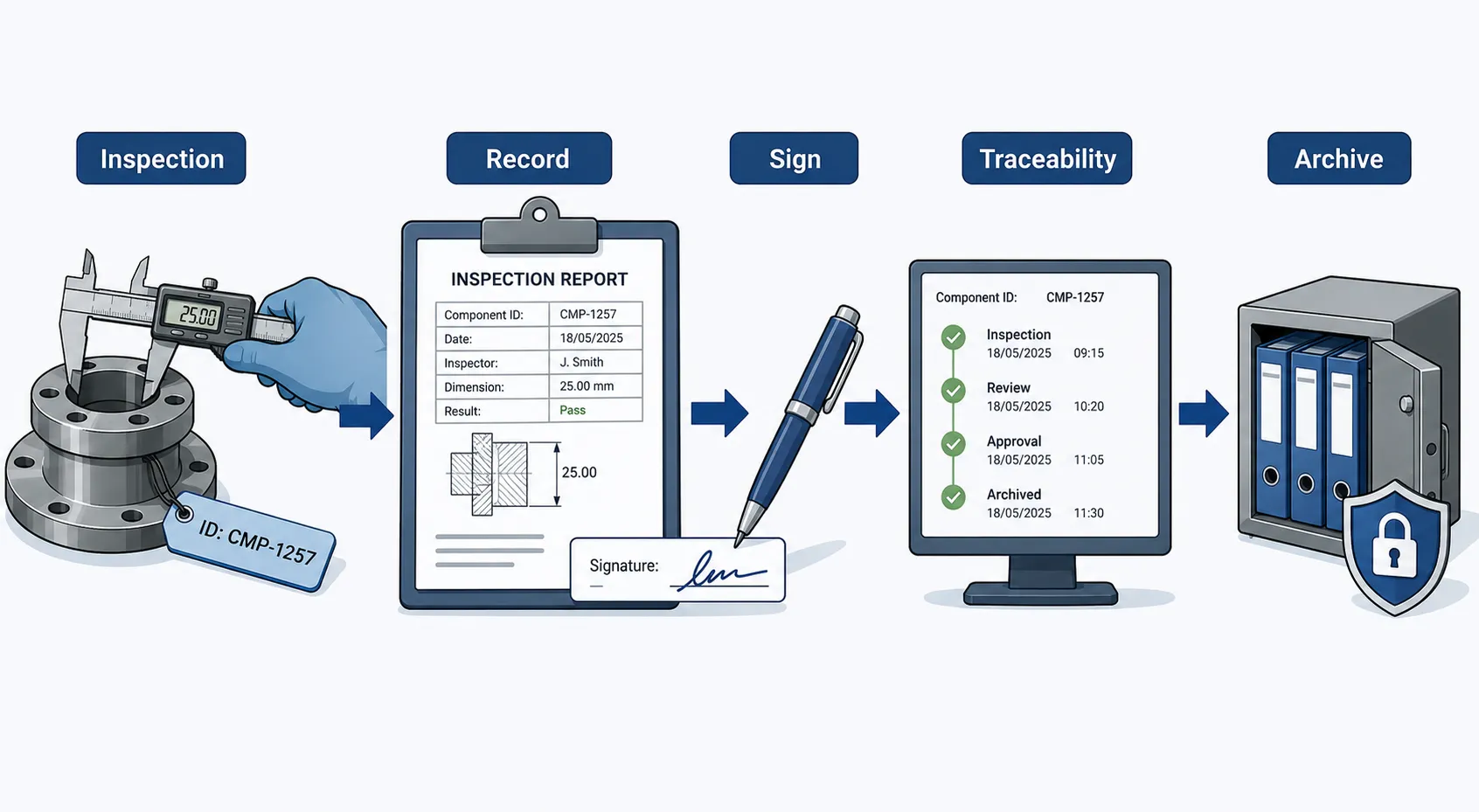
Reviewing Documentation and Traceability
Inspection evidence should be traceable to the specific item inspected.
Records should generally allow the organisation to identify:
- Equipment or component.
- Identification number.
- Inspection date.
- Inspector.
- Inspection method.
- Equipment used.
- Measurement results.
- Acceptance criteria.
- Findings.
- Status.
- Related NCR.
- Corrective action where applicable.
Traceability is particularly important for safety-critical components and regulated equipment.
Reviewing Non-Conformance Controls
Inspection policy should establish how non-conforming conditions are managed.
A robust NCR process should cover:
- Identification.
- Recording.
- Segregation where appropriate.
- Technical evaluation.
- Disposition.
- Corrective action.
- Verification.
- Closure.
- Trend analysis.
The policy should prevent personnel from informally accepting deviations without appropriate technical authority.
Reviewing Corrective Action Requirements
The review should determine whether corrective actions address causes rather than merely symptoms.
For recurring defects, the organisation should examine:
- Root cause.
- Contributing causes.
- Process weaknesses.
- Equipment conditions.
- Training.
- Documentation.
- Material issues.
- Measurement systems.
Corrective actions should have clear ownership and verification.
Reviewing Audit and Management Review Arrangements
Inspection policies should be periodically evaluated through internal audits and management reviews.
Audits can determine:
- Whether procedures are followed.
- Whether inspection records are complete.
- Whether personnel are competent.
- Whether equipment is calibrated.
- Whether NCRs are controlled.
- Whether corrective actions are effective.
Management review can then consider broader trends such as:
- Recurring defects.
- Inspection failures.
- Audit findings.
- Customer complaints.
- Equipment reliability.
- Compliance gaps.
- Resource requirements.
Reviewing Policy Against Actual Workplace Practice
One of the most important principles is:
A documented control is not necessarily an implemented control.
For example, a company policy may require calibration before use, but a workplace inspection may reveal that personnel routinely use instruments without checking calibration status.
Similarly, a procedure may require complete traceability, while actual inspection reports may contain missing equipment identification.
Therefore, policy review should combine:
- Document review.
- Personnel interviews.
- Workplace observation.
- Record sampling.
- Technical verification.
Practical Example: Inspection Frequency Gap
A manufacturing company has an established inspection policy requiring periodic inspection of critical mechanical machinery.
During a regulatory and standards review, the organisation identifies updated risk information showing that one category of machinery has a higher consequence of failure than previously recognised.
The company compares:
Existing Policy → Current Risk → Updated Requirements → Actual Inspection Frequency
The review finds that the existing inspection interval is no longer adequately supported by the organisation’s current risk assessment.
The organisation therefore:
- Reviews the equipment history.
- Reassesses criticality.
- Revises inspection frequency.
- Updates the inspection schedule.
- Revises the relevant procedure.
- Trains affected personnel.
- Monitors implementation.
This demonstrates how a regulatory review can lead to practical operational improvement.
Practical Example: Calibration Policy Gap
A QA/QC review identifies that a company policy requires calibrated measurement equipment but does not clearly define what happens when equipment is discovered outside its calibration period.
This creates a potential gap because previous inspection results may have been affected.
The organisation revises its policy to establish:
- Identification of affected equipment.
- Immediate withdrawal where appropriate.
- Technical assessment.
- Review of previous measurements.
- Impact assessment.
- Re-inspection where necessary.
- Documentation.
- Corrective action.
The revised policy therefore becomes more operationally robust.
Practical Example: NDT Procedure Alignment
A fabrication organisation reviews its NDT procedures against current project requirements and identifies differences in terminology, personnel competence requirements, reporting arrangements, and acceptance criteria.
Instead of simply changing the procedure title, the QA/QC team performs a full gap analysis.
The review identifies:
- Missing technical references.
- Inconsistent reporting requirements.
- Unclear acceptance criteria.
- Incomplete traceability.
- Training requirements requiring clarification.
The organisation updates the relevant controls and verifies implementation through record sampling and workplace observation.
Practical Example: Welding Inspection Policy
A fabrication company reviews its welding inspection policy following changes to its product range.
The previous policy was designed for relatively simple fabrication, while the new work involves more critical welded assemblies.
The review identifies that the existing policy does not adequately address:
- Inspection stages.
- Welding documentation.
- Welder qualification controls.
- Procedure qualification records.
- NDT requirements.
- Traceability.
- Repair documentation.
The company therefore revises the policy and supporting procedures to match the increased technical and quality risk.
Policy Review Evidence
A professional review should generate objective evidence.
Useful evidence includes:
- Approved policy documents.
- Regulatory registers.
- Standards registers.
- Gap-analysis records.
- Revision histories.
- Inspection records.
- Calibration certificates.
- Competency records.
- NCR records.
- Audit reports.
- Corrective-action records.
- Training records.
- Workplace observation notes.
Evidence should be controlled and traceable.
Common Gaps Identified During Policy Reviews
Typical weaknesses may include:
- Outdated standards.
- Missing regulatory references.
- Unclear responsibilities.
- Inadequate acceptance criteria.
- Inconsistent inspection frequencies.
- Weak calibration controls.
- Incomplete traceability.
- Poor NCR management.
- Insufficient competency requirements.
- Outdated inspection forms.
- Inconsistent terminology.
- Missing escalation arrangements.
- Inadequate corrective-action verification.
- Weak document control.
- Insufficient management oversight.
Managing Document Revisions
When a policy is updated, document control becomes critical.
The organisation should ensure:
- New revision is formally approved.
- Previous revision is withdrawn.
- Relevant users receive the updated document.
- Obsolete copies are controlled.
- Changes are communicated.
- Training is provided where necessary.
- Associated procedures are updated.
- Forms and checklists are revised.
- Implementation is verified.
Changing one policy document without reviewing dependent procedures can create inconsistencies.
Maintaining a Regulatory Compliance Register
A regulatory compliance register provides a central mechanism for tracking applicable requirements.
It may contain:
- Requirement title.
- Requirement source.
- Revision status.
- Applicability.
- Related company document.
- Responsible owner.
- Compliance status.
- Evidence.
- Review date.
- Required action.
This creates traceability between external requirements and internal controls.
Risk-Based Gap Prioritisation
A gap should be prioritised according to its potential consequence.
Critical Gap
A gap could create a serious safety, integrity, or regulatory exposure.
High Gap
A gap could significantly affect equipment integrity, compliance, or product conformity.
Medium Gap
A gap requires corrective action but does not represent an immediate significant threat.
Low Gap
A gap has limited immediate impact but should still be corrected to maintain system effectiveness.
Benefits of Regulatory Alignment
Safety Benefits
- Better control of mechanical hazards.
- Improved inspection of critical equipment.
- Earlier identification of deterioration.
- Stronger protection of workers.
- Reduced likelihood of unsafe operation.
Quality Benefits
- Consistent inspection practices.
- Improved conformity.
- Better defect detection.
- Stronger documentation.
- Reduced recurring non-conformances.
Reliability Benefits
- Improved equipment integrity.
- Better maintenance decisions.
- Reduced unexpected failures.
- Improved operational continuity.
Compliance Benefits
- Better regulatory readiness.
- Stronger audit evidence.
- Reduced compliance gaps.
- Improved accountability.
- Better management of regulatory change.
Commercial Benefits
- Reduced rework.
- Reduced downtime.
- Lower failure-related costs.
- Improved customer confidence.
- Stronger contractual compliance.
Challenges in Maintaining Alignment
Organisations may face several challenges when updating inspection policies.
Rapid Regulatory Change
Requirements may change faster than internal documents can be revised.
Multiple Jurisdictions
International operations may involve different national requirements.
Conflicting Requirements
Different contractual, regulatory, and technical requirements may need careful interpretation.
Legacy Equipment
Older equipment may have documentation that does not reflect current practices.
Resource Constraints
Policy review requires competent personnel and sufficient time.
Communication Gaps
Updated procedures may not reach all affected personnel.
Inconsistent Implementation
Different departments may interpret the same requirement differently.
A mature management system anticipates these challenges rather than treating them as exceptional events.
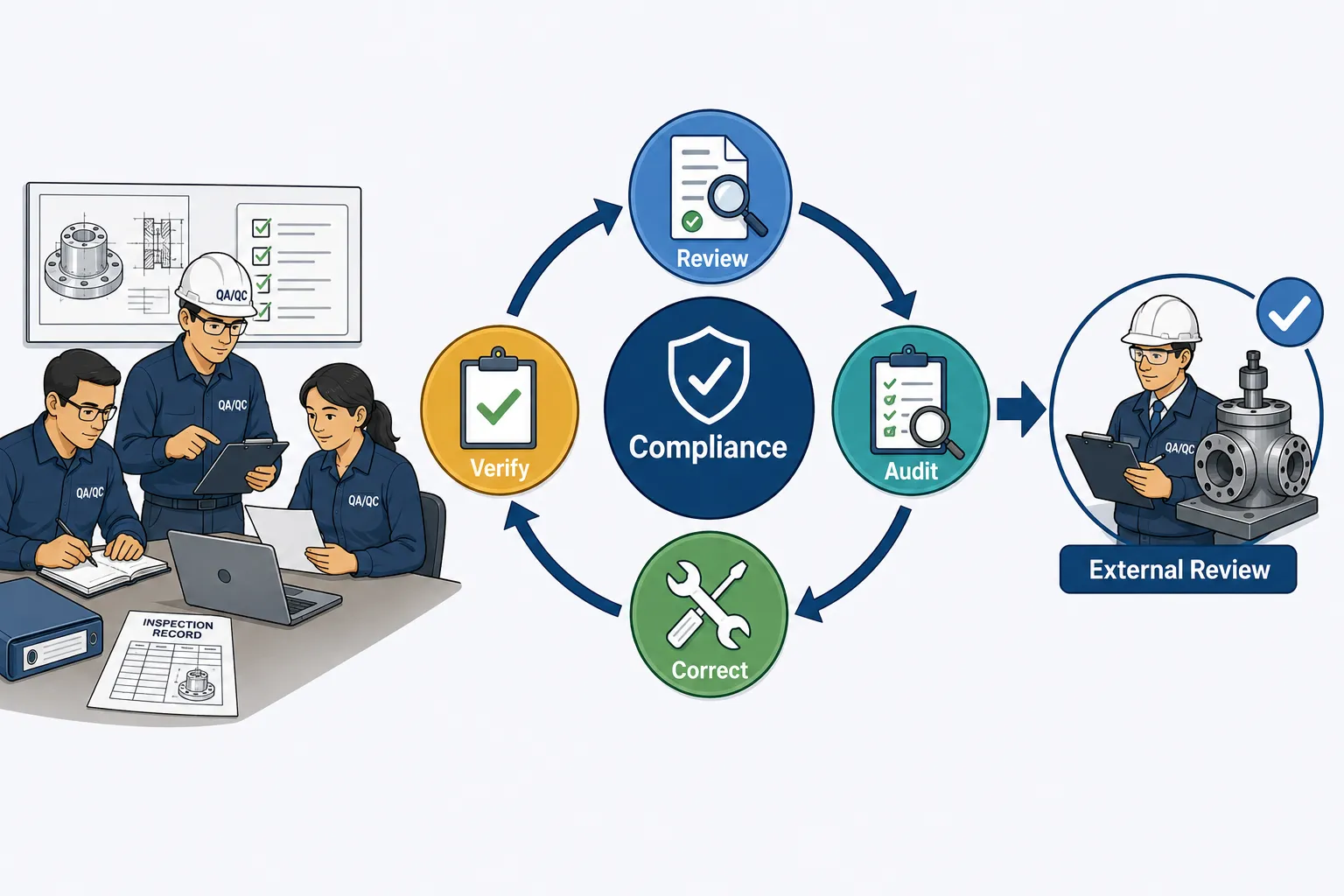
A Structured Operational Alignment Model
A useful model is:
Identify
Identify current applicable requirements.
Interpret
Determine what those requirements mean for the organisation.
Compare
Compare them against existing controls.
Evaluate
Assess compliance and operational risk.
Correct
Update policies and procedures.
Implement
Train and communicate revised requirements.
Verify
Audit actual workplace implementation.
Improve
Use findings and performance data to strengthen the system.
This creates a continuous regulatory-alignment cycle.
Professional Review Questions
During a policy review, a senior QA/QC engineer should ask:
- Does the policy reflect current applicable requirements?
- Are regulatory references controlled?
- Are applicable standards correctly identified?
- Are inspection responsibilities clear?
- Are inspection frequencies justified?
- Are acceptance criteria objective?
- Are inspection personnel competent?
- Are instruments calibrated?
- Is equipment traceable?
- Are records complete?
- Are NCRs effectively controlled?
- Are corrective actions verified?
- Are recurring failures analysed?
- Are policy changes communicated?
- Is implementation audited?
- Are management reviews informed by inspection performance?
Key Principles for Effective Policy Review
- Review requirements systematically.
- Use controlled regulatory information.
- Distinguish mandatory requirements from adopted good practice.
- Maintain current standards and document revisions.
- Apply a risk-based approach.
- Verify actual workplace implementation.
- Maintain inspection traceability.
- Define objective acceptance criteria.
- Ensure inspection personnel are competent.
- Maintain calibrated inspection equipment.
- Control non-conformances.
- Verify corrective-action effectiveness.
- Communicate policy changes.
- Audit implementation.
- Retain objective evidence.
- Continually improve the inspection system.
Case Study: Comprehensive Inspection Policy Alignment
Background
A large mechanical engineering facility operates fabrication, machining, assembly, maintenance, and testing activities. Its inspection policy was originally developed several years earlier. Since that time, the organisation has introduced new machinery, expanded its product range, changed several suppliers, and adopted additional inspection technologies.
During an internal compliance review, management decides that the existing inspection policy requires a comprehensive assessment against current applicable requirements.
Initial Review
The QA/QC team collects:
- Current inspection policies.
- Inspection procedures.
- Equipment registers.
- Calibration records.
- NCR data.
- Audit reports.
- Competency records.
- Current project requirements.
- Applicable regulatory information.
- Relevant technical standards.
Gap Analysis
The team compares the existing policy against current requirements.
Several gaps are identified:
- Some technical references require updating.
- Certain inspection frequencies lack documented risk justification.
- Calibration escalation arrangements are unclear.
- Some inspection forms contain outdated acceptance references.
- Competency requirements are not clearly defined for certain inspection activities.
- Corrective-action verification is inconsistent.
Risk Evaluation
The QA/QC team classifies the gaps according to potential impact.
High-priority issues relate to inspection controls for critical mechanical equipment and measurement reliability.
Lower-priority issues relate to document formatting and administrative controls.
Corrective Action
The organisation develops an action plan.
Actions include:
- Updating the inspection policy.
- Revising affected procedures.
- Updating inspection forms.
- Strengthening calibration controls.
- Clarifying competency requirements.
- Revising inspection frequencies where justified.
- Establishing stronger corrective-action verification.
- Training relevant personnel.
Implementation
The revised documents are approved and distributed through controlled document systems.
Personnel are briefed on significant changes.
Workplace inspections are conducted to verify implementation.
Verification
After implementation, the QA/QC team samples inspection records and observes selected inspection activities.
The review demonstrates improved:
- Traceability.
- Calibration control.
- Acceptance-criteria consistency.
- Documentation quality.
- Inspection planning.
Case Study Outcome
The organisation has moved from a document-focused compliance approach towards an integrated operational alignment system. The review demonstrates that effective regulatory alignment depends on connecting external requirements with policies, procedures, competent personnel, inspection equipment, workplace practices, records, and continuous improvement.
Conclusion
Reviewing existing company inspection policies against updated national and international regulatory frameworks is a critical activity for maintaining mechanical quality, regulatory compliance, equipment integrity, and operational reliability. Effective review goes beyond updating references in a policy document. It requires a structured comparison between applicable requirements and actual organisational controls, followed by risk-based gap assessment, corrective action, implementation, and verification. Inspection frequencies, testing methods, acceptance criteria, personnel competence, calibration arrangements, documentation, traceability, NCR management, and corrective-action systems should all be considered.
A strong regulatory-alignment process also recognises that compliance exists at the point where requirements are translated into workplace practice. Policies must therefore be supported by clear procedures, competent personnel, suitable inspection equipment, controlled documentation, reliable records, and effective management oversight. Workplace observations, internal audits, record sampling, trend analysis, and corrective-action verification provide valuable evidence that the documented system is actually functioning as intended.
For mechanical engineering organisations, continuous inspection-policy review supports a proactive approach to QA/QC and compliance management. It enables emerging regulatory requirements to be incorporated into operational controls, identifies weaknesses before they become major failures, and strengthens confidence in mechanical system integrity. By maintaining a controlled cycle of identify, interpret, compare, evaluate, correct, implement, verify, and improve, organisations can maintain stronger alignment with current regulatory and technical expectations while improving safety, quality, reliability, audit readiness, and long-term operational performance.