
Lesson 6: Recommend strategies to maintain high standards of mechanical system performance and operational excellence.
Maintaining high standards of mechanical system performance and operational excellence requires a structured approach to safety, reliability, quality, efficiency, and long-term asset performance. Mechanical systems such as pumps, compressors, turbines, pressure equipment, valves, heat exchangers, piping systems, rotating machinery, and fabricated assemblies must consistently perform their intended functions under defined operating conditions. Achieving this level of performance depends on more than effective design and installation; it requires disciplined maintenance, inspection, condition monitoring, quality assurance, equipment performance evaluation, asset integrity management, and continual improvement. A proactive approach helps organisations identify deterioration at an early stage, control operational risks, minimise unexpected failures, and maintain mechanical integrity throughout the asset lifecycle.
Sustained operational excellence relies on accurate performance information and evidence-based decision-making. Useful information can include equipment availability, reliability trends, maintenance history, inspection findings, vibration measurements, temperature changes, leakage observations, failure frequency, non-conformance reports, testing results, energy performance, and recurring mechanical defects. Analysing these indicators allows engineering and QA/QC teams to identify emerging problems, determine priorities, and develop targeted improvement strategies. Preventive and predictive maintenance, condition-based monitoring, root cause analysis, reliability improvement programmes, effective spare-parts planning, standardised operating procedures, workforce competency, and continual quality review can collectively reduce unplanned downtime, rework, equipment deterioration, maintenance costs, and operational disruption.
A high-performing mechanical management system must also balance technical integrity with productivity, cost, safety, and operational requirements. Effective strategies should be risk-based, measurable, technically justified, practical to implement, and capable of delivering sustainable improvements. Professional recommendations should consider both immediate equipment performance and long-term reliability, ensuring that short-term efficiency improvements do not create future safety or maintenance problems. By integrating QA/QC controls, inspection, maintenance, condition monitoring, reliability engineering, risk management, performance measurement, competent personnel, and continual improvement, organisations can strengthen mechanical system reliability and achieve safer, more efficient, resilient, and sustainable operations.
1: Justify Strategic Maintenance and Quality Control Recommendations Using Complex Engineering Data, Historical Performance Trends, and Cost-Benefit Analyses
Strategic maintenance and quality control recommendations in mechanical engineering should be based on evidence rather than assumptions, short-term production pressure, or isolated equipment events. At an advanced QA/QC level, the purpose of analysing engineering data is to determine whether an existing maintenance or quality strategy is delivering the required level of safety, reliability, availability, efficiency, and mechanical integrity. Recommendations should demonstrate a clear relationship between observed equipment behaviour, historical performance, failure mechanisms, inspection findings, quality trends, maintenance expenditure, and future operational risk. This evidence-based approach enables engineering teams to distinguish isolated incidents from systemic problems and to prioritise interventions that provide measurable improvements.
Mechanical systems generate substantial quantities of technical information throughout their lifecycle. This may include inspection records, vibration measurements, temperature readings, pressure data, flow measurements, lubrication records, calibration results, equipment failure histories, non-conformance reports (NCRs), repair records, preventive maintenance data, predictive maintenance alerts, test results, production interruptions, and spare-parts consumption. When these datasets are analysed together, they can reveal relationships that are not immediately visible from individual records. For example, increasing vibration combined with repeated bearing replacement and rising operating temperature may indicate progressive equipment deterioration rather than independent maintenance events. Similarly, recurring fabrication defects across multiple components may indicate a systemic process-control problem rather than individual operator error.
Strategic recommendations must also consider financial consequences. A technically effective maintenance intervention may require additional inspection resources, monitoring equipment, specialist personnel, software, training, replacement components, or planned downtime. Conversely, reducing maintenance expenditure may appear attractive but can increase the probability of equipment failure, production interruption, emergency repair, safety incidents, or premature asset replacement. Cost-benefit analysis therefore provides a structured method for comparing alternative strategies. The strongest recommendation is not necessarily the cheapest option; it is the option that provides an appropriate balance between technical performance, risk reduction, lifecycle cost, operational continuity, and quality assurance.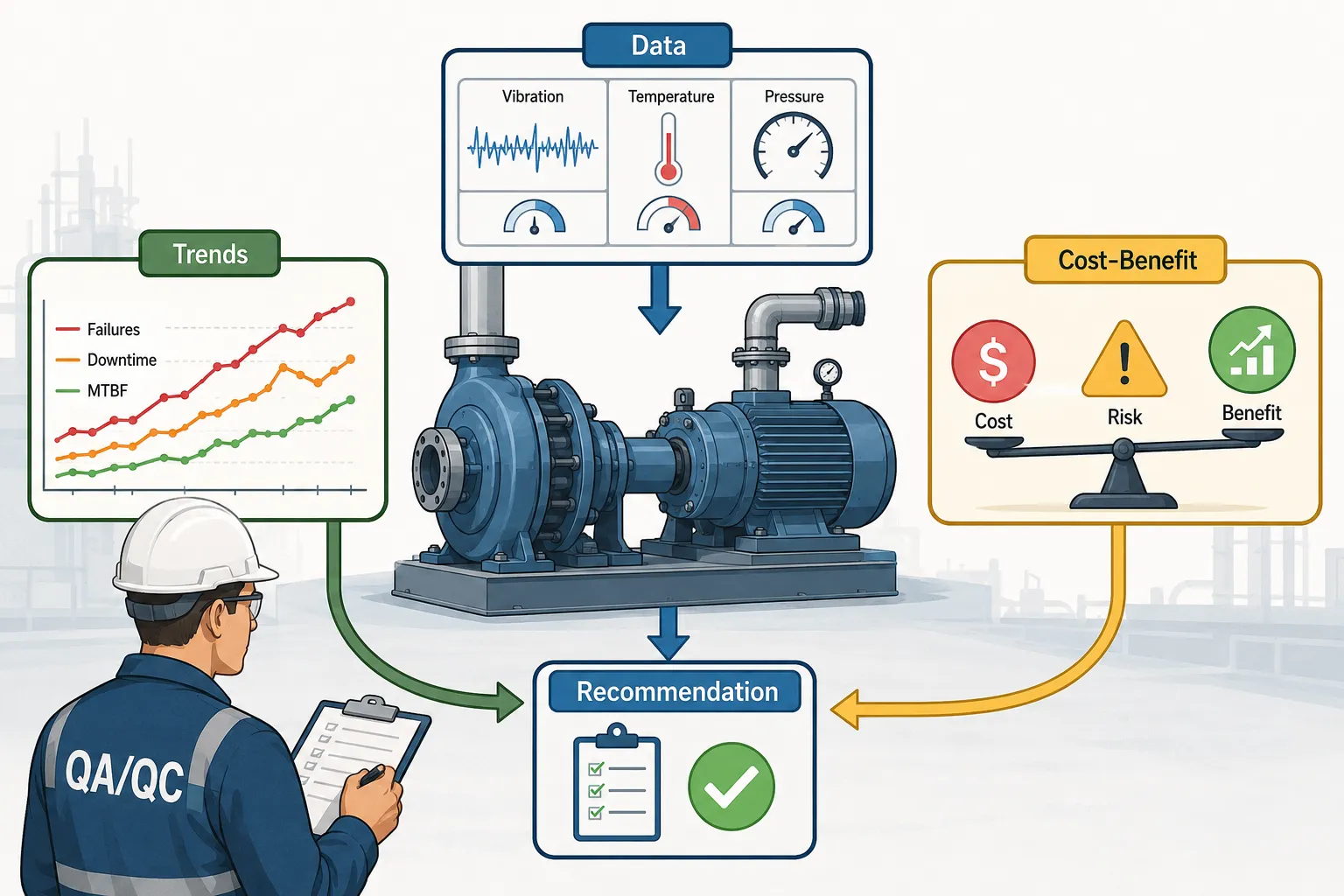
Understanding Strategic Maintenance
Strategic maintenance is the planned management of maintenance activities to achieve defined asset-performance objectives over the equipment lifecycle. It moves beyond simply repairing equipment after failure and considers how maintenance resources should be allocated according to equipment criticality, failure behaviour, operating conditions, risk, cost, and reliability requirements.
A strategic maintenance system may combine:
Preventive maintenance.
Predictive maintenance.
Condition-based maintenance.
Corrective maintenance.
Reliability-centred strategies.
Inspection programmes.
Lubrication management.
Calibration management.
Asset integrity controls.
Root cause analysis.
Performance monitoring.
Continual improvement.
The appropriate combination depends on the characteristics and criticality of the equipment.
Strategic Quality Control
Quality control supports mechanical system performance by verifying that products, components, materials, fabrication activities, installation work, and testing meet defined requirements.
Strategic quality control may include:
Incoming material inspection.
Dimensional verification.
Welding inspection.
Non-destructive testing.
Pressure testing.
Functional testing.
Equipment calibration.
Inspection and test plans.
NCR analysis.
Supplier quality monitoring.
Process performance monitoring.
Final inspection.
Documentation and traceability.
The strategic objective is to prevent defects from progressing into later stages where correction becomes more expensive and disruptive.
Key Definitions and Concepts
| Term | Definition | Mechanical Engineering Application |
|---|---|---|
| Strategic Maintenance | Long-term maintenance planning based on risk, reliability and asset objectives | Developing maintenance strategies for critical rotating equipment |
| Quality Control | Activities used to verify conformity with specified requirements | Inspection and testing of fabricated mechanical components |
| Historical Trend | Pattern identified from data collected over time | Increasing vibration or recurring equipment failures |
| Engineering Data | Technical information describing equipment or process performance | Pressure, temperature, vibration and inspection results |
| Reliability | Probability that equipment performs its required function for a specified period | Reliable operation of pumps or compressors |
| Availability | Proportion of time equipment is capable of performing its function | Production equipment uptime |
| Failure Rate | Frequency at which equipment or components fail | Bearing or seal failure frequency |
| Mean Time Between Failures | Average operating time between failures | Comparing reliability of similar machines |
| Mean Time To Repair | Average time required to restore equipment | Measuring maintenance responsiveness |
| Condition Monitoring | Monitoring equipment condition to identify deterioration | Vibration and temperature monitoring |
| Preventive Maintenance | Planned maintenance performed at defined intervals or conditions | Scheduled bearing and lubrication activities |
| Predictive Maintenance | Maintenance based on indicators of developing failure | Vibration-based bearing intervention |
| Cost-Benefit Analysis | Comparison of expected benefits against associated costs | Evaluating predictive monitoring investment |
| Lifecycle Cost | Total cost associated with an asset over its useful life | Acquisition, maintenance, operation and replacement costs |
| NCR | Formal record of non-conforming work, material or process | Recording repeated fabrication defects |
| Root Cause | Fundamental cause responsible for an identified problem | Incorrect installation causing recurring failures |
| Criticality | Significance of an asset based on consequence and risk | Prioritising maintenance for essential equipment |
| Mechanical Integrity | Ability of mechanical equipment to remain safe and functional | Maintaining pressure containment and structural performance |
The Importance of Engineering Data
Engineering data provides objective evidence for decision-making. Without reliable information, maintenance recommendations may depend excessively on personal experience or assumptions.
Relevant engineering data can include:
Vibration amplitude and frequency.
Bearing temperature.
Lubricant condition.
Pressure trends.
Flow rates.
Equipment operating hours.
Leakage observations.
Alignment measurements.
Dimensional inspection results.
Welding defect rates.
Pressure-test results.
Failure frequency.
Repair duration.
Maintenance expenditure.
Equipment availability.
The value of data increases when information from different sources is combined.
For example:
Vibration increase + bearing temperature increase + repeated bearing replacement = potential developing reliability problem
This is more informative than considering each indicator separately.
Data Quality and Reliability
A recommendation is only as reliable as the evidence supporting it.
Engineering data should therefore be reviewed for:
Accuracy.
Completeness.
Consistency.
Traceability.
Timeliness.
Measurement reliability.
Calibration status.
Appropriate sampling.
Correct equipment identification.
Poor-quality data can lead to incorrect conclusions.
For example, a sudden change in vibration readings may represent genuine equipment deterioration, but it could also result from:
Incorrect sensor placement.
Faulty instrumentation.
Uncalibrated equipment.
Incorrect measurement conditions.
Data-entry errors.
The professional must distinguish actual equipment behaviour from measurement error.
Historical Performance Trends
Single data points rarely provide sufficient evidence for strategic recommendations. Historical trends provide greater insight into how mechanical systems behave over time.
Trend analysis can identify:
Gradual deterioration.
Seasonal performance changes.
Recurring failures.
Increasing maintenance demand.
Improving reliability.
Repeated quality defects.
Changes after process modifications.
A trend becomes particularly significant when several independent indicators support the same conclusion.
Example of Trend Analysis
Suppose a pump shows the following pattern:
| Period | Vibration | Bearing Temperature | Bearing Replacements |
|---|---|---|---|
| Q1 | Stable | Stable | 1 |
| Q2 | Increasing | Slightly increasing | 2 |
| Q3 | High | Increasing | 3 |
| Q4 | Very high | High | 5 |
The combined trend suggests deterioration rather than isolated failure.
A strategic recommendation could include:
Detailed condition assessment.
Alignment verification.
Bearing analysis.
Lubrication review.
Operating-condition review.
Root cause investigation.
Using Failure History
Historical failure information is valuable when determining maintenance priorities.
Failure records should be analysed for:
Failure mode.
Failure frequency.
Equipment type.
Operating hours.
Operating conditions.
Maintenance history.
Repair method.
Component replacement.
Recurrence after repair.
Recurring failures require particular attention because repeated corrective maintenance may be treating symptoms rather than causes.
Failure Mode Analysis
Common mechanical failure modes may include:
Bearing deterioration.
Seal failure.
Misalignment.
Excessive vibration.
Fatigue cracking.
Corrosion.
Wear.
Leakage.
Fastener failure.
Lubrication problems.
Thermal deterioration.
The appropriate maintenance strategy depends on the failure mechanism.
Equipment Criticality
Not all equipment should receive identical maintenance resources.
Criticality assessment may consider:
Safety consequence.
Environmental consequence.
Production impact.
Repair cost.
Replacement availability.
Failure probability.
Detection capability.
Redundancy.
High-criticality equipment generally requires stronger monitoring and maintenance controls.
Strategic Maintenance Selection
Different maintenance approaches can be appropriate for different equipment.
Preventive Maintenance
Useful where deterioration follows reasonably predictable patterns.
Examples include:
Scheduled lubrication.
Planned component replacement.
Periodic inspection.
Routine alignment checks.
Predictive Maintenance
Useful where condition indicators can identify deterioration before failure.
Examples include:
Vibration monitoring.
Thermal monitoring.
Oil analysis.
Performance trending.
Condition-Based Maintenance
Maintenance is initiated according to measured equipment condition rather than simply elapsed time.
Corrective Maintenance
Appropriate where failure consequences are low or where immediate correction is the most suitable strategy.
Selecting the Appropriate Strategy
The decision should consider:
Failure behaviour.
Criticality.
Monitoring capability.
Maintenance cost.
Failure consequences.
Equipment redundancy.
Availability requirements.
Historical performance.
No single maintenance strategy is universally appropriate.
Quality Data as a Maintenance Input
Quality-control information can reveal conditions that later influence reliability.
Examples include:
Recurring welding defects.
Dimensional deviations.
Material inconsistencies.
Alignment problems.
Poor surface preparation.
Installation defects.
Repeated NCRs.
These records should not remain isolated within the QA/QC department. They can provide valuable information for maintenance and reliability management.
Connecting NCRs with Equipment Reliability
Suppose the same fabricated component repeatedly develops weld-related defects.
The organisation may initially treat each NCR individually.
However, trend analysis may reveal:
Repeated NCRs → Recurring process problem → Component weakness → Increased failure potential
A strategic recommendation may therefore focus on:
Fabrication procedure review.
Welder competency.
Welding parameter control.
Material control.
Inspection improvement.
Root cause analysis.
Cost-Benefit Analysis
Cost-benefit analysis compares the expected cost of an intervention with its potential financial and operational benefits.
Costs may include:
Equipment.
Personnel.
Training.
Software.
Monitoring systems.
Planned downtime.
Specialist services.
Replacement components.
Benefits may include:
Reduced failures.
Lower emergency maintenance.
Reduced downtime.
Improved equipment availability.
Reduced rework.
Increased production.
Improved safety.
Extended asset life.
Direct and Indirect Costs
Direct costs are relatively easy to identify.
Examples:
Spare parts.
Labour.
Inspection equipment.
Contractor services.
Indirect costs may include:
Lost production.
Delayed deliveries.
Customer dissatisfaction.
Emergency logistics.
Additional engineering resources.
Reputation impact.
Strategic decisions should consider both.
Example of Cost-Benefit Analysis
A facility considers installing vibration monitoring on critical rotating equipment.
Estimated annual cost
Monitoring equipment: £20,000.
Installation: £8,000.
Training: £4,000.
Annual monitoring support: £8,000.
Total initial and first-year expenditure:
£40,000
Historical failures indicate that a major equipment failure typically costs approximately:
Emergency repair: £25,000.
Production loss: £40,000.
Specialist support: £10,000.
Potential failure consequence:
£75,000
If monitoring has a credible probability of preventing or reducing a major failure, the investment may have a strong business case.
The final recommendation should nevertheless be supported by actual equipment criticality, failure history, monitoring capability, and technical evidence.
Return on Investment
A simplified ROI calculation can be used:
ROI = (Financial Benefit − Investment Cost) ÷ Investment Cost × 100
For example, if an improvement costs £50,000 and produces verified annual benefits of £80,000:
ROI = (£80,000 − £50,000) ÷ £50,000 × 100 = 60%
ROI should not be the only decision criterion where safety or mechanical integrity is involved.
Payback Period
Payback period estimates how long it takes for an investment to recover its initial cost.
Payback Period = Initial Investment ÷ Annual Benefit
If a reliability programme costs £60,000 and generates £30,000 annual savings:
Payback Period = 2 years
Again, financial return should be considered alongside technical and safety risk.
Risk-Adjusted Cost-Benefit Analysis
A stronger approach considers the probability of failure.
For example:
Expected Loss = Probability of Failure × Consequence of Failure
Suppose:
Probability of major failure = 10%.
Consequence = £200,000.
Expected loss:
0.10 × £200,000 = £20,000
If a maintenance improvement costs £12,000 and substantially reduces this risk, the intervention may have a strong economic justification.
Using Total Cost of Ownership
Strategic maintenance decisions should consider the entire lifecycle rather than only immediate expenditure.
Lifecycle costs can include:
Acquisition.
Installation.
Commissioning.
Energy consumption.
Maintenance.
Inspection.
Spare parts.
Downtime.
Repairs.
Replacement.
Disposal.
A cheaper component may become more expensive over its lifecycle if it fails frequently or requires intensive maintenance.
Maintenance Cost Trends
Increasing maintenance expenditure may indicate:
Equipment ageing.
Poor operating conditions.
Weak maintenance strategy.
Recurring failures.
Poor installation.
Inadequate quality control.
However, higher expenditure is not automatically negative.
Investment in proactive maintenance can reduce future failure costs.
The important question is:
What performance is being obtained from the maintenance expenditure?
Maintenance Effectiveness
Maintenance performance can be evaluated through:
Equipment availability.
Failure frequency.
Mean time between failures.
Mean time to repair.
Planned versus unplanned maintenance.
Repeat failures.
Maintenance backlog.
Emergency work percentage.
Mean Time Between Failures
MTBF provides an indication of reliability.
A simplified calculation is:
MTBF = Total Operating Time ÷ Number of Failures
If equipment operates for 4,000 hours and experiences 4 relevant failures:
MTBF = 1,000 hours
An increasing MTBF may indicate improving reliability.
Mean Time To Repair
MTTR measures how quickly equipment can be restored.
MTTR = Total Repair Time ÷ Number of Repairs
Lower MTTR can indicate improved maintenance efficiency, provided repairs remain technically effective.
Availability
Availability is influenced by both reliability and maintainability.
A simplified relationship is:
Availability ≈ MTBF ÷ (MTBF + MTTR)
Improving reliability and reducing repair duration can therefore improve overall availability.
Practical Data Analysis Process
Step 1: Define the Engineering Problem
Identify the issue requiring a recommendation.
Step 2: Collect Relevant Data
Gather:
Inspection records.
Failure records.
Maintenance history.
Operating data.
Quality information.
Cost information.
Step 3: Verify Data Quality
Check:
Accuracy.
Completeness.
Calibration.
Traceability.
Equipment identification.
Step 4: Analyse Trends
Identify:
Recurring failures.
Deterioration.
Process variation.
Cost trends.
Step 5: Identify Root Causes
Determine whether problems originate from:
Design.
Material.
Fabrication.
Installation.
Operation.
Maintenance.
Human factors.
Step 6: Develop Alternatives
Create multiple technically feasible strategies.
Step 7: Assess Risk
Evaluate safety, quality, reliability and operational consequences.
Step 8: Conduct Cost-Benefit Analysis
Compare costs with expected benefits.
Step 9: Recommend an Option
Select the most appropriate evidence-based strategy.
Step 10: Monitor Results
Verify whether the recommendation delivers the intended outcome.
Practical Example: Pump Reliability
A production facility experiences repeated pump failures.
Historical data show:
Increasing bearing failures.
Rising vibration.
Increased maintenance expenditure.
Longer downtime.
Repeated seal replacement.
Analysis
The data suggest that replacing seals alone may not address the underlying problem.
Further investigation considers:
Alignment.
Operating conditions.
Lubrication.
Vibration.
Installation quality.
Recommendation
A condition-monitoring programme combined with alignment verification and improved maintenance planning is considered.
Expected Benefits
Earlier fault detection.
Reduced emergency repairs.
Improved availability.
Lower repeat failure frequency.
Better maintenance planning.
Practical Example: Repeated Welding Defects
A fabrication facility experiences recurring weld repairs.
Historical QA/QC data show that defects are concentrated within one production process.
The team analyses:
Weld type.
Defect category.
Operator.
Material.
Procedure.
Equipment.
Inspection results.
The analysis identifies a recurring process-control weakness.
Recommendation
Instead of increasing final inspection alone, the organisation improves:
Process control.
Welding parameter monitoring.
Competency assurance.
In-process inspection.
Root cause analysis.
This approach addresses the source of the problem rather than simply detecting defects later.
Practical Example: Heat Exchanger Performance
A heat exchanger gradually experiences reduced performance.
Historical data indicate:
Increasing temperature differential.
Increasing pressure drop.
More frequent cleaning.
Reduced process efficiency.
A strategic recommendation may involve:
Condition monitoring.
Fouling analysis.
Inspection frequency review.
Cleaning optimisation.
Operating-condition assessment.
The decision should compare the cost of intervention against energy losses and potential production consequences.
Practical Example: Compressor Reliability
A compressor shows increasing vibration and higher maintenance costs.
The engineering team evaluates:
Vibration spectrum.
Operating hours.
Bearing history.
Alignment records.
Lubrication data.
Previous repairs.
A cost-benefit analysis compares:
Continue reactive maintenance.
Increase preventive inspection.
Introduce condition monitoring.
Undertake major planned maintenance.
The preferred option should be based on reliability improvement, risk reduction, lifecycle cost and operational requirements.
Integrating QA and Maintenance Data
One of the strongest strategic approaches is integrating quality and maintenance information.
For example:
Fabrication NCR → Installation defect → Equipment deterioration → Maintenance event
Without integrated data, each department may see only part of the problem.
Integrated analysis can identify systemic issues.
Using Dashboards
A mechanical performance dashboard can display:
Availability.
Failure frequency.
MTBF.
MTTR.
NCR trends.
Rework.
Inspection completion.
Maintenance backlog.
Critical equipment status.
Dashboards help management identify emerging problems quickly.
Leading and Lagging Indicators
Leading Indicators
These can provide early warnings.
Examples:
Inspection completion.
Calibration status.
Preventive maintenance completion.
Condition-monitoring alerts.
Training status.
Outstanding corrective actions.
Lagging Indicators
These show outcomes.
Examples:
Equipment failures.
NCRs.
Downtime.
Rework.
Customer complaints.
Using both types provides stronger strategic insight.
Benefits of Evidence-Based Recommendations
Safety Benefits
Earlier detection of deterioration.
Reduced equipment failure risk.
Better control of critical assets.
Improved maintenance planning.
Quality Benefits
Reduced recurring defects.
Better process control.
Improved traceability.
Reduced rework.
Reliability Benefits
Increased availability.
Longer asset life.
Fewer unexpected failures.
Better equipment performance.
Financial Benefits
Reduced emergency maintenance.
Lower downtime costs.
Better resource allocation.
Improved lifecycle economics.
Operational Benefits
Better planning.
Improved production continuity.
More predictable maintenance.
Improved decision-making.
Common Errors in Strategic Recommendations
Professionals should avoid:
Relying on a single data point.
Ignoring historical trends.
Using poor-quality data.
Considering only direct costs.
Ignoring downtime costs.
Selecting the cheapest option automatically.
Ignoring equipment criticality.
Treating recurring failures as isolated events.
Focusing exclusively on production output.
Ignoring safety consequences.
Failing to monitor recommendations after implementation.
Building a Strong Recommendation
A professional recommendation should clearly explain:
The Problem
What is happening?
The Evidence
What data demonstrate the problem?
The Trend
Is the issue increasing, decreasing or recurring?
The Risk
What could happen if nothing changes?
The Options
What technically feasible alternatives exist?
The Cost
What will each option require?
The Benefit
What measurable improvement is expected?
The Recommendation
Which option provides the strongest overall outcome?
The Verification
How will effectiveness be measured?
Recommended Strategic Decision Framework
Data → Trend → Risk → Alternatives → Cost-Benefit → Recommendation → Implementation → Monitoring
This framework helps prevent decisions based solely on intuition.
Case Study: Strategic Maintenance Recommendation for Critical Rotating Equipment
Background
A manufacturing facility operates several critical pumps supporting continuous production. One pump has experienced repeated bearing and seal failures over an 18-month period.
The maintenance department initially responds through component replacement.
Historical Evidence
The records show:
Increasing bearing replacement frequency.
Increasing vibration levels.
Higher maintenance costs.
More unplanned downtime.
Repeated seal replacement.
Increasing maintenance hours.
Initial Strategy
The existing approach is predominantly reactive.
When a failure occurs, components are replaced and the equipment is returned to service.
Engineering Analysis
The QA/QC and maintenance teams analyse:
Vibration trends.
Alignment records.
Lubrication history.
Operating conditions.
Previous failure reports.
Installation records.
Maintenance expenditure.
The evidence indicates that recurring component replacement is not addressing the underlying deterioration mechanism.
Alternative 1: Continue Reactive Maintenance
Advantages:
Low immediate investment.
Familiar process.
No major system change.
Disadvantages:
Continued unplanned failures.
High downtime exposure.
Repeated repair costs.
Increased operational uncertainty.
Alternative 2: Increase Preventive Maintenance
Advantages:
Better planned intervention.
Reduced probability of some failures.
Moderate implementation cost.
Disadvantages:
May still miss rapidly developing faults.
Requires planned downtime.
Alternative 3: Introduce Condition Monitoring
Advantages:
Earlier detection.
Trend-based intervention.
Better failure prediction.
Improved maintenance planning.
Disadvantages:
Initial investment.
Training requirements.
Monitoring system management.
Cost-Benefit Evaluation
Historical records show that each major failure results in substantial repair and production losses.
The organisation compares:
Monitoring cost.
Training cost.
Planned maintenance cost.
Expected avoided failures.
Reduced downtime.
Improved equipment life.
The analysis indicates that condition monitoring combined with targeted preventive maintenance provides the strongest long-term value.
Recommendation
The recommended strategy is to introduce:
Routine vibration monitoring.
Defined alarm thresholds.
Trend analysis.
Alignment verification.
Lubrication control.
Targeted preventive maintenance.
Periodic review of failure data.
Performance Measures
Effectiveness should be monitored through:
MTBF.
MTTR.
Unplanned downtime.
Bearing failure frequency.
Seal failure frequency.
Maintenance expenditure.
Equipment availability.
Case Study Outcome
The recommendation demonstrates how engineering data, historical trends, risk assessment, and cost-benefit analysis can support a defensible strategic maintenance decision. Rather than repeatedly correcting failures after they occur, the organisation moves towards proactive performance management.
Strategic Quality Control Recommendation Case Study
Background
A mechanical fabrication facility records recurring dimensional NCRs on fabricated assemblies.
Data Review
Historical records show that:
Most defects occur during one fabrication stage.
Rework increases project duration.
Final inspection detects the majority of defects.
The same defect category occurs repeatedly.
Analysis
The issue is not simply an inspection problem. It indicates a process-control weakness.
Strategic Options
Increase final inspection.
Add additional inspectors.
Improve in-process verification.
Review fabrication procedures.
Improve measurement controls.
Analyse root causes.
Recommended Strategy
The strongest approach combines:
Earlier dimensional verification.
Process monitoring.
Improved measurement control.
Operator competency.
Root cause analysis.
Trend monitoring.
Expected Outcome
The organisation should aim to reduce defects at source rather than increasing inspection after the defect has already been produced.
Monitoring Recommendation Effectiveness
Implementation is not the end of the process.
The organisation should establish review intervals and performance indicators.
Useful questions include:
Has failure frequency changed?
Has equipment availability improved?
Has rework decreased?
Have NCRs reduced?
Has maintenance cost changed?
Has safety performance remained stable?
Has mechanical reliability improved?
Are the expected financial benefits being achieved?
Continual Improvement Cycle
A strategic maintenance and quality system should operate through:
Measure → Analyse → Recommend → Implement → Monitor → Review → Improve
This prevents recommendations from becoming static.
Key Takeaways
Strategic maintenance and QA/QC recommendations should:
Be based on reliable engineering data.
Use historical performance trends.
Consider equipment criticality.
Identify recurring failure patterns.
Integrate quality and maintenance information.
Consider both direct and indirect costs.
Use lifecycle cost thinking.
Apply cost-benefit analysis.
Consider risk and failure consequences.
Compare multiple technically feasible alternatives.
Protect worker safety.
Preserve mechanical integrity.
Monitor implementation results.
Use measurable KPIs.
Address root causes rather than symptoms.
Support continuous improvement.
Conclusion
Strategic maintenance and quality control recommendations become significantly more effective when they are supported by reliable engineering data, historical performance trends, risk analysis, and structured cost-benefit evaluation. Mechanical equipment generates valuable information throughout its lifecycle, and this information can be used to identify deterioration, recurring failures, process weaknesses, maintenance inefficiencies, and emerging reliability risks. By combining inspection records, condition-monitoring information, failure history, maintenance data, NCR trends, operating parameters, and financial information, QA/QC and engineering professionals can develop recommendations that are technically defensible and commercially realistic.
The strongest recommendation is not necessarily the option with the lowest immediate cost or the fastest implementation. A strategic decision should consider safety, mechanical integrity, reliability, availability, lifecycle cost, operational continuity, quality performance, and future failure consequences. Cost-benefit analysis helps demonstrate the financial value of improvement, while risk-based assessment ensures that safety-critical and high-consequence issues receive appropriate priority. Historical trends are particularly valuable because they reveal whether an issue is isolated, recurring, or progressively deteriorating.
Ultimately, evidence-based maintenance and quality control create a proactive approach to mechanical asset management. Organisations can move away from repeated reactive repairs and towards predictive, preventive, condition-based, and risk-informed strategies. When recommendations are implemented under controlled processes and monitored through meaningful performance indicators, mechanical systems can achieve improved reliability, reduced downtime, lower rework, stronger quality performance, and more efficient use of maintenance resources. This integrated approach supports operational excellence by ensuring that engineering decisions are based on measurable evidence while protecting safety, mechanical integrity, quality, and long-term asset value.
2: Develop Comprehensive Asset Integrity and Preventive Maintenance Strategies to Maximise the Operational Lifespan of Critical Mechanical Systems
Asset integrity and preventive maintenance are fundamental components of effective mechanical engineering management because the long-term performance of critical equipment depends on maintaining its physical condition, functional capability, reliability, and safety throughout its operational life. Mechanical systems such as pumps, compressors, pressure vessels, piping systems, heat exchangers, turbines, valves, rotating equipment, lifting machinery, and fabricated assemblies can gradually deteriorate because of wear, corrosion, fatigue, vibration, thermal cycling, contamination, poor lubrication, misalignment, operating stresses, and inappropriate maintenance practices. A comprehensive asset integrity strategy provides a structured framework for identifying these deterioration mechanisms, monitoring their development, controlling associated risks, and implementing timely interventions before they develop into serious failures.
Preventive maintenance forms an important part of this strategy because it allows maintenance activities to be planned before equipment reaches an unacceptable condition. However, an effective preventive maintenance programme should not simply apply the same maintenance interval to every asset. Critical mechanical systems require maintenance strategies based on equipment criticality, failure modes, operating conditions, historical performance, manufacturer recommendations, inspection findings, engineering requirements, and the consequences of failure. Excessive maintenance can create unnecessary cost, downtime, component disturbance, and human-error opportunities, while insufficient maintenance can increase failure probability and reduce mechanical integrity. The objective is therefore to establish a balanced, risk-based maintenance programme that provides the appropriate level of intervention at the appropriate time.
For advanced QA/QC and mechanical engineering management, asset integrity extends beyond maintenance activities. It encompasses design assumptions, material selection, procurement quality, fabrication, installation, commissioning, operation, inspection, maintenance, modification, repair, and eventual replacement or retirement. An effective strategy therefore connects quality assurance with reliability engineering, inspection planning, condition monitoring, maintenance management, risk assessment, engineering review, and continual improvement. By maintaining accurate asset records, identifying critical equipment, monitoring deterioration, analysing failure trends, controlling maintenance quality, and reviewing performance indicators, organisations can extend useful equipment life while protecting workers, production processes, mechanical integrity, and long-term operational performance.
Understanding Asset Integrity
Asset integrity refers to the ability of an asset to perform its required function effectively and safely throughout its intended operating life.
For mechanical systems, asset integrity involves maintaining:
- Structural integrity.
- Pressure containment.
- Functional performance.
- Mechanical strength.
- Reliability.
- Availability.
- Safety.
- Maintainability.
- Traceability.
- Compliance with defined requirements.
Asset integrity should be considered throughout the complete lifecycle rather than only when equipment begins to fail.
A typical lifecycle can be represented as:
Design → Procurement → Fabrication → Installation → Commissioning → Operation → Inspection → Maintenance → Modification → Replacement
Each stage can influence future equipment performance.
Understanding Preventive Maintenance
Preventive maintenance involves planned activities undertaken to reduce the probability of equipment failure or deterioration.
Examples include:
- Scheduled lubrication.
- Inspection.
- Cleaning.
- Alignment verification.
- Component replacement.
- Fastener checks.
- Filter replacement.
- Calibration.
- Planned servicing.
- Condition checks.
Preventive maintenance is proactive because it seeks to address deterioration before it results in functional failure.
Asset Integrity and Preventive Maintenance Relationship
Asset integrity establishes the broader objective of maintaining equipment capability, while preventive maintenance provides specific planned interventions that help achieve that objective.
The relationship can be represented as:
Asset Integrity Strategy → Risk Identification → Maintenance Planning → Inspection → Intervention → Performance Monitoring → Improvement
This approach ensures that maintenance activities support wider engineering objectives.
Key Definitions and Concepts
| Term | Definition | Mechanical Engineering Application |
|---|---|---|
| Asset Integrity | Ability of an asset to perform its required function safely throughout its lifecycle | Maintaining pressure equipment and rotating machinery |
| Preventive Maintenance | Planned maintenance intended to reduce failure probability | Scheduled lubrication and inspection |
| Predictive Maintenance | Maintenance based on evidence of developing deterioration | Vibration-based bearing intervention |
| Condition Monitoring | Measurement of equipment condition over time | Monitoring vibration and temperature |
| Asset Criticality | Significance of an asset based on risk and consequences | Prioritising critical compressors |
| Failure Mode | Specific way in which equipment can fail | Bearing seizure or seal leakage |
| Deterioration Mechanism | Process causing equipment condition to decline | Corrosion, wear or fatigue |
| Inspection Interval | Defined period between inspections | Periodic inspection of critical equipment |
| Maintenance Interval | Planned period between maintenance activities | Scheduled lubrication |
| Reliability | Probability that equipment performs its required function | Continuous pump operation |
| Availability | Ability of equipment to remain operational when required | Production equipment uptime |
| Maintainability | Ease and speed with which equipment can be restored | Accessible components and standardised repairs |
| Mechanical Integrity | Ability of mechanical equipment to remain safe and functional | Pressure containment and structural strength |
| Lifecycle | Complete period from design through retirement | Managing equipment from installation to replacement |
| Failure Consequence | Effect resulting from equipment failure | Safety, environmental, production or financial impact |
| Maintenance Backlog | Planned maintenance work that remains outstanding | Overdue inspections and repairs |
| Reliability-Centred Maintenance | Maintenance strategy based on functions, failures and consequences | Selecting maintenance according to failure behaviour |
| Remaining Useful Life | Estimated period before equipment can no longer perform adequately | Planning replacement of ageing equipment |
Why Asset Integrity Management Is Important
Critical mechanical systems often support essential production, safety, utility, and process functions. A failure can have consequences extending far beyond the failed component.
Potential consequences include:
- Production interruption.
- Worker injury.
- Loss of containment.
- Equipment damage.
- Environmental impact.
- Emergency repair.
- Customer disruption.
- Increased maintenance costs.
- Reduced operational reliability.
An asset integrity strategy seeks to prevent these outcomes through systematic control.
Identifying Critical Mechanical Assets
Not all assets require the same level of management.
Criticality assessment should consider:
- Safety consequences.
- Production consequences.
- Environmental consequences.
- Failure probability.
- Repair difficulty.
- Replacement availability.
- Redundancy.
- Operating conditions.
- Failure history.
- Regulatory or contractual importance.
High-criticality assets generally require stronger inspection, monitoring and maintenance controls.
Asset Criticality Classification
A practical classification may include:
Critical Assets
Failure could result in significant safety, production, environmental or integrity consequences.
Important Assets
Failure could cause substantial operational disruption but may have lower consequences than critical assets.
Routine Assets
Failure has limited consequences and can usually be managed through standard maintenance arrangements.
This classification helps direct resources where they provide the greatest risk reduction.
Asset Register
A comprehensive asset register should provide controlled information about equipment.
Relevant information may include:
- Asset identification.
- Equipment type.
- Manufacturer.
- Model.
- Serial number.
- Installation date.
- Design parameters.
- Operating parameters.
- Criticality classification.
- Maintenance history.
- Inspection history.
- Failure history.
- Spare-parts information.
- Current condition.
- Applicable procedures.
Accurate asset records support informed maintenance decisions.
Understanding Deterioration Mechanisms
Mechanical equipment can deteriorate through different mechanisms.
Common mechanisms include:
- Corrosion.
- Erosion.
- Wear.
- Fatigue.
- Thermal cycling.
- Vibration.
- Misalignment.
- Lubrication failure.
- Material degradation.
- Cavitation.
- Leakage.
- Overloading.
- Contamination.
Each deterioration mechanism requires appropriate controls.
Corrosion Management
Corrosion can reduce material thickness and mechanical strength.
Asset integrity strategies may include:
- Regular inspection.
- Thickness measurements.
- Corrosion monitoring.
- Surface protection.
- Material selection.
- Environmental control.
- Cleaning.
- Repair planning.
Maintenance intervals should reflect observed corrosion rates and equipment criticality.
Wear Management
Mechanical wear can occur in:
- Bearings.
- Gears.
- Shafts.
- Seals.
- Bushes.
- Couplings.
- Sliding surfaces.
Wear monitoring can involve:
- Visual inspection.
- Dimensional measurements.
- Vibration analysis.
- Lubricant analysis.
- Temperature monitoring.
Fatigue Management
Repeated cyclic loading can contribute to fatigue damage.
Potential controls include:
- Inspection of critical areas.
- Monitoring operating conditions.
- Identifying stress concentrations.
- Reviewing vibration.
- Controlling overload.
- Appropriate repair strategies.
Vibration Management
Excessive vibration can indicate:
- Misalignment.
- Imbalance.
- Bearing deterioration.
- Looseness.
- Mechanical resonance.
- Foundation problems.
A condition-monitoring programme can identify changes before catastrophic failure occurs.
Lubrication Management
Lubrication is essential for many mechanical systems.
A lubrication strategy should control:
- Correct lubricant type.
- Quantity.
- Application method.
- Frequency.
- Contamination.
- Storage.
- Handling.
- Condition monitoring.
Incorrect lubrication can accelerate equipment deterioration.
Preventive Maintenance Programme Design
A comprehensive preventive maintenance programme should identify:
- What equipment requires maintenance.
- What maintenance is required.
- Why the maintenance is required.
- Who performs it.
- When it should occur.
- What resources are needed.
- What evidence must be recorded.
- What acceptance criteria apply.
This creates consistency across maintenance activities.
Maintenance Interval Selection
Maintenance intervals should not be selected solely because they are traditional.
They should consider:
- Manufacturer information.
- Historical failures.
- Operating conditions.
- Equipment criticality.
- Inspection results.
- Condition-monitoring data.
- Failure mechanisms.
- Maintenance effectiveness.
If evidence demonstrates that a fixed interval is inappropriate, the strategy should be reviewed.
Time-Based Preventive Maintenance
Time-based maintenance occurs at predefined intervals.
Examples include:
- Monthly lubrication.
- Quarterly inspection.
- Annual servicing.
- Scheduled component replacement.
It is appropriate where deterioration is reasonably predictable.
Condition-Based Maintenance
Condition-based maintenance uses equipment condition to determine when intervention is necessary.
Examples include:
- Vibration exceeding defined thresholds.
- Increasing bearing temperature.
- Deteriorating lubricant condition.
- Increasing leakage.
- Reduced equipment performance.
This approach can prevent unnecessary maintenance.
Predictive Maintenance
Predictive maintenance uses condition information and trend analysis to estimate developing failures.
Techniques can include:
- Vibration analysis.
- Thermal monitoring.
- Oil analysis.
- Ultrasound.
- Performance trending.
- Condition sensors.
Predictive approaches can provide early warning and improve maintenance planning.
Reliability-Centred Maintenance
Reliability-centred maintenance focuses on the functions of equipment, how those functions can fail, the causes of failure, and the consequences.
A simplified process involves:
Define Function → Identify Failure → Analyse Consequence → Select Control → Monitor Performance
This helps prevent inappropriate maintenance strategies.
Failure Mode Analysis
Maintenance planning should consider likely failure modes.
Examples include:
| Equipment | Potential Failure Mode | Possible Control |
|---|---|---|
| Pump | Bearing failure | Vibration monitoring |
| Compressor | Seal leakage | Condition inspection |
| Gearbox | Gear wear | Oil analysis |
| Valve | Leakage | Functional testing |
| Heat exchanger | Fouling | Performance monitoring |
| Fan | Imbalance | Vibration analysis |
| Piping | Corrosion | Thickness inspection |
The maintenance strategy should be matched to the actual failure mechanism.
Developing an Asset Integrity Strategy
Step 1: Identify Assets
Establish a complete asset register.
Step 2: Classify Criticality
Rank assets according to risk and consequences.
Step 3: Identify Failure Modes
Determine how each critical asset can deteriorate.
Step 4: Identify Existing Controls
Review current maintenance and inspection arrangements.
Step 5: Assess Gaps
Identify weaknesses in:
- Inspection.
- Maintenance.
- Monitoring.
- Documentation.
- Competence.
- Spare parts.
Step 6: Develop Maintenance Strategies
Select appropriate preventive, predictive and condition-based controls.
Step 7: Establish Intervals
Set evidence-based inspection and maintenance frequencies.
Step 8: Define Responsibilities
Identify responsible personnel.
Step 9: Establish KPIs
Monitor performance.
Step 10: Review and Improve
Use performance data to continually refine the strategy.
Maintenance Quality Control
Preventive maintenance itself must be subject to quality control.
A maintenance activity can create new problems if performed incorrectly.
Potential maintenance errors include:
- Incorrect component installation.
- Incorrect torque.
- Poor alignment.
- Wrong lubricant.
- Incorrect clearance.
- Incomplete inspection.
- Incorrect calibration.
- Poor documentation.
Therefore, maintenance quality should be controlled through procedures, competence, verification and records.
Maintenance Procedures
A controlled maintenance procedure should describe:
- Scope.
- Equipment identification.
- Required tools.
- Required materials.
- Safety precautions.
- Isolation requirements.
- Inspection requirements.
- Maintenance sequence.
- Acceptance criteria.
- Testing.
- Documentation.
- Restoration requirements.
Competence Management
Maintenance quality depends heavily on workforce competence.
Personnel may require competence in:
- Mechanical inspection.
- Alignment.
- Lubrication.
- Testing.
- Equipment assembly.
- Condition monitoring.
- Fault diagnosis.
- Documentation.
Competence should be matched to equipment criticality.
Spare Parts Strategy
Asset integrity can be compromised when critical spare parts are unavailable.
Spare-parts planning should consider:
- Criticality.
- Lead time.
- Failure frequency.
- Storage conditions.
- Manufacturer requirements.
- Interchangeability.
- Obsolescence.
Critical components may require controlled strategic stock.
Maintenance Backlog Management
A large maintenance backlog can indicate:
- Insufficient resources.
- Poor planning.
- Inappropriate intervals.
- Equipment access problems.
- Weak prioritisation.
Backlog should be prioritised according to:
- Safety.
- Integrity.
- Reliability.
- Production impact.
- Regulatory importance.
Deferred Maintenance
Not all deferred work carries the same risk.
Before deferring maintenance, assess:
- Equipment criticality.
- Failure probability.
- Failure consequence.
- Current condition.
- Existing controls.
- Alternative monitoring.
High-risk maintenance should not be deferred without appropriate technical assessment and authorisation.
Condition Monitoring Programme
A condition-monitoring programme should define:
- Equipment monitored.
- Parameters measured.
- Measurement frequency.
- Equipment used.
- Alarm thresholds.
- Responsibilities.
- Escalation requirements.
- Data storage.
- Review frequency.
Example: Vibration Monitoring
A rotating pump shows gradually increasing vibration.
Rather than waiting for failure, the organisation:
- Records the trend.
- Reviews operating conditions.
- Confirms measurement reliability.
- Investigates likely causes.
- Plans intervention.
- Verifies the repair.
- Continues monitoring.
This approach reduces the likelihood of unexpected failure.
Inspection Planning
Asset integrity inspection should be risk-based.
Inspection planning may consider:
- Equipment criticality.
- Deterioration rate.
- Previous findings.
- Operating conditions.
- Failure consequences.
- Accessibility.
- Inspection effectiveness.
Inspection Results and Maintenance Strategy
Inspection findings should directly influence maintenance planning.
For example:
Increasing corrosion rate → Reduced inspection interval → Planned repair → Updated integrity assessment
This creates a feedback loop between inspection and maintenance.
Integration with QA/QC
Asset integrity and QA/QC should operate together.
QA/QC contributes:
- Material traceability.
- Fabrication quality.
- Inspection records.
- Testing results.
- NCR analysis.
- Supplier quality.
- Installation verification.
Maintenance contributes:
- Failure data.
- Condition information.
- Repair history.
- Equipment performance.
Together they provide a stronger asset-performance picture.
Practical Example: Critical Pump
A critical pump operates continuously in a production facility.
Initial Situation
The pump has experienced:
- Repeated bearing failures.
- Increasing vibration.
- Higher maintenance costs.
- Unplanned downtime.
Asset Integrity Review
The organisation classifies the pump as high criticality.
The team analyses:
- Failure history.
- Operating conditions.
- Lubrication.
- Alignment.
- Vibration.
Strategy
The revised programme introduces:
- Regular vibration monitoring.
- Alignment checks.
- Controlled lubrication.
- Planned bearing inspection.
- Trend analysis.
- Defined intervention criteria.
Expected Result
The strategy aims to:
- Detect deterioration earlier.
- Reduce unexpected failures.
- Improve availability.
- Extend component life.
Practical Example: Pressure Vessel
A pressure vessel requires ongoing integrity management.
The strategy may include:
- Visual inspection.
- Thickness measurement.
- Corrosion monitoring.
- Pressure-related checks.
- Condition documentation.
- Repair planning.
The inspection frequency should reflect equipment condition, deterioration mechanisms, criticality and applicable requirements.
Practical Example: Gearbox
A gearbox experiences recurring failures.
The organisation reviews:
- Lubricant condition.
- Vibration.
- Gear wear.
- Operating load.
- Alignment.
- Previous repairs.
Instead of simply replacing gears after failure, the organisation develops a proactive maintenance strategy based on condition monitoring and root cause analysis.
Practical Example: Heat Exchanger
A heat exchanger experiences declining performance.
Data show:
- Increasing pressure drop.
- Reduced heat transfer.
- More frequent cleaning.
The integrity strategy considers:
- Fouling.
- Corrosion.
- Tube condition.
- Operating conditions.
- Inspection findings.
Maintenance is then planned around actual equipment condition.
Asset Integrity Risk Assessment
A risk assessment should consider:
Probability
How likely is failure?
Consequence
What happens if failure occurs?
Detectability
Can deterioration be detected before failure?
Existing Controls
What controls already exist?
Residual Risk
What risk remains after controls?
This helps determine appropriate maintenance intensity.
Risk-Based Maintenance Prioritisation
High-risk assets may require:
- More frequent monitoring.
- More detailed inspection.
- Greater documentation.
- Specialist personnel.
- Additional condition monitoring.
Lower-risk assets may be managed through standard preventive maintenance.
Performance Indicators
Asset integrity strategies should use measurable KPIs.
Examples include:
- Equipment availability.
- MTBF.
- MTTR.
- Unplanned downtime.
- Preventive maintenance completion.
- Predictive maintenance alerts.
- Repeat failures.
- Maintenance backlog.
- NCR frequency.
- Inspection findings.
- Leakage incidents.
- Failure frequency.
Maintenance Effectiveness Indicators
A preventive maintenance programme should be reviewed to determine whether it actually improves reliability.
Useful questions include:
- Are failures decreasing?
- Is equipment availability improving?
- Is maintenance becoming more planned?
- Are repeat failures declining?
- Is emergency work reducing?
- Is asset life improving?
Avoiding Over-Maintenance
More maintenance does not automatically mean better maintenance.
Excessive intervention can create:
- Higher cost.
- Increased downtime.
- Component disturbance.
- Human error.
- Unnecessary replacement.
- Increased maintenance workload.
Maintenance frequency should therefore be evidence-based.
Avoiding Under-Maintenance
Insufficient maintenance can result in:
- Progressive deterioration.
- Increased failure probability.
- Reduced mechanical integrity.
- Higher emergency repair costs.
- Safety consequences.
The objective is balance.
Maintenance Optimisation
Maintenance optimisation can be represented as:
Criticality + Failure Mode + Condition + History + Cost + Risk → Maintenance Strategy
This provides a more sophisticated approach than fixed maintenance intervals.
Asset Integrity Documentation
Controlled documentation should include:
- Asset register.
- Maintenance plans.
- Inspection records.
- Condition-monitoring data.
- Failure reports.
- Repair records.
- Calibration records.
- NCRs.
- Technical assessments.
- Change-control records.
Accurate documentation supports traceability and future decision-making.
Management of Change
Changes to equipment, operating conditions, maintenance strategy or inspection frequency should be controlled.
Change assessment should consider:
- Technical impact.
- Safety impact.
- Reliability impact.
- Quality impact.
- Maintenance requirements.
- Training.
- Documentation.
Modification and Repair
Repairs should not simply restore equipment temporarily without considering the underlying integrity problem.
Repair decisions should consider:
- Failure mechanism.
- Root cause.
- Material suitability.
- Engineering requirements.
- Inspection.
- Testing.
- Future monitoring.
Obsolescence Management
Ageing equipment may face:
- Spare-part shortages.
- Outdated technology.
- Manufacturer discontinuation.
- Reduced support.
- Increased maintenance cost.
Asset integrity planning should identify these issues early.
End-of-Life Planning
A strategic asset management programme should identify when equipment may require:
- Major refurbishment.
- Replacement.
- Upgrade.
- Decommissioning.
Replacement decisions should consider lifecycle cost and risk rather than age alone.
Key Benefits of Comprehensive Asset Integrity Strategies
Safety Benefits
- Reduced equipment failure risk.
- Better control of critical hazards.
- Improved condition monitoring.
- Reduced unexpected failures.
Reliability Benefits
- Improved equipment availability.
- Longer component life.
- Reduced recurring failures.
- Better maintenance planning.
Quality Benefits
- Improved maintenance quality.
- Better inspection records.
- Reduced repeat defects.
- Stronger traceability.
Financial Benefits
- Lower emergency repair costs.
- Reduced downtime.
- Better spare-parts planning.
- Improved lifecycle economics.
Operational Benefits
- Greater production continuity.
- Better resource allocation.
- Improved planning.
- More predictable maintenance.
Common Weaknesses in Asset Integrity Management
Organisations should avoid:
- Treating all equipment equally.
- Using identical maintenance intervals for every asset.
- Ignoring failure history.
- Ignoring inspection trends.
- Relying entirely on reactive maintenance.
- Performing unnecessary maintenance.
- Allowing critical maintenance backlogs to grow.
- Using unqualified personnel.
- Failing to control spare parts.
- Ignoring ageing equipment.
- Poor documentation.
- Failing to review maintenance effectiveness.
Recommended Asset Integrity Framework
Stage 1: Establish the Asset Register
Identify and classify equipment.
Stage 2: Determine Criticality
Assess risk and consequences.
Stage 3: Identify Failure Modes
Understand how each asset can deteriorate.
Stage 4: Review Historical Performance
Analyse failures, maintenance and inspection data.
Stage 5: Identify Deterioration Mechanisms
Determine likely causes of condition loss.
Stage 6: Select Maintenance Strategies
Choose preventive, predictive or condition-based approaches.
Stage 7: Establish Inspection Controls
Define inspection methods and intervals.
Stage 8: Define Maintenance Procedures
Develop controlled maintenance processes.
Stage 9: Allocate Resources
Provide personnel, equipment and spare parts.
Stage 10: Implement Performance Monitoring
Track reliability and integrity KPIs.
Stage 11: Review Effectiveness
Analyse whether the strategy is achieving its objectives.
Stage 12: Continually Improve
Modify strategies based on evidence.
Case Study: Extending the Life of a Critical Compressor
Background
A manufacturing facility operates a critical compressor that has been in service for several years. The compressor is essential to production and has experienced increasing maintenance requirements.
Historical records show:
- Rising vibration.
- Increasing bearing replacement.
- More frequent lubrication issues.
- Increased downtime.
- Higher maintenance expenditure.
Initial Assessment
The equipment is classified as high criticality because its failure could significantly disrupt production.
The engineering team reviews:
- Failure history.
- Condition-monitoring data.
- Operating conditions.
- Maintenance records.
- Lubrication records.
- Previous inspection findings.
Identified Risks
Potential deterioration mechanisms include:
- Bearing wear.
- Misalignment.
- Lubrication degradation.
- Vibration-related deterioration.
Strategic Options
The team considers:
- Continue reactive maintenance.
- Increase fixed preventive maintenance.
- Introduce condition monitoring.
- Plan major refurbishment.
- Replace the compressor.
Evaluation
Immediate replacement would require substantial capital expenditure and extended project planning.
Reactive maintenance has lower immediate cost but carries greater failure risk.
The selected strategy combines:
- Condition monitoring.
- Preventive maintenance.
- Alignment verification.
- Lubrication control.
- Planned component replacement.
- Performance trending.
Implementation
The organisation establishes:
- Vibration monitoring.
- Defined alarm levels.
- Inspection intervals.
- Maintenance procedures.
- Competence requirements.
- Spare-parts controls.
Performance Monitoring
The following KPIs are tracked:
- MTBF.
- MTTR.
- Availability.
- Bearing failures.
- Unplanned downtime.
- Maintenance expenditure.
Outcome
The strategy provides a structured approach to extending the compressor’s useful operating life while reducing the probability of unexpected failure.
Case Study Lessons
The case demonstrates several important principles:
- Criticality should influence maintenance intensity.
- Historical data should guide decisions.
- Failure modes should determine maintenance methods.
- Condition monitoring can support proactive intervention.
- Maintenance should be integrated with inspection.
- Lifecycle cost should influence major investment decisions.
- Performance must be measured after implementation.
Practical Implementation Checklist
Asset Information
- Asset register complete.
- Criticality assigned.
- Equipment history available.
- Design information controlled.
Integrity Management
- Failure mechanisms identified.
- Inspection requirements established.
- Condition monitoring implemented where appropriate.
- Integrity risks reviewed.
Preventive Maintenance
- Maintenance tasks defined.
- Intervals justified.
- Responsibilities assigned.
- Procedures controlled.
Quality Control
- Maintenance records verified.
- Equipment calibration controlled.
- Components traceable.
- Repairs inspected where required.
Performance Monitoring
- KPIs established.
- Trends reviewed.
- Failures analysed.
- Maintenance effectiveness evaluated.
Key Takeaways
A comprehensive asset integrity and preventive maintenance strategy should:
- Identify critical mechanical systems.
- Assess equipment criticality.
- Understand failure modes.
- Identify deterioration mechanisms.
- Use historical performance data.
- Apply risk-based maintenance planning.
- Combine preventive and predictive approaches where appropriate.
- Use condition monitoring for suitable assets.
- Maintain accurate asset records.
- Control maintenance quality.
- Manage spare parts strategically.
- Control maintenance backlogs.
- Review deferred work.
- Monitor asset performance.
- Use meaningful reliability KPIs.
- Integrate QA/QC and maintenance information.
- Apply formal change control.
- Plan for ageing and obsolescence.
- Consider lifecycle costs.
- Continually improve maintenance strategies.
Conclusion
Developing comprehensive asset integrity and preventive maintenance strategies requires a systematic understanding of how mechanical equipment performs, deteriorates, fails, and recovers throughout its operational lifecycle. Effective asset integrity management begins with accurate asset identification and criticality assessment and continues through failure-mode analysis, inspection planning, condition monitoring, preventive maintenance, quality control, repair management, performance evaluation, and continual improvement. The objective is not simply to maintain equipment according to a fixed calendar but to establish maintenance strategies that reflect actual equipment condition, operating environment, failure behaviour, historical performance, and the consequences of failure.
A well-designed preventive maintenance programme should provide the right intervention at the right time. Preventive, predictive, condition-based, and corrective maintenance methods should be selected according to equipment characteristics and risk. High-criticality assets may require enhanced monitoring, more detailed inspection, specialist competence, strategic spare parts, and tighter performance controls, while lower-risk equipment can often be managed through proportionate routine maintenance. This risk-based approach prevents both under-maintenance and over-maintenance, helping organisations control costs while protecting mechanical integrity and operational reliability.
Ultimately, asset integrity and maintenance should operate as an integrated engineering management system rather than separate activities. Inspection findings, maintenance records, NCRs, condition-monitoring results, failure histories, and operating data should be analysed together to identify deterioration and improve future decisions. By applying structured maintenance planning, competent execution, effective quality control, condition monitoring, lifecycle thinking, and continual performance review, organisations can extend the operational lifespan of critical mechanical systems while reducing unplanned downtime, recurring failures, emergency repairs, and avoidable lifecycle costs. This creates a stronger foundation for safe, reliable, efficient, and sustainable mechanical operations.
3: Formulate Professional Technical Briefs and Action Plans Tailored for Senior Management That Address Long-Term Operational Excellence and Resource Allocation
Professional technical briefs and action plans are essential tools for translating complex mechanical engineering, QA/QC, maintenance, reliability, and asset-integrity information into clear management decisions. Senior management generally requires concise, evidence-based information that explains what is happening, why it matters, what could happen if no action is taken, what resources are required, and what outcomes can reasonably be expected. A technical brief should therefore bridge the gap between detailed engineering analysis and strategic business decision-making. It should provide sufficient technical evidence to support a decision without overwhelming senior decision-makers with unnecessary operational detail.
Within mechanical engineering and QA/QC environments, technical briefs may address equipment reliability, asset integrity, preventive maintenance, inspection performance, recurring failures, quality trends, operational risks, resource shortages, maintenance backlogs, process improvements, or investment requirements. The accompanying action plan converts the recommendation into defined activities with responsibilities, resources, timescales, performance measures, priorities, and review arrangements. When properly formulated, these documents help management allocate personnel, equipment, budget, training, inspection resources, maintenance capacity, and technology according to business and engineering priorities.
Long-term operational excellence requires more than responding to immediate equipment problems. Senior management needs visibility of emerging risks, asset-performance trends, lifecycle costs, maintenance requirements, workforce capability, and future resource needs. A professional technical brief should therefore connect current evidence with future consequences and strategic priorities. It should demonstrate how proposed actions can improve safety, reliability, quality, efficiency, availability, maintainability, and cost performance while protecting mechanical integrity. This creates a structured basis for management decisions and supports sustainable operational improvement.
Purpose of a Professional Technical Brief
A technical brief is a structured management document that presents an engineering issue, evidence, implications, recommendation, and proposed action.
Its purpose is to help management understand:
- What the issue is.
- Why the issue is important.
- What evidence supports the assessment.
- What risks are present.
- What options are available.
- What resources are required.
- What action is recommended.
- What benefits are expected.
- How success will be measured.
- What decisions or approvals are required.
A technical brief should not simply reproduce technical reports. It should interpret the important information and present it in a management-oriented format.
Technical Brief Versus Detailed Engineering Report
A detailed engineering report may contain extensive calculations, inspection records, technical drawings, test results, failure analysis and supporting evidence.
A technical brief is generally more focused.
It should:
- Summarise important evidence.
- Explain implications.
- Highlight management priorities.
- Present strategic alternatives.
- Recommend action.
- Identify resource requirements.
- Define expected outcomes.
Detailed technical evidence can be referenced within supporting documentation rather than reproduced in full.
Key Definitions and Concepts
| Term | Definition | Mechanical Engineering Application |
|---|---|---|
| Technical Brief | Concise document presenting technical evidence and management recommendations | Briefing senior management on critical equipment reliability |
| Action Plan | Structured schedule of activities required to achieve defined objectives | Implementing an asset-integrity improvement programme |
| Operational Excellence | Sustained performance across safety, quality, reliability, efficiency and productivity | Improving mechanical system availability |
| Resource Allocation | Assignment of people, budget, equipment and time according to priorities | Allocating maintenance resources to critical assets |
| Senior Management | Decision-makers responsible for strategic resources and organisational direction | Approving maintenance investment |
| Strategic Recommendation | Evidence-based proposal addressing long-term objectives | Recommending condition-monitoring investment |
| Technical Risk | Potential consequence arising from engineering uncertainty or failure | Risk of critical equipment breakdown |
| Management Decision | Formal choice made regarding resources, priorities or actions | Approving a reliability programme |
| KPI | Measurable indicator used to evaluate performance | Equipment availability or MTBF |
| Milestone | Significant point used to monitor action-plan progress | Completion of critical equipment inspections |
| Deliverable | Defined output expected from an action | Approved maintenance strategy |
| Accountability | Responsibility for ensuring an assigned action is completed | Maintenance manager responsible for implementation |
| Escalation | Formal referral of an issue requiring higher-level intervention | Escalating unresolved mechanical integrity risks |
| Business Case | Structured justification for an investment or strategic action | Justifying predictive-maintenance technology |
| Lifecycle Cost | Total cost associated with an asset throughout its life | Maintenance, downtime and replacement costs |
| Operational Risk | Risk affecting safe and effective operation | Unplanned failure of critical machinery |
| Resource Constraint | Limitation affecting available personnel, budget, equipment or time | Shortage of specialist maintenance engineers |
| Corrective Action | Action designed to address an identified problem | Eliminating recurring equipment failure causes |
Characteristics of an Effective Technical Brief
A high-quality management brief should be:
- Accurate.
- Concise.
- Evidence-based.
- Objective.
- Structured.
- Decision-focused.
- Technically credible.
- Financially realistic.
- Risk-aware.
- Action-oriented.
The language should be professional and understandable to decision-makers who may not have specialist knowledge of every mechanical system.
Understanding the Senior Management Audience
Senior management generally needs answers to strategic questions rather than every technical detail.
Typical questions include:
- What is the problem?
- How serious is it?
- What is causing it?
- What is the potential consequence?
- How frequently is it occurring?
- What will happen if nothing is done?
- What options have been considered?
- How much will the recommended solution cost?
- What resources are required?
- What benefit will the organisation receive?
- When will the improvement be achieved?
- How will performance be measured?
A technical brief should answer these questions clearly.
Executive Summary
The executive summary should provide the most important information at the beginning of the document.
It should normally communicate:
- The issue.
- Key evidence.
- Strategic significance.
- Main risk.
- Recommended action.
- Resource requirement.
- Expected outcome.
For example:
A critical compressor has experienced increasing vibration and repeated bearing failures over the previous 12 months. Historical maintenance data indicate increasing repair expenditure and unplanned downtime. A condition-monitoring programme and targeted preventive-maintenance strategy are recommended to reduce failure risk and improve availability.
This provides management with an immediate understanding of the issue.
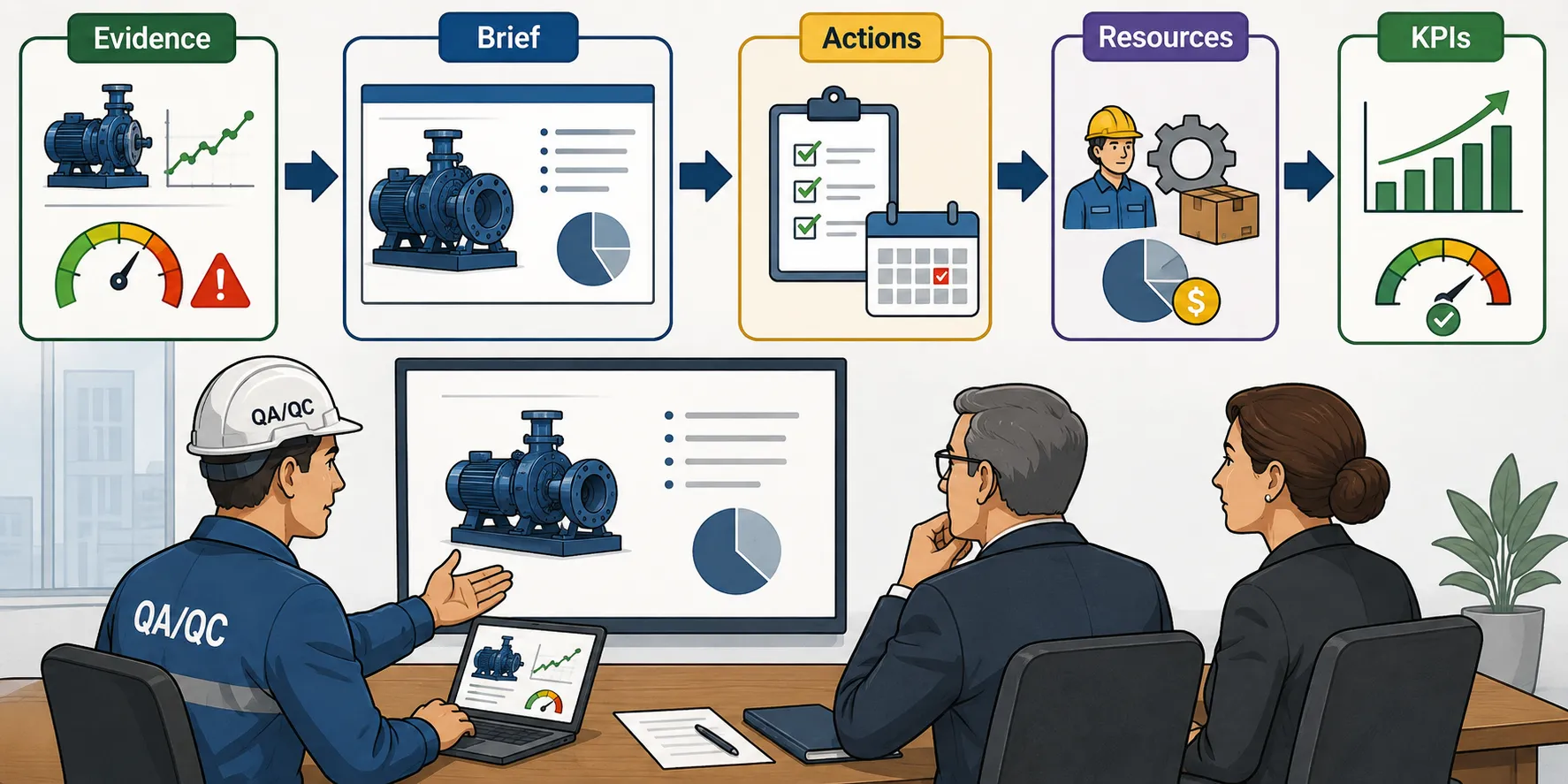
Defining the Business and Engineering Problem
The problem statement should be specific.
Weak statement:
“Equipment maintenance needs improvement.”
Stronger statement:
“Repeated bearing failures on critical rotating equipment are increasing unplanned downtime, maintenance expenditure and production disruption.”
The second statement provides a clearer basis for management action.
Presenting Engineering Evidence
Technical briefs should use relevant evidence rather than excessive information.
Useful evidence may include:
- Failure frequency.
- Equipment availability.
- MTBF.
- MTTR.
- Maintenance expenditure.
- Downtime.
- NCR trends.
- Inspection findings.
- Condition-monitoring results.
- Maintenance backlog.
- Rework.
- Energy-performance trends.
Evidence should be presented in a way that demonstrates the significance of the issue.
Historical Trends
Management decisions become stronger when historical trends are presented.
For example:
| Performance Indicator | Year 1 | Year 2 | Year 3 | Trend |
|---|---|---|---|---|
| Equipment Failures | 4 | 7 | 11 | Increasing |
| Unplanned Downtime | 18 hrs | 31 hrs | 48 hrs | Increasing |
| Emergency Repairs | 6 | 10 | 15 | Increasing |
| Availability | 97% | 95% | 92% | Declining |
| Maintenance Cost | £80k | £105k | £140k | Increasing |
The combined trend indicates a strategic reliability problem rather than isolated maintenance events.
Translating Technical Data into Management Meaning
Technical data must be interpreted.
For example:
“Vibration increased from 3.5 mm/s to 7.2 mm/s.”
Management interpretation:
“The increasing vibration indicates deteriorating equipment condition and may increase the probability of bearing, alignment or rotating-component failure if corrective action is not taken.”
This translation makes technical evidence strategically useful.
Risk Presentation
Risk should be explained in terms that support decision-making.
A technical brief should identify:
- Hazard or failure mechanism.
- Probability.
- Consequence.
- Existing controls.
- Residual risk.
- Recommended mitigation.
Potential consequences may include:
- Worker safety impacts.
- Equipment damage.
- Production interruption.
- Environmental consequences.
- Quality problems.
- Contractual consequences.
- Financial losses.
Strategic Options
A strong technical brief should normally compare realistic options rather than presenting only one solution.
For example:
Option 1: Continue Existing Maintenance
Potential advantages:
- Low immediate expenditure.
- Existing resources remain unchanged.
Potential disadvantages:
- Continuing failure exposure.
- Increasing downtime.
- Rising emergency repair costs.
Option 2: Increase Preventive Maintenance
Potential advantages:
- Greater planned intervention.
- Better control of deterioration.
Potential disadvantages:
- Additional planned downtime.
- Increased maintenance resources.
Option 3: Introduce Condition Monitoring
Potential advantages:
- Earlier fault detection.
- Better maintenance planning.
- Reduced unexpected failures.
Potential disadvantages:
- Initial investment.
- Training requirements.
- Data-management requirements.
Recommendation Structure
The recommendation should clearly state:
- Preferred option.
- Reason for selection.
- Evidence supporting the choice.
- Resources required.
- Risks associated with implementation.
- Expected benefits.
A recommendation should be defensible if challenged by management, finance, engineering, QA/QC or operations.
Resource Allocation
Resource allocation is a central element of operational excellence.
Resources may include:
- Engineers.
- Inspectors.
- Technicians.
- Maintenance personnel.
- QA/QC professionals.
- Specialist contractors.
- Inspection equipment.
- Monitoring systems.
- Spare parts.
- Software.
- Training.
- Capital expenditure.
- Operational budget.
- Planned downtime.
Resources should be prioritised according to risk and strategic importance.
Risk-Based Resource Allocation
Resources should not necessarily be distributed equally.
Critical equipment may require:
- Higher inspection frequency.
- Specialist personnel.
- Condition monitoring.
- Strategic spare parts.
- More detailed maintenance planning.
Lower-risk equipment may require simpler controls.
This approach ensures that limited resources provide the greatest risk reduction.
Developing an Action Plan
An action plan converts recommendations into practical activities.
A strong action plan should identify:
- Action.
- Purpose.
- Responsible person.
- Required resources.
- Priority.
- Start date.
- Target completion.
- Deliverable.
- KPI.
- Verification method.
Example Action Plan
| Action | Responsibility | Priority | Resource | Target | KPI |
|---|---|---|---|---|---|
| Assess critical equipment | Reliability Engineer | High | Engineering team | Month 1 | Assessment completed |
| Install monitoring system | Maintenance Manager | High | Monitoring equipment | Month 2 | System operational |
| Review maintenance intervals | QA/QC Manager | High | Engineering resources | Month 2 | Revised strategy |
| Train personnel | Training Lead | Medium | Training budget | Month 3 | Competence achieved |
| Review performance | Engineering Manager | High | KPI dashboard | Quarterly | Reliability improvement |
Prioritising Actions
Actions can be classified as:
- Critical.
- High.
- Medium.
- Low.
Critical actions may involve:
- Immediate safety risks.
- Critical mechanical-integrity concerns.
- High-consequence equipment.
- Significant compliance gaps.
Prioritisation should be evidence-based.
Assigning Accountability
Every action should have an identified owner.
Avoid vague assignments such as:
“Engineering team to investigate.”
Use:
“Reliability Engineer to complete critical-pump condition assessment by the agreed milestone.”
Clear accountability improves execution.
Defining Deliverables
Each action should produce a measurable output.
Examples include:
- Approved maintenance strategy.
- Completed inspection.
- Condition-monitoring report.
- Updated asset register.
- Training record.
- Revised procedure.
- Risk assessment.
- Performance dashboard.
Setting Milestones
Long-term improvement programmes should be divided into manageable stages.
For example:
Phase 1
Asset review and criticality assessment.
Phase 2
Condition assessment.
Phase 3
Maintenance strategy development.
Phase 4
Implementation.
Phase 5
Performance monitoring.
Phase 6
Management review.
Resource Forecasting
Long-term technical briefs should identify future resource requirements.
These may include:
- Additional engineers.
- Inspection personnel.
- Maintenance technicians.
- Training.
- Specialist contractors.
- Monitoring equipment.
- Software.
- Spare parts.
- Capital investment.
Resource forecasting prevents improvement strategies from becoming unrealistic.
Budget Planning
Financial requirements should be separated into categories.
Capital Expenditure
Examples:
- New monitoring equipment.
- Major machinery.
- Replacement systems.
- Permanent infrastructure.
Operational Expenditure
Examples:
- Maintenance.
- Inspection.
- Training.
- Software licences.
- Specialist support.
This distinction helps management understand financial implications.
Cost-Benefit Presentation
A management brief should explain both costs and expected benefits.
Potential benefits include:
- Reduced downtime.
- Reduced failure frequency.
- Reduced maintenance costs.
- Extended asset life.
- Improved safety.
- Improved production reliability.
- Reduced rework.
- Improved quality.
Lifecycle Financial Perspective
A strategic recommendation should avoid focusing solely on initial expenditure.
Consider:
Initial Cost + Operating Cost + Maintenance Cost + Downtime Cost + Replacement Cost = Lifecycle Cost
An initially expensive solution may provide lower lifecycle cost.
Example: Predictive Maintenance Investment
A facility proposes investing £75,000 in condition-monitoring technology.
Expected benefits include:
- Reduced emergency failures.
- Lower downtime.
- Better maintenance planning.
- Reduced component damage.
Historical failure data indicate annual losses of approximately £100,000 from avoidable equipment failures.
The technical brief should compare the investment with the credible reduction in failure-related costs.
Long-Term Operational Excellence
Operational excellence requires consistent performance rather than temporary improvement.
It combines:
- Safety.
- Quality.
- Reliability.
- Productivity.
- Efficiency.
- Cost control.
- Asset integrity.
- Workforce competence.
- Continual improvement.
Technical briefs should therefore explain how recommendations contribute to long-term performance.
Linking Recommendations to Organisational Objectives
A recommendation becomes stronger when it clearly connects engineering activity with strategic objectives.
For example:
Condition Monitoring → Earlier Failure Detection → Less Downtime → Higher Availability → Improved Production Continuity
Another example:
Improved QA/QC → Fewer Defects → Less Rework → Lower Cost → Improved Project Performance
Performance Indicators for Management
Management-level KPIs may include:
- Asset availability.
- MTBF.
- MTTR.
- Unplanned downtime.
- Maintenance cost.
- Preventive maintenance completion.
- Predictive maintenance findings.
- NCR rate.
- Rework rate.
- Equipment failure frequency.
- Inspection completion.
- Maintenance backlog.
- Safety events.
KPI Selection
KPIs should be:
- Relevant.
- Measurable.
- Consistent.
- Time-bound.
- Comparable.
- Actionable.
Too many KPIs can make management reporting difficult.
Leading and Lagging Indicators
Leading Indicators
These help identify future problems.
Examples:
- Preventive maintenance completion.
- Condition-monitoring alerts.
- Inspection completion.
- Training completion.
- Calibration status.
- Outstanding corrective actions.
Lagging Indicators
These measure outcomes.
Examples:
- Equipment failures.
- Downtime.
- NCRs.
- Rework.
- Safety incidents.
- Customer complaints.
A balanced technical brief should use both.
Technical Brief Development Process
Step 1: Identify the Management Issue
Define the strategic problem.
Step 2: Collect Evidence
Gather relevant technical and financial information.
Step 3: Verify the Evidence
Check accuracy, completeness and traceability.
Step 4: Analyse Trends
Identify deterioration, recurring failures and performance changes.
Step 5: Assess Risk
Determine consequences and existing controls.
Step 6: Develop Options
Identify technically feasible solutions.
Step 7: Compare Costs and Benefits
Evaluate financial and operational implications.
Step 8: Select the Preferred Recommendation
Provide a clear evidence-based conclusion.
Step 9: Develop the Action Plan
Define responsibilities, resources and milestones.
Step 10: Establish KPIs
Define how success will be measured.
Step 11: Obtain Approval
Submit the brief through appropriate management channels.
Step 12: Monitor Implementation
Review progress and performance.
Writing Style for Senior Management
Technical briefs should use:
- Clear headings.
- Short paragraphs.
- Direct statements.
- Evidence-based conclusions.
- Tables where useful.
- Defined recommendations.
- Clear financial information.
- Explicit risks.
- Action-oriented language.
Avoid:
- Excessive technical jargon.
- Unnecessary background.
- Repetition.
- Unsupported claims.
- Long unexplained calculations.
- Ambiguous responsibilities.
Technical Depth Without Excessive Complexity
The technical brief should remain technically credible without becoming difficult to read.
For example, rather than providing pages of vibration analysis, summarise:
“Vibration trends have increased progressively over six months, coinciding with repeated bearing failures. The trend indicates a developing reliability issue requiring targeted condition assessment.”
Supporting technical data can be included in an appendix.
Visual Presentation
Appropriate visual tools may include:
- Trend graphs.
- Risk matrices.
- KPI dashboards.
- Cost-benefit tables.
- Action-plan tables.
- Process diagrams.
- Priority charts.
Visuals should simplify information rather than introduce unnecessary complexity.
Risk Matrix
A simple risk matrix can help management understand priorities.
For example:
| Probability | Consequence | Overall Priority |
|---|---|---|
| Low | Low | Low |
| Medium | Low | Moderate |
| Low | High | Moderate |
| High | Medium | High |
| High | High | Critical |
The exact methodology should reflect the organisation’s established risk-management system.
Management Decision Points
The technical brief should clearly identify what management needs to decide.
Examples include:
- Approve additional maintenance budget.
- Approve monitoring equipment.
- Allocate specialist personnel.
- Approve training.
- Authorise planned downtime.
- Approve revised maintenance strategy.
- Approve additional inspection resources.
This prevents uncertainty after the document is reviewed.
Escalation Requirements
A technical brief should identify issues requiring urgent escalation.
These may include:
- Critical mechanical-integrity concerns.
- Repeated equipment failures.
- Significant safety risks.
- Uncontrolled deterioration.
- Insufficient resources for critical maintenance.
- Major compliance concerns.
- Unresolved technical deviations.
Action-Plan Governance
Action plans should be reviewed periodically.
Review activities may include:
- Progress against milestones.
- Resource availability.
- Budget expenditure.
- KPI performance.
- Emerging risks.
- Corrective actions.
- Delays.
- Changes in priority.
Managing Delays
When an action is delayed, the responsible manager should identify:
- Cause.
- Consequence.
- Revised completion date.
- Interim controls.
- Additional resources.
- Escalation requirement.
This maintains accountability.
Practical Example: Critical Pump Reliability Programme
Situation
A production facility has experienced repeated failures of a critical pump.
Historical information shows:
- Increased bearing failures.
- Increasing downtime.
- Higher emergency maintenance costs.
- Increased vibration.
Technical Assessment
Engineering analysis indicates that the current maintenance strategy is predominantly reactive.
Management Brief
The brief explains:
- Current reliability problem.
- Historical trend.
- Risk.
- Cost of failure.
- Available maintenance strategies.
- Recommended condition-monitoring programme.
Resource Requirement
The recommendation requires:
- Monitoring equipment.
- Specialist training.
- Engineering analysis.
- Maintenance resources.
Action Plan
The programme is divided into:
- Criticality review.
- Baseline condition assessment.
- Monitoring installation.
- Personnel training.
- Implementation.
- Performance review.
KPIs
- MTBF.
- Downtime.
- Failure frequency.
- Maintenance cost.
- Availability.
Management Outcome
Management receives sufficient information to make an informed resource-allocation decision.
Practical Example: Maintenance Backlog
A facility has a growing maintenance backlog involving mechanical equipment.
The technical brief identifies:
- Number of overdue tasks.
- Criticality of affected assets.
- Age of backlog.
- Safety significance.
- Production impact.
- Available maintenance resources.
The recommended action is to prioritise the backlog based on risk rather than simply completing tasks chronologically.
Practical Example: QA/QC Resource Allocation
A project has limited QA/QC personnel while several mechanical activities are progressing simultaneously.
The technical brief analyses:
- Inspection requirements.
- Equipment criticality.
- Historical defect rates.
- Schedule.
- Available inspectors.
The recommended action may involve prioritising high-risk activities while using approved surveillance or sampling approaches where appropriate.
Practical Example: Asset Replacement Decision
A critical mechanical asset is ageing and maintenance costs are increasing.
The technical brief compares:
Option A
Continue maintenance.
Option B
Refurbish equipment.
Option C
Replace equipment.
The analysis considers:
- Capital cost.
- Maintenance cost.
- Downtime.
- Reliability.
- Remaining useful life.
- Spare-part availability.
- Safety.
- Long-term lifecycle cost.
Management can then select the option with the strongest overall value.
Case Study: Long-Term Operational Excellence Programme
Background
A large manufacturing facility operates several critical mechanical systems. Over several years, management observes:
- Increasing unplanned downtime.
- Higher maintenance expenditure.
- Repeated equipment failures.
- Growing maintenance backlog.
- Increasing emergency repairs.
- Inconsistent preventive maintenance completion.
Technical Investigation
The engineering team reviews:
- Asset criticality.
- Maintenance history.
- Failure trends.
- Inspection findings.
- Condition-monitoring data.
- Maintenance resources.
- Spare-parts availability.
Findings
The analysis identifies three major weaknesses:
- Maintenance resources are not aligned with asset criticality.
- Preventive maintenance is inconsistently completed.
- Condition-monitoring coverage is limited for critical equipment.
Strategic Recommendation
The team develops a long-term operational excellence programme consisting of:
- Criticality reassessment.
- Revised maintenance strategies.
- Condition-monitoring expansion.
- Maintenance backlog reduction.
- Competence development.
- Spare-parts optimisation.
- KPI monitoring.
Resource Allocation
The programme requires:
- Additional specialist engineering support.
- Condition-monitoring equipment.
- Technician training.
- Additional planned maintenance capacity.
- Improved digital maintenance records.
Action Plan
The implementation is divided into phases.
Phase 1: Assessment
- Review critical assets.
- Confirm risk ranking.
- Analyse failure history.
Phase 2: Strategy Development
- Revise maintenance plans.
- Define monitoring requirements.
- Establish KPIs.
Phase 3: Implementation
- Deploy monitoring.
- Train personnel.
- Update procedures.
Phase 4: Performance Review
- Measure reliability.
- Review costs.
- Analyse failures.
- Adjust strategies.
Expected Outcomes
The programme aims to deliver:
- Reduced unplanned downtime.
- Improved equipment availability.
- Reduced repeat failures.
- Better maintenance planning.
- Improved resource utilisation.
- Greater mechanical integrity.
Lessons from the Case Study
The case demonstrates that senior management decisions become stronger when technical recommendations are connected to:
- Historical evidence.
- Risk.
- Cost.
- Resources.
- Operational objectives.
- Measurable outcomes.
It also demonstrates that technical briefs should not simply identify problems. They should provide a realistic pathway towards improvement.
Common Problems in Technical Briefs
Poor technical briefs often:
- Provide too much technical detail.
- Fail to state the management decision required.
- Present data without interpretation.
- Ignore financial consequences.
- Lack clear recommendations.
- Fail to identify resource requirements.
- Use unclear terminology.
- Provide no implementation plan.
- Have no measurable KPIs.
- Ignore risk.
- Do not identify accountability.
Common Problems in Action Plans
Weak action plans often:
- Assign vague responsibilities.
- Have no deadlines.
- Do not identify resources.
- Contain unrealistic targets.
- Lack priority rankings.
- Have no success criteria.
- Do not address risks.
- Are not reviewed regularly.
Improving Technical Brief Quality
Before submission, verify that the brief answers:
- What is the problem?
- What evidence supports it?
- Why does it matter?
- What are the risks?
- What options exist?
- What is recommended?
- Why is it recommended?
- What resources are required?
- What will it cost?
- What benefits are expected?
- Who is responsible?
- When will actions be completed?
- How will success be measured?
Benefits of Professional Technical Briefs
Management Benefits
- Faster understanding of complex issues.
- Better strategic decision-making.
- Improved resource allocation.
- Greater visibility of engineering risks.
Engineering Benefits
- Clearer priorities.
- Better coordination.
- Improved technical governance.
- Stronger accountability.
Operational Benefits
- Better reliability planning.
- Reduced downtime.
- Improved asset performance.
- More efficient resource use.
Financial Benefits
- Better investment decisions.
- Improved lifecycle-cost control.
- Reduced avoidable expenditure.
- Greater visibility of expected returns.
Quality Benefits
- Improved QA/QC resource planning.
- Better corrective-action management.
- Reduced recurring defects.
- Stronger continual improvement.
Recommended Technical Brief Structure
A professional management technical brief can follow this structure:
1. Title
Clearly identify the issue.
2. Executive Summary
Provide the key message.
3. Current Situation
Describe existing conditions.
4. Engineering Evidence
Present relevant data and trends.
5. Risk Assessment
Explain consequences and priorities.
6. Options
Compare realistic alternatives.
7. Cost-Benefit Analysis
Present financial and operational implications.
8. Recommendation
State the preferred option.
9. Resource Requirements
Identify people, equipment, budget and time.
10. Action Plan
Define activities and responsibilities.
11. KPIs
Define performance measures.
12. Governance and Review
Explain how implementation will be monitored.
13. Management Decision Required
Clearly identify approval requirements.
Recommended Action-Plan Structure
A robust action plan should contain:
- Action ID.
- Activity.
- Objective.
- Responsible person.
- Supporting personnel.
- Priority.
- Required resources.
- Start date.
- Completion date.
- Deliverable.
- KPI.
- Risk.
- Status.
- Review date.
Key Takeaways
Professional technical briefs and action plans should:
- Translate complex engineering information into management decisions.
- Present evidence clearly.
- Use historical performance trends.
- Identify technical and operational risks.
- Compare realistic strategic options.
- Include cost-benefit considerations.
- Address lifecycle performance.
- Identify resource requirements.
- Prioritise resources according to risk.
- Define clear responsibilities.
- Establish realistic milestones.
- Use measurable KPIs.
- Address short-term and long-term objectives.
- Support operational excellence.
- Protect mechanical integrity.
- Integrate QA/QC, maintenance and reliability information.
- Provide clear management decision points.
- Monitor implementation and revise actions where necessary.
Conclusion
Professional technical briefs and action plans provide an important connection between detailed mechanical engineering analysis and senior management decision-making. A technically strong recommendation must do more than describe an equipment problem or identify a maintenance requirement. It should explain the evidence, demonstrate the significance of the issue, evaluate risk, compare available options, consider lifecycle cost, identify resource requirements, and present a practical route towards implementation. This approach enables senior management to understand not only what needs to be done but also why the proposed action is technically justified and strategically valuable.
Effective resource allocation is particularly important when organisations have limited budgets, personnel, equipment, inspection capacity, or available maintenance windows. Resources should be directed towards activities and assets where they provide the greatest reduction in safety, reliability, quality, or operational risk. Critical mechanical equipment may require additional condition monitoring, specialist competence, strategic spare parts, planned maintenance capacity, or increased inspection coverage, while lower-risk assets may be managed through proportionate controls. A well-designed action plan transforms these strategic decisions into accountable activities with defined owners, milestones, deliverables, resources, and performance indicators.
Ultimately, technical briefs and action plans should support long-term operational excellence rather than short-term problem solving alone. By combining engineering evidence, historical trends, risk assessment, cost-benefit analysis, asset-integrity considerations, QA/QC information, maintenance performance, and measurable KPIs, mechanical engineering organisations can make better-informed strategic decisions. Clear communication with senior management ensures that engineering priorities receive appropriate resources and organisational support, while structured action plans ensure that recommendations are implemented and monitored effectively. This creates a sustainable management framework capable of improving mechanical reliability, safety, quality, efficiency, asset performance, and operational resilience over the long term.