
Lesson 7: Recommend practical applications of research findings to industry.
Research in electrical engineering QA/QC creates meaningful value when its findings can be translated into practical improvements within real industry environments. This lesson focuses on the professional ability to evaluate research evidence and recommend appropriate applications that can improve quality performance, reduce recurring defects, strengthen inspection and testing processes, support compliance, reduce rework, and contribute to continual improvement. Learners will explore how research findings can move beyond academic reporting and become practical actions that address identified quality problems in electrical engineering projects, installations, testing, commissioning, and quality management systems.
Applying research findings requires more than simply proposing solutions. Electrical engineering professionals must critically evaluate the evidence, identify the root causes and practical implications of findings, consider technical and organisational constraints, and develop recommendations that are realistic, measurable, cost-conscious, and aligned with established QA/QC processes. Practical applications may include improving inspection procedures, strengthening testing and verification controls, enhancing workforce competence, improving documentation and traceability, revising quality procedures, introducing targeted monitoring, or applying data-driven approaches to recurring non-conformities. Recommendations should be proportionate to the evidence and should clearly explain how the proposed action is expected to improve quality outcomes.
The lesson also develops professional judgement in translating research into workplace decision-making. Learners will consider stakeholder requirements, resource implications, implementation risks, performance indicators, continuous improvement and the limitations of research evidence when recommending practical applications. By the end of the lesson, learners will be better prepared to convert credible electrical QA/QC research findings into actionable industry recommendations that support safer, more reliable, efficient and consistent quality performance. The lesson therefore connects academic research with professional engineering practice, helping ensure that research outcomes contribute directly to evidence-based quality improvement and sustainable organisational performance.
1. Translate Complex Research Conclusions into Actionable, Practical Recommendations for the Electrical Engineering Sector
Translating complex research conclusions into actionable recommendations is a critical professional capability in electrical engineering QA/QC. Research has limited practical value if its conclusions remain confined to an academic report without being converted into realistic actions that can improve engineering processes, quality performance and organisational decision-making. A research investigation may identify recurring electrical defects, weaknesses in inspection procedures, testing failures, documentation gaps, inconsistent installation practices, supplier-quality problems or variations in quality performance. However, the researcher must go beyond identifying these issues and determine what should realistically be done in response.
For electrical engineering professionals, an actionable recommendation should establish a clear connection between evidence, research findings, professional judgement and workplace action. It should identify the problem addressed, explain the proposed intervention, establish who may be responsible, consider resources and constraints, define expected outcomes and provide an appropriate method for monitoring effectiveness. Recommendations should therefore be specific enough to guide implementation while remaining proportionate to the evidence generated by the research.
At Level 6, learners are expected to demonstrate critical thinking and professional judgement when translating research outcomes into practical applications. This means avoiding generic recommendations such as “improve quality” or “provide more training”. Instead, recommendations should explain what needs to change, why the change is justified, how it can be implemented and how its success can be evaluated. The strongest recommendations are evidence-based, technically appropriate, achievable within the workplace and capable of producing measurable quality improvements.
Understanding the Translation of Research Into Practice
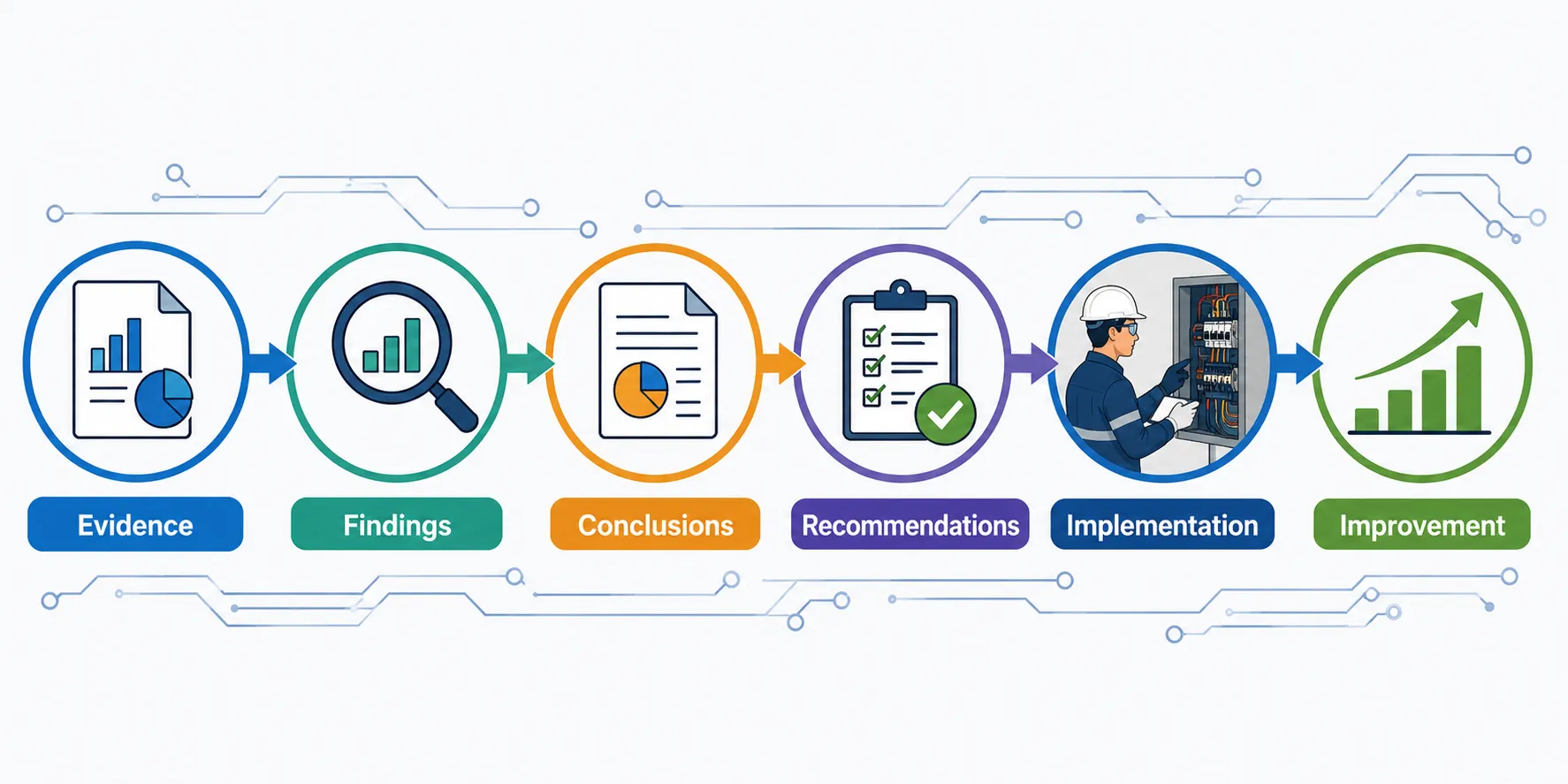
Research translation is the process of converting knowledge generated through systematic investigation into practical actions, decisions, procedures or improvements.
In electrical engineering QA/QC, this can be represented as:
Research Evidence → Finding → Interpretation → Conclusion → Recommendation → Implementation → Evaluation
Each stage has a different purpose.
Research evidence provides the factual basis. Findings identify what the analysis reveals. Interpretation explains the significance of those findings. Conclusions establish what can reasonably be established. Recommendations then convert those conclusions into proposed action.
The final stages are particularly important because a recommendation should not simply repeat the conclusion. It should provide a practical response to the issue identified by the research.
Key Concepts and Definitions
| Key concept | Definition | Electrical engineering application |
|---|---|---|
| Research Conclusion | Evidence-based judgement developed from analysed findings | Determining that progressive inspection requires strengthening |
| Recommendation | Proposed action arising from research conclusions | Introducing additional inspection checkpoints |
| Actionable Recommendation | Recommendation sufficiently specific to guide implementation | Define an inspection stage, responsible role and monitoring measure |
| Research Translation | Conversion of research knowledge into practical application | Applying defect research to improve QA/QC procedures |
| Root Cause | Underlying factor contributing to an identified problem | Inconsistent application of installation procedures |
| Corrective Action | Action intended to address an identified quality problem | Correcting a documented process weakness |
| Preventive Control | Control intended to reduce the likelihood of recurrence | Early-stage verification |
| Implementation | Process of putting a recommendation into practice | Introducing a revised inspection procedure |
| Stakeholder | Person or organisation affected by the recommendation | Client, contractor, engineer or QA/QC manager |
| Feasibility | Extent to which a recommendation can realistically be implemented | Considering resources, time and competence |
| KPI | Measurable indicator used to monitor performance | First-pass acceptance rate |
| Effectiveness | Extent to which an action achieves its intended outcome | Reduction in recurring defects |
| Prioritisation | Ranking recommendations according to significance and urgency | Addressing high-impact quality risks first |
| Continuous Improvement | Ongoing effort to improve processes and outcomes | Reviewing quality data and adjusting controls |
Why Research Conclusions Must Be Translated Into Action
A research conclusion may accurately identify a quality weakness but still provide limited value if it does not indicate how the organisation can respond.
For example:
“Recurring termination defects were identified across multiple work areas.”
This is an important conclusion, but it does not yet provide a practical response.
An actionable recommendation might be:
“Introduce a documented progressive termination inspection before cable testing, with inspection records reviewed by the responsible QA/QC engineer and first-pass acceptance monitored monthly.”
The second statement provides a practical pathway from evidence to action.
Effective recommendations can help organisations:
- Reduce recurring defects.
- Improve inspection effectiveness.
- Strengthen preventive controls.
- Reduce rework.
- Improve testing and commissioning performance.
- Improve documentation.
- Strengthen quality assurance.
- Improve process consistency.
- Support continual improvement.
- Improve stakeholder confidence.
Characteristics of an Actionable Recommendation
A high-quality recommendation should be:
Evidence-Based
The recommendation should arise from research findings rather than personal preference.
Specific
It should identify what needs to change.
Practical
It should be capable of implementation within the relevant workplace context.
Proportionate
The scale of the response should match the significance of the finding.
Measurable
Where possible, implementation should be evaluated through defined performance indicators.
Relevant
The recommendation should directly address the research problem.
Sustainable
The proposed improvement should be capable of being maintained over time.
Stakeholder-Aware
The recommendation should consider the responsibilities and needs of those involved in implementation.
From Research Finding to Practical Recommendation
A useful translation framework is:
Step 1: Identify the Finding
Determine exactly what the research discovered.
Step 2: Establish Significance
Determine why the finding matters.
Step 3: Identify the Underlying Issue
Consider the contributing factors and root causes supported by evidence.
Step 4: Define the Desired Outcome
Establish what improvement is required.
Step 5: Develop Potential Actions
Identify realistic ways to address the issue.
Step 6: Evaluate Feasibility
Consider resources, competence, time, cost and organisational constraints.
Step 7: Prioritise
Determine which actions should receive greatest attention.
Step 8: Assign Responsibility
Identify the relevant professional or organisational role.
Step 9: Define Measures
Determine how effectiveness will be assessed.
Step 10: Review and Improve
Use subsequent performance data to determine whether the recommendation achieved its intended outcome.
Establishing the Difference Between Findings, Conclusions and Recommendations
These three components should not be confused.
Finding
“Inspection records identified repeated cable termination defects.”
Conclusion
“The evidence indicates a recurring weakness in termination quality control.”
Recommendation
“Introduce an additional progressive termination verification stage before testing and monitor first-pass acceptance over subsequent work packages.”
This progression demonstrates logical research translation.
Linking Recommendations to Evidence
Every important recommendation should have an identifiable evidence base.
A useful structure is:
Evidence → Finding → Conclusion → Recommendation
For example:
Evidence: Repeated defects were identified during final inspection.
↓
Finding: Termination defects represented a significant proportion of recorded defects.
↓
Conclusion: Existing controls detect defects but may identify some issues relatively late in the process.
↓
Recommendation: Strengthen progressive inspection before final testing.
This evidence chain makes the recommendation more defensible.
Avoiding Generic Recommendations
Generic recommendations often fail to provide meaningful workplace direction.
Examples of weak recommendations include:
- Improve quality.
- Improve communication.
- Provide more training.
- Monitor performance.
- Strengthen procedures.
- Increase supervision.
These statements may be reasonable but do not explain what should actually happen.
A stronger recommendation identifies:
- Specific action.
- Target process.
- Responsible role.
- Implementation point.
- Expected outcome.
- Measurement approach.
For example:
“Introduce a standardised pre-testing termination checklist for electrical installation teams and require QA/QC verification before release to testing.”
This is considerably more actionable.
Translating Complex Technical Findings
Research findings may be technically complex.
For example, a study may identify relationships between:
- Installation workload.
- Workforce competence.
- Inspection timing.
- Defect recurrence.
- Testing failures.
- Rework.
The researcher should not simply reproduce all of these variables in the recommendation.
Instead, the researcher should determine which relationships are sufficiently supported to justify practical action.
If evidence indicates that defects are concentrated where progressive inspection is inconsistent, the recommendation should address progressive inspection rather than proposing unrelated organisational changes.
Using Root-Cause Thinking
Recommendations should ideally address underlying causes rather than only visible symptoms.
Suppose the research identifies repeated testing failures.
A superficial response may be:
“Repeat testing more frequently.”
A deeper investigation may reveal:
- Incomplete installation verification.
- Inconsistent work instructions.
- Documentation gaps.
- Inadequate pre-testing checks.
The recommendation could therefore focus on strengthening earlier verification rather than simply increasing final testing.
This approach can provide greater long-term value.
Developing Preventive Recommendations
Preventive recommendations aim to reduce the likelihood of recurring problems.
Examples include:
- Progressive inspection.
- Standardised work instructions.
- Competence verification.
- Pre-installation checks.
- Supplier quality verification.
- Improved document control.
- Early-stage testing.
- Quality hold points.
- Lessons-learned processes.
Preventive actions should be justified by evidence showing why recurrence is possible or likely.
Developing Corrective Recommendations
Corrective recommendations address identified weaknesses or failures.
Examples include:
- Reviewing defective work.
- Correcting documentation.
- Revising an ineffective procedure.
- Reassessing a quality-control stage.
- Introducing additional verification.
- Improving corrective-action tracking.
Corrective action should address the identified problem without unnecessarily creating additional controls that add little value.
Considering Feasibility
A technically excellent recommendation may still be unsuitable if it cannot realistically be implemented.
Before recommending an intervention, consider:
- Available personnel.
- Required competence.
- Time.
- Cost.
- Equipment.
- Documentation.
- Project programme.
- Organisational structure.
- Existing QA/QC systems.
- Stakeholder responsibilities.
For example, recommending a complete replacement of an established quality management process may be disproportionate if a smaller procedural adjustment would address the identified weakness.
Considering Cost and Resource Implications
Recommendations should recognise that industry operates within resource constraints.
A recommendation may require:
- Additional inspection time.
- Training resources.
- Specialist personnel.
- Additional testing.
- Documentation systems.
- Software.
- Equipment.
- Management oversight.
The researcher should not automatically reject an improvement because it has a cost. Instead, the recommendation should consider whether the expected quality benefit justifies the resource requirement.
Prioritising Recommendations
Not all recommendations have equal importance.
A useful prioritisation approach considers:
- Quality impact.
- Risk significance.
- Frequency of the problem.
- Cost of recurrence.
- Programme impact.
- Ease of implementation.
- Stakeholder importance.
- Evidence strength.
A simple priority classification could be:
High Priority
Significant recurring quality problem requiring prompt intervention.
Medium Priority
Important improvement opportunity that can be implemented through planned changes.
Low Priority
Useful enhancement with limited immediate quality impact.
Using a Recommendation Matrix
| Recommendation | Evidence basis | Expected benefit | Implementation effort | Priority |
|---|---|---|---|---|
| Progressive inspection | Recurring late defects | Earlier detection | Moderate | High |
| Standardised checklist | Inconsistent verification | Improved consistency | Low | High |
| Additional training | Competence gaps | Improved application | Moderate | Medium |
| Dashboard monitoring | Quality trend variation | Better oversight | Moderate | Medium |
| Procedure review | Documentation weaknesses | Improved clarity | Low | High |
This approach allows stakeholders to compare proposed actions systematically.
Making Recommendations Measurable
A recommendation becomes more useful when its effectiveness can be evaluated.
For example:
“Improve termination quality” is difficult to measure.
A stronger approach is:
“Introduce progressive termination verification and monitor first-pass acceptance and repeat termination defects across subsequent work packages.”
Potential indicators include:
- First-pass acceptance.
- Defect frequency.
- Repeat-defect rate.
- Rework levels.
- Inspection completion.
- Testing failure rate.
- Corrective-action closure.
- NCR recurrence.
Developing Key Performance Indicators
KPIs should reflect the intended improvement.
For example, if the recommendation aims to reduce recurring defects, appropriate measures may include:
- Number of repeat defects.
- Defect rate per defined work quantity.
- First-pass acceptance.
- Rework frequency.
If the recommendation aims to improve documentation, measures could include:
- Documentation completeness.
- Record submission timeliness.
- Document-related NCRs.
- Traceability performance.
The KPI should therefore be linked directly to the recommendation.
Considering Stakeholder Responsibilities
A recommendation should identify who may need to implement or support it.
Potential stakeholders include:
- QA/QC engineers.
- Electrical engineers.
- Site supervisors.
- Project managers.
- Contractors.
- Designers.
- Procurement teams.
- Commissioning teams.
- Clients.
- Consultants.
A recommendation that does not consider responsibility may be difficult to implement.
Communicating Recommendations Professionally
Recommendations should use professional, action-oriented language.
Useful terms include:
- Introduce.
- Review.
- Standardise.
- Strengthen.
- Establish.
- Implement.
- Monitor.
- Verify.
- Evaluate.
- Integrate.
- Document.
- Assess.
Avoid vague statements that do not identify an action.
Example: Documentation Quality
Research Finding
The investigation identifies recurring gaps in inspection documentation.
Conclusion
Existing document-control arrangements do not consistently provide complete traceability.
Recommendation
“Introduce a standardised inspection-record review before quality documentation is formally closed, with responsibility assigned to the relevant QA/QC role and documentation completeness monitored as a quality KPI.”
This recommendation directly addresses the research conclusion.
Example: Supplier Quality
Research Finding
A significant proportion of quality issues is associated with incoming materials from selected suppliers.
Conclusion
Supplier verification may require greater consistency.
Recommendation
“Strengthen incoming material verification by applying documented inspection criteria before materials are released for installation and reviewing supplier-related defect trends periodically.”
The recommendation is targeted and measurable without claiming more than the research demonstrates.
Example: Testing and Commissioning
Research Finding
Repeated commissioning failures are associated with incomplete earlier verification.
Conclusion
Late-stage testing is identifying issues that could potentially be detected earlier.
Recommendation
“Introduce defined pre-commissioning verification points for critical electrical systems and monitor first-pass commissioning acceptance to evaluate whether earlier verification reduces repeat failures.”
This connects research evidence to practical quality improvement.
Case Study: Translating Research Into Workplace Action
Background
An electrical engineering project experiences repeated quality problems during installation and commissioning. A Level 6 research investigation examines inspection records, testing data, non-conformance reports and workplace observations.
Research Findings
The investigation identifies:
- Repeated termination defects.
- Inconsistent progressive inspection.
- Documentation gaps.
- Variable application of work instructions.
- Increased rework during final verification.
Research Conclusions
The research concludes that the existing QA/QC system provides important defect detection but that opportunities exist to strengthen early-stage prevention and process consistency.
Practical Recommendations
The researcher develops four recommendations:
- Introduce progressive termination inspection.
- Standardise termination verification documentation.
- Review competence and procedural understanding.
- Monitor first-pass acceptance and repeat defects.
Implementation Considerations
The researcher recognises that:
- Existing QA/QC staff can perform the additional verification.
- A standardised checklist can be integrated into current documentation.
- Competence reviews can be incorporated into existing project processes.
- KPI monitoring can use existing quality records.
Expected Outcome
The recommendations aim to:
- Reduce recurring defects.
- Detect problems earlier.
- Reduce rework.
- Improve traceability.
- Strengthen quality consistency.
This demonstrates how research can move from academic investigation to practical engineering improvement.
Evaluating Whether a Recommendation Is Proportionate
Recommendations should match the scale and certainty of the research evidence.
If a study identifies a small documentation weakness, recommending a complete organisational restructuring would likely be disproportionate.
Similarly, if research identifies a significant recurring quality problem affecting testing and commissioning, a minor administrative change may be insufficient.
The researcher should therefore consider:
Evidence Strength + Problem Significance + Practical Impact = Appropriate Recommendation
Handling Research Uncertainty
Research conclusions may contain uncertainty.
A recommendation should reflect that uncertainty.
For example:
“The findings suggest that workload variation may contribute to defect frequency.”
A cautious recommendation could be:
“Monitor workload and defect trends across future work packages to determine whether the observed relationship persists and whether additional resource controls are warranted.”
This is preferable to immediately claiming that staffing levels caused the defects.
Translating Qualitative Findings
Qualitative research can also produce actionable recommendations.
Suppose interviews identify:
- Confusion about procedures.
- Inconsistent communication.
- Different interpretations of quality requirements.
- Limited feedback following recurring defects.
Potential recommendations could include:
- Standardised procedural briefings.
- Improved communication points.
- Clarified work instructions.
- Structured lessons-learned feedback.
- Improved documentation of recurring defects.
However, the researcher should explain how the qualitative evidence supports each action.
Translating Quantitative Findings
Quantitative evidence may identify measurable performance gaps.
For example:
- First-pass acceptance: 82%.
- Defined target: 90%.
- Repeat defects: increasing.
- Testing failures: concentrated in one work package.
Possible recommendations may include:
- Investigate the work package with the highest failure rate.
- Strengthen progressive inspection.
- Monitor first-pass acceptance.
- Analyse repeat-defect causes.
The recommendations should address the specific performance evidence.
Translating Mixed-Methods Findings
Mixed-method findings can support more comprehensive recommendations.
For example:
Quantitative Evidence
Defect rates increase during certain work periods.
Qualitative Evidence
Interviews identify inconsistent supervision and procedural application during those periods.
Integrated Conclusion
The evidence indicates that process consistency may be affected by changing workplace conditions.
Recommendation
Review supervision arrangements and procedural verification during high-workload periods while monitoring defect trends.
This is stronger than relying on only one source of evidence.
Developing an Implementation Plan
A recommendation becomes significantly more actionable when accompanied by an implementation framework.
A simple structure can include:
Action
What needs to change?
Responsibility
Who should lead it?
Timing
When should it occur?
Resources
What is required?
Measure
How will effectiveness be assessed?
Review
When should the outcome be evaluated?
For example:
| Element | Example |
|---|---|
| Action | Introduce progressive inspection |
| Responsibility | QA/QC Engineer |
| Timing | Before testing |
| Resources | Checklist and inspection time |
| Measure | First-pass acceptance |
| Review | Monthly quality review |
Monitoring Recommendation Effectiveness
Implementation does not automatically mean success.
The organisation should evaluate whether the action achieved its intended purpose.
Monitoring may involve:
- Comparing performance before and after implementation.
- Reviewing defect trends.
- Monitoring KPIs.
- Conducting follow-up inspections.
- Reviewing stakeholder feedback.
- Examining repeat non-conformities.
The researcher should recognise that improvements may require adjustment over time.
Continuous Improvement Cycle
Research recommendations can contribute to a continual improvement cycle:
Investigate → Identify → Recommend → Implement → Monitor → Evaluate → Improve
This transforms research into an ongoing quality-management activity.
If the recommendation does not produce the expected improvement, new research or analysis may be required.
Common Weaknesses in Research Recommendations
Researchers should avoid:
- Generic recommendations.
- Recommendations unrelated to findings.
- Excessively expensive solutions without justification.
- Recommendations that ignore project constraints.
- Recommendations without responsible ownership.
- Recommendations without measurement.
- Overly broad recommendations.
- Unsupported claims of expected benefits.
- Treating correlation as causation.
- Recommending solutions before understanding the underlying problem.
Practical Benefits of Translating Research Into Action
Improved Quality Performance
Research findings can identify specific areas where quality controls require strengthening.
Reduced Recurring Defects
Targeted recommendations can address contributing factors.
Reduced Rework
Earlier detection and prevention can reduce corrective work.
Improved Inspection
Research can reveal where inspection processes require improvement.
Better Testing Outcomes
Evidence-based recommendations can strengthen pre-testing and commissioning controls.
Improved Documentation
Recommendations can enhance traceability and quality records.
Better Resource Allocation
Research can help direct attention towards high-priority quality problems.
Stronger Decision-Making
Managers can base improvement decisions on evidence rather than assumptions.
Improved Organisational Learning
Research findings can become lessons that inform future projects.
Advanced Recommendation Framework
For complex Level 6 research, recommendations can be developed using the following framework:
Evidence
What does the research demonstrate?
Problem
What quality issue requires attention?
Cause
What contributing factors are supported by evidence?
Action
What should change?
Ownership
Who should implement the change?
Resources
What is required?
Measurement
How will effectiveness be evaluated?
Review
When should the intervention be reassessed?
This framework ensures that recommendations are practical rather than merely theoretical.
Professional Judgement When Developing Recommendations
Professional judgement becomes particularly important where research evidence does not provide a single obvious solution.
For example, research may identify that defects increase during periods of high workload. Several responses could be considered:
- Increase staffing.
- Adjust programme sequencing.
- Strengthen supervision.
- Introduce additional inspection.
- Improve competence verification.
- Reduce workload concentration.
The researcher should evaluate each option against:
- Evidence.
- Feasibility.
- Cost.
- Risk.
- Expected quality benefit.
- Implementation complexity.
The final recommendation should be the most appropriate response supported by the research context rather than simply the most expensive or technologically advanced option.
Conclusion
Translating complex research conclusions into actionable recommendations is the point at which electrical engineering QA/QC research begins to generate direct professional value. A research project may identify recurring defects, process weaknesses, testing failures, documentation gaps, inspection limitations or performance variations, but these findings only become truly useful when they can inform realistic and evidence-based workplace action.
A strong recommendation begins with a clear understanding of the research evidence. The researcher should establish what was found, determine what the findings mean, identify the significance of the issue and consider the contributing factors supported by the investigation. The conclusion should then provide the basis for a practical response. This ensures that recommendations are not based on assumptions or personal preferences but are connected directly to the research evidence.
For electrical engineering QA/QC professionals, recommendations may involve progressive inspection, improved verification, standardised documentation, competence development, testing controls, supplier-quality processes, corrective-action monitoring, quality dashboards or improved communication. However, the appropriate response depends on the specific research findings. There is no universal solution for every quality problem. Professional judgement is required to determine whether a recommendation is proportionate, feasible and capable of producing meaningful improvement.
Actionable recommendations should also consider implementation. Identifying what should change is only the first step. A professional recommendation should consider responsibility, resources, timing, monitoring and evaluation. Where possible, measurable indicators such as defect rates, first-pass acceptance, repeat non-conformities, testing failures, rework levels or corrective-action closure can be used to assess whether the intervention is achieving its intended purpose.
Research translation should also recognise uncertainty. Where evidence demonstrates association rather than causation, recommendations should remain appropriately cautious. Where research is limited to a particular project or sample, recommendations should not automatically be presented as universally applicable. Acknowledging limitations strengthens professional credibility because it demonstrates that the researcher understands the boundaries of the evidence.
Ultimately, the strongest research recommendations create a clear pathway from knowledge to action:
Evidence → Findings → Conclusions → Recommendations → Implementation → Measurement → Improvement
This approach enables electrical engineering organisations to use research not merely as an academic exercise but as a practical resource for improving QA/QC performance, reducing recurring defects, strengthening inspection and testing processes, improving traceability and supporting continual improvement. At Level 6, the ability to make this transition demonstrates advanced analytical thinking, professional judgement and the capacity to apply research knowledge to real electrical engineering challenges.
2. Develop a Strategic Implementation Plan to Apply Research Findings to Existing QA/QC Systems and Processes
Developing a strategic implementation plan is a critical stage in converting electrical engineering research into measurable workplace improvement. Research may identify recurring defects, weaknesses in inspection and testing, ineffective documentation, inconsistent application of procedures, supplier-quality problems, commissioning failures or opportunities to improve quality assurance. However, identifying these issues does not automatically improve project performance. The findings must be translated into a structured implementation plan that can be integrated into existing QA/QC systems and processes without creating unnecessary disruption, duplication or administrative burden.
In electrical engineering quality assurance and quality control, implementation planning requires a balance between technical evidence, organisational priorities, project requirements, available resources and practical constraints. A recommendation may appear technically appropriate but still fail if responsibilities are unclear, resources are unavailable, personnel are not adequately prepared, existing procedures are not updated, or effectiveness is not measured. A strategic implementation plan therefore establishes how research findings will move from documented conclusions into controlled workplace actions.
At Level 6 diploma standard, learners should be able to evaluate research findings critically and develop implementation strategies that are realistic, measurable and aligned with established QA/QC arrangements. This involves identifying the relevant existing processes, determining where research findings require intervention, prioritising actions according to quality impact and feasibility, allocating responsibilities, establishing milestones, managing implementation risks and defining performance indicators. The objective is not simply to introduce new controls but to strengthen existing systems where evidence demonstrates that improvement is required.
Understanding Strategic Implementation in Electrical QA/QC
Strategic implementation is the organised process of converting research-based recommendations into workplace actions that achieve defined quality objectives.
In electrical QA/QC, the implementation pathway can be represented as:
Research Findings → Gap Identification → Strategic Objectives → Actions → Responsibilities → Resources → Implementation → Monitoring → Evaluation → Continual Improvement
Each stage has a distinct purpose.
Research findings provide the evidence for change. Gap identification determines where current systems do not fully achieve the required outcome. Strategic objectives establish what improvement is expected. Actions define what needs to change. Responsibilities identify who will deliver the change. Resources establish what is required. Monitoring and evaluation determine whether implementation has achieved the intended improvement.
This approach prevents organisations from introducing changes simply because they appear beneficial without establishing whether they are actually necessary or effective.
Key Concepts and Definitions
| Key concept | Definition | Electrical QA/QC application |
|---|---|---|
| Strategic Implementation | Planned process for converting findings into organisational action | Applying research recommendations to inspection controls |
| Implementation Plan | Structured document defining actions, responsibilities, resources and timescales | Plan for introducing revised QA/QC procedures |
| QA/QC System | Integrated arrangements used to assure and control quality | Inspection, testing, documentation and corrective actions |
| Process Gap | Difference between current performance and required performance | Inconsistent progressive inspection |
| Implementation Objective | Specific outcome expected from a change | Reduce recurring termination defects |
| Action | Specific activity required to implement a recommendation | Introduce a verification checkpoint |
| Milestone | Defined point used to monitor implementation progress | Completion of revised procedure |
| Responsibility | Assigned ownership for an implementation activity | QA/QC Engineer responsible for verification |
| Resource | Personnel, time, equipment, finance or information required | Inspection staff and documentation |
| KPI | Measurable indicator used to evaluate performance | First-pass acceptance rate |
| Change Control | Controlled process for modifying approved systems | Updating a QA/QC procedure |
| Stakeholder | Individual or organisation affected by implementation | Contractor, client, consultant or QA/QC team |
| Baseline | Existing performance level used for comparison | Current defect rate before intervention |
| Risk | Potential event affecting implementation or outcomes | Resistance to revised inspection requirements |
| Effectiveness Review | Assessment of whether the implemented change achieved its objective | Comparing defect trends before and after implementation |
Why Strategic Implementation Planning Is Important
A research recommendation can fail when it is not supported by an implementation strategy.
Common causes include:
Unclear responsibilities.
Inadequate resources.
Poor communication.
Insufficient workforce competence.
Resistance to change.
Conflicts with existing procedures.
Lack of management support.
Inadequate monitoring.
Poor documentation.
Unrealistic timescales.
A strategic plan provides structure by answering fundamental questions:
What needs to change?
Why does it need to change?
Which research finding supports the change?
Who is responsible?
What resources are required?
When will implementation occur?
What risks exist?
How will success be measured?
How will the change be incorporated into existing QA/QC processes?
Aligning Research Findings With Existing QA/QC Systems
The first implementation task is to understand the existing system.
Electrical QA/QC arrangements may already include:
Inspection and test plans.
Inspection checklists.
Method statements.
Work instructions.
Quality procedures.
Testing procedures.
Non-conformance processes.
Corrective-action systems.
Document-control procedures.
Supplier inspection processes.
Commissioning procedures.
Competence requirements.
Internal audits.
Management reviews.
Research findings should be mapped against these existing controls before new processes are introduced.
This prevents unnecessary duplication.
Conducting a Gap Analysis
A gap analysis compares current performance or processes with the desired condition identified through research.
For example:
Current State: Termination verification occurs primarily during final inspection.
Research Finding: Recurring termination defects are detected late.
Desired State: Progressive verification identifies defects earlier.
Gap: Insufficient early-stage verification.
Implementation Response: Introduce defined progressive inspection checkpoints.
This provides a clear justification for change.
Establishing Implementation Objectives
Implementation objectives should be specific and connected to research findings.
Weak objective:
“Improve electrical quality.”
Stronger objective:
“Strengthen progressive verification of cable termination activities to reduce recurring termination defects and improve first-pass acceptance.”
A good implementation objective should identify:
Target issue.
Intended improvement.
Relevant process.
Expected outcome.
Prioritising Research Findings
Not every research finding requires immediate system-wide implementation.
Prioritisation should consider:
Severity of the quality issue.
Frequency of occurrence.
Impact on testing.
Impact on commissioning.
Rework consequences.
Programme implications.
Client requirements.
Evidence strength.
Implementation feasibility.
Resource requirements.
High-impact findings should normally receive greater implementation priority.
Strategic Implementation Planning Process
Step 1: Review the Research Conclusions
Identify the conclusions that require workplace action.
Step 2: Identify Relevant QA/QC Processes
Determine where the findings relate to existing systems.
Step 3: Conduct a Gap Analysis
Compare current arrangements with the required improvement.
Step 4: Define Implementation Objectives
Establish measurable outcomes.
Step 5: Identify Actions
Determine the practical activities needed.
Step 6: Allocate Responsibilities
Assign ownership for each action.
Step 7: Determine Resources
Identify personnel, time, equipment and documentation requirements.
Step 8: Establish a Timeline
Create realistic milestones.
Step 9: Assess Implementation Risks
Identify barriers and mitigation measures.
Step 10: Communicate the Change
Ensure relevant stakeholders understand the revised arrangements.
Step 11: Implement Through Change Control
Update affected QA/QC documentation systematically.
Step 12: Monitor Performance
Use appropriate KPIs and quality data.
Step 13: Evaluate Effectiveness
Compare performance with the baseline.
Step 14: Refine the System
Adjust the implementation where evidence indicates further improvement is required.
Integrating Findings Rather Than Creating Parallel Systems
One of the most important implementation principles is to integrate research recommendations into existing systems wherever practical.
For example, if research identifies a need for additional verification, it may be possible to modify an existing inspection checklist rather than create an entirely separate inspection process.
Integration may involve:
Revising existing inspection checklists.
Adding verification points to existing ITPs.
Updating work instructions.
Modifying existing KPIs.
Adding fields to existing quality records.
Incorporating new checks into established workflows.
This reduces duplication and improves long-term sustainability.
Example: Integrating Progressive Inspection
Suppose research identifies repeated cable termination defects.
A poor implementation approach might create a completely new quality procedure.
A better approach may be to:
Review the existing ITP.
Add a termination verification hold point.
Update the inspection checklist.
Define acceptance criteria.
Assign inspection responsibility.
Record results using existing documentation.
Monitor first-pass acceptance.
The recommendation is therefore embedded into the existing QA/QC system.
Developing an Implementation Plan
A professional implementation plan should clearly define the major elements.
| Implementation element | Example for electrical QA/QC |
|---|---|
| Research finding | Recurring termination defects |
| Process gap | Late-stage verification |
| Objective | Improve early defect detection |
| Action | Add progressive termination inspection |
| Owner | QA/QC Engineer |
| Supporting roles | Electrical Supervisor, Installer |
| Resources | Checklist, inspection time |
| Milestone | Revised ITP approved |
| KPI | First-pass acceptance |
| Risk | Resistance to additional inspection |
| Mitigation | Briefing and stakeholder engagement |
| Review | Monthly quality review |
This structure makes the plan transparent and easier to manage.
Allocating Responsibilities
Implementation cannot succeed if everyone is responsible but nobody owns the action.
Responsibilities may be assigned to:
Project Manager.
QA/QC Manager.
QA/QC Engineer.
Electrical Engineer.
Site Supervisor.
Electrical Installation Team.
Testing and Commissioning Team.
Document Controller.
Procurement Team.
Supplier.
Consultant.
Each responsibility should be clearly defined.
For example:
QA/QC Engineer: Verify implementation of revised inspection requirements.
Electrical Supervisor: Ensure installation personnel follow the revised process.
Document Controller: Issue and control revised documentation.
Project Manager: Provide resources and resolve implementation constraints.
Using a Responsibility Matrix
A responsibility matrix can strengthen implementation planning.
For example:
| Activity | QA/QC | Electrical Supervisor | Project Manager | Document Control |
|---|---|---|---|---|
| Review findings | Lead | Support | Review | Record |
| Revise procedure | Lead | Consult | Approve | Control |
| Brief workforce | Support | Lead | Support | Record |
| Implement inspection | Lead | Support | Monitor | Record |
| Monitor KPI | Lead | Support | Review | Report |
The precise responsibilities should reflect the organisation’s actual structure.
Resource Planning
Implementation resources may include:
Human Resources
QA/QC personnel.
Engineers.
Supervisors.
Inspectors.
Technical specialists.
Time Resources
Procedure review.
Training.
Additional inspection.
Data collection.
Effectiveness review.
Technical Resources
Testing equipment.
Inspection tools.
Software.
Data systems.
Documentation Resources
Revised procedures.
Checklists.
Inspection forms.
Training records.
Quality reports.
Financial Resources
Additional labour.
Training costs.
Equipment.
Software.
Specialist support.
Resource planning should be proportionate to the scale of the intervention.
Establishing Implementation Milestones
Milestones provide measurable points of progress.
A typical sequence may include:
Research findings reviewed.
Gap analysis completed.
Implementation strategy approved.
Procedure revised.
Stakeholders briefed.
Workforce trained.
Revised process implemented.
Initial performance monitored.
Effectiveness reviewed.
Further improvements agreed.
Milestones should be realistic and aligned with project requirements.
Change Control and Document Management
Changes to established QA/QC processes should be controlled.
A change may affect:
Procedures.
Inspection and test plans.
Method statements.
Checklists.
Work instructions.
Quality forms.
Training materials.
Records.
The implementation plan should therefore identify which documents require review.
A controlled change process helps ensure that obsolete documents are not accidentally used after implementation.
Managing Implementation Risks
Implementation itself creates risks.
Potential risks include:
Workforce resistance.
Misunderstanding of revised requirements.
Additional inspection workload.
Delayed procedure approval.
Inadequate training.
Conflicting project priorities.
Incomplete documentation.
Insufficient management support.
Poor monitoring.
Inconsistent application.
A risk-based implementation plan should identify mitigation measures.
Example Implementation Risk Register
| Risk | Potential impact | Mitigation |
|---|---|---|
| Workforce resistance | Inconsistent adoption | Early engagement and briefing |
| Additional inspection time | Programme pressure | Integrate checks into existing workflow |
| Unclear procedure | Incorrect implementation | Clear revised instructions |
| Inadequate competence | Poor application | Targeted competence briefing |
| Document confusion | Use of obsolete process | Controlled document issue |
| Weak monitoring | Poor evidence of effectiveness | Defined KPIs and review dates |
Stakeholder Engagement
Research findings may affect different groups differently.
Stakeholder engagement should therefore occur before implementation where appropriate.
Relevant stakeholders may include:
Electrical engineers.
QA/QC teams.
Site management.
Installation teams.
Testing personnel.
Clients.
Consultants.
Suppliers.
Engagement can help identify:
Practical barriers.
Resource requirements.
Conflicting responsibilities.
Training needs.
Documentation requirements.
Opportunities for integration.
Communicating the Implementation Strategy
A communication plan may use:
Team briefings.
Toolbox discussions.
Technical meetings.
Updated procedures.
Training sessions.
Quality alerts.
Formal correspondence.
Management reviews.
The communication method should match the complexity and importance of the change.
Competence and Training Requirements
Some research recommendations require changes in workforce behaviour.
In such cases, implementation should consider whether personnel:
Understand the revised procedure.
Have the required technical competence.
Know the acceptance criteria.
Understand documentation requirements.
Can correctly apply new inspection points.
Training should be targeted rather than automatically applied to everyone.
For example, if research identifies inconsistent termination practices, targeted training may focus on:
Correct termination procedures.
Inspection requirements.
Acceptance criteria.
Documentation.
Common defect patterns.
Establishing Baseline Performance
Before implementing a major improvement, establish a baseline where possible.
Relevant baseline metrics may include:
Current defect rate.
First-pass acceptance.
Rework frequency.
Testing failures.
NCR recurrence.
Corrective-action closure.
Inspection completion.
Without a baseline, it may be difficult to determine whether the intervention produced improvement.
Using KPIs to Monitor Implementation
KPIs should be directly related to the implementation objective.
For progressive inspection:
First-pass acceptance.
Repeat termination defects.
Defect frequency.
Rework rate.
For document-control improvement:
Record completeness.
Documentation-related NCRs.
Submission delays.
Traceability performance.
For testing improvement:
First-pass testing acceptance.
Repeat testing.
Failure frequency.
Commissioning delays.
Measuring Implementation Effectiveness
Implementation effectiveness should be assessed using evidence rather than assumptions.
A suitable evaluation process may compare:
Baseline Performance → Implementation → Follow-Up Performance
For example:
| Metric | Baseline | After Implementation | Interpretation |
|---|---|---|---|
| First-pass acceptance | 82% | 91% | Improvement |
| Repeat defects | 28 | 14 | Reduction |
| Testing failures | 18 | 11 | Reduction |
| NCR closure | 76% | 88% | Improvement |
These results would support further evaluation, but the researcher should still consider whether other factors changed during the same period.
Avoiding Unsupported Claims of Success
If performance improves after implementation, it may be tempting to conclude that the new intervention caused the entire improvement.
However, other factors may have changed:
Workforce composition.
Workload.
Materials.
Project phase.
Supervision.
Design information.
Supplier performance.
A more defensible statement would be:
“Performance improved following implementation of the revised QA/QC controls. The findings are consistent with improved process performance, although other project variables may also have contributed.”
Pilot Implementation
For significant changes, a pilot can reduce implementation risk.
A pilot may be conducted:
On one work package.
In one project area.
For one installation activity.
During one defined period.
The organisation can then evaluate:
Practicality.
Resource requirements.
Workforce response.
Quality outcomes.
Documentation burden.
The approach can be adjusted before wider implementation.
Scaling Successful Improvements
If a pilot demonstrates positive results, implementation may be expanded.
The scaling process should consider:
Whether results are transferable.
Whether resources are sufficient.
Whether procedures need modification.
Whether training requirements change.
Whether additional risks emerge.
A successful pilot should not automatically be treated as universal proof.
Integrating Research Into Continual Improvement
Research-based implementation should become part of the continual improvement cycle.
The cycle can be represented as:
Research → Recommendation → Implementation → Monitoring → Evaluation → Learning → Revised Practice
This allows organisations to use research findings to strengthen future projects.
Lessons learned may be incorporated into:
QA/QC procedures.
Standard operating processes.
Training materials.
Inspection plans.
Project start-up processes.
Quality alerts.
Organisational knowledge systems.
Practical Example: Improving Electrical Termination Quality
Research Finding
The investigation identifies recurring termination defects across several work packages.
Existing QA/QC Process
The existing system includes:
Installation inspection.
Final inspection.
Electrical testing.
NCR management.
Gap
Many termination defects are identified relatively late.
Strategic Objective
Improve early identification of termination defects and reduce repeat defects.
Implementation Actions
Review existing ITP.
Introduce a progressive verification point.
Update the termination checklist.
Brief installation teams.
Assign QA/QC verification.
Monitor first-pass acceptance.
KPIs
Termination defect frequency.
First-pass acceptance.
Repeat termination defects.
Rework frequency.
Review
Performance is reviewed after a defined period and compared against the baseline.
This demonstrates a complete research-to-implementation pathway.
Practical Example: Improving Documentation
Finding
Research identifies incomplete inspection records.
Gap
Existing document-control processes do not consistently verify record completeness before closure.
Implementation Strategy
Review the existing inspection form.
Define mandatory fields.
Introduce a document-completeness review.
Assign responsibility.
Monitor documentation-related NCRs.
Expected Outcome
Improved traceability and reduced documentation deficiencies.
Practical Example: Testing and Commissioning
Research Finding
Repeated commissioning failures are linked to issues that could have been identified during earlier verification.
Strategic Response
The implementation plan could:
Introduce defined pre-commissioning checks.
Review testing readiness criteria.
Strengthen progressive verification.
Establish documented release requirements.
Monitor first-pass commissioning acceptance.
The implementation should be integrated into existing testing and commissioning arrangements rather than creating unnecessary parallel processes.
Practical Example: Supplier Quality
Research Finding
A recurring pattern of defects is associated with incoming electrical materials.
Implementation Strategy
The organisation may:
Review supplier quality information.
Strengthen incoming inspection.
Define verification requirements.
Monitor supplier-related defects.
Review recurring supplier NCRs.
The recommendation should remain proportionate to the evidence and should not automatically result in supplier replacement without sufficient justification.
Strategic Implementation Roadmap
A comprehensive roadmap may be structured into phases.
Phase 1: Evidence Review
Review research conclusions.
Confirm supporting evidence.
Identify priority findings.
Phase 2: Gap Assessment
Map findings against existing QA/QC processes.
Identify weaknesses.
Determine required interventions.
Phase 3: Planning
Establish objectives.
Define actions.
Allocate responsibilities.
Identify resources.
Assess risks.
Phase 4: Development
Revise procedures.
Update documentation.
Prepare training.
Establish KPIs.
Phase 5: Implementation
Communicate changes.
Apply revised controls.
Provide support.
Monitor adoption.
Phase 6: Evaluation
Compare results against baseline.
Review KPIs.
Identify unexpected outcomes.
Phase 7: Continual Improvement
Refine controls.
Document lessons learned.
Standardise successful practices.
Common Implementation Mistakes
Researchers and QA/QC professionals should avoid:
Implementing recommendations without confirming evidence.
Introducing unnecessary parallel procedures.
Failing to identify process ownership.
Ignoring workforce competence.
Underestimating resource requirements.
Setting unrealistic deadlines.
Failing to control revised documents.
Introducing changes without stakeholder communication.
Measuring activity instead of outcomes.
Declaring success without sufficient evidence.
Ignoring unintended consequences.
Failing to review implementation effectiveness.
Balancing Standardisation and Flexibility
Standardisation can improve consistency, but excessive standardisation may reduce flexibility where project conditions differ.
For example, a standard inspection checklist may provide consistent minimum controls, while project-specific requirements may require additional checks.
An effective implementation plan should therefore distinguish between:
Mandatory controls.
Project-specific controls.
Risk-based additional controls.
This supports consistency without preventing professional judgement.
Managing Unintended Consequences
A new quality control may solve one problem while creating another.
For example, excessive inspection requirements could:
Increase administrative workload.
Delay installation.
Create inspection bottlenecks.
Reduce productivity.
Therefore, implementation should evaluate both:
Quality Benefit + Operational Impact
A strategic plan should seek the most effective balance.
Benefits of a Strategic Implementation Plan
Improved Research Application
Research findings are converted into practical actions.
Better QA/QC Integration
Recommendations become part of established processes.
Reduced Quality Gaps
Identified weaknesses can be addressed systematically.
Improved Accountability
Responsibilities are clearly allocated.
Better Resource Management
Required resources are identified before implementation.
Reduced Implementation Risk
Potential barriers are assessed in advance.
Improved Measurement
KPIs provide evidence of effectiveness.
Stronger Continual Improvement
Successful interventions can be incorporated into future practice.
Improved Stakeholder Confidence
A structured plan demonstrates that research findings are being managed professionally.
Advanced Strategic Planning Framework
For complex electrical QA/QC research, the implementation strategy can use the following framework:
1. Finding
What did the research identify?
2. Significance
Why does it matter?
3. Gap
What is missing from the current system?
4. Objective
What should improve?
5. Intervention
What should change?
6. Ownership
Who is responsible?
7. Resources
What is required?
8. Risk
What could prevent success?
9. Measurement
How will effectiveness be evaluated?
10. Review
What will happen if the intervention does not achieve the intended outcome?
This framework provides a systematic bridge between research and workplace application.
Case Study: Strategic Implementation of Research Findings
Background
A large electrical engineering project has experienced repeated installation defects and late-stage commissioning problems. A Level 6 research investigation examines inspection records, NCRs, testing results, quality documentation and workplace observations.
Research Findings
The investigation identifies:
Recurring cable termination defects.
Late detection of installation problems.
Inconsistent application of inspection procedures.
Documentation gaps.
Increased rework during final verification.
Research Conclusion
The research concludes that existing QA/QC processes provide important defect detection but require stronger progressive verification and process consistency.
Strategic Implementation Objective
The project aims to reduce recurring termination defects and improve early detection without creating unnecessary inspection duplication.
Implementation Plan
The project team decides to:
Review the existing ITP.
Add progressive termination verification.
Revise the inspection checklist.
Brief installation personnel.
Clarify QA/QC responsibilities.
Establish baseline KPIs.
Monitor first-pass acceptance.
Review repeat defects monthly.
Risk Management
Potential risks include:
Additional inspection workload.
Workforce resistance.
Delays in document approval.
Confusion regarding revised requirements.
Mitigation measures include:
Early stakeholder engagement.
Controlled document issue.
Targeted workforce briefing.
Integration into existing inspection activities.
Evaluation
After implementation, performance data are reviewed against the baseline.
The project examines:
Defect frequency.
First-pass acceptance.
Rework.
Testing failures.
NCR recurrence.
If performance improves, the revised approach can be considered for broader application. If improvement is limited, the implementation strategy can be reviewed and adjusted.
Case Study Conclusion
The case demonstrates that effective implementation is not simply the introduction of a new procedure. It is a controlled process involving evidence review, gap analysis, planning, ownership, resources, risk management, implementation and evaluation. The research findings become valuable because they are integrated into existing QA/QC arrangements and monitored through measurable performance indicators.
Conclusion
Developing a strategic implementation plan is essential for transforming electrical engineering QA/QC research into sustainable workplace improvement. Research findings can identify significant weaknesses, recurring defects, process gaps and opportunities for better quality performance, but these findings only create practical value when organisations have a structured mechanism for applying them.
A strong implementation plan begins with a clear understanding of the research evidence and conclusions. The researcher should then map those findings against existing QA/QC systems to identify where changes are actually required. This gap-based approach helps prevent unnecessary duplication and ensures that recommendations are integrated into established inspection, testing, documentation, corrective-action and quality-management processes wherever practical.
Strategic implementation also requires clear objectives, defined actions, assigned responsibilities, appropriate resources and realistic milestones. Stakeholder engagement, competence requirements, communication, document control and change management should be considered before implementation begins. Potential risks should be identified and managed so that quality improvements do not unintentionally create programme, resource or operational problems.
Measurement is equally important. Baseline data should be established where possible, and relevant KPIs should be selected to determine whether the implementation is producing the intended result. Measures such as defect frequency, first-pass acceptance, repeat non-conformities, testing failures, rework and corrective-action closure can provide valuable evidence of performance. However, researchers should avoid automatically attributing every improvement to the intervention because other workplace variables may also influence results.
The most effective implementation strategy therefore follows a continuous cycle:
Research Findings → Gap Analysis → Strategic Planning → Implementation → Monitoring → Evaluation → Continual Improvement
For electrical engineering QA/QC professionals, this capability demonstrates the ability to move beyond academic analysis and apply research knowledge to real engineering systems. It combines research interpretation, quality management, project awareness, professional judgement, stakeholder management and evidence-based decision-making.
Ultimately, a well-designed strategic implementation plan ensures that research does not remain isolated within a report. Instead, it becomes an active mechanism for improving inspection and testing processes, reducing recurring defects, strengthening documentation and traceability, improving quality performance and supporting continual improvement across electrical engineering projects and organisations.
3. Evaluate the Potential Technical and Financial Impact of Adopting the Proposed Recommendations in a Live Project
Evaluating the potential technical and financial impact of research-based recommendations is a critical stage in applying electrical engineering QA/QC research to a live project. A recommendation may appear technically beneficial in an academic investigation, yet its adoption within an active electrical engineering project can affect programme activities, labour requirements, inspection arrangements, testing resources, procurement, documentation, productivity and project cost. Professional engineering judgement is therefore required to determine whether the expected quality improvement justifies the resources and operational consequences associated with implementation.
In a live project, the evaluation must consider both immediate and longer-term effects. A proposed QA/QC improvement may require additional inspection time, specialist testing, revised procedures, training, software, equipment or additional personnel. At the same time, it may reduce non-conformities, rework, material wastage, testing failures, commissioning delays, corrective-action costs and disruption. The relevant question is therefore not simply whether a recommendation has a cost, but whether its total technical and financial consequences represent an acceptable and potentially beneficial change to project performance.
For electrical engineering QA/QC professionals, this assessment requires a structured comparison between the existing situation and the proposed intervention. Technical considerations should include quality performance, reliability, compliance, constructability, testing, commissioning, safety interfaces, maintainability and compatibility with existing systems. Financial considerations should include implementation costs, labour, materials, equipment, training, programme effects, rework avoidance, defect prevention and potential downstream savings. The evaluation should also consider uncertainty because projected benefits are estimates rather than guaranteed outcomes.
At Level 6 diploma standard, learners should be able to evaluate these impacts critically rather than simply listing advantages and disadvantages. They should interpret research evidence, identify direct and indirect costs, assess technical consequences, consider project constraints, compare alternatives and formulate a balanced professional judgement. The objective is to establish whether the proposed recommendation is technically appropriate, financially proportionate and realistically implementable within the live project environment.
Understanding Technical and Financial Impact Evaluation
Impact evaluation is the systematic assessment of how adopting a recommendation could affect project performance, quality, resources, cost and delivery.
A useful evaluation framework is:
Research Recommendation → Technical Impact → Resource Impact → Financial Impact → Project Risk → Expected Benefit → Professional Judgement
The technical impact considers what changes within the engineering or QA/QC process.
The financial impact considers what the change costs and what financial benefits or avoided costs it may produce.
The project impact considers whether the recommendation affects programme, productivity, procurement, commissioning or stakeholder commitments.
Key Concepts and Definitions
| Key concept | Definition | Electrical QA/QC application |
|---|---|---|
| Technical Impact | Effect of a recommendation on engineering performance or processes | Effect of additional inspection on defect detection |
| Financial Impact | Effect on project expenditure, savings or financial exposure | Cost of additional inspection versus avoided rework |
| Direct Cost | Cost directly associated with an intervention | Labour required for additional inspection |
| Indirect Cost | Secondary cost arising from implementation | Programme disruption caused by additional inspection |
| Avoided Cost | Cost prevented through improved performance | Rework avoided through earlier defect detection |
| Baseline | Existing performance used for comparison | Current defect and rework levels |
| Cost-Benefit Analysis | Comparison of expected costs and benefits | Comparing implementation cost with expected quality savings |
| Return on Investment | Relationship between investment and financial benefit | Financial benefit relative to improvement cost |
| Life-Cycle Cost | Total cost over the relevant operating period | Cost of quality controls and future maintenance |
| Rework | Work repeated because original work did not meet requirements | Re-termination or repeat installation |
| Opportunity Cost | Benefit lost when resources are allocated elsewhere | Inspection resources diverted from another activity |
| Implementation Cost | Cost of introducing the recommendation | Training, equipment and additional labour |
| Risk Exposure | Potential consequence of an uncertain event | Financial effect of recurring quality failures |
| Sensitivity Analysis | Examination of how outcomes change when assumptions vary | Testing impact if defect savings are lower than expected |
| Payback Period | Time required for benefits to recover implementation cost | Period needed to recover additional inspection cost |
Why Technical Impact Must Be Evaluated
Technical improvement should be the primary consideration when evaluating a QA/QC recommendation.
A recommendation may affect:
- Defect detection.
- Defect prevention.
- Inspection frequency.
- Testing requirements.
- Installation sequence.
- Commissioning.
- Documentation.
- Traceability.
- Equipment performance.
- Reliability.
- Maintainability.
- Compliance.
- Quality assurance.
The researcher should determine whether the proposed intervention genuinely addresses the problem identified by the research.
For example, if research identifies that electrical termination defects are frequently detected during final testing, an additional progressive inspection may provide a technical benefit by identifying defects earlier.
However, the technical evaluation should also ask:
- Will the additional inspection duplicate existing controls?
- Will it introduce delays?
- Are acceptance criteria clearly defined?
- Is competent personnel available?
- Can the inspection be integrated into the existing ITP?
- Could additional inspection create bottlenecks?
- Will the intervention improve prevention or merely increase detection?
Evaluating Financial Impact
Financial evaluation should consider more than the immediate implementation cost.
A recommendation may create:
Direct Costs
- Additional labour.
- Training.
- Testing.
- Equipment.
- Software.
- Documentation.
- Specialist consultancy.
Indirect Costs
- Additional supervision.
- Programme disruption.
- Administrative workload.
- Temporary productivity reduction.
- Coordination requirements.
Potential Financial Benefits
- Reduced rework.
- Lower material wastage.
- Fewer repeat tests.
- Reduced commissioning delays.
- Lower corrective-action costs.
- Reduced defect-related disruption.
- Improved productivity.
- Reduced future maintenance exposure.
Therefore:
Total Financial Impact = Implementation Costs + Secondary Costs − Avoided Costs and Benefits
This should be treated as an evaluation framework rather than an assumption that every benefit can be precisely quantified.
Establishing the Baseline
A baseline provides the reference point against which the recommendation can be evaluated.
Relevant baseline information may include:
- Current defect frequency.
- Current rework cost.
- Current testing failures.
- Current first-pass acceptance.
- Current inspection hours.
- Current NCR levels.
- Current commissioning delays.
- Current documentation-related costs.
Without a baseline, it becomes difficult to demonstrate whether the proposed intervention offers meaningful improvement.
Technical Impact Assessment Framework
A technical impact assessment can consider:
Quality
Will the recommendation improve conformity?
Reliability
Could it improve the reliability of installed electrical systems?
Testing
Will testing performance improve?
Commissioning
Could it reduce commissioning failures?
Constructability
Can the intervention be integrated into actual site activities?
Maintainability
Could improved quality reduce future maintenance issues?
Compliance
Does the intervention support applicable project and technical requirements?
Traceability
Will the recommendation improve evidence and documentation?
Process Efficiency
Will the intervention streamline or complicate existing processes?
Financial Impact Assessment Framework
A financial evaluation should consider:
Initial Investment
What must be spent to implement the recommendation?
Recurring Costs
What costs will continue after implementation?
Avoided Costs
What costs could be prevented?
Programme Effects
Could implementation affect project duration?
Resource Reallocation
Will existing resources need to be moved from other activities?
Long-Term Financial Exposure
Could the recommendation reduce future quality-related costs?
Direct Versus Indirect Costs
This distinction is particularly important.
Suppose a project introduces additional progressive inspection.
Direct costs may include:
- Inspector hours.
- Checklist development.
- Training.
Indirect costs may include:
- Waiting time.
- Coordination meetings.
- Additional documentation.
- Possible programme effects.
Potential avoided costs may include:
- Rework.
- Repeat testing.
- Material wastage.
- Commissioning delays.
A professional evaluation should consider all three categories.
Practical Cost-Benefit Analysis
A simple example can demonstrate the principle.
Suppose research identifies recurring termination defects.
The proposed intervention requires:
- Additional inspection labour: £4,000.
- Training: £1,500.
- Documentation revision: £500.
Estimated implementation cost:
£6,000
Historical records indicate that recurring defects have resulted in approximately:
- £8,000 rework.
- £3,000 repeat testing.
- £4,000 programme-related disruption.
Potential avoidable cost:
£15,000
A simplified assessment would therefore identify:
Potential Net Benefit = £15,000 − £6,000 = £9,000
However, this should not automatically be presented as guaranteed savings. The researcher should consider uncertainty and the probability that the recommendation will actually prevent the identified costs.
Considering the Probability of Benefits
Not every projected saving will occur.
Suppose the estimated avoidable cost is £15,000 but the evidence suggests only a 60% likelihood that the intervention will prevent those costs.
Expected benefit:
£15,000 × 0.60 = £9,000
If implementation costs £6,000, the indicative expected net benefit becomes:
£9,000 − £6,000 = £3,000
This provides a more cautious financial assessment.
The figures are illustrative and should be replaced with verified project data in an actual business case.
Considering Technical Benefits That Are Difficult to Monetise
Not all benefits can easily be expressed in monetary terms.
Examples include:
- Improved quality confidence.
- Better traceability.
- Reduced technical uncertainty.
- Improved stakeholder confidence.
- Better maintainability.
- Reduced likelihood of serious defects.
- Improved organisational learning.
These benefits should still be identified even when they cannot be assigned a precise financial value.
Evaluating Programme Impact
A recommendation may improve quality while affecting project duration.
For example, additional inspection could require:
- Additional hold points.
- Waiting for QA/QC approval.
- Additional testing.
- Revised sequencing.
The researcher should therefore assess whether the proposed control:
- Can be integrated into existing activities.
- Requires additional programme time.
- Can be performed concurrently.
- Creates inspection bottlenecks.
- Requires additional resources during peak periods.
A recommendation that creates significant delays may need modification.
Evaluating Productivity Impact
Additional QA/QC controls can affect productivity.
Possible positive effects include:
- Less rework.
- Fewer repeat inspections.
- Fewer failed tests.
- Better installation consistency.
Potential negative effects include:
- Additional inspection time.
- Increased documentation.
- Waiting for approvals.
- Increased coordination.
The objective is to determine the net effect rather than assuming that more quality control is automatically beneficial.
Evaluating Resource Requirements
The implementation plan should identify:
Labour
- QA/QC engineers.
- Inspectors.
- Supervisors.
- Technicians.
Equipment
- Testing equipment.
- Inspection tools.
- Measurement devices.
Technology
- QA/QC software.
- Digital inspection systems.
- Data dashboards.
Documentation
- Revised ITPs.
- Checklists.
- Procedures.
- Training records.
Management
- Coordination.
- Approval.
- Monitoring.
Evaluating Competence Requirements
A recommendation may require new or enhanced competence.
For example:
- Specialist testing.
- Data analysis.
- Digital inspection.
- Revised installation techniques.
- New documentation requirements.
The financial assessment should consider:
- Training cost.
- Training time.
- Productivity during training.
- Competence verification.
- Potential need for specialist personnel.
Evaluating Procurement Impact
Some recommendations require new equipment or materials.
The researcher should consider:
- Availability.
- Lead time.
- Supplier capability.
- Procurement cost.
- Compatibility.
- Existing contractual arrangements.
A technically beneficial recommendation may become impractical if required equipment has a long procurement lead time and threatens the project programme.
Evaluating Compatibility With Existing Systems
The recommendation should be checked against existing QA/QC arrangements.
Consider whether it:
- Duplicates an existing control.
- Conflicts with an existing procedure.
- Requires document revision.
- Requires additional approval.
- Changes responsibilities.
- Requires new records.
Integration is usually preferable to unnecessary duplication.
Evaluating Risk
The impact evaluation should consider both risks of implementation and risks of not implementing the recommendation.
Implementation Risks
- Additional cost.
- Programme disruption.
- Workforce resistance.
- Training requirements.
- Process complexity.
Non-Implementation Risks
- Recurring defects.
- Rework.
- Testing failures.
- Commissioning delays.
- Quality disputes.
- Future maintenance exposure.
A balanced evaluation compares both sides.
Risk-Based Decision-Making
A simple decision framework can consider:
Probability × Consequence = Risk Exposure
For example, if recurring defects have a high probability and significant financial consequences, an intervention may be justified even when its implementation cost is relatively substantial.
Conversely, a recommendation requiring significant investment may not be justified if the underlying problem is rare, low-impact and already adequately controlled.
Evaluating Alternative Recommendations
Sometimes several solutions are available.
For recurring termination defects, alternatives might include:
- Additional inspection.
- Targeted training.
- Revised installation procedure.
- Increased supervision.
- Improved material verification.
- Combined intervention.
The researcher should compare each alternative.
| Option | Technical benefit | Financial impact | Implementation complexity | Overall assessment |
|---|---|---|---|---|
| Additional inspection | High | Moderate | Low | Strong |
| Training | Moderate | Low | Moderate | Useful |
| Procedure revision | High | Low | Low | Strong |
| Increased supervision | Moderate | High | Moderate | Context dependent |
| Combined controls | Potentially high | Higher | Higher | Requires justification |
The most expensive option is not automatically the best option.
Considering Life-Cycle Impact
Electrical QA/QC recommendations may influence costs beyond the immediate project stage.
Poor quality can result in:
- Future maintenance.
- Premature equipment failure.
- Troubleshooting.
- Replacement.
- Operational disruption.
Improved quality can potentially reduce these future costs.
A life-cycle perspective considers:
Design → Procurement → Installation → Testing → Commissioning → Operation → Maintenance
This is particularly relevant where research findings concern reliability or recurring technical failures.
Considering the Cost of Poor Quality
Cost of poor quality can include:
Internal Failure Costs
Problems identified before handover:
- Rework.
- Scrap.
- Repeat testing.
- Additional inspection.
External Failure Costs
Problems identified after handover:
- Warranty work.
- Repairs.
- Client complaints.
- Operational disruption.
- Reputation damage.
Appraisal Costs
Costs associated with checking quality:
- Inspection.
- Testing.
- Auditing.
Prevention Costs
Costs associated with avoiding defects:
- Training.
- Procedure development.
- Process improvement.
The evaluation should consider whether increased prevention or appraisal costs could reduce much larger failure costs.
Evaluating Technical Reliability
A recommendation may be justified because it improves confidence in electrical system reliability.
For example, better verification may reduce the likelihood of:
- Incorrect termination.
- Poor connections.
- Incomplete testing.
- Documentation errors.
However, reliability claims should remain proportionate to the evidence.
Evaluating Documentation and Traceability Benefits
Improved documentation may create indirect technical and financial benefits.
Better records can support:
- Defect investigation.
- Commissioning.
- Maintenance.
- Handover.
- Future troubleshooting.
- Audit readiness.
Although documentation improvements may not immediately reduce installation costs, they can reduce future uncertainty and investigation time.
Practical Example: Progressive Inspection
Research Finding
Repeated termination defects are detected during final testing.
Proposed Recommendation
Introduce an additional progressive inspection stage.
Technical Impact
Potential benefits:
- Earlier defect detection.
- Improved installation consistency.
- Reduced repeat testing.
- Better traceability.
Potential challenges:
- Additional inspection requirements.
- Possible workflow disruption.
Financial Impact
Costs:
- Additional inspector time.
- Checklist revision.
- Briefing.
Potential benefits:
- Reduced rework.
- Reduced material wastage.
- Reduced repeat testing.
Professional Evaluation
The recommendation may be justified if historical evidence demonstrates that the cost of recurring defects exceeds the cost of the additional verification.
Practical Example: Digital QA/QC Inspection System
Research Finding
Paper-based records contain inconsistencies and delays.
Proposed Recommendation
Introduce a digital inspection-recording system.
Technical Impact
Potential benefits:
- Improved traceability.
- Faster record retrieval.
- Better data consistency.
- Improved trend analysis.
Potential technical challenges:
- User competence.
- System reliability.
- Data management.
- Integration with existing processes.
Financial Impact
Costs may include:
- Software.
- Devices.
- Training.
- Implementation support.
Benefits may include:
- Reduced administration.
- Faster reporting.
- Reduced documentation errors.
- Better quality-data analysis.
The decision should be based on the project’s size, duration and expected long-term value.
Practical Example: Additional Testing
Research Finding
A recurring quality problem is not reliably detected by existing verification.
Proposed Recommendation
Introduce additional testing.
Technical Impact
Potential benefit:
- Increased defect detection.
Potential negative effect:
- Additional testing may create delays.
Financial Impact
Costs:
- Testing personnel.
- Equipment.
- Time.
- Documentation.
Benefits:
- Reduced probability of undetected defects.
- Reduced later failure exposure.
The recommendation should be supported by evidence demonstrating that additional testing addresses a meaningful quality gap.
Case Study: Evaluating a QA/QC Recommendation in a Live Project
Project Background
An electrical installation project is experiencing repeated cable termination defects. The defects are identified primarily during final inspection and commissioning. Research findings indicate that progressive verification is inconsistent.
Proposed Recommendation
Introduce a standardised progressive termination inspection before testing.
Technical Evaluation
The proposed control could:
- Identify defects earlier.
- Improve installation consistency.
- Reduce late-stage failures.
- Improve traceability.
- Strengthen preventive quality control.
However, it could also:
- Increase inspection workload.
- Require revised documentation.
- Create additional hold points.
Financial Evaluation
Historical project records indicate that termination defects generate:
- Rework labour.
- Material wastage.
- Repeat testing.
- Programme disruption.
Implementation would require:
- Additional QA/QC inspection time.
- Checklist revision.
- Workforce briefing.
Comparative Assessment
The researcher compares the estimated implementation cost with historical defect-related costs.
If the additional inspection cost is significantly lower than the recurring cost of quality failures, the intervention may be financially attractive.
Implementation Considerations
Before adoption, the project team should:
- Review the existing ITP.
- Define the inspection point.
- Assign responsibility.
- Establish acceptance criteria.
- Brief affected personnel.
- Monitor performance.
Evaluation Metrics
The following may be monitored:
- Termination defect rate.
- First-pass acceptance.
- Repeat defects.
- Rework.
- Testing failures.
Case Study Conclusion
The recommendation has a potentially positive technical and financial impact because it targets a recurring quality problem at an earlier stage. However, the final decision should consider verified project costs, available resources, programme constraints and the strength of evidence supporting expected benefits.
Conducting Sensitivity Analysis
Financial estimates contain uncertainty.
A sensitivity analysis tests how the decision changes under different assumptions.
For example:
Scenario A: High Benefit
Defect reduction produces £20,000 avoided cost.
Scenario B: Moderate Benefit
Defect reduction produces £12,000 avoided cost.
Scenario C: Low Benefit
Defect reduction produces £6,000 avoided cost.
If implementation costs £7,000, the recommendation may be attractive under Scenarios A and B but less attractive under Scenario C.
This helps decision-makers understand uncertainty.
Considering Best-Case and Worst-Case Outcomes
A professional evaluation should consider:
Best Case
- Strong defect reduction.
- Lower rework.
- No programme disruption.
- Improved productivity.
Expected Case
- Moderate improvement.
- Some avoided rework.
- Manageable implementation cost.
Worst Case
- Limited quality improvement.
- Additional administrative burden.
- Programme disruption.
- Higher-than-expected implementation costs.
This provides a more balanced business case.
Evaluating Opportunity Cost
Resources are limited.
If additional QA/QC staff are assigned to one intervention, they may become unavailable for another activity.
The researcher should consider:
- What other work could be affected?
- Is the resource critical elsewhere?
- Can the intervention be integrated into existing duties?
- Can timing be adjusted?
This is particularly important in live projects with tight programmes.
Stakeholder Considerations
Technical and financial impacts may differ among stakeholders.
Client
May prioritise:
- Reliability.
- Compliance.
- Long-term value.
- Reduced defects.
Contractor
May focus on:
- Cost.
- Productivity.
- Programme.
- Resource availability.
QA/QC Team
May prioritise:
- Verification.
- Traceability.
- Defect prevention.
Project Manager
May balance:
- Cost.
- Time.
- Quality.
- Risk.
A recommendation should consider these different perspectives.
Decision-Making Matrix
A structured matrix can support final professional judgement.
| Evaluation criterion | Low impact | Moderate impact | High impact |
|---|---|---|---|
| Quality benefit | Limited | Noticeable | Significant |
| Implementation cost | Low | Moderate | High |
| Programme effect | Minimal | Manageable | Significant |
| Resource requirement | Low | Moderate | High |
| Defect reduction potential | Low | Moderate | High |
| Technical risk reduction | Limited | Moderate | Significant |
| Long-term benefit | Low | Moderate | High |
This allows different options to be compared systematically.
Recommended Evaluation Procedure
Step 1: Define the Recommendation
Clearly state what is proposed.
Step 2: Establish the Current Baseline
Collect existing technical and financial information.
Step 3: Identify Technical Effects
Determine how the recommendation changes engineering and QA/QC processes.
Step 4: Identify Financial Effects
Estimate direct, indirect and potential avoided costs.
Step 5: Assess Programme Effects
Determine whether implementation affects project delivery.
Step 6: Evaluate Resources
Identify labour, equipment, training and documentation requirements.
Step 7: Assess Risks
Consider both implementation and non-implementation risks.
Step 8: Compare Alternatives
Evaluate other possible interventions.
Step 9: Conduct Sensitivity Analysis
Test key assumptions.
Step 10: Develop Professional Judgement
Determine whether the expected benefits justify the impact.
Step 11: Define Monitoring Measures
Establish KPIs and review arrangements.
Step 12: Present the Decision
Communicate the evidence, assumptions, risks and recommendation clearly.
Common Mistakes in Technical and Financial Evaluation
Researchers should avoid:
- Focusing only on implementation cost.
- Ignoring the cost of poor quality.
- Assuming benefits are guaranteed.
- Ignoring programme impact.
- Ignoring resource constraints.
- Using unsupported financial estimates.
- Treating technical benefit as automatically sufficient.
- Ignoring alternative solutions.
- Failing to establish a baseline.
- Ignoring uncertainty.
- Overstating return on investment.
- Using unrelated benchmarks.
- Ignoring stakeholder requirements.
Key Benefits of Evaluating Impact Before Adoption
Better Investment Decisions
Resources can be directed toward interventions with meaningful potential benefits.
Reduced Financial Exposure
Potential implementation costs and risks can be identified early.
Improved Technical Decisions
Engineering implications are considered systematically.
Better Project Planning
Programme and resource impacts become visible.
Stronger QA/QC
Recommendations can be selected based on actual quality needs.
Reduced Cost of Poor Quality
Effective interventions may reduce rework and failure costs.
Improved Stakeholder Confidence
Decisions are supported by structured evidence.
Better Professional Judgement
Engineers can balance technical, financial and operational considerations.
Conclusion
Evaluating the potential technical and financial impact of research-based recommendations is essential before introducing changes into a live electrical engineering project. A recommendation that appears beneficial in a research report must be tested against the realities of project delivery, including existing QA/QC systems, available resources, programme constraints, implementation costs, technical requirements and stakeholder expectations.
The technical evaluation should establish whether the recommendation genuinely addresses the identified quality problem and whether it can improve areas such as defect prevention, inspection, testing, commissioning, reliability, traceability or process consistency. At the same time, the financial evaluation should consider direct implementation costs, indirect costs, resource requirements, potential avoided costs, rework reduction, programme effects and longer-term financial exposure.
The strongest evaluation does not treat cost and quality as competing concepts in isolation. Instead, it considers the total impact of the decision. A recommendation may require additional inspection or training expenditure but produce a greater financial benefit by preventing rework, repeat testing and commissioning disruption. Conversely, a technically attractive intervention may be inappropriate if its cost, resource requirements or programme consequences are disproportionate to the quality problem being addressed.
Professional judgement is therefore central to the process. Engineers should establish a baseline, assess technical consequences, quantify costs where reliable data are available, identify potential benefits, consider implementation and non-implementation risks, compare alternatives and acknowledge uncertainty. Sensitivity analysis can further strengthen decision-making by showing how the outcome changes when key assumptions vary.
A robust evaluation ultimately follows the pathway:
Research Evidence → Recommendation → Technical Impact → Financial Impact → Risk Assessment → Cost-Benefit Evaluation → Professional Judgement → Implementation Decision → Performance Review
This approach enables electrical engineering QA/QC professionals to make evidence-based decisions that balance quality, cost, programme and operational realities. At Level 6, the ability to perform this evaluation demonstrates advanced analytical capability and professional engineering judgement. It ensures that research findings are not adopted simply because they appear theoretically beneficial, but because their likely technical and financial consequences have been systematically examined within the context of a real project.
The ultimate objective is to select recommendations that deliver meaningful and sustainable quality improvement while using project resources responsibly. When research evidence, technical analysis and financial evaluation are integrated effectively, electrical engineering organisations can make better decisions, reduce the cost of poor quality, strengthen QA/QC performance and improve the overall value delivered by live projects.
4. Justify How the Recommended Applications Will Solve Problems That Have a Limited Definition and Involve Many Interacting Factors
In electrical engineering QA/QC, many workplace problems cannot be explained by a single cause or solved through one isolated intervention. A quality issue may appear to have a limited definition, such as recurring cable termination defects, inconsistent inspection records, repeated testing failures, documentation gaps or variations in first-pass acceptance. However, the underlying causes may involve several interacting factors, including workforce competence, installation methods, supervision, workload, materials, design information, inspection timing, testing procedures, communication, documentation and project programme pressures. This makes it essential for electrical engineering professionals to justify recommendations through structured analysis rather than assuming that one visible problem has one simple cause.
A limited-definition problem is one where the boundaries of the issue can be identified, but the exact causes, relationships and consequences may not initially be fully understood. For example, a research investigation may define the problem as “recurring electrical termination defects during final inspection”. The problem is specific enough to investigate, but the reasons for recurrence may involve several connected variables. A technically sound recommendation therefore needs to address the problem within its defined boundaries while recognising the interactions between relevant factors.
At Level 6, learners should demonstrate the ability to connect research findings with professional engineering judgement. This means explaining why a proposed application is appropriate, identifying which factors it addresses, recognising factors it cannot directly control, and showing how the recommendation can reduce the likelihood or impact of the identified quality problem. Justification should be based on research evidence, technical reasoning, workplace conditions and measurable outcomes rather than unsupported assumptions.
Understanding Limited-Definition Problems in Electrical QA/QC
A limited-definition problem has a recognisable scope but may contain significant complexity within that scope.
For example:
“Repeated cable termination failures are occurring during electrical testing.”
This statement defines:
- The type of quality problem.
- The affected engineering activity.
- The point at which the problem becomes visible.
However, it does not immediately explain why the failures occur.
Potential interacting factors could include:
- Installation technique.
- Cable preparation.
- Competence.
- Supervision.
- Workload.
- Inspection timing.
- Material condition.
- Tool selection.
- Work instructions.
- Design information.
- Environmental conditions.
- Testing arrangements.
- Documentation.
The researcher therefore needs to distinguish between the defined problem and the wider factors that may influence it.
Key Concepts and Definitions
| Key concept | Definition | Electrical QA/QC application |
|---|---|---|
| Limited-Definition Problem | A problem with identifiable boundaries but potentially complex causes | Recurring termination defects within a defined project |
| Interacting Factors | Variables that influence or affect one another | Workload, supervision and inspection timing |
| Root Cause | Underlying condition contributing to a problem | Inconsistent application of termination procedures |
| Contributing Factor | Condition that increases the likelihood or severity of a problem | High workload during installation |
| Corrective Action | Action addressing an identified quality problem | Correcting defective installation |
| Preventive Action | Action designed to reduce recurrence | Progressive inspection before testing |
| Quality Control | Activities used to verify conformity | Inspection and testing |
| Quality Assurance | Planned arrangements intended to provide confidence in quality | Controlled procedures and process management |
| Systems Thinking | Considering relationships between multiple factors | Evaluating people, process and project variables together |
| Evidence Chain | Logical connection between evidence, findings and recommendations | Defect data supporting revised inspection controls |
| Risk Reduction | Reduction in likelihood or consequence of a problem | Earlier detection of installation defects |
| Intervention | Action introduced to influence an identified problem | Revised inspection process |
| Effectiveness | Degree to which an intervention achieves its intended outcome | Reduction in recurring defects |
| Monitoring | Systematic observation of performance | Tracking defect and rework trends |
| Professional Judgement | Evidence-informed engineering decision-making | Selecting proportionate corrective measures |
Why Interacting Factors Matter
Electrical quality problems often emerge from the interaction of technical and organisational variables.
For example, an installation team may have competent personnel but still experience defects if:
- The work programme is compressed.
- Drawings are unclear.
- Materials arrive late.
- Inspection is delayed.
- Supervisory coverage is reduced.
Likewise, a technically excellent procedure may produce poor results if workers do not understand it or if the project environment makes compliance difficult.
This demonstrates that a recommendation should not automatically focus on the most visible factor.
The Relationship Between Problem, Cause and Recommendation
A strong justification should establish:
Problem → Evidence → Contributing Factors → Intervention → Expected Effect → Measurement
For example:
Problem:
Recurring termination defects.
Evidence:
Inspection and testing records show repeated failures.
Contributing factors:
Inconsistent installation practice and late verification.
Intervention:
Introduce standardised progressive termination inspection.
Expected effect:
Earlier detection and correction of defects.
Measurement:
First-pass acceptance and repeat-defect rates.
This structure provides a defensible basis for recommending the intervention.
Identifying the Boundaries of the Problem
Before recommending an application, the researcher should define what the recommendation is intended to address.
Important boundaries may include:
- Project.
- Work package.
- Electrical system.
- Installation activity.
- Quality stage.
- Defect category.
- Time period.
- Workforce group.
- Testing stage.
For example, a study may concern cable termination defects within a particular electrical installation package rather than all electrical quality problems across an organisation.
This distinction prevents recommendations from becoming unnecessarily broad.
Establishing the Scope of the Recommended Application
The scope should define:
- What process will change.
- Where the change applies.
- Who will be affected.
- When the change applies.
- What outcome is expected.
A recommendation such as “improve electrical quality” is too broad.
A more controlled recommendation might be:
“Introduce progressive verification for cable termination activities within the identified installation work package before release to electrical testing.”
This provides a clear implementation boundary.
Identifying Interacting Factors
A systematic review can identify factors that may interact.
Technical Factors
- Installation methods.
- Equipment condition.
- Materials.
- Design information.
- Testing procedures.
- Inspection criteria.
Human Factors
- Competence.
- Experience.
- Communication.
- Work practices.
- Supervision.
- Attention to procedures.
Organisational Factors
- Quality culture.
- Resource allocation.
- Management priorities.
- Documentation systems.
- Change management.
Project Factors
- Programme pressure.
- Work sequencing.
- Concurrent activities.
- Procurement delays.
- Interface management.
Environmental Factors
- Working conditions.
- Access.
- Site conditions.
- Temperature or contamination where technically relevant.
The purpose is not to claim that every factor causes the problem. Instead, the researcher should determine which factors are supported by evidence.
Distinguishing Cause From Correlation
A major requirement of professional justification is distinguishing association from causation.
Suppose research shows that defect rates increase during periods of high workload.
This does not automatically prove:
“High workload causes electrical defects.”
Other variables may change at the same time.
For example:
- Supervision may decrease.
- Experienced workers may be reassigned.
- Installation sequencing may change.
- Inspection time may become compressed.
A more defensible conclusion is:
“The evidence indicates an association between periods of increased workload and higher defect frequency, with changes in supervision and inspection timing also identified as potential contributing factors.”
The recommendation should reflect this level of evidence.
Using Systems Thinking
Systems thinking helps professionals understand how multiple factors interact.
Instead of examining:
People → Defects
the researcher may consider:
People + Process + Materials + Supervision + Inspection + Programme → Quality Outcome
This provides a more realistic representation of electrical engineering environments.
A recommendation can then address the most influential controllable factors.
Developing Evidence-Based Justification
A recommendation should be justified using evidence such as:
- Inspection records.
- Testing results.
- NCR trends.
- Rework records.
- Research interviews.
- Observation findings.
- Quality audits.
- Performance indicators.
- Document reviews.
The stronger the evidence, the stronger the justification.
Example of Evidence-Based Reasoning
Research identifies 40 termination defects.
Analysis shows:
- 60% occurred during one installation phase.
- Most were identified during final testing.
- Inspection records show inconsistent progressive verification.
- Interviews identify uncertainty about acceptance criteria.
The recommendation could therefore focus on:
- Earlier verification.
- Clear acceptance criteria.
- Standardised inspection documentation.
The justification is stronger because several evidence sources support the intervention.
Selecting Recommendations That Address Multiple Factors
Some recommendations can influence several interacting factors simultaneously.
For example, a standardised progressive inspection process can potentially:
- Clarify acceptance criteria.
- Improve inspection timing.
- Increase supervisor visibility.
- Improve documentation.
- Detect defects earlier.
- Create feedback for installation teams.
This does not mean the recommendation solves every problem. It means the intervention has multiple relevant mechanisms through which it may improve quality.
Avoiding Single-Cause Solutions
A common weakness is recommending an intervention based on one suspected cause.
For example:
Finding:
Repeated installation defects.
Weak recommendation:
“Provide additional training.”
Training may be useful, but the research may also show:
- Inspection gaps.
- Poor documentation.
- Programme pressure.
- Inconsistent supervision.
A stronger application may combine targeted competence development with procedural clarification and progressive verification, provided the evidence supports these interventions.
Prioritising Interacting Factors
Not every contributing factor needs to be addressed simultaneously.
Prioritisation should consider:
- Strength of evidence.
- Impact on quality.
- Frequency.
- Controllability.
- Cost.
- Implementation feasibility.
- Risk reduction.
- Potential interaction with other factors.
A factor with high impact and strong evidence should generally receive greater attention than a speculative factor with limited evidence.
Developing a Multi-Factor Intervention
A strategic recommendation may contain several linked actions.
For example:
Primary intervention
Introduce progressive inspection.
Supporting intervention
Clarify acceptance criteria.
Workforce intervention
Provide targeted briefing.
Management intervention
Monitor first-pass acceptance.
Evaluation intervention
Review recurring defects monthly.
This creates an integrated response while maintaining a clearly defined problem boundary.
Technical Justification of Recommended Applications
Technical justification should explain how the intervention is expected to influence the quality problem.
For example, progressive inspection can theoretically reduce late-stage defects because it moves verification closer to the point where work is performed.
Its technical logic may be:
Installation → Early Verification → Defect Identification → Correction → Final Testing
rather than:
Installation → Final Testing → Defect Identification → Rework
The first pathway may reduce the consequences associated with late discovery.
Evaluating Process Interaction
An intervention may affect more than one process.
For example, additional inspection can influence:
- Installation.
- QA/QC.
- Documentation.
- Testing.
- Programme.
- Supervision.
The researcher should therefore assess whether the intervention creates positive or negative interactions.
Evaluating Human Factors
People are often central to quality outcomes.
Relevant considerations include:
- Competence.
- Understanding.
- Workload.
- Supervision.
- Communication.
- Experience.
- Procedure accessibility.
A recommendation that changes a technical process without considering human application may have limited effectiveness.
Example: Competence and Procedure Interaction
Suppose research shows that workers understand the general installation method but apply acceptance criteria inconsistently.
The problem may not simply be lack of competence.
Possible contributing factors include:
- Ambiguous documentation.
- Inconsistent supervision.
- Different interpretations.
- Lack of immediate feedback.
A suitable recommendation might therefore include:
- Clarifying the acceptance criteria.
- Updating the inspection checklist.
- Providing targeted briefing.
- Monitoring compliance.
This addresses several interacting factors.
Evaluating Organisational Factors
Quality outcomes can also be influenced by organisational arrangements.
Potential factors include:
- Management priorities.
- Resource allocation.
- Quality culture.
- Reporting arrangements.
- Communication channels.
- Change control.
- Responsibility structures.
If research demonstrates that quality issues remain unresolved because corrective actions are not effectively closed, simply retraining workers may not solve the underlying problem.
The recommendation should address the corrective-action process itself.
Evaluating Project Factors
Live electrical projects are dynamic.
Factors may change throughout the project:
- Workforce size.
- Programme pressure.
- Work location.
- Design information.
- Procurement status.
- Subcontractor involvement.
A recommendation should therefore be robust enough to operate under realistic project conditions.
Risk-Based Justification
The recommendation should be linked to the risk associated with the problem.
A useful framework is:
Likelihood × Consequence = Risk
For example, if a recurring defect has:
- High occurrence.
- Significant rework consequences.
- Potential testing disruption.
then stronger preventive controls may be justified.
Conversely, a low-frequency and low-consequence issue may not justify extensive additional controls.
Evaluating the Consequences of Not Implementing
Justification should consider both:
Adoption → Potential benefits and costs
and:
Non-adoption → Potential continued exposure
Failure to implement may result in:
- Recurring defects.
- Continued rework.
- Repeat testing.
- Commissioning delays.
- Increased quality costs.
- Documentation weaknesses.
- Stakeholder dissatisfaction.
This comparison strengthens professional decision-making.
Practical Example: Recurring Cable Termination Defects
Defined Problem
Repeated termination defects are identified during final testing within a specific installation package.
Research Evidence
The research identifies:
- Repeated defect records.
- Late-stage detection.
- Inconsistent inspection timing.
- Variation in installation practices.
Interacting Factors
The investigation also identifies:
- Workload variation.
- Supervision differences.
- Acceptance-criteria interpretation.
- Documentation inconsistency.
Recommended Application
Introduce a standardised progressive termination verification process supported by clear acceptance criteria and targeted workforce briefing.
Justification
The recommendation directly addresses the defined problem while influencing several contributing factors.
It can:
- Move quality control earlier.
- Standardise verification.
- Improve feedback.
- Increase traceability.
- Reduce late defect discovery.
Measurement
Effectiveness can be assessed using:
- First-pass acceptance.
- Repeat termination defects.
- Rework.
- Testing failures.
Practical Example: Documentation and Traceability
Defined Problem
Inspection records contain incomplete information.
Interacting Factors
The research identifies:
- Inconsistent form completion.
- Unclear responsibility.
- Time pressure.
- Different interpretations of documentation requirements.
Recommended Application
Introduce a standardised inspection-record review before quality records are closed.
Justification
The application addresses:
- Documentation consistency.
- Responsibility.
- Traceability.
- Quality oversight.
The intervention may be more effective than simply instructing personnel to “complete records correctly”.
Practical Example: Testing Failures
Defined Problem
Repeated electrical testing failures occur during commissioning.
Potential Interacting Factors
- Installation defects.
- Incomplete pre-testing verification.
- Documentation gaps.
- Testing readiness.
- Communication between installation and commissioning teams.
Recommended Application
Introduce defined pre-commissioning verification and release criteria.
Expected Effect
The recommendation may:
- Identify defects earlier.
- Improve testing readiness.
- Reduce repeat testing.
- Improve communication.
- Reduce commissioning disruption.
Again, the recommendation does not claim to eliminate every commissioning failure. It addresses evidence-supported contributing factors.
Practical Example: Supplier-Related Quality Problems
Defined Problem
Research identifies recurring defects associated with incoming electrical materials.
Interacting Factors
- Supplier consistency.
- Incoming inspection.
- Documentation.
- Material identification.
- Storage conditions.
- Installation timing.
Recommended Application
Strengthen incoming material verification and traceability.
Justification
The recommendation addresses the quality-control point at which material-related issues can be identified before installation.
Building a Recommendation Logic Model
A logic model can strengthen justification.
| Element | Example |
|---|---|
| Problem | Recurring termination defects |
| Evidence | Inspection and testing records |
| Contributing factors | Inspection timing, competence, documentation |
| Intervention | Progressive verification |
| Immediate output | More defects identified earlier |
| Short-term outcome | Reduced rework |
| Longer-term outcome | Improved quality consistency |
| KPI | First-pass acceptance |
| Review | Monthly quality analysis |
This demonstrates how the recommendation is expected to solve or reduce the identified problem.
Testing the Logic of a Recommendation
Before implementation, ask:
- Does the recommendation directly address the defined problem?
- Is the intervention supported by evidence?
- Does it address relevant contributing factors?
- Is the mechanism of improvement technically credible?
- Can it be implemented?
- Can its effectiveness be measured?
- Does it introduce new risks?
- Is it proportionate?
If the answer to several of these questions is no, the recommendation may require revision.
Evaluating Recommendation Coverage
A useful method is to map recommendations against identified factors.
| Factor | Evidence strength | Recommendation response | Coverage |
|---|---|---|---|
| Inspection timing | Strong | Progressive inspection | High |
| Acceptance criteria | Moderate | Checklist revision | High |
| Competence | Moderate | Targeted briefing | Moderate |
| Workload | Limited | Monitor workload trends | Low/monitor |
| Material quality | Weak | Further investigation | Not directly addressed |
This prevents researchers from claiming that a recommendation addresses factors that it does not actually control.
Dealing With Factors Outside Direct Control
Some factors cannot be directly controlled by the project team.
Examples include:
- External supply-chain conditions.
- Client decisions.
- Major design changes.
- Wider market conditions.
In such cases, recommendations may focus on:
- Monitoring.
- Contingency planning.
- Early identification.
- Escalation.
- Risk management.
The researcher should not claim that the recommendation will eliminate an external factor.
Using Monitoring as Part of the Solution
Where uncertainty remains, monitoring can be a valid recommendation.
For example:
“If workload variation is associated with increased defect frequency but the causal relationship remains uncertain, monitor workload, supervision and defect trends across subsequent work packages.”
This generates additional evidence while managing current risk.
Evaluating Short-Term and Long-Term Effects
A recommendation may produce immediate benefits but also have long-term implications.
Short-term
- Additional inspection.
- Training.
- Documentation changes.
- Increased management attention.
Long-term
- Reduced recurring defects.
- Better quality culture.
- Improved process consistency.
- Better organisational learning.
Both should be considered.
Financial and Technical Proportionality
A recommendation should be proportionate to the problem.
For a small documentation issue, a major digital transformation may be unnecessary.
For a recurring technical problem causing significant rework and commissioning disruption, stronger intervention may be justified.
The researcher should consider:
Problem Significance + Evidence Strength + Expected Benefit + Implementation Burden
This supports balanced professional judgement.
Implementation and Feedback
A recommendation should not be viewed as a one-time solution.
The implementation cycle should be:
Research → Recommendation → Implementation → Monitoring → Evaluation → Feedback → Adjustment
Feedback is important because live projects can behave differently from research assumptions.
Measuring Whether the Problem Has Been Solved
A recommendation should define what “solved” or “improved” means.
Potential measures include:
- Reduction in defect frequency.
- Reduction in repeat defects.
- Increased first-pass acceptance.
- Reduced rework.
- Reduced testing failures.
- Improved documentation completeness.
- Improved corrective-action closure.
The chosen indicator should directly relate to the defined problem.
Distinguishing Problem Resolution From Problem Reduction
Professional reporting should avoid exaggerated claims.
If defects fall by 40%, it may be more appropriate to state:
“The intervention was associated with a reduction in recurring defects.”
rather than:
“The intervention completely solved the quality problem.”
The latter requires stronger evidence.
Evaluating Unintended Effects
A recommendation may create unexpected consequences.
For example, additional inspection could:
- Reduce defects.
- Increase inspection workload.
- Delay some activities.
- Require additional documentation.
Therefore, effectiveness should consider both:
Quality outcome + Operational consequence
A recommendation is most successful when it improves quality without creating disproportionate operational burdens.
Case Study: Integrated QA/QC Intervention
Background
A live electrical project has recurring defects during final testing. Research is conducted to investigate the issue.
Defined Problem
Repeated termination and verification failures within a defined installation package.
Research Findings
The research identifies:
- Late defect detection.
- Inconsistent inspection.
- Variable procedure application.
- Documentation weaknesses.
- Workload fluctuations.
Analysis
The evidence indicates that the problem is not attributable to one isolated variable. Several factors interact.
Recommendation
Implement an integrated quality-control intervention consisting of:
- Progressive termination inspection.
- Standardised verification criteria.
- Targeted workforce briefing.
- Improved inspection records.
- Monthly defect-trend monitoring.
Technical Justification
The intervention addresses the problem at multiple points in the quality process.
It improves:
- Early detection.
- Process consistency.
- Traceability.
- Feedback.
- Quality monitoring.
Financial Justification
Although implementation requires additional inspection and briefing resources, potential benefits include:
- Reduced rework.
- Reduced repeat testing.
- Lower material wastage.
- Reduced commissioning disruption.
Risk Consideration
The principal implementation risk is additional inspection workload.
This can be mitigated by integrating the new verification stage into existing inspection activities rather than creating a separate process.
Evaluation
The project measures:
- First-pass acceptance.
- Repeat defects.
- Rework.
- Testing failures.
- Inspection completion.
Case Study Conclusion
The recommendation is justified because it directly addresses the defined quality problem while responding to several evidence-supported interacting factors. Its effectiveness can be assessed through measurable quality indicators and adjusted according to actual project performance.
Professional Judgement in Complex QA/QC Problems
Professional judgement is required because research rarely provides a perfect solution.
The engineer must balance:
- Evidence.
- Technical performance.
- Cost.
- Programme.
- Risk.
- Resources.
- Stakeholder needs.
- Uncertainty.
A technically sophisticated recommendation is not necessarily the best recommendation if it cannot be implemented effectively.
Similarly, a low-cost recommendation may not be appropriate if it provides insufficient quality improvement.
The best recommendation is usually one that provides an appropriate balance between technical effectiveness, feasibility and proportionality.
Common Weaknesses in Justifying Recommendations
Researchers should avoid:
- Claiming one cause without sufficient evidence.
- Treating correlation as causation.
- Recommending generic solutions.
- Ignoring interacting variables.
- Assuming training solves every human-performance issue.
- Ignoring process weaknesses.
- Ignoring management factors.
- Failing to define the problem boundary.
- Claiming that recommendations eliminate all risk.
- Ignoring implementation constraints.
- Failing to define performance measures.
- Making unsupported financial claims.
- Overstating the effectiveness of an intervention.
Key Benefits of a Multi-Factor Recommendation Approach
Better Problem Understanding
The researcher recognises that quality problems can involve several interacting causes.
Stronger Technical Solutions
Recommendations can address the process rather than only the visible symptom.
Reduced Recurrence
Preventive measures can target contributing factors.
Improved QA/QC Integration
Multiple quality controls can work together.
Better Risk Management
Potential sources of failure can be considered systematically.
Improved Resource Allocation
Resources can be focused on high-impact factors.
Stronger Evidence-Based Decisions
Recommendations are supported by research findings.
Improved Continual Improvement
Monitoring provides feedback for future adjustment.
Better Stakeholder Confidence
A transparent evidence-to-action process strengthens professional credibility.
Advanced Framework for Justifying Recommendations
A Level 6 researcher can use the following framework:
1. Define
What precisely is the problem?
2. Evidence
What does the research demonstrate?
3. Analyse
Which factors interact with the problem?
4. Prioritise
Which factors are most significant and controllable?
5. Recommend
What intervention directly addresses the evidence?
6. Justify
Why should this intervention work?
7. Assess
What technical, financial and operational effects may occur?
8. Implement
How will the recommendation be introduced?
9. Measure
Which indicators will demonstrate effectiveness?
10. Review
What should happen if the expected improvement does not occur?
This framework supports rigorous professional decision-making.
Practical Recommendation Checklist
Before finalising a recommendation, the researcher should be able to demonstrate:
- The problem has clearly defined boundaries.
- The recommendation is directly linked to research findings.
- Relevant interacting factors have been considered.
- Evidence has been distinguished from assumptions.
- Technical mechanisms are understood.
- The recommendation is proportionate.
- Implementation requirements are understood.
- Potential unintended effects have been considered.
- Responsible roles are identified.
- KPIs are defined.
- Effectiveness can be evaluated.
- Further adjustment is possible.
Conclusion
Justifying recommended applications for limited-definition problems with multiple interacting factors requires more than identifying a technically attractive solution. Electrical engineering QA/QC professionals must demonstrate a clear logical relationship between the defined problem, research evidence, contributing factors, proposed intervention and expected improvement. This requires careful distinction between findings, assumptions, correlation and causation, together with an understanding of how technical, human, organisational and project variables can interact to influence quality outcomes.
A well-justified recommendation should therefore address the problem at an appropriate level. It should not attempt to control every possible factor or claim to eliminate all uncertainty. Instead, it should target the factors that are supported by evidence, technically controllable and significant enough to justify intervention. Progressive inspection, improved verification, targeted competence development, better documentation, strengthened communication and performance monitoring can be particularly valuable when they are selected because research demonstrates a clear relationship between those controls and the identified quality problem.
The ultimate objective is to establish a defensible pathway from evidence to practical improvement: research identifies the problem, analysis establishes the interacting factors, professional judgement selects a proportionate intervention, implementation applies the recommendation, and monitoring determines whether the expected improvement occurs. This approach enables electrical engineering organisations to address complex QA/QC problems systematically while avoiding unsupported claims and unnecessarily broad interventions.
When applied effectively, this methodology supports reduced defect recurrence, improved inspection and testing performance, stronger traceability, reduced rework and better project quality management. It also demonstrates the Level 6 capability to apply research findings to complex workplace situations through evidence-based professional judgement. The strength of the recommendation lies not simply in proposing an action, but in demonstrating why that action is technically credible, practically achievable and appropriately targeted to a problem influenced by multiple interacting factors.