
Lesson 5: Evaluate Findings Against Industry Standards and Best Practices
Evaluating research findings against industry standards and recognised best practices is an important stage of electrical engineering QA/QC research. It enables researchers to determine whether findings from inspections, testing, quality records, non-conformance reports, commissioning activities, audits, and performance assessments are consistent with established technical and professional expectations. Rather than examining research evidence in isolation, benchmarking provides an objective framework for assessing quality, identifying deviations, and understanding their potential significance within electrical engineering environments.
This lesson explores how electrical QA/QC findings can be systematically compared with relevant standards, technical specifications, regulatory requirements, manufacturer guidance, organisational procedures, and recognised industry best practices. Learners will develop an understanding of how to select appropriate benchmarks, establish comparison criteria, assess evidence, identify compliance gaps, and distinguish between acceptable variation and significant quality concerns. The lesson also considers the importance of scope, applicability, project conditions, contractual requirements, and research limitations when evaluating findings.
Effective benchmarking requires critical judgement rather than simple comparison. A difference between observed practice and a recommended practice does not automatically demonstrate non-compliance. Researchers must determine whether the reference applies to the specific electrical system, activity, project environment, and research question. They must also ensure that standards and supporting sources are relevant and appropriately interpreted. By applying a structured evaluation process, researchers can produce more credible conclusions and identify opportunities for corrective action, quality improvement, risk reduction, and continual improvement. This strengthens evidence-based electrical QA/QC research and supports professional decision-making across construction, commissioning, manufacturing, infrastructure, energy, and maintenance environments.
1. Critically Compare Primary Research Findings Against Established National and International Electrical Quality Standards
Critically comparing primary research findings against established national and international electrical quality standards is a fundamental part of advanced electrical QA/QC research. Primary findings may include inspection results, electrical test measurements, non-conformance records, commissioning data, audit observations, interviews, surveys, and direct workplace observations. However, these findings have limited value if they are considered without an appropriate benchmark. Comparing research evidence against recognised standards allows the researcher to determine whether observed practices and performance are consistent with defined technical, safety, quality, and performance expectations.
Electrical engineering standards provide structured criteria for evaluating aspects of design, installation, equipment construction, testing, verification, documentation, and quality management. Depending on the research topic and geographical context, relevant references may include International Electrotechnical Commission (IEC) standards, International Organization for Standardization (ISO) quality management standards, national standards such as BS 7671, technical specifications, statutory requirements, manufacturer requirements, project specifications, and recognised professional guidance. For example, IEC 60364 establishes fundamental principles for low-voltage electrical installations, while BS 7671 provides UK requirements for electrical installations. IEC 61439 addresses requirements and verification for low-voltage switchgear and controlgear assemblies.
Critical comparison does not mean simply stating that a research result “meets” or “does not meet” a standard. At Level 6, researchers should evaluate the relevance of the selected standard, identify the precise requirement or benchmark, compare it with the primary evidence, consider deviations and contextual factors, and determine what the difference means for the research question. A finding may differ from a standard because of measurement conditions, project-specific requirements, differences in scope, an alternative permitted approach, or a genuine quality deficiency. The researcher must therefore apply professional judgement and avoid unsupported conclusions.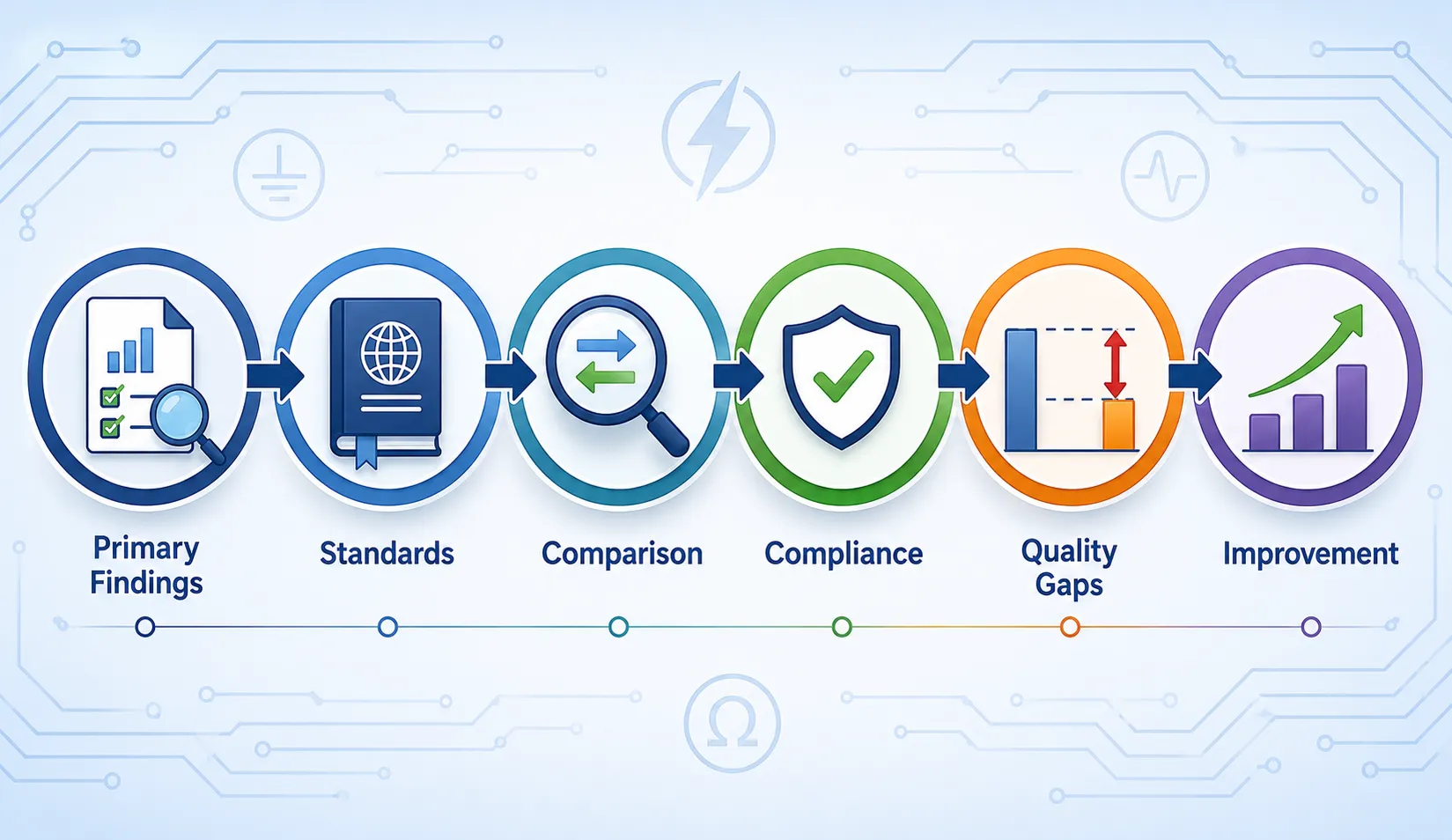
Understanding Standards as Research Benchmarks
A standard can provide a structured reference against which research findings can be assessed. It may specify requirements, principles, verification procedures, performance expectations, definitions, or recommended approaches.
In electrical QA/QC research, standards can provide benchmarks for:
- Electrical installation quality
- Equipment construction
- Testing and verification
- Inspection processes
- Documentation
- Quality management
- Safety-related requirements
- Performance characteristics
- Conformity assessment
The selected benchmark must be directly relevant to the research question.
For example, if research investigates low-voltage installation quality, a researcher may consider the applicable edition and scope of IEC 60364 and, where the research concerns UK installations, the relevant current edition of BS 7671. IEC 60364-1:2025 sets out fundamental principles, assessment of general characteristics and definitions for low-voltage electrical installations. The IET identifies BS 7671 as the UK national standard for electrical installations and currently lists BS 7671:2018+A4:2026 as the latest edition.
Key Concepts and Definitions
| Key Concept | Definition | Application in Electrical QA/QC Research |
|---|---|---|
| Primary Finding | Evidence directly generated or collected during the research | Inspection observations and testing results |
| Standard | An established technical or quality benchmark | IEC or national electrical standard |
| Benchmark | Defined reference used for comparison | Specified testing or performance requirement |
| Compliance | Conformity with an applicable requirement | Installation meeting relevant criteria |
| Deviation | Difference between observed evidence and a benchmark | Test result outside a specified requirement |
| Conformity | Fulfilment of a specified requirement | Equipment satisfying applicable requirements |
| Critical Comparison | Analytical evaluation of similarities and differences | Comparing test findings with standard requirements |
| Applicability | Degree to which a standard is relevant to the research context | Selecting the correct installation standard |
| Edition | Specific published version of a standard | Using the applicable current edition |
| Requirement | Defined condition or expectation within a standard | Verification requirement for equipment |
| Evidence | Information supporting a research judgement | Test certificates and inspection records |
| Benchmarking | Systematic comparison against defined criteria | Comparing defect rates or test results |
| Gap | Difference requiring investigation or improvement | Observed practice falling below an applicable benchmark |
| Professional Judgement | Reasoned decision based on evidence and expertise | Assessing the significance of a deviation |
| Context | Conditions surrounding the research evidence | Project type, environment, system and jurisdiction |
Why Critical Comparison Is Important
Primary research findings describe what the researcher observed or measured. Standards provide a reference for determining how those findings should be evaluated.
Without comparison, a researcher may identify a defect without understanding:
- Its technical significance
- Whether it represents non-conformity
- Whether an alternative approach is permitted
- Whether the benchmark applies
- Whether the finding is isolated or systemic
- Whether corrective action is required
Critical comparison therefore transforms raw findings into professionally meaningful evidence.
National and International Standards
Electrical engineering operates within both national and international standardisation frameworks.
International Standards
International standards can provide common technical principles across countries and projects. IEC standards are particularly important in electrical and electrotechnical engineering.
Examples include:
- IEC 60364 for low-voltage electrical installations
- IEC 61439 for low-voltage switchgear and controlgear assemblies
- Relevant IEC product and testing standards
- ISO 9001 for quality management systems
IEC 61439-1:2020 establishes general definitions, service conditions, construction requirements, technical characteristics and verification requirements for low-voltage switchgear and controlgear assemblies.
National Standards
National standards adapt or establish requirements for specific national environments.
In the UK electrical sector, BS 7671 is a major reference for electrical installations. The IET describes it as the national standard for electrical installations in domestic, commercial and industrial settings.
Researchers should always identify the geographical and regulatory context before selecting a national standard.
Quality Management Standards
Electrical QA/QC research may also examine the effectiveness of quality management systems.
ISO 9001 provides requirements for quality management systems and addresses areas including organisational context, leadership, planning, support, operation, performance evaluation and improvement. ISO states that ISO 9001 is applicable across sectors and is intended to support consistent provision of products and services that meet applicable requirements.
When evaluating electrical QA/QC research findings, ISO 9001 may therefore provide a management-system benchmark, while a technical IEC or national standard may provide the technical benchmark.
These standards should not be treated as interchangeable.
Selecting the Correct Standard
The first stage of critical comparison is identifying the correct benchmark.
Researchers should consider:
- Research topic
- Electrical system involved
- Project type
- Voltage level
- Equipment category
- Geographic jurisdiction
- Applicable contractual requirements
- Regulatory environment
- Standard edition
- Scope of the standard
A researcher should never select a standard merely because it contains terminology similar to the research topic.
Checking Standard Applicability
Before comparing evidence, researchers should confirm that the standard actually applies.
Questions include:
- Does the standard cover the equipment?
- Does it cover the electrical installation?
- Does it apply to the voltage level?
- Does it apply to the project location?
- Does the relevant edition apply to the research period?
- Are there project-specific requirements?
- Are there exclusions or limitations?
This prevents incorrect benchmarking.
Importance of Using the Correct Edition
Standards change over time. Requirements can be amended, reorganised, expanded, or replaced.
For example, the IET currently identifies BS 7671:2018+A4:2026 as available and explains the importance of using the current edition and applicable amendments.
Researchers therefore need to establish:
- Which edition applied during the research period
- Whether amendments were applicable
- Whether the project contract specified another edition
- Whether transitional arrangements existed
Using an outdated edition can produce an inaccurate comparison.
Establishing a Comparison Framework
A systematic comparison framework should connect:
Primary Finding
↓
Applicable Standard
↓
Specific Requirement
↓
Observed Evidence
↓
Comparison
↓
Deviation
↓
Professional Interpretation
↓
Research Conclusion
This structure helps ensure that every conclusion is traceable to evidence.
Step 1: Define the Primary Finding
The researcher should clearly state what the research discovered.
Examples include:
- Testing results
- Defect frequency
- Inspection outcomes
- Documentation deficiencies
- Equipment performance
- Corrective action effectiveness
The finding should be expressed clearly enough to allow comparison with a benchmark.
Step 2: Identify the Applicable Benchmark
The researcher identifies the relevant standard or requirement.
The benchmark should be:
- Relevant
- Current or historically applicable
- Authoritative
- Appropriate to the research context
Step 3: Identify the Specific Requirement
Researchers should avoid comparing a finding with an entire standard.
Instead, identify the relevant:
- Clause
- Requirement
- Verification criterion
- Performance expectation
- Defined principle
This creates a more precise comparison.
Step 4: Compare Evidence
The researcher then compares the primary evidence with the selected requirement.
Possible outcomes include:
- Consistent with requirement
- Partially consistent
- Deviates from requirement
- Insufficient evidence
- Requirement not applicable
This is more academically robust than simply using “pass” or “fail”.
Step 5: Investigate Deviations
Where differences are identified, researchers should investigate why they occurred.
Possible explanations include:
- Genuine non-conformity
- Different project specification
- Alternative permitted approach
- Incorrect measurement
- Documentation error
- Standard interpretation
- Incorrect standard selection
Step 6: Evaluate Significance
Not every difference has the same importance.
Researchers should assess:
- Technical significance
- Safety implications
- Quality implications
- Performance consequences
- Recurrence
- Scope of impact
Step 7: Develop a Defensible Conclusion
The conclusion should reflect the evidence.
For example:
“Primary testing records indicate repeated deviation from the selected benchmark during the investigated commissioning stage.”
This is more defensible than:
“The entire electrical system is unsafe.”
The latter conclusion may exceed the evidence.
Comparing Installation Findings Against Standards
Suppose a research project investigates the quality of electrical installations.
The researcher may examine:
- Wiring arrangements
- Protective measures
- Earthing arrangements
- Identification
- Inspection records
- Testing results
- Certification
The relevant national or international installation standard should then be identified based on the project context.
For UK installation research, BS 7671 is an important benchmark. The IET describes BS 7671 as the national standard for electrical installations and notes its relevance to design, installation, certification and maintenance.
The researcher should then compare the primary findings with the applicable requirements rather than relying on general expectations.
Comparing Testing Findings
Electrical QA/QC research may involve testing information such as:
- Continuity
- Insulation resistance
- Protective conductor performance
- Functional testing
- Equipment verification
- Commissioning results
The relevant test criteria should be identified from the applicable standard and project requirements.
The researcher should record:
- Test condition
- Measured value
- Applicable criterion
- Difference
- Verification status
- Context
Comparing Equipment Findings
Equipment-specific research may require product standards.
For example, where research concerns low-voltage switchgear and controlgear assemblies, IEC 61439 may be relevant. IEC 61439-1:2020 specifies general requirements and verification provisions for low-voltage switchgear and controlgear assemblies, while relevant parts of the IEC 61439 series apply according to the assembly.
The researcher should therefore avoid treating a general standard as sufficient when a specific product standard is required.
Comparing Quality Management Findings
Technical electrical findings may also reveal weaknesses in quality management.
For example:
Research Finding: Corrective actions are repeatedly delayed.
The researcher may compare the organisational quality process against applicable quality-management requirements and documented procedures.
ISO 9001 includes performance evaluation and improvement within its quality-management framework.
The comparison can therefore examine whether the organisation has effective processes for monitoring, analysing, evaluating and improving quality performance.
Critical Comparison Rather Than Simple Compliance Checking
A Level 6 researcher should move beyond statements such as:
“Finding A complies.”
or:
“Finding B does not comply.”
Critical analysis should ask:
- Why does the finding meet or deviate from the benchmark?
- What factors influenced the outcome?
- Is the evidence sufficiently reliable?
- Does the requirement directly apply?
- Is the deviation repeated?
- What are its implications?
- Does the finding support previous research?
- Does it challenge accepted practice?
Considering Project-Specific Requirements
Industry standards are not always the only benchmark.
Electrical projects may also have:
- Client specifications
- Employer requirements
- Design specifications
- Equipment manufacturer instructions
- Contractual requirements
- Approved drawings
- Inspection and test plans
- Project quality plans
Researchers should identify the hierarchy and applicability of these requirements.
Practical Example: Electrical Installation Research
Research Question
A researcher investigates recurring quality defects in low-voltage electrical installations.
Primary Findings
The research identifies:
- Repeated documentation deficiencies
- Inconsistent inspection records
- Recurring installation defects
- Variation in testing records
Benchmarking Process
The researcher:
- Identifies the applicable national installation requirements
- Reviews relevant international principles
- Establishes specific comparison criteria
- Compares primary findings
- Identifies recurring deviations
Interpretation
The researcher determines that some defects represent clear deviations, while other differences are related to documentation practices rather than technical installation performance.
This distinction is important because it prevents all findings from being treated as equivalent.
Case Study: Comparing Commissioning Findings
Background
An electrical engineering project experiences recurring commissioning problems.
Primary Research Evidence
The researcher collects:
- Commissioning records
- Testing results
- Non-conformance reports
- Interviews with commissioning personnel
Standard Comparison
The relevant technical standards and project requirements are reviewed.
Findings
The research identifies:
- Some testing results within requirements
- Several repeated documentation gaps
- Certain test records lacking sufficient supporting evidence
Critical Interpretation
The researcher does not conclude that the entire commissioning process is technically defective.
Instead, the evidence indicates that the principal weakness may involve verification and documentation control.
This illustrates the importance of distinguishing technical non-conformity from process weaknesses.
Case Study: Comparing Switchgear Research Findings
Background
A researcher examines quality problems involving low-voltage switchgear assemblies.
Primary Findings
The investigation identifies inconsistencies in:
- Assembly documentation
- Verification records
- Inspection evidence
- Technical information
Benchmark
The researcher identifies the relevant IEC 61439 requirements for the assembly under investigation.
IEC 61439-1:2020 establishes general requirements and verification provisions, while the applicable product part of the series must also be considered.
Critical Evaluation
The researcher determines whether each finding relates to:
- Construction
- Technical characteristics
- Verification
- Documentation
- Specification
The resulting analysis is more precise than simply stating that the assembly “failed the standard”.
Comparing International and National Requirements
International and national standards may have similar objectives but different structures or requirements.
Researchers should consider:
- Scope
- Definitions
- Technical criteria
- Testing methods
- Documentation requirements
- National adaptations
- Regulatory context
A comparison should not assume that two standards are identical simply because they address the same subject.
Building a Standards Comparison Matrix
A standards comparison matrix can provide a clear research structure.
| Research Finding | Benchmark | Primary Evidence | Comparison | Interpretation |
|---|---|---|---|---|
| Recurring installation defects | Applicable installation standard | Inspection records | Deviation identified | Requires investigation |
| Testing documentation gaps | Project requirements | Test certificates | Partial conformity | Documentation weakness |
| Assembly verification variation | Applicable IEC standard | Verification records | Evidence incomplete | Further verification required |
| Corrective action delays | Quality management framework | Action records | Process weakness | Improvement opportunity |
This approach provides a transparent connection between research evidence and professional judgement.
Evaluating Evidence Strength
Researchers should consider how strong the primary evidence is.
Evidence may be:
- Direct
- Indirect
- Complete
- Partial
- Repeated
- Isolated
- Independently verified
- Unverified
A repeated finding supported by several independent records generally provides stronger evidence than a single unverified observation.
Dealing With Incomplete Evidence
Sometimes a research finding cannot be confidently compared with a standard because required information is missing.
For example:
- Test conditions are unavailable
- Equipment configuration is unclear
- Measurement records are incomplete
- Applicable project specification is missing
In such circumstances, researchers should state:
Evidence insufficient for definitive comparison.
This is preferable to making an unsupported judgement.
Avoiding Overgeneralisation
A finding from one project should not automatically be presented as representative of the entire electrical industry.
Researchers should distinguish between:
- Project-specific findings
- Organisation-level findings
- Sector-level implications
- International implications
The scope of the conclusion should reflect the scope of the research.
Considering Research Limitations
Critical comparison should take research limitations into account.
Relevant limitations may include:
- Small sample
- Limited project access
- Restricted records
- Short research period
- Limited geographic scope
- Incomplete historical data
- Confidentiality restrictions
These factors may affect the strength of the comparison.
Ethical Considerations
Researchers must compare findings objectively.
They should avoid:
- Selecting standards solely to produce a desired result
- Ignoring inconvenient findings
- Misrepresenting standard requirements
- Using outdated standards without explanation
- Presenting recommendations as mandatory requirements without justification
The purpose of benchmarking is to improve research credibility, not to manufacture non-conformities.
Key Benefits of Critical Standards Comparison
Improved Research Credibility
Research findings become more meaningful when evaluated against recognised benchmarks.
Stronger Professional Judgement
Researchers develop the ability to distinguish technical evidence from assumption.
Better Identification of Quality Gaps
Comparison makes deviations and weaknesses more visible.
Improved QA/QC Decision-Making
Standards-based findings support structured quality decisions.
Better Corrective Action
Clear identification of deviations can help organisations determine where improvement is needed.
Improved Continuous Improvement
Repeated comparison can reveal systemic quality weaknesses and improvement opportunities.
Greater International Relevance
Using appropriate international standards helps research findings communicate effectively across different engineering environments.
Common Mistakes to Avoid
Researchers should avoid:
- Selecting irrelevant standards
- Using outdated editions without justification
- Treating all standards as legally mandatory
- Comparing findings with broad principles instead of specific requirements
- Ignoring project specifications
- Confusing recommendations with mandatory requirements
- Treating one deviation as proof of systemic failure
- Ignoring measurement uncertainty
- Making conclusions beyond the available evidence
A Structured Procedure for Critical Comparison
Stage 1: Define the Research Finding
Clearly document what was observed or measured.
Stage 2: Identify the Electrical Context
Define:
- Equipment
- System
- Installation type
- Project environment
- Location
Stage 3: Identify Applicable Standards
Select relevant national and international references.
Stage 4: Confirm the Applicable Edition
Check the version relevant to the research period and project.
Stage 5: Identify Specific Requirements
Locate the precise benchmark relevant to the finding.
Stage 6: Compare Evidence
Determine whether the primary finding:
- Conforms
- Partially conforms
- Deviates
- Cannot be determined
Stage 7: Investigate Differences
Determine why deviations occurred.
Stage 8: Assess Significance
Consider:
- Quality
- Safety
- Performance
- Reliability
- Recurrence
Stage 9: Consider Limitations
Evaluate evidence gaps and research constraints.
Stage 10: Develop Conclusions
Make conclusions that are proportionate to the evidence.
Professional Interpretation Framework
A useful analytical structure is:
What was found?
↓
What standard applies?
↓
What does the standard require?
↓
What does the evidence show?
↓
Is there a difference?
↓
Why might the difference exist?
↓
How significant is it?
↓
What does this mean for the research question?
This framework encourages analytical reasoning rather than simple compliance checking.
Conclusion
Critically comparing primary research findings against established national and international electrical quality standards enables researchers to transform project-specific observations into professionally meaningful evidence. The process requires careful selection of applicable benchmarks, confirmation of the relevant standard edition, identification of specific requirements, systematic comparison of primary evidence, investigation of deviations, and evaluation of the significance of identified differences. International references such as IEC standards and quality-management frameworks such as ISO 9001 can provide important benchmarks, while national standards such as BS 7671 may be essential where the research concerns a specific national electrical installation context.
At Level 6, the objective is not simply to determine whether a research finding passes or fails a standard. The researcher must demonstrate critical judgement by considering applicability, evidence quality, project requirements, measurement conditions, research limitations, alternative explanations, and the potential implications of deviations. Standards should be used as evidence-based benchmarks rather than as substitutes for professional analysis. When this approach is applied systematically, electrical QA/QC research becomes more credible, transparent, technically defensible, and useful for identifying quality gaps, supporting corrective actions, improving compliance, and contributing to continual improvement across electrical engineering environments.
2. Analyse How the Research Outcomes Align With or Challenge Current Industry Best Practices in QA/QC
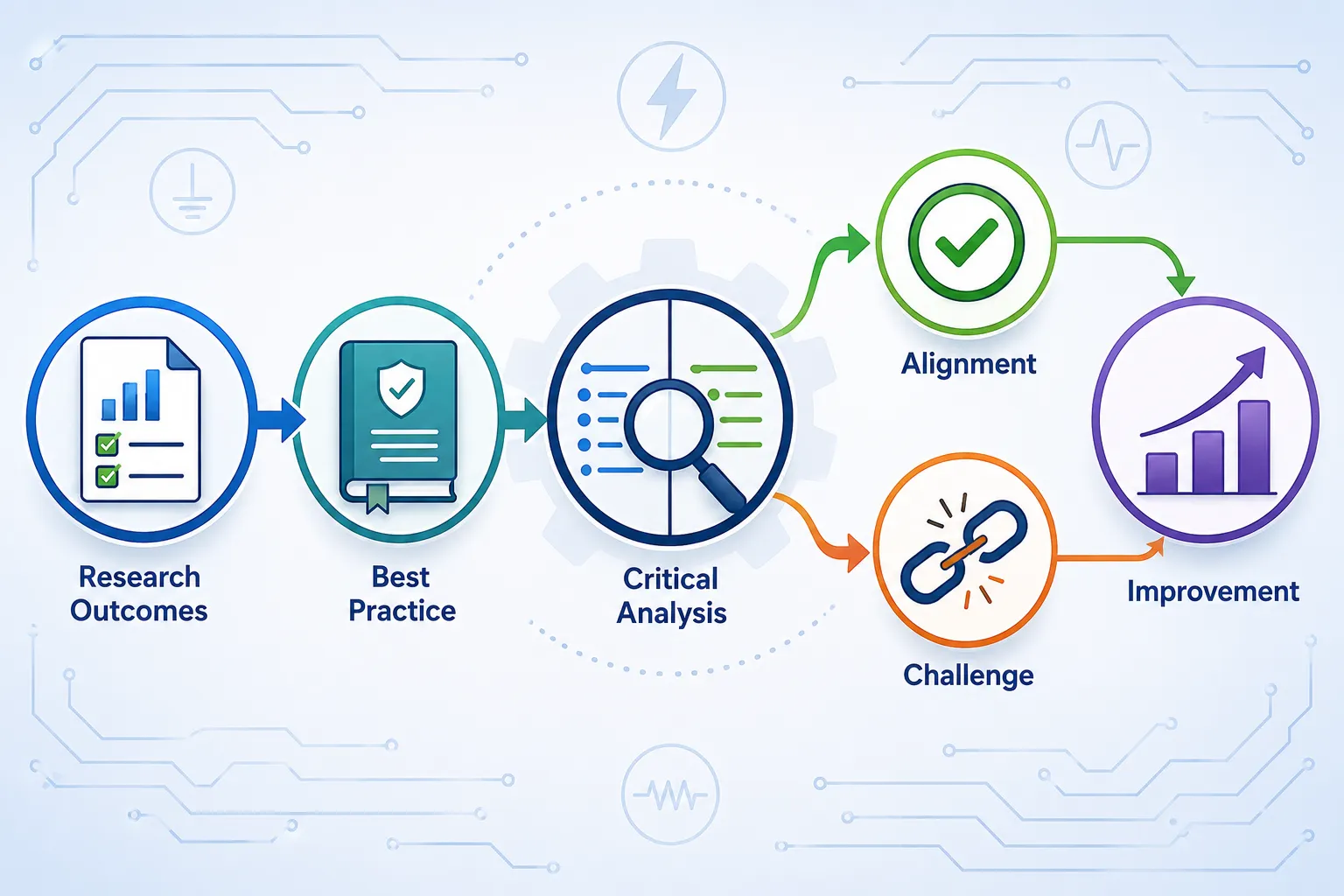
Analysing how research outcomes align with or challenge current industry best practices is an important stage of advanced electrical engineering QA/QC research. Research findings should not be considered valuable simply because they produce numerical results or identify recurring defects. Their professional significance becomes clearer when they are compared with established approaches to quality planning, inspection, testing, verification, documentation, corrective action, risk management, competence, continual improvement, and evidence-based decision-making. This comparison allows researchers to determine whether their findings confirm accepted practice, reveal weaknesses in existing approaches, or provide evidence that may justify a different method of managing electrical quality.
In electrical engineering environments, industry best practice can be informed by international standards, national standards, recognised technical guidance, manufacturer requirements, project specifications, organisational procedures, professional experience, and evidence from successful quality-management systems. ISO’s quality-management framework, for example, emphasises principles including customer focus, leadership, engagement of people, process approach, improvement, evidence-based decision-making, and relationship management. These principles provide a useful conceptual basis for evaluating whether electrical QA/QC research outcomes support systematic and continually improving quality management.
The analysis must nevertheless remain critical. A research finding that differs from common industry practice is not automatically wrong, and an established practice is not automatically optimal. Research may identify situations where a traditional QA/QC procedure produces unnecessary duplication, fails to detect recurring defects, relies excessively on retrospective inspection, or does not respond effectively to changing project conditions. Conversely, an apparently innovative approach may perform well in one project but lack sufficient evidence for wider adoption. The researcher therefore needs to examine evidence, context, limitations, applicability, risks, and practical consequences before deciding whether an outcome aligns with, improves upon, or challenges current best practice.
Understanding Industry Best Practice in Electrical QA/QC
Industry best practice refers to a recognised approach, process, method, or system that is considered effective and appropriate within a particular professional context. It is broader than compliance with a standard.
A standard generally establishes defined requirements or criteria, whereas best practice may represent a professionally recognised way of achieving reliable and efficient outcomes.
For example, an electrical project may comply with applicable technical requirements while still having weaknesses in:
- Quality planning
- Communication
- Document control
- Root-cause investigation
- Corrective-action management
- Lessons learned
- Data analysis
- Supplier quality management
- Continual improvement
Therefore, compliance and best practice should be analysed separately.
Standards, Guidance and Best Practice
Researchers should distinguish between different sources of professional expectations.
| Source | Meaning | Research Application |
|---|---|---|
| International Standard | Internationally developed technical or management benchmark | Compare research outcomes with global expectations |
| National Standard | Standard applicable within a particular national context | Assess country-specific electrical practice |
| Regulation | Legally enforceable requirement where applicable | Determine regulatory compliance |
| Project Specification | Contract or project-specific technical requirement | Compare project performance |
| Manufacturer Requirement | Technical requirement for specific equipment | Assess equipment installation or operation |
| Professional Guidance | Recommended professional approach | Evaluate recognised good practice |
| Organisational Procedure | Internal controlled method | Assess process implementation |
| Best Practice | Demonstrated or recognised effective approach | Evaluate quality performance and improvement |
The researcher must therefore identify the nature and authority of the benchmark before using it.
The Importance of Context
Best practice is context-dependent.
An approach suitable for:
- A large power project
may not be directly transferable to:
- A small commercial installation.
Similarly, a QA/QC approach developed for:
- Manufacturing
may require modification before being applied to:
- Electrical construction.
Researchers should therefore consider:
- Project scale
- Electrical system complexity
- Risk profile
- Regulatory environment
- Workforce competence
- Supply-chain structure
- Project duration
- Technology
- Client requirements
- Geographic context
Relationship Between Research Outcomes and Best Practice
Research outcomes can generally produce four broad relationships with established practice:
- Alignment
- Partial alignment
- Challenge
- Extension or improvement
Alignment
An outcome aligns with best practice when the evidence supports an existing recognised approach.
For example, research may demonstrate that standardised inspection procedures are associated with more consistent defect identification.
This may support established quality principles relating to:
- Standardisation
- Process control
- Consistency
- Evidence-based decision-making
Partial Alignment
A research outcome may support part of an established practice while identifying weaknesses elsewhere.
For example:
- Inspection procedures may be effective.
- However, corrective actions may remain poorly controlled.
The research therefore supports the inspection process but challenges the effectiveness of the wider quality-improvement cycle.
Challenging Existing Practice
Research challenges best practice when evidence indicates that an established approach may be:
- Inefficient
- Inconsistent
- Inadequate
- Contextually inappropriate
- Producing unintended outcomes
- Failing to address emerging risks
A challenge should be supported by evidence rather than personal preference.
Extending Existing Practice
Research may identify an additional practice that complements existing QA/QC methods.
For example, an organisation may already perform inspections effectively but could improve early defect detection by systematically analysing historical defect data.
The research therefore does not necessarily reject current practice. Instead, it proposes an evidence-based extension.
Evaluating Research Outcomes Against Quality Management Principles
Quality-management principles provide a useful framework for analysing research outcomes.
ISO identifies seven quality-management principles, including customer focus, leadership, engagement of people, process approach, improvement, evidence-based decision-making, and relationship management.
Researchers can therefore ask whether their findings support these principles.
Customer Focus
Electrical QA/QC ultimately contributes to delivering systems and services that meet applicable requirements and stakeholder expectations.
Research findings may indicate:
- Improved conformity
- Fewer defects
- Better commissioning
- Reduced rework
- Improved reliability
If research demonstrates that a QA/QC intervention improves these outcomes, it may align with customer-focused quality management.
Leadership
Research may reveal whether management actively supports quality.
Relevant findings may concern:
- Resource allocation
- Quality objectives
- Management review
- Accountability
- Decision-making
- Quality culture
A technically strong QA/QC procedure may still perform poorly if leadership does not support its implementation.
Engagement of People
Electrical quality depends heavily on competent personnel.
Research may identify relationships between:
- Competence
- Training
- Supervision
- Communication
- Workforce engagement
- Defect occurrence
If research demonstrates that improved workforce engagement contributes to better quality outcomes, this may support established quality-management principles.
Process Approach
Electrical QA/QC activities should not be viewed as isolated inspections.
They are interconnected through processes such as:
Planning → Procurement → Installation → Inspection → Testing → Commissioning → Handover → Feedback
Research outcomes may demonstrate that weaknesses at one stage influence later quality performance.
Improvement
Research findings should ideally contribute to continual improvement.
ISO describes continual improvement as a core component of its quality-management approach.
Researchers should therefore examine whether findings lead to:
- Corrective action
- Preventive improvement
- Process refinement
- Better monitoring
- Lessons learned
- Improved future performance
Evidence-Based Decision-Making
Evidence-based decision-making is particularly important when analysing research outcomes.
Researchers should distinguish between:
- Evidence
- Interpretation
- Assumption
- Opinion
- Recommendation
A professional conclusion should be supported by the available evidence.
For example:
Evidence: Defects decreased after a revised inspection process was introduced.
Interpretation: The revised process may have contributed to improved defect detection or prevention.
Recommendation: Further monitoring should establish whether the improvement is sustained.
This is more defensible than stating that the revised procedure definitively caused the improvement without considering alternative factors.
Current Industry Practice and Quality Management Systems
A modern QA/QC system generally requires more than final inspection.
Research should consider whether quality is:
- Planned
- Controlled
- Verified
- Measured
- Analysed
- Improved
ISO 9001 provides a quality-management framework covering areas such as organisational context, leadership, planning, support, operation, performance evaluation, and improvement.
Research outcomes can therefore be assessed against the maturity of the overall quality system rather than individual inspection activities alone.
Moving From Inspection to Prevention
One important area for critical analysis is the relationship between inspection and prevention.
Traditional approaches may focus heavily on identifying defects after work has been completed.
A more preventive QA/QC approach may seek to:
- Identify risks before work begins
- Control critical processes
- Verify materials
- Confirm competence
- Review designs
- Monitor supplier quality
- Analyse recurring defects
If research shows that defects are repeatedly identified at final inspection, the researcher should consider whether earlier controls could prevent those defects.
Example
A project records repeated termination defects during final inspection.
The research identifies that:
- Installation teams receive limited pre-task quality guidance.
- Inspection occurs mainly after completion.
- Similar defects recur across several work areas.
This finding may challenge a heavily inspection-focused approach.
The research may support:
- Earlier inspection points
- First-off inspections
- Competence verification
- Installation checklists
- Supervisor verification
The outcome therefore has implications for preventive QA/QC.
Analysing Research Outcomes Against Risk-Based Thinking
Modern quality management increasingly requires organisations to consider risk and opportunities when planning and controlling processes.
Researchers should ask:
- Does the current QA/QC process focus on high-risk activities?
- Are critical quality characteristics identified?
- Are resources directed towards significant risks?
- Does the inspection strategy reflect actual risk?
- Are recurring defects analysed for systemic causes?
A research outcome that demonstrates poor quality performance in a high-risk process may have greater significance than a larger number of minor administrative errors.
Practical Example: Risk-Based Inspection
Suppose research identifies:
- 40 minor documentation errors
- 5 recurring defects in a critical electrical protection system
A simple numerical comparison might focus on the 40 documentation errors.
A professional QA/QC analysis should consider:
- Severity
- Consequence
- Recurrence
- Technical significance
- Safety implications
- Detectability
The five critical defects may therefore require greater management attention.
Analysing Research Outcomes Against Inspection and Testing Practices
Inspection and testing are central components of electrical QA/QC.
Research may examine:
- Inspection frequency
- Test procedures
- Verification records
- Test equipment
- Inspector competence
- Defect identification
- Documentation
- Corrective action
The research should determine whether observed practices:
- Align with established procedures
- Produce consistent outcomes
- Identify defects effectively
- Support traceability
- Contribute to prevention
For UK electrical installation contexts, BS 7671 is a major national benchmark; the IET currently lists BS 7671:2018+A4:2026 as the current 18th Edition publication and describes it as the national standard for electrical installations in the UK.
Analysing Research Outcomes Against Documentation Practices
Documentation is an important component of QA/QC because it provides evidence of:
- Inspection
- Testing
- Verification
- Approval
- Corrective action
- Handover
Research may identify documentation problems such as:
- Missing records
- Inconsistent terminology
- Incorrect revisions
- Incomplete test results
- Poor traceability
- Delayed approvals
If these issues recur, the researcher should determine whether they represent isolated administrative weaknesses or a broader quality-management problem.
Digital QA/QC and Industry Best Practice
Digital technologies increasingly influence quality-management processes.
Research may examine:
- Digital inspection forms
- Electronic test records
- Document management systems
- Mobile QA/QC applications
- Automated data collection
- Dashboards
- Digital defect tracking
However, digitalisation should not automatically be considered best practice.
The researcher should evaluate whether the technology actually improves:
- Accuracy
- Traceability
- Accessibility
- Timeliness
- Decision-making
- Corrective action
Example
A company introduces a digital inspection system.
Research findings show:
- Faster reporting
- Improved traceability
- Fewer missing records
- Better management visibility
These findings support the value of digitalisation in that context.
However, if field personnel receive insufficient training and data quality declines, the research may challenge the assumption that digitalisation automatically improves QA/QC.
Analysing Supplier and Material Quality
Electrical QA/QC performance is influenced by the supply chain.
Research outcomes may reveal recurring problems involving:
- Material certification
- Incorrect specifications
- Damaged equipment
- Late substitutions
- Incomplete documentation
- Supplier non-conformities
Researchers should evaluate whether supplier-control practices are effective.
Potential best-practice indicators include:
- Approved supplier processes
- Incoming inspection
- Material traceability
- Certification verification
- Non-conformance control
- Supplier performance monitoring
Competence and Workforce Factors
Human performance is an important element of electrical quality.
Research findings may demonstrate relationships between quality outcomes and:
- Training
- Experience
- Competence
- Supervision
- Communication
- Workload
- Fatigue
- Task complexity
The researcher should avoid simplistic conclusions.
For example, if experienced teams produce fewer defects, this does not automatically prove that experience alone caused the improvement.
Other variables may include:
- Better supervision
- More experienced supervisors
- Better planning
- Better materials
- Lower workload
- More effective inspection
Root-Cause Analysis
Best-practice QA/QC should not focus exclusively on identifying symptoms.
Research outcomes should therefore be analysed to determine whether recurring defects have common causes.
Potential causes may involve:
- Design
- Materials
- Installation
- Competence
- Supervision
- Communication
- Procedures
- Planning
- Inspection
- Environmental conditions
Example
If the same cable termination defect occurs repeatedly, recording each occurrence separately may not be sufficient.
The researcher should investigate whether the repeated defects indicate:
- Inadequate training
- Poor installation instructions
- Incorrect tools
- Weak supervision
- Material problems
This moves the research from defect counting towards quality improvement.
When Research Challenges Best Practice
A research outcome should be considered a potential challenge to existing practice when there is credible evidence that the accepted approach:
- Does not achieve its intended outcome
- Produces recurring problems
- Creates unnecessary duplication
- Fails under particular conditions
- Does not adequately address emerging risks
- Produces inconsistent results
However, the researcher should avoid claiming that the entire industry practice is ineffective based on a single project.
Criteria for Challenging Established Practice
Before challenging established practice, researchers should consider:
- Strength of evidence
- Sample size
- Research methodology
- Consistency of findings
- Alternative explanations
- Context
- Replicability
- Risk implications
- Existing evidence
A stronger challenge requires stronger evidence.
When Research Supports Best Practice
Research may confirm existing practice when findings demonstrate that an established approach:
- Produces consistent results
- Reduces defects
- Improves traceability
- Supports compliance
- Reduces rework
- Improves decision-making
- Enhances quality performance
Such findings can strengthen confidence in existing procedures.
When Research Reveals a Partial Gap
A particularly valuable research outcome may identify a gap between formal procedure and actual implementation.
For example:
Procedure: All inspections require documented verification.
Research finding: Verification is formally required but inconsistently recorded.
This suggests that the weakness may not be the quality procedure itself, but its implementation.
Potential causes include:
- Training
- Supervision
- Workload
- Documentation systems
- Communication
Research Outcomes and Continuous Improvement
Research should contribute to continual improvement rather than simply describing existing problems.
Potential improvement actions include:
- Revising procedures
- Improving training
- Introducing additional verification points
- Strengthening document control
- Improving data analysis
- Enhancing supplier controls
- Developing quality indicators
- Reviewing inspection strategies
The improvement should be linked directly to the research evidence.
Practical Comparison Framework
A useful framework is:
1. Identify the Outcome
What did the research discover?
2. Identify Current Practice
What does the organisation or industry currently do?
3. Identify the Benchmark
What standard, guidance, procedure, or recognised practice provides the comparison?
4. Compare
Does the research outcome:
- Support?
- Partially support?
- Challenge?
- Extend?
5. Investigate the Difference
Why does the outcome differ?
6. Assess Significance
What are the implications?
7. Evaluate Evidence Strength
How confident can the researcher be?
8. Develop Recommendation
What should change, remain, or be investigated further?
Standards and Best Practice Should Not Be Confused
A critical researcher must understand that a standard and best practice are not necessarily identical.
A standard may establish:
- Defined requirements
- Technical criteria
- Verification provisions
- Terminology
- Conformity expectations
Best practice may additionally include:
- Efficient workflows
- Effective communication
- Preventive approaches
- Lessons learned
- Digital processes
- Organisational learning
- Practical experience
Therefore, research may find compliance with a standard but still identify opportunities for better practice.
Case Study: Research Findings Challenge a QA/QC Approach
Background
An electrical contractor operates a conventional QA/QC system based heavily on final inspection.
Research Findings
The researcher identifies:
- Recurring installation defects
- High levels of rework
- Similar defects across multiple teams
- Most defects identified late in the project phase
Analysis
The current system successfully detects defects but is less effective at preventing them.
Interpretation
The research does not necessarily demonstrate that final inspection is ineffective.
Instead, it suggests that inspection should be complemented by preventive controls.
Potential improvements include:
- Earlier verification
- First-installation checks
- Supervisor inspections
- Competence reviews
- Process-based monitoring
Conclusion
The research challenges the balance of the existing QA/QC approach rather than rejecting inspection itself.
Case Study: Research Supports Existing Best Practice
Background
A project uses standardised inspection and testing procedures.
Research Findings
The researcher identifies:
- Consistent inspection records
- Low defect recurrence
- Strong traceability
- Timely corrective actions
- Consistent testing documentation
Analysis
The evidence aligns with established quality-management principles involving:
- Process control
- Evidence-based decision-making
- Documentation
- Continual improvement
Conclusion
The research provides evidence supporting the effectiveness of the existing structured QA/QC approach.
Case Study: Research Extends Current Practice
Background
An organisation has a strong inspection programme but limited analysis of historical quality data.
Research Findings
Historical data reveals recurring defects associated with specific installation stages.
Interpretation
The existing inspection process is functioning, but the organisation is not fully using collected data for predictive or preventive improvement.
Recommended Extension
The organisation could introduce:
- Trend analysis
- Recurring-defect analysis
- Quality dashboards
- Targeted improvement actions
- Lessons-learned reviews
The research therefore extends current practice rather than replacing it.
Key Benefits of Analysing Alignment With Best Practice
Improved Research Credibility
Research findings become more meaningful when evaluated against established professional expectations.
Better Quality Decisions
Managers can distinguish genuine weaknesses from isolated variations.
Improved Continuous Improvement
Research provides evidence for improving existing processes.
Reduced Rework
Identifying recurring causes can support earlier intervention.
Stronger QA/QC Systems
Research can reveal weaknesses in process design and implementation.
Better Risk Management
Critical findings can be prioritised according to potential consequences.
Improved Professional Practice
Evidence can challenge assumptions and support better engineering decisions.
Greater Organisational Learning
Research can convert project experience into transferable knowledge.
Common Analytical Errors
Researchers should avoid:
- Assuming established practice is always effective
- Treating innovation as automatically better
- Confusing compliance with excellence
- Generalising from one project
- Ignoring contradictory evidence
- Selecting only favourable findings
- Treating correlation as causation
- Ignoring research limitations
- Making recommendations without evidence
A Structured Procedure for Evaluating Research Outcomes
Stage 1: Review the Research Findings
Identify the major outcomes and supporting evidence.
Stage 2: Define Existing Practice
Document what is currently being done.
Stage 3: Identify Appropriate Benchmarks
Select relevant standards, guidance, procedures, and recognised practices.
Stage 4: Establish Comparison Criteria
Define measurable or observable criteria.
Stage 5: Compare the Findings
Determine whether the outcomes align, partially align, challenge, or extend practice.
Stage 6: Investigate Differences
Consider technical, human, organisational, and contextual factors.
Stage 7: Evaluate Evidence Strength
Assess reliability, validity, limitations, and consistency.
Stage 8: Assess Practical Significance
Determine implications for:
- Quality
- Cost
- Programme
- Safety
- Reliability
- Compliance
Stage 9: Develop Recommendations
Recommendations should directly respond to the evidence.
Stage 10: Identify Further Research
Where evidence remains uncertain, propose appropriate further investigation rather than making unsupported claims.
Research-to-Practice Decision Matrix
| Research Outcome | Relationship to Practice | Interpretation | Potential Response |
|---|---|---|---|
| Consistent improvement | Aligns | Existing approach appears effective | Maintain and monitor |
| Repeated defects | Challenges | Current control may be inadequate | Investigate root causes |
| Mixed results | Partially aligns | Effectiveness depends on context | Refine implementation |
| New effective method | Extends | Additional control may add value | Pilot and evaluate |
| Conflicting evidence | Uncertain | Evidence insufficient | Conduct further research |
| Strong negative outcome | Challenges | Significant weakness identified | Review process urgently |
Professional Judgement in Best-Practice Evaluation
At Level 6, professional judgement requires researchers to move beyond description.
A descriptive statement might be:
“Defects were reduced following implementation of the new inspection process.”
A stronger analytical statement would be:
“Defect frequency decreased following implementation of the revised inspection process; however, concurrent changes in workforce composition and supervision limit the extent to which the reduction can be attributed solely to the revised process.”
The second statement demonstrates:
- Evidence awareness
- Critical thinking
- Consideration of alternative explanations
- Research limitations
- Professional caution
Using Current Industry Evidence Responsibly
Industry practices evolve as technology, standards, project methods, quality systems, and stakeholder expectations change.
Researchers should therefore verify that their benchmarks are current and appropriate to the research period. This is particularly important for standards that are periodically amended or revised. For example, the IET currently publishes BS 7671:2018+A4:2026 and provides guidance on keeping users up to date with the current Wiring Regulations.
Similarly, ISO has been progressing from ISO 9001:2015 towards a 2026 edition; ISO currently describes the 2026 revision as under publication and expects it to replace ISO 9001:2015 in September 2026.
For academic research, this means the researcher should identify which edition applied to the research period, rather than retrospectively applying a newer requirement without explanation.
Building a Defensible Research Argument
A strong Level 6 argument can follow this structure:
Research evidence
→ What was observed?
Current practice
→ What is normally done?
Benchmark
→ What recognised source supports the practice?
Comparison
→ How do the findings differ or align?
Explanation
→ Why might the difference exist?
Significance
→ Why does the difference matter?
Recommendation
→ What should be maintained, changed, or investigated?
This structure produces a transparent and academically defensible analysis.
Conclusion
Analysing how research outcomes align with or challenge current industry best practices in electrical QA/QC requires much more than identifying whether a particular procedure appears successful. The researcher must evaluate the relationship between primary evidence, established quality principles, technical standards, organisational procedures, professional guidance, project requirements, and actual workplace outcomes. Research findings may confirm existing approaches, identify partial weaknesses, challenge established assumptions, or provide evidence for extending current QA/QC practice.
A particularly important distinction is between compliance and effectiveness. An organisation may follow an established procedure while still experiencing recurring defects, rework, documentation problems, or delayed corrective actions. Conversely, a research finding that differs from conventional practice may represent a valuable improvement if it is supported by credible evidence and demonstrates better outcomes under clearly defined conditions. ISO’s quality-management framework emphasises evidence-based decision-making, process approach, improvement, engagement of people, leadership, customer focus, and relationship management, providing useful principles for evaluating these relationships.
The strongest research therefore does not simply accept or reject industry practice. It critically evaluates why a practice produces particular outcomes, under what conditions it is effective, what limitations exist, and whether research evidence supports maintaining, modifying, or challenging it. By applying this approach, electrical QA/QC researchers can generate findings that are technically relevant, academically credible, industry-focused, and capable of supporting continual improvement, better quality performance, reduced rework, stronger risk control, and more effective evidence-based engineering decision-making.
3. Evaluate the Practical Implications of the Findings for Resolving Complex Quality Control Issues in the Workplace
Evaluating the practical implications of research findings is a critical stage in electrical engineering QA/QC research because research has limited professional value if its conclusions cannot be translated into meaningful workplace action. A strong research project should not only identify what is happening, but should also explain what the findings mean for electrical quality performance, how they affect existing QA/QC processes, what actions may be required, and how those actions could improve workplace outcomes. In complex electrical engineering environments, research findings may influence inspection strategies, testing procedures, quality planning, corrective actions, documentation, workforce competence, supplier management, commissioning, maintenance, and continual improvement.
The practical implications of findings should be considered in relation to the actual workplace context. Electrical QA/QC problems rarely have a single cause. A recurring defect may involve design information, material selection, installation practices, competence, supervision, inspection, testing, communication, documentation, workload, procurement, or project management. Consequently, researchers need to move beyond identifying symptoms and evaluate how their findings can support effective and proportionate solutions. This requires professional judgement, evidence-based decision-making, risk awareness, and an understanding of how technical and organisational factors interact.
This approach is consistent with recognised quality-management thinking. ISO identifies evidence-based decision-making as one of its quality-management principles and states that decisions based on the analysis and evaluation of data and information are more likely to produce desired results. ISO also identifies improvement, process approach, engagement of people, leadership, customer focus and relationship management as core quality-management principles. Therefore, evaluating the practical implications of research findings should involve not only technical correction but also consideration of process performance, people, resources, communication, organisational controls and continual improvement.
Understanding Practical Implications in Electrical QA/QC Research
A practical implication is the potential consequence or workplace application that arises from a research finding.
In electrical QA/QC research, practical implications may concern:
- Changes to inspection procedures
- Improvements in testing arrangements
- Revision of quality plans
- Changes to documentation
- Additional workforce training
- Improved supervision
- Supplier-control measures
- Root-cause investigations
- Corrective and preventive actions
- Digital quality systems
- Risk-based inspection
- Process monitoring
- Commissioning controls
- Continuous improvement
A research finding becomes practically useful when the researcher can explain how it could influence workplace decisions or actions.
For example, identifying recurring cable termination defects is only the beginning. The practical evaluation should determine whether the findings indicate a need for:
- Improved installation instructions
- Competence development
- Additional supervision
- First-off inspections
- Better tools
- Earlier verification
- Revised quality checkpoints
The researcher should then evaluate which response is proportionate to the evidence.
Key Concepts and Definitions
| Key Concept | Definition | Electrical QA/QC Application |
|---|---|---|
| Practical Implication | Workplace consequence or application arising from research findings | Changing inspection procedures |
| Research Finding | Evidence-based result produced by the investigation | Recurring installation defects |
| Quality Control | Activities used to verify and control quality outcomes | Inspection and testing |
| Corrective Action | Action addressing an identified non-conformity or problem | Correcting recurring installation failures |
| Root Cause | Underlying factor contributing to a quality problem | Inadequate installation training |
| Preventive Improvement | Action intended to reduce the likelihood of future problems | Introducing earlier verification |
| Workplace Application | Translation of research evidence into operational practice | Implementing revised inspection points |
| Quality Risk | Potential effect of a quality problem on performance or requirements | Recurring protection-system defects |
| Stakeholder | Person or organisation affected by quality outcomes | Client, contractor, inspector |
| Feasibility | Practical possibility of implementing an action | Availability of resources and competence |
| Cost Impact | Financial consequence of implementing or ignoring findings | Rework or additional inspection costs |
| Process Improvement | Modification intended to improve process effectiveness | Improving defect-control procedures |
| Continual Improvement | Ongoing enhancement based on evidence and learning | Using defect trends to revise controls |
| Quality Indicator | Measure used to monitor quality performance | Defect recurrence rate |
| Implementation | Putting a recommended action into workplace practice | Introducing a revised QA/QC process |
Why Practical Implications Matter
Research should contribute to better workplace decision-making.
Effective evaluation of practical implications can help organisations:
- Reduce recurring defects
- Reduce rework
- Improve installation quality
- Improve testing reliability
- Strengthen documentation
- Improve workforce competence
- Improve inspection effectiveness
- Reduce quality-related delays
- Improve commissioning performance
- Strengthen corrective-action systems
- Improve customer confidence
- Support continual improvement
ISO 9001 describes a quality-management system as a framework that helps organisations establish, implement, maintain and continually improve processes, including monitoring, measurement, analysis, performance evaluation and improvement.
Therefore, research findings should ideally be connected to the wider quality-management process rather than treated as isolated observations.
From Research Finding to Workplace Action
A useful analytical pathway is:
Research Finding
↓
Root Cause
↓
Practical Implication
↓
Risk and Impact
↓
Possible Intervention
↓
Implementation
↓
Performance Monitoring
↓
Review and Improvement
This process prevents researchers from moving directly from a finding to a recommendation without evaluating its practical consequences.
Step 1: Identify the Significant Finding
The researcher should determine which findings have meaningful workplace implications.
Not every research finding requires organisational change.
Priority should generally be given to findings that demonstrate:
- Recurring defects
- Significant quality deterioration
- High-risk failures
- Repeated non-conformities
- Ineffective controls
- Major process weaknesses
- Significant documentation gaps
- Persistent corrective-action delays
Step 2: Establish the Root Cause
A practical recommendation should address the cause rather than simply the symptom.
For example:
Finding: Repeated incorrect cable terminations.
A superficial response might be:
“Increase final inspections.”
A deeper investigation might identify:
- Inadequate training
- Poor installation instructions
- Incorrect tools
- Weak supervision
- Poor material identification
The practical implication could therefore involve process improvement rather than simply increasing inspection frequency.
Step 3: Determine the Workplace Impact
Researchers should evaluate how the finding affects workplace performance.
Potential effects include:
- Rework
- Programme delays
- Increased cost
- Reduced productivity
- Testing failures
- Commissioning delays
- Customer dissatisfaction
- Documentation problems
- Increased technical risk
The impact should be supported by evidence wherever possible.
Step 4: Identify Possible Interventions
Potential interventions may include:
- Revised procedures
- Training
- Additional inspection points
- Better documentation
- Improved supervision
- Supplier controls
- Process redesign
- Digital monitoring
- Additional testing
- Root-cause reviews
Step 5: Evaluate Feasibility
A technically effective recommendation may not be practical if it requires unrealistic resources.
Researchers should consider:
- Cost
- Time
- Personnel
- Competence
- Equipment
- Technology
- Training requirements
- Project constraints
- Organisational capacity
Step 6: Prioritise Actions
Not every improvement should be implemented simultaneously.
Prioritisation can consider:
- Risk
- Severity
- Frequency
- Cost
- Urgency
- Feasibility
- Potential benefit
This helps management focus resources on the most important quality issues.
Evaluating Quality Problems Through Risk
Complex workplace quality problems should be evaluated according to both likelihood and consequence.
For example, a recurring documentation error may be frequent but have relatively limited technical consequences.
A less frequent defect affecting an important protection system may require significantly greater attention because of its potential consequences.
Researchers should therefore consider:
- Frequency
- Severity
- Detectability
- Recurrence
- Consequence
- Exposure
- System criticality
Practical Implications for Inspection
Research findings may demonstrate that current inspection arrangements are:
- Too late
- Too infrequent
- Poorly documented
- Inconsistently applied
- Focused on low-risk activities
- Weakly linked to corrective actions
The practical response could involve restructuring inspection points.
Example
If research identifies repeated defects immediately before commissioning, the organisation could introduce earlier verification stages.
Potential changes include:
- First-off inspection
- Hold points
- Witness points
- Supervisor checks
- Progressive inspection
- Stage-based verification
The objective should be to detect and prevent defects before they become expensive to correct.
Practical Implications for Testing
Research may reveal problems involving:
- Incomplete test records
- Inconsistent test procedures
- Delayed testing
- Poor test-equipment control
- Inadequate competence
- Repeated failed tests
The practical implications may include:
- Standardised test procedures
- Improved test documentation
- Competence verification
- Earlier testing
- Better test scheduling
- Stronger review of test results
Where research relates to UK electrical installations, applicable requirements and guidance should be checked against the current relevant edition of BS 7671. The IET currently identifies BS 7671:2018+A4:2026 as the latest edition, while Amendment 3:2024 remains valid during a transition period until 15 October 2026.
This illustrates why practical recommendations must consider the applicable standard edition and project circumstances.
Practical Implications for Documentation
Research frequently identifies documentation as an important QA/QC weakness.
Poor documentation can result in:
- Reduced traceability
- Delayed approvals
- Difficult handover
- Unclear responsibilities
- Repeated work
- Inability to demonstrate conformity
- Weak lessons learned
Practical improvements may include:
- Standardised forms
- Digital records
- Revision control
- Mandatory data fields
- Document review
- Electronic approvals
- Improved record storage
However, digitisation should not be introduced merely because it appears modern. The researcher should demonstrate that the proposed system addresses the specific problem identified.
Practical Implications for Corrective Action
A recurring problem with corrective-action systems is that organisations may correct individual defects without addressing systemic causes.
For example:
Problem: Incorrect equipment identification.
Immediate correction: Replace incorrect labels.
Root cause: Weak material identification process.
Long-term improvement: Strengthen material verification and identification procedures.
The research should distinguish between:
- Correction
- Corrective action
- Process improvement
This distinction is important for resolving recurring QA/QC problems.
Practical Implications for Root-Cause Analysis
Research findings can help organisations move from reactive quality control to preventive quality management.
Root-cause analysis may consider:
- People
- Process
- Equipment
- Materials
- Environment
- Information
- Management
A recurring defect should therefore be examined systematically.
Example
If repeated panel wiring errors occur, possible causes could include:
- Unclear drawings
- Poor revision control
- Inadequate training
- High workload
- Weak inspection
- Poor work instructions
The practical implication may involve several coordinated interventions rather than one corrective action.
Practical Implications for Workforce Competence
Research may identify relationships between competence and quality outcomes.
Potential findings could indicate that:
- Less experienced teams require greater supervision
- Training gaps contribute to recurring defects
- New procedures are poorly understood
- Workers interpret requirements inconsistently
Practical responses may include:
- Targeted training
- Competence assessments
- Toolbox briefings
- Supervisor coaching
- First-task verification
- Refresher training
However, researchers should avoid assuming that training is the solution to every quality problem.
If the real cause is unclear design information, additional training alone may have limited value.
Practical Implications for Supervision
Research may identify quality differences between teams with different levels of supervision.
Potential practical responses include:
- Clear supervisor responsibilities
- Increased quality checks
- Defined escalation routes
- Structured progress reviews
- Improved communication
The researcher should consider whether additional supervision is sustainable and whether it addresses the underlying process weakness.
Practical Implications for Procurement and Suppliers
Research findings may identify recurring quality problems associated with materials or equipment.
Potential issues include:
- Incorrect specification
- Missing certification
- Damaged components
- Inconsistent supplier quality
- Late substitutions
- Poor traceability
Practical implications could include:
- Supplier prequalification
- Incoming inspection
- Certification checks
- Material traceability
- Supplier performance indicators
- Non-conformance reporting
ISO’s quality-management principles include relationship management, recognising the importance of managing relevant relationships and suppliers as part of organisational performance.
Practical Implications for Design Information
Electrical QA/QC problems may originate before installation.
Research may identify:
- Design inconsistencies
- Incomplete drawings
- Specification conflicts
- Revision problems
- Unclear interfaces
Practical responses may include:
- Design reviews
- Constructability reviews
- Drawing verification
- Interface coordination
- Revision-control improvements
This demonstrates why quality should be considered across the entire project lifecycle.
Practical Implications for Commissioning
Research findings can have major implications for commissioning.
Recurring commissioning failures may indicate weaknesses in:
- Installation verification
- Testing
- Documentation
- Equipment configuration
- Functional testing
- Interface coordination
The practical response may involve earlier verification rather than simply increasing commissioning resources.
Digital QA/QC Applications
Research findings may justify the use of digital systems for:
- Defect tracking
- Inspection records
- Test documentation
- Quality dashboards
- Corrective-action monitoring
- Data analysis
The value of digital systems should be evaluated against measurable outcomes.
Potential indicators include:
- Reduced reporting time
- Improved record completeness
- Reduced duplicate data
- Faster corrective action
- Improved traceability
ISO’s evidence-based decision-making principle emphasises accurate and reliable data, appropriate analysis and evaluation, and decisions based on evidence.
Cost Implications of Research Findings
Recommendations should consider financial consequences.
A proposed intervention may involve:
- Training costs
- Additional personnel
- Inspection resources
- New equipment
- Software
- Procedure development
- Testing
However, the cost of implementation should be compared with the potential cost of continuing the problem.
Potential consequences of poor quality include:
- Rework
- Delays
- Material waste
- Additional testing
- Claims
- Lost productivity
- Reputation damage
Programme Implications
Quality problems can affect project schedules.
For example:
Defect → Rework → Retesting → Reinspection → Delayed Commissioning
Research should therefore evaluate whether proposed interventions could:
- Reduce rework
- Improve first-time quality
- Detect defects earlier
- Reduce testing delays
- Improve workflow
A recommendation that improves quality but creates unnecessary delays may require refinement.
Balancing Quality, Cost and Programme
Professional QA/QC decision-making requires balance.
Researchers should consider:
- Quality
- Safety
- Cost
- Programme
- Resources
- Reliability
The objective is not simply to increase inspection activity.
More inspection does not automatically mean better quality.
The better question is:
“What level and type of control is most effective for the identified risk?”
Practical Implications for Quality Metrics
Research findings can support the development of useful quality indicators.
Examples include:
- Defect frequency
- Defect recurrence
- First-time pass rate
- Rework rate
- Corrective-action closure time
- Inspection completion rate
- Testing failure rate
- Documentation completeness
Indicators should be linked to meaningful quality objectives rather than collected simply because they are easy to measure.
Monitoring the Effect of Recommendations
A recommendation should not be considered successful simply because it has been implemented.
The researcher or organisation should monitor:
- Baseline performance
- Intervention
- Post-intervention performance
- Trend
- Recurrence
- Unintended consequences
For example:
Before intervention: 18 recurring defects per month
Intervention: Revised installation verification process
After intervention: 8 defects per month
The researcher should then determine whether the improvement is sustained.
Evaluating Unintended Consequences
Every workplace intervention may create secondary effects.
For example, increasing inspection requirements may:
- Improve defect detection
- Increase documentation workload
- Slow production
- Create bottlenecks
A good research recommendation therefore considers both:
Expected benefits
and
Potential unintended consequences
This demonstrates advanced professional judgement.
Case Study: Recurring Cable Termination Defects
Workplace Situation
An electrical contractor experiences repeated cable termination failures during final inspection.
Research Findings
The research identifies:
- Similar defects across several teams
- Higher defect rates among newly formed teams
- Inconsistent supervisor checks
- Defects often discovered late
Initial Interpretation
The problem appears to be more than individual worker error.
Root-Cause Analysis
The researcher identifies:
- Inconsistent work instructions
- Limited early-stage verification
- Variable supervision
- Competence differences
Practical Implications
Potential interventions include:
- Standardised termination instructions
- Competence verification
- First-off inspections
- Supervisor verification
- Targeted training
Evaluation
The recommended approach is stronger than simply increasing final inspection because it addresses several contributing factors.
Case Study: Testing Documentation Failure
Workplace Situation
A project has completed electrical testing, but several records are incomplete.
Research Findings
The research identifies:
- Missing test values
- Inconsistent formats
- Delayed document submission
- Difficulty tracing test records
Practical Implications
Potential actions include:
- Standardised digital test forms
- Mandatory fields
- Document review points
- Clear responsibility allocation
- Submission deadlines
Performance Measures
The organisation could monitor:
- Record completeness
- Submission time
- Rejected documents
- Traceability
The intervention can then be evaluated using evidence.
Case Study: Repeated Commissioning Failures
Workplace Problem
A project experiences repeated commissioning failures in a particular system.
Research Findings
Analysis reveals:
- Installation defects
- Incomplete pre-commissioning checks
- Late testing
- Communication gaps
Practical Implication
The research indicates that the commissioning problem originates partly from earlier project stages.
Recommended Response
Introduce:
- Pre-commissioning verification
- Stage inspections
- Interface reviews
- Progressive testing
- Improved documentation
Outcome
The research therefore shifts the focus from reactive commissioning correction towards lifecycle quality control.
Practical Implications Matrix
| Finding | Workplace Implication | Potential Action | Performance Indicator |
|---|---|---|---|
| Recurring installation defects | Process control weakness | Introduce earlier verification | Defect recurrence |
| Testing failures | Testing process weakness | Review test procedures | Test failure rate |
| Missing records | Documentation weakness | Standardise digital records | Record completeness |
| Supplier defects | Procurement risk | Strengthen incoming inspection | Supplier defect rate |
| Delayed corrective actions | Weak improvement process | Escalation and tracking | Closure time |
| Competence gaps | Workforce risk | Targeted competence development | Defect rate |
| Repeated commissioning issues | Lifecycle control weakness | Progressive verification | Commissioning failures |
Evaluating Feasibility of Recommendations
A recommendation should be realistic.
Researchers should evaluate:
Technical Feasibility
Can the proposed method technically resolve the problem?
Financial Feasibility
Can the organisation afford the intervention?
Operational Feasibility
Can it be integrated into existing work processes?
Resource Feasibility
Are competent people and equipment available?
Time Feasibility
Can the intervention be implemented without unacceptable disruption?
Organisational Feasibility
Will management and employees support implementation?
Stakeholder Implications
Quality interventions can affect multiple stakeholders.
These may include:
- Electrical engineers
- QA/QC engineers
- Site supervisors
- Installers
- Commissioning teams
- Project managers
- Clients
- Consultants
- Suppliers
- Certification bodies
A recommendation should therefore consider how different stakeholders will be affected.
Change Management Considerations
Even a technically strong recommendation may fail if implementation is poorly managed.
Researchers should consider:
- Communication
- Training
- Responsibility
- Resources
- Leadership
- Monitoring
- Feedback
ISO’s quality-management principles recognise leadership and engagement of people as important components of effective quality management.
Developing an Implementation Plan
A practical implementation plan can include:
Action
What needs to change?
Responsibility
Who will implement it?
Resources
What is required?
Timescale
When will it happen?
Measure
How will success be assessed?
Review
When will performance be evaluated?
This converts research recommendations into actionable workplace controls.
Measuring Improvement
Improvement should be measurable wherever possible.
Potential measures include:
- Percentage reduction in defects
- Reduction in repeat non-conformities
- Improved first-pass acceptance
- Faster corrective-action closure
- Improved documentation completeness
- Reduced rework
- Improved inspection completion
Continual Improvement Cycle
A useful workplace cycle is:
Identify
→ Analyse
→ Correct
→ Implement
→ Measure
→ Review
→ Improve
This reflects the principle that quality management should continually learn from evidence.
ISO identifies improvement and evidence-based decision-making among its quality-management principles.
Avoiding Over-Implementation
A common mistake is to respond to every finding by adding more controls.
This can result in:
- Excessive paperwork
- Inspection duplication
- Increased cost
- Delays
- Conflicting responsibilities
The researcher should therefore determine whether the proposed intervention is:
- Necessary
- Proportionate
- Evidence-based
- Sustainable
Evaluating Research Limitations Before Implementation
Research findings may have limitations.
For example:
- Small sample
- Single project
- Short observation period
- Limited participant group
- Incomplete records
These limitations should influence the confidence with which recommendations are implemented.
Where evidence is limited, a pilot implementation may be appropriate.
Pilot Implementation
A pilot allows an organisation to test an intervention before wider adoption.
A pilot may:
- Test feasibility
- Identify unexpected problems
- Measure benefits
- Gather workforce feedback
- Refine procedures
This can be particularly useful where research evidence is promising but not yet sufficiently broad for full-scale implementation.
Practical Benefits of Applying Research Findings
Reduced Defects
Research can identify recurring problems and their causes.
Lower Rework
Earlier intervention can prevent completed work from requiring correction.
Improved Productivity
Better processes can reduce unnecessary repetition.
Improved Documentation
Research can identify gaps in traceability and record control.
Better Testing
Findings can support improved testing processes.
Improved Commissioning
Earlier quality controls can reduce commissioning failures.
Stronger Workforce Competence
Evidence can identify targeted development needs.
Better Management Decisions
Reliable evidence provides a stronger basis for resource allocation.
Improved Customer Confidence
Consistent quality performance supports stakeholder confidence.
Continual Improvement
Research can become an input into the organisation’s quality-learning process.
Common Mistakes When Applying Research Findings
Researchers and organisations should avoid:
- Treating every finding as requiring immediate change
- Implementing recommendations without root-cause analysis
- Ignoring workplace constraints
- Focusing only on cost
- Focusing only on quality
- Increasing inspections without evidence
- Introducing technology without assessing need
- Ignoring employee feedback
- Failing to establish performance indicators
- Failing to review outcomes
- Generalising limited research findings
Professional Judgement in Evaluating Practical Implications
At Level 6, professional judgement requires the researcher to balance evidence with workplace realities.
For example, a researcher may identify a technically effective intervention that requires significant additional resources.
The researcher should evaluate:
- Expected quality improvement
- Implementation cost
- Risk reduction
- Programme impact
- Workforce requirements
- Sustainability
A recommendation becomes stronger when these factors are explicitly considered.
Structured Procedure for Evaluating Practical Implications
Stage 1: Identify the Finding
Clearly state the evidence-based research outcome.
Stage 2: Determine Its Significance
Assess frequency, severity and relevance.
Stage 3: Identify Root Causes
Investigate underlying contributing factors.
Stage 4: Identify Workplace Consequences
Evaluate quality, cost, time and operational implications.
Stage 5: Develop Options
Identify realistic intervention strategies.
Stage 6: Compare Options
Evaluate benefits, risks, cost and feasibility.
Stage 7: Select the Appropriate Response
Choose the most proportionate evidence-based action.
Stage 8: Implement
Assign responsibilities and resources.
Stage 9: Monitor
Measure performance after implementation.
Stage 10: Review
Determine whether the intervention achieved the intended outcome.
Stage 11: Improve
Refine the process based on evidence.
Research-to-Workplace Framework
A useful framework for learners is:
Finding
What did the research discover?
↓
Meaning
What does the finding indicate?
↓
Cause
Why is the problem occurring?
↓
Impact
What happens if it continues?
↓
Action
What could realistically be changed?
↓
Measurement
How will improvement be assessed?
↓
Review
What further changes are required?
This framework helps learners translate academic research into practical electrical QA/QC decision-making.
Conclusion
Evaluating the practical implications of research findings is essential for transforming electrical engineering QA/QC research into meaningful workplace improvement. A research finding should not end with a description of a defect, trend, correlation or process weakness. At an advanced level, the researcher must determine what the evidence means for the workplace, why the problem occurs, what risks and consequences it creates, which interventions could address it, and how those interventions can be implemented and evaluated.
The strongest approach connects research evidence with root-cause analysis, risk evaluation, quality planning, inspection, testing, documentation, competence, supplier management, corrective action and continual improvement. ISO’s quality-management principles support this evidence-based approach, particularly through evidence-based decision-making, process approach, engagement of people and improvement. ISO 9001 also emphasises monitoring, measurement, analysis, performance evaluation and continual improvement within a quality-management system.
In electrical engineering workplaces, practical recommendations must also remain technically appropriate, proportionate and context-specific. Where installation research is conducted within the UK, for example, the applicable edition of BS 7671 and relevant project requirements should be considered when translating findings into workplace controls; the IET currently identifies BS 7671:2018+A4:2026 as the latest edition while recognising a transition period for the preceding amendment.
Ultimately, the value of QA/QC research is demonstrated by its ability to support better decisions and measurable improvement. By systematically connecting research findings → root causes → practical implications → workplace interventions → performance measurement → continual improvement, researchers can contribute to reduced defects, lower rework, stronger compliance, improved testing and commissioning, better resource use, and more reliable electrical engineering outcomes. This approach ensures that research is not merely academic but becomes a credible foundation for resolving complex quality control issues in real professional environments.
4. Formulate Objective Conclusions Based on the Rigorous Evaluation of Research Data Against Industry Benchmarks
Formulating objective conclusions is the final analytical stage in evaluating electrical engineering QA/QC research against established industry benchmarks. A conclusion should represent the logical outcome of the evidence collected, analysed, interpreted, and compared with appropriate standards, professional practices, technical requirements, and workplace benchmarks. At Level 6, learners are expected to move beyond simply repeating research findings and demonstrate professional judgement by determining what the evidence actually supports, what remains uncertain, and what conclusions can reasonably be drawn within the defined research scope.
In electrical QA/QC research, evidence may include inspection findings, testing results, non-conformance records, commissioning data, quality audits, defect trends, interviews, surveys, observations, corrective-action records, and documented project performance. These sources may reveal compliance, deviations, recurring defects, process weaknesses, performance improvements, or differences between expected and actual quality outcomes. However, the researcher must avoid converting individual observations into unsupported generalisations. An objective conclusion should be proportionate to the quality, quantity, consistency, and relevance of the evidence.
Industry benchmarking provides an important reference point for this process. Research findings may be compared against applicable national and international standards, project specifications, organisational procedures, manufacturer requirements, recognised professional practices, quality indicators, and historical performance. The purpose is not simply to identify whether a result is above or below a benchmark. The researcher must critically evaluate why the difference exists, whether the benchmark is applicable, how reliable the evidence is, what limitations affect the comparison, and what the findings mean for electrical QA/QC performance.
Objective conclusions are therefore evidence-led rather than assumption-led. They should clearly distinguish between what the research demonstrates, what the evidence suggests, and what cannot yet be established. This distinction is essential for professional credibility because electrical QA/QC decisions can affect safety, reliability, compliance, project cost, programme performance, commissioning, maintenance, and long-term system performance.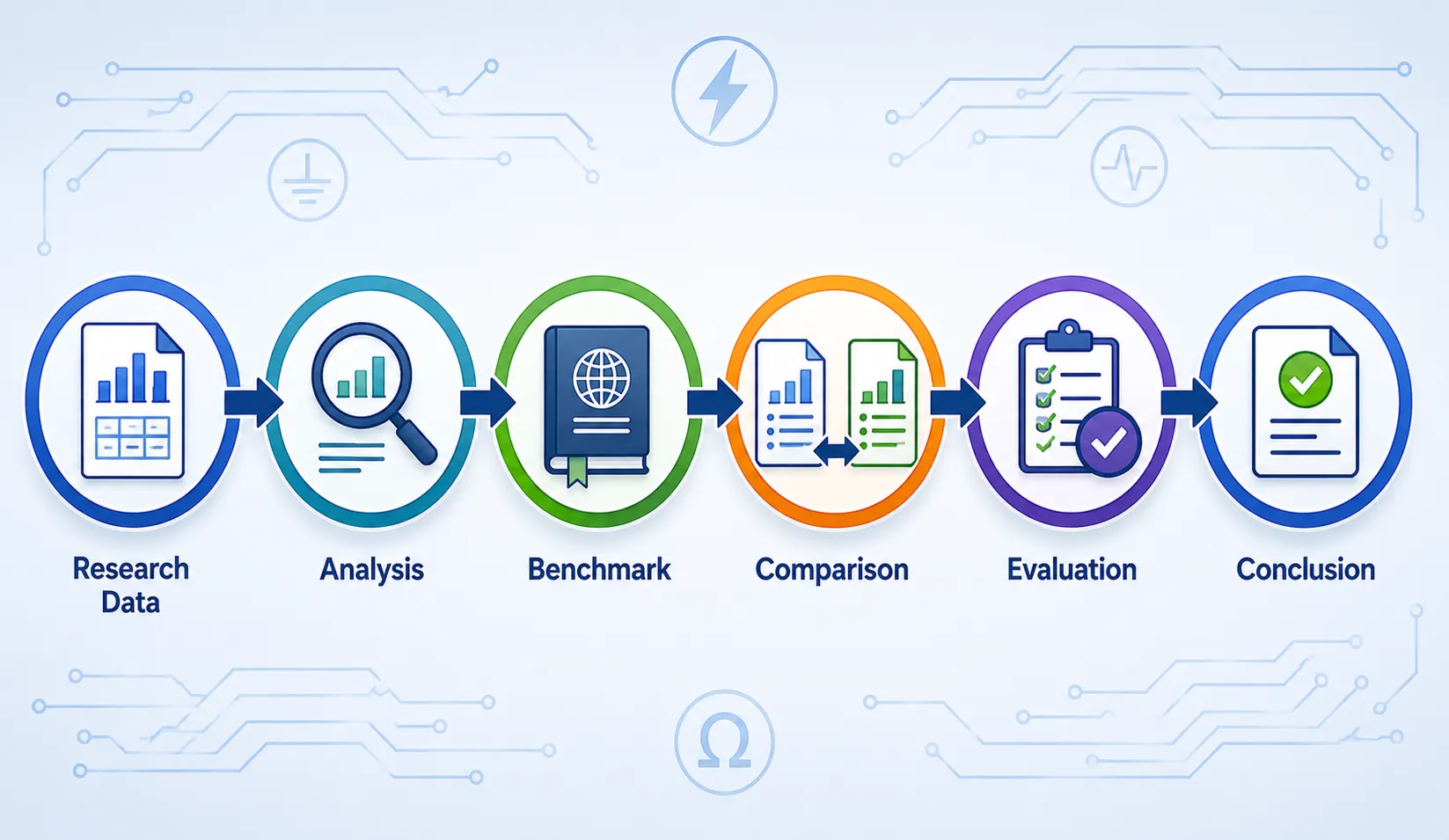
Understanding Objective Conclusions in Electrical QA/QC Research
An objective conclusion is a reasoned statement that directly follows from the evaluated evidence and remains consistent with the research objectives, methodology, limitations, and benchmark comparison.
An objective conclusion should:
Answer the research question
Reflect the research findings
Use appropriate industry benchmarks
Consider evidence quality
Recognise research limitations
Avoid unsupported assumptions
Distinguish evidence from opinion
Reflect the strength of the available evidence
Remain within the defined research scope
A conclusion is not simply a summary of everything discovered during the research. It is an analytical judgement about what those findings mean.
For example, stating that “12 defects were identified” is a finding.
Stating that “the research identified a recurring quality weakness in the installation process, with the observed defect rate exceeding the selected project benchmark” is a conclusion.
The second statement interprets the evidence in relation to a benchmark.
Key Concepts and Definitions
| Key concept | Definition | Electrical QA/QC application |
|---|---|---|
| Objective Conclusion | A conclusion supported by evaluated evidence rather than personal preference | Determining whether quality performance meets the research benchmark |
| Research Finding | A result identified through data collection and analysis | Recurring electrical installation defects |
| Industry Benchmark | A recognised reference used to evaluate performance | Applicable technical or quality requirement |
| Evidence | Information supporting an analytical judgement | Inspection and testing records |
| Benchmark Comparison | Evaluation of findings against an established reference | Comparing defect performance with defined criteria |
| Conformity | Fulfilment of an applicable requirement | Electrical work satisfying relevant requirements |
| Deviation | Difference between observed performance and benchmark | Test or inspection result outside the applicable criterion |
| Research Limitation | Factor restricting interpretation or generalisation | Small sample or limited project access |
| Generalisation | Applying findings beyond the studied context | Extending project findings to other projects |
| Professional Judgement | Reasoned evaluation based on evidence and expertise | Assessing significance of a recurring defect |
| Evidence Strength | Degree of confidence supported by available evidence | Multiple verified records supporting a finding |
| Reliability | Consistency of data or measurement | Consistent inspection results |
| Validity | Extent to which data represent the intended issue | Data accurately representing QA/QC performance |
| Recommendation | Proposed action arising from research findings | Revising an inspection process |
| Research Scope | Defined boundaries of the investigation | Specific project, system, period or population |
The Difference Between Findings and Conclusions
A common weakness in academic and professional research is confusing findings with conclusions.
Findings
Findings describe what the research discovered.
Examples include:
Defect frequency increased during a particular project phase.
Testing failures were concentrated in one equipment category.
Corrective actions were frequently delayed.
Documentation errors occurred repeatedly.
A revised inspection process was associated with lower defect rates.
Conclusions
Conclusions explain what those findings mean.
For example:
“The evidence indicates that the existing inspection process may require additional controls during the installation stage because recurring defects were identified before final inspection.”
The conclusion is stronger because it interprets the evidence rather than merely repeating it.
The Difference Between Conclusions and Recommendations
Conclusions and recommendations should also remain separate.
A conclusion answers:
“What does the evidence demonstrate?”
A recommendation answers:
“What should be done?”
For example:
Conclusion:
“The research indicates that incomplete inspection records are a recurring weakness in the investigated QA/QC process.”
Recommendation:
“The organisation should review its inspection documentation process and introduce stronger verification controls.”
The recommendation should be based on the conclusion.
The Evidence-to-Conclusion Chain
A rigorous research conclusion can be developed through the following sequence:
Research question
↓
Research data
↓
Data quality evaluation
↓
Data analysis
↓
Pattern identification
↓
Industry benchmark
↓
Benchmark comparison
↓
Critical interpretation
↓
Research limitation assessment
↓
Objective conclusion
↓
Evidence-based recommendation
This sequence helps prevent premature conclusions.
Step 1: Return to the Research Question
The conclusion should directly answer the research question.
Researchers should review:
Original research question
Research objectives
Assessment criteria
Variables investigated
Defined research boundaries
If the research question concerns electrical installation quality, the conclusion should not suddenly focus on unrelated project-management issues unless those issues emerged as relevant explanatory factors.
Step 2: Review the Main Research Findings
Before formulating the conclusion, researchers should identify the most significant findings.
These may include:
Recurring defects
Significant trends
Correlations
Anomalies
Compliance gaps
Process weaknesses
Performance improvements
Differences between groups
Differences between project stages
Researchers should distinguish significant findings from minor observations.
Step 3: Evaluate Evidence Quality
The strength of the conclusion depends partly on the quality of the evidence.
Researchers should consider:
Accuracy
Completeness
Consistency
Reliability
Validity
Traceability
Source credibility
Where evidence is incomplete, the conclusion should acknowledge this.
Step 4: Compare Findings With Industry Benchmarks
The researcher should identify how findings compare with relevant benchmarks.
Possible outcomes include:
Meets benchmark
Exceeds benchmark
Falls below benchmark
Partially meets benchmark
Evidence insufficient for comparison
This comparison should be based on relevant and appropriately selected benchmarks.
Step 5: Evaluate the Significance of Differences
A numerical difference does not automatically represent a meaningful quality problem.
Researchers should consider:
Magnitude
Frequency
Recurrence
Technical significance
Risk
Operational impact
Project context
For example, a small variation in a non-critical quality indicator may have less significance than a recurring defect affecting a critical electrical system.
Step 6: Consider Alternative Explanations
Researchers should evaluate whether other factors could explain the findings.
Potential factors include:
Workforce changes
Workload
Project phase
Inspection intensity
Material changes
Design changes
Environmental conditions
Supervision
Testing procedures
This is particularly important when attempting to establish relationships between variables.
Step 7: Evaluate Research Limitations
Every conclusion should be considered within the limitations of the research.
Limitations may involve:
Sample size
Project selection
Time period
Data access
Participant availability
Measurement conditions
Missing records
Geographical scope
The researcher should explain how these limitations affect confidence in the conclusion.
Step 8: Establish the Level of Confidence
Researchers should decide how strongly the evidence supports the conclusion.
Possible levels include:
Strong evidence
Moderate evidence
Limited evidence
Inconclusive evidence
This allows conclusions to be appropriately qualified.
Benchmark-Based Conclusion Structure
A useful structure is:
“The research findings indicate that [finding]. When compared with [benchmark], the evidence shows [comparison]. This suggests [interpretation]. However, [limitation] limits the extent to which the finding can be generalised.”
This structure encourages evidence-based reasoning.
Comparing Research Outcomes With Industry Benchmarks
Industry benchmarks can provide objective reference points.
Depending on the research topic, these may include:
National electrical standards
International electrical standards
Quality-management standards
Project specifications
Employer requirements
Manufacturer requirements
Inspection criteria
Testing criteria
Organisational quality indicators
Historical performance
The benchmark should be selected according to the specific research context.
Ensuring Benchmark Relevance
Before using a benchmark, researchers should verify:
Scope
Geographic applicability
Technical applicability
Project applicability
Relevant edition
Time period
System characteristics
Using an inappropriate benchmark can result in an invalid conclusion.
Example of Appropriate Benchmarking
Suppose research investigates low-voltage electrical installation quality in a UK project.
The researcher identifies recurring inspection deficiencies.
The conclusion should be based on:
Applicable installation requirements
Project specifications
Inspection records
Testing evidence
Relevant project period
The researcher should not simply compare the findings with a generic international quality expectation without checking the applicable national and project context.
Objective Language in Conclusions
Language plays an important role in maintaining objectivity.
Appropriate phrases include:
“The findings indicate…”
“The evidence suggests…”
“The analysis demonstrates…”
“The results are consistent with…”
“The findings identify…”
“The evidence provides support for…”
“Within the scope of this study…”
“The available evidence does not establish…”
“Further investigation may be required…”
These phrases communicate the strength of the evidence appropriately.
Language to Avoid
Researchers should avoid unsupported statements such as:
“This proves everything.”
“This always happens.”
“All electrical projects have this problem.”
“The method is definitely the best.”
“The standard guarantees quality.”
“The problem was entirely caused by workers.”
Such statements often exceed the research evidence.
Evaluating Conformity
Where findings are compared against requirements, researchers should determine whether the evidence supports conformity.
Possible conclusions include:
Conforming
The available evidence supports the conclusion that the applicable requirement was met.
Partially Conforming
Some requirements were met while others showed deficiencies.
Non-Conforming
Reliable evidence demonstrates a deviation from an applicable requirement.
Inconclusive
Available evidence is insufficient to establish conformity.
The “inconclusive” category is particularly important because researchers should not force a conclusion when evidence is inadequate.
Evaluating Trends
Trend-based conclusions require sufficient observations over time.
A researcher should consider:
Number of observation periods
Consistency of trend
Changes in data collection
Changes in project activity
External factors
For example, a reduction in defects over three consecutive months provides stronger evidence of a trend than a comparison between two isolated weeks.
Evaluating Correlations
Researchers should be particularly careful when interpreting correlations.
A relationship between:
Inspection frequency
Defect detection
does not necessarily mean that inspections caused defects.
Higher inspection intensity may simply result in more defects being detected.
An objective conclusion might state:
“The analysis identified an association between inspection frequency and recorded defect detection; however, the evidence does not establish that increased inspection caused an increase in actual defects.”
This demonstrates professional judgement.
Evaluating Anomalies
Anomalies should be investigated before being incorporated into conclusions.
Researchers should determine whether an unusual result is:
Genuine
Measurement-related
Recording-related
Context-specific
A data-entry error
An objective conclusion should not depend heavily on an unverified anomaly.
Evaluating Repeated Findings
Repeated findings usually provide stronger evidence than isolated observations.
For example, if similar installation defects occur across:
Multiple work areas
Multiple teams
Multiple inspection periods
the evidence may support a conclusion about a systemic process issue.
However, researchers should still consider whether the same underlying data-collection or classification method caused the apparent repetition.
Triangulation and Objective Conclusions
Triangulation can strengthen conclusions by comparing evidence from different sources.
For example:
Inspection records
Testing results
Interviews
Site observations
If several independent sources support the same finding, confidence may increase.
However, contradictory evidence should not be ignored.
Contradictions may reveal:
Data limitations
Different perspectives
Process inconsistencies
Documentation problems
Genuine complexity
Example of Triangulated Evidence
Suppose:
Inspection records show repeated defects.
Interviews identify inadequate supervision.
Observations show inconsistent installation practices.
The combined evidence may support the conclusion that supervision and process control are contributing factors.
However, the researcher should still avoid claiming that supervision is the sole cause unless the research establishes this.
Considering Research Limitations in Conclusions
Limitations should be integrated into the conclusion rather than added as an unrelated statement.
For example:
“The findings indicate recurring installation defects within the investigated project; however, the single-project sample limits the extent to which the results can be generalised to other electrical construction environments.”
This is more academically rigorous than simply stating:
“The research was limited to one project.”
Avoiding Overgeneralisation
Researchers should clearly distinguish between:
Findings within the sample
Implications for the organisation
Potential industry implications
General conclusions
A study involving one electrical project cannot automatically establish a universal industry pattern.
The conclusion should therefore match the research scope.
Considering Workplace Context
Objective conclusions should also reflect workplace conditions.
For example, if defect rates increased during a period of unusually high workload, the researcher should consider whether workload may have contributed.
Relevant contextual variables include:
Project phase
Workforce size
Workload
Supervision
Material availability
Design changes
Programme pressure
Environmental conditions
Evaluating Practical Significance
A statistically or numerically noticeable difference may not necessarily be practically significant.
Researchers should consider:
Impact on quality
Impact on safety
Impact on cost
Impact on programme
Impact on reliability
Impact on customer requirements
A small change in a critical quality indicator may be more significant than a large change in a low-risk administrative indicator.
Objective Conclusions and Professional Judgement
Professional judgement is essential when evidence does not provide a simple answer.
For example, research may identify:
Improved defect detection
Increased inspection workload
Reduced recurrence
Higher documentation effort
The researcher must evaluate the overall effect rather than selecting one positive or negative result.
A balanced conclusion may state that the revised process improved defect identification and reduced recurrence but introduced additional documentation requirements requiring process optimisation.
Practical Example: Electrical Installation Defects
Research Findings
A study identifies repeated installation defects.
The findings show:
Defects occur across several teams.
Most defects are identified during final inspection.
Similar defects recur after corrective action.
Supervisors report limited early-stage verification.
Benchmark Comparison
The research findings are compared with applicable quality and installation requirements.
Analysis
The evidence suggests that the final inspection process is detecting defects but that earlier prevention controls may be insufficient.
Objective Conclusion
A suitable conclusion would be:
“The research indicates that the investigated QA/QC process is effective in identifying installation defects during final inspection but provides weaker evidence of effective early-stage defect prevention. The recurrence of similar defects suggests that additional process controls may be required.”
This conclusion does not claim that the entire QA/QC system has failed.
Practical Example: Testing Performance
Findings
Testing records show:
Generally consistent results
Several repeated failures
Higher failure rates in one installation phase
Benchmark
Results are compared with applicable testing criteria.
Evaluation
The majority of results conform, but repeated failures are concentrated in one process stage.
Objective Conclusion
“The evidence indicates generally satisfactory testing performance, while the concentration of repeated failures within a specific installation phase identifies a targeted area requiring further investigation.”
This is more objective than declaring the entire testing process ineffective.
Practical Example: Documentation Quality
Findings
The research identifies:
Missing records
Inconsistent formats
Delayed submissions
Difficulty tracing certain tests
Benchmark Comparison
The findings are compared with the project’s documented QA/QC requirements.
Conclusion
“The research identifies a recurring documentation-control weakness that may reduce traceability and delay quality verification. The evidence supports improvement of record-control processes, although the available data do not establish that documentation deficiencies directly caused technical installation failures.”
This distinction between documentation weakness and technical failure is important.
Case Study: Research-Based QA/QC Conclusion
Background
An electrical contractor experiences recurring commissioning delays.
Research Evidence
The researcher collects:
Non-conformance records
Inspection reports
Testing certificates
Commissioning records
Interviews with engineering personnel
Findings
The evidence indicates:
Repeated installation defects
Delayed inspection
Incomplete test documentation
Recurring commissioning failures
Benchmark Comparison
The findings are compared against:
Applicable project requirements
Relevant technical benchmarks
Organisational QA/QC procedures
Analysis
The research identifies a pattern in which quality issues originating during installation remain unresolved until commissioning.
Objective Conclusion
The evidence supports the conclusion that weaknesses in progressive inspection and earlier verification contribute to commissioning inefficiencies within the investigated project. However, the research does not establish that these factors are the sole cause of all commissioning delays.
This conclusion is strong because it:
Links findings to evidence
Identifies a relationship
Avoids unsupported causation
Defines the research context
Recognises limitations
Developing a Conclusion Matrix
A conclusion matrix can help researchers ensure that conclusions remain evidence-based.
| Research Finding | Benchmark Comparison | Evidence Strength | Limitation | Objective Conclusion |
|---|---|---|---|---|
| Recurring installation defects | Below expected benchmark | Strong | Single project | Process weakness identified |
| Testing performance generally satisfactory | Mostly aligned | Strong | Limited failure sample | Testing process broadly effective |
| Documentation inconsistencies | Below project requirement | Moderate | Some records unavailable | Documentation control requires improvement |
| Reduced defects after intervention | Improved benchmark performance | Moderate | Other variables changed | Intervention may have contributed |
| Higher defects during peak workload | Increased defect rate | Moderate | Limited contextual data | Workload may be a contributing factor |
Conclusions Based on Multiple Benchmarks
Sometimes a finding should be compared against more than one benchmark.
For example:
Technical standard
Project specification
Internal quality indicator
The results may differ.
A finding may:
Meet the technical standard
Fail an internal quality target
Meet the project specification
The researcher should not automatically label the finding as “non-compliant” without clarifying which requirement is being considered.
Distinguishing Compliance From Performance
Compliance asks:
“Does the evidence satisfy the applicable requirement?”
Performance asks:
“How effectively does the process achieve its intended outcome?”
These are related but different.
A process can be technically compliant while still producing:
High rework
Delays
Poor communication
Repeated defects
Therefore, objective conclusions should distinguish compliance from overall quality performance.
Evaluating the Strength of Recommendations From Conclusions
Recommendations should be proportionate to the conclusion.
Strong Evidence
May justify:
Immediate process revision
Formal corrective action
Additional controls
Moderate Evidence
May justify:
Pilot intervention
Targeted monitoring
Further analysis
Limited Evidence
May justify:
Additional data collection
Further investigation
Cautious recommendation
This approach prevents overreaction to weak evidence.
Common Errors in Formulating Conclusions
Researchers should avoid:
Repeating the results without interpretation
Introducing new evidence in the conclusion
Making claims beyond the research scope
Ignoring contradictory findings
Ignoring limitations
Confusing correlation with causation
Treating compliance as complete quality assurance
Using emotional or absolute language
Selecting only favourable findings
Making recommendations before establishing conclusions
Objective Conclusion Checklist
Before finalising the conclusion, the researcher should ask:
Does the conclusion answer the research question?
Is every major claim supported by evidence?
Has the benchmark been appropriately selected?
Is the comparison technically relevant?
Have alternative explanations been considered?
Have limitations been addressed?
Is the conclusion within the research scope?
Does the wording reflect evidence strength?
Have findings and recommendations been separated?
Has contradictory evidence been considered?
A Structured Procedure for Formulating Objective Conclusions
Stage 1: Revisit the Research Question
Confirm the exact issue investigated.
Stage 2: Identify Major Findings
Select the findings most relevant to the research objectives.
Stage 3: Verify Evidence
Check the reliability, validity and completeness of supporting data.
Stage 4: Review Benchmark Evidence
Confirm that the selected industry benchmarks are relevant and appropriate.
Stage 5: Compare Findings
Identify alignment, deviation, improvement or uncertainty.
Stage 6: Consider Context
Evaluate project and workplace factors that may influence results.
Stage 7: Consider Alternative Explanations
Determine whether other variables could explain the findings.
Stage 8: Evaluate Limitations
Identify factors that reduce confidence or generalisability.
Stage 9: Establish Evidence Strength
Determine whether evidence is strong, moderate, limited or inconclusive.
Stage 10: Formulate the Conclusion
Write a concise, objective statement answering the research question.
Stage 11: Check Objectivity
Remove unsupported assumptions and absolute claims.
Stage 12: Develop Recommendations
Only after establishing the conclusion should practical recommendations be formulated.
The Role of Evidence Traceability
An objective conclusion should be traceable back to the original evidence.
The researcher should be able to identify:
Data source
Collection method
Analysis
Benchmark
Comparison
Interpretation
Conclusion
This creates an evidence chain that supports academic and professional review.
Maintaining an Audit Trail
An audit trail may contain:
Original datasets
Data-cleaning records
Coding decisions
Analytical calculations
Benchmark references
Comparison tables
Interpretation notes
Final conclusions
Maintaining this information improves transparency.
Evaluating Conflicting Evidence
Sometimes research data do not produce a single clear conclusion.
For example:
Inspection records indicate improvement.
Interviews report continued problems.
Testing data show mixed performance.
The objective conclusion should acknowledge the complexity.
A suitable conclusion may state:
“The evidence indicates improvement in recorded inspection performance, although qualitative feedback and testing results suggest that improvement has not been consistent across all quality indicators.”
This is more valuable than selecting only the evidence that supports one interpretation.
Conclusions and Continual Improvement
Objective conclusions should contribute to organisational learning.
The research may identify:
What is working
What is not working
Where gaps exist
Which controls require improvement
What should be monitored
The conclusion therefore becomes an input into the continual improvement cycle.
A useful cycle is:
Identify
↓
Measure
↓
Compare
↓
Evaluate
↓
Conclude
↓
Improve
↓
Monitor
↓
Re-evaluate
Key Benefits of Objective Conclusions
Improved Academic Credibility
Evidence-based conclusions demonstrate rigorous research practice.
Stronger Professional Decisions
Managers can make decisions using evaluated evidence rather than assumptions.
Better QA/QC Improvement
Conclusions identify where quality controls require attention.
Reduced Risk of Overstatement
Clear limitations prevent unsupported claims.
Improved Benchmarking
Findings can be interpreted against recognised performance expectations.
Better Resource Allocation
Evidence can help prioritise quality improvements.
Improved Organisational Learning
Research conclusions can contribute to lessons learned.
Stronger Corrective Action
Objective conclusions provide a defensible basis for intervention.
Improved Stakeholder Confidence
Transparent conclusions are easier for clients, engineers and quality professionals to evaluate.
Advanced Professional Judgement
At Level 6, the researcher should demonstrate the ability to handle uncertainty.
For example, if research finds a reduction in defects after a new QA/QC intervention but other project variables also changed, the researcher should not automatically claim that the intervention caused the improvement.
A stronger conclusion would recognise:
Observed improvement
Timing of intervention
Alternative variables
Evidence limitations
Need for further monitoring
This demonstrates analytical maturity.
Balancing Certainty and Caution
Conclusions should be neither unnecessarily weak nor excessively confident.
Too weak:
“The research might possibly indicate something related to quality.”
Too strong:
“The research proves that the new system completely solved the quality problem.”
Balanced:
“The findings indicate an improvement in the investigated quality indicator following implementation of the revised process, although the influence of concurrent operational changes cannot be excluded.”
The balanced version reflects professional research practice.
Practical Implications of Objective Conclusions
Once conclusions have been formulated, they may inform:
QA/QC procedure revisions
Inspection planning
Testing strategies
Workforce development
Supplier controls
Documentation improvements
Corrective actions
Quality objectives
Performance indicators
Further research
The conclusion should therefore provide a logical bridge between research and workplace improvement.
Conclusion
Formulating objective conclusions based on rigorous evaluation of research data against industry benchmarks is essential for producing credible electrical engineering QA/QC research. A high-quality conclusion should not simply repeat numerical findings or describe observed defects. It should demonstrate how the evidence relates to the research question, how the findings compare with appropriate industry benchmarks, what the comparison means, how strong the evidence is, and what limitations affect interpretation.
The most reliable conclusions are developed through a structured evidence chain: research question, data collection, data-quality evaluation, analysis, benchmark comparison, critical interpretation, limitation assessment, and final judgement. This approach ensures that conclusions remain within the defined research scope and are supported by appropriate evidence. It also allows researchers to distinguish between conformity, performance, improvement, deviation, uncertainty, and areas requiring further investigation.
Objective conclusions should also distinguish between evidence and interpretation. Where research identifies a relationship between variables, the researcher should avoid automatically claiming causation. Where a finding differs from an industry benchmark, the researcher should investigate whether the difference represents genuine non-conformity, contextual variation, measurement limitations, or an alternative acceptable approach. Where evidence is insufficient, an inconclusive conclusion may be more academically and professionally appropriate than an unsupported definitive statement.
The practical value of this approach is particularly significant in electrical QA/QC because research findings may influence installation quality, testing, commissioning, documentation, corrective action, reliability, project cost, programme performance and long-term system performance. By formulating conclusions that are evidence-based, benchmarked, transparent and appropriately qualified, researchers can provide a reliable foundation for quality improvement and professional decision-making.
Ultimately, the objective conclusion should answer a central question: what can the available evidence reasonably demonstrate about the electrical QA/QC issue being investigated? When that question is answered through rigorous analysis, appropriate industry benchmarking, critical evaluation and transparent recognition of limitations, the resulting research becomes more credible, defensible and useful for resolving complex quality issues in professional electrical engineering environments.