
Lesson 2: Conduct a Literature Review to Identify Gaps in Current Knowledge
A comprehensive literature review is a fundamental stage in advanced electrical Quality Assurance and Quality Control (QA/QC) research, enabling researchers to understand existing knowledge, evaluate previous studies, and identify areas where further investigation is required. This lesson introduces learners to the principles and processes involved in conducting an effective literature review within the context of electrical engineering QA/QC. By critically analysing published research, technical reports, industry practices, standards, and professional studies, learners develop the ability to recognise knowledge gaps, assess current approaches, and identify opportunities for meaningful research contributions.
In electrical QA/QC environments, a literature review provides the foundation for understanding how quality management practices have evolved and how current challenges are being addressed. Modern electrical projects involve complex systems, advanced technologies, sustainability requirements, digital quality management tools, renewable energy integration, and increasing performance expectations. Through structured review and critical evaluation of existing knowledge, researchers can examine topics such as inspection effectiveness, testing methodologies, defect prevention strategies, quality management systems, emerging technologies, and risk-based approaches. This process helps identify limitations within current practices and highlights areas where improved solutions or further research are needed.
Conducting a literature review requires more than collecting information from existing sources; it involves analysing, comparing, and synthesising evidence to develop a deeper understanding of the research topic. Learners will explore how to evaluate the reliability and relevance of academic publications, technical documents, industry guidelines, and case studies while identifying relationships, trends, and unresolved issues. By recognising gaps in current knowledge, researchers can formulate stronger research objectives, justify their investigations, and develop evidence-based solutions that contribute to improved electrical quality performance, safety, reliability, and continual improvement within engineering projects.
This lesson supports the development of advanced research skills required for professional electrical QA/QC investigations by connecting existing knowledge with future improvement opportunities. A well-executed literature review enables researchers to avoid duplication, understand current limitations, establish research direction, and produce valuable findings that address real challenges in electrical engineering quality management. Through systematic evaluation of available knowledge, learners gain the ability to transform industry challenges into focused research opportunities that support innovation and improved QA/QC practices.
1. Critically Analyse a Wide Range of Academic and Industry Literature Relevant to the Chosen Electrical QA/QC Topic
A comprehensive literature review is a critical component of advanced electrical Quality Assurance and Quality Control (QA/QC) research because it establishes the existing knowledge base, identifies current practices, evaluates previous findings, and highlights areas requiring further investigation. Within electrical engineering, QA/QC practices continue to evolve due to technological advancements, increasing system complexity, sustainability requirements, digital transformation, and the growing demand for reliable electrical infrastructure. Therefore, researchers must critically analyse a wide range of academic and industry literature to understand how quality challenges are currently addressed and where opportunities exist for improvement.
Critical literature analysis involves more than collecting information from different sources. It requires systematic evaluation, comparison, interpretation, and judgement of existing knowledge. Researchers must examine the strengths, limitations, methodologies, findings, and practical relevance of available literature to determine how effectively current approaches address electrical QA/QC challenges. A strong literature review allows researchers to identify relationships between different studies, recognise conflicting viewpoints, assess the reliability of evidence, and develop a clear understanding of the chosen research area.
In electrical QA/QC research, literature may include academic journal articles, engineering publications, technical reports, industry standards, professional guidance documents, project case studies, and research papers. These sources provide valuable insights into areas such as electrical inspection methods, testing procedures, quality management systems, defect prevention, commissioning practices, renewable energy quality challenges, digital QA/QC solutions, artificial intelligence applications, and sustainable electrical project management.
The ability to critically analyse literature enables researchers to move beyond existing information and identify knowledge gaps that require further investigation. By evaluating current academic and industry perspectives, researchers can develop stronger research questions, establish appropriate objectives, and contribute meaningful improvements to electrical quality management practices.
Understanding the Purpose of Literature Analysis in Electrical QA/QC Research
A literature review provides the foundation for understanding what is already known about a specific electrical QA/QC topic. It helps researchers determine whether existing solutions are effective, where limitations exist, and how further research can contribute to professional improvement.
The main purposes of literature analysis include:
- Understanding existing theories and concepts related to electrical QA/QC
- Evaluating previous research findings
- Identifying successful industry practices
- Analysing limitations in current approaches
- Recognising emerging trends and technologies
- Identifying research gaps
- Supporting development of research objectives
- Providing evidence for research decisions
For example, a researcher investigating digital QA/QC management systems should not only review studies describing digital tools but should critically examine whether these systems actually improve inspection accuracy, reduce defects, enhance communication, or provide measurable project benefits.
A critical literature review asks questions such as:
- What methods have previous researchers used?
- Are existing approaches effective?
- What limitations exist within current practices?
- Are findings consistent across different studies?
- What areas require further investigation?
Key Concepts Related to Literature Review and Critical Analysis
| Concept | Definition | Importance in Electrical QA/QC Research |
|---|---|---|
| Literature review | A structured evaluation of existing information related to a research topic | Establishes current knowledge and research direction |
| Critical analysis | The process of evaluating strengths, weaknesses, evidence, and relevance of information | Helps determine reliability of existing knowledge |
| Academic literature | Research-based publications produced by universities and researchers | Provides theoretical knowledge and scientific evidence |
| Industry literature | Professional documents, standards, reports, and practical guidance | Provides real-world engineering applications |
| Research gap | An area where existing knowledge is incomplete or insufficient | Creates opportunities for further investigation |
| Source evaluation | Assessment of reliability, relevance, and quality of information sources | Ensures accurate research foundations |
| Evidence synthesis | Combining findings from multiple sources to develop understanding | Supports stronger research conclusions |
| Research trend | A developing area of interest or technological advancement | Helps identify future research opportunities |
| Methodology evaluation | Assessment of research methods used in previous studies | Determines reliability of previous findings |
| Knowledge contribution | New understanding or improvement generated through research | Demonstrates research value |
Types of Literature Relevant to Electrical QA/QC Research
A successful literature review should include a wide range of reliable sources rather than depending on a single type of information.
Academic Literature
Academic literature provides scientifically developed knowledge through structured research processes.
Examples include:
- Peer-reviewed journal articles
- Conference papers
- University research publications
- Academic textbooks
- Research dissertations
Academic sources help researchers understand:
- Established theories
- Research methodologies
- Experimental findings
- Technical developments
- Scientific discussions
For example, research papers investigating electrical fault detection methods can provide evidence regarding the effectiveness of different testing approaches.
Industry Literature
Industry literature provides practical knowledge based on real engineering applications.
Examples include:
- Engineering standards
- Professional guidelines
- Technical reports
- Manufacturer documentation
- Project case studies
- Quality management frameworks
Industry sources help researchers understand:
- Current professional practices
- Implementation challenges
- Operational experiences
- Industry expectations
For example, technical reports on renewable energy projects may highlight practical QA/QC challenges that are not always covered in academic studies.
Regulatory and Standards-Based Literature
Electrical QA/QC practices are strongly influenced by standards and regulatory requirements.
Relevant literature may include:
- Quality management standards
- Electrical installation guidance
- Safety requirements
- Testing procedures
- Inspection frameworks
These sources help researchers evaluate whether current practices align with accepted professional expectations.
Evaluating the Quality of Literature Sources
Not all sources provide equal value. Researchers must critically evaluate literature before using it as evidence.
Important evaluation criteria include:
Authority
Researchers should consider:
- Who produced the information?
- Is the author technically qualified?
- Is the organisation recognised?
Reliable sources generally come from:
- Universities
- Professional engineering organisations
- Research institutions
- Established industry bodies
Relevance
A source should directly relate to the chosen research topic.
Researchers should evaluate:
- Does the information address the research problem?
- Is it applicable to electrical QA/QC?
- Does it support research objectives?
Accuracy
Researchers should examine:
- Evidence supporting claims
- Research methodology
- Data reliability
- References used
Currency
Electrical engineering develops rapidly, particularly in areas such as:
- Digital technologies
- Smart systems
- Renewable energy
- Artificial intelligence
Therefore, researchers should consider whether information reflects current practices.
Objectivity
Researchers should identify whether the source presents balanced information or promotes a specific viewpoint.
For example:
A manufacturer document promoting its own technology may provide useful information but should be critically evaluated alongside independent research.
Process for Critically Analysing Literature

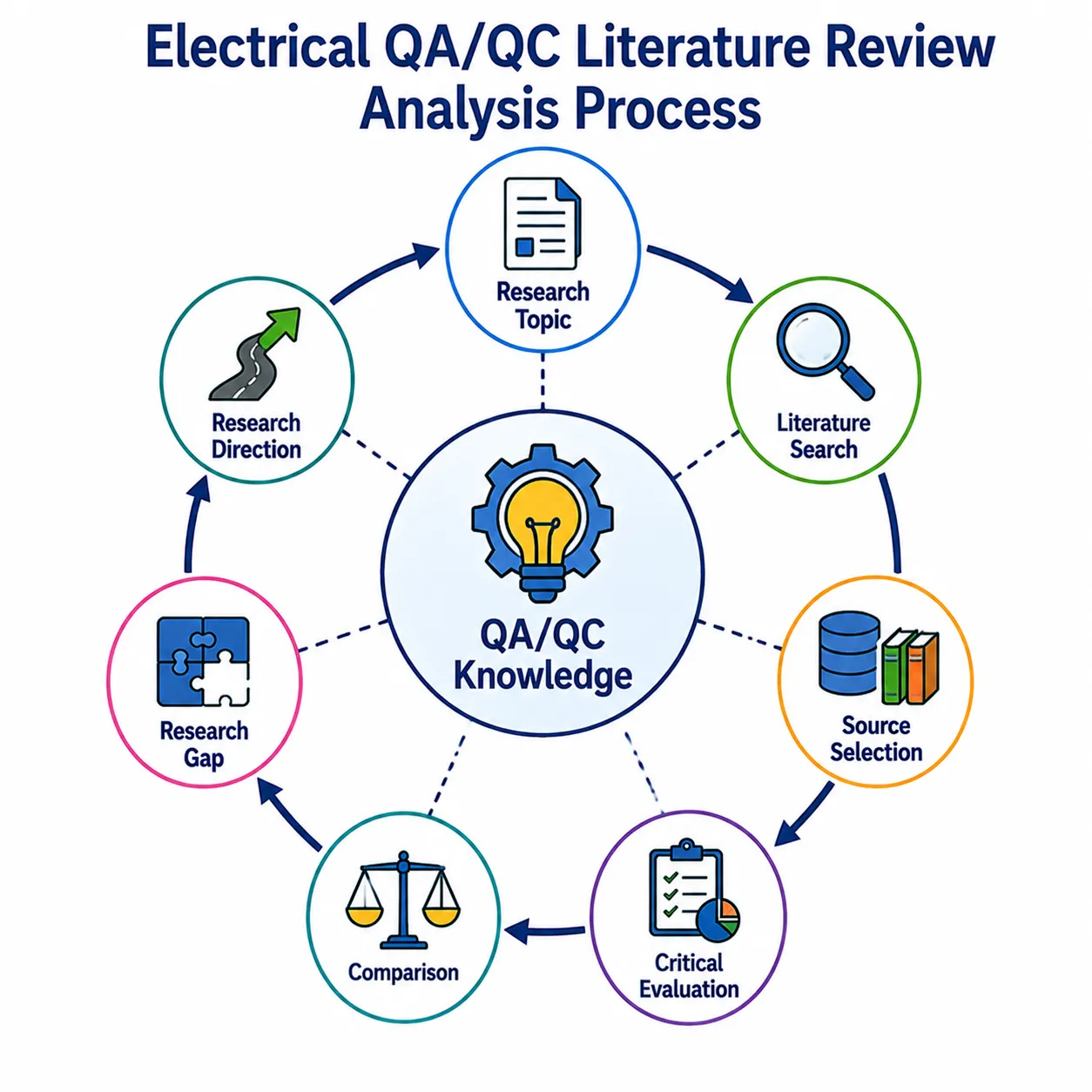
Step 1: Define Literature Search Requirements
Before collecting sources, researchers should establish:
- Research topic
- Key terms
- Required information areas
- Source types needed
Example keywords:
- Electrical QA/QC systems
- Digital inspection technologies
- Electrical testing reliability
- Quality management in engineering projects
Step 2: Collect Relevant Sources
Sources should be collected from:
- Academic databases
- Engineering publications
- Professional organisations
- Technical libraries
- Industry reports
Researchers should avoid relying only on general internet information.
Step 3: Review and Categorise Information
Collected literature should be organised according to themes.
Possible categories include:
- Quality management systems
- Inspection methods
- Testing procedures
- Technology applications
- Sustainability challenges
This helps identify relationships between different sources.
Step 4: Compare Different Perspectives
Critical analysis requires comparison.
Researchers should examine:
- Agreement between studies
- Differences in findings
- Strengths of approaches
- Limitations of methods
For example:
One study may suggest automated inspections improve defect detection, while another may highlight implementation challenges.
The researcher should analyse why differences exist.
Step 5: Identify Strengths and Limitations
Each source should be evaluated critically.
Researchers should consider:
Strengths:
- Reliable methodology
- Strong evidence
- Practical application
Limitations:
- Small sample size
- Limited project context
- Outdated technology
- Restricted data availability
Step 6: Identify Research Gaps
The final purpose of critical literature analysis is identifying areas where further research is required.
Research gaps may include:
- Limited evaluation of new technologies
- Lack of industry evidence
- Inconsistent quality methods
- Unresolved technical challenges
Critical Analysis of Electrical QA/QC Literature Themes
Digital Transformation in QA/QC
Digital technologies are becoming increasingly important in electrical quality management.
Literature may examine:
- Digital inspection platforms
- Mobile quality applications
- Electronic documentation
- Real-time monitoring
Critical analysis should consider:
Benefits:
- Faster reporting
- Improved communication
- Better data management
Limitations:
- Training requirements
- Technology costs
- Data security concerns
Potential research gaps:
- Long-term effectiveness of digital QA/QC systems
- Integration challenges
Renewable Energy Quality Management
Renewable energy projects create new QA/QC challenges.
Literature may discuss:
- Solar PV installation quality
- Energy performance verification
- Equipment reliability
Critical analysis should evaluate:
- Whether current QA/QC procedures ensure expected performance
- How installation quality affects sustainability outcomes
Potential research gaps:
- Improved methods for renewable system verification
Artificial Intelligence in Electrical Quality Control
AI is emerging as a potential solution for predictive quality management.
Literature may explore:
- Automated defect detection
- Predictive maintenance
- Data analysis
Critical analysis should examine:
Benefits:
- Faster analysis
- Pattern recognition
- Predictive capability
Challenges:
- Data availability
- Reliability of predictions
- Human oversight requirements
Practical Example: Literature Analysis for Digital Electrical QA/QC Research
Research Topic
Improving electrical inspection efficiency through digital QA/QC systems.
Literature Collection
The researcher reviews:
- Academic studies on digital quality management
- Industry reports on electronic inspection systems
- Professional guidance documents
Critical Analysis
Academic studies indicate:
- Digital tools improve information sharing
- Automated reporting reduces documentation errors
Industry literature highlights:
- Staff training challenges
- Implementation costs
- Integration difficulties
Identified Research Gap
Existing literature provides limited evidence regarding long-term effectiveness of digital QA/QC systems in complex electrical construction projects.
Research Opportunity
The researcher develops further investigation into how digital QA/QC tools influence defect reduction and project performance.
Case Study: Analysing Literature for Electrical Testing Improvement
Background
An industrial project experienced repeated electrical testing failures during commissioning.
The organisation wanted to understand whether existing testing procedures were effective.
Literature Review Process
The researcher analysed:
- Academic studies on electrical testing methods
- Industry commissioning reports
- Professional testing guidance
Findings from Literature
Previous research identified:
- Importance of structured testing procedures
- Need for improved documentation
- Benefits of advanced monitoring
Industry evidence showed:
- Inconsistent testing practices
- Limited training in advanced methods
Research Gap
Limited research existed on integrating advanced testing technologies with traditional QA/QC processes.
Research Contribution
The research could develop recommendations for improving commissioning reliability.
Benefits of Critical Literature Analysis in Electrical QA/QC Research
Improved Understanding
Researchers gain deeper knowledge of existing practices and challenges.
Better Research Direction
Literature analysis helps refine research questions and objectives.
Stronger Evidence Base
Critical evaluation improves the reliability of research findings.
Identification of Innovation Opportunities
Researchers can identify areas where new technologies or methods may improve QA/QC.
Reduced Research Duplication
Understanding previous studies prevents unnecessary repetition.
Enhanced Professional Decision-Making
Research findings become more valuable for engineering applications.
Common Challenges in Literature Analysis
Researchers may experience difficulties such as:
- Excessive information availability
- Difficulty identifying reliable sources
- Conflicting research findings
- Limited access to technical publications
- Rapid technology development
These challenges require structured search strategies and critical evaluation skills.
Strategies for Effective Literature Analysis
Researchers can improve literature review quality by:
- Using multiple reliable source types
- Comparing academic and industry perspectives
- Recording key findings systematically
- Identifying common themes
- Evaluating limitations
- Linking findings to research objectives
Conclusion
Critically analysing a wide range of academic and industry literature is essential for developing high-quality electrical QA/QC research. A structured literature review enables researchers to understand existing knowledge, evaluate current practices, identify limitations, and discover opportunities for improvement. By examining academic studies, industry reports, technical standards, and practical case studies, researchers can develop a comprehensive understanding of electrical quality challenges and establish a strong foundation for further investigation.
Effective literature analysis allows researchers to move beyond information collection and develop informed professional judgement. Through critical evaluation of evidence, comparison of different perspectives, and identification of research gaps, electrical QA/QC researchers can contribute valuable solutions that improve safety, reliability, sustainability, and performance within modern electrical engineering projects.
2. Synthesize Complex Information from Various Sources to Establish the Current State of Knowledge in the Field
Establishing the current state of knowledge is a critical stage in advanced electrical Quality Assurance and Quality Control (QA/QC) research. After collecting information from academic publications, technical reports, industry standards, professional guidance documents, and real project experiences, researchers must synthesise complex information to develop a clear understanding of what is currently known, what approaches are commonly applied, and where limitations remain.
Information synthesis is more than summarising individual sources. It involves analysing relationships between different findings, comparing multiple perspectives, identifying common themes, evaluating conflicting evidence, and developing an integrated understanding of the research area. In electrical QA/QC, this process is particularly important because quality management practices are influenced by rapidly changing technologies, evolving industry expectations, sustainability requirements, safety considerations, and increasing system complexity.
A researcher investigating electrical QA/QC topics must combine theoretical knowledge from academic studies with practical insights from industry literature. Academic research may provide evidence about quality improvement models, technological effectiveness, and analytical approaches, while industry sources may reveal real-world implementation challenges, operational limitations, and professional requirements. By bringing these different perspectives together, researchers can establish an accurate picture of the current knowledge landscape.
For example, when analysing digital transformation in electrical QA/QC, researchers must synthesise information about digital inspection platforms, automated reporting systems, data management approaches, and industry adoption challenges. Individual sources may provide limited information, but combined analysis can reveal broader trends, opportunities, and unresolved problems requiring further investigation.
Understanding Information Synthesis in Electrical QA/QC Research
Information synthesis is the process of combining knowledge from multiple sources to develop a comprehensive understanding of a research topic. It requires researchers to move beyond collecting information and focus on interpreting how different sources contribute to the overall research area.
In electrical QA/QC research, synthesis involves:
- Reviewing information from different source types
- Identifying relationships between findings
- Comparing academic and industry perspectives
- Recognising common patterns
- Evaluating differences between studies
- Developing conclusions about current knowledge
A successful synthesis creates a structured understanding of:
- Existing theories
- Current technologies
- Industry practices
- Research developments
- Limitations and challenges
- Future improvement opportunities
Importance of Establishing the Current State of Knowledge
Understanding the current state of knowledge allows researchers to determine the position of their research within the wider electrical engineering field.
It helps researchers to:
- Identify what is already understood
- Avoid unnecessary duplication of previous studies
- Recognise limitations in existing approaches
- Identify research opportunities
- Develop stronger research objectives
- Justify the need for further investigation
In electrical QA/QC, current knowledge analysis is essential because engineering practices continue to develop. Traditional inspection methods are increasingly being combined with:
- Digital quality management systems
- Artificial intelligence applications
- Smart monitoring technologies
- Automated testing solutions
- Data-driven quality improvement approaches
Researchers must understand these developments before proposing new investigations.
Key Concepts Related to Knowledge Synthesis
| Concept | Definition | Importance in Electrical QA/QC Research |
|---|---|---|
| Information synthesis | Combining information from multiple sources to develop integrated understanding | Helps establish the overall knowledge position |
| Current state of knowledge | The existing understanding, practices, and evidence within a research field | Defines what is already known |
| Thematic analysis | Identifying common themes across different sources | Helps organise complex information |
| Evidence integration | Combining findings from different studies and documents | Creates stronger research conclusions |
| Comparative analysis | Evaluating similarities and differences between sources | Identifies strengths and limitations |
| Research trend | A developing area of interest within a technical field | Helps identify future opportunities |
| Knowledge gap | An area where existing information is insufficient | Supports development of new research |
| Critical synthesis | Evaluation and interpretation of information rather than simple summary | Improves research quality |
| Industry perspective | Practical knowledge from engineering applications | Connects research with real-world needs |
| Academic perspective | Theoretical and evidence-based understanding from research studies | Provides scientific foundation |
Sources Used for Establishing Current Knowledge
A strong synthesis requires information from multiple reliable sources.
Academic Research Sources
Academic literature provides structured research findings developed through recognised methodologies.
Examples include:
- Peer-reviewed journal articles
- Research papers
- Conference publications
- University studies
- Academic books
Academic sources contribute:
- Theoretical frameworks
- Research evidence
- Analytical methods
- Scientific explanations
For example, academic studies may analyse whether automated inspection technologies improve defect detection accuracy.
Industry Sources
Industry literature provides practical understanding of real engineering applications.
Examples include:
- Technical reports
- Professional guidance documents
- Engineering case studies
- Quality management reports
- Manufacturer documentation
Industry sources contribute:
- Practical experiences
- Implementation challenges
- Operational requirements
- Project-based knowledge
For example, industry reports may identify challenges organisations face when introducing digital QA/QC systems.
Standards and Professional Documents
Electrical QA/QC activities are influenced by professional standards and technical guidance.
These sources provide information about:
- Quality expectations
- Inspection requirements
- Testing approaches
- Documentation practices
- Compliance considerations
Researchers should analyse these documents alongside academic research to understand both theory and application.
Process for Synthesising Complex Information
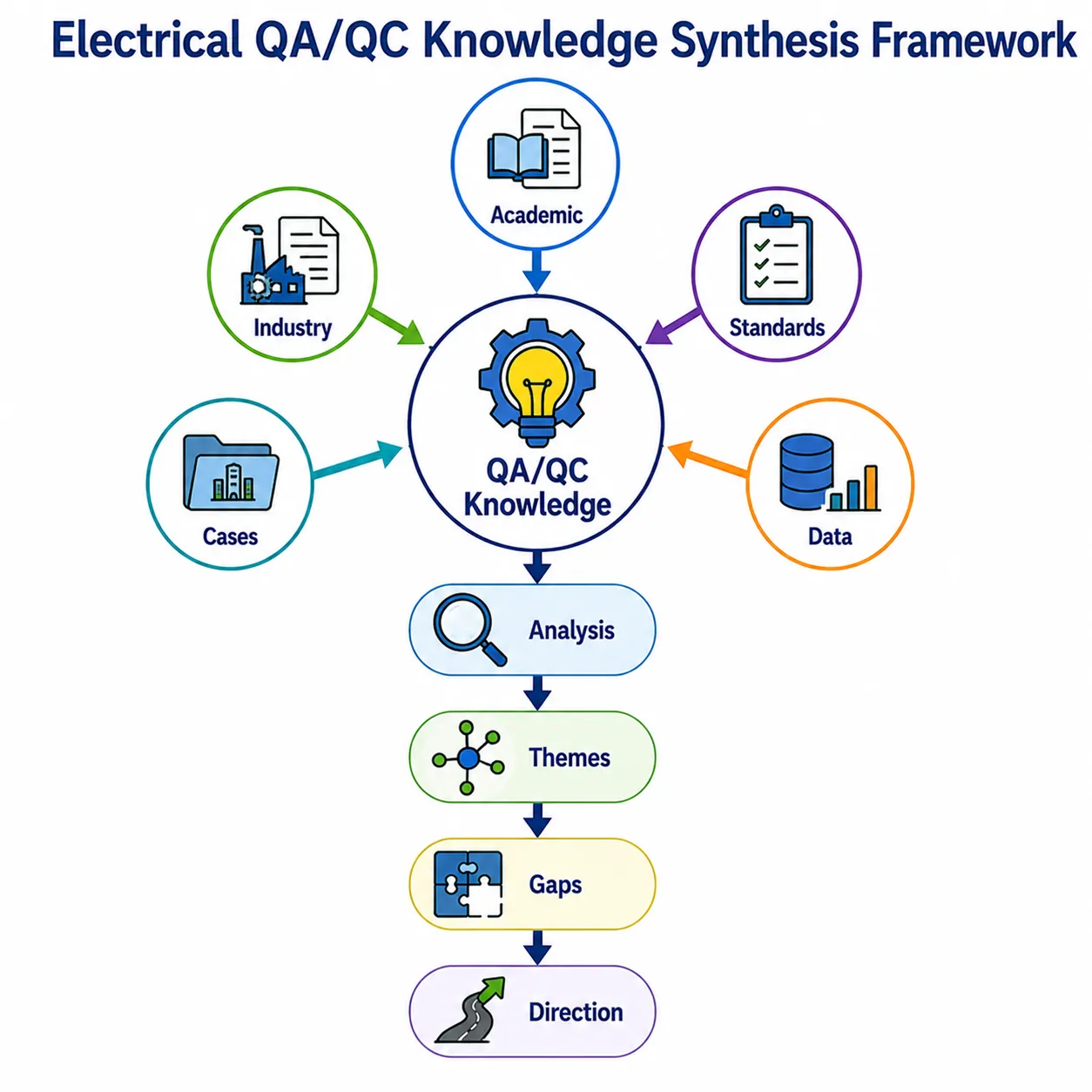
Identify Key Research Themes
The first step is organising collected information into major themes.
For electrical QA/QC research, themes may include:
- Quality management systems
- Inspection and testing methods
- Digital transformation
- Sustainability requirements
- Risk management
- Technology integration
Grouping information by themes allows researchers to identify connections between different sources.
Extract Important Findings
Researchers should identify:
- Main conclusions
- Research methods
- Key evidence
- Reported limitations
- Recommendations
This prevents information overload and supports structured analysis.
Compare Different Sources
Comparison allows researchers to understand similarities and differences.
Researchers should evaluate:
- Do studies support similar conclusions?
- Are there disagreements?
- Are industry practices different from academic findings?
- What factors explain these differences?
For example:
Academic research may highlight the benefits of AI-based quality monitoring, while industry reports may identify challenges related to cost and implementation.
Both perspectives must be considered.
Identify Common Patterns
Repeated findings across multiple sources often indicate important knowledge areas.
Examples:
Several studies may identify that:
- Poor documentation affects quality performance
- Early inspection reduces defects
- Digital tools improve communication
These patterns help establish reliable knowledge.
Evaluate Conflicting Information
Not all sources will agree.
Differences may occur because of:
- Different project environments
- Different technologies
- Different research methods
- Different geographical contexts
Researchers should analyse reasons behind disagreements rather than selecting information that only supports their opinion.
Develop an Integrated Understanding
The final stage is creating a complete picture of the research area.
The researcher should explain:
- What is currently known
- What approaches are effective
- What limitations exist
- What areas need further research
Analysing Current Knowledge in Electrical QA/QC Research Areas
Digital Quality Management Systems
Digital QA/QC systems represent a major development area in electrical engineering.
Current knowledge indicates that digital systems can improve:
- Inspection efficiency
- Documentation accuracy
- Communication between teams
- Quality tracking
However, research also identifies challenges:
- Implementation costs
- Training requirements
- Data management issues
- Resistance to technological change
A complete understanding requires combining academic findings with industry experiences.
Artificial Intelligence Applications
AI is increasingly being investigated for electrical quality improvement.
Current knowledge suggests AI may support:
- Predictive quality analysis
- Automated defect detection
- Data interpretation
- Maintenance forecasting
However, researchers must also consider:
- Data quality requirements
- Reliability concerns
- Human decision involvement
Renewable Energy QA/QC
Renewable energy systems create new quality management requirements.
Current knowledge focuses on:
- Installation verification
- Performance assessment
- Long-term reliability
- Sustainability monitoring
Research shows that quality processes strongly influence renewable system performance.
Advanced Testing and Commissioning
Electrical testing and commissioning remain essential quality control activities.
Existing knowledge highlights:
- Importance of structured testing procedures
- Need for accurate documentation
- Benefits of advanced monitoring
However, gaps remain regarding integration of new technologies with traditional testing approaches.
Practical Example: Synthesising Information for Digital QA/QC Research
Research Topic
Digital technologies for improving electrical quality management.
Information Sources Reviewed
The researcher analyses:
Academic sources:
- Studies on digital inspection effectiveness
- Research on quality management technologies
Industry sources:
- Project reports
- Digital implementation case studies
Professional documents:
- Quality management guidelines
Synthesis Process
The researcher identifies:
Common findings:
- Digital tools improve information flow
- Real-time reporting supports faster decision-making
Industry challenges:
- Staff training requirements
- Technology adoption barriers
Research limitations:
- Limited evidence on long-term project benefits
Established Current Knowledge
The current understanding shows that digital QA/QC systems have significant potential but require effective implementation strategies.
Case Study: Establishing Knowledge Status for Smart Electrical Monitoring
Background
An organisation introduced smart monitoring systems to improve electrical asset reliability. However, inconsistent data interpretation affected decision-making.
Literature Analysis
The researcher reviewed:
- Academic studies on smart monitoring
- Industry applications
- Technical guidance documents
Synthesised Findings
Academic research showed:
- Smart monitoring improves data availability
- Predictive analysis can support maintenance decisions
Industry evidence showed:
- Data quality remains a major challenge
- Staff capability affects successful implementation
Current Knowledge Position
The combined evidence indicated that smart monitoring technology is valuable but requires improved QA/QC frameworks for effective use.
Benefits of Information Synthesis in Electrical QA/QC Research
Better Research Direction
Synthesis helps researchers develop focused and meaningful research questions.
Stronger Evidence-Based Decisions
Combining multiple sources improves reliability of conclusions.
Improved Understanding of Industry Challenges
Researchers gain insight into both theoretical and practical issues.
Identification of Research Opportunities
Knowledge gaps become easier to recognise.
Enhanced Innovation
Synthesis supports development of improved quality strategies and technologies.
Common Challenges in Knowledge Synthesis
Researchers may face challenges including:
- Large volumes of information
- Conflicting findings
- Limited access to technical sources
- Rapid technological changes
- Difficulty comparing different methodologies
These challenges require structured analysis and critical thinking.
Strategies for Effective Knowledge Synthesis
Researchers can improve synthesis quality by:
- Creating organised literature categories
- Comparing different evidence sources
- Maintaining objective analysis
- Identifying repeated findings
- Evaluating limitations
- Linking findings to research objectives
Linking Current Knowledge with Future Research
Establishing current knowledge is not the final purpose of literature analysis. It provides the foundation for identifying where further research can contribute.
Future research opportunities may involve:
- Improving digital QA/QC adoption
- Developing advanced inspection methods
- Enhancing sustainability verification
- Integrating AI into quality processes
- Improving electrical system reliability
A strong understanding of current knowledge allows researchers to develop investigations that provide genuine value.
Conclusion
Synthesising complex information from academic and industry sources is essential for establishing the current state of knowledge in electrical QA/QC research. Through structured analysis, comparison, and evaluation of different evidence sources, researchers can understand existing practices, identify successful approaches, and recognise limitations requiring further investigation. This process ensures that research is built on reliable knowledge rather than isolated information.
Effective knowledge synthesis enables electrical QA/QC researchers to develop meaningful research directions that address real engineering challenges. By integrating academic theories with practical industry experiences, researchers can contribute valuable improvements in quality management, safety performance, sustainability, and reliability across modern electrical engineering projects.
3. Identify Clear Gaps, Inconsistencies, or Unresolved Issues Within Existing Electrical Quality Management Research
Identifying research gaps, inconsistencies, and unresolved issues is a critical stage in advanced electrical Quality Assurance and Quality Control (QA/QC) research. After analysing and synthesising information from academic publications, industry reports, technical standards, and professional case studies, researchers must critically evaluate what remains uncertain, incomplete, or insufficiently addressed within existing knowledge.
Electrical quality management is a continuously evolving field influenced by technological developments, increasing project complexity, sustainability requirements, safety expectations, and changing industry practices. Although significant research has been conducted on electrical inspection, testing, quality systems, digital technologies, and reliability improvement, many areas still require deeper investigation. Existing studies may provide valuable knowledge, but they may also contain limitations such as restricted project contexts, inconsistent findings, limited practical validation, or insufficient consideration of emerging challenges.
The identification of research gaps allows researchers to move beyond reviewing existing information and focus on areas where new knowledge can provide meaningful improvements. In electrical QA/QC research, gaps may exist where current quality processes fail to address modern engineering challenges, where different studies provide conflicting conclusions, or where industry practices have developed faster than academic research.
A well-identified research gap provides the foundation for developing a strong research question and ensures that the proposed investigation contributes genuine value to electrical engineering practice. By recognising limitations within current quality management approaches, researchers can develop solutions that improve electrical system reliability, safety performance, sustainability outcomes, and project delivery effectiveness.
Understanding Research Gaps in Electrical QA/QC Research
A research gap refers to an area where existing knowledge is incomplete, insufficient, inconsistent, or unable to fully address a particular problem. It represents an opportunity for further investigation and knowledge development.
In electrical QA/QC research, a gap may exist when:
Existing quality methods do not solve current industry problems
New technologies lack sufficient evaluation
Research findings conflict with each other
Practical applications are not fully explored
Certain project environments receive limited attention
Existing studies fail to consider emerging risks
For example, digital QA/QC systems are increasingly used in electrical projects, but research gaps may remain regarding their long-term effectiveness, integration challenges, and impact on overall project quality performance.
Identifying such gaps helps researchers determine where their investigation can make a valuable contribution.
Importance of Identifying Gaps in Electrical Quality Management Research
Research gap identification provides several important benefits for advanced QA/QC investigations.
It enables researchers to:
Develop original research questions
Avoid repeating existing studies
Address unresolved engineering challenges
Improve current quality management practices
Support innovation and technological development
Provide evidence-based recommendations
Strengthen academic and professional contributions
In electrical engineering, unresolved quality issues can have significant consequences, including:
Equipment failures
Safety risks
Increased project costs
Reduced operational reliability
Maintenance difficulties
Poor sustainability performance
Therefore, identifying gaps within existing research is essential for developing solutions that address real engineering needs.
Key Concepts Related to Research Gap Identification
| Concept | Definition | Importance in Electrical QA/QC Research |
|---|---|---|
| Research gap | A missing area of knowledge requiring further investigation | Creates opportunities for new research |
| Knowledge limitation | A weakness or restriction within existing understanding | Highlights areas needing improvement |
| Research inconsistency | Differences or contradictions between existing studies | Indicates the need for further analysis |
| Unresolved issue | A problem that existing research has not fully solved | Provides direction for investigation |
| Evidence limitation | Insufficient data or proof supporting existing conclusions | Identifies areas requiring additional evidence |
| Methodological gap | Weaknesses in previous research approaches | Supports development of improved methods |
| Practical gap | Difference between theory and industry application | Connects research with workplace needs |
| Technological gap | Lack of knowledge regarding new technologies | Supports innovation-focused research |
| Literature analysis | Evaluation of existing information sources | Helps identify missing knowledge |
| Research contribution | New understanding created through investigation | Demonstrates research value |
Types of Research Gaps in Electrical QA/QC
Research gaps can appear in different forms depending on the nature of the electrical quality management challenge.
Knowledge Gaps
A knowledge gap exists when limited information is available about a particular topic.
Examples include:
Limited research on new QA/QC technologies
Insufficient understanding of emerging quality risks
Lack of evidence regarding new inspection methods
For example, artificial intelligence is increasingly applied in engineering, but further research may be required to understand how AI-based systems can effectively support electrical quality control.
Methodological Gaps
Methodological gaps occur when existing research methods are unable to fully investigate a problem.
Examples:
Limited data collection methods
Small research samples
Lack of long-term performance analysis
In electrical QA/QC, a study may evaluate a technology through short-term testing but fail to assess long-term project performance.
Practical Gaps
Practical gaps occur when academic knowledge does not fully match industry requirements.
Examples:
Research recommends advanced quality systems, but organisations face implementation barriers
Technical solutions exist but are difficult to apply in real projects
This type of gap is particularly important because electrical engineering research should support practical improvement.
Technological Gaps
Technological gaps develop when new technologies emerge faster than research knowledge.
Examples:
Digital inspection systems
Smart sensors
Artificial intelligence applications
Automated testing technologies
Researchers must investigate whether these technologies provide reliable and cost-effective improvements.
Regulatory and Standards Gaps
Electrical quality management is influenced by technical standards and regulations.
A gap may exist when:
Existing standards do not address new technologies
Industry practices vary between regions
Guidance does not reflect modern project complexity
Process for Identifying Research Gaps

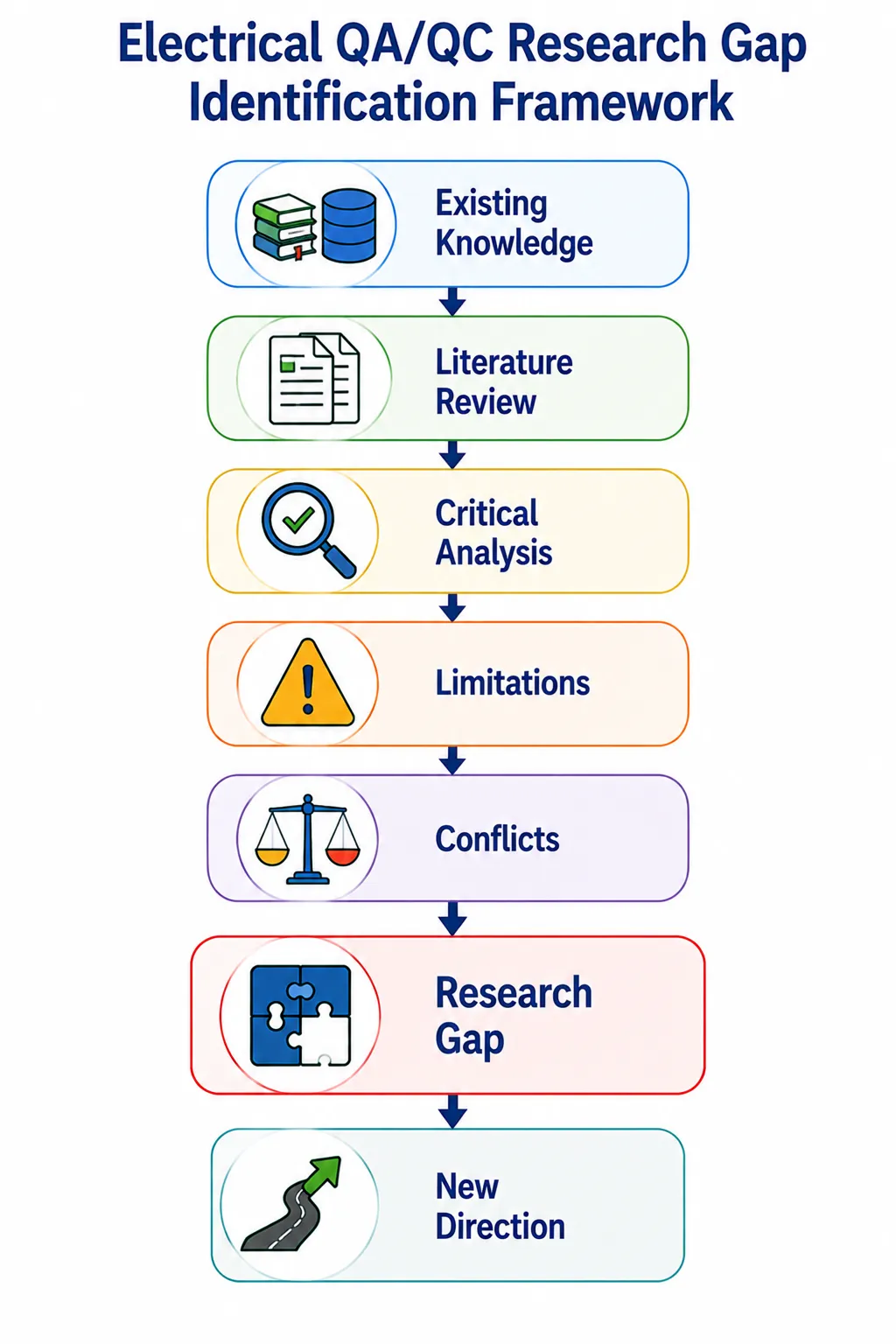
Analyse Existing Literature Findings
The first step is reviewing what previous studies have already established.
Researchers should identify:
Common findings
Accepted practices
Frequently discussed problems
Areas receiving limited attention
This provides an understanding of the current knowledge position.
Compare Different Research Perspectives
Researchers should compare information from different sources.
Comparison may include:
Academic studies
Industry reports
Technical standards
Professional experiences
Differences between sources may reveal important gaps.
For example:
Academic literature may suggest that digital quality systems improve performance, while industry reports may highlight implementation difficulties.
This difference creates an opportunity for further research.
Evaluate Limitations of Previous Studies
Previous research limitations can indicate areas requiring further investigation.
Common limitations include:
Limited sample size
Short research periods
Restricted project types
Lack of practical testing
Limited geographical coverage
Identify Unanswered Questions
Researchers should ask:
What problems remain unsolved?
What information is missing?
What areas require deeper investigation?
Examples:
How effective are AI inspection systems in large-scale electrical projects?
How can sustainability targets be verified through QA/QC processes?
What factors influence successful digital quality implementation?
Assess Industry Challenges
Research gaps often become visible through practical industry problems.
Researchers should analyse:
Project failures
Quality complaints
Non-conformance reports
Inspection challenges
Technology implementation issues
Analysing Inconsistencies Within Existing Research
Inconsistencies occur when different studies provide conflicting findings or conclusions.
These differences should not simply be ignored; they often represent valuable research opportunities.
Differences in Research Findings
Different studies may reach different conclusions because of:
Different methodologies
Different project environments
Different technologies
Different sample sizes
For example:
One study may conclude that automated inspection significantly reduces defects, while another may report limited improvement due to implementation challenges.
The researcher must investigate why these differences exist.
Differences Between Academic and Industry Perspectives
Academic research often focuses on:
Theory
Controlled analysis
Innovation potential
Industry literature often focuses on:
Practical implementation
Cost considerations
Operational challenges
A gap may exist between what research recommends and what organisations can realistically implement.
Regional Differences
Electrical quality management practices may vary depending on:
Regulations
Infrastructure conditions
Available technologies
Industry maturity
A solution successful in one region may not produce the same results elsewhere.
Unresolved Issues in Electrical Quality Management Research
Several important challenges continue to require investigation.
Digital QA/QC Implementation Challenges
Although digital systems provide significant benefits, unresolved issues remain.
Current challenges include:
Integration with existing systems
Staff training requirements
Data security concerns
Implementation costs
Research opportunities include:
Developing effective adoption strategies
Measuring long-term benefits
Improving user acceptance
Quality Management for Renewable Energy Systems
Renewable energy projects introduce new QA/QC challenges.
Unresolved issues include:
Performance verification methods
Long-term reliability assessment
Installation quality control
Further research is needed to improve sustainable electrical system quality.
Artificial Intelligence in Quality Control
AI offers significant opportunities but also creates unanswered questions.
Research challenges include:
Reliability of AI predictions
Data requirements
Human oversight
Ethical considerations
Integration of Sustainability and Quality Management
Modern projects must balance:
Environmental goals
Electrical performance
Cost requirements
Safety expectations
Research gaps exist in developing integrated approaches that achieve all objectives simultaneously.
Practical Example: Identifying Research Gaps in Electrical Digital QA/QC
Background
A construction organisation introduced digital inspection software to improve electrical quality management.
The system improved reporting speed but did not significantly reduce defects.
Literature Review Findings
Academic studies suggested:
Digital tools improve documentation
Real-time information supports decision-making
Industry reports indicated:
Staff training was a major challenge
Adoption was inconsistent
Identified Gap
Existing research lacked sufficient understanding of how organisational factors influence successful digital QA/QC implementation.
Research Opportunity
A new investigation could examine:
“How do organisational readiness factors influence the effectiveness of digital QA/QC systems in electrical construction projects?”
Case Study: Identifying Gaps in Electrical Testing Research
Project Situation
An industrial facility experienced repeated electrical commissioning problems despite following established testing procedures.
Existing Knowledge Review
Research showed:
Testing procedures are important
Documentation improves quality control
However, limited information existed regarding:
Human factors affecting testing accuracy
Integration of advanced monitoring tools
Long-term testing performance
Identified Research Gap
The relationship between advanced testing technologies and human quality management practices required further investigation.
Potential Research Contribution
Research could develop improved testing frameworks combining technology and professional expertise.
Benefits of Identifying Research Gaps
Improved Research Originality
Gap identification ensures research contributes something new.
Better Problem Definition
Researchers can clearly define the issue requiring investigation.
Stronger Research Justification
A clear gap demonstrates why research is necessary.
Increased Industry Value
Research can address practical engineering challenges.
Support for Innovation
Identifying gaps encourages development of improved technologies and methods.
Common Challenges in Finding Research Gaps
Researchers may face difficulties such as:
Large amounts of available information
Difficulty separating important issues from minor issues
Limited access to technical research
Rapid changes in technology
Conflicting research findings
These challenges require systematic literature analysis and critical thinking.
Strategies for Effective Gap Identification
Researchers can improve gap identification by:
Reviewing recent academic studies
Comparing theory with industry practice
Analysing research limitations
Examining project failures
Discussing challenges with professionals
Monitoring emerging technologies
Evaluating future industry needs
Conclusion
Identifying clear gaps, inconsistencies, and unresolved issues within existing electrical quality management research is essential for developing meaningful and valuable investigations. Through critical analysis of academic and industry literature, researchers can determine where current knowledge is incomplete, where practices require improvement, and where new solutions are needed. This process ensures that research addresses genuine engineering challenges rather than simply repeating existing knowledge.
A strong understanding of research gaps enables electrical QA/QC researchers to develop focused research questions that contribute to improved quality management practices. By investigating unresolved issues related to digital technologies, sustainability, testing methods, and emerging engineering challenges, researchers can support innovation, enhance system reliability, improve safety performance, and contribute valuable knowledge to the future development of electrical engineering quality management.
4. Evaluate How the Proposed Research Project Will Address the Identified Gaps in Current QA/QC Knowledge
A successful electrical Quality Assurance and Quality Control (QA/QC) research project must demonstrate how it will contribute to solving existing knowledge gaps, improving current practices, and developing new understanding within the field of electrical engineering. Identifying research gaps is only the beginning of the research process; the next critical step is evaluating how the proposed investigation will address those gaps through structured analysis, evidence collection, and the development of practical solutions.
In advanced electrical QA/QC research, a project should not only describe existing problems but also explain how its findings will contribute to improved quality management outcomes. The ability to evaluate research contribution requires a clear understanding of the relationship between existing limitations and the proposed research approach. Researchers must demonstrate that their investigation has the potential to provide new evidence, improve current processes, evaluate emerging technologies, or develop strategies that enhance electrical quality performance.
Electrical engineering projects are becoming increasingly complex due to digital transformation, renewable energy integration, advanced monitoring systems, automation, and higher expectations for reliability and sustainability. These developments create new challenges that traditional QA/QC approaches may not fully address. Therefore, research projects must be designed to investigate unresolved issues and provide evidence-based improvements that are relevant to modern engineering environments.
Evaluating the contribution of a proposed research project involves analysing how effectively the research objectives, methodology, and expected outcomes align with identified gaps. A strong research project should clearly demonstrate what knowledge is missing, why the gap is important, and how the investigation will generate valuable findings for industry and academic development.
Understanding the Relationship Between Research Gaps and Project Contribution
A research gap represents an area where existing knowledge is incomplete, limited, inconsistent, or unable to fully address current challenges. A proposed research project should directly connect with these gaps by developing methods to investigate and resolve them.
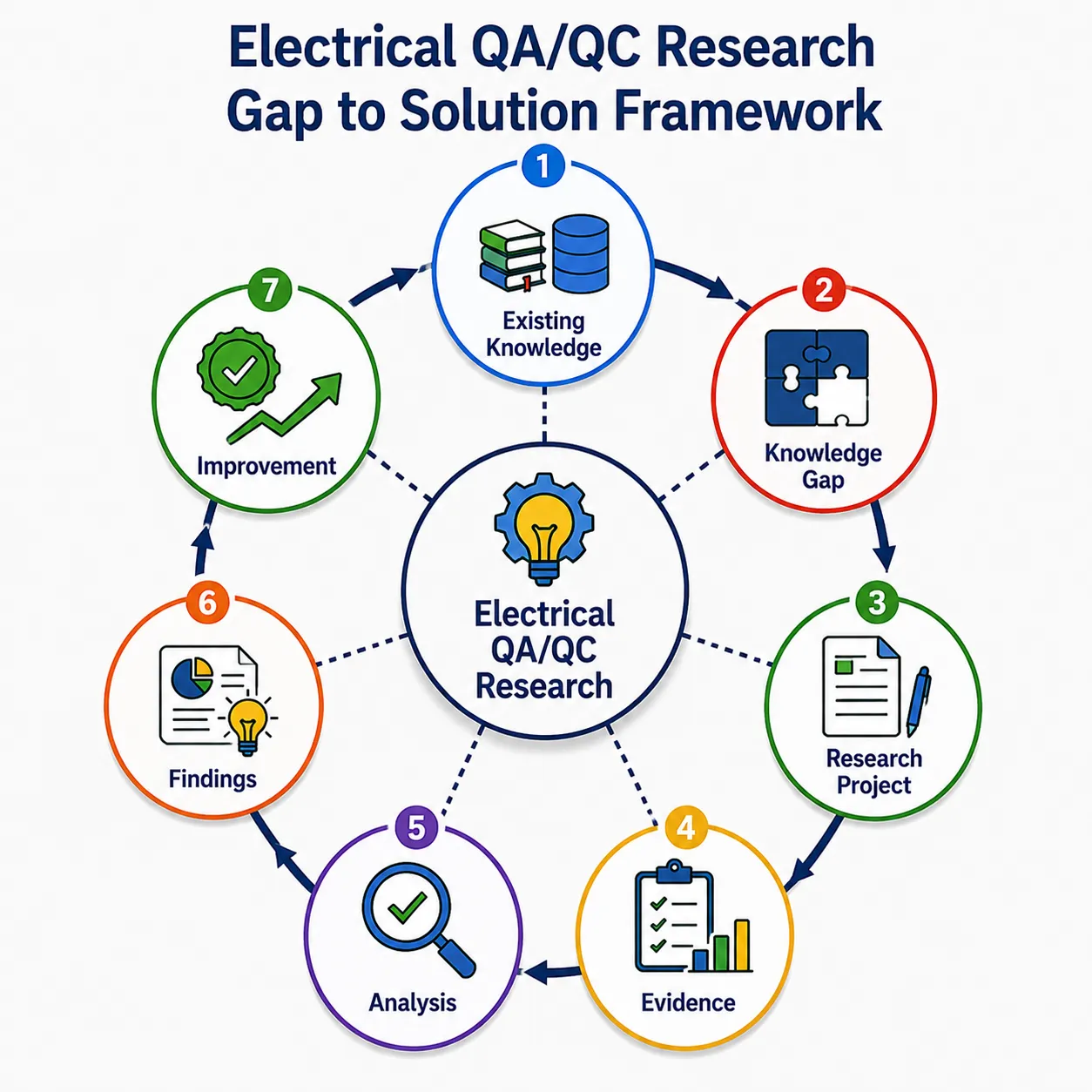
The relationship between research gaps and research contribution can be explained as:
Existing Knowledge
↓
Identified Limitation
↓
Research Gap
↓
Proposed Investigation
↓
New Evidence
↓
Improved QA/QC Practice
For example, previous studies may identify that digital QA/QC systems improve documentation efficiency but provide limited evidence about their effectiveness in reducing electrical installation defects. A proposed research project could address this gap by evaluating how digital inspection platforms influence defect detection and quality performance.
Key Concepts Related to Addressing QA/QC Knowledge Gaps
| Concept | Definition | Importance in Electrical QA/QC Research |
|---|---|---|
| Research contribution | The new knowledge, improvement, or solution produced through research | Demonstrates the value of the project |
| Knowledge gap | An area where existing understanding is incomplete | Provides justification for investigation |
| Research impact | The effect of research findings on professional practice | Shows practical usefulness |
| Evidence generation | The process of producing reliable information through research activities | Supports valid conclusions |
| Innovation | Development of improved methods, technologies, or approaches | Helps advance QA/QC practices |
| Research alignment | Connection between research objectives and identified problems | Ensures investigation remains focused |
| Methodology | The structured approach used to collect and analyse evidence | Determines research reliability |
| Practical application | The ability to implement research findings in real projects | Connects research with industry needs |
| Knowledge improvement | Expansion or refinement of existing understanding | Supports continual improvement |
| Validation | Confirmation that research findings are accurate and useful | Improves confidence in outcomes |
Evaluating How a Research Project Addresses Knowledge Gaps
A proposed research project should be evaluated by examining several important areas.
Alignment Between Research Question and Identified Gap
The first consideration is whether the research question directly responds to the identified knowledge gap.
A strong alignment means:
The research problem is clearly defined
The gap is supported by existing literature
The research question addresses missing information
The expected outcomes provide improvement opportunities
For example:
Identified gap:
Limited evidence exists regarding the effectiveness of artificial intelligence in electrical defect prediction.
Research question:
“How can artificial intelligence-based quality monitoring improve defect prediction in electrical installation projects?”
The research question directly addresses the identified limitation.
Contribution to Existing Knowledge
A research project should provide more than a summary of existing information. It should contribute new understanding.
Possible contributions include:
New evaluation methods
Improved QA/QC frameworks
Better implementation strategies
Evidence regarding technology effectiveness
Identification of new risk factors
In electrical QA/QC research, contribution may involve:
Improving inspection methods
Developing digital quality approaches
Enhancing testing reliability
Supporting sustainable electrical systems
Development of Practical Solutions
Electrical engineering research should have practical value.
A project can address knowledge gaps by developing:
Improved procedures
Quality management recommendations
Decision-making frameworks
Technology adoption strategies
Risk reduction approaches
For example, research into renewable energy QA/QC may develop improved verification procedures for solar installation performance.
Generating New Evidence
Many knowledge gaps exist because insufficient evidence is available.
Research projects address these gaps by collecting and analysing:
Project data
Inspection records
Testing results
Professional opinions
Performance measurements
Case study evidence
Reliable evidence allows researchers to evaluate whether current practices are effective.
Process for Evaluating Research Contribution
Identify the Existing Knowledge Limitation
The first step is clearly defining what current research cannot fully explain.
Examples:
Limited evaluation of digital QA/QC systems
Lack of evidence regarding AI applications
Inconsistent approaches to quality verification
The limitation must be specific and supported by literature analysis.
Define the Research Response
The researcher should explain how the project will investigate the limitation.
This may involve:
Developing a research framework
Analysing industry practices
Testing new approaches
Comparing different methods
Establish Research Objectives
Objectives should directly support gap resolution.
For example:
Research gap:
Limited understanding of digital QA/QC adoption barriers.
Research objectives:
Analyse current digital QA/QC practices
Identify implementation challenges
Evaluate improvement strategies
Select Appropriate Methodology
The research method should match the knowledge gap.
Possible approaches include:
Case study analysis
Surveys
Interviews
Technical evaluation
Data analysis
Comparative research
For example, understanding industry challenges may require interviews with QA/QC professionals.
Evaluate Expected Outcomes
Researchers should identify how findings will improve current knowledge.
Expected outcomes may include:
Improved quality processes
Better technology implementation
Reduced defects
Enhanced decision-making
Addressing Common Electrical QA/QC Knowledge Gaps Through Research
Improving Digital QA/QC Implementation
Digital quality management is a rapidly developing area.
Existing gap:
Limited evidence exists regarding successful digital QA/QC implementation strategies.
A proposed research project may address this by:
Evaluating digital inspection tools
Analysing implementation barriers
Developing adoption recommendations
Potential outcomes:
Improved documentation control
Faster inspection processes
Reduced quality errors
Enhancing Electrical Testing Procedures
Testing and commissioning remain essential quality control activities.
Existing gap:
Current testing methods may not fully address complex modern electrical systems.
Research contribution may include:
Evaluating advanced testing approaches
Comparing traditional and modern methods
Identifying reliability improvements
Improving Renewable Energy Quality Management
Renewable energy systems create new QA/QC requirements.
Existing gap:
Limited understanding exists regarding long-term quality verification.
Research may address this through:
Performance analysis
Installation quality evaluation
Commissioning assessment
Integrating Artificial Intelligence into QA/QC
AI technologies create opportunities for predictive quality management.
Existing gap:
Limited practical evidence exists regarding AI reliability in electrical QA/QC.
Research may investigate:
AI-based defect detection
Predictive analysis methods
Implementation challenges
Practical Example: Research Project Addressing Digital QA/QC Knowledge Gap
Background
A construction organisation identified that manual inspection processes were causing:
Delayed reporting
Documentation errors
Slow defect identification
Existing literature suggested digital QA/QC systems could improve quality management, but limited evidence existed regarding their impact on large electrical projects.
Identified Knowledge Gap
The gap was:
“Insufficient understanding of how digital QA/QC systems influence defect reduction and inspection efficiency.”
Proposed Research Project
Research question:
“How can digital QA/QC platforms improve defect detection and inspection performance in electrical construction projects?”
Research Approach
The project may include:
Reviewing existing digital QA/QC practices
Analysing project quality records
Interviewing quality professionals
Comparing traditional and digital approaches
Expected Contribution
The research could provide:
Evidence of digital system effectiveness
Improved implementation strategies
Recommendations for electrical quality teams
Case Study: Addressing Renewable Electrical Quality Challenges
Project Background
A renewable energy organisation experienced inconsistent performance from installed solar systems despite meeting equipment specifications.
Existing Knowledge Gap
Previous research provided information about solar technology but limited guidance on QA/QC approaches for ensuring long-term performance.
Proposed Research Response
The research project investigated:
Installation quality factors
Commissioning effectiveness
Performance verification methods
Research Outcomes
The project contributed by:
Identifying critical quality control points
Developing improved verification procedures
Supporting better renewable energy performance
Benefits of Research Projects Addressing Knowledge Gaps
Advancement of Engineering Knowledge
Research expands understanding of electrical quality challenges.
Improved Industry Practices
Findings can support better QA/QC processes.
Enhanced Project Performance
Improved methods can reduce:
Defects
Delays
Rework
Operational failures
Increased Safety and Reliability
Better quality approaches support safer electrical systems.
Support for Innovation
Research encourages development of improved technologies and methods.
Stronger Decision-Making
Evidence-based findings help organisations make informed quality decisions.
Challenges When Addressing Knowledge Gaps
Research projects may face several challenges.
Limited Data Availability
Some investigations may require information that organisations cannot easily provide.
Solutions include:
Using case studies
Conducting interviews
Analysing available records
Rapid Technology Development
Electrical technologies change quickly.
Researchers must:
Use current sources
Evaluate emerging trends
Consider future developments
Difficulty Measuring Impact
Some improvements may require long-term evaluation.
Researchers should define:
Clear performance indicators
Measurable outcomes
Evaluation criteria
Balancing Academic and Practical Requirements
Research must satisfy academic standards while providing industry value.
This requires:
Strong theoretical foundation
Practical application
Evidence-based conclusions
Strategies to Maximise Research Impact
Researchers can improve project contribution by:
Selecting significant industry problems
Using reliable evidence sources
Combining academic and industry perspectives
Developing practical recommendations
Evaluating real-world applications
Considering long-term implications
Linking Research Outcomes with Future QA/QC Development
A successful research project should contribute to continual improvement in electrical quality management.
Future applications may include:
Improved quality systems
Advanced inspection methods
Better technology adoption
Enhanced sustainability verification
Improved risk management
Research findings should support organisations in adapting to changing engineering requirements.
Conclusion
Evaluating how a proposed research project will address identified gaps in current QA/QC knowledge is essential for ensuring research relevance and professional value. A strong research project should clearly connect identified limitations with investigation methods, expected outcomes, and practical improvements. By analysing existing knowledge gaps and developing targeted research approaches, researchers can create meaningful contributions that improve electrical quality management practices.
Through evidence-based investigation, practical evaluation, and structured analysis, electrical QA/QC research can support innovation, improve reliability, enhance safety, and strengthen project performance. Addressing unresolved issues within current knowledge allows researchers to develop solutions that respond to modern engineering challenges and contribute to the continual advancement of electrical quality management.