
Lesson 8: Balance Sustainability Goals with Cost and Performance Requirements
Sustainable electrical engineering increasingly requires professionals to balance environmental objectives with cost, reliability, efficiency, quality, and long-term performance. In modern electrical projects, sustainability is not limited to reducing energy consumption or selecting environmentally preferable materials; it involves making technically sound decisions that consider the complete lifecycle of an installation. This includes energy efficiency, material selection, resource consumption, equipment reliability, operational performance, maintenance requirements, lifecycle costs, carbon reduction, waste minimisation, and the long-term resilience of electrical systems. For electrical QA/QC professionals, understanding these competing requirements is essential for ensuring that sustainability initiatives deliver measurable value without compromising safety, compliance, quality, or project performance.
This lesson examines how advanced electrical QA/QC professionals can evaluate and balance sustainability goals against project cost and performance requirements. Learners will explore the relationship between sustainable design decisions, capital expenditure, operating costs, energy performance, reliability, maintainability, durability, and lifecycle value. Particular attention is given to practical decision-making where environmentally preferable solutions may involve higher initial investment but deliver improved efficiency and lower operating costs over time. The lesson also considers situations where sustainability measures can unintentionally increase technical complexity, maintenance requirements, procurement risks, or performance uncertainty. Through structured analysis, workplace examples, case-based learning, and professional QA/QC considerations, learners develop the ability to assess whether sustainability objectives are realistic, measurable, technically appropriate, and economically justified.
The lesson further develops strategic decision-making skills required for sustainable electrical projects, including lifecycle cost evaluation, performance assessment, sustainability criteria, quality controls, risk considerations, and stakeholder requirements. Learners will examine how QA/QC planning can support sustainable outcomes through measurable specifications, inspection and testing requirements, performance verification, documentation, supplier evaluation, and continual monitoring. By the end of the lesson, learners should be able to make informed professional judgements that balance environmental responsibility with financial efficiency and technical performance, ensuring that sustainable electrical installations remain reliable, cost-effective, high-quality, and fit for their intended purpose.
1: Critically Analyse the Complex Interactions Between Sustainability Targets, Project Budgets, and Electrical Performance Standards
Sustainable electrical engineering requires more than selecting energy-efficient equipment or reducing the environmental impact of construction activities. In a complex electrical project, sustainability targets, project budgets, and electrical performance standards are closely interconnected and can create competing priorities. A decision that improves environmental performance may increase capital expenditure, while a lower-cost option may result in higher energy consumption, greater maintenance requirements, shorter service life, or reduced long-term performance. Similarly, selecting highly efficient equipment may introduce technical integration challenges that affect reliability, maintainability, commissioning, or operational performance. For an electrical QA/QC professional working at Level 6, the challenge is therefore to analyse these relationships critically rather than treating sustainability, cost, and performance as separate project objectives.
In practice, sustainable electrical projects may involve renewable energy systems, high-efficiency transformers, LED lighting, intelligent building controls, energy monitoring systems, battery energy storage, variable-speed drives, efficient motors, smart metering, power-factor correction, energy-management platforms, low-carbon materials, and advanced electrical distribution systems. Each decision can influence project cost and electrical performance in different ways. The QA/QC professional must understand the technical requirements, evaluate the evidence provided by designers and suppliers, assess lifecycle implications, verify installation quality, and ensure that sustainability claims are supported by measurable performance. This requires a balanced approach in which environmental objectives are achieved without compromising electrical safety, reliability, quality, contractual requirements, or the intended operational function of the installation.
Understanding the Relationship Between Sustainability, Cost and Performance
The relationship between sustainability, project budgets, and electrical performance can be represented as a three-way decision framework:
Sustainability → Cost → Performance
However, these factors do not operate independently. A change in one area can influence the other two.
For example, an organisation may specify high-efficiency motors to reduce energy consumption. The motors may have a higher initial purchase price than standard alternatives. However, lower energy consumption may reduce operating costs over the equipment’s service life. At the same time, the selected motors may require appropriate variable-speed drives, harmonic considerations, control integration, commissioning, and specialist maintenance.
Therefore, the correct question is not simply:
“Which option has the lowest purchase price?”
A more appropriate professional question is:
“Which option provides the required electrical performance and sustainability outcome at an acceptable whole-life cost and risk?”
This distinction is fundamental to sustainable electrical QA/QC decision-making.
Key Definitions and Concepts
| Term | Definition | Application in Electrical QA/QC |
|---|---|---|
| Sustainability target | A defined environmental or resource-efficiency objective | Establishes measurable sustainability expectations |
| Project budget | Financial limit or planned expenditure for project delivery | Controls capital and implementation expenditure |
| Electrical performance | The ability of an electrical system to operate according to specified technical requirements | Supports reliability, efficiency, safety and functionality |
| Lifecycle cost | Total cost associated with an asset throughout its useful life | Supports long-term investment decisions |
| Capital expenditure | Initial expenditure required to purchase and install an asset | Important when evaluating sustainable technologies |
| Operating expenditure | Costs incurred during operation and maintenance | Important for evaluating long-term economic performance |
| Energy efficiency | Achieving required output while using less energy | Reduces operating energy consumption |
| Performance standard | Defined technical requirement against which performance is assessed | Provides measurable acceptance criteria |
| Lifecycle value | Overall value produced by an asset over its useful life | Balances cost, performance and sustainability |
| Carbon reduction | Reduction in greenhouse-gas emissions associated with an activity or asset | Supports environmental objectives |
| Trade-off | A situation where improving one objective affects another | Common in sustainable project decisions |
| Whole-life assessment | Evaluation of cost and performance throughout an asset’s lifecycle | Prevents decisions based only on initial cost |
| Performance verification | Process of confirming that actual performance meets specified requirements | Supports QA/QC acceptance |
| Residual risk | Risk remaining after controls have been implemented | Supports informed project decisions |
Why Sustainability Cannot Be Considered in Isolation
A sustainability target may appear beneficial when considered independently, but its wider project consequences must be evaluated.
For example, reducing electrical energy consumption may require:
- Higher-efficiency equipment
- Intelligent control systems
- Energy monitoring
- Advanced sensors
- Additional commissioning
- Specialist maintenance
- Staff training
- Digital infrastructure
Each element may increase initial expenditure.
However, the additional investment may produce:
- Lower energy consumption
- Reduced operating costs
- Lower carbon emissions
- Improved equipment performance
- Better energy visibility
- Improved asset management
- Longer-term financial benefits
The QA/QC professional should therefore evaluate both immediate and long-term consequences.
Sustainability Targets in Electrical Projects
Sustainability targets can address several areas.
Energy efficiency
Energy efficiency is often one of the most important sustainability objectives in electrical installations.
Targets may involve:
- Reducing energy consumption
- Improving lighting efficiency
- Reducing distribution losses
- Improving motor efficiency
- Optimising HVAC electrical loads
- Monitoring energy consumption
- Improving power utilisation
- Integrating renewable generation
Renewable energy integration
Renewable electrical systems may include:
- Solar photovoltaic systems
- Battery storage
- Hybrid energy systems
- On-site generation
- Energy management systems
These systems can reduce dependence on conventional energy sources but introduce additional design, installation, commissioning, maintenance, and monitoring requirements.
Material efficiency
Sustainability may also involve:
- Reduced material waste
- Responsible material selection
- Longer equipment life
- Recyclability
- Reduced packaging
- Efficient cable utilisation
- Durable components
Operational sustainability
A sustainable electrical installation should remain effective throughout its operational life.
This means considering:
- Maintenance
- Reliability
- Replacement requirements
- Energy consumption
- Equipment degradation
- Monitoring
- Upgradeability
Project Budget Considerations
Project budgets normally include more than equipment purchase prices.
A realistic budget may include:
- Design costs
- Procurement
- Equipment
- Installation
- Testing
- Commissioning
- Training
- Monitoring
- Maintenance
- Software licences
- Replacement
- Upgrades
- Disposal
A sustainable technology may therefore appear expensive initially but become financially attractive when its whole-life costs are considered.
Capital Cost Versus Lifecycle Cost
One of the most important analytical concepts is the difference between capital cost and lifecycle cost.
Capital cost is concerned primarily with initial investment.
Lifecycle cost considers the wider financial impact of the asset.
For example:
Option A:
- Lower purchase cost
- Higher energy consumption
- Higher maintenance
- Shorter expected service life
Option B:
- Higher purchase cost
- Lower energy consumption
- Lower maintenance
- Longer expected service life
Selecting Option A solely because it is cheaper at procurement stage may result in higher long-term expenditure.
A Level 6 professional should therefore challenge decisions that focus exclusively on initial capital cost when long-term performance is important.
Electrical Performance Standards
Electrical performance requirements provide the technical benchmark against which an installation is assessed.
Performance considerations may include:
- Electrical efficiency
- Voltage stability
- Power quality
- Reliability
- Capacity
- Protection performance
- Thermal performance
- Equipment efficiency
- System availability
- Energy monitoring accuracy
- Control performance
- Maintainability
Sustainability improvements should not reduce compliance with applicable electrical requirements.
Interaction Between Sustainability and Electrical Performance
A sustainable solution must still deliver the required electrical function.
For example, reducing energy consumption through control systems may improve sustainability, but poorly configured controls could cause:
- Unnecessary equipment cycling
- Reduced comfort
- Operational disruption
- Increased maintenance
- Poor system coordination
Similarly, integrating renewable generation can reduce conventional energy consumption but may require careful consideration of:
- Power quality
- Protection
- Control
- Storage
- Grid interaction
- Monitoring
- Commissioning
The sustainability benefit therefore depends on successful technical implementation.
Interaction Between Budget and Electrical Performance
Budget reductions can affect electrical performance when inappropriate cost-cutting measures are applied.
Examples include:
- Selecting lower-quality components
- Reducing inspection activities
- Reducing testing
- Selecting equipment based only on purchase price
- Reducing spare capacity
- Removing monitoring systems
- Selecting unsuitable materials
Cost optimisation should therefore be distinguished from uncontrolled cost reduction.
Strategic Cost Optimisation
Strategic cost optimisation seeks to reduce unnecessary expenditure while maintaining required performance.
This may involve:
- Comparing lifecycle costs
- Evaluating supplier proposals
- Standardising equipment
- Reducing unnecessary complexity
- Improving procurement planning
- Selecting efficient equipment
- Reducing rework
- Improving installation quality
- Optimising maintenance
- Using performance data
The QA/QC professional can contribute by identifying quality failures that create unnecessary costs.
The Role of QA/QC in Sustainability
QA/QC is essential because sustainability claims must ultimately translate into actual project performance.
A design may specify high-efficiency equipment, but poor installation could prevent the expected benefits.
QA/QC should therefore verify:
- Correct equipment
- Correct ratings
- Correct installation
- Correct configuration
- Correct testing
- Correct commissioning
- Accurate documentation
- Performance evidence
This creates a direct relationship between quality assurance and sustainability outcomes.
Sustainability Specifications
Sustainability requirements should be converted into measurable specifications.
Instead of stating:
“Install energy-efficient equipment.”
A stronger requirement would identify:
- Required efficiency
- Operating conditions
- Applicable performance criteria
- Testing requirements
- Acceptance criteria
- Monitoring requirements
- Documentation requirements
Measurable criteria make sustainability objectives auditable.
Performance Verification
Performance verification is particularly important where sustainability benefits are claimed.
Verification may include:
- Energy measurements
- Equipment efficiency checks
- Functional testing
- Control-system testing
- Meter verification
- Commissioning results
- Performance trend analysis
Without verification, a sustainability target may remain an intention rather than a demonstrated outcome.
Practical Example: High-Efficiency Transformer
Consider a project choosing between two transformers.
The conventional transformer has:
- Lower initial cost
- Higher losses
- Lower purchase price
The high-efficiency transformer has:
- Higher initial cost
- Lower operating losses
- Higher efficiency
- Potentially improved lifecycle economics
The decision should consider:
- Initial investment
- Expected loading
- Operating hours
- Energy costs
- Service life
- Maintenance
- Environmental objectives
The QA/QC professional should verify that the selected transformer actually meets the specified efficiency and installation requirements.
Practical Example: LED Lighting
An LED lighting system may provide substantial energy-efficiency benefits.
However, performance depends on:
- Correct luminaire selection
- Appropriate lighting levels
- Correct positioning
- Control configuration
- Sensor operation
- Installation quality
- Commissioning
A poorly designed or installed LED system may not achieve its intended sustainability performance.
Therefore, QA/QC should verify both installation quality and functional performance.
Practical Example: Solar Photovoltaic Installation
A solar PV system may support sustainability targets by reducing reliance on conventional electricity.
However, project costs may include:
- PV modules
- Inverters
- Mounting systems
- Cabling
- Protection
- Monitoring
- Installation
- Testing
- Commissioning
- Maintenance
Electrical performance depends on correct:
- Module installation
- String configuration
- Cable selection
- Protection
- Inverter configuration
- Monitoring
- Testing
A sustainability target cannot be considered achieved merely because PV panels have been installed.
Practical Example: Battery Energy Storage
Battery storage may improve energy management and support renewable integration.
However, it introduces additional considerations:
- Capital cost
- System efficiency
- Capacity
- Maintenance
- Monitoring
- Safety
- Control integration
- Replacement
- Lifecycle performance
The project must evaluate whether the expected operational and sustainability benefits justify the investment and technical complexity.
Interactions Between Three Major Objectives
Sustainability versus cost
A higher sustainability target may require greater initial investment.
Potential relationship:
Higher initial cost → Improved efficiency → Lower operating cost → Long-term value
However, this outcome should be supported by evidence rather than assumed.
Cost versus performance
Reducing expenditure can affect:
- Equipment quality
- Reliability
- Testing
- Maintenance
- Service life
Cost savings should therefore be evaluated against performance consequences.
Performance versus sustainability
Some highly sustainable technologies may require more complex control systems or maintenance.
The professional should establish whether the sustainability benefit remains achievable without compromising operational performance.
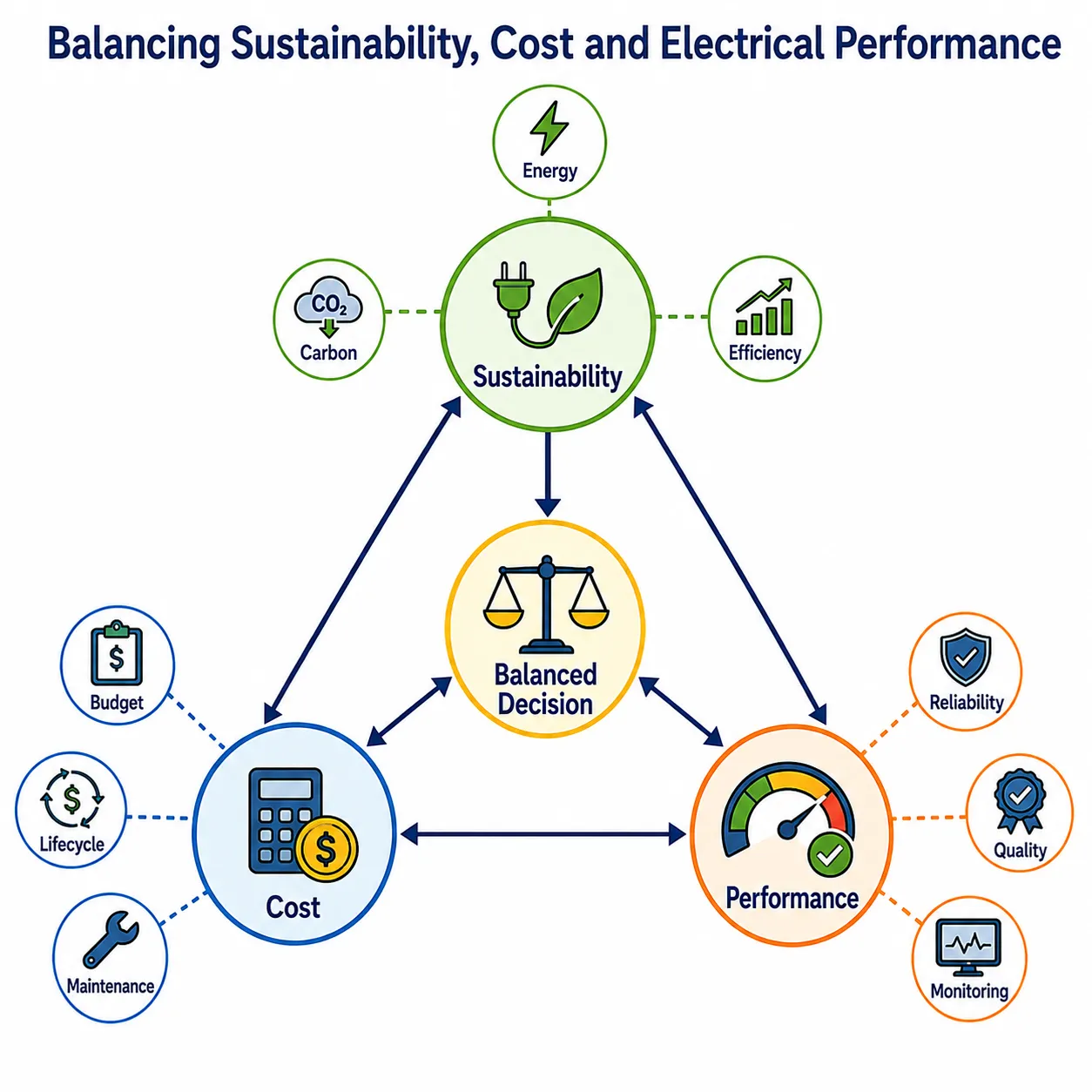
The Sustainability-Cost-Performance Decision Cycle
A structured decision process can be applied.
Step 1: Identify sustainability objectives
Determine exactly what the project wants to achieve.
Examples include:
- Energy reduction
- Carbon reduction
- Reduced waste
- Renewable energy generation
- Improved efficiency
Step 2: Define electrical performance requirements
Establish:
- Capacity
- Reliability
- Efficiency
- Power quality
- Safety
- Availability
- Maintainability
Step 3: Establish budget constraints
Identify:
- Capital budget
- Operating budget
- Maintenance allowance
- Contingency
- Lifecycle expenditure
Step 4: Develop alternatives
Compare technically feasible solutions.
Step 5: Evaluate lifecycle cost
Consider initial and long-term costs.
Step 6: Assess technical performance
Determine whether each alternative can meet required electrical performance.
Step 7: Evaluate sustainability outcomes
Measure expected environmental benefits.
Step 8: Identify risks
Consider:
- Technical risks
- Financial risks
- Supply risks
- Maintenance risks
- Performance risks
Step 9: Select the preferred solution
Use evidence-based professional judgement.
Step 10: Verify implementation
Confirm that the installed solution achieves the specified outcome.
Key Factors to Evaluate
When analysing a sustainable electrical solution, consider:
- Initial capital cost
- Lifecycle cost
- Energy consumption
- Equipment efficiency
- Expected service life
- Maintenance requirements
- Replacement frequency
- Installation complexity
- Availability of spare parts
- Supplier capability
- Workforce competence
- Performance standards
- Commissioning requirements
- Sustainability benefits
- Environmental impact
- Operational reliability
- Data availability
- Monitoring capability
Risk of Focusing Only on Initial Cost
Initial-cost decisions can create hidden long-term consequences.
For example, a cheaper motor may consume more energy throughout its operating life. If the motor operates continuously, the additional energy expenditure may significantly exceed the original saving.
Other consequences may include:
- Higher maintenance
- More frequent replacement
- Increased downtime
- Higher energy losses
- Increased carbon emissions
- Reduced operational efficiency
Therefore, capital cost should be considered alongside lifecycle performance.
Risk of Focusing Only on Sustainability
Sustainability should also not become an isolated objective.
A technically attractive sustainability solution may create:
- Excessive capital expenditure
- Difficult maintenance
- Complex controls
- Specialist skills requirements
- Long procurement periods
- Integration difficulties
The appropriate professional approach is balance rather than prioritisation of one objective at the expense of all others.
Risk of Focusing Only on Performance
Similarly, a project that focuses exclusively on electrical performance may overlook:
- Energy consumption
- Carbon emissions
- Material efficiency
- Lifecycle cost
- Waste
- Resource use
Modern electrical engineering requires performance to be considered within a broader sustainability framework.
Multi-Criteria Decision-Making
A useful approach is to evaluate alternative solutions against several criteria.
For example:
| Decision Criterion | Option A | Option B | Option C |
|---|---|---|---|
| Initial cost | High | Medium | Low |
| Energy efficiency | High | Medium | Low |
| Lifecycle cost | Low | Medium | High |
| Technical performance | High | High | Medium |
| Maintenance | Low | Medium | High |
| Sustainability benefit | High | Medium | Low |
| Implementation complexity | Medium | Low | Low |
The purpose of such a comparison is not to select the option with the best individual score. Instead, the professional should evaluate the overall balance of cost, sustainability, performance, risk, and project requirements.
Stakeholder Influence
Different stakeholders may prioritise different objectives.
Client
May focus on:
- Capital cost
- Long-term value
- Sustainability targets
- Asset performance
Designer
May focus on:
- Technical compliance
- Energy efficiency
- System integration
Contractor
May focus on:
- Installation cost
- Programme
- Procurement
- Constructability
QA/QC professional
May focus on:
- Compliance
- Quality
- Verification
- Traceability
- Performance evidence
Facility operator
May focus on:
- Reliability
- Maintenance
- Energy consumption
- Operational simplicity
The QA/QC professional must understand these different perspectives while maintaining objective quality requirements.
Procurement Considerations
Sustainability and performance decisions can be affected by procurement.
Important considerations include:
- Supplier capability
- Product availability
- Lead times
- Technical documentation
- Product certification
- Warranty
- Maintenance support
- Spare parts
- Lifecycle information
A technically excellent product may become unsuitable if it cannot be procured within the project programme.
Supplier Evaluation
Suppliers should be evaluated using relevant criteria.
These may include:
- Technical capability
- Product performance
- Quality systems
- Sustainability information
- Previous experience
- Testing evidence
- Warranty
- After-sales support
- Documentation
- Delivery capability
Supplier sustainability claims should be supported by appropriate evidence.
Design Review and Sustainability
QA/QC involvement should begin during design rather than only after installation.
Design reviews can consider:
- Energy efficiency
- Equipment selection
- System losses
- Maintainability
- Monitoring
- Integration
- Lifecycle considerations
Early identification of conflicts can prevent expensive changes during construction.
Construction Quality and Sustainability
Construction quality has a direct impact on sustainability.
Poor workmanship can result in:
- Electrical losses
- Equipment overheating
- Reduced efficiency
- Premature failure
- Rework
- Material waste
- Additional transportation
- Increased project costs
Therefore, good QA/QC contributes directly to sustainability.
Testing and Commissioning
Testing and commissioning provide evidence that the installed system performs as intended.
Typical considerations include:
- Functional testing
- Electrical measurements
- Protection testing
- Energy monitoring
- Control verification
- Equipment performance
- System integration
Commissioning should verify both technical performance and relevant sustainability objectives.
Monitoring and Measurement
Sustainability performance should be monitored where practical.
Useful indicators may include:
- Energy consumption
- Energy intensity
- Equipment efficiency
- Renewable energy contribution
- System losses
- Maintenance frequency
- Defect rates
- Equipment downtime
Monitoring converts sustainability objectives into measurable project information.
Key Benefits of Balancing Sustainability, Cost and Performance
Improved lifecycle value
A balanced approach can identify solutions that provide better long-term value rather than simply lower initial expenditure.
Reduced operating costs
Efficient equipment can reduce energy and maintenance costs.
Improved electrical reliability
Sustainability decisions can be aligned with technical performance requirements.
Reduced environmental impact
Energy and resource efficiency can support sustainability objectives.
Better investment decisions
Multi-criteria evaluation provides stronger evidence for project decisions.
Reduced rework
Early QA/QC involvement can identify problems before installation or commissioning.
Improved stakeholder confidence
Transparent decision-making demonstrates that sustainability, cost, and performance have been considered together.
Stronger quality assurance
Measurable sustainability requirements can be incorporated into inspection and testing plans.
Common Decision-Making Errors
Professionals should avoid:
- Selecting equipment based only on purchase price
- Treating sustainability as a separate project activity
- Accepting unverified supplier claims
- Ignoring lifecycle costs
- Ignoring maintenance requirements
- Setting sustainability targets without measurable criteria
- Failing to consider electrical performance
- Ignoring workforce competence
- Introducing complex technologies without adequate training
- Reducing testing to achieve programme savings
- Ignoring long-term operating conditions
- Failing to verify sustainability performance
Practical QA/QC Framework
A sustainable electrical QA/QC framework can be structured around six stages.
Define
Define:
- Sustainability targets
- Cost constraints
- Performance requirements
- Quality criteria
Analyse
Analyse:
- Alternatives
- Lifecycle cost
- Technical performance
- Sustainability impact
- Risks
Specify
Specify:
- Equipment
- Performance criteria
- Inspection requirements
- Testing requirements
- Documentation
Verify
Verify:
- Materials
- Installation
- Configuration
- Testing
- Commissioning
Measure
Measure:
- Energy
- Efficiency
- Performance
- Defects
- Operational results
Improve
Use performance evidence to identify opportunities for:
- Energy optimisation
- Maintenance improvement
- Process improvement
- Equipment optimisation
- Waste reduction
Professional Decision-Making Scenario
Consider a commercial electrical project where the client has established a significant energy-reduction target but has also imposed a strict capital budget.
The design team proposes highly efficient equipment with a higher initial cost. The contractor recommends a lower-cost alternative with slightly lower efficiency.
The QA/QC professional should not simply select either option.
Instead, the professional should examine:
- Required electrical performance
- Expected operating hours
- Energy consumption
- Capital cost
- Lifecycle cost
- Maintenance
- Service life
- Sustainability target
- Supplier capability
- Installation requirements
- Performance verification
If the higher-cost option produces significant lifecycle benefits while meeting technical requirements, it may provide better overall value. If the additional cost produces negligible benefit, the lower-cost solution may be more appropriate.
The decision must therefore be evidence-based.
Case Study: Sustainable Electrical Installation
Project background
A large commercial facility is being developed with a target of reducing operational energy consumption. The project budget is constrained, and the client requires reliable electrical performance throughout the facility’s expected operating life.
The proposed electrical strategy includes:
- High-efficiency lighting
- Smart controls
- Energy monitoring
- High-efficiency motors
- Solar PV
- Intelligent metering
Initial challenge
The sustainability strategy increases initial capital expenditure.
The project team therefore needs to determine whether the additional investment provides sufficient value.
QA/QC analysis
The QA/QC team reviews:
- Equipment specifications
- Efficiency data
- Supplier documentation
- Installation requirements
- Testing procedures
- Commissioning requirements
- Monitoring arrangements
The team identifies that smart controls require additional commissioning and user training.
Cost-performance interaction
The controls increase implementation cost but are expected to reduce unnecessary energy consumption.
The team therefore recommends:
- Defined control sequences
- Functional testing
- Commissioning records
- User training
- Energy monitoring
Sustainability verification
After commissioning, the project team compares actual energy performance with the established target.
This provides evidence that sustainability has been incorporated into actual project performance rather than merely specified at design stage.
How the Case Study Demonstrates Complex Interaction
The case demonstrates that:
- Sustainability targets influence equipment selection.
- Equipment selection influences capital expenditure.
- Capital expenditure influences budget decisions.
- Technology selection influences commissioning requirements.
- Commissioning influences quality assurance.
- Quality influences actual system performance.
- Performance influences lifecycle value.
- Monitoring provides evidence of sustainability achievement.
This chain demonstrates why sustainability, budget, and performance must be evaluated as an interconnected system.
Recommended Professional Evaluation Questions
Before approving a sustainable electrical solution, ask:
Sustainability
- What sustainability target does the solution support?
- How will the benefit be measured?
- Is the target realistic?
- Can the claimed benefit be verified?
Cost
- What is the initial cost?
- What are the operating costs?
- What maintenance costs are expected?
- What is the lifecycle cost?
Performance
- Does the solution meet electrical requirements?
- Is reliability maintained?
- Can the system be tested?
- Can performance be monitored?
Quality
- What inspection requirements apply?
- What testing is required?
- What evidence is required?
- Who will verify performance?
Risk
- What could prevent the sustainability benefit?
- What could increase lifecycle costs?
- What technical risks exist?
- What contingency is available?
Strategic Principles for Level 6 Electrical QA/QC Professionals
A professional approach should follow these principles:
- Evaluate sustainability and cost together.
- Consider lifecycle rather than initial cost alone.
- Maintain required electrical performance.
- Convert sustainability targets into measurable criteria.
- Verify supplier claims through evidence.
- Integrate sustainability into QA/QC planning.
- Include sustainability requirements in inspection and testing.
- Consider maintenance and operational requirements.
- Evaluate technology and workforce capability.
- Use performance data to support decisions.
- Assess risks before implementation.
- Avoid sacrificing critical quality controls for cost savings.
- Avoid adopting sustainability measures without measurable value.
- Maintain traceable evidence of performance.
- Review actual outcomes against planned targets.
Conclusion
Balancing sustainability targets, project budgets, and electrical performance standards requires critical analysis rather than a simple choice between environmental responsibility and financial control. Sustainable electrical solutions must be evaluated according to their technical performance, initial investment, operating costs, maintenance requirements, service life, environmental benefits, quality risks, and ability to meet defined project requirements. A higher initial investment may be justified where it produces measurable improvements in efficiency, reliability, lifecycle cost, or environmental performance, while a lower-cost option may be preferable where the sustainability benefit is limited or the technical risks are excessive. The essential principle is to select solutions based on overall lifecycle value and verified performance rather than focusing on a single project objective.
For the electrical QA/QC professional, this balance must continue from design review through procurement, installation, inspection, testing, commissioning, and operational monitoring. Sustainability requirements should be converted into measurable specifications and incorporated into quality plans, inspection activities, testing procedures, commissioning requirements, and performance verification. By analysing the interaction between environmental objectives, financial constraints, electrical performance, quality, and lifecycle risks, Level 6 professionals can support technically reliable and economically responsible sustainable electrical projects. This approach ensures that sustainability is demonstrated through measurable project outcomes rather than treated merely as a design intention.
2: Evaluate Practical Scenarios Where Strict Environmental Goals Conflict with Commercial Cost or Technical Performance Requirements
Sustainable electrical projects increasingly operate under ambitious environmental objectives, including energy reduction, carbon reduction, renewable energy integration, resource efficiency, waste minimisation, and improved lifecycle performance. However, these objectives must be delivered within commercial budgets and alongside strict electrical performance requirements. In practice, sustainability decisions rarely involve a simple choice between a sustainable option and an unsustainable option. Instead, electrical engineers and QA/QC professionals must evaluate situations in which improving environmental performance may increase capital expenditure, introduce technical complexity, affect reliability, extend procurement periods, or create additional inspection, testing, commissioning, and maintenance requirements. The professional challenge is therefore to determine whether the sustainability objective can be achieved without creating unacceptable commercial or technical consequences.
For a Level 6 electrical QA/QC professional, evaluating these conflicts requires evidence-based judgement and a structured understanding of project priorities. The professional must be able to examine realistic scenarios, identify the competing requirements, assess their interaction, evaluate alternative solutions, and recommend an appropriate course of action. This includes understanding the difference between an unavoidable cost associated with achieving a legitimate sustainability objective and an unnecessary cost caused by poor planning or inappropriate technology selection. It also requires recognition that technical performance must not be compromised simply to achieve environmental targets. A sustainable electrical installation that cannot operate reliably, cannot be maintained effectively, or fails to meet its specified performance requirements cannot be regarded as a successful sustainable solution.
Understanding Conflicting Project Objectives
Electrical projects commonly have several objectives that must be achieved simultaneously.
These may include:
Environmental performance
Capital cost control
Lifecycle cost reduction
Electrical reliability
Energy efficiency
Quality compliance
Programme performance
Maintainability
Safety
Operational resilience
Asset longevity
Stakeholder expectations
These objectives can support one another, but they can also conflict.
For example, higher-efficiency electrical equipment may reduce energy consumption but require greater initial investment. A sophisticated energy management system may improve energy monitoring but introduce additional software, training, cybersecurity, commissioning, and maintenance requirements. Renewable energy generation may reduce operational emissions but require additional infrastructure, controls, protection, monitoring, and specialist expertise.
The role of the professional is therefore to evaluate the complete situation rather than selecting an option based on one criterion.
Key Definitions and Concepts
| Term | Definition | Application to Electrical QA/QC Decision-Making |
|---|---|---|
| Environmental goal | A defined objective intended to reduce environmental impact or resource consumption | Provides the sustainability benchmark |
| Commercial requirement | A financial or business condition that a project must satisfy | Establishes budget and value constraints |
| Technical performance | The ability of an electrical system to achieve its specified functional requirements | Protects reliability, efficiency and operational capability |
| Cost conflict | A situation where achieving one objective increases expenditure | Requires financial and lifecycle evaluation |
| Performance conflict | A situation where a sustainability measure may affect technical capability | Requires engineering assessment |
| Lifecycle cost | Total cost associated with an asset from acquisition through operation and disposal | Supports long-term decision-making |
| Capital expenditure | Initial expenditure required to purchase and install equipment | Important when comparing sustainable alternatives |
| Operating cost | Ongoing expenditure associated with operating an asset | Important when assessing long-term value |
| Trade-off | A decision where improving one objective affects another | Common in sustainable electrical projects |
| Environmental performance | Measurable environmental outcome of a project or system | Used to evaluate sustainability achievement |
| Technical feasibility | The extent to which a proposed solution can meet engineering requirements | Determines whether sustainability options are practical |
| Commercial viability | The extent to which a solution is financially acceptable | Determines whether the option can be delivered within project constraints |
| Performance verification | Confirmation that actual system performance meets specified requirements | Provides objective evidence of success |
| Whole-life value | Overall value considering cost, performance, sustainability and service life | Supports balanced project decisions |
| Residual risk | Remaining risk after controls have been implemented | Supports final professional judgement |
Why Environmental Targets Can Create Commercial Conflicts
Environmental objectives often require investment.
Examples include:
High-efficiency transformers
High-efficiency motors
LED lighting
Solar PV
Battery storage
Smart metering
Energy management systems
Advanced monitoring
Low-energy controls
Sustainable materials
These technologies may require greater initial expenditure than conventional alternatives.
However, the higher capital cost does not automatically mean that the sustainable option is commercially unacceptable.
The professional should examine:
Expected energy savings
Operating hours
Maintenance costs
Equipment lifespan
Replacement costs
Energy prices
Carbon reduction
Performance benefits
Incentives where applicable
Installation complexity
The key question is whether the additional investment creates sufficient value over the asset lifecycle.
Why Environmental Targets Can Create Technical Conflicts
Environmental improvements can sometimes introduce technical challenges.
For example, integrating renewable generation into an electrical distribution system may require consideration of:
Protection coordination
Power quality
System control
Monitoring
Energy storage
Electrical interfaces
Commissioning
Maintenance
Similarly, aggressive energy-reduction strategies may require advanced control systems that create additional dependencies.
Technical performance must therefore remain a fundamental project requirement.
The QA/QC Perspective
QA/QC professionals have a particularly important role because they provide evidence that project decisions are translated into actual performance.
QA/QC activities may include:
Reviewing technical specifications
Checking approved equipment
Inspecting installation
Verifying materials
Reviewing test certificates
Witnessing tests
Checking commissioning
Reviewing energy-performance information
Maintaining quality records
Monitoring non-conformities
Verifying corrective actions
The QA/QC professional should ensure that sustainability objectives are not merely stated but can be verified.
Scenario Evaluation Framework
A structured evaluation process can be used whenever environmental goals conflict with commercial or technical requirements.
Step 1: Define the environmental objective
Identify exactly what the project is trying to achieve.
For example:
Reduce energy consumption by a specified percentage
Increase renewable energy contribution
Reduce operational carbon
Minimise material waste
Improve equipment efficiency
Step 2: Define the commercial constraint
Identify:
Capital budget
Operating budget
Procurement limits
Maintenance allowance
Programme constraints
Step 3: Define technical requirements
Establish:
Capacity
Reliability
Efficiency
Power quality
Safety
Availability
Maintainability
Testing requirements
Step 4: Identify the conflict
Determine precisely where the objectives compete.
Step 5: Develop alternatives
Consider technically credible options rather than immediately selecting one solution.
Step 6: Compare lifecycle consequences
Evaluate:
Capital expenditure
Operating expenditure
Maintenance
Replacement
Energy savings
Environmental benefit
Step 7: Assess technical risk
Consider:
Reliability
Integration
Performance
Complexity
Commissioning
Maintenance
Step 8: Establish controls
Determine how identified risks can be reduced.
Step 9: Verify the preferred option
Ensure that performance can be measured and demonstrated.
Step 10: Make an evidence-based decision
Select the option providing the most appropriate overall balance.
Scenario 1: High-Efficiency Transformer Versus Capital Budget
A commercial facility has established an energy-efficiency target. The design team recommends a high-efficiency transformer with lower losses. However, the equipment costs more than the conventional transformer included in the original budget.
The commercial team argues that the cheaper transformer should be selected because the project budget is already under pressure.
The QA/QC professional should not simply support the cheapest option.
The assessment should consider:
Initial transformer cost
Expected loading
Annual operating hours
Transformer losses
Expected service life
Energy consumption
Maintenance
Sustainability target
Lifecycle cost
If the high-efficiency transformer produces substantial savings throughout its service life, the higher capital cost may be justified.
Key evaluation points
Compare total lifecycle cost.
Establish actual operating conditions.
Verify efficiency claims.
Consider expected service life.
Calculate anticipated energy savings.
Confirm technical compliance.
Assess procurement implications.
Document the decision basis.
QA/QC implications
The selected transformer should be verified against:
Approved technical specification
Manufacturer documentation
Efficiency requirements
Factory test evidence
Installation requirements
Site testing
Commissioning requirements
Scenario 2: Solar PV Versus Capital Expenditure
A project has a strict environmental target requiring a significant reduction in conventional electricity consumption. Solar PV is proposed.
However, the initial cost is substantial.
The project team must evaluate whether the system provides sufficient environmental and commercial value.
Relevant considerations include:
PV system size
Expected generation
Roof or site availability
Equipment efficiency
Inverter performance
Installation costs
Maintenance
Monitoring
Expected service life
Energy savings
Grid interaction
The professional should distinguish between installing the largest possible PV system and installing a system that provides the most appropriate balance of sustainability, cost, and technical performance.
QA/QC considerations
Verification should cover:
Module specifications
Inverter specifications
Cable selection
Installation quality
String configuration
Protection
Earthing
Monitoring
Functional testing
Commissioning
The sustainability objective should ultimately be connected to measurable energy performance.
Scenario 3: Battery Storage Versus Technical Complexity
A facility proposes battery energy storage to increase the utilisation of renewable electricity.
The environmental objective is clear, but the battery system introduces additional technical requirements.
These may include:
Battery monitoring
Energy management
Control systems
Protection
Thermal management
Maintenance
Replacement planning
Performance monitoring
The project must determine whether the additional complexity is justified.
Evaluation process
The professional should examine:
Energy storage requirement
Expected charging cycles
System efficiency
Capacity
Expected service life
Maintenance requirements
Integration requirements
Capital cost
Operational benefit
The appropriate decision may involve a smaller system if it achieves the required sustainability objective without excessive cost or complexity.
Scenario 4: Premium Sustainable Materials Versus Budget
A project specification proposes electrical materials with improved environmental credentials. However, these materials have higher purchase prices.
The commercial team proposes standard alternatives.
The professional should evaluate:
Environmental benefit
Technical suitability
Durability
Availability
Maintenance
Installation requirements
Product evidence
Lifecycle cost
A material should not be selected solely because it is marketed as sustainable.
The QA/QC professional should request appropriate evidence supporting:
Material composition
Performance
Durability
Manufacturer information
Required certification
Technical suitability
Scenario 5: Smart Energy Management Versus Operational Complexity
A facility wants to reduce energy consumption through intelligent controls.
The proposed system includes:
Smart meters
Sensors
Automated controls
Energy dashboards
Remote monitoring
The environmental benefit may be significant.
However, the system introduces:
Additional software
Training requirements
Maintenance
Data management
Cybersecurity considerations
Integration requirements
The project should therefore determine whether personnel have the competence to operate and maintain the system.
Practical QA/QC response
The professional should ensure that:
Functional requirements are defined.
Control sequences are documented.
System integration is tested.
Sensors are verified.
Metering is checked.
Users receive appropriate training.
Performance is monitored.
Scenario 6: Energy Reduction Versus Electrical Reliability
A facility wants to reduce energy consumption aggressively.
The proposed strategy involves reducing equipment operating time and applying automated shutdown controls.
The environmental target may be achieved, but poorly configured controls could affect operational reliability.
Potential consequences include:
Equipment unavailable when required
Incorrect shutdown
Frequent restarting
Reduced equipment life
Operational disruption
The solution is not necessarily to abandon the sustainability target.
Instead, the professional should establish appropriate operating criteria and control logic.
Balanced approach
Define essential loads.
Identify critical equipment.
Establish operating priorities.
Configure controls appropriately.
Test automatic functions.
Provide manual override where appropriate.
Monitor performance.
This demonstrates how sustainability can be achieved without compromising critical electrical performance.
Scenario 7: High-Efficiency Motors Versus Procurement Cost
A project considers high-efficiency motors.
The sustainable option costs more but is expected to consume less energy.
The professional should compare:
Motor efficiency
Operating hours
Load profile
Purchase cost
Energy consumption
Maintenance
Service life
Replacement cost
The decision should be based on actual operating conditions rather than generic assumptions.
A high-efficiency motor may provide limited value if it operates infrequently, while the same technology may provide significant lifecycle benefits in continuous-operation applications.
Scenario 8: Energy Monitoring Versus Budget Constraints
A client wants comprehensive energy monitoring but has limited budget.
Instead of removing monitoring completely, the project may consider prioritising monitoring for:
Major energy-consuming equipment
Critical systems
Renewable generation
High-load distribution sections
Significant operational areas
This can provide useful sustainability data without creating unnecessary expenditure.
The professional should therefore consider proportionality.
Scenario 9: Sustainable Design Versus Construction Programme
A sustainable technology may have a longer procurement lead time.
The project programme is already under pressure.
The team has several options:
Select an alternative product
Adjust procurement planning
Consider an equivalent approved solution
Review installation sequencing
Evaluate programme consequences
The professional should avoid approving an unsuitable substitute simply to protect the programme.
The alternative should still satisfy:
Technical requirements
Quality requirements
Sustainability objectives
Procurement requirements
Scenario 10: Low-Cost Equipment Versus Long-Term Reliability
A contractor proposes lower-cost equipment to reduce project expenditure.
The equipment technically meets minimum requirements but has less favourable lifecycle characteristics.
The QA/QC professional should investigate:
Reliability evidence
Manufacturer capability
Warranty
Maintenance requirements
Expected service life
Spare parts
Performance history
Minimum technical compliance does not automatically mean best lifecycle value.
Evaluating Sustainability Claims
Environmental claims should be treated as technical and quality information requiring appropriate verification.
The professional should ask:
What exactly is being claimed?
How is the claim measured?
What evidence supports it?
Is the evidence relevant to the proposed application?
Can the benefit be verified after installation?
Does the claim affect electrical performance?
This prevents sustainability from becoming a purely marketing-driven consideration.
Environmental Target Versus Commercial Viability
A strict environmental target may sometimes be technically achievable but commercially unrealistic within the existing project constraints.
In such circumstances, the professional should not simply ignore the target.
Instead, the project team should evaluate:
Alternative technologies
Phased implementation
Prioritised measures
Lifecycle financing
Operational improvements
Reduced-cost alternatives
Performance optimisation
The objective should be to achieve the strongest realistic sustainability outcome without undermining project viability.
Environmental Target Versus Technical Performance
Technical performance should remain protected.
A sustainable solution should not be accepted if it causes unacceptable:
Reliability reduction
Electrical instability
Poor power quality
Excessive downtime
Maintenance difficulty
Safety concerns
Performance degradation
The correct approach is to seek an alternative solution or modify the implementation strategy.
Lifecycle Cost Evaluation
Lifecycle evaluation is particularly important when sustainability and capital cost conflict.
Consider:
Initial cost
Equipment
Installation
Testing
Commissioning
Operating cost
Energy
Monitoring
Maintenance
Software
Specialist support
Replacement cost
Component replacement
Technology upgrades
End-of-life disposal
Environmental value
Energy reduction
Carbon reduction
Resource efficiency
Technical value
Reliability
Efficiency
Availability
Maintainability
The final decision should consider all of these factors.
Risk-Based Evaluation
Risk should be incorporated into scenario analysis.
Potential risks include:
Technology failure
Supplier failure
Cost escalation
Procurement delays
Performance shortfall
Inadequate training
Maintenance difficulty
Integration problems
Data quality issues
The professional should evaluate both probability and consequence.
Key Interaction Factors
When sustainability goals conflict with commercial or technical requirements, consider:
Capital cost
Lifecycle cost
Energy savings
Equipment efficiency
Service life
Maintenance
Reliability
Procurement
Installation complexity
Workforce competence
Supplier capability
Monitoring
Commissioning
Performance verification
Decision Matrix for Conflicting Objectives
| Evaluation Factor | Key Question | QA/QC Evidence |
|---|---|---|
| Sustainability | Does the option achieve the environmental target? | Energy and environmental performance data |
| Capital cost | Can the option fit the project budget? | Approved cost information |
| Lifecycle cost | What will the option cost over its useful life? | Lifecycle analysis |
| Technical performance | Does it meet electrical requirements? | Test and commissioning results |
| Reliability | Can the system operate consistently? | Performance and reliability evidence |
| Maintenance | Can the organisation maintain it effectively? | Maintenance requirements |
| Procurement | Can it be obtained within the programme? | Supplier and delivery information |
| Quality | Can installation quality be verified? | Inspection and test records |
| Risk | What could prevent successful implementation? | Risk assessment |
| Sustainability verification | Can the environmental benefit be measured? | Monitoring and performance data |
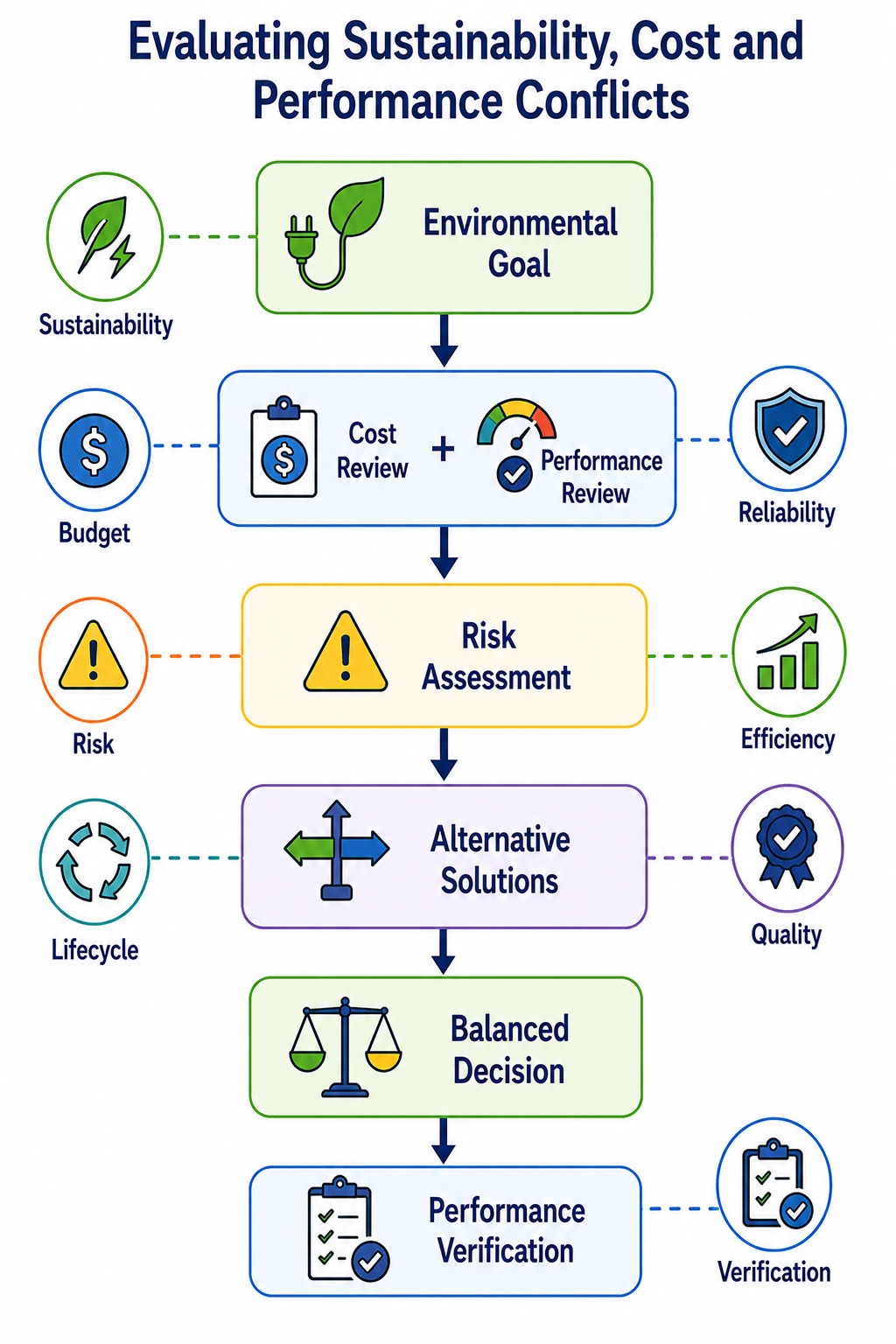
Practical Evaluation Procedure
Define the conflict
Clearly state what is competing.
Example:
“Higher capital expenditure is required to achieve improved energy efficiency.”
Quantify the sustainability target
Use measurable indicators.
Examples:
Energy consumption
Efficiency percentage
Renewable contribution
Carbon reduction
Quantify the commercial impact
Consider:
Initial cost
Operating cost
Maintenance
Replacement
Assess technical performance
Confirm:
Capacity
Reliability
Efficiency
Compatibility
Maintainability
Evaluate alternatives
Compare several technically viable options.
Assess risk
Identify risks associated with each option.
Establish controls
Develop measures to reduce identified risks.
Verify the selected solution
Use inspection, testing, commissioning, and monitoring.
Key Benefits of Structured Scenario Evaluation
Better investment decisions
Structured evaluation prevents decisions being based solely on purchase price.
Improved sustainability outcomes
Environmental objectives are connected to measurable performance.
Reduced technical risk
Potential performance problems are considered before implementation.
Improved lifecycle value
Long-term operating and maintenance costs become visible.
Better QA/QC control
Sustainability requirements can be incorporated into quality verification.
Stronger stakeholder confidence
Evidence-based decisions are easier to justify.
Reduced rework
Early analysis can identify unsuitable solutions before procurement or installation.
Improved operational performance
The selected technology is more likely to remain effective throughout its intended life.
Common Mistakes in Conflict Evaluation
Professionals should avoid:
Treating sustainability as the only priority
Treating capital cost as the only priority
Ignoring lifecycle costs
Ignoring electrical performance
Accepting environmental claims without evidence
Selecting the cheapest technically compliant product automatically
Selecting the most sustainable technology without cost analysis
Ignoring maintenance capability
Ignoring workforce competence
Reducing testing to achieve cost savings
Failing to establish measurable targets
Ignoring procurement lead times
Failing to consider system integration
Assuming predicted energy savings will automatically occur
Failing to verify actual performance
Strategic Role of the Electrical QA/QC Professional
The QA/QC professional should contribute throughout the decision process.
During design
Review:
Sustainability requirements
Equipment specifications
Performance criteria
Inspection requirements
During procurement
Check:
Approved products
Technical documentation
Supplier evidence
Sustainability claims
During installation
Verify:
Correct materials
Correct equipment
Installation quality
Configuration
During testing
Confirm:
Test procedures
Test results
Equipment performance
Control functions
During commissioning
Verify:
Functional performance
Energy monitoring
Control systems
System integration
During operation
Review:
Energy performance
Defect trends
Maintenance
Performance data
Professional Judgement in Conflicting Scenarios
A Level 6 professional should understand that there is rarely one universally correct solution.
For example, a higher-cost sustainable technology may be appropriate where:
Operating hours are high
Energy consumption is significant
Service life is long
Energy savings are measurable
Maintenance is manageable
The same technology may be less appropriate where:
Operating hours are low
Energy savings are minimal
Capital resources are severely constrained
Specialist support is unavailable
Technical complexity introduces disproportionate risk
Therefore, professional judgement should be based on project-specific evidence.
Case Study: Commercial Facility Sustainability Conflict
Project context
A commercial facility has a strict environmental target to reduce operational energy consumption while maintaining a fixed capital budget.
The proposed solution includes:
High-efficiency lighting
Smart controls
Solar PV
High-efficiency motors
Advanced energy monitoring
Conflict
The full sustainability package exceeds the available budget.
The commercial team proposes removing energy monitoring and selecting lower-cost motors.
Professional analysis
The QA/QC team evaluates the proposed changes.
The team determines that removing monitoring would reduce the ability to verify energy performance, while selecting lower-efficiency motors would increase long-term operating costs.
The project team therefore investigates alternatives.
Revised strategy
The project prioritises:
High-impact efficiency measures
Essential energy monitoring
High-efficiency equipment for major loads
Phased implementation of lower-priority measures
This approach maintains the main sustainability objectives while reducing immediate expenditure.
QA/QC controls
The project establishes:
Defined equipment specifications
Inspection requirements
Performance criteria
Commissioning procedures
Energy monitoring
Post-installation performance review
Outcome
The project achieves a more balanced solution because environmental targets, commercial constraints, and technical performance were evaluated together.
Lessons from the Case Study
The case demonstrates that conflict does not necessarily require abandoning one objective.
Instead, professionals can:
Prioritise high-value sustainability measures.
Compare lifecycle costs.
Identify alternative technologies.
Phase implementation.
Protect critical performance requirements.
Maintain appropriate quality controls.
Measure actual outcomes.
This approach provides a stronger basis for professional decision-making.
Recommended Evaluation Checklist
Before approving a solution where sustainability conflicts with cost or performance, confirm:
The environmental objective is clearly defined.
The sustainability target is measurable.
The capital budget is understood.
Lifecycle costs have been considered.
Technical performance requirements are defined.
Reliability requirements are identified.
Maintenance requirements are understood.
Supplier capability has been assessed.
Procurement risks have been considered.
Technical alternatives have been evaluated.
Environmental claims have been verified.
Quality requirements are documented.
Testing requirements are defined.
Commissioning requirements are established.
Performance monitoring is available.
Residual risks are acceptable.
The final decision is evidence-based.
Professional Decision Hierarchy
When objectives conflict, a useful decision hierarchy is:
Protect mandatory requirements
Maintain applicable safety, quality, technical, and contractual requirements.
Define non-negotiable performance
Identify electrical functions that cannot be compromised.
Quantify sustainability outcomes
Determine the actual environmental benefit.
Evaluate commercial impact
Consider capital and lifecycle costs.
Compare alternatives
Identify technically credible solutions.
Reduce unnecessary cost
Optimise rather than simply cut expenditure.
Verify the selected solution
Confirm that actual performance matches requirements.
Conclusion
Evaluating conflicts between strict environmental goals, commercial cost, and technical performance requires a balanced and evidence-based approach. Sustainable electrical projects should not be assessed solely according to how environmentally ambitious they appear, nor should decisions be based only on the lowest initial cost. High-efficiency equipment, renewable generation, energy monitoring, smart controls, sustainable materials, and other environmental measures can provide substantial long-term benefits, but their value depends on capital expenditure, operating conditions, maintenance requirements, technical integration, reliability, workforce capability, procurement constraints, and measurable performance. A Level 6 electrical QA/QC professional must therefore identify the precise nature of each conflict and evaluate the available alternatives using lifecycle cost, technical evidence, risk assessment, and sustainability performance.
The most effective approach is to protect essential electrical performance and quality requirements while seeking the strongest achievable environmental outcome within realistic commercial constraints. Sustainability objectives should be translated into measurable specifications and verified through inspection, testing, commissioning, monitoring, and documented performance evidence. Where a sustainability measure creates disproportionate cost or technical risk, alternatives, phased implementation, prioritisation, or optimisation should be considered rather than automatically rejecting the environmental objective. Through structured scenario evaluation and professional judgement, electrical QA/QC professionals can support sustainable installations that remain technically reliable, commercially viable, and capable of delivering measurable environmental value throughout their operational lifecycle.
3: Formulate Advanced Strategies to Achieve Sustainable QA/QC Outcomes Without Compromising Electrical Safety or Financial Viability
Achieving sustainable QA/QC outcomes in modern electrical projects requires a strategic approach that integrates environmental responsibility, electrical safety, quality assurance, technical performance, lifecycle value, and financial control. Sustainability should not be treated as an additional activity performed separately from quality management. Instead, it should be embedded into design review, procurement, material approval, installation inspection, testing, commissioning, documentation, monitoring, maintenance, and continual improvement. For a Chartered Electrical Engineer and senior electrical QA/QC professional, the central challenge is to formulate strategies that deliver measurable sustainability benefits while maintaining the safety and reliability of electrical systems and ensuring that project expenditure remains commercially viable.
Advanced sustainable QA/QC strategies must recognise that electrical safety is non-negotiable. Energy efficiency, carbon reduction, reduced material consumption, renewable energy integration, smart monitoring, and other sustainability objectives cannot justify unacceptable electrical risks. Similarly, financial viability must be protected because an environmentally attractive solution that creates excessive capital expenditure, unaffordable maintenance requirements, unreliable performance, or premature replacement may fail to deliver genuine lifecycle sustainability. The strongest approach is therefore based on balanced professional judgement, lifecycle thinking, risk-based QA/QC planning, measurable performance requirements, effective verification, competent personnel, and continuous monitoring.
The objective is not simply to make an electrical project “greener”. The objective is to create an electrical installation that is safe, reliable, efficient, maintainable, economically justified, environmentally responsible, and capable of demonstrating its intended performance through objective evidence. This requires QA/QC professionals to move beyond traditional inspection activities and participate strategically in project planning and decision-making.
Understanding Sustainable QA/QC Outcomes
A sustainable QA/QC outcome is achieved when the electrical installation satisfies its required quality and safety requirements while also delivering appropriate environmental and economic performance throughout its lifecycle.
A sustainable QA/QC outcome therefore considers:
Electrical safety
Technical compliance
Energy efficiency
Environmental performance
Capital cost
Operating cost
Maintenance requirements
Asset reliability
Equipment service life
Resource efficiency
Waste reduction
Quality performance
Risk management
Workforce competence
Performance monitoring
Lifecycle value
A project should not be considered sustainable simply because it uses environmentally preferable products. The complete system must demonstrate that sustainability objectives have been incorporated into actual project performance.
Key Definitions and Concepts
| Term | Definition | Application in Sustainable QA/QC |
|---|---|---|
| Sustainable QA/QC | Quality management that integrates environmental, technical, safety and economic considerations | Ensures sustainability is incorporated into quality processes |
| Electrical safety | Protection of people, equipment and systems from electrical hazards | Remains a fundamental requirement during sustainability initiatives |
| Financial viability | The ability of a project or solution to remain economically acceptable | Prevents unsustainable financial decisions |
| Lifecycle value | Overall value generated throughout an asset’s service life | Supports long-term sustainable decisions |
| Energy efficiency | Achieving required output with reduced energy consumption | Supports environmental and operating-cost objectives |
| Risk-based QA/QC | Allocating quality controls according to risk and consequence | Focuses resources on critical sustainability and safety risks |
| Performance verification | Confirming actual performance against defined requirements | Demonstrates achievement of sustainability targets |
| Sustainable procurement | Selecting products and suppliers using environmental, technical and commercial criteria | Supports responsible purchasing |
| Preventive quality control | Measures designed to prevent defects before they occur | Reduces rework, waste and resource consumption |
| Lifecycle assessment | Evaluation of environmental and economic impacts across an asset lifecycle | Supports informed technology and material selection |
| Continual improvement | Systematic improvement based on evidence and performance information | Supports long-term sustainability |
| Quality objective | A defined measurable quality requirement | Provides a basis for monitoring and verification |
| Environmental criterion | A measurable sustainability requirement | Converts sustainability objectives into auditable requirements |
| Corrective action | Action taken to address the cause of an identified problem | Prevents repeated sustainability or quality failures |
| Whole-life cost | Total cost associated with an asset during its useful life | Supports financially sustainable decisions |
The Strategic Relationship Between Safety, Sustainability and Finance
The three major objectives can be represented as:
Safety + Sustainability + Financial Viability = Sustainable Electrical QA/QC
These objectives should not be treated as competing priorities in every situation. In many cases, effective QA/QC can improve all three simultaneously.
For example, high-quality electrical installation can:
Reduce equipment losses.
Prevent premature failure.
Reduce energy consumption.
Minimise rework.
Reduce material waste.
Improve reliability.
Reduce maintenance costs.
Improve asset life.
Protect personnel.
Improve client confidence.
This demonstrates that quality itself can be a sustainability strategy.
Strategy 1: Integrate Sustainability into the QA/QC Plan
One of the most effective strategies is to incorporate sustainability requirements directly into the project QA/QC plan.
Instead of maintaining sustainability as a separate environmental initiative, integrate relevant objectives into:
Inspection and Test Plans
Material approval procedures
Design review
Procurement controls
Installation inspections
Testing procedures
Commissioning
Non-conformance management
Performance monitoring
Handover documentation
For example, if energy efficiency is a project requirement, the QA/QC plan should identify:
Equipment efficiency requirements
Approved equipment criteria
Inspection requirements
Testing requirements
Commissioning requirements
Performance indicators
Required evidence
This creates traceability between the sustainability objective and the final installed system.
Strategy 2: Establish Measurable Sustainability Criteria
A sustainability objective should be measurable wherever practical.
A weak objective might state:
“Use energy-efficient electrical equipment.”
A stronger QA/QC requirement should identify measurable characteristics such as:
Required efficiency
Maximum losses
Energy consumption target
Monitoring requirement
Performance acceptance criteria
Required documentation
Measurable criteria make it possible to:
Inspect
Test
Verify
Record
Compare
Report
Improve
Without measurable criteria, sustainability can become subjective and difficult to demonstrate.
Strategy 3: Apply Lifecycle Cost Analysis
Financial viability should not be assessed only through initial capital cost.
A more advanced strategy is to consider the complete lifecycle.
Initial expenditure
Consider:
Equipment purchase
Installation
Testing
Commissioning
Training
Operational expenditure
Consider:
Energy
Maintenance
Monitoring
Software
Specialist support
Replacement expenditure
Consider:
Component replacement
Technology upgrades
System modifications
End-of-life disposal
Environmental value
Consider:
Energy reduction
Carbon reduction
Resource efficiency
Waste reduction
This approach helps identify solutions that may cost more initially but provide better long-term value.
Strategy 4: Use Risk-Based QA/QC Planning
Not every sustainability requirement has the same level of risk.
For example, an incorrectly installed monitoring sensor may affect energy reporting, while an incorrectly configured protection system may create a serious electrical safety risk.
Therefore, QA/QC resources should be prioritised according to:
Safety consequence
Performance consequence
Environmental consequence
Financial consequence
Likelihood of failure
Detectability
Asset criticality
High-risk activities may require
Detailed inspection
Hold points
Witness points
Specialist testing
Independent verification
Additional documentation
Senior engineering review
Lower-risk activities may require
Routine inspection
Sampling
Standard documentation
Normal verification
This allows project resources to be used efficiently without reducing critical controls.
Strategy 5: Protect Electrical Safety as a Non-Negotiable Requirement
Sustainability strategies should never weaken electrical safety.
This principle should apply when introducing:
Solar PV
Battery storage
Smart controls
Energy management systems
High-efficiency equipment
Automated systems
Renewable generation
Advanced monitoring
The project should ensure that sustainability measures do not compromise:
Protection
Earthing
Isolation
Electrical clearances
Equipment ratings
Overcurrent protection
Fault protection
Safe maintenance
System reliability
Where a sustainability measure introduces additional technical risk, appropriate controls should be established before implementation.
Strategy 6: Apply the Hierarchy of Controls to Sustainability-Related Risks
A sustainability technology may introduce new risks.
For example, remote monitoring may reduce physical inspections but increase reliance on digital systems.
A strategic response should consider:
Elimination of unnecessary risk
Engineering controls
Administrative controls
Competence and training
Monitoring
Contingency arrangements
The aim is to ensure that environmental improvements do not transfer risk from one part of the project to another.
Strategy 7: Use Sustainable Procurement Criteria
Procurement decisions strongly influence sustainable QA/QC outcomes.
Supplier selection should consider more than price.
Relevant criteria include:
Product quality
Energy efficiency
Technical compliance
Environmental characteristics
Reliability
Service life
Warranty
Maintenance
Spare parts
Supplier competence
Documentation
Product availability
A low-cost product may create greater long-term expenditure if it has poor reliability or high energy consumption.
Strategy 8: Evaluate Suppliers on Evidence
Sustainability claims should be supported by appropriate documentation.
The QA/QC professional should review:
Technical datasheets
Test certificates
Product specifications
Performance data
Manufacturer information
Quality documentation
Environmental information
Warranty information
Maintenance requirements
Claims should be relevant to the actual product and application.
This reduces the risk of selecting products based solely on marketing statements.
Strategy 9: Prevent Defects Rather Than Correct Them
Preventive QA/QC is itself a sustainability strategy.
A defect can create:
Rework
Material waste
Additional labour
Additional transport
Programme delays
Energy consumption
Replacement materials
Increased cost
Preventing the defect in the first place is therefore environmentally and financially beneficial.
Preventive controls include:
Design reviews
Approved material controls
Competency verification
Installation procedures
Inspection checklists
Method statements
Hold points
Early testing
Supplier quality assessment
Strategy 10: Integrate Design and QA/QC Reviews
Sustainable decisions should be reviewed during design rather than after construction begins.
Design review should consider:
Equipment efficiency
Energy consumption
Maintainability
Reliability
System losses
Material selection
Monitoring
Future upgrades
Renewable integration
Early review can identify conflicts before procurement.
This can prevent:
Expensive redesign
Procurement delays
Installation changes
Rework
Material waste
Strategy 11: Optimise Equipment Selection
Equipment selection should balance:
Initial cost
Efficiency
Reliability
Service life
Maintenance
Availability
Sustainability
Technical performance
For example, a high-efficiency transformer may cost more but reduce losses over its operating life.
A high-efficiency motor may provide greater value when operating continuously.
An advanced monitoring system may be justified for high-energy-consuming equipment but unnecessary for low-impact assets.
Therefore, equipment selection should be application-specific.
Strategy 12: Prioritise High-Impact Sustainability Measures
Not every sustainability measure provides equal value.
A project should prioritise measures according to:
Energy impact
Environmental benefit
Cost
Technical risk
Lifecycle value
Ease of verification
High-impact measures should normally receive greater attention.
Examples may include:
Major energy-consuming equipment
High-loss distribution systems
Large motor loads
Lighting systems
Renewable generation
Energy storage
Major HVAC electrical loads
Strategy 13: Introduce Phased Implementation
Phased implementation can protect financial viability while allowing sustainability objectives to progress.
A project might implement:
Phase 1
High-efficiency equipment
Essential monitoring
Energy-efficient lighting
Phase 2
Advanced controls
Additional monitoring
Renewable integration
Phase 3
Energy optimisation
Advanced analytics
Further system upgrades
This approach reduces the financial pressure associated with implementing every technology simultaneously.
Strategy 14: Use Pilot Projects
Pilot projects are useful when adopting unfamiliar technologies.
A pilot can assess:
Technical performance
User acceptance
Installation requirements
Maintenance
Cost
Energy performance
Reliability
Integration
The pilot should have defined success criteria.
Pilot evaluation should include
Baseline performance
Target performance
Actual performance
User feedback
Defect rates
Maintenance requirements
Financial impact
Only after evidence has been reviewed should wider implementation be considered.
Strategy 15: Establish Baseline Performance
A sustainability strategy cannot be evaluated effectively without knowing the starting point.
Baseline information may include:
Energy consumption
Equipment efficiency
Maintenance cost
Defect rates
System losses
Operational hours
Existing performance
The baseline provides a reference against which improvements can be measured.
Strategy 16: Use Performance Indicators
Useful sustainable QA/QC performance indicators include:
Energy consumption
Energy intensity
Equipment efficiency
Defect rate
Rework percentage
Testing pass rate
Maintenance frequency
System availability
Renewable contribution
Material waste
Non-conformance frequency
Indicators should be:
Relevant
Measurable
Consistent
Traceable
Reviewable
Strategy 17: Integrate Commissioning with Sustainability Verification
Commissioning should not simply demonstrate that equipment operates.
It should also verify whether sustainability-related functions operate as intended.
For example:
Lighting controls should operate correctly.
Energy meters should provide accurate information.
Solar PV should produce expected output under suitable conditions.
Variable-speed drives should respond appropriately.
Energy management systems should execute defined control sequences.
This makes commissioning an important sustainability verification activity.
Strategy 18: Verify Actual Performance
A sustainable design does not guarantee sustainable operation.
Actual performance should be monitored.
Verification can involve:
Energy measurements
Equipment performance
System efficiency
Monitoring data
Functional tests
Trend analysis
Commissioning records
The results should be compared with established targets.
Strategy 19: Use Digital Monitoring Strategically
Digital monitoring can improve sustainability and QA/QC.
Potential applications include:
Smart metering
IoT sensors
Energy dashboards
Remote monitoring
Automated alerts
Predictive maintenance
However, technology should be introduced where its benefits justify:
Capital expenditure
Training
Maintenance
Cybersecurity
Data management
System integration
Technology should support QA/QC rather than create unnecessary complexity.
Strategy 20: Build Competence into Sustainability Planning
Personnel must understand both the technology and the sustainability objective.
Training may cover:
Equipment operation
Digital systems
Energy monitoring
Sustainable procedures
Inspection requirements
Testing
Commissioning
Data interpretation
Competence should be verified rather than assumed.
Strategy 21: Establish Clear Responsibilities
Sustainable QA/QC outcomes require clear accountability.
Responsibilities may be allocated to:
Electrical engineers
QA/QC engineers
Inspectors
Commissioning teams
Contractors
Suppliers
Facility operators
Responsibility should be clearly defined for:
Inspection
Testing
Data collection
Approval
Monitoring
Corrective action
Reporting
Strategy 22: Manage Change Carefully
Sustainability technologies can change existing workflows.
Change management should address:
New procedures
New responsibilities
New training
New equipment
New data requirements
New maintenance processes
Poor change management can undermine otherwise effective sustainability strategies.
Strategy 23: Integrate Non-Conformance Management
Sustainability-related defects should be managed through the normal QA/QC system.
A non-conformance may involve:
Incorrect equipment efficiency
Incorrect installation
Failed energy monitoring
Incorrect control configuration
Missing sustainability documentation
Failed performance testing
The process should include:
Identify the non-conformance.
Record the issue.
Assess its impact.
Determine the root cause.
Define corrective action.
Verify correction.
Close the non-conformance.
Evaluate whether systemic improvement is required.
Strategy 24: Apply Root Cause Analysis
Repeated quality failures may indicate systemic problems.
For example, repeated incorrect installation of energy meters could be caused by:
Poor drawings
Unclear procedures
Insufficient training
Incorrect equipment
Poor supervision
Correcting only individual defects does not address the underlying issue.
Root cause analysis can therefore improve both quality and sustainability.
Strategy 25: Reduce Rework as a Sustainability Strategy
Rework is often overlooked as an environmental issue.
It can increase:
Material consumption
Labour
Transport
Energy
Waste
Project duration
Cost
Reducing rework therefore supports both sustainability and financial viability.
Effective measures include:
Design coordination
Pre-installation inspections
Competent installation
Early testing
Clear specifications
Effective supervision
Strategy 26: Consider Maintainability
A sustainable installation must remain maintainable.
A solution that is highly efficient but difficult to maintain may not provide good lifecycle value.
Evaluate:
Access
Spare parts
Technician competence
Maintenance frequency
Diagnostic capability
Replacement requirements
Supplier support
Maintainability should be included during design review.
Strategy 27: Consider Equipment Longevity
Long service life can support sustainability because fewer replacements may be required.
QA/QC should consider:
Equipment quality
Operating conditions
Thermal performance
Installation quality
Maintenance
Environmental conditions
Poor installation can shorten equipment life and undermine sustainability benefits.
Strategy 28: Develop a Sustainable Inspection and Test Plan
A sustainable Inspection and Test Plan should identify:
Inspection activity
Acceptance criteria
Responsibility
Hold points
Witness points
Test requirements
Documentation
Sustainability indicators
This ensures sustainability requirements are incorporated into routine quality control.
Strategy 29: Use Balanced Decision-Making
A decision should not be based solely on:
Lowest cost
Highest efficiency
Maximum environmental benefit
Fastest installation
Instead, assess the combined impact.
A balanced decision should consider
Safety
Quality
Sustainability
Cost
Performance
Risk
Reliability
Lifecycle value
Strategy 30: Establish a Sustainable QA/QC Decision Matrix
| Criterion | Key Question | Evidence |
|---|---|---|
| Safety | Does the solution maintain electrical safety? | Risk assessment and test results |
| Sustainability | Does it achieve the environmental target? | Sustainability performance data |
| Cost | Is it financially viable? | Cost and lifecycle analysis |
| Performance | Does it meet technical requirements? | Testing and commissioning |
| Reliability | Can it operate consistently? | Reliability evidence |
| Maintenance | Can it be maintained effectively? | Maintenance strategy |
| Quality | Can quality be verified? | Inspection records |
| Risk | Are risks adequately controlled? | Risk assessment |
| Procurement | Can it be sourced reliably? | Supplier evidence |
| Monitoring | Can performance be measured? | Monitoring system |
Practical Example: High-Efficiency Motor Strategy
A manufacturing facility wants to reduce energy consumption from motor-driven equipment.
The project team proposes high-efficiency motors.
Initial concern
The motors cost more than standard models.
QA/QC evaluation
The professional examines:
Operating hours
Motor load
Efficiency
Capital cost
Energy savings
Maintenance
Service life
Replacement requirements
Strategic decision
High-efficiency motors are prioritised for continuously operating equipment where lifecycle benefits are strongest.
For low-use equipment, conventional compliant solutions may be considered if the sustainability benefit is insufficient to justify additional expenditure.
QA/QC controls
Verify:
Correct motor rating
Efficiency specification
Installation
Alignment
Electrical connections
Protection
Testing
Commissioning
This is an example of targeted sustainability rather than indiscriminate technology adoption.
Practical Example: Solar PV with Financial Constraints
A commercial facility has a renewable-energy target but limited capital.
Instead of installing the maximum possible PV capacity, the project evaluates:
Available roof area
Electrical demand
Expected generation
Capital cost
Maintenance
Monitoring
Lifecycle value
The project selects a system that provides meaningful renewable contribution while remaining within an acceptable financial range.
QA/QC then verifies:
Approved modules
Inverters
Cabling
Mounting
Protection
Earthing
Monitoring
Testing
Commissioning
Practical Example: Smart Lighting Controls
A project wants to reduce lighting energy consumption.
Smart controls are introduced.
However, the system initially creates user complaints because controls are incorrectly configured.
The QA/QC strategy is to:
Review control sequences.
Test sensors.
Adjust settings.
Verify coverage.
Confirm functional performance.
Obtain user feedback.
Monitor energy performance.
This demonstrates that sustainable performance depends on correct implementation rather than technology selection alone.
Practical Example: Sustainable Transformer Selection
A project compares two transformers.
The lower-cost transformer has higher losses.
The sustainable transformer costs more but provides improved efficiency.
The professional assesses:
Capital cost
Loading
Energy consumption
Expected operating period
Service life
Maintenance
Sustainability objectives
The sustainable option is selected only if lifecycle analysis demonstrates sufficient value.
The QA/QC team then verifies the actual transformer against the approved specification.
Case Study: Sustainable Electrical QA/QC Strategy
Project background
A large commercial development has three objectives:
Reduce operational energy consumption.
Maintain strict electrical performance requirements.
Remain within an approved capital budget.
The proposed sustainability programme includes high-efficiency equipment, renewable generation, smart monitoring, and advanced controls.
Initial conflict
The complete package exceeds the available budget.
The project team considers removing several sustainability measures.
Strategic QA/QC response
The QA/QC team recommends a structured evaluation.
First, sustainability objectives are ranked according to importance and measurable impact.
Second, technical performance requirements are established.
Third, lifecycle costs are assessed.
Fourth, technical risks are evaluated.
Fifth, the project identifies measures that provide the strongest environmental benefit for the investment required.
Revised strategy
The project prioritises:
High-efficiency equipment for major loads.
Essential energy monitoring.
High-impact control systems.
Renewable generation within the available budget.
Phased implementation of lower-priority technologies.
Quality controls
The QA/QC plan incorporates:
Design reviews
Supplier evaluation
Material approval
Inspection
Testing
Commissioning
Performance verification
Energy monitoring
Performance review
After commissioning, actual energy performance is compared against the established baseline.
Where performance does not meet expectations, corrective actions are implemented.
This creates a continual improvement cycle.
Sustainable QA/QC Improvement Cycle
Plan
Define:
Sustainability targets
Safety requirements
Budget
Performance criteria
Assess
Evaluate:
Risks
Alternatives
Lifecycle cost
Technical feasibility
Implement
Control:
Procurement
Installation
Inspection
Testing
Verify
Measure:
Performance
Energy
Quality
Safety
Review
Compare:
Target
Actual result
Cost
Environmental benefit
Improve
Implement:
Corrective actions
Process improvements
Equipment optimisation
Training improvements
Key Benefits of Advanced Sustainable QA/QC Strategies
Improved electrical safety
Safety requirements remain embedded within sustainability decisions.
Better financial control
Lifecycle evaluation prevents decisions based solely on short-term expenditure.
Reduced operating costs
Energy-efficient equipment and effective controls can reduce energy consumption.
Reduced environmental impact
Measured sustainability strategies can reduce resource consumption and emissions.
Reduced rework
Preventive quality management reduces waste and unnecessary expenditure.
Improved asset reliability
High-quality installation and commissioning can support longer equipment life.
Better lifecycle performance
Equipment is selected according to long-term value rather than initial cost alone.
Stronger evidence-based decision-making
Performance data provides objective evidence for project decisions.
Improved stakeholder confidence
Clear criteria, testing and reporting demonstrate that sustainability objectives are being managed professionally.
Common Barriers to Sustainable QA/QC
Projects may encounter:
Limited budgets
Short-term commercial pressures
Inadequate sustainability criteria
Poor supplier information
Limited workforce competence
Resistance to new technology
Inadequate monitoring
Poor design coordination
Procurement delays
Unclear responsibilities
Weak commissioning
Incomplete lifecycle information
Each barrier should be addressed through appropriate planning and risk management.
Common Mistakes to Avoid
Professionals should avoid:
Treating sustainability as separate from QA/QC.
Selecting the cheapest option automatically.
Selecting the most expensive sustainable option without evidence.
Compromising electrical safety.
Using unverified sustainability claims.
Ignoring lifecycle costs.
Ignoring maintenance.
Introducing complex technologies without training.
Reducing testing to save money.
Failing to establish measurable sustainability targets.
Ignoring actual operating performance.
Failing to monitor energy outcomes.
Treating commissioning as an administrative formality.
Failing to address repeated non-conformities.
Recommended Sustainable QA/QC Strategy Framework
A comprehensive strategy can be structured into ten stages:
Stage 1: Establish objectives
Define sustainability, safety, quality, financial and performance requirements.
Stage 2: Establish baseline
Determine current energy, quality, cost and performance conditions.
Stage 3: Identify opportunities
Identify sustainable technologies, materials and process improvements.
Stage 4: Assess feasibility
Evaluate technical, commercial and operational feasibility.
Stage 5: Assess lifecycle value
Compare capital and operating costs over the expected asset life.
Stage 6: Assess risk
Evaluate safety, quality, technical, environmental and financial risks.
Stage 7: Define QA/QC controls
Develop inspection, testing, commissioning and documentation requirements.
Stage 8: Implement
Control procurement, installation and commissioning.
Stage 9: Verify
Measure actual sustainability and technical performance.
Stage 10: Improve
Use evidence to improve future performance and decision-making.
Strategic KPIs for Sustainable Electrical QA/QC
A project can use indicators such as:
Energy consumption per operational unit
Percentage of equipment meeting efficiency targets
Renewable energy contribution
Electrical defect rate
Rework percentage
Testing pass rate
Equipment failure frequency
Energy monitoring coverage
Non-conformance closure time
Maintenance frequency
Lifecycle cost variance
Sustainability target achievement
KPIs should be reviewed regularly and linked to meaningful project objectives.
Advanced Professional Considerations
At Level 6, professionals should move beyond simply asking whether a sustainability requirement has been achieved.
They should ask:
Is the sustainability target technically realistic?
Is the environmental benefit measurable?
Is the solution financially justified?
What is the lifecycle impact?
What new safety risks could be introduced?
What technical dependencies exist?
Can personnel maintain the system?
Can performance be verified?
What happens if the technology fails?
Can the solution be scaled or upgraded?
Does the solution provide sufficient long-term value?
This approach demonstrates critical thinking and professional judgement.
Sustainable QA/QC and Continual Improvement
Sustainable QA/QC should not end when the project is handed over.
Operational data can reveal:
Unexpected energy consumption
Equipment degradation
Inefficient controls
Repeated defects
Maintenance trends
Performance gaps
The organisation can use this information to improve:
Future specifications
Equipment selection
Procurement
Installation procedures
Training
Commissioning
Monitoring
This creates an evidence-based improvement cycle.
Professional Checklist
Before approving a sustainable electrical QA/QC strategy, confirm that:
Sustainability objectives are clearly defined.
Environmental targets are measurable.
Electrical safety requirements are protected.
Technical performance criteria are established.
Capital costs are understood.
Lifecycle costs have been evaluated.
Maintenance requirements are considered.
Equipment efficiency has been verified.
Supplier claims are supported by evidence.
Workforce competence has been assessed.
Inspection requirements are defined.
Testing requirements are defined.
Commissioning requirements are defined.
Sustainability performance can be monitored.
Risks have been assessed.
Contingency arrangements are available.
Non-conformities are controlled.
Performance data will be reviewed.
Corrective actions are defined.
Continual improvement is incorporated.
Conclusion
Advanced sustainable QA/QC requires the integration of environmental objectives with electrical safety, technical performance, quality assurance, and financial viability. The most effective strategy is not to maximise sustainability expenditure or minimise project cost independently, but to identify solutions that provide measurable environmental and technical benefits while delivering acceptable lifecycle value. This requires measurable sustainability criteria, lifecycle cost analysis, risk-based QA/QC planning, sustainable procurement, competent personnel, preventive quality controls, effective commissioning, and objective performance verification. Electrical safety must remain a fundamental requirement, while financial decisions should consider the full cost of ownership rather than relying solely on initial capital expenditure.
For the Chartered Electrical Engineer and senior QA/QC professional, sustainable project success depends on evidence-based decision-making throughout the complete project lifecycle. By integrating sustainability into design review, procurement, inspection, testing, commissioning, monitoring, non-conformance management, and continual improvement, organisations can reduce environmental impact without creating unacceptable technical or financial risks. A mature sustainable QA/QC strategy therefore seeks the optimum balance between safety, quality, environmental performance, reliability, cost, and lifecycle value, ensuring that sustainable electrical installations are not only environmentally responsible but also technically dependable and commercially viable.
4: Justify Strategic Project Decisions That Successfully Balance Long-Term Sustainability with Immediate, Unpredictable Performance Constraints
Sustainable electrical projects are frequently delivered in environments where long-term objectives must be achieved while immediate project conditions remain uncertain. Equipment failures, unexpected load changes, supply-chain disruption, commissioning difficulties, weather conditions, design modifications, fluctuating energy demand, resource shortages, budget pressures, and operational requirements can all create performance constraints that were not fully predictable during the planning stage. For a Chartered Electrical Engineer and senior electrical QA/QC professional, the challenge is not simply to maintain the original sustainability strategy regardless of changing circumstances. The professional responsibility is to evaluate emerging evidence, understand the consequences of short-term decisions, protect electrical safety and quality, and justify strategic decisions that preserve long-term sustainability wherever reasonably practicable.
A strategic decision in this context must balance immediate operational needs with the intended lifecycle outcomes of the project. For example, temporarily using a less efficient electrical system may sometimes be necessary to maintain critical operations following an unexpected equipment failure. However, the decision should be controlled, documented, risk assessed, and accompanied by a defined recovery or corrective strategy. Similarly, accelerating procurement of an alternative product may protect the project programme, but the substitute must still satisfy technical, quality, safety, environmental, and lifecycle requirements. The key principle is that short-term constraints should be managed without allowing temporary compromises to become permanent reductions in sustainability, quality, or performance.
At Level 6, learners are expected to move beyond identifying problems and demonstrate professional judgement in justifying decisions. This requires them to compare alternatives, evaluate evidence, assess risks, consider lifecycle implications, establish priorities, communicate decisions to stakeholders, and demonstrate how the selected approach remains consistent with project objectives. The ability to justify a decision is particularly important in electrical QA/QC because decisions may affect safety, reliability, cost, energy performance, environmental outcomes, compliance, and the long-term condition of the asset.
Understanding Strategic Decision-Making in Sustainable Electrical Projects
Strategic decision-making involves selecting an appropriate course of action after considering multiple interacting factors rather than responding to one immediate problem in isolation.
In sustainable electrical QA/QC, strategic decisions may involve:
Equipment selection
Temporary system arrangements
Emergency procurement
Design changes
Alternative materials
Energy-management strategies
Renewable energy integration
Maintenance decisions
Commissioning priorities
Testing strategies
Budget adjustments
Programme recovery
Technology adoption
Performance optimisation
A strategic decision should answer several fundamental questions:
What has changed?
Why has the situation changed?
What immediate constraint exists?
What sustainability objective could be affected?
What electrical performance must be protected?
What risks are introduced?
What alternatives are available?
What will each alternative cost?
What are the lifecycle consequences?
How will the decision be verified?
How will the project return to its intended long-term position?
Key Definitions and Concepts
| Term | Definition | Application in Electrical QA/QC |
|---|---|---|
| Strategic decision | A deliberate decision that influences project objectives and long-term outcomes | Guides major sustainability and performance choices |
| Immediate constraint | A short-term condition requiring prompt action | May include failures, delays or unexpected demand |
| Unpredictable performance constraint | An unexpected condition affecting system performance | Requires controlled professional response |
| Long-term sustainability | Continued environmental, technical and economic performance over an asset lifecycle | Provides the strategic direction |
| Temporary measure | A controlled short-term arrangement used to maintain operations | Should have defined limits and review arrangements |
| Lifecycle impact | Effect of a decision over the asset’s useful life | Prevents excessive focus on immediate outcomes |
| Decision justification | Evidence-based explanation supporting a selected option | Demonstrates professional judgement |
| Scenario analysis | Evaluation of potential outcomes under different conditions | Supports strategic planning |
| Contingency | Pre-planned alternative arrangement for unexpected events | Supports resilience |
| Resilience | Ability of a system or project to withstand and recover from disruption | Supports sustainable performance |
| Performance constraint | A condition limiting expected technical performance | Requires evaluation and mitigation |
| Recovery strategy | Planned actions to return a project or system to its intended state | Prevents temporary solutions becoming permanent |
| Lifecycle value | Overall value generated throughout an asset’s operational life | Supports balanced decisions |
| Decision gate | A defined point where evidence is reviewed before proceeding | Controls strategic implementation |
| Corrective action | Action taken to remove the cause of a problem | Supports recovery and continual improvement |
The Central Challenge: Immediate Need Versus Long-Term Value
One of the most difficult professional situations occurs when an immediate operational problem conflicts with a long-term sustainability objective.
For example, a facility may have a high-efficiency electrical system that suddenly experiences a major equipment failure. Replacement with the original equipment may take several weeks because of procurement delays. A conventional alternative is available immediately but has lower efficiency.
The project team may have several choices:
Wait for the original efficient equipment.
Install the conventional equipment permanently.
Install the conventional equipment temporarily.
Source an alternative efficient product.
Modify the operating strategy.
The correct decision depends on:
Safety
Criticality
Duration
Cost
Technical compatibility
Sustainability impact
Availability
Lifecycle consequences
A strategic decision may be to install a technically acceptable temporary solution to protect critical operations, provided that a defined recovery plan exists to restore the long-term sustainable configuration.
Principle of Controlled Temporary Compromise
A temporary compromise does not necessarily represent failure of sustainability strategy.
However, it should satisfy several conditions:
The compromise is necessary.
The reason is documented.
Electrical safety is maintained.
Technical performance remains acceptable.
Environmental impact is understood.
The duration is defined.
Responsible personnel are identified.
Corrective action is planned.
The permanent solution is tracked.
Performance is monitored.
This approach prevents an emergency arrangement from becoming an uncontrolled permanent condition.
Identifying Immediate Performance Constraints
Unexpected constraints may arise from many sources.
Equipment constraints
Unexpected equipment failure
Reduced equipment efficiency
Overheating
Component availability
Premature degradation
Operational constraints
Sudden increase in electrical demand
Critical operational requirements
Changes in operating schedules
Emergency loads
Temporary facility requirements
Construction constraints
Material shortages
Supplier delays
Installation access restrictions
Design changes
Programme compression
Environmental constraints
Extreme weather
Temperature variations
Dust or moisture
Site conditions
Environmental restrictions
Commercial constraints
Budget restrictions
Cost escalation
Procurement changes
Contractual pressures
Human-resource constraints
Shortage of competent personnel
Training requirements
Specialist availability
Shift changes
A professional response should identify the constraint before selecting a solution.
Establishing Decision Priorities
When an unexpected event occurs, priorities should be established logically.
First priority: Safety
Electrical safety should not be sacrificed to protect cost, programme, or sustainability targets.
Second priority: Critical functionality
Determine which electrical functions must remain available.
Third priority: Quality and technical performance
Ensure that the temporary or revised solution remains within acceptable technical requirements.
Fourth priority: Environmental performance
Evaluate the sustainability consequences and minimise unnecessary environmental impact.
Fifth priority: Commercial impact
Assess the immediate and lifecycle financial consequences.
Sixth priority: Recovery
Establish how the project will return to its intended long-term strategy.
This hierarchy supports consistent professional judgement.
Strategic Decision-Making Process
 Stage 1: Identify the unexpected condition
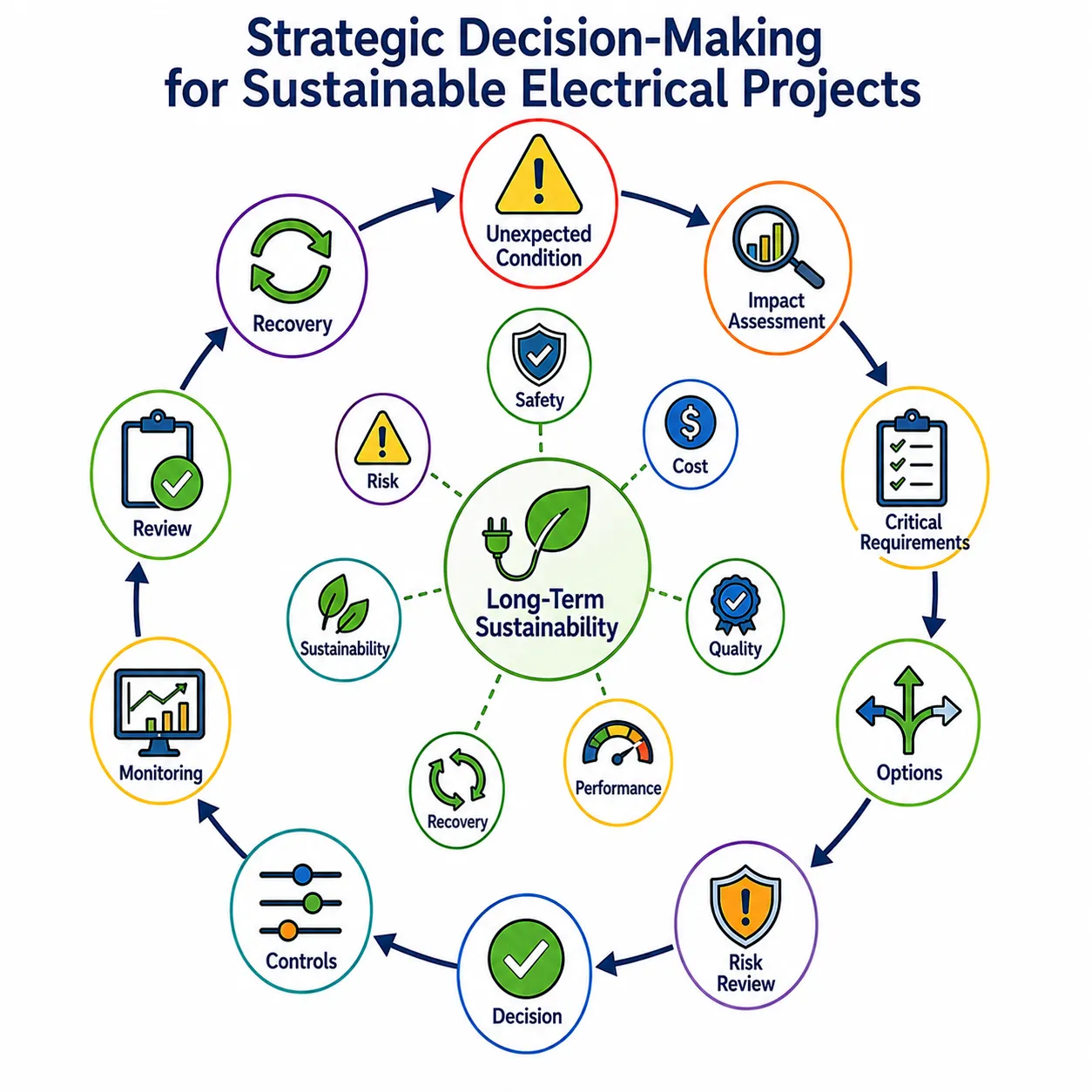 Stage 1: Identify the unexpected condition
Clearly define what has changed.
For example:
Equipment failure
Delayed delivery
Increased electrical load
Failed commissioning test
Unexpected energy consumption
Stage 2: Assess immediate consequences
Determine whether the condition affects:
Safety
Reliability
Quality
Programme
Cost
Sustainability
Stage 3: Identify critical requirements
Determine which requirements cannot be compromised.
Stage 4: Develop alternative responses
Create realistic technical and commercial options.
Stage 5: Evaluate each option
Assess:
Immediate performance
Sustainability
Cost
Risk
Lifecycle consequences
Stage 6: Select the preferred strategy
Choose the option providing the strongest overall balance.
Stage 7: Establish controls
Define:
Responsibilities
Monitoring
Testing
Time limits
Approval requirements
Stage 8: Implement and monitor
Track actual results.
Stage 9: Review the decision
Determine whether assumptions remain valid.
Stage 10: Recover and improve
Return to the intended long-term sustainable configuration where appropriate.
Decision-Making Under Uncertainty
Unpredictable constraints mean that decisions may need to be made without complete information.
A professional should therefore distinguish between:
Known facts
Reasonable assumptions
Unknown information
Risks
Potential consequences
A decision should not be justified simply by saying:
“We had no choice.”
A stronger justification explains:
What information was available.
What alternatives were considered.
Why certain alternatives were rejected.
What risks were identified.
What controls were implemented.
How the decision protects long-term objectives.
This demonstrates professional accountability.
Scenario 1: Unexpected Transformer Failure
A commercial facility experiences an unexpected transformer failure during peak operation.
The original transformer is highly efficient but has a long replacement lead time.
A conventional transformer can be sourced quickly.
Immediate constraint
The facility requires continued electrical service.
Long-term sustainability objective
The project intends to maintain low electrical losses.
Strategic options
Wait for the efficient transformer.
Install the conventional transformer permanently.
Install the conventional transformer temporarily.
Source another high-efficiency transformer.
Reduce non-critical loads temporarily.
Evaluation
The professional should assess:
Critical load requirements
Safety
Temporary equipment suitability
Availability
Efficiency
Installation requirements
Cost
Expected duration
Replacement strategy
Justified decision
If operational continuity is critical, a temporary technically suitable transformer may be justified, provided:
It meets electrical requirements.
Installation is inspected.
Testing is completed.
Temporary status is documented.
Efficiency impact is recorded.
Replacement with the intended sustainable solution is scheduled.
This maintains the long-term sustainability objective while responding realistically to the immediate constraint.
Scenario 2: Renewable Generation Underperforms
A solar PV system does not achieve expected output during early operation.
The client is concerned because the project has an established renewable-energy target.
The professional should not immediately conclude that the technology has failed.
Potential causes should be investigated:
Incorrect configuration
Monitoring error
Equipment fault
Installation issue
Environmental conditions
Inverter performance
Unexpected operating conditions
Strategic response
The QA/QC team should:
Verify monitoring data.
Check system configuration.
Inspect installation.
Review commissioning records.
Compare actual and expected performance.
Identify root causes.
Implement corrective actions.
Reassess performance.
This avoids unnecessary replacement and protects both financial and environmental objectives.
Scenario 3: Unexpected Increase in Electrical Demand
A facility experiences significantly higher electrical demand than predicted.
The increased demand creates a technical performance constraint.
The project also has an energy-reduction target.
The immediate response might be to install additional capacity, but this could increase capital and operating costs.
A strategic approach may include:
Load analysis
Demand profiling
Identification of non-critical loads
Energy-efficiency measures
Load management
Equipment optimisation
Capacity assessment
The aim is to determine whether demand can be reduced before major capacity expansion is implemented.
Scenario 4: Sustainable Equipment Procurement Delay
A specified high-efficiency motor is unavailable due to supply-chain disruption.
The contractor proposes an alternative motor.
The professional should evaluate:
Efficiency
Rating
Dimensions
Electrical characteristics
Control compatibility
Reliability
Maintenance
Lifecycle cost
Sustainability performance
The substitute should not be approved simply because it is available.
If the alternative provides equivalent or acceptable performance, the substitution may be justified.
Scenario 5: Budget Reduction During Construction
A project experiences unexpected cost escalation.
The client requests cost reductions.
The project team considers removing several sustainability measures.
A strategic approach should categorise sustainability measures according to:
Environmental impact
Financial benefit
Technical importance
Lifecycle value
Implementation cost
Measures that provide strong environmental and lifecycle value should be protected where possible.
Lower-impact measures may be:
Deferred
Modified
Phased
Replaced with alternatives
This approach is more defensible than simply removing all sustainability measures.
Scenario 6: Commissioning Reveals Unexpected Performance
During commissioning, a smart energy-management system does not operate as expected.
The system produces incorrect control actions.
Immediate correction is required because incorrect control may affect operational performance.
The QA/QC professional should:
Stop unsafe or unsuitable operation.
Identify the cause.
Check configuration.
Verify sensors.
Review control sequences.
Correct programming.
Retest.
Document results.
The sustainability objective remains valid, but implementation must be corrected before normal operation.
Scenario 7: Energy Efficiency Versus Reliability
A project attempts to minimise energy consumption by reducing operating hours of selected equipment.
Unexpected operational conditions require the equipment to remain available for longer periods.
A rigid energy-reduction strategy could compromise operational reliability.
The strategic response may involve:
Reclassifying critical loads
Revising operating schedules
Optimising controls
Monitoring actual demand
Prioritising essential functions
The objective is to achieve energy reduction without compromising essential performance.
Lifecycle Consequences of Immediate Decisions
Every short-term decision should be evaluated for potential long-term consequences.
A temporary decision may create:
Additional maintenance
Higher energy consumption
Replacement costs
Compatibility problems
Documentation issues
Training requirements
The professional should therefore ask:
“What happens if this temporary solution remains in place longer than expected?”
This question is particularly important where supply delays or project uncertainties are significant.
Establishing Decision Gates
Decision gates provide controlled points for reviewing strategic choices.
Gate 1: Immediate response
Is the proposed action safe and technically acceptable?
Gate 2: Temporary implementation
Can the temporary arrangement operate within defined limits?
Gate 3: Performance review
Is actual performance acceptable?
Gate 4: Long-term solution
Should the temporary arrangement be replaced, retained, or modified?
Decision gates prevent temporary arrangements from continuing without review.
Scenario-Based Cost Evaluation
Cost should be considered across several time periods.
Immediate cost
Emergency procurement
Additional labour
Temporary equipment
Overtime
Short-term cost
Additional maintenance
Monitoring
Temporary operation
Long-term cost
Energy
Replacement
Lifecycle maintenance
Asset modification
A solution with higher immediate cost may have lower long-term cost.
Conversely, a solution that appears cheap during an emergency may create significant lifecycle expenditure.
Strategic Use of Contingency Planning
Contingency planning is an important sustainability strategy because it reduces the likelihood that unexpected events will force poor decisions.
A project may establish:
Approved alternative suppliers
Equivalent equipment lists
Emergency procedures
Temporary operating arrangements
Backup monitoring
Spare components
Technical decision criteria
This improves resilience.
Maintaining Sustainability During Emergency Decisions
Emergency situations can create pressure to abandon sustainability objectives.
However, a structured approach can protect them.
During an emergency
Protect safety.
Maintain critical performance.
Identify immediate alternatives.
Assess environmental consequences.
Record the decision.
Define temporary limits.
Establish recovery actions.
After the emergency
Review actual impacts.
Restore the intended configuration.
Analyse root causes.
Update contingency planning.
Improve future decision-making.
The Role of Performance Monitoring
Monitoring provides evidence about whether a strategic decision is working.
Indicators may include:
Energy consumption
Equipment efficiency
System availability
Defect rates
Maintenance frequency
Renewable contribution
Cost variance
System losses
Monitoring allows decisions to be adjusted when actual performance differs from expectations.
Adaptive Management
Sustainable projects should not be managed as completely static systems.
Adaptive management means:
Plan.
Implement.
Measure.
Compare.
Adjust.
Verify.
Improve.
This approach is particularly useful where:
Demand is uncertain.
Technology is emerging.
Operating conditions change.
Supply chains are unstable.
Energy performance is variable.
Evidence Required to Justify Strategic Decisions
A strong professional justification may include:
Technical specifications
Risk assessments
Cost comparisons
Lifecycle analysis
Performance data
Supplier information
Inspection records
Test results
Commissioning records
Energy data
Stakeholder requirements
Programme information
Documentation should demonstrate why the decision was reasonable at the time it was made.
Decision Justification Structure
A useful professional structure is:
Situation
What happened?
Constraint
What immediate problem must be addressed?
Objective
What long-term project objective must be protected?
Options
What alternatives were available?
Evaluation
What were the costs, benefits and risks?
Decision
Which option was selected?
Controls
How will risks be managed?
Verification
How will performance be demonstrated?
Recovery
How will the project return to the intended long-term position?
This structure creates a clear audit trail.
Strategic Decision Matrix
| Decision Factor | Key Question | Evidence Required |
|---|---|---|
| Safety | Does the option maintain electrical safety? | Risk assessment and test evidence |
| Immediate performance | Does it solve the current constraint? | Operational data |
| Sustainability | Does it protect long-term environmental goals? | Energy and sustainability analysis |
| Cost | Is the decision financially acceptable? | Cost comparison |
| Lifecycle value | What are long-term consequences? | Lifecycle assessment |
| Reliability | Will the system remain dependable? | Performance evidence |
| Quality | Can the solution be controlled and verified? | QA/QC records |
| Programme | Can it be implemented within required time? | Programme analysis |
| Risk | What new risks are created? | Risk assessment |
| Recovery | How will the intended strategy be restored? | Recovery plan |
Balancing Short-Term and Long-Term Objectives
A useful strategic framework is to divide objectives into three categories.
Non-negotiable objectives
These should not be compromised.
Examples:
Electrical safety
Mandatory technical requirements
Critical system protection
Essential quality controls
Protected strategic objectives
These should be maintained wherever reasonably practicable.
Examples:
Sustainability targets
Energy efficiency
Lifecycle value
Asset reliability
Flexible objectives
These may be adjusted when necessary.
Examples:
Implementation sequence
Procurement method
Timing of lower-priority sustainability measures
Non-critical features
This hierarchy supports rational decisions.
Financial Viability During Uncertain Conditions
Financial viability should be protected by:
Prioritising high-value measures
Using lifecycle analysis
Avoiding unnecessary complexity
Preventing rework
Monitoring cost variance
Evaluating alternatives
Using phased implementation
Maintaining procurement flexibility
Financial viability does not mean selecting the cheapest immediate solution.
It means maintaining acceptable economic performance throughout the project lifecycle.
Sustainability Versus Programme Pressure
Programme pressure can encourage rapid decisions.
For example, a contractor may propose a readily available alternative product because the specified product has been delayed.
The professional should evaluate:
Technical equivalence
Sustainability performance
Quality
Reliability
Installation requirements
Testing
Warranty
Lifecycle impact
If the alternative is acceptable, it may be approved through controlled change management.
If it is not equivalent, programme pressure alone should not justify acceptance.
Change Control
Strategic changes should be managed through controlled procedures.
A change should identify:
Original requirement
Proposed change
Reason
Technical impact
Sustainability impact
Cost impact
Programme impact
Safety impact
Approval
Verification requirements
This prevents informal changes from undermining long-term sustainability.
Maintaining Traceability
Traceability is essential when project decisions change.
Records should demonstrate:
What was originally specified.
What changed.
Why it changed.
Who approved it.
What evidence supported the decision.
What testing was performed.
What final configuration was installed.
This provides accountability and supports future maintenance.
Practical Example: Temporary Generator Strategy
A facility experiences an unexpected electrical supply interruption.
A temporary generator is required.
The project has a sustainability objective focused on reducing fuel consumption.
The immediate priority is maintaining critical electrical loads.
The strategic approach should:
Identify essential loads.
Select an appropriately sized generator.
Avoid unnecessary oversizing.
Monitor fuel consumption.
Maintain safe operation.
Establish operating limits.
Plan restoration of normal supply.
This demonstrates that emergency continuity and sustainability can be managed together.
Practical Example: Replacement Equipment
A high-efficiency pump motor fails unexpectedly.
The exact replacement is unavailable for several weeks.
A technically compatible alternative is available.
The professional should compare:
Efficiency
Rating
Compatibility
Reliability
Cost
Availability
Service life
If the alternative meets required technical and sustainability criteria, it may provide a justified solution.
Practical Example: Unexpected Energy Consumption
A newly commissioned building consumes significantly more energy than predicted.
The project team should not immediately purchase additional energy-efficient equipment.
First investigate:
Meter accuracy
Operating schedules
Control settings
Equipment performance
Occupancy
Unexpected loads
System integration
Root cause analysis may identify a low-cost control problem rather than a major equipment deficiency.
This is both financially and environmentally preferable.
Practical Example: Extreme Operational Demand
A facility experiences an unexpected increase in demand.
The project sustainability target requires reduced energy use.
A strategic response could involve:
Demand monitoring
Load prioritisation
Non-critical load management
Equipment optimisation
Temporary operating adjustments
The solution should maintain critical operations while reducing unnecessary consumption.
Practical Example: Sustainability Target at Risk
A project is approaching completion but has not yet achieved its planned energy-performance target.
The team has limited time and budget remaining.
The professional should:
Verify the baseline.
Check measurement accuracy.
Review commissioning.
Identify performance gaps.
Prioritise high-impact corrections.
Evaluate cost-effectiveness.
Implement corrective actions.
Re-measure performance.
The objective should be evidence-based improvement rather than superficial compliance.
Case Study: Balancing an Immediate Constraint with Long-Term Sustainability
Project background
A large commercial facility is designed with high-efficiency electrical equipment, renewable generation, intelligent monitoring, and energy-management controls.
The project has established:
Energy-reduction targets
Electrical reliability requirements
A fixed capital budget
A defined completion date
Unexpected event
During commissioning, one of the main high-efficiency electrical systems develops a significant fault.
The original replacement component has a long procurement period.
The project cannot wait without affecting critical operations.
Immediate options
The project team identifies:
Waiting for the original component
Using an alternative component
Installing a temporary arrangement
Reducing non-critical loads
Strategic analysis
The QA/QC professional evaluates:
Safety
Technical compatibility
Sustainability
Cost
Programme
Reliability
Lifecycle implications
Decision
A temporary technically acceptable arrangement is selected to maintain critical operations while the intended long-term component is procured.
Controls
The project establishes:
Temporary operating limits
Additional monitoring
Inspection requirements
Testing
Approval
Defined replacement deadline
Long-term recovery
The sustainable original configuration is restored.
Performance is then verified.
Outcome
The project maintains:
Operational continuity
Electrical safety
Quality control
Long-term sustainability
Financial discipline
The case demonstrates that strategic sustainability does not require ignoring immediate operational realities.
Key Lessons from the Case Study
The decision was successful because:
Safety remained the first priority.
The immediate constraint was clearly defined.
Alternatives were evaluated.
The temporary measure was controlled.
Sustainability consequences were considered.
Performance was monitored.
A recovery strategy was established.
The final sustainable configuration was restored.
Benefits of Strategic Decision-Making
Improved resilience
Projects become better prepared for unexpected conditions.
Better sustainability protection
Short-term decisions are less likely to permanently undermine long-term environmental goals.
Improved financial control
Lifecycle consequences are considered alongside immediate expenditure.
Stronger electrical performance
Critical technical requirements remain protected.
Better quality assurance
Decisions are supported by evidence and traceability.
Reduced risk
Unexpected situations are managed through structured processes.
Improved stakeholder confidence
Clear justification demonstrates professional accountability.
Better continual improvement
Unexpected events become opportunities to improve future planning.
Common Strategic Decision-Making Errors
Professionals should avoid:
Making emergency decisions without documentation.
Selecting the cheapest immediate solution automatically.
Ignoring lifecycle consequences.
Allowing temporary arrangements to become permanent.
Compromising electrical safety.
Ignoring sustainability impacts.
Failing to monitor temporary systems.
Failing to establish recovery deadlines.
Accepting technically unsuitable substitutions.
Relying on assumptions without evidence.
Ignoring stakeholder requirements.
Failing to review actual performance.
Treating unexpected conditions as reasons to abandon all sustainability objectives.
Advanced Decision-Making Checklist
Before approving a strategic response to an unpredictable performance constraint, confirm:
What exactly has changed?
What immediate performance problem exists?
What safety implications exist?
Which requirements are non-negotiable?
What sustainability objective could be affected?
What commercial consequences exist?
What technical alternatives are available?
What lifecycle consequences exist?
What risks are introduced?
What controls are required?
Who has authority to approve the decision?
What monitoring is required?
How long will the temporary arrangement remain?
What recovery action is required?
How will final performance be verified?
Strategic KPI Framework
Strategic decisions should be monitored using appropriate indicators.
Possible indicators include:
Energy consumption
Energy efficiency
System availability
Equipment failure rate
Cost variance
Programme variance
Sustainability target achievement
Defect frequency
Rework percentage
Temporary arrangement duration
Corrective action closure
Performance verification results
These indicators provide evidence about whether the selected strategy remains effective.
Professional Communication and Decision Justification
A technically correct decision can still fail if it is poorly communicated.
A professional justification should explain:
The problem
The evidence
The alternatives
The risks
The selected option
The controls
The expected outcome
The monitoring arrangements
The recovery plan
Communication should be adapted to the audience.
Senior management
Focus on:
Risk
Cost
Sustainability
Strategic impact
Engineering team
Focus on:
Technical requirements
Performance
Integration
Testing
QA/QC team
Focus on:
Inspection
Documentation
Verification
Non-conformance control
Contractors
Focus on:
Implementation
Procedures
Responsibilities
Acceptance criteria
Advanced Professional Principle: Do Not Confuse Temporary Flexibility with Permanent Relaxation
Strategic flexibility is valuable when conditions change, but flexibility must remain controlled.
A project may temporarily:
Change operating schedules
Use alternative equipment
Prioritise loads
Modify installation sequences
Adjust implementation phases
However, it should not permanently:
Remove essential safety controls
Ignore performance requirements
Abandon sustainability targets without justification
Accept unverified equipment
Eliminate testing
Allow uncontrolled quality deviations
The difference between controlled flexibility and uncontrolled compromise is essential to professional QA/QC practice.
Integrating Lessons into Future Planning
Unexpected events should feed back into future project planning.
After a significant constraint, the organisation should review:
What happened?
Why did it happen?
Was the risk previously identified?
Was the contingency adequate?
Was the decision effective?
What was the sustainability impact?
What was the financial impact?
What should be changed?
This can lead to:
Improved specifications
Better supplier evaluation
Improved contingency planning
Better monitoring
Improved training
More realistic sustainability targets
Better equipment selection
Conclusion
Strategic project decisions in sustainable electrical QA/QC must balance immediate operational realities with long-term environmental, technical, quality, and financial objectives. Unexpected equipment failures, procurement delays, changing electrical loads, commissioning problems, budget pressures, and other performance constraints can force project teams to reconsider planned strategies. However, an immediate constraint should not automatically justify abandoning sustainability objectives or compromising electrical quality. A professional response requires the situation to be clearly defined, safety and critical performance requirements to be protected, alternative solutions to be evaluated, lifecycle implications to be considered, and the selected decision to be supported by objective evidence.
The strongest strategic approach is based on controlled flexibility. Temporary measures may sometimes be necessary, but they should have defined limits, documented approval, appropriate monitoring, technical verification, and a clear recovery strategy. By applying lifecycle thinking, risk-based QA/QC, performance monitoring, change control, contingency planning, and evidence-based professional judgement, electrical QA/QC professionals can respond effectively to unpredictable conditions while protecting long-term sustainability. This approach ensures that short-term project pressures do not unnecessarily undermine environmental objectives, financial viability, electrical safety, reliability, or the overall quality of the completed installation.