
Lesson 5: Recommend Innovative Solutions to Enhance Compliance and Efficiency
Electrical engineering projects are becoming increasingly complex due to the integration of advanced technologies, renewable energy systems, automation, digital monitoring and intelligent control solutions. In this environment, electrical Quality Assurance and Quality Control (QA/QC) professionals must do more than identify defects and verify compliance. They are increasingly required to recommend innovative, practical and evidence-based solutions that improve compliance, operational efficiency, reliability and long-term project performance. This requires a strong understanding of emerging technologies, quality management principles, risk-based decision-making and the practical requirements of complex electrical installations.
This lesson explores how innovative solutions can be evaluated and recommended to strengthen electrical QA/QC systems while improving efficiency and maintaining required technical, safety and regulatory performance. Learners will examine approaches such as digital quality management, automated inspection, smart monitoring, predictive maintenance, data-driven decision-making, BIM integration, IoT technologies and AI-supported quality processes. Emphasis is placed on evaluating the suitability, feasibility, risks, benefits and implementation requirements of innovative solutions rather than adopting technology simply because it is available.
Through practical electrical engineering applications and workplace-oriented scenarios, learners will develop the ability to identify quality and compliance challenges, assess innovative alternatives and formulate recommendations that provide measurable improvements. The lesson also considers how innovation can reduce rework, improve inspection accuracy, strengthen traceability, optimise resources, accelerate corrective actions and support continuous improvement without compromising electrical safety or compliance obligations.
By completing this lesson, learners will be able to make informed professional recommendations for improving electrical QA/QC performance in complex projects. They will develop the analytical and decision-making skills required to balance innovation with technical feasibility, compliance, cost, reliability, cybersecurity, workforce competence and operational requirements. This supports the development of modern, efficient and resilient electrical quality management systems capable of responding to changing technologies, regulatory expectations and industry demands.
1: Critically Investigate Systemic Inefficiencies and Compliance Bottlenecks Within Current Electrical QA/QC Operations
Introduction to Systemic Inefficiencies in Electrical QA/QC
Complex electrical engineering projects depend on effective Quality Assurance and Quality Control (QA/QC) systems to ensure that design, procurement, installation, inspection, testing, commissioning and handover activities meet defined technical, safety, contractual and regulatory requirements. However, even well-established QA/QC systems can develop systemic inefficiencies that reduce productivity, delay approvals, increase rework and create compliance bottlenecks. These problems are often not caused by one individual error. Instead, they arise from weaknesses in processes, communication, information management, responsibilities, resources, technology and organisational decision-making.
For a Chartered Electrical Engineer (CEng) and senior electrical QA/QC professional, investigating these inefficiencies requires a systems-level perspective. The objective is not simply to identify an isolated defect but to understand why the existing quality process allows the problem to occur, remain undetected or recur. A systemic investigation examines the interaction between people, processes, technologies, documentation, materials, equipment and management controls.
In modern electrical construction and infrastructure projects, compliance bottlenecks may occur when inspection requests remain pending, test documentation is incomplete, design revisions are not communicated effectively, materials are approved late or corrective actions remain open for extended periods. Such bottlenecks can affect project schedules and may also increase the risk that electrical systems are energised before all required quality and compliance evidence has been satisfactorily completed.
Systemic inefficiency therefore needs to be investigated as a quality management problem rather than treated solely as an operational inconvenience. The findings should provide evidence for recommending innovative solutions that improve both compliance and efficiency.
Meaning of Systemic Inefficiency in Electrical QA/QC
A systemic inefficiency is a recurring weakness within a process, system or organisational structure that causes unnecessary delays, duplicated effort, errors, resource consumption or reduced quality performance.
Unlike an isolated mistake, systemic inefficiency tends to:
- Occur repeatedly.
- Affect multiple activities or teams.
- Have identifiable process-level causes.
- Create secondary quality problems.
- Increase project cost or duration.
- Reduce confidence in QA/QC information.
- Create opportunities for compliance failure.
For example, if inspection requests are repeatedly rejected because required supporting documents are missing, the issue may not simply be poor document preparation. The underlying system may lack:
- A standard submission checklist.
- Clear document ownership.
- Automated document verification.
- Defined review responsibilities.
- Effective communication between engineering and QA/QC teams.
The professional investigation must therefore move from identifying the symptom to analysing the system that produced it.
Meaning of Compliance Bottlenecks
A compliance bottleneck is a point within a quality or approval process where progress becomes restricted because a required compliance activity, verification, approval or evidence package cannot be completed efficiently.
Typical bottlenecks can occur during:
- Design approval.
- Material approval.
- Inspection requests.
- Testing and commissioning.
- Non-conformance closure.
- Document review.
- Regulatory verification.
- Handover certification.
Compliance bottlenecks can create a chain reaction. For example, delayed material approval can postpone installation; delayed installation can postpone inspection; delayed inspection can postpone testing; delayed testing can postpone commissioning; and delayed commissioning can affect project handover.
Key Concepts and Definitions
| Key Concept | Definition | Electrical QA/QC Application |
|---|---|---|
| Systemic Inefficiency | Recurring weakness embedded within a process or system | Identifying repeated delays or quality failures |
| Compliance Bottleneck | Point where required compliance activity restricts progress | Delayed inspection or approval |
| Process Mapping | Visual or structured representation of process activities | Identifying unnecessary steps |
| Root Cause Analysis | Investigation of underlying causes of problems | Preventing recurring QA/QC failures |
| Rework | Repetition or correction of work that failed requirements | Measuring quality-related inefficiency |
| Non-Conformance | Failure to meet a specified requirement | Controlling defective electrical work |
| Process Ownership | Responsibility for managing a defined activity | Clarifying accountability |
| Workflow | Sequence through which an activity progresses | Managing inspection and approval stages |
| Traceability | Ability to track information, materials and decisions | Supporting compliance evidence |
| Corrective Action | Action addressing the cause of an identified problem | Preventing recurrence |
| Preventive Control | Measure designed to reduce the likelihood of failure | Strengthening quality processes |
| Quality Bottleneck | Stage that limits overall QA/QC process performance | Identifying approval delays |
| Compliance Evidence | Documented information demonstrating conformity | Supporting audits and handover |
| Digital QA/QC | Use of digital technologies to manage quality processes | Improving visibility and traceability |
Why Systemic Investigation Is Important
A superficial investigation may identify that a quality activity is delayed without determining why it is delayed. Senior QA/QC professionals must investigate the wider process.
Systemic investigation helps determine whether inefficiencies originate from:
- Poor process design.
- Inadequate staffing.
- Unclear responsibilities.
- Weak document control.
- Inconsistent inspection procedures.
- Poor communication.
- Inadequate training.
- Outdated technology.
- Supplier performance.
- Design coordination issues.
A properly conducted investigation can reveal that several apparently unrelated problems have the same underlying cause.
For example, repeated inspection delays, missing test certificates and late corrective actions may all result from poor information management rather than separate quality failures.
Major Sources of Systemic Inefficiency
Inefficient Inspection and Approval Workflows
Electrical QA/QC workflows can become inefficient when they contain excessive manual steps or unclear approval sequences.
Common weaknesses include:
- Duplicate inspection requests.
- Multiple manual approval stages.
- Unclear review responsibilities.
- Repeated document submissions.
- Poor visibility of pending approvals.
- Lack of prioritisation for critical activities.
An effective investigation should map the complete workflow from initial work completion through inspection, review, acceptance and close-out.
The professional should determine:
- Who initiates the inspection?
- What information is required?
- Who reviews the submission?
- How long does each stage take?
- Where do requests remain pending?
- Why are submissions rejected?
- How often are they resubmitted?
Poor Document Control
Electrical QA/QC depends heavily on accurate documentation.
Typical documents include:
- Inspection and Test Plans.
- Method statements.
- Material approvals.
- Test certificates.
- Calibration certificates.
- Inspection requests.
- Non-conformance reports.
- As-built information.
Document inefficiencies can arise when:
- Different teams use different revisions.
- Documents are stored in multiple locations.
- Approval status is unclear.
- Information is entered manually several times.
- Superseded documents remain accessible.
These weaknesses can directly affect compliance because the project may be unable to demonstrate which approved requirements were actually followed.
Inadequate Design-to-Construction Information Flow
Electrical quality problems can occur when design information does not flow effectively to construction teams.
Systemic issues may include:
- Late design revisions.
- Incomplete drawings.
- Poor revision control.
- Insufficient coordination.
- Unclear technical instructions.
This can result in:
- Incorrect installation.
- Rework.
- Inspection rejection.
- Material wastage.
- Delayed testing.
A senior QA/QC professional should therefore examine whether quality problems originate before physical installation begins.
Material Approval Bottlenecks
Electrical materials and equipment often require technical review before installation.
Potential bottlenecks include:
- Incomplete supplier submissions.
- Missing technical information.
- Delayed engineering review.
- Repeated comments.
- Poor supplier documentation.
An investigation should evaluate:
- Average approval time.
- First-submission acceptance rate.
- Number of resubmissions.
- Common rejection reasons.
These metrics can identify whether the material approval process itself requires redesign.
Testing and Commissioning Bottlenecks
Testing and commissioning frequently represent critical compliance stages.
Delays may occur because:
- Installation is incomplete.
- Test equipment is unavailable.
- Calibration evidence is missing.
- Test procedures are unclear.
- Witnessing resources are unavailable.
- Previous defects remain unresolved.
The investigation should distinguish between technical failure and process failure.
For example, repeated failed tests may indicate:
- Poor installation quality.
- Incorrect configuration.
- Inadequate pre-testing inspection.
- Inadequate test preparation.
Non-Conformance Management Inefficiencies
NCR systems are designed to control quality failures, but poor NCR management can become a major bottleneck.
Typical problems include:
- Slow NCR issuance.
- Incomplete root cause analysis.
- Weak corrective actions.
- Delayed verification.
- Repeated NCRs.
Useful indicators include:
- NCR ageing.
- Average closure time.
- Repeat NCR frequency.
- NCR severity.
- Corrective action effectiveness.
Investigating Root Causes of QA/QC Inefficiencies
Root cause analysis should go beyond assigning responsibility to an individual.
A structured investigation may consider:
- People.
- Process.
- Equipment.
- Materials.
- Information.
- Environment.
- Management controls.
Five-Why Analysis
The Five-Why technique can be useful for investigating repeated quality problems.
For example:
Problem: Electrical cable termination repeatedly fails inspection.
Possible investigation:
-
Why did the termination fail?
Because the termination did not meet the specified installation requirements. -
Why was the installation incorrect?
Because the installer followed an incorrect procedure. -
Why was the incorrect procedure used?
Because the current procedure was not clearly communicated. -
Why was communication ineffective?
Because revised documentation was not distributed through a controlled system. -
Why was there no effective distribution system?
Because document control depended heavily on manual communication.
The deeper systemic issue may therefore be document and change-control weakness rather than individual workmanship alone.
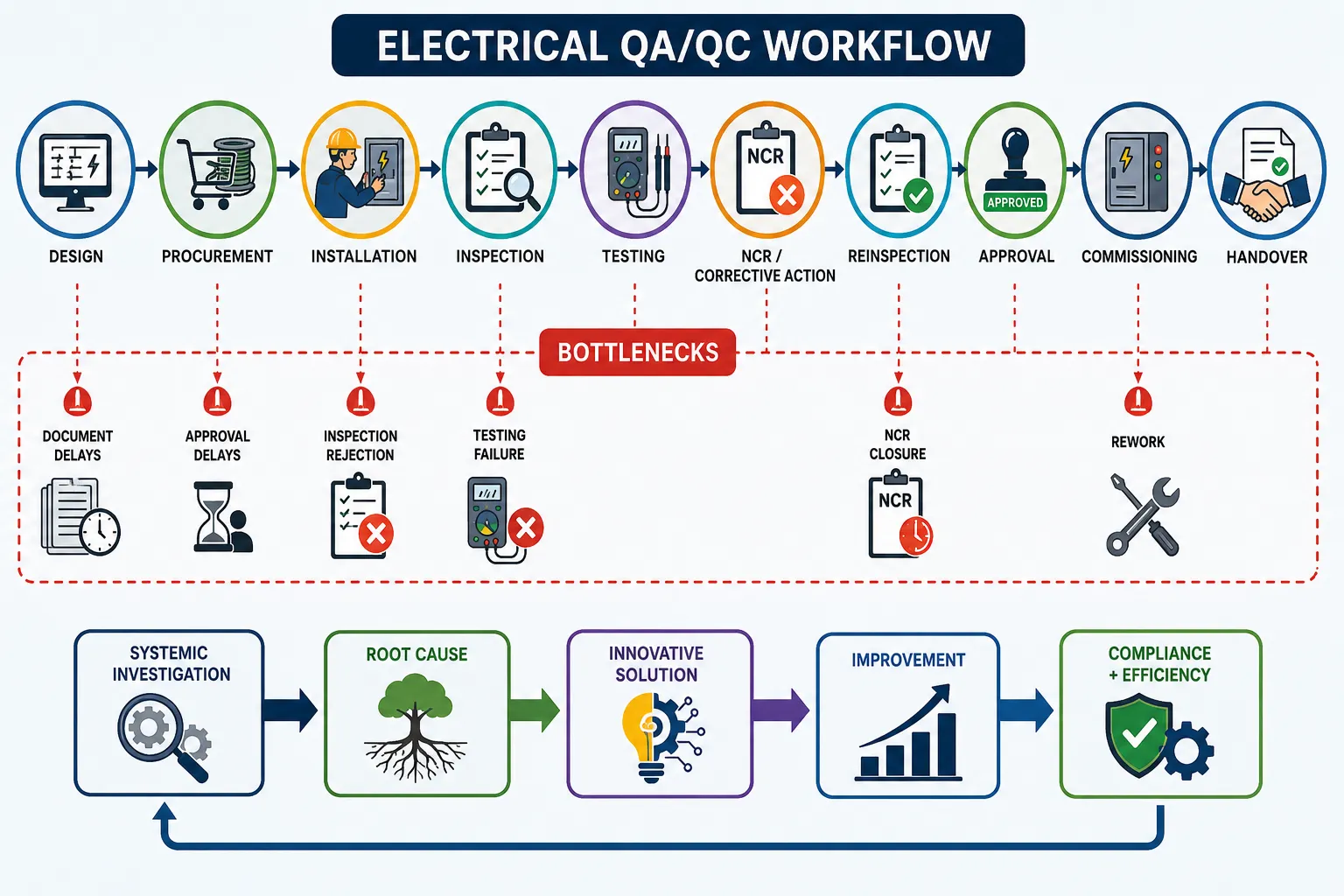
Process Mapping for Bottleneck Identification
Process mapping provides a structured method for visualising QA/QC workflows.
A process map should identify:
- Inputs.
- Activities.
- Decision points.
- Responsibilities.
- Outputs.
- Approval stages.
The investigation can then identify:
- Unnecessary approvals.
- Duplicate data entry.
- Repeated reviews.
- Waiting periods.
-
Unclear handovers.

Practical Process-Mapping Questions
A senior QA/QC engineer should ask:
- What triggers the process?
- Who owns each stage?
- What information is required?
- What causes rejection?
- How many times is information transferred?
- Which stage takes the longest?
- Which stage creates the most rework?
Measuring Systemic Inefficiencies
Inefficiencies should be measured rather than described only subjectively.
Useful metrics include:
- Inspection turnaround time.
- Material approval duration.
- NCR closure time.
- Rework percentage.
- First-pass inspection rate.
- Test failure frequency.
- Documentation rejection rate.
- Repeat inspection frequency.
- Corrective action ageing.
These indicators allow management to distinguish isolated events from persistent systemic problems.
First-Pass Acceptance Rate
The first-pass acceptance rate measures how frequently work is accepted during its initial inspection.
A high first-pass rate generally indicates:
- Effective preparation.
- Clear requirements.
- Competent installation.
- Effective supervision.
A low first-pass rate may indicate:
- Weak pre-inspection controls.
- Poor workmanship.
- Inadequate understanding of requirements.
- Ineffective communication.
Rework Analysis
Rework is a major indicator of systemic inefficiency.
Rework may result from:
- Incorrect installation.
- Design changes.
- Material errors.
- Inspection failures.
- Poor coordination.
A professional investigation should determine whether rework is:
- Preventable.
- Recurring.
- Process-related.
- Contractor-related.
- Design-related.
Compliance Gap Analysis
Compliance gap analysis compares current project practices against defined requirements.
The assessment may examine:
- Technical specifications.
- Approved drawings.
- Inspection requirements.
- Testing requirements.
- Quality procedures.
- Applicable regulatory obligations.
The objective is to identify:
- Missing controls.
- Incomplete evidence.
- Outdated procedures.
- Weak monitoring.
Communication as a Systemic Quality Factor
Poor communication is frequently an underlying contributor to QA/QC inefficiency.
Electrical projects involve:
- Designers.
- Engineers.
- Contractors.
- Inspectors.
- Suppliers.
- Commissioning teams.
- Project managers.
Information can be lost or misunderstood between these groups.
Improvement opportunities may include:
- Defined communication protocols.
- Centralised information systems.
- Controlled technical instructions.
- Digital approval workflows.
- Regular coordination reviews.
Technology-Related Inefficiencies
Technology can improve QA/QC performance, but poorly integrated technology can also create inefficiencies.
Problems may include:
- Multiple incompatible systems.
- Duplicate data entry.
- Poor user training.
- Inconsistent data formats.
- Lack of system integration.
The investigation should therefore evaluate whether technology:
- Reduces workload.
- Improves accuracy.
- Improves traceability.
- Accelerates approvals.
Technology should not be introduced simply because it is innovative. Its value must be demonstrated against defined quality and efficiency objectives.
Practical Example: Electrical Installation Project
Project Situation
A large commercial electrical project experiences frequent inspection delays and increasing rework.
Initial Findings
The QA/QC team identifies:
- High inspection rejection rates.
- Repeated drawing revisions.
- Delayed material approvals.
- Increasing NCRs.
Systemic Investigation
Process mapping shows that installation teams frequently work from outdated information because revised drawings are distributed through inconsistent communication channels.
Root Cause
The underlying issue is weak document and change management.
Improvement Opportunity
Potential solutions include:
- Centralised digital document control.
- Automated revision notifications.
- Digital inspection workflows.
- Controlled access to approved information.
Expected Benefits
The proposed changes can support:
- Reduced rework.
- Faster inspections.
- Better traceability.
- Improved compliance confidence.
Practical Example: Industrial Power Project
Project Situation
A power infrastructure project has a large number of open NCRs.
Investigation
Data analysis reveals that many NCRs remain open because responsibility for verification is unclear.
Systemic Problem
The issue is not simply contractor performance. The NCR closure workflow lacks:
- Defined ownership.
- Clear deadlines.
- Escalation criteria.
- Verification responsibilities.
Corrective Approach
The organisation can introduce:
- Assigned NCR owners.
- Defined closure targets.
- Digital status tracking.
- Escalation procedures.
Case Study: Investigating a Compliance Bottleneck
Background
A major industrial facility is approaching commissioning. However, electrical testing activities are repeatedly delayed.
The project management team initially believes that insufficient testing personnel are responsible.
Investigation
The QA/QC team performs a systemic review.
The analysis examines:
- Inspection completion.
- Equipment readiness.
- Test documentation.
- Calibration records.
- Test procedure approvals.
- Witnessing requirements.
Findings
The investigation reveals that testing delays are primarily caused by incomplete documentation and unresolved inspection findings.
Additional testing personnel would therefore not solve the underlying problem.
Root Causes
The investigation identifies:
- Weak pre-commissioning readiness checks.
- Poor coordination between construction and QA/QC.
- Incomplete documentation.
- Insufficient status visibility.
Recommended Improvements
The project introduces:
- Pre-test readiness checklists.
- Digital document verification.
- Integrated testing schedules.
- Automated status dashboards.
- Defined responsibility matrices.
Results
The approach supports:
- Improved testing readiness.
- Reduced waiting time.
- Better documentation.
- Faster compliance verification.
Case Study Conclusion
The case demonstrates why systemic investigation is essential. Treating the visible bottleneck alone would have produced only a temporary solution. By analysing the complete process, the QA/QC team identified underlying workflow and information-management weaknesses and developed improvements that addressed the actual causes.
Developing a Systemic Investigation Procedure
A structured investigation procedure can be applied across complex electrical projects.
Stage 1: Define the Problem
Clearly establish:
- What is happening?
- Where is it happening?
- How frequently does it occur?
- What is the impact?
Stage 2: Collect Evidence
Gather:
- Inspection records.
- NCR data.
- Approval records.
- Testing results.
- Project correspondence.
- Process performance metrics.
Stage 3: Map the Process
Identify:
- Activities.
- Responsibilities.
- Decision points.
- Waiting stages.
Stage 4: Analyse Root Causes
Use:
- Five-Why analysis.
- Cause-and-effect analysis.
- Trend analysis.
- Pareto analysis.
Stage 5: Quantify the Impact
Measure:
- Time loss.
- Rework.
- Cost impact.
- Compliance risk.
- Resource consumption.
Stage 6: Develop Improvement Options
Potential solutions may include:
- Process redesign.
- Digital workflows.
- Automation.
- Additional controls.
- Training.
- Responsibility clarification.
Stage 7: Evaluate the Solution
Assess each option against:
- Compliance.
- Cost.
- Feasibility.
- Reliability.
- Implementation risk.
- Resource requirements.
Key Benefits of Systemic Investigation
A structured investigation can provide:
- Reduced process delays.
- Lower rework levels.
- Improved compliance.
- Better resource utilisation.
- Faster approvals.
- Stronger traceability.
- Improved inspection effectiveness.
- Reduced recurring defects.
- Better communication.
- Improved project predictability.
Relationship Between Inefficiency and Compliance Risk
Efficiency and compliance should not be treated as competing objectives.
An inefficient compliance process can increase risk because:
- Inspections may be rushed.
- Documentation may be incomplete.
- Corrective actions may remain unresolved.
- Critical approvals may be delayed.
Conversely, excessive bureaucracy can also create unnecessary delays without improving actual quality.
The objective is therefore to develop efficient compliance, where required controls remain robust while unnecessary duplication and administrative waste are removed.
Principles for Recommending Future Innovative Solutions
Once systemic inefficiencies and compliance bottlenecks have been identified, innovative solutions should be selected using evidence.
A recommended solution should:
- Address an identified root cause.
- Improve measurable performance.
- Maintain or strengthen compliance.
- Be technically feasible.
- Be practical for project users.
- Provide appropriate traceability.
- Consider implementation risks.
Potential innovative solutions may include:
- Digital inspection applications.
- Automated document verification.
- Integrated QA/QC dashboards.
- BIM-based quality coordination.
- IoT condition monitoring.
- AI-assisted trend analysis.
- Automated workflow notifications.
The most suitable solution is not necessarily the most technologically advanced. It is the solution that produces the greatest practical improvement while maintaining required quality and compliance controls.
Key Learning Points
Learners should understand that:
- Systemic inefficiencies are recurring weaknesses within processes or systems.
- Compliance bottlenecks can restrict project progress and increase risk.
- Root cause analysis should investigate systems rather than simply blame individuals.
- Process mapping helps identify unnecessary steps and waiting points.
- Inspection, testing, material approval and NCR processes should be measured using meaningful KPIs.
- Poor document control can create both quality and compliance problems.
- Rework is an important indicator of systemic inefficiency.
- Data should be used to distinguish isolated incidents from recurring trends.
- Digital technology should be selected according to demonstrated project needs.
- Efficient compliance should reduce unnecessary process waste without weakening required controls.
- Innovative solutions should address root causes rather than symptoms.
- Professional engineering judgement remains essential when evaluating quality improvement options.
Conclusion
Critically investigating systemic inefficiencies and compliance bottlenecks is a fundamental responsibility within advanced electrical QA/QC management. Complex electrical projects involve interconnected processes, people, technologies and information systems, meaning that recurring quality problems rarely have a single simple cause.
A Chartered Electrical Engineer and senior QA/QC professional should therefore investigate the complete quality system, examine process performance, analyse quality data, map workflows and identify root causes before recommending corrective or innovative solutions. Areas such as inspection approvals, material submissions, document control, testing and commissioning, NCR management and design information flow should be evaluated systematically.
The ultimate objective is to create a QA/QC environment where compliance is robust but efficient, information is traceable, decisions are evidence-based and recurring problems are prevented rather than repeatedly corrected. By identifying the underlying causes of inefficiency and compliance bottlenecks, organisations can establish a strong foundation for innovative solutions that reduce rework, improve productivity, strengthen regulatory compliance and enhance the reliability of complex electrical systems.
2: Formulate Innovative, Advanced Solutions to Address Complex Compliance Challenges Involving Many Interacting Factors
Introduction to Innovative Compliance Solutions in Electrical QA/QC
Complex electrical engineering projects increasingly operate within environments where compliance cannot be achieved through isolated inspections or conventional paperwork-based controls alone. Large commercial developments, industrial facilities, renewable energy installations, data centres, infrastructure projects and integrated power systems involve numerous interacting factors, including design requirements, equipment specifications, installation quality, testing, commissioning, environmental conditions, contractor performance, digital information, operational risks and regulatory obligations. When these factors interact, a compliance problem may have several contributing causes rather than one clearly identifiable source.
For a Chartered Electrical Engineer (CEng) and Senior Electrical QA/QC Engineer, the professional challenge is therefore not simply to identify a non-compliance but to formulate an innovative and technically defensible solution that addresses the underlying system. Such solutions should improve compliance while also considering safety, reliability, efficiency, cost, constructability, maintainability, traceability and long-term operational performance.
Innovative compliance management involves combining engineering judgement with structured quality methodologies and appropriate technologies. Depending on the project, this may include digital inspection platforms, Building Information Modelling (BIM), Internet of Things (IoT) monitoring, automated document verification, artificial intelligence (AI)-supported analytics, risk-based inspection, predictive quality management and integrated quality dashboards.
The purpose of innovation is not to replace established QA/QC principles. Instead, innovation should strengthen them by making quality controls more proactive, measurable, connected and responsive. A successful solution should make it easier for project teams to demonstrate conformity, identify emerging risks and take corrective action before a minor quality issue develops into a significant compliance failure.
Understanding Complex Compliance Challenges
A complex compliance challenge exists when conformity depends on several interconnected technical, organisational, procedural and operational conditions.
For example, the successful commissioning of an electrical distribution system may depend on:
- Approved design information.
- Correct equipment selection.
- Approved materials.
- Correct installation.
- Competent installation personnel.
- Calibration of testing equipment.
- Accurate test procedures.
- Inspection acceptance.
- Correct protection settings.
- Complete documentation.
- Effective coordination between project teams.
Failure in one area can influence another. An incorrect design revision may result in incorrect installation, which may then produce failed testing, delayed commissioning and incomplete compliance records.
This demonstrates why complex compliance challenges require systems thinking.
Key Concepts and Definitions
| Key Concept | Definition | Application in Electrical QA/QC |
|---|---|---|
| Complex Compliance Challenge | A compliance problem influenced by multiple interconnected factors | Managing design, installation, testing and documentation simultaneously |
| Innovative Solution | A new or improved approach that provides measurable value | Digital inspection and automated compliance tracking |
| Systems Thinking | Considering relationships between different parts of a system | Linking design, procurement, installation and commissioning |
| Risk-Based Compliance | Prioritising controls according to risk and consequence | Focusing inspections on high-risk electrical systems |
| Digital Traceability | Ability to electronically track information and decisions | Linking equipment records with inspection evidence |
| Predictive Quality | Using data to anticipate potential quality failures | Identifying equipment performance deterioration |
| Compliance Dashboard | Centralised display of quality and compliance information | Monitoring outstanding approvals and NCRs |
| Automated Verification | Using technology to check defined information or conditions | Checking document completeness |
| Interoperability | Ability of different systems to exchange and use information | Connecting BIM, QA/QC and monitoring platforms |
| Corrective Action | Action taken to eliminate the cause of a detected problem | Preventing recurrence of electrical non-conformities |
| Preventive Control | Measure designed to reduce the likelihood of future failure | Pre-installation verification and risk-based inspections |
| Continuous Improvement | Ongoing enhancement of quality processes | Using performance data to improve QA/QC procedures |
Why Conventional Compliance Approaches May Become Insufficient
Traditional compliance systems often depend heavily on:
- Manual inspection forms.
- Paper-based approvals.
- Spreadsheet tracking.
- Email communication.
- Separate document repositories.
- Periodic inspections.
These approaches can remain useful, but they may become inefficient when project complexity increases.
Potential weaknesses include:
- Delayed information transfer.
- Duplicate data entry.
- Difficulty tracking document revisions.
- Limited real-time visibility.
- Delayed escalation.
- Inconsistent information.
- Difficulty identifying relationships between quality problems.
The objective should not be to remove conventional controls without assessment. Instead, professionals should identify which parts of the existing system create unnecessary delays or risks and then introduce appropriate improvements.
Systems Thinking for Complex Compliance Problems
Systems thinking requires the QA/QC professional to examine the relationships between different project components.
A compliance issue should be assessed across:
- Design.
- Procurement.
- Materials.
- Installation.
- Inspection.
- Testing.
- Commissioning.
- Documentation.
- Competence.
- Management controls.
For example, if repeated electrical installation defects are identified, the investigation should consider whether the problem relates to:
- Design interpretation.
- Drawing revisions.
- Installation procedures.
- Worker competence.
- Material suitability.
- Supervision.
- Inspection timing.
- Quality documentation.
This broader approach prevents the organisation from treating symptoms instead of causes.
Formulating an Innovative Compliance Solution
An effective solution should be developed systematically rather than selected simply because a technology appears advanced.
Step 1: Define the Compliance Challenge
The first stage is to clearly define:
- What requirement is not being achieved?
- Where is the problem occurring?
- How frequently does it occur?
- Which systems are affected?
- What are the consequences?
- Which stakeholders are involved?
A precise problem definition prevents inappropriate solutions.
Step 2: Analyse Interacting Factors
The professional should identify relationships between:
- Technical requirements.
- Human factors.
- Process weaknesses.
- Equipment conditions.
- Information flows.
- Environmental influences.
This analysis establishes the context in which the solution must operate.
Step 3: Identify Root Causes
Potential techniques include:
- Five-Why analysis.
- Cause-and-effect analysis.
- Pareto analysis.
- Trend analysis.
- Process mapping.
- Failure analysis.
The objective is to distinguish primary causes from secondary symptoms.
Step 4: Generate Multiple Solutions
Rather than immediately selecting one option, professionals should develop several possible approaches.
Potential solutions may include:
- Process redesign.
- Digital workflow integration.
- Automated verification.
- Risk-based inspection.
- Real-time monitoring.
- Predictive analytics.
- Enhanced competency controls.
Step 5: Evaluate Solution Feasibility
Each solution should be assessed against:
- Compliance requirements.
- Safety implications.
- Technical feasibility.
- Cost.
- Implementation time.
- Workforce competence.
- System compatibility.
- Cybersecurity considerations.
- Maintenance requirements.
Step 6: Pilot and Validate
Where appropriate, an innovative solution should initially be tested within a controlled area.
The pilot can evaluate:
- Accuracy.
- Usability.
- Reliability.
- Compliance improvement.
- Time savings.
- User acceptance.
Step 7: Implement and Monitor
After successful validation, the solution can be introduced more widely with defined performance indicators.
Developing Risk-Based Compliance Solutions
Risk-based approaches are particularly valuable when projects contain large numbers of inspection points and limited QA/QC resources.
Instead of treating every activity identically, the organisation can prioritise controls according to:
- Safety consequence.
- System criticality.
- Failure probability.
- Installation complexity.
- Previous defect history.
- Environmental exposure.
- Operational importance.
High-risk systems may receive:
- Increased inspection frequency.
- Additional testing.
- Enhanced documentation review.
- Independent verification.
- Continuous monitoring.
Lower-risk activities can remain subject to appropriate standard controls without unnecessary duplication.
Digital Solutions for Complex Compliance Challenges
Digital technologies can significantly improve compliance management when they are integrated with existing QA/QC procedures.
BIM-Enabled Compliance Management
BIM can provide a structured digital representation of electrical systems and associated project information.
It can support:
- Design coordination.
- Equipment identification.
- Installation verification.
- Information traceability.
- Change management.
For example, an electrical equipment record can be associated with relevant technical information, inspection evidence and commissioning status.
This creates a more connected quality information environment.
IoT-Based Compliance Monitoring
IoT devices can provide continuous information about equipment and operating conditions.
Potential applications include monitoring:
- Temperature.
- Current.
- Voltage.
- Equipment status.
- Environmental conditions.
The data can support early identification of abnormal conditions.
However, the use of IoT should be accompanied by:
- Data validation.
- Sensor verification.
- Defined response procedures.
- Appropriate cybersecurity controls.
- Clear responsibility for interpreting alerts.
Technology should therefore support the compliance process rather than operate independently from it.
AI-Supported Quality Analytics
AI and advanced analytics can assist in identifying patterns within large volumes of QA/QC information.
Potential applications include:
- Identifying recurring defects.
- Analysing NCR trends.
- Detecting unusual equipment behaviour.
- Prioritising inspection activities.
- Supporting predictive quality decisions.
AI-generated findings should still be reviewed by competent professionals before significant engineering decisions are implemented.
Automated Document Compliance Checking
One major compliance bottleneck is incomplete or inconsistent documentation.
Automated document verification can potentially identify:
- Missing certificates.
- Missing inspection records.
- Incorrect document revisions.
- Incomplete submissions.
- Expired supporting records.
This can reduce administrative delays while improving traceability.
Integrated Compliance Dashboards
A compliance dashboard can consolidate information from multiple QA/QC activities.
A project dashboard may show:
- Open NCRs.
- Inspection status.
- Testing status.
- Material approval status.
- Outstanding documents.
- Corrective actions.
- High-risk activities.
This provides management with a clearer view of current compliance performance.
Designing an Integrated Compliance Architecture
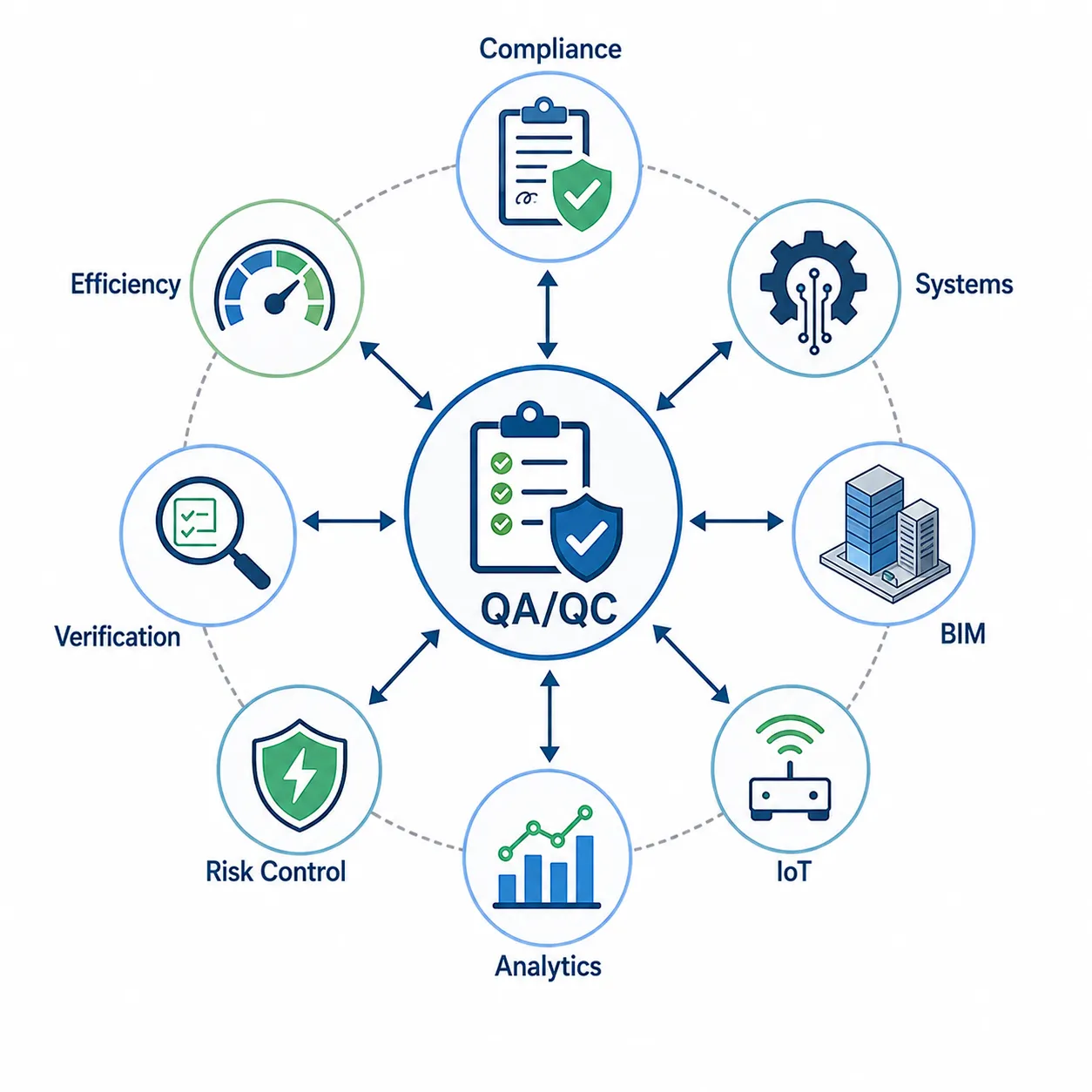
A strong innovative solution should connect rather than isolate different quality activities.
A possible architecture may involve:
- BIM for project information.
- Digital QA/QC platform for inspections.
- IoT for equipment monitoring.
- Analytics for performance evaluation.
- Dashboard for management reporting.
The value comes from the interaction between these components.
For example:
BIM information → Digital inspection → IoT monitoring → Analytics → Risk identification → Corrective action → Verification
This creates a continuous compliance feedback loop.
Practical Example: Complex Electrical Distribution Project
Project Situation
A large industrial project is experiencing repeated inspection failures in electrical distribution rooms.
The problems include:
- Incorrect equipment labelling.
- Incomplete inspection documentation.
- Repeated installation defects.
- Delayed approvals.
Investigation
The QA/QC team discovers that different project teams are working with information from separate systems.
This creates:
- Information duplication.
- Revision confusion.
- Delayed communication.
- Inconsistent inspection preparation.
Innovative Solution
The project introduces an integrated digital QA/QC process.
The solution includes:
- Centralised equipment records.
- BIM-linked electrical information.
- Digital inspection checklists.
- Automated document status tracking.
- Dashboard-based compliance monitoring.
Expected Improvement
The integrated approach can support:
- Better information consistency.
- Faster inspection preparation.
- Improved traceability.
- Reduced documentation errors.
- Faster identification of outstanding compliance actions.
Solving Multi-Factor Compliance Challenges
Complex compliance problems often involve multiple simultaneous constraints.
For example, a project may need to achieve:
- Technical compliance.
- Safety compliance.
- Environmental objectives.
- Cost efficiency.
- Programme requirements.
A proposed solution should therefore be evaluated using a multi-criteria approach.
Multi-Criteria Evaluation
Possible evaluation criteria include:
- Compliance improvement.
- Safety improvement.
- Reliability.
- Implementation cost.
- Time savings.
- Resource requirements.
- Scalability.
- Maintainability.
- Data security.
- Workforce acceptance.
A solution that performs well technically but is impossible to implement within the project environment may not be the most appropriate solution.
Managing Conflicting Project Priorities
Innovative QA/QC solutions must balance competing priorities.
For example:
A project may want to accelerate commissioning, but critical testing remains incomplete.
The correct response is not simply to reduce quality controls.
Instead, innovation could focus on:
- Prioritising high-risk tests.
- Improving testing coordination.
- Digitising test records.
- Providing real-time readiness information.
- Automating documentation checks.
This demonstrates how innovation can improve efficiency while maintaining required compliance controls.
Developing Preventive Compliance Controls
An advanced QA/QC system should aim to prevent non-compliance rather than detect it only after completion.
Preventive controls may include:
- Pre-installation verification.
- Competency verification.
- Digital checklists.
- Material verification.
- Design-change alerts.
- Automated approval status.
- Risk-based inspection planning.
The earlier a problem is identified, the lower its potential impact on project cost and programme.
Practical Example: Preventing Repeated Cable Installation Defects
Problem
A project records repeated cable installation defects during final inspection.
Traditional Response
Inspectors identify defects after installation and issue corrective actions.
Innovative Approach
The project introduces:
- Digital installation checklists.
- Pre-installation briefings.
- QR-based equipment identification.
- Photographic quality evidence.
- Targeted inspections based on previous defect data.
Outcome
The approach moves quality control earlier into the installation process.
Potential benefits include:
- Reduced rework.
- Faster inspections.
- Better evidence.
- Improved installation consistency.
Creating an Innovative Corrective Action System
Corrective action should address both immediate failure and systemic causes.
An advanced corrective action process can include:
- Digital NCR creation.
- Automatic assignment.
- Defined response deadlines.
- Root cause classification.
- Corrective action verification.
- Escalation alerts.
- Trend analysis.
This allows management to identify whether similar problems are occurring across different areas of the project.
Measuring the Effectiveness of Innovative Solutions
Innovation should be measurable.
Useful KPIs include:
- Reduction in NCR frequency.
- First-pass inspection rate.
- Inspection turnaround time.
- Reduction in rework.
- Compliance closure time.
- Testing success rate.
- Documentation accuracy.
- Corrective action completion rate.
A solution should be considered effective only when measurable evidence demonstrates improvement.
Case Study: Innovative Solution for a Multi-Factor Compliance Challenge
Background
A major electrical infrastructure project is preparing for commissioning. Several interconnected compliance problems emerge.
The project experiences:
- Delayed inspection approvals.
- Incomplete test documentation.
- Repeated NCRs.
- Poor visibility of equipment status.
- Communication gaps between construction and commissioning teams.
Management initially considers increasing the number of QA/QC inspectors.
Investigation
The senior QA/QC team conducts a systemic investigation.
Process mapping demonstrates that the main problem is not simply insufficient inspection resources.
The underlying issues include:
- Fragmented information.
- Manual document tracking.
- Lack of real-time status visibility.
- Weak coordination between activities.
Solution Formulation
The team proposes an integrated digital compliance solution.
The solution combines:
- BIM-based equipment information.
- Digital inspection workflows.
- Automated document verification.
- Centralised NCR tracking.
- Compliance dashboards.
Implementation
The project begins with a pilot area.
The pilot measures:
- Inspection turnaround time.
- Documentation completeness.
- NCR closure time.
- First-pass acceptance.
Evaluation
The project team compares results against previous performance.
The analysis demonstrates improved visibility and more efficient handling of quality information.
Wider Implementation
Following successful validation, the system is extended to other project areas.
Case Study Conclusion
The case demonstrates that innovative compliance solutions should address systemic causes rather than simply increase resources. By integrating information, workflow management and performance monitoring, the project can strengthen compliance while improving operational efficiency.
Challenges When Implementing Innovative QA/QC Solutions
Innovation itself creates risks that must be managed.
Potential challenges include:
- Resistance to change.
- Insufficient training.
- Poor system integration.
- Data-quality problems.
- Cybersecurity risks.
- Excessive implementation costs.
- Dependence on technology.
- Unclear ownership.
Professionals should therefore introduce innovation through controlled implementation rather than uncontrolled technology adoption.
Managing Workforce and Competency Requirements
Technology cannot compensate for inadequate professional competence.
Implementation should include:
- User training.
- Competency assessment.
- Clear responsibilities.
- Technical support.
- Procedure updates.
Personnel should understand:
- Why the solution is being introduced.
- How it supports compliance.
- How to use the system.
- How to respond to alerts.
- When professional judgement is required.
Change Management for Innovative Compliance Solutions
A successful change management approach should include:
Communication
Explain the purpose and expected benefits.
Training
Provide practical training for affected personnel.
Pilot Implementation
Test the solution before full deployment.
Feedback
Collect user feedback and identify problems.
Performance Review
Measure whether the solution achieves intended objectives.
Continuous Improvement
Modify the approach based on evidence.
Key Benefits of Innovative Compliance Solutions
Well-designed solutions can provide:
- Improved regulatory compliance.
- Faster approval processes.
- Reduced rework.
- Better inspection efficiency.
- Improved traceability.
- Stronger risk management.
- Better data visibility.
- Faster corrective action.
- Improved equipment reliability.
- More effective resource allocation.
- Enhanced project decision-making.
- Improved readiness for audits and handover.
Professional Criteria for Selecting an Innovative Solution
A senior electrical QA/QC professional should ask:
- Does the solution address the actual root cause?
- Does it improve compliance?
- Does it improve efficiency?
- Is it technically feasible?
- Can the workforce implement it effectively?
- Can it integrate with existing systems?
- Can its benefits be measured?
- Does it introduce new risks?
- Is the solution sustainable throughout the project lifecycle?
These questions prevent innovation from becoming technology adoption without measurable value.
Key Learning Points
Learners should understand that:
- Complex compliance challenges often involve multiple interacting factors.
- Systems thinking is essential when formulating advanced QA/QC solutions.
- Innovative solutions should address root causes rather than symptoms.
- Digital technologies can strengthen compliance when appropriately integrated.
- BIM can improve information coordination and traceability.
- IoT can support real-time equipment and condition monitoring.
- AI and analytics can support pattern identification and predictive quality management.
- Automated document verification can reduce administrative bottlenecks.
- Risk-based inspection can focus resources on higher-consequence activities.
- Innovative solutions must be evaluated against compliance, safety, cost and feasibility.
- Professional engineering judgement remains essential when interpreting digital information.
- Innovation should be measured using defined QA/QC performance indicators.
- Workforce competence and change management are critical to successful implementation.
- Continuous evaluation ensures that innovative solutions remain effective.
Conclusion
Formulating innovative and advanced solutions for complex electrical compliance challenges requires a combination of engineering expertise, systems thinking, quality management knowledge and informed use of technology. A senior electrical QA/QC professional must be able to move beyond identifying individual defects and investigate the wider relationships between design, procurement, installation, inspection, testing, commissioning, documentation, people and operational conditions.
Effective solutions should be based on evidence and should address clearly identified root causes. Digital QA/QC platforms, BIM, IoT, AI-supported analytics, automated document verification, integrated dashboards and risk-based inspection can provide significant improvements when they are appropriately selected and integrated into established quality processes.
The most effective innovative solution is not necessarily the newest or most technologically advanced option. It is the solution that produces measurable improvements in compliance, efficiency, reliability and risk control while remaining practical for the project environment. By combining innovation with robust QA/QC principles, professional engineering judgement, workforce competence and continuous performance evaluation, organisations can develop electrical quality management systems that are more proactive, traceable, efficient and resilient.
Ultimately, the ability to formulate advanced compliance solutions enables electrical QA/QC professionals to contribute beyond traditional inspection functions and become strategic contributors to project performance, regulatory conformity, operational reliability and continuous improvement.
3: Develop a Clear Implementation Strategy for Introducing Innovative QA/QC Practices into a Live Electrical Workplace
Introduction to Implementing Innovative QA/QC Practices in a Live Electrical Workplace
Introducing innovative Quality Assurance and Quality Control (QA/QC) practices into a live electrical workplace requires considerably more than selecting new software, installing monitoring equipment or revising inspection forms. A live electrical workplace is a dynamic environment in which construction, installation, inspection, testing, commissioning, maintenance and operational activities may occur simultaneously. Any change to established QA/QC practices must therefore be carefully planned so that innovation improves quality and efficiency without disrupting safety, compliance, productivity or critical electrical operations.
For a Chartered Electrical Engineer (CEng) and Senior Electrical QA/QC Engineer, implementation strategy involves translating an innovative concept into a controlled, practical and measurable workplace intervention. The strategy must consider the existing quality management system, workforce competence, project programme, electrical risks, contractual requirements, regulatory expectations, information systems, technology infrastructure and organisational culture.
An effective implementation strategy should answer several fundamental questions:
- What problem is the innovation intended to solve?
- Why is the existing QA/QC process insufficient?
- Which activities will change?
- Who will be responsible?
- What risks could the change introduce?
- How will personnel be trained?
- How will the innovation be tested before wider implementation?
- How will effectiveness be measured?
- How will compliance evidence be maintained?
The objective is to introduce innovation in a controlled manner rather than making uncontrolled changes to established electrical quality processes.
Understanding Innovation in a Live Electrical QA/QC Environment
Innovation within electrical QA/QC can involve new technology, improved processes, revised inspection strategies or combinations of these approaches.
Examples include:
- Digital inspection and test records.
- Mobile QA/QC applications.
- BIM-linked inspection processes.
- Automated document verification.
- IoT-based equipment monitoring.
- AI-supported quality analytics.
- Digital NCR management.
- Risk-based inspection planning.
- Automated compliance dashboards.
- Electronic approval workflows.
However, innovation should always be connected to a defined quality or operational requirement.
For example, introducing a digital inspection application may be appropriate where paper-based inspections are causing:
- Delayed reporting.
- Lost records.
- Duplicate data entry.
- Poor traceability.
- Delayed corrective actions.
The technology becomes valuable because it addresses an identified weakness rather than because digitalisation is inherently desirable.
Key Concepts and Definitions
| Key Concept | Definition | Application in Electrical QA/QC |
|---|---|---|
| Implementation Strategy | Structured plan for introducing and controlling a new practice | Managing digital QA/QC implementation |
| Live Workplace | Active operational or construction environment where work continues during change | Introducing innovation without disrupting electrical activities |
| Change Management | Structured process for moving from an existing method to an improved method | Managing workforce and procedural changes |
| Pilot Project | Controlled trial before wider implementation | Testing a digital inspection system |
| Stakeholder | Person or organisation affected by the implementation | Engineers, inspectors, contractors and management |
| Readiness Assessment | Evaluation of whether an organisation is prepared for change | Checking skills, systems and resources |
| Change Control | Formal process for reviewing and approving changes | Preventing uncontrolled QA/QC modifications |
| Competency | Demonstrated ability to perform required tasks effectively | Training personnel to use new systems |
| Performance Indicator | Measurable value used to evaluate results | Measuring defect reduction and inspection time |
| Rollout | Controlled expansion of a successful solution | Extending a pilot across project areas |
| Lessons Learned | Knowledge gained from implementation experience | Improving future QA/QC deployments |
| Business Continuity | Ability to maintain essential operations during change | Avoiding disruption to critical electrical activities |
Why Implementation Strategy Is Essential
A technically excellent QA/QC innovation can fail if it is introduced without sufficient planning.
Common causes of unsuccessful implementation include:
- Insufficient workforce training.
- Poor communication.
- Unclear responsibilities.
- Inadequate technology infrastructure.
- Lack of management support.
- Poor integration with existing procedures.
- Failure to consider operational risks.
- Unrealistic implementation schedules.
- Insufficient testing before deployment.
An implementation strategy reduces these risks by establishing a controlled transition from the current state to the desired future state.
Assessing the Existing QA/QC Environment
Before introducing innovation, the organisation should establish a baseline.
The baseline identifies how the current system operates and provides evidence against which improvement can later be measured.
Current-State Assessment
The assessment should examine:
- Existing inspection procedures.
- Inspection turnaround times.
- NCR management.
- Document control.
- Testing and commissioning workflows.
- Quality reporting.
- Existing digital systems.
- Workforce competency.
- Current compliance performance.
It should also identify:
- Repeated defects.
- Process bottlenecks.
- Duplicate activities.
- Manual data entry.
- Delayed approvals.
- Communication gaps.
Establishing the Business and Quality Case
An innovative practice should have a clear justification.
The business and quality case should explain:
- Existing problem.
- Proposed solution.
- Expected quality benefits.
- Expected efficiency benefits.
- Compliance implications.
- Implementation requirements.
- Estimated risks.
- Performance measures.
For example, a digital inspection system may be justified because the existing paper system causes delays in communicating inspection results.
The proposed solution could provide:
- Immediate record availability.
- Automated notifications.
- Improved traceability.
- Faster NCR creation.
- Better management visibility.
Defining Implementation Objectives
Implementation objectives should be specific and measurable.
Examples include:
- Reduce inspection reporting time.
- Increase first-pass inspection acceptance.
- Reduce repeated NCRs.
- Improve document traceability.
- Reduce corrective action closure time.
- Improve testing readiness.
- Strengthen compliance evidence.
Objectives should have defined baseline values and target outcomes.
For example:
Baseline: Inspection reports take an average of two working days to reach the responsible engineer.
Target: Reduce reporting time through a controlled digital workflow.
The exact target should be determined from project evidence rather than arbitrary assumptions.
Stakeholder Identification and Engagement
Introducing innovative QA/QC practices affects multiple groups.
Potential stakeholders include:
- Chartered engineers.
- QA/QC managers.
- Electrical inspectors.
- Site engineers.
- Construction managers.
- Project managers.
- Contractors.
- Subcontractors.
- Commissioning teams.
- Document controllers.
- IT personnel.
- Equipment suppliers.
- Client representatives.
Each stakeholder may have different priorities.
For example:
- QA/QC teams may prioritise traceability.
- Construction teams may prioritise usability.
- Management may prioritise efficiency.
- IT teams may prioritise security and integration.
- Clients may prioritise compliance evidence.
The implementation strategy must therefore address the interests and responsibilities of each relevant stakeholder.
Developing a Responsibility Structure
Responsibilities should be clearly assigned before implementation begins.
A responsibility framework may define:
- Project sponsor.
- Implementation manager.
- QA/QC owner.
- Technical owner.
- Digital system administrator.
- Training coordinator.
- End users.
- Verification authority.
Clear ownership prevents situations where everyone assumes another person is responsible for implementation.
Conducting a Readiness Assessment
A readiness assessment determines whether the workplace is prepared for innovation.
It should evaluate:
People
- Competence.
- Training requirements.
- User acceptance.
- Availability of technical support.
Processes
- Existing procedures.
- Document control.
- Change management.
- Inspection workflows.
Technology
- Hardware.
- Software.
- Network connectivity.
- Data storage.
- System compatibility.
Management
- Leadership support.
- Resources.
- Budget.
- Implementation authority.
Compliance
- Existing requirements.
- Approval requirements.
- Data retention requirements.
- Audit evidence.
Risk Assessment Before Implementation
Introducing a new QA/QC practice can create new risks.
Potential risks include:
- Incorrect use of technology.
- Data loss.
- System downtime.
- Incorrect automated results.
- User resistance.
- Cybersecurity vulnerabilities.
- Inadequate training.
- Disruption to inspections.
The implementation team should evaluate:
- Likelihood.
- Consequence.
- Existing controls.
- Additional controls.
High-risk implementation activities should be subject to stronger controls and management approval.
Developing the Implementation Roadmap

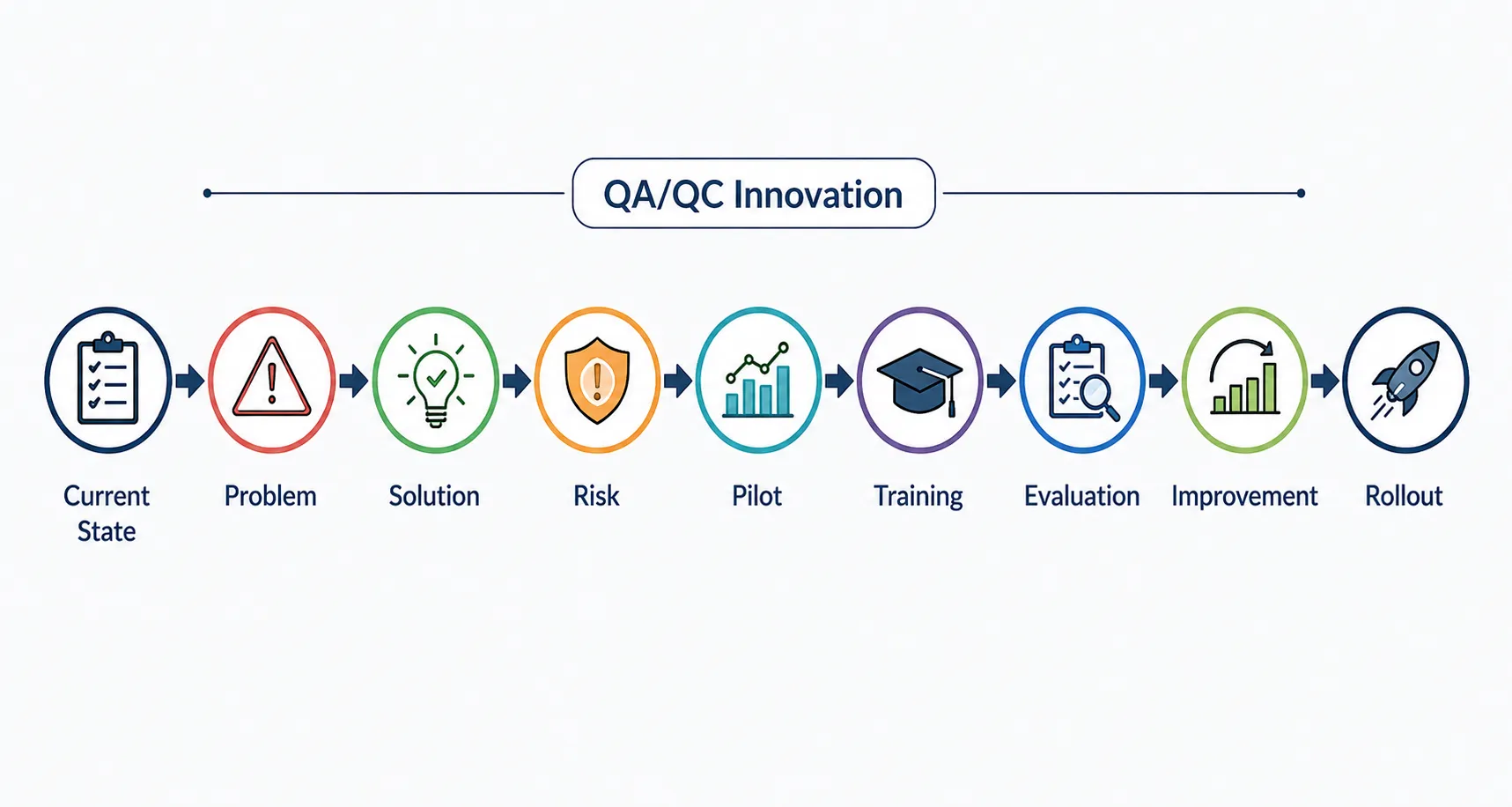
A clear roadmap provides an organised sequence of implementation activities.
A typical roadmap may include:
- Current-state assessment.
- Problem definition.
- Solution selection.
- Stakeholder consultation.
- Risk assessment.
- Process design.
- Pilot preparation.
- Workforce training.
- Pilot implementation.
- Performance evaluation.
- Improvement.
- Controlled rollout.
- Post-implementation review.
This phased approach prevents the organisation from moving directly from concept to full deployment without validation.
Designing the Pilot Phase
A pilot is one of the most effective methods for reducing implementation risk.
The pilot should be:
- Limited in scope.
- Representative of real work.
- Controlled.
- Measurable.
- Supported by trained personnel.
For example, rather than implementing a digital inspection platform across an entire electrical project immediately, the organisation could test it within one electrical zone or work package.
The pilot should evaluate:
- Usability.
- Data accuracy.
- Inspection efficiency.
- User acceptance.
- Compliance evidence.
- Technical reliability.
Establishing Pilot Success Criteria
Pilot success criteria should be agreed before the pilot begins.
Possible criteria include:
- Successful completion of defined inspections.
- Accurate digital records.
- Reduced reporting time.
- Correct workflow notifications.
- Improved traceability.
- No reduction in compliance control.
- Positive user feedback.
This prevents the pilot from being judged subjectively.
Integrating Innovation with Existing QA/QC Procedures
A major implementation principle is that innovation should integrate with the existing quality system.
The organisation should review whether the innovation affects:
- Inspection and Test Plans.
- Method statements.
- Inspection procedures.
- NCR procedures.
- Document control.
- Testing procedures.
- Approval workflows.
Procedures should be revised where necessary.
However, unnecessary procedural changes should be avoided because excessive modification can create confusion.
Managing Change Control
All significant changes should follow an appropriate change-control process.
Change control should establish:
- Proposed change.
- Reason for change.
- Technical implications.
- Compliance implications.
- Risk assessment.
- Responsible authority.
- Implementation date.
- Verification requirements.
This is particularly important where changes affect safety-critical electrical activities.
Workforce Training and Competence
Technology implementation is only effective when personnel can use it correctly.
Training should address:
- System operation.
- Revised procedures.
- Quality responsibilities.
- Data entry.
- Inspection requirements.
- Error reporting.
- Escalation procedures.
Training should be practical and relevant to actual workplace activities.
Competency Verification
Competence can be evaluated through:
- Practical demonstrations.
- Supervised use.
- Knowledge assessments.
- Observation.
- Review of completed records.
Completion of a training session alone does not necessarily demonstrate competence.
Communication Strategy
A clear communication strategy helps reduce resistance and misunderstanding.
Personnel should understand:
- Why the change is being introduced.
- What problem it addresses.
- What will change.
- What will remain unchanged.
- How their responsibilities will be affected.
- Where support is available.
Communication should occur before and during implementation.
Managing Resistance to Innovation
Resistance is common when established practices are changed.
Personnel may be concerned about:
- Increased workload.
- Technology complexity.
- Job responsibilities.
- Performance monitoring.
- Learning requirements.
Resistance can be reduced by:
- Early consultation.
- Practical demonstrations.
- User involvement.
- Training.
- Clear explanations.
- Feedback mechanisms.
Experienced workers should be treated as important sources of implementation knowledge rather than simply as recipients of instructions.
Practical Example: Digital Inspection Implementation
Project Situation
A large electrical construction project relies on paper inspection forms. Inspection records are frequently delayed, and management has limited real-time visibility.
Proposed Innovation
The project proposes a mobile digital inspection system.
Implementation Strategy
The project team:
- Maps the existing inspection process.
- Identifies bottlenecks.
- Defines requirements.
- Selects a suitable platform.
- Conducts a risk assessment.
- Trains inspectors.
- Runs a pilot.
- Measures results.
Pilot
The system is tested within one project area.
The team evaluates:
- Inspection completion.
- Reporting speed.
- Data accuracy.
- User acceptance.
Review
Feedback identifies several improvements required to the inspection checklist and workflow.
Controlled Rollout
The revised system is gradually introduced to additional work areas.
Outcome
The implementation approach supports:
- Better visibility.
- Improved traceability.
- Faster reporting.
- More structured corrective action.
Integrating IoT into a Live Electrical Workplace
IoT monitoring can provide valuable real-time information, but implementation must be controlled.
Before deployment, the team should establish:
- What will be monitored?
- Why will it be monitored?
- What constitutes abnormal performance?
- Who receives alerts?
- Who responds?
- What happens if the system fails?
For example, if temperature sensors monitor critical electrical equipment, the organisation needs a defined response process for abnormal readings.
The system should not simply generate alerts without establishing responsibility.
AI and Data Analytics Implementation
AI-supported QA/QC systems require additional governance.
The implementation should consider:
- Data quality.
- Model limitations.
- Human verification.
- False positives.
- False negatives.
- Data security.
- Appropriate use boundaries.
AI outputs should be treated as decision-support information where professional engineering verification remains necessary.
BIM-Based QA/QC Implementation
BIM integration should establish how quality information connects to project information.
Potential applications include:
- Equipment identification.
- Inspection status.
- Installation verification.
- Testing records.
- Handover information.
The implementation strategy should define:
- Data ownership.
- Information standards.
- Model responsibilities.
- Revision control.
- Access permissions.
Measuring Implementation Performance
Implementation should be evaluated using defined KPIs.
Potential measures include:
- Inspection turnaround time.
- First-pass acceptance rate.
- NCR closure time.
- Rework frequency.
- Documentation completeness.
- User adoption.
- Data accuracy.
- Compliance findings.
Measurement should compare performance against the baseline established before implementation.
Evaluating Compliance During Implementation
Innovation must not reduce the level of required compliance.
During implementation, QA/QC professionals should verify:
- Required inspections remain completed.
- Required testing remains controlled.
- Records remain traceable.
- Approvals remain authorised.
- Technical requirements remain unchanged unless formally approved.
Where digital processes replace paper processes, the organisation must ensure that the new process provides equivalent or improved control.
Maintaining Business Continuity
A live electrical workplace cannot always stop operations while a new system is introduced.
Implementation planning should therefore include contingency arrangements.
These may include:
- Backup procedures.
- Temporary manual records.
- Offline functionality.
- System recovery procedures.
- Technical support.
- Alternative communication channels.
For critical electrical activities, the implementation team must ensure that technology failure does not create an uncontrolled quality or safety condition.
Practical Example: Introducing a Digital NCR System
Existing Problem
A project experiences delays because NCRs are communicated through emails and spreadsheets.
Proposed Solution
A centralised digital NCR platform is introduced.
Implementation Strategy
The organisation:
- Defines the NCR workflow.
- Establishes responsibilities.
- Configures approval stages.
- Trains users.
- Runs a pilot.
- Monitors closure performance.
Performance Indicators
The project measures:
- Average NCR response time.
- Average closure time.
- Repeat NCR frequency.
- Corrective action verification.
Improvement
The system provides better visibility of overdue actions and allows management to identify recurring problems.
Case Study: Introducing Innovative QA/QC Practices During Active Electrical Construction
Background
A large industrial electrical project is approaching a critical installation and commissioning phase. Existing QA/QC procedures rely on manual inspection forms, separate document repositories and email-based corrective action communication.
The project begins experiencing:
- Delayed inspection records.
- Increasing NCRs.
- Poor visibility of outstanding approvals.
- Repeated documentation errors.
- Delayed testing readiness.
Management proposes implementing an integrated digital QA/QC system.
Initial Investigation
The senior QA/QC team first establishes a baseline.
The investigation reviews:
- Inspection processes.
- NCR management.
- Document control.
- Testing readiness.
- Contractor workflows.
The investigation confirms that several delays originate from disconnected information systems.
Implementation Strategy
The team develops a phased implementation plan.
Phase 1: Assessment
The existing process is mapped and performance is measured.
Phase 2: Solution Design
The proposed digital workflow is designed around existing QA/QC requirements.
Phase 3: Risk Review
Potential technology, operational and compliance risks are evaluated.
Phase 4: Pilot
The system is introduced to one controlled electrical work area.
Phase 5: Training
Inspectors, engineers and contractors receive practical training.
Phase 6: Evaluation
The pilot is assessed against predefined KPIs.
Phase 7: Improvement
User feedback and performance results are used to modify the system.
Phase 8: Rollout
The revised process is gradually expanded.
Case Study Outcomes
The implementation provides:
- Better inspection visibility.
- Faster communication.
- Improved record traceability.
- More structured NCR management.
- Improved management reporting.
Most importantly, the project does not treat innovation as a replacement for QA/QC principles. Instead, digital tools are integrated into the established quality management framework.
Case Study Conclusion
The case demonstrates that successful innovation in a live electrical workplace depends on controlled implementation. The organisation first understands the existing system, defines the problem, assesses risks, pilots the solution and measures results before wider deployment.
This approach reduces implementation disruption while ensuring that innovation produces measurable quality and compliance benefits.
Key Benefits of a Structured Implementation Strategy
A controlled implementation strategy can provide:
- Reduced implementation risk.
- Improved workforce acceptance.
- Better technology adoption.
- Stronger compliance control.
- Improved quality performance.
- Reduced disruption.
- Better resource utilisation.
- Faster problem identification.
- Improved information traceability.
- Better management visibility.
- More reliable performance measurement.
- Stronger continuous improvement.
Common Implementation Mistakes to Avoid
A senior QA/QC professional should avoid:
- Introducing technology without identifying a problem.
- Implementing too broadly too quickly.
- Ignoring workforce feedback.
- Failing to establish baseline performance.
- Neglecting training.
- Removing established controls without evaluation.
- Failing to define responsibilities.
- Ignoring data security.
- Treating pilot results as automatically transferable.
- Measuring technology usage instead of quality outcomes.
Implementation Review and Continuous Improvement
Implementation does not end when the new system becomes operational.
A post-implementation review should determine:
- Did the solution achieve its objectives?
- Did quality improve?
- Did compliance improve?
- Were expected efficiencies achieved?
- Did new risks emerge?
- What should be changed?
Lessons learned should be incorporated into:
- Procedures.
- Training.
- Future projects.
- Digital system configuration.
- QA/QC strategies.
This creates a continuous improvement cycle.
Key Learning Points
Learners should understand that:
- Innovation in a live electrical workplace requires structured implementation.
- Existing QA/QC processes should be assessed before introducing change.
- Every innovative practice should have a clearly defined purpose.
- Baseline data is essential for measuring improvement.
- Stakeholder engagement supports successful implementation.
- Risk assessment must consider both technical and organisational factors.
- Pilot implementation reduces the risk of large-scale failure.
- Training must establish practical competence.
- Digital systems should integrate with existing QA/QC procedures.
- Change control prevents uncontrolled modifications.
- Compliance controls must remain effective throughout implementation.
- Business continuity should be considered when changing live workplace systems.
- AI, IoT and BIM require appropriate governance and professional oversight.
- Implementation success should be measured using meaningful QA/QC KPIs.
- Continuous evaluation is necessary after implementation.
Conclusion
Developing a clear implementation strategy is essential when introducing innovative QA/QC practices into a live electrical workplace. Innovation can significantly improve compliance, efficiency, traceability, inspection performance and decision-making, but only when it is introduced through a controlled and evidence-based process.
For Chartered Electrical Engineers and senior electrical QA/QC professionals, successful implementation begins with understanding the existing system. The professional must identify inefficiencies, establish measurable objectives, assess risks, engage stakeholders and determine whether the organisation has the people, processes and technology required for change.
A phased approach involving assessment, design, risk evaluation, pilot implementation, training, performance measurement and controlled rollout provides a practical framework for introducing innovation without unnecessarily disrupting live electrical operations. Technologies such as digital QA/QC platforms, BIM, IoT and AI can provide significant value, but they should support established quality principles rather than replace professional engineering judgement or mandatory compliance controls.
Ultimately, effective implementation means achieving a balance between innovation and control. The objective is to create a QA/QC environment that is more efficient, digitally enabled and responsive while remaining technically rigorous, traceable, safe and compliant. Through structured implementation and continuous improvement, innovative QA/QC practices can deliver sustainable improvements in electrical project quality and operational performance.
4: Propose Evidence-Based Recommendations to Stakeholders, Demonstrating How Innovative Solutions Will Enhance Overall Operational Efficiency
Introduction to Evidence-Based Recommendations in Electrical QA/QC
In complex electrical engineering projects, senior QA/QC professionals are increasingly expected to move beyond identifying defects and reporting non-conformities. They must interpret quality information, evaluate alternative solutions and provide evidence-based recommendations that help project stakeholders improve compliance, reliability, productivity and operational efficiency. This requires a combination of technical electrical engineering knowledge, quality management expertise, data interpretation, risk assessment and professional communication.
An evidence-based recommendation is a professional proposal supported by reliable information rather than assumptions, personal preference or unsupported claims. Within electrical QA/QC, evidence may come from inspection records, testing results, non-conformance trends, audit findings, equipment performance data, rework statistics, project schedules, operational measurements, digital monitoring systems and lessons learned from comparable activities.
For a Chartered Electrical Engineer (CEng) and Senior Electrical QA/QC Engineer, the recommendation process should establish a clear connection between the identified problem, the proposed innovative solution and the measurable operational benefit. Stakeholders should be able to understand not only what should change, but also why the change is necessary, what evidence supports it, what risks it introduces and how its effectiveness will be measured.
Innovative solutions may include:
- Digital QA/QC inspection platforms.
- BIM-integrated quality management.
- IoT-based electrical equipment monitoring.
- AI-supported quality analytics.
- Automated compliance tracking.
- Digital NCR management.
- Predictive maintenance.
- Risk-based inspection.
- Automated document verification.
- Integrated quality dashboards.
The objective is not simply to recommend advanced technology. The recommendation must demonstrate how the selected solution can improve the actual performance of the electrical project.
Understanding Evidence-Based Recommendations
Evidence-based recommendations are decisions or proposals supported by objective and verifiable information.
In electrical QA/QC, evidence may include:
- Inspection performance data.
- Testing and commissioning results.
- NCR statistics.
- Rework records.
- Equipment failure history.
- Audit findings.
- Compliance performance.
- Contractor performance.
- Resource utilisation data.
- Project programme information.
A recommendation becomes stronger when multiple sources of evidence support the same conclusion.
For example, if a project is experiencing repeated inspection delays, a recommendation to introduce digital inspection workflows should not be based simply on the assumption that digital tools are faster.
The QA/QC team should demonstrate evidence such as:
- Current inspection turnaround time.
- Number of manual approval stages.
- Frequency of lost or delayed records.
- Duplicate data-entry requirements.
- Average NCR communication time.
The proposed solution can then be evaluated against these measurable problems.
Key Concepts and Definitions
| Key Concept | Definition | Electrical QA/QC Application |
|---|---|---|
| Evidence-Based Recommendation | Proposal supported by reliable and relevant evidence | Recommending digital inspections using project performance data |
| Stakeholder | Person or organisation affected by a project decision | Client, contractor, engineer or project manager |
| Operational Efficiency | Ability to achieve required outcomes with effective use of resources | Reducing inspection delays and rework |
| Cost-Benefit Analysis | Comparison of expected benefits against implementation costs | Evaluating digital QA/QC investment |
| Performance KPI | Measurable indicator of performance | Inspection time and NCR closure rate |
| Business Case | Structured justification for a proposed investment or change | Supporting adoption of innovative QA/QC technology |
| Risk Assessment | Evaluation of potential threats and consequences | Assessing risks of digital implementation |
| Return on Investment | Value gained compared with investment made | Measuring financial value of innovation |
| Stakeholder Engagement | Process of communicating and consulting with affected parties | Obtaining client and contractor support |
| Benchmarking | Comparison against defined standards or previous performance | Demonstrating improvement |
| Operational Reliability | Ability of systems and processes to perform consistently | Improving electrical equipment performance |
| Recommendation | Professional proposal for a specific action | Proposing an integrated quality dashboard |
Why Evidence Is Essential for Stakeholder Recommendations
Stakeholders often make decisions involving:
- Cost.
- Programme.
- Safety.
- Quality.
- Resources.
- Technology.
- Compliance.
An unsupported recommendation may therefore be rejected because stakeholders cannot clearly understand its value.
Evidence provides a logical foundation for decision-making.
A strong recommendation should answer:
- What is the current problem?
- What evidence demonstrates the problem?
- What solution is being proposed?
- Why is this solution appropriate?
- What benefits are expected?
- What risks exist?
- What resources are required?
- How will success be measured?
This creates transparency and strengthens professional credibility.
Identifying the Operational Problem
Before proposing an innovative solution, the QA/QC professional must define the operational problem accurately.
Problems may include:
- Excessive inspection delays.
- High rework rates.
- Repeated electrical defects.
- Slow NCR closure.
- Poor documentation control.
- Equipment reliability problems.
- Inefficient testing processes.
- Limited quality visibility.
The problem should be described using measurable evidence wherever possible.
For example:
Instead of stating:
“The inspection process is inefficient.”
A stronger professional assessment would identify:
- Average inspection turnaround time.
- Number of rejected inspection requests.
- Number of repeat inspections.
- Main reasons for rejection.
- Time spent preparing documentation.
This provides stakeholders with an objective understanding of the issue.
Establishing a Baseline
A baseline describes the existing level of performance before an innovative solution is implemented.
Important baseline measures may include:
- Inspection duration.
- First-pass acceptance rate.
- NCR closure time.
- Rework percentage.
- Testing failure frequency.
- Documentation completion rate.
- Equipment downtime.
Without a baseline, it becomes difficult to demonstrate whether the proposed solution has actually improved performance.
Analysing Evidence Before Making Recommendations
Evidence should be analysed rather than simply collected.
Useful analytical methods include:
- Trend analysis.
- Root cause analysis.
- Pareto analysis.
- Comparative analysis.
- Risk analysis.
- Cost-benefit analysis.
- Benchmarking.
These techniques allow QA/QC professionals to identify the most significant problems and determine which solutions are likely to provide meaningful benefits.
Developing a Recommendation Framework
A structured recommendation can follow the sequence:
Problem → Evidence → Root Cause → Solution → Benefits → Risks → Resources → KPIs → Recommendation
This framework helps stakeholders understand the complete decision pathway.
Step 1: Define the Problem
Clearly identify:
- The quality or operational issue.
- Where it occurs.
- How often it occurs.
- Who is affected.
- What consequences result.
Step 2: Present Evidence
Provide relevant information such as:
- Inspection statistics.
- Failure trends.
- NCR data.
- Testing results.
- Resource consumption.
Step 3: Identify the Root Cause
Determine whether the issue originates from:
- People.
- Processes.
- Technology.
- Information.
- Equipment.
- Materials.
- Management controls.
Step 4: Recommend an Innovative Solution
The proposed solution should directly address the identified cause.
Step 5: Demonstrate Expected Benefits
Benefits should be connected to measurable outcomes.
Step 6: Identify Risks
Consider:
- Implementation risk.
- Technical risk.
- Financial risk.
- Operational risk.
- Compliance risk.
Step 7: Define Performance Indicators
Establish how stakeholders will determine whether the recommendation works.
Step 8: Present the Recommendation
The final recommendation should be clear, concise and supported by evidence.
Demonstrating Operational Efficiency Improvements
Operational efficiency refers to achieving required quality and project outcomes while using resources effectively.
Innovation may improve efficiency by:
- Reducing manual work.
- Reducing duplicate inspections.
- Improving information flow.
- Reducing rework.
- Accelerating approvals.
- Improving equipment reliability.
- Reducing downtime.
However, efficiency should never be interpreted simply as completing activities faster. In electrical engineering, an efficient process must still maintain:
- Safety.
- Technical quality.
- Compliance.
- Reliability.
- Traceability.
Digital Inspection as an Efficiency Improvement
A digital inspection platform can replace fragmented paper-based processes.
Potential benefits include:
- Faster inspection submission.
- Real-time status updates.
- Automated notifications.
- Digital evidence capture.
- Improved traceability.
The recommendation should be supported by evidence showing weaknesses in the existing system.
BIM as an Operational Efficiency Solution
BIM can improve coordination between design and construction.
It can support:
- Clash identification.
- Equipment information management.
- Installation coordination.
- Quality verification.
A recommendation for BIM integration should explain how it addresses an identified coordination or information-management problem.
IoT-Based Monitoring
IoT can support continuous monitoring of electrical equipment.
Potential efficiency benefits include:
- Early identification of abnormal conditions.
- Reduced unplanned downtime.
- Better maintenance planning.
- Improved equipment reliability.
The recommendation should also consider:
- Sensor reliability.
- Data management.
- Cybersecurity.
- Alert management.
- Maintenance responsibilities.
AI and Advanced Analytics
AI-supported analytics can identify patterns in large datasets that may be difficult to detect manually.
Potential applications include:
- Predictive quality management.
- Defect pattern recognition.
- Equipment risk identification.
- Inspection prioritisation.
However, AI recommendations should be appropriately reviewed by competent professionals, particularly where engineering safety or compliance decisions are involved.
Automated Compliance Management
Automated compliance systems can help track:
- Inspection status.
- Test certificates.
- Approvals.
- NCRs.
- Corrective actions.
The efficiency benefit comes from reducing manual tracking and improving visibility.
Stakeholder Analysis
Different stakeholders require different types of evidence.
Client
The client may focus on:
- Compliance.
- Quality.
- Reliability.
- Cost.
- Handover readiness.
Project Manager
The project manager may prioritise:
- Programme.
- Resources.
- Cost.
- Risk.
QA/QC Manager
The QA/QC manager may focus on:
- Defect reduction.
- Inspection efficiency.
- NCR performance.
- Audit readiness.
Contractor
The contractor may be concerned with:
- Productivity.
- Workability.
- Training.
- Implementation requirements.
Operations Team
Operations personnel may prioritise:
- Reliability.
- Maintainability.
- Equipment performance.
- Long-term operational efficiency.
A successful recommendation should therefore communicate benefits relevant to each stakeholder group.
Presenting Technical Evidence to Non-Technical Stakeholders
Senior engineers often need to communicate technical recommendations to stakeholders who may not have detailed electrical engineering knowledge.
The recommendation should therefore:
- Avoid unnecessary technical terminology.
- Use clear evidence.
- Explain consequences.
- Present measurable benefits.
- Highlight risks.
- Provide practical implementation information.
For example, instead of focusing entirely on technical specifications of an IoT platform, the recommendation should explain:
Current problem → Monitoring gap → Proposed monitoring → Early detection → Reduced downtime → Improved reliability
Cost-Benefit Analysis
Innovation may require initial investment.
Costs can include:
- Software.
- Hardware.
- Training.
- Integration.
- Maintenance.
- Technical support.
Benefits may include:
- Reduced rework.
- Reduced downtime.
- Faster inspections.
- Lower administrative workload.
- Improved equipment reliability.
- Reduced compliance risk.
A professional recommendation should consider both short-term and long-term value.
Risk-Benefit Assessment
Every innovative solution introduces potential risks.
The QA/QC professional should compare:
Expected Benefits vs Implementation Risks
Potential risks include:
- Technology failure.
- Poor user adoption.
- Data inaccuracies.
- Cybersecurity issues.
- Integration problems.
Controls should be proposed for significant risks.
Building a Strong Business Case
A business case for innovative QA/QC should include:
- Executive summary.
- Existing problem.
- Evidence.
- Proposed solution.
- Technical justification.
- Compliance implications.
- Operational benefits.
- Cost considerations.
- Implementation strategy.
- Risk assessment.
- KPIs.
This gives stakeholders enough information to make an informed decision.
Practical Example: Digital Inspection Recommendation
Existing Situation
A large electrical project uses paper inspection forms.
The QA/QC team identifies:
- Delayed reporting.
- Missing records.
- Repeated data entry.
- Slow NCR communication.
Evidence
The project reviews:
- Inspection turnaround time.
- Rejection rates.
- NCR response time.
- Administrative workload.
Proposed Solution
The QA/QC manager recommends a digital inspection platform.
Expected Benefits
The solution is expected to provide:
- Faster reporting.
- Improved traceability.
- Automated notifications.
- Better quality visibility.
Stakeholder Recommendation
The recommendation proposes:
- A controlled pilot.
- User training.
- Performance monitoring.
- Evaluation before wider implementation.
This provides stakeholders with a measured and evidence-based pathway rather than an immediate large-scale investment.
Practical Example: IoT-Based Equipment Monitoring
Problem
An industrial project experiences unexpected electrical equipment failures.
Evidence
Historical data shows:
- Increasing equipment temperatures.
- Repeated overload events.
- Maintenance-related delays.
Recommendation
The QA/QC team proposes IoT-based condition monitoring.
Expected Efficiency Improvement
The system can support:
- Earlier detection.
- Improved maintenance planning.
- Reduced unplanned downtime.
- Better equipment performance information.
Validation
The recommendation includes a pilot installation on selected critical equipment.
Performance is then compared against the baseline.
Practical Example: Automated NCR Management
Problem
NCR closure is delayed because responsibilities are unclear and tracking is manual.
Evidence
Analysis identifies:
- Long NCR closure periods.
- Repeated overdue actions.
- Limited management visibility.
Recommendation
Introduce a digital NCR management system.
Proposed Features
- Automatic assignment.
- Deadline notifications.
- Escalation alerts.
- Status dashboards.
- Closure verification.
Expected Benefit
Stakeholders gain improved visibility and faster corrective action management.
Case Study: Evidence-Based Recommendation for a Large Electrical Project
Background
A major industrial electrical project is experiencing declining QA/QC efficiency during the installation and commissioning phase.
The project reports:
- Increased NCRs.
- Slow inspection approvals.
- Repeated testing failures.
- Delayed documentation.
- Increasing administrative workload.
Management requests a recommendation from the senior QA/QC engineering team.
Evidence Collection
The team reviews:
- Inspection records.
- NCR history.
- Testing data.
- Rework information.
- Document approval records.
Analysis
The evidence demonstrates that several problems are connected.
Inspection delays are associated with incomplete documentation, while repeated defects are linked to poor information transfer between design and construction teams.
Proposed Solution
The QA/QC team recommends an integrated digital quality management approach involving:
- Digital inspections.
- Centralised document control.
- BIM-linked equipment information.
- Digital NCR tracking.
- Quality dashboards.
Stakeholder Considerations
The recommendation explains benefits for:
- Client.
- Project management.
- QA/QC.
- Contractors.
- Commissioning teams.
Implementation Strategy
The recommendation proposes:
- Pilot implementation.
- Workforce training.
- Baseline measurement.
- Defined KPIs.
- Post-pilot evaluation.
Performance Measurement
The project measures:
- Inspection turnaround.
- NCR closure time.
- First-pass acceptance.
- Documentation completeness.
- Rework.
Case Study Conclusion
The case demonstrates how evidence transforms an innovative idea into a credible professional recommendation. Rather than stating that digital technology will automatically improve performance, the QA/QC team identifies the actual weaknesses, selects solutions that address them and establishes measurable indicators to determine whether the expected benefits are achieved.
Measuring the Effectiveness of Recommendations
A recommendation should include clearly defined success criteria.
Potential KPIs include:
- Reduction in inspection turnaround time.
- Reduction in NCR closure time.
- Increase in first-pass acceptance.
- Reduction in rework.
- Reduction in equipment downtime.
- Improvement in documentation completeness.
- Improvement in audit performance.
These indicators should be reviewed after implementation.
Communicating Recommendations Professionally
A senior QA/QC recommendation should be:
- Clear.
- Evidence-based.
- Concise.
- Technically credible.
- Stakeholder-focused.
- Risk-aware.
- Measurable.
The professional should clearly distinguish between:
- Confirmed evidence.
- Engineering interpretation.
- Expected benefits.
- Assumptions.
- Recommendations.
This increases transparency and stakeholder confidence.
Key Benefits of Evidence-Based Innovative Recommendations
Effective recommendations can deliver:
- Improved operational efficiency.
- Reduced quality costs.
- Lower rework.
- Faster inspections.
- Improved compliance.
- Better resource allocation.
- Stronger equipment reliability.
- Improved decision-making.
- Better stakeholder confidence.
- Increased project visibility.
- Improved audit readiness.
- Stronger continuous improvement.
Common Mistakes When Making Recommendations
Senior QA/QC professionals should avoid:
- Recommending technology without evidence.
- Ignoring existing process weaknesses.
- Focusing only on cost.
- Ignoring implementation risks.
- Failing to consult stakeholders.
- Providing unrealistic benefits.
- Using unsupported performance claims.
- Ignoring workforce competence.
- Failing to define KPIs.
- Treating innovation as a replacement for engineering judgement.
Professional Recommendation Checklist
Before submitting a recommendation, the QA/QC professional should confirm:
- The problem is clearly defined.
- Evidence supports the identified problem.
- Root causes have been considered.
- The proposed solution addresses those causes.
- Compliance implications have been evaluated.
- Safety implications have been considered.
- Operational benefits are measurable.
- Implementation requirements are realistic.
- Risks have been identified.
- Stakeholders have been consulted.
- KPIs have been defined.
- A review mechanism is established.
Key Learning Points
Learners should understand that:
- Evidence-based recommendations provide a stronger foundation for professional decision-making.
- Innovation should address a defined operational or quality problem.
- Baseline data is essential for demonstrating improvement.
- Stakeholders require different forms of evidence and information.
- Digital QA/QC systems can improve operational efficiency when appropriately selected.
- BIM can improve coordination and information traceability.
- IoT can improve monitoring and equipment reliability.
- AI and analytics can support advanced quality decision-making.
- Cost, risk, compliance and operational benefits should be evaluated together.
- Recommendations should include measurable performance indicators.
- Pilot implementation can reduce the risk of large-scale technology adoption.
- Engineering judgement remains essential when evaluating innovative solutions.
- Effective communication increases stakeholder confidence.
-
Continuous evaluation determines whether the recommendation has achieved its intended outcomes.
Conclusion
Evidence-based recommendations enable electrical QA/QC professionals to transform quality data, inspection findings and operational experience into practical decisions that deliver measurable improvements. By systematically analysing existing inefficiencies, identifying root causes, evaluating innovative alternatives and considering stakeholder requirements, professionals can recommend solutions that strengthen compliance while improving productivity, reliability and resource utilisation. Technologies such as digital QA/QC platforms, BIM, IoT monitoring, AI-supported analytics and automated compliance systems can provide significant value when their selection is supported by reliable evidence and aligned with actual project requirements.
For a Chartered Electrical Engineer and senior QA/QC professional, the ultimate objective is to ensure that innovation produces sustainable operational improvement rather than simply introducing new technology. Recommendations should therefore remain technically justified, risk-aware, measurable and aligned with safety, quality and compliance requirements. Through continuous performance monitoring, stakeholder feedback and evidence-based review, innovative solutions can be refined over time, helping electrical projects achieve stronger quality performance, reduced rework, improved efficiency, enhanced traceability and greater confidence in long-term operational reliability.