
Lesson 2: Integrate Green Technologies and Energy-Efficient Solutions into QA/QC Frameworks
The integration of green technologies and energy-efficient solutions into electrical Quality Assurance and Quality Control (QA/QC) frameworks represents a major advancement in modern electrical engineering and sustainable project management. As organisations move towards environmentally responsible operations, electrical QA/QC professionals must ensure that quality systems not only verify technical compliance but also support energy efficiency, resource optimisation and long-term sustainability performance. This lesson explores how sustainable technologies, smart energy solutions and efficient engineering practices can be incorporated into established QA/QC procedures to improve electrical system reliability and environmental performance.
Modern electrical projects increasingly require QA/QC frameworks that evaluate the performance of renewable energy systems, energy-efficient equipment, smart monitoring technologies and sustainable electrical components. By integrating green technologies into quality management processes, professionals can assess system efficiency, verify sustainable design requirements, reduce energy losses and ensure that electrical installations achieve their intended lifecycle performance. This approach enables organisations to move beyond traditional inspection practices and develop advanced QA/QC systems that support sustainable innovation, operational efficiency and responsible engineering outcomes.
This lesson provides learners with an in-depth understanding of how green technologies and energy-efficient solutions influence electrical QA/QC operations. It examines practical methods for evaluating sustainable electrical components, implementing energy performance verification, integrating digital monitoring tools and improving quality management processes through innovative technologies. Learners will develop the ability to analyse sustainability requirements, apply energy-efficient quality control methods and contribute to the development of future-ready electrical systems that balance performance, reliability and environmental responsibility.
1: Critically Evaluate the Suitability and Compliance of Various Green Technologies for Integration into Complex Electrical Systems
The rapid transformation of the electrical engineering sector has increased the importance of integrating green technologies and energy-efficient solutions into complex electrical systems. Modern electrical projects are no longer evaluated only on their technical performance, reliability and compliance with engineering specifications. They are increasingly assessed according to their environmental impact, energy efficiency, lifecycle performance and contribution to sustainable development objectives.
For electrical Quality Assurance and Quality Control (QA/QC) professionals, the integration of green technologies introduces new responsibilities. QA/QC frameworks must evolve from traditional inspection-based approaches into advanced quality management systems capable of evaluating sustainable technologies, verifying performance requirements and ensuring compliance with technical, environmental and operational standards.
Green technologies such as solar photovoltaic systems, battery energy storage systems, smart electrical monitoring solutions, energy-efficient equipment and intelligent building management systems provide significant opportunities to improve electrical efficiency and reduce environmental impact. However, their successful integration into complex electrical systems requires detailed evaluation of suitability, compatibility, safety, performance and regulatory compliance.
Senior electrical QA/QC professionals must critically analyse whether a green technology is appropriate for a specific application by considering factors such as system requirements, operational conditions, environmental conditions, maintenance requirements and long-term reliability. A technology that provides environmental benefits may not always be suitable if it cannot meet technical requirements or integrate effectively with existing electrical infrastructure.
Therefore, evaluating green technologies requires a balanced approach that considers sustainability benefits alongside engineering performance, quality requirements and compliance obligations.
Understanding Green Technologies in Electrical QA/QC Frameworks
Green technologies in electrical systems refer to innovative solutions designed to improve energy efficiency, reduce environmental impact, optimise resource usage and support sustainable operation.
Within electrical QA/QC frameworks, green technologies must be evaluated according to:
- Technical performance.
- Safety requirements.
- Energy efficiency.
- Environmental impact.
- Compatibility with existing systems.
- Lifecycle value.
- Maintenance requirements.
The role of QA/QC professionals is not only to verify whether green technologies are installed correctly but also to confirm whether they deliver the expected sustainability outcomes.
For example, installing solar photovoltaic panels does not automatically guarantee sustainable performance. QA/QC teams must verify:
- Correct system design.
- Proper installation.
- Equipment compatibility.
- Energy output performance.
- Safety compliance.
A sustainable technology becomes valuable only when it performs effectively throughout its operational lifecycle.
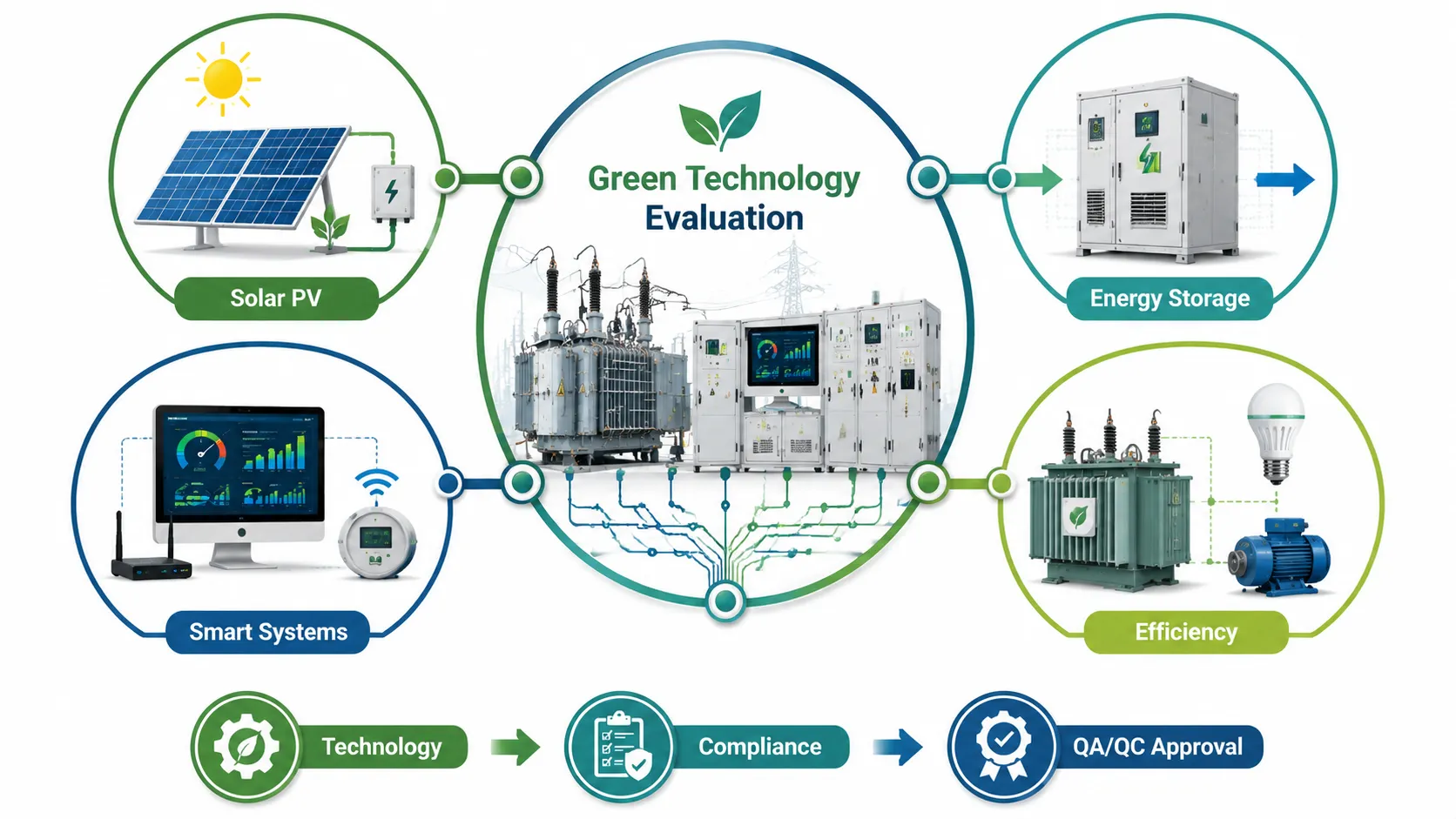
Key Concepts and Definitions of Green Technology Evaluation
| Key Concept | Definition | Application in Electrical QA/QC |
|---|---|---|
| Green Technology | Technology designed to reduce environmental impact and improve efficiency | Evaluating sustainable electrical solutions |
| Energy Efficiency | Achieving required performance using reduced energy consumption | Assessing electrical system performance |
| Renewable Energy Technology | Technology generating energy from naturally replenished sources | Evaluating solar and renewable integration |
| Technology Suitability | The degree to which a technology meets project requirements | Selecting appropriate solutions |
| Compliance Verification | Process of confirming adherence to standards and regulations | Ensuring safe installation and operation |
| Lifecycle Assessment | Evaluation of environmental and operational impact throughout an asset’s life | Supporting sustainable decisions |
| Smart Electrical Systems | Intelligent systems using monitoring and automation technologies | Improving energy management |
| Battery Energy Storage | Technology storing electrical energy for later use | Supporting renewable integration |
| Sustainable Design | Engineering approach considering environmental and lifecycle impacts | Improving project sustainability |
| Quality Performance Evaluation | Assessment of whether systems meet required quality objectives | Measuring technology effectiveness |
Importance of Evaluating Green Technology Suitability
The selection of suitable green technologies is critical because electrical systems operate in complex environments where reliability and safety are essential.
An unsuitable technology may create:
- Reduced system performance.
- Increased maintenance requirements.
- Safety concerns.
- Higher lifecycle costs.
- Poor sustainability outcomes.
QA/QC professionals must therefore evaluate whether a technology is appropriate before integration.
A comprehensive suitability assessment considers:
- Project objectives.
- Electrical load requirements.
- Environmental conditions.
- Existing infrastructure.
- Future expansion needs.
- Maintenance capability.
For example, a solar energy system installed in an area with limited solar availability may not achieve expected performance levels. Similarly, an energy storage system must be evaluated according to demand patterns, safety requirements and operational needs.
Evaluation of Solar Photovoltaic Systems in Electrical QA/QC
Solar photovoltaic (PV) technology is one of the most widely adopted green technologies in electrical systems. It converts solar energy into electrical power and supports renewable energy generation.
However, successful integration requires detailed QA/QC evaluation.
Suitability Assessment of Solar PV Systems
QA/QC professionals should evaluate:
- Available solar resources.
- Electrical load requirements.
- Installation location.
- Structural suitability.
- Grid connection requirements.
Important considerations include:
- Panel orientation.
- Shading conditions.
- Environmental exposure.
- Inverter compatibility.
- Protection requirements.
Compliance Evaluation of Solar PV Systems
Quality control processes should verify:
- Correct equipment specifications.
- Installation quality.
- Electrical protection systems.
- Testing results.
- Performance monitoring.
Inspection activities include:
- Checking panel installation.
- Verifying cable connections.
- Confirming inverter operation.
- Testing system performance.
Benefits of Solar PV Integration
Solar PV systems provide:
- Reduced dependency on conventional energy sources.
- Lower operational emissions.
- Improved energy sustainability.
- Long-term energy cost benefits.
However, QA/QC controls are essential to ensure reliable operation.
Evaluation of Battery Energy Storage Systems (BESS)
Battery energy storage systems are increasingly integrated into electrical networks to improve energy management and support renewable energy solutions.
BESS technology allows organisations to:
- Store excess energy.
- Improve power management.
- Support renewable generation.
- Enhance system resilience.
Suitability Considerations for BESS
QA/QC evaluation should examine:
- Storage capacity requirements.
- Charging and discharging performance.
- Safety systems.
- Environmental conditions.
- Integration with electrical infrastructure.
Key evaluation factors include:
- Battery performance.
- Thermal management.
- Protection systems.
- Monitoring capability.
Compliance Requirements for Battery Systems
QA/QC teams must verify:
- Correct installation practices.
- Safety controls.
- Electrical connections.
- Monitoring systems.
- Manufacturer requirements.
Poorly integrated battery systems may create:
- Safety risks.
- Reduced performance.
- Operational failures.
Therefore, compliance verification is essential.
Evaluation of Smart Grid and Intelligent Monitoring Technologies
Smart electrical technologies improve system visibility by using digital monitoring, automation and data analysis.
Examples include:
- Smart meters.
- Energy monitoring platforms.
- Automated control systems.
- Digital energy management solutions.
These technologies support sustainability by:
- Improving energy awareness.
- Reducing unnecessary consumption.
- Supporting predictive maintenance.
QA/QC Evaluation Requirements
Professionals should assess:
- Data accuracy.
- Communication reliability.
- Cybersecurity considerations.
- Integration capability.
Quality checks should confirm:
- Correct installation.
- Accurate measurement.
- Reliable data transmission.
Evaluation of Energy-Efficient Electrical Equipment
Energy-efficient electrical equipment includes:
- High-efficiency motors.
- Efficient transformers.
- LED lighting systems.
- Advanced control equipment.
These technologies reduce energy consumption while maintaining required performance.
Suitability Assessment
QA/QC professionals should evaluate:
- Equipment efficiency ratings.
- Operational requirements.
- Compatibility with existing systems.
- Maintenance requirements.
Compliance Verification
Quality checks should include:
- Equipment certification.
- Installation verification.
- Performance testing.
- Operational monitoring.
Evaluation of LED Lighting Systems
LED lighting represents a widely used energy-efficient solution.
Benefits include:
- Reduced energy consumption.
- Longer operational life.
- Lower maintenance requirements.
QA/QC evaluation should verify:
- Correct lighting levels.
- Electrical compatibility.
- Installation quality.
- Control system operation.
Building Energy Management Systems (BEMS)
Building Energy Management Systems use digital technologies to monitor and control energy consumption.
They integrate:
- Sensors.
- Control systems.
- Data analytics.
- Automated responses.
Suitability Evaluation
QA/QC professionals should consider:
- Building requirements.
- System compatibility.
- Monitoring objectives.
- User requirements.
Compliance Assessment
Evaluation includes:
- Sensor accuracy.
- Control operation.
- Data reliability.
- System integration.
Green Technology Compliance Evaluation Process
A structured evaluation process helps organisations select and integrate appropriate technologies.
Step 1: Define Project Requirements
The first stage involves understanding:
- Energy objectives.
- Technical requirements.
- Sustainability targets.
- Operational expectations.
Step 2: Assess Technology Suitability
The technology should be evaluated against:
- Performance requirements.
- Environmental conditions.
- Compatibility needs.
- Lifecycle expectations.
Step 3: Review Compliance Requirements
QA/QC teams verify:
- Applicable standards.
- Safety requirements.
- Manufacturer specifications.
- Installation procedures.
Step 4: Conduct Risk Assessment
Potential risks should be identified, including:
- Technical failures.
- Integration challenges.
- Maintenance limitations.
- Safety concerns.
Step 5: Monitor Performance
After installation, performance should be reviewed through:
- Testing.
- Data monitoring.
- Inspection reports.
- Maintenance records.
Practical Example: Green Technology Integration in a Commercial Electrical Project
Project Background
A large commercial facility plans to reduce energy consumption by integrating solar PV systems, LED lighting and intelligent energy monitoring technology.
QA/QC Evaluation Process
The QA/QC team evaluates:
- System compatibility.
- Equipment quality.
- Installation requirements.
- Performance expectations.
Identified Challenges
The project faces:
- Existing infrastructure limitations.
- Integration requirements.
- Maintenance planning concerns.
Quality Improvement Actions
The organisation implements:
- Detailed design reviews.
- Equipment verification.
- Installation inspections.
- Performance testing.
Results
The project achieves:
- Improved energy efficiency.
- Reduced operational consumption.
- Better system monitoring.
- Enhanced sustainability performance.
Case Study: Evaluating Green Technology Integration in an Industrial Electrical System
Background
An industrial organisation wants to reduce energy costs and environmental impact by introducing renewable energy and smart monitoring technologies.
Evaluation Process
The QA/QC team reviews:
- Existing electrical capacity.
- Energy consumption patterns.
- Technology compatibility.
- Compliance requirements.
Findings
The evaluation identifies:
- Suitable solar installation opportunities.
- Need for improved monitoring.
- Requirement for upgraded protection systems.
Implementation Strategy
The organisation introduces:
- Solar PV generation.
- Intelligent energy monitoring.
- Improved electrical protection.
Outcomes
The project achieves:
- Reduced energy consumption.
- Improved operational visibility.
- Better sustainability performance.
- Increased system reliability.
Case Study Conclusion
The case demonstrates that green technologies can significantly improve electrical system sustainability when they are carefully evaluated for suitability, compliance and lifecycle performance.
Key Benefits of Evaluating Green Technologies for Electrical Systems
Effective evaluation provides:
- Improved technology selection.
- Reduced integration risks.
- Enhanced energy efficiency.
- Better regulatory compliance.
- Improved system reliability.
- Reduced environmental impact.
- Lower operational costs.
- Increased asset lifecycle value.
- Better sustainability performance.
- Improved stakeholder confidence.
Key Learning Points
Learners should understand that:
- Green technologies must be evaluated before electrical integration.
- Sustainability benefits must be balanced with technical requirements.
- QA/QC frameworks are essential for successful green technology implementation.
- Solar PV, storage systems and smart technologies require detailed verification.
- Compliance evaluation ensures safe and reliable operation.
- Lifecycle assessment supports sustainable decision-making.
- Energy-efficient equipment improves long-term performance.
- Digital monitoring technologies enhance sustainability management.
- Technology suitability depends on project-specific conditions.
- Effective QA/QC ensures sustainable electrical outcomes.
Conclusion
Critically evaluating the suitability and compliance of green technologies is essential for modern electrical QA/QC professionals. Sustainable technologies provide significant opportunities to improve energy efficiency, reduce environmental impact and enhance electrical system performance. However, successful integration requires careful assessment of technical compatibility, regulatory compliance, safety requirements and lifecycle performance.
By applying structured QA/QC evaluation methods, organisations can ensure that green technologies deliver their intended benefits while maintaining reliability, safety and operational excellence. The integration of sustainable technologies within electrical quality frameworks represents a strategic approach towards achieving efficient, resilient and environmentally responsible electrical systems.
2: Design a QA/QC Framework That Effectively Incorporates and Monitors Specific Energy-Efficient Solutions and Technologies
The increasing demand for sustainable electrical systems has transformed the role of Quality Assurance and Quality Control (QA/QC) professionals. Modern electrical projects are no longer assessed only by their ability to meet technical specifications; they are also evaluated according to their energy efficiency, environmental performance, lifecycle value and contribution to organisational sustainability objectives.
Designing an effective QA/QC framework for energy-efficient electrical solutions requires a structured approach that integrates quality management principles with sustainability requirements. Such a framework must ensure that energy-efficient technologies are correctly selected, properly installed, accurately tested and continuously monitored throughout their operational lifecycle.
Energy-efficient solutions, including renewable energy systems, smart monitoring technologies, high-efficiency electrical equipment, intelligent control systems and energy management platforms, require specialised quality controls. Traditional QA/QC frameworks may verify installation compliance, but advanced sustainable frameworks must also measure energy performance, operational efficiency and long-term reliability.
A well-designed sustainable QA/QC framework enables organisations to:
- Verify that energy-efficient technologies perform according to design expectations.
- Monitor energy consumption and system efficiency.
- Identify performance issues at an early stage.
- Reduce operational losses.
- Improve lifecycle performance.
- Support environmental sustainability objectives.
For senior electrical QA/QC engineers, the challenge is to develop quality frameworks that integrate energy efficiency requirements without disrupting existing project processes. This requires careful planning, technical evaluation, performance monitoring and continuous improvement.
Understanding Sustainable QA/QC Framework Design for Energy-Efficient Solutions
A QA/QC framework is a structured system of processes, procedures, responsibilities and performance controls used to ensure that electrical systems achieve defined quality requirements.
When energy-efficient technologies are incorporated, the QA/QC framework must expand beyond traditional quality verification.
A conventional electrical QA/QC framework focuses on:
- Material approval.
- Installation inspection.
- Testing procedures.
- Compliance verification.
- Documentation control.
A sustainable energy-focused QA/QC framework additionally considers:
- Energy performance.
- Resource efficiency.
- Environmental impact.
- System optimisation.
- Digital monitoring.
- Lifecycle performance.
The framework should ensure that energy-efficient solutions deliver measurable benefits after installation, rather than only meeting initial design requirements.
For example, installing a high-efficiency transformer does not guarantee energy savings unless QA/QC processes verify:
- Correct specification.
- Proper installation.
- Appropriate loading conditions.
- Operational efficiency.
Therefore, monitoring and verification are essential components of sustainable QA/QC systems.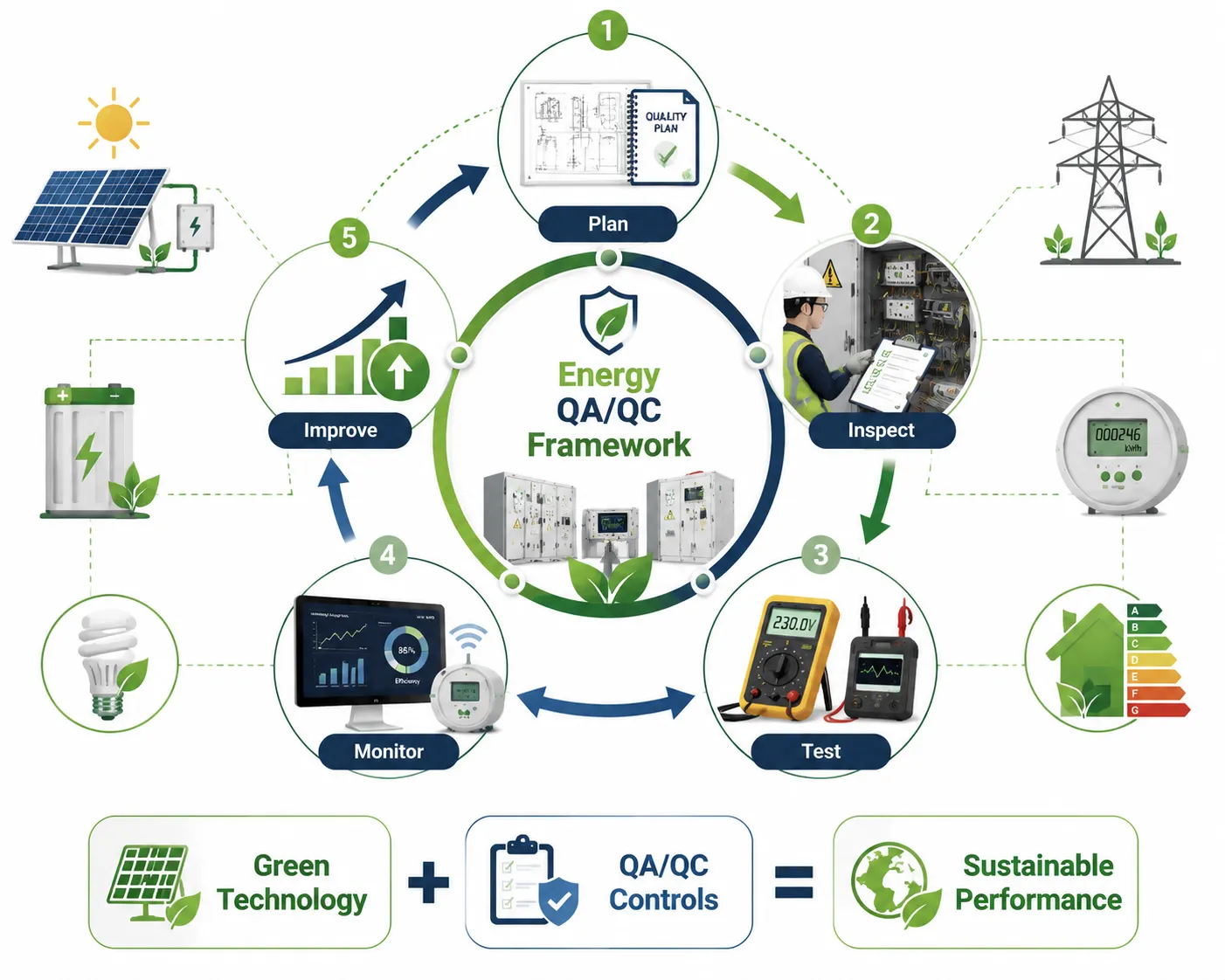
Key Concepts and Definitions of Energy-Efficient QA/QC Frameworks
| Key Concept | Definition | Application in Energy-Efficient Electrical QA/QC |
|---|---|---|
| Sustainable QA/QC Framework | A quality management system integrating technical, environmental and efficiency objectives | Managing quality and sustainability together |
| Energy Performance Verification | Process of confirming actual energy efficiency against expected results | Measuring equipment and system performance |
| Quality Planning | Development of procedures and requirements before project execution | Defining sustainability and quality targets |
| Energy Monitoring System | Technology used to collect and analyse energy performance data | Tracking consumption and efficiency |
| Performance Benchmarking | Comparing actual performance with expected standards | Identifying improvement opportunities |
| Commissioning Verification | Testing process confirming correct operation before handover | Ensuring efficient system performance |
| Digital Quality Management | Use of digital platforms for monitoring and reporting | Improving accuracy and traceability |
| Continuous Improvement | Ongoing enhancement of processes and performance | Maintaining sustainable outcomes |
| Compliance Monitoring | Regular checking against standards and requirements | Ensuring safe and efficient operation |
| Lifecycle Quality Management | Managing quality throughout the asset’s operational life | Improving long-term reliability |
Principles of Designing an Effective Sustainable QA/QC Framework
A successful energy-efficient QA/QC framework should be based on several fundamental principles.
Integration of Quality and Energy Objectives
Energy efficiency should not be treated as a separate project objective. It should be embedded within quality processes.
The framework should define:
- Energy performance requirements.
- Inspection criteria.
- Testing procedures.
- Monitoring methods.
For example, when reviewing electrical equipment specifications, QA/QC teams should evaluate both:
- Technical suitability.
- Energy efficiency performance.
This integrated approach ensures that sustainability becomes part of normal quality management.
Risk-Based Quality Management
Energy-efficient technologies often introduce new technical challenges.
A risk-based framework identifies potential issues before implementation.
Key risks may include:
- Technology compatibility problems.
- Incorrect installation.
- Poor commissioning.
- Monitoring failures.
- Unexpected energy performance.
Risk-based QA/QC includes:
- Early risk identification.
- Preventive controls.
- Performance monitoring.
- Corrective actions.
Data-Driven Decision Making
Modern energy-efficient systems generate significant performance data.
QA/QC frameworks should use this information to:
- Analyse energy consumption.
- Identify inefficiencies.
- Improve system performance.
Data sources may include:
- Smart meters.
- Energy monitoring platforms.
- Building management systems.
- Equipment sensors.
Designing the Structure of an Energy-Efficient QA/QC Framework
An effective framework should contain several interconnected components.
Quality Planning and Energy Performance Requirements
The planning stage establishes the foundation for successful implementation.
QA/QC teams should define:
- Energy efficiency objectives.
- Technical specifications.
- Performance requirements.
- Acceptance criteria.
Planning activities include:
- Reviewing project sustainability goals.
- Identifying applicable standards.
- Establishing inspection requirements.
- Defining monitoring methods.
A detailed quality plan should include:
- Equipment approval procedures.
- Installation requirements.
- Testing methods.
- Reporting requirements.
Equipment Selection and Verification Controls
Energy-efficient equipment requires careful evaluation before approval.
QA/QC verification should assess:
- Manufacturer information.
- Efficiency ratings.
- Certification documents.
- Technical compatibility.
Examples include:
High-Efficiency Transformers
Evaluation criteria:
- Energy loss performance.
- Load efficiency.
- Thermal performance.
- Installation requirements.
Energy-Efficient Motors
Evaluation criteria:
- Efficiency classification.
- Operating conditions.
- Control compatibility.
- Maintenance requirements.
LED Lighting Systems
Evaluation criteria:
- Energy consumption.
- Lighting performance.
- Control integration.
- Installation quality.
Inspection Procedures for Energy-Efficient Technologies
Inspection processes should verify that installations meet both technical and sustainability requirements.
Inspection activities include:
- Checking equipment installation.
- Verifying connections.
- Reviewing installation quality.
- Confirming manufacturer requirements.
For renewable energy systems, inspections may include:
- Panel positioning.
- Inverter installation.
- Protection systems.
- Cable routing.
For smart systems:
- Sensor placement.
- Communication connections.
- Data accuracy.
Testing and Commissioning Controls
Testing and commissioning are critical stages for confirming energy efficiency.
The QA/QC framework should establish:
- Testing procedures.
- Acceptance criteria.
- Performance measurement methods.
Testing activities include:
- Electrical safety testing.
- Functional testing.
- Energy performance measurement.
- System integration testing.
For example, a building energy management system should be tested to confirm:
- Accurate monitoring.
- Correct automated responses.
- Reliable communication.
Monitoring and Measurement Framework
Continuous monitoring is essential because energy efficiency must be maintained throughout operation.
A sustainable QA/QC framework should include:
- Performance monitoring systems.
- Data collection methods.
- Reporting procedures.
Monitoring should evaluate:
- Energy consumption.
- Equipment efficiency.
- System performance.
- Operational trends.
Benefits include:
- Early identification of problems.
- Improved maintenance decisions.
- Reduced energy losses.
Integrating Digital Technologies into QA/QC Frameworks
Digital technologies significantly improve sustainable QA/QC management.
Examples include:
- Digital inspection applications.
- Cloud-based quality platforms.
- Energy monitoring dashboards.
- Automated reporting systems.
Digital integration provides:
- Real-time information.
- Improved traceability.
- Faster decision-making.
- Better performance analysis.
For example, smart energy monitoring systems can identify unexpected energy increases, allowing QA/QC teams to investigate potential issues.
Developing QA/QC Controls for Specific Energy-Efficient Technologies
Solar Photovoltaic QA/QC Framework Requirements
A solar PV quality framework should include:
- Design verification.
- Equipment inspection.
- Installation monitoring.
- Performance testing.
Important controls:
- Panel quality checks.
- Inverter verification.
- Cable inspection.
- Output performance testing.
Battery Energy Storage System QA/QC Requirements
Battery systems require specialised controls.
The framework should monitor:
- Battery capacity.
- Charging performance.
- Thermal conditions.
- Safety systems.
Quality controls include:
- Installation verification.
- Protection testing.
- Performance monitoring.
Smart Energy Management System QA/QC Requirements
Smart systems require evaluation of:
- Data accuracy.
- Communication reliability.
- Automation performance.
Controls include:
- Sensor testing.
- Software verification.
- Data validation.
Energy-Efficient Equipment QA/QC Requirements
The framework should verify:
- Equipment efficiency ratings.
- Correct installation.
- Operational performance.
Examples:
- Efficient motors.
- Modern transformers.
- Intelligent lighting controls.
Compliance and Standards Verification
A sustainable QA/QC framework must ensure compliance with:
- Electrical safety requirements.
- Manufacturer specifications.
- Project standards.
- Energy performance requirements.
Compliance verification includes:
- Reviewing certificates.
- Checking test results.
- Confirming installation quality.
- Maintaining records.
This ensures that energy-efficient technologies operate safely and effectively.
Practical Example: Implementing an Energy-Efficient QA/QC Framework in a Commercial Building Project
Project Background
A commercial building project aims to reduce energy consumption by installing:
- Solar PV systems.
- Smart energy monitoring.
- Energy-efficient lighting.
Existing Challenge
The project team requires a QA/QC framework capable of monitoring sustainability performance.
Framework Development
The QA/QC team introduces:
- Energy performance criteria.
- Digital inspection procedures.
- Commissioning verification.
- Continuous monitoring.
Implementation Process
The team performs:
- Equipment approval checks.
- Installation inspections.
- Performance testing.
- Data analysis.
Results
The project achieves:
- Improved energy monitoring.
- Reduced consumption.
- Better operational control.
- Increased sustainability performance.
Case Study: Sustainable QA/QC Framework for Industrial Energy Efficiency
Background
An industrial facility wanted to improve energy performance by introducing advanced electrical efficiency technologies.
The organisation implemented:
- High-efficiency motors.
- Smart monitoring systems.
- Automated controls.
QA/QC Evaluation
The quality team developed controls for:
- Equipment selection.
- Installation verification.
- Performance monitoring.
Challenges Identified
The project experienced:
- Integration issues.
- Data monitoring limitations.
- Operational adjustment requirements.
Improvement Actions
The organisation introduced:
- Improved testing procedures.
- Digital performance dashboards.
- Regular quality reviews.
Outcomes
The facility achieved:
- Improved energy efficiency.
- Reduced operational losses.
- Better equipment reliability.
- Improved sustainability reporting.
Case Study Conclusion
The case demonstrates that an effective QA/QC framework enables organisations to successfully integrate energy-efficient technologies while maintaining quality, compliance and operational performance.
Key Benefits of Energy-Efficient QA/QC Framework Design
A well-designed framework provides:
- Improved energy performance.
- Reduced operational costs.
- Better technology integration.
- Enhanced compliance.
- Improved system reliability.
- Reduced environmental impact.
- Better monitoring capability.
- Increased lifecycle value.
- Improved decision-making.
- Stronger sustainability outcomes.
Key Learning Points
Learners should understand that:
- Energy efficiency must be integrated into QA/QC frameworks.
- Sustainable quality systems require performance monitoring.
- Technology selection must consider suitability and compliance.
- Digital tools improve energy performance management.
- Testing and commissioning verify sustainability outcomes.
- Continuous monitoring maintains efficiency.
- Risk-based approaches reduce integration problems.
- Lifecycle thinking improves long-term value.
- Data-driven decisions support sustainable improvement.
- Effective QA/QC frameworks enable successful green technology adoption.
Conclusion
Designing a QA/QC framework that incorporates and monitors energy-efficient solutions requires a combination of technical expertise, sustainability knowledge and advanced quality management principles. Modern electrical systems require frameworks that evaluate not only whether installations comply with specifications but also whether they deliver measurable energy and environmental benefits.
By integrating energy performance requirements, digital monitoring, verification procedures and continuous improvement processes, organisations can develop sustainable QA/QC systems that support reliable, efficient and future-ready electrical infrastructure. A strong energy-focused QA/QC framework ensures that green technologies achieve their intended purpose while maintaining safety, compliance and long-term operational excellence.
3: Implement Practical Quality Control Measures to Verify the Performance and Safety of Integrated Green Technologies
The integration of green technologies into complex electrical systems has significantly changed the responsibilities of electrical Quality Assurance and Quality Control (QA/QC) professionals. Modern sustainable electrical projects require more than traditional installation checks and compliance verification. QA/QC frameworks must now ensure that green technologies operate efficiently, safely and reliably throughout their intended lifecycle.
Green technologies such as solar photovoltaic (PV) systems, battery energy storage systems (BESS), smart energy management platforms, energy-efficient electrical equipment and intelligent monitoring systems provide significant sustainability benefits. However, these technologies introduce new technical challenges related to system integration, electrical safety, performance optimisation and long-term reliability.
Practical quality control measures are therefore essential to verify that integrated green technologies achieve their intended objectives. These measures include detailed inspections, performance testing, safety verification, monitoring procedures, data analysis and continuous improvement activities. A successful QA/QC approach ensures that sustainable technologies not only meet design requirements but also deliver measurable improvements in energy efficiency and operational performance.
Senior electrical QA/QC professionals must develop practical verification strategies that consider technical specifications, manufacturer requirements, safety standards, environmental conditions and operational expectations. Effective quality control provides confidence that green technologies are correctly installed, properly commissioned and capable of delivering sustainable value.
Understanding Quality Control Verification for Green Technologies
Quality control verification is the systematic process of confirming that installed green technologies meet specified performance, safety and quality requirements.
In traditional electrical projects, QC verification mainly focuses on:
- Installation accuracy.
- Equipment compliance.
- Electrical testing.
- Safety requirements.
For green technologies, QC verification must additionally evaluate:
- Energy efficiency performance.
- Sustainable operation.
- System integration.
- Long-term reliability.
- Environmental performance.
The purpose of quality control is not only to identify defects but also to ensure that sustainable technologies achieve their expected benefits.
For example, a solar PV system may be correctly installed but still fail to achieve expected energy generation due to:
- Incorrect panel positioning.
- Poor inverter configuration.
- Faulty monitoring systems.
- Incorrect electrical connections.
Therefore, practical QC measures must evaluate both installation quality and operational performance.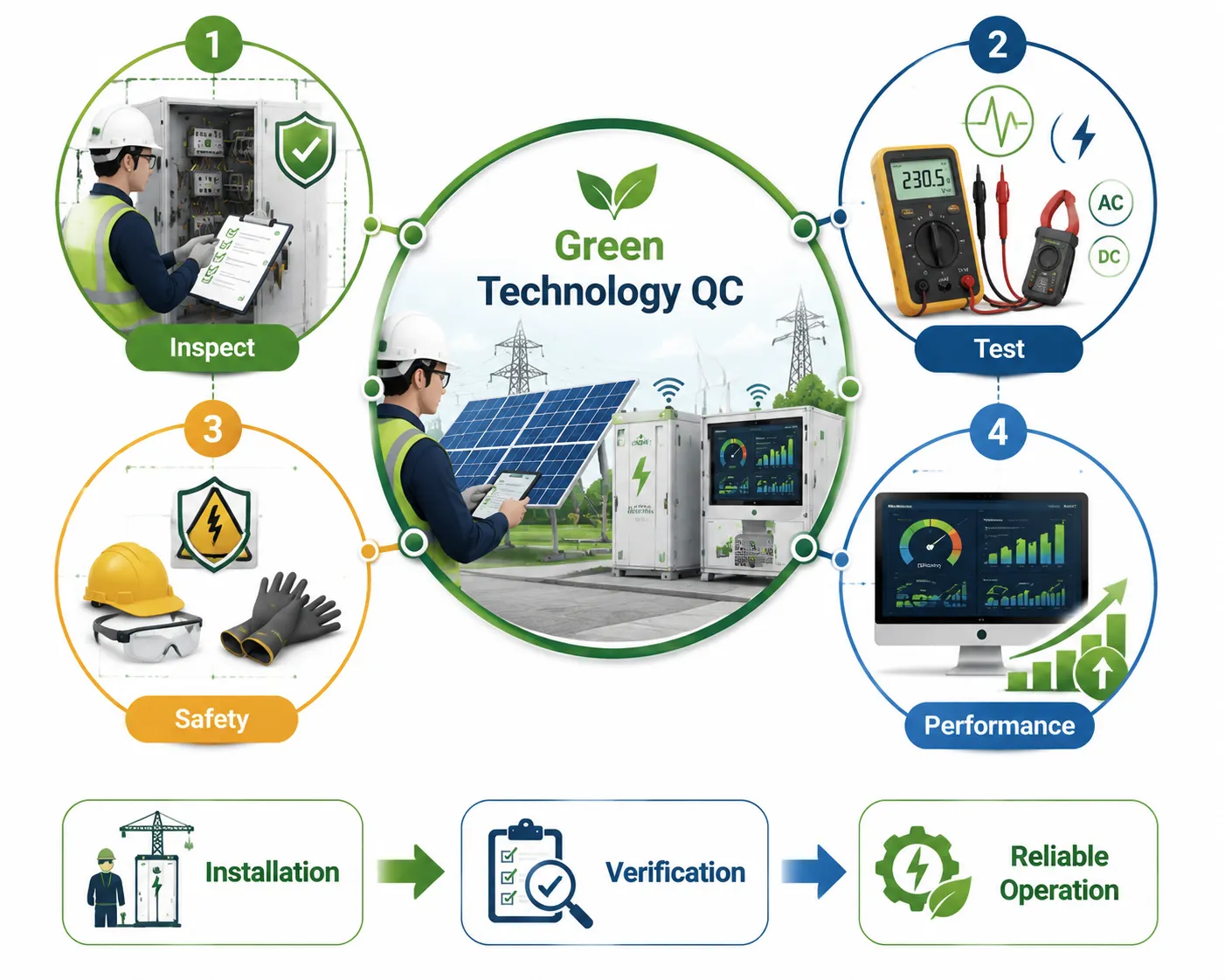
Key Concepts and Definitions of Green Technology Quality Control
| Key Concept | Definition | Application in Green Technology QA/QC |
|---|---|---|
| Performance Verification | Process of confirming that technology operates according to requirements | Measuring energy output and efficiency |
| Safety Verification | Evaluation of systems to confirm safe operation | Checking electrical protection and installation safety |
| Commissioning Testing | Structured testing process before operational handover | Confirming correct system operation |
| Quality Control Measure | Practical activity used to verify compliance and performance | Inspections, testing and monitoring |
| Functional Testing | Assessment of whether equipment performs intended functions | Checking system operation |
| Energy Performance Monitoring | Continuous measurement of energy efficiency | Tracking sustainable performance |
| Non-Conformance Management | Process of identifying and correcting quality failures | Improving reliability |
| Preventive Quality Control | Actions preventing problems before failure occurs | Reducing defects and operational risks |
| System Integration Testing | Verification that multiple technologies operate together correctly | Testing renewable and smart systems |
| Safety Compliance Assessment | Review against safety requirements and standards | Ensuring secure operation |
Importance of Practical Quality Control Measures
Effective quality control measures are essential because green technologies often operate as interconnected systems rather than isolated components.
Poor quality control can result in:
- Reduced energy efficiency.
- Safety hazards.
- Increased maintenance requirements.
- Premature equipment failure.
- Poor sustainability performance.
A comprehensive QC approach ensures:
- Equipment is installed correctly.
- Systems operate safely.
- Performance meets expectations.
- Problems are identified early.
The benefits of practical QC verification include:
- Improved system reliability.
- Reduced operational risks.
- Increased energy savings.
- Better lifecycle performance.
- Enhanced stakeholder confidence.
Establishing Quality Control Procedures for Green Technology Integration
A structured QC process should be established before installation begins.
The quality control framework should define:
- Inspection requirements.
- Testing procedures.
- Acceptance criteria.
- Responsibilities.
- Documentation requirements.
Key stages include:
- Pre-installation verification.
- Installation inspection.
- Functional testing.
- Performance testing.
- Safety assessment.
- Continuous monitoring.
This structured approach ensures that every stage of technology integration is controlled and verified.
Pre-Installation Quality Control Measures
Pre-installation checks establish whether the selected technology and project conditions are suitable.
QA/QC professionals should verify:
- Approved equipment specifications.
- Manufacturer documentation.
- Design compatibility.
- Installation requirements.
Important activities include:
- Reviewing technical drawings.
- Checking equipment certification.
- Confirming environmental conditions.
- Assessing installation locations.
For example, before installing solar PV systems, QA/QC teams should verify:
- Roof structural suitability.
- Solar exposure conditions.
- Electrical connection requirements.
- Inverter compatibility.
Inspection Measures for Solar Photovoltaic Systems
Solar PV systems require detailed quality control because their performance depends on multiple interconnected factors.
PV Module Inspection
Quality checks should verify:
- Correct module specifications.
- Physical condition.
- Installation alignment.
- Secure mounting.
Inspectors should check:
- No visible damage.
- Correct orientation.
- Proper spacing.
- Secure fixing systems.
Inverter Quality Verification
Inverters are critical components that convert DC power into usable AC power.
QC measures include:
- Checking inverter specifications.
- Confirming installation requirements.
- Testing operational functions.
Verification should include:
- Input and output testing.
- Protection system checks.
- Communication testing.
Cable and Connection Inspection
Electrical connections significantly influence PV system safety and performance.
QC inspections should verify:
- Correct cable sizing.
- Proper termination.
- Protection against environmental conditions.
- Secure connections.
Poor cable installation may cause:
- Energy losses.
- Overheating.
- System failure.
Quality Control Measures for Battery Energy Storage Systems
Battery energy storage systems require advanced quality control due to their electrical and safety characteristics.
QC verification should focus on:
- Battery installation.
- Charging performance.
- Safety controls.
- Monitoring systems.
Battery Installation Verification
Inspectors should check:
- Correct placement.
- Ventilation requirements.
- Electrical connections.
- Protection systems.
Performance Testing
Testing should evaluate:
- Charging efficiency.
- Discharge performance.
- Storage capacity.
- System response.
Safety Verification
Battery safety checks include:
- Thermal management.
- Protection devices.
- Emergency shutdown systems.
These controls reduce risks associated with:
- Overheating.
- Electrical faults.
- Equipment damage.
Quality Control Measures for Smart Energy Management Systems
Smart energy systems depend on accurate monitoring and automated control.
QC verification should evaluate:
- Sensor accuracy.
- Data reliability.
- Communication performance.
- Control operation.
Practical QC activities include:
- Testing sensors.
- Verifying communication networks.
- Checking software functionality.
- Confirming data accuracy.
Incorrect monitoring information can lead to:
- Poor energy decisions.
- Inefficient operation.
- Reduced sustainability benefits.
Verification of Energy-Efficient Electrical Equipment
Energy-efficient equipment requires quality verification to confirm expected performance.
Examples include:
- High-efficiency transformers.
- Efficient motors.
- LED lighting systems.
- Intelligent control devices.
QC measures include:
- Checking efficiency ratings.
- Confirming installation standards.
- Testing operational performance.
Testing and Commissioning Procedures
Testing and commissioning are critical stages for verifying green technology performance.
A comprehensive commissioning process should include:
- Functional testing.
- Safety testing.
- Performance measurement.
- System integration testing.
The purpose is to confirm:
- Equipment operates correctly.
- Systems communicate effectively.
- Energy targets are achieved.
- Safety requirements are satisfied.
Functional Testing
Functional testing verifies whether systems perform intended operations.
Examples:
Solar PV:
- Power generation verification.
- Inverter operation checks.
Smart systems:
- Sensor response testing.
- Automated control verification.
Battery systems:
- Charging and discharge testing.
Electrical Safety Testing
Safety verification ensures that green technologies do not introduce unacceptable risks.
Safety checks include:
- Insulation resistance testing.
- Earthing verification.
- Protection system testing.
- Fault detection testing.
Safety verification is essential because sustainable technologies still operate within complex electrical environments.
Performance Monitoring and Data Analysis
Continuous monitoring is required to confirm long-term performance.
Monitoring systems should collect:
- Energy production data.
- Consumption information.
- Equipment performance data.
- Fault records.
Data analysis helps identify:
- Performance reduction.
- Equipment issues.
- Energy losses.
Benefits include:
- Early problem detection.
- Improved maintenance planning.
- Better sustainability outcomes.
Digital Tools Supporting Quality Control Verification
Modern digital tools improve the effectiveness of green technology QA/QC.
Examples include:
- Digital inspection platforms.
- Energy monitoring dashboards.
- Remote monitoring systems.
- Automated reporting tools.
Advantages include:
- Real-time information.
- Improved accuracy.
- Faster decision-making.
- Better documentation.
Digital systems allow QA/QC teams to monitor performance continuously rather than relying only on periodic inspections.
Non-Conformance Management and Corrective Actions
During QC verification, problems may be identified.
Examples include:
- Incorrect installation.
- Performance failures.
- Safety issues.
A structured corrective action process should include:
- Identifying the problem.
- Investigating root causes.
- Implementing corrective actions.
- Verifying effectiveness.
Effective corrective action prevents repeated failures and improves system reliability.
Risk-Based Quality Control Approach
Risk-based QC focuses on controlling areas with the highest potential impact.
Risks may include:
- Equipment failure.
- Incorrect installation.
- Safety hazards.
- Integration problems.
Risk-based measures include:
- Prioritised inspections.
- Enhanced testing.
- Additional monitoring.
This approach improves efficiency by focusing resources where they are most needed.
Practical Example: Quality Verification of a Solar Energy Integration Project
Project Background
A commercial facility installs a large solar PV system to reduce energy consumption.
QC Challenges
The project team must verify:
- Installation quality.
- Electrical safety.
- Energy performance.
Quality Control Measures
The QA/QC team implements:
- Equipment inspections.
- Cable verification.
- Inverter testing.
- Performance monitoring.
Results
The system achieves:
- Reliable energy generation.
- Improved operational efficiency.
- Reduced energy costs.
- Enhanced sustainability performance.
Case Study: Implementing QC Measures for Integrated Green Technologies
Background
An industrial facility integrates solar PV, battery storage and smart energy monitoring technologies.
The organisation requires a quality system to verify safety and performance.
Quality Control Approach
The QA/QC team develops:
- Installation inspection procedures.
- Commissioning requirements.
- Performance monitoring processes.
- Safety verification methods.
Challenges
The project faces:
- Technology integration issues.
- Communication failures.
- Performance monitoring limitations.
Improvement Actions
The organisation introduces:
- Advanced testing procedures.
- Digital monitoring systems.
- Regular performance reviews.
Outcomes
The project achieves:
- Improved energy efficiency.
- Safer operation.
- Reduced operational risks.
- Better sustainability reporting.
Case Study Conclusion
The case demonstrates that practical QC measures are essential for ensuring green technologies achieve their intended performance and safety objectives. Effective verification processes protect investment, improve reliability and maximise sustainability benefits.
Key Benefits of Implementing Practical QC Measures
Effective quality control verification provides:
- Improved green technology reliability.
- Enhanced electrical safety.
- Better energy efficiency.
- Reduced operational failures.
- Lower maintenance requirements.
- Improved compliance.
- Increased lifecycle value.
- Better sustainability performance.
- Reduced environmental impact.
- Greater stakeholder confidence.
Key Learning Points
Learners should understand that:
- Green technologies require specialised QC verification.
- Performance and safety must be assessed together.
- Testing and commissioning confirm system effectiveness.
- Digital monitoring improves quality control.
- Preventive inspections reduce failures.
- Data analysis supports continuous improvement.
- Solar, battery and smart technologies require different QC approaches.
- Safety verification remains essential in sustainable systems.
- Corrective actions improve long-term reliability.
- Effective QA/QC ensures successful green technology integration.
Conclusion
Implementing practical quality control measures for integrated green technologies is essential for achieving safe, reliable and efficient electrical systems. Sustainable technologies provide significant environmental and operational benefits, but these benefits can only be achieved when systems are properly inspected, tested, monitored and maintained.
Advanced electrical QA/QC frameworks must combine traditional quality principles with sustainability-focused verification methods. Through effective inspections, performance testing, safety assessments and continuous monitoring, organisations can ensure that green technologies deliver maximum value while supporting energy efficiency, operational reliability and long-term sustainability goals.
4: Adapt Existing QA/QC Frameworks to Accommodate the Unique Interacting Factors of Renewable or Energy-Efficient Installations
The rapid development of renewable energy systems and energy-efficient electrical technologies has created new challenges for traditional Quality Assurance and Quality Control (QA/QC) frameworks. Conventional electrical QA/QC systems were primarily developed to verify compliance with installation standards, equipment specifications and safety requirements. However, modern sustainable electrical installations involve complex interactions between renewable energy generation, energy storage, digital monitoring systems, intelligent controls and existing electrical infrastructure.
To ensure successful implementation of sustainable technologies, organisations must adapt existing QA/QC frameworks rather than relying only on traditional quality processes. Renewable and energy-efficient installations introduce unique factors such as variable energy generation, advanced electronic components, communication networks, environmental influences and lifecycle performance requirements. These factors require updated inspection procedures, improved testing methods, enhanced documentation systems and continuous performance monitoring.
For senior electrical QA/QC professionals, adapting quality frameworks means creating flexible systems capable of managing both traditional electrical requirements and emerging sustainability objectives. The adapted framework must ensure that renewable and energy-efficient technologies achieve safe operation, reliable performance and measurable energy efficiency throughout their lifecycle.
An effective adapted QA/QC framework allows organisations to:
- Manage complex technology interactions.
- Verify sustainable performance.
- Improve system reliability.
- Reduce operational risks.
- Ensure regulatory compliance.
- Support long-term energy efficiency.
The integration of renewable technologies is not simply an equipment installation process; it is a complete system transformation requiring advanced quality management strategies.
Understanding the Need for QA/QC Framework Adaptation
Existing electrical QA/QC frameworks are designed around predictable systems where equipment behaviour, operating conditions and performance requirements are generally stable. Renewable and energy-efficient technologies introduce additional variables that require a more dynamic quality management approach.
Examples of these changes include:
- Solar PV systems producing variable energy depending on weather conditions.
- Battery systems requiring advanced safety monitoring.
- Smart energy systems depending on communication networks.
- Intelligent controls requiring software verification.
- Energy-efficient equipment requiring performance validation.
Traditional QA/QC approaches may verify whether equipment is installed correctly, but adapted frameworks must also confirm:
- Whether systems interact correctly.
- Whether energy performance targets are achieved.
- Whether digital controls operate effectively.
- Whether safety risks are controlled.
- Whether long-term performance is maintained.
Therefore, QA/QC frameworks must evolve from installation-focused systems into lifecycle-based performance management systems.
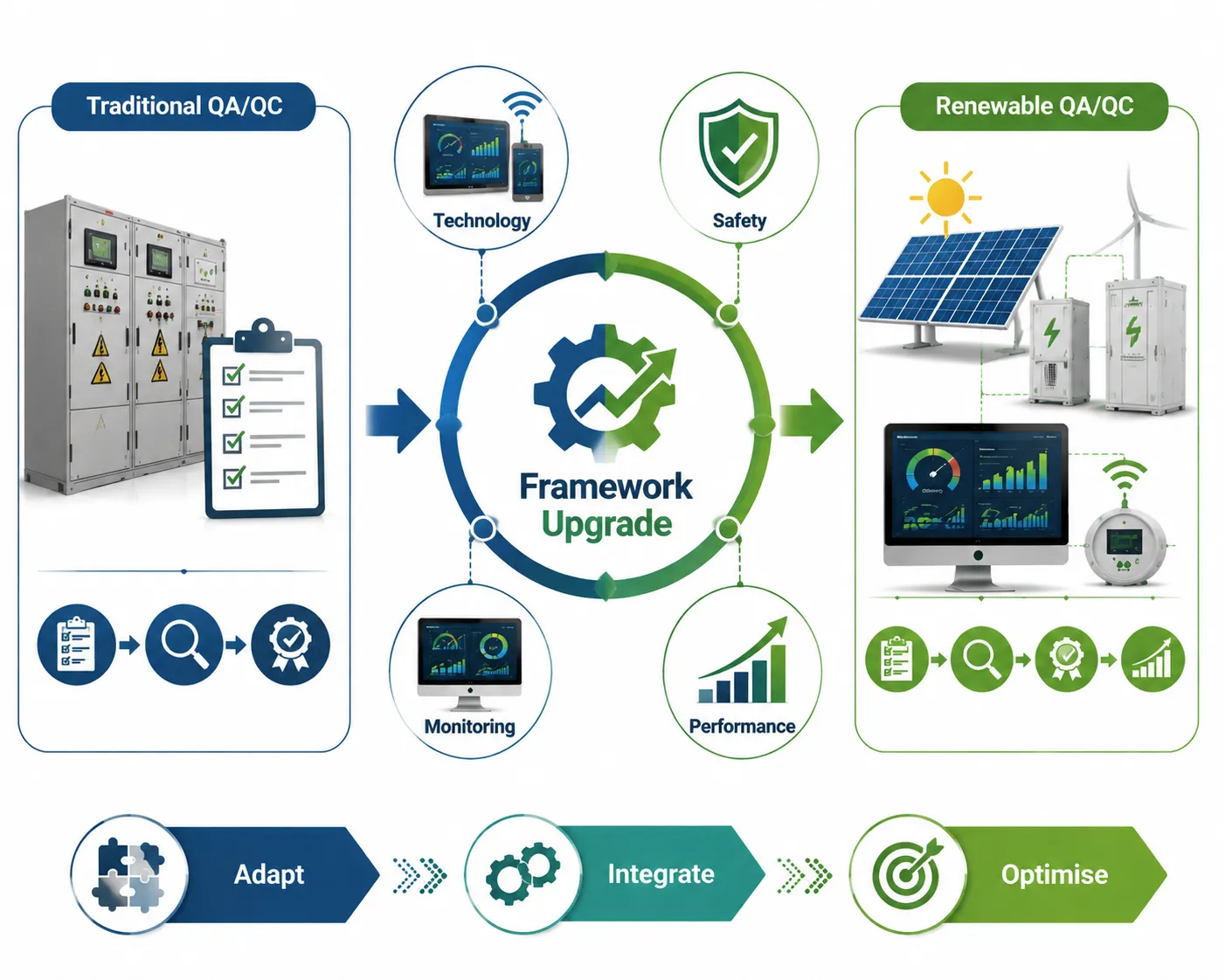
Key Concepts and Definitions for Adapted Renewable Energy QA/QC Frameworks
| Key Concept | Definition | Application in Renewable and Energy-Efficient Installations |
|---|---|---|
| Adaptive QA/QC Framework | A flexible quality system modified to address changing technology requirements | Adjusting inspection and testing procedures for sustainable technologies |
| Renewable Energy Integration | Incorporating renewable generation systems into electrical infrastructure | Managing solar PV and other renewable technologies |
| System Interoperability | Ability of different technologies to operate together effectively | Ensuring communication between devices and systems |
| Lifecycle Quality Management | Managing quality throughout the complete operational life of assets | Maintaining long-term system reliability |
| Performance Verification | Confirming systems achieve expected operational outcomes | Measuring energy efficiency and generation performance |
| Technology Interaction Risk | Potential problems caused by integration between different systems | Managing compatibility issues |
| Digital Quality Monitoring | Use of technology to collect and analyse performance information | Supporting real-time monitoring |
| Energy Efficiency Validation | Confirming that energy-saving technologies achieve expected benefits | Measuring actual energy reduction |
| Sustainable Commissioning | Testing and confirming sustainable systems before operation | Verifying renewable system performance |
| Continuous Quality Improvement | Ongoing enhancement of processes based on performance data | Improving sustainable system operation |
Challenges Requiring QA/QC Framework Adaptation
Renewable and energy-efficient installations create several interacting factors that traditional QA/QC frameworks may not adequately address.
Variable Energy Generation
Renewable technologies such as solar PV systems depend on environmental conditions.
Factors affecting performance include:
- Weather conditions.
- Seasonal variations.
- Solar availability.
- Temperature changes.
QA/QC frameworks must therefore include:
- Performance monitoring.
- Environmental condition assessment.
- Energy output verification.
Traditional installation inspections are not enough because a correctly installed system may still underperform due to environmental factors.
Advanced Electronic Components
Modern sustainable electrical systems include sophisticated electronic equipment such as:
- Inverters.
- Smart controllers.
- Battery management systems.
- Digital monitoring devices.
These components require additional quality controls because failures may occur due to:
- Software issues.
- Communication problems.
- Configuration errors.
- Electronic faults.
Adapted QA/QC procedures should include:
- Software verification.
- Configuration checks.
- Functional testing.
- Communication testing.
Integration with Existing Electrical Infrastructure
Renewable technologies must operate alongside existing electrical systems.
Potential challenges include:
- Grid compatibility.
- Protection coordination.
- Load management.
- Power quality issues.
QA/QC frameworks should evaluate:
- System compatibility.
- Electrical protection performance.
- Integration risks.
Environmental Exposure Factors
Many renewable technologies operate in challenging environments.
Examples include:
- Outdoor solar installations.
- Battery storage facilities.
- Industrial energy systems.
QA/QC frameworks should consider:
- Weather resistance.
- Corrosion protection.
- Temperature effects.
- Physical protection.
Adapting Quality Planning Procedures
Quality planning is the foundation of an effective QA/QC framework.
Existing quality plans should be modified to include sustainability requirements.
Adapted quality planning should define:
- Renewable technology specifications.
- Energy performance targets.
- Testing requirements.
- Monitoring responsibilities.
- Acceptance criteria.
The planning stage should involve:
- Engineering teams.
- Sustainability specialists.
- Installation contractors.
- Equipment suppliers.
This collaborative approach ensures that all technology interactions are considered.
Updating Inspection Procedures for Renewable Installations
Traditional inspection procedures should be expanded to address renewable technology requirements.
Solar PV Inspection Adaptation
Solar PV quality inspections should include:
- Module condition checks.
- Mounting structure verification.
- Cable routing inspection.
- Inverter installation checks.
- Protection system verification.
Additional sustainability-focused checks include:
- Energy generation expectations.
- Orientation and positioning.
- Environmental suitability.
Battery Storage Inspection Adaptation
Battery systems require enhanced inspection procedures.
Quality checks should include:
- Battery installation condition.
- Ventilation requirements.
- Thermal management systems.
- Safety controls.
Inspectors should verify:
- Correct connections.
- Protection devices.
- Monitoring systems.
- Emergency procedures.
Smart Energy System Inspection Adaptation
Smart energy systems require inspection of both electrical and digital components.
QA/QC checks should include:
- Sensor installation.
- Communication networks.
- Data accuracy.
- Control functionality.
The framework should verify that digital systems correctly support energy efficiency objectives.
Adapting Testing and Commissioning Procedures
Testing and commissioning requirements must be expanded for renewable and energy-efficient systems.
Traditional testing focuses on:
- Electrical safety.
- Equipment operation.
- Installation compliance.
Adapted testing should include:
- Energy performance testing.
- System interaction testing.
- Digital communication verification.
- Efficiency validation.
Renewable Energy Commissioning
Solar PV commissioning should verify:
- Energy production capability.
- Inverter operation.
- Protection systems.
- Monitoring accuracy.
Battery System Commissioning
Battery commissioning should assess:
- Charging performance.
- Discharging capability.
- Safety functions.
- Control operation.
Smart System Commissioning
Smart technologies require:
- Communication testing.
- Data validation.
- Automation verification.
Managing Technology Compatibility Risks
One of the most important adaptations involves managing interactions between different technologies.
Renewable systems often include:
- Generation equipment.
- Storage systems.
- Monitoring platforms.
- Control systems.
QA/QC frameworks should include compatibility assessments.
Key considerations include:
- Communication protocols.
- Electrical connection requirements.
- Protection coordination.
- Software integration.
Effective compatibility management reduces:
- System failures.
- Performance losses.
- Safety risks.
Enhancing Documentation and Reporting Systems
Renewable technologies require more detailed documentation compared with traditional systems.
Updated QA/QC documentation should include:
- Equipment specifications.
- Testing records.
- Performance data.
- Monitoring reports.
- Maintenance requirements.
Digital documentation systems are particularly valuable because they provide:
- Real-time access.
- Improved traceability.
- Faster reporting.
- Better decision-making.
Integrating Digital Monitoring into QA/QC Frameworks
Digital monitoring is essential for maintaining sustainable system performance.
Monitoring systems provide information about:
- Energy production.
- Energy consumption.
- Equipment condition.
- Performance trends.
QA/QC teams can use this data to:
- Identify faults.
- Predict failures.
- Improve efficiency.
- Plan maintenance.
Digital monitoring transforms QA/QC from a reactive process into a proactive management system.
Risk Management Within Adapted QA/QC Frameworks
Renewable and energy-efficient installations require enhanced risk management approaches.
Common risks include:
- Technology incompatibility.
- Equipment failure.
- Safety issues.
- Poor performance.
Risk management procedures should include:
Risk Identification
Identify potential problems during:
- Design.
- Installation.
- Commissioning.
- Operation.
Risk Evaluation
Assess:
- Likelihood.
- Impact.
- Control effectiveness.
Risk Control
Implement:
- Additional inspections.
- Enhanced testing.
- Monitoring procedures.
Continuous Improvement of Sustainable QA/QC Systems
Adapted QA/QC frameworks should support continuous improvement.
Improvement activities include:
- Reviewing performance data.
- Analysing failures.
- Updating procedures.
- Improving training.
Continuous improvement helps organisations:
- Maintain efficiency.
- Reduce operational risks.
- Improve sustainability outcomes.
Practical Example: Adapting QA/QC Framework for Solar PV and Battery Integration
Project Background
A commercial facility installs a combined solar PV and battery storage system to reduce energy costs.
Existing QA/QC Challenge
The organisation’s traditional QA/QC framework focuses mainly on installation compliance.
However, the new system requires:
- Energy monitoring.
- Battery safety verification.
- System interaction testing.
Framework Adaptation
The QA/QC team introduces:
- Renewable technology inspection procedures.
- Performance testing requirements.
- Digital monitoring controls.
- Enhanced safety verification.
Results
The adapted framework achieves:
- Improved system reliability.
- Better energy performance tracking.
- Reduced operational risks.
- Improved sustainability outcomes.
Case Study: Renewable Energy Quality Management Framework Development
Background
An industrial organisation integrates renewable generation, energy storage and smart monitoring technologies.
The company identifies that its existing QA/QC framework cannot effectively manage technology interactions.
Evaluation Process
The QA/QC team reviews:
- Existing inspection procedures.
- Testing methods.
- Documentation systems.
- Monitoring capabilities.
Identified Issues
The review identifies:
- Limited performance monitoring.
- Insufficient integration testing.
- Lack of renewable-specific inspection criteria.
Improvement Actions
The organisation develops:
- Renewable technology inspection checklists.
- Digital monitoring procedures.
- Advanced commissioning processes.
- Performance evaluation methods.
Outcomes
The organisation achieves:
- Improved technology integration.
- Reduced system failures.
- Better energy efficiency.
- Stronger quality management performance.
Case Study Conclusion
The case demonstrates that adapting QA/QC frameworks is essential for managing the unique challenges created by renewable and energy-efficient installations. A flexible quality system ensures sustainable technologies achieve safe, reliable and efficient operation.
Key Benefits of Adapting QA/QC Frameworks
An adapted QA/QC framework provides:
- Improved renewable technology reliability.
- Better system integration.
- Enhanced safety performance.
- Improved energy efficiency.
- Reduced operational risks.
- Better compliance control.
- Improved lifecycle management.
- Stronger sustainability performance.
- More effective monitoring.
- Continuous improvement capability.
Key Learning Points
Learners should understand that:
- Renewable technologies require specialised QA/QC approaches.
- Traditional quality systems must evolve to address new challenges.
- Technology interactions create additional quality risks.
- Performance monitoring is essential for sustainable systems.
- Digital tools improve quality management.
- Testing procedures must include energy performance verification.
- Documentation requirements increase with system complexity.
- Risk-based approaches improve reliability.
- Continuous improvement strengthens sustainability outcomes.
- Adapted QA/QC frameworks support successful green technology integration.
Conclusion
Adapting existing QA/QC frameworks for renewable and energy-efficient installations is essential for achieving reliable, safe and sustainable electrical systems. Modern green technologies introduce complex interactions between electrical, digital and environmental factors that require advanced quality management approaches.
By modifying inspection procedures, improving testing methods, integrating digital monitoring and strengthening risk management processes, organisations can ensure that renewable and energy-efficient technologies deliver their intended benefits.
A successful adapted QA/QC framework enables electrical engineering organisations to maintain high-quality standards while supporting energy efficiency, environmental responsibility and long-term operational excellence.