
Lesson 7: Lead quality audits and present findings to senior management.
Quality audits are a vital component of effective electrical QA/QC management, providing a structured approach to evaluate the effectiveness of quality systems, project processes and compliance controls. This lesson focuses on developing the skills required to lead professional quality audits, assess technical and operational performance, identify areas for improvement and ensure that electrical engineering activities meet established quality requirements. Effective audit leadership requires strong analytical ability, technical understanding and the capability to evaluate evidence objectively while maintaining professional independence.
In complex electrical projects, quality auditors play an important role in identifying risks, analysing non-conformities and supporting continual improvement. This lesson explores key audit processes, including audit planning, evidence collection, compliance evaluation, root cause analysis and corrective action review. Learners will understand how to assess inspection records, testing documentation, quality procedures and project controls to determine whether quality objectives are being achieved. The ability to transform audit findings into clear and meaningful information is essential for improving project performance and strengthening quality management systems.
Presenting audit findings to senior management requires more than reporting technical observations; it involves communicating risks, impacts and improvement recommendations in a strategic manner. This lesson develops the ability to prepare professional audit reports, present findings effectively and support leadership decision-making through accurate quality information. By mastering quality audit leadership and management reporting techniques, professionals can enhance compliance, improve stakeholder confidence and contribute to long-term electrical project reliability and continuous improvement.
1: Establish Advanced Procedures for Leading Comprehensive Quality Audits in Complex Electrical Workplace Settings
Quality audits are a critical management activity within complex electrical engineering environments, providing a systematic method for evaluating whether quality systems, technical processes and project activities are achieving required performance standards. In advanced electrical QA/QC environments, leading an audit requires a structured approach that combines technical knowledge, auditing principles, risk assessment, evidence evaluation and effective communication.
A comprehensive quality audit is not limited to identifying defects or non-conformities. It evaluates the effectiveness of quality management processes, verifies compliance with approved requirements and determines whether existing controls are capable of delivering consistent and reliable outcomes. Professional audit leaders must establish advanced procedures that allow audits to be conducted objectively, efficiently and in alignment with organisational quality objectives.
Electrical workplaces present unique audit challenges due to the complexity of systems, safety requirements, technical documentation and multiple stakeholder interactions. From electrical installation projects and manufacturing environments to commissioning activities and maintenance operations, audits must consider technical accuracy, regulatory compliance, operational risks and continuous improvement opportunities.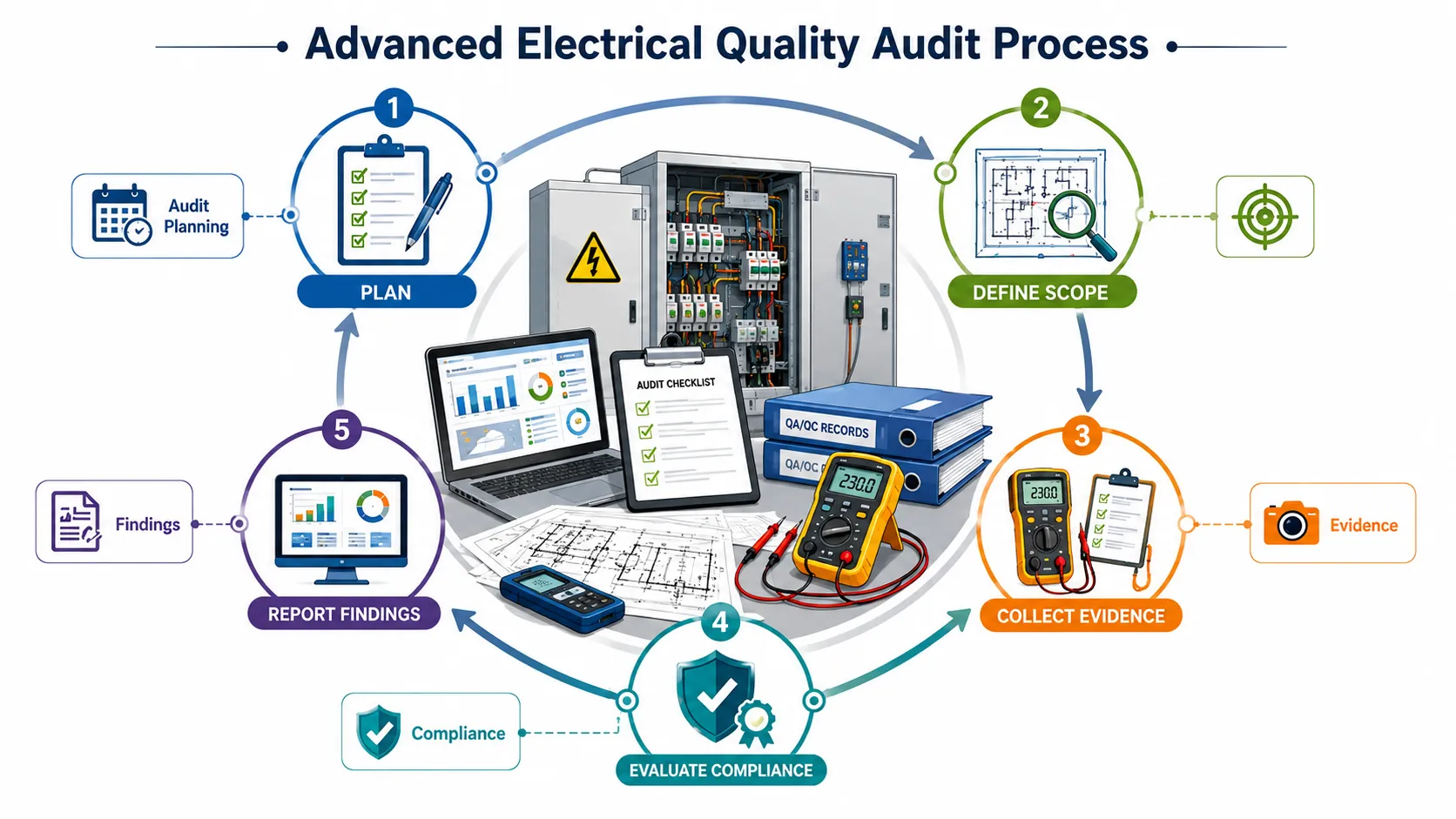
Understanding Advanced Quality Audit Leadership in Electrical QA/QC
Leading a quality audit requires a higher level of responsibility than simply performing inspections. An audit leader must plan, coordinate and control the complete audit process while ensuring that findings are based on reliable evidence.
In complex electrical workplaces, audit leaders are responsible for:
- Establishing audit objectives and scope.
- Selecting appropriate audit methods.
- Coordinating audit teams.
- Evaluating technical evidence.
- Identifying compliance gaps.
- Assessing quality risks.
- Reporting findings to management.
- Supporting corrective action improvement.
A successful audit process provides management with accurate information about the effectiveness of quality controls and helps organisations make informed decisions.
Advanced audit leadership requires the ability to understand both technical details and wider organisational objectives. An auditor must evaluate how individual processes contribute to overall quality performance.
For example, a failed electrical test may not only indicate a technical problem but may also reveal weaknesses in:
- Installation procedures.
- Competency management.
- Inspection planning.
- Material control.
- Communication processes.
- Documentation systems.
Therefore, advanced auditing focuses on identifying system-level improvement opportunities.
Key Concepts and Definitions of Quality Auditing
| Key Concept | Definition | Application in Electrical QA/QC Audits |
|---|---|---|
| Quality Audit | A systematic and independent examination of quality processes and records | Evaluating electrical project quality performance |
| Audit Criteria | Requirements used to assess performance | Standards, specifications and procedures |
| Audit Scope | Defined boundaries of the audit activity | Selecting departments, processes or project areas |
| Audit Objective | Purpose and expected outcome of the audit | Assessing compliance and process effectiveness |
| Audit Evidence | Information used to support audit conclusions | Inspection records, test results and documents |
| Non-Conformity | Failure to meet specified requirements | Incorrect installation or missing records |
| Corrective Action | Action taken to remove causes of problems | Preventing repeated quality failures |
| Audit Trail | Documented sequence of evidence and decisions | Maintaining traceability |
| Quality Management System | Framework controlling quality processes | Reviewing organisational quality controls |
| Risk-Based Auditing | Prioritising audit activities according to risk | Focusing on safety-critical electrical activities |
Importance of Advanced Audit Procedures in Electrical Workplaces
Electrical projects involve activities where quality failures can create serious safety, operational and financial consequences. Therefore, audit procedures must be carefully designed to identify risks before they affect project outcomes.
Advanced audit procedures provide organisations with the ability to:
- Verify compliance with technical requirements.
- Identify weaknesses in quality systems.
- Improve operational reliability.
- Reduce repeated defects.
- Strengthen safety performance.
- Support continual improvement.
A poorly planned audit may only identify visible problems, whereas an advanced audit investigates underlying causes and evaluates whether processes are effective.
For example, discovering repeated cable installation defects should lead to further investigation into:
- Training effectiveness.
- Installation procedures.
- Supervision arrangements.
- Inspection methods.
- Quality awareness.
Establishing the Audit Framework
Before conducting an audit, the audit leader must establish a clear framework that defines how the audit will be performed.
The audit framework should include:
- Audit objectives.
- Audit scope.
- Audit criteria.
- Audit methodology.
- Audit responsibilities.
- Audit schedule.
- Reporting requirements.
A structured framework ensures that all audit activities remain focused and consistent.
Defining Audit Objectives
Audit objectives determine what the audit intends to achieve.
Examples of audit objectives include:
- Evaluating compliance with electrical specifications.
- Assessing effectiveness of quality procedures.
- Reviewing inspection and testing controls.
- Identifying improvement opportunities.
- Evaluating corrective action effectiveness.
Clear objectives prevent audits from becoming general inspections without meaningful outcomes.
Determining Audit Scope
The audit scope defines the boundaries of the audit.
The scope may include:
- Specific electrical systems.
- Installation activities.
- Testing processes.
- Suppliers.
- Contractors.
- Quality documentation.
- Commissioning activities.
The audit leader must ensure that the scope is realistic and sufficient to achieve the audit objectives.
Factors influencing audit scope include:
- Project complexity.
- Risk level.
- Previous audit results.
- Stakeholder requirements.
- Compliance obligations.
Selecting Audit Criteria
Audit criteria provide the benchmark against which performance is evaluated.
Electrical audit criteria may include:
- Approved project specifications.
- Engineering drawings.
- Quality procedures.
- Inspection plans.
- Testing requirements.
- Contract requirements.
- Organisational standards.
Using clearly defined criteria ensures that audit findings are objective and defensible.
Developing an Advanced Audit Plan
A comprehensive audit plan provides structure and coordination.
The audit plan should define:
- Audit activities.
- Responsibilities.
- Timeline.
- Required resources.
- Evidence requirements.
- Reporting arrangements.
A professional audit plan helps avoid disruption while ensuring sufficient assessment coverage.
Audit Planning Process
The audit planning process includes:
- Reviewing project requirements.
- Understanding operational processes.
- Identifying critical risk areas.
- Selecting audit team members.
- Preparing audit documentation.
- Communicating audit arrangements.
Selecting and Managing Audit Teams
The effectiveness of an audit depends significantly on auditor competence.
Audit team members should have knowledge of:
- Electrical engineering principles.
- QA/QC processes.
- Audit techniques.
- Documentation control.
- Risk assessment.
The audit leader should ensure that team members have appropriate responsibilities.
Audit team roles may include:
- Lead auditor.
- Technical auditor.
- Documentation reviewer.
- Process assessor.
- Observation recorder.
Risk-Based Audit Planning
Modern quality auditing increasingly uses risk-based approaches.
Risk-based auditing focuses resources on areas with the greatest potential impact.
High-risk electrical activities may include:
- High-voltage installation.
- Protection system testing.
- Critical equipment commissioning.
- Safety-related systems.
- Compliance-sensitive activities.
A risk-based approach improves audit effectiveness by prioritising important areas.
Preparing Audit Documentation
Effective documentation supports consistency and traceability.
Audit documentation may include:
- Audit checklists.
- Evidence collection forms.
- Interview records.
- Finding reports.
- Corrective action records.
Well-designed audit documents ensure that important information is captured accurately.
Conducting the Audit Process
The audit process involves several controlled stages.
These include:
- Opening meeting.
- Evidence collection.
- Process evaluation.
- Finding identification.
- Closing meeting.
- Audit reporting.
Each stage contributes to producing reliable audit conclusions.
Conducting Opening Meetings
The opening meeting establishes understanding between auditors and stakeholders.
The meeting should clarify:
- Audit purpose.
- Scope.
- Schedule.
- Responsibilities.
- Communication methods.
A professional opening meeting creates cooperation and reduces resistance.
Evidence Collection Methods
Audit conclusions must be supported by objective evidence.
Evidence collection methods include:
Document Review
Reviewing:
- Quality manuals.
- Inspection reports.
- Test certificates.
- Calibration records.
- Training records.
Interviews
Discussing processes with:
- Engineers.
- Supervisors.
- Inspectors.
- Project personnel.
Observation
Assessing:
- Installation practices.
- Testing activities.
- Workplace controls.
Record Verification
Checking:
- Completeness.
- Accuracy.
- Traceability.
Evaluating Electrical Quality Processes
During an audit, the auditor evaluates whether processes are effective.
Evaluation areas may include:
- Material approval processes.
- Installation controls.
- Inspection procedures.
- Testing arrangements.
- Defect management.
- Documentation systems.
The auditor should assess both compliance and effectiveness.
A process may exist but still fail if it is not properly implemented.
Identifying Non-Conformities
A non-conformity occurs when a requirement has not been achieved.
Examples include:
- Incorrect installation methods.
- Missing inspection records.
- Failed testing results.
- Unapproved material use.
- Incomplete documentation.
Professional auditors classify findings according to severity.
Possible classifications include:
Major Non-Conformity
A significant failure affecting safety, compliance or system effectiveness.
Minor Non-Conformity
A limited issue that does not significantly affect overall performance.
Observation
An opportunity for improvement.
Root Cause Analysis During Audits
Advanced audits focus on understanding why problems occur.
Root cause analysis methods include:
- Five Whys analysis.
- Cause-and-effect diagrams.
- Process reviews.
For example:
Problem:
Repeated cable termination failures.
Possible root causes:
- Inadequate training.
- Poor supervision.
- Incorrect procedures.
- Insufficient inspection.
Identifying the true cause allows effective corrective action.
Developing Corrective Action Recommendations
Audit leaders should ensure that corrective actions address causes rather than symptoms.
Effective corrective actions should:
- Define responsibilities.
- Establish deadlines.
- Address root causes.
- Include verification methods.
A corrective action process should include:
- Finding identification.
- Cause analysis.
- Action planning.
- Implementation.
- Effectiveness review.
Practical Example: Electrical Installation Quality Audit
Project Situation
A large commercial electrical installation project experiences repeated inspection failures during installation verification.
Audit Approach
The audit team reviews:
- Installation procedures.
- Inspection records.
- Competency records.
- Supervisor involvement.
Findings
The audit identifies:
- Inconsistent installation practices.
- Limited supervision.
- Weak inspection planning.
Corrective Actions
The organisation implements:
- Additional training.
- Improved inspection scheduling.
- Updated procedures.
- Increased supervision.
Outcome
Quality performance improves and repeated defects decrease.
Case Study: Leading a Complex Electrical Quality Audit
Background
An industrial electrical project requires a comprehensive audit before commissioning. Previous inspections identified documentation gaps and inconsistent quality performance.
Audit Process
The audit leader:
- Defined audit objectives.
- Developed a risk-based audit plan.
- Selected qualified auditors.
- Reviewed technical evidence.
- Conducted stakeholder interviews.
- Evaluated quality processes.
Findings
The audit identified:
- Weak document control.
- Delayed corrective actions.
- Inconsistent inspection records.
Improvement Actions
Management introduced:
- Stronger document controls.
- Improved reporting systems.
- Enhanced quality monitoring.
Case Study Conclusion
The audit demonstrated that effective audit leadership provides valuable insight into organisational performance. By identifying system weaknesses and recommending practical improvements, quality audits support safer, more reliable and compliant electrical operations.
Benefits of Advanced Quality Audit Procedures
Effective audit procedures provide:
- Improved compliance assurance.
- Better risk identification.
- Stronger quality systems.
- Reduced repeated failures.
- Improved documentation control.
- Enhanced decision-making.
- Increased stakeholder confidence.
- Better operational reliability.
- Continuous improvement opportunities.
- Improved project performance.
Common Challenges in Leading Quality Audits
Audit leaders may face challenges such as:
- Resistance from project teams.
- Limited documentation.
- Time constraints.
- Conflicting stakeholder priorities.
- Lack of evidence.
- Poor corrective action implementation.
Effective leadership helps overcome these challenges through professional communication and structured processes.
Key Learning Points
Learners should understand that:
- Quality audits require structured procedures.
- Audit planning determines effectiveness.
- Evidence must support all findings.
- Risk-based approaches improve audit focus.
- Auditors must remain objective and independent.
- Corrective actions should address root causes.
- Audit findings support continual improvement.
- Strong reporting improves management decisions.
- Electrical workplace audits require technical understanding.
- Effective audit leadership strengthens quality performance.
Conclusion
Establishing advanced procedures for leading comprehensive quality audits enables electrical QA/QC professionals to evaluate processes, identify risks and improve organisational performance. Effective audit leadership combines technical knowledge, structured planning, evidence-based assessment and professional communication.
Through systematic audit procedures, organisations can strengthen compliance, reduce quality failures and create a culture of continual improvement across complex electrical workplace environments.
2: Execute Leadership Responsibilities During a Practical QA/QC Audit, Managing Both Personnel and Interacting Technical Factors
Leading a practical QA/QC audit within a complex electrical workplace requires a combination of technical expertise, leadership capability, communication skills and effective decision-making. A successful audit leader must manage not only audit procedures and technical evaluations but also the people, interactions and operational challenges that influence audit effectiveness.
In advanced electrical engineering environments, audits involve multiple personnel including QA/QC inspectors, engineers, project managers, contractors, suppliers and client representatives. Each individual may have different responsibilities, priorities and expectations. Therefore, the audit leader must create a structured environment where all participants understand their roles, cooperate effectively and contribute accurate information.
Leadership during a QA/QC audit extends beyond monitoring compliance. It involves coordinating technical specialists, managing audit resources, resolving disagreements, maintaining audit independence and ensuring that findings are based on objective evidence. The audit leader acts as a bridge between technical teams and senior management by transforming complex technical information into meaningful quality insights.
Understanding Leadership Responsibilities During QA/QC Audits
A QA/QC audit leader is responsible for ensuring that audit activities are completed professionally, consistently and according to defined objectives. Effective leadership ensures that the audit team remains focused, evidence-based and aligned with organisational quality goals.
Key leadership responsibilities include:
- Planning and coordinating audit activities.
- Managing audit personnel.
- Assigning roles and responsibilities.
- Maintaining auditor independence.
- Ensuring effective communication.
- Managing technical discussions.
- Reviewing audit evidence.
- Supporting decision-making.
- Controlling audit progress.
- Presenting accurate findings.
A strong audit leader understands that audit success depends on both technical evaluation and effective human interaction.
Key Concepts and Definitions in QA/QC Audit Leadership
| Key Concept | Definition | Application in Electrical QA/QC Audit Leadership |
|---|---|---|
| Audit Leadership | The ability to guide and control audit activities effectively | Managing audit teams and achieving objectives |
| Audit Team Management | Coordinating people involved in audit activities | Assigning responsibilities and monitoring performance |
| Technical Coordination | Managing interaction between technical specialists | Reviewing engineering evidence and findings |
| Auditor Independence | Maintaining objective judgement without influence | Ensuring unbiased audit conclusions |
| Audit Communication | Exchange of information during audit activities | Managing discussions with stakeholders |
| Audit Control | Monitoring audit progress and quality | Ensuring planned activities are completed |
| Evidence Management | Controlling collection and evaluation of audit information | Maintaining reliable findings |
| Conflict Management | Resolving disagreements professionally | Handling disputes during audits |
| Decision-Making | Selecting appropriate actions based on evidence | Determining audit conclusions |
| Quality Improvement | Using audit outcomes to enhance processes | Supporting continual improvement |
Role of the QA/QC Audit Leader
The audit leader has overall responsibility for ensuring that the audit process achieves its intended purpose. This requires balancing technical requirements, organisational expectations and stakeholder involvement.
The audit leader must ensure that:
- The audit remains within the agreed scope.
- Audit evidence is reliable.
- Team members understand their responsibilities.
- Findings are supported by facts.
- Communication remains professional.
- Corrective actions are clearly defined.
In electrical workplaces, the audit leader must also understand the impact of technical decisions on safety, reliability and operational performance.
For example, during an electrical commissioning audit, the audit leader must coordinate testing specialists, review technical documentation and ensure that any identified issues are properly evaluated before system acceptance.
Managing Audit Personnel Effectively
A major responsibility of the audit leader is managing the performance and coordination of audit personnel.
Audit teams often include individuals with different technical backgrounds and levels of experience. Effective leadership ensures that each member contributes effectively.
The audit leader should:
- Define individual responsibilities.
- Allocate tasks according to competence.
- Provide clear instructions.
- Encourage professional communication.
- Monitor progress.
- Resolve team issues.
Effective personnel management improves audit accuracy and efficiency.
Selecting Appropriate Audit Team Members
Audit effectiveness depends on having competent personnel.
Audit team selection should consider:
- Technical knowledge.
- Audit experience.
- Understanding of electrical systems.
- Knowledge of quality standards.
- Communication skills.
- Problem-solving ability.
For complex electrical audits, the team may require specialists in areas such as:
- Electrical installation.
- Protection systems.
- Testing and commissioning.
- Documentation control.
- Safety management.
Assigning Audit Responsibilities
Clear responsibility allocation prevents confusion during audit activities.
Responsibilities may include:
Lead Auditor
Responsible for:
- Overall audit control.
- Team coordination.
- Final audit conclusions.
- Stakeholder communication.
Technical Auditor
Responsible for:
- Reviewing engineering processes.
- Evaluating technical evidence.
- Assessing compliance.
Documentation Auditor
Responsible for:
- Reviewing records.
- Checking traceability.
- Verifying document control.
Process Auditor
Responsible for:
- Evaluating procedures.
- Assessing effectiveness.
- Identifying improvement opportunities.
Managing Communication Within the Audit Team
Effective communication is essential for audit success.
The audit leader should establish:
- Clear communication channels.
- Regular progress updates.
- Defined reporting methods.
- Professional discussion practices.
Poor communication can result in:
- Missed evidence.
- Incorrect conclusions.
- Delayed findings.
- Conflicting interpretations.
Coordinating Interacting Technical Factors During Audits
Electrical QA/QC audits often involve multiple technical factors that interact with each other.
Examples include:
- Design requirements.
- Installation practices.
- Material quality.
- Testing procedures.
- Safety controls.
- Documentation systems.
The audit leader must understand how these factors influence overall quality performance.
For example, a testing failure may not be caused only by equipment problems. It may result from:
- Incorrect installation.
- Poor calibration.
- Inadequate procedures.
- Lack of technician competency.
A comprehensive audit evaluates the complete system rather than isolated issues.
Managing Technical Discussions During Audits
Technical discussions are a normal part of audit activities. However, they must remain objective and focused on evidence.
The audit leader should:
- Encourage professional debate.
- Require evidence-based explanations.
- Prevent personal disagreements.
- Maintain audit objectives.
Technical discussions should answer questions such as:
- What requirement applies?
- What evidence exists?
- What is the actual condition?
- What risk exists?
- What improvement is required?
Maintaining Auditor Independence and Objectivity
One of the most important leadership responsibilities is protecting audit independence.
The audit leader must prevent:
- Personal bias.
- Stakeholder pressure.
- Commercial influence.
- Conflict of interest.
Objective auditing requires decisions based on:
- Evidence.
- Requirements.
- Technical evaluation.
- Risk assessment.
For example, if a contractor pressures the audit team to ignore a defect because of programme delays, the audit leader must maintain professional judgement and continue evaluating according to approved requirements.
Managing Stakeholder Interaction During Audits
QA/QC audits involve interaction with many stakeholders.
Effective stakeholder management includes:
- Explaining audit objectives.
- Managing expectations.
- Encouraging cooperation.
- Addressing concerns professionally.
Stakeholders may include:
- Clients.
- Contractors.
- Engineers.
- Suppliers.
- Project managers.
- Regulatory representatives.
Each stakeholder may view audit outcomes differently.
The audit leader must ensure that findings are communicated fairly and professionally.
Handling Resistance During Audits
Resistance is a common challenge during audits.
Reasons for resistance may include:
- Fear of negative findings.
- Concern about project delays.
- Lack of understanding.
- Previous poor audit experiences.
The audit leader should respond by:
- Explaining the purpose of auditing.
- Focusing on improvement.
- Maintaining professional communication.
- Supporting collaborative solutions.
The objective is not to blame individuals but to improve processes.
Managing Conflicts During Audit Activities
Conflicts may occur when stakeholders disagree with findings.
Common disagreements include:
- Interpretation of requirements.
- Responsibility for defects.
- Corrective action expectations.
The audit leader should:
- Review evidence.
- Clarify requirements.
- Encourage discussion.
- Document decisions.
A professional approach ensures that conflicts are resolved constructively.
Controlling Audit Evidence and Findings
Audit leaders must ensure that evidence management is controlled throughout the process.
Evidence should be:
- Relevant.
- Accurate.
- Traceable.
- Verified.
- Documented.
Examples of audit evidence include:
- Inspection reports.
- Test certificates.
- Calibration records.
- Photographs.
- Drawings.
- Quality procedures.
Reliable evidence creates confidence in audit conclusions.
Evaluating Complex Quality Issues
Complex electrical audits often identify issues involving multiple factors.
For example:
A failed protection system test may involve:
- Equipment settings.
- Design requirements.
- Installation quality.
- Testing procedures.
- Technician competence.
The audit leader must analyse the interaction between these factors rather than focusing on one issue.
Practical Audit Leadership Process
A structured audit leadership process includes:
Stage 1: Audit Preparation
Activities include:
- Reviewing requirements.
- Understanding risks.
- Preparing audit resources.
Stage 2: Audit Team Coordination
Activities include:
- Assigning responsibilities.
- Confirming communication methods.
- Reviewing objectives.
Stage 3: Audit Execution
Activities include:
- Collecting evidence.
- Conducting interviews.
- Observing processes.
Stage 4: Finding Evaluation
Activities include:
- Reviewing evidence.
- Classifying findings.
- Confirming conclusions.
Stage 5: Reporting and Follow-Up
Activities include:
- Presenting findings.
- Monitoring corrective actions.
- Evaluating improvements.
Practical Example: Managing a Commissioning Audit
Situation
A large electrical installation project is approaching final commissioning. The QA/QC audit identifies inconsistencies between testing records and actual site conditions.
Leadership Challenge
The audit leader must coordinate:
- Testing engineers.
- Installation teams.
- Project management.
- Client representatives.
Leadership Actions
The audit leader:
- Reviews evidence.
- Assigns technical responsibilities.
- Organises clarification meetings.
- Ensures objective evaluation.
- Defines corrective actions.
Outcome
The issue is resolved before commissioning, reducing operational risk and improving stakeholder confidence.
Case Study: Leadership During a Complex Electrical QA/QC Audit
Background
An industrial facility required a comprehensive quality audit before operational handover. Previous inspections identified repeated documentation errors and inconsistent testing practices.
Audit Leadership Approach
The audit leader:
- Established clear audit objectives.
- Selected competent auditors.
- Coordinated technical specialists.
- Managed stakeholder communication.
- Reviewed evidence systematically.
Challenges Identified
The audit identified:
- Incomplete testing records.
- Weak document control.
- Communication gaps between teams.
Improvement Actions
The organisation implemented:
- Improved reporting procedures.
- Additional technical reviews.
- Better coordination between departments.
Case Study Conclusion
The case demonstrates that effective audit leadership requires both technical competence and strong people management skills. By coordinating personnel and technical factors, audit leaders can improve quality performance and support successful project outcomes.
Benefits of Effective QA/QC Audit Leadership
Strong audit leadership provides:
- More accurate audit outcomes.
- Better team coordination.
- Improved stakeholder relationships.
- Stronger compliance assurance.
- Faster problem resolution.
- Better risk management.
- Improved corrective actions.
- Increased confidence in quality systems.
- Enhanced project performance.
Common Leadership Challenges During QA/QC Audits
Audit leaders may experience:
- Limited cooperation.
- Time pressure.
- Technical disagreements.
- Incomplete evidence.
- Conflicting priorities.
- Stakeholder resistance.
Effective leadership helps overcome these challenges through planning, communication and professional judgement.
Key Learning Points
Learners should understand that:
- Audit leadership requires technical and interpersonal skills.
- Effective team management improves audit quality.
- Technical factors must be assessed holistically.
- Evidence-based decisions strengthen audit credibility.
- Stakeholder communication is essential during audits.
- Auditor independence must always be protected.
- Conflict should be managed professionally.
- Complex electrical issues require systematic evaluation.
- Strong leadership improves audit outcomes.
- Quality audits support continual improvement.
Conclusion
Executing leadership responsibilities during practical QA/QC audits requires the ability to manage people, technical information and project challenges simultaneously. Effective audit leaders create structured processes, coordinate competent teams and ensure that findings are based on reliable evidence.
By combining technical expertise, communication skills and professional leadership, QA/QC audit leaders can improve compliance, strengthen quality systems and support safer, more reliable electrical project delivery.
3: Critically Interpret Complex Audit Data to Formulate Clear, Actionable Findings Regarding Electrical Quality Compliance
Complex electrical QA/QC audits generate large volumes of technical information from multiple sources, including inspection records, testing results, quality reports, non-conformance reports, calibration certificates, design documents and compliance evidence. The ability to critically interpret this data is a fundamental capability for senior QA/QC professionals because audit information only creates value when it is transformed into meaningful findings and practical improvement actions.
In advanced electrical engineering environments, auditors must move beyond simply collecting data and develop the ability to analyse relationships, identify patterns, evaluate risks and determine the significance of findings. A single data point may not provide sufficient information, but when combined with trends, historical records and technical requirements, it can reveal underlying weaknesses within quality management systems.
Critical interpretation of audit data enables organisations to understand whether quality controls are effective, whether compliance requirements are being achieved and whether corrective actions are producing sustainable improvements. Professional audit leaders must ensure that findings are accurate, evidence-based and clearly linked to electrical quality performance.
Understanding Complex Audit Data in Electrical QA/QC Environments
Audit data refers to the information collected during an audit process that is used to evaluate compliance, effectiveness and performance. In electrical QA/QC environments, audit data is generated from different technical and operational activities throughout the project lifecycle.
Examples of audit data include:
- Inspection and test records.
- Electrical commissioning reports.
- Material approval documents.
- Installation verification records.
- Calibration certificates.
- Non-conformance reports.
- Corrective action records.
- Internal quality review results.
- Supplier performance information.
- Competency and training records.
The challenge for audit leaders is that this information often exists in different formats and may involve multiple technical disciplines.
Effective interpretation requires the auditor to understand:
- What the data represents.
- Why the data is important.
- How different data sources relate to each other.
- What risks are indicated.
- What actions are required.
Key Concepts and Definitions Related to Audit Data Interpretation
| Key Concept | Definition | Application in Electrical QA/QC Auditing |
|---|---|---|
| Audit Data Analysis | Process of examining collected audit information to identify findings and trends | Reviewing inspection and testing performance |
| Compliance Evaluation | Assessment of performance against defined requirements | Checking conformity with specifications |
| Audit Finding | A conclusion based on objective audit evidence | Identifying quality weaknesses |
| Evidence-Based Decision | Decision supported by verified information | Making reliable quality recommendations |
| Quality Trend Analysis | Reviewing patterns over time | Identifying repeated defects |
| Root Cause Analysis | Method used to determine underlying causes of problems | Preventing repeated failures |
| Risk Assessment | Evaluation of potential consequences and likelihood | Prioritising critical findings |
| Corrective Action Analysis | Evaluation of actions taken to resolve issues | Confirming improvement effectiveness |
| Data Validation | Process of confirming accuracy and reliability of information | Ensuring audit conclusions are trustworthy |
| Performance Indicator | Measurement used to evaluate quality performance | Monitoring defect rates and compliance levels |
Importance of Critical Audit Data Interpretation
Audit data interpretation is essential because raw information does not automatically explain quality performance. An auditor must analyse information and determine what it means for safety, compliance and project success.
For example, a report may show that several electrical inspections failed during installation. However, the auditor must investigate further:
- Are failures increasing over time?
- Are the same defects occurring repeatedly?
- Are procedures ineffective?
- Is training insufficient?
- Is supervision adequate?
Critical interpretation converts information into knowledge.
Benefits include:
- Better identification of quality risks.
- More accurate audit conclusions.
- Improved corrective actions.
- Stronger management decisions.
- Reduced repeated failures.
- Improved compliance performance.
Sources of Complex Audit Data
Electrical QA/QC audits often involve multiple information sources.
Inspection Data
Inspection data provides information about whether work activities meet requirements.
It may include:
- Installation checks.
- Material verification.
- Workmanship assessments.
- Visual examinations.
Testing Data
Testing information provides evidence of technical performance.
Examples include:
- Insulation resistance testing.
- Continuity testing.
- Functional testing.
- Commissioning results.
Documentation Data
Documentation demonstrates process control and traceability.
Examples include:
- Approved drawings.
- Inspection plans.
- Test certificates.
- Quality records.
Non-Conformance Data
NCR information helps identify:
- Defect frequency.
- Recurring problems.
- Process weaknesses.
Performance Data
Performance indicators help evaluate:
- Quality trends.
- Improvement progress.
- Operational effectiveness.
Process for Interpreting Complex Audit Data
A structured interpretation process ensures that audit conclusions are accurate and meaningful.
Step 1: Collect and Organise Audit Information
The first stage is gathering relevant information from different sources.
The auditor should:
- Review available records.
- Confirm data completeness.
- Organise information systematically.
- Identify missing evidence.
Poor data organisation can lead to incorrect conclusions.
Step 2: Validate Data Accuracy
Before analysis, audit data must be verified.
Validation activities include:
- Checking document authenticity.
- Confirming test results.
- Reviewing approval records.
- Comparing information sources.
Reliable findings require reliable evidence.
Step 3: Identify Patterns and Trends
Advanced auditors look beyond individual issues and examine broader patterns.
Examples:
- Increasing defect rates.
- Repeated installation errors.
- Delayed corrective actions.
- Supplier quality issues.
Trend analysis helps identify whether problems are isolated or systemic.
Step 4: Evaluate Compliance Performance
The auditor compares actual performance against defined requirements.
Comparison areas may include:
- Approved specifications.
- Quality procedures.
- Contract requirements.
- Testing criteria.
- Safety expectations.
This determines whether compliance has been achieved.
Step 5: Determine Risk Significance
Not all findings have the same importance.
Auditors should evaluate:
- Safety impact.
- Technical consequences.
- Operational risks.
- Compliance implications.
- Project impact.
A minor documentation issue requires a different response compared with a failure affecting electrical system reliability.
Analysing Audit Trends and Patterns
Trend analysis is a powerful tool for understanding quality performance.
For example:
A project may record:
- January: 5 installation defects.
- February: 12 installation defects.
- March: 20 installation defects.
The increasing trend indicates that the issue requires deeper investigation.
Possible causes may include:
- Increased workload.
- Reduced supervision.
- Inadequate procedures.
- Competency gaps.
Interpreting Electrical Testing Data
Electrical testing data requires technical understanding to determine compliance.
An auditor should consider:
- Test requirements.
- Acceptance criteria.
- Equipment condition.
- Testing methods.
- Previous results.
For example, repeated insulation resistance failures may indicate:
- Installation damage.
- Environmental conditions.
- Incorrect handling.
- Equipment problems.
The auditor must avoid reaching conclusions without analysing all relevant information.
Developing Evidence-Based Audit Findings
A professional audit finding should clearly explain:
- What was identified.
- What requirement applies.
- What evidence supports the finding.
- Why the issue matters.
- What action is required.
A strong finding includes:
Condition
What happened?
Example:
“Three cable termination inspections failed during commissioning verification.”
Criteria
What requirement was not achieved?
Example:
“The installation did not meet approved testing requirements.”
Cause
Why did it happen?
Example:
“Inadequate inspection controls contributed to repeated errors.”
Consequence
What is the impact?
Example:
“Potential reliability and operational risks may occur.”
Recommendation
What action is needed?
Example:
“Implement additional inspection controls before future installation stages.”
Root Cause Analysis of Audit Findings
Identifying symptoms alone does not improve quality.
Root cause analysis determines why problems occur.
Common techniques include:
Five Whys Analysis
This approach repeatedly asks why a problem occurred.
Example:
Problem:
Repeated testing failures.
Why?
Incorrect installation.
Why?
Technicians lacked updated instructions.
Why?
Procedure updates were not communicated.
Root cause:
Weak communication process.
Cause-and-Effect Analysis
This examines possible causes across categories:
- People.
- Processes.
- Equipment.
- Materials.
- Environment.
Risk-Based Interpretation of Findings
Audit findings should be prioritised according to risk.
High-risk findings may involve:
- Electrical safety failures.
- Protection system issues.
- Compliance breaches.
- Critical equipment failures.
Medium-risk findings may include:
- Process weaknesses.
- Documentation issues.
- Minor quality inconsistencies.
Low-risk findings may include:
- Improvement opportunities.
Risk-based prioritisation helps management focus resources effectively.
Converting Audit Findings into Actionable Recommendations
An effective audit finding should lead to practical improvement.
Recommendations should be:
- Specific.
- Realistic.
- Measurable.
- Assigned to responsible persons.
- Time-bound.
Poor recommendation:
“Improve quality.”
Effective recommendation:
“Introduce additional inspection verification before energisation and assign responsibility to the installation supervisor.”
Communicating Complex Audit Findings to Management
Senior management requires information that supports decision-making.
Audit leaders should present findings by focusing on:
- Business impact.
- Compliance risks.
- Required actions.
- Improvement opportunities.
Management presentations should avoid unnecessary technical complexity while maintaining accuracy.
A good management report includes:
- Executive summary.
- Major findings.
- Risk evaluation.
- Recommended actions.
- Improvement priorities.
Practical Example: Interpreting Audit Data During Electrical Commissioning
Situation
During a commissioning audit, several electrical testing failures are identified.
Available Data
The audit team reviews:
- Testing records.
- Installation reports.
- Previous inspection findings.
- Contractor documentation.
Analysis
The audit identifies:
- Increasing failure rates.
- Similar defects across multiple areas.
- Inconsistent installation practices.
Finding
The issue is not limited to individual errors but indicates a process control weakness.
Recommended Action
The organisation introduces:
- Additional supervision.
- Improved testing procedures.
- Competency verification.
Outcome
Future testing performance improves and repeated failures reduce.
Case Study: Transforming Audit Data into Quality Improvement
Background
An industrial electrical project experienced repeated quality issues during installation and testing.
The audit team collected extensive information from:
- Inspection reports.
- Test certificates.
- NCR records.
- Contractor performance data.
Data Interpretation Process
The auditors identified:
- Increasing defect trends.
- Weak corrective action closure.
- Communication gaps.
Findings
The audit concluded that the main issue was ineffective quality control processes rather than individual technical errors.
Improvement Actions
Management implemented:
- Improved quality monitoring.
- Enhanced communication systems.
- Additional technical reviews.
Case Study Conclusion
The case demonstrates that effective audit data interpretation enables organisations to identify underlying problems and develop sustainable solutions. Accurate analysis transforms audit information into valuable improvement opportunities.
Benefits of Effective Audit Data Interpretation
Critical interpretation of audit information provides:
- More accurate findings.
- Better risk management.
- Improved compliance decisions.
- Stronger corrective actions.
- Reduced repeated defects.
- Improved management awareness.
- Enhanced quality performance.
- Better resource allocation.
- Increased stakeholder confidence.
Common Challenges in Audit Data Analysis
Auditors may face:
- Incomplete information.
- Conflicting records.
- Excessive data volume.
- Technical complexity.
- Time limitations.
- Poor documentation quality.
These challenges can be managed through:
- Structured analysis methods.
- Evidence verification.
- Professional judgement.
- Effective audit planning.
Key Learning Points
Learners should understand that:
- Audit data must be critically analysed before conclusions are made.
- Findings must be based on objective evidence.
- Trends reveal wider quality issues.
- Risk determines finding priority.
- Root cause analysis improves corrective actions.
- Technical data must be translated into meaningful decisions.
- Clear recommendations support improvement.
- Management requires concise and actionable information.
- Accurate interpretation strengthens quality systems.
- Effective audit analysis supports continual improvement.
Conclusion
Critical interpretation of complex audit data enables QA/QC professionals to transform technical information into meaningful findings that support electrical quality compliance. By analysing evidence, identifying trends, evaluating risks and determining root causes, auditors can provide valuable insights that improve project performance.
Through structured data analysis and effective communication of findings, organisations can strengthen quality systems, reduce risks and support continuous improvement across complex electrical engineering environments.
4: Present Strategic Audit Outcomes to Senior Management Using Professional, Advanced Communication and Reporting Methods
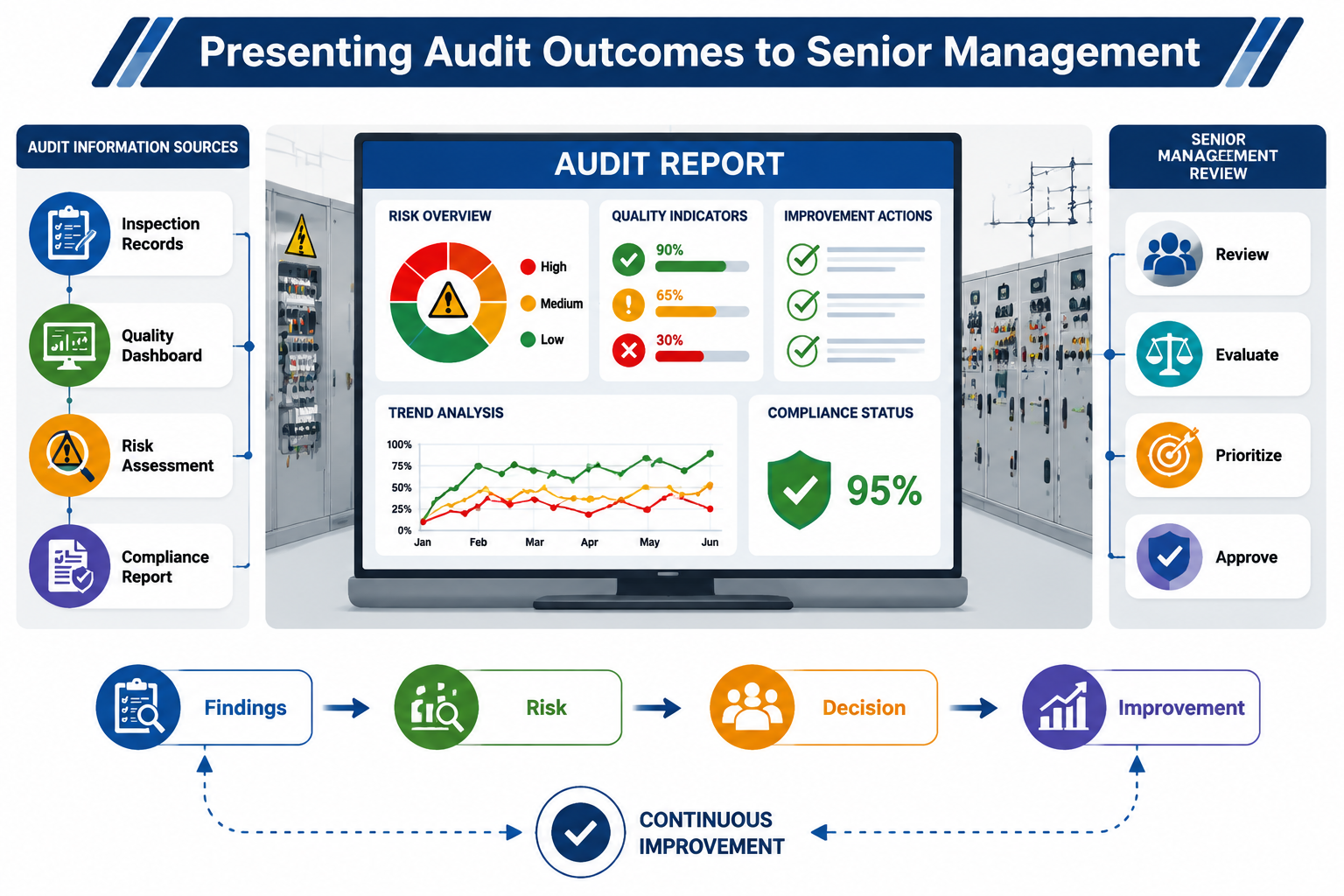
Presenting strategic audit outcomes to senior management is a critical responsibility for advanced QA/QC professionals working in complex electrical engineering environments. An effective audit presentation does not simply communicate technical observations; it transforms audit evidence into meaningful business and operational insights that support informed decision-making.
Senior management requires clear, concise and strategically relevant information that explains the current quality position, potential risks, compliance performance and improvement opportunities. Therefore, QA/QC leaders must develop advanced communication and reporting methods that connect technical audit findings with organisational objectives, project performance and long-term reliability.
In electrical engineering projects, audit outcomes may influence decisions related to safety, compliance, operational readiness, financial performance and stakeholder confidence. The ability to present these outcomes professionally ensures that management understands not only what issues exist but also why they matter and what actions are required.
A strategic audit report acts as a bridge between technical teams and leadership. It converts detailed inspection results, testing information and quality observations into structured recommendations that enable senior managers to prioritise resources and implement effective improvements.
Understanding Strategic Audit Outcome Presentation
Strategic audit outcome presentation involves communicating the results of an audit in a way that supports management decisions. Unlike technical audit notes that focus on detailed observations, strategic presentations focus on impact, risk and improvement direction.
A professional audit outcome presentation should answer key management questions:
- What was audited?
- What was identified?
- Why is it important?
- What risks exist?
- What actions are required?
- What benefits will improvement provide?
The objective is to ensure that senior management receives accurate information that supports timely and effective decisions.
In complex electrical QA/QC environments, audit findings may involve technical issues that require strategic interpretation. For example, repeated testing failures may indicate deeper problems related to competency, process control or resource allocation.
A skilled QA/QC leader explains these relationships clearly so that management can understand the wider implications.
Key Concepts and Definitions in Strategic Audit Reporting
| Key Concept | Definition | Application in Electrical QA/QC Reporting |
|---|---|---|
| Strategic Audit Outcome | A high-level conclusion derived from audit evidence | Communicating overall quality performance |
| Executive Summary | A brief overview of key audit results and recommendations | Providing management with quick understanding |
| Audit Finding | Evidence-based identification of compliance or performance issues | Reporting quality weaknesses |
| Risk Impact | Potential consequence of identified issues | Explaining safety and operational effects |
| Management Report | Formal document presenting audit results | Supporting leadership decisions |
| Corrective Action Plan | Structured approach for resolving identified issues | Defining improvement activities |
| Quality Dashboard | Visual representation of quality performance data | Showing trends and indicators |
| Recommendation | Proposed action based on audit conclusions | Guiding improvement decisions |
| Stakeholder Communication | Exchange of audit information with relevant parties | Maintaining transparency |
| Strategic Decision Support | Using audit information to guide management actions | Improving organisational performance |
Importance of Professional Audit Communication
Effective communication determines whether audit findings create meaningful improvement. Even a technically accurate audit can fail to deliver value if findings are poorly communicated.
Senior management often does not require every technical detail; instead, they need information that highlights:
- Business impact.
- Compliance risks.
- Project consequences.
- Required decisions.
- Improvement priorities.
Professional communication ensures that audit results are understood at the correct organisational level.
Poor audit communication may result in:
- Delayed corrective actions.
- Misunderstood risks.
- Incorrect priorities.
- Ineffective resource allocation.
Advanced QA/QC professionals must therefore develop the ability to communicate complex information clearly and strategically.
Understanding Senior Management Expectations
Senior management evaluates audit outcomes from a strategic perspective. Their focus is usually on organisational performance, risk exposure and improvement opportunities.
Management typically expects audit presentations to include:
- Overall quality status.
- Major risks.
- Critical non-conformities.
- Compliance performance.
- Corrective action progress.
- Recommendations for improvement.
A successful presentation avoids excessive technical complexity while maintaining accuracy.
For example, instead of stating:
“Insulation resistance values failed against test criteria during multiple cable inspections.”
A strategic report may communicate:
“Electrical insulation testing identified repeated compliance failures that may affect system reliability. Immediate corrective action is recommended before energisation.”
This approach connects technical findings with operational consequences.
Converting Technical Findings into Strategic Information
One of the most important skills of a QA/QC leader is converting technical information into management-level insights.
Technical audit data may include:
- Test results.
- Inspection records.
- Defect reports.
- Quality observations.
- Compliance records.
However, management needs interpretation.
The conversion process includes:
Technical Observation
What was identified?
Example:
Multiple cable termination defects were recorded.
Quality Impact
How does it affect performance?
Example:
Defects may reduce electrical reliability.
Risk Assessment
What are the consequences?
Example:
Potential operational failure during service.
Strategic Recommendation
What action is required?
Example:
Implement additional verification controls.
Developing an Advanced Audit Reporting Structure
A professional audit report should follow a structured format that allows easy understanding and effective decision-making.
Executive Summary
The executive summary provides a brief overview of the audit.
It should include:
- Audit purpose.
- Overall conclusion.
- Major findings.
- Critical risks.
- Priority recommendations.
Senior managers often review this section first.
Audit Background
This section explains:
- Project information.
- Audit scope.
- Audit objectives.
- Assessment criteria.
It provides context for the findings.
Audit Findings
Findings should be presented clearly.
Each finding should include:
- Issue identified.
- Evidence reviewed.
- Requirement affected.
- Risk level.
- Recommended action.
Risk Evaluation
Risk evaluation explains the significance of findings.
Risk categories may include:
- Safety risk.
- Compliance risk.
- Operational risk.
- Financial risk.
- Reputation risk.
Corrective Action Recommendations
Recommendations should define:
- Required improvement.
- Responsible person.
- Target completion date.
- Verification method.
Using Data Visualisation in Audit Reporting
Complex audit information can be difficult to understand without effective presentation methods.
Visual tools help management identify trends quickly.
Useful reporting methods include:
Quality Performance Dashboards
Dashboards may show:
- Number of findings.
- Closed corrective actions.
- Outstanding risks.
- Compliance trends.
Trend Analysis Charts
Trend analysis can demonstrate:
- Increasing defects.
- Improvement progress.
- Recurring problems.
Risk Matrix Presentation
Risk matrices help communicate:
- Severity.
- Likelihood.
- Priority level.
Visual reporting improves understanding and supports faster decisions.
Communication Techniques for Senior Management Presentations
Professional audit presentations require effective communication techniques.
The presenter should:
- Focus on key messages.
- Use clear language.
- Avoid unnecessary technical terminology.
- Explain business impact.
- Provide practical recommendations.
Effective communication includes:
Clarity
Information should be simple and structured.
Accuracy
Statements must be supported by evidence.
Professional Confidence
The presenter should demonstrate understanding of findings.
Strategic Focus
Information should relate to organisational objectives.
Presenting Audit Risks and Recommendations
Senior management needs to understand the importance of identified risks.
A strong risk presentation includes:
Current Situation
What is happening?
Potential Impact
What could happen if action is not taken?
Recommended Response
What should be done?
Expected Benefit
What improvement will result?
For example:
Finding:
Repeated protection system testing delays.
Risk:
Potential impact on commissioning schedule and operational readiness.
Recommendation:
Improve testing coordination and resource planning.
Benefit:
Improved commissioning efficiency and reduced project delays.
Managing Challenging Audit Discussions
Presenting negative findings can create difficult discussions.
Senior managers or project teams may question:
- Finding accuracy.
- Audit conclusions.
- Required actions.
- Project impact.
The QA/QC leader should:
- Remain objective.
- Refer to evidence.
- Avoid personal criticism.
- Focus on improvement.
A professional approach maintains trust and supports positive outcomes.
Practical Example: Presenting Electrical QA/QC Audit Outcomes
Project Situation
A large electrical infrastructure project undergoes a final quality audit before operational handover.
The audit identifies:
- Incomplete testing records.
- Delayed corrective actions.
- Documentation inconsistencies.
Audit Analysis
The QA/QC team evaluates:
- Compliance impact.
- Operational risks.
- Project readiness.
Management Presentation
The audit leader presents:
- Overall quality status.
- Critical findings.
- Risk assessment.
- Improvement recommendations.
Recommended Actions
Management approves:
- Additional verification activities.
- Improved document control.
- Enhanced quality monitoring.
Outcome
The project achieves improved compliance confidence and smoother handover.
Case Study: Strategic Reporting of Audit Outcomes
Background
An industrial electrical facility experienced repeated quality issues during commissioning. A comprehensive audit was conducted to evaluate process effectiveness.
Audit Findings
The audit identified:
- Weak inspection coordination.
- Inconsistent testing records.
- Delayed corrective actions.
Reporting Approach
The audit leader presented findings using:
- Executive summary.
- Risk assessment.
- Performance trends.
- Improvement recommendations.
Management Response
Senior leadership introduced:
- Improved quality controls.
- Additional technical reviews.
- Better reporting processes.
Case Study Conclusion
The case demonstrates that strategic audit reporting enables organisations to understand quality risks and implement effective improvement actions. Clear communication transforms audit findings into valuable management decisions.
Benefits of Effective Strategic Audit Reporting
Professional audit reporting provides:
- Improved management awareness.
- Faster decision-making.
- Better risk control.
- Stronger compliance performance.
- Improved resource planning.
- Increased stakeholder confidence.
- Enhanced quality culture.
- Better corrective action management.
- Improved project reliability.
- Continuous improvement support.
Common Challenges in Audit Outcome Presentation
QA/QC professionals may experience challenges such as:
- Excessive technical information.
- Limited management time.
- Conflicting stakeholder priorities.
- Resistance to findings.
- Difficulty explaining risks.
These challenges can be managed through:
- Structured reporting.
- Clear communication.
- Evidence-based recommendations.
- Strategic presentation methods.
Key Learning Points
Learners should understand that:
- Audit outcomes must be communicated strategically.
- Senior management requires clear and relevant information.
- Technical findings must be connected to organisational impact.
- Effective reporting supports decision-making.
- Visual tools improve understanding.
- Recommendations should be practical and measurable.
- Professional communication builds stakeholder confidence.
- Risk-based reporting improves quality management.
- Audit presentations should focus on improvement.
- Strong reporting strengthens QA/QC performance.
Conclusion
Presenting strategic audit outcomes to senior management requires the ability to communicate complex electrical quality information in a clear, structured and meaningful way. Effective QA/QC leaders transform audit evidence into strategic insights that support risk management, compliance improvement and operational reliability.
Through professional reporting methods, evidence-based communication and practical recommendations, audit leaders can influence better decisions, strengthen quality systems and support continuous improvement within complex electrical engineering environments.