
Lexiton International
Lexiton International Welcome to Lexiton International
ICTQual Level 6 Diploma in Quality Assurance and Quality Control (QA/QC) Electrical
Section 1: Unit No 1: Advanced Quality Management Systems in Electrical Engineering
Section 2: Unit No. 2: Electrical Project Planning, Risk, and Compliance Management
Section 3: Unit No 3: Advanced Inspection, Testing, and Non-Destructive Evaluation (NDE) in Electrical Systems
Section 4: Unit 4: Demonstrate Leadership Skills in Managing QA/QC Teams and Projects
Lesson 1: Demonstrate leadership skills in managing QA/QC teams and projects. Quiz No 1: Demonstrate leadership skills in managing QA/QC teams and projects. Lesson 2 : Apply strategic decision‑making models to complex QA/QC challenges Quiz No 2 : Apply strategic decision‑making models to complex QA/QC challenges Lesson 3: Evaluate the impact of leadership styles on quality culture and performance. Quiz No 3: Evaluate the impact of leadership styles on quality culture and performance. Lesson 4: Develop Strategies for Conflict Resolution and Team Motivation Quiz No 4: Develop strategies for conflict resolution and team motivation. Lesson 5: Integrate ethical considerations into QA/QC leadership decisions. Quiz No 5: Integrate ethical considerations into QA/QC leadership decisions. Lesson 6: Manage stakeholder expectations in high‑pressure project environments. Quiz No 6: Manage stakeholder expectations in high‑pressure project environments. Lesson 7: Lead quality audits and present findings to senior management. Quiz No 7: Lead quality audits and present findings to senior management Lesson 8: Recommend Strategic Improvements to Enhance Organisational QA/QC Performance Quiz No 8: Recommend strategic improvements to enhance organisational QA/QC performance.
Section 5: Unit 5: Sustainability, Innovation, and Digital Tools in Electrical QA/QC
Section 6: Unit 6: Research Project in Electrical Quality Assurance and Control
Lesson 29

Lesson 5: Integrate ethical considerations into QA/QC leadership decisions.

Ethical decision-making is a fundamental responsibility of effective QA/QC leadership within electrical engineering environments. Senior QA/QC professionals are required to make decisions that influence product quality, system reliability, regulatory compliance, workplace safety and stakeholder confidence. In complex engineering projects, leaders often face challenging situations where technical requirements, commercial pressures, project deadlines and organisational expectations may conflict. This lesson explores how ethical principles guide QA/QC leaders in making fair, transparent and professionally responsible decisions while maintaining the highest standards of quality and integrity.

This lesson examines the role of ethics in electrical QA/QC leadership, including professional accountability, integrity, impartiality, confidentiality, responsible reporting and evidence-based decision-making. Learners will explore how ethical considerations influence inspection decisions, non-conformance management, corrective actions, team leadership and communication with clients, contractors and project stakeholders. The lesson also highlights the importance of protecting technical independence and ensuring that quality decisions are never compromised by pressure, personal interests or short-term project objectives.

By completing this lesson, learners will develop the ability to integrate ethical thinking into QA/QC leadership practices and apply professional judgement when managing complex engineering challenges. The knowledge gained will support stronger quality cultures, improved stakeholder trust, responsible leadership behaviour and sustainable project outcomes within electrical engineering and quality management environments.

1: Critically Analyse the Ethical Principles and Codes of Conduct Governing Electrical QA/QC Practices

Ethical principles and professional codes of conduct form the foundation of effective electrical Quality Assurance and Quality Control (QA/QC) practices. In complex engineering environments, QA/QC professionals are responsible not only for verifying technical compliance but also for ensuring that decisions are made with honesty, fairness, accountability and professional integrity. Electrical systems are often safety-critical assets where poor-quality decisions, inaccurate reporting or unethical practices can create serious consequences for people, organisations and the wider community.

Senior electrical QA/QC engineers, including Chartered Electrical Engineers (CEng) and quality professionals, must apply ethical judgement when managing inspections, testing activities, documentation, non-conformities, corrective actions and stakeholder communication. They frequently operate under competing pressures involving project deadlines, cost constraints, contractor expectations and client requirements. Ethical leadership ensures that technical decisions remain objective and that quality standards are protected even when commercial or operational pressures exist.

This section examines the ethical principles, professional responsibilities and codes of conduct that guide electrical QA/QC practices. It explores how ethical considerations influence inspection decisions, reporting accuracy, technical independence, confidentiality, safety responsibilities and relationships with project stakeholders. It also evaluates how ethical leadership contributes to quality culture, compliance performance and long-term engineering reliability.
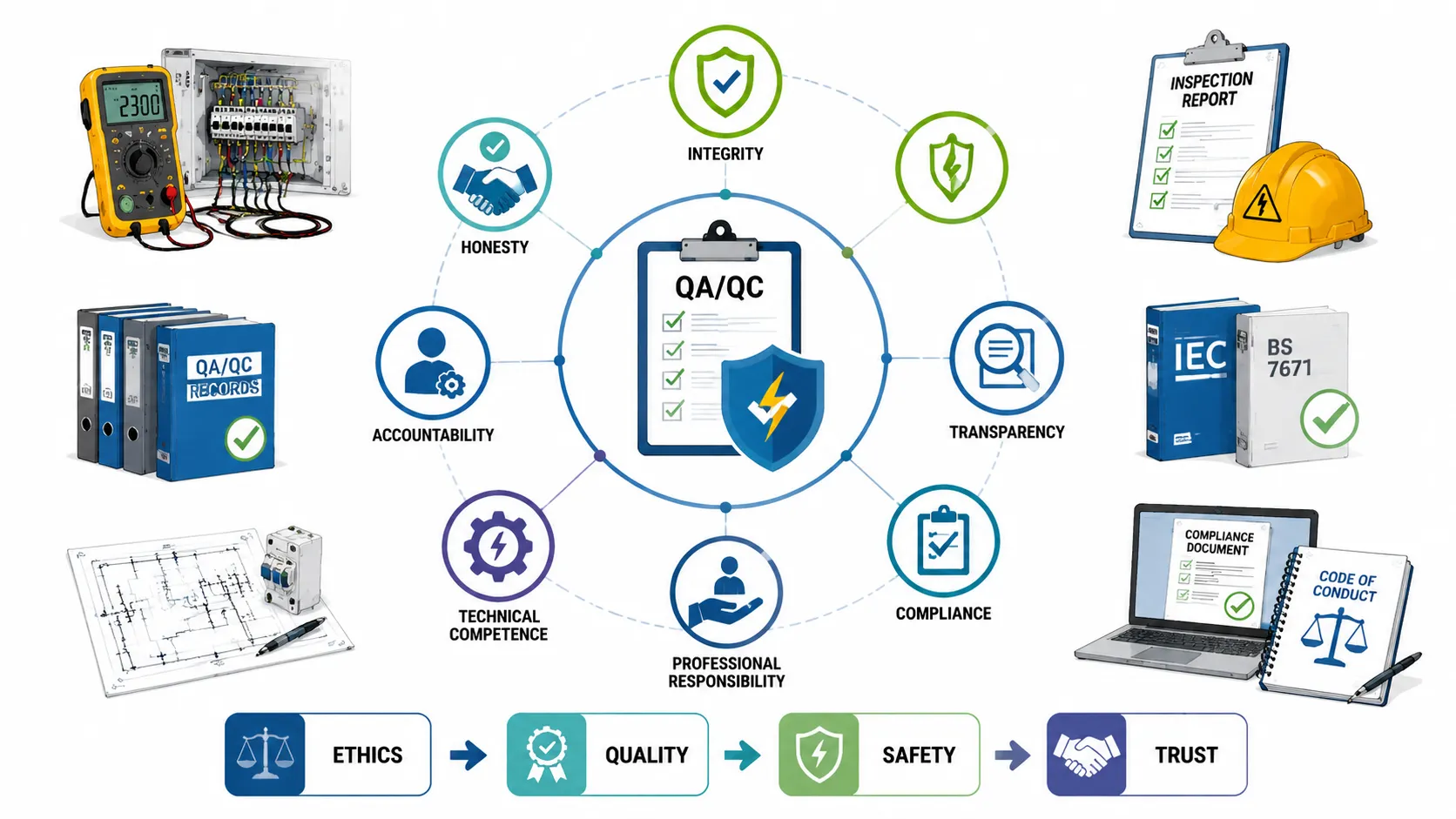
QAQC Integrity and Compliance Infographic

Understanding Ethics in Electrical QA/QC Practices

Ethics refers to the principles and values that determine what is considered professionally responsible and acceptable behaviour. Within electrical QA/QC, ethics provides a framework for making decisions when rules, procedures or technical requirements alone may not fully address a complex situation.

Electrical QA/QC professionals are expected to make decisions that protect:

  • Public safety.

  • Electrical system reliability.

  • Regulatory compliance.

  • Client interests.

  • Organisational reputation.

  • Professional credibility.

  • Environmental and operational responsibilities.

Ethical practice requires professionals to consider not only whether an activity is technically acceptable but also whether the decision is responsible, transparent and aligned with professional obligations.

For example, an electrical QA/QC engineer may discover that a component has passed a basic inspection but has questionable long-term reliability due to installation conditions. Although immediate acceptance may support project progress, an ethical professional must consider the potential future consequences before approving the work.

Importance of Ethical Leadership in Electrical QA/QC

Ethical leadership influences how quality decisions are made throughout an organisation. Senior QA/QC leaders establish expectations for professional behaviour and create an environment where employees understand that quality cannot be compromised for convenience.

Ethical QA/QC leadership supports:

  • Honest inspection reporting.

  • Accurate documentation.

  • Independent technical judgement.

  • Fair treatment of stakeholders.

  • Responsible risk management.

  • Transparent communication.

  • Continuous improvement.

A leader who demonstrates ethical behaviour encourages the entire QA/QC team to follow similar standards.

Key Ethical Principles Governing Electrical QA/QC

Integrity

Integrity is one of the most important ethical principles in engineering quality management. It requires professionals to act honestly, consistently and transparently regardless of external pressure.

In electrical QA/QC practices, integrity applies to:

  • Recording inspection findings accurately.

  • Reporting defects without modification.

  • Presenting test results truthfully.

  • Maintaining accurate quality documentation.

  • Communicating technical concerns openly.

  • Avoiding misleading statements.

An electrical QA/QC professional demonstrates integrity by reporting an identified defect even when doing so may delay project activities.

Practical Application of Integrity

A testing engineer identifies abnormal results during electrical testing. The construction team requests that the results are not reported immediately because the project deadline is approaching.

An ethical QA/QC professional should:

  • Record the actual test results.

  • Investigate the cause.

  • Communicate the concern appropriately.

  • Recommend corrective action.

  • Maintain technical evidence.

The objective is not to create unnecessary delay but to ensure that decisions are based on accurate information.

Objectivity and Impartiality

Objectivity requires QA/QC professionals to make decisions based on evidence rather than personal interests, relationships or external influence.

Impartiality means treating all relevant parties fairly while applying the same standards consistently.

Electrical QA/QC professionals should avoid decisions influenced by:

  • Personal relationships.

  • Contractor pressure.

  • Financial interests.

  • Organisational politics.

  • Project urgency.

  • Personal preferences.

Importance of Objectivity in Inspection Activities

Inspection decisions should be based on:

  • Approved drawings.

  • Specifications.

  • Standards.

  • Test results.

  • Inspection criteria.

  • Technical evidence.

A QA/QC engineer should not approve unacceptable work simply because the contractor is experienced or because the project is behind schedule.

Professional Competence

Ethical practice requires professionals to maintain appropriate knowledge, skills and competence.

A QA/QC engineer should understand:

  • Electrical engineering principles.

  • Inspection procedures.

  • Testing requirements.

  • Quality management systems.

  • Applicable standards.

  • Risk assessment methods.

  • Documentation requirements.

Professionals should recognise their limitations and seek appropriate support when required.

Competence Responsibilities Include:

  • Maintaining technical knowledge.

  • Participating in professional development.

  • Understanding current requirements.

  • Applying correct procedures.

  • Seeking specialist advice when necessary.

Accepting responsibility for decisions without adequate competence can create ethical and technical risks.

Accountability

Accountability means accepting responsibility for professional decisions and their consequences.

Electrical QA/QC professionals are accountable for:

  • Inspection decisions.

  • Quality records.

  • Technical recommendations.

  • Corrective action verification.

  • Reporting accuracy.

Accountability encourages careful decision-making because professionals understand that their actions can affect safety, performance and organisational reputation.

Transparency

Transparency involves providing clear, accurate and understandable information to relevant stakeholders.

In QA/QC environments, transparency applies to:

  • Inspection outcomes.

  • Test results.

  • Quality concerns.

  • Non-conformities.

  • Corrective actions.

  • Decision-making processes.

Transparent communication builds trust between:

  • QA/QC teams.

  • Contractors.

  • Clients.

  • Project managers.

  • Regulatory bodies.

Confidentiality

Electrical QA/QC professionals often access sensitive information, including:

  • Design documents.

  • Client information.

  • Technical specifications.

  • Project data.

  • Commercial information.

Ethical professionals must protect confidential information and only share information with authorised individuals.

Confidentiality does not mean hiding important safety or quality concerns.

Professionals must balance confidentiality with their responsibility to report significant risks.

Public Safety Responsibility

The protection of public safety is a primary ethical responsibility in engineering.

Electrical QA/QC professionals contribute to safety by ensuring:

  • Equipment is suitable.

  • Installations meet requirements.

  • Testing is completed correctly.

  • Defects are identified.

  • Risks are controlled.

A decision that improves short-term project performance but increases safety risk would be ethically unacceptable.

Professional Codes of Conduct in Electrical QA/QC

Professional codes of conduct provide guidance on expected behaviour and responsibilities.

They commonly require engineers and quality professionals to:

  • Act honestly.

  • Protect public welfare.

  • Maintain competence.

  • Respect professional responsibilities.

  • Avoid conflicts of interest.

  • Communicate accurately.

  • Support sustainable engineering practices.

Codes of conduct help professionals make appropriate decisions when facing complex situations.

Ethical Decision-Making Framework for QA/QC Professionals

Ethical decision-making requires a structured approach.

Step 1: Identify the Ethical Issue

Determine:

  • What decision must be made?

  • Who may be affected?

  • What values are involved?

  • Are there competing responsibilities?

Step 2: Review Technical Requirements

Consider:

  • Standards.

  • Procedures.

  • Specifications.

  • Contract requirements.

  • Regulatory expectations.

Step 3: Identify Stakeholders

Consider:

  • Client.

  • Contractor.

  • Employees.

  • Public users.

  • Organisation.

  • Regulators.

Step 4: Evaluate Options

Assess possible actions considering:

  • Safety.

  • Quality.

  • Compliance.

  • Risk.

  • Long-term consequences.

Step 5: Make a Defensible Decision

The chosen action should be:

  • Evidence-based.

  • Professionally justified.

  • Transparent.

  • Consistent with ethical responsibilities.

Step 6: Document the Decision

Maintain appropriate records showing:

  • Issue identified.

  • Evidence considered.

  • Decision made.

  • Actions required.

Ethical Challenges in Electrical QA/QC

Pressure to Accept Non-Compliant Work

One common ethical challenge occurs when project teams request acceptance of work that does not fully meet requirements.

Reasons may include:

  • Schedule pressure.

  • Cost concerns.

  • Client expectations.

  • Contractor difficulties.

The ethical response is to:

  • Evaluate evidence.

  • Explain the concern.

  • Identify corrective actions.

  • Maintain technical independence.

Manipulation of Quality Records

Quality records provide evidence that work has been completed correctly.

Unethical practices may include:

  • Changing inspection findings.

  • Altering test results.

  • Creating inaccurate records.

  • Removing evidence of defects.

Such actions damage trust and may create serious safety risks.

Ethical QA/QC professionals must maintain accurate and traceable documentation.

Conflict of Interest

A conflict of interest occurs when personal interests may influence professional judgement.

Examples include:

  • Personal relationships with suppliers.

  • Financial interests.

  • Pressure from management.

  • Preference for certain contractors.

Professionals should disclose and manage conflicts appropriately.

Balancing Commercial and Quality Requirements

Engineering projects require commercial awareness, but commercial objectives should not override essential quality requirements.

A professional QA/QC leader should seek solutions that balance:

  • Cost.

  • Programme.

  • Quality.

  • Safety.

  • Performance.

However, safety-critical and compliance requirements must remain protected.

Ethical Handling of Non-Conformities

Non-conformities represent situations where requirements have not been satisfied.

Ethical NCR management requires:

  • Accurate identification.

  • Clear description.

  • Objective classification.

  • Root-cause investigation.

  • Effective corrective action.

  • Verification before closure.

Closing NCRs without effective resolution is unethical because it creates false assurance.

Ethical Responsibilities During Audits

Audits require honesty and cooperation.

QA/QC professionals should:

  • Provide accurate information.

  • Support auditor access.

  • Avoid hiding problems.

  • Respond professionally.

  • Implement agreed improvements.

Attempting to manipulate audit outcomes damages the credibility of the quality management system.

Ethical Communication With Stakeholders

Effective communication requires:

  • Accuracy.

  • Respect.

  • Professional language.

  • Appropriate timing.

  • Transparency.

QA/QC leaders should avoid:

  • Misleading statements.

  • Withholding important information.

  • Blaming individuals unfairly.

  • Exaggerating problems.

Communication should support problem-solving rather than conflict creation.

Ethical Quality Culture Development

Ethical behaviour becomes stronger when embedded into organisational culture.

A strong ethical quality culture encourages:

  • Speaking up about concerns.

  • Honest reporting.

  • Professional challenge.

  • Learning from mistakes.

  • Fair decision-making.

  • Continuous improvement.

Leadership plays a critical role because employees often follow the behaviours demonstrated by senior personnel.

Role of Senior QA/QC Leaders in Ethical Practice

Senior leaders should:

  • Demonstrate ethical behaviour.

  • Establish clear expectations.

  • Support professional independence.

  • Protect employees who raise concerns.

  • Encourage evidence-based decisions.

  • Address unethical behaviour.

  • Promote continual improvement.

Leadership behaviour directly influences team culture.

Ethical Decision-Making Example

Scenario

A QA/QC engineer identifies repeated insulation testing failures in an electrical installation. The project manager requests approval to continue because replacement materials may delay completion.

Ethical Analysis

The engineer should consider:

  • Safety implications.

  • Technical requirements.

  • Available evidence.

  • Long-term reliability.

  • Corrective options.

Appropriate Response

The engineer should:

  • Record the findings.

  • Explain the risk.

  • Recommend corrective action.

  • Support problem-solving.

  • Avoid approving unacceptable work.

Outcome

The project may experience short-term delay but benefits from improved reliability and reduced future risk.

Ethical Leadership Case Study: Quality Pressure During Project Completion

Project Background

An electrical infrastructure project is approaching final handover. Several outstanding quality issues remain, including incomplete documentation and unresolved inspection findings.

Project management requests rapid closure to achieve the contractual milestone.

Ethical Challenge

The QA/QC team faces pressure between:

  • Meeting the deadline.

  • Protecting quality assurance.

  • Maintaining accurate records.

Leadership Response

The QA/QC leader:

  • Reviews outstanding issues.

  • Prioritises risks.

  • Maintains accurate documentation.

  • Communicates concerns professionally.

  • Establishes corrective action plans.

  • Ensures final acceptance is evidence-based.

Outcome

The project achieves handover with improved quality confidence because decisions were based on ethical and professional principles.

Case Study Conclusion

The case demonstrates that ethical leadership does not prevent project success. Instead, it supports sustainable success by ensuring that decisions protect safety, quality and stakeholder trust.

Ethical Principles and Their Application Table

Ethical PrincipleMeaningQA/QC Application
IntegrityActing honestly and consistentlyAccurate inspection reporting
ObjectivityMaking evidence-based decisionsIndependent quality judgement
CompetenceMaintaining professional capabilityCorrect inspection and testing decisions
AccountabilityAccepting responsibilityDefensible QA/QC decisions
TransparencyOpen and accurate communicationClear reporting and documentation
ConfidentialityProtecting sensitive informationSecure handling of project data
Safety ResponsibilityProtecting people and assetsPreventing unsafe acceptance
FairnessTreating stakeholders consistentlyEqual application of quality criteria

Benefits of Ethical QA/QC Leadership

Ethical practices provide significant benefits, including:

  • Improved stakeholder trust.

  • Stronger quality culture.

  • Reduced compliance risks.

  • Better decision-making.

  • Increased professional credibility.

  • Improved audit performance.

  • More reliable electrical systems.

  • Reduced rework.

  • Better team confidence.

  • Stronger organisational reputation.

  • Improved long-term project outcomes.

Key Learning Points

Learners should understand that:

  • Ethics is fundamental to professional QA/QC practice.

  • Technical decisions must be based on evidence and integrity.

  • QA/QC professionals must maintain independence.

  • Public safety is a primary ethical responsibility.

  • Accurate documentation is an ethical obligation.

  • Confidential information must be protected.

  • Conflicts of interest should be managed appropriately.

  • Quality requirements should not be compromised by pressure.

  • Ethical leadership influences organisational culture.

  • Professional codes of conduct guide responsible behaviour.

  • Ethical decision-making requires structured evaluation.

  • Transparency builds stakeholder confidence.

  • Accountability strengthens professional practice.

  • Competence is essential for ethical performance.

  • Ethical behaviour supports sustainable quality improvement.

Conclusion

Ethical principles and professional codes of conduct provide the foundation for responsible electrical QA/QC leadership. Senior QA/QC professionals must apply integrity, objectivity, accountability, competence and transparency when making decisions that affect quality, safety and project performance. Ethical leadership ensures that technical judgement remains independent and that quality requirements are protected even under significant commercial and operational pressure.

By integrating ethical considerations into everyday QA/QC practices, electrical engineering organisations can develop stronger quality cultures, improve stakeholder confidence and deliver safer, more reliable systems. Ethical decision-making is therefore not only a professional obligation but also a critical factor in achieving long-term engineering excellence.

2: Evaluate Complex Scenarios Where Electrical Quality Requirements May Conflict With Project Timelines or Commercial Budgets

In complex electrical engineering projects, QA/QC leaders frequently face situations where technical quality requirements compete with project pressures such as strict deadlines, limited budgets, resource constraints and commercial expectations. These situations require advanced professional judgement because decisions made under pressure can directly affect electrical system reliability, operational safety, regulatory compliance and stakeholder confidence.

A Chartered Electrical Engineer (CEng) and senior electrical QA/QC professional must understand that successful project delivery requires a balanced approach. Quality cannot be considered separately from cost and schedule; however, commercial and programme pressures must not override essential technical requirements. Ethical QA/QC leadership involves analysing available options, assessing risks, communicating clearly with stakeholders and making decisions that protect long-term project performance.

Electrical quality requirements exist to ensure that installations, equipment and systems perform safely and reliably throughout their operational life. Project timelines and commercial budgets represent legitimate business requirements, but they must be managed through improved planning, efficient processes and responsible decision-making rather than by reducing essential quality controls.

This section explores how senior QA/QC professionals evaluate complex scenarios where electrical quality requirements conflict with project deadlines or financial limitations. It focuses on ethical decision-making, risk-based assessment, professional responsibility, stakeholder management and practical strategies for achieving quality objectives while considering real project constraints.

Understanding the Relationship Between Quality, Cost and Time in Electrical Projects

Electrical engineering projects are commonly managed around three interconnected objectives:

  • Quality.

  • Cost.

  • Time.

These objectives are often referred to as competing project constraints because changes in one area may affect the others.
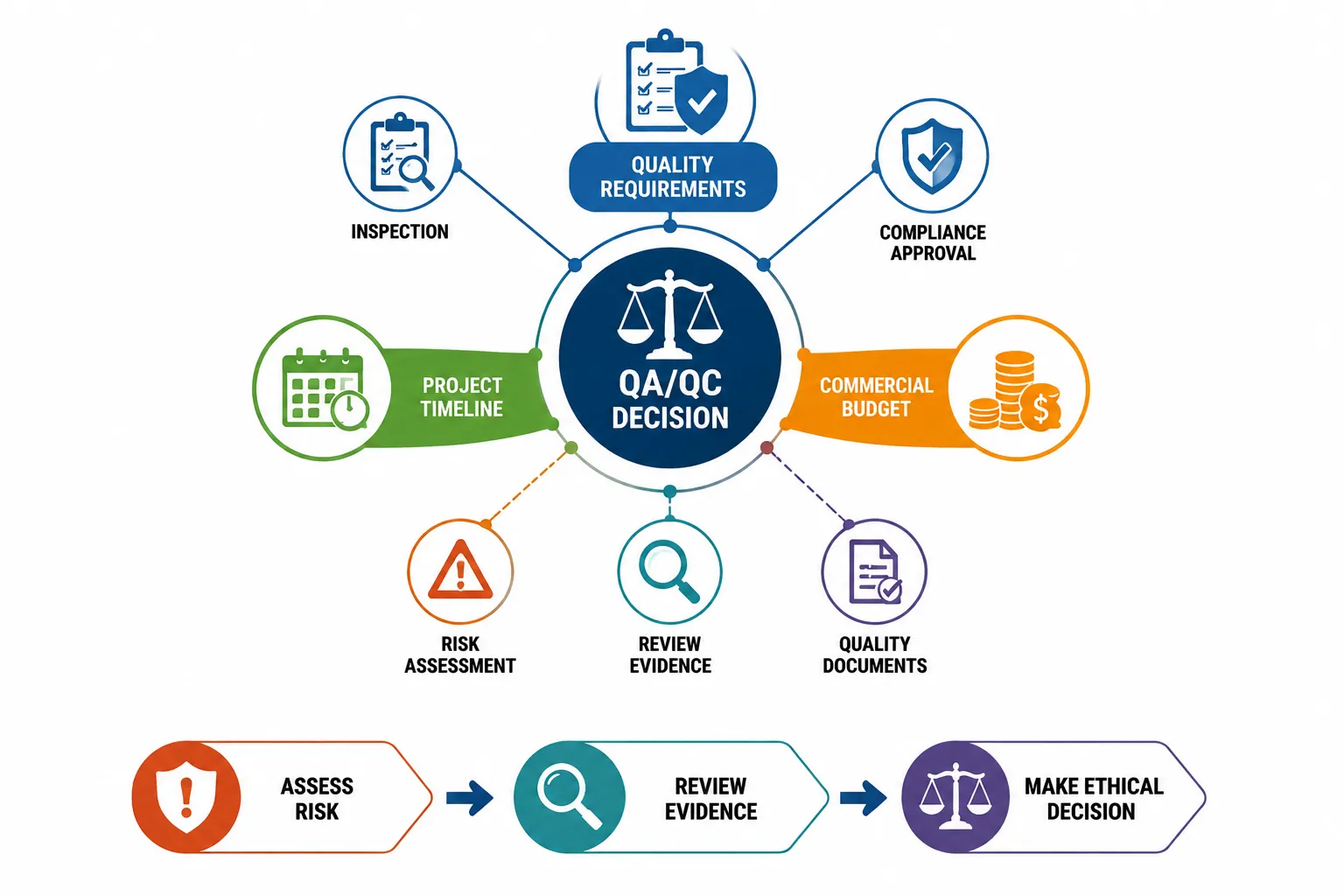
Relationship Between Quality Cost and Time in Electrical Projects

For example:

  • Reducing project time may increase pressure on inspections and testing.

  • Reducing cost may limit available quality resources.

  • Increasing quality requirements may require additional time or investment.

However, professional QA/QC leadership requires understanding that some quality requirements are not optional. Safety-critical testing, regulatory compliance, approved specifications and verification activities must be maintained regardless of commercial pressure.

The Role of QA/QC Leadership in Managing Conflicting Priorities

Senior QA/QC leaders act as a bridge between technical requirements and project objectives. Their responsibility is not to delay projects unnecessarily but to ensure that project decisions remain technically justified.

A professional QA/QC leader should:

  • Understand project objectives.

  • Protect essential quality requirements.

  • Identify acceptable alternatives.

  • Evaluate risks.

  • Communicate technical concerns.

  • Support efficient solutions.

  • Maintain ethical standards.

  • Provide evidence-based recommendations.

The role requires balancing professional independence with practical project awareness.

Key Concepts in Quality, Cost and Time Decision-Making

Key ConceptDefinitionApplication in Electrical QA/QC
Quality RequirementA defined condition or standard that work must satisfyEnsuring electrical systems meet specifications
Project ConstraintA limitation affecting project deliveryManaging budget, resources and deadlines
Ethical Decision-MakingSelecting actions based on professional values and responsibilitiesProtecting safety and quality under pressure
Risk-Based DecisionChoosing actions based on potential consequencesPrioritising critical electrical issues
Technical IntegrityMaintaining accuracy and reliability of engineering decisionsPreventing unacceptable acceptance decisions
Commercial PressureInfluence created by financial or contractual demandsManaging budget-driven requests
Programme PressurePressure to complete activities within required datesMaintaining quality during deadlines
Value EngineeringOptimising cost without reducing required performanceSelecting efficient technical solutions
Quality CompromiseReduction of standards that may affect performanceAvoiding unsafe cost-saving decisions
Corrective ActionAction taken to resolve identified problemsRestoring compliance
Preventive ActionAction taken to prevent future failuresImproving processes and reliability
Professional JudgementApplying expertise to complex decisionsEvaluating competing project priorities

Ethical Challenges When Quality Conflicts With Project Deadlines

One of the most challenging responsibilities for QA/QC professionals is managing situations where project teams request faster completion while quality verification remains incomplete.

Common examples include:

  • Requests to reduce inspection activities.

  • Pressure to accept incomplete documentation.

  • Requests to approve temporary solutions.

  • Delays in corrective action implementation.

  • Pressure to close non-conformities quickly.

  • Requests to use alternative materials without full assessment.

These situations require careful evaluation because short-term project benefits may create long-term technical risks.

Evaluating Deadline Pressure Against Quality Requirements

A project deadline may be influenced by:

  • Contract completion dates.

  • Client expectations.

  • Financial milestones.

  • Commissioning schedules.

  • Operational requirements.

However, QA/QC leaders should assess:

  • Is the required activity essential?

  • What risk exists if it is reduced?

  • Is there an alternative method?

  • Can resources be increased?

  • Can activities be resequenced?

  • Can efficiency improve without reducing quality?

The objective is not to choose quality over time or time over quality. The objective is to find solutions that maintain essential quality while improving project efficiency.

Scenario 1: Pressure to Complete Electrical Installation Without Full Inspection

Project Situation

An electrical installation project is approaching a major completion milestone. The construction team requests immediate approval because delays may affect contractual deadlines.

The QA/QC team identifies that:

  • Some inspection records are incomplete.

  • Certain installation checks require verification.

  • Testing evidence is not fully available.

Conflict

The project team prioritises:

  • Schedule completion.

  • Contract milestone achievement.

  • Cost control.

The QA/QC team prioritises:

  • Evidence-based acceptance.

  • Technical assurance.

  • Compliance.

Ethical Evaluation

A senior QA/QC leader should not simply reject progress or approve incomplete work.

The leader should:

  • Review outstanding requirements.

  • Identify critical versus non-critical issues.

  • Assess technical risk.

  • Develop an action plan.

  • Communicate clearly with stakeholders.

Appropriate Response

Possible solutions include:

  • Prioritising critical inspections.

  • Assigning additional competent inspectors.

  • Improving coordination.

  • Completing documentation verification in parallel.

  • Establishing a controlled completion plan.

The solution maintains quality while addressing programme concerns.

Scenario 2: Budget Reduction Affecting QA/QC Resources

Project Situation

A project experiences financial pressure, and management proposes reducing QA/QC staffing to lower costs.

Potential Risks

Reduced QA/QC resources may result in:

  • Delayed inspections.

  • Reduced testing oversight.

  • Increased defects.

  • Poor documentation.

  • Higher future rework costs.

Ethical Analysis

The QA/QC leader should evaluate whether the proposed reduction affects essential quality activities.

Considerations include:

  • Project complexity.

  • Electrical system criticality.

  • Inspection workload.

  • Competence requirements.

  • Risk exposure.

Appropriate Leadership Response

The leader should:

  • Present evidence-based risks.

  • Identify efficiency improvements.

  • Recommend appropriate resource levels.

  • Avoid unnecessary duplication.

  • Protect critical QA/QC activities.

Cost efficiency should not become quality neglect.

Scenario 3: Pressure to Accept Alternative Materials

Project Situation

A specified electrical component becomes unavailable. Procurement suggests using an alternative product to avoid project delay.

Conflict

The alternative may:

  • Reduce cost.

  • Improve availability.

  • Support programme recovery.

However, it may also require:

  • Technical review.

  • Approval.

  • Compatibility assessment.

  • Additional testing.

Ethical Evaluation

The QA/QC leader should ensure:

  • Technical suitability.

  • Approved change process.

  • Performance requirements.

  • Documentation updates.

The decision should be based on evidence rather than urgency.

Scenario 4: Reducing Testing Due to Programme Pressure

Project Situation

Commissioning activities are delayed, and project management requests reduced testing to recover time.

Ethical Concerns

Reducing testing may affect:

  • Safety.

  • Reliability.

  • Compliance.

  • Future maintenance.

  • System performance.

Professional Response

The QA/QC leader should evaluate:

  • Which tests are mandatory.

  • Which tests are risk-critical.

  • Whether additional resources can accelerate testing.

  • Whether sequencing can improve.

Testing requirements should only change through appropriate technical evaluation and approval.

Risk-Based Decision-Making Approach

A senior QA/QC professional should use risk-based thinking when evaluating conflicts.

The process includes:

Identify the Issue

Determine:

  • What quality requirement is affected?

  • What project pressure exists?

  • Who is impacted?

Assess Risk

Consider:

  • Safety impact.

  • Technical failure possibility.

  • Compliance consequences.

  • Financial consequences.

  • Operational impact.

Evaluate Options

Options may include:

  • Maintaining the original approach.

  • Increasing resources.

  • Changing sequence.

  • Applying approved alternatives.

  • Escalating the decision.

Select the Best Option

The preferred solution should:

  • Protect essential requirements.

  • Reduce unnecessary delay.

  • Be technically justified.

  • Be properly documented.

Balancing Commercial Considerations With Ethical Responsibilities

Commercial awareness is an important leadership skill. QA/QC professionals should understand project realities, including:

  • Budget limitations.

  • Contract obligations.

  • Client expectations.

  • Resource availability.

However, commercial considerations should not encourage unethical actions.

A professional leader should avoid:

  • Ignoring defects.

  • Reducing required inspections.

  • Accepting poor-quality materials.

  • Altering records.

  • Closing issues without evidence.

Ethical leadership means finding responsible solutions.

Value Engineering Without Reducing Quality

Value engineering can support cost efficiency when applied correctly.

Effective value engineering involves:

  • Reviewing design efficiency.

  • Removing unnecessary costs.

  • Improving processes.

  • Selecting suitable alternatives.

  • Optimising resources.

Poor value engineering may involve:

  • Reducing testing.

  • Lowering material quality.

  • Removing verification activities.

  • Ignoring lifecycle performance.

The difference is that good value engineering improves efficiency while maintaining required performance.

Managing Stakeholder Expectations

Conflicts often occur because stakeholders have different priorities.

Client Perspective

The client may prioritise:

  • Reliability.

  • Compliance.

  • Long-term performance.

Contractor Perspective

The contractor may prioritise:

  • Completion.

  • Cost control.

  • Resource efficiency.

Project Management Perspective

Project managers may prioritise:

  • Schedule.

  • Milestones.

  • Commercial outcomes.

QA/QC Perspective

QA/QC professionals prioritise:

  • Evidence.

  • Compliance.

  • Technical integrity.

A skilled leader aligns these perspectives through communication and evidence.

Communication Strategies During Quality Conflicts

Effective communication is essential when quality conflicts occur.

QA/QC leaders should:

  • Explain technical risks clearly.

  • Avoid emotional arguments.

  • Provide evidence.

  • Suggest practical solutions.

  • Communicate early.

  • Maintain professional relationships.

Poor communication can transform a manageable technical issue into a major dispute.

Decision-Making Framework for Complex QA/QC Conflicts

A structured framework helps leaders make consistent decisions.

Step 1: Understand the Situation

Identify:

  • Technical issue.

  • Project pressure.

  • Stakeholders involved.

Step 2: Review Requirements

Check:

  • Standards.

  • Specifications.

  • Procedures.

  • Contract requirements.

Step 3: Assess Consequences

Evaluate:

  • Safety.

  • Quality.

  • Cost.

  • Time.

  • Reputation.

Step 4: Develop Options

Consider:

  • Technical solutions.

  • Resource changes.

  • Alternative approaches.

Step 5: Evaluate Options

Assess:

  • Risk.

  • Compliance.

  • Practicality.

  • Long-term impact.

Step 6: Make a Professional Decision

Ensure the decision is:

  • Ethical.

  • Defensible.

  • Evidence-based.

Step 7: Document and Monitor

Maintain records and verify outcomes.

Case Study: Balancing Quality and Project Completion

Project Background

A large electrical infrastructure project is approaching final commissioning. The project is behind schedule due to design changes and procurement delays.

The project management team requests rapid completion.

Outstanding issues include:

  • Incomplete inspection documentation.

  • Several minor defects.

  • Testing schedule pressure.

  • Limited specialist resources.

Ethical Challenge

The QA/QC leader must balance:

  • Client expectations.

  • Contract deadlines.

  • Technical requirements.

  • Safety responsibilities.

Leadership Evaluation

The leader reviews:

  • Defect severity.

  • Testing requirements.

  • Documentation status.

  • Available resources.

  • Project risks.

Actions Taken

The QA/QC leader:

  • Categorises defects by risk.

  • Prioritises critical activities.

  • Allocates resources effectively.

  • Communicates risks.

  • Maintains required verification.

  • Creates a controlled completion plan.

Outcome

The project progresses toward completion without reducing essential quality controls.

Case Study Conclusion

The case demonstrates that ethical QA/QC leadership does not prevent successful project delivery. Instead, it supports sustainable success by ensuring that decisions consider technical reliability, stakeholder expectations and long-term consequences.

Benefits of Ethical Evaluation of Quality Conflicts

Effective evaluation of quality conflicts provides:

  • Improved decision-making.

  • Reduced technical risk.

  • Better stakeholder relationships.

  • Stronger quality culture.

  • Improved project reliability.

  • Reduced rework.

  • Better cost control.

  • Increased professional credibility.

  • Improved compliance performance.

  • Stronger engineering outcomes.

Common Mistakes When Managing Quality Conflicts

Prioritising Deadlines Above Safety

This can create unacceptable risks.

Accepting Unverified Work

This reduces quality assurance confidence.

Reducing QA/QC Resources Without Risk Assessment

This may increase future costs.

Ignoring Long-Term Consequences

Short-term savings may create lifecycle problems.

Making Decisions Without Evidence

This reduces professional credibility.

Failing to Communicate Risks

Stakeholders cannot make informed decisions without information.

Compromising Documentation

Incomplete records damage traceability.

Key Learning Points

Learners should understand that:

  • Quality, cost and time are interconnected project factors.

  • Ethical QA/QC leaders must balance competing priorities.

  • Deadlines should not justify unacceptable quality reduction.

  • Commercial pressures require professional judgement.

  • Risk-based decision-making supports better outcomes.

  • Evidence should guide technical decisions.

  • Value engineering should improve efficiency without reducing quality.

  • Stakeholder communication is essential during conflicts.

  • QA/QC independence must be protected.

  • Documentation provides accountability.

  • Long-term reliability should influence decisions.

  • Ethical leadership supports sustainable project success.

Conclusion

Electrical QA/QC leaders frequently face complex decisions where quality requirements conflict with project timelines and commercial budgets. Effective leadership requires a balanced approach that recognises legitimate project pressures while protecting essential technical, safety and compliance requirements. Through risk-based evaluation, ethical judgement, stakeholder communication and evidence-based decision-making, professionals can develop solutions that support both project success and engineering integrity.

The most successful QA/QC leaders understand that quality is not an obstacle to project delivery but a foundation for long-term performance. By maintaining professional ethics and applying structured decision-making methods, electrical engineering organisations can achieve reliable systems, improved stakeholder confidence and sustainable project outcomes.
 3: Integrate Advanced Ethical Considerations into Practical Decision-Making Processes for Live QA/QC Operations

In live electrical QA/QC operations, professionals are required to make continuous decisions that directly influence system reliability, safety performance, regulatory compliance and project success. Unlike theoretical situations, real-world QA/QC environments involve dynamic conditions where technical requirements, operational pressures, commercial expectations, human factors and unforeseen challenges interact simultaneously. Senior electrical QA/QC engineers must therefore integrate advanced ethical considerations into their daily decision-making processes to ensure that quality decisions remain fair, transparent, evidence-based and professionally responsible.

A Chartered Electrical Engineer (CEng) and senior QA/QC leader is expected to apply ethical judgement beyond simply following procedures. While standards, specifications and inspection requirements provide technical direction, complex operational situations often require deeper evaluation. Ethical decision-making ensures that professionals consider the consequences of their actions, protect public safety, maintain technical integrity and support sustainable engineering outcomes.

Live QA/QC operations involve activities such as inspections, testing, material verification, non-conformance management, documentation review, commissioning support and quality audits. During these activities, professionals may experience pressure to accelerate progress, reduce costs, accept deviations or prioritise short-term objectives. Advanced ethical leadership enables QA/QC professionals to manage these challenges while maintaining professional independence and protecting quality standards.

Understanding Ethical Decision-Making in Live QA/QC Operations

Ethical decision-making in QA/QC refers to the process of selecting appropriate actions based on professional values, technical evidence, safety responsibilities and stakeholder interests.

In operational environments, ethical decisions require consideration of:

  • Technical compliance.
  • Safety implications.
  • Quality objectives.
  • Project constraints.
  • Stakeholder expectations.
  • Professional responsibilities.
  • Long-term consequences.

A technically possible decision is not always an ethically acceptable decision. For example, an electrical component may function temporarily despite failing a required verification process. Approving such equipment without proper evaluation may create future reliability and safety risks.

Ethical QA/QC professionals evaluate both immediate and long-term impacts before making decisions.

Importance of Ethics in Live Electrical QA/QC Operations

Electrical systems often support critical infrastructure, industrial facilities, commercial buildings and essential services. Errors in QA/QC decisions may lead to:

  • Electrical failures.
  • Equipment damage.
  • Operational interruptions.
  • Safety incidents.
  • Regulatory non-compliance.
  • Financial losses.
  • Reputation damage.

Therefore, ethical decision-making is not an additional responsibility; it is a fundamental part of professional QA/QC practice.

Senior QA/QC professionals must ensure that:

  • Inspection findings are reported honestly.
  • Testing results remain accurate.
  • Defects are managed properly.
  • Quality records are reliable.
  • Decisions are independent.
  • Risks are communicated clearly.

Key Concepts in Ethical QA/QC Decision-Making

Key ConceptDefinitionApplication in Live QA/QC Operations
Ethical Decision-MakingSelecting actions based on professional values and responsibilitiesChoosing solutions that protect safety and quality
Professional IntegrityMaintaining honesty and consistency in decisionsAccurate inspection and testing reports
Technical IndependenceMaking decisions without inappropriate influenceRejecting pressure-based approvals
AccountabilityAccepting responsibility for professional actionsMaintaining traceable decisions
TransparencyProviding clear and accurate informationOpen communication of quality issues
Conflict of InterestA situation where personal interests influence judgementManaging supplier or contractor relationships
Risk-Based ThinkingEvaluating decisions according to potential consequencesPrioritising critical defects
Quality AssurancePlanned activities ensuring quality requirements are achievedPreventing failures through effective systems
Quality ControlOperational activities verifying complianceInspection and testing activities
Professional JudgementApplying expertise to complex situationsEvaluating technical alternatives

Role of Senior QA/QC Engineers in Ethical Decision-Making

Senior QA/QC engineers have a leadership responsibility to create ethical decision-making environments.

Their responsibilities include:

  • Establishing clear quality expectations.
  • Encouraging honest reporting.
  • Protecting inspection independence.
  • Supporting technical discussions.
  • Reviewing complex decisions.
  • Ensuring compliance with standards.
  • Managing stakeholder expectations.

A senior professional should not only make ethical decisions personally but also encourage ethical behaviour throughout the QA/QC team.

Integrating Ethics into Daily QA/QC Activities

Ethical considerations should be integrated into routine operations rather than considered only during major disputes.

Daily QA/QC activities requiring ethical judgement include:

  • Reviewing inspection requests.
  • Approving material submissions.
  • Witnessing testing activities.
  • Recording non-conformities.
  • Reviewing contractor documentation.
  • Accepting completed work.
  • Closing corrective actions.
  • Supporting commissioning activities.

Each activity requires professional honesty and evidence-based judgement.

Ethical Considerations During Inspection Activities

Inspection is one of the most important areas where ethical decision-making applies.

A QA/QC inspector must ensure that:

  • Actual conditions are recorded.
  • Inspection criteria are applied consistently.
  • Defects are reported accurately.
  • Evidence is maintained.
  • Personal relationships do not influence decisions.

Example Scenario

A contractor requests acceptance of an electrical installation because correcting identified issues may delay completion.

An ethical QA/QC professional should:

  • Review the actual defect severity.
  • Assess safety implications.
  • Verify applicable requirements.
  • Communicate the risk.
  • Recommend appropriate corrective action.

The professional should not approve unacceptable work simply to support schedule recovery.

Ethical Decision-Making During Testing and Verification

Testing activities provide objective evidence about system performance.

Ethical testing practices require:

  • Correct test procedures.
  • Accurate measurements.
  • Qualified personnel.
  • Reliable instruments.
  • Complete records.

Unethical testing practices may include:

  • Ignoring failed results.
  • Repeating tests until acceptable results appear.
  • Altering records.
  • Reporting incomplete testing as complete.

Such actions create false confidence and may affect future operational safety.

Managing Ethical Challenges During Non-Conformance Handling

Non-conformance reports (NCRs) are essential tools for controlling quality issues.

Ethical NCR management requires:

  • Accurate defect descriptions.
  • Correct classification.
  • Root-cause investigation.
  • Appropriate corrective action.
  • Verification before closure.

Common Ethical Risks

  • Closing NCRs without evidence.
  • Reducing defect severity incorrectly.
  • Blaming individuals instead of processes.
  • Ignoring repeated failures.

A professional QA/QC leader must ensure NCR processes support improvement rather than simply removing outstanding issues.

Ethical Approach to Pressure From Project Stakeholders

Live projects often involve pressure from:

  • Project managers.
  • Contractors.
  • Clients.
  • Procurement teams.
  • Senior management.

Pressure may involve:

  • Faster approvals.
  • Reduced inspections.
  • Alternative materials.
  • Delayed corrective actions.

An ethical professional should manage pressure through:

  • Evidence-based communication.
  • Risk explanation.
  • Alternative solutions.
  • Professional confidence.

The objective is collaboration, not confrontation.

Applying Ethical Frameworks to QA/QC Decisions

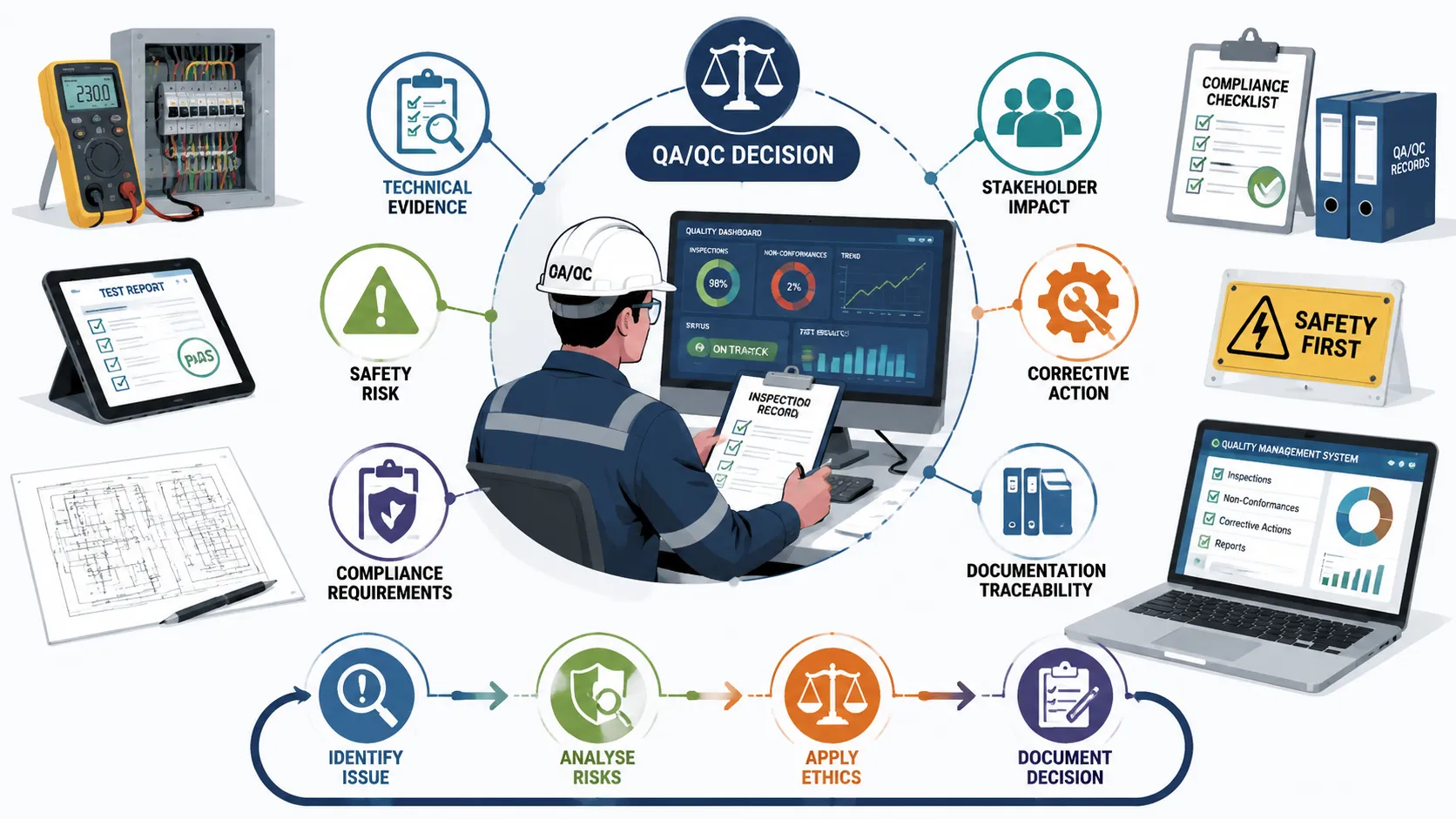
A structured ethical framework helps professionals manage complex situations.

Step 1: Identify the Decision Issue

Determine:

  • What decision is required?
  • What quality concern exists?
  • Who is affected?

Questions to consider:

  • Is safety involved?
  • Are requirements being compromised?
  • Is there external pressure?

Step 2: Gather Technical Evidence

Review:

  • Inspection records.
  • Test results.
  • Drawings.
  • Specifications.
  • Standards.
  • Previous findings.

Ethical decisions must be based on reliable evidence.

Step 3: Identify Stakeholder Responsibilities

Consider:

  • Client expectations.
  • Contractor obligations.
  • Regulatory requirements.
  • Public safety.
  • Organisational responsibilities.

Step 4: Evaluate Possible Actions

Possible options should be assessed against:

  • Safety.
  • Quality.
  • Compliance.
  • Cost.
  • Programme impact.
  • Long-term consequences.

Step 5: Select the Most Responsible Action

The preferred decision should be:

  • Technically justified.
  • Ethically acceptable.
  • Properly documented.
  • Communicated clearly.

Step 6: Monitor Outcomes

After implementation:

  • Review effectiveness.
  • Confirm compliance.
  • Record lessons learned.
  • Improve future decisions.

Decision Making Infographic
Ethical Decision-Making in Live Project Scenarios

Scenario 1: Client Pressure for Faster Handover

Situation

A client requests early handover of an electrical system despite incomplete documentation.

Ethical Challenge

The project team wants:

  • Faster completion.
  • Reduced delays.
  • Commercial achievement.

QA/QC requires:

  • Complete records.
  • Verified testing.
  • Reliable evidence.

Professional Response

The QA/QC leader should:

  • Identify outstanding requirements.
  • Explain risks.
  • Prioritise critical documentation.
  • Develop a controlled completion plan.

The leader should support progress without compromising essential quality evidence.

Scenario 2: Contractor Requests Acceptance of Defective Equipment

Situation

A contractor proposes using equipment with minor deviations from approved specifications.

Ethical Evaluation

The QA/QC engineer should assess:

  • Technical suitability.
  • Safety impact.
  • Performance requirements.
  • Approval process.

Appropriate Action

The engineer should:

  • Review technical evidence.
  • Request formal approval.
  • Document the decision.
  • Verify compliance.

Personal relationships or project urgency should not influence acceptance.

Scenario 3: Internal Pressure to Reduce Reported Defects

Situation

Management suggests reporting fewer defects to improve project performance statistics.

Ethical Concern

Reducing reported defects may:

  • Misrepresent quality performance.
  • Hide systemic issues.
  • Affect future reliability.

Correct Approach

The QA/QC leader should:

  • Maintain accurate reporting.
  • Explain the importance of transparency.
  • Use findings for improvement.

Quality data must represent reality.

Ethical Leadership During Commissioning Operations

Commissioning is a high-pressure phase where ethical decisions are particularly important.

Challenges may include:

  • Tight deadlines.
  • Multiple contractors.
  • Outstanding defects.
  • Client expectations.

Ethical commissioning leadership requires:

  • Verified test results.
  • Accurate documentation.
  • Clear acceptance criteria.
  • Controlled defect management.

A system should not be considered ready simply because the project schedule requires completion.

Managing Conflicts of Interest in QA/QC Operations

Conflicts of interest can affect professional judgement.

Examples include:

  • Personal relationships with suppliers.
  • Financial interests.
  • Pressure from project leadership.
  • Previous involvement with defective work.

Professionals should:

  • Declare conflicts.
  • Maintain independence.
  • Request independent review when necessary.
  • Follow organisational procedures.

Ethical Communication During Difficult Decisions

Effective ethical leadership depends on communication.

Professionals should communicate:

  • The technical issue.
  • The evidence.
  • The risk.
  • The recommended action.
  • The consequences.

Good communication should be:

  • Professional.
  • Respectful.
  • Clear.
  • Evidence-based.

Developing an Ethical QA/QC Culture

An ethical culture encourages employees to:

  • Report concerns.
  • Challenge poor decisions.
  • Share improvement ideas.
  • Follow procedures.
  • Accept responsibility.

Senior leaders develop this culture by:

  • Demonstrating ethical behaviour.
  • Supporting transparency.
  • Recognising responsible actions.
  • Addressing unethical practices.

Practical Example: Ethical Material Approval Decision

Situation

A supplier proposes replacing a specified electrical component with an alternative due to availability issues.

Evaluation Process

The QA/QC team reviews:

  • Technical specifications.
  • Performance requirements.
  • Certification evidence.
  • Compatibility.
  • Long-term reliability.

Decision

The alternative may be accepted only if:

  • Requirements are satisfied.
  • Approval is obtained.
  • Documentation is updated.
  • Risks are controlled.

This demonstrates ethical decision-making because the decision is based on evidence rather than urgency.

Case Study: Ethical Decision-Making During Electrical Project Delivery

Project Background

A large industrial electrical project is approaching final completion. During final inspections, the QA/QC team identifies several issues:

  • Incomplete test documentation.
  • Minor installation defects.
  • Outstanding corrective actions.

The project manager requests immediate approval because delays may create financial penalties.

Ethical Challenge

The QA/QC leader must balance:

  • Contract deadlines.
  • Client expectations.
  • Technical compliance.
  • Safety responsibilities.

Decision-Making Process

The QA/QC leader:

  • Reviews all findings.
  • Classifies risks.
  • Separates critical and minor issues.
  • Communicates concerns.
  • Develops corrective action priorities.
  • Maintains accurate records.

Outcome

Critical issues are resolved before acceptance, while minor issues are managed through an agreed improvement plan.

The project achieves successful completion without compromising essential quality requirements.

Case Study Conclusion

This case demonstrates that ethical QA/QC leadership supports project success by ensuring decisions are responsible, transparent and technically justified. Ethical decision-making does not prevent progress; it creates confidence that project outcomes are reliable and sustainable.

Benefits of Integrating Ethics Into QA/QC Decisions

Effective ethical integration provides:

  • Improved quality reliability.
  • Stronger safety performance.
  • Increased stakeholder confidence.
  • Better audit outcomes.
  • Reduced technical risks.
  • Improved team professionalism.
  • Stronger organisational reputation.
  • Better decision consistency.
  • Reduced rework.
  • Improved continual improvement.

Common Barriers to Ethical Decision-Making

Excessive Schedule Pressure

May encourage poor decisions.

Commercial Influence

May create pressure to reduce requirements.

Poor Communication

May hide important information.

Lack of Competence

May result in incorrect judgement.

Weak Quality Culture

May discourage reporting.

Fear of Conflict

May prevent professionals from raising concerns.

Key Learning Points

Learners should understand that:

  • Ethics is essential in live QA/QC operations.
  • Professional decisions must protect safety and quality.
  • Evidence should guide decisions.
  • QA/QC independence must be maintained.
  • Pressure should be managed professionally.
  • Accurate reporting is an ethical responsibility.
  • Testing results must remain reliable.
  • NCR management requires transparency.
  • Conflicts of interest must be controlled.
  • Ethical leadership strengthens quality culture.
  • Long-term consequences should influence decisions.
  • Professional judgement is essential in complex situations.

Conclusion

Integrating advanced ethical considerations into live QA/QC operations enables electrical engineering professionals to make responsible decisions under complex conditions. Senior QA/QC leaders must balance technical requirements, project pressures and stakeholder expectations while maintaining integrity, transparency and professional independence.

Ethical decision-making ensures that electrical systems are delivered safely, reliably and in accordance with professional responsibilities. By embedding ethical principles into daily QA/QC activities, organisations can strengthen quality culture, improve stakeholder trust and achieve sustainable engineering performance.

4: Formulate Leadership Strategies That Prioritize Uncompromising Ethical Standards and Long-Term Electrical Safety

In modern electrical engineering projects, ethical leadership is a critical factor in maintaining quality, reliability and long-term safety performance. Senior QA/QC leaders are responsible not only for ensuring compliance with technical requirements but also for creating a professional culture where safety, integrity and responsible decision-making are prioritised above short-term commercial gains.

A Chartered Electrical Engineer (CEng) and senior electrical QA/QC professional must demonstrate leadership strategies that protect the fundamental principles of engineering ethics. Electrical systems are often safety-critical assets where poor decisions can result in equipment failure, operational disruption, financial loss and risks to human life. Therefore, ethical leadership requires a commitment to maintaining uncompromising quality standards throughout design, installation, inspection, testing, commissioning and operation.

This section explores how advanced leadership strategies can be developed and applied to promote ethical behaviour, maintain technical independence and protect long-term electrical safety. It examines how QA/QC leaders can establish ethical cultures, manage project pressures, support professional accountability and ensure that all quality decisions contribute to sustainable engineering outcomes.

Understanding Ethical Leadership in Electrical QA/QC

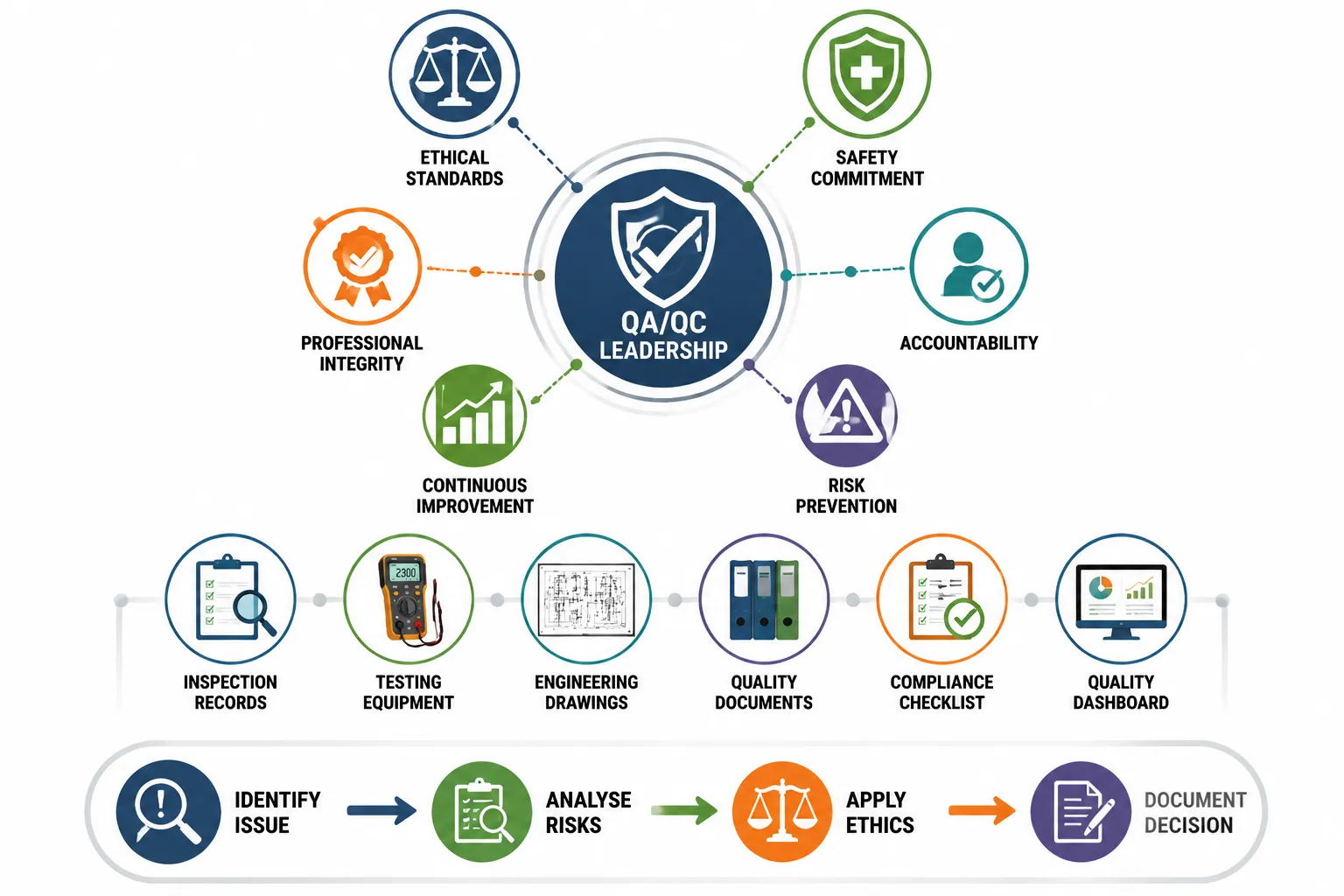
Ethical leadership refers to the ability of leaders to influence professional behaviour by demonstrating integrity, fairness, accountability and responsible judgement. In electrical QA/QC environments, ethical leaders establish expectations that quality and safety requirements must never be compromised without proper evaluation and approval.

An ethical QA/QC leader understands that achieving project milestones is important, but achieving them without compromising safety and reliability is essential.

Ethical leadership requires leaders to:

  • Demonstrate professional integrity.
  • Protect public and operational safety.
  • Encourage transparent communication.
  • Support evidence-based decisions.
  • Maintain technical independence.
  • Challenge unsafe practices.
  • Promote continual improvement.

A leader’s behaviour directly influences how team members approach quality responsibilities.

Importance of Ethical Leadership for Long-Term Electrical Safety

Electrical safety is not only related to immediate compliance during project completion. It involves ensuring that electrical systems continue to operate safely throughout their lifecycle.

Long-term electrical safety depends on:

  • Correct design implementation.
  • Quality installation.
  • Accurate testing.
  • Reliable documentation.
  • Effective maintenance planning.
  • Competent personnel.
  • Continuous monitoring.

Ethical leadership ensures that decisions made during project delivery do not create hidden future risks.

For example, accepting a minor installation deviation without proper technical evaluation may appear acceptable during construction but may create reliability problems years later.

Key Concepts in Ethical Leadership and Electrical Safety

Key ConceptDefinitionApplication in Electrical QA/QC Leadership
Ethical LeadershipLeading through integrity, responsibility and professional valuesEstablishing a quality-focused culture
Safety IntegrityCommitment to protecting people and systems from harmMaintaining essential safety requirements
Professional AccountabilityResponsibility for decisions and outcomesDefensible QA/QC approvals
Technical IndependenceAbility to make unbiased engineering decisionsRejecting inappropriate pressure
Quality CultureShared organisational commitment to qualityEncouraging responsible behaviour
Risk-Based LeadershipMaking decisions based on potential consequencesPrioritising safety-critical issues
Ethical StandardsProfessional principles guiding behaviourMaintaining honesty and fairness
Continuous ImprovementOngoing enhancement of processes and performanceLearning from quality issues
Safety LeadershipInfluencing behaviours that protect safetyEncouraging hazard reporting
Engineering ResponsibilityDuty to apply professional knowledge responsiblyProtecting system reliability

Role of Senior QA/QC Leaders in Maintaining Ethical Standards

Senior QA/QC leaders have a responsibility to ensure that ethical standards are integrated into everyday operations.

Their responsibilities include:

  • Establishing clear ethical expectations.
  • Providing professional guidance.
  • Supporting inspectors and engineers.
  • Reviewing complex decisions.
  • Ensuring accurate reporting.
  • Protecting employees who raise concerns.
  • Maintaining compliance with professional obligations.

Leadership should create an environment where quality personnel feel confident to challenge decisions that may negatively affect safety.

Developing an Ethical Quality Culture

A strong ethical quality culture ensures that employees understand that quality is everyone’s responsibility.

An ethical QA/QC culture encourages:

  • Honest reporting.
  • Early identification of problems.
  • Professional discussions.
  • Learning from failures.
  • Continuous improvement.
  • Responsible decision-making.

Leaders develop this culture by consistently demonstrating ethical behaviour.

QAQC Leadership and Safety Framework 1

Leadership Actions to Build Ethical Culture

Effective leaders should:

  • Communicate quality expectations clearly.
  • Include ethical considerations in decision-making.
  • Recognise responsible behaviour.
  • Address unethical practices.
  • Encourage employee participation.
  • Provide ethical training.
  • Promote transparency.

Strategy 1: Establish Clear Ethical Expectations

The first leadership strategy is creating clear expectations regarding ethical behaviour.

Team members should understand:

  • What professional behaviour is expected.
  • How quality decisions should be made.
  • How conflicts should be managed.
  • How concerns should be reported.

Clear expectations reduce uncertainty during difficult situations.

Practical Implementation

Leaders can establish ethical expectations through:

  • Quality policies.
  • Team briefings.
  • Engineering procedures.
  • Training sessions.
  • Project communication plans.

Strategy 2: Protect Technical Independence

Technical independence is essential for effective QA/QC leadership.

QA/QC professionals must be able to make decisions based on:

  • Technical evidence.
  • Approved standards.
  • Inspection criteria.
  • Safety requirements.

They should not be influenced by:

  • Commercial pressure.
  • Personal relationships.
  • Project urgency.
  • Management preferences.

Leadership Actions

Leaders should:

  • Support independent judgement.
  • Prevent inappropriate influence.
  • Escalate unresolved conflicts.
  • Encourage professional challenge.

Strategy 3: Promote Evidence-Based Decision-Making

Ethical leaders ensure that decisions are based on reliable information rather than assumptions.

Evidence may include:

  • Inspection results.
  • Test records.
  • Engineering calculations.
  • Risk assessments.
  • Technical specifications.
  • Historical data.

Evidence-based decisions improve reliability and reduce bias.

Example

A contractor requests approval of modified electrical equipment due to supply issues.

An ethical QA/QC leader should:

  • Review technical documentation.
  • Verify suitability.
  • Assess risks.
  • Obtain approval.
  • Record the decision.

The decision should not be based only on schedule pressure.

Strategy 4: Develop Strong Safety Leadership

Safety leadership involves actively influencing behaviours that protect people and systems.

A safety-focused leader:

  • Encourages reporting.
  • Reviews risks.
  • Challenges unsafe practices.
  • Supports corrective actions.

Safety Leadership Practices

Leaders should:

  • Conduct safety discussions.
  • Review incidents and lessons learned.
  • Encourage proactive risk identification.
  • Include safety in all decisions.

Strategy 5: Integrate Risk-Based Thinking Into Leadership Decisions

Complex electrical projects involve uncertainty.

Ethical leaders evaluate decisions by considering potential consequences.

Risk-based thinking involves:

Identifying Risks

Consider:

  • Technical failure.
  • Safety impact.
  • Compliance issues.
  • Operational consequences.

Evaluating Risks

Assess:

  • Probability.
  • Severity.
  • Detectability.
  • Long-term impact.

Managing Risks

Develop:

  • Preventive actions.
  • Controls.
  • Monitoring plans.

Strategy 6: Encourage Transparent Communication

Transparency strengthens trust between project stakeholders.

Ethical leaders encourage communication about:

  • Defects.
  • Delays.
  • Risks.
  • Technical concerns.
  • Improvement opportunities.

Poor communication can allow small problems to become major failures.

Effective Communication Principles

Leaders should:

  • Share accurate information.
  • Avoid hiding problems.
  • Explain decisions clearly.
  • Encourage feedback.
  • Maintain professional respect.

Strategy 7: Develop Competence and Professional Responsibility

Long-term safety depends on competent personnel.

Ethical leaders support:

  • Training.
  • Mentoring.
  • Professional development.
  • Knowledge sharing.

Competence development reduces the risk of poor decisions caused by insufficient knowledge.

Competence Development Activities

Include:

  • Technical workshops.
  • Inspection training.
  • Standards updates.
  • Practical assessments.
  • Lessons learned sessions.

Strategy 8: Strengthen Accountability Systems

Accountability ensures that individuals understand their responsibilities.

Effective accountability includes:

  • Clear roles.
  • Defined authority.
  • Documented decisions.
  • Performance review.
  • Corrective feedback.

Accountability should not create fear; it should encourage responsibility.

Managing Ethical Challenges in Real QA/QC Operations

Challenge 1: Pressure to Reduce Quality Controls

Situation

A project team requests fewer inspections to recover schedule delays.

Ethical Concern

Reduced inspections may increase:

  • Undetected defects.
  • Safety risks.
  • Future failures.

Leadership Response

The QA/QC leader should:

  • Assess risk.
  • Identify essential inspections.
  • Improve efficiency.
  • Maintain safety-critical controls.

Challenge 2: Pressure to Approve Defective Work

Situation

A contractor requests acceptance of work containing known defects.

Ethical Response

The leader should:

  • Document the issue.
  • Evaluate severity.
  • Require corrective action.
  • Verify compliance.

Approval should only occur when requirements are satisfied.

Challenge 3: Conflict Between Cost Savings and Safety

Situation

Management proposes cheaper equipment alternatives.

Leadership Approach

Evaluate:

  • Technical suitability.
  • Lifecycle performance.
  • Safety impact.
  • Compliance requirements.

Cost savings should not create unacceptable risk.

Ethical Leadership Decision-Making Process

Step 1: Identify the Ethical Issue

Determine:

  • What decision is required?
  • What values are involved?
  • Who may be affected?

Step 2: Review Technical Requirements

Analyse:

  • Standards.
  • Specifications.
  • Procedures.
  • Safety requirements.

Step 3: Assess Consequences

Consider:

  • Immediate impact.
  • Long-term impact.
  • Safety implications.
  • Operational reliability.

Step 4: Develop Responsible Options

Possible solutions may include:

  • Alternative technical approaches.
  • Additional resources.
  • Improved planning.
  • Corrective actions.

Step 5: Select the Ethical Solution

Choose the option that:

  • Protects safety.
  • Maintains quality.
  • Meets professional obligations.
  • Is technically justified.

Step 6: Document and Communicate

Record:

  • Decision reasoning.
  • Evidence considered.
  • Actions required.

Practical Example: Ethical Leadership During Commissioning

Project Situation

A large electrical facility is approaching commissioning. Several issues remain:

  • Incomplete testing evidence.
  • Minor installation defects.
  • Documentation gaps.

Project management requests immediate approval.

Leadership Evaluation

The QA/QC leader reviews:

  • Safety impact.
  • Testing requirements.
  • Outstanding risks.
  • Corrective action progress.

Leadership Decision

The leader:

  • Maintains essential testing.
  • Prioritises critical issues.
  • Coordinates corrective actions.
  • Communicates risks.

Result

The project achieves successful commissioning with confidence that safety and quality requirements were protected.

Case Study: Building an Ethical QA/QC Leadership Culture

Background

An electrical engineering organisation experienced repeated quality issues caused by:

  • Poor reporting.
  • Pressure-based decisions.
  • Weak communication.
  • Limited accountability.

A new QA/QC leadership strategy was introduced.

Leadership Actions

The organisation implemented:

  • Ethical decision-making training.
  • Independent quality reviews.
  • Improved reporting systems.
  • Safety leadership meetings.
  • Competence development.

Outcomes

After implementation:

  • Quality reporting improved.
  • Employees became more confident raising concerns.
  • Defect prevention increased.
  • Stakeholder trust improved.
  • Safety performance strengthened.

Case Study Conclusion

The case demonstrates that ethical leadership creates long-term benefits by improving both technical performance and organisational culture. Strong leadership does not only control quality; it develops a workforce committed to protecting quality.

Benefits of Ethical Leadership Strategies

Implementing ethical leadership strategies provides:

  • Improved electrical safety.
  • Stronger quality culture.
  • Better decision-making.
  • Increased stakeholder confidence.
  • Reduced technical failures.
  • Improved compliance.
  • Higher employee engagement.
  • Better risk management.
  • Reduced rework.
  • Improved organisational reputation.
  • Stronger long-term reliability.

Common Leadership Failures That Affect Electrical Safety

Prioritising Schedule Over Safety

Creates unacceptable technical risks.

Ignoring Early Warning Signs

Allows minor problems to become major failures.

Weak Communication

Prevents effective risk management.

Poor Accountability

Creates unclear responsibility.

Allowing Pressure to Influence Decisions

Reduces professional independence.

Failing to Develop Competence

Increases technical errors.

Key Learning Points

Learners should understand that:

  • Ethical leadership is essential for electrical safety.
  • Quality decisions require professional integrity.
  • Technical independence must be protected.
  • Safety should remain a priority.
  • Evidence should guide decisions.
  • Leaders influence organisational behaviour.
  • Risk-based thinking improves decisions.
  • Competence development supports reliability.
  • Transparent communication strengthens trust.
  • Accountability improves professional responsibility.
  • Ethical cultures prevent quality failures.
  • Long-term safety requires consistent leadership commitment.

Conclusion

Ethical leadership is fundamental to achieving reliable and safe electrical systems. Senior QA/QC leaders must develop strategies that protect professional integrity, maintain technical independence and ensure that quality requirements are never compromised by short-term pressures. Through strong ethical standards, transparent communication, risk-based decision-making and continuous competence development, leaders can create environments where safety and quality remain central priorities.

By prioritising ethical leadership, electrical engineering organisations can achieve sustainable project success while protecting people, assets and future operational performance. Ethical QA/QC leadership is therefore not only a professional responsibility but a key driver of long-term electrical safety and engineering excellence.