
Lesson 4: Develop Strategies for Conflict Resolution and Team Motivation
Developing effective strategies for conflict resolution and team motivation is an essential leadership responsibility within electrical QA/QC environments. Complex engineering projects often involve different professional opinions, competing priorities, tight deadlines, resource pressures and technical disagreements. Effective QA/QC leaders must be able to manage these challenges constructively, maintain professional relationships and ensure that conflicts do not negatively affect quality, safety, compliance or project performance.
This lesson explores practical approaches to identifying the causes of workplace conflict, communicating effectively, resolving disagreements and encouraging collaborative problem-solving within QA/QC teams. It also examines how leaders can improve team motivation through clear expectations, recognition, participation, support, accountability and effective communication, helping employees remain engaged and focused during demanding project conditions.
Learners will develop the ability to apply appropriate conflict-resolution and motivation strategies to real electrical QA/QC situations. The lesson emphasises professional judgement, teamwork, leadership communication and continuous improvement, enabling learners to build cohesive, motivated and high-performing QA/QC teams that can consistently support electrical quality objectives and successful project delivery.
1: Critically Evaluate Advanced Conflict Resolution Strategies Applicable to Specialized Engineering and Technical Teams
Conflict is a normal feature of complex engineering and QA/QC environments because specialised teams operate at the intersection of technical requirements, project deadlines, commercial pressures, contractual expectations and professional responsibilities. In electrical engineering projects, disagreements may arise over inspection findings, testing results, non-conformities, design interpretation, material acceptance, work sequencing, resource allocation or the timing of corrective actions. When these disagreements are managed poorly, they can affect communication, employee motivation, quality performance, project schedules and stakeholder relationships. When managed effectively, however, constructive conflict can expose weaknesses, encourage technical challenge and contribute to better decisions.
For senior electrical QA/QC professionals, conflict resolution is therefore not simply a people-management activity. It is an important part of quality leadership and professional decision-making. A Chartered Electrical Engineer or senior QA/QC specialist must be able to distinguish between personal disagreement, technical disagreement, process conflict, resource conflict and legitimate professional challenge. The appropriate resolution strategy should then be selected according to the nature, seriousness, urgency and consequences of the conflict.
Advanced conflict resolution requires more than asking people to compromise. It involves analysing evidence, understanding competing interests, protecting technical integrity, maintaining professional relationships and creating solutions that are sustainable. In a specialised engineering team, the strongest resolution strategy is one that addresses the underlying issue while preserving the independence and professional judgement of competent technical personnel.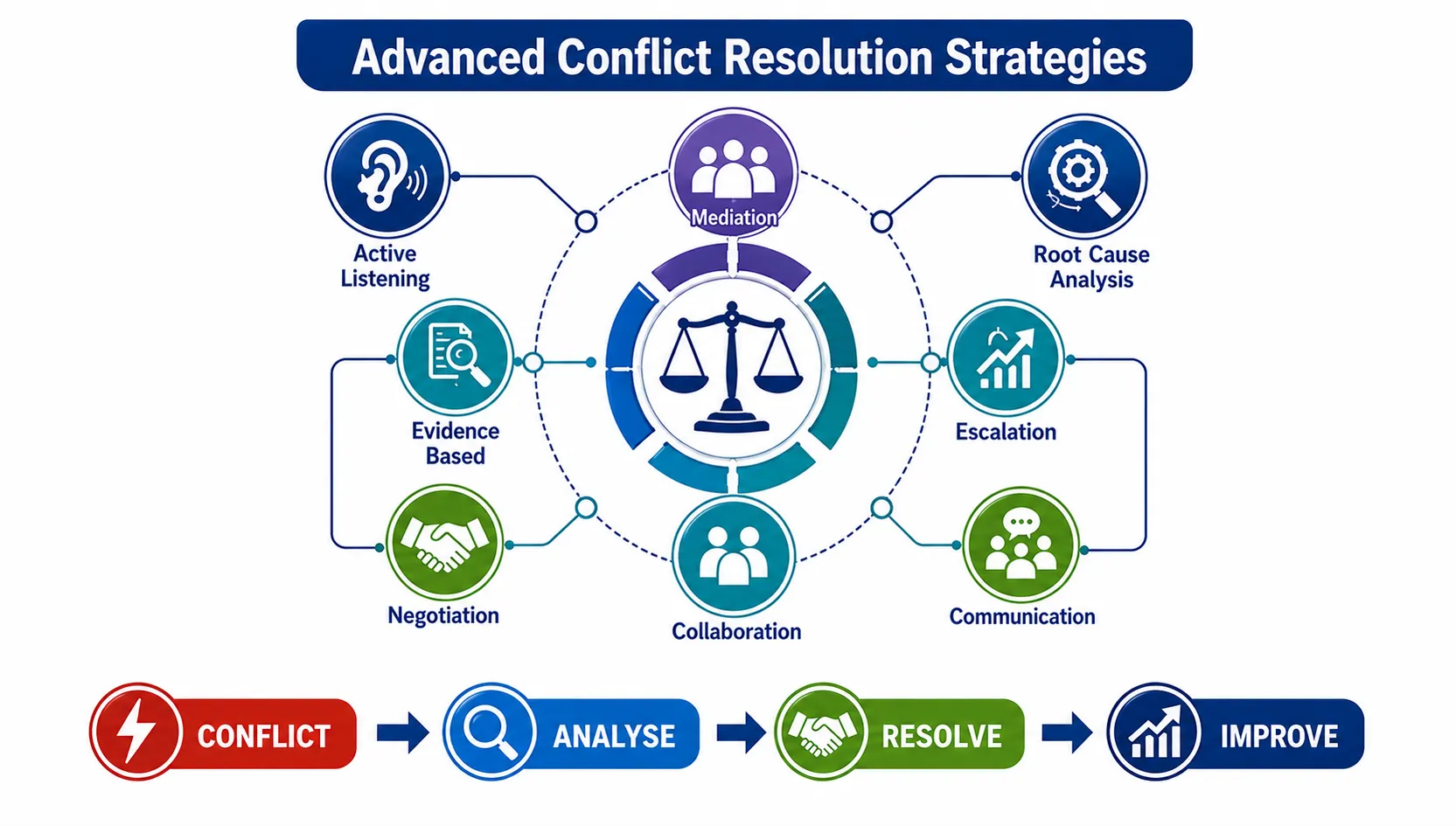
Understanding Conflict in Specialised Engineering and QA/QC Teams
Conflict occurs when two or more individuals or groups perceive that their interests, responsibilities, objectives, interpretations or expectations are incompatible. In electrical QA/QC environments, conflict may be technical, operational, interpersonal or strategic.
A disagreement about whether an electrical installation satisfies an approved requirement may initially appear to be a technical dispute. However, the underlying causes may include:
Different interpretations of technical information.
Incomplete design documentation.
Unclear responsibilities.
Programme pressure.
Resource shortages.
Contractor performance concerns.
Poor communication.
Previous unresolved disagreements.
Differing professional priorities.
Commercial pressure.
Inadequate escalation procedures.
A senior QA/QC leader should therefore avoid treating the visible disagreement as the complete problem.
Types of Conflict in Engineering Teams
Technical Conflict
Technical conflict occurs when professionals disagree about engineering requirements, inspection results, testing evidence, design interpretation or technical acceptability.
Examples include:
Disagreement over test results.
Different interpretations of drawings.
Disputes concerning equipment acceptance.
Different views regarding installation quality.
Disagreement about corrective action requirements.
Technical conflict can be constructive when supported by evidence and professional reasoning.
Process Conflict
Process conflict concerns how work should be performed.
Examples include:
Inspection sequencing.
Approval workflows.
NCR management.
Testing procedures.
Document control.
Inspection notification arrangements.
Process conflict often indicates that responsibilities or procedures require clarification.
Resource Conflict
Resource conflict develops when teams compete for:
Skilled personnel.
Testing equipment.
Inspection time.
Specialist support.
Materials.
Work areas.
Technical resources.
Resource conflict becomes particularly significant during commissioning and project completion.
Interpersonal Conflict
Interpersonal conflict may involve:
Communication style.
Personality differences.
Perceived disrespect.
Lack of trust.
Previous disagreements.
Poor working relationships.
Although interpersonal conflict may appear less technical, it can directly affect QA/QC performance.
Priority Conflict
Priority conflict occurs when stakeholders have different objectives.
For example:
Construction may prioritise programme.
QA/QC may prioritise verification.
Engineering may prioritise technical integrity.
Procurement may prioritise availability.
Project management may prioritise completion.
Effective leadership requires these priorities to be reconciled without compromising essential requirements.
Key Concepts in Advanced Conflict Resolution
| Key Concept | Definition | Application in Engineering QA/QC |
|---|---|---|
| Conflict Resolution | Structured process for addressing disagreement and reaching an acceptable outcome | Resolving technical and operational disputes |
| Negotiation | Process through which parties discuss differences and seek an acceptable solution | Managing competing project priorities |
| Mediation | Structured assistance from a neutral person to help parties resolve disagreement | Supporting difficult interpersonal or cross-functional disputes |
| Collaboration | Joint problem-solving focused on achieving a mutually beneficial outcome | Resolving complex technical issues |
| Compromise | Each party makes acceptable concessions to reach an agreement | Useful where interests partially overlap |
| Active Listening | Deliberate effort to understand another person’s position before responding | Reduces misunderstanding |
| Root-Cause Analysis | Investigation of underlying reasons for a conflict | Prevents repeated disputes |
| Escalation | Moving an unresolved issue to an appropriate higher authority | Used when risk, authority or complexity exceeds team capacity |
| Psychological Safety | Ability to raise concerns without unnecessary fear of negative consequences | Encourages early reporting and technical challenge |
| Professional Judgement | Evidence-based evaluation using expertise and applicable requirements | Supports fair technical decisions |
| Interest-Based Resolution | Focus on underlying interests rather than fixed positions | Helps identify practical solutions |
| Conflict Prevention | Measures designed to reduce the likelihood of future conflict | Improves procedures, roles and communication |
Why Advanced Conflict Resolution Is Important in Electrical QA/QC
Poor conflict management can produce consequences that extend beyond the individuals involved.
Potential consequences include:
Delayed inspections.
Repeated NCRs.
Poor communication.
Reduced employee motivation.
Increased rework.
Delayed testing.
Escalated disputes.
Reduced trust.
Inconsistent technical decisions.
Increased project costs.
Reduced quality performance.
Delayed commissioning.
Effective conflict resolution can instead support:
Better communication.
Faster decision-making.
Stronger technical collaboration.
Improved quality ownership.
Better employee relationships.
Reduced rework.
More effective corrective actions.
Improved project coordination.
Stronger quality culture.
The Conflict Resolution Process
An advanced conflict-resolution process should be structured rather than reactive.
Step 1: Identify the Conflict
The leader should establish what the disagreement actually concerns.
Questions may include:
What happened?
Who is involved?
What are the parties disagreeing about?
When did the disagreement begin?
What evidence exists?
What project objectives are affected?
Step 2: Classify the Conflict
Determine whether it is primarily:
Technical.
Interpersonal.
Procedural.
Resource-related.
Priority-related.
Communication-related.
Many conflicts involve several categories simultaneously.
Step 3: Assess the Consequences
Evaluate whether the conflict could affect:
Electrical quality.
Safety.
Compliance.
Programme.
Cost.
Testing.
Documentation.
Team performance.
Step 4: Establish the Facts
Separate evidence from assumptions.
Relevant evidence may include:
Approved drawings.
Specifications.
Inspection records.
Test results.
NCR documentation.
Correspondence.
Meeting records.
Approved procedures.
Technical calculations.
Quality records.
Step 5: Understand Each Position
Each party should have an opportunity to explain:
What they believe.
Why they believe it.
What evidence supports their position.
What outcome they require.
What constraints they face.
Step 6: Identify Underlying Interests
The leader should move beyond statements such as:
“We need this inspection accepted today.”
The underlying interest may be:
Meeting a commissioning milestone.
Avoiding work stoppage.
Protecting a contractual commitment.
Understanding the interest creates more opportunities for resolution.
Step 7: Generate Options
The parties should consider realistic alternatives.
Step 8: Evaluate Options
Options should be evaluated against:
Technical requirements.
Quality objectives.
Risk.
Programme.
Resources.
Cost.
Long-term consequences.
Step 9: Agree the Resolution
The selected solution should be clearly defined.
Step 10: Verify Implementation
The leader should confirm that the agreed solution has been implemented and has actually resolved the issue.
Advanced Strategy 1: Interest-Based Conflict Resolution
Interest-based conflict resolution focuses on what each party needs rather than simply defending their stated position.
For example, a construction manager may insist:
“We need the inspection accepted today.”
The QA/QC inspector may respond:
“The work does not have sufficient evidence for acceptance.”
Instead of treating these statements as opposing positions, the leader can identify the underlying interests.
Construction may need:
Programme continuity.
Work-front release.
Reduced delay.
QA/QC may need:
Adequate evidence.
Technical assurance.
Traceability.
A solution could involve establishing a clearly defined evidence-recovery process and arranging a prompt re-inspection when the requirements are satisfied.
This approach can resolve the underlying conflict without compromising technical standards.
Advanced Strategy 2: Collaborative Problem-Solving
Collaboration seeks to find a solution that addresses the legitimate interests of all relevant parties.
It is particularly suitable for:
Complex technical disputes.
Recurring quality problems.
Cross-functional issues.
Process weaknesses.
Major project interfaces.
Collaborative Problem-Solving Process
Define the shared problem.
Establish common objectives.
Review available evidence.
Identify constraints.
Generate alternatives.
Evaluate technical implications.
Agree responsibilities.
Establish timescales.
Verify effectiveness.
Collaboration is particularly valuable where no single individual has all the necessary information.
Advanced Strategy 3: Evidence-Based Negotiation
Engineering conflicts should not be resolved primarily through authority, personality or seniority.
Evidence-based negotiation uses objective information.
Useful evidence may include:
Approved technical requirements.
Inspection findings.
Test results.
Design information.
Quality records.
NCR trends.
Previous lessons learned.
Project procedures.
This approach helps move discussion from:
“I think this is acceptable.”
to:
“What does the approved technical requirement and available evidence demonstrate?”
This is particularly important in QA/QC because technical decisions must remain defensible.
Advanced Strategy 4: Mediation
Mediation can be useful when two parties are unable to resolve a conflict independently.
The mediator should:
Remain neutral.
Allow both parties to explain their concerns.
Clarify disputed issues.
Identify common interests.
Encourage constructive communication.
Help generate potential solutions.
Record agreed actions where appropriate.
Mediation is especially useful for persistent interpersonal or cross-functional conflicts.
It should not, however, be used to replace formal technical decision-making where a clear engineering or quality requirement determines the outcome.
Advanced Strategy 5: Structured Escalation
Not every conflict can be resolved at team level.
Escalation may be appropriate when:
Technical authority is required.
The issue presents significant risk.
Contractual interpretation is involved.
Parties remain unable to agree.
The decision exceeds delegated authority.
Project objectives are significantly affected.
A structured escalation should provide:
Description of the issue.
Relevant evidence.
Positions of involved parties.
Options considered.
Risks.
Recommended action.
Required decision.
This allows senior management or technical authority to make an informed decision.
Advanced Strategy 6: Root-Cause Analysis of Conflict
Repeated conflict may indicate an organisational problem rather than a personality problem.
For example, repeated arguments between QA/QC and construction about inspection readiness may indicate:
Poor planning.
Unclear inspection notification requirements.
Inadequate readiness criteria.
Poor communication.
Unrealistic sequencing.
Root-cause analysis may therefore involve:
Problem
Repeated disputes about inspection readiness.
Immediate Cause
Construction presents incomplete work.
Contributing Cause
Inspection requirements are not clearly understood.
Systemic Cause
The project lacks an effective readiness-control process.
The appropriate response is therefore not simply to instruct people to “work together better”.
The process itself needs improvement.
Advanced Strategy 7: Active Listening
Active listening is an important leadership tool.
It requires the leader to:
Listen without premature judgement.
Ask clarifying questions.
Summarise what was said.
Confirm understanding.
Distinguish facts from assumptions.
Identify concerns.
Acknowledge legitimate perspectives.
Useful questions include:
“What evidence supports your position?”
“What is the main concern from your perspective?”
“What outcome are you trying to achieve?”
“What constraint is affecting your decision?”
“What information would help resolve this?”
Active listening does not mean agreeing with everything.
It means understanding the position before evaluating it.
Advanced Strategy 8: Reframing
Reframing changes the way a conflict is presented.
Instead of:
“QA/QC is stopping construction.”
The leader may reframe the issue as:
“How can inspection readiness be improved so construction and QA/QC can achieve their objectives without reducing technical assurance?”
The second statement creates a shared problem rather than assigning blame.
Reframing can:
Reduce defensiveness.
Encourage collaboration.
Focus attention on solutions.
Improve communication.
Protect professional relationships.
Advanced Strategy 9: Compromise
Compromise involves each party making acceptable concessions.
It can be appropriate when:
Interests are partly compatible.
Time is limited.
The issue is not technically critical.
Both parties have legitimate interests.
However, compromise has limitations.
Technical requirements should not be compromised simply to make disagreement disappear.
For example, a QA/QC requirement that protects essential technical integrity should not be weakened merely because a project is under schedule pressure.
Advanced Strategy 10: Avoidance
Avoidance means temporarily or deliberately not addressing a conflict.
It may be appropriate when:
Emotions are too high.
More information is required.
The issue is minor.
Immediate discussion would worsen the situation.
However, avoidance becomes ineffective when:
The issue affects quality.
The problem continues.
Trust deteriorates.
Project performance is affected.
A leader should distinguish between strategic postponement and failure to manage conflict.
Advanced Strategy 11: Accommodation
Accommodation occurs when one party gives greater consideration to another party’s position.
It may be appropriate when:
The issue is relatively minor.
Maintaining the relationship is particularly important.
One party has a stronger legitimate interest.
The issue does not affect essential technical requirements.
However, repeated accommodation can create resentment or weaken professional standards.
Selecting the Appropriate Conflict Resolution Strategy
A senior QA/QC leader should consider several factors before selecting a strategy.
Consider:
Conflict severity.
Technical complexity.
Risk.
Urgency.
Relationship importance.
Available evidence.
Team competence.
Authority level.
Stakeholder involvement.
Potential consequences.
Example
A minor scheduling disagreement may require discussion and compromise.
A major technical dispute may require evidence-based collaboration and technical escalation.
A serious interpersonal dispute may require mediation.
A critical quality issue may require immediate direction followed by structured investigation.
Conflict Resolution Strategy Comparison
| Strategy | Most Suitable For | Strength | Limitation |
|---|---|---|---|
| Collaboration | Complex technical problems | Creates comprehensive solutions | Requires time |
| Negotiation | Competing interests | Flexible and practical | May require concessions |
| Mediation | Persistent interpersonal disputes | Provides neutral structure | Requires willingness to participate |
| Compromise | Moderate disagreements | Can produce rapid agreement | May not address root cause |
| Direct Resolution | Urgent issues | Fast response | Limited participation |
| Escalation | High-risk or authority-limited issues | Provides higher authority | Can increase formality |
| Avoidance | Temporary emotional situations | Prevents immediate escalation | Can allow issues to persist |
| Accommodation | Low-impact disagreements | Protects relationships | Can create imbalance |
| Root-Cause Analysis | Repeated conflict | Addresses underlying causes | Requires evidence and time |
Conflict Resolution and Professional Ethics
Senior electrical QA/QC personnel have a professional responsibility to ensure that conflict resolution does not undermine technical integrity.
A leader should not:
Approve unacceptable work to end an argument.
Suppress legitimate technical concerns.
Pressure inspectors to change findings without evidence.
Use authority to silence professional disagreement.
Alter quality records to avoid conflict.
Prioritise personal relationships over technical requirements.
Instead, conflict resolution should support:
Objectivity.
Evidence-based decisions.
Professional independence.
Transparency.
Accountability.
Traceability.
Quality assurance.
Managing Conflict Between QA/QC and Construction
One of the most common conflicts in engineering projects involves the relationship between quality personnel and construction teams.
Construction may perceive QA/QC as creating delays.
QA/QC may perceive construction as presenting incomplete or non-compliant work.
A strong leader should establish:
Clear inspection readiness requirements.
Defined responsibilities.
Agreed inspection notification processes.
Clear escalation routes.
Shared programme visibility.
Objective acceptance criteria.
This moves the relationship from confrontation towards coordination.
Managing Technical Disagreement Between Engineers
Technical disagreement can be valuable if professionally managed.
The leader should ask each engineer to:
State the technical position.
Provide evidence.
Explain assumptions.
Identify potential consequences.
Consider alternative interpretations.
The decision should then be based on the strongest applicable technical evidence and appropriate authority.
The objective is not necessarily to make everyone agree personally.
The objective is to reach a technically defensible decision.
Managing Conflict During NCR Closure
NCR closure can create significant conflict when construction teams want rapid closure while QA/QC requires effective corrective action.
The leader should ensure that:
The problem is clearly defined.
The cause is adequately considered.
Corrective action addresses the issue.
Evidence is available.
Effectiveness is verified.
Responsibilities are clear.
Pressure to reduce the number of open NCRs should not replace effective quality management.
Managing Conflict During Testing and Commissioning
Testing and commissioning create particular pressure because multiple parties depend on successful completion.
Potential conflicts may involve:
Testing readiness.
Failed results.
Missing documentation.
Client witnessing.
Specialist availability.
Programme milestones.
A leader should:
Establish testing priorities.
Clarify readiness requirements.
Coordinate stakeholders.
Maintain technical evidence.
Escalate unresolved issues.
Avoid premature acceptance.
Managing Conflict Through Clear Roles and Responsibilities
Many conflicts arise because people are uncertain about who is responsible for decisions.
Clear role definition should establish:
Who inspects.
Who tests.
Who approves.
Who provides evidence.
Who resolves defects.
Who authorises changes.
Who escalates unresolved issues.
Clear responsibilities reduce ambiguity and prevent disputes from becoming personal.
Communication as a Conflict Prevention Strategy
Conflict resolution should not begin only after a disagreement becomes serious.
Leaders can prevent conflict through:
Regular quality meetings.
Clear project communication.
Defined escalation processes.
Early technical consultation.
Transparent expectations.
Timely feedback.
Accessible documentation.
Good communication reduces the likelihood of misunderstanding.
Psychological Safety and Technical Challenge
A strong QA/QC culture allows employees to challenge technical decisions professionally.
For example, an inspector should be able to state:
“I have concerns regarding the available evidence for acceptance.”
without being treated as obstructive.
The leader should then assess the evidence objectively.
Psychological safety supports:
Early reporting.
Technical challenge.
Learning.
Innovation.
Problem identification.
Quality ownership.
Emotional Intelligence in Conflict Resolution
Senior leaders should understand how emotional responses affect conflict.
Emotional intelligence involves:
Self-awareness.
Self-control.
Empathy.
Social awareness.
Relationship management.
A technically correct response can still be ineffective if communicated aggressively.
A leader should therefore manage both:
What is communicated
and
How it is communicated.
Practical Example: Inspection Dispute
A QA/QC inspector rejects an electrical installation because required evidence is incomplete.
The construction supervisor argues that the work is technically correct and should be accepted because the project is under programme pressure.
Weak Response
The QA/QC manager simply orders the inspector to accept the work.
This may resolve the immediate disagreement but creates quality and professional risks.
Advanced Response
The manager:
Reviews the inspection evidence.
Allows both parties to explain their positions.
Confirms the acceptance requirements.
Identifies the missing evidence.
Establishes a rapid route for obtaining the required evidence.
Arranges re-verification.
Records the agreed action.
This resolves the conflict while protecting technical integrity.
Practical Example: Conflict Between Two Technical Specialists
Two engineers disagree about the interpretation of technical information.
The disagreement becomes increasingly personal.
The QA/QC leader separates the personal issue from the technical issue.
The leader asks both engineers to:
Explain their interpretation.
Identify evidence.
State assumptions.
Explain potential consequences.
A structured technical review is then conducted.
The final decision is based on evidence rather than seniority or personality.
Practical Example: Contractor and QA/QC Conflict
A contractor repeatedly submits work for inspection before it is ready.
QA/QC personnel become frustrated and the contractor argues that inspection delays are affecting the programme.
The leader investigates and identifies that the project has no clear readiness checklist.
A readiness process is introduced covering:
Work completion.
Required documentation.
Preliminary checks.
Test availability.
Access requirements.
The number of unsuitable inspection requests decreases.
This demonstrates that conflict may sometimes be a symptom of a process weakness.
Case Study: Resolving a Complex QA/QC Conflict
Project Situation
An electrical engineering project is approaching commissioning.
The QA/QC team has identified several outstanding quality issues.
Construction management is under pressure to meet a major milestone and requests rapid closure.
The QA/QC team believes that some corrective actions require additional verification.
Conflict
Construction argues:
Programme pressure is increasing.
Work must progress.
The issues are relatively minor.
QA/QC argues:
Evidence is incomplete.
Verification is required.
Premature closure could create future problems.
Leadership Analysis
The conflict contains:
Programme pressure.
Quality requirements.
Technical disagreement.
Resource constraints.
Stakeholder expectations.
Resolution Strategy
The QA/QC leader:
Defines the disputed issues.
Reviews available evidence.
Categorises issues by risk.
Separates critical issues from lower-risk matters.
Involves relevant technical specialists.
Establishes realistic corrective action priorities.
Maintains verification requirements.
Communicates the basis of decisions.
Tracks completion.
Reviews whether the conflict has been resolved.
Outcome
The project gains a clearer quality-priority structure without requiring the QA/QC team to compromise essential technical controls.
Case Study Conclusion
The case demonstrates that effective conflict resolution is not about selecting one department as the winner. It is about identifying legitimate interests, analysing evidence and creating a solution that protects essential quality objectives while recognising genuine project constraints.
Developing a Conflict Resolution Decision Framework
A senior QA/QC professional can use the following framework.
Assess the Situation
Identify:
Who is involved?
What is the issue?
What is the potential impact?
Analyse the Conflict
Determine:
Technical causes.
Interpersonal causes.
Process causes.
Resource causes.
Priority causes.
Assess Risk
Consider:
Quality.
Safety.
Compliance.
Programme.
Cost.
Reputation.
Select a Strategy
Choose between:
Collaboration.
Negotiation.
Mediation.
Compromise.
Direct resolution.
Escalation.
Temporary avoidance.
Establish Evidence
Ensure decisions are based on reliable information.
Agree Actions
Define:
What will happen.
Who will act.
When action is required.
What evidence is required.
Verify Effectiveness
Determine whether:
The conflict has been resolved.
The technical issue is closed.
Relationships have improved.
The underlying cause has been addressed.
Evaluating Conflict Resolution Effectiveness
Conflict resolution should be measured rather than assumed to be successful.
Possible indicators include:
Reduced recurring disputes.
Faster issue resolution.
Reduced NCR recurrence.
Improved inspection coordination.
Better communication.
Reduced rework.
Improved employee feedback.
Faster technical decisions.
Improved stakeholder cooperation.
Increased quality performance.
A resolution that produces immediate agreement but causes recurring problems is not necessarily effective.
Common Mistakes in Conflict Resolution
Treating Every Conflict as Personal
Many disputes have process or technical causes.
Using Authority Too Quickly
Senior position does not automatically make a technical argument correct.
Seeking Compromise at Any Cost
Essential quality requirements should not be compromised simply to end disagreement.
Ignoring Evidence
Opinions should not replace technical records and applicable requirements.
Delaying Important Issues
Avoidance can allow problems to become more serious.
Blaming Individuals
Blame can discourage reporting and reduce psychological safety.
Focusing Only on Immediate Resolution
The underlying cause may remain.
Failing to Record Decisions
Poor traceability can cause the same dispute to return.
Ignoring Team Motivation
Unresolved conflict can reduce morale and performance.
Benefits of Advanced Conflict Resolution
Effective conflict resolution can contribute to:
Stronger QA/QC teamwork.
Improved technical communication.
Faster decision-making.
Reduced workplace tension.
Better employee engagement.
Improved inspection coordination.
Reduced rework.
Lower NCR recurrence.
Stronger quality ownership.
Better stakeholder relationships.
Improved project coordination.
Greater professional trust.
More effective problem-solving.
Stronger continual improvement.
Leadership Responsibilities in Conflict Resolution
Senior QA/QC leaders should:
Remain impartial where appropriate.
Protect technical integrity.
Encourage evidence-based discussion.
Listen actively.
Identify underlying causes.
Clarify responsibilities.
Maintain professional conduct.
Escalate appropriately.
Document significant decisions.
Monitor agreed actions.
Prevent recurrence.
The leader should also recognise when a conflict exceeds their authority and requires escalation to an appropriate technical, contractual or organisational level.
Integrating Conflict Resolution with Quality Culture
Conflict resolution should form part of the wider quality culture.
A mature QA/QC culture encourages employees to:
Raise concerns early.
Challenge technical assumptions.
Discuss evidence openly.
Respect professional differences.
Focus on solutions.
Learn from disagreements.
Avoid personal blame.
Maintain accountability.
This creates an environment where disagreement can contribute to improvement rather than becoming destructive.
Key Learning Points
Learners should understand that:
Conflict is common in complex engineering environments.
Technical disagreement is not necessarily negative.
Conflict should be analysed before selecting a resolution strategy.
Evidence should guide technical decisions.
Interest-based approaches can reveal practical solutions.
Collaboration is useful for complex technical problems.
Negotiation can address competing legitimate interests.
Mediation can help resolve persistent interpersonal conflict.
Escalation is appropriate when risk or authority exceeds team capacity.
Root-cause analysis can identify systemic sources of repeated conflict.
Active listening reduces misunderstanding.
Reframing can move discussions from blame towards problem-solving.
Compromise should not weaken essential technical requirements.
Psychological safety encourages early reporting and professional challenge.
Clear roles and responsibilities can prevent conflict.
Communication is an important conflict-prevention mechanism.
Conflict resolution should protect technical integrity.
QA/QC leaders should distinguish positions from underlying interests.
Conflict resolution should be evaluated for effectiveness.
A short-term agreement is not necessarily a sustainable solution.
Professional conflict should be managed objectively and respectfully.
Advanced conflict resolution supports stronger quality culture and team performance.
Conclusion
Effective conflict resolution in specialised electrical QA/QC teams requires professional judgement, evidence-based decision-making and an understanding of the technical, operational and interpersonal factors contributing to disagreement. Leaders should select strategies such as collaboration, negotiation, mediation, structured escalation and root-cause analysis according to the nature and seriousness of the conflict, while maintaining technical quality and professional accountability.
A successful conflict-resolution strategy should achieve more than immediate agreement. It should address the underlying issue, protect essential quality requirements, improve communication and reduce the likelihood of recurrence. By applying structured and fair approaches, senior electrical QA/QC professionals can turn workplace conflict into an opportunity for stronger teamwork, better decision-making and continuous quality improvement.
2: Develop Comprehensive Strategies to Motivate QA/QC Personnel Working Under Strict Electrical Compliance Deadlines
Motivating QA/QC personnel under strict electrical compliance deadlines requires a leadership approach that balances technical discipline, employee engagement, workload management and project objectives. Electrical QA/QC teams may be required to complete inspections, review documentation, witness testing, manage non-conformities, verify corrective actions and maintain traceable quality records while project deadlines continue to tighten. Under these conditions, motivation cannot depend only on financial incentives or verbal encouragement. Senior QA/QC leaders must create an environment in which personnel understand the importance of their work, have the resources to perform effectively and remain committed to quality even when programme pressure increases.
In specialised electrical engineering environments, motivation is closely connected with professional purpose. QA/QC inspectors and engineers are responsible for identifying problems before they develop into more serious failures, protecting technical integrity and ensuring that project work satisfies defined requirements. When employees understand how their individual responsibilities contribute to electrical system reliability, compliance and successful project delivery, their sense of ownership can increase. Effective leaders therefore connect daily QA/QC activities with wider project objectives while ensuring that deadlines do not encourage inappropriate shortcuts.
A comprehensive motivation strategy should address both individual and team needs. Some personnel may respond positively to recognition and increased responsibility, while others may require coaching, clearer expectations, improved resources or opportunities for professional development. Senior leaders should therefore avoid applying one motivation method to everyone. Instead, they should assess competence, workload, experience, performance, project pressure and individual contribution before selecting appropriate motivational interventions.
Understanding Motivation in Electrical QA/QC Teams
Motivation refers to the factors that influence an individual’s willingness, commitment and persistence to perform a task or achieve an objective. Within electrical QA/QC, motivation influences how consistently personnel:
- Complete inspections.
- Review quality documentation.
- Identify defects.
- Report non-conformities.
- Participate in corrective actions.
- Maintain accurate records.
- Communicate technical concerns.
- Support testing and commissioning.
- Meet quality milestones.
- Contribute to continual improvement.
Motivation should not be confused with simply increasing workload or pressure. A team may work longer hours because of a deadline without being genuinely motivated. Sustainable motivation involves commitment, purpose, confidence, recognition, support and appropriate accountability.
The Importance of Motivation Under Strict Compliance Deadlines
Strict electrical compliance deadlines can create competing pressures.
QA/QC personnel may need to achieve:
- Inspection completion targets.
- Testing milestones.
- Documentation deadlines.
- NCR closure targets.
- Client witness requirements.
- Commissioning milestones.
- Audit preparation deadlines.
- Handover requirements.
At the same time, they must maintain:
- Technical accuracy.
- Inspection quality.
- Testing integrity.
- Documentation traceability.
- Professional independence.
- Evidence-based decisions.
- Required verification.
A strong motivation strategy therefore helps personnel maintain performance without allowing deadline pressure to compromise quality.
Key Concepts
| Key Concept | Definition | Application to Electrical QA/QC |
|---|---|---|
| Motivation | Factors that encourage people to perform towards objectives | Supports consistent quality performance |
| Intrinsic Motivation | Internal satisfaction derived from meaningful work or achievement | Encourages professional ownership |
| Extrinsic Motivation | External recognition or reward associated with performance | Can reinforce desired behaviours |
| Recognition | Acknowledgement of valuable contribution | Reinforces positive QA/QC behaviours |
| Empowerment | Giving competent personnel appropriate responsibility and authority | Builds ownership and confidence |
| Engagement | Level of commitment and involvement in work | Supports sustained performance |
| Goal Alignment | Connecting individual tasks with project objectives | Gives purpose to routine activities |
| Feedback | Information about performance and improvement | Supports learning and correction |
| Accountability | Responsibility for achieving defined requirements | Maintains professional standards |
| Coaching | Structured support to improve competence | Develops technical capability |
| Workload Management | Balancing demands with available capacity | Prevents excessive pressure |
| Psychological Safety | Confidence to raise legitimate concerns | Supports early reporting and technical challenge |
Relationship Between Motivation and QA/QC Performance
Motivation can influence quality performance through several stages:
Clear expectations
↓
Employee understanding
↓
Engagement and ownership
↓
Consistent performance
↓
Quality verification
↓
Improved project outcomes
For example, an inspector who understands the importance of accurate inspection records is more likely to treat documentation as a critical quality activity rather than administrative paperwork.
A motivated QA/QC professional is more likely to:
- Ask appropriate questions.
- Escalate concerns.
- Maintain inspection standards.
- Participate in problem-solving.
- Support colleagues.
- Identify improvement opportunities.
Establishing a Clear Quality Purpose
One of the strongest motivational strategies is to connect individual work with a meaningful quality purpose.
QA/QC personnel should understand that their work contributes to:
- Electrical system reliability.
- Quality assurance.
- Compliance.
- Safe project delivery.
- Reduced rework.
- Improved commissioning.
- Client confidence.
- Long-term asset performance.
A leader should explain why an inspection matters rather than simply stating that it must be completed.
For example:
Instead of saying:
“Complete these inspection reports by Friday.”
A stronger leadership message is:
“These inspection records provide the evidence required to demonstrate that the critical electrical installation has been properly verified before commissioning.”
This creates purpose while maintaining the deadline.
Setting Clear and Achievable Objectives
Strict deadlines require clear objectives.
Effective objectives should specify:
- What must be achieved.
- Who is responsible.
- When it must be completed.
- What quality standard applies.
- What evidence is required.
- How performance will be evaluated.
Poor objectives may create confusion.
For example:
“Finish all outstanding QA/QC work urgently.”
A stronger objective would define:
- Priority inspection packages.
- Required evidence.
- Responsible personnel.
- Completion dates.
- Verification requirements.
Clear objectives reduce uncertainty and improve motivation.
Establishing SMART-Oriented QA/QC Targets
Targets can be structured around:
- Specific outcomes.
- Measurable performance.
- Achievable workload.
- Relevant quality objectives.
- Time-bound milestones.
However, targets should not focus exclusively on quantity.
A balanced QA/QC target might include:
- Inspection completion.
- First-time acceptance.
- Documentation accuracy.
- NCR recurrence.
- Corrective action effectiveness.
This prevents employees from focusing solely on speed.
Balancing Deadline Pressure With Quality Expectations
Strict deadlines should never imply that essential quality controls can be bypassed.
Leaders should communicate clearly that:
Urgency changes priorities, not essential technical requirements.
Appropriate acceleration may involve:
- Reallocating competent personnel.
- Improving work sequencing.
- Increasing coordination.
- Prioritising critical inspections.
- Reducing avoidable administrative delays.
- Preparing documentation earlier.
- Improving communication.
Inappropriate acceleration may involve:
- Skipping required inspections.
- Reducing testing.
- Accepting incomplete evidence.
- Closing NCRs without verification.
- Pressuring inspectors to change legitimate findings.
A motivated team should be encouraged to achieve deadlines through improved efficiency rather than reduced quality.
Recognition as a Motivation Strategy
Recognition can strengthen positive behaviour.
Recognition may include:
- Verbal acknowledgement.
- Formal appreciation.
- Recognition during quality meetings.
- Increased responsibility.
- Professional development opportunities.
- Positive performance feedback.
Recognition should be specific.
Instead of:
“Good work.”
A leader might state:
“Your early identification of the recurring inspection issue prevented additional rework and helped the project team address the underlying problem before commissioning.”
This connects recognition with meaningful quality behaviour.
Recognising Quality, Not Just Speed
Leaders should be careful about what they reward.
If only rapid completion is recognised, employees may focus on speed.
Recognition should also consider:
- Accurate inspection.
- Effective defect identification.
- Strong documentation.
- Early escalation.
- Useful improvement suggestions.
- Effective teamwork.
- Reliable corrective action.
- Professional technical challenge.
This creates a balanced quality culture.
Empowering Competent QA/QC Personnel
Empowerment can improve motivation by giving competent employees greater ownership.
Appropriate empowerment may involve:
- Assigning work-package responsibility.
- Allowing competent inspectors to manage routine activities.
- Involving personnel in quality planning.
- Asking inspectors to contribute improvement ideas.
- Giving experienced engineers responsibility for defined investigations.
Empowerment should be supported by:
- Clear boundaries.
- Suitable authority.
- Available resources.
- Escalation routes.
- Performance monitoring.
Empowerment without authority can create frustration rather than motivation.
Using Coaching to Improve Motivation
Coaching is particularly useful when personnel lack confidence or experience.
A leader can:
- Identify the performance gap.
- Explain the expected standard.
- Discuss the reason for the requirement.
- Demonstrate the appropriate approach.
- Allow the employee to practise.
- Provide feedback.
- Review subsequent performance.
Effective coaching can improve both competence and confidence.
Professional Development as a Motivation Strategy
QA/QC professionals may become more engaged when they see opportunities to develop their careers.
Development opportunities may include:
- Advanced technical training.
- Quality management training.
- Inspection specialisation.
- Leadership development.
- Mentoring.
- Involvement in complex investigations.
- Participation in lessons learned.
- Responsibility for improvement projects.
Professional development should be linked to actual project needs where possible.
Creating Team Ownership
A strong QA/QC team should not depend entirely on one manager.
Team ownership can be encouraged by:
- Involving personnel in planning.
- Discussing quality objectives collectively.
- Sharing performance information.
- Encouraging improvement suggestions.
- Assigning appropriate responsibilities.
- Recognising contributions.
- Discussing lessons learned.
When employees see quality as a shared responsibility, motivation can become more sustainable.
Effective Team Briefings Under Deadline Pressure
Short, focused quality briefings can help maintain motivation.
A useful briefing should cover:
- Current priorities.
- Critical risks.
- Inspection workload.
- Testing requirements.
- Outstanding NCRs.
- Resource constraints.
- Key deadlines.
- Escalation requirements.
Briefings should not become lengthy meetings that increase workload without improving coordination.
Managing Workload to Protect Motivation
Excessive workload can reduce motivation even among highly committed professionals.
Leaders should monitor:
- Number of outstanding inspections.
- Working hours.
- Documentation workload.
- Testing demands.
- NCR workload.
- Staff availability.
- Competence requirements.
Where workload becomes excessive, leaders should consider:
- Reprioritisation.
- Resource reallocation.
- Additional competent personnel.
- Task redistribution.
- Improved sequencing.
Simply telling personnel to work harder is not a sustainable motivation strategy.
Motivation During Inspection Backlogs
Inspection backlogs can create frustration.
A leader should avoid treating every inspection as equally urgent.
Instead, work can be prioritised according to:
- Electrical system criticality.
- Risk.
- Project sequence.
- Testing dependencies.
- Client requirements.
- Potential rework.
- Commissioning impact.
This gives the team a clearer sense of what matters most.
Motivation During Testing and Commissioning
Testing and commissioning often involve high pressure because delays can affect major project milestones.
QA/QC personnel may experience:
- Long working periods.
- Multiple testing requests.
- Failed results.
- Documentation pressure.
- Client witnessing requirements.
- Contractor pressure.
Leaders can support motivation by:
- Establishing realistic priorities.
- Coordinating resources.
- Clarifying readiness requirements.
- Recognising effort.
- Maintaining clear communication.
- Avoiding unnecessary administrative delays.
- Protecting essential technical controls.
Creating Fair Work Allocation
Perceived unfairness can significantly reduce motivation.
Work should be allocated based on:
- Competence.
- Experience.
- Workload.
- Availability.
- Project requirements.
- Development needs.
Leaders should avoid repeatedly assigning the most difficult tasks to the same individuals simply because they are reliable.
At the same time, critical tasks should be assigned to competent personnel.
The objective is to balance fairness with technical capability.
Using Team Competence to Support Motivation

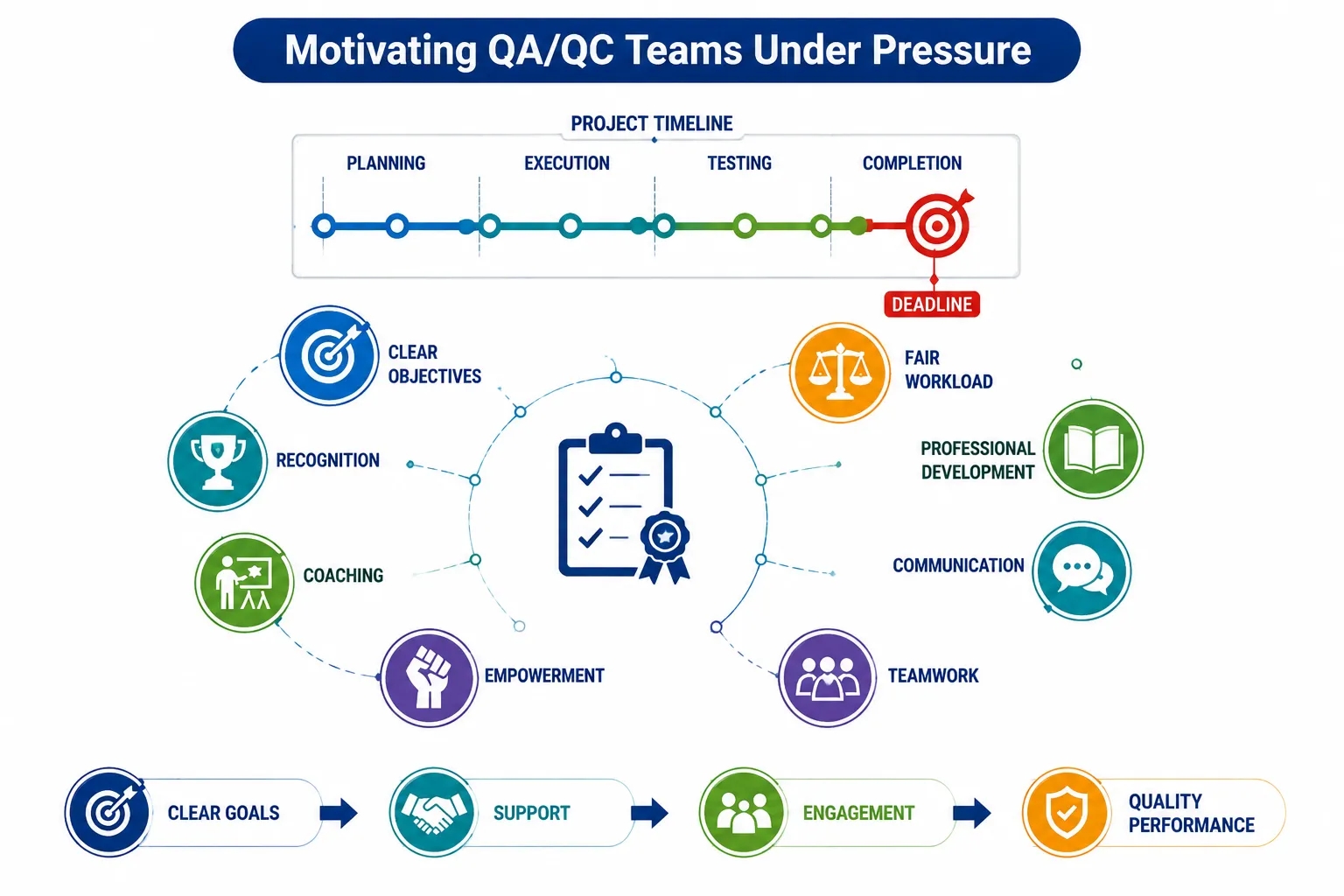
Employees are more likely to feel motivated when they are given work appropriate to their capability.
Developing Personnel
Provide:
- Coaching.
- Structured responsibility.
- Feedback.
- Mentoring.
Experienced Personnel
Provide:
- Greater autonomy.
- Complex assignments.
- Improvement responsibilities.
- Technical leadership opportunities.
Specialist Personnel
Provide:
- Technical ownership.
- Investigation responsibilities.
- Advisory roles.
- Strategic involvement.
This approach supports both performance and development.
Maintaining Psychological Safety
A motivated QA/QC team should feel able to raise concerns.
Employees should be able to say:
- “I believe this inspection requires further evidence.”
- “The testing result needs investigation.”
- “I am concerned about the proposed corrective action.”
- “The current workload may affect inspection quality.”
without unnecessary fear of blame.
Psychological safety supports:
- Early reporting.
- Technical challenge.
- Better decision-making.
- Learning.
- Quality improvement.
Building Trust Between Leadership and QA/QC Personnel
Trust develops when leaders consistently:
- Keep commitments.
- Apply standards fairly.
- Listen to concerns.
- Support professional judgement.
- Recognise contributions.
- Explain important decisions.
- Protect technical integrity.
Trust is particularly important when deadlines become demanding.
If employees believe that management will always prioritise programme over quality, motivation and reporting behaviour can deteriorate.
Motivation and Professional Independence
QA/QC personnel must maintain appropriate professional independence.
Motivation strategies should never involve pressure to:
- Ignore defects.
- Change inspection results without evidence.
- Approve incomplete work.
- Close NCRs prematurely.
- Alter documentation.
- Suppress technical concerns.
A healthy motivation strategy reinforces the value of professional judgement.
Managing Motivation During Conflict
Conflict can reduce motivation if employees feel:
- Ignored.
- Unfairly treated.
- Blamed.
- Overloaded.
- Undervalued.
Leaders should:
- Listen to concerns.
- Establish facts.
- Resolve issues fairly.
- Explain decisions.
- Recognise contributions.
- Maintain consistent standards.
Conflict resolution and motivation should therefore operate together.
Motivation Through Feedback
Feedback should be:
- Timely.
- Specific.
- Constructive.
- Evidence-based.
- Balanced.
Effective feedback can include:
What was done well → What needs improvement → Why it matters → What should happen next
This is more useful than vague criticism.
Motivation Through Performance Reviews
Performance reviews should consider both results and behaviours.
Relevant areas include:
- Inspection accuracy.
- Documentation quality.
- NCR management.
- Teamwork.
- Communication.
- Technical judgement.
- Initiative.
- Improvement contribution.
A balanced review can help employees understand their strengths and development needs.
Using Quality KPIs Without Creating Negative Pressure
KPIs can motivate when they are fair and meaningful.
Possible indicators include:
- Inspection completion.
- First-time acceptance.
- NCR recurrence.
- Corrective action effectiveness.
- Documentation accuracy.
- Testing success.
- Response time.
- Improvement actions completed.
However, leaders should avoid creating excessive pressure through unrealistic targets.
Balanced QA/QC Performance Dashboard
A useful performance dashboard can combine:
Productivity
- Inspections completed.
- Testing activities completed.
Quality
- First-time acceptance.
- Defect trends.
- NCR recurrence.
Effectiveness
- Corrective action effectiveness.
- Rework reduction.
Team
- Training progress.
- Improvement suggestions.
- Workload indicators.
This provides a more complete picture of performance.
Motivation and Continuous Improvement
Motivated personnel are more likely to contribute improvement ideas.
Leaders should encourage employees to identify:
- Repeated process weaknesses.
- Inspection bottlenecks.
- Documentation problems.
- Communication gaps.
- Unnecessary duplication.
- Recurring defects.
Improvement suggestions should be reviewed and acknowledged.
Even when an idea cannot be implemented, explaining the decision demonstrates respect for employee contribution.
Practical Example: Strict Inspection Deadline
An electrical project requires completion of a large inspection package within a short period.
The QA/QC team is concerned that the workload is unrealistic.
A weak leader simply increases pressure.
A stronger leader:
- Reviews the workload.
- Identifies critical inspections.
- Allocates work according to competence.
- Removes avoidable administrative barriers.
- Establishes daily priorities.
- Provides specialist support where needed.
- Recognises progress.
- Maintains required inspection quality.
The team is more likely to remain focused because the leader has converted pressure into a structured plan.
Practical Example: Commissioning Deadline
A commissioning milestone is approaching and the QA/QC team has several outstanding verification activities.
The project manager requests rapid completion.
The QA/QC leader:
- Establishes critical priorities.
- Reviews available resources.
- Coordinates testing requirements.
- Identifies blockers.
- Communicates realistic deadlines.
- Protects essential verification.
- Recognises individual and team contributions.
This demonstrates that motivation can be supported through effective project organisation rather than pressure alone.
Practical Example: NCR Closure Pressure
A QA/QC team has a high number of open NCRs.
Management wants the number reduced quickly.
Instead of motivating employees solely through a closure target, the leader establishes:
- Risk-based NCR prioritisation.
- Clear responsibilities.
- Corrective action deadlines.
- Evidence requirements.
- Effectiveness verification.
- Recognition for successful problem prevention.
This encourages meaningful quality improvement rather than administrative closure.
Practical Example: Recognising a Quality Contribution
An inspector identifies a recurring installation defect before the problem spreads to multiple work areas.
The leader recognises the contribution during the team quality meeting and explains how early identification prevented additional rework.
This reinforces:
- Vigilance.
- Professional judgement.
- Early reporting.
- Quality ownership.
The recognition is meaningful because it is directly connected to a measurable quality benefit.
Case Study: Motivating a QA/QC Team Under a Major Electrical Deadline
Project Background
A large electrical engineering project is approaching final commissioning.
The QA/QC team faces:
- Inspection backlogs.
- Testing deadlines.
- Outstanding NCRs.
- Documentation requirements.
- Contractor pressure.
- Limited specialist availability.
Team morale begins to decline.
Initial Problem
Management focuses heavily on completion numbers.
Personnel begin reporting:
- Excessive workload.
- Reduced communication.
- Fatigue.
- Increasing frustration.
Inspection productivity increases temporarily, but documentation errors also increase.
Leadership Response
The QA/QC manager introduces a comprehensive motivation strategy.
The manager:
- Clarifies the project quality purpose.
- Prioritises critical work.
- Reallocates competent resources.
- Establishes realistic daily objectives.
- Introduces short quality coordination meetings.
- Provides targeted coaching.
- Recognises strong performance.
- Encourages early reporting.
- Monitors workload.
- Reviews balanced quality KPIs.
Outcomes
The team experiences:
- Better prioritisation.
- Improved communication.
- Greater ownership.
- Better documentation.
- Reduced frustration.
- Improved inspection coordination.
Case Study Conclusion
The case demonstrates that effective motivation under strict deadlines depends on leadership, resources, recognition, clarity, competence and fairness. Simply increasing pressure may produce short-term output but can undermine sustainable quality performance.
Developing a Comprehensive Motivation Strategy
Step 1: Assess the Current Situation
Review:
- Team morale.
- Workload.
- Performance.
- Competence.
- Project pressure.
- Quality risks.
Step 2: Identify Motivation Barriers
Determine whether barriers include:
- Excessive workload.
- Unclear objectives.
- Poor communication.
- Lack of recognition.
- Limited resources.
- Conflict.
- Competence gaps.
- Lack of development opportunities.
Step 3: Establish Clear Quality Objectives
Define:
- Priorities.
- Responsibilities.
- Deadlines.
- Quality requirements.
- Evidence expectations.
Step 4: Match Responsibilities to Competence
Ensure personnel receive appropriate assignments.
Step 5: Provide Resources
Ensure availability of:
- Personnel.
- Information.
- Equipment.
- Technical support.
- Appropriate time.
Step 6: Communicate Purpose
Explain why the work matters.
Step 7: Provide Feedback and Recognition
Recognise meaningful contributions and provide constructive improvement feedback.
Step 8: Monitor Workload
Prevent sustained overload from undermining quality performance.
Step 9: Monitor Quality and Team Indicators
Review:
- Inspection performance.
- NCR trends.
- Rework.
- Testing results.
- Employee feedback.
- Workload.
Step 10: Adjust the Strategy
Modify motivational approaches as project conditions change.
Motivation Strategy Matrix
| Situation | Motivation Challenge | Recommended Strategy | Expected Outcome |
|---|---|---|---|
| Tight inspection deadline | High workload | Prioritise and redistribute work | Improved focus |
| Testing pressure | Stress and uncertainty | Clear priorities and support | Better coordination |
| NCR backlog | Frustration | Risk-based targets and recognition | Better closure quality |
| New personnel | Low confidence | Coaching and mentoring | Improved competence |
| Experienced team | Low autonomy | Empowerment and delegation | Greater ownership |
| Repeated defects | Reduced morale | Root-cause involvement | Stronger engagement |
| Poor communication | Confusion | Clear briefings and feedback | Better coordination |
| Unequal workload | Perceived unfairness | Balanced allocation | Improved trust |
| Low participation | Limited ownership | Involvement in decisions | Greater engagement |
| High performance | Risk of complacency | Recognition and development | Sustained improvement |
Avoiding Counterproductive Motivation
Some approaches may create short-term activity but damage long-term performance.
Excessive Pressure
May cause:
- Stress.
- Errors.
- Reduced reporting.
- Poor judgement.
Unrealistic Targets
May encourage:
- Superficial inspections.
- Incomplete documentation.
- Premature closure.
Public Criticism
May reduce:
- Confidence.
- Psychological safety.
- Communication.
Rewarding Speed Alone
May encourage:
- Quantity over quality.
- Reduced verification.
Unequal Recognition
May create:
- Resentment.
- Reduced trust.
- Poor teamwork.
Ignoring Workload
May result in:
- Burnout.
- Reduced concentration.
- Increased mistakes.
Maintaining Motivation During Extended Projects
Long projects can create motivation challenges even when deadlines are not immediate.
Leaders should periodically review:
- Team objectives.
- Workload.
- Development needs.
- Performance trends.
- Recognition.
- Employee concerns.
Long-term motivation can be supported through:
- Career development.
- Increased responsibility.
- Mentoring.
- Improvement projects.
- Recognition.
- Team learning.
Measuring Motivation Strategy Effectiveness
Motivation should be evaluated using evidence.
Possible indicators include:
- Employee participation.
- Quality improvement suggestions.
- Inspection performance.
- First-time acceptance.
- NCR recurrence.
- Rework.
- Testing performance.
- Absence trends.
- Staff turnover indicators.
- Feedback from team members.
No single indicator should be treated as definitive.
A balanced evaluation should consider both employee and quality outcomes.
Leading and Lagging Indicators for Motivation
Leading Indicators
These may indicate whether motivation strategies are working:
- Participation in quality meetings.
- Improvement suggestions.
- Training engagement.
- Early reporting.
- Team communication.
- Coaching participation.
Lagging Indicators
These demonstrate later outcomes:
- Reduced rework.
- Improved first-time acceptance.
- Reduced NCR recurrence.
- Better testing outcomes.
- Improved quality milestone performance.
Linking Motivation With Professional Development
Motivation is stronger when personnel can see how current responsibilities contribute to future capability.
A leader can provide:
- Mentoring.
- Technical assignments.
- Leadership opportunities.
- Advanced inspection responsibilities.
- Participation in investigations.
- Involvement in quality improvement.
This creates a connection between project performance and professional growth.
Leadership Behaviours That Strengthen Motivation
Senior QA/QC leaders should consistently demonstrate:
- Fairness.
- Technical credibility.
- Respect.
- Clear communication.
- Accountability.
- Recognition.
- Support.
- Consistency.
- Professional independence.
- Responsiveness.
Employees are more likely to trust motivational strategies when leaders demonstrate these behaviours themselves.
Key Benefits of Effective Motivation Strategies
A comprehensive motivation strategy can contribute to:
- Higher employee engagement.
- Better inspection performance.
- Improved documentation quality.
- Stronger technical ownership.
- Reduced rework.
- Reduced NCR recurrence.
- Improved testing outcomes.
- Better communication.
- Stronger teamwork.
- Increased quality awareness.
- Improved professional development.
- Better project coordination.
- Greater resilience under pressure.
- Stronger continual improvement culture.
Key Learning Points
Learners should understand that:
- Motivation is essential for effective QA/QC performance.
- Deadline pressure should not replace professional motivation.
- Quality purpose can strengthen employee commitment.
- Clear objectives reduce uncertainty.
- Targets should balance productivity and quality.
- Recognition should focus on meaningful quality contributions.
- Empowerment can increase ownership.
- Coaching supports competence and confidence.
- Professional development can strengthen engagement.
- Fair workload allocation supports motivation.
- Psychological safety encourages technical reporting.
- Effective feedback improves performance.
- Balanced KPIs prevent excessive focus on speed.
- Workload management is important during strict deadlines.
- Motivation strategies should reflect team competence.
- Quality requirements should not be weakened to achieve deadlines.
- Team participation can improve quality ownership.
- Leadership behaviour strongly influences motivation.
- Recognition should be specific and evidence-based.
- Motivation strategies should be measured.
- Leading and lagging indicators should both be considered.
- Sustainable motivation requires more than short-term incentives.
- Effective motivation supports quality, teamwork and project performance.
Conclusion
Effective motivation of electrical QA/QC personnel under strict compliance deadlines requires a balanced combination of clear objectives, meaningful recognition, appropriate workload management, professional development, coaching, empowerment and strong communication. Leaders should create a clear connection between individual responsibilities and wider electrical quality objectives while ensuring that project pressure does not encourage inappropriate shortcuts or weaken technical standards.
A successful motivation strategy should improve both employee engagement and measurable quality performance. By monitoring workload, recognising meaningful contributions, supporting professional judgement and using balanced performance indicators, senior electrical QA/QC leaders can maintain a motivated and resilient team capable of meeting demanding project deadlines while protecting quality, compliance and technical integrity.
3: Apply Practical Conflict Resolution Techniques to Mediate Disputes Involving Complex, Interacting Project Variables
Conflict mediation is an important leadership capability for senior electrical QA/QC professionals because complex engineering projects involve multiple teams, technical interfaces, contractual obligations, deadlines, resources and quality requirements that can interact with one another. A disagreement that appears to concern a single inspection or testing activity may actually involve programme pressure, incomplete information, resource limitations, design changes, contractor performance, documentation requirements and stakeholder expectations. Effective mediation therefore requires more than encouraging two people to reach an agreement. It requires the leader to understand the wider project context, establish reliable evidence, protect technical integrity and guide the parties towards a practical and sustainable resolution.
In electrical QA/QC environments, mediation must be conducted without compromising professional independence or applicable quality requirements. A QA/QC leader may need to mediate between inspectors and construction personnel, engineering and procurement teams, contractors and consultants, or project management and technical specialists. The objective is not to determine which person is personally correct, but to establish the facts, identify legitimate interests, understand the interaction between project variables and develop an outcome that supports quality, compliance, safety, programme and effective project delivery.
Understanding Mediation in Electrical QA/QC Environments
Mediation is a structured process in which a neutral or appropriately impartial person helps individuals or groups understand a dispute, communicate their positions, identify underlying interests and develop an acceptable way forward.
In specialised engineering projects, mediation should be:
- Evidence-based.
- Structured.
- Fair.
- Professional.
- Objective.
- Focused on the underlying issue.
- Appropriate to the level of risk.
- Consistent with project procedures.
- Protective of essential technical requirements.
Mediation does not mean forcing both parties to make equal concessions. Where technical evidence clearly establishes that a particular requirement must be met, the mediator should not compromise that requirement merely to create agreement.
Why Complex Project Variables Make Mediation Difficult
Engineering disputes rarely occur in isolation. Several variables may influence the same disagreement.
For example, an electrical inspection dispute may involve:
- A late design revision.
- Limited inspection personnel.
- Contractor programme pressure.
- Missing documentation.
- Client witnessing requirements.
- Material availability.
- Testing dependencies.
- Commissioning deadlines.
Each variable can affect the others.
A delay in design approval may delay procurement. Delayed procurement may compress installation time. Compressed installation may increase defects. Increased defects may increase inspection workload. Increased inspection workload may affect testing schedules.
Therefore, a mediator must understand the system rather than focusing only on the immediate disagreement.
Types of Disputes Requiring Mediation
Technical Disputes
Technical disputes may concern:
- Inspection findings.
- Test results.
- Equipment acceptance.
- Design interpretation.
- Installation requirements.
- Defect classification.
- Corrective actions.
Programme Disputes
These may occur when QA/QC activities are perceived to delay:
- Installation.
- Testing.
- Commissioning.
- Handover.
- Client activities.
Resource Disputes
These may involve competition for:
- Inspectors.
- Testing specialists.
- Equipment.
- Work areas.
- Engineering support.
- Documentation resources.
Documentation Disputes
Examples include disagreements over:
- Missing inspection records.
- Test certificates.
- Approval status.
- Revision control.
- NCR evidence.
- Traceability.
Responsibility Disputes
Teams may disagree over:
- Who should correct a defect.
- Who should provide evidence.
- Who should approve a change.
- Who owns a delayed activity.
Interpersonal Disputes
These can arise from:
- Communication problems.
- Perceived unfairness.
- Lack of trust.
- Previous disagreements.
- Different working styles.
Key Concepts
| Concept | Definition | Application in Electrical QA/QC Mediation |
|---|---|---|
| Mediation | Structured process for helping parties resolve disagreement | Managing disputes between technical and project teams |
| Neutrality | Maintaining appropriate impartiality during the process | Avoiding personal bias |
| Evidence-Based Resolution | Using reliable information to support decisions | Reviewing drawings, records and test results |
| Active Listening | Understanding each party before responding | Identifying concerns and assumptions |
| Reframing | Presenting a dispute in constructive terms | Moving from blame to shared problem-solving |
| Common Interest | Objective shared by conflicting parties | Protecting quality and project delivery |
| Root Cause | Underlying reason contributing to a problem | Preventing repeated disputes |
| Escalation | Referring unresolved issues to appropriate authority | Handling high-risk or authority-limited decisions |
| Negotiation | Structured discussion to reach an acceptable outcome | Managing competing project priorities |
| Corrective Action | Action addressing an identified quality problem | Resolving the technical issue behind conflict |
| Traceability | Ability to follow evidence and decisions | Supporting defensible mediation outcomes |
| Psychological Safety | Confidence to raise concerns appropriately | Encouraging honest technical discussion |
Principles of Effective Mediation
A senior QA/QC mediator should apply several fundamental principles.
Maintain Professional Respect
Every participant should have an opportunity to explain their position without unnecessary interruption or personal criticism.
Separate People From Problems
The focus should remain on:
- Facts.
- Requirements.
- Risks.
- Processes.
- Outcomes.
rather than personalities.
Protect Technical Integrity
The mediator should not allow:
- Programme pressure.
- Commercial interests.
- Personal relationships.
- Seniority.
to override legitimate technical requirements.
Focus on Interests
A person may state a fixed position, but their underlying interest may be different.
Use Evidence
Technical disagreements should be supported by reliable evidence.
Seek Sustainable Solutions
The objective should be to resolve the cause of the dispute rather than merely stop the immediate argument.
The Mediation Process
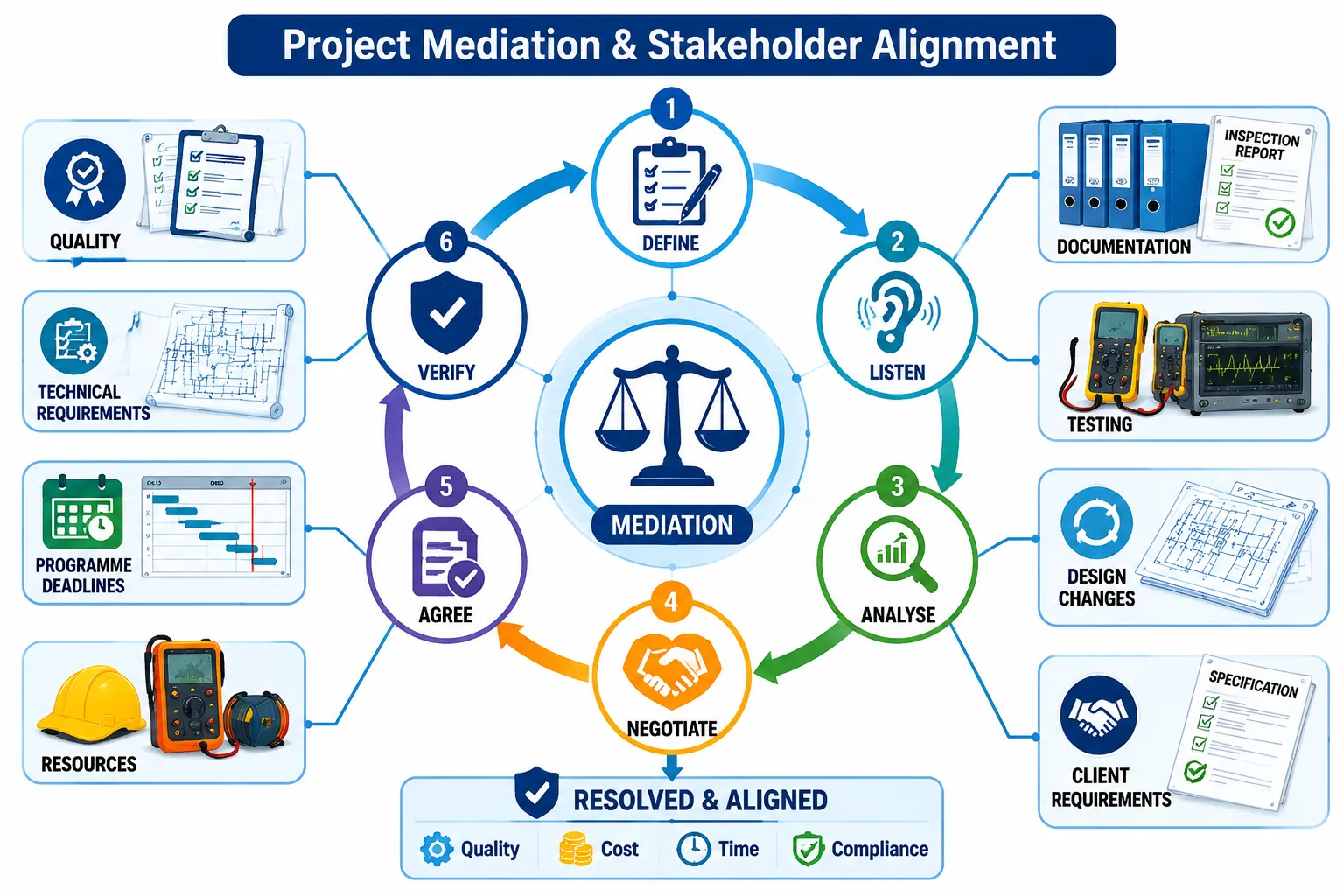
Step 1: Identify and Define the Dispute
The first stage is to define exactly what the parties disagree about.
The mediator should determine:
- What happened?
- What decision is disputed?
- Who is involved?
- What evidence exists?
- What project activities are affected?
- What risks are present?
A vague statement such as “QA/QC is causing delays” is not sufficient.
It should be converted into a specific issue such as:
“Inspection requests are repeatedly being submitted before required documentation and preliminary checks are complete.”
This makes the dispute easier to analyse.
Step 2: Assess the Severity and Urgency
Not every disagreement requires a formal mediation process.
The leader should assess:
- Technical risk.
- Safety implications.
- Quality impact.
- Programme impact.
- Commercial implications.
- Relationship impact.
- Potential for escalation.
Urgent technical issues may require immediate containment before mediation.
Step 3: Identify Interacting Variables
The mediator should map the variables influencing the dispute.
For example:
Design change
↓
Procurement delay
↓
Compressed installation programme
↓
Increased work-front pressure
↓
Inspection backlog
↓
Testing delay
↓
Commissioning pressure
↓
Conflict between project teams
Understanding these relationships prevents the mediator from addressing only the final symptom.
Step 4: Establish the Facts
The mediator should review relevant evidence.
This may include:
- Approved drawings.
- Specifications.
- Inspection records.
- Test results.
- NCRs.
- Method statements.
- Inspection and test plans.
- Correspondence.
- Programme information.
- Meeting minutes.
- Technical submissions.
- Approval records.
Evidence should be distinguished from assumptions.
Step 5: Allow Each Party to Present Its Position
Each party should explain:
- What happened.
- What they believe.
- What evidence supports their position.
- What concern they have.
- What outcome they require.
The mediator should avoid deciding too early.
Step 6: Apply Active Listening
The mediator should listen carefully and clarify unclear statements.
Useful questions include:
- “Can you explain the evidence supporting this position?”
- “What is the main concern?”
- “Which project constraint is affecting this decision?”
- “What outcome would you consider acceptable?”
- “What information is currently missing?”
Active listening can reduce defensiveness and expose hidden causes.
Step 7: Reframe the Conflict
Reframing is particularly useful when discussions become personal.
Instead of:
“The contractor keeps ignoring QA/QC.”
The mediator could state:
“We need to understand why inspection readiness requirements are not consistently being achieved and what process change could prevent recurrence.”
This converts blame into a shared problem.
Step 8: Identify Common Interests
Conflicting parties often share important objectives.
For example:
QA/QC wants:
- Technical assurance.
- Reliable evidence.
- Compliance.
Construction wants:
- Progress.
- Predictability.
- Work-front availability.
Both may share:
- Successful commissioning.
- Reduced rework.
- Client satisfaction.
- Project completion.
The mediator should use these common interests to build cooperation.
Step 9: Generate Options
The parties should identify practical options without immediately judging them.
Possible options may include:
- Re-sequencing inspections.
- Allocating additional competent resources.
- Clarifying readiness criteria.
- Improving documentation.
- Introducing earlier technical review.
- Prioritising critical activities.
- Establishing additional coordination meetings.
Step 10: Evaluate Options
Each option should be assessed against:
- Technical quality.
- Compliance.
- Risk.
- Programme.
- Cost.
- Resources.
- Practicality.
- Long-term consequences.
Step 11: Agree the Resolution
The resolution should identify:
- Required action.
- Responsible person.
- Deadline.
- Required evidence.
- Verification method.
- Escalation route.
Step 12: Document the Decision
Significant mediation outcomes should be appropriately recorded.
Documentation can include:
- Issue description.
- Evidence reviewed.
- Decision.
- Responsibilities.
- Timescales.
- Follow-up requirements.
Step 13: Verify Effectiveness
The mediator should determine whether:
- The immediate dispute has been resolved.
- The technical issue has been addressed.
- The underlying cause has been controlled.
- Relationships have improved.
- Similar disputes are less likely to recur.
Active Listening as a Mediation Technique
Active listening requires more than hearing words.
The mediator should:
- Maintain attention.
- Avoid unnecessary interruption.
- Ask clarification questions.
- Summarise key points.
- Confirm understanding.
- Recognise legitimate concerns.
- Separate facts from assumptions.
For example:
“You are concerned that the inspection process is affecting the commissioning sequence, while the QA/QC team is concerned that evidence is incomplete. Is that an accurate summary?”
This allows both sides to recognise that their concerns have been understood.
Reframing Difficult Statements
Reframing can transform destructive language.
Statement
“Your team always rejects our work.”
Reframed
“We need to identify the acceptance requirements that are creating repeated rejection and establish how readiness can be improved.”
Statement
“QA/QC does not understand the programme.”
Reframed
“The teams need a clearer method for integrating inspection requirements with the construction programme.”
Statement
“The contractor does not care about quality.”
Reframed
“There appears to be a gap between project delivery priorities and the quality controls required for acceptance.”
Evidence-Based Mediation
Engineering mediation should rely heavily on evidence.
Relevant evidence may include:
- Approved requirements.
- Inspection findings.
- Test results.
- Technical calculations.
- Drawings.
- Quality records.
- NCR history.
- Programme information.
Evidence helps prevent disputes becoming arguments based on authority or personal opinion.
For example, if two engineers disagree about whether equipment can be accepted, the mediator should establish:
- What requirement applies?
- What evidence is available?
- What tests have been completed?
- What remains outstanding?
- Who has authority to make the final decision?
Managing Programme Versus Quality Conflict
One of the most challenging disputes occurs when project schedule pressure conflicts with QA/QC requirements.
The mediator should distinguish between:
Removing unnecessary delay
and
Removing necessary quality controls.
Appropriate solutions may include:
- Earlier inspection planning.
- Additional competent inspectors.
- Better work-front coordination.
- Parallel documentation review.
- Prioritisation of critical systems.
The solution should improve efficiency without weakening technical assurance.
Managing Resource Conflicts
Suppose two work fronts require the same specialist testing engineer.
The mediator should consider:
- System criticality.
- Testing sequence.
- Commissioning dependencies.
- Risk.
- Available alternatives.
- Required competence.
A fair allocation does not necessarily mean dividing time equally. It means allocating resources according to project need and technical priority.
Managing Documentation Disputes
Documentation conflicts often involve disagreements about whether evidence is sufficient.
The mediator should establish:
- What document is required?
- Which revision applies?
- Who is responsible?
- What evidence is missing?
- What acceptance requirement applies?
A structured document review can often resolve disputes that initially appear interpersonal.
Managing NCR-Related Disputes
NCRs can create conflict because different parties may have different perceptions of:
- Severity.
- Responsibility.
- Root cause.
- Corrective action.
- Closure criteria.
The mediator should ensure that the NCR discussion focuses on:
- The identified condition.
- Objective evidence.
- Applicable requirements.
- Cause.
- Corrective action.
- Effectiveness verification.
The purpose should be effective quality control rather than assigning blame.
Managing Testing Disputes
Testing disputes may involve:
- Test method.
- Test results.
- Equipment calibration.
- Witnessing requirements.
- Acceptance criteria.
- Retesting responsibilities.
The mediator should establish the approved testing basis and determine what evidence is required.
Where the issue exceeds the mediator’s technical authority, it should be escalated appropriately.
Managing Design and Construction Interface Conflicts
Design changes can create conflict when construction believes changes are causing delay and engineering believes construction has not implemented the latest information.
The mediator should establish:
- Current approved revision.
- Change status.
- Communication history.
- Implementation responsibility.
- Affected work.
- Required verification.
This reduces the risk of decisions being based on outdated information.
Managing Client and Contractor Expectations
Client expectations may emphasise assurance and compliance, while contractors may emphasise delivery and cost.
A QA/QC leader should avoid framing these objectives as inherently incompatible.
Instead, mediation can focus on:
- Clear acceptance requirements.
- Predictable inspection processes.
- Early communication.
- Evidence availability.
- Risk-based prioritisation.
Conflict Resolution Matrix
| Conflict Situation | Main Variables | Suitable Technique | Leadership Focus |
|---|---|---|---|
| Inspection rejection | Quality, evidence, programme | Evidence-based mediation | Technical assurance |
| Testing disagreement | Test method, results, acceptance | Technical review | Objective evidence |
| NCR dispute | Cause, responsibility, closure | Collaborative resolution | Effective corrective action |
| Resource conflict | People, workload, priority | Negotiation | Risk-based allocation |
| Design dispute | Revision, scope, programme | Structured technical review | Traceability |
| Contractor dispute | Quality, schedule, expectations | Interest-based mediation | Shared objectives |
| Interpersonal dispute | Communication, trust | Mediation and active listening | Professional relationships |
| Commissioning pressure | Testing, programme, quality | Prioritised resolution | Critical milestones |
| Documentation conflict | Evidence, revision, responsibility | Evidence review | Traceability |
Practical Example: Inspection Dispute
A construction supervisor requests acceptance of an electrical installation because the project is approaching a major milestone.
The QA/QC inspector refuses because several required records are incomplete.
Poor Response
The manager pressures the inspector to accept the work.
Better Mediation Response
The manager:
- Brings both parties together.
- Establishes the acceptance requirement.
- Reviews available evidence.
- Identifies missing records.
- Determines whether any checks can be completed in parallel.
- Establishes responsibility for missing evidence.
- Sets a rapid verification timetable.
This protects technical quality while addressing the legitimate programme concern.
Practical Example: Testing Resource Conflict
Two critical electrical systems require the same specialist testing engineer within the same period.
Instead of allowing the teams to argue over access, the QA/QC leader:
- Reviews system criticality.
- Examines commissioning dependencies.
- Checks alternative competent resources.
- Reviews test sequencing.
- Agrees a prioritised testing plan.
- Communicates the decision clearly.
The conflict is resolved through objective project criteria.
Practical Example: Recurring NCR Dispute
Construction believes QA/QC is issuing too many NCRs. QA/QC believes construction is repeatedly failing to meet requirements.
The leader reviews:
- NCR trends.
- Defect categories.
- Work instructions.
- Inspection readiness.
- Training records.
- Recurrence patterns.
The analysis identifies that several defects arise from unclear work instructions.
The conflict therefore becomes an opportunity to improve the process.
Case Study: Complex Electrical Project Mediation
Project Situation
An electrical engineering project is approaching commissioning. Several systems are ready for testing, but documentation is incomplete.
The construction team argues that documentation can be completed after testing.
The QA/QC team argues that required evidence must be available before acceptance.
At the same time:
- The commissioning date is fixed.
- Specialist resources are limited.
- A design change has recently been issued.
- Client witnessing requirements are approaching.
- Several NCRs remain open.
Conflict Analysis
The dispute involves:
- Technical requirements.
- Documentation.
- Programme.
- Resources.
- Design change.
- Client expectations.
- NCR closure.
Treating the conflict as simply “QA/QC versus construction” would be inappropriate.
Mediation Process
The QA/QC leader:
- Defines the immediate dispute.
- Reviews approved requirements.
- Confirms the current design revision.
- Maps outstanding documentation.
- Identifies critical testing dependencies.
- Categorises NCRs by risk.
- Identifies resource constraints.
- Brings relevant technical personnel together.
- Reframes the issue around commissioning readiness.
- Develops options.
- Prioritises activities according to risk.
- Allocates competent resources.
- Establishes responsibilities.
- Records the agreed actions.
- Monitors implementation.
Outcome
The project establishes a prioritised readiness plan.
Critical evidence is completed before acceptance, while non-critical administrative activities are scheduled separately where project procedures permit.
Case Study Conclusion
The case demonstrates that effective mediation requires the leader to understand how technical, programme, resource and documentation factors interact. The strongest solution is not necessarily the fastest agreement but the resolution that addresses the underlying problem while protecting essential quality requirements.
Handling Emotionally Difficult Disputes
Technical professionals may become defensive when their work is challenged.
The mediator should:
- Remain calm.
- Avoid personal criticism.
- Use factual language.
- Allow reasonable expression of concerns.
- Return discussion to evidence.
- Prevent personal attacks.
- Establish clear boundaries.
If discussions become unproductive, the leader may temporarily pause the meeting and reconvene after the relevant evidence has been collected.
Maintaining Psychological Safety During Mediation
Participants should feel able to explain legitimate concerns.
The mediator should discourage:
- Intimidation.
- Personal criticism.
- Blame.
- Retaliation.
- Suppression of technical concerns.
This is especially important when junior personnel are challenging senior personnel on technical grounds.
When Mediation Is Not Enough
Some issues require formal escalation.
Escalation may be necessary when:
- The issue presents significant technical risk.
- The mediator lacks appropriate authority.
- Parties cannot reach agreement.
- Contractual interpretation is required.
- The issue affects major project milestones.
- Professional independence is compromised.
- A formal decision is required.
The escalation should include:
- Clear issue statement.
- Evidence.
- Positions of parties.
- Options considered.
- Risk assessment.
- Recommended action.
Measuring Mediation Effectiveness
A mediation process should be evaluated against measurable outcomes.
Possible measures include:
- Time taken to resolve disputes.
- Recurrence of similar conflicts.
- NCR recurrence.
- Inspection delays.
- Rework.
- Testing delays.
- Stakeholder feedback.
- Team communication.
- Quality performance.
A dispute should not be considered successfully resolved simply because participants stop arguing.
Common Mediation Mistakes
Taking Sides Too Early
This can reduce trust.
Focusing Only on the Immediate Argument
The systemic cause may remain.
Using Authority Instead of Evidence
This can create compliance without commitment.
Compromising Technical Requirements
This may create unacceptable quality risks.
Ignoring Programme Constraints
Technical solutions must also be practical.
Ignoring Quality Requirements
Programme pressure must not weaken essential controls.
Failing to Document Agreements
This can allow the same dispute to return.
Overlooking Emotional Factors
Technical professionals are still affected by communication and trust.
Failing to Follow Up
An agreement without verification may not solve the problem.
Benefits of Effective Mediation
Effective mediation can provide:
- Faster dispute resolution.
- Improved technical communication.
- Reduced rework.
- Better stakeholder relationships.
- Stronger QA/QC coordination.
- Reduced NCR recurrence.
- Improved inspection planning.
- Better resource allocation.
- Improved team morale.
- Stronger professional trust.
- Better project decision-making.
- Improved quality culture.
- Reduced unnecessary delays.
- More sustainable solutions.
Developing a Practical Mediation Framework
A senior electrical QA/QC leader can use the following framework:
Define
Identify exactly what the parties disagree about.
Analyse
Identify technical, operational, interpersonal and project variables.
Evidence
Collect reliable information.
Listen
Allow each party to explain its position.
Reframe
Convert blame into a shared problem.
Identify Interests
Determine what each party genuinely needs.
Generate
Develop realistic options.
Evaluate
Assess quality, risk, programme, resources and cost.
Agree
Define actions, responsibilities and deadlines.
Record
Maintain appropriate traceability.
Verify
Confirm that the resolution is effective.
Improve
Address underlying causes and prevent recurrence.
Integrating Mediation With Continual Improvement
Mediation should not be viewed only as a response to problems. Repeated disputes can provide valuable information about weaknesses in project systems.
For example, recurring disputes over:
- Inspection readiness.
- Documentation.
- NCR closure.
- Testing sequence.
- Design changes.
may indicate the need to improve:
- Procedures.
- Communication.
- Planning.
- Training.
- Responsibilities.
- Quality controls.
A mature QA/QC leader therefore asks:
“What does this conflict tell us about the system?”
rather than simply:
“How can we stop this argument?”
Key Learning Points
Learners should understand that:
- Mediation is a structured approach to resolving disputes.
- Complex engineering conflicts often involve several interacting variables.
- Technical disputes should be addressed using reliable evidence.
- Programme pressure should not automatically override quality requirements.
- Active listening is essential for understanding conflicting positions.
- Reframing can convert blame into constructive problem-solving.
- Common interests can help competing teams work towards shared outcomes.
- Root-cause analysis can identify systemic sources of repeated conflict.
- Negotiation can address competing legitimate interests.
- Escalation is appropriate when issues exceed authority or risk thresholds.
- Mediation should protect professional independence.
- Psychological safety encourages legitimate technical challenge.
- Clear roles and responsibilities can prevent recurring disputes.
- Documentation provides traceability for significant decisions.
- Mediation should consider quality, safety, programme, cost and resources.
- Effective mediation is not necessarily about equal compromise.
- Essential technical requirements should not be compromised simply to end conflict.
- A sustainable resolution addresses underlying causes.
- Mediation effectiveness should be measured.
- Lessons from disputes can support continual improvement.
Conclusion
Practical conflict resolution in complex electrical QA/QC environments requires leaders to combine communication, technical judgement, evidence-based analysis and structured mediation. Effective leaders must understand that disputes are often created by interacting project variables rather than by individual behaviour alone. By identifying the underlying causes, listening to all relevant perspectives, reviewing evidence and focusing on shared objectives, leaders can develop solutions that protect technical quality while addressing genuine programme and resource constraints.
Successful mediation should result in more than an immediate agreement. It should improve communication, clarify responsibilities, address underlying causes and reduce the likelihood of recurrence. When applied consistently, practical conflict-resolution techniques help electrical QA/QC leaders maintain professional relationships, protect quality and compliance, strengthen teamwork and support successful delivery of complex engineering projects.
4: Evaluate the Success of Implemented Motivational Strategies in Improving QA/QC Team Retention and Output
Evaluating the success of motivational strategies is an important responsibility for senior electrical QA/QC leaders because motivation should produce measurable improvements in both employee stability and quality performance. In complex electrical engineering projects, a motivated team is more likely to maintain inspection accuracy, complete quality documentation, identify defects early, support testing activities and contribute to continual improvement. However, simply introducing recognition, coaching, empowerment, improved communication or performance incentives does not prove that these strategies have been successful. Their effectiveness must be evaluated systematically using reliable evidence, relevant performance indicators and feedback from QA/QC personnel.
Retention and output should be considered together because high productivity achieved through excessive pressure may not represent sustainable success. A team may temporarily complete more inspections while experiencing increased errors, reduced morale, higher turnover intentions or declining engagement. Conversely, a team with strong retention but weak output may require improved processes, resources or competence development. A senior QA/QC professional therefore needs to evaluate whether motivational interventions have created a balanced improvement in employee commitment, quality performance, productivity, professional development and project outcomes.
Understanding Motivation Strategy Evaluation
Motivational strategy evaluation is the systematic process of determining whether actions introduced to improve employee engagement and performance have achieved their intended objectives.
In an electrical QA/QC environment, evaluation should consider two broad dimensions:
Team Retention
Retention relates to the organisation’s ability to maintain competent QA/QC personnel over time.
Relevant indicators include:
- Staff turnover.
- Retention of experienced inspectors.
- Internal transfers.
- Absence patterns.
- Employee engagement.
- Job satisfaction.
- Intention to remain.
- Participation in development activities.
- Stability of specialist expertise.
Team Output
Output refers to the quality and quantity of work produced by the QA/QC team.
Relevant indicators include:
- Inspection completion.
- Testing support.
- Documentation accuracy.
- NCR management.
- First-time acceptance.
- Corrective action effectiveness.
- Rework reduction.
- Inspection response time.
- Quality milestone achievement.
The strongest evaluation combines both dimensions rather than relying on a single performance measure.
Why Retention and Output Must Be Evaluated Together
A project may report increased output after introducing aggressive productivity targets. However, if experienced QA/QC personnel subsequently leave, the organisation may lose technical knowledge and require new personnel to be trained.
Similarly, retention may remain high because employees are staying with the organisation, but output may decline because:
- Workload has increased.
- Resources are inadequate.
- Processes are inefficient.
- Training needs are not addressed.
- Quality priorities are unclear.
Therefore, senior leaders should ask:
Did the motivational strategy improve sustainable performance without creating unintended consequences?
Key Concepts
| Key Concept | Definition | Application in Electrical QA/QC |
|---|---|---|
| Motivation Strategy | Planned action intended to improve employee commitment and performance | Recognition, coaching, empowerment and development |
| Retention | Ability to retain competent personnel over time | Maintaining experienced QA/QC capability |
| Output | Work completed by the team against defined requirements | Inspections, testing, documentation and NCR activities |
| Employee Engagement | Level of involvement and commitment to work | Participation in quality activities |
| Productivity | Relationship between resources used and useful work produced | Efficient completion of QA/QC activities |
| Performance Indicator | Measure used to evaluate results or behaviour | Inspection completion or NCR recurrence |
| Baseline | Performance position before an intervention | Pre-motivation performance level |
| Benchmark | Reference point used for comparison | Previous project or agreed target |
| Trend | Pattern of performance over time | Improving or declining quality results |
| Staff Turnover | Rate at which personnel leave and are replaced | Indicator of retention |
| First-Time Acceptance | Work accepted without requiring additional corrective activity | Indicator of effective quality performance |
| Sustainability | Ability to maintain improvement over time | Long-term motivational effectiveness |
Establishing a Baseline Before Evaluation
A motivational strategy cannot be evaluated effectively without knowing the previous performance position.
Before implementation, leaders should establish baseline information such as:
- Staff turnover.
- Inspection completion rate.
- NCR recurrence.
- Rework.
- Documentation errors.
- First-time acceptance.
- Employee feedback.
- Training participation.
- Absence patterns.
- Quality milestone performance.
For example, if a QA/QC team historically completed 85% of planned inspections within the required period, that figure can be used as a baseline.
If performance later reaches 94%, the leader has a measurable basis for assessing improvement.
Establishing Clear Evaluation Objectives
Evaluation should begin with defined objectives.
A motivational intervention may aim to:
- Improve QA/QC staff retention.
- Increase inspection productivity.
- Reduce documentation errors.
- Improve first-time acceptance.
- Reduce NCR recurrence.
- Improve employee engagement.
- Strengthen quality ownership.
- Increase participation in improvement activities.
Objectives should be specific enough to measure.
Measuring Retention Performance
Retention should not be measured only by counting how many people remain employed.
A stronger evaluation considers:
Quantitative Indicators
- Annual turnover.
- Voluntary departures.
- Internal transfers.
- Length of service.
- Absence levels.
- Recruitment requirements.
Qualitative Indicators
- Employee satisfaction.
- Perceived leadership support.
- Career confidence.
- Workload perceptions.
- Recognition satisfaction.
- Quality culture feedback.
This provides a more complete understanding of why people stay or leave.
Measuring QA/QC Output
Output should reflect meaningful quality work rather than simple activity volume.
Useful measures include:
- Planned inspections completed.
- Inspection turnaround.
- First-time acceptance.
- NCR closure effectiveness.
- Documentation accuracy.
- Testing activities supported.
- Corrective actions verified.
- Rework reduction.
- Quality milestones achieved.
A high number of completed inspections does not necessarily mean strong performance if inspection quality has declined.
Evaluating Quality of Output
Quantity should always be balanced with quality.
For example:
High inspection volume + increased missed defects = weak improvement
Whereas:
Higher inspection completion + stable or improved accuracy = stronger improvement
Leaders should therefore examine both productivity and quality outcomes.
Comparing Before and After Performance
A straightforward evaluation approach is to compare baseline performance with post-intervention results.
Example
Before motivation strategy:
- Inspection completion: 82%
- First-time acceptance: 76%
- NCR recurrence: 14%
- Voluntary turnover: 12%
After implementation:
- Inspection completion: 93%
- First-time acceptance: 88%
- NCR recurrence: 8%
- Voluntary turnover: 7%
The results suggest improvement across several indicators.
However, the leader should still investigate whether other project factors contributed to the change.
Trend Analysis
One month’s performance is rarely sufficient to demonstrate sustainable improvement.
Leaders should examine trends over:
- Weekly periods.
- Monthly periods.
- Project phases.
- Major milestones.
For example, if inspection output improves for one month and then falls sharply, the strategy may not be sustainable.
A consistent positive trend provides stronger evidence.
Leading and Lagging Indicators
Evaluation should include both leading and lagging indicators.
Leading Indicators
These provide early evidence of engagement and behavioural change.
Examples include:
- Training participation.
- Coaching attendance.
- Improvement suggestions.
- Quality meeting participation.
- Early defect reporting.
- Employee engagement scores.
- Participation in problem-solving.
Lagging Indicators
These demonstrate eventual outcomes.
Examples include:
- Reduced turnover.
- Reduced rework.
- Reduced NCR recurrence.
- Improved first-time acceptance.
- Improved inspection completion.
- Improved milestone performance.
Using both types provides a more comprehensive evaluation.
Employee Feedback as Evaluation Evidence
Employee feedback is important because numerical indicators may not explain why performance changed.
Feedback can examine:
- Recognition.
- Workload.
- Leadership support.
- Career development.
- Communication.
- Team relationships.
- Autonomy.
- Fairness.
Methods may include:
- Structured surveys.
- Individual discussions.
- Team meetings.
- Performance reviews.
- Anonymous feedback mechanisms.
Feedback should be analysed systematically rather than treated as isolated opinions.
Evaluating Recognition Strategies
Suppose the organisation introduced recognition for employees who identify significant quality issues.
The leader should assess:
- Whether employees report more concerns.
- Whether early defect identification improves.
- Whether employees perceive recognition as fair.
- Whether rework decreases.
- Whether quality ownership increases.
A recognition strategy is more successful when it changes useful behaviour rather than simply making employees feel temporarily appreciated.
Evaluating Coaching Strategies
A coaching programme should be evaluated against competence and performance outcomes.
Possible measures include:
- Inspection accuracy.
- Documentation quality.
- Decision-making confidence.
- Reduced supervision requirements.
- First-time acceptance.
- Employee feedback.
For example, if inspectors who received coaching require less corrective supervision and demonstrate improved inspection accuracy, the coaching strategy has stronger evidence of effectiveness.
Evaluating Empowerment Strategies
Empowerment may involve giving experienced QA/QC personnel greater responsibility.
Evaluation should consider:
- Decision quality.
- Response time.
- Accountability.
- Employee confidence.
- Supervisor workload.
- Quality outcomes.
Empowerment should not be considered successful merely because managers perform fewer routine decisions.
The quality of delegated decisions must also be assessed.
Evaluating Professional Development
Training and development strategies can be evaluated through:
- Competence assessments.
- Improved inspection performance.
- Reduced errors.
- Increased responsibility.
- Improved employee engagement.
- Internal progression.
The key question is:
Did development activities produce meaningful improvement in capability and performance?
Evaluating Workload Management
If workload management was introduced to improve motivation, leaders should examine:
- Working hours.
- Backlog levels.
- Error rates.
- Absence.
- Employee feedback.
- Inspection completion.
- Quality outcomes.
If reduced workload produces better accuracy and stable output, the intervention may have improved efficiency rather than simply reducing activity.
Evaluating Team Motivation During Deadlines
Strict electrical compliance deadlines can distort performance measurements.
A team may temporarily increase output because of:
- Overtime.
- Increased management pressure.
- Extended working hours.
Therefore, leaders should examine whether improvement continues after the deadline.
Sustainable motivation should produce performance that remains effective under normal operating conditions.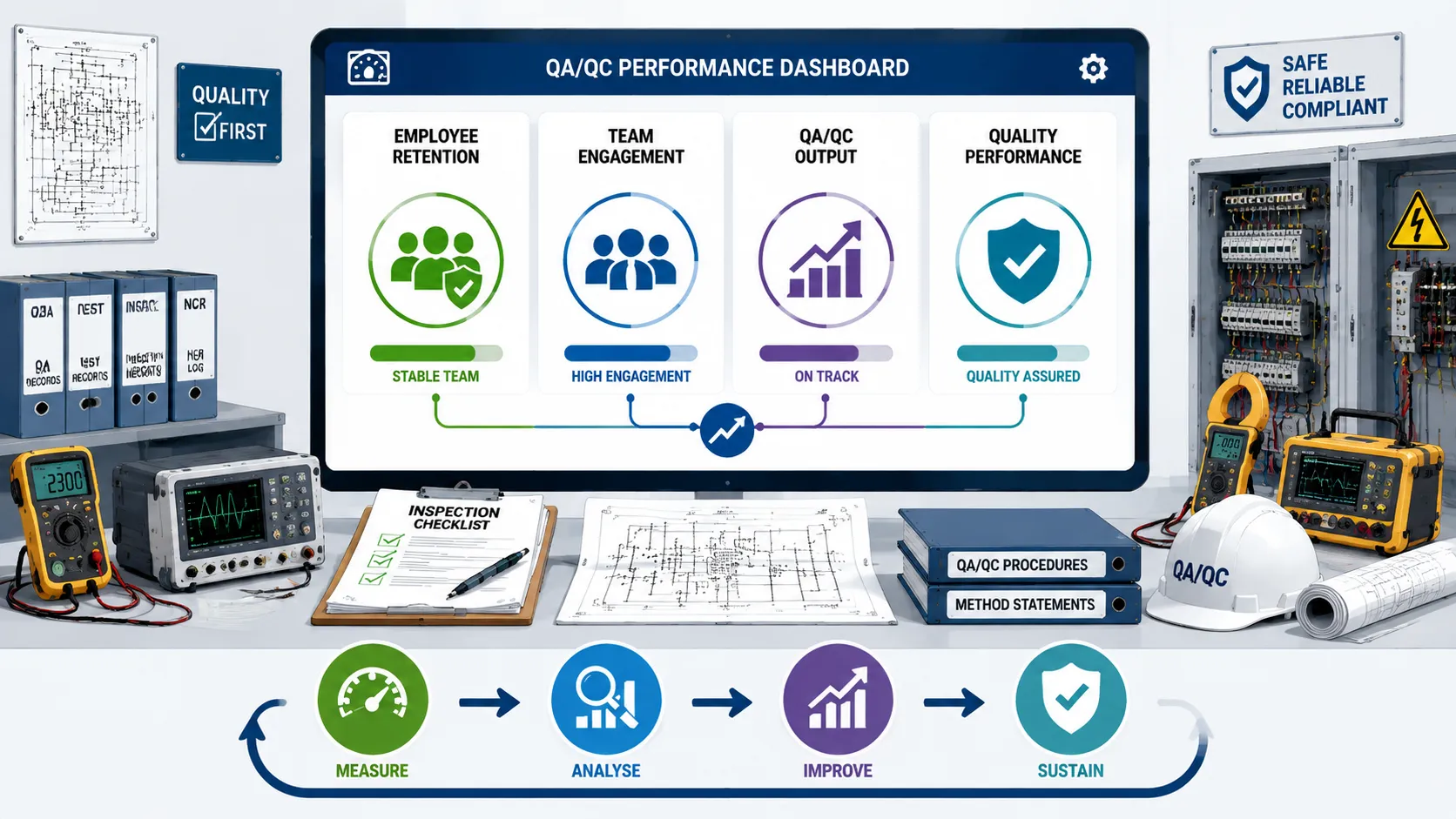
The Evaluation Process
Step 1: Define the Intended Outcome
Identify what the motivation strategy was designed to achieve.
Step 2: Establish Baseline Data
Record performance before implementation.
Step 3: Select Appropriate Indicators
Choose both employee and quality measures.
Step 4: Collect Evidence
Gather quantitative and qualitative information.
Step 5: Compare Results
Compare post-intervention performance against:
- Baseline.
- Targets.
- Previous periods.
- Relevant benchmarks.
Step 6: Analyse Trends
Determine whether improvement is temporary or sustained.
Step 7: Investigate Contributing Factors
Consider:
- Project phase.
- Resources.
- Leadership changes.
- Workload.
- Technical complexity.
- External conditions.
Step 8: Gather Employee Feedback
Determine whether employees believe the intervention was useful.
Step 9: Assess Unintended Consequences
Check whether the strategy created:
- Excessive pressure.
- Reduced reporting.
- Quality shortcuts.
- Unfair competition.
- Increased workload.
Step 10: Determine Overall Effectiveness
Decide whether the strategy:
- Achieved its objectives.
- Partially achieved them.
- Failed to achieve them.
- Requires modification.
Step 11: Implement Improvements
Modify the strategy based on evidence.
Step 12: Continue Monitoring
Confirm that improvements remain sustainable.
Motivation Evaluation Framework
| Evaluation Area | Possible Measure | Positive Evidence | Warning Sign |
|---|---|---|---|
| Retention | Voluntary turnover | Reduced departures | Increasing turnover |
| Engagement | Participation | More involvement | Reduced participation |
| Productivity | Inspections completed | Higher sustainable output | Temporary increase only |
| Quality | First-time acceptance | Improvement | Increased rework |
| NCR Management | Recurrence | Reduction | Repeated defects |
| Documentation | Error rate | Fewer errors | More corrections |
| Development | Competence | Improved capability | No performance change |
| Recognition | Feedback | Greater appreciation | Perceived unfairness |
| Workload | Backlog and hours | Better balance | Sustained overload |
| Teamwork | Collaboration feedback | Improved cooperation | Increasing conflict |
Distinguishing Motivation From External Factors
Performance changes may not always result from motivational strategies.
Other factors may include:
- Additional staffing.
- Improved equipment.
- Reduced workload.
- Project phase changes.
- Design stabilisation.
- Contractor improvement.
- New procedures.
- Changes in project leadership.
For example, inspection completion may improve because additional inspectors were recruited rather than because recognition improved motivation.
A senior QA/QC leader should therefore avoid attributing every performance change to the motivational intervention.
Evaluating Causation Carefully
A useful evaluation question is:
What evidence supports the conclusion that the motivational strategy contributed to the improvement?
Evidence may include:
- Timing of improvement.
- Employee feedback.
- Behavioural changes.
- Performance trends.
- Comparison with similar teams.
- Specific changes linked to the intervention.
This produces a more credible evaluation.
Practical Example: Recognition Programme
A QA/QC department introduces monthly recognition for employees who make significant contributions to quality improvement.
Baseline
Before implementation:
- Low participation in improvement activities.
- Limited quality suggestions.
- Moderate employee engagement.
After Implementation
The department records:
- Increased improvement suggestions.
- More early defect reporting.
- Higher participation in quality meetings.
- Improved employee feedback.
Evaluation
The leader should assess whether the changes are sustained and whether quality outcomes also improved.
If increased suggestions lead to measurable defect prevention, the strategy has stronger evidence of effectiveness.
Practical Example: Coaching Programme
A team introduces structured coaching for less experienced inspectors.
Initial Situation
Several inspectors require frequent supervisory support.
Intervention
The leader introduces:
- Weekly coaching.
- Practical feedback.
- Competence reviews.
- Gradual responsibility increases.
Results
After several months:
- Inspection errors decrease.
- Documentation quality improves.
- Employees require less routine supervision.
- Confidence increases.
Evaluation
The evidence indicates that coaching has contributed to improved competence and output.
Practical Example: Workload Rebalancing
A QA/QC team experiences excessive inspection backlogs.
The leader reallocates work according to competence and criticality.
Results
- Backlogs decrease.
- Working hours stabilise.
- Documentation errors decline.
- Employee feedback improves.
The strategy demonstrates that motivation can be improved through organisational design rather than incentives alone.
Case Study: Evaluating Motivation and Retention
Project Situation
A major electrical engineering project experiences high QA/QC staff turnover and inconsistent inspection output.
The project introduces:
- Recognition.
- Coaching.
- Improved workload allocation.
- Clear objectives.
- Greater empowerment.
- Regular team communication.
Baseline
Before implementation:
- High voluntary turnover.
- Inspection backlog.
- Frequent documentation errors.
- Low improvement participation.
- Reduced employee engagement.
Six-Month Review
The leader collects:
- Turnover data.
- Inspection performance.
- NCR trends.
- Rework information.
- Employee feedback.
- Training participation.
Results
The evaluation identifies:
- Lower turnover.
- Higher inspection completion.
- Improved documentation accuracy.
- Increased quality suggestions.
- Better employee feedback.
However, the leader also identifies that performance remains weaker during major commissioning periods.
Evaluation
The motivational strategy is considered effective but incomplete.
Additional action is required to address:
- Peak workload.
- Specialist resource shortages.
- Commissioning pressure.
Case Study Conclusion
The case demonstrates that motivational strategy evaluation must consider both positive outcomes and remaining weaknesses. A strategy may be successful overall while still requiring adjustment for specific project conditions.
Evaluating Retention of Specialist Expertise
Retention is particularly important in specialised electrical QA/QC because experienced personnel possess knowledge that may not be easily replaced.
Leaders should consider whether motivational strategies help retain:
- Experienced inspectors.
- Testing specialists.
- QA/QC engineers.
- Technical reviewers.
- Quality managers.
Loss of experienced personnel may result in:
- Knowledge gaps.
- Increased training requirements.
- Reduced productivity.
- Increased supervision.
- Weaker technical continuity.
Knowledge Retention as a Performance Indicator
Employee retention should be connected with organisational knowledge.
Useful measures may include:
- Length of service.
- Internal progression.
- Mentoring participation.
- Knowledge transfer.
- Competence coverage.
A team that retains experienced personnel may develop stronger technical resilience.
Evaluating Team Output Without Encouraging Unsafe Pressure
A leader should ensure that output metrics do not encourage:
- Rushed inspections.
- Incomplete records.
- Reduced verification.
- Premature NCR closure.
- Reduced technical challenge.
Output should always be interpreted alongside quality indicators.
For example:
Inspection completion ↑ + first-time acceptance ↑ + rework ↓
provides stronger evidence of positive performance than:
Inspection completion ↑ alone.
Evaluating Motivation Through Quality Culture
A successful motivational strategy should gradually influence the wider quality culture.
Indicators may include:
- Employees voluntarily report concerns.
- Teams cooperate across functions.
- Quality discussions become constructive.
- Improvement ideas increase.
- Technical challenge becomes accepted.
- Responsibility for quality becomes shared.
This demonstrates that motivation is influencing behaviour beyond immediate productivity.
Evaluating Psychological Safety
Psychological safety can be evaluated through questions such as:
- Can employees raise technical concerns?
- Do employees feel safe challenging decisions?
- Are mistakes discussed constructively?
- Are quality concerns acted upon?
- Do junior employees participate in discussions?
Improved psychological safety can contribute to earlier identification of quality problems.
Evaluating Leadership Support
Employees may be asked to assess whether leaders:
- Provide clear direction.
- Recognise good performance.
- Support technical judgement.
- Manage workload fairly.
- Communicate effectively.
- Provide development opportunities.
This feedback can reveal whether motivational strategies are being implemented consistently.
Evaluating Motivation During High-Pressure Periods
Motivational strategies should be evaluated particularly carefully during:
- Major installation phases.
- Testing.
- Commissioning.
- Client inspections.
- Handover.
- Audit preparation.
These periods reveal whether motivation is sustainable under pressure.
Common Evaluation Mistakes
Measuring Only Productivity
Higher output does not automatically mean better quality.
Measuring Only Retention
Employees may remain while engagement and output decline.
Ignoring Employee Feedback
Numerical data cannot explain every performance change.
Comparing Incompatible Periods
Different project phases can have different workloads.
Ignoring External Factors
Changes may result from staffing or project conditions.
Evaluating Too Early
Short-term improvements may not be sustainable.
Ignoring Unintended Consequences
Pressure-based strategies can produce hidden quality risks.
Using Too Many KPIs
Excessive measurement can create administrative burden and confusion.
Failing to Act on Findings
Evaluation is valuable only when it leads to appropriate improvement.
Benefits of Effective Motivation Evaluation
A structured evaluation process can help organisations:
- Identify successful strategies.
- Improve weak interventions.
- Retain experienced personnel.
- Improve QA/QC productivity.
- Reduce quality failures.
- Strengthen employee engagement.
- Improve resource allocation.
- Support continual improvement.
- Improve leadership decisions.
- Protect technical capability.
- Reduce unnecessary turnover.
- Improve project performance.
Developing an Integrated Evaluation Dashboard
A senior QA/QC leader can develop a balanced dashboard covering four areas.
People
- Retention.
- Engagement.
- Training.
- Workload.
- Feedback.
Quality
- NCR recurrence.
- First-time acceptance.
- Rework.
- Inspection accuracy.
Productivity
- Inspection completion.
- Response time.
- Backlog.
- Testing support.
Improvement
- Suggestions.
- Corrective actions.
- Lessons learned.
- Process improvements.
This provides a more balanced picture of motivation effectiveness.
Continuous Review of Motivational Strategies
Motivational strategies should not remain unchanged indefinitely.
Project conditions may change because of:
- New personnel.
- New leadership.
- Increased workload.
- New technical challenges.
- Commissioning pressure.
- Changes in project priorities.
Leaders should therefore periodically ask:
- What is working?
- What is not working?
- What has changed?
- What do employees need now?
- Are quality outcomes improving?
- Is retention improving?
- Are improvements sustainable?
Linking Evaluation With Continual Improvement
Evaluation should lead to action.
A useful cycle is:
Implement → Measure → Analyse → Learn → Adjust → Reimplement → Measure Again
This creates a continual improvement approach to team motivation.
For example:
- Introduce coaching.
- Measure competence.
- Review performance.
- Gather feedback.
- Identify remaining gaps.
- Modify coaching.
- Reassess performance.
Key Learning Points
Learners should understand that:
- Motivational strategies must be evaluated using evidence.
- Retention and output should be assessed together.
- Baseline information is essential.
- Productivity alone does not demonstrate success.
- Quality indicators should accompany output measures.
- Employee feedback provides important evaluation evidence.
- Leading and lagging indicators provide different perspectives.
- Trends are more useful than isolated measurements.
- Staff retention helps preserve specialist knowledge.
- Coaching effectiveness should be linked to competence improvement.
- Recognition should be evaluated through behaviour and quality outcomes.
- Empowerment should be assessed through decision quality and accountability.
- Workload management can influence both motivation and output.
- External factors should be considered when interpreting results.
- Motivation strategies may have unintended consequences.
- Psychological safety can provide evidence of cultural improvement.
- Sustainable improvement is more valuable than short-term productivity.
- Evaluation should identify both successful and unsuccessful elements.
- Findings should lead to practical adjustments.
- Continual monitoring is required to confirm sustainability.
Conclusion
Evaluating motivational strategies in electrical QA/QC environments requires a balanced assessment of employee retention, engagement, productivity and quality performance. Senior leaders should establish baselines, select appropriate indicators, analyse trends, gather employee feedback and consider external factors before concluding that a particular intervention has been successful. Strong evaluation should demonstrate whether strategies such as recognition, coaching, empowerment, professional development and workload management have produced sustainable improvements rather than temporary increases in output.
The most effective evaluation approach connects people-related outcomes with measurable QA/QC results. When improved retention is accompanied by stronger inspection performance, better documentation, reduced rework, lower NCR recurrence and greater employee engagement, there is stronger evidence of successful motivation. By continuously measuring, reviewing and adjusting motivational strategies, electrical QA/QC leaders can build stable, competent and high-performing teams capable of maintaining quality and compliance throughout demanding engineering projects.