
Lesson 6: Assess the role of NDE in predictive maintenance and reliability engineering.
Non-Destructive Evaluation (NDE) plays a critical role in modern predictive maintenance and reliability engineering by enabling electrical and engineering professionals to identify deterioration, defects, abnormal operating conditions, and potential failure mechanisms without unnecessarily damaging or dismantling equipment. In high-risk electrical systems, where unexpected failure can result in electrical hazards, equipment damage, production losses, service interruption, or significant safety consequences, NDE provides valuable condition-based evidence for making informed maintenance and asset-management decisions. Techniques such as infrared thermography, ultrasonic inspection, partial discharge assessment, visual examination, vibration monitoring, and other appropriate diagnostic methods can support the early identification of developing faults and help organisations move from reactive maintenance towards proactive and predictive maintenance strategies.
This lesson develops an advanced understanding of how NDE contributes to predictive maintenance, electrical asset reliability, condition monitoring, fault detection, risk management, and lifecycle performance. Learners will examine how NDE information can be collecte1. d, interpreted, trended, and integrated with inspection and maintenance programmes to identify deterioration before functional failure occurs. Particular attention is given to the relationship between NDE findings, failure mechanisms, equipment criticality, inspection intervals, maintenance planning, reliability-centred decision-making, and engineering judgement. The lesson also considers how diagnostic evidence should be evaluated alongside historical inspection records, operating conditions, manufacturer recommendations, applicable standards, and asset performance data rather than being interpreted in isolation.
Effective NDE is not simply the application of a specialist testing technique. Its value depends on selecting an appropriate evaluation method, establishing meaningful baseline information, ensuring competent personnel and suitable equipment, maintaining measurement quality, recognising diagnostic limitations, and converting findings into actionable maintenance decisions. A reliable predictive maintenance programme should distinguish between normal operating variation and genuine deterioration, identify trends over time, prioritise critical assets, establish suitable intervention thresholds, and verify the effectiveness of corrective actions. Through practical electrical engineering applications and workplace scenarios, this lesson enables learners to critically assess how NDE can improve asset reliability, reduce unplanned downtime, support safer operation, optimise maintenance resources, and provide objective evidence for long-term electrical asset management.
1. Critically Analyse How NDE Techniques Contribute to the Core Principles of Predictive Maintenance
Non-Destructive Evaluation (NDE) is a fundamental component of modern predictive maintenance because it enables the condition of electrical and associated engineering assets to be evaluated without causing unnecessary damage or dismantling. Predictive maintenance is based on the principle that maintenance decisions should be driven by reliable evidence about actual equipment condition rather than relying solely on fixed time intervals or waiting for functional failure. NDE supports this principle by providing information about developing defects, degradation mechanisms, abnormal operating conditions, and changes in equipment performance.
In high-risk electrical installations, the ability to identify deterioration before failure is particularly important. Electrical equipment such as transformers, switchgear, busbars, cable systems, rotating machines, generators, UPS systems, battery systems, distribution assemblies, and control equipment can deteriorate gradually before a visible or functional failure occurs. NDE techniques can provide early warning of these changes, allowing maintenance teams to investigate, prioritise, repair, replace, or monitor equipment before the condition develops into a serious operational or safety event.
The contribution of NDE to predictive maintenance should, however, be critically evaluated rather than assumed to be automatically beneficial. Every NDE technique has a particular purpose, sensitivity, operating range, interpretation requirement, and limitation. A technically sophisticated diagnostic technique can produce little maintenance value if it is applied to the wrong asset, performed under unsuitable conditions, interpreted incorrectly, or disconnected from the organisation’s maintenance decision-making process. Effective predictive maintenance therefore depends on integrating NDE results with asset criticality, failure modes, historical data, operating conditions, maintenance records, engineering judgement, and defined intervention criteria.
Understanding Predictive Maintenance
Definition of Predictive Maintenance
Predictive maintenance is a maintenance strategy in which the condition and performance of equipment are monitored to determine when maintenance intervention is required. Instead of replacing components solely according to calendar intervals or repairing equipment only after failure, predictive maintenance uses condition information to identify developing deterioration and estimate when intervention may become necessary.
The fundamental principle can be expressed as:
Condition monitoring → deterioration detection → trend analysis → risk evaluation → maintenance decision → intervention → verification
This approach attempts to maximise equipment availability while reducing unnecessary maintenance and preventing avoidable failures.
Core Principles of Predictive Maintenance
The main principles include:
- Condition-based decision-making.
- Early detection of deterioration.
- Continuous or periodic condition monitoring.
- Identification of failure mechanisms.
- Trend analysis.
- Asset criticality assessment.
- Risk-based maintenance planning.
- Evidence-based intervention.
- Remaining useful life assessment where sufficiently supported.
- Optimisation of maintenance intervals.
- Reduction of unplanned failures.
- Verification of corrective actions.
- Continual improvement.
NDE contributes to many of these principles by generating information about the physical and functional condition of equipment.
Understanding the Role of NDE in Predictive Maintenance
Definition of Non-Destructive Evaluation
Non-Destructive Evaluation refers to techniques used to examine, assess, or characterise materials, components, equipment, or systems without causing unacceptable damage to their future serviceability.
In electrical asset management, NDE and associated diagnostic techniques can be used to identify:
- Thermal abnormalities.
- Insulation deterioration.
- Surface defects.
- Electrical discharge activity.
- Mechanical abnormalities.
- Corrosion.
- Connection problems.
- Structural deterioration.
- Moisture-related degradation.
- Abnormal vibration.
- Leakage or environmental deterioration.
- Developing equipment faults.
The precise techniques used should be selected according to the equipment, failure mechanism, operating environment, criticality, and required information.
Relationship Between NDE and Condition-Based Maintenance

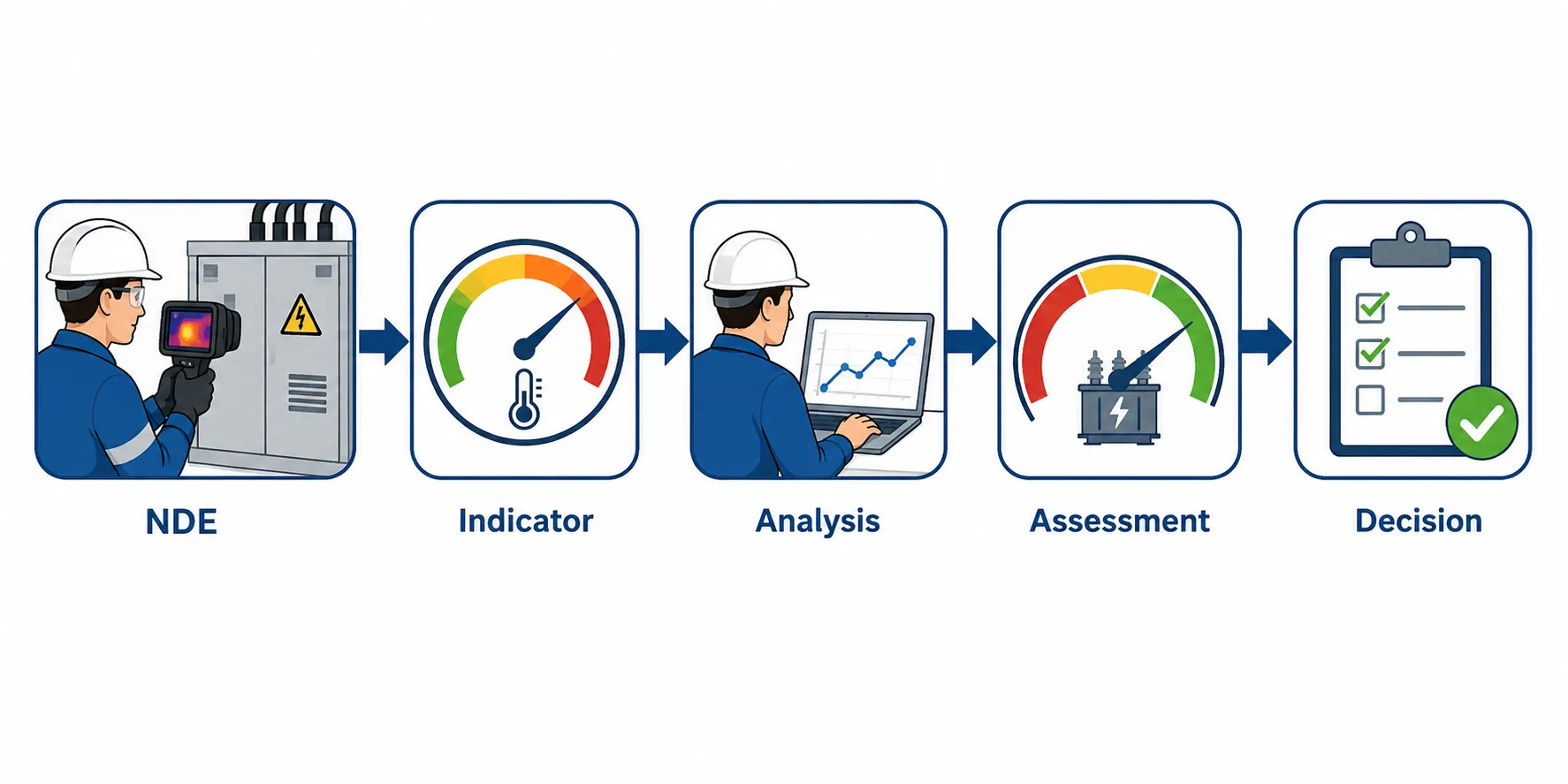
Condition-based maintenance relies on actual evidence of equipment condition. NDE provides one important source of this evidence.
The relationship can be represented as:
NDE measurement → condition indicator → engineering interpretation → condition assessment → maintenance decision
For example, infrared thermography may identify an abnormal temperature at an electrical termination. The thermal image itself is not the maintenance decision. It is an indicator that requires interpretation.
The engineer may then consider:
- Current loading.
- Phase balance.
- Ambient temperature.
- Connection condition.
- Equipment rating.
- Historical thermal data.
- Manufacturer information.
- Previous maintenance.
- Consequence of failure.
The final decision could be immediate repair, planned intervention, further testing, increased monitoring, or continued operation under controlled conditions.
Key NDE Techniques Supporting Predictive Maintenance
Infrared Thermography
Infrared thermography detects thermal radiation and produces images representing surface temperature distribution.
In electrical systems, it can help identify:
- Loose connections.
- High-resistance connections.
- Overloaded components.
- Phase imbalance.
- Abnormal heating.
- Deteriorated connections.
- Cooling problems.
- Component deterioration.
Thermography is particularly valuable because it can often be performed while equipment remains in normal operation, subject to appropriate safety controls and equipment accessibility.
Critical Analysis of Thermography
Thermography provides strong value when:
- Equipment is operating under representative load.
- Inspection conditions are controlled.
- Images are interpreted by competent personnel.
- Historical comparison is available.
- Abnormalities are investigated.
- Corrective actions are verified.
However, temperature alone does not establish the exact cause of a defect.
Potential limitations include:
- Low equipment loading.
- Reflections.
- Environmental temperature.
- Wind or ventilation.
- Surface emissivity.
- Obstructed viewing.
- Incorrect measurement technique.
- Inappropriate comparison points.
Therefore, thermography is most effective when integrated with electrical measurements, physical inspection, historical trends, and engineering judgement.
Ultrasonic Inspection
Ultrasonic techniques can be used to detect certain abnormal acoustic emissions and conditions associated with electrical or mechanical activity.
In electrical maintenance environments, appropriate ultrasonic techniques can assist in detecting:
- Certain forms of electrical discharge.
- Corona-related activity.
- Arcing indicators.
- Compressed-air leakage in relevant industrial systems.
- Mechanical abnormalities.
Predictive Maintenance Contribution
Ultrasonic inspection can provide early warning where an abnormal sound or acoustic signature develops before a visible failure occurs.
Its predictive value increases when:
- Baseline measurements are established.
- Similar equipment is compared.
- Trends are recorded.
- Abnormal signals are investigated.
- Environmental influences are considered.
An ultrasonic indication should not automatically be interpreted as proof of a particular defect. Further technical assessment may be required.
Partial Discharge Assessment
Partial discharge is a localised electrical discharge that can occur within or around insulation systems under certain conditions. Partial discharge diagnostics can provide valuable information about insulation condition in appropriate electrical assets.
It may assist in identifying developing insulation problems in equipment such as:
- High-voltage cables.
- Switchgear.
- Transformers.
- Rotating machines.
- Other suitable high-voltage insulation systems.
Predictive Value of Partial Discharge Monitoring
Partial discharge information can contribute to predictive maintenance by helping identify deterioration before complete insulation breakdown.
Potential benefits include:
- Early identification of insulation problems.
- Condition trending.
- Maintenance prioritisation.
- Risk-based intervention.
- Reduction of unexpected insulation failures.
- Improved asset lifecycle management.
However, interpretation is technically demanding. The presence, magnitude, location, pattern, and development of discharge activity must be evaluated in context.
Visual NDE and Condition Assessment
Visual examination remains one of the most important condition assessment techniques despite the development of sophisticated diagnostic technologies.
A detailed visual inspection can identify:
- Cracks.
- Corrosion.
- Contamination.
- Mechanical damage.
- Loose or deteriorated components.
- Discolouration.
- Evidence of overheating.
- Water ingress.
- Damaged insulation.
- Enclosure deterioration.
- Cable damage.
Visual evidence can also provide context for interpreting results obtained through other NDE methods.
Vibration Monitoring
For electrical assets containing rotating machinery, vibration monitoring can provide information about mechanical condition.
Potential indicators include:
- Misalignment.
- Imbalance.
- Bearing deterioration.
- Mechanical looseness.
- Resonance-related conditions.
- Changes in machine behaviour.
The predictive maintenance value comes from observing changes in vibration patterns over time rather than relying solely on one isolated measurement.
Combining Multiple NDE Techniques
Why One Technique Is Rarely Sufficient
A major principle of effective predictive maintenance is that no single diagnostic technique can identify every possible failure mechanism.
For example:
- Thermography identifies thermal abnormalities.
- Ultrasonics may identify acoustic abnormalities.
- Partial discharge assessment addresses relevant insulation deterioration.
- Vibration monitoring addresses mechanical behaviour.
- Visual inspection identifies physical deterioration.
- Electrical testing provides electrical performance information.
Combining techniques can therefore provide a more complete condition assessment.
Multimethod Condition Assessment
A comprehensive strategy may follow:
- Visual examination.
- Baseline measurement.
- Specialist NDE.
- Historical comparison.
- Trend analysis.
- Risk assessment.
- Engineering interpretation.
- Maintenance decision.
- Corrective action.
- Verification.
This approach reduces dependence on a single measurement and improves confidence in maintenance decisions.
NDE and Early Fault Detection
The Failure Development Concept
Many equipment failures develop through identifiable stages:
Normal condition → early deterioration → detectable abnormality → progressive deterioration → functional degradation → failure
Predictive maintenance attempts to identify the condition during the detectable abnormality stage rather than waiting until functional failure.
NDE can therefore act as an early-warning mechanism.
Examples
An electrical connection may progress through:
- Normal connection.
- Increased contact resistance.
- Localised heating.
- Thermal deterioration.
- Insulation damage.
- Arcing.
- Equipment failure.
Thermography may identify the abnormal heating stage, allowing corrective action before the condition progresses.
Similarly, insulation deterioration may develop gradually before complete breakdown. Appropriate diagnostic techniques may identify evidence of degradation before catastrophic failure occurs.
NDE Baseline Data
Importance of Baseline Measurements
A baseline represents an established reference condition against which future measurements can be compared.
Baseline information may include:
- Temperature patterns.
- Vibration characteristics.
- Partial discharge characteristics.
- Insulation measurements.
- Equipment operating conditions.
- Load conditions.
- Environmental conditions.
Without reliable baseline data, it may be more difficult to determine whether a future measurement represents normal variation or deterioration.
Establishing a Useful Baseline
A baseline should ideally be established:
- After commissioning.
- Following major maintenance.
- Under representative operating conditions.
- Using controlled measurement methods.
- With accurate equipment identification.
- With relevant environmental information.
The baseline should be retained as part of the asset history.
Trend Analysis
Definition
Trend analysis involves comparing condition measurements over time to identify deterioration, stability, improvement, or abnormal changes.
A single measurement may provide limited information. A series of reliable measurements can provide substantially greater predictive value.
Example
Suppose an electrical connection produces the following thermal observations:
| Inspection Period | Relative Thermal Condition | Engineering Interpretation |
|---|---|---|
| Baseline | Normal | Reference condition established |
| Inspection 1 | Slight increase | Monitor and investigate context |
| Inspection 2 | Moderate increase | Increased attention required |
| Inspection 3 | Significant increase | Corrective action should be considered |
| Post-repair | Returned towards baseline | Repair effectiveness verified |
The key principle is that the trend should be interpreted alongside loading, environmental conditions, equipment design, and other evidence.
NDE and Failure Mode Identification
Predictive maintenance becomes more effective when monitoring techniques are connected to known failure modes.
Failure Mode Approach
The maintenance team should identify:
- What can fail?
- Why can it fail?
- What physical indicators develop before failure?
- Which NDE technique can identify those indicators?
- How early can the condition be detected?
- What action should follow detection?
This creates a logical connection between failure mechanisms and inspection strategy.
Example
For a transformer, potential deterioration mechanisms may involve:
- Insulation degradation.
- Thermal stress.
- Connection problems.
- Moisture.
- Cooling-system issues.
The inspection strategy should therefore use suitable condition indicators rather than applying the same NDE method indiscriminately to every asset.
NDE and Asset Criticality
Criticality-Based Prioritisation
Not every asset requires identical monitoring intensity.
Asset criticality may consider:
- Safety consequence.
- Production consequence.
- Environmental consequence.
- Financial consequence.
- Service continuity.
- Availability of redundancy.
- Replacement lead time.
- Repair complexity.
A critical transformer supporting an essential process may justify more intensive condition monitoring than a non-critical auxiliary component.
Benefits of Criticality-Based NDE
- Better allocation of specialist resources.
- Increased monitoring of high-consequence equipment.
- Reduced unnecessary testing.
- Improved maintenance prioritisation.
- Better risk management.
NDE and Maintenance Decision-Making
NDE results should be connected to clearly defined maintenance decisions.
Possible decisions include:
- Continue normal operation.
- Continue with increased monitoring.
- Conduct additional diagnostic testing.
- Schedule planned maintenance.
- Repair during the next outage.
- Replace a component.
- Reduce operating exposure.
- Immediately isolate equipment.
The appropriate decision depends on the condition evidence and consequence of failure.
NDE Does Not Automatically Mean Predictive Maintenance
A critical distinction is that simply performing NDE does not create a predictive maintenance programme.
Predictive maintenance requires:
- Defined objectives.
- Appropriate asset selection.
- Failure-mode understanding.
- Condition indicators.
- Reliable measurements.
- Baseline data.
- Trend analysis.
- Intervention thresholds.
- Maintenance decision rules.
- Competent interpretation.
- Corrective-action management.
Without these elements, NDE may become an isolated inspection activity rather than an integrated predictive maintenance tool.
NDE and Risk-Based Maintenance
NDE results can influence maintenance risk assessments.
For example, an asset may have:
- High criticality.
- Moderate deterioration.
- Limited redundancy.
- Long replacement lead time.
Such an asset may require earlier intervention than a lower-criticality asset showing the same deterioration.
A risk-based decision therefore considers both:
Condition × Consequence = Maintenance Priority
This is more effective than relying solely on the measured condition.
NDE and Remaining Useful Life
Concept
Remaining useful life refers to an estimate of how long an asset or component may continue performing its intended function under defined conditions.
NDE can provide evidence that supports such assessments, but NDE results alone do not necessarily provide an accurate remaining-life prediction.
Factors may include:
- Current condition.
- Historical deterioration rate.
- Operating environment.
- Loading.
- Maintenance history.
- Material properties.
- Failure mechanism.
- Future operating conditions.
Professional Limitation
Remaining-life estimates should therefore be treated as engineering assessments with uncertainty rather than exact predictions.
NDE and Maintenance Interval Optimisation
Traditional maintenance programmes often use fixed intervals.
For example:
- Annual inspection.
- Five-year testing.
- Scheduled component replacement.
Predictive maintenance can supplement fixed schedules by using condition information.
Where condition remains stable, inspection planning may be optimised within applicable requirements and organisational controls. Where deterioration accelerates, inspection or intervention may need to become more frequent.
This creates a more responsive maintenance strategy.
NDE and Unplanned Downtime Reduction
Unplanned failures can result in:
- Production interruption.
- Emergency repair costs.
- Equipment damage.
- Safety exposure.
- Contractual consequences.
- Loss of service.
- Secondary equipment damage.
NDE can help identify developing conditions before failure and therefore provide opportunities for planned intervention.
Practical Example
A manufacturing facility identifies an abnormal temperature at a motor termination during a routine thermographic survey.
Instead of waiting for failure, the organisation:
- Records the thermal condition.
- Confirms loading.
- Investigates the connection.
- Plans corrective maintenance.
- Repairs the connection during a controlled shutdown.
- Repeats thermography.
- Compares the new condition with baseline data.
The result is a shift from reactive failure response to planned condition-based intervention.
NDE and Quality Assurance
NDE contributes to QA/QC by providing objective evidence of equipment condition.
Inspection records should contain, where appropriate:
- Asset identification.
- Date and time.
- Inspection method.
- Equipment condition.
- Operating conditions.
- Test instrument.
- Measurement results.
- Environmental conditions.
- Inspector competence.
- Findings.
- Acceptance decision.
- Corrective action.
- Verification.
Good documentation makes NDE results auditable and supports future trend analysis.
NDE Data Quality
Importance of Measurement Reliability
Predictive maintenance decisions are only as reliable as the information supporting them.
Potential sources of uncertainty include:
- Instrument limitations.
- Incorrect measurement technique.
- Environmental conditions.
- Operator competence.
- Inconsistent inspection positions.
- Different equipment loading.
- Calibration issues.
- Data transcription errors.
Data Quality Controls
A strong NDE programme should establish:
- Instrument calibration.
- Standardised procedures.
- Defined measurement locations.
- Competent personnel.
- Consistent operating conditions.
- Digital data storage where appropriate.
- Asset identification.
- Quality review.
- Trend comparison.
Limitations of NDE in Predictive Maintenance
Critical analysis requires recognition of limitations.
False Positives
An NDE method may identify an abnormal indication that does not ultimately represent a significant failure mechanism.
Consequences may include:
- Unnecessary maintenance.
- Unplanned shutdown.
- Increased costs.
- Replacement of serviceable components.
False Negatives
A more serious concern is when a developing defect is not detected.
Potential causes include:
- Inappropriate technique.
- Poor access.
- Insufficient sensitivity.
- Incorrect operating conditions.
- Inadequate competence.
- Incorrect interpretation.
Therefore, NDE should be designed around credible failure mechanisms.
Interpretation Dependence
Some NDE results require substantial specialist knowledge. The value of a diagnostic result depends on the competence of the person interpreting it.
Key NDE and Predictive Maintenance Concepts
| Concept | Definition | Contribution to Predictive Maintenance |
|---|---|---|
| NDE | Evaluation without unacceptable damage | Provides condition evidence |
| Condition Monitoring | Measurement of equipment condition over time | Identifies deterioration |
| Baseline | Reference condition established for comparison | Supports trend detection |
| Trend Analysis | Evaluation of measurements over time | Identifies deterioration patterns |
| Failure Mode | Specific way equipment can fail | Guides NDE method selection |
| Asset Criticality | Importance and consequence of asset failure | Prioritises monitoring |
| Intervention Threshold | Condition requiring defined action | Links NDE findings to maintenance |
| Predictive Maintenance | Maintenance based on equipment condition | Reduces unnecessary and reactive work |
| Diagnostic Evidence | Information indicating equipment condition | Supports engineering decisions |
| Remaining Useful Life | Estimated remaining service capability | Supports lifecycle planning |
| Corrective Action | Intervention addressing identified deterioration | Prevents progression of defects |
| Verification | Confirmation that corrective action was effective | Closes the maintenance feedback loop |
Process for Integrating NDE into Predictive Maintenance
Step 1: Identify Critical Assets
Establish which assets have the greatest consequences of failure.
Consider:
- Safety.
- Production.
- Reliability.
- Environmental consequences.
- Replacement time.
- Redundancy.
Step 2: Identify Failure Modes
Determine credible mechanisms that could cause functional failure.
Examples include:
- Insulation deterioration.
- Overheating.
- Mechanical deterioration.
- Corrosion.
- Electrical discharge.
- Connection deterioration.
Step 3: Select Appropriate NDE Techniques
Select techniques capable of identifying relevant condition indicators.
The selection should consider:
- Sensitivity.
- Accessibility.
- Equipment type.
- Operating conditions.
- Failure mechanism.
- Inspection frequency.
- Competence requirements.
Step 4: Establish Baseline Condition
Collect reliable reference information after commissioning or a verified satisfactory condition.
Step 5: Establish Inspection Frequency
Determine frequency according to:
- Criticality.
- Deterioration rate.
- Operating environment.
- Historical performance.
- Manufacturer recommendations.
- Applicable requirements.
Step 6: Collect Consistent Data
Measurements should be collected using controlled procedures.
Step 7: Analyse Trends
Compare current results with:
- Baseline.
- Previous results.
- Similar equipment.
- Defined criteria.
Step 8: Evaluate Risk
Determine the significance of the observed condition.
Step 9: Select Maintenance Action
Possible actions include:
- Continue monitoring.
- Additional diagnostic testing.
- Planned repair.
- Component replacement.
- Immediate intervention.
Step 10: Verify Effectiveness
After corrective action, perform suitable inspection or testing to demonstrate that the condition has been resolved.
Step 11: Update Asset History
Record the findings, action, results, and lessons learned.
Practical Example: Thermographic Predictive Maintenance Programme
Scenario
A large industrial facility operates multiple motor-control centres. Conventional maintenance has historically involved annual shutdown inspections. Several connection failures have previously caused production interruptions.
The organisation introduces thermographic condition monitoring.
Initial Assessment
The maintenance team identifies:
- Critical motor-control centres.
- High-load circuits.
- Historical failure locations.
- Accessible inspection points.
- Normal operating temperatures.
Baseline Development
Thermal images are captured under representative operating conditions.
Each image is associated with:
- Equipment identification.
- Circuit identification.
- Load information.
- Date.
- Environmental conditions.
Trend Monitoring
Future inspections identify one termination with progressively increasing temperature.
Rather than waiting for failure, the team investigates the connection.
Maintenance Decision
The connection is repaired during a planned outage.
A post-maintenance thermal inspection confirms improved condition.
Predictive Maintenance Outcome
The process demonstrates how NDE can:
- Identify deterioration.
- Support planned intervention.
- Reduce unexpected failure.
- Create historical condition data.
- Improve maintenance planning.
Practical Example: Partial Discharge Monitoring
Scenario
A high-voltage installation contains critical switchgear with significant operational consequences if insulation failure occurs.
A partial discharge monitoring programme is established.
Process
The programme:
- Establishes baseline measurements.
- Records operating conditions.
- Conducts periodic assessments.
- Compares discharge patterns.
- Identifies changes.
- Escalates significant deterioration.
- Conducts additional diagnostic assessment where required.
Engineering Decision
A developing change in discharge behaviour is identified. The organisation does not immediately replace the equipment solely on the basis of one result. Instead, the engineering team evaluates:
- Measurement reliability.
- Historical trend.
- Equipment condition.
- Operating conditions.
- Criticality.
- Failure consequences.
A controlled maintenance decision is then made.
This illustrates an important predictive maintenance principle: diagnostic information supports engineering judgement; it does not automatically replace it.
Case Study: Predictive Maintenance in a Critical Electrical Distribution System
Background
A processing facility operates a critical electrical distribution network containing transformers, switchgear, motor-control centres, standby generation, and emergency power systems.
Historically, maintenance has been largely time-based.
The organisation experiences:
- Unexpected switchgear failures.
- Thermal abnormalities.
- Emergency shutdowns.
- Increasing maintenance expenditure.
- Difficulty prioritising ageing assets.
Introduction of NDE
A condition-based strategy is introduced using:
- Visual inspection.
- Infrared thermography.
- Appropriate ultrasonic assessment.
- Electrical diagnostic testing.
- Historical condition analysis.
Criticality Assessment
Assets are classified according to:
- Safety consequence.
- Production consequence.
- Redundancy.
- Replacement lead time.
- Failure severity.
Critical transformers and switchgear receive more intensive monitoring.
Baseline Programme
Initial condition data is collected following verification of satisfactory equipment condition.
Trend Development
Subsequent inspections identify:
- Stable assets.
- Slowly deteriorating assets.
- Rapidly deteriorating assets.
- Assets requiring immediate technical investigation.
Maintenance Prioritisation
Instead of treating every asset equally, the organisation prioritises assets based on:
Condition + Criticality + Failure Consequence + Deterioration Trend
Results
The strategy can provide:
- Better maintenance prioritisation.
- Reduced unnecessary intervention.
- Earlier defect detection.
- Better outage planning.
- Improved asset information.
- Reduced exposure to unexpected failures.
Critical Analysis of NDE Effectiveness
Strengths
NDE can:
- Detect deterioration before functional failure.
- Provide objective condition information.
- Support condition-based maintenance.
- Reduce unnecessary equipment dismantling.
- Improve maintenance planning.
- Support risk-based asset prioritisation.
- Identify developing defects.
- Establish historical trends.
- Improve reliability engineering decisions.
- Support lifecycle management.
Limitations
NDE may also:
- Require specialist competence.
- Produce ambiguous indications.
- Depend on operating conditions.
- Require expensive equipment.
- Generate large quantities of data.
- Produce false positives.
- Miss defects outside its detection capability.
- Require specialist interpretation.
- Need complementary techniques.
Therefore, the value of NDE should be assessed according to its ability to provide useful information about specific failure mechanisms and support meaningful maintenance decisions.
Key Benefits of Integrating NDE with Predictive Maintenance
Safety
- Earlier identification of dangerous deterioration.
- Reduced probability of catastrophic electrical failure.
- Improved control of high-risk assets.
- Better prioritisation of safety-critical defects.
Reliability
- Improved equipment availability.
- Earlier intervention.
- Reduced unexpected failures.
- Better understanding of asset condition.
Cost Management
- Reduced unnecessary component replacement.
- Better maintenance scheduling.
- Reduced emergency repair costs.
- Better allocation of specialist resources.
Operational Performance
- Reduced unplanned downtime.
- Improved outage planning.
- Better asset utilisation.
- Improved maintenance coordination.
Quality Assurance
- Objective condition evidence.
- Improved inspection records.
- Better defect trending.
- Stronger corrective-action verification.
Professional Checklist for NDE-Based Predictive Maintenance
A predictive maintenance programme should consider:
- Asset criticality.
- Equipment failure modes.
- Appropriate NDE methods.
- Baseline condition.
- Measurement quality.
- Inspection frequency.
- Operating conditions.
- Historical records.
- Trend analysis.
- Acceptance criteria.
- Intervention thresholds.
- Competence requirements.
- Equipment calibration.
- Data management.
- Risk assessment.
- Corrective action.
- Reinspection.
- Verification.
- Lessons learned.
- Continual improvement.
Conclusion
NDE contributes significantly to the core principles of predictive maintenance by transforming equipment condition into measurable and actionable information. Instead of relying exclusively on fixed maintenance intervals or responding after equipment failure, organisations can use appropriate NDE techniques to identify deterioration, establish condition baselines, monitor trends, assess risk, prioritise critical assets, and plan intervention at an appropriate stage of the equipment lifecycle.
The most important contribution of NDE is therefore not the test itself but the information it provides for engineering decision-making. Infrared thermography can reveal abnormal thermal behaviour; ultrasonic techniques can identify appropriate acoustic indicators; partial discharge assessment can support evaluation of insulation condition; visual inspection can identify physical deterioration; and vibration monitoring can provide useful information about mechanical condition in suitable rotating equipment. Each technique addresses particular condition indicators and failure mechanisms, meaning that method selection must be based on the asset and the failure mechanism rather than simply the availability of technology.
A mature predictive maintenance programme connects NDE to a structured decision process:
NDE → condition evidence → trend analysis → risk assessment → maintenance decision → intervention → verification → improved asset knowledge
This process is particularly valuable for high-risk electrical installations where equipment failure can result in safety incidents, significant downtime, costly damage, or loss of critical services. However, NDE should not be treated as an infallible prediction mechanism. Measurement limitations, environmental conditions, false indications, missed defects, interpretation uncertainty, and differences between diagnostic techniques must all be considered.
The strongest predictive maintenance programmes therefore combine NDE with asset criticality assessment, failure-mode analysis, historical records, maintenance information, operating conditions, engineering calculations, competent interpretation, and controlled decision criteria. Baseline measurements and consistent data collection are particularly important because a trend over time can often provide more useful information than an isolated measurement.
Ultimately, NDE provides the evidence needed to move electrical asset management from a predominantly reactive model towards a proactive, condition-based, and predictive approach. When correctly selected, competently performed, consistently documented, critically interpreted, and integrated with risk-based maintenance planning, NDE can improve reliability, reduce unplanned downtime, optimise maintenance resources, strengthen quality assurance, and support safer and more sustainable operation of complex electrical systems.
2. Evaluate the Effectiveness of NDE in Extending the Lifecycle and Reliability of Electrical Systems
Non-Destructive Evaluation (NDE) is an important component of modern electrical asset management because it allows the condition of equipment to be assessed without causing unacceptable damage or unnecessarily dismantling the asset. Its effectiveness in extending equipment lifecycle depends on more than the ability to detect a defect. The real value of NDE is demonstrated when condition information is converted into timely engineering decisions that prevent deterioration from progressing into functional failure, improve maintenance planning, and support continued safe operation.
Electrical systems are exposed to thermal, electrical, mechanical, environmental, and operational stresses throughout their service life. Transformers, switchgear, cables, busbars, generators, motors, UPS systems, battery installations, control equipment, and distribution assemblies can gradually deteriorate through mechanisms such as overheating, insulation ageing, contamination, moisture ingress, vibration, corrosion, loose connections, electrical discharge, and mechanical degradation. Many of these conditions develop progressively before complete failure occurs. NDE provides an opportunity to identify these changes during the deterioration phase and determine whether intervention, monitoring, repair, replacement, or further investigation is appropriate.
Evaluating NDE effectiveness therefore requires a lifecycle perspective. An effective NDE programme should demonstrate that condition information contributes to improved reliability, reduced unplanned failures, better maintenance decisions, controlled operating risk, and increased useful service life where technically justified. It should also recognise that NDE cannot eliminate deterioration or guarantee that failure will never occur. Its effectiveness depends on appropriate technique selection, competent inspection, reliable measurements, meaningful baseline data, trend analysis, accurate interpretation, suitable intervention criteria, and effective corrective action.
Understanding Electrical Asset Lifecycle and Reliability
Electrical Asset Lifecycle
The lifecycle of an electrical asset extends from design and procurement through installation, commissioning, operation, maintenance, modification, refurbishment, and eventual replacement or retirement.
A simplified lifecycle is:
- Design
- Procurement
- Installation
- Commissioning
- Initial operation
- Condition monitoring
- Maintenance
- Refurbishment
- Extended operation
- Replacement or retirement
NDE can contribute at several stages of this lifecycle. During commissioning, it can establish baseline condition. During operation, it can identify deterioration. During maintenance, it can verify condition before and after intervention. During lifecycle extension assessments, it can provide evidence to support continued service where the asset remains technically suitable.
Electrical Reliability
Reliability refers to the ability of an electrical asset or system to perform its intended function for a defined period under specified operating conditions.
Reliability can be influenced by:
- Equipment design.
- Installation quality.
- Material condition.
- Operating temperature.
- Electrical loading.
- Environmental exposure.
- Maintenance quality.
- Protection performance.
- Equipment age.
- Failure mechanisms.
- Operating practices.
NDE contributes primarily by improving knowledge of actual asset condition and identifying evidence of developing failure mechanisms.
What Makes NDE Effective?
NDE should not be considered effective merely because an inspection has been completed. Effectiveness must be evaluated according to the quality and usefulness of the information produced and the resulting maintenance outcome.
An effective NDE programme should answer questions such as:
- Was the correct technique selected?
- Was the relevant failure mechanism detectable?
- Was the inspection performed under suitable conditions?
- Was the equipment correctly identified?
- Was the measurement reliable?
- Was a baseline available?
- Were trends evaluated?
- Was the finding interpreted correctly?
- Did the result influence a maintenance decision?
- Was corrective action completed?
- Was the equipment reassessed afterwards?
- Did the intervention reduce the identified risk?
The ultimate measure of effectiveness is therefore the connection between NDE evidence and improved asset-management outcomes.
Key Concepts in NDE-Based Lifecycle Extension
| Concept | Definition | Contribution to Lifecycle and Reliability |
|---|---|---|
| NDE | Condition evaluation without unacceptable equipment damage | Provides evidence about asset condition |
| Condition Monitoring | Repeated assessment of equipment condition | Identifies changes over time |
| Baseline | Reference condition established for comparison | Enables deterioration detection |
| Deterioration Trend | Progressive change in condition indicators | Supports intervention planning |
| Asset Criticality | Consequence and importance of asset failure | Helps prioritise NDE resources |
| Failure Mechanism | Process through which equipment may deteriorate or fail | Determines suitable NDE methods |
| Predictive Maintenance | Maintenance based on actual or developing condition | Enables planned intervention |
| Lifecycle Extension | Continued service beyond an originally expected period where justified | Delays unnecessary replacement |
| Reliability | Ability to perform the required function consistently | Measures operational performance |
| Intervention Threshold | Defined condition requiring maintenance action | Connects NDE results with decisions |
| Corrective Action | Intervention designed to control identified deterioration | Prevents further degradation |
| Reinspection | Follow-up evaluation after intervention | Verifies corrective effectiveness |
How NDE Extends Electrical Equipment Lifecycle
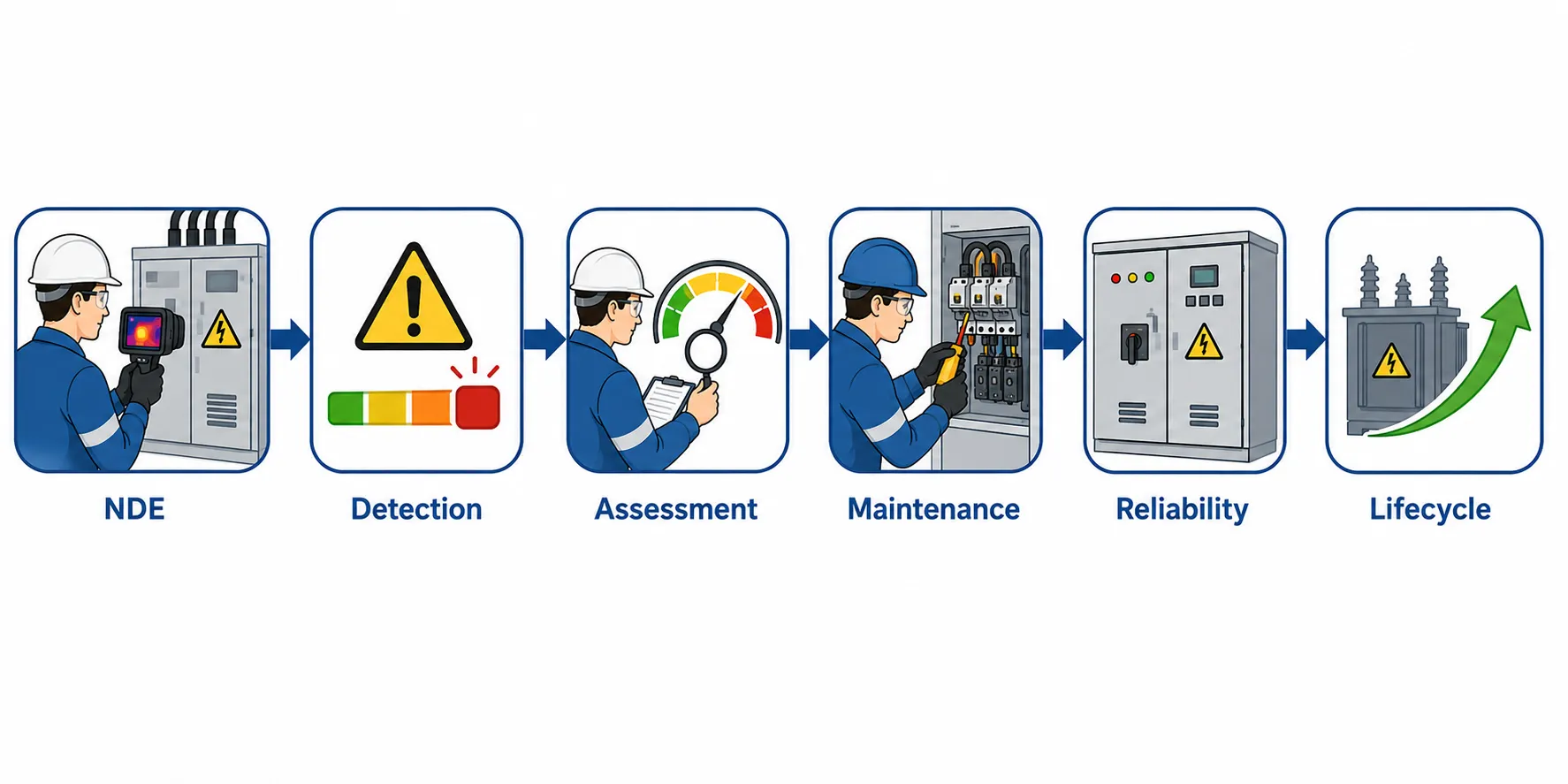
Early Detection of Deterioration
One of the most important ways NDE can support lifecycle extension is through early detection.
Many electrical failures are preceded by detectable changes. For example:
- A loose connection can develop abnormal heating.
- Insulation deterioration can produce diagnostic indicators.
- Bearing degradation can change vibration characteristics.
- Corrosion can progressively weaken connections or enclosures.
- Moisture ingress can affect insulation condition.
- Partial discharge can indicate developing insulation problems.
- Mechanical looseness can produce abnormal vibration or acoustic patterns.
When these conditions are identified early, maintenance teams may be able to intervene before the damage becomes extensive.
Preventing Secondary Damage
A developing fault can cause damage beyond the original defective component.
For example, an abnormal electrical connection may progressively generate heat. If left uncontrolled, the condition could damage:
- Conductors.
- Insulation.
- Terminations.
- Adjacent equipment.
- Enclosures.
- Protection components.
Early NDE detection can allow the original condition to be addressed before secondary damage develops.
This is important for lifecycle extension because preventing secondary damage can preserve equipment that might otherwise require major refurbishment or replacement.
NDE and Electrical Equipment Reliability
Reliability Improvement Through Condition Information
Reliability engineering depends on understanding how equipment behaves and deteriorates.
NDE contributes by providing:
- Condition measurements.
- Defect indications.
- Historical trends.
- Failure-mode evidence.
- Early warning information.
- Maintenance verification data.
This information can improve reliability decisions because maintenance can be targeted towards actual deterioration rather than assumptions based solely on equipment age.
Reliability Versus Age
Equipment age alone does not determine condition.
Two electrical assets of identical age may have very different condition profiles because of differences in:
- Loading.
- Environment.
- Maintenance.
- Operating cycles.
- Installation quality.
- Temperature.
- Contamination.
- Duty pattern.
NDE helps distinguish between chronological age and actual physical condition.
Lifecycle Extension Through Condition-Based Decisions
A common mistake in maintenance management is to assume that ageing equipment must automatically be replaced.
NDE can provide evidence for a more technically informed decision.
For an ageing transformer, for example, an engineering assessment may consider:
- Current condition.
- Historical deterioration.
- Loading.
- Thermal performance.
- Insulation condition.
- Connection condition.
- Maintenance history.
- Failure consequences.
- Availability of replacement equipment.
If evidence demonstrates satisfactory condition and controlled deterioration, continued operation may be technically reasonable, subject to applicable requirements and appropriate risk controls.
This does not mean NDE should be used to justify indefinite operation. Lifecycle extension must remain evidence-based and subject to appropriate engineering assessment.
Role of Infrared Thermography in Lifecycle Extension
Thermal Condition Monitoring
Infrared thermography is particularly useful for identifying abnormal thermal patterns in electrical equipment.
Applications may include:
- Switchboards.
- Distribution boards.
- Motor-control centres.
- Cable terminations.
- Busbar connections.
- Transformers.
- Circuit-breaker connections.
- Generator connections.
Thermal abnormalities may indicate:
- High-resistance connections.
- Overloading.
- Phase imbalance.
- Poor contact.
- Deterioration.
- Cooling problems.
Lifecycle Benefit
Early detection allows maintenance teams to correct developing problems before extensive thermal damage occurs.
A simple intervention such as correcting a defective connection may prevent:
- Insulation damage.
- Arcing.
- Component failure.
- Fire.
- Production interruption.
This can preserve equipment condition and reduce the probability of premature replacement.
Role of Partial Discharge Assessment
Partial discharge assessment can provide valuable condition information for appropriate high-voltage insulation systems.
Its lifecycle contribution can include:
- Identifying developing insulation problems.
- Monitoring changes over time.
- Supporting condition assessment.
- Prioritising high-risk equipment.
- Supporting planned intervention.
The effectiveness of partial discharge assessment depends heavily on correct measurement and interpretation. A single indication should not automatically lead to equipment replacement. The engineering assessment should consider the pattern, trend, equipment design, operating conditions, historical data, and other available evidence.
Role of Ultrasonic Techniques
Ultrasonic inspection can support identification of certain acoustic indications associated with electrical or mechanical conditions.
Potential applications include:
- Detecting suitable discharge-related acoustic activity.
- Identifying abnormal arcing indicators.
- Supporting condition monitoring.
- Identifying certain mechanical abnormalities.
The lifecycle benefit occurs when an abnormal indication leads to appropriate investigation and intervention before failure.
Role of Visual Examination
Visual examination remains an essential part of lifecycle management.
It can identify:
- Corrosion.
- Cracks.
- Contamination.
- Water ingress.
- Physical damage.
- Discolouration.
- Deteriorated insulation.
- Enclosure deterioration.
- Loose components.
- Evidence of overheating.
Visual inspection is particularly valuable because it provides physical context for findings from specialist NDE techniques.
Role of Vibration Monitoring
For suitable rotating electrical equipment, vibration monitoring can help identify mechanical deterioration.
Potential indications include:
- Imbalance.
- Misalignment.
- Bearing deterioration.
- Mechanical looseness.
- Changes in operating condition.
Lifecycle benefits include:
- Earlier maintenance planning.
- Reduced secondary damage.
- Improved rotating-machine reliability.
- Better maintenance scheduling.
- Reduced unexpected shutdowns.
NDE Baseline and Lifecycle Management
Importance of Baseline Information
A baseline provides a reference against which future measurements can be evaluated.
A useful baseline should include appropriate information such as:
- Equipment identification.
- Operating load.
- Environmental conditions.
- Measurement location.
- Inspection technique.
- Instrument information.
- Initial condition.
- Relevant diagnostic values.
The quality of the baseline directly influences the quality of future trend analysis.
Baseline After Corrective Maintenance
A new baseline may also be required following:
- Major repair.
- Component replacement.
- Refurbishment.
- Reconfiguration.
- Significant maintenance.
- System modification.
This provides a new reference condition for subsequent monitoring.
NDE Trend Analysis and Reliability Improvement
Single Measurement Versus Trend
A single measurement provides a snapshot. A series of reliable measurements provides a trend.
Trend analysis can help identify:
- Stable condition.
- Gradual deterioration.
- Accelerating deterioration.
- Sudden abnormal changes.
- Successful corrective action.
For example, an electrical termination may show progressively increasing thermal behaviour over several inspections. The trend provides stronger evidence of deterioration than one isolated measurement.
Trend Analysis Process
A professional process can involve:
- Establish baseline.
- Collect repeat measurements.
- Confirm comparable operating conditions.
- Compare results.
- Identify changes.
- Assess deterioration rate.
- Evaluate risk.
- Determine intervention requirements.
- Complete maintenance.
- Reinspect.
- Update the asset history.
NDE and Maintenance Optimisation
Moving Beyond Fixed Maintenance Intervals
Traditional maintenance may use fixed schedules such as annual inspection or periodic component replacement.
NDE allows condition information to supplement these schedules.
This can support:
- Earlier intervention where deterioration is accelerating.
- Continued monitoring where condition remains stable.
- Better outage planning.
- More targeted maintenance.
- Reduced unnecessary intervention.
This approach does not mean fixed requirements should be ignored. Statutory, regulatory, manufacturer, and organisational requirements must continue to be respected.
NDE and Failure Prevention
Preventing Catastrophic Electrical Failure
The strongest lifecycle benefit of NDE may occur when a developing defect is identified before catastrophic failure.
For example:
Normal condition → connection deterioration → abnormal heating → insulation damage → arcing → equipment failure
NDE may identify the abnormal heating stage.
If appropriate corrective action is taken, the later stages may be prevented.
Preventing System-Level Consequences
Electrical equipment failure can affect interconnected systems.
A single switchgear failure may cause:
- Loss of production.
- Emergency power transfer.
- Protection operation.
- Shutdown of critical equipment.
- Secondary equipment stress.
Preventing the initiating failure can therefore protect the wider electrical system.
NDE and Risk-Based Asset Management
NDE effectiveness should be evaluated according to asset criticality.
High-Criticality Equipment
High-criticality equipment may include assets whose failure could cause:
- Serious safety consequences.
- Major production interruption.
- Loss of essential services.
- Significant financial loss.
- Extended outage.
- Difficult replacement.
Such assets may justify enhanced monitoring.
Lower-Criticality Equipment
Lower-criticality assets may require less intensive NDE depending on:
- Failure consequence.
- Redundancy.
- Replacement availability.
- Operating conditions.
- Historical performance.
This ensures NDE resources are allocated proportionately.
NDE and Remaining Useful Life
Understanding Remaining Useful Life
Remaining useful life is an engineering estimate of how long an asset may continue performing its required function under defined conditions.
NDE can provide important evidence, but it should not be treated as a precise prediction tool by itself.
A lifecycle assessment may consider:
- Current condition.
- Historical deterioration.
- Deterioration rate.
- Operating duty.
- Environmental exposure.
- Maintenance history.
- Failure mechanism.
- Equipment criticality.
- Future operating conditions.
Responsible Lifecycle Extension
Lifecycle extension should be based on evidence rather than simply the absence of visible defects.
A professional decision should establish whether:
- The equipment remains fit for service.
- Known deterioration is controlled.
- Failure risk remains acceptable.
- Protection remains effective.
- Maintenance requirements can be satisfied.
- Future operating conditions are understood.
Evaluating NDE Effectiveness Through Key Performance Indicators
The effectiveness of an NDE programme can be assessed using measurable indicators.
Technical Indicators
- Number of significant defects detected.
- Percentage of inspections completed correctly.
- Number of repeat defects.
- Deterioration trends.
- Diagnostic accuracy.
- Corrective-action effectiveness.
- Reinspection results.
Reliability Indicators
- Reduction in unplanned failures.
- Reduction in emergency shutdowns.
- Increased equipment availability.
- Improved mean time between failures.
- Reduced repeat failures.
Maintenance Indicators
- Planned versus reactive maintenance.
- Emergency repair frequency.
- Maintenance cost trends.
- Number of unnecessary interventions avoided.
- Outage planning efficiency.
Quality Indicators
- Inspection record completeness.
- Calibration compliance.
- Personnel competency.
- Traceability of findings.
- Closure of corrective actions.
Practical Example: Switchgear Lifecycle Extension
Scenario
An industrial facility operates ageing medium-voltage switchgear. Replacement would require substantial capital expenditure and an extended outage.
Instead of relying solely on equipment age, the organisation develops an NDE-based condition assessment programme.
The programme includes:
- Detailed visual examination.
- Thermal assessment.
- Appropriate ultrasonic assessment.
- Electrical condition testing.
- Historical defect review.
- Operating-load review.
Findings
The assessment identifies:
- Several stable components.
- One connection showing abnormal thermal behaviour.
- Minor enclosure corrosion.
- No significant evidence of deterioration in several other components.
Engineering Response
The organisation:
- Repairs the abnormal connection.
- Addresses corrosion.
- Repeats appropriate inspections.
- Updates the condition baseline.
- Increases monitoring of the affected equipment.
- Reviews lifecycle strategy.
Outcome
Rather than replacing the entire switchgear assembly immediately, the organisation uses condition evidence to target maintenance where required while continuing to assess overall equipment suitability.
The important principle is that NDE does not automatically extend the life of equipment. Instead, it provides evidence that can support a technically justified lifecycle decision.
Practical Example: Transformer Condition Monitoring
Scenario
A critical transformer has been in service for many years and supplies an important industrial process.
The asset has:
- High replacement cost.
- Long procurement lead time.
- Limited redundancy.
- Significant production consequence if failure occurs.
NDE-Based Strategy
The condition programme incorporates suitable techniques and inspections according to the transformer’s construction, failure mechanisms, operating environment, and applicable requirements.
The programme tracks:
- Thermal condition.
- Physical condition.
- Connection condition.
- Relevant insulation indicators.
- Historical findings.
Decision-Making
A gradual deterioration trend is identified.
The engineering team does not simply wait for failure. Instead, it:
- Reviews the trend.
- Assesses the rate of deterioration.
- Considers operational loading.
- Evaluates failure consequence.
- Plans appropriate intervention.
- Reassesses after maintenance.
This demonstrates how NDE can convert condition information into lifecycle planning.
Case Study: NDE-Based Reliability Improvement Programme
Background
A manufacturing organisation experiences repeated electrical equipment failures. Maintenance is predominantly reactive, and equipment is often repaired only after a functional failure occurs.
The organisation introduces a structured NDE and predictive maintenance programme.
Initial Problems
The facility identifies:
- Unexpected switchgear failures.
- Thermal abnormalities.
- Repeated connection defects.
- Limited historical condition data.
- Poor maintenance prioritisation.
- Unplanned production interruptions.
Programme Development
The organisation establishes:
- Asset criticality categories.
- Failure-mode assessments.
- NDE technique selection.
- Baseline inspections.
- Condition-monitoring schedules.
- Defined escalation criteria.
- Corrective-action processes.
- Post-maintenance verification.
Implementation
Critical equipment receives enhanced condition monitoring, while lower-criticality assets receive proportionate inspection.
NDE findings are entered into asset records and compared over time.
Maintenance Decision Process
A condition finding is classified according to:
- Severity.
- Trend.
- Failure consequence.
- Confidence in the measurement.
- Equipment criticality.
- Availability of alternative supply.
This allows the organisation to distinguish between:
- Normal condition.
- Monitor condition.
- Planned intervention.
- Urgent intervention.
Case Study Outcome
The organisation gains improved visibility of asset condition and can better plan maintenance around actual equipment needs.
The major lesson is that NDE becomes most effective when it is integrated into a complete reliability-management process rather than operating as a standalone inspection activity.
Critical Evaluation of NDE Benefits
Benefit: Reduced Unplanned Failure
NDE can identify developing faults before functional failure.
This can contribute to:
- Planned intervention.
- Reduced emergency repairs.
- Improved operational continuity.
- Better safety management.
Benefit: Extended Equipment Service
Where deterioration is identified early and effectively controlled, equipment may remain suitable for service for longer.
This can reduce:
- Premature replacement.
- Capital expenditure.
- Equipment disposal.
- Major outage requirements.
Benefit: Improved Maintenance Planning
NDE provides condition information that can help maintenance teams prioritise work.
This supports:
- Planned shutdowns.
- Spare-parts planning.
- Labour planning.
- Specialist resource allocation.
- Budget forecasting.
Benefit: Better Reliability Data
Repeated NDE provides historical evidence that can support reliability engineering.
The organisation can identify:
- Common failure mechanisms.
- Recurring defects.
- High-risk equipment.
- Deterioration patterns.
- Maintenance effectiveness.
Limitations and Risks of Using NDE for Lifecycle Extension
NDE Cannot Eliminate Failure Risk
NDE provides evidence but cannot guarantee that failure will not occur.
Unpredictable failures may still result from:
- Sudden component breakdown.
- External events.
- Incorrect operation.
- Severe overload.
- Installation defects.
- Unexpected environmental conditions.
Detection Capability Is Technique-Dependent
Each NDE method has limitations.
A technique may detect one condition effectively while providing little information about another.
Therefore:
- Method selection must reflect failure mechanisms.
- Multiple techniques may be required.
- Specialist interpretation may be necessary.
Poor Data Can Produce Poor Decisions
If measurements are inconsistent, the resulting trend may be misleading.
Common problems include:
- Different measurement positions.
- Different loading conditions.
- Poor instrument control.
- Incorrect asset identification.
- Inadequate environmental records.
- Inconsistent inspection personnel.
Over-Reliance on Technology
Advanced diagnostic equipment does not replace engineering judgement.
The correct question is not:
“Was the equipment tested?”
The more useful question is:
“Does the available evidence demonstrate that the equipment remains suitable for its intended service?”
Process for Evaluating NDE Effectiveness
Step 1: Establish the Objective
Define what the NDE programme is intended to achieve.
Possible objectives include:
- Early fault detection.
- Reliability improvement.
- Lifecycle extension.
- Maintenance optimisation.
- Risk reduction.
Step 2: Identify Relevant Failure Mechanisms
Determine what deterioration can occur and how it may be detected.
Step 3: Select Suitable NDE Techniques
Choose techniques based on:
- Asset type.
- Failure mechanism.
- Operating conditions.
- Criticality.
- Accessibility.
- Required sensitivity.
Step 4: Establish Baseline Condition
Record reliable initial measurements.
Step 5: Monitor Condition
Repeat measurements at appropriate intervals.
Step 6: Analyse Trends
Determine whether the asset is:
- Stable.
- Improving.
- Slowly deteriorating.
- Rapidly deteriorating.
Step 7: Assess Risk
Combine condition information with failure consequence.
Step 8: Make Maintenance Decision
Select:
- Continue monitoring.
- Additional investigation.
- Planned maintenance.
- Immediate intervention.
- Replacement.
Step 9: Verify Action
Repeat suitable NDE after maintenance.
Step 10: Evaluate Programme Effectiveness
Assess whether NDE has contributed to:
- Reduced failures.
- Better maintenance decisions.
- Improved reliability.
- Reduced emergency intervention.
- Better lifecycle planning.
Key Benefits of Effective NDE Integration
Safety Benefits
- Early identification of hazardous deterioration.
- Reduced likelihood of catastrophic failure.
- Better prioritisation of safety-critical assets.
- Improved control of electrical risks.
Reliability Benefits
- Increased equipment availability.
- Improved failure prediction.
- Reduced repeat failures.
- Better condition visibility.
Lifecycle Benefits
- Evidence-based service-life decisions.
- Reduced premature replacement.
- Better refurbishment planning.
- Improved asset lifecycle management.
Financial Benefits
- Reduced emergency repair costs.
- Better maintenance resource allocation.
- Improved capital planning.
- Potentially reduced unnecessary replacement.
Quality Benefits
- Stronger condition records.
- Better corrective-action verification.
- Improved traceability.
- Better technical decision-making.
NDE Lifecycle Extension Decision Framework
When evaluating whether NDE supports continued operation of an ageing asset, consider:
Condition
- What is the actual physical condition?
- What deterioration has been identified?
- Is deterioration stable or accelerating?
Reliability
- Has the asset experienced previous failures?
- Are similar assets experiencing problems?
- Is the failure mechanism understood?
Criticality
- What happens if the asset fails?
- Is there redundancy?
- How long would replacement take?
NDE Confidence
- Was the appropriate technique used?
- Was the measurement reliable?
- Was the equipment operating under suitable conditions?
- Was competent interpretation applied?
Maintenance Capability
- Can identified deterioration be controlled?
- Are spare parts available?
- Can intervention be completed safely?
Future Duty
- Will loading increase?
- Will environmental conditions change?
- Will operating cycles become more demanding?
Only after these factors have been evaluated should continued operation or lifecycle extension be considered.
Professional NDE Effectiveness Checklist
A comprehensive evaluation should verify:
- Appropriate NDE technique selected.
- Relevant failure mechanisms identified.
- Asset criticality established.
- Baseline condition recorded.
- Measurement equipment controlled.
- Inspection personnel competent.
- Operating conditions recorded.
- Historical information available.
- Trends evaluated.
- Findings technically interpreted.
- Intervention thresholds defined.
- Maintenance actions documented.
- Corrective actions verified.
- Reinspection completed.
- Asset records updated.
- Reliability performance reviewed.
- Lifecycle decisions evidence-based.
- Lessons learned captured.
Conclusion
NDE can make a substantial contribution to extending the lifecycle and improving the reliability of electrical systems when it is integrated into a structured condition-based and predictive maintenance strategy. Its greatest value comes from providing reliable information about actual equipment condition before deterioration develops into functional failure. This enables maintenance teams and engineers to make better decisions about monitoring, repair, refurbishment, replacement, and continued operation.
The relationship between NDE and lifecycle extension can be represented as:
NDE → Condition Evidence → Trend Analysis → Risk Assessment → Maintenance Decision → Corrective Action → Verification → Lifecycle Optimisation
The process begins with appropriate condition evaluation but does not end with the inspection report. NDE findings must be interpreted within the context of asset criticality, failure mechanisms, operating conditions, historical performance, maintenance history, and potential consequences of failure. A thermal anomaly, acoustic indication, partial discharge result, vibration change, corrosion finding, or physical defect should therefore be treated as engineering evidence requiring appropriate assessment rather than as an automatic instruction to repair or replace equipment.
NDE can contribute to lifecycle extension by detecting deterioration at an early stage, preventing secondary damage, supporting planned maintenance, reducing unplanned downtime, and providing evidence for continued service where equipment remains technically suitable. It can also improve reliability by identifying recurring failure mechanisms and allowing maintenance strategies to evolve from reactive intervention towards condition-based decision-making.
However, effective lifecycle management requires recognition of NDE limitations. No individual technique can detect every failure mechanism, and no diagnostic result can guarantee future equipment performance. Measurement quality, environmental conditions, equipment loading, inspection competence, technique sensitivity, data consistency, and interpretation all influence the reliability of NDE findings. Consequently, multiple condition indicators may need to be considered for critical electrical assets.
The effectiveness of NDE should ultimately be measured by outcomes rather than inspection activity alone. Relevant outcomes include earlier defect detection, fewer unexpected failures, improved equipment availability, reduced emergency maintenance, better maintenance prioritisation, improved corrective-action verification, and more informed lifecycle decisions. Where these outcomes are achieved through a controlled and evidence-based programme, NDE becomes a valuable reliability engineering tool rather than simply another inspection technique.
For high-risk electrical installations, this approach is particularly important because the consequences of failure can extend beyond individual equipment to affect personnel safety, production continuity, critical services, environmental performance, and wider electrical system stability. By combining NDE with asset criticality assessment, failure-mode analysis, condition monitoring, trend evaluation, risk-based maintenance, quality assurance, and engineering judgement, organisations can develop a more resilient approach to electrical asset lifecycle management.
Ultimately, NDE does not extend equipment life by itself. It provides the condition evidence required to determine whether continued operation, maintenance, refurbishment, or replacement is technically justified. When appropriately selected, competently performed, accurately interpreted, and connected to effective maintenance decision-making, NDE can help electrical systems operate more reliably, safely, efficiently, and economically throughout their service lifecycle.
3. Integrate Advanced NDE Data into Broader Reliability Engineering Strategies for Complex Projects
Advanced Non-Destructive Evaluation (NDE) data can provide highly valuable information about the condition, deterioration, and developing failure mechanisms of electrical assets. However, the greatest value of NDE is achieved when diagnostic information is integrated into a wider reliability engineering strategy rather than being treated as an isolated inspection activity. Complex electrical projects contain interconnected assets, multiple energy sources, critical loads, protection systems, control systems, environmental influences, and operational dependencies. Consequently, a single NDE result may have implications that extend beyond the individual component being inspected.
Reliability engineering provides the framework for understanding these relationships. It considers how assets perform, how they fail, why failures occur, how failure consequences should be managed, and how maintenance and engineering controls can improve system performance. Integrating advanced NDE data into this framework allows condition information to influence reliability assessments, maintenance planning, risk management, asset criticality, failure-mode analysis, project decision-making, and lifecycle strategies.
Advanced NDE data may include thermal imaging results, ultrasonic indications, partial discharge information, vibration measurements, condition-monitoring trends, visual assessment findings, insulation-related diagnostic information, and other technically appropriate diagnostic measurements. The data becomes particularly valuable when it is structured, quality-controlled, linked to specific assets, compared against historical information, and interpreted against known failure mechanisms.
For complex projects, the objective is not simply to collect more data. The objective is to convert reliable condition data into meaningful engineering knowledge and then use that knowledge to support better decisions.
Understanding Reliability Engineering in Complex Electrical Projects
Definition of Reliability Engineering
Reliability engineering is a systematic discipline concerned with ensuring that systems, equipment, and components perform their intended functions consistently under specified operating conditions for a defined period.
Within complex electrical projects, reliability engineering considers:
- Asset performance.
- Failure mechanisms.
- System dependencies.
- Equipment criticality.
- Redundancy.
- Maintainability.
- Availability.
- Operating conditions.
- Maintenance strategies.
- Failure consequences.
- Lifecycle performance.
Reliability engineering therefore extends beyond individual equipment inspection.
An electrical asset may be technically healthy while the overall system remains vulnerable because another interconnected component has insufficient redundancy or because a common failure mechanism affects several assets simultaneously.
Relationship Between NDE and Reliability Engineering
The relationship can be represented as:
NDE Data → Condition Information → Failure Analysis → Reliability Assessment → Risk Decision → Maintenance Strategy → Performance Verification
This relationship demonstrates that NDE is one source of evidence within a broader engineering decision-making system.
Advanced NDE Data as Reliability Evidence
From Measurement to Engineering Information
An NDE measurement is not automatically a reliability conclusion.
For example, an infrared image may identify an elevated temperature at a cable termination. The raw measurement is only the starting point.
The engineering process may require evaluation of:
- Equipment loading.
- Phase balance.
- Ambient temperature.
- Connection characteristics.
- Historical measurements.
- Equipment rating.
- Previous maintenance.
- Failure history.
- Criticality.
- Consequence of failure.
The result may lead to:
- Continued monitoring.
- Additional investigation.
- Planned maintenance.
- Immediate corrective action.
- Increased inspection frequency.
The reliability strategy determines how the information is used.
Data Hierarchy
A useful hierarchy is:
- Raw measurement.
- Validated measurement.
- Condition indicator.
- Condition assessment.
- Failure-mode interpretation.
- Risk assessment.
- Reliability decision.
- Maintenance action.
- Performance verification.
This prevents organisations from making major decisions based solely on unprocessed diagnostic information.
Key Concepts for Integrating NDE Data
| Concept | Definition | Application to Reliability Engineering |
|---|---|---|
| NDE Data | Information obtained through non-destructive evaluation | Provides evidence of asset condition |
| Condition Indicator | Measurable characteristic representing equipment condition | Helps identify deterioration |
| Baseline | Verified reference condition | Enables comparison over time |
| Trend Analysis | Evaluation of condition changes over time | Identifies deterioration patterns |
| Failure Mode | Specific mechanism through which equipment can fail | Connects NDE findings with reliability analysis |
| Asset Criticality | Relative importance and consequence of asset failure | Determines monitoring and maintenance priority |
| Reliability Model | Structured representation of system reliability | Shows how component failures affect system performance |
| Risk | Combination of likelihood and consequence | Supports maintenance and engineering decisions |
| Availability | Ability of equipment to perform when required | Links condition to operational performance |
| Maintainability | Ability to restore equipment to service effectively | Influences maintenance strategy |
| Data Quality | Degree to which information is accurate, consistent, complete, and reliable | Determines confidence in engineering decisions |
| Intervention Threshold | Defined condition requiring a specified action | Connects diagnostic results to maintenance |
| Reliability-Centred Maintenance | Maintenance approach based on functions, failure modes, consequences, and appropriate tasks | Integrates NDE with maintenance planning |
| Lifecycle Management | Management of an asset throughout its service life | Uses condition information for long-term decisions |
Why NDE Data Must Be Integrated Across Complex Projects
Complex projects often contain interconnected systems rather than independent assets.
Examples include:
- Transformers supplying multiple switchboards.
- Generators supporting emergency systems.
- UPS systems supporting critical controls.
- Motor-control centres feeding production equipment.
- Protection systems controlling multiple circuits.
- Busbars connecting multiple distribution sections.
- Battery systems supporting emergency power.
- Cable networks supplying geographically distributed loads.
A failure identified through NDE may therefore have implications for several dependent systems.
Example
Suppose thermal inspection identifies deterioration at a transformer connection.
The reliability assessment may need to consider:
- Transformer loading.
- Downstream switchgear.
- Protection coordination.
- Alternative supply availability.
- Critical loads.
- Generator capacity.
- Planned outage opportunities.
- Consequence of transformer failure.
The NDE finding has therefore become a system-level reliability input.
NDE Data and Asset Criticality
Criticality Assessment
Asset criticality determines how seriously an NDE finding should influence maintenance planning.
Criticality may be based on:
- Personnel safety.
- Production impact.
- Service continuity.
- Environmental consequences.
- Financial loss.
- Replacement lead time.
- Redundancy.
- Repair complexity.
A moderate condition anomaly in a highly critical transformer may receive greater attention than a similar anomaly in a non-critical auxiliary circuit.
Criticality-Based NDE Strategy
A complex project can classify assets into categories such as:
- Critical.
- High priority.
- Medium priority.
- Low priority.
This classification can influence:
- NDE frequency.
- Data quality requirements.
- Specialist involvement.
- Trend analysis.
- Escalation requirements.
- Maintenance response.
Failure Mode Integration
Linking NDE to Failure Mechanisms
Reliability engineering requires an understanding of how equipment can fail.
For each important asset, the project team should consider:
- What functions must the asset perform?
- How can those functions fail?
- What causes each failure?
- What physical indicators develop?
- Which NDE technique can detect those indicators?
- How early can detection occur?
- What action should follow?
This creates a direct relationship between NDE and reliability analysis.
Example: Electrical Connection
Potential failure progression:
Normal connection → deterioration → increased resistance → localised heating → insulation damage → arcing → failure
An NDE technique capable of detecting abnormal thermal behaviour can provide an early condition indicator.
The reliability strategy can then establish:
- Monitoring threshold.
- Investigation requirement.
- Maintenance threshold.
- Escalation level.
- Reinspection requirement.
NDE Data and Reliability-Centred Maintenance
Reliability-centred maintenance focuses on preserving required system functions by selecting maintenance tasks according to failure consequences and failure mechanisms.
NDE can support this approach by providing condition information for appropriate failure mechanisms.
NDE Contribution
NDE can help determine whether a condition-monitoring task should be:
- Routine.
- Periodic.
- Continuous.
- Increased following abnormal results.
- Applied only to critical equipment.
The goal is not to perform maximum inspection. The goal is to perform the right inspection at the appropriate frequency.
Data Quality Management
Importance of NDE Data Quality
Poor-quality NDE data can lead to incorrect reliability decisions.
Potential problems include:
- Incorrect asset identification.
- Incorrect measurement location.
- Poor instrument calibration.
- Different operating conditions.
- Inconsistent inspection techniques.
- Incomplete records.
- Data transcription errors.
- Inadequate environmental information.
- Incorrect interpretation.
Data Quality Controls
A reliable programme should establish:
- Standardised inspection procedures.
- Asset identification requirements.
- Instrument calibration controls.
- Defined measurement locations.
- Competency requirements.
- Environmental recording.
- Controlled data storage.
- Technical review.
- Historical comparison.
- Data validation.
Establishing Reliable NDE Baselines
Baseline Condition
A baseline provides a reference point for future condition assessments.
For complex electrical assets, baseline data should be linked to:
- Asset identification.
- Equipment configuration.
- Operating load.
- Environmental conditions.
- Measurement method.
- Measurement location.
- Date.
- Inspection personnel.
- Instrument information.
- Relevant test conditions.
Baseline After Commissioning
A verified satisfactory condition following commissioning can provide a useful reference.
However, baseline information may also need to be established after:
- Major refurbishment.
- Component replacement.
- Corrective maintenance.
- System modification.
- Significant environmental change.
Advanced Trend Analysis
Why Trends Matter
A single NDE result may be difficult to interpret without context.
A trend can show whether an asset is:
- Stable.
- Slowly deteriorating.
- Rapidly deteriorating.
- Experiencing intermittent abnormalities.
- Improving after maintenance.
Trend-Based Decision-Making
The reliability engineer should consider:
- Magnitude of change.
- Rate of change.
- Measurement uncertainty.
- Operating conditions.
- Asset criticality.
- Failure consequences.
A rapidly changing condition may require greater attention than a stable condition even when the absolute measurement is not yet extreme.
Integrating NDE with Historical Data
NDE data becomes more valuable when combined with historical information.
Relevant historical data may include:
- Previous NDE results.
- Electrical test results.
- Maintenance records.
- Failure reports.
- Defect records.
- Protection trips.
- Operating history.
- Loading records.
- Environmental events.
- Previous modifications.
Historical Comparison
Historical comparison can identify:
- Recurring problems.
- Deterioration patterns.
- Effective maintenance actions.
- Failure-prone components.
- Asset-specific behaviour.
This supports continuous improvement of the reliability strategy.
NDE and Risk-Based Decision-Making
NDE findings should be evaluated alongside consequence.
A simplified framework is:
Condition Evidence + Failure Likelihood + Consequence = Reliability Risk
The same NDE finding may produce different decisions for different assets.
Example
An abnormal thermal indication may occur on:
- A non-critical auxiliary circuit.
- A critical hospital supply.
- A major industrial transformer.
The condition may be technically similar, but the consequences of failure differ considerably.
Therefore, reliability decisions must consider system context.
NDE Data and Reliability Modelling
System-Level Reliability
Complex projects may use reliability models to understand how component failures influence system performance.
NDE data can improve these models by providing information about:
- Actual component condition.
- Failure trends.
- Defect frequency.
- Deterioration rates.
- Failure mechanisms.
This can make reliability assessments more representative of actual asset condition.
Series and Redundant Systems
In a system where several components must operate for the system to function, one deteriorating component may significantly influence overall reliability.
In redundant systems, the consequences may differ because alternative equipment may continue supplying the load.
NDE data can therefore help identify whether redundancy remains effective.
NDE and Redundancy Assessment
Importance of Redundancy
Redundancy is particularly important in complex electrical projects.
Examples include:
- Dual transformers.
- Multiple generators.
- Dual UPS systems.
- Alternative distribution routes.
- Parallel feeders.
If one asset shows deterioration, the reliability assessment should determine whether the alternative supply is:
- Available.
- Healthy.
- Correctly configured.
- Capable of supporting the required load.
NDE data can therefore influence decisions about whether redundancy is genuinely available rather than merely designed on paper.
NDE and Maintenance Prioritisation
A large complex project may generate hundreds or thousands of inspection findings.
It is therefore necessary to prioritise.
A maintenance prioritisation framework may consider:
- Severity.
- Deterioration rate.
- Asset criticality.
- Failure consequence.
- Confidence in the diagnostic result.
- Redundancy.
- Repair complexity.
- Availability of spare parts.
- Planned outage opportunities.
This helps convert large quantities of NDE data into manageable work priorities.
NDE Intervention Thresholds
Definition
An intervention threshold is a defined condition at which a specified maintenance, investigation, or escalation action is required.
Thresholds may include:
- Normal condition.
- Monitor.
- Investigate.
- Planned intervention.
- Urgent intervention.
Importance
Without defined response criteria, NDE data can become informational rather than actionable.
A good reliability strategy therefore establishes what should happen when condition indicators change.
NDE Data and Maintenance Work Planning
NDE findings should be connected to maintenance management systems.
A finding may generate:
- Inspection follow-up.
- Maintenance work order.
- Engineering assessment.
- Specialist investigation.
- Planned shutdown task.
- Replacement requirement.
The work order should retain the relationship between:
NDE finding → risk assessment → action → completion → verification
This creates traceability.
Integrating NDE with Digital Asset Management
Modern complex projects may use digital asset-management platforms to store condition information.
Useful information can include:
- Asset identification.
- Inspection date.
- NDE method.
- Measurements.
- Images.
- Findings.
- Condition rating.
- Maintenance action.
- Reinspection result.
Benefits
Digital integration can support:
- Centralised information.
- Faster historical comparison.
- Automated trend visualisation.
- Better reporting.
- Improved maintenance planning.
- Easier auditability.
However, digital systems do not automatically guarantee data quality. Information still needs validation and engineering interpretation.
NDE and Predictive Analytics
Advanced reliability programmes may use statistical or predictive techniques to identify deterioration patterns.
Potential inputs include:
- NDE measurements.
- Equipment age.
- Loading.
- Environmental conditions.
- Failure history.
- Maintenance history.
- Operating cycles.
Predictive analysis can help identify assets requiring additional attention.
However, outputs should be treated as decision-support information rather than automatically accepted as engineering conclusions.
NDE Data and Remaining Useful Life
NDE findings may contribute to estimates of remaining useful life where adequate evidence exists.
Relevant information may include:
- Current condition.
- Historical deterioration rate.
- Operating stress.
- Environmental exposure.
- Failure mechanism.
- Maintenance history.
- Material or insulation condition.
Remaining-life estimates should recognise uncertainty and should not be treated as guaranteed service-life predictions.
Integrating NDE into Project Risk Registers
Risk Register Connection
NDE findings can be incorporated into project risk management.
A risk record may identify:
- Asset.
- Hazard.
- Failure mechanism.
- Current condition.
- Likelihood.
- Consequence.
- Existing controls.
- Additional actions.
- Responsible person.
- Review date.
This ensures that significant condition findings remain visible to project management.
NDE and Project Governance
For major projects, reliability decisions should be governed through defined responsibilities.
Roles may include:
- Electrical engineer.
- Reliability engineer.
- QA/QC engineer.
- Maintenance manager.
- Operations manager.
- Asset manager.
- Specialist NDE technician.
- Project manager.
Responsibilities should define who can:
- Interpret results.
- Approve technical findings.
- Escalate critical conditions.
- Authorise continued operation.
- Approve corrective actions.
- Close defects.
NDE Data and Quality Assurance
QA/QC Integration
NDE results should form part of the project’s quality documentation where applicable.
Records may include:
- Inspection reports.
- NDE images.
- Test results.
- Calibration information.
- Inspector competence evidence.
- Defect reports.
- Corrective actions.
- Reinspection records.
Traceability
A strong traceability chain is:
Asset → Inspection → Result → Finding → Risk Assessment → Action → Verification → Closure
This provides defensible evidence for technical decisions.
Practical Example: Complex Industrial Distribution Network
Scenario
A large industrial facility operates:
- Multiple transformers.
- Medium-voltage switchgear.
- Low-voltage distribution boards.
- Motor-control centres.
- Standby generators.
- UPS systems.
The facility has experienced several unexpected electrical failures.
Initial Reliability Problem
Historical records show:
- Repeated thermal anomalies.
- Unplanned switchgear trips.
- Connection deterioration.
- Inconsistent inspection records.
The organisation decides to integrate NDE data into its reliability strategy.
Step 1: Asset Criticality
Assets are classified according to:
- Safety consequence.
- Production consequence.
- Redundancy.
- Replacement lead time.
Step 2: NDE Programme
Appropriate NDE techniques are assigned to relevant failure mechanisms.
Step 3: Data Integration
Results are linked to individual asset records.
Step 4: Trend Analysis
Repeated thermal measurements identify progressive deterioration at several connections.
Step 5: Reliability Assessment
The affected assets are reviewed according to:
- Deterioration rate.
- Criticality.
- Redundancy.
- Failure consequence.
Step 6: Maintenance Planning
High-priority connections are repaired during planned outages.
Step 7: Verification
Follow-up NDE confirms whether thermal conditions have improved.
Step 8: Reliability Improvement
The organisation updates:
- Inspection frequency.
- Maintenance procedures.
- Training.
- Failure-mode analysis.
- Asset risk rankings.
The project has therefore moved from isolated NDE inspection towards an integrated reliability strategy.
Practical Example: Transformer Fleet Management
Scenario
An organisation operates several transformers across different sites.
Each transformer has different:
- Age.
- Loading.
- Environmental exposure.
- Criticality.
- Maintenance history.
A standard inspection frequency would treat all transformers similarly.
An integrated NDE and reliability strategy instead evaluates each transformer individually.
Data Integration
The organisation combines:
- NDE findings.
- Historical condition.
- Loading.
- Failure records.
- Maintenance history.
- Criticality.
Result
Transformers with stable condition may remain under normal monitoring.
Transformers showing deterioration may receive:
- Additional NDE.
- Engineering review.
- Increased monitoring.
- Planned maintenance.
Critical transformers with significant deterioration may require urgent intervention.
This demonstrates how NDE data can support differentiated asset-management strategies.
Case Study: Integrating NDE into a Major Infrastructure Project
Background
A major infrastructure project includes critical electrical distribution systems supporting continuous operations.
The project contains:
- Multiple electrical substations.
- Emergency power.
- UPS systems.
- Control systems.
- Critical distribution networks.
- Numerous interconnected electrical assets.
The project team initially uses routine inspection schedules but recognises that this approach does not adequately reflect differences in asset criticality and condition.
Development of an Integrated Strategy
The team develops:
- Asset criticality rankings.
- Failure-mode assessments.
- NDE requirements.
- Baseline condition records.
- Data-quality procedures.
- Escalation criteria.
- Maintenance decision rules.
Advanced Data Integration
NDE results are linked with:
- Asset registers.
- Maintenance records.
- Failure history.
- Operating conditions.
- Risk registers.
Emerging Finding
A group of similar electrical connections shows increasing thermal indicators.
Instead of treating each finding separately, the reliability team investigates whether a common failure mechanism exists.
Potential causes considered include:
- Installation quality.
- Connection design.
- Loading.
- Environmental conditions.
- Maintenance practices.
Strategic Response
The project team:
- Reviews the installation method.
- Inspects similar connections.
- Updates the failure-mode assessment.
- Increases targeted NDE.
- Revises maintenance controls.
- Conducts corrective action.
- Performs verification.
Case Study Outcome
The NDE data has identified not just an individual defect but a potential systemic reliability issue.
This illustrates an advanced reliability principle:
A repeated NDE indication across similar assets may represent a common-cause failure mechanism rather than several unrelated component defects.
Common-Cause Failure Considerations
Definition
A common-cause failure occurs when multiple components or systems are affected by the same underlying cause.
Examples may include:
- Environmental exposure.
- Design deficiency.
- Installation practice.
- Common overheating condition.
- Shared power supply.
- Maintenance error.
- Incorrect protection configuration.
Importance of NDE
When similar NDE findings occur across multiple assets, the reliability engineer should ask:
- Are the assets exposed to the same environment?
- Were they installed using the same method?
- Do they have the same equipment design?
- Do they have similar loading?
- Do they share a common maintenance history?
- Is there a systemic cause?
This can significantly improve project reliability.
NDE and Continual Improvement
NDE data should contribute to organisational learning.
After significant findings, the project should consider:
- What caused the condition?
- Was the inspection method appropriate?
- Was the defect detected early enough?
- Was the response effective?
- Should inspection frequency change?
- Should acceptance criteria change?
- Should similar assets be inspected?
- Should the design be reviewed?
- Should personnel training change?
This creates a feedback loop:
Inspection → Finding → Analysis → Action → Learning → Protocol Improvement
Key Benefits of Integrated NDE Data
Safety Benefits
- Earlier identification of hazardous deterioration.
- Better prioritisation of critical assets.
- Improved control of high-risk conditions.
- Reduced exposure to unexpected electrical failure.
Reliability Benefits
- Better understanding of asset condition.
- Improved failure-mode identification.
- Reduced unexpected failures.
- Improved equipment availability.
- Better system-level reliability assessment.
Maintenance Benefits
- More targeted maintenance.
- Better outage planning.
- Improved work prioritisation.
- Reduced unnecessary intervention.
- Better spare-parts planning.
Quality Benefits
- Stronger traceability.
- Better defect management.
- Improved corrective-action verification.
- More reliable inspection records.
Project Management Benefits
- Better risk visibility.
- Improved technical decision-making.
- Stronger lifecycle planning.
- Better resource allocation.
- Improved stakeholder confidence.
Process for Integrating Advanced NDE Data into Reliability Engineering
Step 1: Define Reliability Objectives
Establish what the project needs to achieve.
Objectives may include:
- Improved availability.
- Reduced failure frequency.
- Increased safety.
- Reduced downtime.
- Lifecycle optimisation.
Step 2: Identify Critical Assets
Rank equipment according to failure consequence and system importance.
Step 3: Identify Failure Modes
Determine credible deterioration and failure mechanisms.
Step 4: Select Appropriate NDE Methods
Match diagnostic techniques to failure mechanisms.
Step 5: Establish Data Standards
Define:
- Measurement requirements.
- Asset identification.
- Recording formats.
- Inspection conditions.
- Calibration requirements.
Step 6: Establish Baselines
Capture reliable reference conditions.
Step 7: Collect and Validate Data
Ensure results are complete, accurate, and traceable.
Step 8: Analyse Trends
Evaluate condition changes over time.
Step 9: Integrate with Reliability Models
Use NDE evidence alongside:
- Failure history.
- Criticality.
- Redundancy.
- Maintenance data.
- Operating conditions.
Step 10: Assess Risk
Determine the significance of findings.
Step 11: Define Maintenance Actions
Select appropriate responses.
Step 12: Verify Corrective Action
Perform suitable follow-up inspection or testing.
Step 13: Update Reliability Strategy
Revise:
- Inspection frequency.
- Failure-mode analysis.
- Risk rankings.
- Maintenance strategies.
- Procedures.
Step 14: Capture Lessons Learned
Use NDE findings to improve future project performance.
Professional Checklist for NDE and Reliability Integration
A complex project should verify that:
- Critical assets are identified.
- Failure mechanisms are documented.
- NDE methods match relevant failure modes.
- Baselines are established.
- Asset identification is controlled.
- Measurements are reliable.
- Equipment calibration is controlled.
- Personnel competence is appropriate.
- Operating conditions are recorded.
- NDE data is traceable.
- Historical data is available.
- Trends are evaluated.
- Criticality is considered.
- Redundancy is assessed.
- Risk implications are evaluated.
- Intervention thresholds are defined.
- Maintenance actions are tracked.
- Corrective actions are verified.
- Similar assets are reviewed where necessary.
- Common-cause failures are considered.
- Reliability models are updated where appropriate.
- Lessons learned are captured.
Conclusion
Integrating advanced NDE data into broader reliability engineering strategies is essential for complex electrical projects where individual asset condition can influence overall system performance, safety, availability, and lifecycle cost. NDE provides valuable evidence about deterioration and potential failure mechanisms, but its full engineering value is realised only when the information is systematically connected to asset criticality, failure-mode analysis, risk assessment, maintenance planning, reliability modelling, and project governance.
The central principle is:
NDE data should not remain an isolated inspection record; it should become actionable reliability information.
An effective integration process begins with identifying critical assets and credible failure mechanisms. Appropriate NDE techniques are then selected to detect relevant condition indicators. Reliable baseline data is established, subsequent measurements are collected consistently, and trends are analysed to identify deterioration. The resulting condition information is then combined with failure consequences, redundancy, operating conditions, maintenance history, and system dependencies to support engineering decisions.
For complex electrical systems, this approach provides a major advantage because reliability problems are rarely limited to a single component. A deteriorating transformer, switchgear connection, cable termination, generator, UPS, or motor can affect multiple downstream systems. Similarly, repeated NDE findings across several similar assets may indicate a common-cause failure mechanism requiring a broader engineering response rather than individual repairs.
Advanced NDE data can also strengthen maintenance strategies by supporting condition-based and predictive approaches. Instead of treating all equipment according to the same inspection frequency, organisations can prioritise resources according to actual condition, deterioration trends, equipment criticality, and failure consequences. This can improve maintenance efficiency while reducing the risk of unexpected failure.
Data quality remains fundamental. Incorrect asset identification, inconsistent measurement conditions, poor calibration, inadequate documentation, or inappropriate interpretation can undermine the reliability value of even sophisticated NDE technology. Consequently, advanced NDE programmes require controlled procedures, competent personnel, reliable equipment, traceable records, defined acceptance criteria, and systematic technical review.
The most effective reliability strategy creates a continuous feedback loop:
NDE → Condition Data → Validation → Trend Analysis → Failure-Mode Assessment → Risk Evaluation → Reliability Decision → Maintenance → Verification → Continuous Improvement
This process transforms NDE from a standalone inspection technique into an integrated engineering control.
Ultimately, the objective is not to collect the greatest quantity of NDE data. The objective is to obtain the right condition information, ensure its reliability, interpret it within the context of the electrical system, and convert it into decisions that improve safety, reliability, availability, maintainability, and lifecycle performance. For complex electrical projects, this integrated approach provides a stronger foundation for evidence-based maintenance, risk management, asset lifecycle planning, and continual improvement.
4. Formulate Predictive Maintenance Schedules Based on the Critical Interpretation of Routine NDE Findings
Predictive maintenance scheduling is a critical element of modern electrical asset management because it converts condition information into planned engineering action. Routine Non-Destructive Evaluation (NDE) provides valuable evidence about the physical and operational condition of electrical assets without unnecessarily damaging or dismantling them. However, the collection of NDE data alone does not constitute predictive maintenance. The information must be critically interpreted, compared with appropriate baseline and historical data, evaluated against known failure mechanisms, considered in relation to asset criticality and operating conditions, and translated into a proportionate maintenance schedule.
For complex electrical installations, predictive maintenance scheduling should be dynamic rather than based exclusively on fixed calendar intervals. Routine NDE findings can indicate whether equipment remains stable, is showing early deterioration, requires additional monitoring, needs planned intervention, or presents an urgent condition requiring immediate action. This enables maintenance resources to be directed towards assets where intervention is most likely to reduce risk and improve reliability.
A professionally formulated predictive maintenance schedule should therefore establish a clear relationship between NDE findings and maintenance decisions:
NDE Inspection → Data Validation → Condition Interpretation → Trend Analysis → Risk Evaluation → Maintenance Priority → Scheduled Intervention → Verification → Schedule Review
The effectiveness of this process depends heavily on professional judgement. A single abnormal reading should not automatically trigger replacement, while a progressively deteriorating trend should not be ignored simply because the equipment remains operational. The maintenance schedule should reflect the actual condition, consequences of failure, rate of deterioration, equipment criticality, operating environment, redundancy, and available intervention opportunities.

Understanding Predictive Maintenance Scheduling
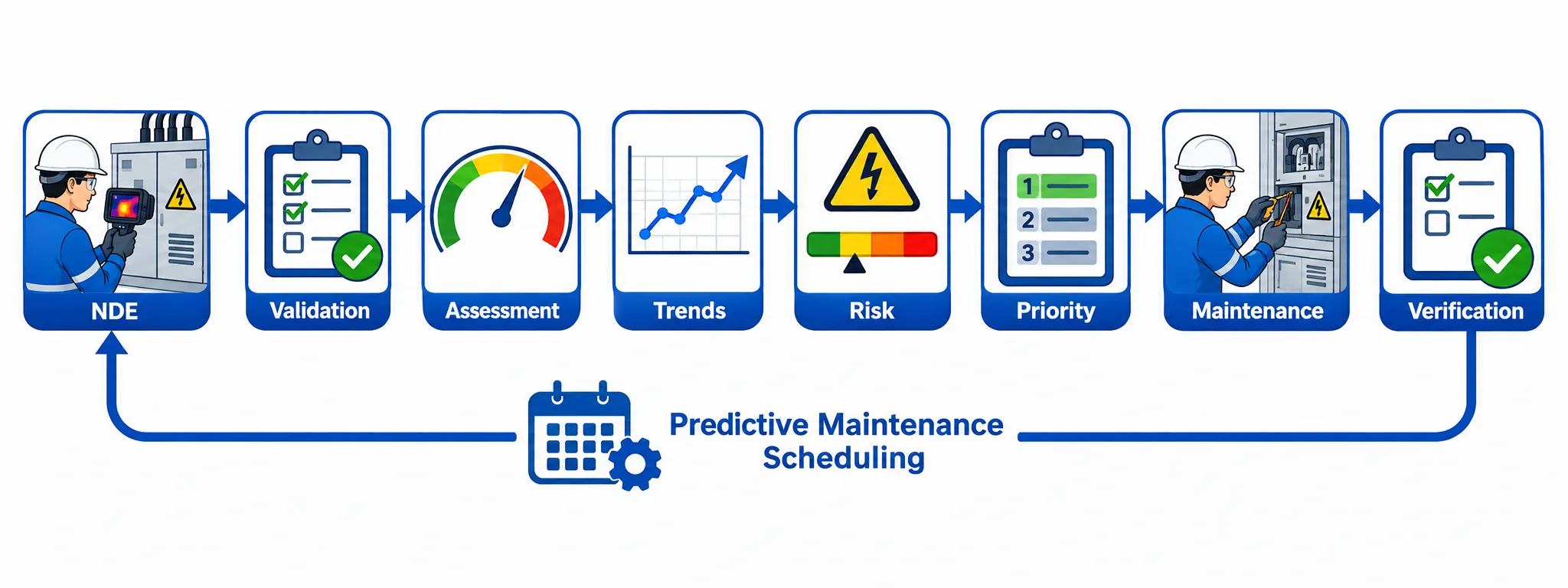
Definition of Predictive Maintenance Scheduling
Predictive maintenance scheduling is the planned arrangement of maintenance activities based on evidence of equipment condition, deterioration trends, failure mechanisms, risk, and operational requirements.
Unlike purely time-based maintenance, predictive scheduling seeks to answer:
- When is intervention likely to be required?
- Which asset requires attention first?
- What evidence supports the intervention?
- What maintenance activity is appropriate?
- How urgent is the intervention?
- Can the equipment safely continue operating?
- When should the condition be reassessed?
- How should the maintenance outcome be verified?
Difference Between Time-Based and Predictive Scheduling
Time-based maintenance generally follows predetermined intervals.
Examples include:
- Monthly inspection.
- Annual testing.
- Five-year replacement.
- Scheduled shutdown maintenance.
Predictive maintenance uses condition evidence to modify the timing and scope of intervention.
For example:
Stable NDE condition → Routine monitoring
Early deterioration → Increased monitoring
Progressive deterioration → Planned maintenance
Rapid deterioration → Urgent intervention
Critical abnormality → Immediate controlled response
This approach allows maintenance planning to reflect actual asset condition.
Role of Routine NDE Findings
Routine NDE as a Condition Monitoring Tool
Routine NDE provides repeated condition information that can be compared over time.
Typical findings may include:
- Thermal abnormalities.
- Increasing vibration.
- Electrical discharge indicators.
- Corrosion.
- Physical deterioration.
- Insulation-related changes.
- Moisture-related deterioration.
- Abnormal acoustic activity.
- Connection deterioration.
The value of routine NDE increases when measurements are performed consistently and recorded in a structured asset history.
Routine Does Not Mean Automatic
A routine inspection schedule should not result in automatic maintenance decisions.
The engineer must interpret:
- What changed?
- How significant is the change?
- Is the change genuine?
- Is the trend increasing?
- What failure mechanism could explain it?
- What happens if the condition progresses?
- How critical is the asset?
- Is there redundancy?
- What action is technically justified?
This critical interpretation is what converts NDE findings into predictive maintenance information.
Key Concepts for Predictive Maintenance Scheduling
| Concept | Definition | Scheduling Application |
|---|---|---|
| Routine NDE | Repeated non-destructive condition assessment | Provides ongoing condition information |
| Baseline | Verified reference condition | Enables meaningful comparison |
| Condition Trend | Change in condition over time | Indicates deterioration rate |
| Criticality | Consequence and importance of asset failure | Determines maintenance priority |
| Failure Mechanism | Process leading to equipment failure | Determines appropriate intervention |
| Intervention Threshold | Defined condition requiring action | Triggers maintenance scheduling |
| Monitoring Interval | Time between condition assessments | Adjusts according to deterioration |
| Maintenance Priority | Relative urgency of required action | Controls work sequencing |
| Condition-Based Maintenance | Maintenance based on actual condition | Links findings to intervention |
| Predictive Maintenance | Maintenance planned using condition and trend information | Supports proactive scheduling |
| Risk Rating | Assessment of likelihood and consequence | Supports urgency decisions |
| Reinspection | Follow-up condition assessment | Verifies maintenance effectiveness |
| Escalation | Movement to a higher level of technical response | Controls abnormal or rapidly changing conditions |
| Maintenance Window | Planned period available for intervention | Enables safe and efficient scheduling |
Establishing a Reliable NDE Baseline
Importance of Baseline Condition
Predictive scheduling depends on meaningful comparison. Without a reliable baseline, it can be difficult to determine whether an observed condition represents deterioration or normal variation.
A baseline should ideally be established when:
- Equipment is newly commissioned.
- Equipment has been verified as satisfactory.
- Major refurbishment has been completed.
- Significant corrective maintenance has been undertaken.
- A new monitoring programme begins.
Baseline Information
The record may include:
- Asset identification.
- Equipment type.
- Operating load.
- Environmental conditions.
- NDE technique.
- Measurement location.
- Measurement values.
- Inspection date.
- Instrument identification.
- Relevant equipment settings.
- Condition assessment.
A high-quality baseline improves confidence in future scheduling decisions.
Critical Interpretation of Routine NDE Findings
Why Critical Interpretation Matters
An NDE result should never be interpreted in isolation where the consequences are significant.
For example, a thermal indication may be influenced by:
- Equipment loading.
- Ambient temperature.
- Phase imbalance.
- Connection resistance.
- Ventilation.
- Surface characteristics.
- Measurement conditions.
Therefore, the engineer should distinguish between:
Normal variation → Investigate → Confirmed deterioration → Maintenance decision
Questions for Interpretation
A professional interpretation should ask:
- Is the finding genuine?
- Is the measurement reliable?
- Is the condition repeatable?
- Is there a historical trend?
- What failure mechanism could explain it?
- How quickly is it changing?
- What is the asset criticality?
- What is the consequence of failure?
- What controls currently exist?
- What maintenance action is proportionate?
NDE Findings Classification
Routine NDE findings can be categorised into condition levels.
Normal Condition
Characteristics may include:
- Stable measurements.
- No significant deterioration.
- No abnormal trend.
- Condition consistent with baseline.
Typical response:
- Continue routine NDE.
- Maintain existing schedule.
- Record results.
Monitor Condition
Characteristics may include:
- Minor change from baseline.
- Early indication.
- Stable but unusual condition.
- Low immediate consequence.
Typical response:
- Increase monitoring if justified.
- Record trend.
- Review at the next condition assessment.
Investigate Condition
Characteristics may include:
- Significant change.
- Uncertain indication.
- Inconsistent measurements.
- Potential developing defect.
Typical response:
- Additional NDE.
- Specialist assessment.
- Electrical testing.
- Review operating conditions.
Planned Intervention
Characteristics may include:
- Confirmed deterioration.
- Progressive trend.
- Moderate or high failure consequence.
- Known defect requiring correction.
Typical response:
- Schedule maintenance.
- Plan outage.
- Obtain spare parts.
- Allocate competent personnel.
- Verify after repair.
Urgent or Critical Condition
Characteristics may include:
- Rapid deterioration.
- Severe abnormality.
- Immediate safety concern.
- High likelihood of consequential failure.
Typical response:
- Escalate immediately.
- Establish appropriate controls.
- Consider isolation.
- Arrange urgent intervention.
Developing Maintenance Priority Categories
A predictive maintenance programme can use priority categories such as:
Priority 1 – Immediate
Used where the condition presents a significant and immediate risk.
Potential actions:
- Immediate engineering escalation.
- Controlled isolation where required.
- Emergency corrective action.
- Specialist assessment.
Priority 2 – Urgent
Used where deterioration is significant but controlled continued operation may be technically possible.
Potential actions:
- Accelerated intervention.
- Increased monitoring.
- Planned short-term shutdown.
Priority 3 – Planned
Used where deterioration requires maintenance but immediate intervention is not justified.
Potential actions:
- Include in the next planned outage.
- Arrange parts and resources.
- Continue condition monitoring.
Priority 4 – Monitor
Used where the condition is stable or only mildly abnormal.
Potential actions:
- Maintain monitoring.
- Establish next inspection date.
- Review trend.
Using Deterioration Rate to Formulate Schedules
Importance of Rate of Change
The absolute condition value is important, but the rate at which the condition changes can be equally significant.
An asset showing a small but rapidly increasing abnormality may require more attention than an asset with a larger but stable indication.
The engineer should therefore assess:
- Current condition.
- Previous condition.
- Rate of change.
- Direction of change.
- Measurement uncertainty.
- Criticality.
Trend-Based Scheduling
A simplified process is:
Stable trend → Normal monitoring
Slow deterioration → Increased monitoring
Accelerating deterioration → Planned intervention
Rapid deterioration → Urgent intervention
This allows maintenance intervals to respond to actual asset behaviour.
Establishing Monitoring Intervals
Fixed Monitoring Interval
A fixed interval may remain appropriate where:
- Equipment is stable.
- Failure mechanisms are well understood.
- Risk is relatively low.
- Historical data shows predictable behaviour.
Reduced Monitoring Interval
More frequent monitoring may be required where:
- Deterioration is increasing.
- Equipment is highly critical.
- Environmental conditions have changed.
- Previous defects have occurred.
- Failure consequences are significant.
Increased Monitoring Example
An electrical connection normally inspected annually begins showing progressive thermal deterioration.
Instead of waiting twelve months for the next routine inspection, the engineer may establish a shorter reassessment interval based on:
- Deterioration rate.
- Loading.
- Criticality.
- Failure consequence.
- Available controls.
The revised interval should be technically justified and documented.
Predictive Maintenance Scheduling Process
Step 1: Identify the Asset
Confirm:
- Asset number.
- Location.
- Equipment type.
- System connection.
- Critical function.
Step 2: Validate NDE Findings
Confirm:
- Measurement reliability.
- Instrument suitability.
- Operating conditions.
- Inspection procedure.
- Asset identification.
Step 3: Review Historical Data
Compare:
- Current result.
- Baseline.
- Previous results.
- Similar assets.
Step 4: Identify Failure Mechanism
Determine the most credible explanation for deterioration.
Step 5: Assess Criticality
Evaluate:
- Safety.
- Production.
- Service continuity.
- Environmental impact.
- Financial consequence.
- Redundancy.
Step 6: Determine Condition Category
Classify as:
- Normal.
- Monitor.
- Investigate.
- Planned intervention.
- Urgent intervention.
Step 7: Select Maintenance Action
Define:
- Maintenance activity.
- Responsible person.
- Required resources.
- Required outage.
- Completion target.
Step 8: Establish Monitoring Requirement
Determine whether:
- Routine monitoring is sufficient.
- Increased monitoring is required.
- Additional NDE is necessary.
Step 9: Schedule Intervention
Coordinate with:
- Operations.
- Maintenance.
- Production.
- Safety.
- Engineering.
- Specialist contractors.
Step 10: Verify Corrective Action
Perform appropriate post-maintenance inspection or testing.
Step 11: Update Asset History
Record:
- Original finding.
- Decision.
- Maintenance action.
- Post-maintenance result.
- New baseline where appropriate.
Practical Example: Thermal Anomaly in Switchgear
Scenario
Routine thermographic inspection identifies elevated temperature at one switchgear termination.
The equipment remains operational and the initial finding is not immediately classified as critical.
Critical Interpretation
The engineer reviews:
- Load current.
- Phase balance.
- Ambient temperature.
- Historical thermal images.
- Connection condition.
- Equipment rating.
Historical records show that the temperature has increased gradually during the last three inspections.
Predictive Decision
The condition is classified as progressive deterioration.
The maintenance schedule is therefore changed from:
Annual inspection → Increased monitoring → Planned corrective maintenance
Maintenance Planning
The team:
- Arranges a controlled outage.
- Inspects the connection.
- Corrects the defect.
- Repeats thermography.
- Compares the post-maintenance condition.
Outcome
The NDE finding has directly influenced maintenance timing and helped prevent further deterioration.
Practical Example: Stable Transformer Condition
Scenario
A critical transformer has undergone routine condition monitoring for several years.
Results show:
- Stable thermal behaviour.
- No significant physical deterioration.
- Consistent operating conditions.
- No significant trend changes.
Scheduling Decision
There is no evidence requiring accelerated intervention.
The organisation therefore:
- Maintains the existing monitoring interval.
- Retains the baseline.
- Continues routine inspection.
- Reviews condition during future assessments.
This demonstrates that predictive maintenance does not always mean increasing maintenance. It means making maintenance decisions based on evidence.
Practical Example: Progressive Vibration in a Motor
Scenario
A critical motor shows increasing vibration over three consecutive monitoring periods.
Interpretation
The reliability team considers:
- Vibration trend.
- Machine operating conditions.
- Previous maintenance.
- Bearing history.
- Equipment criticality.
- Production consequences.
Scheduling Decision
The increasing trend indicates potential developing mechanical deterioration.
The schedule may include:
- Additional diagnostic assessment.
- Increased monitoring.
- Planned bearing inspection.
- Controlled shutdown.
- Post-maintenance vibration verification.
The maintenance schedule is therefore based on the condition trend rather than an arbitrary calendar date.
NDE Findings and Asset Criticality
Why Criticality Changes Scheduling
Two assets can show similar NDE findings but require different maintenance schedules because their failure consequences differ.
For example:
Asset A:
- Low criticality.
- Spare available.
- Alternative supply exists.
Asset B:
- Critical process supply.
- No redundancy.
- Long replacement lead time.
Even if both show similar deterioration, Asset B may require earlier intervention or enhanced monitoring.
Criticality Factors
Consider:
- Safety consequence.
- Operational consequence.
- Production loss.
- Environmental consequence.
- Financial impact.
- Redundancy.
- Replacement lead time.
- Repair complexity.
- Availability of spare equipment.
Predictive Scheduling and Failure Consequences
The maintenance schedule should account for the consequence of failure.
Low Consequence
Potential response:
- Routine monitoring.
- Planned maintenance.
- Normal work-order priority.
Moderate Consequence
Potential response:
- Increased monitoring.
- Planned intervention.
- Additional diagnostic testing.
High Consequence
Potential response:
- Enhanced monitoring.
- Accelerated maintenance.
- Engineering review.
- Contingency planning.
Critical Consequence
Potential response:
- Immediate escalation.
- Controlled operational restrictions.
- Urgent intervention where technically justified.
Integrating NDE with Planned Shutdowns
Predictive scheduling should consider available maintenance windows.
A condition finding may not require immediate intervention but may justify inclusion in the next planned shutdown.
The maintenance team should coordinate:
- Equipment access.
- Isolation.
- Replacement parts.
- Specialist personnel.
- Testing equipment.
- Commissioning activities.
- Reinspection.
This reduces disruption while ensuring deterioration is not ignored.
Predictive Maintenance Schedule Design
A professional schedule should contain clear information.
Recommended fields include:
- Asset identification.
- Asset criticality.
- NDE method.
- Last inspection date.
- Current condition.
- Previous condition.
- Trend.
- Failure mechanism.
- Risk rating.
- Maintenance priority.
- Required action.
- Target intervention date.
- Next NDE date.
- Responsible person.
- Verification requirement.
- Closure status.
Example Predictive Maintenance Schedule
| Asset Condition | NDE Finding | Interpretation | Maintenance Response | Monitoring Schedule |
|---|---|---|---|---|
| Normal | Stable condition | No significant deterioration | Continue routine maintenance | Normal interval |
| Monitor | Minor change | Early indication | Continue with enhanced observation | Shorter interval |
| Investigate | Significant abnormality | Possible developing defect | Additional diagnostic assessment | Increased monitoring |
| Planned | Progressive deterioration | Confirmed condition issue | Schedule corrective maintenance | Until intervention |
| Urgent | Rapid deterioration | High failure concern | Immediate engineering response | Continuous or urgent reassessment |
NDE Data and Maintenance Resource Planning
Predictive scheduling must consider resource availability.
Resources may include:
- Competent electrical engineers.
- NDE specialists.
- Maintenance technicians.
- Test equipment.
- Replacement components.
- Spare parts.
- Shutdown periods.
- Isolation resources.
- Specialist contractors.
A technically correct maintenance recommendation may still fail if resources are not available.
Therefore, the schedule should be realistic and coordinated.
Spare Parts and Predictive Maintenance
NDE findings can support spare-parts planning.
For example, if repeated NDE findings indicate deterioration in a particular component, the organisation may decide to:
- Maintain strategic spares.
- Pre-order replacement components.
- Coordinate procurement with planned outages.
- Review alternative components.
- Assess supplier lead times.
This can reduce the delay between defect identification and corrective action.
Managing Uncertainty in NDE Findings
Why Uncertainty Matters
NDE results may contain uncertainty due to:
- Instrument limitations.
- Environmental conditions.
- Measurement technique.
- Equipment loading.
- Operator competence.
- Surface characteristics.
- Data interpretation.
The maintenance schedule should therefore consider confidence in the finding.
High-Confidence Finding
Potential response:
- Direct maintenance scheduling.
Moderate-Confidence Finding
Potential response:
- Additional diagnostic testing.
- Increased monitoring.
Low-Confidence Finding
Potential response:
- Verification before major intervention.
This prevents unnecessary maintenance while maintaining appropriate risk control.
Predictive Scheduling and Escalation
A maintenance schedule should contain escalation criteria.
Escalation may be required when:
- Deterioration accelerates.
- A condition exceeds an intervention threshold.
- Similar defects appear elsewhere.
- Safety consequences increase.
- Redundancy is lost.
- Equipment loading increases.
- Environmental conditions deteriorate.
This ensures the schedule can respond dynamically.
Revising Maintenance Schedules After New NDE Findings
Predictive maintenance schedules should be treated as controlled engineering documents rather than static calendars.
A schedule may need revision when:
- New deterioration is identified.
- Equipment is modified.
- Operating conditions change.
- Criticality changes.
- Historical trends change.
- A failure occurs.
- Corrective maintenance changes asset condition.
Schedule Review Process
- Review latest NDE result.
- Compare historical trend.
- Assess risk.
- Review criticality.
- Determine whether interval remains appropriate.
- Modify maintenance timing if required.
- Document technical justification.
- Communicate changes.
- Monitor outcome.
Post-Maintenance Verification
Why Verification Is Essential
Predictive maintenance does not end when the repair is completed.
The engineer must establish whether the corrective action actually resolved the condition.
Verification may include:
- Repeat thermography.
- Repeat vibration measurement.
- Follow-up ultrasonic assessment.
- Electrical testing.
- Visual inspection.
- Functional testing.
Example
Before maintenance:
Abnormal thermal indication
After maintenance:
Normalised thermal condition
This provides evidence that the corrective action was effective.
Updating the NDE Baseline After Maintenance
Where a major intervention changes equipment condition, the post-maintenance result can become a new reference point.
The new baseline may include:
- Updated condition images.
- New measurements.
- Revised equipment configuration.
- Maintenance details.
- Operating conditions.
Future NDE results can then be compared with the new baseline.
Common Mistakes in Predictive Maintenance Scheduling
Scheduling Only by Calendar
A purely calendar-based approach may fail to respond to rapid deterioration.
Treating Every Finding as Critical
This can create:
- Unnecessary shutdowns.
- Increased costs.
- Maintenance overload.
- Reduced resource availability.
Ignoring Trends
A gradually deteriorating condition may be more important than a single isolated abnormal reading.
Ignoring Asset Criticality
The same defect can have different consequences across different assets.
Failing to Verify Repairs
Without post-maintenance verification, the effectiveness of the intervention remains uncertain.
Poor Documentation
Without traceable records, future engineers may be unable to interpret condition trends.
Key Benefits of Predictive Maintenance Scheduling
Safety Benefits
- Earlier intervention.
- Reduced exposure to developing hazards.
- Better control of critical defects.
- Reduced likelihood of catastrophic failure.
Reliability Benefits
- Improved equipment availability.
- Reduced unexpected failures.
- Better understanding of deterioration.
- Improved maintenance timing.
Cost Benefits
- Reduced emergency repairs.
- Better maintenance resource allocation.
- Reduced unnecessary replacement.
- Improved spare-parts planning.
Operational Benefits
- Better outage planning.
- Reduced production disruption.
- Improved coordination.
- More predictable maintenance activities.
Quality Benefits
- Better traceability.
- Improved corrective-action verification.
- Stronger asset records.
- Better engineering decisions.
Formulating a Predictive Maintenance Schedule: Professional Procedure
Stage 1: Gather NDE Findings
Collect all relevant routine NDE results.
Stage 2: Validate Data
Confirm:
- Correct asset.
- Correct method.
- Reliable instrument.
- Appropriate operating conditions.
Stage 3: Compare with Baseline
Identify deviations from normal condition.
Stage 4: Review Historical Trends
Determine whether the condition is:
- Stable.
- Improving.
- Deteriorating.
- Rapidly deteriorating.
Stage 5: Identify Failure Mechanism
Determine what could cause the observed condition.
Stage 6: Assess Asset Criticality
Determine consequences of failure.
Stage 7: Determine Maintenance Priority
Assign appropriate response level.
Stage 8: Establish Intervention Timing
Select the most appropriate maintenance window.
Stage 9: Establish Follow-Up Monitoring
Determine when the asset should be reassessed.
Stage 10: Complete Maintenance
Implement corrective action.
Stage 11: Verify Effectiveness
Perform suitable NDE or testing.
Stage 12: Update the Schedule
Adjust future inspection and maintenance intervals according to the latest condition evidence.
Case Study: Predictive Maintenance Scheduling for a Critical Distribution System
Background
A large industrial facility operates a critical electrical distribution system consisting of transformers, switchgear, busbars, motor-control centres, and emergency supplies.
Routine NDE is conducted annually.
Initial Findings
The inspection identifies:
- Stable transformer temperatures.
- Slightly increasing temperature at one switchgear connection.
- Stable motor vibration.
- Minor corrosion on an enclosure.
Critical Interpretation
The reliability team classifies:
- Transformer: Normal.
- Switchgear connection: Monitor/Investigate.
- Motor: Normal.
- Enclosure: Planned maintenance.
Trend Review
Historical data shows the switchgear connection temperature has increased during three consecutive inspections.
This changes the interpretation from an isolated abnormality to a progressive condition.
Schedule Revision
The maintenance schedule is modified:
- Transformer: Continue routine monitoring.
- Switchgear connection: Additional short-term monitoring and planned intervention.
- Motor: Continue normal schedule.
- Enclosure: Include corrosion treatment in planned maintenance.
Intervention
During the planned outage, the switchgear connection is inspected and corrective work is completed.
Verification
Post-maintenance NDE demonstrates improved thermal condition.
Schedule Outcome
The switchgear asset receives a new baseline and an appropriate follow-up inspection interval.
The case demonstrates that predictive scheduling should differentiate between assets rather than applying one maintenance frequency to the entire facility.
Case Study: Rapidly Deteriorating Electrical Asset
Background
A critical electrical component is subject to routine condition monitoring.
The latest NDE results show a significant change compared with the previous inspection.
Engineering Assessment
The team evaluates:
- Measurement confidence.
- Deterioration rate.
- Asset criticality.
- Failure consequence.
- Redundancy.
- Operating conditions.
The condition is classified as requiring urgent attention.
Scheduling Response
The organisation:
- Escalates the finding.
- Establishes temporary controls.
- Arranges specialist assessment.
- Plans controlled intervention.
- Secures replacement components.
- Performs post-maintenance verification.
This demonstrates why predictive maintenance scheduling must be capable of accelerating intervention when condition evidence changes.
Integrating Predictive Maintenance with Reliability Engineering
Predictive maintenance scheduling should contribute to wider reliability objectives.
The schedule should therefore be reviewed against:
- Failure history.
- Asset criticality.
- Availability.
- Maintainability.
- Redundancy.
- Failure mechanisms.
- Maintenance performance.
- NDE trends.
This ensures that maintenance timing contributes to overall system reliability rather than simply completing individual work orders.
Continuous Improvement of Maintenance Schedules
A predictive maintenance programme should continuously learn from new information.
After each significant NDE finding, consider:
- Was the inspection frequency appropriate?
- Was the failure mechanism correctly identified?
- Was the condition detected early enough?
- Was the maintenance response appropriate?
- Did the repair resolve the condition?
- Should similar assets be inspected?
- Should the maintenance interval change?
- Should the NDE technique change?
This produces a continuous improvement cycle:
NDE → Interpretation → Maintenance → Verification → Learning → Schedule Improvement
Professional Checklist
Before approving a predictive maintenance schedule based on NDE findings, verify:
- Asset is correctly identified.
- NDE result is validated.
- Baseline is available.
- Historical trend has been reviewed.
- Failure mechanism has been considered.
- Asset criticality is established.
- Failure consequence is assessed.
- Measurement uncertainty is understood.
- Maintenance priority is assigned.
- Intervention timing is justified.
- Resources are available.
- Spare parts are considered.
- Operational constraints are understood.
- Safety controls are planned.
- Follow-up NDE is scheduled.
- Corrective action is documented.
- Post-maintenance verification is defined.
- Asset records will be updated.
- Future monitoring interval is reviewed.
- Lessons learned are captured.
Conclusion
Formulating predictive maintenance schedules from routine NDE findings requires significantly more than assigning a maintenance date after an inspection. It requires a structured process of data validation, condition interpretation, trend analysis, failure-mode assessment, asset criticality evaluation, risk assessment, maintenance prioritisation, intervention planning, and post-maintenance verification.
Routine NDE provides the condition evidence needed to determine whether an electrical asset is stable, deteriorating, or approaching a condition requiring intervention. When these findings are interpreted critically, maintenance schedules can become more responsive to actual equipment behaviour. Stable equipment can remain under appropriate routine monitoring, developing conditions can receive increased observation, progressive deterioration can trigger planned intervention, and rapidly deteriorating or high-consequence conditions can be escalated for urgent action.
The fundamental predictive maintenance process can be represented as:
NDE Finding → Data Validation → Condition Assessment → Trend Analysis → Risk Evaluation → Maintenance Priority → Scheduled Intervention → Verification → Schedule Review
This process allows maintenance resources to be focused where they provide the greatest reliability and risk-reduction benefit. It also prevents two common problems: under-maintaining assets with developing deterioration and over-maintaining assets that remain demonstrably stable.
Asset criticality is particularly important. A similar NDE finding may require different maintenance responses depending on whether the asset supplies a non-critical auxiliary load or a critical electrical system with no available redundancy. Predictive maintenance schedules must therefore consider not only the condition of the equipment but also the consequences of failure, availability of alternative supplies, replacement lead times, operational constraints, and safety implications.
Trend analysis is another essential component. A single abnormal result may require confirmation, whereas a consistent deterioration trend can provide strong evidence that intervention should be planned. The rate of change should also be considered because rapidly deteriorating equipment may require accelerated action even when the absolute condition indicator has not yet reached a conventional intervention threshold.
A well-formulated predictive maintenance schedule should remain dynamic. New NDE findings, equipment modifications, changes in loading, environmental changes, failures, maintenance outcomes, and changing asset criticality can all require the schedule to be reviewed. Following corrective maintenance, suitable NDE or testing should verify that the condition has improved, and the resulting condition may establish a new baseline for future monitoring.
Ultimately, predictive maintenance scheduling transforms routine NDE from a data-collection exercise into an active reliability management process. By connecting condition evidence with failure mechanisms, risk, criticality, maintenance resources, operational requirements, and verification, electrical engineering teams can develop maintenance schedules that are technically justified, risk-informed, cost-conscious, and responsive to actual asset behaviour.
The objective is not simply to perform maintenance more frequently. The objective is to perform the right maintenance, on the right asset, at the right time, using reliable condition evidence and professional engineering judgement. This approach can improve electrical system reliability, reduce unplanned downtime, optimise maintenance resources, support safer operation, and strengthen long-term electrical asset lifecycle management.