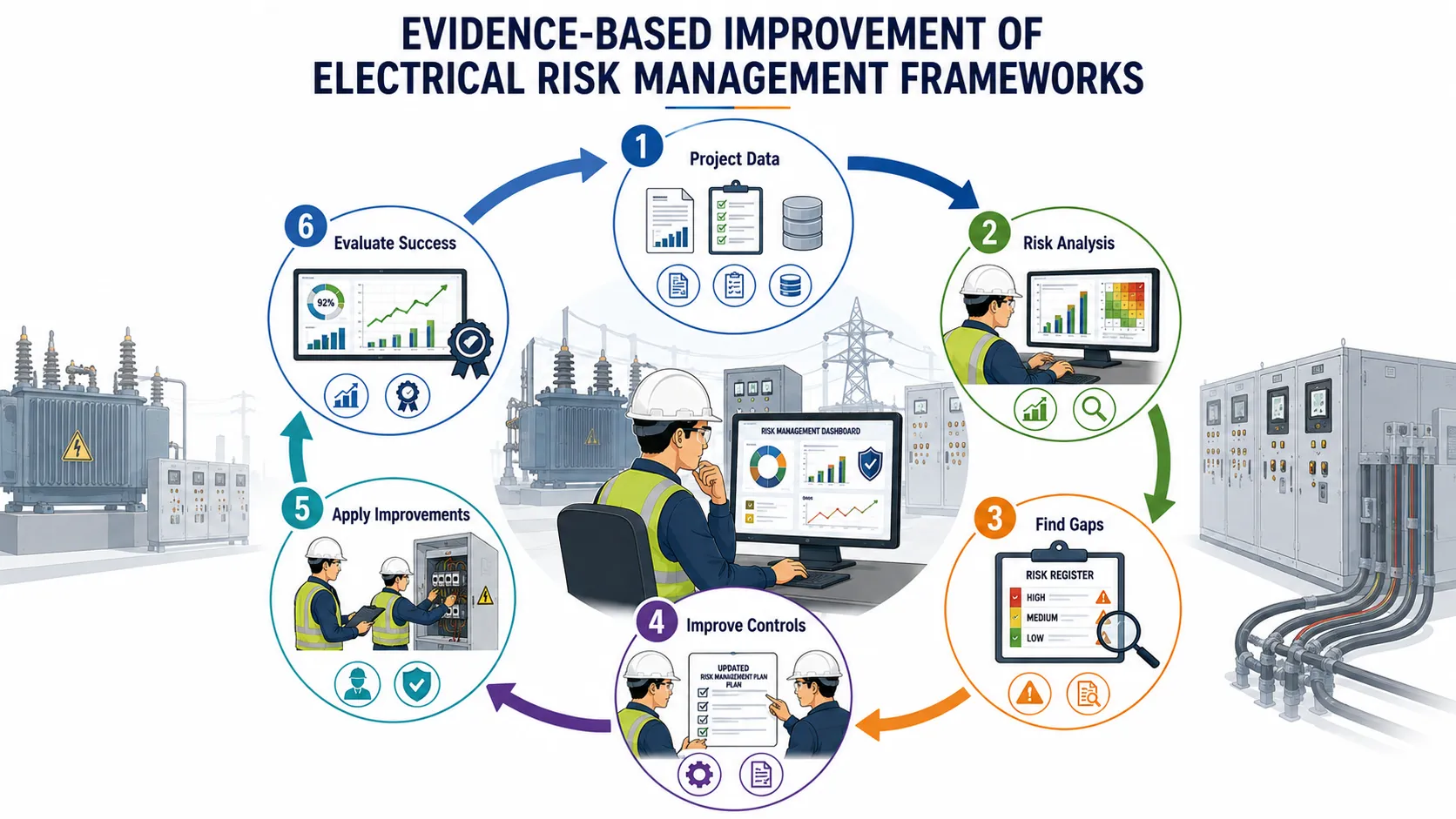
Lesson No 7: Evaluate the effectiveness of risk management frameworks in electrical projects.
Effective risk management is a fundamental responsibility of a Senior Chartered Electrical Engineer (CEng) and Senior Electrical QA/QC Engineer involved in complex electrical projects. Modern electrical systems, including power distribution networks, industrial installations, renewable energy projects, and critical infrastructure developments, involve significant technical, operational, safety, and regulatory risks. A structured risk management framework enables engineering professionals to identify potential hazards, evaluate their impact, implement appropriate controls, and continuously improve project performance.
Electrical project risks can arise from multiple sources, including design limitations, equipment failures, installation errors, testing deficiencies, regulatory non-compliance, supply chain challenges, and changing site conditions. A Senior Electrical QA/QC Engineer must evaluate whether existing risk management frameworks are effective in controlling these risks throughout the project lifecycle. This requires the application of professional engineering judgement, risk assessment methodologies, quality management principles, and compliance monitoring techniques to ensure electrical systems are delivered safely, reliably, and according to international standards.
This lesson explores advanced approaches for evaluating risk management frameworks within electrical engineering projects. It focuses on assessing risk identification processes, reviewing mitigation strategies, analysing risk control effectiveness, and improving QA/QC practices through continuous monitoring. By understanding how risk management frameworks perform in real-world project environments, electrical engineering professionals can strengthen safety performance, minimise failures, improve regulatory compliance, and support successful project delivery.
1. Critically Analyse the Core Components of Established Risk Management Frameworks Used in Electrical Engineering
Risk management is a fundamental discipline within modern electrical engineering projects because electrical systems involve complex technical processes, safety-critical operations, regulatory obligations, and significant operational consequences if failures occur. A Senior Chartered Electrical Engineer (CEng) and Senior Electrical QA/QC Engineer must understand, evaluate, and critically analyse established risk management frameworks to ensure that electrical projects are delivered safely, efficiently, and in compliance with international engineering standards.
Electrical engineering projects such as power generation facilities, substations, industrial electrical networks, renewable energy installations, and commercial infrastructure developments contain multiple sources of uncertainty. These risks may originate from design limitations, equipment failures, incorrect installation practices, inadequate testing procedures, supply chain problems, environmental conditions, or failures in regulatory compliance. Without a structured risk management framework, these uncertainties can develop into major safety incidents, project delays, financial losses, or operational failures.
Established risk management frameworks provide systematic methods for identifying hazards, evaluating potential impacts, implementing controls, and monitoring risk performance throughout the project lifecycle. For Senior Electrical QA/QC Engineers, these frameworks are essential tools for integrating safety, quality, compliance, and operational reliability into electrical project management processes.
A professional risk management approach does not only focus on responding to problems after they occur. Instead, it emphasises proactive identification and prevention of risks through continuous assessment, engineering analysis, and improvement strategies. Effective frameworks enable project teams to understand potential failures before they affect electrical system performance.
The role of a Senior Electrical QA/QC Engineer includes critically evaluating whether existing risk management frameworks are effective in controlling project risks. This requires analysing:
How risks are identified and classified.
Whether assessment methods accurately evaluate risk levels.
Whether mitigation strategies effectively reduce exposure.
How risk information is communicated to stakeholders.
Whether monitoring systems support continuous improvement.
In international electrical engineering environments, risk management frameworks must align with recognised principles of safety management, quality assurance, and regulatory compliance. A strong framework supports:
Safe electrical system design and operation.
Improved project quality performance.
Reduced non-conformities.
Better decision-making.
Enhanced stakeholder confidence.
Understanding Risk Management Frameworks in Electrical Engineering
Definition of Risk Management Frameworks
A risk management framework is a structured approach used by organisations and engineering teams to identify, analyse, evaluate, treat, monitor, and communicate risks throughout a project or operational lifecycle.
Within electrical engineering, a risk management framework provides a systematic process for controlling uncertainties that may affect:
Safety.
Quality.
Reliability.
Cost.
Schedule.
Regulatory compliance.
Operational performance.
A risk management framework integrates technical assessments, management procedures, engineering controls, and monitoring activities to ensure that risks are managed effectively.
For example, during the construction of a high-voltage substation, a risk management framework may identify risks related to:
Electrical shock hazards.
Equipment failure.
Incorrect protection settings.
Installation defects.
Testing failures.
Commissioning delays.
The framework ensures that these risks are:
Identified before work begins.
Assessed according to severity.
Assigned to responsible personnel.
Controlled through appropriate mitigation measures.
Reviewed throughout the project.
Importance of Risk Management Frameworks in Electrical Projects
Electrical engineering projects involve activities where failure can have serious consequences. Therefore, effective risk management is essential for maintaining safety, quality, and compliance.
The importance of risk management frameworks includes:
Improving Electrical Safety Performance
Electrical systems operate with potentially dangerous energy levels. Poor risk management can result in:
Electric shock incidents.
Arc flash events.
Equipment damage.
Fire hazards.
System failures.
Risk frameworks help engineers identify hazards and implement controls before work begins.
Safety improvements include:
Better hazard identification.
Improved work procedures.
Enhanced protection measures.
Reduced accident probability.
Preventing Project Failures
Electrical project failures can result from technical and management weaknesses.
Risk management frameworks help prevent:
Design errors.
Installation defects.
Testing failures.
Commissioning problems.
By identifying risks early, engineering teams can introduce corrective measures before failures occur.
Supporting Regulatory Compliance
Electrical projects must comply with:
National electrical regulations.
International standards.
Client requirements.
Safety legislation.
Risk management frameworks support compliance by ensuring:
Regulatory risks are identified.
Required controls are implemented.
Compliance evidence is maintained.
Improving Engineering Decision-Making
Risk-based decision-making allows engineers to prioritise actions according to potential impact.
For example:
A minor documentation issue may require administrative correction, while a protection system failure may require immediate technical intervention.
Risk frameworks help teams focus resources on the most critical issues.
Key Concepts of Electrical Engineering Risk Management
Risk Identification
Risk identification is the first stage of any effective risk management framework. It involves systematically identifying potential hazards, uncertainties, and events that may negatively affect electrical project outcomes.
A Senior Electrical QA/QC Engineer must identify risks across all project phases, including:
Design.
Procurement.
Installation.
Testing.
Commissioning.
Operation.
Risk identification methods include:
Engineering design reviews.
Site inspections.
Safety assessments.
Quality audits.
Lessons learned from previous projects.
Technical discussions with specialists.
Types of Risks in Electrical Engineering Projects

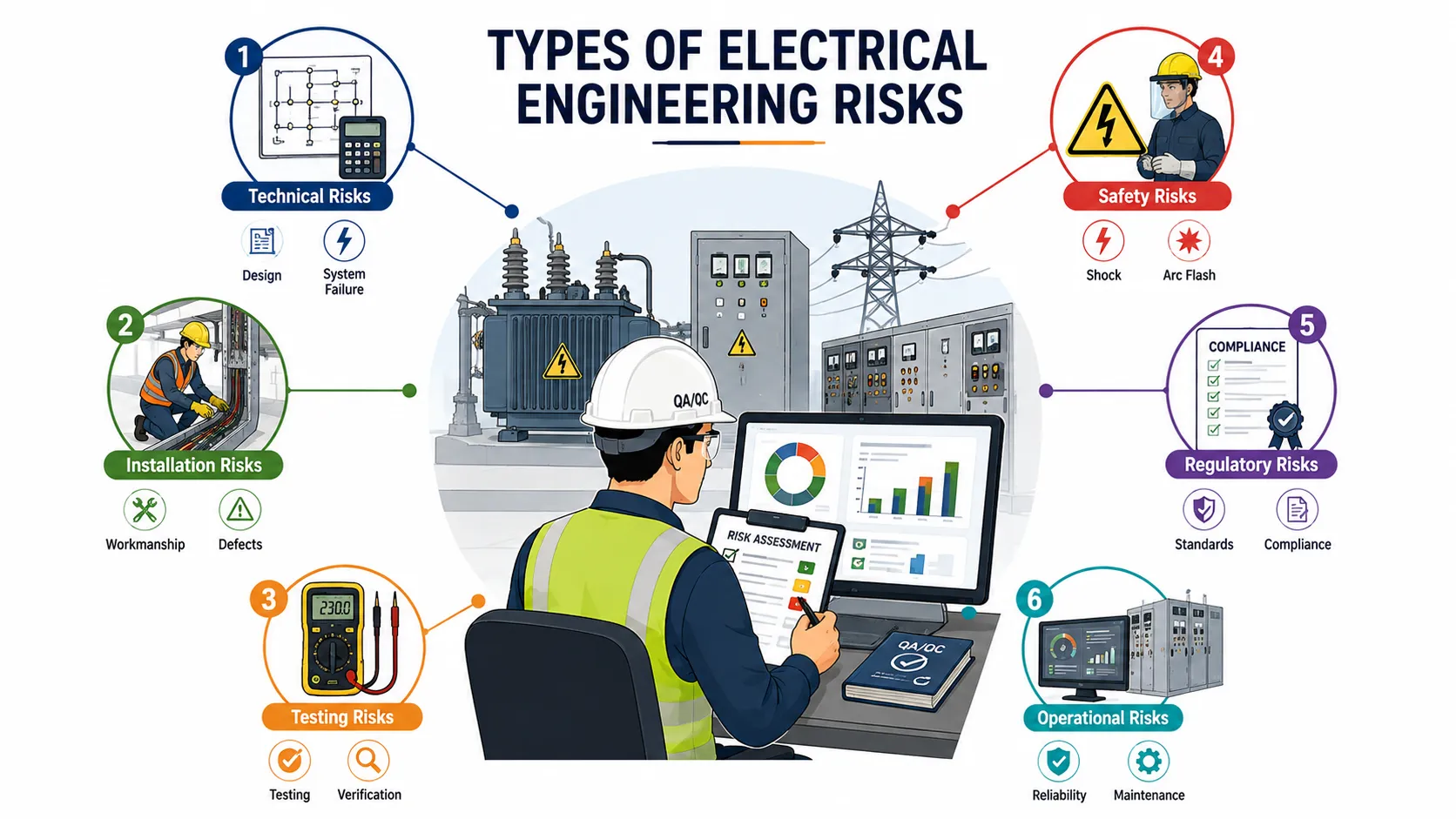
Electrical projects may experience different categories of risks.
Technical Risks
Technical risks relate to engineering design and system performance.
Examples include:
Incorrect electrical calculations.
Equipment compatibility issues.
Protection system failures.
Poor system integration.
Installation Risks
Installation risks occur during construction activities.
Examples include:
Incorrect cable installation.
Poor termination practices.
Improper equipment mounting.
Earthing system defects.
Testing and Commissioning Risks
These risks occur when verifying system performance.
Examples include:
Incorrect testing procedures.
Equipment calibration problems.
Unexpected system failures.
Incomplete commissioning activities.
Regulatory and Compliance Risks
These risks relate to failure to meet required standards.
Examples include:
Non-compliance with electrical codes.
Missing approvals.
Incorrect documentation.
Failure to meet client requirements.
Risk Assessment and Evaluation
After identifying risks, the next stage is evaluating their likelihood and potential consequences.
Risk assessment determines:
How likely a risk is to occur.
The potential impact if it occurs.
The priority level for action.
Senior Electrical QA/QC Engineers use assessment methods to determine which risks require immediate attention.
Qualitative Risk Assessment
Qualitative assessment evaluates risks using descriptive categories.
Typical classifications include:
Low risk.
Medium risk.
High risk.
Critical risk.
Example:
A minor documentation error may be classified as low risk, while incorrect protection system settings may be classified as high risk.
Benefits include:
Simple application.
Fast decision-making.
Suitable for early project assessments.
Quantitative Risk Assessment
Quantitative assessment uses numerical analysis to evaluate risk impact.
It may consider:
Probability values.
Financial impact.
Safety consequences.
Project delay effects.
Benefits include:
More detailed evaluation.
Improved resource allocation.
Better decision support.
Risk Matrix Approach
A risk matrix combines:
Likelihood of occurrence.
Severity of consequence.
The matrix helps engineers prioritise risks.
Example:
| Risk Level | Meaning | Engineering Response |
|---|---|---|
| Low | Minimal impact | Monitor and review |
| Medium | Moderate impact | Apply additional controls |
| High | Significant impact | Immediate mitigation required |
| Critical | Severe consequences | Stop activity and implement urgent controls |
Risk matrices are widely used in electrical QA/QC because they provide a simple visual method for communicating risk levels.
Risk Control and Mitigation
Risk control involves selecting appropriate measures to reduce the likelihood or impact of identified risks.
A Senior Electrical QA/QC Engineer must ensure that mitigation strategies are practical, effective, and aligned with project requirements.
Risk mitigation approaches include:
Engineering Controls
Engineering controls reduce risks through technical solutions.
Examples:
Protective devices.
Safety interlocks.
Equipment design improvements.
Automatic shutdown systems.
Administrative Controls
Administrative controls reduce risks through procedures and management practices.
Examples:
Work permits.
Training programmes.
Inspection procedures.
Safe work instructions.
Preventive Measures
Preventive controls aim to stop failures before they occur.
Examples:
Design verification.
Material inspections.
Quality audits.
Competency assessments.
Corrective Measures
Corrective controls address problems after identification.
Examples:
Equipment repair.
Re-testing.
Procedure improvement.
Additional inspections.
Risk Monitoring and Review
Risk monitoring and review is a continuous process used to evaluate whether identified risks remain controlled throughout the electrical project lifecycle. A risk management framework is only effective when risks are regularly reviewed, updated, and adjusted according to changing project conditions.
Electrical engineering projects are dynamic environments where new risks may emerge due to:
Design modifications.
Changes in regulations.
Equipment availability issues.
Construction challenges.
Environmental conditions.
Contractor performance variations.
A Senior Electrical QA/QC Engineer must ensure that risk assessments are not treated as static documents but as continuously evolving management tools.
Effective risk monitoring involves:
Reviewing existing risks regularly.
Identifying new hazards.
Evaluating mitigation effectiveness.
Updating risk registers.
Communicating changes to stakeholders.
For example:
During the commissioning phase of a power distribution project, a previously low-risk equipment issue may become a high-risk concern if testing reveals unexpected performance problems. The risk framework must be updated immediately to reflect the new situation.
Risk Register Management
A risk register is a central component of electrical project risk management frameworks. It provides a structured record of identified risks and their management status.
A professional risk register typically includes:
Risk description.
Risk category.
Likelihood rating.
Impact rating.
Risk level.
Assigned owner.
Mitigation actions.
Review status.
The risk register supports:
Risk visibility.
Accountability.
Monitoring.
Decision-making.
Senior Electrical QA/QC Engineers use risk registers to track:
Quality-related risks.
Safety concerns.
Compliance issues.
Testing failures.
Installation challenges.
Risk Communication and Reporting
Effective communication is essential because risk information must reach the correct stakeholders at the correct time.
Risk communication ensures that:
Project managers understand major risks.
Engineers receive technical information.
Contractors understand required controls.
Clients receive compliance assurance.
Risk reporting may include:
Risk assessment reports.
QA/QC reports.
Safety reports.
Project review meetings.
Management dashboards.
A strong risk communication process prevents situations where important risks remain unidentified or unmanaged.
Integration of Risk Management Frameworks with Electrical QA/QC Systems
Risk management and quality assurance are closely connected because many electrical project risks directly affect quality performance.
A strong QA/QC system incorporates risk management principles to prevent failures rather than only detecting them after occurrence.
Relationship Between Risk Management and Quality Assurance
Risk management supports QA/QC activities by identifying areas where quality failures are most likely to occur.
Examples include:
High-risk installation activities.
Critical electrical equipment.
Complex testing procedures.
Safety-critical systems.
By understanding these risks, QA/QC engineers can develop targeted quality controls.
Examples:
For a high-voltage cable installation:
Risk:
Incorrect cable termination.
Potential consequence:
Electrical failure during operation.
QA/QC response:
Additional inspection points.
Skilled personnel verification.
Detailed testing procedures.
Risk-Based Quality Control Approach
Risk-based quality control focuses inspection and verification resources on activities with the highest potential impact.
Instead of applying identical inspection levels to every activity, engineers prioritise based on risk.
High-risk activities may receive:
Increased inspection frequency.
Additional testing requirements.
Specialist engineering review.
Enhanced documentation checks.
Examples of high-risk electrical activities include:
High-voltage equipment installation.
Protection system configuration.
Transformer commissioning.
Emergency power system testing.
Benefits of risk-based quality control include:
Better resource utilisation.
Improved defect prevention.
Faster identification of critical issues.
Enhanced safety performance.
Role of Risk Management Throughout the Electrical Project Lifecycle
Design Phase Risk Management
The design phase is critical because decisions made during design influence the safety and reliability of the final electrical system.
Risk management activities include:
Design risk assessments.
Electrical calculations review.
Compliance verification.
System reliability analysis.
Potential design risks include:
Incorrect load calculations.
Inadequate protection coordination.
Insufficient system capacity.
Non-compliance with standards.
Senior Electrical QA/QC Engineers support design risk control by reviewing:
Drawings.
Technical specifications.
Design assumptions.
Engineering calculations.
Procurement Phase Risk Management
Procurement risks can affect project quality, schedule, and compliance.
Common procurement risks include:
Incorrect equipment specifications.
Supplier quality issues.
Delayed delivery.
Missing certification.
Risk controls include:
Supplier evaluation.
Factory inspections.
Material approval processes.
Certification verification.
For example:
Before accepting electrical switchgear, QA/QC engineers verify:
Manufacturer compliance.
Test certificates.
Material specifications.
Quality documentation.
Installation Phase Risk Management
The installation phase contains significant quality and safety risks.
Common installation risks include:
Poor workmanship.
Incorrect equipment positioning.
Cable damage.
Unsafe working conditions.
Risk controls include:
Installation inspections.
Method statement reviews.
Permit-to-work systems.
Competency verification.
QA/QC engineers monitor installation risks through:
Inspection and Test Plans (ITPs).
Site audits.
Non-conformance management.
Testing and Commissioning Phase Risk Management
Testing and commissioning involve verifying whether electrical systems perform safely and reliably.
Potential risks include:
Incorrect test procedures.
Equipment failure.
Protection system malfunction.
Unsafe energisation.
Risk controls include:
Approved testing procedures.
Calibrated instruments.
Qualified testing personnel.
Detailed commissioning plans.
The QA/QC engineer ensures that:
Test results meet acceptance criteria.
Failures are investigated.
Corrective actions are completed.
Operation and Maintenance Phase Risk Management
Risk management continues after project completion because electrical systems require ongoing monitoring.
Operational risks include:
Equipment degradation.
Maintenance failures.
Unexpected breakdowns.
Risk controls include:
Preventive maintenance programmes.
Condition monitoring.
Performance reviews.
Periodic inspections.
Critical Analysis of Risk Management Framework Effectiveness
Evaluating the effectiveness of risk management frameworks requires analysing both their strengths and limitations.
A framework may provide excellent procedures but still fail if:
Risks are not accurately identified.
Controls are poorly implemented.
Stakeholders do not communicate effectively.
Senior Electrical QA/QC Engineers must critically evaluate whether risk frameworks actually improve project outcomes.
Strengths of Established Risk Management Frameworks
Structured Risk Identification
Established frameworks provide systematic methods for identifying hazards.
Benefits include:
Improved risk awareness.
Better planning.
Reduced unexpected failures.
Improved Safety Management
Risk frameworks help organisations establish:
Safety controls.
Hazard prevention strategies.
Emergency response procedures.
This reduces the likelihood of electrical incidents.
Better Decision-Making
Risk assessment provides evidence for engineering decisions.
Examples:
Selecting appropriate mitigation strategies.
Prioritising inspections.
Allocating resources.
Enhanced Compliance Control
Risk frameworks support compliance by ensuring:
Regulations are considered.
Safety requirements are addressed.
Documentation is maintained.
Limitations and Challenges of Risk Management Frameworks
Incomplete Risk Identification
One limitation is that some risks may not be identified during initial assessments.
Reasons include:
Lack of experience.
Changing project conditions.
Incomplete information.
Improvement measures:
Regular risk reviews.
Lessons learned.
Expert involvement.
Human Factors
Human behaviour can influence risk management effectiveness.
Examples:
Poor communication.
Lack of training.
Failure to follow procedures.
Controls include:
Competency development.
Supervision.
Safety culture improvement.
Changing Project Conditions
Electrical projects often experience changes that affect existing risk assessments.
Examples:
Design modifications.
Material substitutions.
Schedule changes.
Effective frameworks require continuous updating.
Lack of Effective Monitoring
A risk framework becomes ineffective if risks are identified but not monitored.
Common problems include:
Outdated risk registers.
Missing reviews.
Poor reporting.
Continuous monitoring is essential.
Professional Comparison Table: Risk Management Framework Components
| Risk Management Component | Definition | Purpose | Electrical Engineering Application |
|---|---|---|---|
| Risk Identification | Process of discovering potential hazards and uncertainties | Recognise possible project threats | Identifying electrical safety, design, and installation risks |
| Risk Assessment | Evaluation of likelihood and impact of identified risks | Determine risk priority | Using risk matrices for electrical activities |
| Risk Mitigation | Actions implemented to reduce risk exposure | Control potential failures | Applying engineering and administrative controls |
| Risk Monitoring | Continuous review of risk status and controls | Ensure effectiveness over time | Updating risk registers during project phases |
| Risk Reporting | Communication of risk information to stakeholders | Support informed decisions | Providing QA/QC and management risk reports |
Practical Examples of Risk Management Framework Application in Electrical Engineering Projects
Example 1: High Voltage Substation Project Risk Management Framework
Project Background
A large-scale high-voltage substation development project required a comprehensive risk management framework to control technical, safety, quality, and regulatory risks. The project involved the installation of:
High-voltage switchgear.
Power transformers.
Protection and control systems.
Underground cable networks.
Earthing and lightning protection systems.
Supervisory control and data acquisition (SCADA) systems.
Due to the complexity of the electrical infrastructure, the project team implemented an integrated risk management framework throughout the design, construction, testing, and commissioning stages.
The Senior Electrical QA/QC Engineer was responsible for evaluating whether the risk management framework effectively controlled potential failures and ensured compliance with project requirements.
Risk Identification Process
During the initial risk assessment, the engineering team identified several critical risks:
Design Risks
Potential issues included:
Incorrect protection coordination settings.
Inadequate fault level calculations.
Non-compliance with electrical design standards.
Risk controls included:
Independent design reviews.
Protection system verification.
Engineering approval processes.
Installation Risks
Identified installation risks included:
Incorrect cable routing.
Poor termination practices.
Equipment alignment issues.
Improper earthing connections.
Risk mitigation measures included:
Inspection and Test Plans (ITPs).
Hold point inspections.
Competency verification.
Installation quality audits.
Testing and Commissioning Risks
Potential commissioning risks included:
Incorrect testing procedures.
Equipment malfunction.
Protection system failure.
Controls included:
Approved commissioning procedures.
Specialist testing engineers.
Calibration verification.
Test result reviews.
Evaluation of Framework Effectiveness
The Senior Electrical QA/QC Engineer evaluated the framework by reviewing:
Number of identified risks.
Effectiveness of mitigation actions.
Reduction in non-conformities.
Testing performance.
Compliance achievement.
The evaluation showed that the framework successfully:
Reduced installation defects.
Improved inspection efficiency.
Increased regulatory compliance.
Supported successful commissioning.
Example 2: Renewable Energy Electrical Installation Risk Management
Project Background
A large renewable energy project involving solar photovoltaic electrical systems required effective risk management due to changing environmental conditions, complex electrical integration, and strict performance requirements.
The project included:
Solar panel arrays.
DC cable systems.
Inverters.
Energy storage systems.
Medium-voltage distribution equipment.
Identified Risks
Equipment Performance Risks
Potential problems included:
Incorrect equipment selection.
Inverter compatibility issues.
Manufacturing defects.
Mitigation strategies included:
Supplier quality assessment.
Factory acceptance testing.
Equipment certification verification.
Environmental Risks
Environmental factors included:
Extreme temperatures.
Dust exposure.
Moisture conditions.
Weather-related installation delays.
Risk controls included:
Environmental assessments.
Equipment protection measures.
Installation planning.
Quality Risks
Quality-related risks included:
Incorrect cable installation.
Poor connections.
Inadequate testing.
Controls included:
Increased inspection frequency.
Installation checklists.
Testing verification.
Framework Evaluation
The risk management framework was evaluated based on:
Defect reduction.
Safety performance.
Compliance achievement.
Project delivery performance.
The evaluation demonstrated that effective risk planning improved:
Installation quality.
System reliability.
Operational performance.
Example 3: Industrial Power Distribution Project
Project Background
An industrial facility required a new electrical distribution system to support manufacturing operations. The project included:
Main distribution boards.
Motor control centres.
Emergency power systems.
Electrical protection equipment.
Because electrical failures could interrupt production operations, risk management was integrated with QA/QC procedures.
Risk Identification
Major risks included:
Operational Risks
Examples:
Unexpected power interruptions.
Equipment overload.
Protection system failures.
Controls included:
Load assessments.
Protection testing.
System verification.
Safety Risks
Examples:
Electrical shock hazards.
Arc flash exposure.
Unsafe working conditions.
Controls included:
Safety procedures.
Permit-to-work systems.
Competency assessments.
Documentation Risks
Examples:
Missing test certificates.
Incorrect drawings.
Incomplete handover documents.
Controls included:
Document control systems.
Quality audits.
Final compliance reviews.
Outcome
The risk management framework contributed to:
Successful electrical system commissioning.
Reduced operational risks.
Improved compliance documentation.
Increased client confidence.
Case Study: Evaluating Risk Management Framework Effectiveness in a Major Electrical Infrastructure Project
Project Overview
A major electrical infrastructure project was developed to provide reliable power distribution for a large industrial development. The project required strict compliance with electrical safety regulations, client specifications, and international engineering standards.
The project included:
High-voltage substations.
Distribution networks.
Protection systems.
Control systems.
Emergency power facilities.
A structured risk management framework was implemented from the design phase through final commissioning.
Initial Risk Assessment
The project team conducted a detailed risk assessment to identify potential threats.
Key risks identified included:
Design coordination problems.
Equipment delivery delays.
Installation quality failures.
Testing complications.
Regulatory compliance issues.
Each risk was evaluated using:
Probability assessment.
Impact analysis.
Risk ranking.
Risk Management Strategy Implementation
The project team developed mitigation strategies including:
Design Controls
Actions:
Technical design reviews.
Independent engineering verification.
Compliance assessments.
Procurement Controls
Actions:
Supplier evaluation.
Material approval procedures.
Equipment certification checks.
Construction Controls
Actions:
Site inspections.
Quality audits.
Installation verification.
Commissioning Controls
Actions:
Testing procedures.
Functional verification.
Performance validation.
Monitoring and Review Process
Throughout project execution, risk performance was continuously monitored.
Monitoring activities included:
Weekly risk reviews.
QA/QC meetings.
Inspection analysis.
Corrective action tracking.
The Senior Electrical QA/QC Engineer reviewed whether:
Risk controls were effective.
New risks emerged.
Existing risks changed.
Additional actions were required.
Identified Improvements
The evaluation identified several improvement opportunities:
Improved Contractor Management
The project required stronger contractor competency controls.
Actions implemented:
Additional training.
Improved supervision.
Regular performance reviews.
Enhanced Documentation Control
Documentation weaknesses were improved through:
Digital record systems.
Approval tracking.
Regular document audits.
Increased Risk Communication
Communication improvements included:
Risk review meetings.
Updated risk registers.
Stakeholder reporting.
Final Results
The risk management framework achieved significant improvements:
Reduced quality failures.
Improved regulatory compliance.
Faster corrective action completion.
Better stakeholder communication.
Successful project completion.
The case study demonstrates that risk management frameworks are effective when they are actively monitored, continuously improved, and integrated with QA/QC systems.
Key Benefits of Effective Risk Management Frameworks
Improved Electrical Safety
Effective risk management reduces the possibility of electrical incidents.
Benefits include:
Better hazard identification.
Improved safety procedures.
Reduced accident probability.
Enhanced worker protection.
Reduced Project Failures
Risk frameworks help prevent technical failures by identifying problems early.
Benefits include:
Fewer defects.
Reduced rework.
Improved system reliability.
Better project performance.
Enhanced Quality Performance
Integration of risk management with QA/QC improves overall quality control.
Benefits include:
Risk-based inspections.
Better defect prevention.
Improved testing outcomes.
Stronger quality assurance.
Improved Regulatory Compliance
Risk frameworks ensure that legal and regulatory requirements are considered throughout the project lifecycle.
Benefits include:
Better compliance evidence.
Easier approval processes.
Reduced regulatory risks.
Better Resource Allocation
Risk evaluation helps organisations prioritise resources effectively.
Resources can be directed towards:
Critical electrical systems.
High-risk activities.
Specialist inspections.
Additional testing requirements.
Increased Stakeholder Confidence
Professional risk management improves trust among:
Clients.
Contractors.
Regulators.
Engineering teams.
Stakeholders gain confidence because risks are:
Identified.
Controlled.
Monitored.
Reported.
Best Practices for Senior Electrical QA/QC Engineers
Senior Electrical QA/QC Engineers should apply the following best practices when evaluating risk management frameworks:
Establish Risk Management Early
Risk assessment should begin during the design stage rather than after problems occur.
Best practices include:
Early hazard identification.
Design risk reviews.
Regulatory assessment.
Integrate Risk Management with QA/QC Procedures
Risk management should be connected with:
Inspection plans.
Testing procedures.
Audit processes.
Non-conformance management.
Maintain Updated Risk Registers
Risk registers should be reviewed regularly.
Updates should include:
New risks.
Completed actions.
Changing risk levels.
Emerging concerns.
Use Data-Based Risk Evaluation
Engineering decisions should be supported by:
Inspection data.
Testing results.
Performance trends.
Previous project experience.
Encourage Effective Communication
Risk information should be shared through:
Project meetings.
Reports.
Digital systems.
Stakeholder discussions.
Continuously Improve Risk Processes
Lessons learned should be used to improve future projects.
Improvement activities include:
Reviewing failures.
Updating procedures.
Training personnel.
Improving controls.
Conclusion
Critically analysing the core components of established risk management frameworks is essential for Senior Chartered Electrical Engineers and Senior Electrical QA/QC Engineers responsible for delivering safe, reliable, and compliant electrical projects. Effective frameworks provide structured methods for identifying hazards, evaluating risks, implementing controls, and monitoring performance throughout the project lifecycle.
Electrical engineering projects involve complex technical challenges where ineffective risk management can lead to safety incidents, quality failures, regulatory non-compliance, and operational disruptions. By applying recognised risk management principles, engineers can proactively control uncertainties and improve project outcomes.
A successful risk management framework is not only based on documented procedures but also on effective implementation, continuous monitoring, stakeholder communication, and improvement practices. When integrated with QA/QC systems, risk management frameworks strengthen inspection processes, reduce defects, improve compliance performance, and support successful project delivery.
For Senior Electrical QA/QC Engineers, the ability to evaluate and improve risk management frameworks represents a critical professional competency. Through advanced risk analysis, evidence-based decision-making, and continuous improvement, electrical engineering organisations can achieve higher standards of safety, quality, reliability, and operational excellence.
2. Measure the Success of a Specific Risk Management Framework Applied to a Complex Electrical Project
Measuring the success of a risk management framework is a critical activity in complex electrical engineering projects because effective risk management is not determined only by the existence of procedures, registers, or assessment methods. A successful framework must demonstrate that it can identify potential threats, reduce risk exposure, prevent failures, improve safety performance, support regulatory compliance, and contribute to successful project delivery.
Complex electrical projects such as high-voltage substations, industrial power distribution networks, renewable energy systems, and critical infrastructure installations involve multiple technical and operational uncertainties. These projects require structured risk management approaches because failures can result in:
Electrical safety incidents.
Equipment damage.
Project delays.
Regulatory non-compliance.
Increased operational costs.
Reduced system reliability.
A Senior Electrical QA/QC Engineer must evaluate whether a specific risk management framework is achieving its intended objectives. This evaluation involves analysing measurable performance indicators, reviewing risk treatment effectiveness, assessing quality outcomes, and determining whether the framework supports continuous improvement throughout the project lifecycle.
A risk management framework is considered successful when it enables project teams to move from reactive problem-solving towards proactive risk prevention. The effectiveness of the framework can be measured through evidence-based evaluation, including:
Reduction in identified risks.
Decrease in repeated failures.
Improvement in quality performance.
Faster corrective action completion.
Better compliance achievement.
Improved stakeholder confidence.
For complex electrical projects, measuring risk management success requires integration between risk processes and Quality Assurance and Quality Control (QA/QC) systems. Risk assessment results must influence inspection planning, testing strategies, commissioning procedures, and compliance monitoring activities.
The measurement process allows engineering teams to determine:
Whether risks were correctly identified.
Whether mitigation strategies were effective.
Whether resources were allocated appropriately.
Whether risk controls prevented failures.
Whether improvements were achieved over time.
Understanding Risk Management Framework Success Measurement
Definition of Risk Management Framework Effectiveness
Risk management framework effectiveness refers to the ability of a structured risk management system to achieve its intended purpose by reducing uncertainty, controlling hazards, improving decision-making, and supporting successful project outcomes.
In electrical engineering projects, effectiveness means that the framework can:
Identify critical risks before they become failures.
Evaluate risks accurately.
Apply suitable mitigation measures.
Monitor changing risk conditions.
Improve project safety and quality performance.
A successful framework does not eliminate all risks because uncertainty is unavoidable in complex engineering environments. Instead, it ensures that risks are controlled to an acceptable level through systematic management processes.
For example:
During a high-voltage substation construction project, a risk management framework may identify the possibility of protection system failure. The framework’s effectiveness is measured by whether it successfully:
Identifies the risk during the design stage.
Assigns responsibility for mitigation.
Ensures protection testing is completed.
Prevents operational failure during commissioning.
Importance of Measuring Risk Management Performance in Electrical Projects
Measurement provides evidence that risk management activities are producing valuable outcomes. Without performance evaluation, organisations cannot determine whether their risk controls are effective or require improvement.
The importance of measuring risk management success includes:
Improving Safety Performance
Electrical projects involve high-risk activities where failures can cause serious consequences.
Measurement helps identify:
Safety improvement trends.
Effectiveness of hazard controls.
Areas requiring additional protection.
Benefits include:
Reduced electrical incidents.
Improved workforce safety.
Better compliance with safety requirements.
Enhancing Quality Performance
Risk management directly influences electrical installation and system quality.
Measurement helps evaluate:
Defect reduction.
Inspection effectiveness.
Testing performance.
Corrective action success.
Examples include:
Reduction in cable installation defects.
Improved equipment testing results.
Fewer commissioning failures.
Supporting Regulatory Compliance
Electrical projects must comply with legal requirements, client specifications, and industry standards.
Risk framework evaluation confirms whether:
Compliance risks are controlled.
Required documentation is maintained.
Regulatory obligations are achieved.
Improving Project Delivery Performance
Effective risk management contributes to:
Reduced delays.
Better resource planning.
Improved project coordination.
By measuring risk performance, project teams can identify issues affecting:
Cost.
Schedule.
Quality.
Safety.
Key Performance Indicators for Evaluating Risk Management Framework Success
Key Performance Indicators (KPIs) provide measurable information to determine whether a risk management framework is achieving its objectives.
KPIs allow engineering teams to compare actual project performance against expected outcomes.
Important risk management KPIs include:
Number of identified risks.
Number of closed risks.
Risk mitigation completion rate.
Safety incident frequency.
Non-conformance trends.
Corrective action closure rate.
Audit findings.
Compliance performance.
Safety Performance Indicators
Safety performance indicators measure how effectively the risk management framework controls electrical hazards.
Important indicators include:
Number of electrical incidents.
Near-miss reports.
Safety observations.
Hazard identification effectiveness.
A successful framework should demonstrate:
Reduction in safety incidents.
Improved hazard reporting.
Increased effectiveness of preventive controls.
For example:
If a project initially experiences repeated electrical safety concerns but later shows reduced incidents after implementing risk controls, this indicates that the framework is improving safety performance.
Quality Performance Indicators
Quality indicators evaluate whether risk management processes improve electrical installation and system reliability.
Measurement areas include:
Number of non-conformities.
Rework requirements.
Testing failures.
Inspection rejection rates.
A successful risk framework should contribute to:
Reduced defects.
Improved workmanship.
Better compliance with specifications.
Example:
A project that introduces additional inspection controls for cable termination risks may experience:
Fewer termination defects.
Reduced testing failures.
Faster commissioning approval.
Compliance Performance Indicators
Compliance indicators measure how effectively the risk management framework supports regulatory and contractual requirements.
Important measurements include:
Number of compliance issues.
Audit results.
Approval status.
Documentation accuracy.
A successful framework ensures:
Regulatory requirements are identified.
Compliance risks are controlled.
Evidence is available for verification.
Project Delivery Indicators
Risk management effectiveness can also be measured through project delivery performance.
Key indicators include:
Schedule performance.
Cost impact from risks.
Delay reduction.
Resource efficiency.
Effective risk management helps prevent:
Unexpected delays.
Emergency corrective actions.
Additional project costs.
Methods for Measuring Risk Management Framework Effectiveness
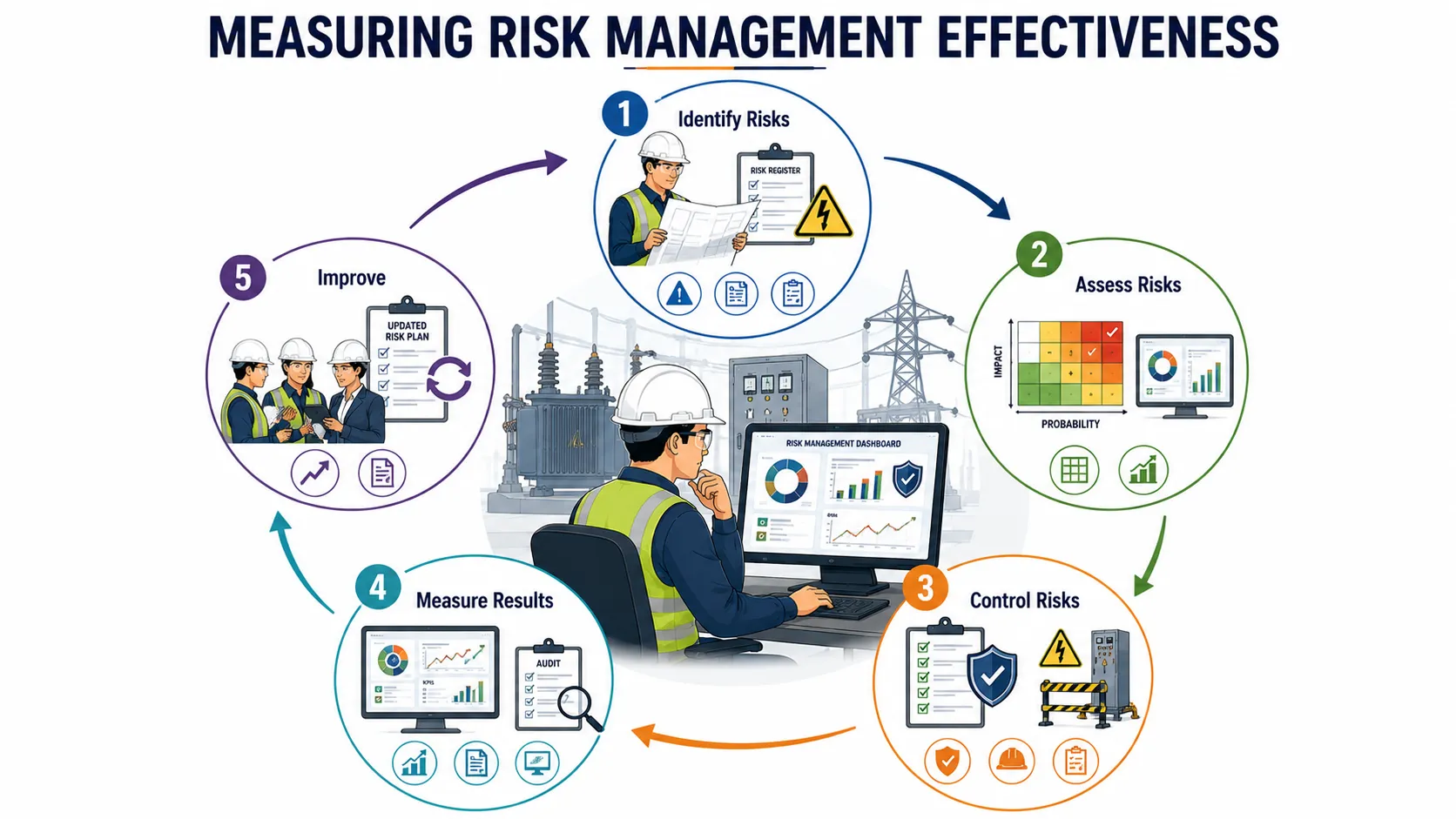
Risk Register Performance Evaluation
The risk register is one of the most important tools for measuring framework performance.
Evaluation includes reviewing:
Number of identified risks.
Accuracy of risk classification.
Risk ownership assignment.
Mitigation progress.
Risk closure status.
A well-managed risk register demonstrates that risks are:
Actively monitored.
Properly controlled.
Regularly reviewed.
Measurement activities include:
Comparing initial and current risk levels.
Reviewing closed risks.
Identifying repeated risk categories.
Evaluating mitigation effectiveness.
For example:
If a project risk register shows that equipment installation risks reduced from high level to low level after implementing additional inspections, this indicates successful risk treatment.
Risk Mitigation Effectiveness Assessment
Risk mitigation effectiveness measures whether implemented controls actually reduce risk exposure.
Assessment includes:
Reviewing implemented controls.
Comparing risk levels before and after mitigation.
Evaluating actual project outcomes.
Effective mitigation should:
Reduce probability of failure.
Reduce impact severity.
Improve project reliability.
Examples of mitigation measures include:
Additional inspections.
Specialist testing.
Improved training.
Design verification.
Supplier quality checks.
A Senior Electrical QA/QC Engineer evaluates whether these controls achieved their intended purpose.
Incident and Failure Trend Analysis
Trend analysis provides valuable information about whether risk controls are improving project performance.
The analysis examines:
Repeated failures.
Defect patterns.
Safety events.
Compliance issues.
A successful framework should demonstrate decreasing negative trends.
Examples:
Before risk improvement:
Frequent cable installation defects.
Repeated testing failures.
Delayed corrective actions.
After risk improvement:
Reduced defects.
Improved testing results.
Faster issue resolution.
Trend analysis helps organisations identify whether risk management activities are creating measurable improvement.
Audit and Compliance Review
Auditing is an important method for measuring whether a risk management framework is functioning effectively within complex electrical engineering projects. A risk management framework may contain well-developed procedures, but its true success depends on how effectively these procedures are implemented in practical project activities.
Internal and external audits provide objective evaluation of:
Risk identification processes.
Risk assessment accuracy.
Implementation of mitigation measures.
Compliance with contractual obligations.
Effectiveness of quality controls.
A Senior Electrical QA/QC Engineer uses audit findings to determine whether the risk management framework is achieving its objectives or requires improvement.
Audit evaluation activities include:
Reviewing risk management documentation.
Checking compliance with approved procedures.
Verifying implementation of risk controls.
Assessing corrective action effectiveness.
Identifying gaps in risk management processes.
For example:
During an electrical infrastructure project audit, the QA/QC team may identify that the risk register contains identified installation risks, but mitigation actions were not consistently implemented. This indicates that the framework requires improvement in risk control execution rather than risk identification.
Risk-Based Audit Approach
A risk-based audit approach focuses resources on areas with the highest potential impact on project success.
Instead of reviewing every activity equally, auditors prioritise:
High-voltage electrical systems.
Safety-critical equipment.
Complex commissioning activities.
Areas with previous failures.
Benefits include:
More effective use of audit resources.
Faster identification of critical weaknesses.
Improved risk control verification.
Examples of high-priority audit areas include:
Transformer installation.
Protection relay testing.
Earthing system verification.
Emergency power system commissioning.
Evaluating Risk Identification Effectiveness
The success of a risk management framework depends heavily on the accuracy and completeness of risk identification.
An effective framework should identify risks from:
Design activities.
Procurement processes.
Installation works.
Testing procedures.
Commissioning operations.
Maintenance requirements.
Accuracy of Risk Identification
Risk identification accuracy measures whether the framework identifies realistic and significant risks before they affect project performance.
Evaluation methods include:
Comparing identified risks with actual project issues.
Reviewing previous project lessons.
Analysing unexpected failures.
A strong risk identification process should reduce unexpected events.
For example:
If a project experiences repeated cable damage during installation but the risk framework failed to identify cable protection as a potential risk, the identification process was ineffective.
Coverage of Project Risk Areas
A successful framework should cover all major risk categories.
These include:
Technical Risks
Examples:
Design errors.
Equipment incompatibility.
System performance issues.
Quality Risks
Examples:
Installation defects.
Material non-conformities.
Testing failures.
Safety Risks
Examples:
Electrical hazards.
Unsafe working practices.
Emergency response failures.
Compliance Risks
Examples:
Regulatory violations.
Missing approvals.
Documentation gaps.
Comprehensive coverage ensures that important risks are not overlooked.
Evaluating Risk Assessment Accuracy
Risk assessment determines the priority level of identified risks. Measuring assessment effectiveness involves reviewing whether risk ratings accurately represent actual project conditions.
Risk Probability and Impact Evaluation
A successful framework should correctly evaluate:
Likelihood of occurrence.
Severity of consequences.
Overall risk level.
Incorrect assessment may result in:
Underestimating critical risks.
Wasting resources on low-priority issues.
Poor decision-making.
Example:
A protection system failure risk should receive a higher priority than a minor documentation error because its impact on electrical safety and system reliability is significantly greater.
Risk Prioritisation Effectiveness
Risk prioritisation ensures that resources are directed towards the most important risks.
Evaluation considers:
Whether critical risks receive appropriate attention.
Whether mitigation resources match risk severity.
Whether high-risk activities receive additional controls.
Effective prioritisation supports:
Better inspection planning.
Improved resource allocation.
Reduced project exposure.
Measuring Risk Control and Mitigation Success
Risk control effectiveness determines whether implemented measures successfully reduce identified risks.
A framework is successful when mitigation actions produce measurable improvements.
Effectiveness of Preventive Controls
Preventive controls aim to stop problems before they occur.
Examples include:
Design verification.
Supplier qualification.
Material inspection.
Workforce competency assessment.
Testing procedure approval.
Measurement methods include:
Reviewing defect reduction.
Comparing performance before and after controls.
Analysing quality trends.
Example:
If additional factory inspections reduce equipment-related failures during commissioning, the preventive controls have been effective.
Effectiveness of Corrective Actions
Corrective actions address problems after they are identified.
Evaluation includes:
Completion status.
Root cause resolution.
Recurrence prevention.
A corrective action is considered effective when:
The original problem is eliminated.
Similar failures do not occur again.
Project performance improves.
Examples:
Problem:
Repeated cable termination failures.
Corrective action:
Additional technician training and inspection points.
Measurement:
Reduction in termination-related defects.
Integration of Risk Management with Electrical QA/QC Processes
Risk management frameworks achieve greater effectiveness when integrated with electrical QA/QC systems.
Integration ensures that risk information influences:
Inspection planning.
Testing requirements.
Quality audits.
Non-conformance management.
Risk-Based Inspection and Testing
Risk-based inspection focuses QA/QC activities on areas where failure consequences are highest.
Examples:
High-risk activities requiring additional controls:
High-voltage equipment installation.
Protection system testing.
Critical power supply verification.
Benefits include:
Improved defect detection.
Better quality assurance.
Reduced commissioning failures.
Non-Conformance Reduction Analysis
Non-conformance data provides evidence about risk management success.
Evaluation includes:
Number of defects.
Severity of issues.
Repeated failures.
Corrective action effectiveness.
A successful framework should demonstrate:
Reduced non-conformities.
Faster issue resolution.
Improved workmanship.
Professional Comparison Table: Risk Management Success Measurement
| Evaluation Area | Definition | Measurement Method | Electrical Project Application |
|---|---|---|---|
| Risk Identification Effectiveness | Ability of the framework to identify potential risks before failure occurs | Comparing predicted risks with actual project issues | Identifying design, installation, and commissioning risks |
| Risk Assessment Accuracy | Ability to correctly evaluate risk likelihood and impact | Reviewing risk ratings against actual outcomes | Prioritising high-voltage and safety-critical risks |
| Mitigation Effectiveness | Ability of controls to reduce risk exposure | Monitoring performance before and after controls | Evaluating inspections, testing, and preventive measures |
| Audit Performance | Evaluation of compliance with risk management procedures | Internal and external audits | Verifying implementation of risk controls |
| Risk Monitoring | Continuous review of changing risk conditions | Risk register updates and performance tracking | Managing evolving electrical project risks |
Practical Example: Measuring Risk Framework Success in a High-Voltage Electrical Project
Project Background
A major high-voltage electrical project involved the construction of a substation supplying power to an industrial facility. The project included:
High-voltage switchgear.
Power transformers.
Protection systems.
Cable networks.
Control systems.
Due to the critical nature of the project, an advanced risk management framework was implemented.
Risk Management Framework Implementation
The framework included:
Risk identification workshops.
Risk registers.
Risk assessments.
Mitigation plans.
Regular risk reviews.
Major risks identified included:
Equipment failure.
Installation defects.
Testing delays.
Safety hazards.
Regulatory compliance issues.
Success Measurement Process
The effectiveness of the framework was measured using:
Safety Indicators
Evaluation showed:
Reduced safety incidents.
Improved hazard reporting.
Better control implementation.
Quality Indicators
Results demonstrated:
Reduced installation defects.
Improved inspection performance.
Fewer testing failures.
Compliance Indicators
The project achieved:
Improved documentation accuracy.
Successful regulatory inspections.
Complete compliance records.
Project Performance Indicators
The framework contributed to:
Reduced delays.
Improved coordination.
Successful commissioning.
Improvement Actions
Although the framework was successful, evaluation identified improvement opportunities:
Increase early supplier risk assessment.
Improve contractor risk awareness.
Enhance digital risk monitoring.
Increase communication between engineering teams.
Final Outcome
The risk management framework successfully supported project delivery by reducing uncertainty and improving control over critical electrical activities.
The evaluation demonstrated that effective risk management requires:
Accurate risk identification.
Continuous monitoring.
Strong QA/QC integration.
Evidence-based improvement.
Key Benefits of Measuring Risk Management Success
Improved Project Safety
Measurement ensures that safety controls are effective.
Benefits include:
Reduced electrical incidents.
Better hazard management.
Improved workplace protection.
Reduced Project Risks
Performance measurement identifies weaknesses before they create major problems.
Benefits include:
Fewer failures.
Reduced rework.
Lower project disruption.
Better Quality Outcomes
Risk measurement improves QA/QC performance through:
Targeted inspections.
Improved testing strategies.
Reduced defects.
Enhanced Regulatory Compliance
Evaluation ensures that:
Standards are followed.
Documentation is complete.
Compliance evidence is available.
Improved Stakeholder Confidence
Reliable risk performance information improves trust among:
Clients.
Contractors.
Regulators.
Engineering teams.
Best Practices for Measuring Risk Management Effectiveness
Senior electrical project teams should apply the following practices:
Establish measurable risk performance indicators.
Review risk registers regularly.
Integrate risk evaluation with QA/QC processes.
Analyse failure trends.
Conduct periodic audits.
Use lessons learned for improvement.
Maintain accurate documentation.
Encourage stakeholder communication.
Review mitigation effectiveness continuously.
Conclusion
Measuring the success of a risk management framework applied to a complex electrical project requires a structured evaluation approach based on evidence, performance indicators, and continuous improvement. A successful framework is demonstrated through measurable improvements in safety, quality, compliance, and project delivery performance.
The effectiveness of risk management cannot be judged only by the existence of procedures or documentation. It must be evaluated through practical outcomes, including reduced failures, improved risk control, successful audits, and better stakeholder confidence.
For complex electrical engineering projects, effective risk management measurement enables organisations to identify weaknesses, improve decision-making, and strengthen QA/QC performance. By continuously evaluating risk frameworks, engineering teams can achieve safer installations, improved reliability, and successful project completion.
3. Identify Systemic Weaknesses in Existing Risk Frameworks When Dealing with Unpredictable Work Contexts
Risk management frameworks are essential components of modern electrical engineering projects because they provide structured methods for identifying hazards, evaluating uncertainty, implementing controls, and improving project performance. However, even well-established risk management frameworks may contain systemic weaknesses when applied to complex electrical projects where working conditions change rapidly and unpredictable situations emerge.
Electrical engineering projects operate within highly dynamic environments where unexpected challenges can occur at any stage of the project lifecycle. These challenges may include sudden equipment failures, unforeseen site conditions, supply chain interruptions, regulatory changes, extreme environmental conditions, design modifications, and variations in workforce capability. Although traditional risk frameworks provide valuable planning and control mechanisms, they may not always provide sufficient flexibility to manage emerging risks that were not identified during initial assessments.
A Senior Electrical QA/QC Engineer must critically evaluate whether existing risk frameworks are capable of responding effectively to unpredictable work contexts. This requires analysing not only documented procedures but also the practical performance of risk management systems during real project situations.
Systemic weaknesses occur when limitations exist within the structure, processes, communication systems, or decision-making approaches of a risk management framework. These weaknesses may prevent organisations from detecting emerging risks early or responding effectively when project conditions change.
Examples of systemic weaknesses include:
- Limited ability to identify new and emerging risks.
- Excessive dependence on historical risk information.
- Lack of real-time monitoring systems.
- Poor integration between risk management and QA/QC processes.
- Inadequate stakeholder communication.
- Limited adaptability of risk control strategies.
- Weak feedback mechanisms.
Identifying these weaknesses allows engineering teams to improve existing frameworks and develop more resilient risk management approaches. A flexible and adaptive risk framework enables electrical projects to maintain safety, quality, and compliance even under uncertain conditions.
Understanding Systemic Weaknesses in Risk Management Frameworks
Definition of Systemic Weaknesses in Risk Frameworks
Systemic weaknesses refer to fundamental limitations within the structure, processes, or operation of a risk management framework that reduce its ability to effectively identify, control, and respond to risks.
Unlike isolated mistakes or individual errors, systemic weaknesses are caused by broader organisational or procedural issues.
For example:
An individual engineer failing to identify a minor installation defect represents an isolated error. However, if multiple projects repeatedly fail to identify similar defects because the organisation lacks effective inspection planning procedures, this indicates a systemic weakness.
In electrical engineering projects, systemic weaknesses may exist within:
- Risk identification processes.
- Risk assessment methods.
- Monitoring systems.
- Communication channels.
- Decision-making procedures.
- Quality management integration.
A risk framework with systemic weaknesses may continue operating but fail to provide adequate protection against unpredictable events.
Importance of Identifying Framework Limitations in Electrical Projects
Identifying weaknesses in risk frameworks is important because electrical projects involve safety-critical systems where unexpected failures can have significant consequences.
Effective evaluation helps organisations:
- Improve risk management maturity.
- Strengthen project resilience.
- Reduce unexpected failures.
- Improve safety performance.
- Enhance QA/QC effectiveness.
- Maintain regulatory compliance.
Electrical projects require continuous improvement because risks evolve throughout the project lifecycle.
For example:
A risk assessment completed during the design phase may not consider:
- Unexpected ground conditions during installation.
- Supplier quality problems.
- Changes in electrical regulations.
- New technical challenges during commissioning.
Therefore, risk frameworks must be regularly reviewed and improved.
Unpredictable Work Contexts in Electrical Engineering Projects
Definition of Unpredictable Work Conditions
Unpredictable work conditions are situations where actual project circumstances differ significantly from planned assumptions, creating new risks that were not fully considered during initial risk assessments.
These conditions may occur because of:
- Changing environments.
- Technical uncertainty.
- Human factors.
- External influences.
- Operational challenges.
In electrical engineering projects, unpredictable conditions require risk frameworks to be adaptable and responsive.
Examples include:
- Unexpected equipment malfunction during testing.
- Discovery of existing underground utilities during excavation.
- Sudden changes in client requirements.
- Availability issues with critical electrical components.
Common Sources of Uncertainty in Electrical Projects
Changing Site Conditions
Electrical installation projects often experience unexpected site conditions that affect planned activities.
Examples include:
- Unidentified underground services.
- Limited installation access.
- Environmental restrictions.
- Structural changes.
Traditional risk frameworks may fail when they assume that initial site information remains unchanged throughout the project.
Potential impacts include:
- Installation delays.
- Additional costs.
- Safety risks.
- Quality issues.
Improvement approaches include:
- Regular site risk reviews.
- Updated surveys.
- Continuous communication between engineering teams.
Unexpected Technical Failures
Complex electrical systems contain many interconnected components where failures can occur unexpectedly.
Examples include:
- Transformer malfunction.
- Protection system failure.
- Control system communication problems.
- Equipment compatibility issues.
A framework based only on planned risks may not effectively address failures that emerge during:
- Testing.
- Commissioning.
- Initial operation.
Effective frameworks require:
- Real-time monitoring.
- Technical feedback systems.
- Rapid response procedures.
Supply Chain Disruptions
Modern electrical projects depend on global supply chains for specialist equipment and materials.
Unexpected supply chain problems may include:
- Equipment delivery delays.
- Manufacturing defects.
- Material shortages.
- Supplier quality issues.
Traditional risk assessments may underestimate these risks if they rely on previous project experience without considering current market conditions.
Effective risk frameworks should include:
- Supplier risk evaluation.
- Alternative sourcing strategies.
- Equipment approval controls.
Regulatory and Compliance Changes
Electrical engineering regulations and standards may change during project execution.
Examples include:
- Updated safety requirements.
- Revised electrical installation standards.
- New environmental obligations.
A rigid risk framework may fail if it does not include processes for monitoring regulatory changes.
Improvement measures include:
- Regulatory review procedures.
- Compliance monitoring systems.
- Regular technical updates.
Extreme Environmental Conditions
Environmental factors can create unexpected risks during electrical projects.
Examples include:
- Extreme temperatures.
- Heavy rainfall.
- Flooding.
- High wind conditions.
These conditions may affect:
- Installation activities.
- Equipment protection.
- Testing schedules.
Risk frameworks should include environmental monitoring and contingency planning.
Workforce Competency Variations
Human performance is a major factor influencing electrical project risk.
Unpredictable workforce-related issues may include:
- Skill shortages.
- Inadequate training.
- Communication difficulties.
- Contractor capability differences.
Potential consequences include:
- Installation defects.
- Safety incidents.
- Testing failures.
Risk frameworks must consider:
- Competency assessments.
- Training requirements.
- Supervision levels.
Core Systemic Weaknesses in Existing Risk Frameworks
Limited Risk Identification Capability
One major weakness of traditional risk frameworks is their dependence on planned risk identification methods.
Many frameworks rely heavily on:
- Initial workshops.
- Previous project data.
- Historical risk registers.
Although these methods are valuable, they may not identify completely new risks.
Failure to Identify Emerging Risks
Emerging risks develop from changing conditions and may not have previous examples.
Examples include:
- New technologies.
- Changing regulations.
- Unexpected technical interactions.
A framework that only considers known risks may fail to recognise emerging threats.
The consequences may include:
- Delayed response.
- Increased project disruption.
- Higher failure probability.
Improvement strategies include:
- Continuous risk reviews.
- Real-time monitoring.
- Expert engineering input.
Overdependence on Historical Risk Data
Historical data helps organisations learn from previous projects. However, excessive dependence on previous information can create limitations.
Previous project experience may not reflect:
- New technologies.
- Different environmental conditions.
- Changing regulations.
- New suppliers.
For example:
A previous substation project may have experienced no transformer issues. However, a new project using a different manufacturer may introduce new equipment risks.
Effective frameworks should combine:
- Historical information.
- Current project conditions.
- Expert judgement.
- Real-time observations.
Inadequate Real-Time Risk Monitoring
Many traditional risk frameworks depend on periodic reviews rather than continuous monitoring.
This creates a weakness because risks can change rapidly.
Examples:
- Equipment conditions may deteriorate.
- Installation quality may decline.
- New hazards may develop.
Effective risk management requires:
- Digital monitoring systems.
- Continuous reporting.
- Regular site feedback.
Delayed Risk Information
Delayed information can prevent timely decision-making.
Examples include:
- Late inspection reports.
- Slow communication of defects.
- Delayed test results.
The impact includes:
- Increased rework.
- Higher costs.
- Extended project schedules.
Improvement approaches include:
- Digital reporting platforms.
- Real-time dashboards.
-
Immediate escalation procedures.
Inadequate Real-Time Risk Monitoring (Continued)
Lack of Dynamic Risk Assessment
One of the major systemic weaknesses in traditional risk management frameworks is the limited ability to perform dynamic risk assessments when project conditions change unexpectedly. Many risk frameworks are developed during the planning stage and are not updated frequently enough during execution.
In complex electrical engineering projects, risk levels can change due to:
Changes in installation methods.
New equipment requirements.
Unexpected technical problems.
Changes in workforce capability.
Delays affecting project sequencing.
A static risk assessment approach may become ineffective because it does not represent the actual conditions occurring on site.
For example:
During the installation of a high-voltage electrical system, the original risk assessment may identify cable installation as a moderate-risk activity. However, if unexpected environmental conditions cause water ingress into cable routes, the risk level may increase significantly. A dynamic risk assessment process would recognise this change and introduce additional controls.
Effective dynamic risk assessment requires:
Regular risk reviews.
Continuous site observations.
Updated risk registers.
Immediate communication of changes.
Flexible control measures.
Benefits include:
Faster response to emerging risks.
Improved safety performance.
Reduced unexpected failures.
Better decision-making.
Poor Adaptability to Changing Project Conditions
Electrical projects frequently experience changes that can affect planned activities. A risk framework that cannot adapt quickly may become ineffective.
Examples of changing conditions include:
Design modifications.
Revised client requirements.
Equipment replacement.
Programme changes.
Contractor changes.
A rigid framework may continue following original assumptions even when project circumstances have changed.
This creates risks such as:
Incorrect control measures.
Delayed risk responses.
Increased project disruption.
Reduced quality performance.
A flexible risk framework should allow:
Rapid reassessment of risks.
Modification of mitigation strategies.
Additional technical reviews.
Updated control procedures.
Rigid Risk Management Procedures
Some organisations develop highly structured risk procedures that provide consistency but lack flexibility.
Although standard procedures are important, excessive rigidity can prevent engineers from responding effectively to unusual situations.
Examples of rigid approaches include:
Using identical risk assessments for different site conditions.
Applying fixed inspection requirements regardless of risk level.
Following outdated procedures without review.
A more effective approach combines:
Standardised processes.
Engineering judgement.
Project-specific adjustments.
Continuous improvement.
Lack of Flexible Decision-Making
Unpredictable electrical project environments require timely decisions.
Weak risk frameworks may create delays because:
Approval processes are too complex.
Responsibilities are unclear.
Escalation procedures are ineffective.
Consequences include:
Delayed corrective actions.
Extended project timelines.
Increased exposure to risks.
Improvement approaches include:
Clear risk ownership.
Defined escalation procedures.
Empowered technical decision-makers.
Weak Integration Between Risk Management and QA/QC Systems
A major systemic weakness occurs when risk management operates separately from quality assurance and quality control activities.
Risk management identifies potential problems, while QA/QC systems verify quality performance. When these systems are disconnected, important risk information may not influence inspection and testing activities.
Disconnect Between Risk Registers and Site Activities
A common weakness is that risk registers are developed as formal documents but are not actively used during daily project activities.
Examples include:
Site teams unaware of identified risks.
Inspection teams not prioritising high-risk activities.
Risk controls not included in work procedures.
Effective integration requires:
Linking risks with Inspection and Test Plans (ITPs).
Including risk controls in method statements.
Reviewing risks during site meetings.
Updating risk information based on inspection findings.
Ineffective Feedback Mechanisms
Feedback systems allow organisations to learn from:
Failures.
Near misses.
Inspection findings.
Testing results.
Weak feedback mechanisms prevent continuous improvement.
Examples of poor feedback practices include:
Closing issues without root cause analysis.
Repeating similar corrective actions.
Failing to update risk assessments.
Improved feedback systems include:
Lessons learned reviews.
Non-conformance trend analysis.
Corrective action verification.
Human Factors and Organisational Weaknesses
Risk management frameworks depend heavily on human involvement. Even well-designed systems may fail if organisational factors are not properly managed.
Communication Failures
Poor communication is one of the most common weaknesses affecting risk management effectiveness.
Communication problems may occur between:
Design engineers.
Construction teams.
QA/QC personnel.
Contractors.
Project managers.
Examples include:
Failure to communicate design changes.
Delayed reporting of defects.
Misunderstanding of risk responsibilities.
Effective communication requires:
Regular risk meetings.
Clear reporting channels.
Accessible risk information.
Stakeholder involvement.
Competency and Training Gaps
Risk frameworks rely on competent personnel who understand:
Risk assessment methods.
Safety requirements.
Quality procedures.
Technical controls.
Competency weaknesses may result in:
Incorrect risk assessments.
Poor implementation of controls.
Increased safety incidents.
Improvement strategies include:
Technical training.
Competency assessments.
Continuous professional development.
Specialist involvement.
Insufficient Stakeholder Involvement
A risk management framework becomes weaker when important stakeholders are excluded from risk discussions.
Electrical projects involve multiple stakeholders, including:
Clients.
Engineers.
Contractors.
Suppliers.
Regulatory authorities.
Each stakeholder provides valuable risk information.
Limited Risk Ownership
A common weakness is unclear responsibility for managing identified risks.
If risk ownership is not assigned:
Actions may not be completed.
Problems may remain unresolved.
Accountability becomes unclear.
Effective frameworks require:
Named risk owners.
Defined responsibilities.
Regular progress reviews.
Poor Risk Communication
Risk information must be communicated clearly to ensure effective action.
Poor communication can result in:
Incorrect work methods.
Delayed responses.
Increased project risks.
Effective communication methods include:
Risk dashboards.
Progress meetings.
Technical reports.
Digital monitoring systems.
Process for Identifying Systemic Weaknesses in Risk Frameworks
Step 1: Review Existing Risk Management Processes
The first step is evaluating current risk management procedures.
Review activities include:
Examining risk policies.
Reviewing risk registers.
Assessing monitoring methods.
Evaluating reporting systems.
The objective is to identify gaps between planned processes and actual implementation.
Step 2: Analyse Historical Project Performance Data
Previous project information provides valuable evidence about framework weaknesses.
Analysis should include:
Repeated failures.
Previous incidents.
Non-conformance records.
Audit findings.
This helps identify patterns indicating systemic problems.
Step 3: Evaluate Risk Response Effectiveness
Risk responses should be reviewed to determine whether they achieved the intended outcomes.
Evaluation considers:
Was the risk reduced?
Were controls effective?
Did similar issues occur again?
Step 4: Identify Repeated Failures and Patterns
Repeated problems often indicate weaknesses in the risk framework.
Examples include:
Repeated cable installation defects.
Recurring testing failures.
Frequent documentation issues.
These patterns require deeper investigation.
Step 5: Develop Improvement Strategies
After identifying weaknesses, organisations should develop improvement actions.
Strategies include:
Updating risk procedures.
Improving training.
Enhancing monitoring systems.
Strengthening communication.
Professional Comparison Table: Risk Framework Weaknesses and Improvements
Risk Framework Weakness Definition Impact on Electrical Projects Improvement Approach Static Risk Assessment Risk assessment not updated when conditions change Emerging risks remain uncontrolled Implement dynamic risk reviews Poor Monitoring Limited tracking of changing risks Delayed response to problems Use real-time monitoring systems Weak Communication Ineffective sharing of risk information Increased errors and misunderstandings Improve reporting processes Limited Risk Ownership Unclear responsibility for risk actions Delayed corrective measures Assign clear risk owners Poor QA/QC Integration Risk management separated from quality activities Defects and failures increase Integrate risk with inspection processes Case Study: Identifying Risk Framework Weaknesses in a High-Voltage Project
Project Background
A high-voltage electrical infrastructure project experienced repeated delays and quality issues during installation and commissioning phases.
The project had an established risk management framework, including:
Risk registers.
Monthly risk reviews.
Safety procedures.
Quality inspections.
However, unexpected problems continued to occur.
Identified Systemic Weaknesses
Weak Real-Time Monitoring
The project relied mainly on monthly risk reviews.
Problems:
New risks were identified late.
Site changes were not immediately reflected.
Corrective actions were delayed.
Improvement:
A digital risk monitoring system was introduced.
Poor Integration with QA/QC
The risk register identified cable installation risks, but inspection activities did not prioritise these areas.
Improvement:
Risk information was integrated into:
Inspection plans.
Testing procedures.
Site quality meetings.
Communication Problems
Contractors and engineering teams had different understandings of risk responsibilities.
Improvement actions included:
Weekly risk coordination meetings.
Clear responsibility assignment.
Improved reporting procedures.
Final Outcome
After implementing improvements:
Installation defects reduced.
Risk response times improved.
Quality performance increased.
Project delays were reduced.
The case study demonstrates that identifying systemic weaknesses allows organisations to strengthen risk frameworks and improve project resilience.
Key Benefits of Identifying Risk Framework Weaknesses
Improved Project Resilience
Identifying weaknesses helps organisations prepare for unexpected conditions.
Benefits include:
Faster response to changes.
Better uncertainty management.
Reduced project disruption.
Enhanced Safety Performance
Improved risk frameworks help prevent:
Electrical incidents.
Unsafe practices.
Equipment failures.
Better Quality Control
Integration between risk management and QA/QC improves:
Inspection effectiveness.
Defect prevention.
Testing reliability.
Improved Decision-Making
Understanding framework limitations supports:
Better engineering decisions.
More effective resource allocation.
Improved project planning.
Increased Stakeholder Confidence
A strong and adaptable risk framework demonstrates professional project management.
Benefits include:
Improved client trust.
Better regulatory confidence.
Stronger project reputation.
Best Practices for Improving Risk Framework Adaptability
Effective electrical project risk frameworks should include:
Continuous risk monitoring.
Dynamic risk assessment processes.
Strong QA/QC integration.
Regular stakeholder communication.
Digital risk management tools.
Competency development programmes.
Lessons learned systems.
Regular framework reviews.
Conclusion
Identifying systemic weaknesses in existing risk management frameworks is essential for improving the performance and reliability of complex electrical engineering projects. Traditional risk frameworks provide valuable structures for managing uncertainty, but unpredictable work contexts require flexible, adaptive, and continuously improving approaches.
Weaknesses such as limited risk identification, poor monitoring, rigid procedures, communication failures, and weak QA/QC integration can reduce the effectiveness of risk management systems. By analysing these limitations, engineering organisations can develop stronger frameworks capable of responding to changing conditions.
Effective risk management requires more than documentation and procedures. It requires continuous evaluation, stakeholder collaboration, technical expertise, and integration with quality management processes. Through proactive identification of framework weaknesses, electrical engineering projects can achieve improved safety, quality, compliance, and successful delivery outcomes.
4. Propose Evidence-Based Modifications to Improve the Overall Effectiveness of Electrical Risk Management Frameworks
Electrical engineering projects operate within complex and continuously changing environments where effective risk management is essential for maintaining safety, quality, reliability, and regulatory compliance. Established risk management frameworks provide structured methods for identifying hazards, assessing risks, implementing controls, and monitoring performance. However, changing technologies, complex project conditions, evolving regulations, and unpredictable operational challenges require these frameworks to be continuously improved.
Evidence-based modification of risk management frameworks involves using reliable information, measurable performance data, and practical project experiences to identify weaknesses and implement targeted improvements. Instead of making changes based on assumptions or isolated observations, engineering teams analyse evidence collected from project activities, quality records, safety performance, audits, and operational feedback.
For complex electrical projects, evidence-based improvements ensure that risk management systems remain effective throughout the complete project lifecycle, including:
- Design and engineering development.
- Procurement and supplier management.
- Electrical installation activities.
- Inspection and testing.
- Commissioning.
- Operational handover.
A Senior Electrical QA/QC Engineer must evaluate whether existing risk management approaches are achieving their intended outcomes and identify opportunities for improvement. This requires analysing actual project performance data and determining whether current controls are preventing failures or only responding after problems occur.
Evidence-based modifications may involve:
- Improving risk identification methods.
- Introducing dynamic risk assessment processes.
- Strengthening monitoring systems.
- Enhancing communication procedures.
- Integrating risk management with QA/QC activities.
- Improving corrective and preventive action processes.
The objective is not simply to create additional procedures but to develop a more intelligent, flexible, and responsive risk management framework that can effectively manage uncertainty within modern electrical engineering projects.
Understanding Evidence-Based Improvements in Electrical Risk Management
Definition of Evidence-Based Risk Framework Modification
Evidence-based risk framework modification refers to the process of improving existing risk management systems by using verified information, performance data, technical analysis, and documented project experiences.
The purpose of these modifications is to improve the ability of risk management frameworks to:
- Identify emerging risks.
- Predict potential failures.
- Reduce risk exposure.
- Improve decision-making.
- Strengthen safety and quality performance.
Evidence-based modification follows a structured improvement cycle:
- Collect reliable project evidence.
- Analyse existing risk management performance.
- Identify weaknesses or improvement opportunities.
- Develop appropriate modifications.
- Implement improved controls.
- Measure the effectiveness of changes.
For example:
If project records show repeated cable installation failures, the organisation should not simply repair individual defects. Instead, it should analyse the evidence and modify the risk framework by introducing:
- Improved installation risk assessments.
- Additional inspection stages.
- Enhanced contractor competency requirements.
- Updated installation procedures.
This approach ensures that improvements address the root cause rather than only treating symptoms.
Importance of Continuous Improvement in Electrical Risk Management
Electrical engineering projects involve changing conditions where previously effective risk controls may become insufficient over time. Continuous improvement ensures that risk management frameworks remain aligned with actual project requirements.
The importance of continuous improvement includes:
Improving Safety Performance
Evidence-based modifications help organisations identify weaknesses that may contribute to electrical hazards.
Improvements may include:
- Strengthening hazard identification processes.
- Improving safety controls.
- Updating work procedures.
- Increasing competency requirements.
Benefits include:
- Reduced electrical incidents.
- Improved worker protection.
- Better safety culture.
Enhancing Quality Outcomes
Risk management and quality management are closely connected. Poor risk controls can result in:
- Installation defects.
- Testing failures.
- Equipment damage.
- System reliability issues.
Evidence-based improvements help improve:
- Inspection effectiveness.
- Testing reliability.
- Defect prevention.
- Non-conformance management.
Supporting Regulatory Compliance
Electrical projects must satisfy contractual, legal, and regulatory requirements.
Evidence-based modifications help organisations ensure:
- Current standards are considered.
- Compliance risks are controlled.
- Documentation requirements are maintained.
Increasing Project Resilience
A flexible risk framework enables projects to respond effectively to unexpected situations.
Examples include:
- Equipment failure.
- Supplier disruption.
- Environmental challenges.
- Design changes.
Sources of Evidence Used for Improving Risk Management Frameworks
Effective modifications require accurate and relevant evidence. Engineering teams should use multiple sources of information to understand framework performance.
Project Performance Data
Project performance data provides measurable information about how risk management processes are functioning.
Examples include:
- Schedule performance.
- Cost impacts.
- Delay records.
- Productivity information.
- Resource utilisation.
This information helps identify whether risks are affecting project objectives.
For example:
If project data shows repeated delays caused by equipment approval issues, the risk framework may require stronger supplier risk assessment procedures.
Risk Register Analysis
The risk register provides valuable evidence about:
- Identified risks.
- Risk severity.
- Mitigation actions.
- Risk status changes.
Reviewing risk registers helps identify:
- Repeated risk categories.
- Ineffective controls.
- Unmanaged emerging risks.
Improvement opportunities may include:
- Updating risk categories.
- Improving risk ownership.
- Revising mitigation strategies.
QA/QC Inspection Records
Quality inspection records provide evidence about risk-related quality performance.
Important information includes:
- Inspection findings.
- Defect trends.
- Failed inspections.
- Repeated non-conformities.
Analysis of inspection records helps identify whether risk controls are preventing quality issues.
Example:
If inspection records show repeated problems with electrical terminations, the risk framework may require:
- Additional inspection checkpoints.
- Improved installation procedures.
- Additional technician training.
Non-Conformance Reports
Non-conformance reports (NCRs) are important sources of evidence because they identify failures against project requirements.
NCR analysis helps determine:
- Common defect patterns.
- Root causes.
- Effectiveness of corrective actions.
Evidence from NCRs can support improvements such as:
- Revised quality procedures.
- Additional risk controls.
- Improved contractor management.
Audit Findings
Audits provide independent evaluation of risk management performance.
Audit evidence may identify:
- Weak procedures.
- Documentation problems.
- Poor implementation.
- Compliance gaps.
Internal and external audits support continuous improvement by highlighting areas requiring attention.
Incident and Near-Miss Data
Safety incidents and near misses provide valuable information about potential weaknesses before serious failures occur.
Analysis includes:
- Incident causes.
- Contributing factors.
- Control effectiveness.
Near-miss information is particularly valuable because it allows organisations to improve controls before major incidents happen.
Testing and Commissioning Results
Testing and commissioning data provides technical evidence about system performance.
Important information includes:
- Test failures.
- Equipment performance.
- Protection system results.
- Functional verification outcomes.
Example:
Repeated protection relay testing failures may indicate that risk controls related to design review or commissioning procedures require improvement.
Analysing Existing Risk Management Framework Performance
Before modifying a risk management framework, organisations must evaluate current performance.
The analysis process determines:
- What is working effectively.
- What weaknesses exist.
- Which improvements provide the greatest benefit.
Identifying Improvement Opportunities
Improvement opportunities can be identified through:
- Performance reviews.
- Risk trend analysis.
- Audit findings.
- Stakeholder feedback.
- Engineering assessments.
Common improvement areas include:
- Risk identification.
- Monitoring systems.
- Communication processes.
- Quality integration.
Evaluating Risk Control Effectiveness
Risk controls should be evaluated based on actual performance rather than assumptions.
Evaluation questions include:
- Did the control prevent the risk?
- Did the risk level reduce?
- Did similar failures occur again?
- Was the control practical?
For example:
A project may introduce additional inspections to reduce installation defects. Evidence should be reviewed to determine whether defect rates actually decreased.
Reviewing Framework Adaptability
Modern electrical projects require risk frameworks that can respond to change.
Evaluation should consider whether the framework can handle:
- New technical challenges.
- Changing project conditions.
- Unexpected events.
- Emerging risks.
A flexible framework should allow:
- Rapid risk reassessment.
- Updated controls.
- Improved communication.
- Faster decision-making.
Implementing Dynamic Risk Assessment Processes
One of the most important modifications for improving risk frameworks is introducing dynamic risk assessment.
Traditional assessments are often completed during project planning. However, electrical projects continue to change throughout execution.
Dynamic risk assessment allows teams to:
- Review risks continuously.
- Update risk levels.
- Respond to new information.
Benefits include:
- Faster identification of emerging risks.
- Improved safety control.
-
Better project adaptability.
Strengthening Risk Identification Methods
Improving risk identification capability is one of the most important evidence-based modifications required to enhance electrical risk management frameworks. Traditional approaches often depend on previous project experience and standard risk registers; however, complex electrical projects require more advanced methods capable of identifying emerging and unpredictable risks.
A stronger risk identification process should combine:
- Historical project information.
- Current project conditions.
- Technical expert judgement.
- Real-time observations.
- Data-driven analysis.
The objective is to move from reactive risk identification towards proactive risk prediction.
Advanced Hazard Identification Techniques
Advanced hazard identification techniques provide a more comprehensive understanding of potential electrical project risks.
These techniques include:
Structured Risk Workshops
Risk workshops involve technical teams, project managers, QA/QC personnel, contractors, and specialists working together to identify potential threats.
Benefits include:
- Multiple professional perspectives.
- Improved risk visibility.
- Better understanding of project challenges.
Participants may review:
- Electrical designs.
- Installation methods.
- Testing procedures.
- Environmental conditions.
- Operational requirements.
Failure Mode and Effects Analysis (FMEA)
FMEA is a systematic method used to identify possible failures and evaluate their consequences.
It analyses:
- Possible failure modes.
- Causes of failure.
- Effects on system performance.
- Preventive actions.
Electrical engineering applications include:
- Transformer reliability assessment.
- Protection system evaluation.
- Control system analysis.
Example:
If a protection relay failure is identified as a potential risk, FMEA helps determine:
- Why the failure may occur.
- How severe the impact could be.
- What controls should be introduced.
Hazard and Operability Studies (HAZOP)
HAZOP provides a structured approach for identifying deviations from intended system operation.
It is useful for:
- Complex electrical systems.
- Industrial power networks.
- Critical infrastructure.
The process evaluates:
- Design assumptions.
- Operating conditions.
- Possible failures.
Benefits include:
- Improved design reliability.
- Better hazard awareness.
- Early identification of technical problems.
Integration of Predictive Risk Analysis
Predictive risk analysis uses available data to forecast potential future problems.
Modern electrical projects can use:
- Historical performance data.
- Equipment monitoring information.
- Inspection trends.
- Failure records.
Predictive approaches help identify risks before they become actual failures.
Examples include:
- Predicting equipment degradation.
- Identifying repeated installation problems.
- Forecasting maintenance requirements.
Benefits include:
- Reduced unexpected failures.
- Improved planning.
- Better resource allocation.
Improving Risk Data Management Systems
Effective risk management depends on accurate, accessible, and updated information. Weak data management can reduce the effectiveness of risk frameworks because decisions may be based on incomplete or outdated information.
Improved risk data systems should support:
- Real-time information sharing.
- Accurate risk tracking.
- Performance measurement.
- Decision-making.
Digital Risk Management Platforms
Digital platforms provide advanced methods for managing electrical project risks.
Features may include:
- Digital risk registers.
- Automated alerts.
- Risk dashboards.
- Performance tracking.
- Document integration.
Benefits include:
- Faster risk communication.
- Improved transparency.
- Better stakeholder coordination.
For example:
A digital dashboard can display:
- Current high-risk activities.
- Open corrective actions.
- Inspection performance.
- Risk mitigation progress.
This enables project teams to respond quickly when risk conditions change.
Data-Based Decision Making
Evidence-based modifications require decisions supported by reliable information.
Data analysis should consider:
- Risk trends.
- Quality performance.
- Safety records.
- Testing results.
- Audit findings.
Data-driven decisions help avoid:
- Assumptions.
- Unnecessary controls.
- Poor resource allocation.
Example:
If inspection data shows that a particular installation activity produces repeated defects, resources can be redirected towards:
- Additional inspections.
- Improved training.
- Revised procedures.
Enhancing Risk Communication and Collaboration
Effective communication is essential for ensuring that risk information reaches the correct personnel at the correct time.
A strong risk communication system improves:
- Awareness.
- Accountability.
- Decision-making.
- Response speed.
Stakeholder Risk Engagement
Electrical projects involve multiple stakeholders with different responsibilities.
Effective risk frameworks should involve:
- Clients.
- Design engineers.
- Contractors.
- Suppliers.
- QA/QC teams.
- Commissioning specialists.
Stakeholder involvement improves risk management by providing:
- Technical knowledge.
- Practical experience.
- Early identification of problems.
Example:
A supplier may identify equipment availability risks earlier than the construction team. Including suppliers in risk discussions improves project preparedness.
Improved Reporting Systems
Risk reporting should provide clear and useful information rather than excessive documentation.
Effective reports should include:
- Current risk status.
- Critical issues.
- Required actions.
- Responsible persons.
- Improvement recommendations.
Benefits include:
- Faster decision-making.
- Improved management visibility.
- Better project control.
Integrating Risk Management with QA/QC Systems
A major improvement opportunity is strengthening the relationship between risk management and quality assurance processes.
Risk information should directly influence:
- Inspection planning.
- Testing procedures.
- Audit activities.
- Non-conformance management.
Risk-Based Inspection Planning
Risk-based inspection ensures that QA/QC resources are focused on activities with the highest potential consequences.
Instead of applying identical inspection levels to every activity, inspections are prioritised according to risk.
High-risk electrical activities may include:
- High-voltage equipment installation.
- Cable termination.
- Protection system configuration.
- Transformer testing.
Benefits include:
- Better defect prevention.
- Improved inspection efficiency.
- Reduced commissioning problems.
Linking Non-Conformance Data with Risk Controls
Non-conformance reports provide valuable evidence for improving risk frameworks.
Analysis of NCR data helps identify:
- Repeated defects.
- Weak procedures.
- Ineffective controls.
Example:
If repeated cable installation defects are recorded, the risk framework should be modified by:
- Revising installation procedures.
- Increasing inspection points.
- Improving workforce competency.
Developing Stronger Risk Mitigation Strategies
Risk mitigation strategies must be continuously improved based on evidence from actual project performance.
Effective modifications focus on strengthening preventive and corrective controls.
Preventive Control Improvements
Preventive controls aim to reduce the likelihood of failures before they occur.
Improvements may include:
- Enhanced design verification.
- Supplier quality assessments.
- Additional technical reviews.
- Competency-based training.
Benefits include:
- Reduced defects.
- Improved reliability.
- Lower project risks.
Corrective Action Optimisation
Corrective actions should address root causes rather than temporary symptoms.
Improved corrective action processes include:
- Root cause analysis.
- Responsibility assignment.
- Effectiveness verification.
- Follow-up monitoring.
Example:
Problem:
Repeated electrical testing failures.
Weak response:
Repeating the test without investigation.
Improved response:
- Analyse failure causes.
- Review installation practices.
- Improve testing procedures.
- Verify long-term improvement.
Professional Comparison Table: Evidence-Based Risk Framework Modifications
Modification Area Existing Limitation Evidence Used Proposed Improvement Risk Identification Limited identification of emerging risks Incident records, expert reviews, project data Introduce advanced hazard identification methods Risk Monitoring Delayed awareness of changing conditions Real-time project information Implement digital monitoring systems Risk Assessment Static evaluation methods Risk trend analysis Introduce dynamic risk assessments QA/QC Integration Risk information not linked with inspections Inspection records and NCR data Develop risk-based inspection planning Communication Poor sharing of risk information Stakeholder feedback Improve reporting and collaboration systems Practical Example: Improving Risk Management in a High-Voltage Substation Project
Project Background
A high-voltage substation project experienced several challenges during construction and commissioning.
The original risk management framework included:
- Risk registers.
- Monthly reviews.
- Standard inspection procedures.
However, project performance data showed:
- Repeated installation defects.
- Testing delays.
- Communication issues.
- Late identification of technical risks.
Evidence Collection and Analysis
The project team analysed:
- Inspection reports.
- Non-conformance records.
- Testing results.
- Contractor performance data.
- Audit findings.
The analysis identified weaknesses in:
- Real-time monitoring.
- Contractor risk awareness.
- Risk communication.
Proposed Modifications
Based on evidence analysis, improvements were implemented.
Digital Risk Monitoring
A digital platform was introduced to provide:
- Real-time risk updates.
- Automated alerts.
- Improved reporting.
Enhanced QA/QC Integration
Risk information was linked with:
- Inspection plans.
- Testing schedules.
- Quality meetings.
Improved Contractor Management
Actions included:
- Additional training.
- Competency verification.
- Improved supervision.
Implementation Results
After implementing modifications:
- Defect rates decreased.
- Risk response improved.
- Testing efficiency increased.
- Stakeholder communication improved.
The project demonstrated that evidence-based modifications can significantly improve risk management framework performance.
Key Benefits of Improved Electrical Risk Management Frameworks
Improved Safety Performance
Enhanced frameworks help identify and control hazards before they result in incidents.
Benefits include:
- Reduced electrical accidents.
- Improved hazard awareness.
- Better safety compliance.
Better Quality Performance
Improved risk controls support:
- Reduced defects.
- Improved installation quality.
- More reliable electrical systems.
Increased Project Resilience
Adaptive frameworks allow projects to respond effectively to:
- Unexpected failures.
- Technical challenges.
- Changing conditions.
Improved Decision-Making
Evidence-based improvements provide:
- Accurate information.
- Better risk prioritisation.
- More effective resource allocation.
Enhanced Regulatory Compliance
Improved frameworks support:
- Compliance monitoring.
- Documentation control.
- Audit readiness.
Best Practices for Maintaining Continuous Risk Improvement
Electrical engineering organisations should maintain effective risk frameworks through:
- Regular risk framework reviews.
- Continuous analysis of project data.
- Integration with QA/QC systems.
- Digital risk monitoring tools.
- Stakeholder involvement.
- Competency development.
- Lessons learned processes.
- Performance measurement.
Conclusion
Evidence-based modification of electrical risk management frameworks is essential for improving safety, quality, compliance, and project performance in complex engineering environments. Traditional risk frameworks provide valuable foundations, but unpredictable work contexts require flexible and continuously improving approaches.
By analysing evidence from project performance data, quality records, audits, incidents, and testing outcomes, organisations can identify weaknesses and implement targeted improvements. Dynamic risk assessment, improved communication, digital monitoring systems, and stronger QA/QC integration significantly enhance framework effectiveness.
A successful electrical risk management framework is not a fixed system; it is an evolving process that improves through experience, analysis, and continuous development. Through evidence-based modifications, electrical engineering projects can achieve improved reliability, reduced failures, stronger compliance, and successful delivery outcomes.