
Lesson 1: Apply Advanced Project Planning Techniques to Electrical QA/QC Activities
Effective project planning is a fundamental element of successful electrical Quality Assurance and Quality Control (QA/QC) management, particularly within complex engineering environments where multiple activities, resources, stakeholders, and compliance requirements must be coordinated simultaneously. Advanced project planning techniques enable electrical engineering teams to establish structured quality processes, optimise resource allocation, control project risks, and ensure that all inspection, testing, documentation, and verification activities are completed according to approved standards and project objectives.
Within modern electrical projects, QA/QC planning extends beyond traditional inspection schedules and focuses on integrating quality requirements throughout the complete project lifecycle. Advanced planning approaches involve developing detailed quality plans, inspection and test plans (ITPs), risk-based quality strategies, resource forecasting, milestone control, and performance monitoring frameworks. These techniques support proactive quality management by identifying potential issues before they affect project delivery, reducing rework, improving compliance, and enhancing overall project performance.
This lesson explores the application of advanced project planning methods within electrical QA/QC activities, including the coordination of engineering resources, quality objectives, inspection processes, testing requirements, documentation controls, and stakeholder responsibilities. By applying structured planning principles, electrical QA/QC professionals can improve project efficiency, maintain regulatory compliance, strengthen quality outcomes, and deliver reliable electrical systems that meet technical specifications and client expectations.
1. Critically Evaluate Advanced Project Planning Techniques Suitable for Complex Electrical QA/QC Operations
Complex electrical engineering projects require highly structured planning approaches to ensure that quality, safety, compliance, and delivery objectives are achieved effectively. As electrical systems become more advanced, involving high-voltage networks, renewable energy integration, industrial power systems, automation controls, and critical infrastructure, traditional project planning methods are often insufficient to manage the increasing level of technical complexity.
Advanced project planning techniques provide a systematic framework for organising electrical QA/QC activities throughout the project lifecycle. These techniques enable engineering teams to coordinate inspection requirements, testing schedules, documentation processes, resource allocation, risk controls, and compliance obligations while maintaining alignment with project objectives.
Electrical QA/QC operations are highly dependent on effective planning because quality activities are closely connected with engineering design, procurement, installation, commissioning, and handover stages. Poor planning can result in delayed inspections, incomplete testing, documentation gaps, repeated non-conformances, inefficient resource utilisation, and increased project risks.
Advanced planning methods allow quality professionals to move from reactive quality control towards proactive quality management. Instead of identifying defects after they occur, planned QA/QC systems establish preventive controls that identify potential problems early and ensure that quality requirements are integrated into every project activity.
This section critically evaluates advanced project planning techniques suitable for complex electrical QA/QC operations, examining their principles, applications, benefits, limitations, and suitability within professional engineering environments.
Understanding Advanced Project Planning in Electrical QA/QC Operations
Definition of Advanced Project Planning
Advanced project planning refers to the structured process of defining project activities, resources, timelines, quality requirements, risks, and control mechanisms using systematic planning methodologies and analytical tools.
Within electrical QA/QC operations, advanced project planning involves developing coordinated strategies for:
- Quality objectives.
- Inspection activities.
- Testing requirements.
- Resource management.
- Risk control.
- Compliance monitoring.
- Documentation management.
- Performance evaluation.
Unlike basic scheduling approaches, advanced planning considers the relationship between multiple project activities and identifies how decisions in one area may influence overall quality performance.
For example, a delay in equipment delivery may affect:
- Installation sequence.
- Inspection timing.
- Testing activities.
- Commissioning schedules.
- Client acceptance dates.
Advanced planning techniques help organisations anticipate these relationships and develop effective control strategies.
Importance of Advanced Planning Techniques in Electrical QA/QC
Supporting Proactive Quality Management
Advanced planning enables QA/QC teams to identify quality requirements before project activities begin.
This supports:
- Early identification of inspection requirements.
- Better preparation of testing resources.
- Improved coordination between engineering teams.
- Reduction of quality failures.
- Effective management of project risks.
A proactive approach ensures that quality is designed into project processes rather than inspected only after completion.
Improving Coordination Between Project Activities
Electrical projects involve multiple interconnected activities, including:
- Engineering design.
- Procurement.
- Material inspection.
- Installation.
- Testing.
- Commissioning.
- Documentation approval.
Advanced planning techniques help establish clear relationships between these activities.
Benefits include:
- Improved workflow coordination.
- Reduced activity conflicts.
- Better resource scheduling.
- Faster issue identification.
Enhancing Compliance Management
Electrical engineering projects must comply with:
- Client specifications.
- Industry standards.
- Regulatory requirements.
- Safety procedures.
- Quality management systems.
Advanced planning ensures compliance requirements are included within project schedules and quality plans.
Examples include:
- Planned inspection hold points.
- Scheduled testing activities.
- Required approval stages.
- Document submission deadlines.
Key Concepts of Advanced Project Planning Techniques
Work Breakdown Structure (WBS)
A Work Breakdown Structure is a systematic method of dividing a complex project into smaller, manageable work packages.
In electrical QA/QC operations, WBS helps organise quality activities into clearly defined sections.
A typical electrical project WBS may include:
- Design verification.
- Material approval.
- Installation inspection.
- Cable testing.
- Equipment testing.
- Commissioning verification.
- Final documentation.
The purpose of WBS is to create clarity regarding:
- Scope of work.
- Responsibilities.
- Deliverables.
- Quality requirements.
Application of WBS in Electrical QA/QC
WBS supports quality management by ensuring that every project activity has defined quality controls.
For example:
A substation project may be divided into:
Design Phase
- Drawing reviews.
- Technical approval.
- Design compliance checks.
Construction Phase
- Installation inspections.
- Material verification.
- Workmanship monitoring.
Commissioning Phase
- Functional testing.
- Performance verification.
- Handover documentation.
This structured approach prevents important quality activities from being overlooked.
Benefits of Work Breakdown Structure
WBS provides several advantages:
- Improves project visibility.
- Defines quality responsibilities.
- Supports accurate scheduling.
- Helps identify resource requirements.
- Improves progress monitoring.
Limitations of WBS
Although effective, WBS requires careful development.
Potential challenges include:
- Excessive detail creating complexity.
- Difficulty managing changes.
- Requirement for continuous updating.
For large electrical projects, WBS must remain flexible to accommodate engineering changes.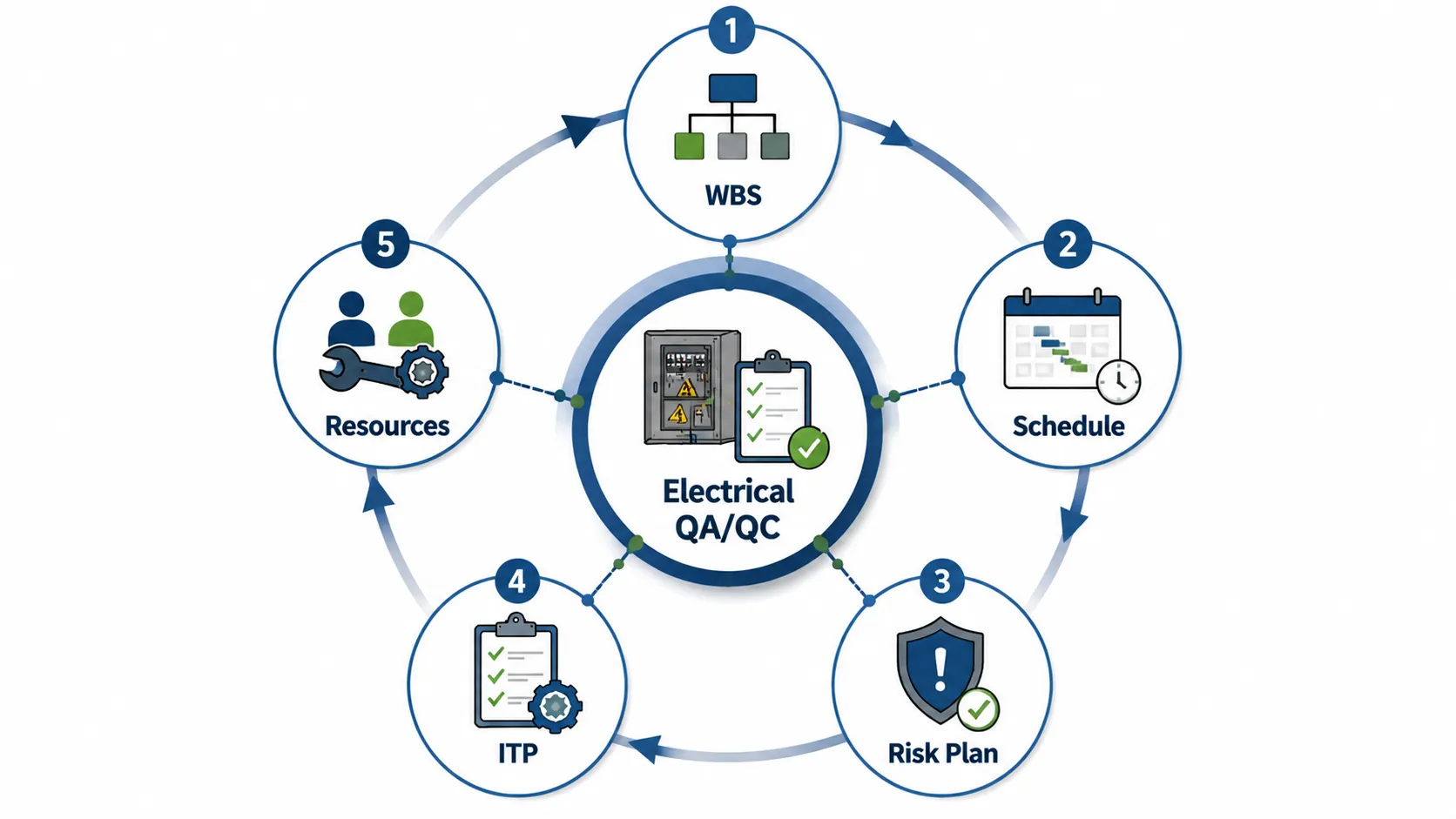
Critical Path Method (CPM)
Definition of Critical Path Method
Critical Path Method is a project planning technique used to identify activities that directly influence project completion time.
The critical path represents the sequence of activities where delays will directly affect the overall project schedule.
In electrical QA/QC operations, CPM helps identify quality activities that must be completed within specific timeframes.
Examples include:
- Equipment inspections before installation.
- Cable testing before energisation.
- Protection system testing before commissioning.
- Regulatory approvals before operation.
Application of CPM in Electrical QA/QC
CPM allows project teams to determine:
- Which quality activities are time-critical.
- Where additional resources may be required.
- Which delays could affect project completion.
For example:
If transformer testing is a critical activity before energisation, any delay in testing may prevent the entire commissioning process from progressing.
Using CPM, the project team can:
- Prioritise testing resources.
- Monitor critical activities closely.
- Develop contingency plans.
Benefits of CPM
Advantages include:
- Improved schedule control.
- Better identification of critical activities.
- Effective resource prioritisation.
- Reduced project delays.
Limitations of CPM
CPM has some limitations:
- It depends on accurate activity duration estimates.
- Unexpected technical problems may affect reliability.
- Complex projects may require additional planning tools.
Therefore, CPM should be combined with risk management techniques for complex electrical projects.
Programme and Schedule Management
Importance of Quality-Focused Scheduling
Electrical QA/QC activities must be integrated into the overall project programme rather than treated as separate tasks.
Quality scheduling ensures that inspections and testing occur at appropriate project stages.
A quality-focused schedule includes:
- Inspection dates.
- Testing milestones.
- Approval periods.
- Document submission dates.
- Audit activities.
Effective Schedule Management Practices
Successful schedule management involves:
- Regular progress reviews.
- Updating activity status.
- Monitoring delays.
- Coordinating stakeholders.
- Adjusting resources when required.
Effective scheduling prevents situations where quality activities become rushed due to construction delays.
Resource Planning for Electrical QA/QC Activities
Definition of Resource Planning
Resource planning involves identifying and allocating the personnel, equipment, materials, technology, and financial resources required to complete project activities successfully.
Electrical QA/QC operations require careful resource planning because quality activities depend on specialised expertise and equipment.
Types of Resources Required
Human Resources
Include:
- QA/QC engineers.
- Electrical inspectors.
- Testing engineers.
- Commissioning specialists.
- Document controllers.
Technical Resources
Include:
- Testing equipment.
- Calibration tools.
- Inspection devices.
- Digital quality systems.
Documentation Resources
Include:
- Inspection checklists.
- Testing procedures.
- Quality plans.
- Technical specifications.
Importance of Resource Planning
Effective resource planning helps:
- Prevent inspection delays.
- Ensure competent personnel availability.
- Improve testing efficiency.
- Reduce project interruptions.
Table 1: Comparison of Advanced Project Planning Techniques in Electrical QA/QC
| Planning Technique | Definition | QA/QC Application | Key Benefit | Limitation |
|---|---|---|---|---|
| Work Breakdown Structure (WBS) | Divides projects into manageable work packages | Organising inspection and testing activities | Improves project clarity | Requires regular updates |
| Critical Path Method (CPM) | Identifies activities affecting project completion | Managing critical testing and approval activities | Improves schedule control | Depends on accurate estimates |
| Schedule Management | Controls timing and sequencing of activities | Planning inspections and milestones | Reduces delays | Requires continuous monitoring |
| Resource Planning | Allocates required project resources | Managing inspectors and testing equipment | Improves resource efficiency | Resource constraints may affect plans |
Risk-Based Planning for Complex Electrical QA/QC Operations
Definition of Risk-Based Planning
Risk-based planning is an advanced project management approach that integrates risk identification, assessment, and control measures into the planning process. Instead of responding to quality problems after they occur, risk-based planning enables electrical QA/QC teams to identify potential failures in advance and establish preventive controls.
In complex electrical engineering projects, risks may arise from:
- Technical design challenges.
- Equipment reliability issues.
- Supplier performance problems.
- Installation quality variations.
- Testing failures.
- Regulatory compliance requirements.
- Resource limitations.
- Project schedule pressures.
By integrating risk analysis into project planning, organisations can prioritise quality activities based on potential impact and likelihood.
Application of Risk-Based Planning in Electrical QA/QC
Risk-based planning helps determine where additional quality controls are required.
For example, in a high-voltage substation project, risk analysis may identify protection systems, transformer installation, and cable termination activities as high-risk areas.
Based on this assessment, the QA/QC plan may include:
- Increased inspection frequency.
- Additional testing requirements.
- Specialist technical reviews.
- Enhanced documentation verification.
- Additional approval stages.
This ensures that quality resources are focused on activities with the greatest potential impact.
Risk Assessment Process in Electrical QA/QC Planning
A structured risk assessment process normally includes:
Risk Identification
The first step involves identifying possible threats that may affect project quality.
Sources of risk information include:
- Previous project lessons learned.
- Design reviews.
- Engineering calculations.
- Supplier evaluations.
- Quality performance records.
- Industry experience.
Risk Analysis
Identified risks are evaluated according to:
- Probability of occurrence.
- Severity of impact.
- Detectability.
- Consequences for project objectives.
Risk Control Planning
After evaluation, suitable control measures are developed.
Examples include:
- Additional inspection points.
- Improved testing procedures.
- Supplier audits.
- Workforce training.
- Alternative resource planning.
Benefits of Risk-Based Planning
Risk-based planning provides several advantages:
- Reduces unexpected quality failures.
- Improves resource allocation.
- Supports proactive decision-making.
- Enhances safety performance.
- Improves project predictability.
- Strengthens compliance management.
Inspection and Test Plan (ITP) Planning
Definition of Inspection and Test Plan
An Inspection and Test Plan (ITP) is a structured quality control document that defines inspection requirements, testing activities, acceptance criteria, responsibilities, and verification points throughout an electrical project.
The ITP ensures that quality requirements are systematically controlled during engineering, installation, and commissioning activities.
Importance of ITP Planning
A well-developed ITP provides a clear framework for:
- Inspection scheduling.
- Testing coordination.
- Quality verification.
- Stakeholder approval.
- Compliance monitoring.
Without effective ITP planning, critical inspection and testing activities may be missed, resulting in quality failures or commissioning delays.
Key Elements of an Electrical QA/QC ITP
An effective ITP normally includes:
- Activity description.
- Inspection requirements.
- Testing requirements.
- Acceptance criteria.
- Responsible personnel.
- Required documentation.
- Hold points.
- Witness points.
- Approval requirements.
Hold Points and Witness Points
Hold Points
A hold point is a mandatory stage where work cannot continue until inspection or approval has been completed.
Examples:
- Cable installation approval before backfilling.
- Transformer inspection before energisation.
- Protection testing approval before commissioning.
Witness Points
A witness point allows the client or inspector to observe an activity before continuation.
Examples:
- Equipment testing.
- Factory acceptance testing.
- Functional verification.
Benefits of Effective ITP Planning
ITP planning helps:
- Prevent quality defects.
- Improve inspection coordination.
- Ensure compliance.
- Provide documented evidence.
- Support project acceptance.
Digital Project Planning Tools in Electrical QA/QC
Role of Digital Technologies
Modern electrical projects increasingly use digital planning tools to improve efficiency, communication, and quality control.
Digital systems allow project teams to manage:
- Schedules.
- Inspection records.
- Testing information.
- Risk registers.
- Document approvals.
- Performance data.
Examples of Digital Planning Applications
Digital project planning tools support:
- Real-time progress monitoring.
- Automated notifications.
- Document version control.
- Quality dashboard reporting.
- Mobile inspection activities.
Benefits of Digital Planning Systems
Advantages include:
- Improved information accuracy.
- Faster communication.
- Better traceability.
- Reduced documentation errors.
- Improved decision-making.
Limitations of Digital Planning Tools
Although digital systems provide significant benefits, challenges may include:
- Training requirements.
- Initial implementation costs.
- Data management issues.
- Dependence on system availability.
Successful implementation requires proper planning, user training, and organisational support.
Critical Evaluation of Advanced Project Planning Techniques
Advanced planning techniques provide significant benefits for electrical QA/QC operations, but their suitability depends on project complexity, available resources, and organisational capability.
Evaluation of Work Breakdown Structure (WBS)
WBS is highly suitable for complex electrical projects because it provides detailed visibility of project activities.
Strengths include:
- Clear activity definition.
- Improved responsibility allocation.
- Better quality tracking.
However:
- Excessive breakdown can increase management complexity.
- Frequent project changes require continuous updates.
WBS is most effective when combined with schedule and risk management techniques.
Evaluation of Critical Path Method (CPM)
CPM is valuable for controlling time-critical quality activities.
Strengths include:
- Identifying schedule-sensitive activities.
- Supporting resource prioritisation.
- Improving completion forecasting.
Limitations include:
- Dependence on accurate activity duration estimates.
- Difficulty managing uncertain technical problems.
CPM should be supported by risk management for complex engineering projects.
Evaluation of Risk-Based Planning
Risk-based planning is highly effective for electrical QA/QC because it focuses resources on critical areas.
Advantages include:
- Proactive quality control.
- Improved safety management.
- Reduced unexpected failures.
Challenges include:
- Requires experienced risk assessment.
- Depends on reliable historical data.
For high-risk electrical projects, risk-based planning is considered one of the most effective approaches.
Evaluation of ITP Planning
ITP planning is essential for ensuring quality verification throughout project stages.
Advantages:
- Provides structured inspection control.
- Improves compliance evidence.
- Supports client confidence.
Limitations:
- Requires regular updates.
- Can become ineffective if not properly implemented.
Practical Workplace Example
A large industrial electrical project involved the installation of power distribution systems, control panels, protection equipment, and emergency power systems.
During early project planning, the QA/QC team identified several potential challenges:
- Limited testing resources.
- Complex commissioning requirements.
- Multiple contractors involved.
- Strict client compliance requirements.
To manage these challenges, the project team applied advanced planning techniques.
The Work Breakdown Structure divided the project into:
- Design verification.
- Equipment inspection.
- Installation monitoring.
- Testing activities.
- Commissioning verification.
The Critical Path Method identified protection testing and final commissioning as critical activities.
Risk-based planning identified high-risk areas requiring additional controls.
An advanced Inspection and Test Plan was developed to define:
- Inspection stages.
- Testing requirements.
- Approval points.
- Documentation responsibilities.
As a result:
- Quality issues were identified earlier.
- Testing activities were completed efficiently.
- Documentation compliance improved.
- Project handover occurred successfully.
This example demonstrates how combining multiple planning techniques creates a stronger QA/QC management framework.
Key Benefits of Applying Advanced Project Planning Techniques
Advanced project planning provides significant benefits for electrical QA/QC operations:
- Improved project control.
- Better coordination between engineering teams.
- Reduced quality risks.
- Enhanced compliance performance.
- Improved resource utilisation.
- Reduced rework.
- Better inspection management.
- Improved testing efficiency.
- Stronger documentation control.
- Increased stakeholder confidence.
- Improved project delivery performance.
Best Practices for Advanced Electrical QA/QC Planning
Effective organisations apply the following practices:
- Integrate QA/QC activities into the overall project programme.
- Use risk-based approaches for prioritising quality controls.
- Develop detailed inspection and testing plans.
- Allocate resources according to project requirements.
- Use digital tools for monitoring and reporting.
- Review plans regularly throughout the project lifecycle.
- Incorporate lessons learned from previous projects.
- Maintain communication between all stakeholders.
- Monitor performance against planned objectives.
Conclusion
Advanced project planning techniques are essential for managing complex electrical QA/QC operations effectively. Methods such as Work Breakdown Structure, Critical Path Method, risk-based planning, Inspection and Test Plan development, and digital project management tools provide structured approaches for controlling quality activities throughout the project lifecycle.
The effective application of these techniques enables electrical engineering organisations to improve coordination, reduce risks, optimise resources, maintain compliance, and achieve reliable project outcomes. By critically evaluating and selecting suitable planning methods according to project requirements, QA/QC professionals can establish proactive quality management systems that support successful delivery of complex electrical engineering projects.
2. Develop a Comprehensive Project Plan That Integrates Specific QA/QC Requirements for an Electrical Installation
A comprehensive project plan for electrical installation projects provides a structured framework for managing technical activities, resources, quality requirements, safety obligations, and compliance responsibilities from project initiation through final handover. In complex electrical engineering environments, successful project delivery depends not only on completing installation activities according to schedule but also on ensuring that every stage meets defined Quality Assurance and Quality Control (QA/QC) requirements.
Electrical installation projects involve multiple interconnected activities, including engineering design review, material procurement, equipment inspection, cable installation, testing, commissioning, documentation preparation, and client approval processes. Without effective integration of QA/QC requirements into the project plan, organisations may experience quality failures, installation defects, testing delays, compliance issues, and increased project costs.
A comprehensive QA/QC-integrated project plan ensures that quality requirements are established before work begins and remain controlled throughout the project lifecycle. It defines inspection points, testing procedures, acceptance criteria, responsibilities, documentation requirements, and monitoring processes to ensure that electrical installations achieve the required technical and regulatory standards.
Modern electrical engineering projects require a proactive approach where quality is planned, managed, and continuously improved rather than inspected only after installation completion. By integrating QA/QC requirements into project planning, electrical engineering organisations can improve reliability, reduce rework, enhance safety performance, and deliver installations that satisfy client expectations and regulatory requirements.
Understanding Comprehensive Project Planning for Electrical Installations
Definition of a Comprehensive Electrical Project Plan
A comprehensive electrical project plan is a detailed management document that defines how an electrical installation project will be executed, monitored, controlled, and completed while achieving technical, quality, safety, and compliance objectives.
The project plan integrates multiple project elements, including:
- Project scope and objectives.
- Engineering requirements.
- Installation activities.
- Quality control measures.
- Inspection and testing requirements.
- Resource allocation.
- Risk management strategies.
- Documentation processes.
- Communication procedures.
Unlike a basic construction schedule, a comprehensive project plan considers the complete relationship between engineering activities and quality requirements.
For example, an electrical installation plan must consider how:
- Design approvals affect procurement activities.
- Material inspections affect installation progress.
- Installation quality affects testing outcomes.
- Testing results affect commissioning approval.
- Documentation quality affects project handover.
A well-developed plan ensures that each activity is completed in the correct sequence while maintaining required quality standards.
Importance of Integrating QA/QC Requirements into Project Planning
Ensuring Installation Quality from the Beginning
Quality cannot be achieved effectively through final inspection alone. Electrical installation quality depends on controlling processes throughout every project stage.
Integrating QA/QC requirements into planning helps organisations establish:
- Defined quality objectives.
- Planned inspection activities.
- Controlled installation procedures.
- Verification processes.
- Acceptance requirements.
This approach ensures that potential quality issues are prevented before they become major project problems.
Reducing Installation Defects and Rework
Poor planning can result in:
- Incorrect installation methods.
- Material compatibility issues.
- Testing failures.
- Documentation errors.
- Delayed approvals.
A QA/QC-focused project plan reduces these risks by establishing clear quality controls before work begins.
Examples include:
- Reviewing approved drawings before installation.
- Verifying material certificates before use.
- Conducting inspections at critical stages.
- Performing testing according to approved procedures.
Supporting Regulatory and Client Compliance
Electrical installations must comply with various requirements, including:
- Project specifications.
- Engineering standards.
- Safety requirements.
- Client procedures.
- Quality management systems.
A comprehensive project plan ensures compliance activities are scheduled and controlled.
Examples include:
- Inspection approvals.
- Testing documentation.
- Calibration records.
- Material certification.
- Commissioning reports.
Key Components of a QA/QC Integrated Electrical Project Plan
Project Scope Definition
The first stage of developing a project plan is defining the project scope clearly.
The scope establishes:
- What electrical systems will be installed.
- Required performance requirements.
- Project boundaries.
- Quality expectations.
- Deliverables.
A clearly defined scope prevents misunderstandings and supports effective quality planning.
For electrical installation projects, scope definition may include:
- Power distribution systems.
- Lighting installations.
- Control systems.
- Protection systems.
- Communication networks.
- Testing and commissioning requirements.
Establishing Quality Objectives
Quality objectives define what the project must achieve in terms of performance, reliability, compliance, and workmanship.
Effective quality objectives should be:
- Specific.
- Measurable.
- Achievable.
- Relevant.
- Time-based.
Examples include:
- Achieving 100% completion of required inspections.
- Ensuring all testing records are approved before commissioning.
- Reducing installation-related non-conformances.
- Completing project documentation before handover.
Clear quality objectives provide direction for all project participants.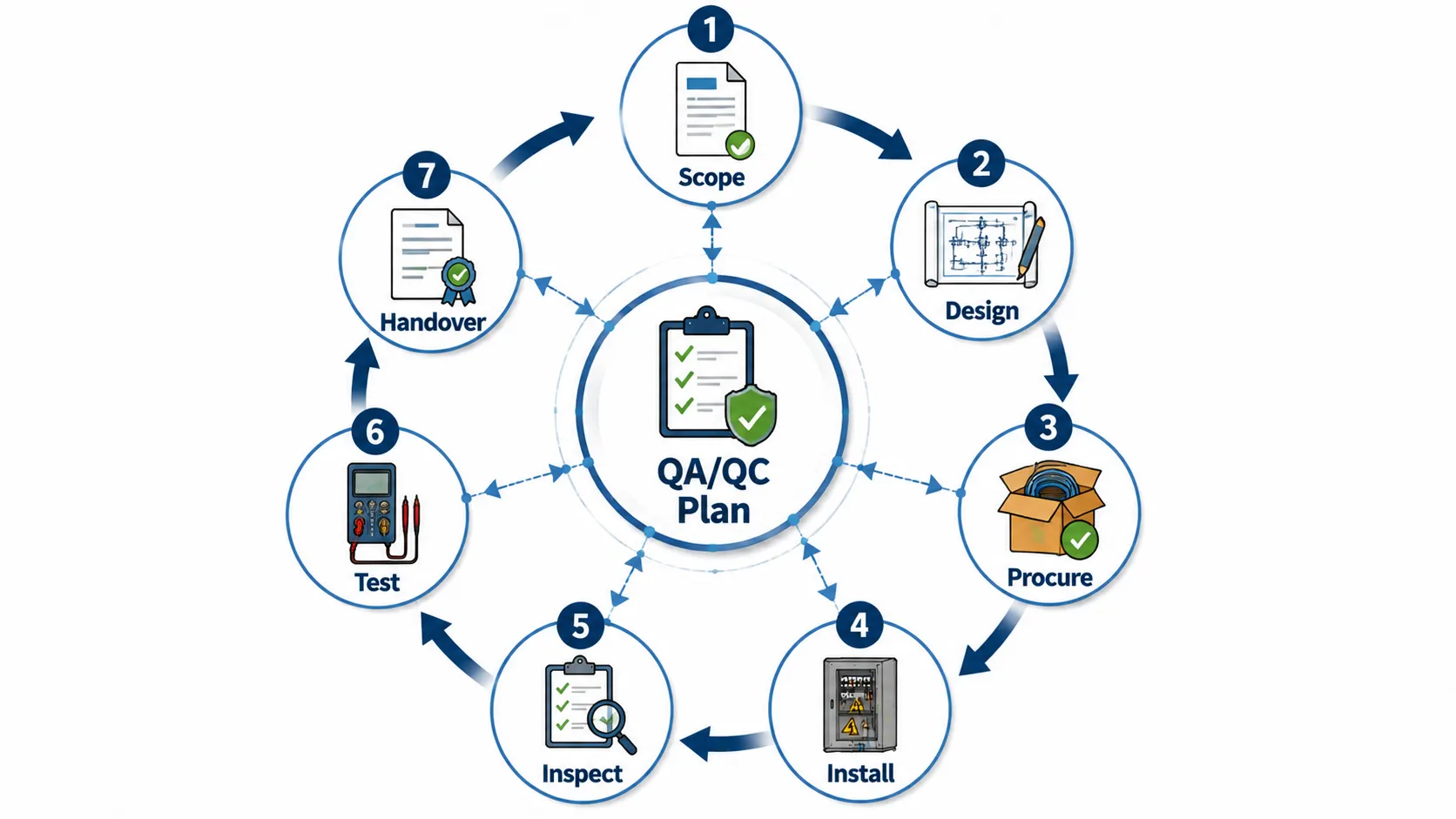
Integration of QA/QC Requirements Throughout the Project Lifecycle
Design Phase Quality Planning
The design phase establishes the foundation for electrical installation quality.
QA/QC planning during design should include:
- Design verification procedures.
- Technical drawing reviews.
- Specification checks.
- Compliance assessments.
- Design change control.
Quality activities during design include:
- Reviewing electrical calculations.
- Checking equipment ratings.
- Verifying protection coordination.
- Confirming compliance requirements.
Effective design quality planning reduces errors during later installation stages.
Procurement Quality Planning
Material and equipment quality significantly influence installation performance.
Procurement planning should integrate QA/QC requirements such as:
- Approved supplier selection.
- Material approval processes.
- Factory inspection requirements.
- Certificate verification.
- Delivery inspection procedures.
Examples of controlled procurement activities include:
- Reviewing manufacturer certificates.
- Checking equipment specifications.
- Verifying compliance documents.
- Inspecting delivered materials.
Poor procurement control can lead to:
- Incorrect equipment installation.
- Project delays.
- Testing failures.
- Increased replacement costs.
Installation Phase QA/QC Integration
Planning Installation Quality Controls
During installation, the project plan should define how workmanship and technical compliance will be controlled.
Installation quality planning includes:
- Approved installation procedures.
- Inspection schedules.
- Competency requirements.
- Workmanship standards.
- Site quality monitoring.
Key inspection activities may include:
- Cable routing inspection.
- Termination checks.
- Equipment installation verification.
- Earthing system inspection.
- Panel installation checks.
Inspection and Test Plan (ITP) Development
An Inspection and Test Plan is one of the most important QA/QC planning documents for electrical installations.
The ITP defines:
- What activities require inspection.
- When inspections occur.
- Who performs verification.
- Required acceptance criteria.
- Required documentation.
A typical electrical installation ITP includes:
| Project Stage | QA/QC Activity | Verification Method | Required Evidence |
|---|---|---|---|
| Material Delivery | Equipment inspection | Visual and document review | Inspection records |
| Installation | Workmanship verification | Site inspection | Checklists |
| Testing | Electrical performance testing | Approved test procedures | Test reports |
| Commissioning | System validation | Functional testing | Commissioning records |
The ITP ensures that quality control activities are planned rather than performed randomly.
Resource Planning for QA/QC Implementation
Human Resource Requirements
A successful electrical QA/QC plan requires competent personnel.
Required resources may include:
- QA/QC managers.
- Electrical engineers.
- Inspectors.
- Testing specialists.
- Commissioning engineers.
- Document controllers.
Responsibilities should be clearly defined to prevent confusion.
Equipment and Technical Resources
Quality activities require appropriate technical resources, including:
- Calibrated testing instruments.
- Inspection tools.
- Digital reporting systems.
- Technical documentation.
Examples:
- Insulation resistance testers.
- Earth resistance testers.
- Protection testing equipment.
- Cable testing equipment.
Proper resource planning ensures inspections and testing activities are completed accurately and efficiently.
Risk Integration Within an Electrical QA/QC Project Plan
Importance of Risk-Based Quality Planning
Risk management is a critical element of comprehensive electrical project planning because electrical installations involve complex technical activities, safety requirements, and operational challenges. Integrating risk assessment into the project plan enables QA/QC teams to identify potential quality failures before they occur and establish appropriate preventive measures.
A risk-based QA/QC approach ensures that project resources are focused on areas with the highest potential impact on safety, reliability, compliance, and project performance.
Electrical installation risks may include:
- Incorrect equipment selection.
- Poor installation practices.
- Material defects.
- Testing failures.
- Inadequate documentation.
- Non-compliance with technical requirements.
- Lack of competent personnel.
- Delays caused by approval processes.
A comprehensive project plan should identify these risks during the planning stage and include suitable control measures.
Developing a Risk Management Process
Risk Identification
The first stage of risk integration is identifying possible threats that may affect electrical installation quality.
Risk identification activities include:
- Reviewing previous project lessons learned.
- Analysing design documents.
- Conducting technical reviews.
- Assessing supplier performance.
- Reviewing installation methods.
- Evaluating regulatory requirements.
Examples of identified risks:
- Incorrect cable sizing.
- Incomplete testing procedures.
- Unapproved material substitution.
- Poor coordination between contractors.
- Delayed inspection approvals.
Risk Assessment and Prioritisation
After identifying risks, each risk should be assessed based on:
- Probability of occurrence.
- Severity of impact.
- Ability to detect the issue before failure.
High-risk activities require stronger quality controls.
Examples of high-risk electrical activities:
- High-voltage equipment installation.
- Protection system testing.
- Transformer commissioning.
- Earthing system verification.
- Energisation procedures.
Risk prioritisation allows QA/QC teams to allocate inspection resources effectively.
Risk Control Measures
The project plan should define actions to reduce identified risks.
Control measures may include:
- Additional inspection points.
- Increased testing requirements.
- Specialist technical reviews.
- Improved installation procedures.
- Additional workforce training.
- Enhanced documentation checks.
Effective risk control improves project reliability and reduces unexpected quality failures.
Quality Documentation Planning
Importance of Documentation Control
Documentation is a fundamental component of electrical QA/QC management. A comprehensive project plan must define how quality records will be created, reviewed, approved, stored, and controlled.
Quality documentation provides evidence that:
- Work was completed according to requirements.
- Inspections were performed correctly.
- Testing results meet acceptance criteria.
- Materials comply with specifications.
Poor documentation control can result in:
- Delayed approvals.
- Audit failures.
- Difficulty during commissioning.
- Reduced client confidence.
Key QA/QC Documents in Electrical Installation Projects
A project plan should identify required quality documents, including:
- Quality Management Plan.
- Inspection and Test Plan (ITP).
- Method statements.
- Inspection checklists.
- Material approval records.
- Calibration certificates.
- Test reports.
- Non-Conformance Reports (NCRs).
- Corrective action records.
- As-built drawings.
- Commissioning documentation.
Document Control Procedures
Effective document control procedures include:
- Revision management.
- Approval workflows.
- Access control.
- Document tracking.
- Record retention.
These controls ensure that project teams always use the latest approved information.
Communication and Stakeholder Coordination
Importance of Effective Communication
Electrical projects involve multiple stakeholders, including:
- Project managers.
- Electrical engineers.
- QA/QC teams.
- Contractors.
- Suppliers.
- Clients.
- Regulatory authorities.
A comprehensive project plan must establish communication processes to ensure that quality information is shared effectively.
Poor communication can lead to:
- Incorrect installation decisions.
- Delayed inspections.
- Unresolved quality issues.
- Conflicting requirements.
QA/QC Communication Methods
Effective communication methods include:
- Quality meetings.
- Progress reviews.
- Inspection coordination meetings.
- Technical discussions.
- Digital reporting platforms.
- Corrective action reviews.
Regular communication ensures that quality concerns are identified and resolved quickly.
Monitoring and Controlling QA/QC Performance
Quality Performance Monitoring
A project plan should include methods for measuring quality performance throughout the installation lifecycle.
Performance monitoring may include:
- Inspection completion rates.
- Non-conformance trends.
- Testing performance.
- Corrective action progress.
- Audit results.
- Documentation status.
These indicators help determine whether project quality objectives are being achieved.
Key Performance Indicators (KPIs)
KPIs provide measurable evidence of quality performance.
Electrical QA/QC KPIs may include:
- Percentage of completed inspections.
- Number of NCRs identified.
- Time taken to close corrective actions.
- Testing success rate.
- Supplier quality performance.
- Documentation approval status.
Monitoring KPIs enables project teams to make informed decisions and implement improvements.
Change Management Within Electrical Projects
Managing Changes Effectively
Electrical projects frequently experience changes due to:
- Design modifications.
- Client requirements.
- Equipment availability.
- Regulatory updates.
- Site conditions.
A comprehensive project plan must include a controlled change management process.
Change control should include:
- Change identification.
- Technical evaluation.
- Quality impact assessment.
- Approval process.
- Document updates.
Importance of Change Control in QA/QC
Effective change management prevents:
- Installation errors.
- Use of outdated information.
- Testing failures.
- Compliance issues.
Every approved change should be reflected in:
- Drawings.
- Specifications.
- Inspection procedures.
- Testing requirements.
- Project documentation.
Practical Workplace Example: QA/QC Integrated Electrical Installation Project Plan
A large commercial electrical installation project involved the installation of power distribution systems, emergency lighting, fire alarm interfaces, and control equipment.
During project planning, the QA/QC team developed a comprehensive project plan integrating quality requirements.
The planning process included:
Project Scope Planning
The team defined:
- Electrical system requirements.
- Installation boundaries.
- Testing expectations.
- Handover requirements.
Quality Planning
The team developed:
- Quality management procedures.
- Inspection schedules.
- Inspection and Test Plans.
- Testing documentation requirements.
Risk Planning
Potential risks were identified:
- Incorrect cable installation.
- Equipment delivery delays.
- Testing failures.
Control measures included:
- Additional inspection points.
- Supplier verification.
- Specialist testing support.
Implementation Results
The integrated project plan resulted in:
- Improved inspection coordination.
- Reduced installation defects.
- Faster approval processes.
- Better documentation quality.
- Successful project handover.
This example demonstrates how effective planning improves electrical installation quality and project performance.
Key Benefits of a QA/QC Integrated Electrical Project Plan
Developing a comprehensive project plan with integrated QA/QC requirements provides significant advantages:
- Improved project coordination.
- Enhanced installation quality.
- Reduced technical risks.
- Better compliance management.
- Lower rework costs.
- Improved testing efficiency.
- Stronger documentation control.
- Better stakeholder communication.
- Increased client confidence.
- Improved project delivery performance.
Best Practices for Developing Electrical QA/QC Project Plans
Successful electrical projects should adopt the following practices:
- Define quality requirements at the beginning of the project.
- Integrate QA/QC activities into the overall project schedule.
- Develop detailed Inspection and Test Plans.
- Apply risk-based quality controls.
- Ensure competent personnel are assigned.
- Maintain accurate documentation.
- Monitor quality performance regularly.
- Manage changes through formal procedures.
- Use digital tools for quality tracking.
- Capture lessons learned for future projects.
Conclusion
Developing a comprehensive project plan that integrates specific QA/QC requirements is essential for achieving successful electrical installation outcomes. Effective planning ensures that quality requirements are established, controlled, and monitored throughout every stage of the project lifecycle.
By combining project scope management, risk-based planning, inspection strategies, documentation control, resource management, and performance monitoring, electrical engineering organisations can reduce quality failures and improve project reliability.
A well-structured QA/QC integrated project plan enables teams to deliver electrical installations that meet technical specifications, regulatory requirements, and client expectations while supporting safe, efficient, and sustainable engineering practices.
3. Adapt Planning Methods to Address Unpredictable Factors and Resource Constraints in Live Electrical Projects
Live electrical projects operate within highly dynamic environments where conditions can change rapidly due to technical challenges, operational requirements, supply chain limitations, regulatory updates, stakeholder decisions, and unexpected site conditions. Unlike projects planned in controlled environments, live electrical installations require continuous adaptation to maintain safety, quality, compliance, and delivery objectives.
Advanced project planning in electrical QA/QC environments must therefore include flexibility, contingency strategies, and adaptive decision-making approaches. A fixed project plan developed at the beginning of a project may become ineffective when unforeseen circumstances affect resources, timelines, installation methods, or quality requirements. Effective planning methods must allow project teams to respond quickly while maintaining control over quality processes.
Adapting planning methods involves reviewing existing schedules, reallocating resources, modifying work sequences, reassessing risks, and implementing corrective strategies without compromising electrical installation standards. This approach enables QA/QC teams to maintain inspection requirements, testing procedures, documentation control, and compliance obligations even when project conditions become unpredictable.
For complex electrical engineering projects, adaptive planning is essential because quality failures often occur when teams respond to unexpected situations without proper planning controls. A flexible planning approach ensures that changes are managed systematically rather than through uncontrolled decisions that may create additional risks.
Understanding Adaptive Planning in Live Electrical Projects
Definition of Adaptive Project Planning
Adaptive project planning is a flexible management approach that allows project plans, schedules, resources, and quality strategies to be modified according to changing project conditions.
In electrical QA/QC operations, adaptive planning ensures that quality objectives remain achievable even when unexpected challenges occur.
Adaptive planning focuses on:
Continuous monitoring of project conditions.
Early identification of changes.
Adjustment of project activities.
Effective resource redistribution.
Maintaining quality and compliance requirements.
Unlike traditional planning methods that assume stable project conditions, adaptive planning recognises that live electrical projects require continuous evaluation and improvement.
Importance of Adaptive Planning for Electrical QA/QC
Electrical projects involve many interconnected activities where one unexpected event can affect multiple project areas.
For example:
A delay in receiving electrical switchgear may affect:
Installation schedules.
Inspection activities.
Testing dates.
Commissioning plans.
Client handover timelines.
Without adaptive planning, project teams may experience:
Increased delays.
Reduced inspection quality.
Resource conflicts.
Increased rework.
Compliance risks.
Adaptive planning allows teams to respond effectively while maintaining project control.
Unpredictable Factors Affecting Live Electrical Projects
Technical Changes and Engineering Modifications
Electrical projects frequently experience technical changes due to design improvements, client requirements, site conditions, or engineering discoveries.
Examples include:
Modified electrical layouts.
Updated equipment specifications.
Changes in load requirements.
Revised protection settings.
Additional system requirements.
These changes can affect:
Installation activities.
Testing procedures.
Documentation requirements.
Resource planning.
QA/QC teams must ensure that technical changes are properly reviewed and incorporated into project plans.
Effective responses include:
Reviewing design changes before implementation.
Updating inspection requirements.
Revising testing procedures.
Controlling document revisions.
Communicating changes to relevant stakeholders.
Supply Chain and Material Availability Issues
Material availability is one of the most common unpredictable factors affecting electrical projects.
Challenges may include:
Delayed equipment deliveries.
Supplier manufacturing delays.
Material shortages.
Incorrect material supply.
Transportation problems.
These issues can interrupt planned installation sequences.
For example:
A project may schedule transformer installation in week six, but delayed delivery may require the team to reorganise activities and focus on cable containment, testing preparation, or documentation activities instead.
Adaptive planning strategies include:
Identifying alternative suppliers.
Prioritising critical materials.
Developing procurement contingency plans.
Adjusting installation sequences.
Monitoring supplier performance.
Site Conditions and Operational Constraints
Live electrical projects often face unexpected site conditions.
Examples include:
Limited access areas.
Existing operational systems.
Restricted working hours.
Space limitations.
Unexpected underground services.
Safety restrictions.
These conditions require project plans to be adjusted without affecting quality standards.
QA/QC considerations include:
Revising inspection schedules.
Modifying installation methods.
Increasing supervision.
Conducting additional risk assessments.
Managing Resource Constraints in Electrical Projects
Understanding Resource Constraints
Resource constraints occur when the availability of required resources is limited compared with project requirements.
In electrical QA/QC projects, resources may include:
Skilled personnel.
Testing equipment.
Materials.
Budget.
Time.
Technical information.
Resource limitations can affect project performance if not managed effectively.
Labour and Competency Constraints
Electrical projects require qualified and experienced personnel to perform installation, inspection, and testing activities.
Potential workforce challenges include:
Shortage of skilled electricians.
Limited availability of testing specialists.
Absence of experienced QA/QC inspectors.
Increased workload on existing teams.
Adaptive resource planning strategies include:
Prioritising critical activities.
Allocating skilled personnel to high-risk tasks.
Providing additional training.
Using specialist contractors when required.
Maintaining competency is essential because poor workmanship can directly affect electrical system reliability and safety.
Equipment and Testing Resource Limitations
Electrical QA/QC activities depend on specialised testing equipment.
Examples include:
Insulation resistance testers.
Protection relay testing equipment.
Earth resistance testers.
Power quality analysers.
Unexpected equipment issues may include:
Equipment failure.
Calibration delays.
Limited availability.
Maintenance requirements.
Adaptive planning methods include:
Scheduling equipment availability in advance.
Maintaining backup resources.
Prioritising essential testing activities.
Coordinating equipment sharing between teams.
Advanced Planning Techniques for Managing Uncertainty
Rolling Wave Planning
Rolling wave planning is an adaptive planning technique where detailed planning is completed for immediate activities while future activities remain at a higher planning level until more information becomes available.
This approach is highly suitable for electrical projects where future conditions may change.
Example:
A project team may develop detailed plans for current installation activities while keeping future commissioning activities flexible until equipment availability and testing requirements are confirmed.
Benefits include:
Improved flexibility.
Reduced planning errors.
Better response to changes.
Improved decision-making.
Contingency Planning
Contingency planning involves preparing alternative actions to manage unexpected events.
A contingency plan may address:
Supplier delays.
Equipment failure.
Workforce shortages.
Design changes.
Testing problems.
A strong contingency plan includes:
Identified risks.
Alternative solutions.
Responsible personnel.
Required resources.
Activation conditions.
For electrical QA/QC operations, contingency planning ensures that quality activities continue even during disruptions.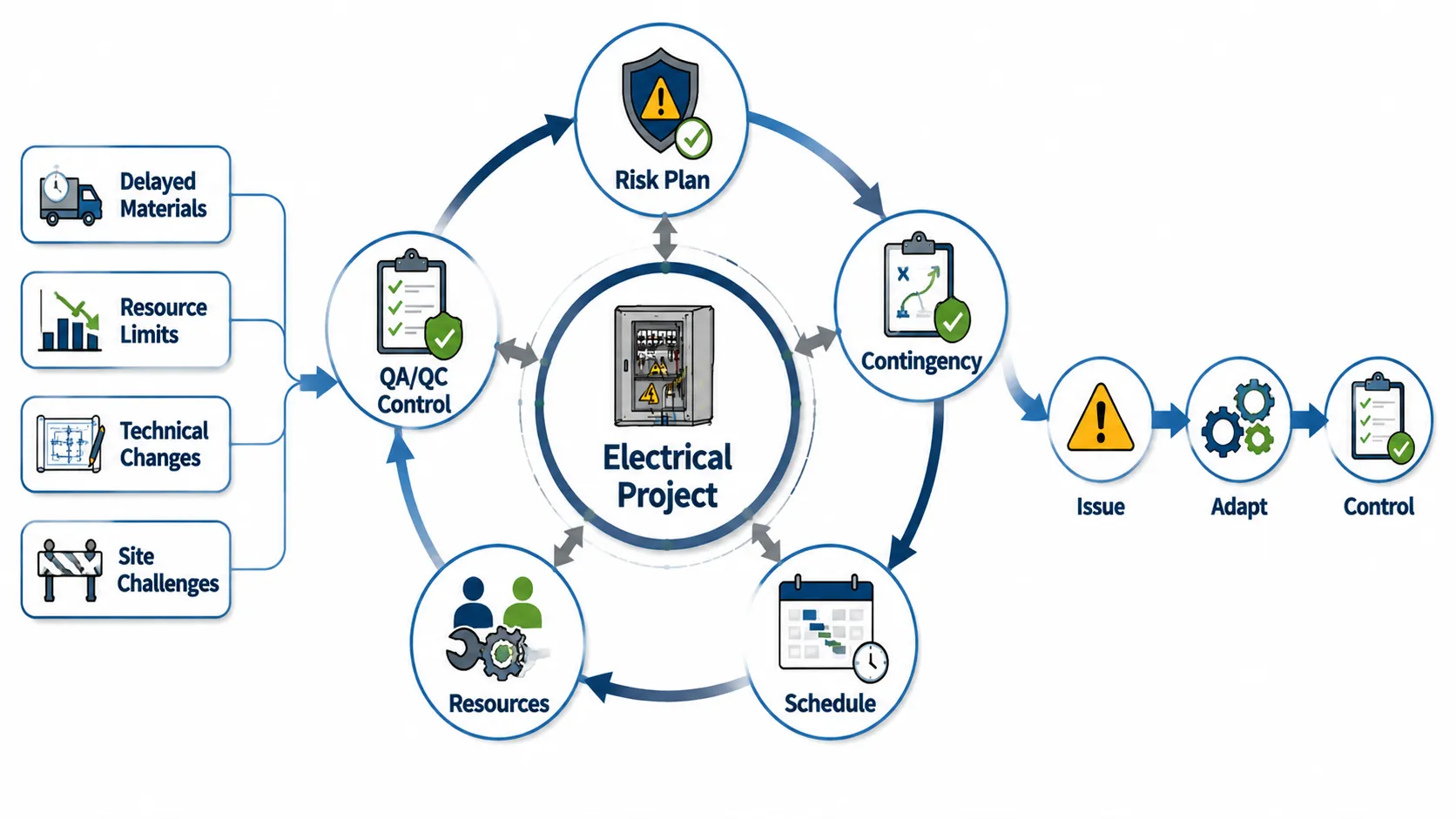
Dynamic Scheduling and Activity Adjustment
Importance of Dynamic Scheduling
Dynamic scheduling allows project schedules to be updated according to current project conditions.
Traditional schedules may become ineffective when unexpected events occur. Dynamic scheduling ensures that project activities remain realistic.
It involves:
Regular schedule reviews.
Progress evaluation.
Resource adjustment.
Activity reprioritisation.
Application in Electrical QA/QC
Dynamic scheduling helps manage:
Inspection delays.
Testing changes.
Material availability issues.
Contractor performance problems.
For example:
If installation work is delayed, QA/QC teams can adjust inspection sequences and focus on available activities rather than allowing quality activities to become delayed or rushed.
Risk-Based Adaptation for Unpredictable Electrical Project Conditions
Importance of Risk-Based Adaptation
Risk-based adaptation is an essential approach for managing uncertainty in live electrical projects because unexpected events can directly influence safety, quality, cost, and delivery performance. Instead of reacting after problems occur, risk-based adaptation enables project teams to anticipate potential disruptions and prepare suitable responses.
In electrical QA/QC operations, risk-based adaptation ensures that quality controls remain effective even when project conditions change.
Key areas where risk-based adaptation is applied include:
Installation activities.
Material availability.
Testing procedures.
Workforce planning.
Regulatory compliance.
Equipment reliability.
Project scheduling.
A risk-based approach allows QA/QC teams to identify which activities require additional monitoring and where resources should be prioritised.
Change Control Management in Live Electrical Projects
Importance of Controlled Change Management
Changes are unavoidable in complex electrical projects. However, uncontrolled changes can create serious quality and compliance issues.
Examples of uncontrolled changes include:
Using outdated drawings.
Installing unapproved materials.
Modifying systems without technical review.
Changing procedures without approval.
A structured change management process ensures that all modifications are evaluated before implementation.
Change Control Process
An effective electrical project change control process includes:
Change Identification
The project team identifies the reason for change.
Common causes include:
Client requirements.
Design improvements.
Site conditions.
Equipment availability.
Regulatory updates.
Technical Evaluation
The impact of the change is assessed.
Evaluation areas include:
Safety implications.
Quality impact.
Testing requirements.
Cost effects.
Schedule impact.
Approval and Implementation
Approved changes are incorporated into:
Project schedules.
Drawings.
Quality plans.
Inspection procedures.
Testing documentation.
Benefits of Change Control
Controlled change management provides:
Better quality consistency.
Reduced installation errors.
Improved documentation accuracy.
Stronger compliance performance.
Better stakeholder coordination.
Maintaining QA/QC Standards During Project Disruptions
Importance of Quality Continuity
When unexpected events occur, there is often pressure to accelerate activities or reduce controls to recover lost time. However, reducing QA/QC requirements can create long-term problems.
Maintaining quality standards during disruptions requires:
Protecting critical inspections.
Maintaining testing requirements.
Ensuring competent supervision.
Controlling documentation.
Quality should remain a priority even when project schedules are under pressure.
Strategies for Maintaining QA/QC During Disruptions
Effective strategies include:
Reprioritising inspection activities based on risk.
Increasing monitoring of critical work areas.
Conducting additional quality reviews.
Maintaining communication with stakeholders.
Using digital quality monitoring systems.
For example:
If a project experiences a major schedule delay, the QA/QC team should not remove mandatory testing activities. Instead, the team should adjust resources and sequencing to complete required inspections properly.
Resource Optimisation Strategies in Electrical Projects
Effective Resource Allocation
When resources are limited, project teams must ensure that available resources are used effectively.
Resource optimisation involves:
Prioritising critical activities.
Allocating skilled personnel efficiently.
Managing equipment availability.
Avoiding unnecessary resource conflicts.
In electrical QA/QC operations, resource optimisation ensures that essential quality activities are completed without compromising project objectives.
Resource Prioritisation Methods
Project teams can prioritise resources by considering:
Safety impact.
Quality risk.
Project importance.
Regulatory requirements.
Completion deadlines.
High-priority activities may include:
High-voltage testing.
Protection system verification.
Energisation approval.
Critical equipment inspection.
Communication and Coordination During Uncertainty
Role of Communication in Adaptive Planning
Effective communication is essential when project conditions change. Poor communication can result in incorrect decisions, duplicated work, and quality failures.
Adaptive planning requires continuous communication between:
Project managers.
Electrical engineers.
QA/QC teams.
Contractors.
Suppliers.
Clients.
Communication Methods
Useful communication methods include:
Daily coordination meetings.
Quality review meetings.
Digital reporting platforms.
Progress updates.
Technical discussions.
Clear communication ensures that all stakeholders understand:
Current project conditions.
Required changes.
Updated responsibilities.
Quality expectations.
Digital Tools Supporting Adaptive Project Planning
Role of Digital Project Management Systems
Digital technologies improve the ability of electrical project teams to respond quickly to changing conditions.
Digital planning systems support:
Real-time progress tracking.
Resource monitoring.
Document control.
Inspection management.
Risk tracking.
Examples include:
Digital QA/QC platforms.
Project scheduling software.
Mobile inspection applications.
Document management systems.
Benefits of Digital Adaptive Planning
Digital tools provide:
Faster decision-making.
Improved information accuracy.
Better project visibility.
Enhanced collaboration.
Improved traceability.
Comparison Table: Adaptive Planning Methods for Electrical Projects
| Planning Method | Definition | Application in Electrical QA/QC | Key Benefit | Challenge |
|---|---|---|---|---|
| Rolling Wave Planning | Plans immediate activities in detail while keeping future activities flexible | Managing changing installation and testing requirements | Improves flexibility | Requires frequent reviews |
| Contingency Planning | Develops alternative actions for unexpected events | Managing delays, shortages, and technical issues | Reduces disruption impact | Requires accurate risk identification |
| Dynamic Scheduling | Continuously updates project activities according to current conditions | Adjusting inspection and testing schedules | Improves schedule control | Requires regular monitoring |
| Risk-Based Planning | Prioritises activities based on potential impact | Managing high-risk electrical activities | Improves quality protection | Requires experienced assessment |
| Resource Optimisation | Uses available resources efficiently | Managing limited personnel and equipment | Improves productivity | Requires effective coordination |
Practical Workplace Example: Adapting Planning Methods in a Live Electrical Project
A large industrial electrical project involved the installation and commissioning of a power distribution system. The original project plan included fixed installation sequences, inspection schedules, and testing milestones.
During execution, several unexpected challenges occurred:
Delivery delays for critical electrical equipment.
Limited availability of specialist testing engineers.
Changes to installation requirements.
Restricted site access periods.
The project team adapted the planning approach by applying several techniques.
Rolling Wave Planning Application
The team focused detailed planning on immediate installation activities while keeping future commissioning activities flexible until equipment availability was confirmed.
Risk-Based Planning Application
High-risk activities were identified, including:
Protection testing.
Equipment energisation.
Cable verification.
Additional quality controls were introduced for these areas.
Resource Optimisation Application
Available testing specialists were allocated to critical systems first, while lower-risk activities were rescheduled.
Change Control Application
All design modifications were reviewed, approved, and incorporated into updated documentation.
Project Outcome
The adaptive planning approach achieved:
Successful completion of quality inspections.
Reduced installation defects.
Improved testing coordination.
Compliance with project requirements.
Successful system commissioning.
This example demonstrates that flexible planning methods allow electrical projects to respond effectively to uncertainty without reducing QA/QC standards.
Key Benefits of Adaptive Planning in Electrical QA/QC Operations
Applying adaptive planning methods provides several important advantages:
Improved response to unexpected challenges.
Reduced project disruption.
Better resource utilisation.
Stronger quality control.
Improved safety performance.
Enhanced compliance management.
Reduced rework and delays.
Better stakeholder confidence.
Improved project delivery reliability.
Greater flexibility in complex environments.
Best Practices for Adapting Planning Methods
Electrical project teams should apply the following best practices:
Review project plans regularly.
Integrate risk assessment into planning activities.
Maintain contingency strategies.
Protect critical QA/QC activities during disruptions.
Use accurate project performance data.
Maintain effective communication channels.
Control all project changes formally.
Train teams on adaptive working methods.
Use digital tools for monitoring and reporting.
Capture lessons learned for future projects.
Conclusion
Adapting planning methods to address unpredictable factors and resource constraints is essential for successful delivery of live electrical projects. Complex electrical environments require flexible approaches that allow project teams to respond to changes while maintaining quality, safety, and compliance requirements.
Techniques such as rolling wave planning, contingency planning, dynamic scheduling, risk-based planning, and resource optimisation provide effective methods for managing uncertainty. When integrated with strong QA/QC controls, these approaches enable organisations to maintain installation quality, reduce project risks, and achieve reliable engineering outcomes.
Effective adaptive planning does not mean changing project objectives; rather, it ensures that project teams have the flexibility and control required to achieve those objectives despite changing conditions. For modern electrical engineering projects, adaptive planning is a key capability that supports efficient delivery, regulatory compliance, and long-term system reliability.
4. Implement Advanced Planning Tools to Coordinate and Oversee Complex, Interacting Electrical QA/QC Activities
Complex electrical engineering projects require effective coordination between multiple activities, teams, resources, and quality requirements. As electrical systems become more advanced, QA/QC operations involve a wide range of interconnected processes, including design verification, material inspection, installation monitoring, testing, commissioning, documentation control, and regulatory compliance. Managing these activities manually or through basic planning methods can create difficulties in maintaining visibility, controlling risks, and ensuring consistent quality performance.
Advanced planning tools provide structured solutions for managing complex electrical QA/QC activities by improving coordination, communication, monitoring, and decision-making. These tools enable project teams to integrate schedules, quality requirements, risk information, resource availability, and performance data into a unified management approach.
In modern electrical projects, advanced planning tools support proactive quality management by allowing QA/QC professionals to identify potential issues early, track progress in real time, manage changing conditions, and maintain compliance throughout the project lifecycle. These systems help transform quality management from a reactive inspection process into a strategic control mechanism that supports successful project delivery.
Effective implementation of advanced planning tools requires understanding project requirements, selecting suitable technologies, integrating quality processes, training personnel, and ensuring that all stakeholders use consistent information systems. When properly applied, these tools improve efficiency, reduce errors, enhance traceability, and strengthen the overall performance of electrical QA/QC operations.
Understanding Advanced Planning Tools in Electrical QA/QC
Definition of Advanced Planning Tools
Advanced planning tools are digital, analytical, and management systems used to organise, monitor, and control complex project activities through structured data, automated processes, and real-time information sharing.
Within electrical QA/QC environments, these tools support:
Project scheduling.
Inspection coordination.
Testing management.
Resource allocation.
Risk monitoring.
Document control.
Performance evaluation.
Unlike traditional planning methods based mainly on spreadsheets and manual reporting, advanced planning tools provide integrated platforms where multiple project functions can communicate and share information effectively.
For example, a digital QA/QC planning system can connect:
Project schedules.
Inspection requirements.
Testing activities.
Non-conformance records.
Corrective actions.
Approval workflows.
This integration provides better visibility of project quality performance.
Importance of Advanced Planning Tools in Electrical QA/QC Operations
Improving Coordination of Complex Activities
Electrical projects involve many activities that must occur in a controlled sequence.
Examples include:
Equipment delivery before installation.
Installation completion before inspection.
Inspection approval before testing.
Testing completion before commissioning.
Documentation approval before handover.
Advanced planning tools help coordinate these relationships by providing clear visibility of activity dependencies.
Benefits include:
Improved workflow management.
Reduced activity conflicts.
Better communication between teams.
Improved project control.
Supporting Real-Time Quality Monitoring
Traditional quality monitoring methods often depend on periodic reports, which may delay decision-making.
Advanced tools allow project teams to monitor:
Inspection status.
Testing progress.
Quality issues.
Resource availability.
Schedule performance.
Real-time monitoring enables faster response to problems and improves project decision-making.
Enhancing Data-Based Decision-Making
Modern QA/QC management depends on accurate project data.
Advanced planning tools collect and analyse information such as:
Inspection results.
Testing records.
Defect trends.
Schedule performance.
Risk indicators.
This allows engineers and project managers to make decisions based on evidence rather than assumptions.
Key Concepts of Advanced Planning Tool Implementation
Integration of Project and Quality Management
One of the most important concepts in advanced planning is the integration of project management and QA/QC systems.
Quality activities should not operate separately from project planning.
Integration ensures that:
Quality requirements are included in schedules.
Inspection activities are planned in advance.
Testing resources are available.
Documentation requirements are controlled.
For example, when a project schedule shows cable installation activities, the planning system should also identify:
Required inspections.
Testing stages.
Responsible personnel.
Approval requirements.
Data Visibility and Traceability
Traceability is essential in electrical QA/QC operations because project teams must demonstrate that work has been completed according to requirements.
Advanced planning tools improve traceability by maintaining records of:
Material approvals.
Inspection results.
Test certificates.
Document revisions.
Corrective actions.
This information provides evidence during:
Client reviews.
Internal audits.
Regulatory inspections.
Project handover.
Advanced Project Scheduling Tools
Role of Scheduling Software in Electrical QA/QC
Project scheduling tools are essential for managing complex electrical installation activities.
These tools help coordinate:
Project milestones.
Installation sequences.
Inspection points.
Testing schedules.
Resource requirements.
Scheduling software allows project teams to identify delays and adjust activities before they affect project completion.
Applications in Electrical QA/QC
Scheduling tools can be used to manage:
Electrical installation programmes.
Inspection and Test Plan activities.
Commissioning schedules.
Contractor activities.
Approval timelines.
For example:
A project schedule can identify that transformer installation must be completed before protection testing can begin. The QA/QC team can then plan inspection resources accordingly.
Benefits of Scheduling Tools
Advantages include:
Improved time management.
Better activity coordination.
Early identification of delays.
Improved resource planning.
Better communication.
Building Information Modelling (BIM) Integration
Role of BIM in Electrical Quality Planning
Building Information Modelling (BIM) provides a digital representation of electrical systems and project information.
BIM supports QA/QC activities by improving:
Design coordination.
Installation planning.
Clash detection.
Asset information management.
In complex electrical projects, BIM helps identify potential issues before physical installation begins.
Applications of BIM in Electrical QA/QC
BIM can support:
Electrical layout verification.
Equipment coordination.
Installation sequence planning.
As-built information management.
Examples include:
Identifying conflicts between cable routes and mechanical systems.
Reviewing equipment access requirements.
Verifying installation locations.
Benefits of BIM-Based Planning
BIM integration provides:
Improved design accuracy.
Reduced installation conflicts.
Better coordination between disciplines.
Enhanced project documentation.
Digital Quality Management Systems (QMS)
Definition of Digital QMS
A Digital Quality Management System is an electronic platform used to manage quality processes, records, inspections, approvals, and corrective actions.
Digital QMS solutions replace manual quality documentation with controlled digital workflows.
Applications in Electrical QA/QC
Digital QMS platforms support:
Electronic inspection forms.
Digital approval processes.
Non-conformance management.
Corrective action tracking.
Quality reporting.
For example, an inspector working on-site can record inspection results digitally and immediately upload evidence for review.
Benefits of Digital QMS
Key benefits include:
Faster information sharing.
Reduced documentation errors.
Improved record control.
Better audit readiness.
Enhanced quality visibility.
Risk Management Planning Tools
Role of Risk Tools in QA/QC Coordination
Risk management tools help identify, analyse, and monitor potential threats that may affect electrical project quality.
These tools support:
Risk registers.
Risk scoring.
Mitigation tracking.
Responsibility assignment.
Applications in Electrical Projects
Risk tools can monitor:
Equipment delivery risks.
Installation quality risks.
Testing failures.
Compliance issues.
Resource limitations.
By integrating risk information with project planning systems, teams can prioritise high-impact activities.
Table: Comparison of Advanced Planning Tools for Electrical QA/QC
| Planning Tool | Definition | Electrical QA/QC Application | Key Benefit | Common Challenge |
|---|---|---|---|---|
| Scheduling Software | Digital system for managing project activities and timelines | Coordinating inspections, testing, and installation activities | Improves schedule control | Requires accurate updates |
| BIM | Digital model containing project information | Supporting design review and installation coordination | Reduces conflicts | Requires skilled users |
| Digital QMS | Electronic quality management platform | Managing inspections, NCRs, and quality records | Improves traceability | Requires implementation training |
| Risk Management Tools | Systems for identifying and controlling project risks | Monitoring quality and compliance risks | Supports proactive decisions | Depends on quality risk data |
Dashboard and KPI Monitoring Tools for Electrical QA/QC Management
Role of Performance Dashboards in Quality Planning
Performance dashboards are advanced monitoring tools that provide a visual representation of project quality information, enabling engineering teams to understand current performance conditions quickly. In complex electrical projects, dashboards support effective supervision by presenting important quality indicators in an organised and accessible format.
A QA/QC dashboard combines information from multiple sources, including:
Inspection records.
Testing results.
Non-Conformance Reports (NCRs).
Corrective action status.
Project progress data.
Risk information.
Compliance records.
These tools allow project managers and QA/QC engineers to identify performance trends and make timely decisions.
Applications of Dashboards in Electrical QA/QC
Electrical QA/QC dashboards can monitor:
Completed inspections.
Pending approvals.
Testing completion percentages.
Defect trends.
Corrective action progress.
Contractor performance.
For example, a dashboard may indicate that cable testing activities are delayed compared with the project schedule. The QA/QC team can investigate the cause and allocate additional resources before the delay affects commissioning.
Benefits of Dashboard Monitoring
Effective dashboard implementation provides:
Real-time quality visibility.
Faster problem identification.
Improved management decisions.
Better stakeholder communication.
Increased project transparency.
Resource Management Tools for Complex Electrical Projects
Importance of Resource Coordination
Electrical QA/QC activities require effective management of skilled personnel, equipment, materials, and time. Resource management tools help project teams ensure that required resources are available when needed.
Poor resource planning may result in:
Inspection delays.
Testing interruptions.
Increased project costs.
Reduced quality performance.
Advanced resource management systems help balance project demands with available resources.
Types of Resources Managed
Resource planning tools support management of:
Human Resources
Including:
QA/QC engineers.
Electrical inspectors.
Testing specialists.
Commissioning engineers.
Document controllers.
Technical Resources
Including:
Testing equipment.
Calibration instruments.
Inspection tools.
Digital systems.
Project Resources
Including:
Time allocation.
Contractor availability.
Budget requirements.
Material availability.
Benefits of Resource Management Tools
These tools support:
Efficient workforce planning.
Reduced resource conflicts.
Better testing coordination.
Improved productivity.
Effective workload distribution.
Document Control and Collaboration Platforms
Importance of Document Management in Electrical QA/QC
Electrical projects generate large volumes of technical documentation throughout their lifecycle.
Examples include:
Engineering drawings.
Inspection records.
Test reports.
Material certificates.
Method statements.
Approval documents.
Commissioning records.
Document control platforms ensure that project teams use accurate and approved information.
Functions of Document Control Systems
Advanced document management systems provide:
Version control.
Approval workflows.
Document tracking.
Access management.
Revision history.
These functions prevent common quality problems such as:
Using outdated drawings.
Missing approval records.
Incorrect installation information.
Documentation gaps during handover.
Benefits of Digital Document Control
Advantages include:
Improved information accuracy.
Better traceability.
Faster approvals.
Reduced administrative errors.
Improved audit preparation.
Coordinating Interacting Electrical QA/QC Activities
Managing Multiple Quality Processes
Complex electrical projects involve many quality activities that must operate together effectively.
Examples include:
Design verification.
Material inspection.
Installation monitoring.
Testing.
Commissioning.
Documentation approval.
Advanced planning tools help connect these activities so that one process supports another.
For example:
Before electrical equipment testing begins:
Installation inspection must be completed.
Approved procedures must be available.
Testing equipment must be prepared.
Required documentation must be reviewed.
Planning tools help ensure that these dependencies are managed correctly.
Integration of Planning Tools Across Project Phases
Design Phase Coordination
During the design phase, advanced tools support:
Drawing management.
Design review scheduling.
Technical approval tracking.
Compliance verification.
QA/QC teams can monitor:
Design changes.
Review status.
Approval requirements.
Outstanding technical issues.
Procurement Phase Coordination
Planning tools support procurement quality control through:
Supplier monitoring.
Material approval tracking.
Delivery scheduling.
Inspection planning.
Quality teams can verify:
Material specifications.
Manufacturer certificates.
Inspection requirements.
Delivery status.
Installation Phase Coordination
During installation, planning tools support:
Work progress monitoring.
Inspection scheduling.
Contractor coordination.
Quality reporting.
Examples include:
Tracking cable installation inspections.
Monitoring equipment installation status.
Managing corrective actions.
Testing and Commissioning Coordination
Testing and commissioning require strong coordination because multiple systems must work together.
Advanced tools help manage:
Test schedules.
Test documentation.
Engineer availability.
Approval processes.
Examples include:
Protection relay testing.
Functional testing.
System verification.
Performance validation.
Handover Phase Coordination
During project completion, planning tools support:
Document collection.
Final inspection tracking.
Client approvals.
As-built information management.
This ensures that the project is transferred successfully with complete quality records.
Data-Driven Decision Making in Electrical QA/QC
Importance of Quality Data Analysis
Advanced planning tools provide valuable project data that can support continuous improvement.
QA/QC teams can analyse:
Defect frequency.
Inspection performance.
Testing results.
Contractor quality trends.
Risk performance.
Data analysis helps identify:
Recurring problems.
Process weaknesses.
Improvement opportunities.
Example of Data-Based Improvement
If dashboard data shows repeated cable termination failures, the QA/QC team can investigate:
Installation procedures.
Workforce competency.
Material quality.
Supervision effectiveness.
Based on findings, improvement actions can be developed.
Managing Multiple Contractors and Stakeholders
Importance of Stakeholder Coordination
Large electrical projects often involve multiple organisations working together.
Stakeholders may include:
Main contractors.
Electrical subcontractors.
Equipment suppliers.
Consultants.
Clients.
Regulatory bodies.
Advanced planning tools provide a shared platform where stakeholders can:
Access updated information.
Review progress.
Track quality issues.
Manage approvals.
Benefits of Improved Coordination
Effective coordination results in:
Reduced communication errors.
Faster issue resolution.
Improved responsibility clarity.
Better project control.
Practical Workplace Example: Using Advanced Planning Tools in an Electrical Project
A large renewable energy project required installation of electrical distribution systems, protection equipment, and monitoring systems.
The project involved:
Multiple contractors.
Tight completion deadlines.
Complex testing requirements.
Strict quality standards.
The QA/QC team implemented advanced planning tools.
Scheduling System Implementation
The team used digital scheduling tools to coordinate:
Installation activities.
Inspection points.
Testing dates.
Commissioning milestones.
Digital QMS Implementation
A digital quality system was introduced to manage:
Inspection records.
NCRs.
Corrective actions.
Approval workflows.
Dashboard Monitoring
Performance dashboards tracked:
Inspection completion.
Testing progress.
Quality issues.
Contractor performance.
Project Outcome
The implementation resulted in:
Improved communication.
Faster quality issue resolution.
Better documentation control.
Reduced project delays.
Successful commissioning.
This case demonstrates how advanced planning tools improve coordination and control within complex electrical QA/QC environments.
Key Benefits of Implementing Advanced Planning Tools
The implementation of advanced planning tools provides significant advantages:
Improved coordination of complex activities.
Better quality monitoring.
Faster decision-making.
Enhanced project visibility.
Improved risk control.
Better resource utilisation.
Reduced documentation errors.
Increased compliance confidence.
Improved stakeholder communication.
Enhanced project delivery performance.
Best Practices for Implementing Advanced Planning Tools
Electrical engineering organisations should consider the following practices:
Select tools according to project complexity.
Integrate planning systems with QA/QC processes.
Train users before implementation.
Maintain accurate project data.
Establish clear responsibilities.
Review system performance regularly.
Encourage stakeholder collaboration.
Protect data accuracy and security.
Use dashboards for continuous improvement.
Update processes based on lessons learned.
Conclusion
Implementing advanced planning tools is essential for coordinating and overseeing complex, interacting electrical QA/QC activities. Modern electrical projects require integrated approaches that combine scheduling, quality management, risk control, resource planning, and digital information management.
Advanced tools such as scheduling platforms, BIM systems, digital QMS solutions, dashboards, and document control systems enable organisations to manage complex relationships between project activities effectively. These technologies improve visibility, support evidence-based decisions, enhance traceability, and strengthen quality performance.
When properly implemented, advanced planning tools allow electrical QA/QC teams to move beyond traditional monitoring approaches and establish proactive quality management systems. This ensures that electrical installations are delivered safely, efficiently, and in compliance with technical and regulatory requirements.