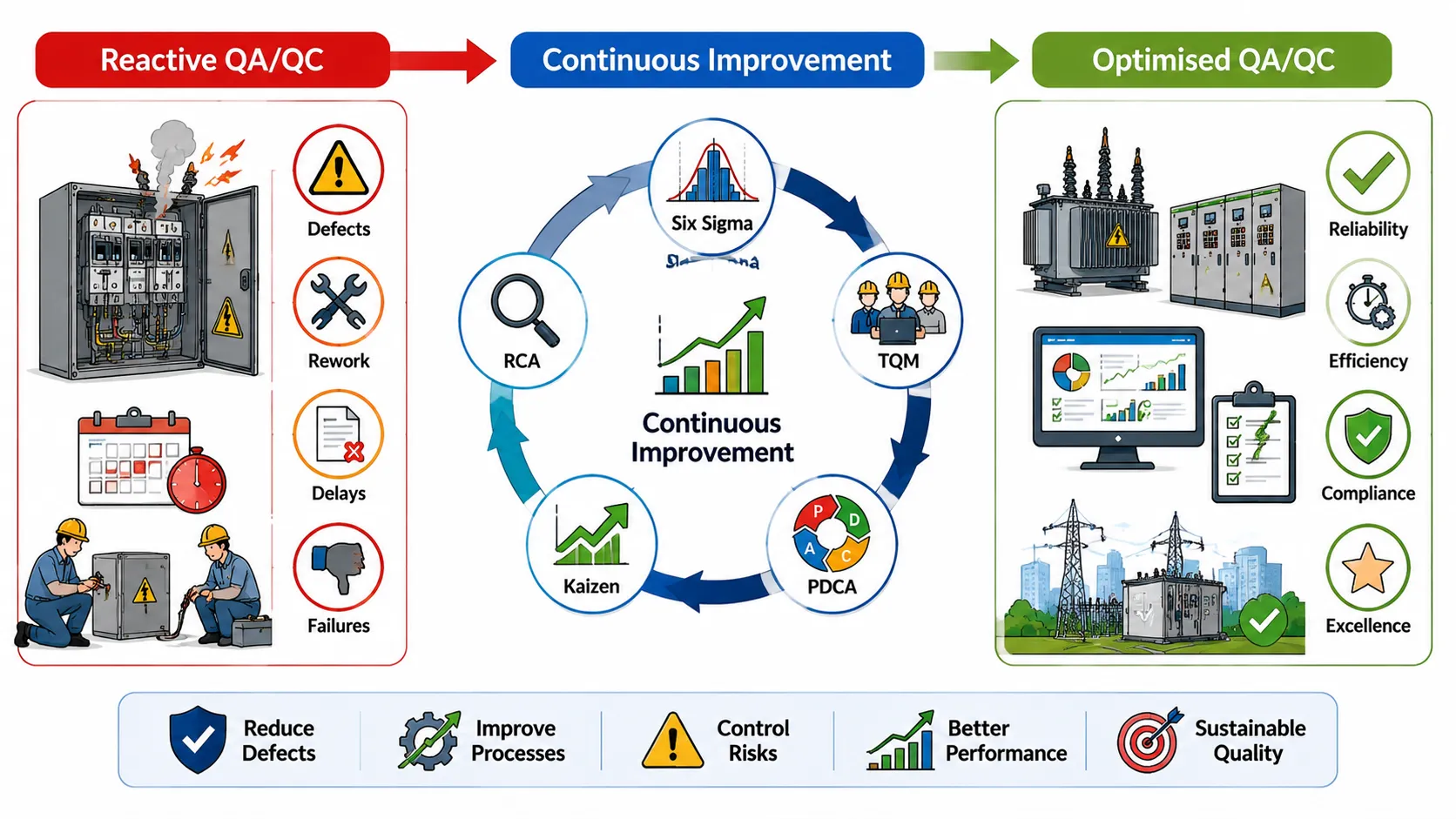
Lesson 4: Integrate Continuous Improvement Methodologies (e.g., Six Sigma, TQM) into QA/QC Processes
1. Critical Evaluation and Integration of Six Sigma and TQM in Electrical Engineering Quality Management
Critical Comparison of Six Sigma and TQM Methodologies
Six Sigma and Total Quality Management (TQM) are both powerful continuous improvement methodologies used to strengthen Quality Assurance and Quality Control (QA/QC) processes. However, their effectiveness depends on how well they match the specific requirements of electrical engineering projects. Complex electrical environments require improvement approaches that can manage technical risks, process variation, human factors, stakeholder expectations, and long-term operational reliability.
Six Sigma provides a structured, analytical approach focused on identifying defects, measuring performance, analysing process variation, and implementing data-based improvements. In contrast, TQM provides a broader organisational approach that develops a quality culture by involving leadership, employees, suppliers, and customers.
A critical comparison shows that neither methodology is universally superior. The selection depends on project objectives, organisational maturity, available resources, and the nature of quality challenges.
Strengths of Six Sigma in Electrical Engineering Applications
Six Sigma provides several advantages for electrical engineering organisations where accuracy, reliability, and defect reduction are critical.
Data-Driven Problem Solving
One of the strongest features of Six Sigma is its dependence on measurable data.
Electrical engineering projects generate significant performance information, including:
- Testing results.
- Equipment failure records.
- Inspection reports.
- Non-conformance data.
- Commissioning performance results.
Six Sigma uses this information to identify process weaknesses and develop targeted improvements.
For example:
- A manufacturing facility producing electrical switchgear may analyse failure records to identify repeated component defects.
- A commissioning team may analyse testing failures to determine whether errors are caused by procedures, equipment, or personnel competency.
Effective Defect Reduction
Six Sigma is particularly effective when organisations need to reduce repeated failures.
Applications include:
- Reducing electrical installation defects.
- Improving equipment manufacturing consistency.
- Minimising testing errors.
- Reducing commissioning delays.
By identifying root causes, Six Sigma helps organisations move from reactive problem solving to preventive quality management.
Process Standardisation
Electrical projects often involve repeated activities such as:
- Cable installation.
- Equipment testing.
- Inspection procedures.
- Documentation approval.
Six Sigma helps organisations develop standardised processes that improve consistency.
Benefits include:
- Reduced process variation.
- Improved repeatability.
- Better quality prediction.
- Improved project control.
Limitations of Six Sigma in Electrical Engineering
Although Six Sigma provides strong analytical capabilities, it also has limitations.
High Dependence on Data Quality
Six Sigma requires accurate and reliable data.
Weaknesses may occur when:
- Data collection systems are incomplete.
- Inspection records are inconsistent.
- Testing information is inaccurate.
Poor-quality data can lead to incorrect analysis and ineffective improvement decisions.
Requires Specialist Knowledge
Successful Six Sigma implementation often requires trained professionals who understand:
- Statistical analysis.
- Process mapping.
- Root cause techniques.
- Performance measurement.
Small engineering organisations may experience difficulties due to limited resources.
May Focus More on Processes Than People
Six Sigma mainly focuses on measurable process improvement. However, electrical project success also depends on:
- Communication.
- Team cooperation.
- Leadership.
- Engineering judgement.
Without considering human factors, improvement initiatives may not achieve their full potential.
Strengths of TQM in Electrical Engineering Applications
TQM provides a wider approach by developing a quality-focused organisational culture.
Organisation-Wide Quality Responsibility
A major strength of TQM is that it considers quality as the responsibility of everyone involved.
This includes:
- Engineers.
- Technicians.
- Project managers.
- Suppliers.
- Contractors.
- Clients.
In electrical engineering projects, this approach improves collaboration between different disciplines.
Examples include:
- Electrical designers communicating better with installation teams.
- Contractors understanding quality expectations.
- Suppliers participating in improvement activities.
Improved Communication and Collaboration
Electrical projects involve multiple stakeholders with different responsibilities.
TQM supports:
- Open communication.
- Shared quality objectives.
- Team-based improvement.
- Knowledge sharing.
This reduces problems caused by:
- Poor coordination.
- Misunderstood requirements.
- Delayed information exchange.
Strong Customer and Stakeholder Focus
TQM places significant importance on meeting customer expectations.
In electrical engineering, this means ensuring:
- System reliability.
- Operational safety.
- Performance requirements.
- Long-term asset value.
For example, a power infrastructure project should not only meet construction requirements but also provide reliable operation throughout its service life.
Limitations of TQM in Electrical Engineering
Although TQM provides significant organisational benefits, it also has limitations.
Difficult to Measure Immediate Results
Unlike Six Sigma, which uses measurable statistical indicators, TQM improvements may take longer to evaluate.
Benefits such as:
- Improved teamwork.
- Better communication.
- Stronger quality culture.
may not immediately appear in numerical performance data.
Requires Strong Leadership Commitment
TQM success depends heavily on management support.
Weak leadership commitment can result in:
- Limited employee involvement.
- Poor implementation.
- Reduced improvement effectiveness.
Slower Implementation Process
Because TQM involves organisational culture change, implementation may require significant time.
Selecting the Appropriate Methodology for Electrical Projects
Electrical engineering organisations should evaluate several factors before selecting Six Sigma, TQM, or a combined approach.
Project Complexity
Highly complex electrical projects involving advanced technology may benefit from Six Sigma because it provides structured analytical methods.
Examples:
- High-voltage transmission systems.
- Semiconductor manufacturing.
- Advanced control systems.
Projects requiring extensive collaboration may benefit from TQM.
Examples:
- Large infrastructure projects.
- Multi-contractor electrical developments.
- Long-term operational projects.
Quality Objectives
The choice depends on the desired improvement outcome.
Six Sigma is suitable when objectives include:
- Reducing defects.
- Improving process accuracy.
- Controlling variation.
TQM is suitable when objectives include:
- Developing quality culture.
- Improving teamwork.
- Enhancing stakeholder relationships.
Organisational Capability
Organisations should consider:
- Available expertise.
- Training requirements.
- Quality maturity level.
- Data management capability.
A company with strong analytical capability may successfully implement Six Sigma, while organisations focusing on cultural improvement may benefit from TQM.
Integration of Six Sigma and TQM into Electrical QA/QC Processes
Many advanced engineering organisations combine Six Sigma and TQM because both methodologies provide complementary advantages.
Six Sigma provides:
- Analytical tools.
- Defect reduction methods.
- Performance measurement.
TQM provides:
- Cultural improvement.
- Employee engagement.
- Stakeholder collaboration.
Together, they create a balanced improvement system.
Integrated Continuous Improvement Model
A combined approach may include:
Quality Culture Development Through TQM
Organisations establish:
- Leadership commitment.
- Employee participation.
- Shared quality objectives.
- Continuous learning.
Data-Based Improvement Through Six Sigma
Teams then apply:
- Performance measurement.
- Root cause analysis.
- Process optimisation.
- Statistical evaluation.
Control and Sustainability
Improvements are maintained through:
- Audits.
- KPIs.
- Training.
- Continuous monitoring.
Advanced Electrical Engineering Application Example
Case Study: Improving Quality Performance in a High-Voltage Substation Project
A utility organisation was developing a high-voltage substation project. During early commissioning activities, the project experienced repeated testing failures and communication problems between engineering teams and contractors.
The existing QA/QC system included:
- Inspection procedures.
- Testing requirements.
- Documentation controls.
However, repeated issues indicated the need for continuous improvement.
Application of Six Sigma
The organisation applied Six Sigma DMAIC methodology.
Define
The team identified:
- Repeated protection testing failures.
- Commissioning delays.
- Increased corrective actions.
Measure
Performance data was collected from:
- Testing records.
- Inspection reports.
- Failure history.
Analyse
The analysis identified causes including:
- Inconsistent testing procedures.
- Limited technician training.
- Communication gaps.
Improve
Improvements included:
- Standardised testing procedures.
- Additional competency training.
- Improved inspection checkpoints.
Control
The organisation introduced:
- Performance monitoring.
- Regular audits.
- Quality dashboards.
Application of TQM
TQM principles were introduced to improve organisational performance.
Actions included:
- Quality meetings involving all stakeholders.
- Increased employee participation.
- Improved communication channels.
- Supplier involvement in improvement activities.
Case Study Outcomes
The combined methodology achieved:
- Reduced testing failures.
- Improved project coordination.
- Faster issue resolution.
- Better stakeholder confidence.
- Improved commissioning performance.
This demonstrates that Six Sigma and TQM can work together to create stronger QA/QC systems in complex electrical environments.
Key Benefits of Integrating Six Sigma and TQM
Technical Benefits
Integration supports:
- Improved electrical system reliability.
- Reduced defects.
- Better testing performance.
- Enhanced engineering accuracy.
Operational Benefits
Organisations achieve:
- More efficient processes.
- Reduced delays.
- Improved resource utilisation.
- Better workflow control.
Quality Management Benefits
The combined approach provides:
- Stronger QA/QC frameworks.
- Improved risk management.
- Better corrective actions.
- Sustainable improvements.
Organisational Benefits
Benefits include:
- Stronger quality culture.
- Improved teamwork.
- Better decision-making.
- Increased stakeholder satisfaction.
Conclusion
Critically comparing Six Sigma and Total Quality Management demonstrates that both methodologies provide valuable approaches for improving electrical engineering QA/QC processes. Six Sigma offers a structured, data-driven method for reducing defects, controlling variation, and improving process performance. TQM provides a broader organisational approach focused on leadership, employee involvement, communication, and quality culture.
For complex electrical engineering projects, selecting the appropriate methodology depends on project requirements, organisational capability, and improvement objectives. While Six Sigma is highly effective for technical problem-solving and measurable improvements, TQM is valuable for creating long-term organisational commitment to quality.
The most effective approach for modern electrical engineering environments is often the integration of both methodologies. Combining Six Sigma analytical techniques with TQM quality culture creates a comprehensive continuous improvement system capable of improving reliability, reducing risks, and achieving sustainable QA/QC excellence throughout the electrical project lifecycle.
2.Select the Most Appropriate Improvement Methodology to Address a Complex QA/QC Problem
Introduction to Improvement Methodology Selection in Electrical QA/QC Management
Complex electrical engineering projects operate within highly interconnected environments where quality failures can result from multiple technical, operational, and organisational factors. Electrical systems such as high-voltage substations, renewable energy installations, industrial power networks, and automation systems require reliable QA/QC processes to ensure safety, performance, compliance, and long-term operational stability. However, when quality problems occur, selecting the most appropriate improvement methodology is critical because different methodologies are designed to address different types of challenges.
From the perspective of a Chartered Electrical Engineer (CEng) and Senior Electrical QA/QC Engineer Specialist, improvement methodology selection should not be based on popularity or previous use alone. It requires a systematic evaluation of the nature of the QA/QC problem, available resources, project requirements, risk level, and expected improvement outcomes. A methodology that is highly effective for reducing manufacturing defects may not provide the best solution for improving communication failures or organisational quality culture.
Electrical engineering organisations commonly use improvement methodologies such as Six Sigma, Total Quality Management (TQM), Lean improvement, PDCA (Plan-Do-Check-Act), Kaizen, and Root Cause Analysis. Each approach provides different tools and philosophies for analysing problems, improving processes, and maintaining quality performance.
Selecting the correct methodology enables engineering teams to:
- Identify root causes effectively.
- Reduce recurring quality failures.
- Improve process reliability.
- Optimise QA/QC activities.
- Increase project efficiency.
- Achieve continuous improvement.
The selection process therefore represents an important professional judgement activity within advanced electrical quality management.
Understanding Complex QA/QC Problems in Electrical Engineering Projects
Definition of Complex QA/QC Problems
A complex QA/QC problem is a quality issue that involves multiple interacting causes, uncertain conditions, technical challenges, or organisational factors that cannot be solved through simple corrective actions.
Unlike straightforward defects, complex quality problems often involve relationships between:
- Engineering design.
- Equipment performance.
- Installation practices.
- Supplier activities.
- Human competency.
- Documentation systems.
- Project management processes.
For example, repeated failures during electrical commissioning may not be caused by a single equipment defect. The actual causes may include:
- Incomplete design verification.
- Incorrect installation procedures.
- Poor communication between teams.
- Insufficient testing methods.
- Lack of competency.
Therefore, selecting an appropriate improvement methodology requires understanding the complete problem environment.
Types of Complex QA/QC Problems in Electrical Engineering
Technical Quality Problems
Technical problems relate to failures in engineering design, equipment performance, or system integration.
Examples include:
- Transformer performance issues.
- Protection system failures.
- Cable installation defects.
- Electrical equipment compatibility problems.
- Testing inconsistencies.
Suitable improvement approaches may include:
- Six Sigma.
- Root Cause Analysis.
- Failure Mode and Effects Analysis (FMEA).
Process-Based Quality Problems
Process problems occur when existing QA/QC procedures are ineffective or inconsistent.
Examples include:
- Delayed inspections.
- Poor document control.
- Inefficient approval processes.
- Repeated corrective actions.
Suitable improvement methodologies may include:
- Lean improvement.
- PDCA cycle.
- Six Sigma.
Human and Organisational Quality Problems
Some QA/QC failures result from organisational issues rather than technical causes.
Examples include:
- Poor communication.
- Lack of quality awareness.
- Weak teamwork.
- Limited employee involvement.
Suitable improvement approaches may include:
- TQM.
- Kaizen.
- Quality culture development.
Importance of Selecting the Correct Improvement Methodology
Selecting an appropriate improvement methodology directly influences the success of quality improvement activities.
Using an unsuitable approach can result in:
- Wasted resources.
- Incorrect problem analysis.
- Temporary solutions.
- Failure recurrence.
- Limited improvement outcomes.
For example:
Applying Six Sigma to a problem caused mainly by poor communication may provide detailed data analysis but fail to address the cultural issue. Similarly, applying TQM alone to a highly technical equipment failure may not provide sufficient analytical depth.
A suitable methodology should match:
- Problem characteristics.
- Project objectives.
- Available information.
- Organisational capability.
Key Factors Influencing Improvement Methodology Selection
Nature and Complexity of the QA/QC Problem
The first consideration is understanding the type of quality problem.
Engineering teams should evaluate:
- Is the problem technical or organisational?
- Is the failure recurring or isolated?
- Are multiple causes involved?
- Is measurable data available?
For example:
A repeated switchgear testing failure requires a different approach from improving communication between contractors.
Availability of Quality Data
Some improvement methodologies require extensive data analysis, while others depend more on team participation and process review.
Data availability should be considered.
Examples:
High Data Availability
Suitable methods:
- Six Sigma.
- Statistical analysis.
- Trend evaluation.
Applications:
- Defect analysis.
- Equipment failure reduction.
- Testing improvement.
Limited Data Availability
Suitable methods:
- PDCA.
- Kaizen.
- Root Cause Analysis.
Applications:
- Process improvement.
- Communication issues.
- Operational improvements.
Project Risk Level
The risk associated with the quality problem influences methodology selection.
High-risk electrical systems require structured and analytical approaches.
Examples:
- Nuclear power electrical systems.
- High-voltage transmission networks.
- Critical industrial power systems.
Suitable methodologies:
- Six Sigma.
- FMEA.
- Risk-based improvement methods.
Lower-risk process improvements may use:
- Kaizen.
- PDCA.
Organisational Capability and Resources
The organisation’s skills and available resources must be considered.
Important factors include:
- Technical expertise.
- Training availability.
- Data management capability.
- Improvement experience.
- Time limitations.
For example:
A large engineering organisation with trained analysts may successfully implement Six Sigma, while a smaller contractor may achieve better results using PDCA or Kaizen.
Overview of Major Improvement Methodologies for QA/QC Problems
Six Sigma Methodology
Definition of Six Sigma
Six Sigma is a structured, data-driven improvement methodology focused on reducing defects, controlling process variation, and improving performance.
It uses statistical analysis and the DMAIC process:
- Define.
- Measure.
- Analyse.
- Improve.
- Control.
Suitable QA/QC Problems for Six Sigma
Six Sigma is most appropriate when:
- Defects occur repeatedly.
- Process variation affects quality.
- Performance data is available.
- Precise improvement measurement is required.
Electrical applications include:
- Reducing equipment failures.
- Improving testing accuracy.
- Optimising installation processes.
- Reducing commissioning problems.
Key Benefits of Six Sigma
Benefits include:
- Evidence-based decision making.
- Reduced defects.
- Improved process consistency.
- Better quality prediction.
- Improved operational efficiency.
Total Quality Management (TQM)
Definition of TQM
Total Quality Management is an organisation-wide improvement philosophy focused on developing a quality culture through leadership commitment, employee involvement, customer focus, and continuous improvement.
Suitable QA/QC Problems for TQM
TQM is appropriate when problems involve:
- Poor quality culture.
- Communication failures.
- Weak teamwork.
- Lack of stakeholder engagement.
Electrical applications include:
- Improving contractor coordination.
- Enhancing supplier relationships.
- Developing quality awareness.
Key Benefits of TQM
Benefits include:
- Strong quality culture.
- Improved collaboration.
- Better stakeholder satisfaction.
- Long-term improvement commitment.
Lean Quality Improvement
Definition of Lean Improvement
Lean improvement focuses on eliminating waste, improving efficiency, and maximising value within processes.
Waste in electrical projects may include:
- Waiting time.
- Repeated inspections.
- Excessive documentation.
- Unnecessary movement of materials.
Applications in Electrical QA/QC
Lean methods can improve:
- Material management.
- Inspection workflows.
- Project scheduling.
- Resource utilisation.
PDCA Improvement Cycle
Definition of PDCA
The Plan-Do-Check-Act cycle is a continuous improvement approach used to test changes, evaluate results, and standardise successful improvements.
Electrical Engineering Applications
PDCA can be used for:
- Improving inspection procedures.
- Testing new QA processes.
- Enhancing maintenance activities.
Root Cause Analysis
Definition
Root Cause Analysis identifies the fundamental reason behind a quality failure rather than only correcting the visible problem.
Common tools include:
- Five Whys.
- Fishbone Diagram.
- Fault analysis.
Comparison Table: Improvement Methodology Selection for Electrical QA/QC Problems
| Methodology | Main Purpose | Suitable QA/QC Problems | Electrical Engineering Applications | Key Benefit |
|---|---|---|---|---|
| Six Sigma | Reduce defects and variation | Repeated technical failures | Testing improvement, equipment reliability | Data-driven improvement |
| TQM | Develop quality culture | Communication and teamwork issues | Stakeholder coordination | Long-term quality improvement |
| Lean | Remove waste and improve efficiency | Process delays and inefficiency | Workflow optimisation | Improved productivity |
| PDCA | Continuous process improvement | Small and medium process issues | Procedure improvement | Flexible improvement cycle |
| Root Cause Analysis | Identify failure causes | Recurring quality problems | Failure investigation | Prevents recurrence |
Practical Example: Selecting a Methodology for an Electrical QA/QC Problem
A large electrical installation project experienced repeated cable testing failures during commissioning.
The project team investigated the issue and identified:
- Incorrect installation practices.
- Inconsistent testing procedures.
- Limited technician training.
- Poor communication between installation and testing teams.
The selection process considered:
Problem Characteristics
The issue involved technical variation and human factors.
Data Availability
Testing records were available for analysis.
Improvement Objective
The objective was to reduce failures and improve process reliability.
Based on this evaluation:
- Six Sigma was selected to analyse testing failures and reduce variation.
- TQM principles were introduced to improve communication and quality culture.
The combined approach provided both technical improvement and organisational improvement.
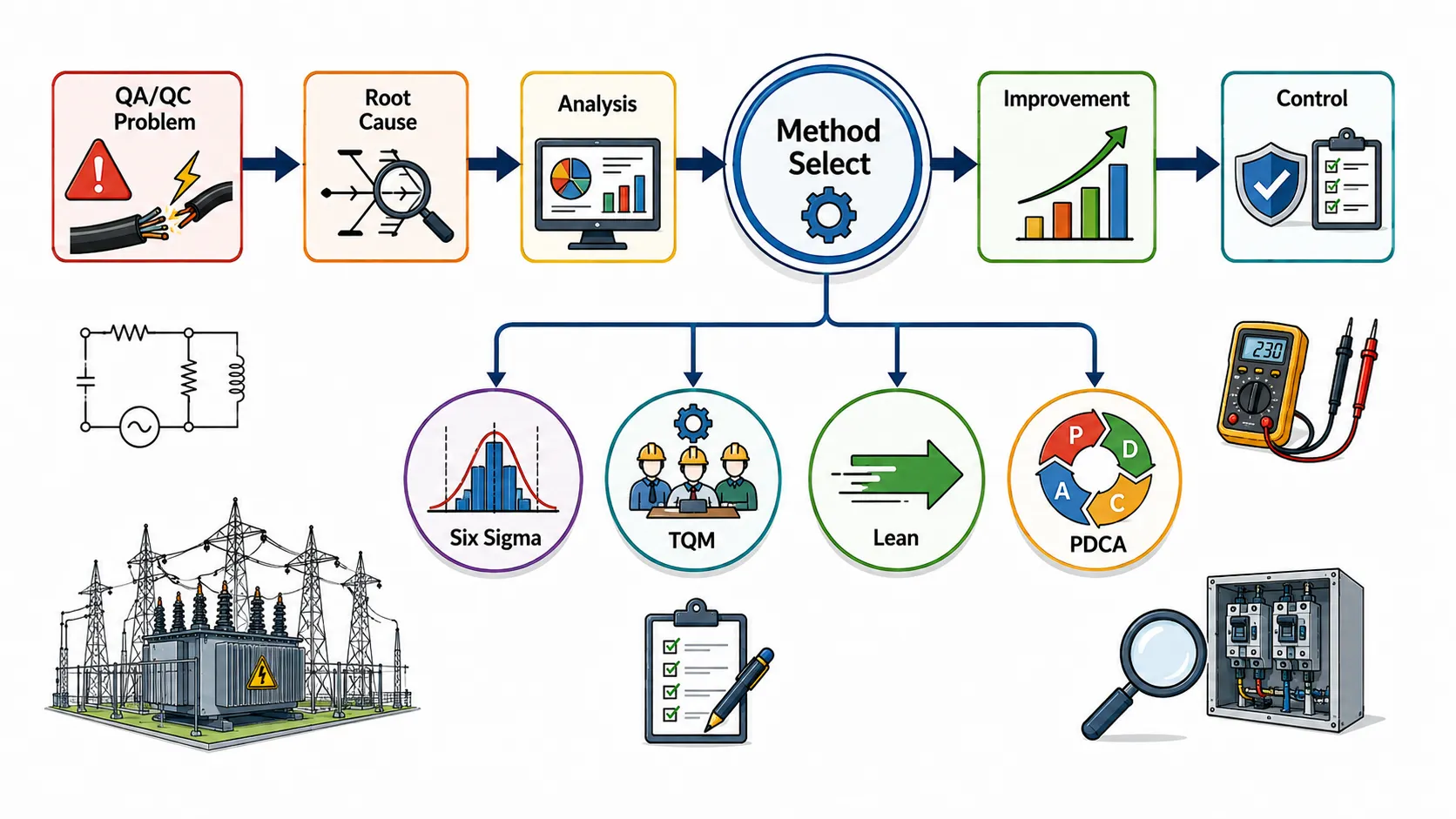
Advanced Process for Selecting the Most Appropriate Improvement Methodology for Complex QA/QC Problems
Systematic Methodology Selection Framework for Electrical Engineering Projects
Selecting the most appropriate improvement methodology for a complex QA/QC problem requires a structured decision-making process. Electrical engineering organisations should avoid selecting improvement methods based only on previous experience or industry trends. Instead, the methodology should be selected after analysing the problem characteristics, quality objectives, available evidence, project constraints, and expected improvement outcomes.
A systematic selection framework ensures that the chosen methodology provides the most effective solution and creates sustainable improvements within the QA/QC system.
The selection process should consider:
- The type and cause of the quality problem.
- The level of project complexity.
- Available quality data.
- Required improvement speed.
- Risk impact.
- Available technical expertise.
- Organisational quality maturity.
A structured methodology selection process improves the probability of achieving successful quality improvements.
Step 1: Define and Understand the QA/QC Problem
The first stage is to clearly define the quality problem before selecting an improvement methodology.
A poorly defined problem can result in selecting an unsuitable improvement approach.
The engineering team should identify:
- What quality failure has occurred?
- Where does the problem occur?
- When does the problem occur?
- How frequently does it happen?
- What is the impact on project performance?
For electrical engineering projects, problem definition may involve analysing:
- Equipment failures.
- Installation defects.
- Testing problems.
- Documentation errors.
- Supplier performance issues.
Example:
A project team observes repeated failures during protection relay testing.
A basic observation may identify:
“Protection testing is failing.”
However, a detailed problem definition may identify:
“Protection relay failures occur due to inconsistent testing procedures, insufficient technical verification, and variations in commissioning practices.”
This detailed understanding supports better methodology selection.
Step 2: Analyse Root Causes Before Selecting the Methodology
Before choosing an improvement method, organisations must understand the underlying causes of the problem.
Root cause analysis prevents teams from applying temporary solutions that only address symptoms.
Common root cause analysis techniques include:
Five Whys Analysis
This method repeatedly asks “why” until the fundamental cause is identified.
Example:
Problem:
Cable insulation testing failures.
Why?
- Cable insulation failed.
Why?
- Cable installation conditions were unsuitable.
Why?
- Environmental protection procedures were not followed.
Why?
- Installation guidance was unclear.
Why?
- Quality procedures were not reviewed after previous failures.
The identified root cause is a process weakness rather than only an installation error.
Fishbone Diagram Analysis
Fishbone analysis categorises possible causes under different areas:
- People.
- Process.
- Equipment.
- Materials.
- Environment.
- Management.
Electrical engineering teams can use this method to analyse complex quality failures involving multiple factors.
Step 3: Match the Problem Type with the Appropriate Methodology
Different QA/QC problems require different improvement approaches.
When Six Sigma Is the Appropriate Choice
Six Sigma is suitable when the problem involves:
- Repeated defects.
- High process variation.
- Measurable performance issues.
- Technical inconsistency.
Electrical examples:
- Repeated transformer testing failures.
- Inconsistent manufacturing quality.
- High installation defect rates.
- Commissioning delays.
Six Sigma provides strong analytical tools for identifying variation sources and improving process performance.
When TQM Is the Appropriate Choice
TQM is more suitable when quality problems are related to:
- Organisational culture.
- Communication failures.
- Poor teamwork.
- Limited employee involvement.
Electrical examples:
- Coordination problems between contractors.
- Poor supplier relationships.
- Lack of quality awareness.
- Weak management commitment.
TQM improves quality performance by creating shared responsibility throughout the organisation.
When Lean Improvement Is the Appropriate Choice
Lean methodology is suitable when the main issue is inefficiency or waste.
Examples:
- Long approval processes.
- Delayed inspections.
- Excessive documentation.
- Poor workflow management.
Electrical project applications include:
- Improving material handling.
- Reducing inspection delays.
- Optimising maintenance processes.
When PDCA Is the Appropriate Choice
PDCA is useful when organisations require continuous testing and improvement of processes.
Suitable applications include:
- Improving inspection procedures.
- Testing new QA approaches.
- Enhancing maintenance processes.
PDCA provides a flexible improvement cycle:
Plan
Identify the improvement opportunity.
Do
Implement the change.
Check
Evaluate results.
Act
Standardise successful improvements.
Step 4: Evaluate Available Resources and Capabilities
The chosen methodology must match organisational capability.
Important considerations include:
- Available expertise.
- Training requirements.
- Budget limitations.
- Project schedule.
- Data availability.
Six Sigma Resource Requirements
Six Sigma implementation may require:
- Data analysts.
- Quality specialists.
- Statistical tools.
- Performance measurement systems.
It may not be suitable for organisations lacking analytical resources.
TQM Resource Requirements
TQM requires:
- Leadership commitment.
- Employee participation.
- Cultural change.
- Long-term engagement.
It may require more time but creates sustainable improvement.
Step 5: Consider Project Risk and Quality Impact
The severity of the QA/QC problem influences methodology selection.
High-risk electrical projects require robust improvement approaches.
Examples:
- Power transmission systems.
- Industrial control systems.
- Critical electrical infrastructure.
For high-risk problems, organisations may combine:
- Six Sigma for technical analysis.
- FMEA for risk evaluation.
- TQM for organisational improvement.
Integrated Methodology Selection Approach
Complex electrical QA/QC problems often involve multiple causes. Therefore, combining improvement methodologies can provide better results.
A combined approach may include:
Six Sigma for Technical Improvement
Used for:
- Defect analysis.
- Process variation reduction.
- Performance measurement.
TQM for Organisational Improvement
Used for:
- Team collaboration.
- Leadership involvement.
- Quality culture development.
Lean for Efficiency Improvement
Used for:
- Waste reduction.
- Workflow improvement.
- Resource optimisation.
PDCA for Continuous Monitoring
Used for:
- Testing improvements.
- Maintaining performance.
- Updating processes.
Advanced Case Study: Selecting an Improvement Methodology for a High-Voltage Electrical Project
Project Background
A utility organisation was upgrading a high-voltage substation to increase network capacity. During commissioning, several quality issues were identified:
- Protection system testing failures.
- Delayed equipment approvals.
- Repeated documentation errors.
- Poor coordination between contractors.
The organisation needed to select the most appropriate improvement methodology.
Problem Assessment
The QA/QC team analysed the issues and identified multiple causes:
Technical Causes
- Incorrect testing procedures.
- Equipment configuration problems.
Process Causes
- Weak document control.
- Inefficient approval processes.
Human Factors
- Limited communication.
- Different quality expectations between teams.
Because the problem involved technical, process, and organisational factors, a single methodology was not sufficient.
Selected Improvement Strategy
Six Sigma Application
Six Sigma was selected for technical problems.
The team applied DMAIC:
Define
The main problem was identified as repeated commissioning failures.
Measure
Testing records and failure data were analysed.
Analyse
Root causes were identified.
Improve
Testing procedures were standardised.
Control
Performance monitoring systems were introduced.
TQM Application
TQM principles were introduced to address organisational issues.
Actions included:
- Quality awareness sessions.
- Regular coordination meetings.
- Improved supplier communication.
- Increased employee involvement.
Lean Application
Lean methods were applied to improve workflow.
Improvements included:
- Reducing approval delays.
- Simplifying documentation processes.
- Improving inspection scheduling.
Case Study Results
The integrated methodology approach achieved:
- Reduction in commissioning failures.
- Improved documentation accuracy.
- Faster approval processes.
- Better contractor coordination.
- Increased stakeholder confidence.
This demonstrates that selecting the appropriate improvement methodology requires analysing the complete quality problem rather than applying a single universal solution.
Key Benefits of Selecting the Appropriate Improvement Methodology
Improved Quality Performance
Correct methodology selection helps organisations achieve:
- Reduced defects.
- Improved reliability.
- Better compliance.
- Stronger QA/QC processes.
Better Problem-Solving Capability
Organisations develop the ability to:
- Identify root causes.
- Analyse complex issues.
- Implement effective solutions.
- Prevent recurrence.
Improved Project Efficiency
Effective improvement approaches support:
- Reduced rework.
- Lower project delays.
- Better resource utilisation.
- Improved workflow.
Enhanced Engineering Decision-Making
Methodology selection develops professional judgement by requiring engineers to evaluate:
- Technical factors.
- Process weaknesses.
- Risk impacts.
- Improvement opportunities.
Conclusion
Selecting the most appropriate improvement methodology to address a complex QA/QC problem is a critical responsibility within advanced electrical engineering quality management. Complex electrical projects require improvement approaches that are carefully matched to the nature of the problem, available resources, risk level, and desired outcomes.
Six Sigma provides strong analytical capabilities for reducing defects and controlling process variation. TQM supports organisational improvement through quality culture, leadership involvement, and stakeholder collaboration. Lean improves efficiency by removing waste, while PDCA supports continuous process improvement.
For complex electrical engineering environments, the most effective approach is often a combination of methodologies rather than relying on one system alone. By applying structured selection processes and integrating suitable improvement techniques, organisations can strengthen QA/QC performance, improve reliability, reduce risks, and achieve sustainable quality excellence throughout the electrical project lifecycle.
3. Integrate Advanced Continuous Improvement Techniques into Active Electrical QA/QC Operations
Introduction to Advanced Continuous Improvement Integration in Electrical QA/QC Operations
Modern electrical engineering projects require quality management systems that are proactive, data-driven, and capable of adapting to complex technical challenges. Traditional QA/QC approaches that focus only on inspection and defect detection are no longer sufficient for large-scale electrical projects involving high-voltage systems, industrial installations, renewable energy infrastructure, and advanced automation networks. Organisations must integrate advanced continuous improvement techniques directly into active QA/QC operations to improve reliability, reduce risks, and achieve sustainable quality performance.
From the perspective of a Chartered Electrical Engineer (CEng) and Senior Electrical QA/QC Engineer Specialist, continuous improvement integration means embedding structured improvement methods into daily engineering activities rather than treating quality improvement as a separate exercise. It involves applying advanced methodologies such as Six Sigma, Lean Six Sigma, Total Quality Management (TQM), Kaizen, PDCA, Root Cause Analysis (RCA), and Failure Mode and Effects Analysis (FMEA) within design reviews, procurement processes, installation inspections, testing activities, commissioning procedures, and operational maintenance.
Complex electrical projects involve multiple interacting factors, including engineering design requirements, supplier performance, installation conditions, environmental influences, regulatory compliance, and human competency. Advanced improvement techniques provide systematic approaches for identifying weaknesses, analysing performance data, reducing process variation, and improving QA/QC decision-making.
Integrating these techniques into active electrical QA/QC operations enables engineering organisations to move from reactive quality control towards predictive and preventive quality management. This approach improves project outcomes by reducing non-conformities, minimising rework, enhancing safety performance, and increasing stakeholder confidence.
Understanding Advanced Continuous Improvement in Electrical QA/QC Operations
Definition of Advanced Continuous Improvement
Advanced continuous improvement refers to the systematic application of structured methodologies, analytical tools, digital technologies, and organisational practices to continuously enhance quality performance.
Within electrical QA/QC operations, advanced continuous improvement focuses on:
Identifying recurring quality issues.
Analysing process inefficiencies.
Reducing technical variations.
Improving inspection and testing reliability.
Enhancing engineering processes.
Preventing future failures.
Unlike basic corrective actions, advanced improvement techniques investigate the underlying causes of quality problems and develop long-term solutions.
Importance of Continuous Improvement in Active QA/QC Operations
Electrical QA/QC operations involve continuous decision-making throughout the project lifecycle.
Continuous improvement helps organisations improve:
Design verification processes.
Material and equipment quality control.
Installation procedures.
Testing accuracy.
Commissioning reliability.
Maintenance effectiveness.
The integration of improvement techniques ensures that quality processes remain effective even when projects experience:
Design changes.
Technical challenges.
Supplier variations.
Schedule pressures.
Environmental constraints.
Role of Advanced Improvement Techniques in Electrical Engineering Quality Management
Moving from Reactive to Proactive Quality Management
A reactive QA/QC system identifies problems after failures occur. Advanced continuous improvement techniques allow organisations to predict risks and prevent failures before they affect project performance.
Reactive Quality Approach:
Detect defects after occurrence.
Perform corrective actions.
Repair failed components.
Investigate problems after delays.
Proactive Quality Approach:
Identify potential risks early.
Analyse process performance.
Improve procedures continuously.
Prevent defect recurrence.
For example, instead of waiting for repeated cable installation failures, an organisation can analyse installation processes, identify risk factors, improve procedures, and train personnel before failures occur.
Integration of Six Sigma into Electrical QA/QC Operations
Application of Six Sigma DMAIC Methodology
Six Sigma provides a structured framework for improving electrical QA/QC processes through data analysis and defect reduction.
The DMAIC cycle includes:
Define
Measure
Analyse
Improve
Control
Define Phase in Electrical QA/QC
The Define phase identifies the quality problem and establishes improvement objectives.
Electrical engineering teams define:
Quality issues.
Project requirements.
Performance expectations.
Stakeholder concerns.
Examples:
High failure rate during equipment testing.
Repeated installation non-conformities.
Delays caused by approval processes.
Activities include:
Reviewing inspection records.
Analysing client complaints.
Identifying critical quality problems.
Measure Phase in QA/QC Operations
The Measure phase establishes the current performance level.
Data collection may include:
Non-conformance reports.
Inspection results.
Testing records.
Commissioning reports.
Equipment failure statistics.
Electrical QA/QC teams use measured data to understand:
Defect frequency.
Process performance.
Variation levels.
Improvement requirements.
Analyse Phase for Root Cause Identification
The Analyse phase identifies the reasons behind quality failures.
Common tools include:
Root Cause Analysis.
Fishbone Diagram.
Five Whys Analysis.
Statistical evaluation.
Electrical applications include:
Analysing transformer failures.
Investigating protection system issues.
Evaluating cable testing failures.
Improve Phase for Implementing Solutions
The Improve phase develops and applies corrective improvements.
Solutions may include:
Updated procedures.
Improved inspection methods.
Enhanced training.
Better equipment verification.
Example:
If testing failures are caused by inconsistent procedures, the organisation may introduce standardised testing methods and competency assessments.
Control Phase for Maintaining Improvements
The Control phase ensures improvements remain effective.
Control activities include:
Quality audits.
KPI monitoring.
Performance reviews.
Procedure updates.
This prevents organisations from returning to previous ineffective practices.
Integration of Lean Six Sigma into Electrical QA/QC Processes
Understanding Lean Six Sigma
Lean Six Sigma combines:
Lean principles for waste elimination.
Six Sigma principles for variation reduction.
This integrated approach improves both efficiency and quality performance.
Lean Six Sigma Applications in Electrical Projects
Lean Six Sigma can improve:
Inspection Processes
By reducing:
Unnecessary inspection delays.
Duplicate checks.
Poor workflow arrangements.
Material Management
By improving:
Equipment availability.
Storage processes.
Material tracking.
Documentation Control
By reducing:
Approval delays.
Documentation errors.
Information duplication.
Integration of Total Quality Management (TQM)
Building a Quality Culture in Electrical Organisations
TQM focuses on creating an organisation-wide commitment to quality.
Successful TQM integration requires:
Leadership involvement.
Employee participation.
Supplier cooperation.
Customer focus.
TQM Applications in QA/QC Operations
Electrical organisations can integrate TQM through:
Team-Based Improvement
Encouraging:
Engineers.
Technicians.
Inspectors.
Contractors.
to contribute improvement ideas.
Quality Awareness Development
Organisations can improve quality culture through:
Training programmes.
Quality meetings.
Lessons learned sessions.
Supplier Quality Improvement
TQM supports:
Supplier collaboration.
Performance reviews.
Joint improvement activities.
Integration of Kaizen into Daily QA/QC Activities
Definition of Kaizen
Kaizen is a continuous improvement philosophy based on making small, regular improvements to processes.
In electrical QA/QC operations, Kaizen encourages employees to identify improvement opportunities during daily activities.
Kaizen Applications in Electrical Engineering
Examples include:
Improving inspection checklists.
Reducing testing preparation time.
Improving workplace organisation.
Simplifying documentation processes.
Benefits include:
Increased employee involvement.
Faster improvement implementation.
Better operational efficiency.
Integration of PDCA Cycle into QA/QC Management
PDCA Improvement Process
The Plan-Do-Check-Act cycle provides a practical method for testing and maintaining improvements.
Plan
Identify:
Quality issue.
Improvement objective.
Required actions.
Do
Implement the improvement on a controlled basis.
Check
Evaluate:
Performance results.
Quality indicators.
Stakeholder feedback.
Act
Standardise successful improvements.
Integration of Root Cause Analysis and FMEA
Root Cause Analysis Application
Root Cause Analysis ensures that QA/QC teams address the actual cause of failures.
Applications include:
Equipment malfunction investigations.
Installation defect analysis.
Testing failure reviews.
Failure Mode and Effects Analysis (FMEA)
FMEA identifies potential failures before they occur.
Electrical applications include:
Switchgear reliability assessment.
Transformer risk evaluation.
Protection system analysis.
FMEA evaluates:
Failure mode.
Cause.
Effect.
Risk priority.
Comparison of Advanced Continuous Improvement Techniques in Electrical QA/QC
| Improvement Technique | Main Purpose | QA/QC Application | Electrical Engineering Benefit |
|---|---|---|---|
| Six Sigma | Reduce variation and defects | Testing improvement, failure reduction | Improved reliability |
| Lean Six Sigma | Remove waste and improve efficiency | Process optimisation | Reduced delays |
| TQM | Develop quality culture | Team and stakeholder improvement | Better collaboration |
| Kaizen | Small continuous improvements | Daily QA/QC activities | Faster improvements |
| PDCA | Continuous process control | Procedure improvement | Sustainable performance |
| RCA | Identify failure causes | Defect investigation | Prevents recurrence |
| FMEA | Predict potential failures | Risk assessment | Improved reliability planning |
Practical Example: Integrating Continuous Improvement Techniques into Electrical QA/QC Operations
A renewable energy project experienced repeated inverter failures during commissioning. The QA/QC team investigated the issue using advanced improvement methods.
Problem Identification
The team identified:
Equipment performance failures.
Testing inconsistencies.
Documentation gaps.
Improvement Method Integration
Six Sigma Application
The team analysed failure data and identified variation in testing procedures.
Actions:
Standardised testing methods.
Improved measurement procedures.
TQM Application
The organisation improved communication between:
Designers.
Suppliers.
Installation teams.
Kaizen Application
Daily improvement meetings were introduced to identify small operational improvements.
FMEA Application
Potential equipment risks were analysed before future installations.
Results
The integrated approach achieved:
Reduced commissioning failures.
Improved testing reliability.
Better team coordination.
Improved project quality performance.
Advanced Implementation Strategies for Continuous Improvement in Electrical QA/QC Operations
Developing an Effective Continuous Improvement Implementation Framework
Integrating advanced continuous improvement techniques into active electrical QA/QC operations requires more than selecting a suitable methodology. Organisations must establish a structured implementation framework that ensures improvement activities become part of routine engineering practices. In complex electrical projects, improvement systems should operate alongside existing quality management processes to continuously identify weaknesses, optimise performance, and prevent recurring failures.
A successful implementation framework connects:
- Quality objectives with project requirements.
- Improvement methodologies with QA/QC activities.
- Engineering data with decision-making processes.
- Corrective actions with preventive improvement strategies.
Electrical engineering organisations should ensure that continuous improvement becomes an ongoing operational activity rather than a one-time corrective measure.
Key Elements of an Effective Implementation Framework
A structured continuous improvement framework includes:
- Clear improvement objectives.
- Defined responsibilities.
- Quality performance indicators.
- Data collection systems.
- Improvement review meetings.
- Corrective and preventive action processes.
- Knowledge-sharing mechanisms.
These elements allow QA/QC teams to systematically monitor performance and implement effective improvements.
Integrating Improvement Techniques Across the Electrical Project Lifecycle
Continuous improvement should be applied throughout every stage of an electrical engineering project.
Design Stage Improvement Integration
The design phase creates the foundation for project quality. Improvement techniques help engineering teams identify design weaknesses before construction begins.
Advanced improvement activities include:
- Design review analysis.
- Lessons learned evaluation.
- Failure risk assessment.
- Engineering process optimisation.
Six Sigma techniques can be applied to:
- Analyse repeated design errors.
- Reduce calculation variations.
- Improve design accuracy.
FMEA can support:
- Identification of potential design failures.
- Evaluation of system reliability risks.
- Development of preventive measures.
Procurement Stage Improvement Integration
Electrical equipment quality depends heavily on supplier performance and material reliability.
Continuous improvement techniques support:
- Supplier performance evaluation.
- Factory acceptance testing improvement.
- Material quality monitoring.
- Procurement process optimisation.
Key improvement activities include:
- Analysing supplier defect trends.
- Reviewing supplier corrective actions.
- Improving communication with manufacturers.
Benefits include:
- Reduced equipment failures.
- Improved supplier reliability.
- Better compliance with technical specifications.
Installation Stage Improvement Integration
Electrical installation activities involve multiple risks that can affect system performance.
Continuous improvement techniques help improve:
- Installation procedures.
- Workforce competency.
- Inspection effectiveness.
- Safety compliance.
Practical applications include:
- Using Kaizen meetings to identify daily improvement opportunities.
- Applying PDCA cycles to improve installation workflows.
- Using root cause analysis for repeated installation defects.
Examples of installation improvement areas:
- Cable routing accuracy.
- Earthing system installation.
- Equipment alignment.
- Termination quality.
Testing and Commissioning Improvement Integration
Testing and commissioning are critical quality verification stages in electrical projects.
Advanced improvement methods improve:
- Testing reliability.
- Fault detection capability.
- Commissioning efficiency.
- Documentation accuracy.
Continuous improvement activities include:
- Reviewing failed test results.
- Analysing commissioning delays.
- Improving testing procedures.
- Updating testing checklists.
Six Sigma can help identify:
- Testing variation.
- Measurement errors.
- Repeated failure patterns.
Operational Maintenance Improvement Integration
Continuous improvement continues after project completion through operational quality management.
Maintenance improvement activities include:
- Performance monitoring.
- Failure analysis.
- Preventive maintenance optimisation.
- Asset reliability improvement.
FMEA and Root Cause Analysis are valuable for:
- Analysing equipment failures.
- Preventing repeated breakdowns.
- Improving maintenance strategies.
Establishing Advanced QA/QC Performance Measurement Systems
Importance of Performance Measurement
Continuous improvement requires measurable evidence to determine whether implemented changes are effective.
Performance measurement enables organisations to:
- Evaluate improvement results.
- Identify remaining weaknesses.
- Compare performance trends.
- Support engineering decisions.
Without effective measurement systems, organisations cannot determine whether improvement initiatives are successful.
Advanced QA/QC Performance Indicators
Electrical projects should monitor a combination of technical, process, and organisational indicators.
Performance Indicator Definition QA/QC Application Improvement Purpose Non-Conformance Rate Number of quality failures identified during project activities Monitoring defects and compliance issues Reduce recurring failures Rework Percentage Amount of repeated work required due to quality problems Measuring process effectiveness Improve efficiency Corrective Action Closure Time Time required to resolve identified issues Evaluating response effectiveness Faster problem resolution Testing Failure Rate Frequency of unsuccessful testing activities Assessing equipment and procedure reliability Improve testing performance Supplier Quality Performance Evaluation of supplier-related quality issues Managing external quality risks Improve supplier reliability Using Advanced Data Analysis for Improvement Decisions
Modern electrical QA/QC operations generate large amounts of quality data.
Advanced analysis methods include:
Trend Analysis
Used to identify:
- Increasing defect patterns.
- Recurring quality issues.
- Performance changes over time.
Example:
A trend analysis may show that cable termination defects increase during specific project phases, allowing early preventive action.
Statistical Analysis
Six Sigma uses statistical methods to:
- Identify process variation.
- Measure performance capability.
- Predict improvement opportunities.
Applications include:
- Manufacturing quality analysis.
- Testing process improvement.
- Installation performance evaluation.
Predictive Quality Analysis
Predictive approaches use historical data to anticipate future problems.
Benefits include:
- Early risk identification.
- Reduced failures.
- Improved project planning.
Digital Transformation in Continuous Improvement
Role of Digital Quality Management Systems
Digital quality management systems support continuous improvement by improving:
- Data accessibility.
- Documentation control.
- Performance monitoring.
- Communication.
Digital platforms allow QA/QC teams to:
- Record inspection findings electronically.
- Track corrective actions.
- Monitor KPIs.
- Generate quality reports.
Digital Tools Supporting Electrical QA/QC Improvement
Important technologies include:
- Cloud-based quality management systems.
- Mobile inspection applications.
- Digital dashboards.
- Automated reporting tools.
- BIM-based quality monitoring.
These technologies improve:
- Information accuracy.
- Response time.
- Decision-making quality.
Creating a Continuous Improvement Culture within Electrical Teams
Importance of Employee Participation
Advanced improvement techniques are most effective when employees actively participate in quality improvement activities.
Electrical engineers, supervisors, and technicians contribute valuable practical knowledge because they directly experience operational challenges.
Employee involvement supports:
- Faster problem identification.
- Practical improvement solutions.
- Better acceptance of changes.
Leadership Responsibilities in Continuous Improvement
Effective leadership is essential for successful implementation.
Leaders should:
- Establish improvement objectives.
- Provide necessary resources.
- Encourage innovation.
- Support quality training.
- Review improvement performance.
Strong leadership creates an environment where quality improvement becomes an organisational priority.
Overcoming Challenges During Implementation
Resistance to Change
One of the main challenges is employee resistance.
Common causes include:
- Lack of awareness.
- Fear of additional responsibilities.
- Limited understanding of improvement benefits.
Solutions include:
- Training programmes.
- Clear communication.
- Employee involvement.
Poor Data Management
Continuous improvement may fail when organisations lack reliable information.
Common issues include:
- Incomplete records.
- Incorrect reporting.
- Poor documentation practices.
Solutions include:
- Digital quality systems.
- Standard reporting procedures.
- Data verification processes.
Limited Technical Capability
Advanced methodologies require skilled professionals.
Challenges include:
- Lack of Six Sigma knowledge.
- Limited analytical skills.
- Insufficient improvement experience.
Solutions include:
- Professional development.
- Specialist training.
- Knowledge-sharing programmes.
Advanced Case Study: Integration of Continuous Improvement Techniques in a High-Voltage Substation Project
Project Background
A high-voltage substation project experienced several QA/QC challenges during construction and commissioning.
The main issues included:
- Repeated cable installation defects.
- Delayed inspection approvals.
- Equipment testing failures.
- Documentation inconsistencies.
The project team decided to integrate advanced continuous improvement techniques.
Improvement Approach Implementation
Six Sigma Application
The team applied DMAIC methodology.
Actions included:
- Defining critical quality problems.
- Measuring defect performance.
- Analysing failure causes.
- Implementing corrective improvements.
- Controlling future performance.
Results:
- Reduced testing failures.
- Improved process consistency.
TQM Application
The organisation introduced quality culture improvements.
Actions included:
- Regular quality meetings.
- Improved communication between contractors.
- Shared quality objectives.
Results:
- Better teamwork.
- Increased stakeholder confidence.
Kaizen Application
Daily improvement activities were introduced.
Actions included:
- Short improvement discussions.
- Employee suggestions.
- Workflow optimisation.
Results:
- Faster problem identification.
- Continuous operational improvements.
Overall Project Improvement Outcomes
The integrated approach achieved:
- Reduced non-conformities.
- Improved testing reliability.
- Faster corrective action completion.
- Better documentation control.
- Improved project quality performance.
Key Benefits of Integrating Advanced Continuous Improvement Techniques
Quality Performance Benefits
Integration provides:
- Reduced defects.
- Improved reliability.
- Better compliance.
- Stronger QA/QC processes.
Operational Benefits
Organisations achieve:
- Reduced project delays.
- Improved workflow efficiency.
- Lower rework requirements.
- Better resource utilisation.
Risk Management Benefits
Continuous improvement supports:
- Early risk identification.
- Preventive action planning.
- Improved technical decision-making.
Organisational Benefits
Benefits include:
- Stronger quality culture.
- Improved employee engagement.
- Better engineering capability.
- Sustainable improvement practices.
Conclusion
Integrating advanced continuous improvement techniques into active electrical QA/QC operations enables organisations to move from traditional defect detection approaches towards proactive quality management systems. Complex electrical projects require improvement strategies that address technical failures, process inefficiencies, and organisational challenges simultaneously.
Methodologies such as Six Sigma, Lean Six Sigma, TQM, Kaizen, PDCA, Root Cause Analysis, and FMEA provide structured approaches for improving electrical engineering quality performance. When integrated effectively, these techniques enhance reliability, reduce risks, optimise processes, and strengthen project outcomes.
For modern electrical engineering environments, continuous improvement should become a permanent part of QA/QC operations. Through effective implementation, performance measurement, digital support, and employee involvement, organisations can achieve sustainable quality excellence and deliver safer, more reliable electrical systems.
4. Evaluate How the Integration of Continuous Improvement Methods Positively Changes QA/QC Outcomes Over Time
Introduction to Long-Term Quality Transformation Through Continuous Improvement
Continuous improvement is a strategic approach that enables electrical engineering organisations to progressively enhance their Quality Assurance and Quality Control (QA/QC) performance over time. In complex electrical environments, quality outcomes cannot be improved through isolated corrective actions alone. Modern projects require structured improvement systems that continuously analyse performance, identify weaknesses, implement corrective measures, and establish preventive controls.
From the perspective of a Chartered Electrical Engineer (CEng) and Senior Electrical QA/QC Engineer Specialist, the integration of continuous improvement methodologies creates a measurable transformation in how electrical projects manage quality. Methods such as Six Sigma, Total Quality Management (TQM), Lean, Kaizen, PDCA, Root Cause Analysis (RCA), and Failure Mode and Effects Analysis (FMEA) provide systematic frameworks for improving engineering processes, reducing defects, and increasing operational reliability.
Electrical engineering projects involve multiple interconnected activities, including design verification, procurement control, installation inspection, testing, commissioning, and maintenance. Any weakness in one area can affect overall project quality. Continuous improvement methods create a structured mechanism for analysing these interactions and improving the complete QA/QC system.
The positive impact of continuous improvement becomes more visible over time because organisations develop stronger processes, improved technical capability, better quality culture, and more effective decision-making practices. Instead of repeatedly solving the same problems, engineering teams learn from previous experiences and create systems that prevent future failures.
The long-term integration of improvement methods results in:
- Reduced non-conformities.
- Improved electrical system reliability.
- Better compliance performance.
- Lower rework costs.
- Improved project delivery.
- Stronger stakeholder confidence.
- Enhanced organisational learning.
Understanding the Evolution of QA/QC Outcomes Through Continuous Improvement
Definition of QA/QC Outcome Improvement
QA/QC outcome improvement refers to the measurable enhancement of quality performance resulting from planned improvement activities implemented within engineering processes.
In electrical engineering, improved QA/QC outcomes can be identified through changes in:
- Defect frequency.
- Inspection effectiveness.
- Testing reliability.
- Commissioning performance.
- Process efficiency.
- Compliance achievement.
Continuous improvement ensures that QA/QC performance develops progressively rather than remaining static.
Key Concept of Continuous Improvement Maturity
Continuous improvement maturity describes the level at which an organisation has developed the capability to identify, implement, and sustain quality improvements.
Organisations typically progress through different maturity stages:
Initial Stage
At the initial stage:
- Quality problems are mainly managed reactively.
- Corrective actions focus on immediate fixes.
- Lessons learned are rarely captured.
- Similar failures may occur repeatedly.
Developing Stage
At the developing stage:
- Organisations begin using structured improvement methods.
- Quality data is collected.
- Root cause analysis becomes common.
- Corrective actions become more effective.
Advanced Stage
At an advanced maturity level:
- Improvement becomes part of daily operations.
- Data-driven decisions are used.
- Predictive quality methods are applied.
- Employees actively contribute to improvement activities.
Optimised Stage
At the optimised stage:
- Continuous improvement becomes an organisational culture.
- Digital technologies support decision-making.
- Quality performance is continuously monitored.
- Processes are continuously refined.
Transformation from Reactive QA/QC to Proactive Quality Management

One of the most significant changes created by continuous improvement methods is the transition from reactive quality control to proactive quality assurance.
Reactive QA/QC Characteristics
Traditional reactive approaches generally involve:
- Finding defects after completion of activities.
- Repairing failed components.
- Investigating problems after project delays.
- Applying temporary solutions.
Common disadvantages include:
- Increased project costs.
- Higher rework requirements.
- Reduced productivity.
- Repeated quality failures.
Proactive Continuous Improvement Characteristics
Continuous improvement creates a preventive quality environment through:
- Early risk identification.
- Performance monitoring.
- Process optimisation.
- Preventive corrective actions.
- Knowledge sharing.
Benefits include:
- Reduced failure probability.
- Improved process consistency.
- Better resource management.
- Higher confidence in project outcomes.
Impact of Continuous Improvement on Defect Reduction
Reducing Non-Conformities Through Systematic Improvement
A major measurable impact of continuous improvement is the reduction of defects and non-conformities.
Electrical QA/QC teams commonly deal with issues such as:
- Incorrect cable installation.
- Equipment testing failures.
- Documentation errors.
- Material quality problems.
- Incorrect equipment configuration.
Continuous improvement methods help identify why these problems occur and develop permanent solutions.
Role of Six Sigma in Defect Reduction
Six Sigma improves defect performance by applying a structured data-based approach.
The DMAIC process supports:
- Defining quality problems.
- Measuring current performance.
- Analysing failure causes.
- Implementing improvements.
- Controlling future performance.
Electrical applications include:
- Reducing transformer testing failures.
- Improving switchgear manufacturing quality.
- Reducing commissioning errors.
- Improving installation consistency.
Long-Term Defect Reduction Benefits
Continuous improvement produces:
- Lower defect rates.
- Fewer corrective actions.
- Reduced project interruptions.
- Improved equipment reliability.
- Better customer satisfaction.
Improvement in Electrical Process Reliability and Standardisation
Importance of Reliable QA/QC Processes
Electrical projects depend on consistent processes to achieve reliable outcomes.
Examples include:
- Inspection procedures.
- Testing methods.
- Equipment approval processes.
- Installation standards.
- Documentation workflows.
Continuous improvement ensures these processes remain effective and adaptable.
Process Standardisation Through Improvement Methods
Improvement methods support standardisation by:
- Reviewing existing procedures.
- Identifying process variations.
- Developing improved workflows.
- Monitoring implementation effectiveness.
Benefits include:
- Consistent engineering practices.
- Reduced human errors.
- Improved quality predictability.
- Better project control.
Role of Lean and Six Sigma in Process Improvement
Lean Contribution
Lean focuses on removing waste and improving efficiency.
In electrical QA/QC operations, Lean helps reduce:
- Waiting time during inspections.
- Duplicate approval processes.
- Unnecessary documentation activities.
- Inefficient material handling.
Six Sigma Contribution
Six Sigma focuses on reducing variation and improving accuracy.
It supports:
- Testing consistency.
- Measurement improvement.
- Process capability analysis.
- Defect prevention.
Combined Lean Six Sigma Benefits
The integration of Lean and Six Sigma provides:
- Faster quality processes.
- Improved technical accuracy.
- Reduced operational waste.
- Better resource utilisation.
Enhancement of Risk Management Through Continuous Improvement
Role of Improvement Methods in Risk Reduction
Electrical projects contain significant risks related to:
- Equipment failure.
- Design errors.
- Installation problems.
- Supplier performance.
- Environmental conditions.
Continuous improvement methods strengthen risk management by identifying potential issues before they become major failures.
Application of Failure Mode and Effects Analysis (FMEA)
FMEA supports proactive risk control by evaluating:
- Possible failure modes.
- Causes of failure.
- Effects on system performance.
- Preventive actions.
Electrical applications include:
- Transformer reliability analysis.
- Protection system evaluation.
- Switchgear performance assessment.
- Critical equipment risk review.
Long-Term Risk Management Benefits
Continuous improvement creates:
- Earlier risk identification.
- Better preventive controls.
- Reduced unexpected failures.
- Improved system reliability.
Improvement in Compliance and Quality Standard Performance
Continuous improvement positively affects compliance because organisations continuously review and improve their processes.
Electrical projects must satisfy:
- Client specifications.
- Engineering requirements.
- Safety expectations.
- Quality management procedures.
Improvement methods support compliance through:
- Internal audits.
- Process reviews.
- Corrective action tracking.
- Performance monitoring.
Audit Performance Improvement
Organisations using continuous improvement approaches achieve stronger audit results because they maintain:
- Better documentation.
- Controlled processes.
- Evidence-based improvements.
- Effective corrective actions.
Improved audit performance demonstrates stronger QA/QC capability.
Continuous Improvement Impact Summary Table
Improvement Area Continuous Improvement Contribution Long-Term QA/QC Outcome Electrical Engineering Example Defect Reduction Root cause identification and preventive actions Fewer failures and non-conformities Reduced cable installation defects Process Reliability Standardisation and optimisation Consistent quality performance Improved testing procedures Risk Management Early identification of potential failures Reduced technical risks FMEA-based equipment assessment Compliance Continuous monitoring and improvement Better audit performance Improved quality documentation Efficiency Waste reduction and workflow improvement Reduced delays and costs Faster inspection processes Organisational Learning Knowledge sharing and lessons learned Stronger quality culture Improved future project performance Measuring the Long-Term Effectiveness of Continuous Improvement Methods in Electrical QA/QC Operations
Evaluating Continuous Improvement Performance Over Time
The success of continuous improvement integration cannot be measured through short-term quality results only. Electrical engineering organisations must evaluate how improvement methods influence QA/QC performance over extended periods. Long-term evaluation determines whether implemented improvements have created sustainable changes or only temporary solutions.
From the perspective of a Chartered Electrical Engineer (CEng) and Senior Electrical QA/QC Engineer Specialist, effective evaluation requires analysing both technical and organisational performance indicators. A successful continuous improvement system should demonstrate measurable progress in defect reduction, process efficiency, risk control, compliance performance, and stakeholder satisfaction.
Long-term evaluation allows organisations to understand:
- Whether improvement actions have achieved planned objectives.
- Whether quality problems are reducing over time.
- Whether processes remain effective under changing conditions.
- Whether employees and teams continue applying improvement principles.
- Whether the quality management system is becoming more mature.
Key Methods for Measuring Continuous Improvement Outcomes
Key Performance Indicator (KPI) Monitoring
KPIs provide measurable evidence of how continuous improvement methods affect QA/QC performance.
Electrical engineering organisations should monitor KPIs before and after implementing improvement initiatives.
Important QA/QC performance indicators include:
- Number of non-conformance reports.
- Defect frequency.
- Rework percentage.
- Inspection failure rate.
- Testing failure trends.
- Corrective action completion time.
- Supplier quality performance.
- Audit findings.
Example of KPI Improvement
Before continuous improvement implementation:
- Frequent cable installation defects.
- Delayed corrective actions.
- Repeated testing failures.
After improvement implementation:
- Reduced installation errors.
- Faster issue resolution.
- Improved testing accuracy.
This comparison demonstrates the measurable impact of continuous improvement.
Trend Analysis for Quality Performance Evaluation
Trend analysis helps organisations understand how QA/QC performance changes over time.
Instead of analysing individual failures separately, trend analysis identifies patterns.
It helps answer questions such as:
- Are defects increasing or decreasing?
- Are corrective actions effective?
- Are certain processes still creating risks?
- Are improvements sustainable?
Electrical engineering applications include:
- Monitoring equipment failure trends.
- Evaluating commissioning performance.
- Reviewing supplier quality history.
Benefits of Trend Analysis
Trend analysis supports:
- Early identification of quality problems.
- Better decision-making.
- Predictive quality management.
- Continuous process optimisation.
Audit-Based Evaluation of Improvement Effectiveness
Internal and external audits provide valuable information about the effectiveness of continuous improvement methods.
Audits evaluate whether:
- Improved procedures are being followed.
- Corrective actions are effective.
- Quality objectives are achieved.
- Processes remain controlled.
Continuous improvement improves audit performance by creating:
- Better documentation systems.
- Clearer responsibilities.
- Improved process control.
- Evidence-based quality decisions.
Corrective and Preventive Action Evaluation
Corrective and preventive actions (CAPA) are important indicators of improvement success.
A mature QA/QC system does not only correct problems but prevents recurrence.
Effective CAPA processes involve:
- Identifying the actual cause of failure.
- Implementing suitable corrective actions.
- Monitoring effectiveness.
- Updating procedures where required.
Continuous improvement improves CAPA effectiveness by ensuring actions address root causes rather than symptoms.
Digital Monitoring and Data-Driven Improvement Evaluation
Role of Digital Quality Management Systems
Modern electrical engineering organisations increasingly use digital technologies to monitor improvement performance.
Digital QA/QC systems support:
- Real-time quality monitoring.
- Automated reporting.
- Digital inspection records.
- Corrective action tracking.
- Performance dashboards.
These systems allow engineering teams to make faster and more accurate improvement decisions.
Benefits of Digital Improvement Monitoring
Digital systems provide:
- Improved data accuracy.
- Faster communication.
- Better traceability.
- Improved decision-making.
- Stronger quality control.
Example:
A digital inspection system can identify repeated installation defects across different project areas and allow managers to implement targeted improvement actions.
Development of Organisational Quality Culture
Long-Term Cultural Transformation Through TQM
Continuous improvement methods create significant changes in organisational culture.
TQM especially supports long-term quality improvement by encouraging:
- Employee involvement.
- Leadership commitment.
- Team collaboration.
- Shared responsibility.
A strong quality culture means that employees do not view quality as only the responsibility of the QA/QC department. Instead, every person involved in the electrical project contributes to quality performance.
Changes in Employee Behaviour
Successful continuous improvement integration changes employee behaviour by encouraging:
- Reporting of quality issues.
- Participation in improvement activities.
- Problem-solving approaches.
- Knowledge sharing.
Examples include:
- Technicians suggesting better testing procedures.
- Engineers identifying design improvement opportunities.
- Supervisors improving installation practices.
Continuous Improvement Maturity Assessment
Understanding Improvement Maturity Levels
Organisations can evaluate their continuous improvement maturity to understand their progress.
Basic Maturity Level
Characteristics include:
- Reactive problem solving.
- Limited data analysis.
- Minimal improvement activities.
Intermediate Maturity Level
Characteristics include:
- Structured corrective actions.
- Regular quality reviews.
- Increased employee involvement.
Advanced Maturity Level
Characteristics include:
- Data-driven decision-making.
- Predictive quality management.
- Integrated improvement systems.
Optimised Maturity Level
Characteristics include:
- Continuous innovation.
- Digital quality management.
- Organisation-wide improvement culture.
Case Study: Long-Term QA/QC Improvement in a High-Voltage Electrical Project
Project Background
A utility company involved in a high-voltage substation development experienced several quality challenges during project execution.
The major QA/QC issues included:
- Repeated equipment testing failures.
- Cable installation defects.
- Delayed inspection approvals.
- Communication problems between contractors and engineering teams.
The organisation decided to implement continuous improvement methods to improve long-term quality outcomes.
Initial Quality Performance Assessment
The QA/QC team collected performance data and identified:
- High non-conformance rates.
- Increased rework requirements.
- Delayed commissioning activities.
- Weak coordination between project teams.
The organisation selected a combination of improvement methodologies:
- Six Sigma.
- TQM.
- PDCA.
- FMEA.
Six Sigma Implementation
Six Sigma was applied to technical quality problems.
The team used DMAIC:
Define
The main quality issues were identified.
Measure
Testing failures and defect data were collected.
Analyse
Root causes were investigated.
Improve
Testing procedures and inspection methods were improved.
Control
Performance monitoring systems were introduced.
Results:
- Reduced testing failures.
- Improved process consistency.
- Better commissioning performance.
TQM Implementation
TQM principles were introduced to improve organisational performance.
Actions included:
- Regular quality meetings.
- Improved communication between teams.
- Increased employee participation.
- Supplier improvement discussions.
Results:
- Better teamwork.
- Improved quality awareness.
- Stronger stakeholder relationships.
PDCA Implementation
The PDCA cycle was applied to improve inspection processes.
The organisation:
- Planned improvements.
- Tested new approaches.
- Evaluated results.
- Standardised successful methods.
Results:
- Improved inspection efficiency.
- Faster corrective action completion.
FMEA Implementation
FMEA was used to identify future equipment risks.
Actions included:
- Analysing possible failure modes.
- Evaluating risk impacts.
- Developing preventive controls.
Results:
- Reduced unexpected failures.
- Improved equipment reliability.
Overall Case Study Outcomes
After continuous improvement integration, the project achieved:
- Reduced defect rates.
- Improved testing reliability.
- Faster quality issue resolution.
- Improved documentation accuracy.
- Increased stakeholder confidence.
- Better project delivery performance.
This demonstrates that continuous improvement methods create progressive and sustainable QA/QC improvements over time.
Challenges in Sustaining Continuous Improvement Outcomes
Maintaining Employee Engagement
One challenge is maintaining employee participation after initial improvement activities.
Organisations should support engagement through:
- Continuous training.
- Recognition of improvement contributions.
- Regular quality discussions.
Preventing Improvement Decline
Without continuous monitoring, organisations may return to previous practices.
Prevention methods include:
- Regular audits.
- KPI reviews.
- Management involvement.
- Process updates.
Managing Changing Project Conditions
Electrical projects often experience changes such as:
- New technologies.
- Updated regulations.
- Design modifications.
- Supplier changes.
Continuous improvement systems must remain flexible and adaptable.
Key Benefits of Long-Term Continuous Improvement Integration
Improved Electrical System Reliability
Continuous improvement supports:
- Better equipment performance.
- Reduced failures.
- Improved operational stability.
Enhanced Project Quality Performance
Benefits include:
- Fewer defects.
- Improved inspection outcomes.
- Stronger compliance.
Reduced Operational and Project Costs
Organisations achieve:
- Less rework.
- Lower material wastage.
- Improved productivity.
Better Engineering Decision-Making
Continuous improvement develops:
- Analytical thinking.
- Problem-solving capability.
- Evidence-based decisions.
Sustainable Quality Excellence
Long-term integration creates:
- Strong quality culture.
- Continuous learning.
- Improved organisational capability.
Conclusion
The integration of continuous improvement methods creates significant positive changes in QA/QC outcomes over time by transforming electrical engineering organisations from reactive quality management systems into proactive and continuously improving environments. Methodologies such as Six Sigma, TQM, Lean, Kaizen, PDCA, RCA, and FMEA provide structured approaches for reducing defects, improving processes, controlling risks, and strengthening quality performance.
The effectiveness of continuous improvement is demonstrated through measurable improvements in key areas such as defect reduction, process reliability, compliance performance, cost efficiency, and stakeholder satisfaction. However, sustainable improvement requires continuous monitoring, employee involvement, leadership commitment, and effective use of quality data.
For complex electrical engineering projects, continuous improvement should be considered a long-term quality strategy rather than a short-term corrective activity. When successfully integrated into QA/QC operations, it enables organisations to achieve higher reliability, improved project outcomes, and sustainable excellence in electrical quality management.