
Lesson 1: Critically Evaluate International Quality Standards (e.g., ISO 9001) and Their Application in Electrical Engineering
1. Critically Analyse the Core Principles of International Quality Standards (e.g., ISO 9001) Used in the Electrical Engineering Sector
Quality is one of the most significant factors influencing the success, safety, reliability, and sustainability of electrical engineering projects. Whether constructing a high-voltage substation, installing electrical systems in commercial buildings, commissioning renewable energy facilities, manufacturing electrical switchgear, or maintaining industrial power distribution networks, every activity must meet defined quality requirements to ensure dependable performance throughout the asset lifecycle. Poor quality management can result in electrical failures, costly rework, project delays, contractual disputes, safety incidents, equipment damage, and reduced customer confidence. Consequently, internationally recognised quality management standards have become essential tools for organisations seeking to deliver consistent, compliant, and high-performing electrical engineering solutions.
Quality is one of the most significant factors influencing the success, safety, reliability, and sustainability of electrical engineering projects. Whether constructing a high-voltage substation, installing electrical systems in commercial buildings, commissioning renewable energy facilities, manufacturing electrical switchgear, or maintaining industrial power distribution networks, every activity must meet defined quality requirements to ensure dependable performance throughout the asset lifecycle. Poor quality management can result in electrical failures, costly rework, project delays, contractual disputes, safety incidents, equipment damage, and reduced customer confidence. Consequently, internationally recognised quality management standards have become essential tools for organisations seeking to deliver consistent, compliant, and high-performing electrical engineering solutions.
Among these standards, ISO 9001:2015 – Quality Management Systems (QMS) is the most widely adopted framework across the global engineering and construction industries. Rather than prescribing technical engineering specifications, ISO 9001 establishes a structured management system that enables organisations to consistently meet customer expectations, comply with statutory and regulatory requirements, manage organisational risks, improve operational efficiency, and promote continual improvement. Electrical engineering organisations use ISO 9001 alongside technical standards such as IEC, IEEE, BS, and NEC to ensure that engineering processes, inspections, testing, procurement, installation, commissioning, and maintenance activities achieve consistent quality outcomes.
From the perspective of a Chartered Electrical Engineer (CEng) and Senior Electrical QA/QC Engineer, quality management extends beyond inspection activities. Effective quality begins during project planning, continues through engineering design, material procurement, manufacturing, installation, testing, commissioning, operation, and maintenance, and remains active throughout the asset’s service life. Every process contributes to the final quality of electrical systems, making quality management an integrated organisational responsibility rather than the sole responsibility of inspectors.
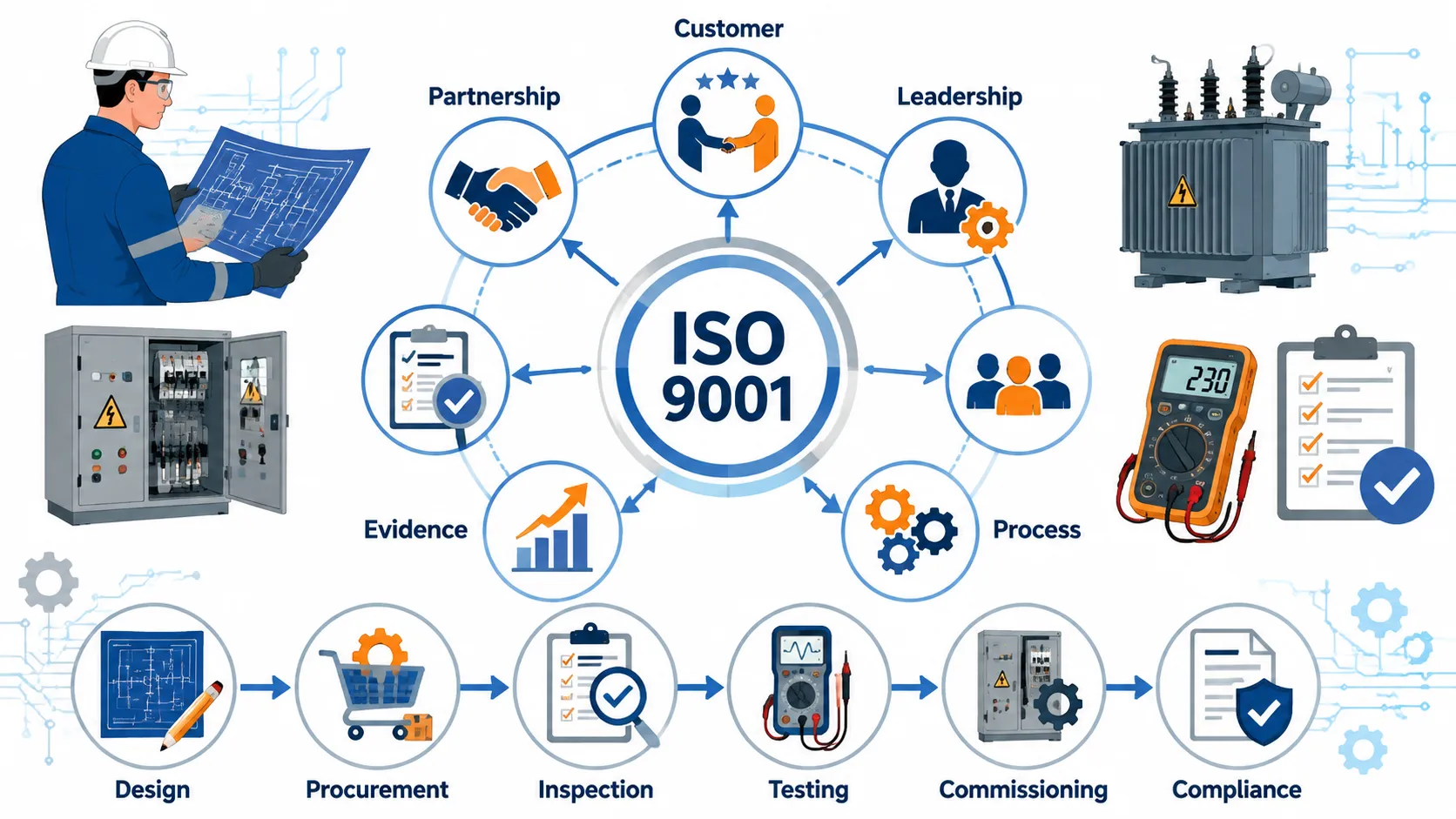
Understanding International Quality Standards in Electrical Engineering
International quality standards provide organisations with systematic frameworks for controlling engineering activities, improving process consistency, and delivering products and services that satisfy customer expectations while complying with applicable legal and technical requirements. These standards establish common management principles that can be implemented across diverse engineering sectors regardless of project size or geographical location.
Within electrical engineering, quality standards ensure that:
- Engineering designs satisfy technical specifications.
- Electrical materials comply with approved standards.
- Installation activities follow recognised engineering procedures.
- Inspection and testing are conducted systematically.
- Commissioning verifies operational performance.
- Documentation demonstrates compliance.
- Risks affecting quality are effectively managed.
- Continuous improvement becomes part of organisational culture.
Unlike technical standards that specify equipment characteristics or installation requirements, quality standards govern how organisations manage their processes to consistently achieve desired results.
Why ISO 9001 Is Highly Relevant to Electrical Engineering
Electrical engineering projects involve numerous interconnected activities where even minor deficiencies may affect system safety, operational reliability, energy efficiency, and regulatory compliance. ISO 9001 provides organisations with a management framework that strengthens process control across all project phases.
Key reasons why ISO 9001 is widely implemented include:
- Promotes consistent quality throughout engineering operations.
- Supports regulatory compliance.
- Improves customer satisfaction.
- Reduces project risks.
- Enhances organisational efficiency.
- Minimises defects and rework.
- Improves communication between departments.
- Encourages evidence-based decision making.
- Strengthens supplier management.
- Supports continual improvement initiatives.
- Improves project documentation.
- Builds confidence among clients and stakeholders.
- Facilitates international business opportunities.
- Enhances organisational reputation.
- Encourages proactive quality management rather than reactive inspection.
For electrical contractors, EPC organisations, utility providers, manufacturers, consultants, and commissioning companies, ISO 9001 provides a structured management approach that improves consistency throughout complex engineering projects.
Evolution of ISO 9001 and Modern Quality Management
Quality management has evolved considerably over recent decades. Earlier quality systems focused heavily on inspection, defect detection, and final product acceptance. Modern quality management places greater emphasis on prevention, process control, organisational leadership, and continual improvement.
ISO 9001 has progressively developed from a documentation-driven system into a strategic management framework supporting organisational excellence.
Major developments include:
- Increased emphasis on leadership involvement.
- Greater integration of organisational risk management.
- Stronger customer-focused planning.
- Process-based quality management.
- Continuous performance monitoring.
- Knowledge management.
- Organisational learning.
- Strategic planning.
- Stakeholder engagement.
- Continual improvement culture.
Modern electrical engineering organisations no longer rely solely on inspection departments. Instead, quality responsibilities are distributed across engineering teams, procurement specialists, project managers, construction supervisors, commissioning engineers, maintenance personnel, and senior leadership.
The Seven Core Principles of ISO 9001
The foundation of ISO 9001 is built upon seven internationally recognised Quality Management Principles. These principles guide organisations in developing effective quality management systems capable of delivering consistent engineering performance.
Customer Focus
Customer focus represents the primary principle of ISO 9001 because every engineering activity ultimately exists to satisfy customer requirements. In electrical engineering, customers expect safe installations, reliable equipment, timely project completion, regulatory compliance, and long-term operational performance.
Customer expectations may include:
- Compliance with contract specifications.
- Reliable electrical performance.
- Safe operation.
- Regulatory approval.
- Energy efficiency.
- High-quality workmanship.
- Minimal defects.
- Accurate documentation.
- Professional project management.
- Long-term maintainability.
From a QA/QC perspective, customer focus requires organisations to understand not only explicit contractual requirements but also implicit expectations related to reliability, safety, durability, and operational efficiency.
A customer-focused electrical organisation typically:
- Reviews client specifications thoroughly.
- Understands project quality objectives.
- Conducts design verification.
- Implements quality planning.
- Performs systematic inspections.
- Monitors customer satisfaction.
- Responds promptly to quality concerns.
- Continuously improves services based on client feedback.
Leadership
Leadership establishes organisational direction and creates the environment necessary for successful quality management. ISO 9001 recognises that quality cannot be achieved solely through documented procedures; it requires active commitment from top management.
In electrical engineering projects, leadership influences:
- Project quality objectives.
- Engineering culture.
- Resource allocation.
- Employee competence.
- Risk management.
- Compliance monitoring.
- Continuous improvement.
- Ethical engineering practices.
- Safety integration.
- Customer satisfaction.
Effective engineering leaders demonstrate quality commitment by:
- Establishing measurable quality objectives.
- Providing sufficient engineering resources.
- Supporting staff development.
- Encouraging innovation.
- Promoting accountability.
- Monitoring quality performance.
- Leading management reviews.
- Supporting corrective actions.
- Promoting continual improvement.
- Encouraging cross-functional collaboration.
When senior management actively participates in quality management, employees are more likely to follow procedures consistently and contribute to organisational improvement.
Engagement of People
Quality is achieved through competent, motivated, and engaged personnel working collaboratively across the organisation. Electrical engineering projects require coordination among multiple disciplines, making employee engagement fundamental to successful quality outcomes.
Personnel directly influencing electrical quality include:
- Electrical design engineers.
- QA/QC engineers.
- Electrical inspectors.
- Site engineers.
- Commissioning engineers.
- Procurement specialists.
- Material inspectors.
- Construction supervisors.
- Document controllers.
- Project managers.
- Maintenance engineers.
- Calibration technicians.
An organisation promoting engagement typically:
- Invests in professional development.
- Encourages technical training.
- Supports competency assessment.
- Promotes knowledge sharing.
- Recognises employee contributions.
- Encourages innovation.
- Maintains open communication.
- Supports continuous learning.
- Promotes teamwork.
- Encourages reporting of quality concerns.
Highly engaged personnel are more likely to identify potential quality risks before they develop into costly project problems.
Process Approach
The process approach is one of the most influential principles within ISO 9001 and is particularly important in electrical engineering. Rather than viewing engineering activities as isolated tasks, ISO 9001 considers every activity as part of an interconnected process contributing to project success.
For example, electrical installation quality depends upon successful completion of preceding processes:
- Client requirements.
- Engineering design.
- Design verification.
- Procurement.
- Supplier evaluation.
- Material inspection.
- Storage.
- Installation.
- Inspection.
- Testing.
- Commissioning.
- Final handover.
Each process receives inputs, performs defined activities, and produces outputs that become inputs for subsequent processes.
Table: Process Approach in Electrical Engineering Quality Management
| Process | Purpose | Typical QA/QC Activities | Expected Outcome |
|---|---|---|---|
| Engineering Design | Develop compliant electrical designs | Design reviews, verification, approval | Accurate engineering documentation |
| Procurement | Source approved materials | Supplier evaluation, material verification | Compliant electrical equipment |
| Installation | Construct electrical systems | Installation inspections, workmanship checks | Safe and compliant installations |
| Inspection & Testing | Verify quality requirements | Visual inspections, electrical testing, calibration | Verified conformity with specifications |
| Commissioning | Confirm operational readiness | Functional testing, performance verification | Reliable system performance |
| Documentation & Handover | Demonstrate compliance | Quality records, test certificates, as-built drawings | Complete project quality documentation |
The process approach encourages organisations to identify interactions between engineering activities and optimise them collectively rather than managing each function independently. This significantly reduces inefficiencies, improves communication, enhances traceability, and strengthens quality assurance throughout the project lifecycle.
Practical Example: Applying the Process Approach
Consider the installation of an electrical distribution system in a modern commercial building. A process-based quality management approach ensures that each activity is linked to the next rather than being treated as an isolated task.
The sequence typically includes:
- Reviewing project specifications and electrical drawings.
- Verifying approved material submittals.
- Inspecting incoming switchboards, cables, and protective devices.
- Confirming calibration status of testing instruments.
- Monitoring installation quality through staged inspections.
- Performing insulation resistance, continuity, and functional tests.
- Recording inspection and test results.
- Resolving non-conformities before energisation.
- Completing commissioning and final acceptance documentation.
By managing these interconnected activities as a single quality process, the organisation improves consistency, reduces rework, and increases confidence that the completed electrical installation will meet both contractual requirements and international quality standards.
Improvement
Continual improvement is one of the most important principles of ISO 9001 and a defining characteristic of high-performing electrical engineering organisations. In today’s rapidly evolving engineering environment, organisations cannot rely solely on established procedures or historical performance. Advancements in electrical technologies, digital monitoring systems, renewable energy integration, smart grids, automation, and stricter regulatory requirements demand ongoing improvements in quality management systems. From the perspective of a Senior Electrical QA/QC Engineer, continual improvement is not limited to correcting problems after they occur; it involves proactively identifying opportunities to enhance processes, reduce risks, improve efficiency, and increase customer satisfaction.
An effective improvement strategy begins with monitoring organisational performance, analysing quality data, investigating non-conformities, and implementing corrective and preventive actions. Lessons learned from completed projects should be incorporated into future planning to avoid recurring issues and promote organisational learning. In electrical engineering, improvement activities may involve updating inspection procedures, improving testing methodologies, adopting advanced technologies, enhancing staff competence, refining supplier evaluation processes, or strengthening document control systems. Organisations that embed continual improvement into their quality culture are better positioned to deliver reliable electrical systems while maintaining competitiveness in national and international markets.
Key activities supporting continual improvement include:
- Monitoring quality objectives and key performance indicators (KPIs).
- Conducting regular internal quality audits.
- Reviewing customer feedback and client satisfaction.
- Analysing inspection and testing results.
- Investigating root causes of non-conformities.
- Implementing corrective and preventive actions (CAPA).
- Updating quality procedures based on lessons learned.
- Introducing innovative engineering solutions.
- Enhancing workforce competence through continuous training.
- Promoting employee suggestions for quality improvements.
- Reviewing supplier performance and implementing improvements.
- Benchmarking organisational performance against industry best practices.
- Using digital quality management systems to monitor performance.
- Conducting periodic management reviews.
- Measuring the effectiveness of implemented improvements.
Evidence-Based Decision Making
Successful quality management depends on making informed decisions supported by accurate, reliable, and objective evidence rather than assumptions or personal opinions. ISO 9001 promotes evidence-based decision making to ensure that organisational improvements and corrective actions are based on measurable facts. Within electrical engineering, this principle is particularly important because technical decisions directly affect safety, operational reliability, regulatory compliance, and project performance.
Electrical QA/QC professionals regularly collect and analyse quality-related data from inspections, testing, commissioning, audits, calibration records, material certifications, supplier evaluations, and customer feedback. This information enables organisations to identify performance trends, assess process effectiveness, evaluate risks, and implement targeted improvements. Decisions based on factual evidence improve confidence, reduce uncertainty, and support more effective project management.
Common sources of quality evidence include:
- Inspection reports.
- Electrical test reports.
- Factory Acceptance Test (FAT) records.
- Site Acceptance Test (SAT) results.
- Material certificates and manufacturer documentation.
- Calibration certificates for measuring instruments.
- Internal and external audit reports.
- Non-Conformance Reports (NCRs).
- Corrective Action Reports (CARs).
- Preventive Action Records.
- Customer complaints and feedback.
- Project quality performance indicators.
- Supplier evaluation records.
- Risk assessment reports.
- Commissioning documentation.
Benefits of evidence-based decision making:
- Improves engineering accuracy.
- Reduces subjective decision making.
- Supports regulatory compliance.
- Enhances quality planning.
- Improves customer confidence.
- Strengthens audit readiness.
- Supports continual improvement initiatives.
- Reduces quality-related project risks.
- Improves resource allocation.
- Enables better management reporting.
Relationship Management
Electrical engineering projects involve extensive collaboration among clients, consultants, contractors, subcontractors, manufacturers, suppliers, inspection agencies, and regulatory authorities. ISO 9001 recognises that sustainable organisational success depends upon maintaining effective relationships with these interested parties. Strong professional relationships improve communication, reduce misunderstandings, strengthen quality performance, and contribute to successful project delivery.
Relationship management extends beyond supplier selection. It includes continuous communication, performance monitoring, collaborative problem-solving, and mutual commitment to achieving quality objectives. Organisations that actively engage with stakeholders are more likely to identify potential issues early, improve coordination, and maintain consistent quality throughout project execution.
Effective relationship management involves:
- Selecting competent and approved suppliers.
- Establishing clear quality requirements within contracts.
- Conducting supplier performance evaluations.
- Maintaining open communication with stakeholders.
- Sharing project quality objectives.
- Resolving technical issues collaboratively.
- Conducting regular coordination meetings.
- Monitoring subcontractor quality performance.
- Encouraging continuous supplier improvement.
- Maintaining transparent documentation and reporting.
Key Concepts in ISO 9001 for Electrical Engineering
Understanding the core concepts of ISO 9001 enables electrical engineering professionals to apply quality management principles effectively across all project stages.
Essential quality concepts include:
- Quality Management System (QMS).
- Customer satisfaction.
- Risk-based thinking.
- Process approach.
- Leadership commitment.
- Competence and awareness.
- Documented information.
- Operational planning and control.
- Performance evaluation.
- Internal auditing.
- Corrective and preventive actions.
- Continual improvement.
- Compliance management.
- Stakeholder engagement.
- Evidence-based decision making.
Processes and Procedures in Electrical QA/QC
A structured quality management system relies on clearly defined processes and documented procedures that guide engineering activities from project initiation through final handover.
Typical QA/QC process sequence:
- Review project specifications and contractual requirements.
- Develop Project Quality Plan (PQP).
- Prepare Inspection and Test Plans (ITPs).
- Approve engineering drawings and technical documents.
- Evaluate and approve suppliers.
- Conduct incoming material inspections.
- Monitor installation quality.
- Perform stage inspections.
- Execute electrical testing and commissioning.
- Record inspection findings.
- Manage non-conformities.
- Implement corrective actions.
- Conduct internal quality audits.
- Review project quality performance.
- Complete final documentation and handover.
Practical Applications in Electrical Engineering
ISO 9001 principles are applied across numerous electrical engineering environments to ensure consistency, compliance, and operational excellence.
Common application areas include:
- Commercial building electrical installations.
- Industrial manufacturing plants.
- High-voltage substations.
- Power generation facilities.
- Renewable energy projects.
- Oil and gas electrical systems.
- Transmission and distribution networks.
- Data centres.
- Healthcare facilities.
- Smart building infrastructure.
- Railway electrification projects.
- Utility infrastructure.
Practical Example
During the construction of a solar photovoltaic power plant, the QA/QC team implemented ISO 9001 principles by establishing a comprehensive quality management system before construction commenced. Approved suppliers were selected through rigorous evaluations, incoming photovoltaic modules and inverters were inspected against technical specifications, and installation activities were monitored using Inspection and Test Plans. Every stage of cable installation, earthing, inverter commissioning, and performance testing was documented and verified before project handover. This systematic approach reduced installation defects, improved commissioning efficiency, ensured compliance with project specifications, and increased client confidence in the completed facility.
Case Study: Implementation of ISO 9001 in a High-Voltage Substation Project
A national utility company initiated the construction of a new 132 kV electrical substation to improve regional power distribution capacity. Previous infrastructure projects had experienced delays, inconsistent documentation, equipment defects, and commissioning failures due to fragmented quality management practices. To improve project performance, the organisation implemented a comprehensive ISO 9001 Quality Management System across all project phases.
A multidisciplinary quality team developed a Project Quality Plan, established Inspection and Test Plans for all critical activities, implemented supplier qualification procedures, introduced digital document control, and strengthened internal auditing processes. QA/QC engineers monitored civil works, transformer installation, switchgear assembly, cable termination, protection systems, earthing installation, and commissioning activities through systematic inspections and testing.
During construction, several non-conformities relating to cable gland installation and documentation inconsistencies were identified through scheduled quality inspections. Rather than allowing these issues to progress into commissioning, root cause analysis was conducted, corrective actions were implemented, and installation procedures were revised. Additional competency training was delivered to installation teams, while supplier communication processes were improved to minimise future quality deviations.
Following project completion, the utility reported measurable improvements, including reduced rework, improved documentation accuracy, enhanced commissioning performance, faster regulatory approval, and increased customer satisfaction. The implementation of ISO 9001 also strengthened organisational learning, enabling lessons from the project to be incorporated into future infrastructure developments.
Conclusion
The core principles of ISO 9001 provide a robust and internationally recognised framework for achieving excellence in electrical engineering quality management. Principles such as customer focus, leadership, engagement of people, process approach, continual improvement, evidence-based decision making, and relationship management enable organisations to consistently deliver safe, reliable, and compliant electrical systems. Rather than relying solely on final inspections, ISO 9001 promotes a proactive approach that integrates quality into every stage of the engineering lifecycle, from design and procurement to installation, commissioning, and maintenance.
For electrical engineering organisations operating in construction, manufacturing, utilities, renewable energy, industrial facilities, and infrastructure projects, effective implementation of these principles improves operational efficiency, reduces quality risks, enhances customer confidence, and supports long-term business sustainability. As technology and regulatory requirements continue to evolve, professionals who understand and apply international quality management standards will play a critical role in delivering high-quality electrical engineering solutions that meet global expectations and contribute to continuous organisational improvement.
2. Evaluate the Benefits and Limitations of Applying International Quality Standards to Complex Electrical Projects
International quality standards have become an essential component of modern electrical engineering, particularly in large-scale and technically demanding projects where safety, reliability, compliance, and operational performance are critical. Projects such as high-voltage substations, renewable energy facilities, industrial manufacturing plants, power transmission networks, commercial developments, data centres, and smart infrastructure involve numerous stakeholders, sophisticated technologies, extensive documentation, and strict regulatory requirements. In such environments, internationally recognised quality management standards, including ISO 9001, provide a structured framework that enables organisations to establish consistent processes, improve quality performance, minimise risks, and deliver engineering solutions that meet both customer expectations and international best practices.
From the perspective of a Chartered Electrical Engineer (CEng) and Senior Electrical QA/QC Engineer, implementing international quality standards extends beyond obtaining certification. It requires integrating quality principles into engineering design, procurement, manufacturing, installation, inspection, testing, commissioning, and maintenance activities throughout the entire project lifecycle. Quality standards promote systematic planning, process control, effective communication, evidence-based decision-making, and continual improvement. However, despite their significant advantages, these standards also present practical challenges related to implementation costs, organisational culture, documentation complexity, training requirements, and adaptation to project-specific conditions. Therefore, understanding both the benefits and limitations is essential for professionals responsible for managing quality in complex electrical engineering projects.
This lesson critically evaluates how international quality standards contribute to successful project delivery while examining the practical constraints organisations may encounter during implementation. Through detailed analysis, practical engineering examples, industry applications, and professional best practices, learners will develop the ability to assess the effectiveness of quality management systems in achieving operational excellence, technical compliance, and sustainable organisational performance.
Understanding International Quality Standards in Complex Electrical Projects
What Are International Quality Standards?
International quality standards are globally recognised frameworks that establish systematic requirements for managing organisational processes to achieve consistent quality, customer satisfaction, regulatory compliance, and continual improvement. Rather than specifying technical engineering designs or equipment characteristics, these standards define management principles that help organisations control activities affecting product and service quality.
In electrical engineering, quality standards support organisations by ensuring that engineering activities are planned, monitored, evaluated, and continuously improved throughout every phase of a project.
Common international standards applied in electrical engineering include:
- ISO 9001 – Quality Management Systems
- ISO 19011 – Guidelines for Auditing Management Systems
- ISO 45001 – Occupational Health and Safety Management
- ISO 14001 – Environmental Management Systems
- IEC Standards for Electrical Equipment
- IEEE Engineering Standards
- BS 7671 (IET Wiring Regulations)
- IEC 60364 Electrical Installations
- IEC 61439 Low Voltage Switchgear Assemblies
- IEC 60076 Power Transformers
These standards collectively support quality, safety, environmental protection, and technical excellence across electrical engineering projects.
Why Complex Electrical Projects Require International Quality Standards
Modern electrical engineering projects involve thousands of interconnected activities where failures in one process can affect multiple downstream operations. The increasing integration of digital technologies, renewable energy systems, automation, and smart infrastructure has significantly increased project complexity.
Examples of complex electrical projects include:
- National transmission networks
- High-voltage substations
- Offshore wind farms
- Solar photovoltaic power plants
- Industrial process facilities
- Oil and gas processing plants
- Smart city infrastructure
- Data centres
- Railway electrification
- Airport electrical systems
- Hospital power distribution networks
- Manufacturing automation systems
Without structured quality management, these projects face increased risks associated with installation defects, design inconsistencies, equipment failures, documentation errors, and regulatory non-compliance.
Benefits of Applying International Quality Standards
Improved Project Quality
One of the most significant advantages of implementing international quality standards is the improvement in overall project quality. ISO 9001 establishes systematic controls that ensure engineering activities are performed consistently according to approved procedures.
Quality improvements include:
- Standardised engineering processes.
- Improved workmanship.
- Reduced installation defects.
- Better inspection consistency.
- Enhanced documentation accuracy.
- Improved testing procedures.
- Greater commissioning reliability.
- Higher customer satisfaction.
- Reduced project rework.
- Increased operational reliability.
From a QA/QC perspective, consistent quality reduces uncertainty during project execution and improves confidence that completed electrical systems will perform as intended.
Enhanced Regulatory Compliance
Electrical engineering projects operate within strict legal and regulatory environments. International quality standards help organisations establish processes that demonstrate compliance with statutory requirements, contractual obligations, and industry regulations.
Regulatory compliance is strengthened through:
- Documented procedures.
- Controlled engineering documentation.
- Inspection records.
- Test certificates.
- Equipment traceability.
- Internal audits.
- Corrective action processes.
- Management reviews.
- Competency assessments.
- Supplier qualification.
These controls reduce the likelihood of regulatory violations and improve organisational credibility during external audits.
Improved Risk Management
Complex electrical projects involve numerous technical, commercial, operational, and safety risks. International quality standards encourage organisations to identify potential risks before they affect project performance.
Typical quality-related risks include:
- Incorrect engineering design.
- Material non-conformance.
- Supplier delays.
- Equipment incompatibility.
- Installation errors.
- Testing failures.
- Calibration inaccuracies.
- Documentation deficiencies.
- Human error.
- Poor communication.
Through risk-based thinking, organisations implement preventive controls that minimise the probability and impact of these risks.
Increased Customer Confidence
Clients investing in major electrical infrastructure expect high standards of quality, reliability, and transparency. Certification to internationally recognised standards provides assurance that an organisation follows structured quality management practices.
Customer confidence improves because organisations:
- Demonstrate internationally recognised certification.
- Maintain documented quality procedures.
- Deliver consistent engineering quality.
- Resolve quality issues systematically.
- Improve communication.
- Meet contractual obligations.
- Reduce project uncertainties.
- Promote transparency.
- Provide complete quality documentation.
- Support long-term asset reliability.
Satisfied clients are more likely to establish long-term business relationships and award future contracts.
Greater Operational Efficiency
A well-implemented quality management system eliminates unnecessary duplication, improves coordination, and enhances organisational productivity.
Operational improvements include:
- Better workflow planning.
- Clear responsibilities.
- Reduced process variation.
- Improved communication.
- Faster problem resolution.
- Better document control.
- Reduced waste.
- Improved resource utilisation.
- Shorter project timelines.
- Improved engineering coordination.
For large electrical construction projects involving multiple contractors and suppliers, these improvements contribute significantly to overall project success.
Improved Supplier and Procurement Quality
Electrical engineering projects depend heavily on external suppliers for cables, transformers, switchgear, protection systems, control panels, instrumentation, and numerous specialised components. International quality standards strengthen procurement processes by requiring systematic supplier evaluation and performance monitoring.
Supplier quality management typically includes:
- Supplier qualification.
- Technical capability assessment.
- Factory audits.
- Material approval procedures.
- Incoming material inspection.
- Certificate verification.
- Performance monitoring.
- Non-conformance reporting.
- Supplier corrective actions.
- Continuous supplier evaluation.
Improved supplier management reduces the likelihood of defective materials entering the project and enhances overall system reliability.
Better Documentation and Traceability
Quality documentation provides evidence that engineering activities comply with project specifications and regulatory requirements. Traceability is particularly important in complex electrical projects where equipment performance must be verified throughout the asset lifecycle.
Essential QA/QC documentation includes:
- Project Quality Plans.
- Inspection and Test Plans.
- Material Inspection Reports.
- Method Statements.
- Risk Assessments.
- Calibration Certificates.
- Factory Acceptance Test reports.
- Site Acceptance Test reports.
- Non-Conformance Reports.
- Corrective Action Reports.
- As-built drawings.
- Commissioning records.
- Operation and Maintenance Manuals.
Comprehensive documentation supports audits, regulatory inspections, maintenance planning, warranty claims, and future system modifications.
Strengthened Continual Improvement
International quality standards encourage organisations to view quality as an ongoing process rather than a final inspection activity. Continual improvement enables organisations to learn from previous projects, improve engineering performance, and increase organisational maturity.
Improvement activities may include:
- Internal quality audits.
- Root cause analysis.
- Corrective actions.
- Preventive actions.
- Lessons learned workshops.
- Employee training.
- Technology upgrades.
- Digital quality systems.
- Customer feedback analysis.
- KPI monitoring.
Over time, these improvements contribute to greater engineering efficiency, reduced defects, improved customer satisfaction, and enhanced business performance.
Practical Example
A multinational engineering contractor was awarded the construction of a large industrial manufacturing facility requiring complex electrical distribution systems, motor control centres, backup power generation, and automated production equipment. The project involved numerous international suppliers, multiple subcontractors, and strict contractual quality requirements.
By implementing ISO 9001-based quality management processes from the planning stage, the organisation established comprehensive Project Quality Plans, supplier approval procedures, Inspection and Test Plans, document control systems, and regular internal audits. Material inspections prevented non-compliant equipment from being installed, while systematic quality inspections identified installation issues before commissioning commenced. As a result, the project achieved successful commissioning with minimal rework, reduced delays, improved client satisfaction, and full compliance with contractual quality requirements.
Limitations of Applying International Quality Standards
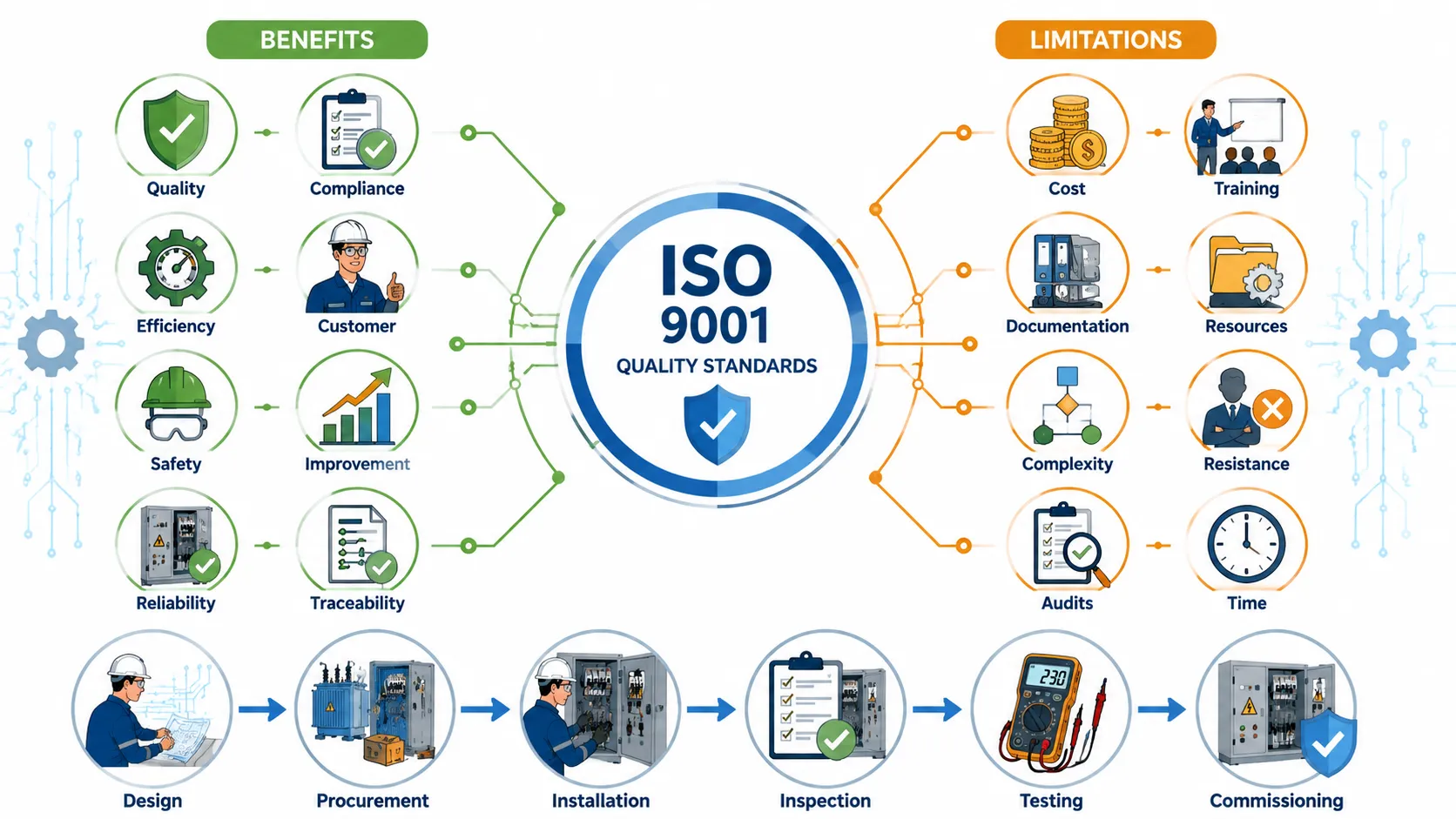
Although international quality standards provide a structured framework for achieving consistent quality, their implementation within complex electrical engineering projects presents several practical and organisational challenges. From the perspective of a Chartered Electrical Engineer (CEng) and Senior Electrical QA/QC Engineer, standards such as ISO 9001 establish management principles that support quality assurance and continual improvement; however, they do not automatically guarantee technical excellence or project success. Their effectiveness depends on competent personnel, committed leadership, effective communication, and the consistent application of quality procedures throughout the project lifecycle.
One of the primary challenges is ensuring that quality management systems become an integral part of engineering operations rather than a documentation exercise. Organisations that focus solely on achieving certification without embedding quality into everyday engineering activities may experience limited improvements in project performance. Complex electrical projects require collaboration between designers, procurement teams, contractors, suppliers, inspectors, commissioning engineers, and clients. Maintaining consistent quality across these multiple stakeholders requires continuous monitoring, coordination, and strong quality leadership.
Common limitations include:
- High implementation and certification costs.
- Extensive documentation requirements.
- Increased administrative workload.
- Continuous training and competency development requirements.
- Resistance to organisational change.
- Dependence on management commitment.
- Variability in supplier performance.
- Complex coordination between multiple contractors.
- Time required to implement new quality systems.
- Difficulty maintaining consistency across international projects.
- Risk of excessive focus on paperwork rather than engineering quality.
- Resource-intensive auditing and compliance activities.
- Continuous maintenance of certification requirements.
- Challenges adapting standard procedures to specialised project environments.
- Increased project planning requirements.
Documentation and Record Management Challenges
One of the most demanding aspects of implementing ISO 9001 within electrical engineering projects is maintaining comprehensive and accurate documentation. Large-scale electrical projects generate thousands of quality records covering design reviews, procurement, inspections, testing, commissioning, audits, and final project handover.
Comprehensive documentation is essential for demonstrating compliance with contractual requirements, engineering specifications, and statutory regulations. However, if documentation systems are poorly managed, they can delay engineering activities, create confusion through document version inconsistencies, and increase administrative costs.
Common quality documents include:
- Project Quality Plans (PQP).
- Inspection and Test Plans (ITPs).
- Material Inspection Reports (MIR).
- Request for Inspection (RFI).
- Method Statements.
- Engineering drawing approvals.
- Technical submittals.
- Supplier approval records.
- Calibration certificates.
- Inspection reports.
- Electrical testing reports.
- Factory Acceptance Test (FAT) reports.
- Site Acceptance Test (SAT) reports.
- Non-Conformance Reports (NCRs).
- Corrective and Preventive Action (CAPA) reports.
- Internal audit reports.
- Commissioning reports.
- As-built drawings.
- Operation and Maintenance Manuals.
To overcome documentation challenges, many organisations now utilise digital document management systems that improve traceability, version control, accessibility, and approval workflows.
Financial and Resource Considerations
Implementing and maintaining an internationally recognised quality management system requires substantial investment. Organisations must allocate financial resources not only for certification but also for staff training, internal auditing, quality management software, inspection equipment, calibration services, and continual improvement activities.
For large engineering organisations, these investments often deliver long-term operational benefits. Smaller contractors, however, may experience financial pressure during the initial implementation phase.
Key organisational investments include:
- Qualified QA/QC personnel.
- Internal quality auditors.
- Professional development programmes.
- Calibration services.
- Inspection equipment.
- Digital quality management software.
- Document control systems.
- External certification audits.
- Supplier evaluation activities.
- Continuous improvement initiatives.
Although these investments increase operational costs initially, they often reduce long-term expenses associated with defects, rework, delays, contractual disputes, and warranty claims.
Human Factors and Organisational Culture
The success of any quality management system depends on the people responsible for implementing it. Even the most comprehensive quality procedures will produce limited results if employees do not understand or support the organisation’s quality objectives.
Developing a positive quality culture requires leadership commitment, effective communication, continuous training, and active employee participation. Quality should be viewed as a shared organisational responsibility rather than solely the responsibility of the QA/QC department.
Common organisational challenges include:
- Resistance to procedural changes.
- Limited employee engagement.
- Poor communication between departments.
- Inadequate quality awareness.
- Lack of technical competence.
- Insufficient leadership involvement.
- Inconsistent application of procedures.
- Reluctance to report quality concerns.
- Limited collaboration among stakeholders.
- Poor understanding of continual improvement principles.
Organisations that invest in employee development and promote a culture of accountability are generally more successful in implementing international quality standards.
Table: Benefits and Limitations of International Quality Standards in Electrical Engineering
| Aspect | Benefits | Limitations |
|---|---|---|
| Quality Management | Standardises engineering processes and improves consistency. | Requires disciplined implementation and regular monitoring. |
| Regulatory Compliance | Supports compliance with legal, contractual, and industry requirements. | Regulations may vary between countries and projects. |
| Documentation | Provides traceability and objective evidence of conformity. | Extensive documentation can increase administrative workload. |
| Risk Management | Encourages proactive identification and control of quality risks. | Continuous risk reviews require dedicated resources. |
| Customer Satisfaction | Improves confidence through reliable project delivery. | Customer expectations may change during project execution. |
| Supplier Management | Strengthens supplier selection and performance monitoring. | Supplier quality may still vary despite qualification procedures. |
| Continual Improvement | Promotes organisational learning and performance enhancement. | Requires ongoing investment in training and improvement initiatives. |
| Operational Efficiency | Reduces defects, rework, and process variation. | Initial implementation may temporarily reduce productivity. |
Processes and Procedures Supporting Effective Implementation
International quality standards become effective only when they are integrated into clearly defined engineering processes supported by competent personnel and documented procedures.
Typical implementation process:
- Review client specifications and project requirements.
- Establish project quality objectives.
- Develop the Project Quality Plan.
- Prepare Inspection and Test Plans.
- Approve engineering documentation.
- Qualify suppliers and subcontractors.
- Inspect incoming materials.
- Monitor installation activities.
- Conduct quality inspections.
- Perform electrical testing and commissioning.
- Record inspection and testing results.
- Investigate non-conformities.
- Implement corrective actions.
- Conduct internal quality audits.
- Review quality performance.
- Complete final documentation.
- Deliver project handover.
This structured approach ensures that quality requirements are addressed throughout the project lifecycle rather than only during final inspections.
Practical Applications in Complex Electrical Projects
International quality standards support quality management across a broad range of electrical engineering environments where technical complexity, safety, and regulatory compliance are critical.
Common application areas include:
- High-voltage substations.
- Commercial building electrical installations.
- Industrial manufacturing facilities.
- Renewable energy projects.
- Power generation stations.
- Transmission and distribution networks.
- Railway electrification.
- Airport electrical systems.
- Healthcare electrical infrastructure.
- Data centres.
- Water treatment facilities.
- Oil and gas installations.
Across these sectors, quality management systems help organisations improve engineering consistency, reduce operational risks, strengthen compliance, and enhance long-term asset performance.
Practical Example
An engineering contractor responsible for constructing a large industrial manufacturing facility implemented an ISO 9001-based quality management system before project mobilisation. The quality team developed a comprehensive Project Quality Plan, established Inspection and Test Plans for all major activities, and introduced digital document control for engineering drawings, inspections, and commissioning records.
During procurement, incoming inspections identified several electrical components that did not comply with approved technical specifications. These materials were rejected before installation, preventing costly rework and potential commissioning failures. Throughout construction, scheduled quality inspections ensured that cable installations, switchgear assembly, earthing systems, and electrical testing complied with project requirements. As a result, the project achieved successful commissioning with minimal quality-related delays and high client satisfaction.
Case Study: ISO 9001 Implementation in a High-Voltage Substation Project
A national electricity transmission company initiated the construction of a new 220 kV high-voltage substation to strengthen regional power distribution capacity. The project involved multiple international equipment suppliers, specialist subcontractors, advanced protection systems, power transformers, GIS switchgear, underground cable networks, and sophisticated control systems. Due to the project’s complexity, the client required all participating organisations to implement an ISO 9001-compliant Quality Management System.
The project team established a comprehensive quality framework covering engineering design reviews, supplier qualification, Inspection and Test Plans, document control, internal auditing, material inspections, installation monitoring, electrical testing, and commissioning verification. Regular coordination meetings ensured effective communication between designers, contractors, suppliers, and quality engineers throughout project execution.
During construction, routine inspections identified several non-conformities relating to cable termination practices and incomplete inspection documentation. Instead of delaying project completion, the QA/QC team performed root cause analysis, implemented corrective actions, updated installation procedures, and delivered additional technical training to installation personnel. These actions prevented similar issues from recurring during subsequent project phases.
Following project completion, the organisation reported significant improvements in construction quality, documentation accuracy, commissioning efficiency, regulatory compliance, and customer satisfaction. Although implementing the quality management system required considerable investment in training, auditing, documentation, and process management, the long-term benefits substantially outweighed the initial costs by reducing rework, improving operational reliability, and strengthening organisational quality performance.
Conclusion
International quality standards such as ISO 9001 provide a comprehensive framework for managing quality within complex electrical engineering projects by promoting structured processes, regulatory compliance, risk-based thinking, continual improvement, and customer-focused engineering practices. Their implementation enables organisations to improve project consistency, enhance operational efficiency, reduce defects, strengthen supplier performance, and deliver safe, reliable, and technically compliant electrical systems across construction, manufacturing, power generation, renewable energy, utilities, and industrial infrastructure sectors.
Despite these advantages, successful implementation requires significant organisational commitment, competent personnel, effective leadership, adequate resources, and a strong quality culture. Challenges such as extensive documentation, implementation costs, workforce training, supplier coordination, and process integration must be effectively managed to achieve the full value of international quality standards. When quality principles are embedded into every stage of the electrical engineering lifecycle, organisations are better equipped to deliver high-performance projects, maintain regulatory compliance, and achieve sustainable excellence in an increasingly competitive global engineering industry.
3. Assess Current Organisational Practices Against the Requirements of International Quality Standards
In today’s highly regulated electrical engineering industry, organisations are expected to deliver projects that consistently meet international quality, safety, and performance standards. Whether working on power generation facilities, transmission and distribution networks, renewable energy installations, commercial buildings, industrial plants, or large-scale infrastructure projects, organisations must regularly assess their internal practices to ensure they comply with internationally recognised quality management standards such as ISO 9001. Conducting systematic assessments enables organisations to determine whether their existing quality management systems, engineering procedures, operational controls, and organisational processes effectively support the delivery of safe, reliable, and compliant electrical engineering projects.
From the perspective of a Chartered Electrical Engineer (CEng) and Senior Electrical QA/QC Engineer, organisational assessment is not simply an auditing exercise but a strategic process that evaluates the effectiveness, efficiency, and maturity of an organisation’s quality management system. It involves comparing existing engineering practices, documentation, leadership commitment, resource management, supplier controls, inspection procedures, testing activities, risk management, and continual improvement initiatives against the requirements of international quality standards. Through these assessments, organisations can identify strengths, recognise areas requiring improvement, reduce quality-related risks, and implement corrective actions that enhance operational performance and customer satisfaction.
This lesson examines how organisations evaluate their current quality management practices against internationally recognised standards and explains the methodologies used to identify compliance gaps, improve organisational performance, and achieve continual improvement. Learners will develop a comprehensive understanding of quality assessment techniques, internal auditing processes, performance evaluation, and best practices for maintaining compliance in complex electrical engineering environments.
Understanding Organisational Quality Assessment
What Is Organisational Quality Assessment?
Organisational quality assessment is the systematic process of evaluating an organisation’s quality management practices, engineering procedures, operational controls, and management systems against established international standards and organisational objectives. The purpose is to determine whether existing practices effectively support consistent quality performance while meeting customer, contractual, statutory, and regulatory requirements.
Unlike product inspections that evaluate completed work, organisational assessments examine the systems and processes responsible for producing quality outcomes. This proactive approach helps organisations identify weaknesses before they result in quality failures, project delays, or customer complaints.
Organisational assessment focuses on evaluating:
- Quality Management System (QMS) effectiveness.
- Leadership commitment.
- Customer focus.
- Engineering process control.
- Risk management practices.
- Competency management.
- Resource allocation.
- Supplier management.
- Inspection and testing procedures.
- Document control systems.
- Internal auditing programmes.
- Corrective and preventive action processes.
- Performance monitoring.
- Continual improvement initiatives.
- Regulatory compliance.
These assessments provide management with objective evidence regarding the effectiveness of organisational quality systems and support informed decision-making.
Importance of Assessing Organisational Practices
Electrical engineering organisations operate in environments where quality failures can have significant financial, operational, legal, and safety consequences. Deficiencies in organisational processes may lead to defective installations, equipment failures, contractual disputes, increased maintenance costs, project delays, and regulatory penalties.
Regular assessments provide organisations with valuable insights into their quality performance and enable management to implement improvements before significant problems occur.
Benefits of organisational assessment include:
- Improved compliance with ISO 9001 requirements.
- Enhanced engineering consistency.
- Better risk management.
- Reduced quality-related defects.
- Improved customer satisfaction.
- Greater operational efficiency.
- Increased employee accountability.
- Improved supplier performance.
- Better resource utilisation.
- Enhanced regulatory compliance.
- Stronger quality culture.
- Improved organisational decision-making.
- Reduced project rework.
- Increased stakeholder confidence.
- Support for continual improvement.
From a QA/QC perspective, organisational assessments strengthen confidence that engineering activities consistently meet quality expectations throughout every phase of project delivery.
International Quality Standards Used for Assessment
Several internationally recognised standards provide the framework against which organisations evaluate their quality management practices.
Frequently applied standards include:
- ISO 9001 – Quality Management Systems.
- ISO 19011 – Guidelines for Auditing Management Systems.
- ISO 45001 – Occupational Health and Safety Management Systems.
- ISO 14001 – Environmental Management Systems.
- IEC Standards.
- IEEE Engineering Standards.
- BS 7671 Wiring Regulations.
- IEC 60364 Electrical Installations.
- IEC 61439 Low Voltage Switchgear.
- IEC 60076 Power Transformers.
Although each standard has different objectives, they collectively promote systematic management, risk reduction, operational consistency, and continual improvement.
Assessing Compliance with ISO 9001
ISO 9001 provides organisations with a structured framework for evaluating the effectiveness of their quality management systems. Compliance assessments determine whether organisational practices align with the standard’s principles and requirements.
Assessment activities typically evaluate:
- Organisational context.
- Leadership involvement.
- Customer focus.
- Quality policy.
- Quality objectives.
- Risk-based thinking.
- Operational planning.
- Process management.
- Competence management.
- Resource availability.
- Documented information.
- Internal audits.
- Management reviews.
- Corrective actions.
- Continual improvement.
Assessments should focus not only on the existence of documented procedures but also on whether these procedures are effectively implemented and consistently followed.
Key Organisational Areas Evaluated
Leadership and Strategic Direction
Leadership commitment forms the foundation of an effective quality management system. Senior management is responsible for establishing organisational quality objectives, allocating resources, promoting customer focus, and creating a culture that supports continual improvement.
Assessors typically evaluate:
- Leadership commitment.
- Quality policy.
- Strategic planning.
- Organisational objectives.
- Resource allocation.
- Employee communication.
- Decision-making processes.
- Accountability structures.
- Performance monitoring.
- Management review effectiveness.
Without visible leadership commitment, quality management systems often become administrative exercises rather than practical management tools.
Quality Management System (QMS)
The Quality Management System integrates organisational processes that influence quality throughout engineering operations. Assessors examine whether the QMS is effectively planned, documented, implemented, monitored, and continuously improved.
Areas commonly assessed include:
- QMS documentation.
- Process interaction.
- Procedure effectiveness.
- Process consistency.
- Document control.
- Record management.
- Operational controls.
- Performance monitoring.
- Improvement mechanisms.
- Compliance verification.
An effective QMS supports consistent engineering performance while providing flexibility for continual improvement.
Human Resources and Competence
Competent personnel are essential for delivering quality electrical engineering projects. Organisations must ensure that employees possess the necessary knowledge, technical skills, qualifications, and experience to perform assigned responsibilities.
Competency assessments typically review:
- Professional qualifications.
- Technical competence.
- Training records.
- Skills development.
- Certification status.
- Experience levels.
- Performance evaluations.
- Competency matrices.
- Continuous professional development.
- Employee awareness.
Engineering quality depends significantly on the competence of designers, inspectors, supervisors, commissioning engineers, technicians, and project managers.
Assessment of Engineering Processes
Engineering processes form the operational core of electrical project delivery. Assessing these processes enables organisations to verify whether engineering activities are consistently performed according to approved procedures and technical specifications.
Key engineering processes include:
- Engineering design.
- Design verification.
- Procurement.
- Supplier qualification.
- Material inspection.
- Installation.
- Inspection.
- Electrical testing.
- Commissioning.
- Maintenance planning.
- Asset management.
- Project handover.
Assessors evaluate whether each process operates effectively, interacts appropriately with other organisational processes, and supports overall project quality.
Supplier and Procurement Assessment
The quality of electrical engineering projects depends heavily on the performance of suppliers and subcontractors. Poor supplier management can introduce defective equipment, delivery delays, documentation inconsistencies, and installation problems.
Supplier assessments typically examine:
- Supplier qualification procedures.
- Technical capability.
- Manufacturing quality.
- Delivery performance.
- Material certifications.
- Inspection records.
- Factory audits.
- Corrective action implementation.
- Communication effectiveness.
- Continuous supplier evaluation.
Strong supplier management significantly reduces quality risks throughout procurement and construction activities.
Risk-Based Assessment
ISO 9001 encourages organisations to adopt risk-based thinking when planning and evaluating engineering activities. Rather than reacting to quality failures after they occur, organisations identify potential risks early and implement preventive controls.
Typical quality risks include:
- Design errors.
- Material non-conformance.
- Equipment incompatibility.
- Supplier failures.
- Installation defects.
- Calibration inaccuracies.
- Documentation errors.
- Human error.
- Inadequate supervision.
- Poor communication.
- Regulatory changes.
- Project schedule pressures.
By evaluating organisational risk management practices, assessors determine whether quality risks are systematically identified, monitored, and controlled.
Internal Auditing as an Assessment Tool
Internal quality audits provide organisations with an objective method for evaluating compliance with ISO 9001 and organisational procedures. Unlike external certification audits, internal audits are conducted by trained personnel within the organisation to identify opportunities for improvement before external assessments occur.
An effective internal audit programme typically includes:
- Annual audit planning.
- Audit schedules.
- Audit checklists.
- Evidence collection.
- Employee interviews.
- Process observation.
- Documentation review.
- Non-conformance reporting.
- Corrective action follow-up.
- Audit effectiveness evaluation.
Internal audits not only verify compliance but also encourage continual improvement by identifying process inefficiencies and organisational weaknesses.
Practical Example
An electrical engineering contractor responsible for constructing a major commercial development conducted an internal organisational assessment before commencing the installation phase. The assessment evaluated leadership commitment, supplier approval procedures, engineering documentation, workforce competence, Inspection and Test Plans, and calibration records for testing equipment.
During the assessment, auditors identified inconsistencies in document version control and incomplete competency records for newly appointed electrical inspectors. Corrective actions included implementing a digital document management system, updating competency matrices, providing additional technical training, and strengthening document approval procedures. As a result, the organisation improved process consistency, reduced documentation errors, enhanced inspection quality, and achieved full compliance with project quality requirements before construction activities accelerated.
Performance Evaluation Against International Quality Standards
Performance evaluation is a critical component of organisational quality assessment because it enables management to determine whether the Quality Management System (QMS) is achieving its intended objectives. In electrical engineering, performance evaluation involves collecting, analysing, and interpreting quality-related information to measure the effectiveness of organisational processes, engineering activities, inspection programmes, and continual improvement initiatives.
From the perspective of a Chartered Electrical Engineer (CEng) and Senior Electrical QA/QC Engineer, performance evaluation extends beyond measuring completed work. It examines how efficiently quality management systems operate, how effectively engineering processes are controlled, and whether organisational objectives are consistently achieved. Reliable performance evaluation supports informed decision-making, improves operational efficiency, and strengthens customer confidence.
Key performance indicators (KPIs) commonly evaluated include:
- Project quality performance.
- Customer satisfaction.
- Inspection acceptance rates.
- Non-conformance trends.
- Corrective action effectiveness.
- Preventive action implementation.
- Internal audit findings.
- Supplier performance ratings.
- Defect frequency.
- Rework percentages.
- Project completion within quality objectives.
- Equipment testing success rates.
- Commissioning performance.
- Training completion rates.
- Regulatory compliance performance.
Regular monitoring of these indicators enables organisations to identify emerging quality issues before they develop into major project risks.
Conducting Organisational Gap Analysis
Gap analysis is one of the most effective methods for assessing current organisational practices against international quality standards. It involves comparing existing organisational processes with the requirements of standards such as ISO 9001 to identify areas where improvements are required.
The objective of a gap analysis is not merely to identify non-conformities but to determine the maturity of the organisation’s quality management system and establish priorities for continual improvement.
Typical gap analysis process:
- Review applicable international standards.
- Define organisational quality objectives.
- Assess existing procedures.
- Compare current practices with standard requirements.
- Identify compliance gaps.
- Evaluate associated risks.
- Prioritise improvement actions.
- Develop corrective action plans.
- Assign responsibilities.
- Monitor implementation progress.
- Verify effectiveness.
- Update organisational procedures where necessary.
A well-executed gap analysis provides organisations with a structured roadmap for improving compliance and strengthening quality management performance.
Table: Assessment of Organisational Practices Against ISO 9001 Requirements
| ISO 9001 Requirement | Organisational Practice | Assessment Criteria | Expected Outcome |
|---|---|---|---|
| Leadership | Management commitment and quality objectives | Leadership involvement, communication, resource allocation | Strong quality culture and strategic direction |
| Quality Management System | Documented policies, procedures, and operational controls | Process effectiveness, consistency, and compliance | Reliable and standardised quality management |
| Competence | Employee qualifications and technical training | Skills, certifications, competency records | Competent workforce capable of delivering quality work |
| Risk-Based Thinking | Risk identification and mitigation processes | Risk assessments and preventive controls | Reduced operational and project risks |
| Operational Control | Engineering, procurement, installation, inspection, and testing procedures | Compliance with approved procedures and specifications | Consistent engineering performance |
| Performance Evaluation | Audits, KPIs, inspections, and management reviews | Data analysis and performance monitoring | Continuous quality improvement |
| Continual Improvement | Corrective actions, preventive actions, and improvement initiatives | Effectiveness of implemented improvements | Enhanced organisational maturity and long-term performance |
Assessing Documentation and Information Management
Documented information forms the foundation of an effective Quality Management System. Accurate, controlled, and up-to-date documentation ensures consistency, traceability, regulatory compliance, and effective communication across electrical engineering projects.
Organisational assessments verify whether document management systems effectively support engineering activities throughout the project lifecycle.
Common documents evaluated include:
- Quality Manual.
- Project Quality Plans.
- Inspection and Test Plans.
- Method Statements.
- Engineering drawings.
- Technical specifications.
- Material approval records.
- Inspection reports.
- Electrical test reports.
- Calibration certificates.
- Internal audit reports.
- Non-Conformance Reports (NCRs).
- Corrective Action Reports (CARs).
- Commissioning records.
- As-built documentation.
Assessors also evaluate document version control, accessibility, approval procedures, retention periods, and security measures to ensure information integrity.
Assessing Continual Improvement Practices
One of the defining characteristics of ISO 9001 is its emphasis on continual improvement. Organisations are expected to regularly evaluate their performance, identify opportunities for enhancement, and implement actions that improve efficiency, quality, and customer satisfaction.
Continual improvement assessments examine whether organisations actively learn from previous projects, customer feedback, audit findings, and operational experiences.
Continual improvement activities include:
- Root cause analysis.
- Corrective actions.
- Preventive actions.
- Internal audits.
- Management reviews.
- Employee training.
- Technology upgrades.
- Process optimisation.
- Supplier improvement programmes.
- Customer feedback analysis.
- Performance benchmarking.
- Lessons incorporated into future projects.
Organisations demonstrating a mature improvement culture are generally more resilient, innovative, and capable of maintaining long-term compliance with international standards.
Practical Applications in Electrical Engineering
Assessing organisational practices against international quality standards is essential across a wide range of electrical engineering sectors.
Typical applications include:
- High-voltage transmission projects.
- Electrical substations.
- Commercial building developments.
- Industrial manufacturing plants.
- Renewable energy facilities.
- Power generation stations.
- Railway electrification.
- Airport electrical infrastructure.
- Healthcare facilities.
- Data centres.
- Water treatment plants.
- Oil and gas installations.
- Smart grid projects.
- Utility distribution networks.
In each of these environments, systematic organisational assessments improve quality management, reduce project risks, strengthen regulatory compliance, and enhance operational reliability.
Practical Example
A multinational engineering company undertaking the construction of a new data centre conducted a comprehensive organisational assessment before commencing electrical installation activities. The assessment evaluated leadership commitment, workforce competence, supplier management, document control, inspection procedures, and internal audit performance against ISO 9001 requirements.
The review identified weaknesses in supplier performance monitoring and inconsistencies in document approval workflows. Management implemented digital document control software, revised supplier evaluation procedures, strengthened competency assessments, and introduced monthly internal quality audits. These improvements enhanced process consistency, reduced documentation errors, improved supplier performance, and ensured that construction activities progressed with minimal quality-related disruptions.
Case Study: Organisational Assessment During the Construction of a 400 kV Electrical Substation
A national transmission company initiated the construction of a 400 kV electrical substation to strengthen the national electricity grid. Due to the technical complexity of the project, multiple international contractors, specialist equipment manufacturers, engineering consultants, and commissioning teams were involved.
Before construction commenced, senior management instructed the QA/QC department to conduct a comprehensive organisational assessment against ISO 9001 requirements. The assessment evaluated leadership commitment, engineering procedures, procurement controls, supplier qualification, workforce competence, inspection processes, testing procedures, risk management practices, document control, and internal auditing arrangements.
The assessment identified several improvement opportunities. Although engineering procedures were technically sound, inconsistencies existed in document version control, subcontractor competency verification, and supplier performance monitoring. Additionally, communication between procurement and construction teams required strengthening to improve material traceability and inspection scheduling.
Following the assessment, the organisation implemented a structured improvement programme. Digital document management systems replaced manual document control processes, supplier evaluation criteria were expanded, competency assessments were updated for electrical inspectors and commissioning engineers, and additional internal audits were scheduled throughout construction. Regular management reviews monitored progress and ensured corrective actions were effectively implemented.
As construction progressed, these improvements resulted in enhanced documentation accuracy, improved inspection consistency, reduced installation defects, stronger supplier performance, and more efficient commissioning activities. The completed substation successfully met contractual quality objectives, complied with international standards, and achieved regulatory approval without significant quality-related delays or major non-conformities.
Conclusion
Assessing current organisational practices against the requirements of international quality standards is a fundamental activity that enables electrical engineering organisations to evaluate the effectiveness of their Quality Management Systems, identify compliance gaps, and strengthen operational performance. Through structured assessments, internal audits, gap analyses, performance evaluations, and continual improvement initiatives, organisations gain valuable insights into the maturity of their quality management processes while ensuring alignment with internationally recognised standards such as ISO 9001.
For organisations operating within construction, power generation, renewable energy, manufacturing, utilities, and industrial engineering sectors, regular quality assessments contribute to improved customer satisfaction, enhanced regulatory compliance, reduced operational risks, and greater engineering reliability. By integrating leadership commitment, competent personnel, robust documentation, effective risk management, supplier control, and evidence-based decision-making into everyday engineering practices, organisations can establish a sustainable culture of quality that supports long-term business success and the successful delivery of complex electrical engineering projects.
4. Propose Practical Ways to Adapt and Apply International Quality Standards in Unpredictable Electrical Engineering Environments
Electrical engineering environments are becoming increasingly complex due to rapid technological developments, changing regulatory requirements, supply chain uncertainties, climate-related challenges, emerging energy technologies, and the integration of advanced digital systems. Projects such as renewable energy facilities, smart grids, high-voltage substations, industrial automation systems, and large-scale infrastructure developments frequently encounter unpredictable conditions that can affect quality performance, project schedules, safety, and operational reliability. In such environments, organisations must not only implement international quality standards but also develop the ability to adapt these standards effectively to changing circumstances.
From the perspective of a Chartered Electrical Engineer (CEng) and Senior Electrical QA/QC Engineer Specialist, international standards such as ISO 9001 Quality Management Systems provide a structured foundation for managing quality, but successful application requires flexibility, professional judgement, and risk-based decision-making. Quality management systems should not be treated as rigid procedures that prevent adaptation; instead, they should provide a controlled framework that enables organisations to respond effectively to unexpected engineering challenges while maintaining compliance, safety, and performance requirements.
This lesson explores practical methods for adapting and applying international quality standards in unpredictable electrical engineering environments. It examines how organisations can strengthen resilience through flexible quality planning, dynamic risk management, effective communication, digital quality systems, competent personnel, supplier management, and continuous improvement strategies. Learners will develop the ability to apply international quality principles while responding effectively to real-world engineering uncertainties.
Understanding Quality Management in Unpredictable Electrical Engineering Environments
Definition of an Unpredictable Engineering Environment
An unpredictable electrical engineering environment refers to project conditions where unexpected changes, uncertainties, or external factors influence engineering activities, quality performance, and project outcomes. Unlike controlled environments where processes follow predictable patterns, complex electrical projects often experience changing requirements, technical challenges, resource limitations, and unforeseen risks.
Examples of unpredictable conditions include:
- Sudden changes in client requirements.
- Design modifications during construction.
- Equipment delivery delays.
- Supplier quality problems.
- Material shortages.
- Regulatory changes.
- Extreme weather conditions.
- Emerging technologies.
- Unexpected site conditions.
- Workforce availability issues.
- Testing failures during commissioning.
- Cybersecurity risks affecting digital electrical systems.
In these situations, organisations must maintain quality control while adapting quickly to new circumstances.
Importance of Adaptability in Quality Management
Traditional quality management approaches often focused on controlling processes through strict procedures and predefined inspections. However, modern electrical engineering projects require a more adaptable approach where organisations can maintain quality objectives while responding to uncertainty.
Adaptable quality management enables organisations to:
- Maintain compliance during changing conditions.
- Reduce project disruption.
- Improve decision-making speed.
- Manage emerging risks.
- Protect customer requirements.
- Maintain safety standards.
- Improve operational resilience.
- Prevent quality failures.
- Support innovation.
- Achieve project objectives despite uncertainty.
A flexible Quality Management System (QMS) does not reduce control; rather, it improves an organisation’s ability to manage controlled change.
Applying ISO 9001 Principles in Changing Electrical Engineering Conditions
ISO 9001 provides several principles that help organisations remain effective in unpredictable environments. These principles allow engineering teams to maintain quality performance while adapting processes according to project conditions.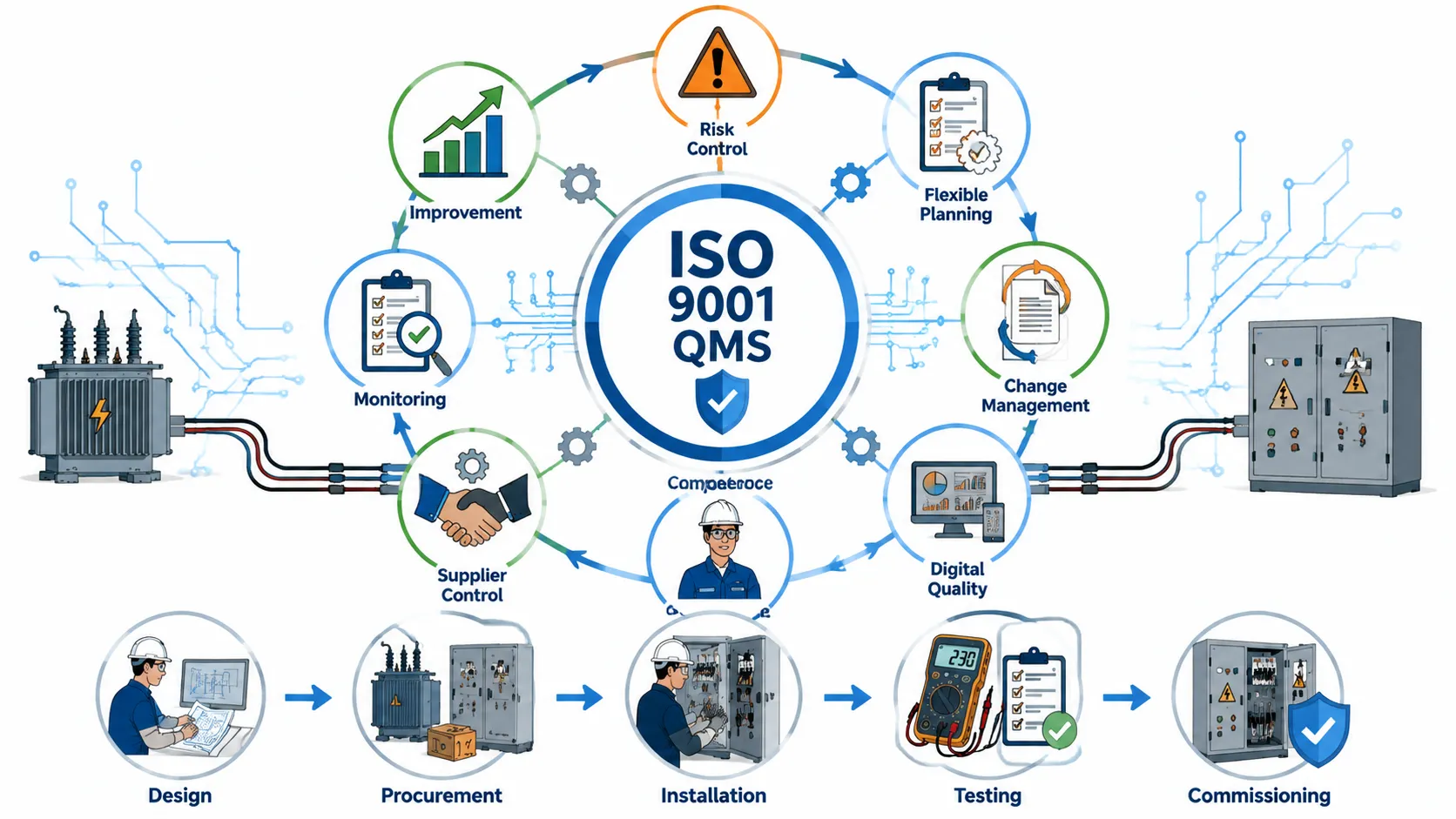
Risk-Based Thinking for Uncertain Projects
Risk-based thinking is one of the most important approaches for applying international quality standards in unpredictable electrical engineering environments. ISO 9001 encourages organisations to identify potential risks before they negatively affect quality performance.
In electrical projects, risk management should be continuous rather than performed only during initial project planning.
Effective risk-based approaches include:
- Identifying potential technical risks.
- Evaluating probability and impact.
- Prioritising critical risks.
- Developing mitigation strategies.
- Monitoring changing conditions.
- Updating risk assessments regularly.
- Assigning risk ownership.
- Recording risk decisions.
- Reviewing effectiveness of controls.
- Communicating risks to stakeholders.
For example, during the construction of a high-voltage substation, unexpected delays in transformer delivery may affect project schedules. A proactive QA/QC team would identify this risk early, evaluate alternative suppliers, review technical approvals, and develop contingency plans to maintain project quality objectives.
Flexible Quality Planning
Quality planning is essential for ensuring that engineering activities meet project requirements. However, unpredictable environments require quality plans that can adapt to changing conditions.
A flexible Project Quality Plan (PQP) should include:
- Clear quality objectives.
- Defined responsibilities.
- Adaptable inspection procedures.
- Change management processes.
- Risk response strategies.
- Alternative supplier arrangements.
- Updated testing requirements.
- Communication procedures.
- Emergency response processes.
- Continuous monitoring methods.
Flexible quality planning allows organisations to maintain control while adjusting procedures when project conditions change.
Dynamic Inspection and Test Plans (ITPs)
Inspection and Test Plans are essential tools for electrical QA/QC management. However, in unpredictable environments, static ITPs may not always address emerging risks or technical changes.
Dynamic ITP management allows organisations to modify inspection requirements based on actual project conditions.
Effective dynamic ITP practices include:
- Reviewing ITPs regularly.
- Adding additional inspection points when required.
- Increasing inspection frequency for high-risk activities.
- Updating testing requirements after design changes.
- Including lessons from previous inspections.
- Adjusting witness and hold points.
- Coordinating changes with clients and consultants.
For example, if repeated cable termination defects are identified during installation, the QA/QC team may introduce additional inspection stages, increase supervision, and require additional testing before energisation.
Strengthening Change Management Processes
Electrical engineering projects frequently experience changes caused by design revisions, technological improvements, regulatory updates, or client requirements. Poor change management can create quality failures, documentation errors, and safety risks.
International quality standards encourage organisations to establish controlled change management processes.
Effective change management includes:
- Identifying the reason for change.
- Evaluating technical impacts.
- Reviewing quality implications.
- Assessing safety risks.
- Obtaining approvals.
- Updating documentation.
- Communicating changes.
- Training affected personnel.
- Monitoring implementation.
- Verifying effectiveness.
A controlled change process ensures that project flexibility does not compromise quality performance.
Digital Transformation and Quality Management
Modern electrical engineering projects increasingly rely on digital technologies to improve quality management, particularly in unpredictable environments. Digital tools provide real-time information, improve communication, and support faster decision-making.
Examples of digital quality management solutions include:
- Cloud-based document management systems.
- Digital inspection applications.
- Mobile QA/QC reporting tools.
- Building Information Modelling (BIM).
- Computerised Maintenance Management Systems (CMMS).
- Digital testing records.
- Real-time project dashboards.
- Automated quality tracking systems.
- Electronic approval workflows.
- Data analytics platforms.
Benefits of digital quality systems include:
- Faster access to information.
- Improved document control.
- Reduced paperwork.
- Better communication.
- Real-time quality monitoring.
- Improved traceability.
- Faster corrective actions.
- Enhanced audit readiness.
- Improved decision-making.
For example, during a large renewable energy project, digital inspection platforms can allow QA/QC engineers to record defects immediately, upload photographs, assign corrective actions, and monitor closure status without delays.
Maintaining Competence During Changing Conditions
The ability of an organisation to adapt depends heavily on the competence of its workforce. Electrical engineering environments require professionals who can make informed decisions when unexpected situations occur.
Competent personnel should possess:
- Technical electrical knowledge.
- Understanding of quality standards.
- Problem-solving skills.
- Risk assessment capability.
- Communication skills.
- Decision-making ability.
- Knowledge of inspection methods.
- Understanding of testing procedures.
- Awareness of regulatory requirements.
- Ability to manage change.
Organisations should continuously develop employee competence through:
- Technical training.
- Quality management workshops.
- Internal mentoring.
- Professional development programmes.
- Practical site experience.
- Lessons from previous projects.
- Manufacturer training.
- Standard awareness sessions.
A skilled workforce provides organisations with the flexibility required to maintain quality during uncertain project conditions.
Supplier and Supply Chain Adaptation
Electrical engineering projects depend heavily on global supply chains. Unexpected supplier issues can significantly affect quality, cost, and project schedules.
International quality standards encourage organisations to establish effective supplier management systems that can respond to supply chain uncertainty.
Adaptive supplier management practices include:
- Maintaining approved supplier lists.
- Evaluating supplier capability.
- Monitoring supplier performance.
- Conducting supplier audits.
- Maintaining alternative suppliers.
- Reviewing material certifications.
- Performing incoming inspections.
- Establishing clear technical requirements.
- Maintaining supplier communication.
- Developing long-term supplier relationships.
Strong supplier management reduces the impact of material shortages, equipment delays, and quality problems.
Practical Example
A contractor was responsible for installing electrical systems in a large offshore wind farm project. During construction, unexpected supply chain disruptions affected the delivery of specialised switchgear equipment. Additionally, extreme weather conditions created delays in offshore installation activities.
Instead of compromising quality requirements, the project team adapted its ISO 9001-based quality management approach. The organisation reviewed risks, evaluated alternative supply options, updated inspection schedules, increased supplier communication, and modified project sequencing. Digital quality management tools were used to monitor documentation, inspections, and corrective actions remotely.
Through effective adaptation, the project maintained compliance with quality requirements, avoided major defects, and successfully completed commissioning activities while managing significant external uncertainties.
Building Organisational Resilience Through Adaptive Quality Management
In unpredictable electrical engineering environments, organisations must develop resilience to maintain quality performance despite uncertainty, disruption, and changing project conditions. Organisational resilience refers to the ability of an organisation to anticipate risks, respond effectively to unexpected situations, recover from challenges, and continue delivering reliable engineering outcomes.
Key elements of resilient quality management include:
- Strong leadership commitment.
- Effective risk management.
- Flexible procedures.
- Competent engineering teams.
- Reliable supplier networks.
- Digital quality monitoring.
- Continuous improvement culture.
- Effective communication systems.
- Emergency response planning.
- Evidence-based decision-making.
These elements enable organisations to maintain project quality even when unexpected technical, commercial, or operational challenges occur.
Implementing Adaptive Quality Control Procedures
Quality control procedures must be capable of responding to changing project conditions without reducing inspection effectiveness. In complex electrical projects, unexpected situations may require modifications to inspection methods, testing frequency, approval processes, or supervision levels.
Adaptive quality control ensures that inspection activities remain appropriate throughout the project lifecycle.
Practical adaptive QA/QC procedures include:
- Reviewing inspection requirements regularly.
- Increasing inspection frequency for high-risk activities.
- Introducing additional quality checkpoints when defects occur.
- Updating testing procedures after technical changes.
- Using alternative inspection methods when required.
- Increasing technical supervision during critical activities.
- Revising acceptance criteria with stakeholder approval.
- Applying lessons from previous project phases.
- Monitoring quality trends continuously.
- Adjusting resources according to project risks.
For example, during the installation of underground electrical cables, unexpected ground conditions may require changes to installation methods. A flexible QA/QC approach would include additional inspections, revised installation procedures, updated risk assessments, and modified testing requirements while maintaining compliance with electrical standards.
Effective Communication and Stakeholder Collaboration
Communication is a critical factor in maintaining quality during unpredictable engineering conditions. Complex electrical projects involve multiple stakeholders, including clients, consultants, contractors, suppliers, regulatory authorities, and engineering teams.
Poor communication can result in:
- Incorrect installation.
- Delayed approvals.
- Documentation errors.
- Misunderstanding of requirements.
- Quality disputes.
- Safety risks.
- Project delays.
International quality standards emphasise the importance of clear communication channels and stakeholder engagement.
Effective communication practices include:
- Regular project coordination meetings.
- Quality review meetings.
- Digital reporting platforms.
- Clear responsibility allocation.
- Technical clarification procedures.
- Change notification systems.
- Supplier communication protocols.
- Client feedback mechanisms.
- Document approval workflows.
- Escalation procedures.
Strong communication allows organisations to identify problems early and implement corrective actions before they affect project performance.
Integrating Continuous Improvement in Uncertain Environments
Continuous improvement is essential for organisations operating in unpredictable electrical engineering environments. Projects should not only resolve immediate problems but also use these experiences to improve future performance.
A mature quality organisation continuously evaluates:
- What processes are effective.
- Where failures occur.
- Why problems develop.
- How procedures can improve.
- Which risks require additional controls.
- How technology can enhance performance.
Continuous improvement methods include:
- Root cause analysis.
- Corrective action programmes.
- Preventive action strategies.
- Internal audits.
- Management reviews.
- Quality performance analysis.
- Employee feedback.
- Customer feedback evaluation.
- Process optimisation.
- Digital improvement initiatives.
Through continuous improvement, organisations become better prepared to manage future uncertainties while maintaining international quality requirements.
Practical Framework for Applying International Quality Standards in Unpredictable Environments
Organisations can apply the following structured approach to adapt international quality standards effectively:
Step 1: Understand Project Uncertainties
The first step involves identifying potential uncertainties that may influence quality performance.
Organisations should evaluate:
- Technical challenges.
- Environmental conditions.
- Supply chain risks.
- Regulatory changes.
- Workforce availability.
- Equipment limitations.
- Stakeholder expectations.
- Project complexity.
Understanding uncertainty allows organisations to develop appropriate quality strategies.
Step 2: Establish Flexible Quality Objectives
Quality objectives should provide clear direction while allowing adaptation when project conditions change.
Effective quality objectives should be:
- Measurable.
- Realistic.
- Project-specific.
- Aligned with customer requirements.
- Reviewed regularly.
- Supported by performance indicators.
Step 3: Develop Risk-Based Quality Strategies
Risk-based strategies enable organisations to prioritise resources where they provide the greatest quality benefit.
These strategies include:
- Risk identification.
- Risk evaluation.
- Preventive controls.
- Contingency planning.
- Monitoring activities.
- Emergency response procedures.
Step 4: Monitor Performance Continuously
Continuous monitoring allows organisations to identify emerging quality problems before they become major issues.
Monitoring methods include:
- Quality audits.
- Inspection results.
- Testing records.
- Defect analysis.
- KPI evaluation.
- Supplier performance reviews.
- Customer feedback.
Step 5: Adapt Processes Through Controlled Changes
Changes should be implemented systematically to prevent negative impacts on quality.
Controlled adaptation requires:
- Change evaluation.
- Technical review.
- Approval processes.
- Documentation updates.
- Personnel communication.
- Effectiveness verification.
Table: Adaptive Application of International Quality Standards in Electrical Engineering
| Quality Management Area | Traditional Approach | Adaptive Approach | Key Benefit |
|---|---|---|---|
| Quality Planning | Fixed project quality plan | Flexible plan updated according to risks and changes | Improved project control |
| Risk Management | Initial risk assessment only | Continuous risk monitoring | Faster response to emerging issues |
| Inspection Activities | Standard inspection schedule | Risk-based inspection frequency | Better defect prevention |
| Documentation | Manual document control | Digital quality management systems | Improved traceability |
| Supplier Management | Basic supplier approval | Continuous supplier evaluation | Reduced supply chain risks |
| Workforce Management | Standard training approach | Continuous competency development | Improved technical capability |
| Corrective Actions | Reaction after failure | Preventive improvement approach | Reduced recurring problems |
| Decision Making | Experience-based decisions | Evidence-based decisions | Improved accuracy and reliability |
Key Benefits of Adaptive Quality Management
Applying international quality standards with flexibility provides significant advantages for electrical engineering organisations.
Major benefits include:
- Improved project resilience.
- Faster response to unexpected challenges.
- Reduced quality risks.
- Better decision-making.
- Improved customer confidence.
- Enhanced regulatory compliance.
- Reduced project delays.
- Improved resource management.
- Stronger supplier relationships.
- Better operational efficiency.
- Increased workforce capability.
- Improved innovation.
- Reduced rework and defects.
- Greater organisational maturity.
Adaptive quality management enables organisations to maintain high standards while operating effectively in uncertain and rapidly changing environments.
Advanced Case Study: Adaptive Quality Management in a Renewable Energy Project
A global engineering company was responsible for developing a large-scale offshore wind energy project involving complex electrical systems, subsea cables, offshore substations, power conversion equipment, and advanced monitoring technologies. The project faced several unpredictable challenges, including supply chain disruption, severe weather conditions, changing environmental requirements, and delays in specialist equipment delivery.
The organisation implemented an ISO 9001-based quality management system but adapted its application to address project uncertainties. Instead of using a fixed quality approach, the project team developed a dynamic quality strategy based on continuous risk evaluation, flexible inspection planning, digital monitoring systems, and enhanced stakeholder communication.
During equipment procurement, supplier performance monitoring identified potential delivery risks affecting critical electrical components. The QA/QC team responded by evaluating alternative suppliers, increasing supplier communication, conducting additional technical reviews, and implementing enhanced incoming inspection procedures.
During offshore installation, weather conditions created unexpected operational challenges. The organisation adapted inspection schedules, increased quality supervision during critical activities, and implemented remote digital reporting systems to maintain effective quality monitoring. Additional testing and verification activities were introduced for high-risk electrical connections to ensure reliability before commissioning.
The project successfully achieved commissioning requirements while maintaining compliance with international quality standards. The adaptive approach reduced quality risks, improved communication between stakeholders, minimised delays, and ensured that the final electrical systems achieved required performance standards.
Conclusion
Applying international quality standards in unpredictable electrical engineering environments requires a balanced approach that combines structured quality management with flexibility and professional judgement. Standards such as ISO 9001 provide essential principles for managing quality, but their successful application depends on an organisation’s ability to adapt processes, respond to risks, and continuously improve performance.
For electrical engineering organisations working in construction, power generation, renewable energy, manufacturing, utilities, and infrastructure sectors, adaptive quality management provides a pathway to maintain reliability, compliance, and operational excellence despite changing project conditions. By implementing risk-based thinking, flexible quality planning, digital quality systems, competent workforce development, effective supplier management, and continuous improvement practices, organisations can successfully apply international standards while managing uncertainty.
A mature quality management system does not prevent change; it enables organisations to control change effectively. Through strategic adaptation and consistent application of international quality principles, electrical engineering professionals can deliver safer, more reliable, and higher-performing projects that meet global quality expectations.