
Lesson 1: Reflective Practice
Reflective practice is a fundamental professional skill that enables addiction counsellors and mental health practitioners to examine their experiences, behaviours, attitudes, and decision-making processes. In addiction counselling, professionals frequently work with individuals experiencing complex challenges related to substance misuse, mental health conditions, trauma, and social difficulties. To provide effective, ethical, and person-centred support, practitioners must continually evaluate their own professional practice and personal responses.
Within the addiction treatment sector, reflective practice supports continuous learning, enhances self-awareness, and promotes professional growth. It helps practitioners identify personal strengths, recognise limitations, challenge assumptions, and reduce the impact of personal biases on service delivery. By engaging in structured reflection, counsellors can improve client relationships, strengthen professional competence, and contribute to positive treatment outcomes. This lesson explores the principles, techniques, and applications of reflective practice in addiction counselling and professional development.
Upon successful completion of this lesson, learners will be able to:
- Define reflective practice and explain its role in addiction counselling.
- Identify personal attitudes, values, assumptions, and biases that may influence professional practice.
- Evaluate personal growth and development through reflective activities.
- Apply reflective techniques to improve self-awareness.
- Analyse the relationship between reflective practice and professional development.
- Use reflective models to support continuous improvement.
- Develop strategies for maintaining reflective practice in professional settings.
- Demonstrate how reflection contributes to ethical and effective addiction counselling.
1: Engage in Reflective Practice to Evaluate Personal Attitudes, Biases, and Growth in Addiction Counselling
Understanding Reflective Practice
Reflective practice is a structured and purposeful process through which professionals critically examine their experiences, actions, decisions, and behaviours to gain deeper insight and improve future performance. Within addiction counselling, reflective practice is recognised as a fundamental professional competency because it enables practitioners to continually evaluate the effectiveness of their interventions while developing greater awareness of how their personal beliefs, attitudes, emotions, and assumptions influence their work.
Unlike casual thinking or recalling past events, reflective practice involves a systematic examination of professional experiences. It requires practitioners to analyse what happened, why it happened, how their actions influenced the outcome, and what lessons can be learned for future situations. Through this process, counsellors move beyond simply performing tasks and develop the ability to learn from experience in a meaningful and evidence-informed manner.
In addiction counselling, professionals frequently work with individuals facing complex challenges including substance dependence, mental health difficulties, trauma, family conflict, social isolation, and repeated relapse. These situations often involve emotional, ethical, and professional challenges that require thoughtful decision-making. Reflective practice helps counsellors navigate these complexities while maintaining professionalism, objectivity, and client-centred care.
Furthermore, reflective practice is closely linked to lifelong learning and continuous professional development. As treatment approaches, research evidence, and client needs evolve, practitioners must continually assess and adapt their knowledge and skills. Reflection serves as a bridge between experience and learning, enabling professionals to transform everyday practice into opportunities for growth and improvement.
The Importance of Reflective Practice in Addiction Counselling
The field of addiction counselling demands more than technical knowledge and practical skills. Practitioners must also possess self-awareness, emotional intelligence, ethical sensitivity, and the ability to critically evaluate their professional actions. Reflective practice supports the development of these qualities and contributes significantly to effective service delivery.
Counsellors often encounter situations that challenge their beliefs, values, and emotional resilience. For example, working with individuals who repeatedly relapse may evoke frustration, disappointment, or self-doubt. Without reflection, these emotions may unconsciously influence professional judgement and negatively affect client relationships. Through reflective practice, practitioners can identify and manage such responses before they impact service quality.
Reflection also supports evidence-based practice by encouraging professionals to evaluate whether their interventions are producing desired outcomes. Rather than relying solely on routine or habit, reflective practitioners continuously assess their effectiveness and seek opportunities for improvement.
Benefits of Reflective Practice
Reflective practice provides numerous benefits for both practitioners and clients:
- Enhances professional competence and confidence.
- Improves critical thinking and decision-making skills.
- Strengthens ethical and professional accountability.
- Promotes self-awareness and emotional intelligence.
- Improves communication and interpersonal relationships.
- Encourages continuous professional development.
- Supports client-centred and recovery-focused practice.
- Enhances treatment effectiveness and client outcomes.
Key Components of Reflective Practice
Reflective practice consists of several interconnected components that contribute to professional growth and improved service delivery.
| Component | Description | Professional Significance |
|---|---|---|
| Self-Awareness | Understanding personal emotions, beliefs, values, and behaviours | Supports objective and ethical practice |
| Critical Reflection | Analysing experiences in depth | Improves professional judgement |
| Evaluation | Assessing strengths, weaknesses, and outcomes | Identifies development opportunities |
| Learning | Extracting lessons from experiences | Promotes continuous improvement |
| Action Planning | Applying learning to future situations | Enhances effectiveness and competence |
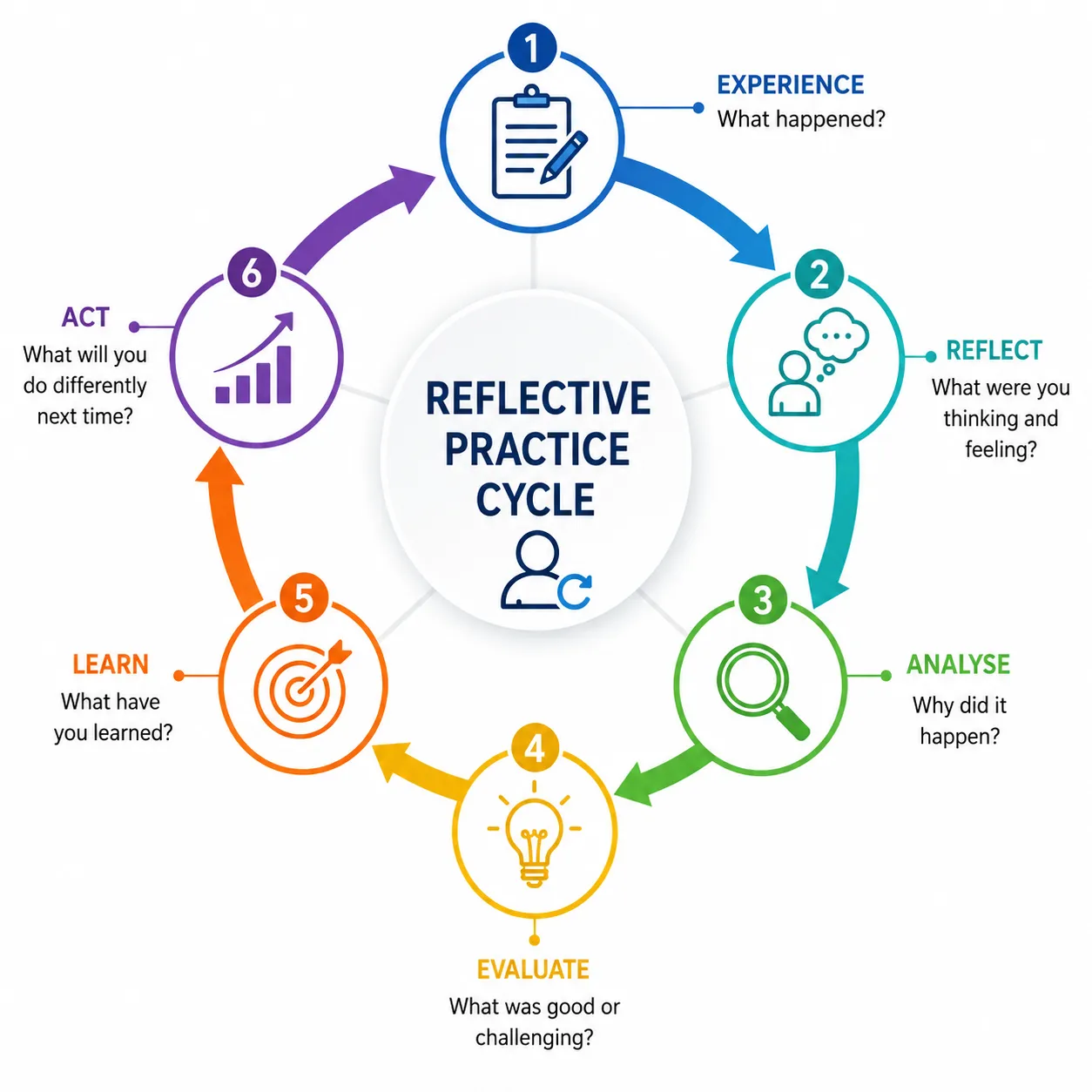
Recommended Image
Recommended Image: Reflective Practice Cycle Diagram
Placement: After the section “Key Components of Reflective Practice”
Purpose: Illustrates reflection as an ongoing cycle of experience, analysis, learning, and professional improvement.
Reflective Practice Process Flow
Professional Experience
          ↓
Reflection on Actions
          ↓
Critical Analysis
          ↓
Identification of Learning
          ↓
Action Planning
          ↓
Application of Learning
          ↓
Improved Professional Practice
Personal Attitudes and Their Influence on Counselling Practice
Understanding Personal Attitudes
Personal attitudes are beliefs, opinions, values, and assumptions that shape how individuals perceive and respond to people, situations, and experiences. Every practitioner enters the profession with attitudes that have been influenced by personal experiences, cultural background, family upbringing, education, social environments, and professional training.
In addiction counselling, attitudes can influence how professionals view addiction, recovery, relapse, treatment approaches, and client responsibility. While attitudes are a natural aspect of human behaviour, they can significantly affect professional interactions if left unexamined.
For example, a counsellor who views addiction primarily as a moral failing may approach clients differently from a counsellor who understands addiction as a complex health condition influenced by biological, psychological, and social factors. Such differences can affect communication, treatment planning, and the quality of therapeutic relationships.
Reflective practice enables counsellors to identify and critically evaluate these attitudes, ensuring that personal beliefs do not interfere with professional responsibilities.
The Role of Attitudes in Professional Practice
Attitudes influence multiple aspects of addiction counselling, including:
- Communication style.
- Interpretation of client behaviour.
- Treatment recommendations.
- Professional decision-making.
- Relationship building.
- Responses to challenging situations.
Positive attitudes contribute to effective counselling by fostering empathy, respect, and collaboration. Practitioners who maintain a positive and recovery-oriented perspective are more likely to support clients in a constructive and empowering manner.
Conversely, negative attitudes can create barriers to effective practice. Judgemental views, unrealistic expectations, or assumptions about client motivation may reduce trust and hinder therapeutic progress.
Positive Versus Negative Professional Attitudes
Positive Professional Attitudes
Positive attitudes support ethical and effective practice by encouraging:
- Empathy and compassion.
- Respect for client autonomy.
- Cultural sensitivity.
- Openness to learning.
- Belief in recovery and change.
Negative Professional Attitudes
Negative attitudes may lead to:
- Judgemental behaviours.
- Reduced objectivity.
- Poor communication.
- Limited client engagement.
- Inaccurate assessments.
Workplace Example
A counsellor working in a residential rehabilitation centre becomes frustrated when a client relapses shortly after completing treatment. Through reflective practice, the counsellor recognises that their frustration stems from an unrealistic expectation that treatment guarantees long-term recovery. By re-evaluating their attitude towards relapse, the counsellor develops a more realistic understanding of recovery as a process rather than a single event. This change in perspective improves the quality of support provided to clients.
Understanding Bias in Addiction Counselling
Defining Bias
Bias refers to a tendency to interpret information, make decisions, or form judgements based on personal beliefs, assumptions, experiences, or preferences rather than objective evidence.
Bias can occur consciously or unconsciously and may influence professional behaviour without the practitioner’s awareness. In addiction counselling, bias has the potential to affect assessments, treatment planning, communication, and client relationships.
Recognising and addressing bias is therefore essential for maintaining fairness, objectivity, and professional integrity.
Common Biases in Addiction Counselling
Professionals may encounter various forms of bias during practice.
Confirmation Bias
The tendency to seek information that confirms existing beliefs while ignoring contradictory evidence.
Stereotyping
Making assumptions about individuals based on characteristics such as age, ethnicity, gender, social status, or addiction history.
Cultural Bias
Judging behaviours or values through one’s own cultural perspective.
Personal Experience Bias
Allowing personal experiences to influence professional decisions.
Attribution Bias
Incorrectly attributing behaviours to personal characteristics rather than situational factors.
Comparison Table: Reflective Practitioner vs Non-Reflective Practitioner
| Reflective Practitioner | Non-Reflective Practitioner |
|---|---|
| Challenges personal assumptions | Accepts assumptions without question |
| Seeks feedback from others | Rarely seeks feedback |
| Recognises personal biases | Often unaware of biases |
| Learns from mistakes | Repeats ineffective approaches |
| Adapts professional practice | Resists change |
| Demonstrates self-awareness | Limited self-awareness |
Impact of Bias on Client Outcomes
Bias can have significant consequences for both practitioners and clients.
Potential impacts include:
- Misinterpretation of client needs.
- Reduced therapeutic trust.
- Inaccurate assessments.
- Unequal treatment.
- Reduced client engagement.
- Poor treatment outcomes.
Reflective practice helps minimise these risks by encouraging practitioners to question assumptions, seek alternative perspectives, and base decisions on evidence rather than personal opinion.
Evaluating Personal Growth Through Reflection
Professional growth involves the continuous development of knowledge, skills, behaviours, and professional competence. Reflection provides a valuable mechanism for evaluating progress and identifying future development needs.
Growth occurs when practitioners actively learn from experience and apply new insights to future situations. Through reflection, counsellors can identify changes in their attitudes, communication skills, emotional intelligence, and professional confidence.
Areas of Professional Growth
Communication Skills
Practitioners may develop:
- Improved active listening.
- More effective questioning techniques.
- Enhanced interpersonal communication.
Knowledge and Understanding
Growth may include:
- Greater understanding of addiction theories.
- Enhanced awareness of treatment approaches.
- Increased knowledge of mental health conditions.
Emotional Intelligence
Reflective practice supports:
- Better emotional regulation.
- Increased empathy.
- Greater resilience.
Professionalism
Professional development may result in:
- Stronger ethical awareness.
- Improved accountability.
- Greater confidence in decision-making.
Hierarchy Chart: Reflective Practice and Professional Development
                    Reflective Practice
                             │
       ┌─────────────────────┼─────────────────────┐
       │                     │                     │
 Personal Reflection   Self-Awareness     Professional Growth
       │                     │                     │
Attitudes & Values      Emotional Insight   Skills Development
Personal Biases         Behaviour Analysis  Knowledge Expansion
Strengths & Weaknesses  Self-Evaluation     Career Progression
Recognising Personal Strengths and Development Needs
An essential aspect of reflective practice is the ability to recognise both strengths and areas requiring improvement.
Professional Strengths
Examples include:
- Active listening skills.
- Empathy and compassion.
- Patience.
- Professional communication.
- Ethical decision-making.
Development Needs
Areas for improvement may include:
- Managing emotional responses.
- Expanding professional knowledge.
- Improving documentation skills.
- Enhancing cultural competence.
- Strengthening confidence in challenging situations.
Identifying these areas enables practitioners to develop targeted professional development plans and improve their overall effectiveness.
Case Study: Reflection Following Client Relapse
Background
A counsellor working within a community addiction service notices increasing frustration when several clients relapse despite receiving ongoing support.
Situation
The practitioner begins questioning client commitment and experiences reduced motivation during counselling sessions.
Challenge
These feelings risk affecting the therapeutic relationship and quality of support provided.
Reflective Analysis
Through reflective journaling and professional supervision, the counsellor identifies unrealistic expectations regarding recovery and recognises a tendency to view relapse as failure rather than part of a recovery journey.
Professional Response
The practitioner reviews current research, engages in additional training, and adopts a more recovery-focused perspective.
Outcome
The counsellor develops greater empathy, improves client engagement, and strengthens professional resilience.
Learning Point
Reflective practice enabled the practitioner to recognise personal attitudes, challenge assumptions, reduce bias, and improve professional effectiveness.
Reflective Practice at a Glance
EXPERIENCE
     ↓
REFLECT
     ↓
IDENTIFY ATTITUDES & BIASES
     ↓
ANALYSE IMPACT
     ↓
LEARN FROM EXPERIENCE
     ↓
CREATE ACTION PLAN
     ↓
IMPLEMENT IMPROVEMENTS
     ↓
ENHANCED PROFESSIONAL PRACTICE
     ↓
BETTER CLIENT OUTCOMES
2: Apply Reflective Techniques to Enhance Self-Awareness and Professional Development
Understanding Self-Awareness in Addiction Counselling
Self-awareness is one of the most important competencies within addiction counselling and professional helping professions. It refers to an individual’s ability to recognise, understand, and evaluate their own thoughts, emotions, values, beliefs, attitudes, motivations, strengths, and limitations. In professional practice, self-awareness extends beyond personal understanding and involves recognising how these internal factors influence interactions, decision-making, communication, and relationships with clients.
In addiction counselling, self-awareness is particularly important because practitioners work with individuals experiencing complex and often emotionally challenging circumstances. Clients may present with substance dependency, co-occurring mental health conditions, trauma histories, social exclusion, family conflict, or repeated relapse. These situations can evoke strong emotional responses in practitioners, including frustration, sympathy, concern, disappointment, or personal identification with a client’s experiences. Without adequate self-awareness, such responses may unintentionally influence professional judgement and compromise the quality of support provided.
Self-awareness enables practitioners to identify these reactions, understand their origins, and manage them appropriately. This promotes objective decision-making, ethical practice, and effective therapeutic relationships. Furthermore, self-aware professionals are more likely to recognise their professional limitations, seek support when necessary, and engage in continuous professional development.
The development of self-awareness is not a one-time achievement but an ongoing process. As professionals gain experience, encounter diverse client populations, and face new challenges, they must continually re-evaluate their beliefs, assumptions, and professional behaviours. Reflective practice provides a structured mechanism for achieving this ongoing self-examination and growth.
The Relationship Between Self-Awareness and Professional Effectiveness
Self-awareness directly influences the quality and effectiveness of addiction counselling services. Practitioners who understand their own values, biases, emotional triggers, and communication styles are better positioned to build therapeutic alliances and respond appropriately to client needs.
Research and professional practice consistently demonstrate that self-aware practitioners are more likely to:
- Demonstrate empathy and emotional intelligence.
- Maintain professional boundaries.
- Communicate effectively.
- Make objective and ethical decisions.
- Adapt their approach to individual client needs.
- Recognise the influence of personal beliefs on practice.
- Engage in lifelong learning and professional development.
In contrast, limited self-awareness may contribute to unconscious bias, poor communication, ineffective interventions, and professional burnout.
Benefits of Self-Awareness
Benefits for Professionals
Developing self-awareness provides significant professional advantages.
These include:
- Improved critical thinking and decision-making.
- Better emotional regulation during challenging situations.
- Increased confidence in professional judgement.
- Greater adaptability and resilience.
- Enhanced professional accountability.
- Improved communication and interpersonal skills.
- Stronger commitment to ethical practice.
Benefits for Clients
Clients also benefit when practitioners demonstrate high levels of self-awareness.
Potential benefits include:
- Greater trust and rapport.
- Increased feelings of respect and understanding.
- Improved therapeutic relationships.
- More personalised support.
- Enhanced treatment engagement.
- Better recovery outcomes.
Hierarchy Chart: Self-Awareness and Professional Development
                    Self-Awareness
                           │
      ┌────────────────────┼────────────────────┐
      │                    │                    │
 Personal Insight    Emotional Awareness   Professional Growth
      │                    │                    │
Values & Beliefs    Emotional Regulation   Skills Development
Attitudes           Empathy                Knowledge Expansion
Bias Recognition    Self-Control           Career Progression
Reflective practice becomes meaningful when supported by structured techniques that help practitioners systematically evaluate experiences and learning. These techniques provide practical methods for developing self-awareness, identifying development needs, and improving professional competence.
Reflective Journaling
Reflective journaling is one of the most widely used reflective techniques within counselling, healthcare, education, and social care professions. It involves regularly recording professional experiences, thoughts, emotional reactions, observations, and lessons learned.
A reflective journal is more than a diary of events. Effective journaling requires critical analysis of situations, exploration of emotions, identification of learning points, and consideration of future actions.
Benefits of Reflective Journaling
- Encourages deeper self-analysis.
- Promotes emotional processing.
- Identifies recurring patterns of behaviour.
- Supports evidence of professional development.
- Enhances critical thinking.
- Creates a record of learning and growth.
Practical Application
An addiction counsellor may record reflections after a challenging client session. By reviewing the interaction, the practitioner may identify emotional reactions, communication challenges, and opportunities for improving future interventions.
Self-Assessment
Self-assessment involves critically evaluating one’s own performance against professional standards, expectations, and learning objectives.
Effective self-assessment encourages practitioners to move beyond assumptions and objectively evaluate their strengths and areas requiring improvement.
Questions Used in Self-Assessment
- What went well during this interaction?
- What challenges arose?
- How did my actions influence the outcome?
- What have I learned from this experience?
- What would I do differently next time?
- What professional development needs have I identified?
Professional Significance
Self-assessment promotes accountability and encourages practitioners to take ownership of their professional growth. It also helps identify learning needs that may require further training, supervision, or support.
Professional Supervision
Professional supervision is a structured process in which practitioners discuss their work with a qualified supervisor. Supervision plays a critical role in addiction counselling by providing support, guidance, accountability, and opportunities for reflection.
Supervisors help practitioners explore complex cases, identify blind spots, challenge assumptions, and enhance professional competence.
Benefits of Professional Supervision
- Provides objective perspectives.
- Supports ethical decision-making.
- Reduces professional isolation.
- Enhances confidence and competence.
- Promotes accountability.
- Facilitates continuous learning.
Workplace Application
A counsellor struggling with a client’s repeated relapse may use supervision to explore personal reactions, review intervention strategies, and identify alternative approaches.
Peer Reflection
Peer reflection involves discussing professional experiences with colleagues to gain alternative perspectives and shared learning opportunities.
Unlike supervision, peer reflection typically occurs between professionals of similar experience levels and focuses on collaborative learning.
Benefits of Peer Reflection
- Encourages professional dialogue.
- Increases objectivity.
- Promotes knowledge sharing.
- Supports problem-solving.
- Enhances critical thinking.
Professional Considerations
When engaging in peer reflection, confidentiality must always be maintained. Discussions should focus on professional learning rather than identifying client information.
Comparison Table: Reflective Techniques
| Reflective Technique | Primary Purpose | Advantages | Limitations |
|---|---|---|---|
| Reflective Journaling | Personal reflection and learning | Detailed, flexible, promotes self-awareness | Requires consistency and commitment |
| Self-Assessment | Evaluate performance | Encourages accountability and growth | May be influenced by personal bias |
| Professional Supervision | Guidance and support | Objective feedback and expert insight | Availability may vary |
| Peer Reflection | Shared learning | Multiple perspectives and collaborative problem-solving | Requires careful confidentiality management |
Reflective Models in Professional Development
Reflective models provide structured frameworks that guide practitioners through the reflection process. These models help ensure that reflection remains analytical, purposeful, and focused on learning outcomes.
Gibbs’ Reflective Cycle
One of the most widely recognised reflective frameworks is Gibbs’ Reflective Cycle. Developed by Graham Gibbs, the model encourages systematic reflection through six interconnected stages.
| Stage | Reflective Focus |
|---|---|
| Description | What happened? |
| Feelings | What were you thinking and feeling? |
| Evaluation | What was positive or challenging? |
| Analysis | Why did it happen? |
| Conclusion | What could have been done differently? |
| Action Plan | What will you do in future situations? |
The strength of Gibbs’ model lies in its structured approach. By moving through each stage systematically, practitioners are encouraged to explore experiences in depth rather than simply describing events.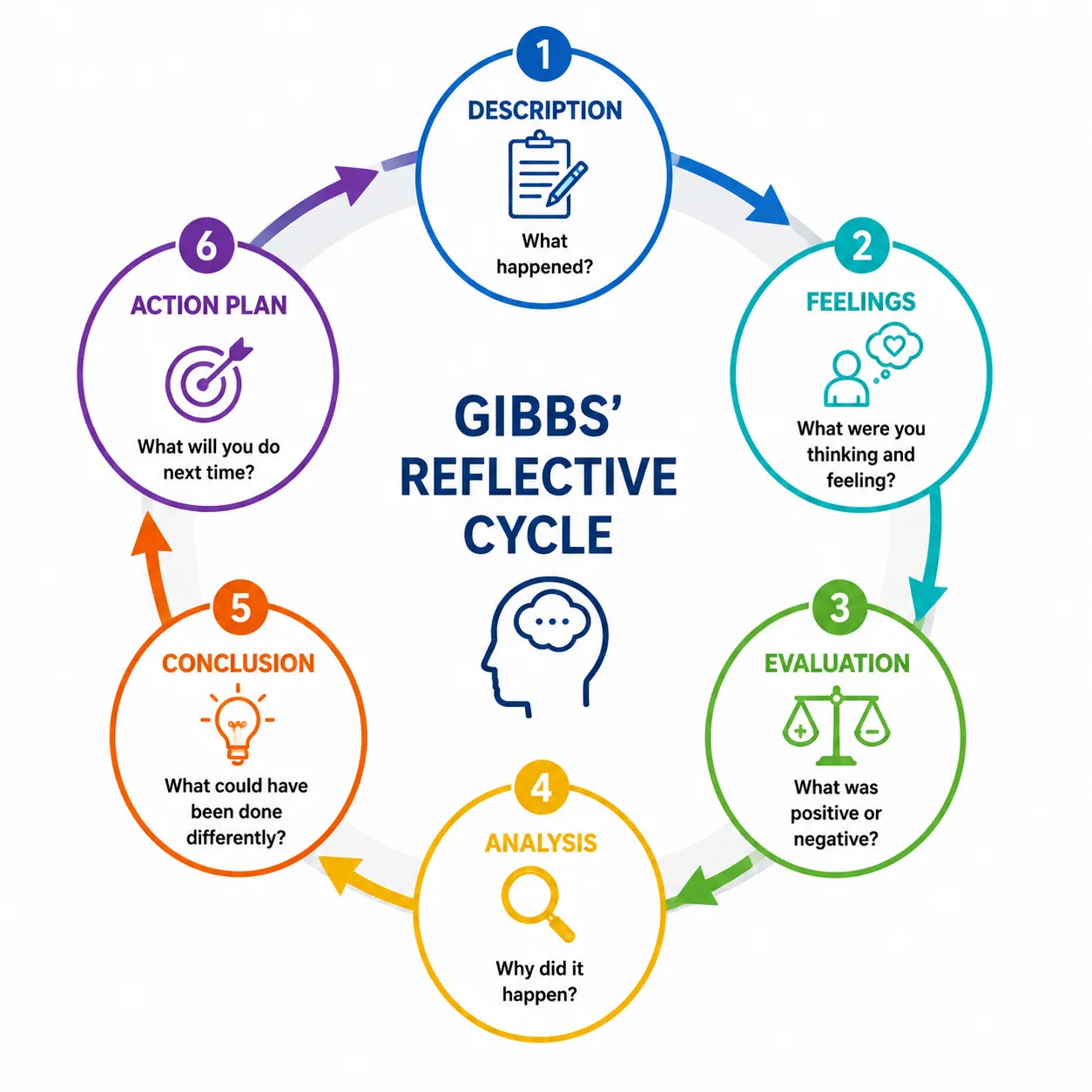
Reflective Practice Process Flow
The reflective process follows a logical sequence that transforms experience into learning and professional development.
Reflective Practice Workflow
Professional Experience
          ↓
Describe the Situation
          ↓
Identify Thoughts and Feelings
          ↓
Evaluate Actions and Outcomes
          ↓
Analyse Contributing Factors
          ↓
Identify Learning Points
          ↓
Develop Improvement Strategies
          ↓
Create Action Plan
          ↓
Apply Learning to Future Practice
          ↓
Enhanced Professional CompetenceReflective practice is most effective when conducted systematically and honestly.
Professional Guidelines
Reflect Regularly
Reflection should be integrated into routine professional practice rather than reserved for significant events.
Maintain Objectivity
Practitioners should focus on understanding experiences rather than assigning blame or seeking justification.
Be Honest
Meaningful reflection requires openness about both strengths and weaknesses.
Seek Constructive Feedback
Feedback from supervisors, colleagues, and mentors provides valuable external perspectives.
Record Reflections Consistently
Written records support long-term professional development and demonstrate evidence of learning.
Develop Action Plans
Reflection should result in practical strategies for improvement.
Protect Confidentiality
Client information must always remain confidential during reflective activities.
Industry Applications of Reflective Practice
Addiction Counselling
Reflective practice supports:
- Development of therapeutic relationships.
- Management of complex client situations.
- Improved communication skills.
- Client-centred intervention planning.
Mental Health Services
Reflection contributes to:
- Ethical practice.
- Emotional resilience.
- Professional accountability.
- Continuous improvement.
Healthcare and Social Care
Reflective techniques are used to support:
- Quality assurance.
- Service improvement.
- Professional competence.
- Lifelong learning.
Case Study: Using Reflection to Improve Counselling Practice
Background
Emma is a newly qualified addiction counsellor working within a community recovery programme.
Situation
One of Emma’s clients repeatedly misses appointments and appears unwilling to follow treatment recommendations.
Challenge
Over time, Emma becomes increasingly frustrated. She notices that her communication style is becoming less patient and supportive.
Reflective Analysis
Using reflective journaling and supervision, Emma examines her emotional reactions and professional responses. Through this process, she recognises that she had developed unrealistic expectations regarding the recovery process and was interpreting missed appointments as a lack of commitment rather than considering the complex barriers clients may face.
Professional Response
Emma adjusts her approach by focusing on understanding the client’s circumstances, reviewing evidence-based recovery principles, and adopting a more empathetic perspective.
Outcome
The therapeutic relationship improves significantly. Emma develops greater self-awareness, enhanced emotional intelligence, and increased confidence in managing challenging situations.
Learning Outcome
The case demonstrates how reflective techniques can improve self-awareness, challenge assumptions, strengthen professional judgement, and enhance counselling effectiveness.
Reflective Practice at a Glance
Review Professional Experiences
               ↓
evelop Self-Awareness
               ↓
Strengths and Biases
               ↓
Learn from Experience
               ↓
Create Improvement Strategies
               ↓
Apply Learning to Practice
               ↓
Continuous Professional DevelopmentReflective techniques are essential tools for developing self-awareness and maintaining professional competence in addiction counselling. Through structured approaches such as journaling, self-assessment, supervision, peer reflection, and reflective models, practitioners can transform everyday experiences into meaningful learning opportunities. By continuously evaluating their thoughts, emotions, behaviours, and professional decisions, counsellors strengthen their ability to provide ethical, evidence-informed, and client-centred support while fostering ongoing professional growth.
Conclusion
Reflective practice plays a vital role in shaping effective and competent addiction counselling and mental health professionals. It enables practitioners to continuously examine their experiences, beliefs, attitudes, and behaviours, leading to deeper self-awareness and more informed professional judgement. Through this ongoing process of reflection, counsellors are better equipped to recognise personal biases, refine their skills, and enhance the quality of their therapeutic interactions.
By consistently applying reflective techniques such as journaling, self-evaluation, professional supervision, and structured reflection models, practitioners develop a stronger commitment to lifelong learning and ethical practice. Ultimately, reflective practice strengthens professional capability, improves decision-making, and ensures higher standards of client care, contributing meaningfully to positive recovery outcomes and overall wellbeing.