
Lesson 2: Legal Frameworks
Legal frameworks play a crucial role in addiction treatment and counselling by establishing the rules, responsibilities, and standards that govern professional practice. Individuals receiving addiction support often share highly sensitive personal information and may present with complex health, social, safeguarding, and legal concerns. Practitioners must therefore understand their legal obligations to ensure that services are delivered safely, ethically, and in accordance with relevant laws and regulations. A strong understanding of legal frameworks helps protect client rights, promote accountability, and support high-quality care.
In addiction counselling settings, legal responsibilities extend beyond providing treatment and support. Practitioners must comply with requirements relating to confidentiality, record keeping, information sharing, safeguarding, reporting concerns, and maintaining accurate documentation. Failure to meet these legal obligations can place clients at risk, compromise professional standards, and lead to disciplinary or legal consequences. This lesson provides learners with the knowledge needed to understand and apply legal responsibilities within addiction treatment and counselling environments.
By the end of this lesson, learners will be able to:
- Define legal frameworks and explain their importance in addiction counselling.
- Understand legal obligations and professional responsibilities in addiction treatment settings.
- Identify key legal principles that influence counselling practice.
- Explain the legal requirements relating to documentation and record keeping.
- Understand reporting obligations and safeguarding responsibilities.
- Apply confidentiality requirements within client care.
- Recognise the legal consequences of non-compliance.
- Demonstrate an understanding of professional accountability in addiction support services.
1. Understanding Legal Obligations and Responsibilities in Addiction Treatment and Counselling
Legal frameworks are a fundamental part of addiction treatment and counselling practice. They provide the laws, regulations, policies, and professional standards that guide how services are delivered and how practitioners interact with clients. Individuals seeking addiction support are often experiencing complex personal circumstances that may include substance dependence, mental health difficulties, safeguarding concerns, family conflict, financial hardship, homelessness, or involvement with the criminal justice system. Because of these vulnerabilities, addiction counsellors must understand their legal obligations to ensure that services are delivered safely, professionally, and in a manner that protects client rights and wellbeing.
A legal framework establishes the boundaries within which addiction treatment and counselling services operate. It provides clear guidance on professional responsibilities, client protection, confidentiality, documentation, safeguarding, reporting procedures, and duty of care. These legal requirements help ensure consistency in practice and support accountability across healthcare, social care, rehabilitation, and community support services. By understanding legal frameworks, practitioners are better equipped to make informed decisions, manage risk effectively, and respond appropriately to challenging situations that may arise during treatment and recovery support.
Legal compliance is not simply about following rules or avoiding legal consequences. It is an essential component of professional practice that helps safeguard clients, maintain public trust, and promote high-quality care. Practitioners who understand their legal responsibilities are more likely to provide safe, ethical, and effective support while reducing the likelihood of harm, negligence, or professional misconduct. As addiction counselling involves working with individuals who may be particularly vulnerable, legal awareness is an important professional competency that supports both client welfare and practitioner accountability.
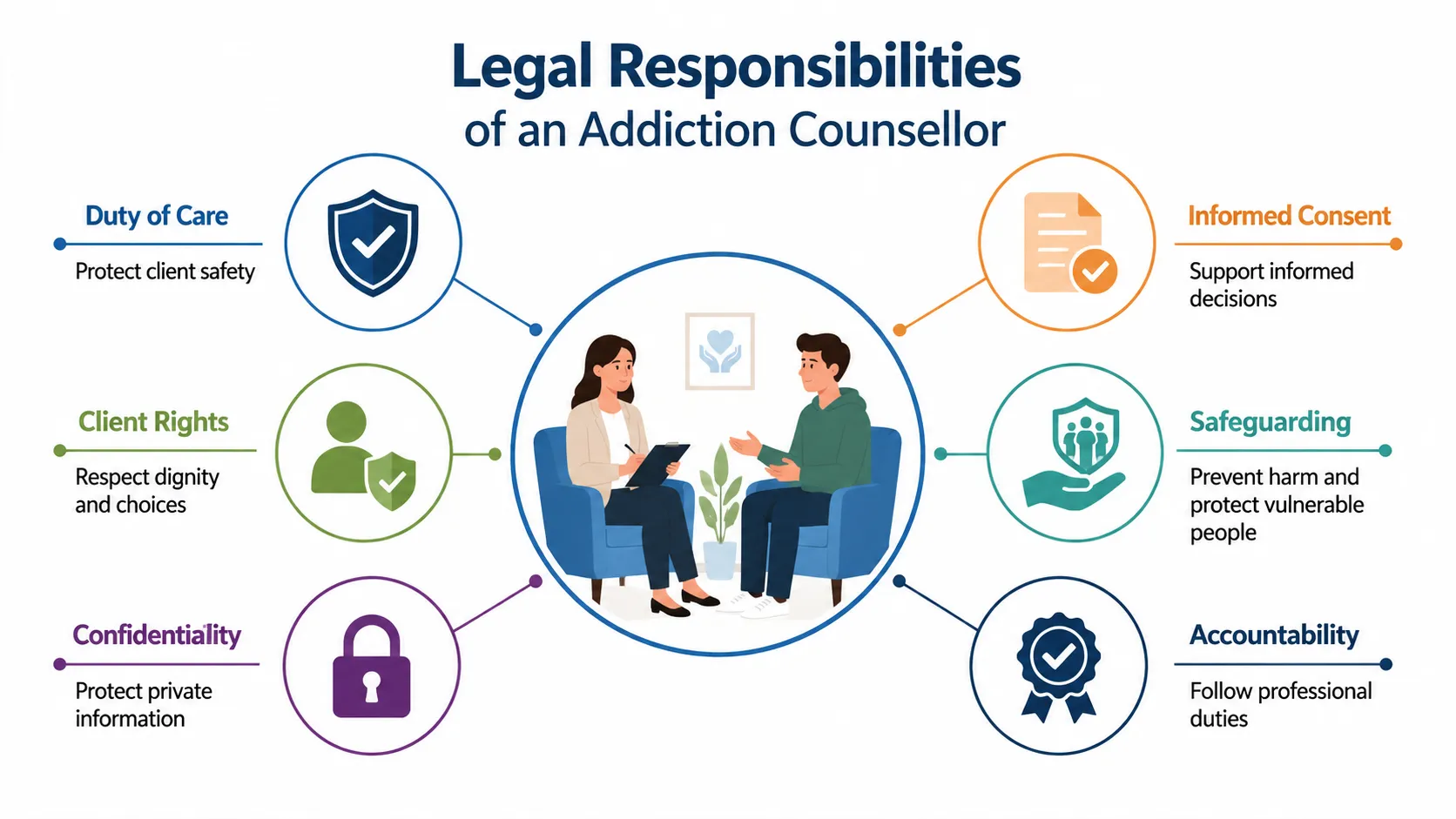
Why Legal Frameworks Matter in Addiction Counselling
Legal frameworks play a vital role in ensuring that addiction treatment services are delivered consistently and responsibly. They provide practitioners with a structured approach for making decisions, responding to risk, and balancing competing responsibilities.
The importance of legal frameworks can be seen in several areas of professional practice:
- Protecting clients from harm, abuse, neglect, and exploitation.
- Supporting safe and effective treatment delivery.
- Promoting accountability and professional responsibility.
- Protecting client rights and freedoms.
- Providing guidance for managing risk and safeguarding concerns.
- Supporting lawful information sharing and confidentiality practices.
- Ensuring consistency across organisations and services.
- Maintaining public confidence in addiction treatment programmes.
Without legal frameworks, practitioners may struggle to determine the most appropriate course of action when faced with complex situations. Legal guidance provides a clear foundation for decision-making and helps ensure that clients receive fair, safe, and professional support.
Key Legal Responsibilities in Addiction Counselling
Addiction counsellors and support practitioners are required to fulfil a range of legal responsibilities throughout the counselling and treatment process. These responsibilities are designed to protect clients, maintain professional standards, and ensure compliance with organisational and legal requirements.
Core Legal Responsibilities
| Legal Responsibility | Purpose in Addiction Counselling |
|---|---|
| Duty of Care | Protect clients from foreseeable harm and promote safety |
| Confidentiality | Safeguard sensitive personal information |
| Informed Consent | Ensure clients understand and agree to treatment decisions |
| Documentation | Maintain accurate, factual, and secure records |
| Safeguarding | Protect vulnerable individuals from harm, abuse, or neglect |
| Professional Accountability | Ensure ethical, lawful, and competent practice |
These responsibilities are interconnected and collectively contribute to the delivery of safe, professional, and client-centred addiction treatment services.
Duty of Care
Definition and Purpose
Duty of care refers to the legal obligation to take reasonable steps to protect clients from foreseeable harm and to provide support that meets accepted professional standards. It is one of the most significant legal responsibilities within addiction counselling because practitioners frequently work with individuals who may be at risk due to substance misuse, mental health difficulties, or challenging life circumstances.
Duty of care requires practitioners to actively consider how their actions, decisions, and interventions may affect client wellbeing. It also requires them to identify risks and respond appropriately when concerns arise.
Application in Addiction Counselling
Practitioners demonstrate duty of care by:
- Conducting risk assessments when concerns are identified.
- Responding appropriately to safeguarding issues.
- Recognising signs of crisis or vulnerability.
- Referring clients to specialist services when necessary.
- Maintaining professional competence.
- Following organisational procedures and professional standards.
For example, if a client expresses thoughts of self-harm or suicide during a counselling session, the practitioner has a duty to take appropriate action. This may involve conducting a risk assessment, consulting supervisors, following safeguarding procedures, and arranging additional support to reduce the risk of harm.
Critical Analysis
Duty of care can sometimes create challenging situations because practitioners must balance client autonomy with client safety. A client may refuse treatment, decline referrals, or reject professional advice even when significant risks are present. In these circumstances, practitioners must carefully consider whether respecting the client’s wishes remains appropriate or whether intervention is necessary to protect wellbeing. This demonstrates the importance of professional judgement and legal awareness in addiction counselling practice.
Professional Accountability
Professional accountability means accepting responsibility for one’s actions, decisions, and professional conduct. Addiction counsellors are expected to demonstrate competence, integrity, and compliance with legal and organisational requirements at all times.
Accountability requires practitioners to:
- Follow legal and professional standards.
- Maintain current knowledge and skills.
- Work within the limits of their competence.
- Seek supervision when required.
- Document actions accurately.
- Accept responsibility for professional decisions.
Professional accountability promotes transparency and helps ensure that practitioners remain focused on client welfare and service quality.
Industry Relevance
Across healthcare, rehabilitation, social care, and community support services, accountability is considered a key indicator of professionalism. Organisations expect practitioners to justify their decisions and demonstrate that actions are based on professional standards and legal requirements. Failure to do so can result in disciplinary action, loss of professional credibility, or legal consequences.
Client Rights and Legal Protection
Individuals receiving addiction treatment have legal rights that must be respected throughout the counselling process. These rights help ensure that clients are treated fairly, respectfully, and in accordance with recognised professional standards.
Key Client Rights
Clients have the right to:
- Confidentiality and privacy.
- Dignity and respect.
- Informed consent.
- Access relevant information about their care.
- Participate in decisions affecting treatment.
- Receive fair and non-discriminatory services.
- Raise concerns or complaints about services provided.
Respecting these rights supports person-centred care and helps build trust between practitioners and clients.
Practical Example
A client requests information regarding their treatment records and wishes to discuss alternative recovery options. Respecting the client’s rights means providing access to appropriate information and supporting informed participation in treatment planning.
Legal and Professional Significance
Protecting client rights is not only a legal obligation but also a key element of effective counselling practice. When clients feel respected and involved in decisions, they are more likely to engage positively in treatment and recovery programmes.
Confidentiality as a Legal Responsibility
Confidentiality is one of the most important legal and professional responsibilities in addiction counselling. Clients often disclose highly sensitive information relating to substance use, mental health, family relationships, criminal history, trauma, and personal experiences. Protecting this information is essential for building trust and maintaining effective therapeutic relationships.
Practitioners must ensure that client information is:
- Stored securely.
- Protected from unauthorised access.
- Shared only when legally or professionally justified.
- Handled according to organisational policies and procedures.
Clients should be informed about confidentiality arrangements and any circumstances in which information may need to be disclosed.
Importance of Confidentiality
Confidentiality:
- Encourages honest communication.
- Builds trust between practitioner and client.
- Supports treatment engagement.
- Protects privacy and dignity.
- Promotes professional credibility.
Challenges in Practice
While confidentiality is essential, there may be situations where information sharing is legally required. For example, concerns relating to safeguarding, abuse, or serious risk of harm may require disclosure through appropriate channels. Practitioners must understand these limits and explain them clearly to clients.
Informed Consent and Legal Compliance
Informed consent is closely linked to client rights and legal responsibility. It ensures that clients understand the nature of counselling services and voluntarily agree to participate.
Obtaining informed consent requires practitioners to provide information about:
- The purpose of counselling.
- Treatment approaches and options.
- Confidentiality arrangements.
- Client rights and responsibilities.
- Potential benefits and limitations of treatment.
Consent must be given freely and should be based on a clear understanding of the information provided.
Professional Importance
Informed consent protects both clients and practitioners by ensuring transparency and supporting lawful treatment decisions. It also reinforces client autonomy by encouraging active participation in the counselling process.
Safeguarding Responsibilities
Safeguarding involves protecting individuals from abuse, neglect, exploitation, and harm. Addiction counsellors often work with clients who may be vulnerable due to addiction, mental health difficulties, disability, age, or social circumstances.
Practitioners have a legal responsibility to recognise safeguarding concerns and respond appropriately when risks are identified.
Examples of Safeguarding Concerns
- Domestic abuse.
- Child neglect.
- Financial exploitation.
- Emotional abuse.
- Physical abuse.
- Self-neglect.
- Exploitation by others.
Workplace Example
A practitioner learns that a client is experiencing domestic violence and that children may be present in the household. The practitioner must follow safeguarding procedures, document concerns accurately, and report information through appropriate channels to help protect those at risk.
Working Within Professional Competence
Legal and professional responsibilities require practitioners to recognise the limits of their expertise and qualifications. Working beyond one’s competence may place clients at risk and could lead to professional misconduct.
Good professional practice involves:
- Undertaking ongoing training and development.
- Seeking supervision when needed.
- Referring clients to specialist services when appropriate.
- Recognising professional limitations.
For example, if a counsellor identifies severe trauma-related symptoms that require specialist intervention, referral to an appropriately qualified professional may be necessary to ensure safe and effective support.
Industry Application of Legal Responsibilities
Legal responsibilities apply across a wide range of addiction treatment and support settings, including:
- Rehabilitation centres.
- Community recovery services.
- Healthcare organisations.
- Mental health services.
- Social care agencies.
- Voluntary and charitable organisations.
- Criminal justice rehabilitation programmes.
Regardless of the setting, practitioners are expected to apply legal requirements consistently to protect clients and maintain professional standards.
Hierarchy of Legal Responsibilities
Legal Compliance
        │
 ┌──────┼──────┐
 │      │      │
Client Protection
Professional Responsibility
Organisational Compliance
 │      │      │
Confidentiality
Duty of Care
Documentation
Safeguarding
Accountability
Reporting
This hierarchy demonstrates how legal responsibilities operate at multiple levels. Effective addiction counselling requires practitioners to balance client protection, professional accountability, and organisational requirements while ensuring compliance with legal and regulatory standards.
Workplace Reflection
When faced with a challenging situation, practitioners should consider:
- Does this decision protect the client’s welfare?
- Am I complying with legal and organisational requirements?
- Have I respected the client’s rights?
- Have I documented my actions appropriately?
- Do I need supervision or additional guidance?
Reflective practice helps ensure that legal obligations are consistently applied and supports safe, professional, and client-centred addiction counselling services.
2.Documentation in Addiction Counselling
Documentation is a fundamental legal and professional responsibility in addiction counselling and treatment services. It involves the systematic creation, recording, maintenance, storage, and management of information relating to client assessment, treatment, progress, risk management, referrals, and support interventions. Effective documentation provides an accurate account of the services delivered and serves as an essential communication tool between practitioners, organisations, and other professionals involved in client care.
In addiction treatment settings, practitioners often work with individuals experiencing complex challenges related to substance misuse, mental health conditions, social difficulties, safeguarding concerns, and recovery planning. Accurate documentation ensures that information relating to these issues is recorded consistently and can be accessed when required to support decision-making and continuity of care.
Documentation is not merely an administrative task. It is a legal requirement that protects clients, practitioners, and organisations by providing evidence of professional actions, decisions, and interventions. Well-maintained records demonstrate accountability, support effective treatment planning, and contribute to safe and coordinated care. Conversely, poor documentation can lead to misunderstandings, compromised client safety, legal disputes, and professional misconduct concerns.
The Importance of Documentation in Addiction Counselling
Accurate and comprehensive documentation plays a critical role in supporting effective addiction treatment and recovery services. Every interaction, assessment, intervention, and significant decision should be recorded appropriately to ensure transparency and accountability.
Effective documentation helps to:
- Provide evidence of care and support delivered.
- Support continuity of care between professionals and services.
- Record treatment goals, interventions, and outcomes.
- Facilitate communication within multidisciplinary teams.
- Protect practitioners and organisations in the event of complaints or investigations.
- Support legal compliance and professional accountability.
- Assist with monitoring client progress and recovery.
- Contribute to service quality improvement and evaluation.
Documentation is particularly important in addiction counselling because clients may move between different services, such as healthcare providers, rehabilitation programmes, community recovery services, and mental health organisations. Accurate records help ensure that information is communicated effectively and that support remains consistent throughout the recovery journey.
Principles of Effective Documentation
Professional documentation should follow recognised standards to ensure accuracy, reliability, and legal compliance.
Good documentation should be:
- Accurate and factually correct.
- Clear and easy to understand.
- Objective rather than opinion-based.
- Timely and completed as soon as possible after events occur.
- Legible and professionally presented.
- Relevant to client care and treatment.
- Confidential and securely stored.
- Consistent with organisational policies and procedures.
Practitioners should focus on recording observable facts, client statements, actions taken, and professional decisions. Assumptions, speculation, personal opinions, or emotional language should be avoided because they may compromise the accuracy and credibility of records.
For example, rather than writing, “The client appeared irresponsible and unwilling to cooperate,” a practitioner should record factual observations such as, “The client declined to attend the scheduled appointment and stated they did not wish to continue treatment at this time.”
This approach ensures that records remain professional, objective, and legally defensible.
Types of Documentation Used in Addiction Counselling
Addiction treatment services require a variety of records to support assessment, treatment planning, monitoring, and legal compliance.
Common examples include:
- Initial client assessments.
- Treatment and recovery plans.
- Counselling session notes.
- Risk assessments.
- Safeguarding records.
- Referral documentation.
- Consent forms.
- Incident reports.
- Progress reviews.
- Discharge summaries.
Each document serves a specific purpose and contributes to a comprehensive understanding of the client’s needs, treatment journey, and progress towards recovery goals.
Documentation Process
To ensure consistency and legal compliance, practitioners should follow a structured documentation process.
Gather Information
        ↓
Record Information Accurately
        ↓
Review for Completeness and Accuracy
        ↓
Store Information Securely
        ↓
Update Records as Required
        ↓
Maintain Confidentiality
This process helps ensure that records remain current, reliable, and accessible to authorised personnel while protecting sensitive client information.
Industry Relevance of Documentation
Documentation is a critical requirement across all addiction treatment environments, including:
- Residential rehabilitation centres.
- Community recovery programmes.
- Mental health services.
- Healthcare facilities.
- Social care organisations.
- Criminal justice rehabilitation services.
- Voluntary and charitable support agencies.
Employers expect practitioners to maintain accurate records because documentation forms part of professional accountability and quality assurance. Regulatory bodies also rely on documentation when evaluating service standards and investigating complaints or incidents.
Reporting Responsibilities in Addiction Counselling
Understanding Reporting Responsibilities
Reporting refers to the formal process of communicating concerns, incidents, risks, safeguarding issues, or legally significant information through appropriate organisational and professional channels.
Addiction counsellors frequently encounter situations where reporting is necessary to protect clients, vulnerable individuals, staff members, or the wider community. Reporting responsibilities exist because practitioners have a duty of care that extends beyond individual counselling sessions.
The purpose of reporting is not to punish or blame individuals. Rather, it is to ensure that risks are identified, managed, and addressed appropriately.
Situations Requiring Reporting
Reporting responsibilities may arise when:
- A client is at risk of self-harm or suicide.
- Safeguarding concerns are identified.
- Abuse or neglect is suspected.
- Serious incidents occur.
- Criminal activity presents significant risk.
- Organisational policies require escalation.
- Legal obligations require disclosure.
In each situation, practitioners must act promptly and follow established procedures to ensure that concerns are managed effectively.
Importance of Reporting
Effective reporting contributes to:
- Protection of vulnerable individuals.
- Prevention of harm and abuse.
- Compliance with legal requirements.
- Professional accountability.
- Improved risk management.
- Organisational transparency.
- Enhanced client safety.
Failure to report concerns appropriately may expose individuals to harm and place practitioners and organisations at legal risk.
Professional Judgement in Reporting
Reporting often requires careful professional judgement because practitioners may need to balance competing responsibilities. For example, a client may request confidentiality while simultaneously disclosing information that suggests significant risk to themselves or others.
In these situations, practitioners must evaluate:
- The seriousness of the risk.
- Legal obligations.
- Organisational policies.
- Safeguarding responsibilities.
- Potential consequences of action or inaction.
This highlights the importance of training, supervision, and professional support when managing complex situations.
Confidentiality in Client Care
Understanding Confidentiality
Confidentiality is the legal and professional obligation to protect information shared by clients from unauthorised disclosure. It is one of the most important responsibilities within addiction counselling because effective therapeutic relationships depend upon trust.
Clients often disclose highly sensitive information relating to addiction, mental health, family relationships, trauma, criminal behaviour, and personal experiences. Without confidence that this information will be protected, clients may be reluctant to engage openly in treatment.
Confidentiality therefore serves both a legal and therapeutic function.
Benefits of Confidentiality
Maintaining confidentiality helps to:
- Build trust and rapport.
- Encourage honest communication.
- Protect client privacy.
- Support treatment engagement.
- Promote recovery-focused relationships.
- Strengthen professional credibility.
- Enhance service quality.
When clients feel safe discussing difficult issues, practitioners are better able to provide effective support and interventions.
Limits of Confidentiality
Although confidentiality is a fundamental principle, it is not absolute. There are situations in which information must be disclosed in order to comply with legal obligations or protect individuals from harm.
Situations Requiring Disclosure
| Situation | Reason for Disclosure |
|---|---|
| Serious risk of harm to self or others | Protection of life and safety |
| Safeguarding concerns | Protection of vulnerable individuals |
| Disclosure of abuse or neglect | Compliance with safeguarding duties |
| Court orders or legal requirements | Compliance with the law |
| Serious criminal activity creating significant risk | Public protection responsibilities |
Practitioners should explain these limitations at the beginning of the counselling relationship so that clients understand the circumstances in which information may be shared.
Confidentiality and Information Sharing
Confidentiality does not mean that information can never be shared. Instead, information sharing must be lawful, justified, and proportionate.
Effective information sharing should be:
- Necessary.
- Relevant.
- Accurate.
- Proportionate.
- Secure.
- Consistent with organisational procedures.
Only the minimum amount of information required to achieve a legitimate purpose should be disclosed.
For example, if a safeguarding referral is necessary, practitioners should share information relevant to the safeguarding concern rather than disclosing unnecessary personal details.
Best Practice for Maintaining Confidentiality
Practitioners should:
- Store records securely.
- Use password-protected systems.
- Restrict access to authorised personnel.
- Follow organisational policies.
- Obtain consent whenever appropriate.
- Record information-sharing decisions.
- Participate in confidentiality training.
- Seek guidance when uncertain.
Maintaining confidentiality requires ongoing vigilance and professional responsibility.
Legal Consequences of Non-Compliance
Failure to comply with legal requirements relating to documentation, reporting, and confidentiality can have serious consequences for clients, practitioners, and organisations.
Potential consequences include:
- Disciplinary action by employers.
- Professional misconduct investigations.
- Loss of professional reputation.
- Organisational sanctions.
- Financial penalties.
- Legal proceedings.
- Harm to clients.
- Breaches of trust and confidentiality.
Non-compliance can also undermine public confidence in addiction treatment services and negatively affect treatment outcomes.
Practical Workplace Applications
Example 1: Documentation
Following a counselling session, a practitioner records factual information regarding the client’s progress, treatment goals, and agreed actions. The notes are reviewed for accuracy and stored securely according to organisational procedures.
Example 2: Reporting
A support worker becomes concerned that a vulnerable adult may be experiencing neglect. Following organisational safeguarding procedures, the concern is documented and reported through the appropriate channels.
Example 3: Confidentiality
A client discusses sensitive information relating to substance misuse. The practitioner protects the information and shares it only when legally required or with appropriate consent.
Example 4: Risk Management
A client discloses suicidal thoughts. The practitioner documents the disclosure, completes a risk assessment, follows reporting procedures, and seeks appropriate support services.
Case Study: Legal Responsibilities in Practice
Background
David works as an addiction support practitioner within a community recovery service.
Situation
During a counselling session, a client discloses ongoing domestic abuse and expresses concern about the safety of their child.
Challenge
David must balance the client’s expectation of confidentiality with his safeguarding responsibilities and legal duty of care.
Analysis
Several legal responsibilities are relevant:
- Duty of care.
- Safeguarding obligations.
- Confidentiality.
- Reporting requirements.
- Professional accountability.
- Accurate documentation.
Failure to act could place the client and child at continued risk. However, inappropriate disclosure could damage trust and compromise the therapeutic relationship.
Solution
David explains the limits of confidentiality, records the disclosure accurately, follows safeguarding procedures, consults appropriate professionals, and submits a formal safeguarding report through organisational channels.
Learning Outcome
This case demonstrates that legal responsibilities sometimes require practitioners to share information in order to protect individuals from harm. Effective decision-making requires balancing confidentiality with safeguarding and duty of care obligations while maintaining professional accountability.
LEGAL RESPONSIBILITIES IN CLIENT CARE

Maintain Accurate Documentation
          ↓
Protect Confidential Information
          ↓
Recognise Safeguarding Concerns
          ↓
Assess Risks Appropriately
          ↓
Report Concerns Through Correct Channels
          ↓
Follow Legal and Organisational Requirements
          ↓
Maintain Professional Accountability
          ↓
Provide Safe and Lawful Care
This framework highlights the interconnected responsibilities that support safe, ethical, and legally compliant addiction counselling practice.
Conclusion
Legal frameworks are essential for ensuring that addiction treatment and counselling services are delivered safely, professionally, and in accordance with recognised standards. By understanding legal obligations such as duty of care, safeguarding, confidentiality, documentation, and reporting responsibilities, practitioners can protect client welfare while maintaining professional accountability. These responsibilities provide the structure needed to support ethical decision-making and lawful practice within addiction support settings.
Effective compliance with legal requirements also strengthens trust between practitioners and clients, improves service quality, and promotes positive treatment outcomes. Through accurate documentation, responsible information sharing, and adherence to professional and organisational standards, addiction counsellors can contribute to safe, transparent, and client-centred care across a wide range of health, social care, and community support environments.