
Lesson 3: Identify Behavioural Activation Strategies
Behavioural activation is a fundamental CBT intervention that focuses on helping individuals increase engagement in meaningful and rewarding activities. It is based on the understanding that low mood and depression are strongly linked to reduced activity levels, withdrawal, and avoidance behaviours.
In modern mental health practice, behavioural activation is widely used in clinical psychology, counselling services, rehabilitation programmes, and community mental health interventions. It is particularly effective in treating depression, low motivation, and inactivity-related emotional difficulties.
In workplace environments, behavioural activation strategies are applied in employee wellbeing programmes, stress recovery plans, return-to-work interventions, and performance improvement coaching. Employees experiencing burnout, disengagement, or low motivation benefit from structured activity-based interventions.
Learners need to understand behavioural activation because it provides a practical and structured approach to improving mood through action rather than cognitive analysis alone. It is one of the most effective behavioural strategies in CBT for promoting emotional recovery and functional improvement.
By the end of this lesson, learners will be able to:
- Define behavioural activation and its purpose
- Identify techniques used to increase positive activity levels
- Explain how behavioural activation supports emotional improvement
- Apply behavioural activation strategies in practical scenarios
- Understand the relationship between behaviour and mood in CBT
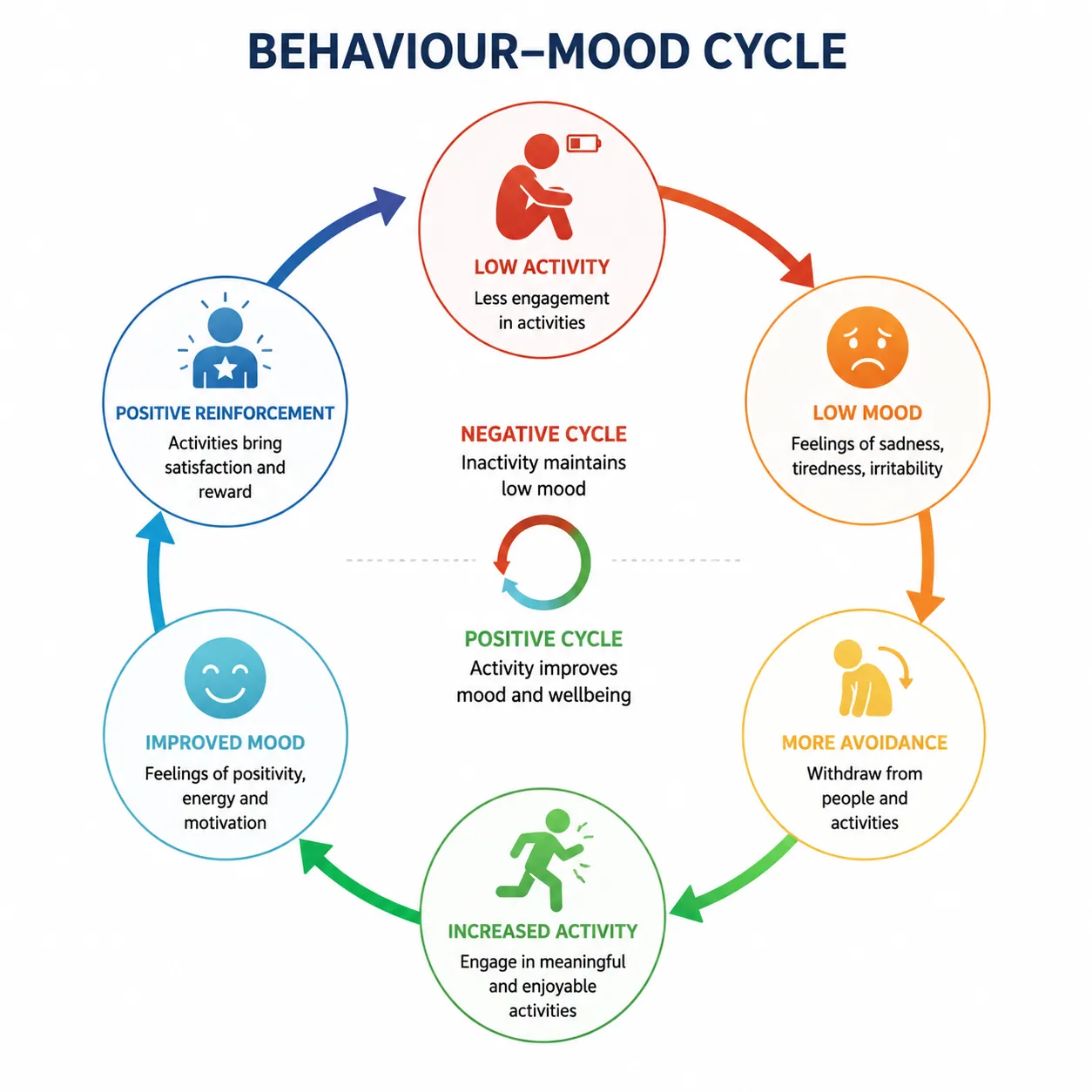
2. Identify Techniques Used to Increase Positive Activity Levels
Increasing positive activity levels is a core component of Behavioural Activation within Cognitive Behavioural Therapy (CBT). It focuses on helping individuals overcome inactivity, withdrawal, and low motivation by engaging them in structured, meaningful, and goal-directed activities. This approach is essential in breaking the cycle of depression and improving overall psychological functioning.
Industry Relevance
In modern mental health practice, behavioural activation techniques are widely used in clinical psychology, counselling, occupational therapy, and community mental health programmes. These methods are particularly effective for individuals experiencing depression, burnout, and reduced functional engagement.
Workplace Application
In workplace environments, these techniques are applied in employee wellbeing programmes, return-to-work strategies, stress management interventions, and performance enhancement coaching. They support employees in rebuilding routine, improving motivation, and increasing productivity through structured behavioural change.
Definition / Key Concepts
Behavioural Activation techniques are structured CBT-based interventions designed to increase engagement in meaningful, rewarding, and goal-oriented activities in order to improve mood and reduce avoidance behaviours.
Core Concepts Include
- Activity engagement
- Behaviour–mood relationship
- Reinforcement principles
- Routine building
- Gradual task progression
- Emotional monitoring
These concepts work together to help individuals replace avoidance behaviours with purposeful action.
Importance
Behavioural Activation techniques are important because they directly address behavioural patterns that maintain low mood and depression. By focusing on action rather than avoidance, they create immediate opportunities for emotional improvement.
Key importance includes:
- Breaks inactivity cycles
- Encourages structured daily functioning
- Enhances emotional recovery through action
- Improves motivation and engagement
- Supports long-term behavioural change
Benefits
Behavioural Activation techniques provide multiple psychological and practical benefits:
- Improved mood and emotional stability
- Increased motivation and energy levels
- Reduced avoidance behaviour
- Enhanced productivity and daily functioning
- Improved self-confidence and achievement
- Stronger social interaction and engagement
- Development of positive behavioural habits
Behavioural Activation techniques are grounded in behavioural learning theory, which emphasises that behaviour directly influences emotional states. When individuals engage in meaningful activities, they experience positive reinforcement, which improves mood and motivation.
1. Activity Scheduling
Activity Scheduling involves creating a structured daily plan that includes personal, social, and work-related activities. It helps individuals establish routine and consistency, especially when motivation is low.
- Builds structure in daily life
- Reduces inactivity and withdrawal
- Encourages discipline and organisation
- Supports gradual re-engagement
2. Graded Task Assignment
This technique involves breaking large or overwhelming tasks into smaller, manageable steps.
Example:
Cleaning a room → Start with one section → Organise items → Complete entire room
- Reduces feelings of overwhelm
- Builds confidence through small achievements
- Encourages task completion
3. Monitoring Activity and Mood
This technique involves tracking activities and emotional responses to identify patterns between behaviour and mood.
Tools include:
- Activity logs
- Mood rating scales
- Reflection journals
- Enhances self-awareness
- Identifies triggers and patterns
- Supports progress evaluation
4. Reinforcement Strategies
Reinforcement techniques use rewards and positive feedback to encourage repetition of helpful behaviours.
- Self-reward systems
- Therapist feedback
- Progress tracking charts
- Increases motivation
- Strengthens positive behaviour patterns
- Encourages consistency
5. Social Engagement Activities
This technique encourages individuals to participate in social interactions to reduce isolation.
- Meeting friends or family
- Group activities
- Workplace communication
- Community involvement
- Reduces loneliness
- Improves communication skills
- Enhances emotional support systems
Critical Analysis
Behavioural Activation techniques are highly effective due to their practical and action-based nature. However, their success depends on client motivation and consistency. In cases of severe depression, initial engagement may be challenging, requiring therapist guidance and gradual task introduction. Despite this limitation, behavioural activation remains one of the most accessible and effective CBT approaches because it does not rely heavily on cognitive effort.
Practical Applications
Industry Examples
- Mental health clinics using activity scheduling for depression recovery
- Schools applying graded tasks for students with low motivation
- Corporate wellbeing programmes using monitoring tools for employee stress
- Rehabilitation centres using social engagement to reduce isolation
Workplace Scenarios
- An employee uses activity scheduling to rebuild daily work routine after burnout
- A staff member breaks down complex projects using graded task assignment
- A worker tracks mood changes during workload adjustments
- A team member improves engagement through structured social interaction
Real-Life Applications
Behavioural Activation techniques are widely used in counselling, digital mental health platforms, and self-help interventions. Individuals apply these techniques in daily life to improve productivity, manage stress, and rebuild motivation through structured activity engagement.
Table: Behavioural Activation Techniques Overview
| Technique | Purpose | Example |
|---|---|---|
| Activity Scheduling | Build routine and structure | Daily planned activities |
| Graded Tasks | Reduce overwhelm | Breaking tasks into steps |
| Mood Monitoring | Track emotional changes | Activity-mood diary |
| Reinforcement | Increase motivation | Reward after completing tasks |
| Social Engagement | Reduce isolation | Attending group meetings |
Case Study
Background
A 29-year-old office employee presents with low motivation, fatigue, and withdrawal from work-related responsibilities following prolonged stress.
Situation
The client avoids tasks, struggles with daily routine, and reports feeling disconnected from colleagues and responsibilities.
Analysis
- Reduced activity levels
- Avoidance of responsibilities
- Low motivation and emotional withdrawal
- Disrupted daily routine
Solution
- Implement activity scheduling for daily structure
- Use graded task assignment for workload management
- Introduce mood and activity monitoring tools
- Apply reinforcement strategies to encourage progress
- Encourage gradual social engagement at work
Result
The client gradually resumes structured daily routines, improves task completion, and begins engaging more actively with colleagues. Mood and motivation significantly improve over time.
Case Study Conclusion
Behavioural Activation techniques effectively restored routine, increased engagement, and improved emotional wellbeing by systematically addressing avoidance and inactivity patterns.
Key Takeaways
- Behavioural Activation focuses on increasing meaningful activity levels
- Techniques include scheduling, grading tasks, monitoring, reinforcement, and social engagement
- These techniques directly improve mood through behavioural change
- They are highly effective for depression and low motivation
- Consistent application leads to improved emotional and functional outcomes
Behavioural Activation techniques provide a structured and evidence-based approach to increasing positive activity levels and improving emotional wellbeing. By focusing on practical behavioural change, these techniques help individuals break cycles of inactivity and low mood. Their application across clinical and workplace settings demonstrates their effectiveness in promoting motivation, restoring routine, and supporting long-term psychological recovery.
3. Explain How Behavioural Activation Supports Emotional Improvement
Behavioural Activation is a central intervention within Cognitive Behavioural Therapy (CBT) that focuses on improving emotional wellbeing through structured increases in meaningful activity. It is based on the understanding that emotions are strongly influenced by behaviour, and that inactivity or avoidance often maintains or worsens low mood. This makes it a key approach in supporting individuals experiencing depression, fatigue, and reduced motivation.
Industry Relevance
In modern mental health practice, Behavioural Activation is widely recognised as an evidence-based treatment for depression and related emotional disorders. It is used across clinical psychology, counselling services, rehabilitation programmes, and community mental health interventions due to its practical, structured, and measurable outcomes.
Workplace Application
In workplace environments, Behavioural Activation is applied in employee wellbeing programmes, return-to-work strategies, stress management initiatives, and occupational health support. It helps employees experiencing burnout, disengagement, or reduced productivity to rebuild routine, motivation, and emotional balance through structured activity engagement.
Definition / Key Concepts
Behavioural Activation improves emotional wellbeing by directly influencing behaviour in a structured and purposeful way. It is based on the principle that engaging in meaningful activities increases positive reinforcement, which in turn improves mood and reduces depressive symptoms.
Core Concepts Include
- Behaviour–mood relationship
- Avoidance cycle in depression
- Positive reinforcement
- Structured activity engagement
- Gradual behavioural change
- Emotional recovery through action
Behavioural Activation focuses on action-based change rather than relying solely on cognitive restructuring.
Types / Classification of Behavioural Activation
Behavioural Activation improves emotional wellbeing through a set of structured and functional intervention categories. Each category targets a specific behavioural pathway that influences mood, motivation, and psychological recovery. Together, these approaches help individuals gradually rebuild routine, increase engagement, and develop a more balanced emotional state.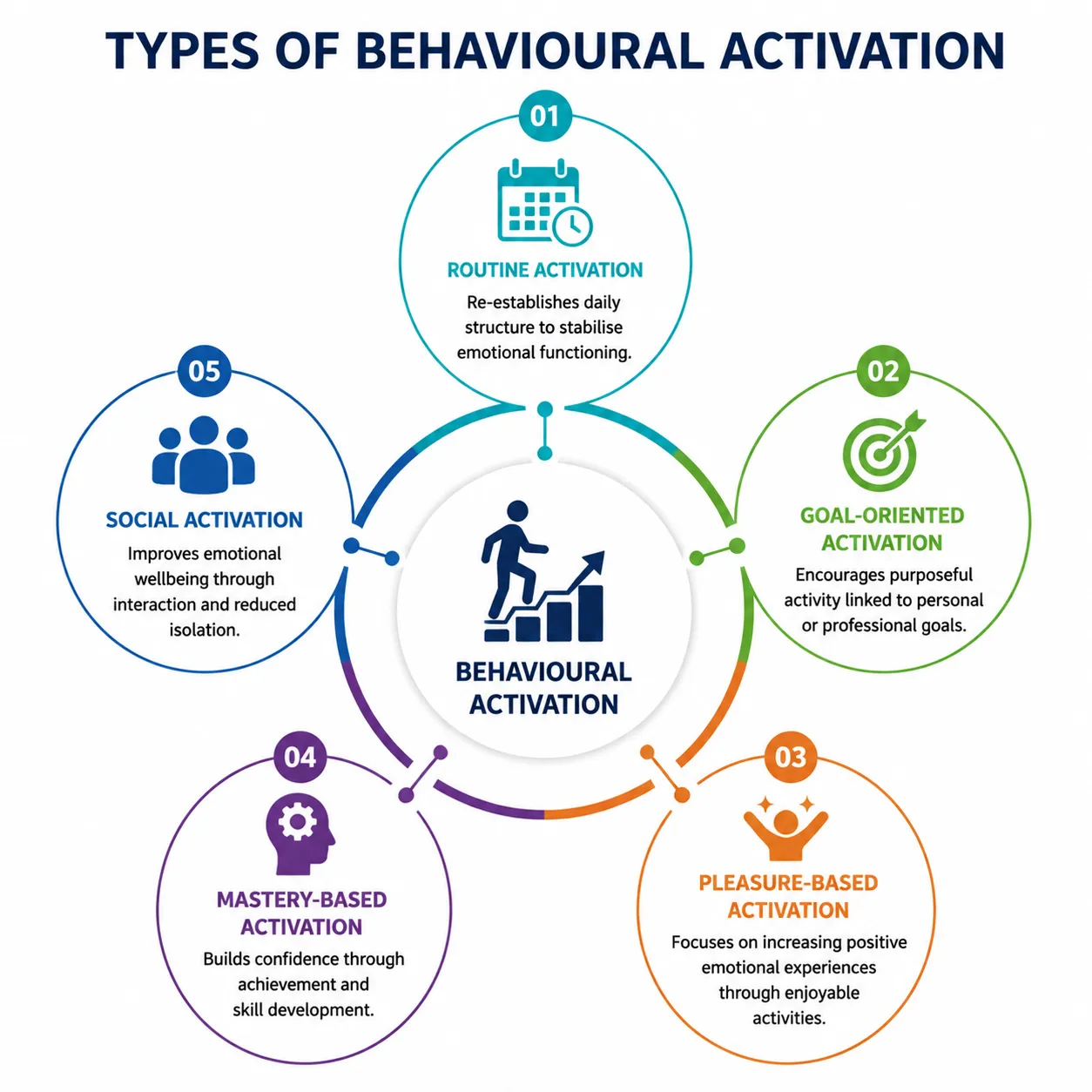
1. Routine Activation
Routine Activation focuses on re-establishing a stable and predictable daily structure for individuals whose routines have been disrupted due to depression, stress, or low motivation. This approach helps restore normal functioning by encouraging consistent engagement in essential daily activities such as waking up at regular times, maintaining personal care, and completing basic responsibilities.
By creating structure in daily life, Routine Activation reduces chaos and uncertainty, which often contribute to emotional distress. Over time, a consistent routine helps individuals regain a sense of control, stability, and psychological grounding, which supports gradual emotional recovery and improved mood regulation.
2. Goal-Oriented Activation
Goal-Oriented Activation focuses on encouraging individuals to engage in purposeful activities that are directly linked to personal values, aspirations, or professional responsibilities. This method helps individuals shift focus from inactivity to meaningful direction and achievement.
The process involves identifying short-term and long-term goals and breaking them into manageable actions. By working toward clear objectives, individuals experience increased motivation, improved focus, and a stronger sense of direction. This approach is particularly effective in workplace and educational settings where goal achievement plays a key role in performance and self-esteem.
3. Pleasure-Based Activation
Pleasure-Based Activation focuses on increasing participation in activities that bring enjoyment, relaxation, or emotional satisfaction. This approach is based on the principle that positive emotional experiences help counteract low mood and reduce symptoms of depression.
Individuals are encouraged to re-engage in hobbies, leisure activities, or experiences that previously provided joy or comfort. These pleasurable experiences help restore positive reinforcement in daily life, improve emotional balance, and increase motivation to continue engaging in meaningful activities.
4. Mastery-Based Activation
Mastery-Based Activation involves engaging in tasks that promote learning, skill development, and a sense of achievement. These activities may include completing challenging tasks, learning new skills, or accomplishing step-by-step goals.
This approach is particularly beneficial for individuals experiencing low self-confidence or feelings of failure. Each completed task builds a sense of competence and personal accomplishment, which strengthens self-efficacy and reduces negative self-perception. Over time, repeated mastery experiences contribute to improved emotional resilience and confidence.
5. Social Activation
Social Activation focuses on improving emotional wellbeing through increased interaction with others and reduced social isolation. This approach encourages individuals to participate in social, community, or workplace interactions that provide emotional support and connection.
Engaging in social activities helps individuals rebuild communication skills, strengthen relationships, and reduce feelings of loneliness. Social Activation is especially important in managing depression, as isolation often worsens emotional distress. By reconnecting with others, individuals experience improved mood, increased belonging, and stronger emotional stability.
Importance
Behavioural Activation is important because it directly addresses the behavioural patterns that maintain emotional distress. It interrupts the cycle of avoidance and inactivity, which is a key driver of depression.
Key importance includes:
- Breaks the inactivity–low mood cycle
- Encourages positive behavioural engagement
- Restores structure and daily functioning
- Enhances emotional regulation through action
- Supports recovery in depressive conditions
Benefits
Behavioural Activation provides multiple emotional and functional benefits:
- Improved mood stability and emotional balance
- Increased motivation and energy levels
- Reduced feelings of helplessness
- Enhanced sense of control and achievement
- Improved social interaction and engagement
- Better daily functioning and productivity
- Strengthened psychological resilience
Behavioural Activation is grounded in behavioural learning theory, which explains that behaviour directly influences emotional states. When individuals engage in meaningful activities, they experience positive reinforcement that improves mood and motivation.
How Behavioural Activation Improves Emotions
Behavioural Activation improves emotional wellbeing by breaking the cycle of avoidance, inactivity, and low mood. It encourages individuals to take structured action, which increases exposure to positive experiences and reinforces emotional improvement.
Process Flow: Behavioural Activation Model
Avoidance → Low Activity → Low Mood → Increased Withdrawal
↓
Structured Activity Planning
↓
Increased Engagement
↓
Positive Reinforcement
↓
Improved Mood and Motivation
Key Mechanisms of Emotional Improvement
- Increases exposure to positive reinforcement
- Reduces avoidance behaviours
- Restores sense of achievement and control
- Improves energy and motivation levels
- Interrupts depressive behavioural cycles
Features of Emotional Improvement
- Gradual and sustainable mood enhancement
- Increased confidence in daily functioning
- Reduction in feelings of helplessness
- Improved participation in social and work activities
- Strengthened emotional resilience over time
Critical Analysis
Behavioural Activation is highly effective because it focuses on action rather than cognitive analysis, making it especially useful for individuals with low motivation. However, its effectiveness depends on consistency and client engagement. In severe depression, initial participation may be difficult, requiring graded task introduction and strong therapist support. Despite these limitations, it remains one of the most practical and evidence-based CBT interventions due to its simplicity and direct impact on behaviour.
Practical Applications
Industry Examples
- Mental health clinics using Behavioural Activation for depression treatment
- Rehabilitation centres promoting structured daily routines
- Schools supporting students with low motivation and disengagement
- Corporate wellness programmes addressing employee burnout and stress
Workplace Scenarios
- An employee recovering from burnout follows a structured activity schedule to rebuild routine
- A disengaged worker uses graded tasks to gradually restore productivity
- A stressed employee improves mood through planned breaks and positive engagement activities
Real-Life Applications
Behavioural Activation is widely used in counselling sessions, online therapy platforms, and self-help mental health programmes. It supports individuals in managing daily life challenges by encouraging structured engagement even when motivation is low.
Table: Behavioural Activation Summary
| Component | Description | Outcome |
|---|---|---|
| Activity Scheduling | Planning structured daily tasks | Builds routine and stability |
| Graded Tasks | Breaking tasks into smaller steps | Reduces overwhelm and avoidance |
| Mood Monitoring | Tracking emotional responses | Identifies behaviour–mood patterns |
| Reinforcement | Rewarding positive behaviour | Increases motivation and repetition |
| Social Engagement | Encouraging interaction | Reduces isolation and improves mood |
Key Takeaways
- Behavioural Activation improves emotional wellbeing through structured activity
- It is based on the principle that behaviour directly influences mood
- It breaks the cycle of avoidance, inactivity, and low mood
- Techniques include scheduling, graded tasks, monitoring, and reinforcement
- It is highly effective for depression and low motivation
Case Study
Background
A 33-year-old employee presents with chronic low mood, fatigue, and withdrawal from workplace responsibilities following prolonged work stress.
Situation
The client avoids tasks, isolates from colleagues, and reports lack of interest in daily activities, resulting in reduced performance and emotional exhaustion.
Analysis
- Behavioural pattern: Avoidance and inactivity
- Emotional state: Low mood and fatigue
- Cognitive impact: Reduced motivation and self-doubt
- Cycle: Inactivity reinforcing depression
Solution
- Implement structured activity scheduling
- Introduce graded task assignments for workload
- Use mood and activity monitoring tools
- Apply reinforcement strategies for motivation
- Encourage gradual re-engagement in workplace tasks
Result
The client gradually resumes structured routines, improves task completion, and begins engaging positively with colleagues. Energy levels and mood significantly improve over time.
Behavioural Activation effectively disrupted the cycle of inactivity and low mood, demonstrating how structured behavioural change leads to emotional improvement and enhanced workplace functioning.
Behavioural Activation is a highly effective CBT intervention that supports emotional improvement by encouraging structured and meaningful activity engagement. By breaking the cycle of avoidance and inactivity, it directly improves mood, motivation, and daily functioning. Its practical, action-focused approach makes it highly applicable in clinical, educational, and workplace settings, ensuring long-term emotional stability and psychological resilience.
Conclusion
Behavioural Activation is a highly effective Cognitive Behavioural Therapy (CBT) technique that enhances emotional wellbeing by encouraging individuals to actively participate in structured, meaningful, and goal-directed activities. It works on the principle that behaviour has a direct influence on mood, and that increasing positive engagement helps reduce symptoms of depression, low motivation, and emotional withdrawal. By focusing on action rather than avoidance, it provides a practical pathway for emotional improvement.
Through breaking the cycle of inactivity and disengagement, Behavioural Activation helps individuals rebuild routine, restore motivation, and improve overall daily functioning. Its structured and action-oriented nature makes it a valuable intervention in both clinical practice and workplace mental health support, contributing significantly to long-term psychological recovery, resilience, and improved quality of life.