
Lesson 1: Understand CBT Intervention Techniques
Cognitive Behavioural Therapy (CBT) intervention techniques form the practical backbone of psychological treatment aimed at helping individuals identify and change unhelpful thoughts, emotions, and behaviours. These techniques are evidence-based and widely used in clinical, counselling, and mental health settings to support individuals experiencing anxiety, depression, stress-related disorders, and behavioural challenges.
In professional practice, CBT interventions are applied in a structured and goal-oriented manner to ensure measurable progress within a defined therapeutic timeframe. Understanding when and how to use different CBT techniques is essential for effective client support, improved emotional regulation, and long-term behavioural change across diverse workplace and healthcare environments.
By the end of this lesson, learners will be able to:
- Describe a range of CBT intervention techniques used in therapy
- Explain the purpose of structured therapeutic interventions in CBT practice
- Identify appropriate situations for applying different CBT techniques
- Understand how CBT methods support cognitive and behavioural change
- Recognise the role of structured interventions in achieving therapy goals
1. Range of CBT Intervention Techniques
Cognitive Behavioural Therapy (CBT) intervention techniques form the practical foundation of evidence-based psychological treatment. These techniques enable practitioners to systematically address maladaptive thoughts, emotional distress, and unhelpful behavioural patterns that contribute to mental health challenges.
Industry Relevance
CBT is one of the most widely applied therapeutic approaches in mental health services, counselling, occupational wellbeing programmes, and clinical psychology settings. Its structured and measurable nature makes it highly valued in healthcare systems, private practice, and workplace mental health interventions.
Workplace Application
In professional environments, CBT techniques are used to support employees experiencing stress, anxiety, burnout, and performance-related psychological difficulties. Organisational wellbeing practitioners, counsellors, and therapists apply these methods to improve emotional resilience and productivity.
Definition / Key Concepts
CBT intervention techniques are structured psychological strategies designed to identify, challenge, and modify unhelpful cognitive patterns and behaviours. These techniques are grounded in the principle that thoughts, emotions, and behaviours are interconnected, and changing one component can positively influence the others.
At their core, CBT interventions are:
- Structured and goal-oriented
- Evidence-based and measurable
- Time-limited and solution-focused
- Adaptable to individual client needs
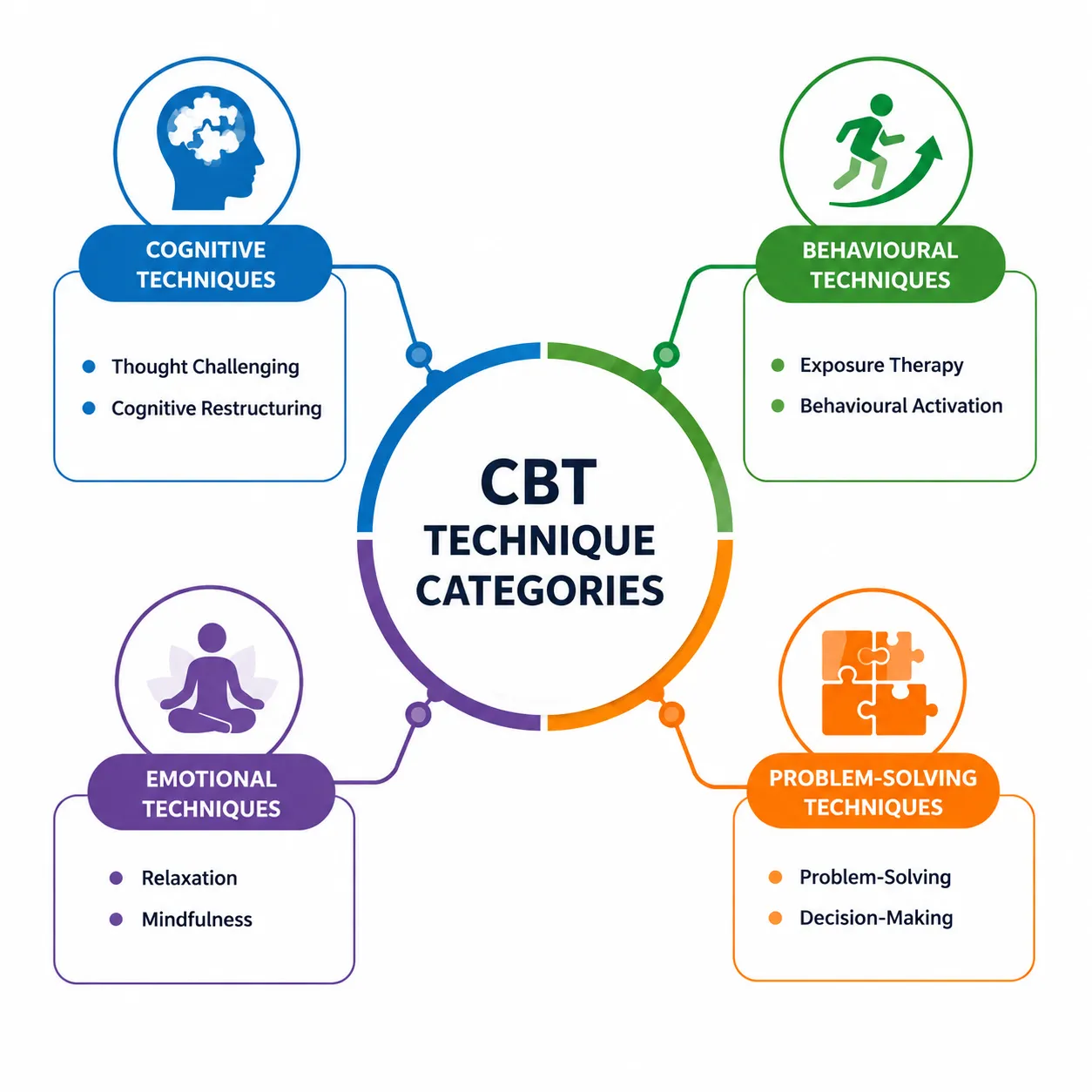
The techniques are broadly categorised into cognitive, behavioural, emotional regulation, and problem-solving approaches.
Types / Classification
Cognitive Techniques
Cognitive techniques focus on identifying and modifying distorted thinking patterns that influence emotional responses and behaviour.
- Cognitive restructuring
- Thought challenging
- Identifying cognitive distortions
- Socratic questioning
- Guided discovery
Behavioural Techniques
Behavioural techniques aim to change unhelpful behaviours and reinforce positive actions through structured activities.
- Behavioural activation
- Exposure therapy (gradual exposure)
- Activity scheduling
- Behavioural experiments
- Reinforcement strategies
Emotional Regulation Techniques
These techniques help individuals manage physiological and emotional responses to stressors.
- Relaxation training
- Breathing exercises
- Mindfulness-based CBT strategies
- Stress management techniques
Problem-Solving Techniques
These methods enhance decision-making and coping skills in real-life situations.
- Structured problem-solving steps
- Decision-making frameworks
- Coping strategy development
Importance
CBT intervention techniques are essential because they provide a structured framework for addressing complex psychological problems in a systematic and measurable way. They allow practitioners to break down overwhelming emotional and behavioural issues into manageable components, making therapy more effective and goal-driven.
They also ensure that interventions are not based on subjective interpretation alone but are grounded in scientifically validated psychological principles.
Benefits
CBT techniques offer multiple professional and clinical benefits:
- Improve emotional awareness and regulation
- Reduce symptoms of anxiety, depression, and stress
- Enhance behavioural adaptability and resilience
- Promote long-term cognitive restructuring
- Support self-management and independence
- Provide measurable treatment outcomes
- Increase therapy efficiency and structure
CBT intervention techniques are built upon several psychological principles, including learning theory, cognitive theory, and behavioural psychology.
Cognitive Techniques in Detail
Cognitive techniques focus on identifying irrational or distorted thinking patterns such as catastrophising, overgeneralisation, and black-and-white thinking. Through cognitive restructuring and thought challenging, clients learn to replace negative automatic thoughts with balanced and realistic alternatives.
Socratic questioning and guided discovery are used to help clients explore evidence for and against their beliefs, encouraging independent thinking rather than therapist-directed conclusions.
Behavioural Techniques in Detail
Behavioural strategies are based on the principle that behaviour can be modified through reinforcement and exposure. Behavioural activation encourages individuals experiencing depression to engage in meaningful activities to counter withdrawal patterns.
Exposure therapy gradually reduces fear responses by controlled and repeated exposure to anxiety-provoking stimuli. Behavioural experiments test beliefs through real-world actions, helping clients validate or disprove their assumptions.
Emotional Regulation Techniques
These techniques aim to regulate physiological arousal and emotional intensity. Relaxation training and breathing exercises reduce stress responses by activating the parasympathetic nervous system. Mindfulness-based CBT integrates awareness practices to help individuals observe thoughts without judgment.
Problem-Solving Techniques
Structured problem-solving equips individuals with step-by-step methods to define problems, generate solutions, evaluate options, and implement action plans. These techniques enhance decision-making and reduce feelings of helplessness.
Critical Analysis
While CBT techniques are highly effective, their success depends on client engagement, consistency, and the therapist’s skill in selecting appropriate interventions. Some clients may initially resist structured approaches, particularly those with deeply ingrained cognitive distortions. However, when applied correctly, CBT remains one of the most empirically supported therapeutic models globally.
Practical Applications
Industry Examples
- Mental health clinics using CBT for depression and anxiety treatment
- Corporate wellness programmes addressing workplace stress
- Schools implementing CBT-based emotional regulation training
- Rehabilitation centres supporting behavioural change in addiction recovery
Workplace Scenarios
- An employee experiencing performance anxiety uses cognitive restructuring to challenge self-doubt
- A stressed manager practices breathing exercises before high-pressure meetings
- A staff member with avoidance behaviour uses graded exposure to rebuild confidence in public speaking
- A worker struggling with decision fatigue applies structured problem-solving models
Real-Life Application
In everyday life, CBT techniques are used to manage overthinking, reduce stress responses, improve interpersonal relationships, and support healthier decision-making patterns in both personal and professional contexts.
Table: CBT Intervention Techniques
| Technique Type | Examples | Purpose |
|---|---|---|
| Cognitive | Thought challenging, cognitive restructuring, Socratic questioning | Change negative thinking patterns |
| Behavioural | Exposure therapy, behavioural activation, activity scheduling | Modify behaviours and reduce avoidance |
| Emotional | Relaxation training, mindfulness, breathing exercises | Manage emotional distress and physiological arousal |
| Problem-Solving | Structured problem-solving, decision-making frameworks | Improve coping skills and decision-making ability |
Case Study
Background
A 35-year-old office worker reports chronic workplace stress, low motivation, and frequent negative thoughts about job performance.
Situation
The client avoids taking on challenging tasks, experiences anxiety before meetings, and believes they are “not competent enough” for their role.
Intervention Applied
- Cognitive restructuring to challenge negative self-beliefs
- Behavioural activation to encourage engagement in tasks
- Relaxation training before meetings
- Structured problem-solving to manage workload
Result
After six weeks, the client demonstrates improved confidence, reduced anxiety symptoms, and increased workplace engagement. Productivity and job satisfaction significantly improve.
Conclusion of Case Study
The structured application of CBT intervention techniques successfully transformed cognitive distortions into balanced thinking patterns and improved functional workplace behaviour.
Key Takeaways
- CBT intervention techniques are structured, evidence-based psychological tools
- They are classified into cognitive, behavioural, emotional, and problem-solving categories
- Each technique targets specific psychological processes such as thoughts, emotions, and behaviours
- Their effectiveness depends on appropriate selection and structured application
- CBT is widely used in clinical, educational, and workplace environments
CBT intervention techniques provide a powerful, structured framework for addressing psychological difficulties through scientifically validated methods. By combining cognitive, behavioural, emotional, and problem-solving strategies, CBT enables individuals to develop healthier thinking patterns, improved emotional regulation, and more adaptive behaviours. In both clinical and workplace settings, these techniques remain essential tools for promoting mental wellbeing, resilience, and long-term personal development.
2. Purpose of Structured Therapeutic Interventions
Structured therapeutic interventions in Cognitive Behavioural Therapy (CBT) are essential for ensuring that psychological treatment follows a clear, planned, and outcome-focused approach. Unlike unstructured counselling methods, CBT relies on systematic procedures that help both therapist and client work toward measurable psychological and behavioural change.
Industry Relevance
In modern mental health practice, structured interventions are a cornerstone of evidence-based therapy. Healthcare systems, counselling organisations, schools, and corporate wellbeing programmes depend on structured CBT approaches to ensure consistency, accountability, and treatment effectiveness across diverse client groups.
Workplace Application
In professional environments, structured CBT interventions are used in employee assistance programmes, occupational health services, clinical psychology units, and rehabilitation settings. They help practitioners manage stress-related disorders, workplace anxiety, burnout, and behavioural difficulties in a controlled and measurable way.
Definition / Key Concepts
Structured therapeutic interventions in CBT refer to systematically planned therapeutic actions designed to follow a clear sequence of assessment, goal setting, technique application, and evaluation. These interventions ensure that therapy remains focused, measurable, and aligned with specific psychological outcomes.
Key characteristics include:
- Goal-oriented planning
- Evidence-based practice
- Session structure and consistency
- Measurable progress tracking
- Collaborative therapist-client engagement
The central principle is that psychological change is most effective when guided by a structured framework rather than unplanned discussion.
Types / Classification
Structured CBT interventions can be understood through their functional application within the therapeutic process:
Assessment-Based Structure
Focuses on identifying client needs, symptoms, and cognitive-behavioural patterns.
Goal-Oriented Structure
Involves setting SMART (Specific, Measurable, Achievable, Relevant, Time-bound) goals.
Technique-Based Structure
Applies selected CBT techniques such as cognitive restructuring or behavioural activation.
Evaluation-Based Structure
Focuses on reviewing progress and modifying interventions accordingly.
Importance
Structured interventions are critical in CBT because they:
- Ensure therapy remains focused and purposeful
- Prevent deviation from therapeutic goals
- Support consistent treatment delivery
- Enable objective measurement of progress
- Strengthen client accountability and engagement
- Improve treatment efficiency in time-limited sessions
Without structure, therapy may become inconsistent, less measurable, and less effective in achieving behavioural change.
Benefits
Structured CBT interventions provide several clinical and professional benefits:
- Improved clarity in treatment planning
- Increased efficiency in therapy sessions
- Enhanced tracking of client progress
- Greater consistency in therapeutic delivery
- Higher success rates in achieving outcomes
- Strong alignment with evidence-based practice standards
- Better communication between therapist and client
Structured CBT interventions are grounded in psychological theories of behaviour change, cognitive processing, and learning principles. The structured approach ensures that therapy is not random but follows a logical progression.
Principles of Structured CBT Interventions
- Cognitive Principle: Thoughts influence emotions and behaviours
- Behavioural Principle: Behaviour can be learned and modified
- Empirical Principle: Interventions are based on measurable evidence
- Collaborative Principle: Therapist and client work jointly
- Goal-Oriented Principle: Therapy is directed toward defined outcomes
Structured CBT Process Model
Assessment → Goal Setting → Technique Selection → Intervention Delivery → Progress Review → Adjustment
This model ensures continuous monitoring and refinement of therapeutic strategies.
Features of Structured Interventions
- Session planning templates
- Standardised treatment pathways
- Progress monitoring tools
- Behavioural tracking systems
- Cognitive assessment frameworks
Advantages
- Enhances treatment predictability
- Supports clinical accountability
- Reduces ambiguity in therapy sessions
- Improves patient engagement and trust
- Facilitates evidence-based decision-making
Limitations
- May feel rigid for some clients
- Requires skilled therapist adaptation
- Not always suitable for complex trauma cases without modification
- Depends heavily on client participation and honesty
Critical Analysis
While structured CBT interventions offer strong advantages in consistency and measurable outcomes, their effectiveness depends on flexibility in application. Over-structuring may limit emotional expression in some clients; however, when balanced correctly, structured CBT remains one of the most effective therapeutic frameworks in modern psychology. Its strength lies in its adaptability within a structured system, ensuring both scientific rigour and human-centred care.
Practical Applications
Industry Examples
- Hospitals using structured CBT for anxiety and depression treatment
- Schools implementing structured CBT for student emotional regulation
- Corporate organisations applying CBT frameworks for stress management
- Rehabilitation centres using structured CBT for behavioural change in addiction recovery
Workplace Scenarios
- An employee experiencing burnout follows a structured CBT plan with weekly progress reviews
- A manager undergoing anxiety treatment uses goal-based intervention tracking
- A staff member with avoidance behaviour progresses through structured exposure sessions
- An HR wellbeing officer implements CBT-based structured workshops for stress management
Real-Life Applications
Structured CBT interventions are widely used in everyday psychological support systems, including counselling services, online therapy platforms, and workplace mental health programmes to ensure consistent and measurable improvements in emotional wellbeing.
Table: Benefits of Structured CBT Interventions
| Benefit Area | Explanation |
|---|---|
| Clarity | Provides clear direction for therapy sessions |
| Efficiency | Ensures focused and time-managed sessions |
| Measurability | Enables tracking of psychological and behavioural progress |
| Consistency | Maintains structured and standardised therapeutic approach |
| Effectiveness | Increases likelihood of achieving positive clinical outcomes |
Key Takeaways
- Structured CBT interventions ensure systematic and goal-focused therapy
- They follow a clear process: assessment → goal setting → intervention → review
- They improve consistency, efficiency, and measurable outcomes
- They are essential in clinical, educational, and workplace settings
- Effective CBT relies on both structure and flexibility
Case Study
Background
A 40-year-old employee presents with chronic workplace stress, reduced productivity, and difficulty managing deadlines.
Situation
The client reports feeling overwhelmed, disorganised, and unable to prioritise tasks effectively, leading to increased anxiety.
Intervention Using Structured CBT
- Initial assessment of stress triggers and thought patterns
- Goal setting: improve time management and reduce anxiety levels
- Technique selection: cognitive restructuring and structured problem-solving
- Intervention delivery: weekly CBT sessions with task scheduling
- Progress review: monitoring stress levels and productivity
- Adjustment: refining coping strategies based on progress
Result
After eight weeks, the client demonstrates improved organisational skills, reduced anxiety, and increased workplace efficiency. Stress levels decrease significantly due to structured coping strategies.
Case study Conclusion
The structured CBT intervention model enabled systematic identification and resolution of workplace stress factors, demonstrating the effectiveness of goal-oriented psychological treatment in improving both emotional wellbeing and professional performance.
Structured therapeutic interventions are fundamental to effective CBT practice, ensuring that therapy remains organised, measurable, and outcome-driven. By following a systematic process, practitioners can deliver consistent and evidence-based treatment that supports meaningful psychological change. In both clinical and workplace environments, structured CBT interventions enhance accountability, improve client outcomes, and reinforce the overall effectiveness of mental health support systems.
3. Appropriate Use of CBT Techniques
The appropriate use of Cognitive Behavioural Therapy (CBT) techniques is a critical professional skill in psychological practice. It ensures that interventions are not applied randomly but are carefully selected based on the client’s presenting issues, cognitive patterns, emotional state, and behavioural responses. This targeted application increases the effectiveness of therapy and supports sustainable psychological change.
Industry Relevance
In modern mental health services, CBT is widely used across clinical psychology, counselling, occupational health, and community wellbeing programmes. Practitioners are required to make informed decisions about which CBT techniques best match client needs, ensuring evidence-based and ethical practice across diverse populations.
Workplace Application
In workplace environments, CBT techniques are applied in employee assistance programmes, stress management interventions, leadership coaching, and mental health support services. Proper technique selection ensures that interventions are relevant to workplace stressors such as burnout, anxiety, communication difficulties, and performance pressure.
Definition / Key Concepts
Appropriate use of CBT techniques refers to the evidence-based selection and application of specific cognitive and behavioural strategies based on a client’s psychological condition, symptom severity, cognitive distortions, behavioural patterns, and therapeutic goals.
Core principles include:
- Individualised treatment planning
- Evidence-based decision-making
- Symptom-specific intervention matching
- Structured therapeutic alignment
- Risk-sensitive practice
This ensures that therapy remains both clinically effective and ethically responsible.
Types / Classification
CBT technique selection can be classified based on psychological needs:
Symptom-Based Classification
- Anxiety-related conditions
- Depressive disorders
- Stress-related conditions
- Behavioural disorders
Cognitive Pattern Classification
- Negative automatic thoughts
- Cognitive distortions
- Irrational beliefs
- Rumination patterns
Behavioural Pattern Classification
- Avoidance behaviours
- Compulsive behaviours
- Withdrawal patterns
- Performance avoidance
Goal-Oriented Classification
- Emotional regulation goals
- Behaviour change goals
- Cognitive restructuring goals
- Problem-solving enhancement goals
Importance
Appropriate selection of CBT techniques is essential because:
- It ensures therapy is personalised and effective
- It increases treatment success rates
- It reduces unnecessary or ineffective interventions
- It enhances client engagement and trust
- It supports ethical and evidence-based practice
- It improves long-term psychological outcomes
Without appropriate selection, CBT interventions may lose their effectiveness and fail to address the core psychological issues.
Benefits
Appropriate use of CBT techniques provides several professional and clinical benefits:
- Improved therapeutic accuracy and targeting
- Faster symptom reduction
- Enhanced client motivation and engagement
- Better alignment with treatment goals
- Increased efficiency in therapy sessions
- Reduced risk of therapeutic mismatch
- Stronger long-term behavioural change outcomes
The appropriate application of CBT techniques is guided by structured clinical reasoning, psychological assessment, and evidence-based frameworks.
Guidelines for Technique Selection
CBT practitioners consider several factors before selecting interventions:
- Severity of psychological symptoms
- Nature of cognitive distortions
- Behavioural patterns (avoidance, compulsions, withdrawal)
- Client readiness and motivation
- Therapy goals and treatment plan
- Risk factors and emotional stability
These criteria ensure that interventions are both safe and effective.
Theoretical Principles
CBT technique selection is grounded in:
- Cognitive Theory: Thoughts influence emotions and behaviours
- Behavioural Learning Theory: Behaviour is shaped through reinforcement and exposure
- Functional Analysis: Identifying cause-effect relationships in behaviour
- Client-Centred Approach: Tailoring therapy to individual needs
Critical Analysis
While CBT provides structured guidance for technique selection, professional judgment remains essential. Clients often present with overlapping symptoms, requiring integration of multiple techniques. Over-reliance on a single intervention may limit therapeutic effectiveness. Therefore, skilled practitioners adapt CBT tools dynamically while maintaining a structured framework.
Additionally, client readiness plays a significant role; even the most suitable technique may fail if the client is not emotionally prepared or motivated.
Practical Applications
Industry Examples
- Clinical psychology clinics selecting exposure therapy for phobia treatment
- Schools using cognitive restructuring for student anxiety management
- Corporate wellness programmes applying relaxation techniques for stress reduction
- Rehabilitation centres using structured problem-solving for behavioural change
Workplace Scenarios
- An employee with presentation anxiety undergoes exposure therapy through gradual speaking tasks
- A staff member experiencing burnout uses behavioural activation to re-engage in work activities
- A manager with negative thinking patterns uses cognitive restructuring during coaching sessions
- A worker facing decision fatigue applies structured problem-solving tools
Real-Life Applications
CBT technique selection is widely used in everyday counselling, online therapy platforms, and workplace mental health interventions to ensure individuals receive tailored psychological support based on their specific challenges.
Table: When to Use CBT Techniques
| Situation | Suitable Technique | Reason |
|---|---|---|
| Anxiety disorders | Exposure therapy | Gradually reduces fear response through controlled exposure |
| Depression | Behavioural activation | Encourages engagement in meaningful activities |
| Negative thinking | Cognitive restructuring | Challenges and replaces distorted thoughts |
| Stress management | Relaxation techniques | Reduces physiological and emotional stress responses |
| Poor problem-solving | Structured problem-solving | Improves decision-making and coping ability |

Hierarchy Chart: CBT Decision-Making Process
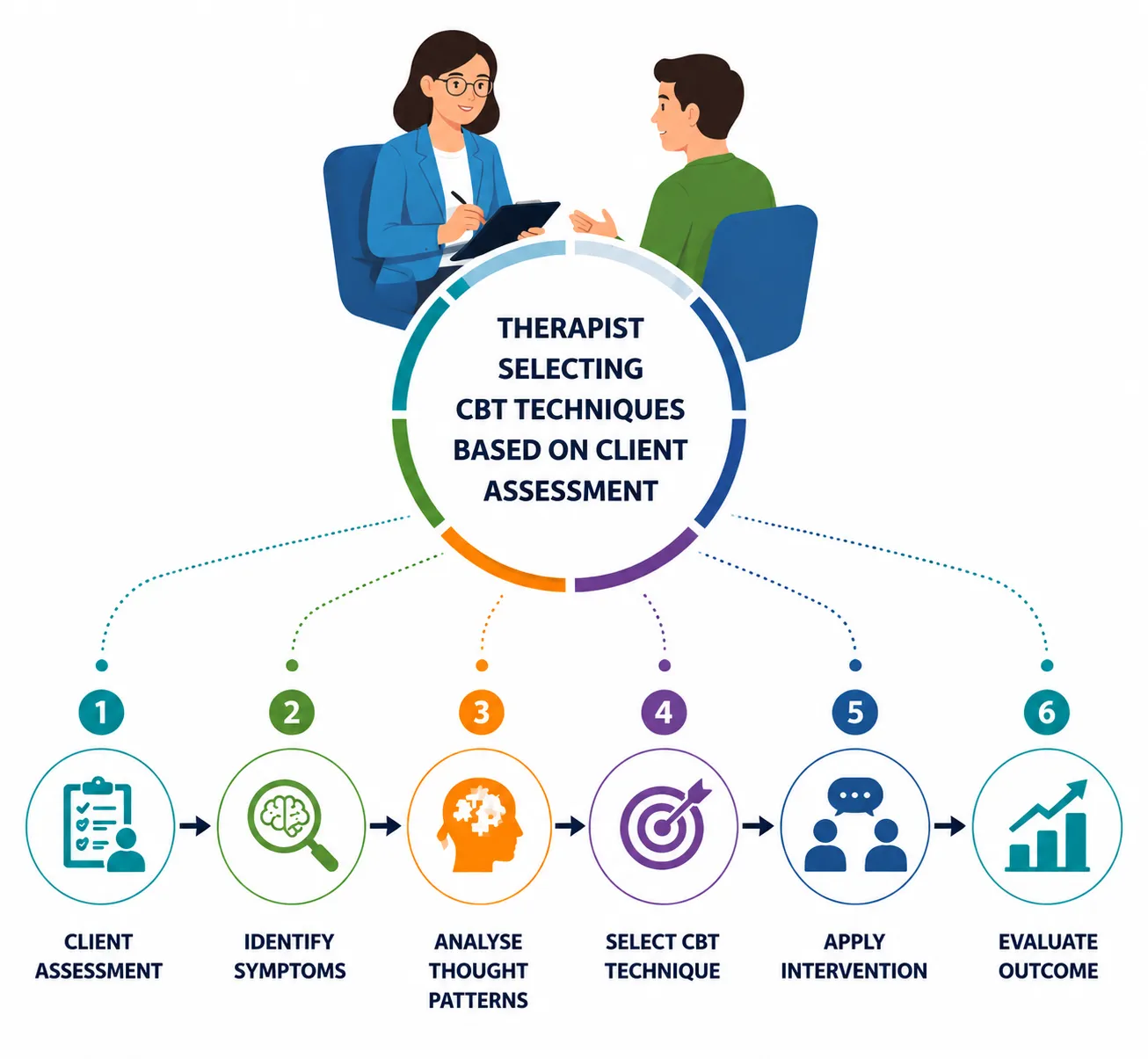
Client Assessment
→ Identify Symptoms
→ Analyse Thought Patterns
→ Select CBT Technique
→ Apply Intervention
→ Evaluate Outcome
CBT Intervention Framework
- Identify problem thoughts
- Select appropriate CBT technique
- Apply structured intervention
- Monitor emotional and behavioural response
- Review and adjust treatment plan
Case Study
Background
A 28-year-old client reports severe social anxiety affecting workplace performance.
Situation
The client avoids meetings, experiences intense fear of judgment, and engages in negative self-talk such as “I will embarrass myself.”
Analysis
- Cognitive distortion: Catastrophising and negative prediction
- Behavioural pattern: Avoidance of social interaction
- Emotional response: Anxiety, fear, and low confidence
Solution
- Cognitive restructuring to challenge irrational beliefs
- Gradual exposure to workplace meetings
- Relaxation techniques before social exposure
- Behavioural rehearsal for communication improvement
Result
The client progressively participates in meetings with reduced anxiety and improved confidence. Avoidance behaviours significantly decrease over time.
Case Study Conclusion
The appropriate selection and application of CBT techniques resulted in measurable behavioural improvement and cognitive restructuring, demonstrating the importance of tailored therapeutic intervention.
Key Takeaways
- CBT techniques must be selected based on client needs and symptom severity
- Different psychological conditions require different CBT interventions
- Structured decision-making improves therapeutic effectiveness
- CBT supports cognitive, behavioural, and emotional change
- Appropriate technique selection ensures long-term positive outcomes
The appropriate use of CBT techniques is essential for delivering effective, ethical, and evidence-based psychological interventions. By carefully selecting techniques based on client assessment, symptom patterns, and therapeutic goals, practitioners can ensure meaningful behavioural and cognitive change. This structured and adaptive approach strengthens the overall effectiveness of CBT in both clinical and workplace mental health settings, promoting long-term emotional resilience and wellbeing.
Conclusion
CBT intervention techniques play a fundamental role in modern psychological practice by offering structured, evidence-based approaches to understanding and addressing mental health challenges. These techniques enable practitioners to systematically identify and modify unhelpful thoughts, emotions, and behaviours, ensuring that therapeutic interventions are both purposeful and clinically effective.
When applied appropriately and in alignment with client needs, CBT techniques support meaningful and measurable psychological change. This structured approach not only enhances treatment outcomes but also promotes long-term cognitive and behavioural improvement, contributing to sustained mental wellbeing and improved quality of life for clients across diverse settings.