
Lesson 3: Identify Behavioural Interventions Used in CBT
Behavioural interventions are practical techniques used in Cognitive Behavioural Therapy (CBT) to help individuals change unhelpful behaviours and improve emotional wellbeing. These interventions focus on actions a person can take to reduce distress, build healthier habits, and gradually improve their response to difficult situations.
In real-world practice, behavioural interventions are widely used in mental health services, counselling, education, and workplace wellbeing programmes. They are especially helpful for managing anxiety, depression, phobias, stress, and avoidance behaviours. Understanding these techniques allows learners to recognise how structured behavioural changes can lead to improved emotional balance and daily functioning.
For beginners, the key idea is simple: CBT uses practical actions to help people feel better by changing what they do in response to stress.
By the end of this lesson, learners will be able to:
- List common behavioural interventions used in CBT
- Explain the purpose of exposure-based techniques
- Describe the role of behavioural activation in treatment planning
- Recognise how behavioural interventions support emotional improvement
1. Common Behavioural Interventions Used in CBT
Behavioural interventions are practical techniques used in Cognitive Behavioural Therapy (CBT) to help people change unhelpful behaviour patterns and improve emotional wellbeing. These interventions focus on actions a person can take in their daily life to reduce stress, manage anxiety, and build healthier habits.
In simple terms, CBT does not only focus on talking about problems. It also focuses on doing something different. By changing behaviour step by step, individuals can slowly improve how they feel emotionally. These techniques are widely used in healthcare, counselling, education, and workplace wellbeing support.
For beginners, the main idea is that behaviour and emotions are connected. When behaviour changes, emotions can also improve over time.
Key Behavioural Interventions in CBT
CBT uses several structured behavioural techniques. Each one has a specific purpose and is used depending on the person’s emotional needs and situation.
The most common behavioural interventions include:
- Exposure therapy
- Behavioural activation
- Activity scheduling
- Relaxation techniques
- Positive reinforcement strategies
- Skills training (social or coping skills)
Each of these methods works by helping individuals change how they respond to stress, fear, or low mood in a structured and gradual way.
Overview of Behavioural Interventions
The table below shows the main behavioural interventions used in CBT, their purpose, and where they are commonly applied.
| Intervention | Purpose | Main Use |
|---|---|---|
| Exposure Therapy | Reduce fear response | Anxiety, phobias |
| Behavioural Activation | Increase positive activity | Depression |
| Activity Scheduling | Improve daily routine | Stress management |
| Relaxation Techniques | Reduce physical tension | Anxiety and stress |
| Positive Reinforcement | Encourage healthy behaviour | Habit building |
| Skills Training | Improve coping ability | Social difficulties |
This table helps learners understand that each intervention is designed for a specific emotional or behavioural challenge.
Exposure Therapy
Exposure therapy is a technique that helps individuals face situations, objects, or thoughts that they fear. Many people try to avoid what makes them anxious, but avoidance often increases fear over time.
Exposure therapy works by gradually facing fears in a safe and controlled way. The goal is to reduce fear responses slowly.
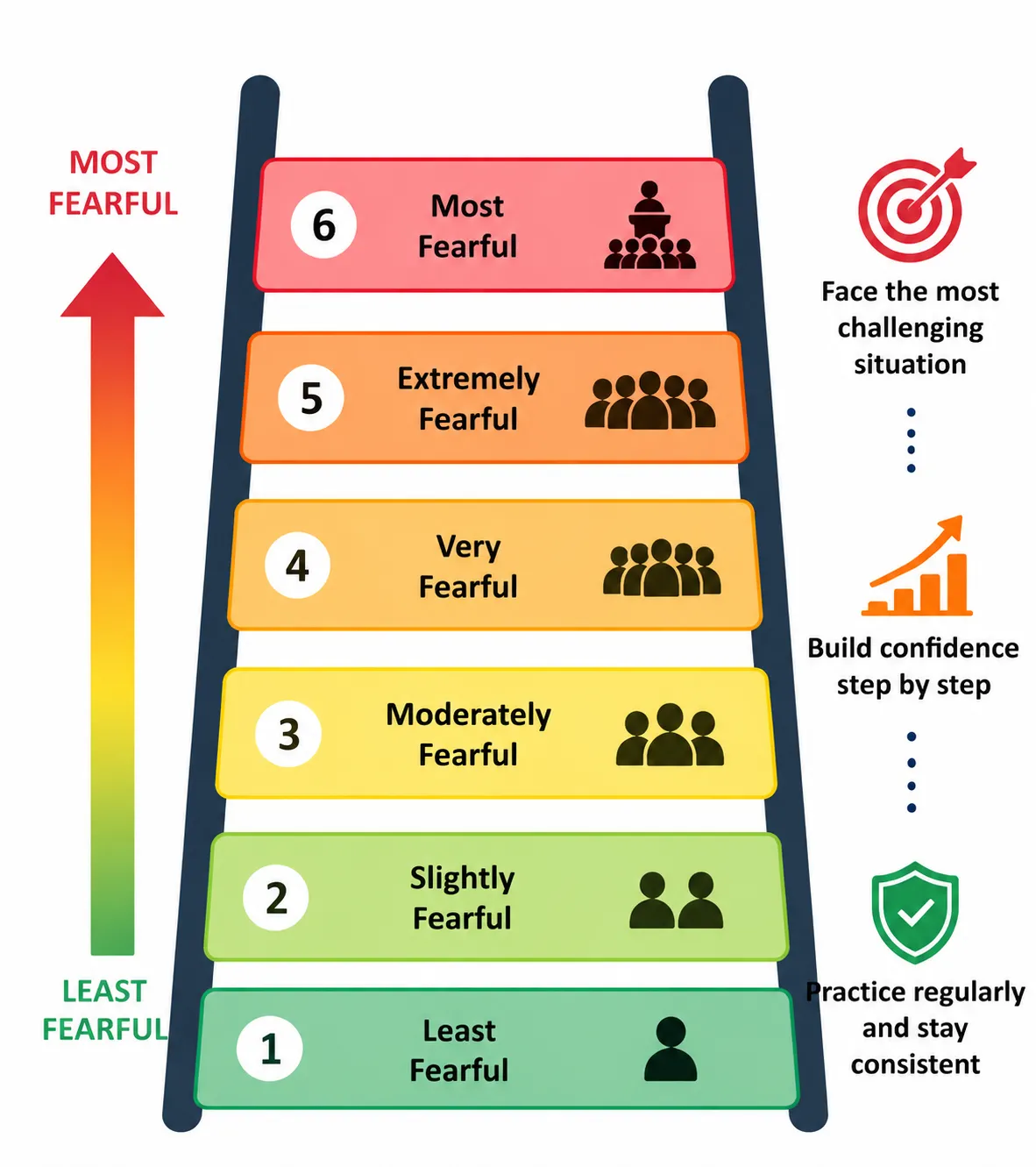
For example, a person with a fear of speaking in public may first speak in front of one trusted person, then a small group, and later a larger audience. Over time, their fear reduces because they learn that the situation is not as dangerous as they thought.
Exposure therapy is mainly used for:
- Phobias
- Anxiety disorders
- Panic-related fears
In everyday life, this technique helps people become more confident by slowly facing situations they usually avoid.
Behavioural Activation
Behavioural activation is a technique used mainly to support people who feel low, unmotivated, or depressed. When people feel low, they often stop doing activities they enjoy or need to do. This can make their mood worse.
Behavioural activation encourages individuals to start doing small, meaningful activities even when they do not feel motivated. The idea is simple: action can improve mood.
For example, a person feeling low may start by going for a short walk, completing a small task, or meeting a friend. These small actions can slowly improve emotional wellbeing.
This technique is commonly used for:
- Low mood
- Depression
- Lack of motivation
In workplace settings, it helps individuals rebuild energy and return to normal routines.
Activity Scheduling
Activity scheduling helps individuals plan their day in a structured way. When people feel stressed or overwhelmed, they may struggle to organise their time. This can increase anxiety and reduce productivity.
Activity scheduling involves creating a simple plan of daily tasks and activities. This helps bring structure and reduces uncertainty.
For example, a person may plan:
- Morning walk
- Work tasks in small steps
- Short breaks
- Time for relaxation
This approach helps reduce stress and improves focus by making the day more manageable.
Relaxation Techniques
Relaxation techniques are used to reduce physical and mental tension. Stress and anxiety often affect the body by causing tight muscles, fast breathing, and restlessness.
Relaxation techniques help calm the body and mind. These may include deep breathing, slow breathing exercises, or guided relaxation.
For example, before a stressful meeting, a person may take slow deep breaths to reduce nervousness.
These techniques are commonly used for:
- Stress
- Anxiety
- Panic symptoms
Relaxation helps individuals feel more in control of their emotional responses.
Positive Reinforcement Strategies
Positive reinforcement means encouraging helpful behaviour by giving positive outcomes or rewards. In CBT, this does not always mean material rewards. It can also include self-praise, satisfaction, or recognition of progress.
For example, if a person completes a difficult task, they may allow themselves a short break or acknowledge their achievement.
This technique helps:
- Build healthy habits
- Increase motivation
- Encourage positive behaviour repetition
Over time, reinforced behaviour becomes a stable habit that supports emotional wellbeing.
Skills Training
Skills training helps individuals develop basic social and coping skills needed for everyday life. Some people struggle with communication, confidence, or managing emotions in social situations.
Skills training may include:
- Learning how to communicate clearly
- Practising social interaction
- Developing problem-solving skills
- Improving emotional control
For example, a person who finds it difficult to speak in groups may practise simple conversation skills step by step.
This technique is useful for:
- Social difficulties
- Workplace communication issues
- Low confidence situations
How Behavioural Interventions Work Together
In CBT, these interventions are often used together rather than separately. Each technique supports different aspects of behaviour and emotional wellbeing.
For example:
- Exposure therapy reduces fear
- Behavioural activation increases motivation
- Relaxation techniques reduce stress
- Skills training improves confidence
When combined, they help individuals build healthier emotional responses and improve daily functioning.
Workplace Example
An employee feels stressed about workload and avoids difficult tasks. This increases pressure over time. A CBT-based approach may include:
- Breaking tasks into small steps (behavioural activation)
- Planning daily work schedule (activity scheduling)
- Using breathing techniques before meetings (relaxation)
Over time, stress reduces and productivity improves.
Everyday Life Example
A person feels anxious about social interaction. Instead of avoiding people, they start attending small gatherings. They also practise relaxation techniques before meeting others. Gradually, their confidence improves and anxiety reduces.
This shows how behavioural interventions support real-life emotional improvement.
Case Study
Situation
Ali is a university student experiencing stress and low motivation due to academic pressure.
Action
Ali avoids studying and spends most of his time on distractions. His stress increases as deadlines approach. A CBT approach is introduced using behavioural activation and activity scheduling.
Result
Ali starts studying in small steps and creates a daily study plan. He also uses short breaks and relaxation techniques. Over time, his stress reduces and productivity improves.
Learning Point
Small behavioural changes can improve emotional wellbeing. Structured actions help reduce stress and build motivation over time.
Key Takeaways
- CBT uses practical behavioural interventions to improve emotional wellbeing
- Exposure therapy helps reduce fear through gradual facing of situations
- Behavioural activation improves mood through meaningful activity
- Activity scheduling improves structure and reduces stress
- Relaxation techniques help calm the body and mind
- Skills training improves communication and confidence
- Small behavioural changes can lead to long-term emotional improvement
Behavioural interventions are essential tools in CBT that help individuals improve emotional wellbeing through structured and practical actions. Each intervention supports different emotional needs, such as reducing fear, improving motivation, managing stress, and building confidence.
By using these techniques step by step, individuals can develop healthier behaviour patterns and improve their overall mental wellbeing. CBT shows that even small changes in behaviour can lead to meaningful and lasting improvements in daily life.
2. Exposure-Based Techniques
Exposure-based techniques are an important part of Cognitive Behavioural Therapy (CBT). These techniques help individuals gradually face situations, thoughts, or objects that they fear or tend to avoid. Many people try to escape from what makes them anxious, but in CBT, the focus is on slowly facing these fears in a safe and controlled way.
The main idea behind exposure is very simple: fear becomes stronger when we avoid it, and it becomes weaker when we face it step by step. Over time, repeated safe exposure helps the brain learn that the feared situation is not as dangerous as it first seemed.
Purpose of Exposure Techniques
The main purpose of exposure techniques is to reduce fear and anxiety by helping individuals face situations instead of avoiding them. Avoidance may give short-term relief, but it does not solve the problem. In fact, it often increases fear over time because the person never learns that the situation is safe or manageable.
Exposure techniques help break this cycle by slowly and safely introducing the feared situation. As a result, the person becomes more confident and less anxious.
Key purposes include
- Reducing fear and anxiety
- Breaking avoidance patterns
- Building confidence step by step
- Helping individuals feel more in control
- Improving emotional responses in real situations
For beginners, the key understanding is that exposure is not about forcing someone into fear, but about gradual learning in a safe environment.
How Exposure Works
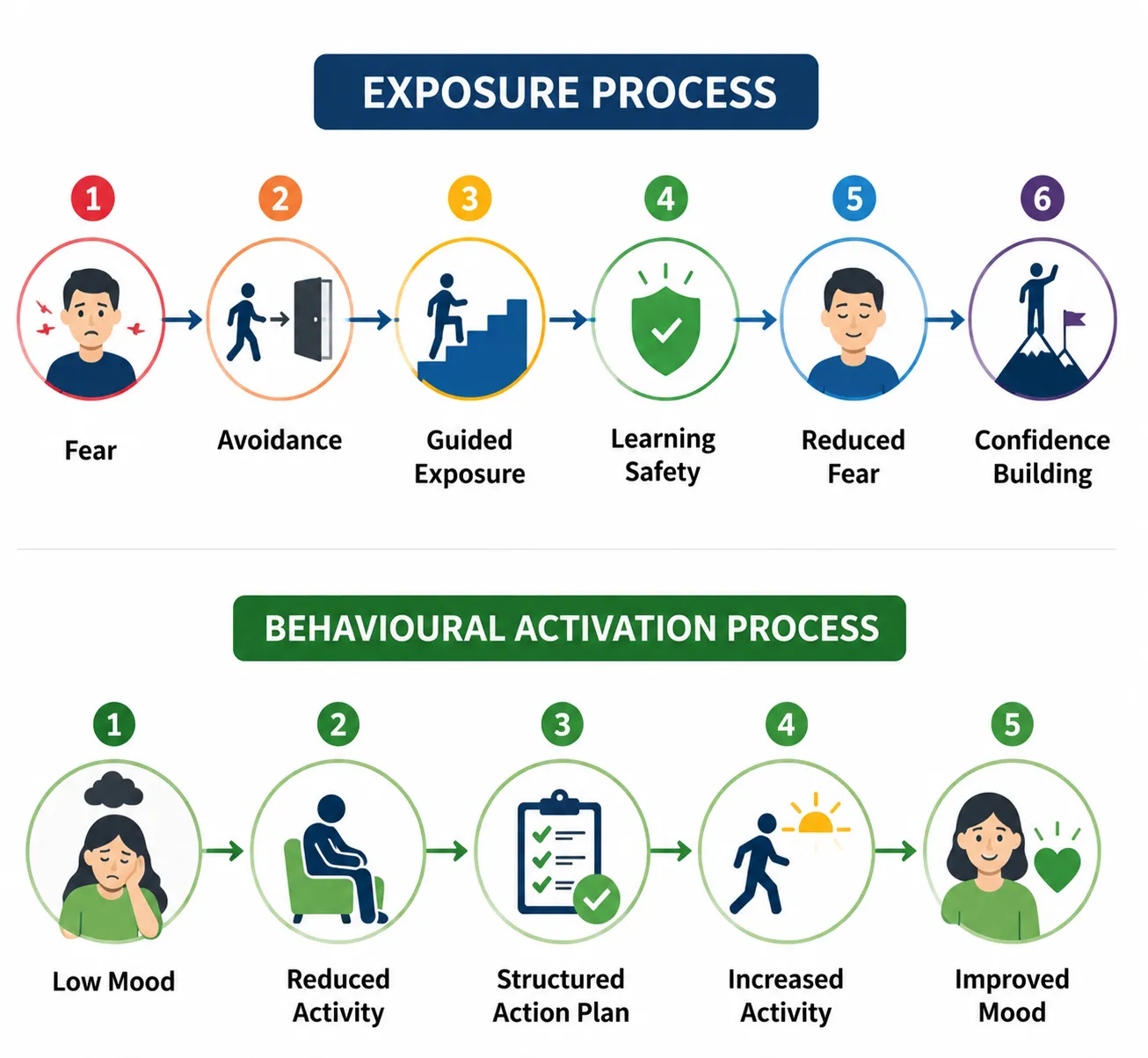
Exposure therapy works through a gradual learning process. Instead of facing a fear all at once, the person is guided step by step.
Exposure Process
Fear Trigger → Anxiety → Gradual Exposure → Reduced Fear → Increased Confidence
Simple Explanation
- A situation triggers fear
- The person feels anxious
- They are gradually exposed to the situation
- Anxiety starts to reduce over time
- Confidence increases with repeated exposure
This process shows the brain that the feared situation is not harmful, which slowly reduces the fear response.
Types of Exposure
There are different types of exposure techniques used in CBT. Each type is used depending on the person’s situation and level of fear.
1. Gradual Exposure
This involves facing fear step by step, starting from the easiest level and slowly moving to more difficult situations.
For example, a person afraid of social interaction may start by saying hello to one person, then talking in small groups, and later joining larger gatherings.
2. Direct Exposure
This involves facing the feared situation directly in real life without avoiding it.
For example, someone afraid of elevators may start using one instead of taking the stairs, with support if needed.
3. Imaginal Exposure
This involves imagining the feared situation in a controlled and safe environment.
For example, a person afraid of flying may imagine being on a plane and going through the experience step by step.
Comparison of Exposure Types
| Type | Description | Example |
|---|---|---|
| Gradual Exposure | Step-by-step approach | Speaking to small groups first |
| Direct Exposure | Facing fear in real life | Using an elevator directly |
| Imaginal Exposure | Thinking about fear | Imagining flying on a plane |
This table helps learners understand that exposure can happen in different ways depending on comfort level and readiness.
Simple Example of Exposure in Daily Life
A person who is afraid of public speaking may start small. First, they may speak in front of one trusted friend. Then they may speak in a small group. Later, they may present in a classroom or meeting.
At each step, the fear becomes easier to manage. This gradual approach helps build confidence without overwhelming the person.
Why Exposure is Important
Exposure techniques are widely used in CBT because they help individuals improve their emotional and behavioural responses in a structured way.
Main benefits include
- Reduces avoidance behaviour
- Builds confidence over time
- Helps retrain emotional responses
- Improves coping skills in real-life situations
When people avoid fear, it often grows stronger. Exposure helps reverse this pattern by encouraging safe and gradual engagement.
Workplace Example
In a workplace setting, exposure techniques can be very helpful for improving confidence and performance.
An employee who fears presenting in meetings may first practise speaking in front of a small group of colleagues. Later, they may present short updates in meetings. Over time, they gradually become more comfortable with speaking in larger groups.
This process reduces anxiety and improves communication skills. It also helps the employee feel more confident in their role.
Case Study
Situation
Ali is a young professional who feels strong anxiety when speaking in group meetings.
Action
Instead of avoiding meetings, Ali is introduced to gradual exposure. He starts by speaking in front of one colleague, then gradually participates in small team discussions, and later contributes in full meetings.
Result
Over time, Ali’s fear reduces. He becomes more confident and starts participating actively in workplace discussions.
Learning Point
Facing fear step by step helps reduce anxiety and build confidence. Avoidance increases fear, while exposure helps overcome it.
Key Takeaways
- Exposure techniques help individuals face fears in a controlled way
- Avoidance increases fear, while exposure reduces it
- Exposure works through gradual learning and repetition
- There are three main types: gradual, direct, and imaginal exposure
- Exposure builds confidence and reduces anxiety over time
- It is widely used in both personal and workplace situations
Exposure-based techniques are a powerful part of CBT that help individuals manage fear and anxiety by facing situations gradually instead of avoiding them. These techniques support emotional learning by showing that feared situations are often less harmful than expected.
Through gradual steps, individuals develop confidence, reduce avoidance, and improve their ability to cope with real-life challenges. CBT uses exposure as a structured method to help people achieve long-term emotional stability and personal growth.
3. Behavioural Activation in CBT
Behavioural activation is an important technique used in Cognitive Behavioural Therapy (CBT), mainly for supporting individuals who experience low mood, lack of motivation, or depression. It focuses on helping people become more active in their daily lives through small and manageable steps.
In simple terms, when people feel low, they often stop doing things they usually enjoy or need to do. This can make their mood even worse. Behavioural activation helps break this cycle by encouraging positive action, even when motivation is low. Over time, these actions help improve mood and emotional wellbeing.
What is Behavioural Activation?
Behavioural activation is a structured approach that encourages individuals to take part in meaningful and positive activities. The main idea is that action can improve feelings, even if a person does not feel motivated at the beginning.
When a person is feeling low, they may believe they need motivation first before acting. However, CBT teaches the opposite idea: doing something small first can help create motivation later.
For example, someone who feels low may start by taking a short walk or completing a simple task. Even small actions can slowly improve energy and mood.
How Behavioural Activation Works
Behavioural activation follows a simple emotional and behavioural cycle. It explains how low mood can continue and how it can be improved through action.
Low Mood → Withdrawal → Reduced Activity → Lower Mood → Behavioural Activation → Increased Activity → Improved Mood
Simple Explanation of the Cycle
- A person feels low or unmotivated
- They start withdrawing from activities
- Their activity level decreases
- Their mood becomes even lower
- Behavioural activation introduces small actions
- Activity increases gradually
- Mood begins to improve
This cycle shows that inactivity keeps low mood going, while action helps improve it.
Main Purpose of Behavioural Activation
Behavioural activation is used to improve emotional wellbeing through structured activity. Its main purposes include:
- Increasing engagement in daily life
- Improving mood through positive action
- Breaking the cycle of inactivity and low energy
- Building routine and structure in daily living
It is important because it helps individuals understand that behaviour and mood are closely connected.
Types of Activities Used in Behavioural Activation
Behavioural activation includes different types of activities that support emotional improvement. These activities are simple and can be done in everyday life.
1. Physical Activities
These include movement-based actions that improve energy levels.
- Walking
- Light exercise
- Stretching
2. Social Activities
These help reduce loneliness and improve connection with others.
- Meeting friends
- Talking to family
- Joining group activities
3. Routine Tasks
These help create structure and reduce feelings of chaos.
- Cleaning
- Planning the day
- Studying or working
4. Enjoyable Activities
These focus on positive feelings and relaxation.
- Hobbies
- Listening to music
- Reading or relaxation
Summary of Activity Types
| Type of Activity | Example | Benefit |
|---|---|---|
| Physical | Walking | Increases energy |
| Social | Meeting friends | Reduces loneliness |
| Routine | Planning tasks | Improves structure |
| Enjoyable | Hobbies | Improves mood |
Example of Behavioural Activation
A person is feeling low and unmotivated. Instead of staying in bed all day, they start by doing small activities like making their bed or going for a short walk.
At first, they may not feel much change. However, after repeating these small actions, their energy slowly improves. Over time, they feel more active and their mood becomes better.
This shows that small actions can create positive emotional change.
Workplace Example
An employee is feeling unmotivated at work and starts delaying tasks. This increases stress and makes the workload feel heavier.
To improve the situation, the employee starts using behavioural activation. They begin by completing small tasks first, such as replying to emails or organising their desk. As they complete small tasks, they feel more productive and less stressed.
Over time, their motivation improves and their performance becomes more stable.
Comparison of Key Behavioural Interventions
| Intervention | Focus | Outcome |
|---|---|---|
| Exposure Therapy | Reducing fear | Less anxiety over time |
| Behavioural Activation | Increasing activity | Improved mood and energy |
| Activity Scheduling | Organising routine | Better structure and control |
| Relaxation Techniques | Calming body response | Reduced stress levels |
This comparison helps show that different CBT techniques support emotional wellbeing in different ways.
Process Flow Diagram
Key Ideas in Behavioural Activation
Behavioural activation is based on some important ideas:
- Behavioural interventions are practical CBT techniques
- Exposure therapy reduces fear through gradual facing of situations
- Behavioural activation improves mood through structured activity
- Small behavioural steps lead to emotional improvement
- Avoidance increases distress while action reduces it
- Behaviour change supports long-term wellbeing
Practical Examples
Everyday Life Example
A person feels anxious about meeting new people. Instead of avoiding social situations, they start by attending small gatherings. Over time, they become more confident and less anxious.
Workplace Example
An employee feels overwhelmed with tasks. Instead of delaying work, they use a checklist and complete small tasks one by one. This reduces stress and improves performance.
Case Study
Background
Sara is a university student who is experiencing anxiety and low mood due to academic pressure.
Situation
Sara avoids studying and social interaction because she feels overwhelmed. This avoidance increases her stress and reduces her confidence.
Challenge
Her avoidance behaviour leads to poor academic performance, isolation from friends, and increased emotional distress.
Analysis
CBT identifies two key issues: avoidance behaviour and lack of positive activity. These patterns are maintaining her low mood and anxiety.
Action (Solution)
Sara is guided to use behavioural activation by starting small study sessions and short daily walks. She is also encouraged to gradually join group discussions instead of avoiding them.
Result
Over time, Sara becomes more active. Her mood improves, her anxiety reduces, and she begins to feel more confident in managing academic tasks.
Learning Point
Small structured actions can improve emotional wellbeing. Avoidance increases distress, while gradual activity leads to positive emotional change.
Key Takeaways
- Behavioural activation is used to improve mood and reduce low energy
- It works by encouraging small, structured daily activities
- Action can improve mood even when motivation is low
- Avoidance keeps low mood active, while activity improves wellbeing
- CBT uses behavioural activation to support long-term emotional stability
- Small consistent steps can lead to meaningful emotional improvement
Behavioural activation is a simple but powerful CBT technique that helps individuals improve emotional wellbeing through structured activity. It shows that waiting for motivation is not always necessary, and taking small actions can help create positive emotional change.
By engaging in daily activities step by step, individuals can break the cycle of low mood and inactivity. Over time, this leads to improved confidence, better emotional balance, and stronger mental wellbeing in everyday life.
Conclusion
Behavioural activation and exposure-based techniques are both important CBT interventions that help individuals improve emotional wellbeing through structured and practical action. These approaches demonstrate that behaviour strongly influences emotions, and that small, gradual changes in behaviour can reduce anxiety, fear, and low mood over time. Instead of avoiding difficulties, CBT encourages individuals to face challenges step by step and engage in meaningful daily activities that support emotional recovery.
Overall, these techniques show that emotional wellbeing is closely connected to everyday behaviour. By using structured CBT strategies, individuals can break negative cycles such as avoidance and inactivity, and replace them with healthier and more productive patterns. This leads to improved confidence, better mood, and long-term emotional stability in both personal and professional life.