Lesson 2: Explain how Behaviour Influences Emotional Wellbeing
Behaviour plays an important role in shaping how a person feels emotionally in daily life. In Cognitive Behavioural Therapy (CBT), behaviour is not seen only as actions, but also as a key factor that can influence mood, stress levels, and overall mental wellbeing. Many emotional difficulties are maintained or reduced depending on how a person behaves in different situations.
In real-life and workplace settings, people often experience stress, anxiety, or low mood based on their behavioural responses. For example, avoiding difficult tasks may reduce stress temporarily but increase pressure later. Understanding how behaviour influences emotions helps learners recognise patterns that affect wellbeing and supports healthier choices in everyday life.
This knowledge is essential for anyone studying CBT because it explains how simple behavioural changes can lead to meaningful emotional improvement.
By the end of this lesson, learners will be able to:
- Describe how behaviour can maintain or reduce emotional distress
- Explain the impact of avoidance behaviours on mental health
- Identify links between behavioural patterns and emotional outcomes
- Recognise how behaviour influences emotional wellbeing in daily life
How Behaviour Influences Emotional Wellbeing
Behaviour and emotions are closely connected. What a person does in response to a situation can either improve or worsen how they feel. In CBT, this connection is very important because it helps explain why some emotional problems continue over time.
When a person engages in positive or helpful behaviour, emotional wellbeing improves. However, when a person uses unhelpful behaviours such as avoidance, withdrawal, or procrastination, emotional distress often increases.
Simple Understanding
- Helpful behaviour → better emotional wellbeing
- Unhelpful behaviour → increased emotional distress
For example, talking about a problem may reduce stress, while avoiding it may increase anxiety.
1. How Behaviour Maintains or Reduces Emotional Distress
Understanding how behaviour affects emotional wellbeing is an important part of Cognitive Behavioural Therapy (CBT). People often think emotions are only caused by outside events, but in reality, behaviour plays a major role in shaping how a person feels. The way someone responds to stress can either make emotional distress worse or help reduce it over time.
In everyday life, individuals respond differently to challenges. Some behaviours help them cope better, while others may temporarily feel helpful but create long-term emotional difficulties. CBT focuses on helping people recognise these patterns so they can make healthier behavioural choices that support emotional balance.
Behaviour That Maintains Emotional Distress
Certain behaviours may seem useful in the moment because they reduce discomfort quickly, but they often keep emotional problems active or make them worse in the long run. These behaviours are usually linked with avoiding difficulty or escaping uncomfortable feelings.
When a person avoids responsibilities, they may feel less pressure at that moment. However, the responsibility does not disappear. It builds up and often creates more stress later. Similarly, when someone isolates themselves from others, they may feel temporarily safe, but over time, this can increase loneliness and sadness.
Another common behaviour is overthinking without taking action. This can create a cycle where the person keeps worrying but does not solve the problem. Procrastination also works in a similar way. Delaying tasks reduces stress for a short time, but the pressure increases as deadlines approach. Withdrawing from support systems, such as friends, family, or colleagues, also reduces opportunities for emotional relief and guidance.
These behaviours are important to understand because they often become habits. Once repeated, they form a pattern where the person feels stuck in emotional distress without realising the behaviour is contributing to it.
Key behaviours that maintain distress
- Avoiding responsibilities
- Isolating from others
- Overthinking without action
- Procrastination
- Withdrawing from support systems
Example
A student feels stressed about upcoming exams. Instead of studying, they avoid revision and spend time on distractions. At first, this reduces pressure and feels comfortable. However, as the exam date approaches, the lack of preparation increases anxiety and fear. The behaviour that provided short relief ends up increasing emotional distress.
Behaviour That Reduces Emotional Distress
Not all behaviours increase stress. Some actions help reduce emotional pressure and support emotional wellbeing. These behaviours usually involve facing problems in a structured and manageable way rather than avoiding them.
Talking to someone for support is one of the most effective ways to reduce emotional distress. Sharing feelings can help a person feel understood and less alone. Completing tasks step by step is another helpful approach. When a large task feels overwhelming, breaking it into smaller parts makes it easier to manage and reduces pressure.
Practising relaxation techniques such as deep breathing or taking short breaks can also help calm the mind. Engaging in positive activities, such as exercise, hobbies, or social interaction, improves mood and reduces negative thinking. Facing problems gradually instead of avoiding them helps build confidence and reduces fear over time.
These behaviours may require more effort at first, but they help create long-term emotional stability. Over time, they also improve confidence and problem-solving ability.
Key behaviours that reduce distress
- Talking to someone for support
- Completing tasks step by step
- Practising relaxation
- Engaging in positive activities
- Facing problems gradually
Example
An employee has a large project at work and feels overwhelmed. Instead of avoiding it, they divide the task into smaller sections and complete one part at a time. They also take short breaks and ask a colleague for guidance. As a result, stress reduces, and confidence increases.
Behaviour Impact Overview
Behaviour influences emotional wellbeing in predictable ways. The table below shows how different types of behaviour affect emotions over time.
| Behaviour Type | Effect on Emotion | Short-Term Result | Long-Term Result |
|---|---|---|---|
| Avoidance | Increases anxiety | Temporary relief | Increased stress |
| Problem-solving | Reduces stress | Small effort needed | Improved wellbeing |
| Isolation | Increases sadness | Feels safe initially | Loneliness increases |
| Engagement | Improves mood | More effort required | Better emotional health |
This table helps show that short-term comfort is not always linked to long-term emotional wellbeing. Some behaviours feel easier at first but lead to more emotional difficulty later.
How Behaviour Patterns Influence Emotional State
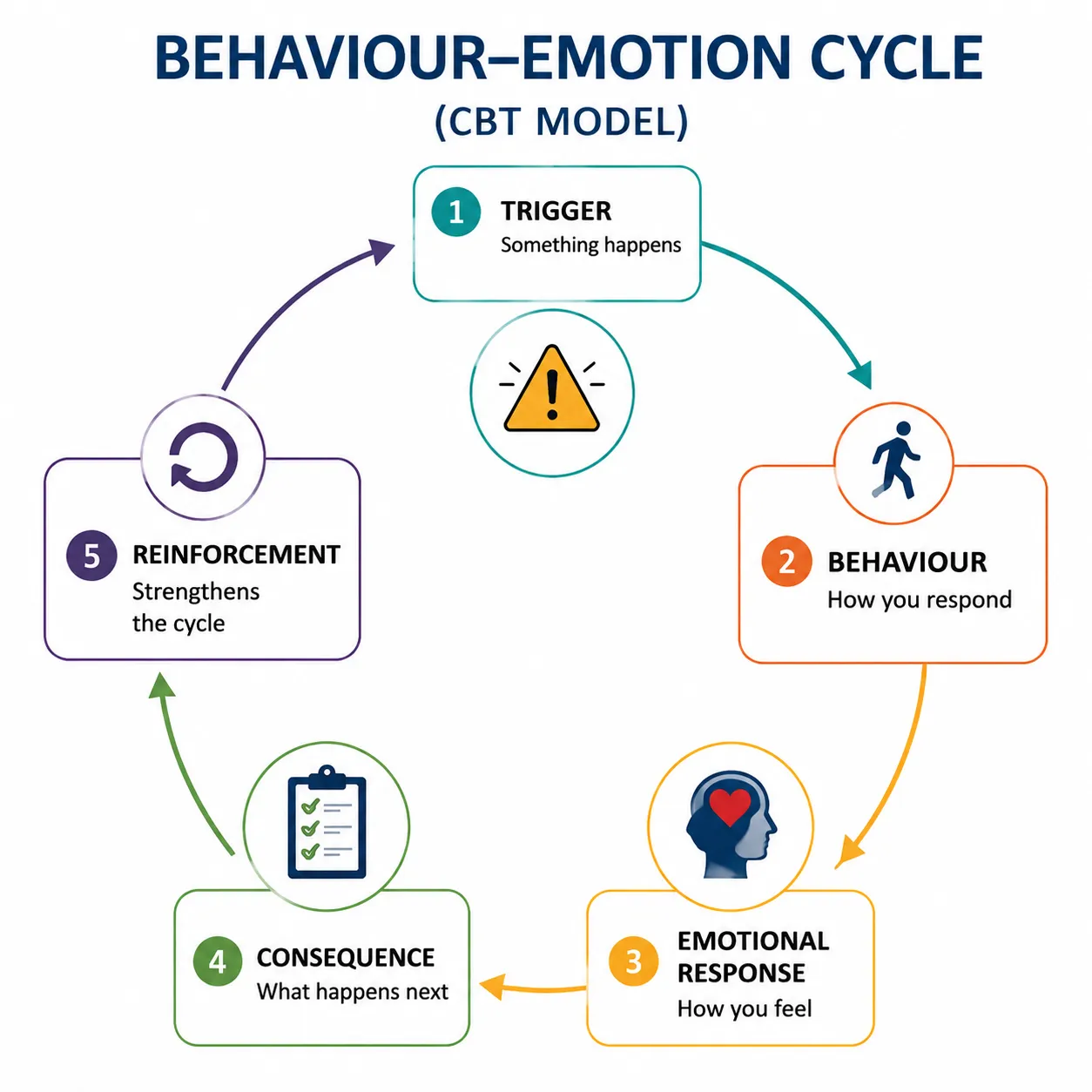
Behaviour often becomes a pattern when it is repeated regularly. These patterns strongly influence how a person feels over time. If someone repeatedly avoids problems, their anxiety tends to grow. If someone regularly engages in positive actions, their emotional wellbeing improves.
For example, a person who avoids social situations may feel less anxious in the moment. However, over time, this avoidance can increase fear of social interaction. On the other hand, a person who gradually participates in social activities may feel nervous at first but becomes more confident with practice.
CBT focuses on helping individuals notice these patterns and slowly replace unhelpful behaviours with more supportive ones.
Workplace Example
In a workplace setting, behaviour has a direct impact on emotional wellbeing and performance. An employee who avoids asking questions may feel less embarrassed temporarily. However, this can lead to confusion, mistakes, and increased stress later.
If the same employee starts asking small questions and gradually participates more in discussions, they begin to feel more confident. This reduces stress and improves job performance. This example shows how behaviour choices can shape emotional outcomes in a professional environment.
Case Study
Situation
A young professional named Ali feels overwhelmed by his workload and starts avoiding important tasks.
Action
Instead of completing tasks, Ali delays them and spends time on unimportant activities. This gives him temporary relief from stress.
Result
As deadlines approach, Ali feels more pressure and anxiety. His workload increases, and his confidence decreases.
Learning Point
Avoidance reduces stress only for a short time but increases emotional distress in the long run. Facing tasks gradually would have helped reduce pressure and improve emotional wellbeing.
Recognising Behaviour and Emotional Links
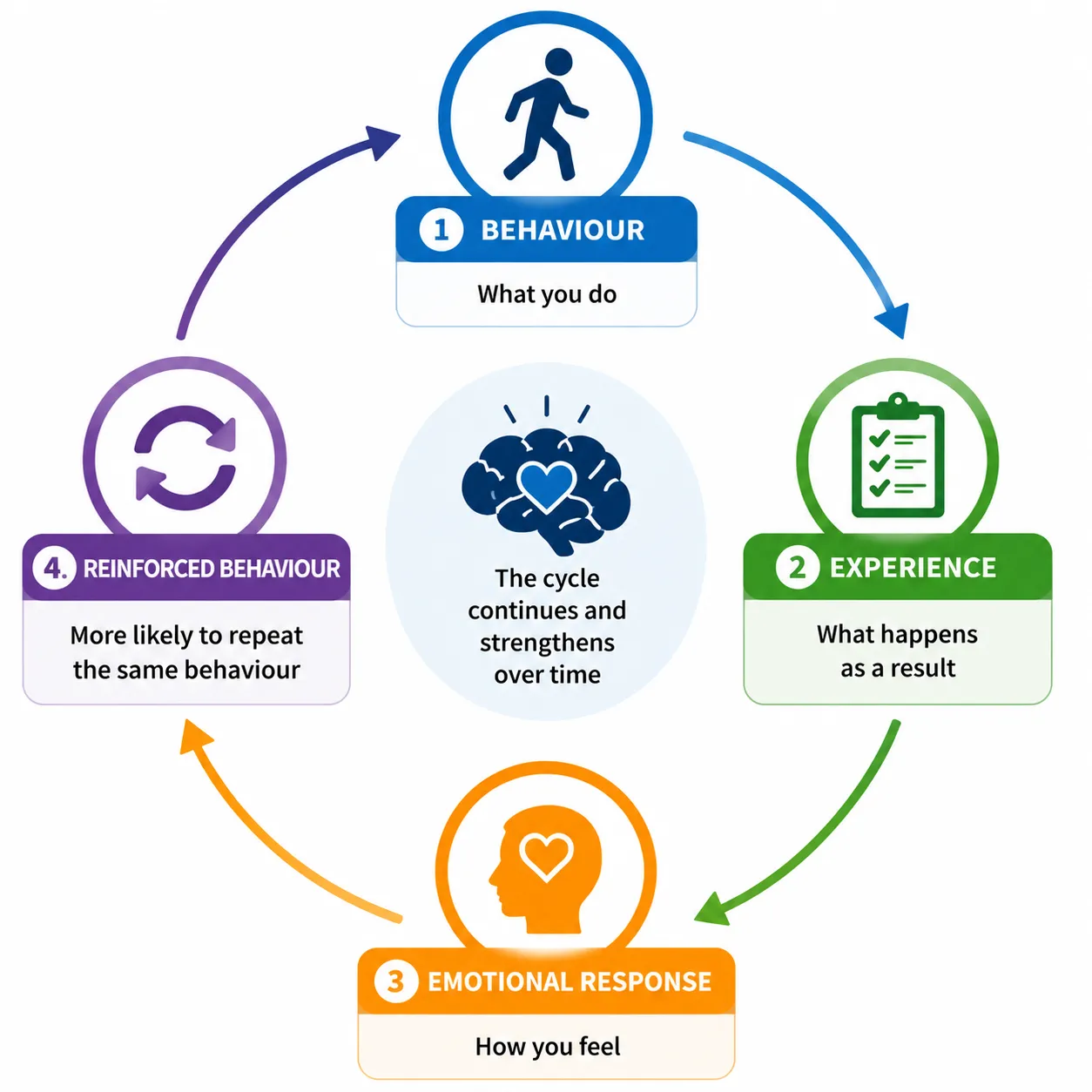
It is important to understand that emotions and behaviour are connected. A person’s actions influence how they feel, and their feelings also influence their actions. This creates a cycle that can either be helpful or unhelpful.
When behaviour is positive and structured, emotional wellbeing improves. When behaviour is based on avoidance or withdrawal, emotional distress increases. Recognising this connection is the first step toward improving mental wellbeing.
Practical Everyday Understanding
In daily life, people can observe how small behavioural changes affect emotions. For example:
- Going for a walk may improve mood
- Ignoring a problem may increase worry
- Talking to a friend may reduce stress
- Delaying work may increase pressure
These examples show that behaviour is not just action; it is closely linked to emotional experience.
Key Takeaways
- Behaviour can either increase or reduce emotional distress
- Avoidance may provide short-term relief but increases long-term stress
- Positive actions improve emotional wellbeing and confidence
- Behaviour patterns shape emotional responses over time
- Small changes in behaviour can significantly improve mental health
- CBT helps individuals replace unhelpful behaviours with healthier ones
Behaviour plays a central role in emotional wellbeing. Some behaviours, such as avoidance and withdrawal, may feel helpful at first but often increase emotional distress over time. Other behaviours, such as problem-solving, support-seeking, and gradual engagement, help reduce stress and build emotional strength.
By understanding how behaviour influences emotions, individuals can make better choices in their daily lives. CBT uses this understanding to help people develop healthier behavioural patterns that support long-term emotional stability and wellbeing.