
Lesson 1: Understand the History and Development of Cognitive Behavioural Therapy (CBT)
Cognitive Behavioural Therapy (CBT) is a structured, evidence-based psychological approach widely used in modern mental health practice. It is grounded in the understanding that thoughts, emotions, and behaviours are closely interconnected, and that changes in thinking patterns can significantly improve emotional wellbeing and behavioural outcomes.
Understanding the history and development of Cognitive Behavioural Therapy is essential for learners because it provides the foundation for how modern therapeutic techniques were formed. In professional settings such as counselling, healthcare, education, and workplace wellbeing, CBT is applied to manage stress, anxiety, depression, and behavioural challenges effectively. Knowing its development helps learners understand why CBT is structured, goal-oriented, and evidence-based.
By the end of this lesson, learners will be able to:
- Describe the origins and historical development of Cognitive Behavioural Therapy
- Identify and outline key contributors to CBT development
- Explain the transition from behavioural and cognitive theories into modern CBT practice
- Analyse how CBT evolved into a structured, evidence-based therapeutic approach
- Apply historical understanding to interpret modern CBT techniques
1. Origins and Historical Development of Cognitive Behavioural Therapy (CBT)
Cognitive Behavioural Therapy, commonly known as CBT, is a widely used approach in understanding human thoughts, emotions, and behaviour. To understand how CBT works today, it is important to first learn where it came from and how it developed over time. The development of Cognitive Behavioural Therapy is based on two major psychological ideas: behavioural psychology and cognitive psychology. These two approaches helped shape the way professionals understand human behaviour and mental wellbeing in modern times.
In the early stages of psychology, most researchers focused only on visible actions or behaviour. They believed that only what people do can be studied scientifically. However, later studies showed that thoughts and internal feelings also play a very important role in shaping behaviour. This understanding became the foundation for modern CBT, which combines both thoughts and behaviour to help people improve emotional wellbeing.
Behavioural Psychology (Early 20th Century)
Behavioural psychology is one of the earliest foundations of CBT. It focuses on how people learn behaviour from their environment. In simple words, it explains that people learn by observing, experiencing, and reacting to situations around them.
At this stage, psychologists believed that behaviour could be changed by controlling external factors such as rewards, punishment, and repeated practice. Internal thoughts were not considered important because they could not be directly observed or measured.
Key Principles of Behavioural Psychology
- Behaviour is learned from the environment
- Actions can be changed through practice and experience
- Rewards encourage positive behaviour
- Punishments reduce unwanted behaviour
- Learning happens through repetition and conditioning
These principles are still used today in schools, workplaces, and training environments to encourage positive behaviour and discipline.
Key Early Theorists in Behavioural Psychology
Several important psychologists contributed to the development of behavioural psychology. Their work laid the foundation for modern CBT.
Ivan Pavlov (Classical Conditioning)
Ivan Pavlov discovered that behaviour can be learned through association. He showed that animals (and humans) can learn to connect a neutral stimulus with a natural response. For example, dogs learned to associate the sound of a bell with food, and eventually responded to the bell alone.
John B. Watson (Behaviourism)
John B. Watson believed that human behaviour should be studied through observable actions only. He argued that emotions and behaviours are learned from the environment and can be shaped through experience.
B.F. Skinner (Operant Conditioning)
B.F. Skinner focused on how rewards and punishments influence behaviour. He explained that behaviour followed by positive outcomes is more likely to continue, while behaviour followed by negative outcomes is less likely to repeat.
These early ideas were very important in shaping behavioural learning techniques used in modern therapy and education.
Behavioural Learning Process
Behavioural psychology explains learning as a simple process. It focuses on how behaviour is formed and changed through interaction with the environment.
Behavioural Learning Flow
Stimulus → Behaviour → Reinforcement → Behaviour Change
This means:
- A stimulus triggers a response
- The person shows a behaviour
- The behaviour is followed by a reward or punishment
- The behaviour either increases or decreases over time
This simple cycle is used in many areas today, such as training employees, teaching students, and improving habits.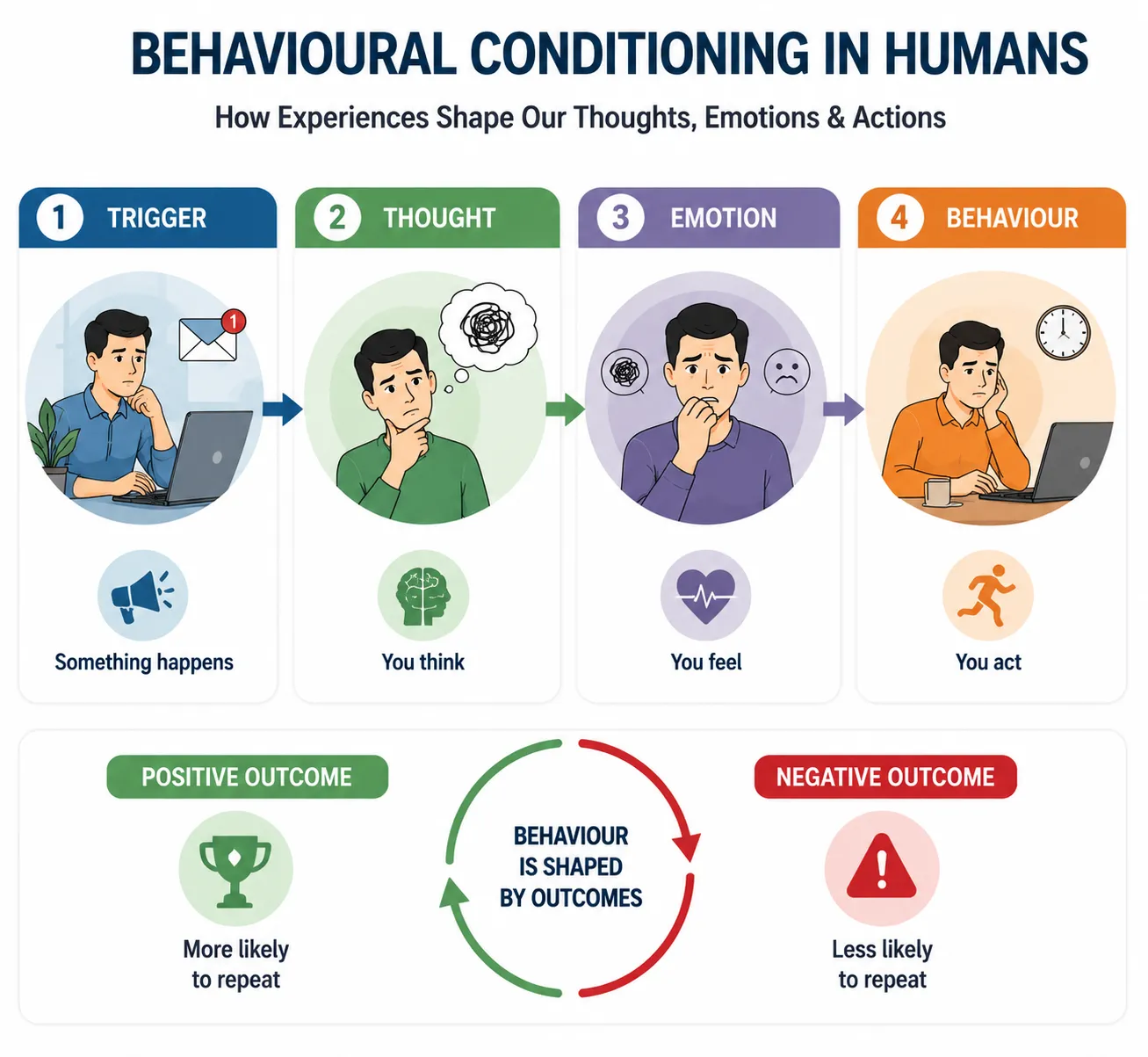
Behavioural psychology helped early researchers understand that human actions are not random. Instead, they are learned responses to the environment. This idea became very useful in understanding habits, phobias, and emotional reactions.
For example, if a person receives praise after completing a task, they are more likely to repeat that behaviour. Similarly, if a behaviour leads to negative results, it may reduce over time. These simple learning patterns became important tools in therapy and behaviour change programmes.
Transition Towards Cognitive Psychology
Although behavioural psychology was very useful, it had limitations. It did not explain why people think differently in the same situation or why emotions vary from person to person. This led psychologists to study the role of thoughts and beliefs.
Cognitive psychology introduced the idea that internal thinking patterns strongly influence behaviour and emotions. This shift was very important in developing CBT later on.
How Behavioural Psychology Influenced CBT Development
Behavioural psychology contributed several important ideas to CBT:
- Learning through experience
- Changing behaviour through structured steps
- Using reinforcement to support positive change
- Understanding habits and conditioned responses
These ideas form one half of CBT, while cognitive psychology forms the other half.
Comparison Table: Behaviour in Early Psychology
| Aspect | Behavioural Psychology |
|---|---|
| Focus | Visible behaviour |
| Learning Method | Experience and conditioning |
| Key Idea | Behaviour is learned |
| Role of Thoughts | Not considered important |
| Application | Training, habit formation, behaviour change |
Everyday Workplace Examples
Behavioural psychology is still used in real-life situations today.
- In schools, students receive rewards for good performance
- In workplaces, employees are recognised for good behaviour and performance
- In training, repeated practice is used to improve skills
- In customer service, positive feedback improves communication behaviour
These examples show how behaviour can be shaped in a structured way without needing complex psychological knowledge.
Case Study: Workplace Behaviour Improvement
Situation
A new employee in a retail shop often forgets to greet customers properly.
Action
The supervisor introduces a reward system where employees receive positive feedback and recognition when they greet customers correctly.
Result
The employee gradually improves behaviour and starts greeting customers naturally.
Learning Point
This shows how reinforcement can help improve behaviour through simple learning techniques.
Key Takeaways
- Behavioural psychology is one of the main foundations of CBT
- It focuses on learning through environment, experience, and repetition
- Key theorists include Pavlov, Watson, and Skinner
- Behaviour can be shaped using rewards and consequences
- These ideas are still widely used in education and workplaces today
The origins and historical development of Cognitive Behavioural Therapy show how early psychological ideas about behaviour helped shape modern therapy. Behavioural psychology provided a strong foundation by explaining how actions are learned and changed through experience. Although it focused only on observable behaviour, it played a major role in the development of CBT. This understanding helps learners appreciate how simple behavioural principles continue to support modern approaches to learning, training, and mental wellbeing.
2. Cognitive Foundations of Cognitive Behavioural Therapy (CBT)
The cognitive foundations of Cognitive Behavioural Therapy explain how human thinking patterns influence emotions and behaviour in everyday life. This part of the course helps learners understand that people do not respond only to situations, but also to how they interpret those situations in their mind. These ideas form an important part of modern mental health understanding and are widely used in counselling, education, healthcare, and workplace wellbeing.
The development of Cognitive Behavioural Therapy was strongly influenced by cognitive psychology, which focuses on how people think, remember, and interpret information. This approach helped psychologists understand that internal thoughts are just as important as external behaviour. For example, two people can experience the same situation but feel and react differently because of their thoughts. This simple idea is the foundation of cognitive psychology and later CBT practice.
Understanding cognitive foundations is important for beginners because it builds awareness of how negative thinking patterns can affect daily life, confidence, decision-making, and emotional wellbeing. It also helps learners recognise that thoughts can be changed, and when thoughts change, feelings and behaviour can also improve.
Cognitive Psychology Development
Cognitive psychology developed as a new area of psychology when researchers realised that behaviour alone could not fully explain human actions. Earlier approaches focused only on visible behaviour, but psychologists noticed that internal thinking processes play a major role in shaping responses.
Cognitive psychology focuses on how people understand information, how they interpret situations, and how their thoughts influence their emotional reactions. It highlights that the mind is active and constantly processing information, even when a person is not aware of it.
Key Principles of Cognitive Psychology
- Thoughts influence emotional responses
- Negative thinking patterns can lead to stress, anxiety, or sadness
- People react based on how they interpret situations, not just the situation itself
- Changing thoughts can help change behaviour and emotional reactions
For example, if a person believes “I will fail this task,” they may feel anxious and avoid trying. However, if they think “I can try my best and learn,” they are more likely to stay calm and take action. This shows how thinking directly affects behaviour.
Cognitive psychology became very important because it helped explain why people behave differently even in the same situation. It also created a foundation for practical therapeutic methods used in modern counselling.
Key Cognitive Theorists
Two major psychologists played an important role in developing cognitive ideas that later shaped CBT.
Aaron Beck
Aaron Beck is known as the founder of cognitive therapy. He discovered that many people experience “automatic negative thoughts” that happen quickly and often without awareness. These thoughts can affect emotions and behaviour in a negative way.
Beck explained that when people learn to identify and challenge these thoughts, they can improve their emotional wellbeing. His work is one of the main foundations of modern CBT practice.
Albert Ellis
Albert Ellis developed Rational Emotive Behaviour Therapy (REBT). He believed that emotional distress is not caused by events themselves but by irrational beliefs about those events.
For example, if someone fails at a task, they may believe “I am a complete failure,” which creates strong emotional distress. Ellis suggested that replacing irrational beliefs with more realistic thinking helps reduce negative emotions.
Simple Comparison of Theorists
| Theorist | Approach | Main Idea |
|---|---|---|
| Aaron Beck | Cognitive Therapy | Negative automatic thoughts affect emotions |
| Albert Ellis | REBT | Irrational beliefs cause emotional distress |
Both theorists helped shift psychology from focusing only on behaviour to understanding the importance of thinking patterns.
Cognitive Thinking Process in Everyday Life
Cognitive psychology explains that people constantly interpret events in their minds. These interpretations affect how they feel and behave.
A simple thinking process can be understood as:
Situation → Thought → Emotion → Behaviour
For example:
- Situation: A manager gives feedback
- Thought: “I did a bad job”
- Emotion: Feeling sad or anxious
- Behaviour: Avoiding future tasks or becoming less confident
This simple process shows how thoughts can change emotional and behavioural responses.
In real life, this is seen in many situations such as exams, workplace feedback, social interactions, and personal challenges. Understanding this process helps learners become more aware of their thinking patterns.
Cognitive Model Comparison
Cognitive psychology is often compared with behavioural psychology to understand the difference between actions and thoughts.
| Behavioural Theory | Cognitive Theory |
|---|---|
| Focus on actions | Focus on thoughts |
| Based on environment | Based on internal beliefs |
| Learning through conditioning | Learning through thinking patterns |
| Behaviour change through reinforcement | Behaviour change through cognitive restructuring |
This comparison helps learners understand that CBT uses both thinking and behaviour together to support improvement.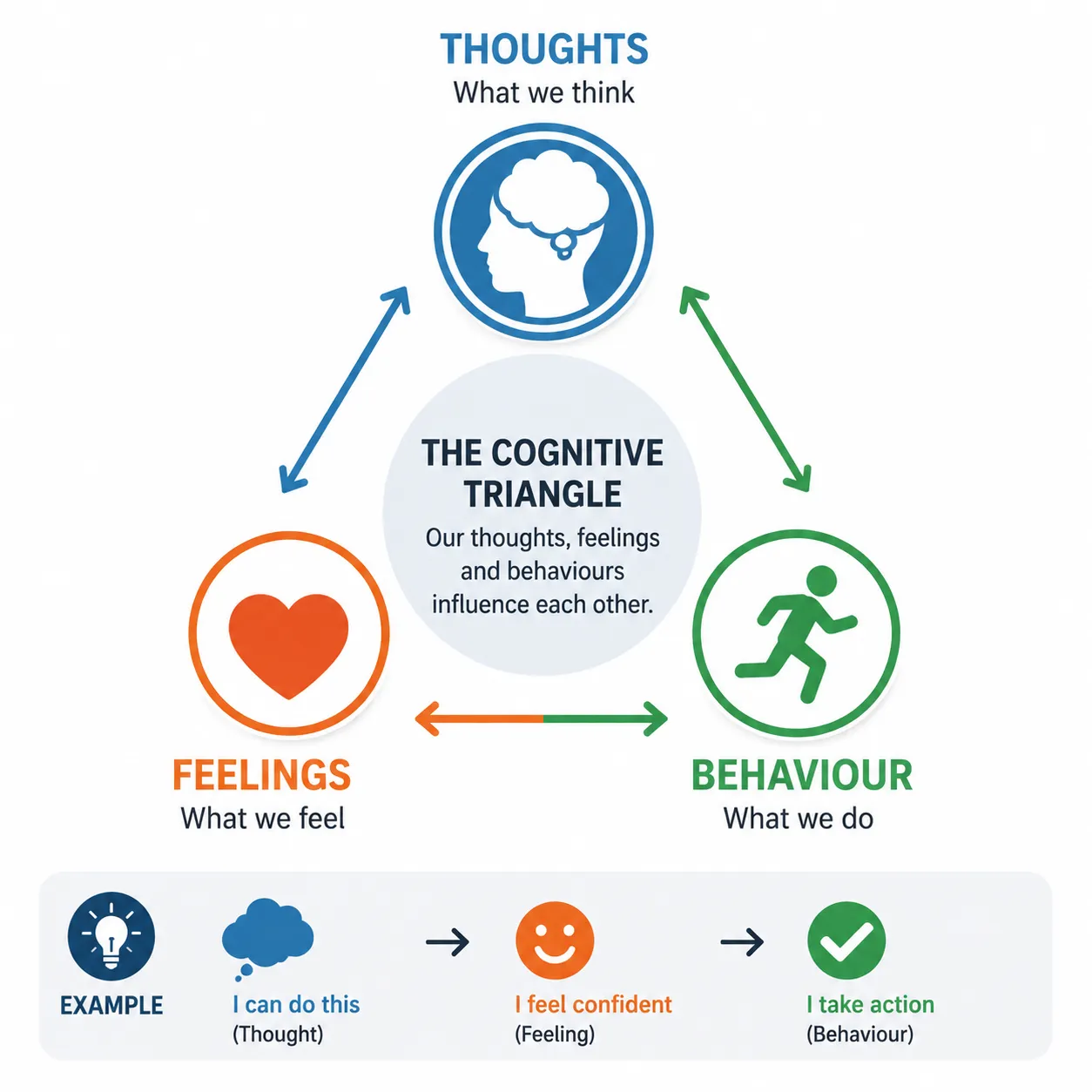
Real-Life Workplace Example
In a workplace setting, cognitive psychology can be observed easily.
For example, an employee receives an email asking for corrections in a report. One employee may think, “I am not good at my job,” which leads to stress and low confidence. Another employee may think, “I can improve this report,” which leads to a calm and positive response.
Both employees faced the same situation, but their thoughts created different emotional and behavioural outcomes. This shows how important thinking patterns are in workplace performance and wellbeing.
Managers and team leaders can use this understanding to support employees by encouraging positive thinking and constructive feedback.
Case Study
Situation
A student in a training class receives a low score on a test.
Action
The student immediately thinks, “I am not intelligent,” and starts avoiding studying for future tests.
Result
The student feels demotivated and performs poorly in the next assessments as well.
Learning Point
The problem is not the test score itself but the negative thinking pattern. By changing the thought to “I need more practice to improve,” the student can feel more motivated and improve performance.
Key Takeaways
- Cognitive psychology focuses on how thoughts influence emotions and behaviour
- People interpret the same situation differently based on thinking patterns
- Negative thoughts can lead to emotional distress
- Aaron Beck and Albert Ellis were key contributors to cognitive theory
- Changing thinking patterns can improve behaviour and emotional wellbeing
- Cognitive psychology is a core foundation of modern CBT practice
The cognitive foundations of Cognitive Behavioural Therapy help learners understand the important role of thinking in human behaviour. While earlier psychological approaches focused only on actions, cognitive psychology showed that thoughts are equally important. This understanding is essential for modern mental health practices, education, and workplace wellbeing. By recognising how thoughts influence emotions and behaviour, individuals can develop better self-awareness and improve their daily responses to challenges.
3. Integration into Cognitive Behavioural Therapy (CBT)
Cognitive Behavioural Therapy, commonly known as CBT, is a structured and practical approach used to help people understand and improve their thoughts, emotions, and behaviours. The integration stage is very important because it explains how two different psychological ideas came together to form one powerful method used in modern mental health support.
The development of Cognitive Behavioural Therapy began when psychologists realised that behaviour alone could not explain how people feel or react in daily life. They also understood that thoughts play a major role in shaping emotional responses. When behavioural therapy and cognitive psychology were combined, a new structured approach called CBT was formed. This integration created a practical method that is now widely used in counselling, healthcare, education, and workplace wellbeing.
Understanding this integration helps learners recognise that CBT is not based on a single idea, but is a combination of two important psychological approaches working together to support human wellbeing.
Development Process of CBT Integration
The integration of CBT happened gradually as psychologists studied both behaviour and thinking patterns. They realised that changing only behaviour was not always enough, and changing thoughts alone also had limitations. Therefore, both approaches were combined into one structured system.
Simple Development Flow
Behavioural Therapy + Cognitive Therapy → Integration → Cognitive Behavioural Therapy (CBT)
This simple process shows how CBT was formed step by step. Behavioural therapy focused on actions, while cognitive therapy focused on thoughts. When combined, they created a more complete understanding of human behaviour.
In everyday life, this means that both what a person thinks and what they do are important for understanding their emotional wellbeing.
Key Features of CBT Integration
The integration of CBT introduced several important features that make it useful in real-world practice.
Focus on Present Thinking and Behaviour
CBT focuses on what a person is thinking and doing in the present moment. It does not only explore the past but looks at current thoughts and actions that affect daily life.
Structured and Goal-Oriented Sessions
CBT is organised in a step-by-step way. Each session has a clear goal, such as reducing stress or improving confidence. This makes it easy for learners and clients to understand progress.
Evidence-Based Approach
CBT is supported by research and real-life studies. It has been tested in many clinical situations and has shown positive results in improving mental health.
Practical Application in Real Life
CBT is not only theoretical. It is used in real situations such as managing stress at work, handling anxiety in exams, or improving communication skills.
These features make CBT a practical and widely trusted approach in modern psychology.
CBT Development Process Flow
The development of CBT can also be understood through its historical progression.
Behaviourism → Cognitive Psychology → Integration → Modern CBT Practice
This flow shows how psychology evolved over time:
- Behaviourism focused on learning through actions
- Cognitive psychology focused on thinking patterns
- Integration combined both ideas
- Modern CBT uses both thinking and behaviour strategies together
This development helped create a balanced approach that supports both emotional and behavioural change.
Evolution into Modern Therapeutic Practice
CBT has become one of the most widely used psychological approaches in the world today. Its growth into modern practice is based on strong evidence, practical results, and its ability to help people in different situations.
Modern CBT is now used in many countries and is considered a standard approach in mental health care. It is used by therapists, counsellors, healthcare workers, teachers, and workplace wellbeing professionals.
Key Reasons for Modern Adoption
CBT became popular for several important reasons:
Strong Scientific Evidence
CBT has been tested in many clinical studies. These studies show that it is effective in improving emotional wellbeing and reducing symptoms of anxiety and depression.
Effective for Common Mental Health Issues
CBT is widely used to support people dealing with stress, anxiety, depression, and negative thinking patterns.
Short-Term and Structured Approach
Unlike some long therapies, CBT is usually short-term and focused. It follows a clear structure, making it easier to understand and apply.
Applicable in Many Settings
CBT is not limited to hospitals. It is also used in schools, workplaces, and personal development programmes.
These reasons explain why CBT is now a global standard in mental health support.
Modern CBT Applications
CBT is used in many different areas of life and work.
Mental Health Treatment
CBT is used in hospitals and clinics to support people with emotional and psychological challenges.
Workplace Stress Management
Many organisations use CBT techniques to help employees manage stress and improve productivity.
Educational Support
Teachers and counsellors use CBT principles to support students with anxiety, behaviour issues, and learning challenges.
Personal Development
Individuals also use CBT techniques to improve confidence, decision-making, and emotional control.
These applications show that CBT is useful not only in therapy but also in everyday life.
Modern CBT Evolution Table
| Stage | Focus | Outcome |
|---|---|---|
| Behaviourism | Observable behaviour | Learning theories |
| Cognitive Psychology | Thought patterns | Cognitive models |
| CBT Integration | Combined approach | Structured therapy |
| Modern CBT | Evidence-based practice | Global therapeutic tool |
This table helps learners clearly understand how CBT developed step by step from simple behaviour studies to a global therapeutic approach.
Real-Life Workplace Example
In a workplace setting, an employee feels stressed when given a new task. They think, “I will not be able to complete this task,” which leads to anxiety and slow performance. A manager trained in CBT principles encourages the employee to break the task into smaller steps and replace negative thinking with positive and realistic thoughts.
As a result, the employee becomes more confident, completes the task successfully, and improves performance. This example shows how CBT principles can be applied in real working environments to improve both thinking and behaviour.
Case Study
Situation
A student in a training centre feels overwhelmed before exams and believes they will fail.
Action
The trainer introduces simple CBT techniques, helping the student identify negative thoughts and replace them with positive and realistic thinking. The student is also guided to create a study plan.
Result
The student becomes more confident, reduces stress, and performs better in exams.
Learning Point
Changing negative thoughts and improving behaviour together can help improve emotional wellbeing and performance.
Key Takeaways
- CBT is formed by combining behavioural and cognitive psychology
- It focuses on thoughts, emotions, and behaviour together
- CBT is structured, practical, and goal-oriented
- It is widely used in healthcare, education, and workplace settings
- Modern CBT is supported by strong scientific research
- It helps people manage stress, anxiety, and negative thinking
The integration of Cognitive Behavioural Therapy shows how two important psychological approaches came together to create a practical and effective method for improving mental wellbeing. By combining behavioural and cognitive ideas, CBT offers a balanced approach that focuses on both thinking and behaviour. Today, it is widely used in many professional and everyday settings because it is simple, structured, and highly effective for supporting emotional and behavioural change.
Conclusion
The development of Cognitive Behavioural Therapy shows how early psychological ideas gradually combined to form a clear and practical approach for understanding human behaviour and emotions. By bringing together behavioural learning principles and cognitive psychology, CBT has become a structured method that focuses on improving both thinking patterns and actions.
Today, Cognitive Behavioural Therapy is widely used in mental health, education, and workplace settings because of its simple, goal-focused, and effective nature. Learning its history and development helps learners understand how scientific ideas are applied in real-life situations to support emotional wellbeing and positive behaviour change.