
Lesson No 1: Fall Prevention Systems
Fall Prevention Systems are a fundamental component of workplace health and safety management, designed to protect workers from falling hazards during activities performed at elevated locations. In construction, engineering, maintenance, and industrial environments, falls remain one of the most significant workplace risks, making the correct selection, installation, and use of prevention systems essential. This lesson introduces learners to the principles of fall prevention, including collective protection measures, personal protective systems, safety barriers, guardrails, anchor points, and other control methods used to minimise fall risks.
This lesson provides a detailed understanding of how effective fall prevention systems are planned, implemented, and maintained to create safer working environments. Learners will explore the importance of hazard identification, risk assessment, equipment selection, inspection procedures, and safe working practices. The content focuses on practical workplace applications, helping learners understand how safety professionals and supervisors apply fall prevention strategies to control risks and protect workers.
By completing this lesson, learners will develop the knowledge required to recognise different types of fall prevention systems, understand their purpose and limitations, and apply appropriate safety measures in real workplace situations. The lesson supports the development of professional safety awareness by emphasising proactive risk control, responsible equipment use, effective communication, and compliance with occupational health and safety requirements.
Understanding fall prevention systems enables workers and supervisors to make informed safety decisions, reduce the likelihood of fall-related incidents, and contribute to a positive safety culture. Through practical examples and workplace scenarios, learners will gain the ability to evaluate safety controls and support the implementation of effective prevention strategies across various industries.
1. Understand the Various Fall Prevention Systems, Including Guardrails, Barriers, and Safety Nets
Introduction to Fall Prevention Systems
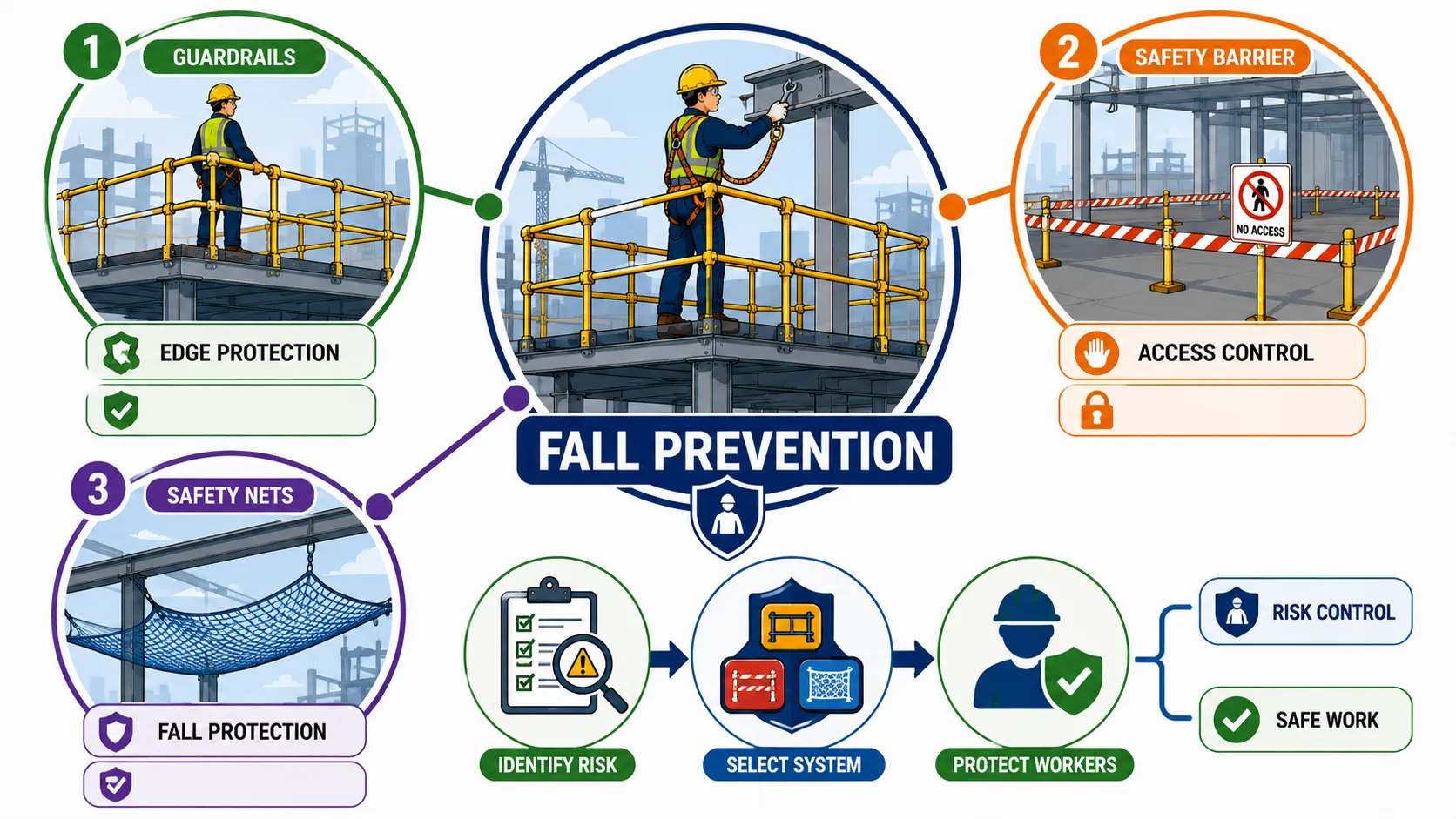
Fall prevention systems are essential workplace safety controls designed to eliminate or reduce the possibility of workers falling from elevated locations. In construction, engineering, maintenance, and industrial environments, working at height activities often involve exposure to open edges, elevated platforms, temporary structures, and other areas where a fall hazard may exist. Effective fall prevention systems provide physical protection and create safer working conditions by preventing workers from reaching dangerous areas or reducing the consequences of potential falls.
Unlike personal protective equipment that depends heavily on individual worker behaviour, many fall prevention systems provide collective protection for multiple workers at the same time. Systems such as guardrails, barriers, and safety nets are designed through careful planning, correct installation, regular inspection, and appropriate maintenance. Understanding these systems allows safety professionals, supervisors, and workers to select suitable controls based on workplace conditions, task requirements, and identified risks.
Key Concepts of Fall Prevention Systems
| Fall Prevention System | Definition | Main Purpose |
|---|---|---|
| Guardrails | A protective barrier system installed along edges or openings to prevent workers from falling | Prevents workers from reaching fall hazards |
| Safety Barriers | Physical structures used to restrict access to dangerous areas | Controls movement and protects workers |
| Safety Nets | Flexible protective systems installed below work areas to catch falling persons or objects | Reduces consequences of falls |
| Collective Protection | Safety measures designed to protect groups of workers | Provides continuous workplace protection |
| Fall Hazard Control | Methods used to remove or reduce risks associated with falls | Improves workplace safety |
| Inspection Process | Regular examination of safety systems to confirm effectiveness | Maintains reliability and performance |
Importance of Fall Prevention Systems in Workplace Safety
Falls from height can result in serious injuries, permanent disabilities, or fatalities. Therefore, preventing falls before they happen is one of the most important objectives of occupational health and safety management.
Effective fall prevention systems help organisations:
Protect workers from dangerous edges and openings.
Reduce reliance on individual safety behaviour.
Improve workplace control measures.
Support legal and safety compliance.
Create safer working environments.
Fall prevention systems are particularly important in areas such as:
Construction sites.
Industrial maintenance areas.
Roofing activities.
Building installations.
Electrical and mechanical works.
Inspection and repair operations.
A properly selected prevention system provides a physical safety barrier between workers and hazards, reducing the likelihood of accidental falls.
Understanding Collective Fall Prevention Systems
Role of Collective Protection Measures
Collective protection systems are designed to protect everyone working in a specific area rather than relying on each individual worker to use personal protection equipment correctly.
Examples include:
Guardrails.
Safety barriers.
Safety nets.
Edge protection systems.
Protected access routes.
The main advantage of collective protection is that it provides continuous protection without requiring constant worker action.
Key characteristics include:
Installed before work begins.
Available to multiple workers.
Reduces human error.
Provides consistent protection.

Guardrail Systems
Definition and Purpose of Guardrails
Guardrails are physical protective systems installed around exposed edges, platforms, walkways, roofs, and openings to prevent workers from accidentally falling.
They are commonly used in:
Construction platforms.
Scaffolding systems.
Roof edges.
Industrial walkways.
Temporary work areas.
The primary purpose of guardrails is to create a physical barrier that prevents workers from approaching unsafe edges.
Components of Guardrail Systems
A typical guardrail system may include:
Top Rail
The top rail provides the main protective barrier and prevents workers from moving beyond the safe boundary.
Intermediate Rail
The intermediate rail reduces the space between the top rail and working surface, preventing workers from slipping through.
Toe Board
Toe boards help prevent tools, materials, and objects from falling from elevated platforms.
Important components include:
Strong structural support.
Secure fixing points.
Appropriate height and spacing.
Regular inspections.
Benefits of Guardrail Systems
Guardrails provide several workplace safety benefits:
Continuous protection for workers.
Reduced risk of accidental falls.
Improved worker confidence.
Protection for multiple users.
Reduced dependence on personal fall protection.
Practical Example: Roof Maintenance Work
A maintenance team is required to inspect a commercial roof area. Before workers begin, guardrails are installed around exposed edges.
The guardrails:
Create a physical separation from the roof edge.
Allow workers to move safely.
Reduce the chance of accidental falls.
As a result, workers can complete inspections with improved protection.
Safety Barriers
Understanding Safety Barriers
Safety barriers are physical controls used to restrict access to hazardous areas and prevent workers from entering unsafe zones.
They are commonly used around:
Open floor areas.
Construction openings.
Temporary hazards.
Restricted work zones.
Safety barriers are especially useful when complete elimination of a hazard is not immediately possible.
Types of Safety Barriers
Safety barriers may include:
Temporary barrier systems.
Permanent protective barriers.
Warning barriers.
Restricted access systems.
The selection of barriers depends on:
Hazard type.
Workplace environment.
Number of workers involved.
Duration of the activity.
Purpose of Safety Barriers
Safety barriers help:
Control worker movement.
Separate safe and unsafe areas.
Prevent unauthorised access.
Improve hazard awareness.
Effective barriers should be:
Clearly visible.
Securely positioned.
Suitable for workplace conditions.
Regularly checked.
Safety Nets
Definition and Purpose of Safety Nets
Safety nets are flexible protective systems installed below elevated work areas to catch workers or objects if a fall occurs.
They are commonly used in:
Construction projects.
Structural installation activities.
Large open work areas.
Safety nets do not prevent workers from falling; instead, they reduce the consequences of a fall by providing a controlled landing system.
Key Features of Safety Nets
Effective safety nets require:
Correct installation.
Suitable positioning.
Regular inspection.
Proper maintenance.
Safety nets must be:
Installed by competent personnel.
Positioned close enough to the working area.
Free from damage.
Suitable for expected loads.
Benefits of Safety Nets
Safety nets provide:
Reduced injury severity.
Protection over large working areas.
Support where guardrails are difficult to install.
Additional protection during complex activities.
Comparing Guardrails, Barriers, and Safety Nets
| System | Main Function | Best Application | Key Benefit |
|---|---|---|---|
| Guardrails | Prevent access to fall edges | Platforms, roofs, walkways | Stops falls before they occur |
| Safety Barriers | Restrict movement into hazardous areas | Openings and restricted zones | Controls worker access |
| Safety Nets | Catch falling workers or objects | Large elevated work areas | Reduces fall consequences |
Selecting Appropriate Fall Prevention Systems
Choosing the correct fall prevention system requires careful consideration of workplace conditions and task requirements.
Factors to consider include:
Height of the working area.
Type of activity being performed.
Duration of work.
Number of workers involved.
Environmental conditions.
Equipment requirements.
A suitable selection process includes:
Identifying fall hazards.
Assessing workplace conditions.
Selecting suitable prevention methods.
Installing systems correctly.
Inspecting before use.
Monitoring effectiveness.
Inspection and Maintenance Requirements
Fall prevention systems must be regularly inspected to ensure they remain effective.
Inspection activities include:
Checking structural condition.
Identifying damage.
Confirming secure installation.
Reviewing suitability for current tasks.
Workers and supervisors should check for:
Loose components.
Corrosion.
Physical damage.
Incorrect positioning.
Regular maintenance helps:
Extend system lifespan.
Maintain protection levels.
Prevent equipment failure.
Practical Workplace Scenario: Construction Building Project
Scenario
A construction company is completing work on a multi-storey building. Workers are installing external panels at elevated levels.
Fall Prevention Approach
The safety team implements:
Guardrails around open edges.
Safety barriers around restricted areas.
Safety nets beneath specific work zones.
Safety Benefits
These systems:
Reduce exposure to fall hazards.
Protect multiple workers.
Improve workplace organisation.
Support safe task completion.
The project is completed with fewer risks because appropriate fall prevention systems were selected and maintained.
Key Benefits of Implementing Fall Prevention Systems
Improved Worker Protection
Fall prevention systems:
Reduce the likelihood of falls.
Protect workers from serious injuries.
Create safer working conditions.
Increased Workplace Control
Effective systems:
Establish clear safety boundaries.
Improve hazard management.
Support safe movement.
Reduced Dependence on Individual Behaviour
Collective protection:
Provides continuous safety.
Reduces human error.
Supports all workers in the area.
Improved Safety Compliance
Proper systems help organisations:
Meet workplace safety expectations.
Demonstrate effective risk control.
Maintain professional safety standards.
Responsibilities for Effective Fall Prevention
Worker Responsibilities
Workers should:
Use safety systems correctly.
Report damaged equipment.
Avoid removing protective measures.
Follow workplace procedures.
Supervisor Responsibilities
Supervisors should:
Confirm systems are installed correctly.
Monitor workplace conditions.
Ensure workers follow safety requirements.
Arrange corrective actions.
Employer Responsibilities
Employers should:
Provide suitable prevention systems.
Ensure competent installation.
Maintain equipment standards.
Provide safety training.
Conclusion
Understanding fall prevention systems, including guardrails, barriers, and safety nets, is essential for maintaining safe working environments where fall hazards exist. These systems provide effective protection by preventing falls, controlling access to dangerous areas, and reducing the impact of potential incidents.
Effective fall prevention requires correct selection, installation, inspection, and maintenance of safety systems. By applying suitable collective protection measures and following professional safety practices, organisations can protect workers, improve safety performance, and create a stronger workplace safety culture across construction, engineering, maintenance, and industrial environments.
2. Implement the Use of Physical Barriers to Prevent Falls Effectively
Introduction to Physical Barriers for Fall Prevention
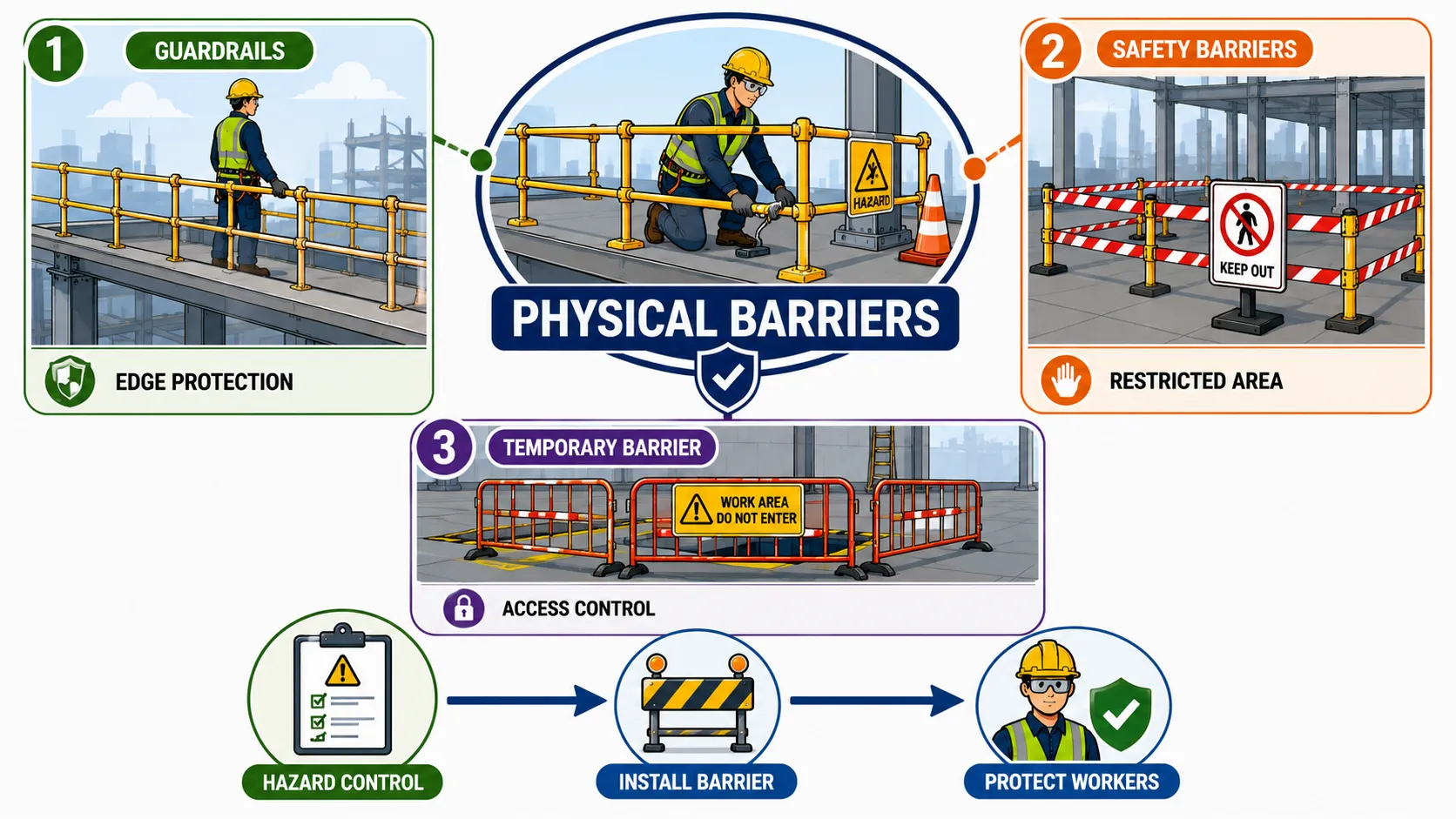
Physical barriers are one of the most effective collective protection measures used to prevent falls in workplaces where workers may be exposed to elevated hazards. These systems create a physical separation between workers and dangerous areas, reducing the likelihood of accidental access to edges, openings, unstable surfaces, or restricted zones. Unlike personal protective systems that depend on individual worker actions, physical barriers provide continuous protection for everyone working within the controlled area.
In construction, engineering, maintenance, and industrial environments, physical barriers are commonly used around roof edges, platforms, scaffolding, floor openings, stairways, and temporary work areas. Their purpose is not only to prevent falls but also to improve workplace organisation, control movement, and create clearly defined safe working zones. Effective implementation requires careful planning, correct selection of barrier types, proper installation, routine inspection, and ongoing monitoring.
Key Concepts of Physical Barrier Systems
| Key Concept | Definition | Purpose |
|---|---|---|
| Physical Barrier | A protective structure that prevents workers from entering hazardous areas | Controls access and prevents falls |
| Guardrail System | A barrier installed along exposed edges to stop workers from falling | Provides continuous edge protection |
| Safety Barrier | A protective boundary used to restrict movement near hazards | Separates safe and unsafe areas |
| Edge Protection | A system designed to protect workers from open edges | Prevents accidental falls |
| Exclusion Zone | A restricted area created to keep people away from hazards | Controls workplace access |
| Barrier Inspection | Regular checking of barrier condition and effectiveness | Ensures continued protection |
Importance of Physical Barriers in Fall Prevention
Physical barriers play an essential role in controlling fall hazards because they prevent workers from reaching dangerous areas. In many workplace situations, eliminating the fall hazard completely may not be possible; therefore, installing suitable barriers becomes an important control measure.
Effective physical barriers help organisations:
Prevent accidental falls from elevated surfaces.
Protect multiple workers at the same time.
Improve workplace organisation.
Control movement around hazardous areas.
Reduce dependence on individual safety decisions.
Support safe working practices.
Physical barriers are especially valuable in areas where:
Several workers operate simultaneously.
Tasks continue for extended periods.
Frequent movement is required.
Workers may become distracted.
Access to hazardous areas must be controlled.
Examples of locations requiring physical barriers include:
Building edges.
Roof areas.
Scaffold platforms.
Floor openings.
Excavation areas.
Machinery access zones.
Understanding Different Types of Physical Barriers
Guardrail Systems
Guardrails are one of the most common physical fall prevention systems. They are installed along exposed edges to prevent workers from accidentally stepping or moving into a fall hazard.
Guardrails are commonly used on:
Roof edges.
Working platforms.
Scaffold structures.
Walkways.
Temporary work areas.
A complete guardrail system may include:
Top rails.
Intermediate rails.
Toe boards.
Supporting posts.
Effective guardrail systems should:
Be securely fixed.
Have sufficient strength.
Maintain appropriate spacing.
Remain stable during use.
Be inspected regularly.
Safety Barriers
Safety barriers are designed to restrict access to hazardous areas and prevent workers from entering unsafe locations.
They are commonly used for:
Open floor sections.
Construction openings.
Temporary hazards.
Restricted work areas.
Safety barriers may include:
Temporary fencing.
Warning barriers.
Protective screens.
Access control systems.
The main purpose of safety barriers is to create a visible and physical boundary between workers and hazards.
Temporary Physical Barriers
Temporary barriers are frequently used during short-term activities where hazards change regularly.
Examples include:
Maintenance activities.
Construction modifications.
Repair work.
Inspection tasks.
Temporary barriers should:
Be easy to install.
Remain stable.
Clearly identify restricted areas.
Be removed only when hazards are controlled.
Selecting Suitable Physical Barriers
Selecting the correct barrier system requires careful consideration of workplace conditions and task requirements.
A suitable selection process includes:
Identifying Hazards
Before installing barriers, organisations should identify:
Open edges.
Fall points.
Worker movement areas.
Access requirements.
Assessing Workplace Conditions
Important factors include:
Height of the working area.
Environmental conditions.
Number of workers involved.
Duration of work.
Equipment being used.
Choosing Appropriate Barrier Types
The selected barrier should match:
The level of risk.
Workplace layout.
Expected use.
Required protection level.
Installation Procedures for Physical Barriers
Correct installation is essential to ensure barriers provide effective protection.
The installation process should include:
Planning the Barrier Location
Before installation:
Identify hazardous areas.
Determine safe boundaries.
Confirm access requirements.
Preparing Installation Areas
Workers should:
Remove obstacles.
Check supporting surfaces.
Confirm structural suitability.
Installing Barrier Components
Installation should ensure:
Components are securely connected.
Barriers remain stable.
Required protection levels are achieved.
Verification Before Use
Before workers begin activities:
Inspect installation quality.
Confirm stability.
Check for damage or weaknesses.
Maintaining and Inspecting Physical Barriers
Physical barriers must remain effective throughout their service life. Regular inspections help identify problems before they create safety risks.
Inspection activities should include checking:
Structural damage.
Loose connections.
Corrosion.
Missing components.
Incorrect positioning.
Workers should report:
Damaged rails.
Unstable barriers.
Removed protective systems.
Unsafe conditions.
Regular maintenance benefits include:
Improved reliability.
Extended equipment life.
Reduced failure risks.
Continued worker protection.
Safe Use of Physical Barriers During Workplace Activities
Workers must understand that barriers are safety controls and should never be removed without proper authorisation.
Safe practices include:
Respecting restricted areas.
Keeping barriers in position.
Reporting defects.
Following workplace procedures.
Workers should never:
Climb over barriers.
Move barriers without approval.
Use damaged barriers.
Create openings in protective systems.
Role of Supervision in Barrier Management
Supervisors play an important role in ensuring physical barriers remain effective.
Supervisors should:
Confirm correct installation.
Monitor workplace conditions.
Prevent unauthorised removal.
Arrange repairs when required.
Effective supervision ensures that barriers continue to provide protection throughout the task.
Practical Example: Roof Maintenance Activity
Scenario
A maintenance team is required to inspect and repair equipment on the roof of an industrial building. The roof contains exposed edges that create a fall hazard.
Safety Control Implementation
Before work begins:
The hazard area is identified.
Guardrails are installed around exposed edges.
Restricted areas are marked using barriers.
Workers receive safety instructions.
During the activity:
Workers remain within protected areas.
Barriers are monitored.
Any damage is reported immediately.
Supervisors check compliance.
Outcome
The task is completed safely because physical barriers prevent workers from approaching dangerous edges and maintain a controlled working environment.
Benefits of Effective Physical Barrier Implementation
Improved Fall Prevention
Physical barriers:
Stop workers from reaching fall hazards.
Reduce accidental access.
Provide continuous protection.
Enhanced Workplace Organisation
Barriers help:
Define safe areas.
Improve movement control.
Separate work zones.
Reduced Workplace Incidents
Effective barriers reduce:
Fall risks.
Unsafe access.
Worker exposure to hazards.
Improved Safety Culture
Proper barrier use encourages:
Safety awareness.
Responsibility.
Professional workplace behaviour.
Supporting Legal and Safety Compliance
Organisations benefit from:
Improved risk management.
Demonstration of effective safety controls.
Better workplace safety performance.
Common Problems with Physical Barrier Systems
Incorrect Installation
Problems may include:
Weak connections.
Incorrect positioning.
Insufficient protection.
Solutions:
Use competent installers.
Follow manufacturer instructions.
Conduct inspections.
Unauthorised Removal
Removing barriers without approval can create serious risks.
Preventive actions include:
Worker training.
Supervisor monitoring.
Clear procedures.
Poor Maintenance
Damaged barriers may fail during use.
Preventive actions include:
Regular inspections.
Prompt repairs.
Replacement of defective components.
Responsibilities for Effective Barrier Use
Worker Responsibilities
Workers should:
Follow barrier requirements.
Report defects.
Avoid bypassing controls.
Maintain safe behaviour.
Supervisor Responsibilities
Supervisors should:
Check barrier effectiveness.
Monitor compliance.
Manage corrective actions.
Employer Responsibilities
Employers should:
Provide suitable barrier systems.
Ensure proper installation.
Provide training and supervision.
Maintain safety standards.
Conclusion
Implementing physical barriers effectively is a critical element of fall prevention management. Systems such as guardrails, safety barriers, and exclusion zones provide reliable protection by preventing workers from accessing dangerous areas and reducing exposure to fall hazards.
Successful implementation requires proper planning, suitable selection, correct installation, regular inspection, and continuous supervision. By using physical barriers as a primary safety control, organisations can protect workers, improve workplace safety performance, and establish safer working environments across construction, engineering, maintenance, and industrial sectors.
3. Install and Utilize Anchor Points and Lifeline Systems Properly
Introduction to Anchor Points and Lifeline Systems
Anchor points and lifeline systems are important components of personal fall protection systems used to protect workers when performing tasks in areas where fall prevention through physical barriers or collective protection methods is not possible. These systems provide secure connection points that allow workers to attach safety harnesses, lanyards, and other fall protection equipment while carrying out activities at elevated locations.
In construction, engineering, maintenance, and industrial environments, workers may need to access areas where guardrails, barriers, or other fixed protections cannot be installed. In these situations, properly designed anchor points and lifeline systems provide controlled protection by reducing the risk of uncontrolled falls. However, their effectiveness depends on correct selection, professional installation, regular inspection, and proper use by trained workers.
Key Concepts of Anchor Points and Lifeline Systems
| Key Concept | Definition | Purpose |
|---|---|---|
| Anchor Point | A secure attachment point designed to connect fall protection equipment | Provides a reliable connection for workers |
| Lifeline System | A safety system consisting of a line and connection devices that allow worker movement while maintaining protection | Supports safe movement during elevated tasks |
| Fixed Anchor | A permanently installed attachment point connected to a structure | Provides long-term fall protection |
| Temporary Anchor | A removable attachment system used for short-term activities | Provides flexible protection |
| Horizontal Lifeline | A system allowing workers to move along a horizontal path while connected | Supports mobility across work areas |
| Vertical Lifeline | A system designed for movement up and down structures | Provides protection during climbing activities |
Importance of Proper Anchor Point and Lifeline Installation
Correct installation of anchor points and lifeline systems is essential because these systems may be required to support a worker during a fall. A poorly installed or unsuitable system can fail when it is needed most.
Properly installed systems help:
- Reduce the risk of serious falls.
- Provide secure worker attachment.
- Improve confidence during elevated tasks.
- Support safe movement in difficult areas.
- Reduce workplace incidents.
Anchor points and lifeline systems are commonly used in:
- Roof maintenance.
- Telecommunications work.
- Industrial inspection.
- Construction installation.
- Structural maintenance.
- Wind energy maintenance.
The effectiveness of these systems depends on:
- Structural strength.
- Correct installation methods.
- Compatibility with personal protective equipment.
- Regular inspection.
- Worker competence.
Understanding Anchor Point Systems
Purpose of Anchor Points
Anchor points provide a secure connection between the worker and the structure. They allow fall protection equipment such as harnesses and lanyards to be attached safely.
A suitable anchor point must:
- Support expected forces during a fall.
- Be installed on a suitable structure.
- Remain secure during use.
- Be inspected regularly.
Anchor points may be:
- Permanently installed.
- Temporarily attached.
- Designed for individual workers.
- Designed for multiple users.
Types of Anchor Points
Fixed Anchor Points
Fixed anchor points are permanently attached to a structure and are commonly used where regular access is required.
Examples include:
- Roof anchor systems.
- Structural attachment points.
- Maintenance access anchors.
Benefits include:
- Long-term availability.
- Reliable protection.
- Reduced setup time.
Temporary Anchor Points
Temporary anchor points are installed for specific tasks and removed after completion.
They are useful for:
- Short-term maintenance.
- Construction projects.
- Temporary access activities.
Important considerations include:
- Correct installation.
- Compatibility with the structure.
- Inspection before use.
Selecting Suitable Anchor Points
The selection of anchor points should be based on a detailed assessment of workplace requirements.
Factors to consider include:
- Type of work being performed.
- Number of workers requiring protection.
- Structure condition.
- Worker movement requirements.
- Environmental conditions.
Workers and supervisors should ensure:
- Anchor points are approved for use.
- Installation is completed correctly.
- Equipment limitations are understood.
Understanding Lifeline Systems
Purpose of Lifeline Systems
Lifeline systems allow workers to remain connected while moving through elevated work areas. They provide continuous attachment and reduce the risk of falling when workers need to move across large areas.
Lifeline systems are commonly used where:
- Workers require mobility.
- Fixed anchor points are insufficient.
- Large work areas must be accessed.
Benefits include:
- Increased worker movement.
- Continuous connection.
- Improved fall protection.
Types of Lifeline Systems
Horizontal Lifeline Systems
Horizontal lifelines allow workers to move sideways while remaining connected to a secure safety line.
Applications include:
- Roof maintenance.
- Large platforms.
- Structural inspection work.
Important features include:
- Secure end anchors.
- Correct tensioning.
- Suitable connection devices.
Workers should:
- Remain attached throughout the task.
- Follow movement procedures.
- Avoid exceeding system limits.
Vertical Lifeline Systems
Vertical lifelines are designed for workers moving vertically, such as climbing ladders, towers, or structures.
Applications include:
- Access towers.
- Communication structures.
- Industrial equipment.
Safety features may include:
- Fall arrest devices.
- Secure attachment points.
- Guided movement systems.
Installation Procedures for Anchor Points and Lifeline Systems
Planning Before Installation
Before installation begins, organisations should assess:
- Workplace hazards.
- Structural conditions.
- Required protection level.
- Worker access requirements.
Planning should include:
- Selecting suitable equipment.
- Identifying installation locations.
- Reviewing manufacturer instructions.
Checking Structural Suitability
Anchor systems must be attached to structures capable of supporting expected forces.
Assessment should consider:
- Structural strength.
- Material condition.
- Corrosion or damage.
- Installation requirements.
Unsafe installation locations may include:
- Weak surfaces.
- Damaged structures.
- Unsuitable materials.
Installing the System Correctly
Installation should only be completed by competent personnel.
Correct installation includes:
- Following manufacturer requirements.
- Using approved components.
- Securing connections properly.
- Checking alignment and positioning.
After installation:
- The system should be inspected.
- Records should be maintained.
- Approval should be confirmed before use.
Inspection and Maintenance Requirements
Anchor points and lifeline systems require regular inspection to ensure continued effectiveness.
Inspection checks should include:
- Physical damage.
- Corrosion.
- Loose components.
- Structural problems.
- Signs of wear.
Workers should check before use:
- Connection points.
- Equipment condition.
- Labels and identification.
- Visible defects.
Regular maintenance helps:
- Maintain system reliability.
- Identify problems early.
- Extend equipment lifespan.
Correct Use of Anchor Points and Lifeline Systems
Connecting Personal Fall Protection Equipment
Workers must connect their equipment correctly to the approved anchor system.
Correct practices include:
- Using compatible harnesses and connectors.
- Checking connections before use.
- Maintaining secure attachment.
Workers should never:
- Attach to unsuitable structures.
- Modify equipment.
- Use damaged connectors.
Maintaining Safe Movement
When using lifeline systems, workers should:
- Maintain continuous connection.
- Move carefully.
- Avoid creating additional hazards.
Safe movement practices include:
- Checking the travel path.
- Avoiding sharp edges.
- Preventing line obstruction.
Practical Example: Industrial Roof Inspection
Scenario
A maintenance team needs to inspect equipment installed on a large industrial roof where permanent guardrails are unavailable.
Safety Approach
The safety team:
- Identifies the fall hazards.
- Installs approved anchor points.
- Uses a horizontal lifeline system.
- Connects workers using suitable harnesses.
During the inspection:
- Workers remain attached.
- The system is monitored.
- Supervisors check compliance.
Outcome
The task is completed safely because workers use a correctly installed lifeline system that provides continuous fall protection.
Benefits of Proper Anchor Point and Lifeline Use
Improved Worker Protection
Correct systems:
- Reduce fall risks.
- Provide secure attachment.
- Protect workers in hazardous areas.
Increased Workplace Flexibility
Lifeline systems allow:
- Greater worker movement.
- Access to difficult areas.
- Safer completion of complex tasks.
Better Risk Control
Proper systems support:
- Effective hazard management.
- Reduced incident potential.
- Improved safety performance.
Increased Safety Confidence
Workers perform tasks more effectively when they:
- Understand equipment use.
- Trust safety systems.
- Receive proper training.
Responsibilities for Anchor Point and Lifeline Safety
Worker Responsibilities
Workers should:
- Use systems correctly.
- Complete pre-use checks.
- Report defects.
- Follow procedures.
Supervisor Responsibilities
Supervisors should:
- Confirm correct installation.
- Monitor safe use.
- Ensure workers are trained.
- Address unsafe practices.
Employer Responsibilities
Employers should:
- Provide suitable systems.
- Arrange competent installation.
- Maintain inspection records.
- Provide safety training.
Common Problems and Safety Improvements
Incorrect Installation
Problems:
- Weak attachment points.
- Incorrect positioning.
- Unsuitable structures.
Improvements:
- Use competent installers.
- Follow technical guidance.
- Verify installation quality.
Poor Inspection Practices
Problems:
- Damaged equipment remaining in service.
- Missed defects.
Improvements:
- Conduct regular inspections.
- Maintain records.
- Remove defective equipment.
Lack of Worker Training
Problems:
- Incorrect connections.
- Unsafe movement.
- Misuse of equipment.
Improvements:
- Provide practical training.
- Assess worker competence.
- Refresh knowledge regularly.
Conclusion
Proper installation and use of anchor points and lifeline systems are essential for effective fall prevention in workplaces where workers are exposed to elevated hazards. These systems provide reliable protection when physical barriers and collective protection methods cannot fully eliminate risks.
Successful implementation requires suitable system selection, correct installation, regular inspection, effective maintenance, and competent use. By applying professional safety practices, organisations can reduce fall risks, protect workers, and create safer working environments across construction, engineering, maintenance, and industrial sectors.
4. Evaluate and Choose Appropriate Fall Prevention Measures for Different Work Scenarios
Introduction to Selecting Appropriate Fall Prevention Measures
Selecting appropriate fall prevention measures is a critical part of effective workplace safety management. Different work environments present different types of fall hazards, meaning that a single safety solution cannot be applied to every situation. Safety professionals, supervisors, and workers must evaluate the nature of the task, workplace conditions, equipment requirements, and potential risks before choosing the most suitable fall prevention approach.
In construction, engineering, maintenance, and industrial workplaces, fall prevention decisions should be based on a systematic assessment of hazards and risk levels. The selection process may involve choosing collective protection systems such as guardrails and barriers, personal fall protection systems such as harnesses and lifelines, or a combination of different control measures. The most effective approach is always to prevent falls before they occur by removing hazards or implementing reliable protective systems.
Key Concepts of Fall Prevention Selection
| Key Concept | Definition | Importance |
|---|---|---|
| Fall Hazard Assessment | The process of identifying situations where workers may fall | Helps determine suitable control measures |
| Risk Evaluation | Assessing the likelihood and severity of potential harm | Supports informed safety decisions |
| Hierarchy of Controls | A structured approach for selecting the most effective safety controls | Prioritises hazard elimination and prevention |
| Collective Protection | Safety systems designed to protect multiple workers | Provides continuous protection |
| Personal Fall Protection | Equipment used by individual workers to prevent or reduce fall risks | Provides additional protection where required |
| Control Measure | A method used to eliminate or reduce workplace risks | Improves workplace safety |
Understanding the Importance of Fall Prevention Assessment
Before selecting any fall prevention system, organisations must understand the hazards associated with the task. Every workplace scenario has unique conditions that influence the type of protection required.
A proper assessment considers:
- Height of the working area.
- Type of work being performed.
- Duration of the activity.
- Number of workers involved.
- Accessibility requirements.
- Environmental conditions.
- Available equipment.
Effective assessment helps identify:
- Where falls could occur.
- Who may be affected.
- What level of protection is required.
- Which control measures are most suitable.
Poor selection of fall prevention measures can result in:
- Inadequate worker protection.
- Equipment failure.
- Increased workplace risks.
- Non-compliance with safety requirements.
Applying the Hierarchy of Controls for Fall Prevention
Eliminating Fall Hazards
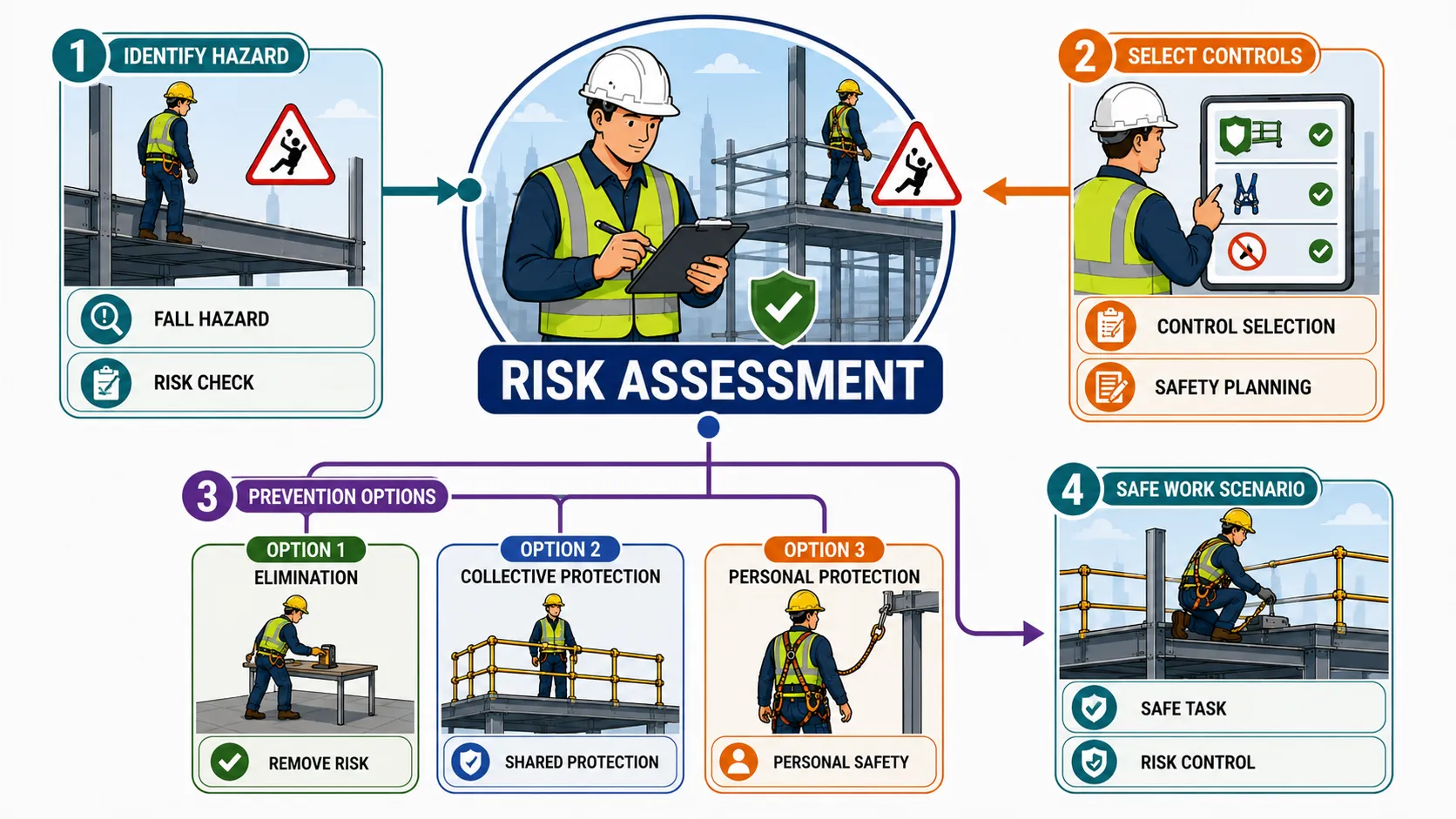
The most effective approach is to remove the need for working at height wherever possible.
Examples include:
- Completing assembly work at ground level.
- Using extended tools from safe positions.
- Prefabricating components before installation.
Benefits include:
- Complete removal of fall exposure.
- Reduced dependence on protective equipment.
- Improved worker safety.
Using Collective Protection Measures
Where elimination is not possible, collective protection should be considered before personal systems.
Examples include:
- Guardrails.
- Safety barriers.
- Protected platforms.
- Edge protection systems.
Advantages include:
- Protection for multiple workers.
- Continuous safety coverage.
- Reduced reliance on individual actions.
Using Personal Fall Protection Systems
Personal systems may be required when collective protection cannot fully control the risk.
Examples include:
- Safety harnesses.
- Lanyards.
- Anchor points.
- Lifeline systems.
These systems require:
- Worker training.
- Correct fitting.
- Regular inspection.
- Proper connection methods.
Evaluating Different Work Scenarios
Scenario 1: Roof Maintenance Activities
Roof work often involves exposed edges, fragile surfaces, and unpredictable environmental conditions. The correct fall prevention approach depends on the roof design and task requirements.
Suitable measures may include:
- Permanent guardrails.
- Temporary edge protection.
- Safety barriers.
- Lifeline systems.
- Personal fall protection equipment.
Important considerations:
- Roof condition.
- Access routes.
- Weather conditions.
- Worker movement requirements.
Example:
A maintenance team repairing rooftop equipment may require temporary edge protection and a lifeline system because workers need movement across the roof while remaining protected.
Scenario 2: Scaffold-Based Work
Scaffolding provides a stable working platform, but fall hazards can still exist if protective systems are missing or incorrectly used.
Appropriate measures include:
- Guardrails.
- Toe boards.
- Safe access points.
- Scaffold inspections.
Workers should ensure:
- Platforms are complete.
- Barriers remain installed.
- Access routes are safe.
Example:
Workers installing external building materials should use fully protected scaffold platforms rather than relying only on personal protective equipment.
Scenario 3: Ladder-Based Tasks
Ladders should only be selected when the task is suitable for ladder use. They are generally intended for short-duration, low-risk activities.
Suitable controls include:
- Correct ladder selection.
- Stable positioning.
- Securing methods.
- Three-point contact.
Additional considerations:
- Task duration.
- Required tools.
- Worker balance.
- Ground conditions.
Example:
A worker replacing a light fitting for a short task may use a secured ladder if the activity does not require excessive reaching or heavy equipment.
Scenario 4: Mobile Elevated Work Platform (MEWP) Activities
MEWPs provide flexible access but require proper planning and operation.
Suitable prevention measures include:
- Operator training.
- Pre-use inspections.
- Platform barriers.
- Harness systems where required.
Important factors include:
- Ground stability.
- Overhead hazards.
- Equipment limitations.
- Weather conditions.
Example:
A worker performing external building inspection using a MEWP should ensure the platform is stable, barriers are secured, and operational procedures are followed.
Scenario 5: Industrial Maintenance Work
Industrial environments may include machinery, restricted spaces, and complex structures.
Suitable fall prevention measures may include:
- Fixed anchor points.
- Lifeline systems.
- Access platforms.
- Guarded walkways.
Important considerations:
- Equipment location.
- Worker movement.
- Emergency arrangements.
- Maintenance frequency.
Process for Selecting Appropriate Fall Prevention Measures
Step 1: Identify the Fall Hazard
The first step is understanding where and how a fall could occur.
Identify:
- Open edges.
- Unprotected platforms.
- Access difficulties.
- Fragile surfaces.
Step 2: Assess the Level of Risk
Evaluate:
- Likelihood of falling.
- Possible consequences.
- Number of workers exposed.
Risk assessment helps determine the level of control required.
Step 3: Consider Available Prevention Options
Review possible solutions:
- Elimination methods.
- Collective protection.
- Personal protection systems.
The preferred option should provide the highest level of protection.
Step 4: Select Suitable Equipment
Selection should consider:
- Compatibility.
- Workplace conditions.
- Worker requirements.
- Manufacturer guidance.
Step 5: Implement and Monitor Controls
After implementation:
- Inspect systems.
- Train workers.
- Monitor effectiveness.
- Update controls when conditions change.
Factors Affecting Fall Prevention Selection
Workplace Environment
Environmental factors include:
- Weather.
- Surface conditions.
- Lighting.
- Space limitations.
These conditions influence equipment selection and safe working methods.
Task Requirements
The type of activity affects the required protection.
Consider:
- Duration.
- Movement requirements.
- Tools and materials.
- Worker position.
Worker Competence
Workers must have:
- Appropriate training.
- Knowledge of equipment use.
- Understanding of procedures.
Equipment Suitability
Equipment should be:
- Suitable for the task.
- Properly maintained.
- Correctly installed.
Benefits of Choosing Appropriate Fall Prevention Measures
Improved Worker Protection
Correct selection:
- Reduces fall risks.
- Prevents injuries.
- Protects workers effectively.
Better Risk Management
Effective measures:
- Control hazards.
- Improve safety planning.
- Reduce workplace incidents.
Increased Productivity
Safe systems allow:
- Efficient task completion.
- Reduced interruptions.
- Better worker confidence.
Improved Compliance
Proper controls support:
- Workplace safety standards.
- Legal responsibilities.
- Professional safety management.
Practical Case Study: Building Installation Project
Scenario
A construction company is installing external panels on a multi-storey building. Workers need access to elevated areas for several weeks.
Risk Evaluation
The safety team identifies:
- Open edges.
- Worker movement requirements.
- Material handling risks.
Selected Fall Prevention Measures
The team implements:
- Scaffold platforms with guardrails.
- Toe boards to prevent falling objects.
- Restricted access zones.
- Additional personal fall protection where required.
Outcome
The project progresses safely because the selected systems match the workplace conditions and provide appropriate protection throughout the activity.
Common Mistakes When Selecting Fall Prevention Measures
Choosing Equipment Based Only on Cost
Problems:
- Reduced protection quality.
- Increased risk exposure.
Better approach:
- Select systems based on suitability and safety effectiveness.
Using Personal Protection Instead of Prevention
Problems:
- Increased reliance on worker behaviour.
- Greater possibility of incorrect use.
Better approach:
- Prioritise collective protection where possible.
Ignoring Changing Conditions
Problems:
- Existing controls may become ineffective.
Better approach:
- Continuously review workplace conditions.
Responsibilities for Selecting Fall Prevention Measures
Worker Responsibilities
Workers should:
- Follow selected safety measures.
- Use equipment correctly.
- Report changing hazards.
Supervisor Responsibilities
Supervisors should:
- Confirm suitable controls are implemented.
- Monitor workplace conditions.
- Provide guidance.
Employer Responsibilities
Employers should:
- Provide appropriate systems.
- Ensure competent assessment.
- Maintain safety standards.
Conclusion
Evaluating and choosing appropriate fall prevention measures for different work scenarios is essential for protecting workers and maintaining effective safety management. Each workplace activity requires careful assessment of hazards, working conditions, equipment requirements, and worker capabilities.
By applying the hierarchy of controls, selecting suitable prevention systems, and continuously monitoring workplace conditions, organisations can reduce fall risks and create safer working environments. Effective fall prevention decisions support compliance, improve safety performance, and protect workers across construction, engineering, maintenance, and industrial sectors.