
Lesson No 1: Safe Working Practices
Safe working practices are the foundation of effective workplace health and safety management, ensuring that employees can perform their duties in a controlled environment while reducing the likelihood of accidents, injuries, and unsafe conditions. This lesson introduces learners to the essential principles of safe working practices, focusing on hazard awareness, risk prevention, correct working procedures, and the responsibilities of individuals in maintaining a safe workplace. In construction, engineering, maintenance, and industrial environments, applying effective safety practices is critical for protecting workers, improving operational efficiency, and meeting occupational health and safety requirements.
This lesson explores how safe working methods contribute to accident prevention through proper planning, communication, use of equipment, personal responsibility, and compliance with workplace procedures. Learners will develop an understanding of how to identify unsafe conditions, follow established control measures, use tools and equipment correctly, and respond appropriately to workplace hazards. The lesson also highlights the importance of safety culture, teamwork, and continuous improvement in achieving safer working environments.
From a Construction HSE and occupational safety management perspective, safe working practices are not only about following rules but also about developing professional behaviours that support long-term workplace safety. Learners will gain practical knowledge of implementing safety procedures, reducing risks, improving decision-making, and supporting effective health and safety performance across different industries. By completing this lesson, learners will be better prepared to apply safe working principles in real workplace situations and contribute positively to organisational safety standards.
1. Develop Effective Planning and Preparation Strategies for Tasks Involving Work at Height
Introduction to Planning and Preparation for Work at Height Activities
Effective planning and preparation are essential elements of safe workplace management when tasks involve working at elevated levels. Before any activity begins, organisations must ensure that hazards are identified, risks are assessed, appropriate control measures are implemented, and workers are properly prepared. Poor planning is one of the major causes of workplace incidents because it can result in unsuitable equipment selection, inadequate supervision, poor communication, and unsafe working conditions.
Work at height activities require a structured approach that considers the nature of the task, environmental conditions, equipment requirements, worker competence, and emergency arrangements. Effective preparation ensures that workers understand their responsibilities, have access to suitable resources, and can complete tasks safely without unnecessary exposure to hazards. Whether the activity involves construction, maintenance, inspection, electrical work, or industrial operations, proper planning reduces risks and improves workplace efficiency.
From a construction HSE and occupational safety management perspective, planning is not only about preparing equipment but also about developing a complete safety strategy. This includes reviewing work methods, selecting appropriate access solutions, establishing communication procedures, and ensuring compliance with workplace safety requirements. A well-planned activity creates safer working conditions and supports a positive safety culture.
Key Concepts of Planning and Preparation for Elevated Tasks
| Key Concept | Definition | Importance |
|---|---|---|
| Task Planning | The process of organising work activities before starting the task | Ensures risks are controlled before work begins |
| Risk Assessment | A structured process of identifying hazards and evaluating risks | Helps determine suitable safety controls |
| Method Statement | A written document explaining how work will be completed safely | Provides clear instructions for workers |
| Competence | The knowledge, skills, and experience required to perform a task safely | Ensures workers can complete activities correctly |
| Work Equipment Selection | Choosing suitable tools and access equipment for the task | Reduces equipment-related hazards |
| Emergency Planning | Preparing actions for unexpected situations | Improves response during incidents |
Importance of Effective Planning Before Work at Height
Planning before starting elevated tasks allows organisations to identify potential problems and develop safe solutions before workers are exposed to risks. A planned approach reduces uncertainty and ensures that all aspects of the activity are properly controlled.
Effective planning helps organisations:
- Identify hazards before work begins.
- Select suitable equipment and materials.
- Allocate competent workers.
- Establish safe working procedures.
- Prepare emergency arrangements.
- Reduce workplace accidents.
Without proper planning, workers may:
- Use unsuitable access equipment.
- Work in unsafe environmental conditions.
- Lack necessary information.
- Make unsafe decisions during the activity.
- Experience delays due to poor preparation.
A professional safety approach requires considering the complete work process from preparation through completion. Every stage should be evaluated to ensure risks remain controlled.
Developing a Work Planning Strategy
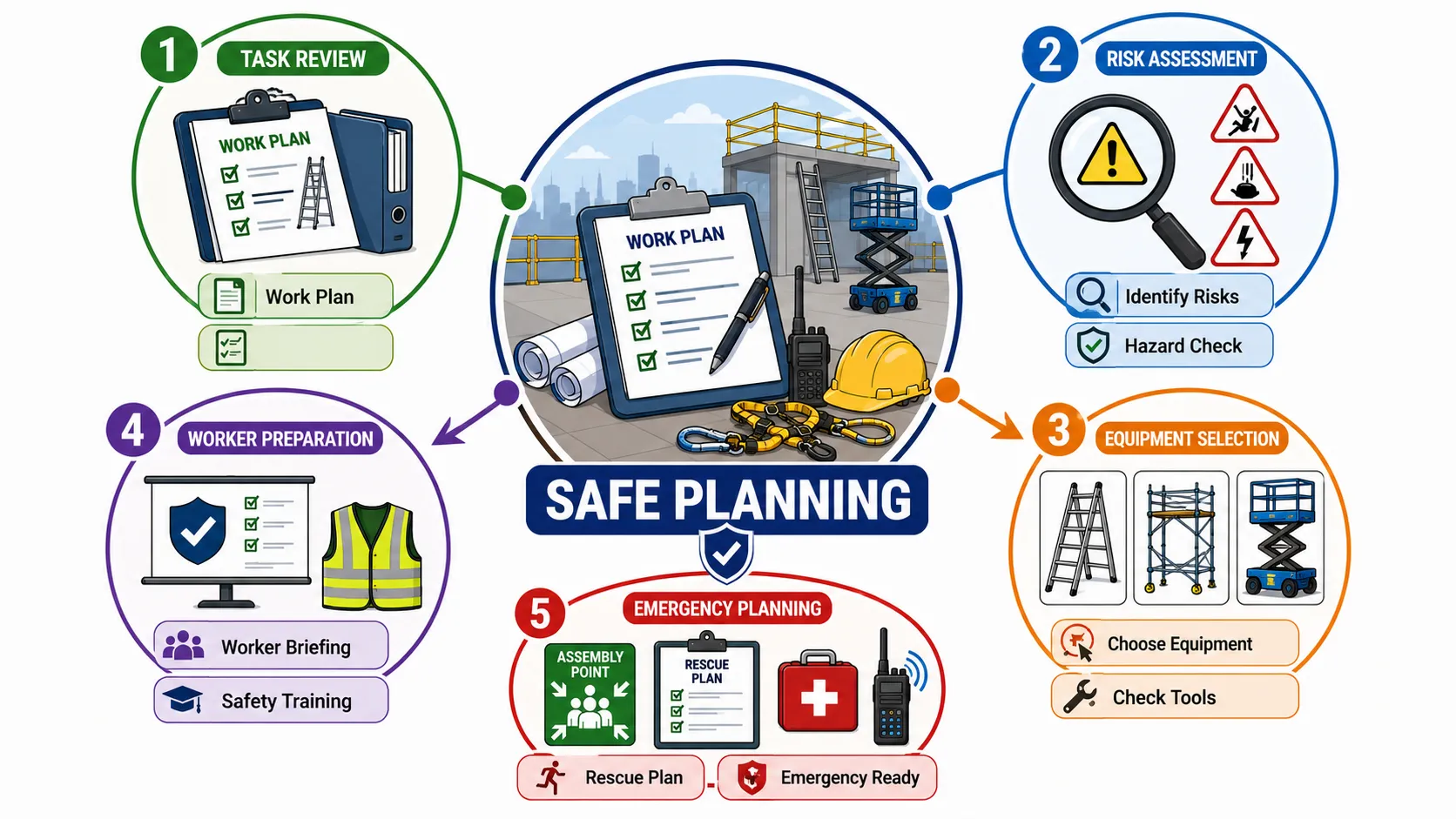
Understanding Task Requirements
The first stage of effective preparation is understanding the exact requirements of the task. Workers and supervisors should identify what needs to be achieved, how the work will be completed, and what resources are required.
Important questions include:
- What type of work needs to be completed?
- How high is the working area?
- How long will the task take?
- What tools and materials are required?
- How many workers are involved?
- What hazards may exist?
Understanding task requirements helps determine:
- Appropriate access methods.
- Required equipment.
- Worker skills needed.
- Safety controls.
For example, replacing a lighting unit at a low height may require different preparation compared with installing equipment on an industrial structure.
Assessing Workplace Conditions
The working environment must be evaluated before any elevated activity begins. Environmental conditions can significantly affect worker safety and equipment performance.
Workplace assessment should consider:
- Ground stability.
- Weather conditions.
- Lighting levels.
- Access routes.
- Nearby hazards.
- Presence of other workers.
Potential workplace hazards include:
- Uneven surfaces.
- Slippery areas.
- Overhead obstructions.
- Electrical hazards.
- Moving vehicles.
- Restricted working spaces.
A suitable plan should identify these conditions and establish appropriate controls before work starts.
Conducting Risk Assessments
Purpose of Risk Assessment
A risk assessment is a critical planning activity that identifies hazards, evaluates risks, and determines suitable control measures. It allows organisations to understand potential dangers and implement preventive actions.
A suitable risk assessment should include:
- Hazard identification.
- Risk evaluation.
- Control selection.
- Review of effectiveness.
Hazard Identification Process
Workers and supervisors should identify hazards associated with:
- Access equipment.
- Working surfaces.
- Tools and materials.
- Weather conditions.
- Worker behaviour.
Examples of hazards include:
- Falls from elevated positions.
- Falling objects.
- Equipment failure.
- Slips and trips.
- Poor communication.
Selecting Control Measures
After identifying hazards, suitable controls should be implemented.
Control measures may include:
- Using appropriate access equipment.
- Installing protective barriers.
- Providing worker training.
- Improving supervision.
- Establishing exclusion zones.
The selected controls should reduce risks to an acceptable level before work begins.
Preparing Suitable Equipment and Resources
Selecting Appropriate Equipment
Equipment selection is an important part of planning. The chosen equipment must match the task requirements and workplace conditions.
Factors to consider include:
- Working height.
- Duration of activity.
- Load requirements.
- Accessibility.
- Environmental conditions.
Examples:
- A short inspection may require suitable ladder access.
- A longer maintenance activity may require scaffolding.
- A task requiring movement between locations may require a MEWP.
Equipment Inspection and Preparation
Before use, equipment should be checked to ensure it is safe and functional.
Preparation activities include:
- Inspecting equipment condition.
- Confirming maintenance status.
- Checking safety features.
- Removing damaged equipment.
Workers should verify:
- Equipment suitability.
- Manufacturer requirements.
- Inspection records.
- Operating instructions.
Preparing Workers for Safe Performance
Ensuring Worker Competence
Workers involved in elevated tasks must have appropriate knowledge and skills. Competence ensures that individuals understand hazards, procedures, and equipment requirements.
Competent workers should understand:
- Safe working methods.
- Equipment operation.
- Emergency procedures.
- Hazard reporting.
Training should include:
- Practical demonstrations.
- Safety procedures.
- Equipment familiarisation.
- Workplace expectations.
Communication and Team Coordination
Effective communication is essential when planning elevated tasks, particularly where multiple workers are involved.
Communication arrangements should include:
- Task responsibilities.
- Safety instructions.
- Emergency contacts.
- Reporting procedures.
Good communication helps prevent:
- Confusion.
- Unsafe decisions.
- Delayed emergency responses.
Developing Safe Work Procedures
Creating Method Statements
A method statement provides clear instructions on how a task will be completed safely. It explains the work sequence, required controls, and responsibilities.
A method statement should include:
- Task description.
- Required equipment.
- Safety precautions.
- Work sequence.
- Emergency arrangements.
Benefits include:
- Improved consistency.
- Clear worker guidance.
- Better risk control.
Establishing Safe Work Sequences
A planned work sequence ensures activities are completed logically and safely.
A typical sequence includes:
- Preparing the work area.
- Checking equipment.
- Briefing workers.
- Completing the task.
- Inspecting completed work.
- Removing equipment safely.
Following a planned sequence reduces unnecessary risks.
Emergency Planning and Preparedness
Importance of Emergency Arrangements
Emergency planning ensures workers know what actions to take if something goes wrong. Elevated tasks require specific emergency arrangements because rescue situations may be more complex.
Emergency planning should consider:
- Rescue methods.
- Communication systems.
- First aid arrangements.
- Emergency contacts.
Workers should understand:
- How to raise an alarm.
- Who is responsible for rescue.
- How equipment will be safely recovered.
Rescue Planning
A rescue plan should be prepared before starting elevated activities.
It should identify:
- Possible emergency situations.
- Required rescue equipment.
- Responsible personnel.
- Communication methods.
A planned rescue approach prevents delays during emergencies.
Practical Example: Building Maintenance Project
Scenario
A maintenance team is required to repair external lighting systems on a commercial building. The work requires access to elevated areas and the use of specialised equipment.
Planning Process
Before starting work, the supervisor:
- Reviews task requirements.
- Conducts a risk assessment.
- Selects suitable access equipment.
- Confirms worker competence.
- Prepares emergency arrangements.
Preparation Activities
The team:
- Inspects equipment.
- Establishes a safe working area.
- Communicates responsibilities.
- Reviews safety procedures.
Outcome
Effective planning reduces risks, improves coordination, and allows the task to be completed safely and efficiently.
Benefits of Effective Planning and Preparation
Improved Safety Performance
Effective planning helps:
- Prevent accidents.
- Control hazards.
- Protect workers.
Better Operational Efficiency
Good preparation allows:
- Reduced delays.
- Improved teamwork.
- Effective resource use.
Increased Worker Confidence
Workers perform better when they:
- Understand procedures.
- Have suitable equipment.
- Receive clear instructions.
Stronger Safety Culture
Effective planning encourages:
- Personal responsibility.
- Better communication.
- Continuous improvement.
Responsibilities of Employers, Supervisors, and Workers
Employer Responsibilities
Employers should:
- Provide suitable resources.
- Ensure training is available.
- Establish safe procedures.
- Maintain equipment.
Supervisor Responsibilities
Supervisors should:
- Plan activities effectively.
- Monitor safe practices.
- Communicate requirements.
- Address unsafe conditions.
Worker Responsibilities
Workers should:
- Follow procedures.
- Use equipment correctly.
- Report hazards.
- Participate in safety activities.
Conclusion
Developing effective planning and preparation strategies for tasks involving work at height is essential for preventing incidents and maintaining safe working environments. Proper planning ensures that hazards are identified, risks are controlled, suitable equipment is selected, and workers are prepared before activities begin.
By applying structured planning processes, conducting effective risk assessments, preparing competent workers, and establishing emergency arrangements, organisations can improve safety performance and create a controlled approach to elevated tasks. Effective preparation is a key element of professional workplace safety management and supports safer operations across construction, engineering, maintenance, and industrial environments.
2. Implement Best Practices for Safely Executing Work at Different Heights
Introduction to Safe Execution of Work at Different Heights
Safely executing work at different heights requires the effective application of planned safety procedures, suitable equipment use, continuous risk awareness, and responsible worker behaviour. While planning and preparation establish the foundation for safe activities, the execution stage determines whether safety controls are properly applied during the actual task. Workers must ensure that all identified hazards remain controlled throughout the activity and that safe working methods are followed from the beginning until completion.
Work at different heights is common across construction, engineering, electrical installation, maintenance, inspection, and industrial environments. These activities may involve ladders, scaffolding, mobile elevated work platforms (MEWPs), access platforms, and other specialised equipment. Each working situation presents different hazards, including falls from elevated positions, falling objects, unstable surfaces, equipment failure, poor weather conditions, and unsafe worker behaviour. Implementing best practices helps reduce these risks and ensures tasks are completed safely and efficiently.
A professional safety approach requires workers and supervisors to continuously monitor conditions, communicate effectively, and make appropriate decisions throughout the activity. Safe execution is not limited to wearing personal protective equipment; it involves selecting the correct equipment, maintaining safe positions, controlling the work environment, and responding quickly when conditions change.
Key Concepts of Safe Work Execution
| Key Concept | Definition | Importance |
|---|---|---|
| Safe Work Practice | An approved method of completing work while controlling workplace hazards | Prevents unsafe actions and reduces incidents |
| Fall Prevention | Measures used to stop workers from reaching a fall hazard | Provides effective protection against falls |
| Access Equipment | Equipment used to safely reach elevated working areas | Enables controlled access to different heights |
| Safe Positioning | Maintaining a stable and secure working position during tasks | Improves worker balance and control |
| Continuous Monitoring | Regular observation of workplace conditions during activities | Identifies changing hazards quickly |
| Exclusion Zone | A controlled area preventing unauthorised access below elevated work | Protects people from falling objects |
Understanding the Principles of Safe Work Execution
Safe execution begins with applying the control measures identified during planning and risk assessment. Workers must understand that workplace conditions can change during the activity, requiring continuous attention and professional judgement.
Effective execution involves:
- Following approved work procedures.
- Using equipment correctly.
- Maintaining communication with team members.
- Monitoring workplace conditions.
- Reporting hazards immediately.
- Stopping work when conditions become unsafe.
Workers should avoid:
- Taking shortcuts.
- Ignoring safety procedures.
- Using unsuitable equipment.
- Continuing work after identifying hazards.
- Modifying equipment without approval.
A strong safety culture encourages workers to prioritise safety over speed and productivity. Completing a task quickly should never compromise worker protection or workplace standards.
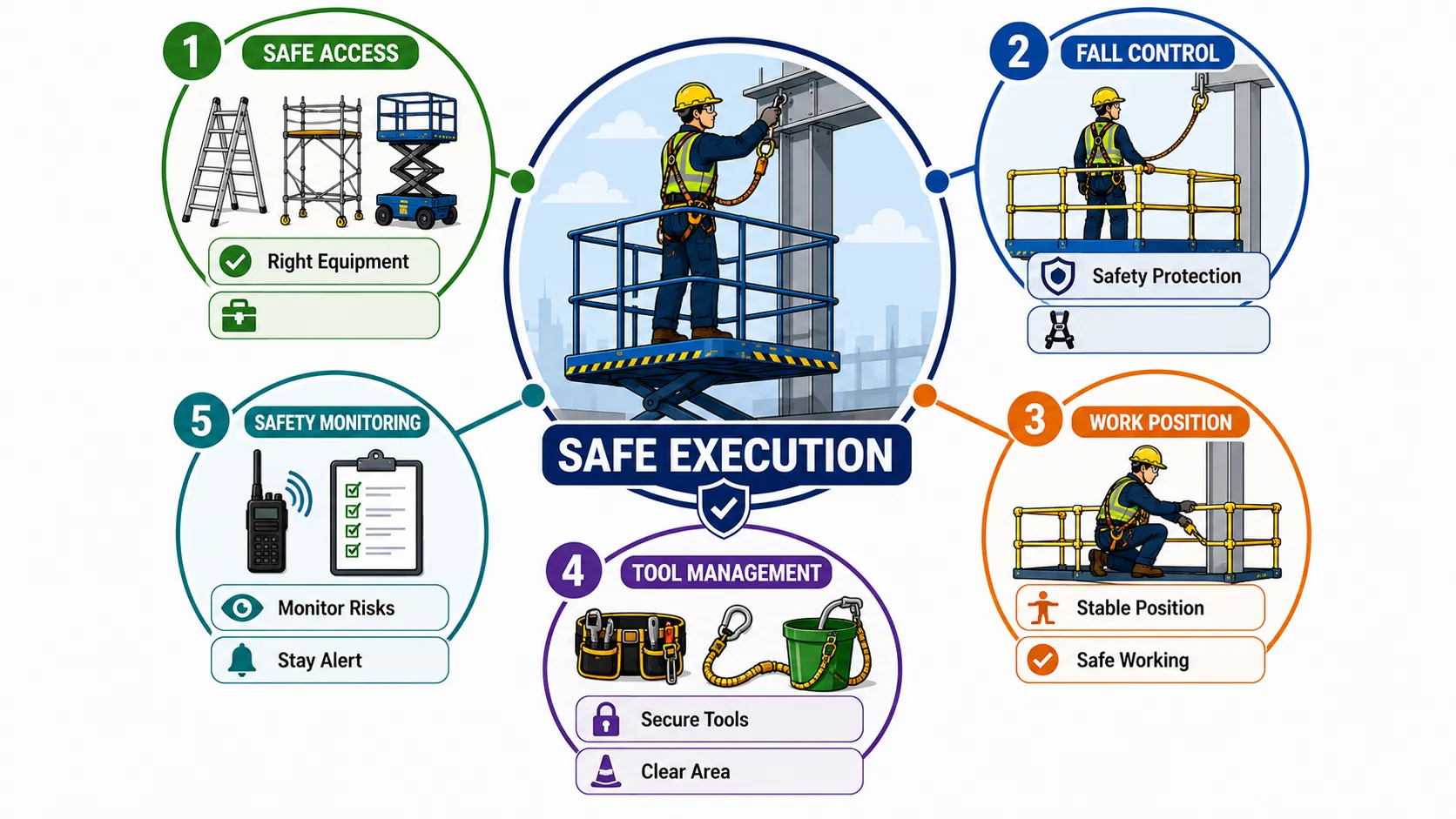
Applying Safe Access and Positioning Methods
Selecting Suitable Access Equipment
Choosing appropriate access equipment is one of the most important factors in safe execution. The selected equipment must match the height, duration, complexity, and environmental conditions of the task.
Suitable access options may include:
- Ladders for short-duration activities with limited risk.
- Scaffolding for longer tasks requiring stable platforms.
- MEWPs for flexible access and movement.
- Fixed access systems for permanent work locations.
Before selecting equipment, workers should consider:
- Required working height.
- Duration of the activity.
- Number of workers involved.
- Tools and materials required.
- Ground and environmental conditions.
Using incorrect access equipment can create additional risks, including instability, falls, and inefficient working methods.
Maintaining a Stable Working Position
A secure working position allows workers to complete tasks with better control and reduced risk.
Workers should:
- Maintain firm footing.
- Keep platforms and work areas organised.
- Position themselves correctly.
- Avoid excessive reaching.
- Keep their centre of balance controlled.
Safe positioning practices include:
- Standing within designated working areas.
- Using provided barriers and guardrails.
- Maintaining three-point contact when using ladders.
- Remaining inside MEWP platforms.
Unsafe positioning includes:
- Standing on unstable surfaces.
- Leaning outside protective barriers.
- Working from unsuitable objects.
- Overstretching to reach materials.
Implementing Fall Prevention Measures
Using Collective Protection Systems
Collective protection measures protect multiple workers and should be prioritised wherever possible.
Examples include:
- Guardrails.
- Edge protection systems.
- Secure working platforms.
- Scaffold protection systems.
- Safety barriers.
Benefits of collective protection include:
- Continuous protection.
- Reduced dependence on individual behaviour.
- Improved workplace safety.
Applying Personal Fall Protection Systems
Where fall prevention measures cannot completely eliminate risks, personal fall protection systems may be required.
Examples include:
- Safety harnesses.
- Lanyards.
- Anchor points.
- Energy-absorbing devices.
Workers must ensure:
- Equipment is suitable for the task.
- Equipment is inspected before use.
- Connections are secure.
- Correct attachment points are used.
Workers should never:
- Use damaged fall protection equipment.
- Attach equipment incorrectly.
- Ignore inspection requirements.
Safe Management of Tools and Materials
Preventing Falling Objects
Objects falling from elevated positions can seriously injure workers below. Effective control measures must be implemented to prevent materials and tools from becoming hazards.
Control methods include:
- Securing tools with suitable restraints.
- Maintaining organised platforms.
- Using storage containers.
- Establishing exclusion zones.
Workers should avoid:
- Leaving loose tools near edges.
- Throwing materials from height.
- Overloading platforms.
- Allowing unnecessary materials to accumulate.
Maintaining Good Housekeeping
A clean and organised work area improves safety and efficiency.
Good housekeeping practices include:
- Removing unnecessary materials.
- Keeping access routes clear.
- Storing tools safely.
- Cleaning working platforms regularly.
Benefits include:
- Reduced trip hazards.
- Improved movement.
- Easier hazard identification.
- Better working conditions.
Following Equipment-Specific Safe Practices
Safe Ladder Operation
Ladders require careful use because they provide limited working space compared with other access equipment.
Safe ladder practices include:
- Inspecting ladders before use.
- Placing ladders on stable surfaces.
- Securing ladders when required.
- Maintaining three-point contact.
- Avoiding overreaching.
Workers should not:
- Use damaged ladders.
- Stand on unsuitable steps.
- Place ladders on unstable objects.
- Carry heavy items while climbing.
Safe Scaffolding Practices
Scaffolding provides stable access but must be used correctly to remain safe.
Workers should:
- Confirm scaffold inspection status.
- Use approved access points.
- Maintain platform cleanliness.
- Follow load restrictions.
- Report defects.
Workers must not:
- Remove guardrails.
- Alter scaffolding without authorisation.
- Overload platforms.
- Use incomplete structures.
Safe MEWP Operation
Mobile Elevated Work Platforms require competent operation and continuous awareness.
Safe MEWP practices include:
- Completing pre-use inspections.
- Checking ground conditions.
- Understanding equipment limitations.
- Following manufacturer instructions.
Operators should:
- Maintain safe platform positioning.
- Monitor surroundings.
- Communicate with ground workers.
- Follow emergency procedures.
Maintaining Effective Communication During Elevated Work
Importance of Communication
Communication plays a critical role when workers perform tasks at different heights. Clear information exchange helps prevent misunderstandings and improves coordination.
Effective communication methods include:
- Toolbox talks.
- Safety briefings.
- Radios.
- Hand signals.
Good communication ensures:
- Workers understand responsibilities.
- Hazards are reported quickly.
- Activities are coordinated safely.
Supervisor Monitoring
Supervisors are responsible for ensuring that safe practices continue throughout the task.
Supervisors should:
- Observe working methods.
- Provide safety guidance.
- Correct unsafe behaviour.
- Review changing conditions.
Continuous Monitoring and Risk Control
Reviewing Workplace Conditions
Safety conditions must be monitored throughout the activity because hazards can change over time.
Workers should monitor:
- Equipment condition.
- Weather changes.
- Work area organisation.
- Worker fatigue.
- New hazards.
Work should stop when:
- Equipment becomes unsafe.
- Environmental conditions deteriorate.
- Control measures fail.
Managing Weather Conditions
Weather can significantly affect elevated work activities.
Potential risks include:
- Strong winds.
- Heavy rain.
- Reduced visibility.
- Slippery surfaces.
Workers should:
- Check weather conditions before work.
- Follow workplace restrictions.
- Stop activities when necessary.
Practical Example: Commercial Building Maintenance Task
Scenario
A maintenance team is required to replace external lighting fixtures on a commercial building. The activity involves working several metres above ground level using access equipment.
Safety Implementation
Before starting:
- Workers review the work procedure.
- Equipment is inspected.
- A safe working area is established.
- Responsibilities are assigned.
During the task:
- Workers use suitable access equipment.
- Tools are secured.
- Communication is maintained.
- Supervisors monitor progress.
Outcome
The task is completed safely because workers apply correct procedures, maintain control measures, and respond effectively to changing workplace conditions.
Benefits of Applying Safe Work Execution Practices
Improved Worker Safety
Effective practices help:
- Reduce fall incidents.
- Prevent injuries.
- Control workplace hazards.
Increased Productivity
Safe methods support:
- Better organisation.
- Reduced interruptions.
- Efficient task completion.
Improved Equipment Performance
Correct equipment use helps:
- Extend equipment lifespan.
- Reduce damage.
- Improve reliability.
Stronger Workplace Safety Culture
Consistent safety practices encourage:
- Worker responsibility.
- Better teamwork.
- Continuous improvement.
Responsibilities for Safe Work Execution
Worker Responsibilities
Workers should:
- Follow safety procedures.
- Use equipment correctly.
- Report hazards.
- Maintain professional safety behaviour.
Supervisor Responsibilities
Supervisors should:
- Monitor activities.
- Ensure procedures are followed.
- Provide support.
- Stop unsafe work.
Employer Responsibilities
Employers should:
- Provide suitable equipment.
- Ensure worker training.
- Develop safe procedures.
- Maintain safety standards.
Conclusion
Implementing best practices for safely executing work at different heights is essential for protecting workers and maintaining effective workplace safety performance. Safe execution requires correct equipment selection, proper positioning, fall prevention measures, effective communication, and continuous monitoring of workplace conditions.
By applying structured safety practices and maintaining professional responsibility, workers can complete elevated tasks efficiently while reducing risks. A strong commitment to safe execution supports compliance with occupational safety requirements and creates safer working environments across construction, engineering, maintenance, and industrial sectors.
3. Enhance Communication and Supervision Skills to Maintain Safety During Height Work
Introduction to Communication and Supervision in Height Work Activities
Effective communication and strong supervision are essential elements of maintaining safety during activities performed at elevated levels. Even when suitable equipment, risk assessments, and safety procedures are in place, poor communication or inadequate supervision can lead to misunderstandings, unsafe decisions, and increased workplace risks. Clear communication ensures that workers understand their responsibilities, recognise hazards, and respond appropriately to changing conditions.
Height-related activities often involve multiple people working together, including operators, supervisors, contractors, and support personnel. These activities may require coordination between workers operating access equipment, those working on platforms, and individuals managing ground-level safety controls. Effective communication creates a shared understanding of the task, helping teams coordinate movements, report hazards, and maintain safe working practices.
Key Concepts of Communication and Supervision During Height Work
| Key Concept | Definition | Importance |
|---|---|---|
| Safety Communication | The exchange of safety information between workers, supervisors, and teams | Prevents misunderstandings and improves coordination |
| Active Supervision | Continuous observation and guidance of workplace activities | Ensures safe procedures are followed |
| Toolbox Talk | A short safety discussion conducted before work begins | Highlights hazards and control measures |
| Safety Briefing | A formal explanation of task requirements and safety expectations | Ensures workers understand responsibilities |
| Feedback | Information provided about performance, hazards, or improvements | Supports continuous safety improvement |
| Safety Leadership | The ability to influence others to follow safe practices | Builds a positive safety culture |
Importance of Effective Communication During Height Work
Communication plays a critical role in preventing incidents during elevated activities. Workers need accurate and timely information about the task, hazards, equipment requirements, and emergency procedures.
Effective communication helps teams:
- Understand work instructions clearly.
- Identify hazards before starting activities.
- Coordinate tasks between workers.
- Report unsafe conditions quickly.
- Respond effectively during emergencies.
Poor communication may result in:
- Incorrect equipment use.
- Conflicting instructions.
- Delayed hazard reporting.
- Unsafe work practices.
- Increased accident potential.
For example, when a worker operates a Mobile Elevated Work Platform (MEWP), clear communication between the operator and ground personnel is essential to avoid collisions, restricted access issues, and unsafe movement.
Developing Effective Safety Communication Strategies
Conducting Pre-Task Safety Briefings
Before starting height work activities, supervisors should conduct safety briefings to ensure all workers understand the task requirements and safety expectations.
A good safety briefing should cover:
- Description of the task.
- Identified hazards.
- Control measures.
- Equipment requirements.
- Individual responsibilities.
- Emergency procedures.
Benefits of pre-task briefings include:
- Improved worker awareness.
- Better teamwork.
- Reduced confusion.
- Increased safety confidence.
A successful briefing should encourage workers to ask questions and report concerns before work begins.
Using Toolbox Talks Effectively
Toolbox talks are short safety discussions designed to address specific workplace risks before activities start.
Effective toolbox talks should include:
- Current workplace hazards.
- Lessons from previous incidents.
- Correct working procedures.
- Required safety controls.
Key characteristics of effective toolbox talks:
- Short and focused.
- Relevant to the task.
- Interactive.
- Easy to understand.
Examples of topics include:
- Safe ladder use.
- Scaffold safety.
- MEWP operation.
- Falling object prevention.
- Weather-related risks.
Maintaining Clear Communication During Operations
Communication should continue throughout the entire task, not only before work begins.
Workers should maintain communication by:
- Reporting changing conditions.
- Informing others about hazards.
- Confirming instructions.
- Using agreed communication methods.
Suitable communication methods may include:
- Verbal instructions.
- Hand signals.
- Radios.
- Visual signs.
- Digital communication systems.
The chosen method should match the working environment and task complexity.
Enhancing Supervision Skills for Height Work Safety
Role of Effective Supervision
Supervision ensures that planned safety measures are correctly implemented during actual work activities. A competent supervisor provides direction, monitors performance, and takes action when unsafe conditions are identified.
Effective supervisors should:
- Understand workplace hazards.
- Know safety procedures.
- Observe worker behaviour.
- Provide guidance.
- Correct unsafe actions.
Supervision is especially important during height work because conditions can change quickly and small mistakes can result in serious consequences.
Planning Supervisory Activities
Good supervision begins before work starts. Supervisors should prepare by reviewing:
- Risk assessments.
- Method statements.
- Equipment requirements.
- Worker competence.
- Emergency arrangements.
Supervisors should confirm:
- Workers understand their roles.
- Equipment is suitable.
- Safety controls are available.
- Work areas are properly organised.
Monitoring Worker Behaviour and Compliance
Supervisors must observe whether workers are following safe practices.
Monitoring activities should include:
- Checking equipment use.
- Observing working positions.
- Reviewing housekeeping standards.
- Confirming communication procedures.
Unsafe behaviours may include:
- Ignoring safety instructions.
- Removing protective systems.
- Using unsuitable equipment.
- Taking unnecessary risks.
Supervisors should address unsafe behaviour immediately through:
- Guidance.
- Coaching.
- Corrective action.
Providing Effective Feedback and Support
Feedback helps workers understand how their actions affect workplace safety. Positive feedback encourages good safety behaviour, while constructive feedback helps correct problems.
Effective feedback should be:
- Clear.
- Respectful.
- Specific.
- Provided promptly.
Examples include:
- Recognising correct equipment use.
- Advising on safer working methods.
- Discussing improvements after task completion.
Managing Communication Between Different Teams
Height work activities often involve multiple groups, including:
- Main contractors.
- Subcontractors.
- Maintenance teams.
- Equipment operators.
- Supervisors.
Effective coordination is required to prevent conflicts and unsafe conditions.
Team communication should include:
- Work schedules.
- Equipment use arrangements.
- Access restrictions.
- Safety responsibilities.
Poor coordination can result in:
- Workers entering unsafe areas.
- Equipment conflicts.
- Interrupted activities.
- Increased risks.
Emergency Communication and Response
Importance of Emergency Communication
Emergency situations require immediate and effective communication. Workers must understand how to raise alarms, request assistance, and support rescue activities.
Emergency communication arrangements should include:
- Emergency contact details.
- Alarm procedures.
- Rescue responsibilities.
- Communication methods.
Workers should know:
- Who to contact.
- How to report incidents.
- What actions to take.
Supervisory Role During Emergencies
During emergencies, supervisors should:
- Remain calm.
- Control the situation.
- Communicate instructions clearly.
- Coordinate emergency response.
Supervisors must ensure:
- Workers do not create additional risks.
- Rescue procedures are followed.
- Emergency services receive accurate information.
Practical Example: Construction Roof Maintenance Activity
Scenario
A maintenance team is assigned to repair roofing materials on a commercial building. The task involves multiple workers, access equipment, and movement around elevated areas.
Communication Process
Before starting work:
- The supervisor conducts a safety briefing.
- Hazards are discussed.
- Worker responsibilities are assigned.
- Emergency procedures are reviewed.
During the activity:
- Workers maintain communication.
- Supervisors monitor progress.
- Hazards are reported immediately.
- Safety controls are adjusted when required.
Outcome
The task is completed successfully because effective communication and supervision ensure workers understand risks and follow safe procedures.
Benefits of Strong Communication and Supervision
Improved Workplace Safety
Effective communication and supervision help:
- Prevent misunderstandings.
- Identify hazards early.
- Reduce unsafe behaviour.
Better Team Coordination
Strong communication supports:
- Clear responsibilities.
- Efficient teamwork.
- Improved task management.
Increased Worker Confidence
Workers perform better when they:
- Receive clear instructions.
- Understand expectations.
- Have supervisor support.
Reduced Workplace Incidents
Effective supervision helps:
- Identify unsafe conditions.
- Correct problems quickly.
- Maintain safety standards.
Stronger Safety Culture
Good communication and supervision promote:
- Safety awareness.
- Worker involvement.
- Continuous improvement.
Responsibilities for Maintaining Effective Communication and Supervision
Worker Responsibilities
Workers should:
- Listen carefully to instructions.
- Report hazards.
- Communicate concerns.
- Follow supervisor guidance.
Supervisor Responsibilities
Supervisors should:
- Provide clear instructions.
- Monitor activities.
- Support workers.
- Take corrective action when required.
Employer Responsibilities
Employers should:
- Provide training.
- Establish communication systems.
- Develop supervision arrangements.
- Promote safety leadership.
Conclusion
Enhancing communication and supervision skills is essential for maintaining safety during height work activities. Effective communication ensures that workers understand hazards, responsibilities, and safe procedures, while strong supervision ensures that safety standards are consistently applied during operations.
By developing effective safety briefings, encouraging open communication, monitoring workplace activities, and providing professional guidance, organisations can reduce risks and improve safety performance. Strong communication and supervision create a safer working environment and support a positive workplace safety culture across construction, engineering, maintenance, and industrial sectors.
4. Recognize the Importance of Teamwork and Coordination in Maintaining a Safe Working Environment
Introduction to Teamwork and Coordination in Workplace Safety
Teamwork and coordination are essential elements of maintaining a safe working environment, particularly during activities where workers are exposed to hazards and complex operational conditions. In construction, engineering, maintenance, and industrial environments, safety depends not only on individual actions but also on how effectively teams communicate, cooperate, and support each other throughout the task.
When multiple workers are involved in activities such as elevated work, equipment operation, maintenance activities, or site operations, poor coordination can create confusion, delays, and unsafe conditions. Effective teamwork ensures that everyone understands their responsibilities, follows agreed procedures, and contributes to identifying and controlling workplace risks.
A strong safety culture is built when workers, supervisors, contractors, and management work together towards common safety objectives. Team members must share information, report hazards, assist colleagues, and maintain awareness of surrounding activities. Good coordination allows tasks to be completed efficiently while protecting workers from unnecessary risks.
Key Concepts of Teamwork and Coordination in Safety Management
| Key Concept | Definition | Importance |
|---|---|---|
| Teamwork | A cooperative effort where individuals work together towards a common safety goal | Improves safety performance and task efficiency |
| Coordination | Organising activities, responsibilities, and resources between team members | Prevents confusion and unsafe actions |
| Safety Culture | Shared workplace values and behaviours that prioritise safety | Encourages responsible safety practices |
| Role Responsibility | Understanding individual duties within a work team | Ensures accountability |
| Collaboration | Working together by sharing information and supporting decisions | Improves problem-solving |
| Safety Communication | Exchange of safety information between workers and supervisors | Reduces misunderstandings and hazards |
Importance of Teamwork in Maintaining Workplace Safety
A safe working environment requires cooperation between all individuals involved in an activity. Even highly trained workers can create risks if they fail to communicate or coordinate effectively with others.
Effective teamwork helps organisations:
- Identify hazards more quickly.
- Improve decision-making.
- Prevent unsafe actions.
- Support emergency responses.
- Maintain consistent safety standards.
In workplace environments involving elevated activities, teamwork becomes particularly important because one worker’s actions can directly affect others.
For example:
- A worker operating a MEWP must communicate with ground personnel.
- Scaffold users must coordinate with other workers using the same structure.
- Supervisors must communicate changes in work conditions.
- Team members must report hazards immediately.
A lack of teamwork can result in:
- Conflicting instructions.
- Poor equipment coordination.
- Increased accident risks.
-
Delayed emergency responses.

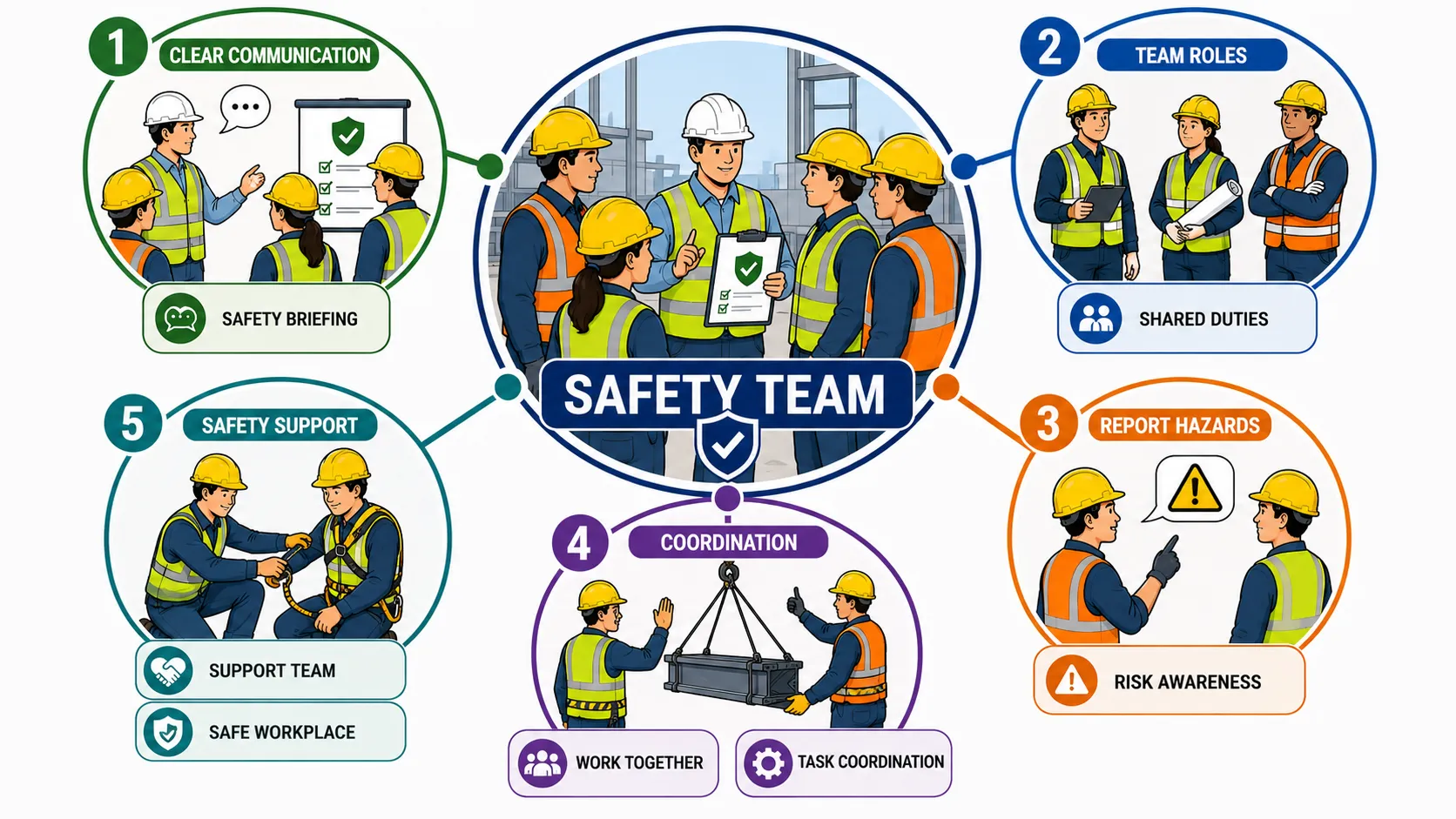
Understanding Individual Roles Within a Safety Team
Importance of Clear Responsibilities
Every team member should understand their role and responsibilities before work begins. Clear responsibilities prevent duplication, confusion, and unsafe decisions.
A successful safety team requires:
- Defined responsibilities.
- Effective leadership.
- Clear communication.
- Mutual support.
Workers should understand:
- What tasks they are responsible for.
- Which safety procedures apply.
- Who to report hazards to.
- How to support colleagues.
Role of Workers
Workers contribute to safety by actively participating in workplace controls.
Worker responsibilities include:
- Following safety procedures.
- Using equipment correctly.
- Reporting hazards.
- Supporting team members.
- Communicating safety concerns.
Workers should avoid:
- Ignoring unsafe behaviour.
- Assuming someone else will address hazards.
- Working without coordination.
Role of Supervisors
Supervisors provide leadership and direction to ensure activities are completed safely.
Supervisor responsibilities include:
- Organising work activities.
- Communicating expectations.
- Monitoring performance.
- Providing guidance.
- Correcting unsafe practices.
Effective supervisors encourage workers to:
- Raise safety concerns.
- Participate in discussions.
- Suggest improvements.
Role of Employers and Management
Employers are responsible for creating systems that support teamwork and coordination.
Management responsibilities include:
- Providing safety training.
- Establishing communication procedures.
- Supporting teamwork initiatives.
- Providing suitable resources.
A positive management approach encourages workers to view safety as a shared responsibility.
Developing Effective Team Communication
Importance of Clear Communication
Communication is one of the most important factors in successful teamwork. Workers need accurate information to understand tasks, hazards, and safety expectations.
Effective communication helps teams:
- Coordinate activities.
- Share important information.
- Prevent mistakes.
- Respond quickly to problems.
Communication methods may include:
- Toolbox talks.
- Safety meetings.
- Radio communication.
- Verbal instructions.
- Written procedures.
Safety Briefings and Team Discussions
Before starting work, teams should discuss:
- Task requirements.
- Potential hazards.
- Control measures.
- Individual responsibilities.
A good safety briefing allows workers to:
- Ask questions.
- Clarify expectations.
- Identify concerns.
Benefits include:
- Better preparation.
- Improved understanding.
- Reduced confusion.
Coordination During Work Activities
Planning Team Activities
Effective coordination begins before work starts. Teams should plan how tasks will be completed and how workers will interact during the activity.
Planning should consider:
- Work sequence.
- Equipment requirements.
- Worker responsibilities.
- Communication methods.
A coordinated approach ensures:
- Resources are available.
- Workers understand priorities.
- Risks are controlled.
Coordinating Equipment Use
Many workplace activities involve shared equipment, making coordination essential.
Examples include:
- MEWPs.
- Scaffolding systems.
- Lifting equipment.
- Tools and machinery.
Good equipment coordination requires:
- Scheduled use.
- Clear responsibilities.
- Proper communication.
Poor coordination may lead to:
- Equipment conflicts.
- Unsafe access.
- Delays.
- Increased hazards.
Supporting Team-Based Risk Management
Sharing Hazard Information
Every team member should contribute to hazard identification and risk control.
Workers should communicate:
- New hazards.
- Changing conditions.
- Equipment concerns.
- Unsafe practices.
Team involvement improves:
- Hazard awareness.
- Safety decision-making.
- Workplace control measures.
Collective Problem Solving
Teams often face unexpected challenges during workplace activities. Effective teamwork allows workers to find safer solutions together.
Examples include:
- Changing weather conditions.
- Equipment problems.
- Access difficulties.
- Unexpected hazards.
A strong team approach encourages:
- Discussion.
- Shared responsibility.
- Practical solutions.
Teamwork During Emergency Situations
Importance of Emergency Coordination
During emergencies, teamwork becomes critical because quick and organised actions can prevent further harm.
Emergency teamwork requires:
- Clear communication.
- Defined responsibilities.
- Controlled response.
Workers should know:
- Who raises the alarm.
- Who provides assistance.
- Who contacts emergency services.
- How rescue procedures are implemented.
Supervisor Leadership During Emergencies
Supervisors should:
- Take control of the situation.
- Provide clear instructions.
- Prevent unnecessary risks.
- Coordinate emergency actions.
Effective leadership helps prevent confusion during stressful situations.
Practical Example: Construction Height Work Activity
Scenario
A construction team is installing external building panels using scaffolding and lifting equipment. Several workers are involved, including installers, supervisors, and equipment operators.
Team Coordination Process
Before work begins:
- The supervisor conducts a safety briefing.
- Responsibilities are assigned.
- Equipment use is discussed.
- Hazards are reviewed.
During the activity:
- Workers communicate continuously.
- Equipment movement is coordinated.
- Hazards are reported immediately.
- Supervisors monitor progress.
Outcome
The activity is completed safely because workers cooperate, communicate effectively, and understand their responsibilities within the team.
Benefits of Effective Teamwork and Coordination
Improved Safety Performance
Effective teamwork helps:
- Reduce workplace incidents.
- Improve hazard awareness.
- Strengthen safety controls.
Increased Productivity
Good coordination supports:
- Better workflow.
- Reduced delays.
- Improved resource management.
Better Decision-Making
Team collaboration allows:
- Shared knowledge.
- Different perspectives.
- More effective solutions.
Stronger Workplace Relationships
Effective teamwork encourages:
- Trust.
- Respect.
- Support between workers.
Positive Safety Culture
A cooperative workplace develops:
- Greater safety commitment.
- Improved reporting.
- Continuous improvement.
Strategies for Improving Teamwork and Coordination
Organisations can improve teamwork by:
- Providing communication training.
- Encouraging worker participation.
- Conducting regular safety meetings.
- Recognising positive safety behaviour.
- Developing clear procedures.
Teams should regularly review:
- What worked well.
- What risks were identified.
- What improvements are needed.
Common Barriers to Effective Teamwork
Workplace safety can be affected by:
Poor Communication
Problems include:
- Missing information.
- Unclear instructions.
- Delayed reporting.
Lack of Responsibility
Problems include:
- Workers ignoring hazards.
- Assuming others will manage risks.
Poor Coordination
Problems include:
- Conflicting activities.
- Equipment misuse.
- Unsafe work sequences.
These issues should be addressed through:
- Training.
- Leadership.
- Improved communication systems.
Conclusion
Teamwork and coordination are fundamental to maintaining a safe working environment. Workplace safety depends on individuals working together, communicating effectively, understanding their responsibilities, and supporting each other throughout daily activities.
By developing strong teamwork practices, organisations can improve hazard control, prevent incidents, and create a positive safety culture. Effective coordination between workers, supervisors, and management ensures that tasks are completed safely, efficiently, and in accordance with occupational health and safety requirements.
A successful safety environment is achieved when every team member recognises that safety is a shared responsibility and actively contributes to protecting themselves and others.