
Lesson No 1: Personal Protective Equipment (PPE)
Personal Protective Equipment (PPE) is a critical component of workplace health and safety management, providing workers with protection against hazards that cannot be completely eliminated through engineering controls, safe systems of work, or administrative measures. In construction, engineering, maintenance, and industrial environments, workers may be exposed to risks such as falling objects, hazardous substances, noise, electrical hazards, sharp materials, and impact injuries. This lesson introduces learners to the purpose, selection, correct use, inspection, and maintenance of PPE to support safer workplace practices.
This lesson explores the importance of choosing suitable PPE based on workplace hazards, task requirements, and risk assessment findings. Learners will develop an understanding of different types of protective equipment, including helmets, safety footwear, gloves, eye protection, hearing protection, respiratory protection, high-visibility clothing, and fall protection equipment. The content explains how safety professionals evaluate PPE requirements, ensure proper fitting, and promote correct usage to reduce workplace injuries and improve safety performance.
Through this lesson, learners will gain practical knowledge of PPE responsibilities, including the roles of employers, supervisors, and workers in maintaining effective protection systems. By understanding PPE limitations and best practices, learners will be able to contribute to a positive safety culture, improve hazard control measures, and support compliance with occupational health and safety standards across construction, industrial, and workplace environments.
1. Recognize Different Types of PPE Required for Working at Height
Introduction to Personal Protective Equipment for Work at Height
Personal Protective Equipment (PPE) is an essential component of workplace safety management for activities involving work at height. When workers perform tasks on elevated surfaces, platforms, scaffolding, ladders, roofs, or temporary structures, they may be exposed to hazards such as falls, falling objects, impact injuries, and environmental risks. Although PPE is considered the last level of protection within the hierarchy of controls, it provides an important additional safeguard when hazards cannot be completely eliminated through engineering or administrative controls.
From the perspective of a Senior Health and Safety Professional and Work at Height Safety Specialist, selecting the correct PPE is a critical safety decision that requires proper understanding of workplace hazards, task requirements, equipment limitations, and user competence. Incorrect PPE selection or improper use can create a false sense of security and increase the possibility of workplace incidents. Therefore, workers must recognise different types of PPE, understand their purpose, and know how each item contributes to reducing risks during height-related activities.
For professionals working in construction, mechanical engineering, electrical installation, maintenance, and industrial operations, PPE knowledge is directly linked with safety compliance and quality performance. A QA/QC-focused approach ensures that PPE provided to workers meets required specifications, is inspected regularly, and remains suitable for the intended task. This lesson develops learners’ ability to identify different types of PPE used for working at height and understand their practical applications in real workplace environments.
Understanding the Purpose of PPE in Work at Height
Personal Protective Equipment refers to specially designed protective items worn or used by workers to reduce exposure to workplace hazards. PPE does not remove hazards from the workplace; instead, it reduces the potential consequences when risks cannot be fully controlled through other methods.
For work at height activities, PPE is mainly designed to:
Prevent or reduce injuries caused by falls.
Protect workers from head injuries.
Reduce exposure to impact hazards.
Improve worker protection during elevated tasks.
Support compliance with workplace safety requirements.
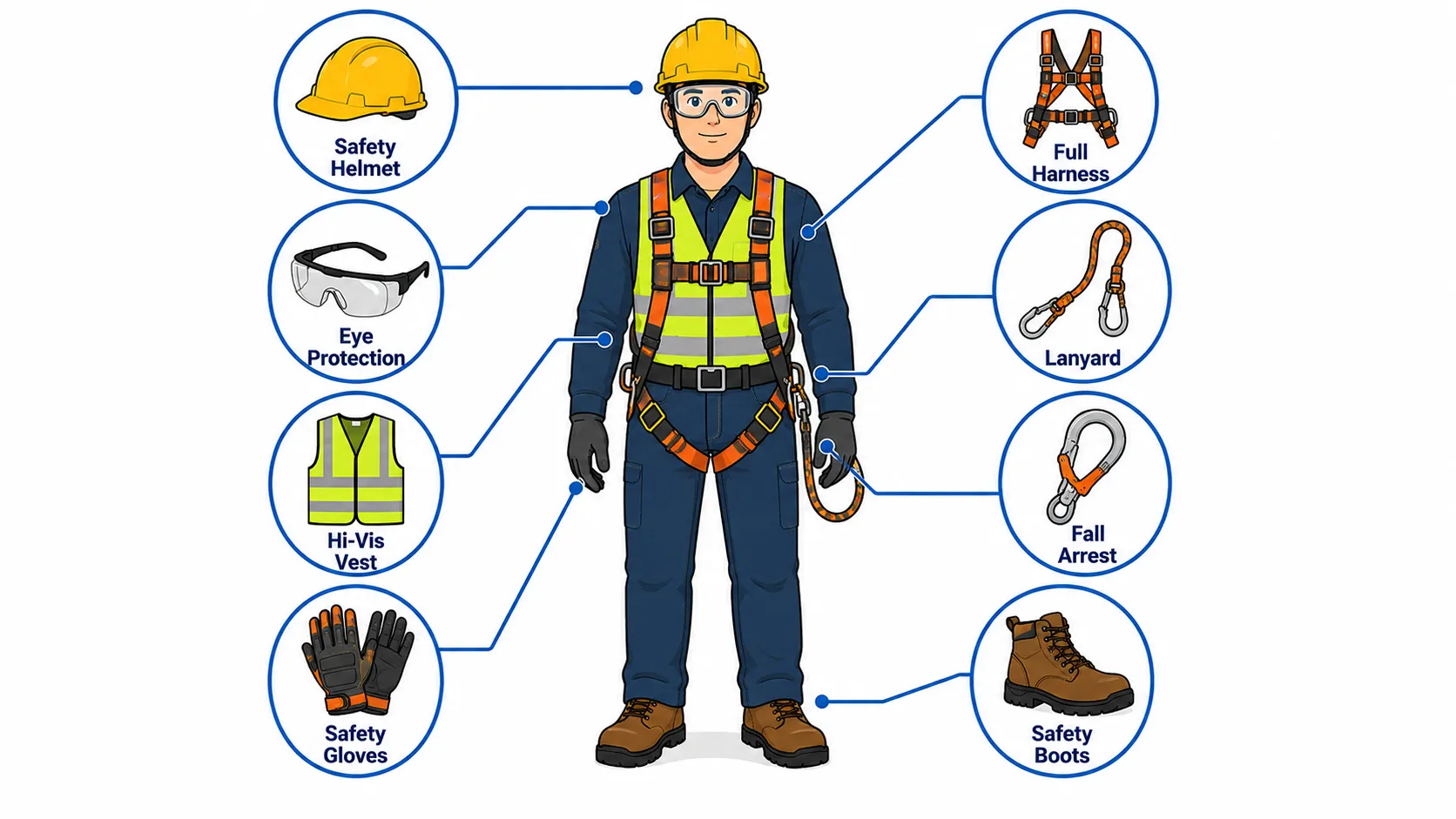
Examples of work at height PPE include:
Safety helmets.
Full-body harnesses.
Lanyards.
Fall arrest systems.
Safety footwear.
High-visibility clothing.
Protective gloves.
Eye protection.
Each type of PPE has a specific purpose and must be selected according to the identified workplace hazards.
Key Concepts of PPE Selection and Use
| PPE Type | Definition | Purpose in Work at Height Activities |
|---|---|---|
| Safety Helmet | Protective headgear designed to reduce impact injuries | Protects against falling objects and head impacts |
| Full-Body Harness | A wearable safety system that distributes fall forces across the body | Prevents serious injury during falls |
| Lanyard | A connecting device attached between a harness and anchor point | Provides secure attachment and fall restraint |
| Fall Arrest System | A combination of harness, connectors, and anchor systems | Stops a worker after a fall occurs |
| Safety Footwear | Protective footwear designed for workplace hazards | Improves stability and protects feet |
| High-Visibility Clothing | Clothing designed to increase worker visibility | Helps workers remain visible in active work areas |
| Protective Gloves | Hand protection equipment | Protects hands from cuts, abrasions, and handling risks |
Types of PPE Required for Working at Height
Safety Helmets
Safety helmets are one of the most common forms of PPE used in construction and industrial workplaces. During work at height activities, workers may be exposed to falling tools, materials, or accidental impacts from surrounding structures.
A suitable safety helmet should:
Provide impact protection.
Fit securely on the worker’s head.
Include an adjustable retention strap where required.
Be inspected regularly for damage.
Practical Example
A maintenance worker repairing equipment on an elevated platform may accidentally drop a tool. A properly worn safety helmet reduces the risk of serious head injury to workers below or the person performing the task.
Benefits of safety helmets include:
Protection from falling objects.
Reduced risk of head injuries.
Improved workplace safety compliance.
Increased worker confidence.
Full-Body Harnesses
A full-body harness is one of the most important PPE items for preventing serious injuries during work at height. Unlike simple belts, full-body harnesses distribute fall forces across stronger areas of the body, reducing the possibility of severe injury.
A harness system normally includes:
Shoulder straps.
Leg straps.
Chest connection points.
Attachment points for lanyards.
Workers using harnesses must understand:
Correct fitting procedures.
Inspection requirements.
Connection methods.
Weight limitations.
A poorly fitted harness may not provide effective protection during a fall.
Lanyards and Connectors
Lanyards connect the worker’s harness to a secure anchor point. They are essential components of fall restraint and fall arrest systems.
Types of lanyards include:
Fixed-length lanyards.
Adjustable lanyards.
Shock-absorbing lanyards.
Shock-absorbing lanyards are designed to reduce the force transferred to the worker during a fall.
Important considerations include:
Correct attachment points.
Compatibility with harness systems.
Regular inspection.
Protection from damage.
Fall Arrest Systems
A fall arrest system is designed to stop a worker safely after a fall occurs. It normally includes:
Full-body harness.
Energy-absorbing lanyard.
Anchor point.
Connecting devices.
Fall arrest systems are used when workers may fall from elevated positions and cannot be fully protected through other controls.
Before use, workers should verify:
Equipment condition.
Anchor strength.
Correct connection.
Clearance distance below.
Safety Footwear
Safety footwear is important during work at height because workers require stability and protection while moving on elevated surfaces.
Suitable footwear should provide:
Slip resistance.
Good grip.
Toe protection.
Support during movement.
Examples of situations requiring safety footwear include:
Working on scaffolding.
Accessing elevated platforms.
Performing maintenance tasks.
Poor footwear can increase the risk of slips, trips, and falls.
High-Visibility Clothing
High-visibility clothing improves worker visibility, particularly in construction sites, industrial facilities, and areas with moving equipment.
It helps:
Vehicle operators identify workers.
Supervisors monitor activities.
Teams communicate safely.
High-visibility PPE is especially important where workers perform elevated tasks near:
Cranes.
Vehicles.
Machinery.
Active construction areas.
Protective Gloves
Protective gloves provide hand protection during work at height activities involving tools, materials, and equipment.
Gloves may protect against:
Cuts.
Abrasions.
Sharp edges.
Contamination.
The correct glove type depends on the task being performed.
For example:
Electrical tasks require electrically suitable gloves.
Material handling may require cut-resistant gloves.
Eye Protection
Eye protection may be required when working at height where workers are exposed to:
Dust.
Flying particles.
Chemical splashes.
Mechanical operations.
Examples include:
Safety glasses.
Protective goggles.
Face shields.
Eye protection helps prevent injuries during drilling, cutting, and maintenance activities.
PPE Selection Process for Work at Height
Selecting appropriate PPE requires a systematic approach.
Step 1: Identify Workplace Hazards
Before selecting PPE, organisations should identify:
Fall risks.
Impact hazards.
Environmental conditions.
Equipment requirements.
Task-specific dangers.
Step 2: Evaluate PPE Requirements
The selected PPE should match:
The type of work.
Workplace conditions.
Worker capability.
Safety requirements.
Step 3: Check Equipment Compatibility
Different PPE components must work together.
For example:
Harnesses must match connectors.
Lanyards must connect correctly.
Helmets must fit securely.
Step 4: Provide Worker Training
Workers must understand:
How to wear PPE correctly.
How to inspect equipment.
When replacement is required.
How to store PPE safely.
Step 5: Inspect and Maintain PPE
Regular inspections ensure PPE remains effective.
Inspection activities include:
Checking for damage.
Reviewing expiry dates.
Cleaning equipment.
Removing defective items.
Practical Case Study: Roof Maintenance Activity
Scenario
A maintenance team is required to repair ventilation equipment on the roof of a commercial building.
Identified Hazards
The risk assessment identifies:
Fall from roof edges.
Dropped tools.
Slippery surfaces.
Exposure to weather conditions.
Required PPE
The team uses:
Safety helmets.
Full-body harnesses.
Shock-absorbing lanyards.
Safety footwear.
High-visibility clothing.
Outcome
Because suitable PPE was selected and correctly used, workers were protected while completing the maintenance task safely.
Role of Health and Safety Professionals in PPE Management
Health and safety professionals ensure that PPE systems are effective and properly managed.
Their responsibilities include:
Reviewing risk assessments.
Selecting suitable PPE.
Checking compliance.
Delivering training.
Monitoring PPE usage.
Investigating PPE-related incidents.
They ensure PPE supports, rather than replaces, effective risk control strategies.
Role of QA/QC Professionals in PPE Inspection
QA/QC professionals contribute to PPE reliability by ensuring equipment meets required standards.
Their responsibilities include:
Checking PPE quality.
Maintaining inspection records.
Verifying equipment certification.
Monitoring replacement requirements.
Quality control ensures protective equipment performs effectively when required.
Benefits of Correct PPE Selection for Work at Height
Benefits for Workers
Correct PPE provides:
Increased personal protection.
Reduced injury risk.
Greater confidence during tasks.
Improved safety awareness.
Benefits for Organisations
Effective PPE management helps organisations achieve:
Better safety performance.
Reduced workplace incidents.
Improved compliance.
Lower accident-related costs.
Benefits for Safety Management Systems
PPE management supports:
Effective risk control.
Improved workplace standards.
Stronger safety culture.
Continuous improvement.
Common Mistakes in PPE Use
Workers and organisations should avoid:
Using damaged PPE.
Selecting incorrect equipment.
Failing to inspect PPE.
Wearing poorly fitted equipment.
Ignoring manufacturer instructions.
Treating PPE as the only safety measure.
Best Practices for PPE Management
Organisations should:
Select PPE based on risk assessments.
Provide suitable training.
Conduct regular inspections.
Replace damaged equipment.
Maintain PPE records.
Encourage workers to report defects.
Conclusion
Recognising different types of PPE required for working at height is an essential skill for maintaining workplace safety and preventing injuries. Each PPE item has a specific role in reducing risks, from protecting the head and body to preventing falls and improving worker visibility.
For learners completing the ICTQual Level 1 Award in Work at Height, understanding PPE selection, inspection, and correct usage provides the foundation for safe working practices. Effective PPE management supports legal compliance, improves safety performance, and contributes to safer construction, electrical, mechanical, and industrial workplaces.
Although PPE represents the final level of protection in the hierarchy of controls, when correctly selected and used, it provides valuable protection against serious workplace hazards and supports a strong safety culture.
2.Demonstrate Correct Use and Fitting of Various PPE, Including Harnesses, Helmets, and Lanyards
Introduction to Correct PPE Use and Fitting for Work at Height
Correct use and fitting of Personal Protective Equipment (PPE) is a critical safety requirement for anyone involved in work at height activities. PPE such as full-body harnesses, safety helmets, lanyards, and fall protection systems are designed to reduce the severity of injuries when workers are exposed to elevated work environments. However, PPE can only provide effective protection when it is selected correctly, fitted properly, inspected regularly, and used according to manufacturer instructions and workplace safety procedures.
From the perspective of a Senior Health and Safety Professional and Work at Height Safety Specialist, incorrect PPE fitting is one of the major causes of reduced protection during workplace incidents. A poorly adjusted harness, incorrectly attached lanyard, or damaged helmet may fail during an emergency situation and expose workers to serious harm. Therefore, workers must develop practical competence in wearing, adjusting, checking, and maintaining PPE before performing any work at height activity.
For learners completing the ICTQual Level 1 Award in Work at Height, understanding correct PPE use is essential for developing safe working practices. This knowledge supports compliance with occupational health and safety requirements and helps workers contribute to safer construction, mechanical, electrical, maintenance, and industrial environments. Proper PPE fitting is not only a personal responsibility but also an important part of organisational safety management systems.
Importance of Correct PPE Fitting and Usage
PPE is considered the final layer of protection within the hierarchy of controls. It does not remove workplace hazards but reduces the potential consequences when risks remain after other controls have been applied.
Correct PPE fitting ensures:
- Maximum protection during work activities.
- Reduced risk of injury.
- Improved comfort and worker confidence.
- Proper operation of safety equipment.
- Compliance with workplace safety procedures.
Incorrect PPE use can result in:
- Increased injury severity.
- Equipment failure during incidents.
- Reduced worker mobility.
- Unsafe working practices.
- Non-compliance with safety requirements.
Workers must understand that simply wearing PPE is not enough; it must be correctly selected, adjusted, and maintained.
Key Concepts of PPE Use and Fitting
| PPE Equipment | Definition | Correct Use Requirement |
|---|---|---|
| Full-Body Harness | A safety device worn around the body to distribute fall forces during a fall arrest situation | Must be correctly adjusted and securely connected |
| Safety Helmet | Protective headgear designed to reduce impact injuries | Must fit securely and be inspected before use |
| Lanyard | A connecting device used between a harness and anchor point | Must be attached correctly and checked for damage |
| Fall Arrest System | A combination of harness, lanyard, connectors, and anchor points | Must be compatible and properly installed |
| PPE Inspection | A process of checking equipment condition before use | Identifies defects before equipment failure occurs |
Correct Use and Fitting of Full-Body Harnesses
Understanding Full-Body Harnesses
A full-body harness is one of the most important pieces of PPE used for work at height. Unlike simple belts, full-body harnesses distribute fall forces across stronger areas of the body, including the shoulders, chest, thighs, and pelvis.
A properly fitted harness helps:
- Keep the worker securely connected.
- Reduce injury during a fall.
- Maintain correct body position.
- Support effective fall arrest.
A harness should always be selected based on:
- Type of work.
- Worker size and weight.
- Compatibility with other equipment.
-
Manufacturer requirements.

Steps for Correct Harness Fitting
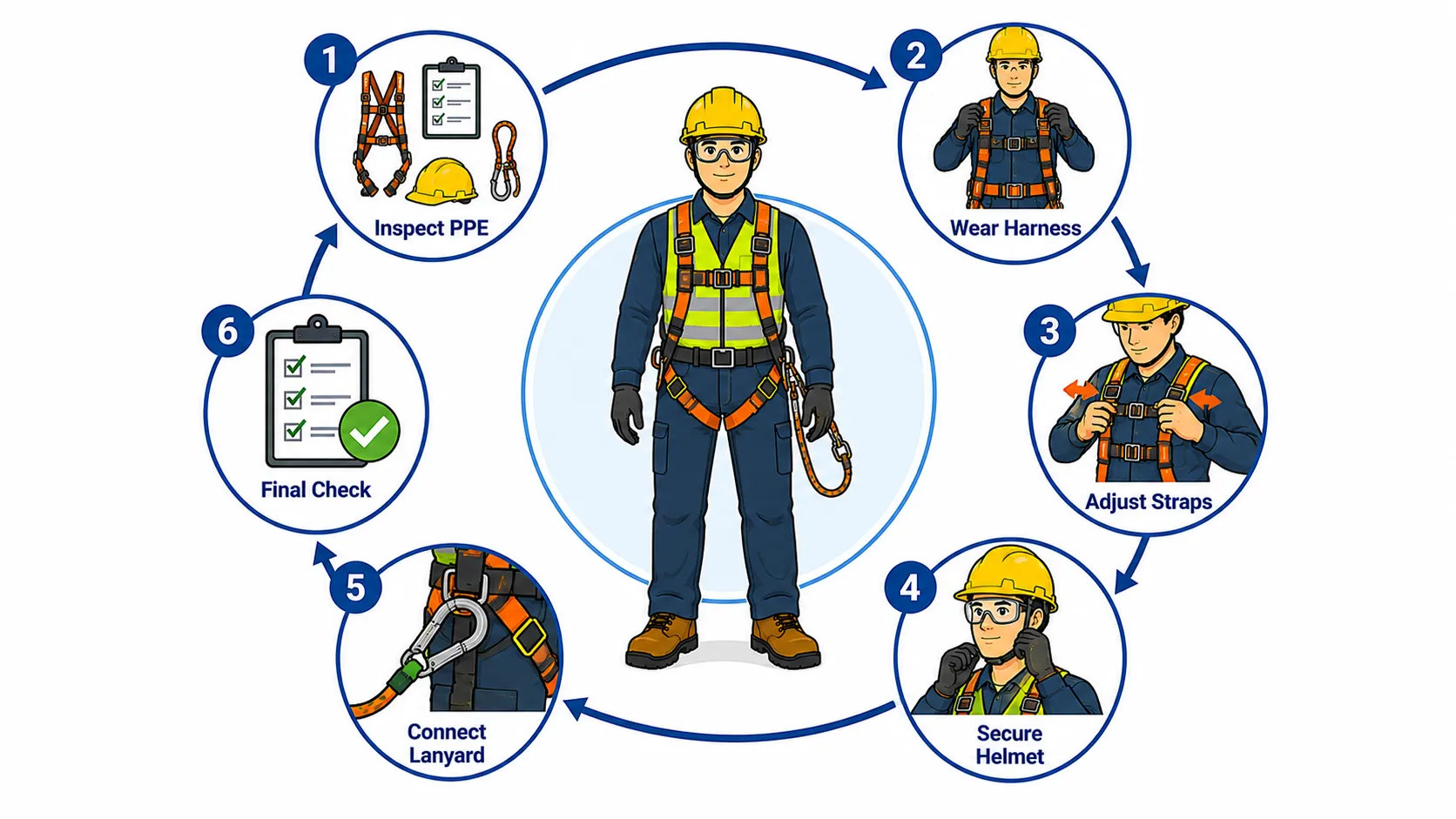
Before wearing a harness, workers should complete a visual inspection.
Check for:
- Damaged straps.
- Broken stitching.
- Corrosion on metal components.
- Missing labels.
- Damaged attachment points.
Correct fitting steps include:
Step 1: Hold and Inspect the Harness
Workers should hold the harness by the rear attachment point and allow straps to hang freely.
Check:
- Straps are not twisted.
- Buckles are functioning.
- Components are complete.
Step 2: Put on the Shoulder Straps
The worker should place arms through the shoulder straps like wearing a jacket.
Ensure:
- Straps sit correctly on shoulders.
- No twisting occurs.
- The back attachment point is positioned correctly.
Step 3: Secure Leg Straps
Leg straps should be connected and adjusted to provide a secure but comfortable fit.
They should:
- Allow normal movement.
- Prevent excessive looseness.
- Avoid restricting circulation.
Step 4: Adjust Chest Strap
The chest strap should be positioned correctly to maintain harness alignment.
It should:
- Keep shoulder straps in place.
- Avoid being too tight.
- Avoid hanging loose.
Step 5: Final Fit Check
Before starting work:
- Confirm all buckles are locked.
- Check strap adjustment.
- Ensure comfortable movement.
- Verify connection points.
Common Harness Fitting Errors
Workers should avoid:
- Wearing twisted straps.
- Leaving buckles unsecured.
- Connecting to unsuitable anchor points.
- Using damaged harnesses.
- Wearing incorrect sizes.
These mistakes can reduce the effectiveness of fall protection systems.
Correct Use and Fitting of Safety Helmets
Purpose of Safety Helmets
Safety helmets protect workers from:
- Falling objects.
- Impact with structures.
- Accidental contact with overhead hazards.
In work at height environments, helmets are essential because tools, materials, or equipment may fall from elevated positions.
Correct Helmet Fitting Procedure
Workers should:
- Select the correct helmet size.
- Adjust the internal suspension system.
- Position the helmet correctly.
- Secure the chin strap when required.
A correctly fitted helmet should:
- Sit level on the head.
- Provide comfortable protection.
- Remain secure during movement.
Helmet Inspection Requirements
Before use, workers should check:
- Cracks or damage.
- Signs of impact.
- Damaged straps.
- Expired service life.
A helmet that has experienced a strong impact should be removed from service even if damage is not visible.
Correct Use of Lanyards
Understanding Lanyards
A lanyard connects the worker’s harness to a secure anchor point. It is a critical component of fall restraint and fall arrest systems.
Types of lanyards include:
- Fixed-length lanyards.
- Adjustable lanyards.
- Shock-absorbing lanyards.
Correct Lanyard Connection
Workers should ensure:
- The lanyard is compatible with the harness.
- The connection point is approved.
- Hooks are fully secured.
- The lanyard is protected from damage.
Incorrect attachment can result in equipment failure during a fall.
Lanyard Inspection Before Use
Workers should check:
- Cuts or tears.
- Damaged stitching.
- Broken connectors.
- Corrosion.
- Missing identification information.
Damaged lanyards must not be used.
PPE Inspection Process Before Work at Height
A pre-use inspection should always be completed before starting work.
The inspection process includes:
Step 1: Visual Examination
Check for:
- Physical damage.
- Wear and tear.
- Missing components.
Step 2: Functional Check
Confirm:
- Buckles operate correctly.
- Connectors lock properly.
- Adjustment systems work.
Step 3: Confirm Suitability
Verify:
- PPE matches the task.
- Equipment is compatible.
- Worker is trained.
Step 4: Report Defects
Any damaged PPE should:
- Be removed from service.
- Be reported.
- Be replaced or repaired according to requirements.
Practical Example 1: Construction Roof Maintenance
Scenario
A maintenance worker needs to inspect equipment installed on a commercial roof.
PPE Requirements
The worker requires:
- Full-body harness.
- Shock-absorbing lanyard.
- Safety helmet.
- Safety footwear.
Correct Procedure
Before starting work, the worker:
- Inspects the harness.
- Adjusts all straps correctly.
- Connects the lanyard to an approved anchor point.
- Secures the helmet.
Outcome
Correct PPE fitting reduces the likelihood of serious injury and ensures safe completion of the task.
Practical Example 2: Mechanical Installation Work
Scenario
A mechanical team installs ventilation equipment at height inside an industrial facility.
Potential Risks
- Falling from elevated platforms.
- Dropped components.
- Contact with structures.
PPE Controls
Workers use:
- Properly fitted harnesses.
- Secure lanyards.
- Protective helmets.
The supervisor verifies PPE compliance before work begins.
Role of Supervisors and Safety Professionals
Supervisors and safety professionals ensure workers understand PPE requirements.
Their responsibilities include:
- Providing PPE training.
- Checking correct fitting.
- Conducting workplace inspections.
- Monitoring PPE condition.
- Correcting unsafe practices.
They help create a workplace culture where PPE is used correctly and consistently.
Benefits of Correct PPE Use and Fitting
Benefits for Workers
Correct PPE practices provide:
- Increased personal protection.
- Reduced injury risks.
- Improved confidence.
- Better workplace awareness.
Benefits for Organisations
Effective PPE management supports:
- Reduced workplace accidents.
- Improved safety performance.
- Better compliance.
- Lower operational disruption.
Benefits for Safety Management Systems
Proper PPE practices contribute to:
- Stronger risk control.
- Improved inspection processes.
- Better safety culture.
- Continuous improvement.
Common PPE Usage Mistakes
Workers should avoid:
- Using damaged equipment.
- Wearing incorrectly adjusted harnesses.
- Connecting lanyards incorrectly.
- Ignoring inspection requirements.
- Sharing unsuitable PPE.
- Using expired equipment.
Best Practices for PPE Management
Organisations should:
- Provide suitable PPE training.
- Maintain inspection records.
- Replace damaged equipment immediately.
- Ensure workers understand fitting procedures.
- Monitor PPE compliance.
- Encourage reporting of defects.
Conclusion
Demonstrating the correct use and fitting of PPE, including harnesses, helmets, and lanyards, is essential for maintaining safety during work at height activities. PPE provides effective protection only when it is properly selected, correctly fitted, regularly inspected, and used according to established safety procedures.
For learners completing the ICTQual Level 1 Award in Work at Height, developing practical PPE skills ensures they can work safely and confidently in elevated environments. Understanding harness adjustment, helmet fitting, lanyard connection, and inspection procedures helps prevent accidents and supports compliance with workplace safety requirements.
Effective PPE management protects workers, improves safety performance, and contributes to safer construction, mechanical, electrical, and industrial workplaces where work at height activities are performed responsibly.
3. Perform Routine Inspection and Maintenance of PPE to Ensure Its Effectiveness and Safety
Introduction to PPE Inspection and Maintenance for Work at Height
Routine inspection and maintenance of Personal Protective Equipment (PPE) are essential practices for ensuring that protective equipment remains reliable, effective, and safe during work at height activities. PPE such as full-body harnesses, lanyards, helmets, connectors, and fall protection systems are designed to protect workers from serious injuries; however, their effectiveness depends on regular checking, proper care, and timely replacement when defects are identified.
From the perspective of a Senior Health and Safety Professional and Work at Height Safety Specialist, PPE should never be considered permanently safe simply because it was previously approved or used successfully. Continuous exposure to environmental conditions, mechanical stress, chemicals, sunlight, moisture, and general wear can reduce the performance of protective equipment over time. Therefore, routine inspection and maintenance procedures are necessary to identify defects before they create dangerous situations.
For learners completing the ICTQual Level 1 Award in Work at Height, understanding PPE inspection and maintenance develops essential workplace safety skills. It enables workers to recognise damaged equipment, apply correct maintenance procedures, and ensure that PPE remains suitable for protecting against identified hazards. Effective PPE management supports compliance with occupational safety requirements and contributes to safer construction, mechanical, electrical, maintenance, and industrial workplaces.
Importance of Routine PPE Inspection and Maintenance
PPE inspection is a systematic process of checking protective equipment before and during use to identify damage, defects, or conditions that may affect performance. Maintenance involves cleaning, storing, repairing, or replacing PPE to ensure it remains functional and safe.
Regular inspection and maintenance help organisations:
Prevent equipment failure during critical situations.
Identify damaged PPE before use.
Extend the service life of protective equipment.
Maintain compliance with workplace safety requirements.
Improve worker confidence and safety awareness.
Reduce workplace accidents caused by defective equipment.
A worker wearing damaged PPE may believe they are protected, but hidden defects can significantly reduce the equipment’s ability to perform during an emergency.
Key Concepts of PPE Inspection and Maintenance
| Key Concept | Definition | Importance in Work at Height Safety |
|---|---|---|
| PPE Inspection | A systematic examination of protective equipment to identify damage or defects | Ensures equipment remains safe before use |
| Pre-Use Check | A quick inspection completed by the user before each task | Identifies immediate problems before work begins |
| Detailed Inspection | A thorough examination performed by a competent person | Detects hidden defects and wear |
| Maintenance | Activities performed to keep PPE in effective working condition | Extends equipment reliability and performance |
| Equipment Replacement | Removing damaged or unsuitable PPE from service | Prevents use of unsafe equipment |
| Storage Management | Proper protection of PPE when not in use | Prevents unnecessary deterioration |
Understanding the Need for PPE Inspection
Work at height PPE is regularly exposed to conditions that can affect its performance. Equipment may appear visually acceptable while containing defects that reduce its protective ability.
Common factors that can damage PPE include:
Frequent use.
Impact forces.
Exposure to chemicals.
Extreme temperatures.
Moisture and humidity.
Ultraviolet sunlight.
Poor storage conditions.
Incorrect cleaning methods.
Routine inspection ensures that these issues are identified before equipment is required during an emergency.
Types of PPE Requiring Regular Inspection
Full-Body Harness Inspection
A full-body harness is a critical component of fall protection systems. Because it carries the worker’s body weight during a fall arrest event, it must be maintained in excellent condition.
Workers should inspect harnesses for:
Cuts or tears in straps.
Damaged stitching.
Frayed webbing.
Broken buckles.
Corrosion on metal components.
Damaged attachment points.
Missing identification labels.
A harness showing signs of serious damage must be removed from service immediately.
Lanyard Inspection
Lanyards connect workers to secure anchor points and play a vital role in preventing injuries during falls.
Inspection should include checking:
Webbing condition.
Stitching quality.
Shock absorber condition.
Connector operation.
Hooks and attachment points.
Signs requiring replacement include:
Cuts.
Excessive wear.
Burn marks.
Chemical damage.
Deformed connectors.
Safety Helmet Inspection
Safety helmets protect workers from falling objects and impact hazards.
Inspection points include:
Cracks or fractures.
Damaged suspension systems.
Loose components.
Deformation.
Signs of impact.
A helmet involved in a significant impact should be replaced even if visible damage is limited.
Safety Footwear Inspection
Safety footwear should be inspected to ensure it continues to provide stability and protection.
Workers should check:
Sole condition.
Slip resistance.
Toe protection.
Stitching.
General wear.
Damaged footwear can increase the risk of slips and falls.
PPE Inspection Process
Step 1: Review Equipment History
Before inspection, workers should consider:
Age of equipment.
Previous use.
Exposure conditions.
Previous incidents.
Equipment with an unknown history should not be used until its condition is confirmed.
Step 2: Perform Visual Inspection
The first stage involves checking for visible defects.
Look for:
Damage.
Missing parts.
Contamination.
Excessive wear.
Step 3: Perform Functional Checks
Functional checks confirm that equipment operates correctly.
Examples:
Testing buckles.
Checking connectors.
Ensuring adjustment systems work properly.
Step 4: Record Inspection Results
Inspection records should include:
Date of inspection.
Equipment identification.
Inspector details.
Findings.
Required actions.
Documentation supports accountability and safety management.
Step 5: Remove Defective Equipment
Any PPE that fails inspection should:
Be removed immediately.
Be clearly identified.
Prevent accidental reuse.
Be repaired or replaced where appropriate.
PPE Maintenance Procedures
Cleaning PPE Correctly
Proper cleaning prevents deterioration and maintains equipment performance.
Recommended practices include:
Following manufacturer instructions.
Using suitable cleaning materials.
Avoiding harmful chemicals.
Allowing equipment to dry naturally.
Incorrect cleaning methods may weaken protective materials.
Proper Storage of PPE
Storage conditions directly affect PPE lifespan.
PPE should be stored:
In clean and dry areas.
Away from direct sunlight.
Away from chemicals.
Protected from physical damage.
Poor storage may cause:
Material deterioration.
Corrosion.
Reduced strength.
Repair and Replacement Procedures
Some PPE can be repaired according to manufacturer requirements, while other equipment must be replaced.
Replacement is required when:
Damage affects safety performance.
Equipment exceeds service life.
Components fail inspection.
Identification information is missing.
Pre-Use PPE Checks by Workers
Before every work at height activity, workers should complete a basic inspection.
The check should include:
Harness Check
Straps are intact.
Buckles function correctly.
Attachment points are secure.
Lanyard Check
No cuts or damage.
Connectors operate correctly.
Shock absorber is not activated.
Helmet Check
No cracks.
Suspension system works.
Helmet fits securely.
Practical Example 1: Construction Roof Work
Scenario
A construction worker prepares to complete maintenance work on a commercial roof.
Before starting, the worker inspects:
Full-body harness.
Lanyard.
Safety helmet.
The inspection identifies damaged stitching on the harness.
Correct Action
The worker:
Removes the harness from service.
Reports the defect.
Uses approved replacement equipment.
Outcome
The inspection prevents possible equipment failure during work at height.
Practical Example 2: Industrial Maintenance Activity
Scenario
A maintenance team uses fall protection equipment inside an industrial facility.
During inspection, a supervisor identifies corrosion on lanyard connectors.
Action Taken
The equipment is:
Removed immediately.
Recorded as defective.
Replaced before work continues.
This demonstrates how routine inspection prevents workplace incidents.
Role of Health and Safety Professionals in PPE Management
Health and safety professionals are responsible for ensuring PPE systems remain effective.
Their responsibilities include:
Developing PPE inspection procedures.
Training workers.
Monitoring compliance.
Reviewing inspection records.
Investigating PPE-related incidents.
They ensure PPE management supports wider safety objectives.
Role of QA/QC Professionals in PPE Inspection
Quality assurance and quality control principles also apply to PPE management.
QA/QC professionals help by:
Verifying equipment quality.
Maintaining inspection documentation.
Checking compliance requirements.
Ensuring replacement procedures are followed.
A quality-focused approach ensures PPE remains reliable throughout its service life.
Benefits of Effective PPE Inspection and Maintenance
Benefits for Workers
Routine PPE management provides:
Improved personal protection.
Increased confidence.
Reduced risk of equipment failure.
Better understanding of safety responsibilities.
Benefits for Organisations
Organisations benefit through:
Fewer workplace incidents.
Improved safety compliance.
Reduced equipment-related risks.
Better safety culture.
Benefits for Safety Management Systems
Effective PPE maintenance supports:
Improved risk control.
Better safety documentation.
Continuous improvement.
Stronger workplace standards.
Common Mistakes in PPE Inspection and Maintenance
Workers and organisations should avoid:
Using damaged equipment.
Skipping pre-use inspections.
Storing PPE incorrectly.
Ignoring manufacturer instructions.
Failing to record inspections.
Continuing to use expired equipment.
These mistakes can reduce PPE effectiveness and increase workplace risks.
Best Practices for PPE Management
Organisations should implement:
Regular inspection schedules.
Worker training programmes.
Clear replacement procedures.
Proper storage systems.
Inspection records.
Safety awareness campaigns.
Workers should:
Inspect PPE before every use.
Report defects immediately.
Follow maintenance instructions.
Never use damaged equipment.
Conclusion
Routine inspection and maintenance of PPE are essential activities for ensuring the continued effectiveness and safety of protective equipment used during work at height. PPE such as harnesses, helmets, lanyards, and fall protection systems can only provide reliable protection when they are regularly inspected, properly maintained, and replaced when necessary.
For learners completing the ICTQual Level 1 Award in Work at Height, understanding PPE inspection procedures develops important practical safety skills. By learning how to identify defects, perform pre-use checks, maintain equipment, and follow replacement procedures, workers can contribute to safer working environments.
Effective PPE management supports legal compliance, reduces workplace risks, and strengthens safety performance across construction, electrical, mechanical, maintenance, and industrial operations. A proactive inspection and maintenance approach ensures that PPE remains ready to protect workers when it is needed most.
4. Understand the Limitations and Proper Care of PPE
Introduction to PPE Limitations and Care Requirements for Work at Height
Personal Protective Equipment (PPE) plays an important role in protecting workers involved in work at height activities, but it is essential to understand that PPE is not a complete solution for eliminating workplace hazards. PPE acts as the final layer of protection within the hierarchy of controls and is designed to reduce the severity of injuries when risks cannot be fully controlled through elimination, engineering controls, or administrative measures. Understanding the limitations of PPE allows workers to use protective equipment correctly and avoid relying on it as the only safety measure.
From the perspective of a Senior Health and Safety Professional and Work at Height Safety Specialist, effective PPE management requires awareness of both the capabilities and restrictions of protective equipment. A safety harness can reduce the consequences of a fall, but it cannot prevent unsafe working conditions. A helmet can protect against impact, but it cannot eliminate falling object hazards. Therefore, workers must understand that PPE must always be combined with proper planning, risk assessment, training, and safe systems of work.
For learners completing the ICTQual Level 1 Award in Work at Height, understanding PPE limitations and care procedures develops essential workplace safety awareness. Correct PPE care improves equipment reliability, extends service life, and ensures that protective systems perform effectively when required. This lesson explains the importance of proper storage, inspection, cleaning, maintenance, and correct usage while highlighting common limitations that workers must consider during height-related activities.
Understanding the Role and Limitations of PPE
PPE is designed to provide protection against specific workplace hazards, but it has limitations that must be recognised. Many workplace incidents occur because workers assume PPE provides complete protection and ignore other safety requirements.
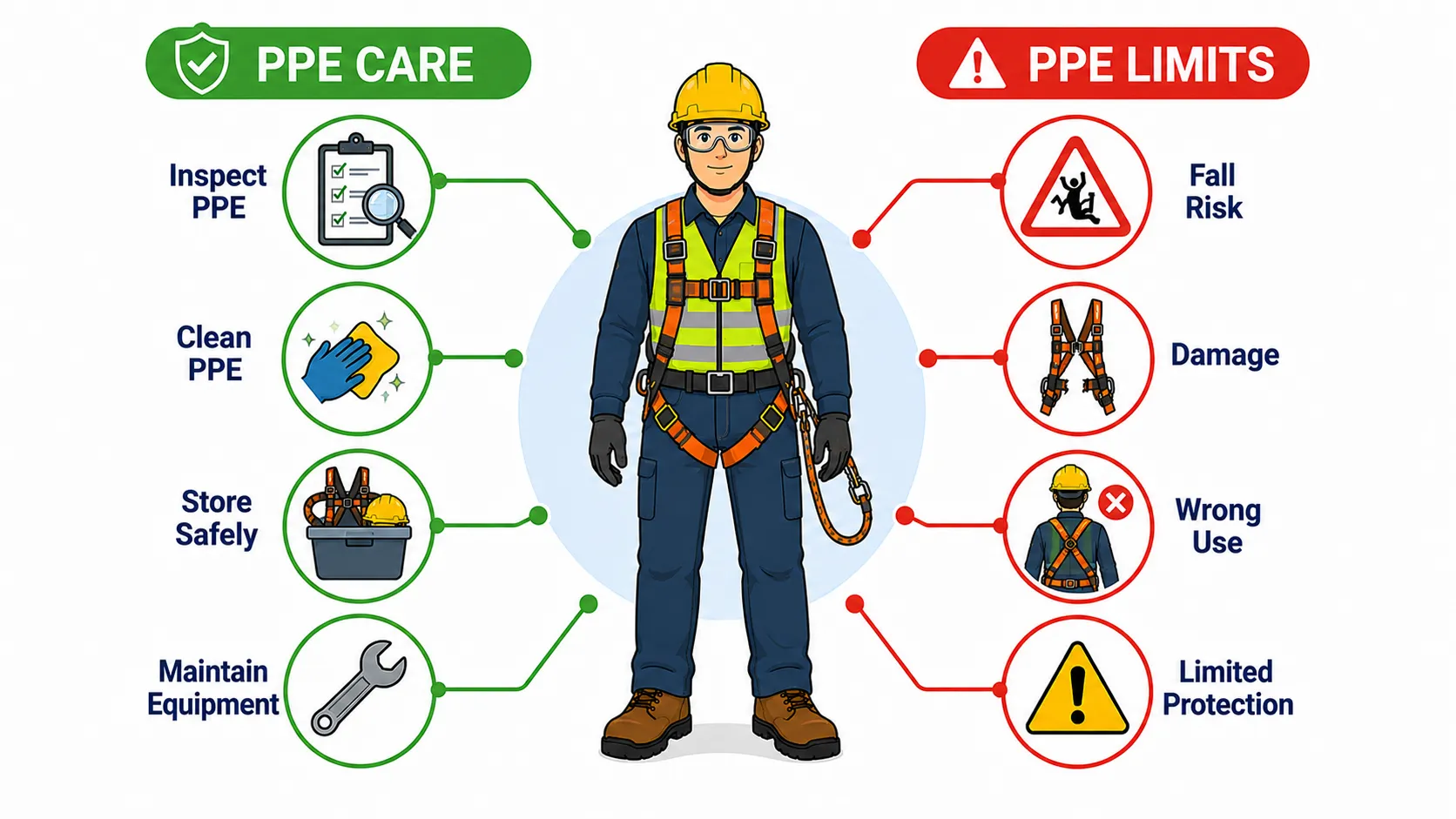
PPE limitations include:
PPE does not remove hazards from the workplace.
PPE effectiveness depends on correct selection and use.
Damaged PPE may fail during an emergency.
Incorrect fitting reduces protection.
PPE requires regular inspection and maintenance.
PPE cannot replace proper training and supervision.
For example, a worker wearing a safety harness while working near an unprotected roof edge is still exposed to risk if the harness is incorrectly connected or the anchor point is unsuitable.
Key Concepts of PPE Limitations and Care
| Key Concept | Definition | Importance in Work at Height Safety |
|---|---|---|
| PPE Limitation | A restriction that affects the ability of protective equipment to provide complete protection | Helps workers understand realistic protection levels |
| PPE Care | Actions taken to maintain equipment condition and performance | Ensures equipment remains effective |
| Equipment Compatibility | Ensuring different PPE components work safely together | Prevents system failure |
| Service Life | The period during which PPE remains suitable for use | Supports timely replacement decisions |
| Storage Management | Proper protection of PPE when not in use | Prevents unnecessary damage |
| Inspection Routine | Regular checking of PPE condition | Identifies defects before use |
Limitations of Different Types of PPE
Limitations of Full-Body Harnesses
A full-body harness is designed to reduce injury during a fall arrest situation, but it has important limitations.
A harness:
Does not prevent falls by itself.
Requires correct connection to a suitable anchor point.
Requires correct fitting and adjustment.
Must be used with compatible equipment.
Cannot protect workers if damaged.
Common limitations include:
Incorrect attachment.
Poor fitting.
Lack of inspection.
Incorrect anchor selection.
Failure to consider fall clearance distance.
A harness should always be part of a complete fall protection system rather than used as a standalone safety solution.
Limitations of Lanyards
Lanyards are important components of fall protection systems, but they also have restrictions.
Limitations include:
Limited length and working range.
Dependence on suitable anchor points.
Risk of damage from sharp edges.
Reduced effectiveness if incorrectly connected.
Workers must understand:
The correct attachment method.
The allowable working distance.
The importance of avoiding damage.
A lanyard that is too long may increase fall distance, while an unsuitable connection may cause system failure.
Limitations of Safety Helmets
Safety helmets provide protection against impact hazards but do not eliminate all head injury risks.
Limitations include:
They cannot protect against every type of impact.
They may become ineffective if damaged.
They require correct fitting.
They must be replaced after significant impact.
Workers should not assume that wearing a helmet removes all risks from falling objects or workplace hazards.
Limitations of Safety Footwear
Safety footwear provides protection and improves stability, but it also has limitations.
Safety footwear:
Cannot prevent all slips and falls.
Requires suitable selection for the environment.
Loses effectiveness when worn excessively.
Workers should consider:
Surface conditions.
Weather conditions.
Type of work activity.
Footwear condition.
Importance of Proper PPE Care
Proper PPE care ensures protective equipment remains reliable throughout its intended service life. Poor maintenance practices can weaken materials, reduce performance, and create hidden safety risks.
Effective PPE care involves:
Regular cleaning.
Correct storage.
Routine inspection.
Appropriate repairs.
Timely replacement.
Proper care helps:
Maintain equipment strength.
Prevent premature damage.
Improve worker safety.
Reduce unnecessary replacement costs.
PPE Cleaning Procedures
Cleaning PPE correctly is essential because contamination can affect equipment performance.
Workers should:
Follow manufacturer cleaning instructions.
Use recommended cleaning products.
Remove dirt and contaminants regularly.
Allow equipment to dry naturally.
Workers should avoid:
Using harsh chemicals.
Applying excessive heat.
Modifying equipment.
Washing equipment incorrectly.
For example, using unsuitable chemicals on harness straps may weaken fibres and reduce their strength.
Proper PPE Storage Requirements
Correct storage protects PPE from environmental damage.
PPE should be stored:
In clean and dry locations.
Away from direct sunlight.
Away from chemicals.
Protected from moisture.
Away from sharp objects.
Poor storage conditions may cause:
Material deterioration.
Corrosion.
Reduced flexibility.
Structural damage.
PPE Inspection and Maintenance Requirements
Regular inspection ensures PPE remains suitable for use.
Inspection should identify:
Wear and tear.
Cuts or cracks.
Missing components.
Damaged connectors.
Expired equipment.
Inspection types include:
Pre-Use Inspection
Completed by workers before every task.
Checks include:
Visual damage.
Correct operation.
Clean condition.
Secure components.
Detailed Inspection
Completed by a competent person at planned intervals.
Includes:
Thorough examination.
Documentation review.
Condition assessment.
Serviceability decision.
When PPE Should Be Removed from Service
PPE should be removed immediately when:
Damage is identified.
Equipment has been involved in a fall.
Components are missing.
Service life has expired.
Identification labels are unreadable.
Using defective PPE creates unnecessary risks.
Common Causes of PPE Damage
PPE may become damaged due to:
Environmental Exposure
Examples:
Sunlight exposure.
Extreme temperatures.
Moisture.
Chemical Exposure
Examples:
Cleaning chemicals.
Industrial substances.
Oils and solvents.
Mechanical Damage
Examples:
Cutting.
Abrasion.
Impact.
Poor Handling
Examples:
Throwing equipment.
Incorrect storage.
Unauthorised modifications.
Practical Example 1: Damaged Harness During Inspection
Scenario
A construction worker prepares for roof maintenance and inspects their harness before use.
The worker identifies:
Frayed straps.
Damaged stitching.
Wear near the attachment point.
Correct Action
The worker:
Removes the harness from service.
Reports the defect.
Uses approved replacement equipment.
Outcome
The inspection prevents potential failure during a fall arrest situation.
Practical Example 2: Incorrect PPE Storage
Scenario
A maintenance company stores harnesses outside in direct sunlight.
After several months, the straps become weakened due to ultraviolet exposure.
Risk
Although the harness appears usable, its strength may have reduced.
Corrective Action
The company:
Replaces damaged equipment.
Improves storage conditions.
Introduces better PPE management procedures.
This demonstrates the importance of proper PPE care.
Role of Workers in PPE Care
Workers have an important responsibility in maintaining PPE effectiveness.
Workers should:
Inspect PPE before use.
Follow manufacturer instructions.
Report defects immediately.
Store equipment correctly.
Avoid unauthorised modifications.
Workers should never:
Use damaged PPE.
Ignore inspection requirements.
Share unsuitable equipment.
Continue using expired equipment.
Role of Supervisors and Safety Professionals
Supervisors and safety professionals ensure PPE systems are properly managed.
Responsibilities include:
Providing PPE training.
Monitoring correct use.
Conducting inspections.
Maintaining records.
Reviewing PPE performance.
They ensure workers understand both the benefits and limitations of PPE.
Benefits of Proper PPE Care and Understanding Limitations
Benefits for Workers
Proper PPE management provides:
Increased protection.
Reduced risk of injury.
Improved safety awareness.
Greater confidence during work.
Benefits for Organisations
Effective PPE care supports:
Reduced workplace incidents.
Improved compliance.
Lower replacement costs.
Better safety performance.
Benefits for Safety Management Systems
Proper PPE management contributes to:
Stronger risk control.
Improved documentation.
Better workplace standards.
Continuous safety improvement.
Best Practices for PPE Management
Organisations should implement:
Clear PPE inspection procedures.
Regular worker training.
Proper storage systems.
Replacement schedules.
Equipment tracking records.
Workers should:
Check PPE before every use.
Understand equipment limitations.
Follow safe working procedures.
Report problems immediately.
Conclusion
Understanding the limitations and proper care of PPE is essential for maintaining effective protection during work at height activities. PPE provides valuable protection, but it cannot eliminate hazards or replace proper risk assessment, planning, training, and safe working procedures.
For learners completing the ICTQual Level 1 Award in Work at Height, recognising PPE limitations helps develop responsible safety behaviour. Understanding that harnesses, helmets, and lanyards have specific capabilities and restrictions enables workers to make safer decisions and use equipment correctly.
Proper PPE care, including inspection, cleaning, storage, and timely replacement, ensures protective equipment remains reliable throughout its service life. By applying effective PPE management practices, workers and organisations can reduce risks, improve compliance, and create safer workplaces across construction, engineering, maintenance, and industrial environments.